

IEC 62282-6-200:2016
(Main)Fuel cell technologies - Part 6-200: Micro fuel cell power systems - Performance test methods
General Information
- Abstract
IEC 62282-6-200:2016 specifies test methods for the performance evaluation of micro fuel cell power systems for laptop computers, mobile phones, personal digital assistants (PDAs), cordless home appliances, TV broadcast cameras, autonomous robots, etc. This new edition includes the following significant technical changes with respect to the previous edition:
- deletion of 5.3 (Fuel consumption test) as it was impractical to measure the actual consumption rate of some kinds of fuels;
- addition and modification of some terms and definitions.
- Status
- Published
- Publication Date
- 21-Sep-2016
- Technical Committee
- TC 105 - Fuel cell technologies
- Drafting Committee
- MT 403 - TC 105/MT 403
- Current Stage
- PPUB - Publication issued
- Start Date
- 22-Sep-2016
- Completion Date
- 30-Sep-2016
Overview
IEC 62282-6-200:2016 is an essential international standard published by the International Electrotechnical Commission (IEC). It outlines performance test methods for micro fuel cell power systems used in a wide range of portable and mobile electronic devices. Target applications include laptop computers, mobile phones, personal digital assistants (PDAs), cordless home appliances, TV broadcast cameras, and autonomous robots. This standard provides a unified approach to evaluating the performance and mechanical durability of micro fuel cell systems, ensuring consistency, reliability, and comparability of product performance worldwide.
Key Topics
- Scope and Applicability: Defines micro fuel cell power systems as DC power sources with outputs up to 60 V DC and 240 VA, intended for portable devices.
- Performance Test Methods: Specifies standardized procedures to assess power generation characteristics, such as starting duration, rated power and voltage tests, and operation after idle conditions.
- Environmental Performance: Details requirements for testing under varied temperatures, humidity levels, and altitude to verify robust operation across environmental conditions.
- Mechanical Durability: Includes rigorous procedures for drop and vibration testing to ensure systems retain performance after physical impacts and vibrations during transport and use.
- Measurement and Test Environments: Sets strict controls for test environment conditions (temperature, pressure, humidity, oxygen concentration) and prescribes minimum measurement accuracies for key performance parameters.
- Labelling and Reporting: Outlines mandatory labelling of systems with manufacturer information, rated power and voltage, and clear reference to the standard. Provides a template for comprehensive test reporting, including calibration and environmental conditions.
Applications
The standard is highly relevant across numerous industries and fields, including:
- Consumer Electronics: Ensures safe and consistent performance of fuel cell systems in devices such as laptops, tablets, and mobile phones.
- Professional Equipment: Validates the durability and reliability of micro fuel cells in equipment like broadcast cameras and robots, which may be subjected to rough handling and variable environmental conditions.
- Home and Industrial Devices: Facilitates the integration of alternative energy sources into cordless home appliances, reducing reliance on traditional batteries.
- Research and Development: Provides manufacturers, researchers, and testing laboratories with a trusted framework to evaluate new micro fuel cell technologies during the design and prototype phases.
The use of this standard leads to improved device safety, enhanced consumer confidence, and streamlined product certification processes.
Related Standards
IEC 62282-6-200:2016 is part of the broader IEC 62282 series on fuel cell technologies. Key related standards include:
- IEC TS 62282-1: Fuel cell technologies - Part 1: Terminology
- IEC 60068-2-6: Environmental testing – Tests on vibration (sinusoidal)
- IEC 60721-3-7: Classification of environmental conditions for portable and non-stationary use
- ISO/IEC 17025: General requirements for the competence of testing and calibration laboratories
Adhering to these standards ensures compatibility, interoperability, and quality across international markets in the rapidly evolving field of portable fuel cell technology.
By following IEC 62282-6-200:2016, manufacturers and stakeholders can ensure that micro fuel cell power systems are not only high-performing but also robust and fit for real-world applications, reinforcing the global shift towards clean and efficient energy solutions in portable electronics.
Relations
- Replaces
IEC 62282-6-100:2010 - Fuel cell technologies - Part 6-100: Micro fuel cell power systems - Safety - Effective Date
- 10-May-2024
- Effective Date
- 05-Sep-2023
Get Certified
Connect with accredited certification bodies for this standard

DNV
DNV is an independent assurance and risk management provider.

Lloyd's Register
Lloyd's Register is a global professional services organisation specialising in engineering and technology.
DNV Energy Systems
Energy and renewable energy certification.
Sponsored listings
Frequently Asked Questions
IEC 62282-6-200:2016 is a standard published by the International Electrotechnical Commission (IEC). Its full title is "Fuel cell technologies - Part 6-200: Micro fuel cell power systems - Performance test methods". This standard covers: IEC 62282-6-200:2016 specifies test methods for the performance evaluation of micro fuel cell power systems for laptop computers, mobile phones, personal digital assistants (PDAs), cordless home appliances, TV broadcast cameras, autonomous robots, etc. This new edition includes the following significant technical changes with respect to the previous edition: - deletion of 5.3 (Fuel consumption test) as it was impractical to measure the actual consumption rate of some kinds of fuels; - addition and modification of some terms and definitions.
IEC 62282-6-200:2016 specifies test methods for the performance evaluation of micro fuel cell power systems for laptop computers, mobile phones, personal digital assistants (PDAs), cordless home appliances, TV broadcast cameras, autonomous robots, etc. This new edition includes the following significant technical changes with respect to the previous edition: - deletion of 5.3 (Fuel consumption test) as it was impractical to measure the actual consumption rate of some kinds of fuels; - addition and modification of some terms and definitions.
IEC 62282-6-200:2016 is classified under the following ICS (International Classification for Standards) categories: 27.070 - Fuel cells. The ICS classification helps identify the subject area and facilitates finding related standards.
IEC 62282-6-200:2016 has the following relationships with other standards: It is inter standard links to IEC 62282-6-100:2010, IEC 62282-6-200:2012. Understanding these relationships helps ensure you are using the most current and applicable version of the standard.
IEC 62282-6-200:2016 is available in PDF format for immediate download after purchase. The document can be added to your cart and obtained through the secure checkout process. Digital delivery ensures instant access to the complete standard document.
Standards Content (Sample)
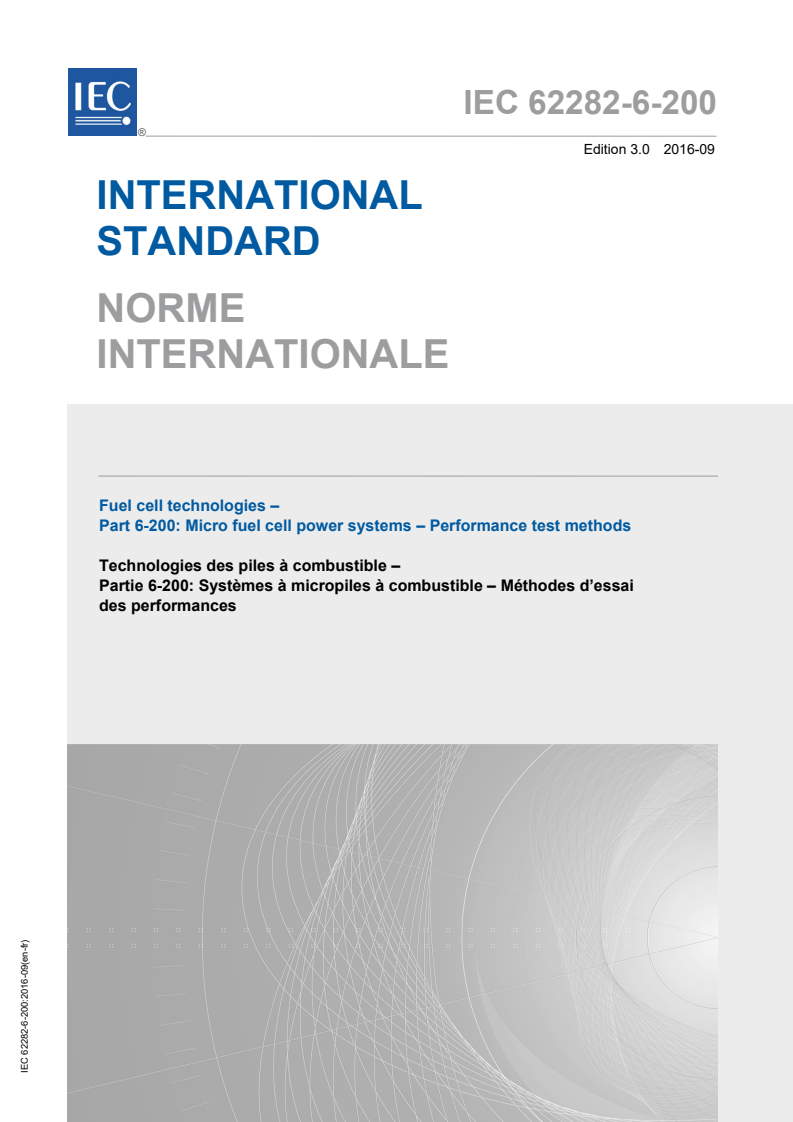
IEC 62282-6-200 ®
Edition 3.0 2016-09
INTERNATIONAL
STANDARD
NORME
INTERNATIONALE
Fuel cell technologies –
Part 6-200: Micro fuel cell power systems – Performance test methods
Technologies des piles à combustible –
Partie 6-200: Systèmes à micropiles à combustible – Méthodes d’essai
des performances
All rights reserved. Unless otherwise specified, no part of this publication may be reproduced or utilized in any form
or by any means, electronic or mechanical, including photocopying and microfilm, without permission in writing from
either IEC or IEC's member National Committee in the country of the requester. If you have any questions about IEC
copyright or have an enquiry about obtaining additional rights to this publication, please contact the address below or
your local IEC member National Committee for further information.
Droits de reproduction réservés. Sauf indication contraire, aucune partie de cette publication ne peut être reproduite
ni utilisée sous quelque forme que ce soit et par aucun procédé, électronique ou mécanique, y compris la photocopie
et les microfilms, sans l'accord écrit de l'IEC ou du Comité national de l'IEC du pays du demandeur. Si vous avez des
questions sur le copyright de l'IEC ou si vous désirez obtenir des droits supplémentaires sur cette publication, utilisez
les coordonnées ci-après ou contactez le Comité national de l'IEC de votre pays de résidence.
IEC Central Office Tel.: +41 22 919 02 11
3, rue de Varembé Fax: +41 22 919 03 00
CH-1211 Geneva 20 info@iec.ch
Switzerland www.iec.ch
About the IEC
The International Electrotechnical Commission (IEC) is the leading global organization that prepares and publishes
International Standards for all electrical, electronic and related technologies.
About IEC publications
The technical content of IEC publications is kept under constant review by the IEC. Please make sure that you have the
latest edition, a corrigenda or an amendment might have been published.
IEC Catalogue - webstore.iec.ch/catalogue Electropedia - www.electropedia.org
The stand-alone application for consulting the entire The world's leading online dictionary of electronic and
bibliographical information on IEC International Standards, electrical terms containing 20 000 terms and definitions in
Technical Specifications, Technical Reports and other English and French, with equivalent terms in 15 additional
documents. Available for PC, Mac OS, Android Tablets and languages. Also known as the International Electrotechnical
iPad. Vocabulary (IEV) online.
IEC publications search - www.iec.ch/searchpub IEC Glossary - std.iec.ch/glossary
The advanced search enables to find IEC publications by a 65 000 electrotechnical terminology entries in English and
variety of criteria (reference number, text, technical French extracted from the Terms and Definitions clause of
committee,…). It also gives information on projects, replaced IEC publications issued since 2002. Some entries have been
and withdrawn publications. collected from earlier publications of IEC TC 37, 77, 86 and
CISPR.
IEC Just Published - webstore.iec.ch/justpublished
Stay up to date on all new IEC publications. Just Published IEC Customer Service Centre - webstore.iec.ch/csc
details all new publications released. Available online and If you wish to give us your feedback on this publication or
also once a month by email. need further assistance, please contact the Customer Service
Centre: csc@iec.ch.
A propos de l'IEC
La Commission Electrotechnique Internationale (IEC) est la première organisation mondiale qui élabore et publie des
Normes internationales pour tout ce qui a trait à l'électricité, à l'électronique et aux technologies apparentées.
A propos des publications IEC
Le contenu technique des publications IEC est constamment revu. Veuillez vous assurer que vous possédez l’édition la
plus récente, un corrigendum ou amendement peut avoir été publié.
Catalogue IEC - webstore.iec.ch/catalogue Electropedia - www.electropedia.org
Application autonome pour consulter tous les renseignements
Le premier dictionnaire en ligne de termes électroniques et
bibliographiques sur les Normes internationales,
électriques. Il contient 20 000 termes et définitions en anglais
Spécifications techniques, Rapports techniques et autres
et en français, ainsi que les termes équivalents dans 15
documents de l'IEC. Disponible pour PC, Mac OS, tablettes
langues additionnelles. Egalement appelé Vocabulaire
Android et iPad.
Electrotechnique International (IEV) en ligne.
Recherche de publications IEC - www.iec.ch/searchpub
Glossaire IEC - std.iec.ch/glossary
La recherche avancée permet de trouver des publications IEC 65 000 entrées terminologiques électrotechniques, en anglais
en utilisant différents critères (numéro de référence, texte, et en français, extraites des articles Termes et Définitions des
comité d’études,…). Elle donne aussi des informations sur les publications IEC parues depuis 2002. Plus certaines entrées
projets et les publications remplacées ou retirées. antérieures extraites des publications des CE 37, 77, 86 et
CISPR de l'IEC.
IEC Just Published - webstore.iec.ch/justpublished
Service Clients - webstore.iec.ch/csc
Restez informé sur les nouvelles publications IEC. Just
Published détaille les nouvelles publications parues. Si vous désirez nous donner des commentaires sur cette
Disponible en ligne et aussi une fois par mois par email. publication ou si vous avez des questions contactez-nous:
csc@iec.ch.
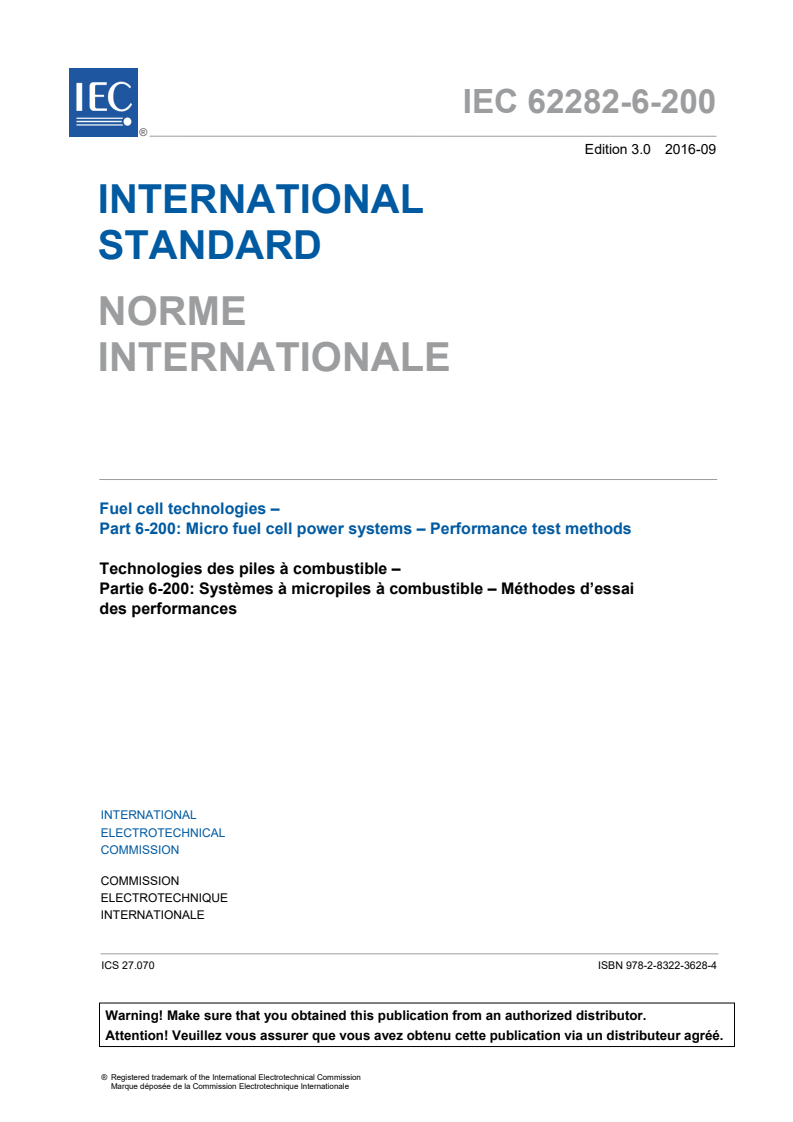
IEC 62282-6-200 ®
Edition 3.0 2016-09
INTERNATIONAL
STANDARD
NORME
INTERNATIONALE
Fuel cell technologies –
Part 6-200: Micro fuel cell power systems – Performance test methods
Technologies des piles à combustible –
Partie 6-200: Systèmes à micropiles à combustible – Méthodes d’essai
des performances
INTERNATIONAL
ELECTROTECHNICAL
COMMISSION
COMMISSION
ELECTROTECHNIQUE
INTERNATIONALE
ICS 27.070 ISBN 978-2-8322-3628-4
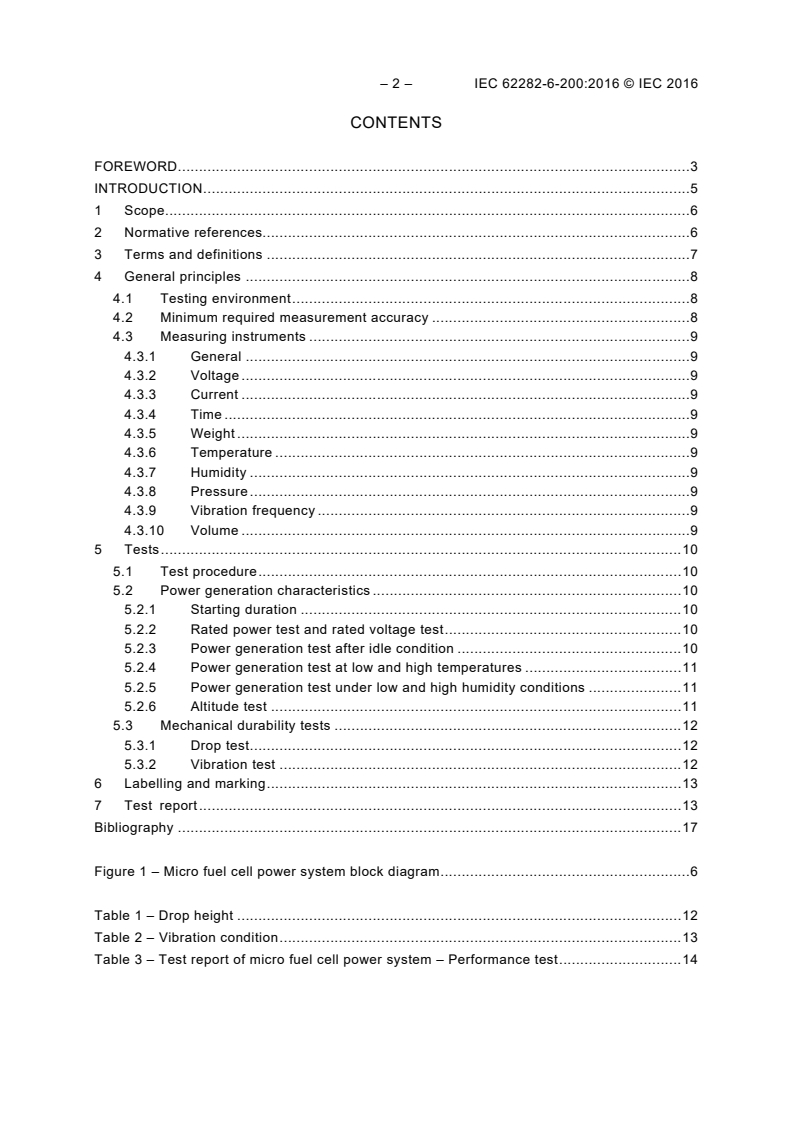
– 2 – IEC 62282-6-200:2016 © IEC 2016
CONTENTS
FOREWORD . 3
INTRODUCTION . 5
1 Scope . 6
2 Normative references. 6
3 Terms and definitions . 7
4 General principles . 8
4.1 Testing environment . 8
4.2 Minimum required measurement accuracy . 8
4.3 Measuring instruments . 9
4.3.1 General . 9
4.3.2 Voltage . 9
4.3.3 Current . 9
4.3.4 Time . 9
4.3.5 Weight . 9
4.3.6 Temperature . 9
4.3.7 Humidity . 9
4.3.8 Pressure . 9
4.3.9 Vibration frequency . 9
4.3.10 Volume . 9
5 Tests . 10
5.1 Test procedure . 10
5.2 Power generation characteristics . 10
5.2.1 Starting duration . 10
5.2.2 Rated power test and rated voltage test . 10
5.2.3 Power generation test after idle condition . 10
5.2.4 Power generation test at low and high temperatures . 11
5.2.5 Power generation test under low and high humidity conditions . 11
5.2.6 Altitude test . 11
5.3 Mechanical durability tests . 12
5.3.1 Drop test . 12
5.3.2 Vibration test . 12
6 Labelling and marking . 13
7 Test report . 13
Bibliography . 17
Figure 1 – Micro fuel cell power system block diagram . 6
Table 1 – Drop height . 12
Table 2 – Vibration condition . 13
Table 3 – Test report of micro fuel cell power system – Performance test . 14
INTERNATIONAL ELECTROTECHNICAL COMMISSION
_____________
FUEL CELL TECHNOLOGIES –
Part 6-200: Micro fuel cell power systems –
Performance test methods
FOREWORD
1) The International Electrotechnical Commission (IEC) is a worldwide organization for standardization comprising
all national electrotechnical committees (IEC National Committees). The object of IEC is to promote
international co-operation on all questions concerning standardization in the electrical and electronic fields. To
this end and in addition to other activities, IEC publishes International Standards, Technical Specifications,
Technical Reports, Publicly Available Specifications (PAS) and Guides (hereafter referred to as “IEC
Publication(s)”). Their preparation is entrusted to technical committees; any IEC National Committee interested
in the subject dealt with may participate in this preparatory work. International, governmental and non-
governmental organizations liaising with the IEC also participate in this preparation. IEC collaborates closely
with the International Organization for Standardization (ISO) in accordance with conditions determined by
agreement between the two organizations.
2) The formal decisions or agreements of IEC on technical matters express, as nearly as possible, an international
consensus of opinion on the relevant subjects since each technical committee has representation from all
interested IEC National Committees.
3) IEC Publications have the form of recommendations for international use and are accepted by IEC National
Committees in that sense. While all reasonable efforts are made to ensure that the technical content of IEC
Publications is accurate, IEC cannot be held responsible for the way in which they are used or for any
misinterpretation by any end user.
4) In order to promote international uniformity, IEC National Committees undertake to apply IEC Publications
transparently to the maximum extent possible in their national and regional publications. Any divergence
between any IEC Publication and the corresponding national or regional publication shall be clearly indicated in
the latter.
5) IEC itself does not provide any attestation of conformity. Independent certification bodies provide conformity
assessment services and, in some areas, access to IEC marks of conformity. IEC is not responsible for any
services carried out by independent certification bodies.
6) All users should ensure that they have the latest edition of this publication.
7) No liability shall attach to IEC or its directors, employees, servants or agents including individual experts and
members of its technical committees and IEC National Committees for any personal injury, property damage or
other damage of any nature whatsoever, whether direct or indirect, or for costs (including legal fees) and
expenses arising out of the publication, use of, or reliance upon, this IEC Publication or any other IEC
Publications.
8) Attention is drawn to the Normative references cited in this publication. Use of the referenced publications is
indispensable for the correct application of this publication.
9) Attention is drawn to the possibility that some of the elements of this IEC Publication may be the subject of
patent rights. IEC shall not be held responsible for identifying any or all such patent rights.
International Standard IEC 62282-6-200 has been prepared by IEC technical committee 105:
Fuel cell technologies.
This third edition cancels and replaces the second edition, published in 2012. This edition
constitutes a technical revision.
This edition includes the following significant technical changes with respect to the previous
edition:
a) deletion of 5.3 (Fuel consumption test) as it was impractical to measure the actual
consumption rate of some kinds of fuels;
b) addition and modification of some terms and definitions.
– 4 – IEC 62282-6-200:2016 © IEC 2016
The text of this standard is based on the following documents:
CDV Report on voting
105/527/CDV 105/545A/RVC
Full information on the voting for the approval of this standard can be found in the report on
voting indicated in the above table.
This publication has been drafted in accordance with the ISO/IEC Directives, Part 2.
A list of all parts in the IEC 62282 series, published under the general title Fuel cell
technologies, can be found on the IEC website.
The committee has decided that the contents of this publication will remain unchanged until
the stability date indicated on the IEC web site under "http://webstore.iec.ch" in the data
related to the specific publication. At this date, the publication will be
• reconfirmed,
• withdrawn,
• replaced by a revised edition, or
• amended.
INTRODUCTION
With advancements in technology, the expectation or demand for the commercial introduction
of fuel cells has increased dramatically in recent years. It is especially strong for micro fuel
cell power systems intended for applications in laptop computers, mobile phones, personal
digital assistants (PDAs), cordless home appliances, TV broadcast cameras, autonomous
robots, etc. The essential component of a micro fuel cell power system is its power unit. Some
micro fuel cell power systems have built-in power units and others have external power units.
– 6 – IEC 62282-6-200:2016 © IEC 2016
FUEL CELL TECHNOLOGIES –
Part 6-200: Micro fuel cell power systems –
Performance test methods
1 Scope
This part of IEC 62282 specifies test methods for the performance evaluation of micro fuel cell
power systems for laptop computers, mobile phones, personal digital assistants (PDAs),
cordless home appliances, TV broadcast cameras, autonomous robots, etc.
This document describes the performance test methods for power characteristics, and
mechanical durability for micro fuel cell power systems with output up to 60 V DC and 240 VA.
The functional arrangement of a typical example of a micro fuel cell power system, evaluated
according to this document, is shown in Figure 1.
This document does not address the safety of micro fuel cell power systems.
This document does not address the interchangeability of micro fuel cell power systems.
Water/
byproduct
Micro fuel cell power unit
Aqueous
discharge
Water/byproduct
reservoir/
Waste
management
Water
Aqueous supply reservoir
cartridge
(optional) Internal power (optional)
(optional)
needs
Fuel
(optional)
management
Fuel supply
Waste
system
Micro cartridge
Internal
Fuel fuel cell (optional)
Power
reservoir
Power
reservoir
or micro
output
(optional)
conditioning
fuel cell
module
Optional
combined
cartridge
Air Primary or
housing
management secondary
battery or
system
Thermal
capacitor
management
(optional)
Fuel
cartridge
Balance of
Waste
Control
plant
heat
Air
system
External
Micro fuelcell power system
control
IEC
Figure 1 – Micro fuel cell power system block diagram
2 Normative references
The following documents are referred to in the text in such a way that some or all of their
content constitutes requirements of this document. For dated references, only the edition
cited applies. For undated references, the latest edition of the referenced document (including
any amendments) applies.
IEC 60068-2-6, Environmental testing – Part 2-6: Tests – Test Fc: Vibration (sinusoidal)
IEC 60721-3-7, Classification of environmental conditions – Part 3-7: Classification of groups
of environmental parameters and their severities – Portable and non-stationary use
IEC TS 62282-1:2013, Fuel cell technologies – Part 1: Terminology
ISO/IEC 17025, General requirements for the competence of testing and calibration
laboratories
3 Terms and definitions
For the purposes of this document, the terms and definitions given in IEC TS 62282-1:2013
and the following apply.
ISO and IEC maintain terminological databases for use in standardization at the following
addresses:
• IEC Electropedia: available at http://www.electropedia.org/
• ISO Online browsing platform: available at http://www.iso.org/obp
NOTE Some terms have been taken from IEC TS 62282-1 and modified for the needs of this document.
3.1
conditioning
placing the micro fuel cell power system in the pre-generation state in the testing environment
for a period of time to make the system adjusted to the environment under the prescribed test
conditions, prior to a performance test
[SOURCE: IEC TS 62282-1:2013, 3.22, modified]
3.2
micro fuel cell power system
DC power source providing electric power from a fuel cell that includes a fuel cartridge,
provides not more than 60 V DC output voltage and 240 VA output power, and is connected to
a hand-held or wearable electronic device by flexible cord(s) and plug arrangement or
termination connectors integrated into the casing of the portable DC electric device
Note 1 to entry: Examples of hand-held or wearable electronic device are a laptop computer, mobile phone, PDA,
cordless home appliance, TV broadcast camera and autonomous robot.
[SOURCE: IEC TS 62282-1:2013, 3.49.1, modified]
3.3
rated current
maximum continuous electric output current that a micro fuel cell power system is designed to
achieve at the rated voltage under normal operation conditions specified by the manufacturer
[SOURCE: IEC TS 62282-1:2013, 3.25.2, modified]
3.4
rated power
maximum continuous electric output power that a micro fuel cell power system is designed to
achieve under normal operating conditions specified by the manufacturer
– 8 – IEC 62282-6-200:2016 © IEC 2016
[SOURCE: IEC TS 62282-1:2013, 3.85.4, modified]
3.5
rated voltage
voltage assigned by the manufacturer for the output of micro fuel cell power system
3.6
pre-generation state
state of a micro fuel cell power system with zero electrical output power yet capable of being
promptly switched to a state with substantial electric active output power
[SOURCE: IEC TS 62282-1:2013, 3.110.4, modified]
3.7
starting duration
period required for transitioning from the pre-generation state to reach within ±10 % the rated
voltage of the micro fuel cell power system after connection to the specified constant
resistance
4 General principles
4.1 Testing environment
Unless otherwise specified, performance shall be tested in a controlled environment as
specified in this document. The controlled ambient test conditions shall be as follows:
• temperature: 22 °C ± 5 °C;
• pressure: between 83 kPa and 106 kPa;
• humidity: 60 % ± 15 % relative humidity;
• volumetric oxygen concentration: 18 % ≤ O ≤ 21 %.
Measurement shall be conducted in a space with no substantial air movement specified by the
manufacturer. The ambient test conditions shall be kept as constant as possible during the
test. The parameters of the testing environment shall be recorded in the test report.
4.2 Minimum required measurement accuracy
The measurement parameters and minimum measurement accuracies shall be as follows:
• voltage: ±1 %;
• current: ±1 %;
• time: ±1 %;
• weight: ±1 %;
• temperature: ±2 °C;
• humidity: ±5 percentage points;
• pressure: ±5 %;
• vibration frequency: ±1 Hz (5 Hz < frequency ≤ 50 Hz) or
±2 % (frequency > 50 Hz);
• volume: ±2 %.
4.3 Measuring instruments
4.3.1 General
The measuring instruments shall be selected in accordance with the required accuracies and
the range of values to be measured. The instruments shall be calibrated regularly in order to
maintain the levels of accuracy described in 4.2. Refer to IEC/ISO 17025. Calibration
information shall be described in the test report. Voltage and current instruments shall be
capable of continuous recording for the entire duration of the measurements.
4.3.2 Voltage
The accuracy specified in 4.2 shall be maintained. Internal resistance of the voltage
measurement instruments shall be more than or equal to 1 MΩ.
4.3.3 Current
The accuracy specified in 4.2 shall be maintained.
4.3.4 Time
Time measurement instruments shall have an accuracy margin of within ±1 s/h or better in
order to maintain the measurement accuracy specified in 4.2.
4.3.5 Weight
The accuracy specified in 4.2 shall be maintained. Weight measurement shall be performed in
accordance with the national regulation for measurements, industry guidelines, or guidelines
of the relevant organization of each country.
4.3.6 Temperature
The accuracy specified in 4.2 shall be maintained. Recommended instruments for direct
measurements of ambient temperatures are as follows:
a) thermocouples with transducer; or
b) resistance thermometer with transducer.
4.3.7 Humidity
The accuracy specified in 4.2 shall be maintained for ambient humidity measurements.
4.3.8 Pressure
The accuracy specified in 4.2 shall be maintained. Pressure measurement shall be performed
in accordance with the relevant government standard, industry guidelines or guidelines of the
relevant organization of each country. If such is not available, a relevant organization shall
create a pressure measurement standard or guidelines for the performance tests.
4.3.9 Vibration frequency
The accuracy specified in 4.2 shall be maintained. For frequency measurement, refer to
IEC 60068-2-6.
4.3.10 Volume
The accuracy specified in 4.2 shall be maintained.
– 10 – IEC 62282-6-200:2016 © IEC 2016
5 Tests
5.1 Test procedure
The performance test method is based on Figure 1. The performance of the system includes
the micro fuel cell and (optional) primary battery or rechargeable battery or capacitor as one
system.
Each test shall be carried out on three samples. Conditioning of samples shall be conducted
for a minimum of 2 h prior to the test measurement in order to adjust the samples to the
testing environment. The test shall be started immediately following conditioning. Unless
otherwise indicated, a voltmeter and a load specified by the manufacturer shall be connected
so as to operate the micro fuel cell power system at the rated power or with the rated current,
and measurements shall be taken for a duration sufficient to be representative of the micro
fuel cell power system actual operation. The data shall be recorded at a sampling frequency
specified by the manufacturer for the entire duration of the measurement. The measured
values reported shall be the mean value of the three measured values obtained by averaging
the recorded data sample.
Unless otherwise indicated, the data may be recorded at a sampling rate of once every five
seconds or longer for the entire duration of the test. The measured value reported for each
sample may be the average of all data recorded during the test. The standard deviation and
recorded maximum and minimum values may be recorded.
The tests may be executed in series, using one sample group, or in parallel using different
sample groups. Electrical measurements shall be taken at the power interface.
The test report should specify the lot number and serial numbers of the test samples to
indicate that the results are representative only of that specific small set of samples.
5.2 Power generation characteristics
5.2.1 Starting duration
a) The purpose of this test is to verify the starting duration of micro fuel cell power systems.
b) After conditioning in accordance with 5.1, the time to reach the lower limit of the rated
voltage range defined by the manufacturer shall be measured from the time when the
power interface circuit is electrically connected to the constant resistance load specified
by the manufacturer. The values of the constant resistance load and the starting duration
shall be recorded in the test report.
5.2.2 Rated power test and rated voltage test
a) The purpose of this test is to verify the rated power and the rated voltage of micro fuel cell
power systems. The performance of the system includes the micro fuel cell and (optional)
primary battery of capacitor as one system.
b) Rechargeable batteries or capacitors (optional) shall be in the fully charged state at the
beginning of the test. The test shall be started with the sample with a full internal reservoir
or fuel cartridge. If the system cannot deliver the rated power, the test shall be terminated.
The test shall run for two hours or until there is insufficient fuel to operate the fuel cell,
whichever comes first.
c) The output voltage shall be monitored to see whether it is within the upper and lower limits
of the rated voltage range specified by the manufacturer. The rated voltage range
specified by the manufacturer shall be indicated in the test report. The load connected and
the duration of measurement shall be recorded in the test report.
5.2.3 Power generation test after idle condition
a) The purpose of this test is to verify the performance of micro fuel cell power systems after
a period of idle condition.
b) Rechargeable batteries or capacitors (optional) should be in the fully charged state at the
beginning of the test. Samples shall be conditioned in the idle condition by subjecting
them to a period of pre-generation state, during which they are operated at the rated
power specified by the manufacturer, followed by a period of idle condition. The minimum
duration of pre-use shall be 1 h and the duration of idle condition shall be 24 h. The
internal reservoir or the fuel cartridge shall be full at the beginning of the test. The output
voltage and current or related power after idle condition shall be measured and recorded
in accordance with 5.1. The load connected at the measurement and the duration of
measurement which will be taken after the system operated for two hours shall be
recorded in the test report.
The measured value reported for each sample may be the average of all data recorded
during the test.
5.2.4 Power generation test at low and high temperatures
a) The purpose of this test is to verify the performance of micro fuel cell power systems at
low and high temperatures.
b) Rechargeable batteries or capacitors (optional) shall be in the fully charged state at the
beginning of the test. The test shall start with the sample with its internal reservoir filled
or a full fuel cartridge. The samples shall be conditioned in the idle condition at the test
temperature for a minimum of two hours prior to the measurement. A voltmeter and a
constant power load shall be connected so as to draw the rated power (watts) specified by
the manufacturer, and the output voltage and power or current shall be measured
according to 5.1 at the manufacture specified minimum operating temperature and
manufacture specified maximum operating temperature. The test temperatures shall be
recorded in the test report. The samples shall be operated at the test temperature for two
hours or until there is insufficient fuel to operate the fuel cell, whichever comes first.
During the measurement, the micro fuel cell or micro fuel cell module in the micro fuel cell
power unit must be generating power by consuming the fuel.
5.2.5 Power generation test under low and high humidity conditions
a) The purpose of this test is to verify the performance of micro fuel cell power systems
under low and high humidity conditions.
b) The test humidity shall be specified by the manufacturer at a humidity level lower than
20 % relative humidity and at a humidity level higher than 80 % relative humidity.
Rechargeable batteries or capacitors (optional) shall be in the fully charged state at the
beginning of the test. The test shall start with the sample with its internal reservoir filled or
a full fuel cartridge. The samples shall be conditioned in the idle condition at the test
humidity for a minimum of two hours prior to the measurement. A voltmeter and a constant
power load shall be connected so as to draw the rated power (watts) specified by the
manufacturer, and the output voltage and current or power shall be measured at a
humidity level lower than 20 % relative humidity (RH) and at a humidity level higher than
80 % RH. The test humidity levels shall be specified by the manufacturer and recorded in
the test report. The samples shall be operated at the test humidity for a minimum of two
hours or until fuel runs out, and data shall be recorded in accordance with the procedures
of 5.1. During the measurement, the micro fuel cell or micro fuel cell module in the micro
fuel cell power unit must be generating power by consuming the fuel.
5.2.6 Altitude test
a) The purpose of this test is to verify the performance of micro fuel cell power systems
under reduced atmospheric pressure.
b) The test pressure shall be 68 kPa or 10 kPa less, but as close to 68 kPa as possible.
Rechargeable batteries or capacitors should be in the fully charged state at the beginning
of the test. Samples shall be conditioned in the idle condition at the test pressure for a
minimum of two hours prior to the measurement. A voltmeter and a constant power load
shall be connected so as to draw the rated power (watts) specified by the manufacturer,
and the output voltage shall be measured under a pressure of 68 kPa. Test pressure
−10
shall be recorded in the test report. The samples shall be operated at the test pressure for
a minimum of two hours, and data shall be recorded in accordance with the procedures of
– 12 – IEC 62282-6-200:2016 © IEC 2016
5.1. During the measurement, the micro fuel cell or micro fuel cell module in the micro fuel
cell power unit must be generating power by consuming the fuel.
NOTE 68 kPa is the minimum standard pressure in an aircraft cabin.
5.3 Mechanical durability tests
5.3.1 Drop test
a) The purpose of this test is to evaluate how the performance of micro fuel cell power
systems is affected by the impact of a drop.
b) Internal reservoir or the fuel cartridge shall be full” prior to the drop. The test sample shall
be dropped onto a horizontal surface that consists of hardwood at least 13 mm thick,
mounted on two layers of plywood, each with a thickness of 18 mm to 20 mm, all
supported on a concrete or equivalent non-resilient floor from a predetermined height. The
height of the drop shall be determined as shown in Table 1 (in compliance with
IEC 60721-3-7). The micro fuel cell power system shall be held in its intended operating
position and oriented parallel to the surface of the floor when being dropped.
Table 1 – Drop height
Class
Sample a b c
7M1 7M2 7M3
m m m
0,025 0,25 1,0
Mass < 1 kg
1 kg ≤ mass < 10 kg 0,025 0,1 0,5
10 kg ≤ mass < 50 kg 0,025 0,05 0,25
a
Class 7M1 applies to use at, and direct transfer between locations with only low level vibrations, or with
medium level shocks. The handling and transfer of products is done with care.
b
In addition to the conditions covered by class 7M1, class 7M2 applies to use at, and direct transfer
between locations with high level shocks. The handling and transfer of products is done with less care.
c
In addition to the conditions covered by class 7M2, class 7M3 applies to use at, and direct transfer
between locations with significant vibrations, or with high level shocks. The handling and transfer of
products is rough.
c) After the drop procedure, a voltmeter and a constant power load shall be connected so as
to draw the rated power (watts) specified by the manufacturer, and the output voltage shall
be measured. The sample shall be operated for a minimum of two hours. The voltage shall
be measured in accordance with 5.1. During the measurement, the micro fuel cell or micro
fuel cell module in the micro fuel cell power unit must be generating power by consuming
the fuel. The measurement shall start with the sample with its internal reservoir filled or a
full fuel cartridge. The height of the drop test, the load connected and the duration of
measurement shall be recorded in the test report.
5.3.2 Vibration test
a) Internal reservoir or the fuel cartridge shall be full prior to the vibration. The purpose of
this test is to evaluate how the performance of micro fuel cell power systems is affected by
vibration.
b) A micro fuel cell power system shall be mounted on a shake table in its intended operating
position. Sine-wave form vibration shall be applied with a logarithmic sweep from 2 Hz to
200 Hz and back to 2 Hz in 15 min. Repeat this cycle 12 times. The vibration direction
shall be perpendicular to the fixed horizontal plane of the micro fuel cell power system.
The vibration condition shall be determined as shown in Table 2 (in compliance with
IEC 60721-3-7).
Table 2 – Vibration condition
Class
Sample
a b c
7M1 7M2 7M3
Displacement amplitude 3,5 mm 3,5 mm 7,5 mm
2 2 2
Acceleration amplitude 10 m/s 10 m/s 20 m/s
Frequency range 2 Hz to 9 Hz; 2 Hz to 9 Hz; 2 Hz to 8 Hz;
9 Hz to 200 Hz 9 Hz to 200 Hz 8 Hz to 200 Hz
a
Class 7M1 applies to use at, and direct transfer between, locations with only low level vibrations or with
medium level shocks. The handling and transfer of products is done with care.
b
In addition to the conditions covered by class 7M1, class 7M2 applies to use at, and direct transfer between,
locations with high level shocks. The handling and transfer of products is done with less care.
c
In addition to the conditions covered by class 7M2, class 7M3 applies to use at, and direct transfer between,
locations with significant vibrations, or with high level shocks. The handling and transfer of products is rough.
c) After the vibration procedure, a voltmeter and a constant power load shall be connected
so as to draw the rated power (watts) specified by the manufacturer, and the output
voltage shall be measured. The sample shall be operated for a minimum of two hours. The
voltage shall be measured in accordance with 5.1, and the average reading may be
recorded with standard deviation, maximum, and minimum readings. During the
measurement, the micro fuel cell or micro fuel cell module in the micro fuel cell power unit
must be generating power by consuming the fuel. The measurement shall start with the
sample with its internal reservoir filled or a full fuel cartridge. The vibration conditions of
the test, the load connected and the duration of measurement shall be recorded in the test
report.
6 Labelling and marking
As a self-declaration, the manufacturer shall clearly label its micro fuel cell power system to
indicate conformance with this document. The label shall include the following information and
be marked as per the manufacturer’s specification:
• name of manufacturer;
• year and month of manufacture;
• reference standard number (IEC 62282-6-200);
• rated voltage and rated power.
7 Test report
Manufacturers of micro fuel cell power systems shall use this document in order to evaluate
the performance of their products for commercial purposes. The format of test reports shall be
as given in Table 3.
– 14 – IEC 62282-6-200:2016 © IEC 2016
Table 3 – Test report of micro fuel cell power system – Performance test (1 of 3)
Name of manufacturer and type of micro fuel cell power system:
Year and month of manufacture: Month Year
Reference standard number: IEC 62282-6-200
Rated voltage range and rated power range:
Rated voltage: V ± V Rated power: W ± W
Existence of primary battery, rechargeable battery or capacitor □ Yes □ No
Report for calibration information described in 4.3:
4.1 Testing environment Temperature °C Pressure kPa
Relative humidity % Oxygen concentration %
5.2.1 Starting duration [Test condition]
Constant resistance connected at the measurement: Ω
[Test result]
Hour(s) Minute(s) Second(s)
□ The starting duration is shorter than 100 ms.
□ The output voltage remains within ±10 % of the rated
voltage when connected to the constant resistance in
accordance with 5.2.1.
5.2.2 Rated power test and rated voltage [Test conditions]
test
Load connected at the measurement: Ω, A or W
Duration of measurement: hour(s)
[Test result]
□ The rated power was delivered by the micro fuel cell power
system.
□ The measured output voltage remained within the specified
limits of the rated voltage.
□ The system cannot deliver the rated power.
5.2.3 Power generation test after idle [Test conditions]
condition
Duration of pre-use: hour(s) (more than 1 h)
Period of idle condition: 24 h
Load connected at the measurement: Ω, A or W
Duration of measurement: 1 h [Test result]
Measured voltage: V
or Measured power W
Table 3 (2 of 3)
5.2.4 Power generation test at low and (1) Power generation test at low temperature
high temperatures
[Test conditions]
Temperature (low): °C
Load connected at the measurement: Ω, A or W
Duration of measurement: hour(s)
[Test result]
Measured voltage: V
(2) Power generation test at high temperature
[Test conditions]
Temperature (high): °C
Load connected at the measurement: Ω, A or W
Duration of measurement: hour(s)
[Test result]
Measured voltage: V
Measured current A
or Measured power W
5.2.5 Power generation test under low and (1) Power generation test under low humidity condition
high humidity conditions
[Test conditions]
Relative humidity (low): %
Load connected at the measurement: Ω, A or W
Duration of measurement: hour(s)
[Test result]
Measured voltage: V
(2) Power generation test under high humidity condition
[Test conditions]
Relative humidity (high): %
Load connected at the measurement: Ω, A or W
Duration of measurement: hour(s)
[Test result]
Measured voltage: V
5.2.6 Altitude test [Test conditions]
Pressure: kPa
Load connected at the measurement: Ω, A or W
Duration of measurement: hour(s)
[Test result]
Measured voltage: V Output power W
– 16 – IEC 62282-6-200:2016 © IEC 2016
Table 3 (3 of 3)
5.3.1 Drop test [Test conditions]
Height of the drop test: m
Load connected at the measurement: Ω, A or W
Duration of measurement: hour(s)
[Test result]
Measured voltage: V Output power W
5.3.2 Vibration test [Test conditions]
Vibration frequency: 7 Hz to 200 Hz
Other conditions, if necessary:
Load connected at the measurement: Ω, A or W
Duration of measurement: hour(s)
[Test result]
Measured voltage: V Output power W
In the table, the symbol '□' indicates that it should be checked in accordance with the following:
5.2.1 □ The starting duration is shorter than 100 ms: Check the box, if this is the case.
5.2.1 □ The output voltage remains within ±10 % of the rated voltage when connected to the constant
resistance in accordance with 5.2.1: Check the box if this is the case.
5.2.2 □ The rated power was delivered by the micro fuel cell power system: Check the box, if it is the case.
5.2.2 □ The measured output voltage remained within the specified limits of the rated voltage: In accordance
with 5.2.2 b) and 5.2.2 c), the output voltage shall be measured continuously. Check the box, if it was
confirmed that the output voltage remained within the upper and lower limits of the rated voltage
range specified by the manufacturer.
Bibliography
ISO 4677-1, Atmospheres for conditioning and testing – Determination of relative humidity –
Part 1: Aspirated psychrometer method
ISO 4677-2, Atmospheres for conditioning and testing – Determination of relative humidity –
Part 2: Whirling psychrometer method
_____________
___________
Withdrawn.
Withdrawn.
– 18 – IEC 62282-6-200:2016 © IEC 2016
SOMMAIRE
AVANT-PROPOS . 19
INTRODUCTION . 21
1 Domaine d’application. 22
2 Références normatives . 23
3 Termes et définitions .
...