

IEC 61921:2017
(Main)Power capacitors - Low-voltage power factor correction banks
General Information
- Abstract
IEC 61921:2017 is applicable to low-voltage AC shunt capacitor banks intended to be used for power factor correction purposes, possibly equipped with a built-in switchgear and controlgear apparatus capable of connecting to or disconnecting from the mains part(s) of the bank with the aim to correct its power factor. Low-voltage power factor correction banks if not otherwise indicated hereinafter and where applicable comply with the requirements of IEC 61439-1 and IEC 61439-2. This second edition cancels and replaces the first edition published in 2003. It constitutes a technical revision. This edition includes the following significant technical changes with respect to the previous edition: numerous changes regarding verification methods to align with IEC 61439-1; modification of marking; add routine verification of rated output; new Annex D with guidance on methods for temperature rise verification; update of normative references; general editorial review.
Keywords: low-voltage AC shunt capacitor banks
- Status
- Published
- Publication Date
- 19-Jun-2017
- Technical Committee
- TC 33 - Power capacitors and their applications
- Current Stage
- PPUB - Publication issued
- Start Date
- 20-Jun-2017
- Completion Date
- 30-Jun-2017
Buy Documents
IEC 61921:2017 RLV - Power capacitors - Low-voltage power factor correction banks Released:6/20/2017
IEC 61921:2017 - Power capacitors - Low-voltage power factor correction banks Released:6/20/2017
Overview
IEC 61921:2017 - "Power capacitors - Low-voltage power factor correction banks" is the International Electrotechnical Commission standard that defines requirements, tests and guidance for low-voltage AC shunt capacitor banks used for power factor correction. This second edition (2017) supersedes the 2003 edition and introduces a technical revision that aligns verification methods with IEC 61439-1, updates marking and routine tests (including routine verification of rated output), and adds Annex D with guidance on temperature-rise verification.
Key Topics
- Scope and applicability: Requirements for low-voltage AC shunt capacitor banks intended for power factor correction, including assemblies with built‑in switchgear and controlgear.
- Design and installation guidance: Recommendation on rated voltage selection, switching and overload protection, electrical environment and secondary effects of capacitor banks.
- Safety measures: Discharging devices and procedures after disconnection, fire-hazard considerations, protection against human and property damage, and busbar/connection rules.
- Verification and testing:
- Design verification: Dielectric properties, temperature-rise limits, short-circuit withstand strength, mechanical operation, EMC and component incorporation.
- Routine tests: Degree of protection of enclosures, clearances and creepage, dielectric tests, mechanical operation and verification of rated output.
- New Annex D: Guidance on methods for temperature-rise verification when adding capacitors for test purposes.
- Electromagnetic compatibility (EMC): Emission and immunity requirements plus considerations for assemblies that incorporate electronic equipment.
- Marking and documentation: Updated marking requirements and normative references to ensure traceability and safe installation.
- Informative annexes: Practical formulae, typical assembly examples and conductor sizing guidance.
Applications
IEC 61921:2017 is directly applicable to:
- Industrial and commercial power factor correction (PFC) systems
- Distribution boards and low-voltage reactive compensation plants
- Retrofit and new-build electrical installations where capacitor banks are integrated with switchgear/controlgear
- Situations requiring formal type and routine testing of capacitor bank assemblies
Using the standard helps ensure safe operation, predictable temperature behavior, proper protection against overvoltages/overloads, and compliance with recognized verification methods.
Who should use this standard
- Manufacturer and designer of capacitor banks and PFC equipment
- Electrical engineers specifying reactive compensation systems
- Panel builders and switchgear integrators
- Testing laboratories and conformity assessment bodies
- Consultants, installers and utilities responsible for safe, compliant low-voltage installations
Related standards
IEC 61921:2017 references and is intended to be used alongside IEC 61439-1 and IEC 61439-2 (requirements for low-voltage switchgear and controlgear assemblies) and relevant capacitor standards such as IEC 60831 / IEC 60931.
Relations
- Effective Date
- 05-Sep-2023
Buy Documents
IEC 61921:2017 RLV - Power capacitors - Low-voltage power factor correction banks Released:6/20/2017
IEC 61921:2017 - Power capacitors - Low-voltage power factor correction banks Released:6/20/2017
Frequently Asked Questions
IEC 61921:2017 is a standard published by the International Electrotechnical Commission (IEC). Its full title is "Power capacitors - Low-voltage power factor correction banks". This standard covers: IEC 61921:2017 is applicable to low-voltage AC shunt capacitor banks intended to be used for power factor correction purposes, possibly equipped with a built-in switchgear and controlgear apparatus capable of connecting to or disconnecting from the mains part(s) of the bank with the aim to correct its power factor. Low-voltage power factor correction banks if not otherwise indicated hereinafter and where applicable comply with the requirements of IEC 61439-1 and IEC 61439-2. This second edition cancels and replaces the first edition published in 2003. It constitutes a technical revision. This edition includes the following significant technical changes with respect to the previous edition: numerous changes regarding verification methods to align with IEC 61439-1; modification of marking; add routine verification of rated output; new Annex D with guidance on methods for temperature rise verification; update of normative references; general editorial review. Keywords: low-voltage AC shunt capacitor banks
IEC 61921:2017 is applicable to low-voltage AC shunt capacitor banks intended to be used for power factor correction purposes, possibly equipped with a built-in switchgear and controlgear apparatus capable of connecting to or disconnecting from the mains part(s) of the bank with the aim to correct its power factor. Low-voltage power factor correction banks if not otherwise indicated hereinafter and where applicable comply with the requirements of IEC 61439-1 and IEC 61439-2. This second edition cancels and replaces the first edition published in 2003. It constitutes a technical revision. This edition includes the following significant technical changes with respect to the previous edition: numerous changes regarding verification methods to align with IEC 61439-1; modification of marking; add routine verification of rated output; new Annex D with guidance on methods for temperature rise verification; update of normative references; general editorial review. Keywords: low-voltage AC shunt capacitor banks
IEC 61921:2017 is classified under the following ICS (International Classification for Standards) categories: 31.060.70 - Power capacitors. The ICS classification helps identify the subject area and facilitates finding related standards.
IEC 61921:2017 has the following relationships with other standards: It is inter standard links to IEC 61921:2003. Understanding these relationships helps ensure you are using the most current and applicable version of the standard.
IEC 61921:2017 is available in PDF format for immediate download after purchase. The document can be added to your cart and obtained through the secure checkout process. Digital delivery ensures instant access to the complete standard document.
Standards Content (Sample)
IEC 61921 ®
Edition 2.0 2017-06
REDLINE VERSION
INTERNATIONAL
STANDARD
colour
inside
Power capacitors – Low-voltage power factor correction banks
All rights reserved. Unless otherwise specified, no part of this publication may be reproduced or utilized in any form
or by any means, electronic or mechanical, including photocopying and microfilm, without permission in writing from
either IEC or IEC's member National Committee in the country of the requester. If you have any questions about IEC
copyright or have an enquiry about obtaining additional rights to this publication, please contact the address below or
your local IEC member National Committee for further information.
IEC Central Office Tel.: +41 22 919 02 11
3, rue de Varembé Fax: +41 22 919 03 00
CH-1211 Geneva 20 info@iec.ch
Switzerland www.iec.ch
About the IEC
The International Electrotechnical Commission (IEC) is the leading global organization that prepares and publishes
International Standards for all electrical, electronic and related technologies.
About IEC publications
The technical content of IEC publications is kept under constant review by the IEC. Please make sure that you have the
latest edition, a corrigenda or an amendment might have been published.
IEC Catalogue - webstore.iec.ch/catalogue Electropedia - www.electropedia.org
The stand-alone application for consulting the entire The world's leading online dictionary of electronic and
bibliographical information on IEC International Standards, electrical terms containing 20 000 terms and definitions in
Technical Specifications, Technical Reports and other English and French, with equivalent terms in 16 additional
documents. Available for PC, Mac OS, Android Tablets and languages. Also known as the International Electrotechnical
iPad. Vocabulary (IEV) online.
IEC publications search - www.iec.ch/searchpub IEC Glossary - std.iec.ch/glossary
The advanced search enables to find IEC publications by a 65 000 electrotechnical terminology entries in English and
variety of criteria (reference number, text, technical French extracted from the Terms and Definitions clause of
committee,…). It also gives information on projects, replaced IEC publications issued since 2002. Some entries have been
and withdrawn publications. collected from earlier publications of IEC TC 37, 77, 86 and
CISPR.
IEC Just Published - webstore.iec.ch/justpublished
Stay up to date on all new IEC publications. Just Published IEC Customer Service Centre - webstore.iec.ch/csc
details all new publications released. Available online and If you wish to give us your feedback on this publication or
also once a month by email. need further assistance, please contact the Customer Service
Centre: csc@iec.ch.
IEC 61921 ®
Edition 2.0 2017-06
REDLINE VERSION
INTERNATIONAL
STANDARD
colour
inside
Power capacitors – Low-voltage power factor correction banks
INTERNATIONAL
ELECTROTECHNICAL
COMMISSION
ICS 31.060.70 ISBN 978-2-8322-4505-7
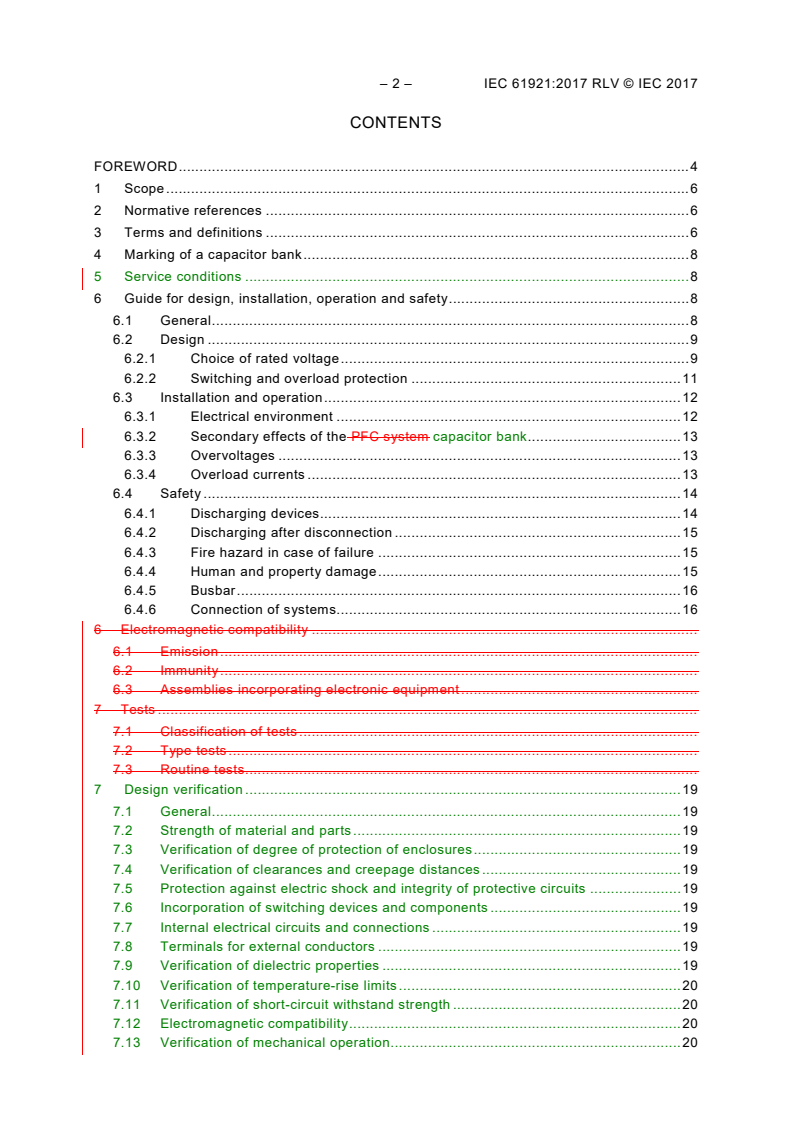
– 2 – IEC 61921:2017 RLV © IEC 2017
CONTENTS
FOREWORD . 4
1 Scope . 6
2 Normative references . 6
3 Terms and definitions . 6
4 Marking of a capacitor bank . 8
5 Service conditions . 8
6 Guide for design, installation, operation and safety . 8
6.1 General . 8
6.2 Design . 9
6.2.1 Choice of rated voltage . 9
6.2.2 Switching and overload protection . 11
6.3 Installation and operation . 12
6.3.1 Electrical environment . 12
6.3.2 Secondary effects of the PFC system capacitor bank . 13
6.3.3 Overvoltages . 13
6.3.4 Overload currents . 13
6.4 Safety . 14
6.4.1 Discharging devices. 14
6.4.2 Discharging after disconnection . 15
6.4.3 Fire hazard in case of failure . 15
6.4.4 Human and property damage . 15
6.4.5 Busbar . 16
6.4.6 Connection of systems. 16
6 Electromagnetic compatibility .
6.1 Emission .
6.2 Immunity .
6.3 Assemblies incorporating electronic equipment .
7 Tests .
7.1 Classification of tests .
7.2 Type tests .
7.3 Routine tests.
7 Design verification . 19
7.1 General . 19
7.2 Strength of material and parts . 19
7.3 Verification of degree of protection of enclosures . 19
7.4 Verification of clearances and creepage distances . 19
7.5 Protection against electric shock and integrity of protective circuits . 19
7.6 Incorporation of switching devices and components . 19
7.7 Internal electrical circuits and connections . 19
7.8 Terminals for external conductors . 19
7.9 Verification of dielectric properties . 19
7.10 Verification of temperature-rise limits . 20
7.11 Verification of short-circuit withstand strength . 20
7.12 Electromagnetic compatibility . 20
7.13 Verification of mechanical operation. 20
8 Routine verification . 20
8.1 General . 20
8.2 Degree of protection of enclosures. 20
8.3 Clearances and creepage distances . 21
8.4 Protection against electric shock and integrity of protective circuits . 21
8.5 Incorporation of built-in components . 21
8.6 Internal electrical circuits and connections . 21
8.7 Terminals for external conductors . 21
8.8 Mechanical operation . 21
8.9 Dielectric properties . 21
8.10 Wiring, operational performance and function, including verification of rated
output . 21
Annex A (normative) Minimum and maximum cross-sections of copper conductors
suitable for connections . 23
Annex B (normative) Method of calculating the cross-sectional area of protective
conductors with regard to thermal stresses due to currents of short-duration .
Annex B (informative) Formulae for capacitors and installations . 26
B.1 Computation of the output of three-phase capacitors from three single-phase
capacitance measurements . 26
B.2 Resonance frequency . 26
B.3 Voltage rise . 26
B.4 Inrush transient current . 27
B.4.1 Switching in of a single capacitor . 27
B.4.2 Switching of capacitors in parallel with energized capacitor(s) . 27
B.4.3 Discharge resistance in single-phase units or in one-phase or
polyphase units . 27
Annex C (informative) Typical examples of assemblies .
Annex C (informative) Definition of similar designs for capacitor bank . 28
Annex D (informative) Methods for connecting additional capacitors for performing
temperature rise test . 29
Bibliography . 30
Figure D.1 – Configurations for temperature rise test . 29
– 4 – IEC 61921:2017 RLV © IEC 2017
INTERNATIONAL ELECTROTECHNICAL COMMISSION
____________
POWER CAPACITORS –
LOW-VOLTAGE POWER FACTOR CORRECTION BANKS
FOREWORD
1) The International Electrotechnical Commission (IEC) is a worldwide organization for standardization comprising
all national electrotechnical committees (IEC National Committees). The object of IEC is to promote
international co-operation on all questions concerning standardization in the electrical and electronic fields. To
this end and in addition to other activities, IEC publishes International Standards, Technical Specifications,
Technical Reports, Publicly Available Specifications (PAS) and Guides (hereafter referred to as “IEC
Publication(s)”). Their preparation is entrusted to technical committees; any IEC National Committee interested
in the subject dealt with may participate in this preparatory work. International, governmental and non-
governmental organizations liaising with the IEC also participate in this preparation. IEC collaborates closely
with the International Organization for Standardization (ISO) in accordance with conditions determined by
agreement between the two organizations.
2) The formal decisions or agreements of IEC on technical matters express, as nearly as possible, an international
consensus of opinion on the relevant subjects since each technical committee has representation from all
interested IEC National Committees.
3) IEC Publications have the form of recommendations for international use and are accepted by IEC National
Committees in that sense. While all reasonable efforts are made to ensure that the technical content of IEC
Publications is accurate, IEC cannot be held responsible for the way in which they are used or for any
misinterpretation by any end user.
4) In order to promote international uniformity, IEC National Committees undertake to apply IEC Publications
transparently to the maximum extent possible in their national and regional publications. Any divergence
between any IEC Publication and the corresponding national or regional publication shall be clearly indicated in
the latter.
5) IEC itself does not provide any attestation of conformity. Independent certification bodies provide conformity
assessment services and, in some areas, access to IEC marks of conformity. IEC is not responsible for any
services carried out by independent certification bodies.
6) All users should ensure that they have the latest edition of this publication.
7) No liability shall attach to IEC or its directors, employees, servants or agents including individual experts and
members of its technical committees and IEC National Committees for any personal injury, property damage or
other damage of any nature whatsoever, whether direct or indirect, or for costs (including legal fees) and
expenses arising out of the publication, use of, or reliance upon, this IEC Publication or any other IEC
Publications.
8) Attention is drawn to the Normative references cited in this publication. Use of the referenced publications is
indispensable for the correct application of this publication.
9) Attention is drawn to the possibility that some of the elements of this IEC Publication may be the subject of
patent rights. IEC shall not be held responsible for identifying any or all such patent rights.
This redline version of the official IEC Standard allows the user to identify the changes
made to the previous edition. A vertical bar appears in the margin wherever a change
has been made. Additions are in green text, deletions are in strikethrough red text.
International Standard IEC 61921 has been prepared by IEC technical committee 33: Power
capacitors and their applications.
This second edition cancels and replaces the first edition published in 2003. It constitutes a
technical revision.
This edition includes the following significant technical changes with respect to the previous
edition:
• numerous changes regarding verification methods to align with IEC 61439-1;
• modification of marking;
• add routine verification of rated output;
• new Annex D with guidance on methods for temperature rise verification;
• update of normative references;
• general editorial review.
The text of this International Standard is based on the following documents:
FDIS Report on voting
33/607/FDIS 33/611/RVD
Full information on the voting for the approval of this International Standard can be found in
the report on voting indicated in the above table.
This document has been drafted in accordance with the ISO/IEC Directives, Part 2.
The committee has decided that the contents of this document will remain unchanged until the
stability date indicated on the IEC website under "http://webstore.iec.ch" in the data related to
the specific document. At this date, the document will be
• reconfirmed,
• withdrawn,
• replaced by a revised edition, or
• amended.
IMPORTANT – The “colour inside” logo on the cover page of this publication indicates
that it contains colours which are considered to be useful for the correct understanding
of its contents. Users should therefore print this publication using a colour printer.
– 6 – IEC 61921:2017 RLV © IEC 2017
POWER CAPACITORS –
LOW-VOLTAGE POWER FACTOR CORRECTION BANKS
1 Scope
This International Standard is applicable to low-voltage AC shunt capacitor banks intended to
be used for power factor correction purposes, possibly equipped with a built-in switchgear and
controlgear apparatus capable of connecting to or disconnecting from the mains part(s) of the
bank with the aim to correct its power factor.
Low-voltage power factor correction banks if not otherwise indicated hereinafter and where
applicable shall comply with the requirements of IEC 60439-1 and those of IEC 60439-3
IEC 61439-1 and IEC 61439-2.
2 Normative references
The following documents are referred to in the text in such a way that some or all of their
content constitutes requirements of this document. For dated references, only the edition
cited applies. For undated references, the latest edition of the referenced document (including
any amendments) applies.
IEC 60439-1:1999, Low-voltage switchgear and controlgear assemblies – Part 1: Type-tested
and partially type-tested assemblies
IEC 60439-3:1990, Low-voltage switchgear and controlgear assemblies – Part 3: Particular
requirements for low-voltage switchgear and controlgear assemblies intended to be installed
in places where unskilled persons have access for their use – Distribution boards
IEC 60831-1:1996 2014, Shunt power capacitors of the self-healing type for AC systems
having a rated voltage up to and including 1 000 V – Part 1: General – Performance, testing
and rating – Safety requirements – Guide for installation and operation
IEC 60931-1:1996, Shunt power capacitors of the non-self-healing type for AC systems
having a rated voltage up to and including 1000 V – Part 1: General – Performance, testing
and rating – Safety requirements – Guide for installation and operation
IEC 61439-1:2011, Low-voltage switchgear and controlgear assemblies – Part 1: General
rules
IEC 61439-2:2011, Low-voltage switchgear and controlgear assemblies – Part 2: Power
switchgear and controlgear assemblies
IEC 61642:1997, Industrial AC networks affected by harmonics – Application of filters and
shunt capacitors
3 Terms and definitions
For the purposes of this document, the terms and definitions given in IEC 60439-1,
IEC 61439-1, IEC 61439-2, IEC 60831-1 and IEC 60931-1 and the following apply.
ISO and IEC maintain terminological databases for use in standardization at the following
addresses:
• IEC Electropedia: available at http://www.electropedia.org/
• ISO Online browsing platform: available at http://www.iso.org/obp
3.1
Low-voltage AC capacitor bank or power factor correction bank
Combination of one or more low-voltage capacitor units together with associated switching
devices and control, measuring, signalling, protective, regulating equipment, etc., completely
assembled under the responsibility of the assembly manufacturer with all the internal
electrical and mechanical interconnections and structural parts
Note 1 to entry: Throughout this standard, the abbreviations “automatic bank” and “assembly” are used for a low-
voltage a.c capacitors automatic or non-automatic bank.
Note 1 to entry: The capacitor bank can be fixed, manually switched or automatically controlled through the use of
a power factor controller.
Note 2 to entry: The components of switchgear and controlgear of the automatic bank may be electromechanical
or electronic.
3.2
step of capacitor bank
step
combination of one or more capacitor units switched together through a single switch with
possible detuned reactors, connecting wires, and associated switchgear and controlgear
apparatus
3.3
automatic reactive power regulator
controller
circuit device designed to calculate the reactive power absorbed by the load connected to the
power line and to control the switching on and off of the steps of the automatic bank, in order
to compensate for the reactive power
Note 1 to entry: The reactive power is normally calculated at the fundamental frequency.
Note 2 to entry: The controller may be “built-in” or “free-standing” and has usually to be adjusted for each bank
before operation.
Note 3 to entry: The controller generally performs functions of measurement / monitoring of power, controlling (of
capacitor steps) and protection (of capacitor bank).
3.4
transient inrush current I
t
transient overcurrent of high amplitude and frequency that may occur when a capacitor is
switched on, the amplitude and frequency being determined by factors such as the short-
circuit impedance of the supply, the amount of energized capacitance switched in parallel and
the instant of the switching
3.5
rated reactive power Q (of an assembly a capacitor bank)
N
total reactive power of an assembly a capacitor bank at the rated frequency and voltage,
calculated by the total impedance of the bank including reactors, if any
3.6
maximum permissible current
value of current declared by the manufacturer which can be present continuously in the
capacitor bank, used for installation and protection settings
– 8 – IEC 61921:2017 RLV © IEC 2017
4 Marking of a capacitor bank
The following minimum information shall be given by the manufacturer in an instruction sheet
or alternatively, on request of the purchaser, on a rating plate to be fixed on the assembly
capacitor bank.
1) Manufacturer’s name or trademark.
2) Identification number or type designation.
3) Date of manufacture, in clear or code form.
4) Rated reactive power, Q in kilovars (kvar).
N
5) Rated voltage, U in volts (V).
N
6) Rated frequency, f in hertz (Hz).
N
7) Reference to the IEC 61921 standard and its year of publication.
The following information must also be given by the manufacturer, on the rating plate or on
instruction sheet.
8) Rating of steps, in kvar.
9) Short-circuit withstand strength, in amperes (A)
Value of series reactor if any (or reactance ratio in % or tuning frequency).
10) Minimum and maximum ambient temperatures in degrees Celsius (°C).
11) Degree of protection of enclosure.
12) Location type: indoor or outdoor.
13) Rated short time withstand current (I ).
cw
14) Rated conditional short-circuit current (I ), if applicable.
cc
15) Maximum permissible current.
16) Rated insulation voltage(U ).
i
17) Rated impulse withstand voltage (U ).
imp
5 Service conditions
See relevant clauses of IEC 61439-1 and IEC 61439-2.
6 Guide for design, installation, operation and safety
6.1 General
Unlike most electrical apparatus, shunt capacitors, whenever energized, operate continuously
at full load, or at loads that deviate from this value only as a result of voltage and frequency
variations.
Overstressing and overheating shorten the life of a capacitor, and therefore the operating
conditions (that is temperature, voltage and current) should be strictly controlled.
It should be noted that the introduction of a capacitance in a system might produce
unsatisfactory operating conditions (for example amplification of harmonics, self-excitation of
machines, overvoltage due to switching, unsatisfactory working of audio-frequency remote-
control apparatus, etc.).
Because of the different types of capacitors and the many factors involved, it is not possible
to cover, by simple rules, installation and operation in all possible cases. The following
information is given with regard to the more important points to be considered. In addition, the
instructions of the manufacturer and the power supply authorities shall be followed.
5.2 Choice of components
The choice of components of an assembly shall be carried out with careful reference to
compliance between their ambient air temperature category and that of the assembly itself.
6.2 Design
5.3.1 Power factor correction system enclosed within a main switchboard
The equipment needed for the automatic correction of power factor in an installation, including
controller, fuses, switching devices, capacitors and reactors (chokes), can be installed as an
integral part of the main switchboard.
This equipment can be also installed in a separate shell of the main board or simply as an
added part in the common main switchboard shell.
5.3.2 Free standing power factor correction system
The equipment is free standing and usually installed adjacent or close to the main
switchboard or relevant sub-board. It generally has a main bus bar arrangement of the
required fault level to match the adjacent main switchboard or sub-board or the required fault
current of that section of the installation.
This bus bar section is bus barred or cabled back to the main supply of the installation.
Feeding off this bus bar section is a group of fuses, circuit-breakers or fused switch which are
wired to a switching device and then to the capacitor banks.
5.3.3 Automatic power factor correction system with remote mounted capacitors
All components except for the capacitors are mounted in the control cubicle.
The capacitors and the required reactors, if any, are mounted on a remote mounting rack.
This arrangement is generally used if there is a problem with space requirements or to allow
further dissipation of heat.
It is important to note that power factor component equipment such as fuses, capacitors,
reactors, etc. generate a significant amount of heat.
5.3.4 Compartmentalization
The general arrangement of a power factor correction assembly can be made in sections,
which can be arranged in separate compartments or in a single configuration:
a) bus bar, main connection and/or main isolation;
b) capacitor bank fuses or circuit-breakers and/or contactors;
c) reactors for harmonic control purposes;
d) capacitors;
e) control fuses, terminals and controller.
6.2.1 Choice of rated voltage
The rated voltage of the capacitor bank shall be at least equal to the service voltage of the
network to which the capacitor is to be connected, account being taken of the influence of the
– 10 – IEC 61921:2017 RLV © IEC 2017
presence of the capacitor itself. The service voltage is the actual voltage level experienced by
the capacitor bank even if it does not respect the normal tolerances on the rated voltage.
In certain networks, a considerable difference may exist between the service and rated
voltage of the network, details of which should be furnished by the purchaser, so that due
allowance can be made by the manufacturer. This is of importance for capacitor banks, since
their performance and life may be adversely affected by an undue increase of the voltage
across the capacitor dielectric.
If no information to the contrary is available agreed between the manufacturer and the
customer, the service voltage shall be assumed as equal to the rated (or declared) voltage of
the network with applicable tolerances.
Where circuit elements are inserted in series with the capacitor to reduce the effects of
harmonics, etc., the resultant increase in voltage at the capacitor terminals over and above
the service voltage of the network necessitates a corresponding increase in the rated voltage
of the capacitor.
When determining the voltage to be expected on the capacitor terminals, the following
considerations shall be taken into account:
a) Shunt-connected capacitors may cause a voltage rise from the source to the point where
they are located (see Annex B); this voltage rise may be greater due to the presence of
harmonics. Capacitors are therefore liable to operate at a higher voltage than that
measured before connecting the capacitors.
b) The voltage on the capacitor terminals may be particularly high at times of light load
conditions (see Annex B); in such cases, some or all of the capacitors should be switched
out of circuit in order to prevent overstressing of the capacitors and undue voltage
increase in the network.
Only in case of emergency should capacitors be operated at maximum permissible voltage
and maximum ambient temperature simultaneously, and then only for short periods of time.
Exception will be during temperature rise test of the design verification.
NOTE 1 An excessive safety margin in the choice of the rated voltage U of the capacitor units should has to be
N
avoided, because this would result in a decrease of reactive power output when compared with the rated reactive
power output.
NOTE 2 See IEC 60831-1 concerning maximum permissible voltage.
5.3.6 Special service conditions
Apart from the conditions prevailing at both limits of the temperature category, the most
important conditions about which the manufacturer shall be informed are the following:
a) High relative humidity
It may be necessary to use insulators of special design. Attention is drawn to the possibility
of external fuses being shunted by a deposit of moisture on their surfaces.
b) Rapid mould growth
Mould growth does not develop on metals, ceramic materials and certain kinds of paints or
lacquers. For other materials, mould growth may develop in humid places, especially
where dust, etc. can settle.
The use of fungicidal products may improve the behaviour of these materials, but such
products do not retain their poisoning property for more than a certain period.
c) Corrosive atmosphere
Corrosive atmosphere is found in industrial and coastal areas. It should be noted that in
climates of higher temperature the effects of such atmosphere might be more severe than
in temperate climates. Highly corrosive atmosphere may be present even in indoor
installations.
d) Pollution
When capacitors are mounted in a location with a high degree of pollution, special
precautions shall be taken.
e) Altitude exceeding 2 000 m
Capacitors used at altitudes exceeding 2 000 m are subject to special conditions. Choice of
type of capacitor should be made by agreement between purchaser and manufacturer.
6.2.2 Switching and overload protection
Capacitor overload capacities are given in IEC 60831-1 and in IEC 60931-1. These limits are
however larger than the ones applicable for the banks. The switching and protective devices
and the connections shall be designed to carry continuously a current of at least 1,3 times the
current that would be obtained with a sinusoidal voltage of an r.m.s. value equal to the rated
voltage at the rated frequency.
The switching and protective devices and the connections shall also be capable of
withstanding the electrodynamic and thermal stresses caused by the transient overcurrents
of high amplitude and frequency that may occur when switching on.
Such transients are to be expected when a bank or a step is switched in parallel with others
that are already energized. It is common practice to increase the inductance of the
connections in order to reduce switching current, although this increases the total losses.
Care should be taken not to exceed the maximum permissible switching current of capacitors
and switching devices.
Some of the techniques used to reduce the switching transient include use of series reactors,
use of capacitor duty contactors with pre-charging resistors or solid state switches. When
consideration of electrodynamic and thermal stresses runs the risk of leading to excessive
dimensions, special precautions, such as those mentioned in IEC 60831-1 for the purpose of
protection against overcurrents, should be taken.
NOTE 1 In certain cases, for example when the banks are automatically controlled, repeated
switching operations may occur at relatively short intervals of time. Switchgear and fuses
Switching and protection devices should be selected to withstand these conditions.
NOTE 2 Switching devices connected to a busbar which is also connected to a bank, may be subjected to special
stress in the event of switching on a short-circuit.
NOTE 3 Devices for switching parallel steps and their associated protective equipment should be able to
withstand the inrush current (amplitude and frequency) resulting when one bank is connected to a busbar to which
other bank(s) are already connected.
It is recommended that capacitors be protected against overcurrent by means of suitable
overcurrent relays, which are adjustable to operate the switching devices when the current
exceeds the permissible limit specified in IEC 60831-1 and IEC 60931-1. Fuses do not
generally provide suitable overcurrent protection.
NOTE 4 Depending on the design of capacitors, their capacitance will vary more or less with the temperature.If
iron-core reactors are used, attention should be paid to possible saturation and overheating of the core by
harmonics.
Any bad contacts in capacitor circuits may give rise to arcing, causing high-frequency
oscillations that may overheat and overstress the capacitors. Regular inspection of all
capacitor equipment contacts is therefore recommended.
– 12 – IEC 61921:2017 RLV © IEC 2017
5.3.8 International protection designation (IP)
Most panels are installed in main switch rooms or adjacent to main boards: in these
conditions, IP20 may be sufficient. Other IP levels should be agreed between manufacturer
and purchaser.
Degrees of protection (IP rating) for assemblies to be installed outdoor may be increased up
to IP54. Careful consideration is to be paid to the design of the ventilation of the cubicle.
5.3.9 Accessibility of components
The cubicle and equipment shall be arranged so that in the event of a component failure,
components can be easily replaced.
The arrangement of cabling to the capacitor(s) should allow easy regular maintenance
checks.
6.3 Installation and operation
6.3.1 Electrical environment
6.3.1.1 Harmonics
The connection of PFC (power factor correction) equipment a capacitor bank onto a system
containing harmonics may reduce the life of the PFC equipment its life time. The damaging
effects of harmonics can be mitigated by the use of a suitable detuning reactor in series with
each capacitor step.
If iron-core reactors are used, attention should be paid to possible saturation and overheating
of the core by harmonics.
More detailed information can be found in IEC 61642.
5.4.1.2 Voltage spikes
Voltage spikes should be avoided. If switching components are selected which are specifically
recommended for capacitor applications, the problem should not arise. Nevertheless,
equipment does deteriorate with time and worn contacts should be replaced during regular
maintenance checks.
5.4.1.3 Load assessment
The decision of where to apply the power factor correction is determined by a number of
factors, including cost and available space:
a) determine where the loads with the low power factor are situated: the PFC can be located
at these points;
b) generally, it is more practical to locate PFC at the main switchboard, where space is
available. In this case, the PFC will correct the power factor of the whole load and
maintenance of the PFC is in one location.
6.3.1.2 Switching overvoltages
Switching overvoltages internally generated due to the operation of the capacitor bank should
be avoided or minimized. Such switching overvoltages if any shall not exceed the limits
prescribed in the IEC 60831-1 or IEC 60931-1. If switching components are selected which
are specifically recommended for capacitor applications, the problem should not arise.
Nevertheless, equipment does deteriorate with time and worn contacts should be replaced
during regular maintenance checks.
6.3.2 Secondary effects of the PFC system capacitor bank
6.3.2.1 Harmonic distortion
PFC equipment A capacitor bank when connected onto a system where harmonics are being
generated will generally increase the amplitude of the harmonics, unless a well suited
detuning reactor is placed in series with each capacitor step.
The increase in harmonics will not only affect the life of the capacitors but could cause
problems with other electric and electronic equipment in the system.
6.3.2.2 Attenuation of injected ripple control signal
Ripple control signals are provided by electricity authorities for the control and switching of
off-peak loads (e.g. hot water heaters, street lighting, etc).
If the PFC equipment causes significant loss of the audio frequency signal, the impedance to
the frequency may be increased by connecting rejection or stopper circuits in series to the
capacitors units, which will prevent interference to the frequency injection control system of
the electricity authority concerned.
A capacitor bank may cause significant decrease of the ripple control signal. This can be
prevented by increasing the impedance at the frequency of that signal by connecting rejection
or blocking circuits in series to the capacitors units.
5.4.2.3 Rise of ambient temperature
PFC equipment produces heat from the losses developed in capacitors, reactors, resistors,
coils, etc. This heat adds to the ambient temperature in the surrounding area. It is important
to ensure that adequate ventilation is provided in the operating room in order to maintain good
air circulation around the PFC unit.
6.3.3 Overvoltages
IEC 60831-1 and IEC 60931-1 specify overvoltage factors.
With the manufacturer’s agreement, the overvoltage factor may be increased if the estimated
number of overvoltages is lower, or if the temperature conditions are less severe. These
power-frequency overvoltage limits are valid, provided that transient overvoltages are not
superimposed on them. The peak voltage shall not exceed 2 times the given r.m.s. value.
Capacitor banks that are liable to be subjected to high overvoltages due to lightning should be
adequately protected.
6.3.4 Overload currents
Before ordering PFC equipment a capacitor bank, consideration should be given to checking
the conditions in the system at the place of installation (for instance, presence of harmonic
distortion, or use of ripple control frequencies).
Capacitors should never be operated with currents exceeding the maximum value specified in
IEC 60831-1 or IEC 60931-1.
Overload currents may be caused either by excessive voltage at the fundamental frequency,
or by harmonics, or both. The chief sources of harmonics are rectifiers, power electronics and
saturated transformer cores.
– 14 – IEC 61921:2017 RLV © IEC 2017
If the voltage rise at times of light load is increased by capacitors, the saturation of
transformer cores may be considerable. In this case, harmonics of abnormal magnitude are
produced, one of which may be amplified by resonance between the transformer and
capacitor. This is a further reason for recommending the disconnection of capacitor banks at
times of light load.
If the capacitor current exceeds the maximum value specified in IEC 60831-1, while the
voltage is within the permissible limit of 1,10 U specified in IEC 60831-1, the predominant
N
harmonic should be determined in order to find the best remedy.
The following remedies should be considered:
a) move some or all of the capacitor units to other parts of the system fed by another
transformer;
b) connect a reactor in series with the capacitor unit, to lower the resonant frequency of the
circuit to a value below that of the disturbing harmonic.
The voltage waveform and the network characteristics should be determined before and after
installing the capacitor bank. When sources of harmonics such as large power electronic
devices are present, special care should be taken.
Transient overcurrents of high amplitude and frequency may occur when capacitors are
switched on. Such transient effects are to be expected when a section of a capacitor bank is
switched in parallel with other steps that are already energized (see Annex D).
It may be necessary to reduce these transient overcurrents to acceptable values in relation to
the capacitor unit and to the equipment by switching on the capacitors through a resistor
(resistance switching), or by the insertion of reactors into the supply circuit of each section of
the bank.
The peak value of the overcurrents due to switching operations shall be limited to a maximum
of 100 I (r.m.s. value) or to the maximum capability of the contactors, whichever is the
N
smaller.
6.4 Safety
6.4.1 Discharging devices
6.4.1.1 General
Each capacitor bank or step should shall be provided with means for discharging the bank
capacitors (as for IEC 60831-1 or IEC 60931-1) after disconnection from the network.
The specified discharging times may be met by applying either internal (incorporated)
discharge resistors on each capacitor or external discharge devices rated for the entire
capacitor equipment.
Before touching any live parts, allow at least 5 min for the bank to self-discharge and then
short-circuit each capacitor terminal together and ground.
6.4.1.2 Internal resistors
Internal resistors are generally built into the individual capacitors. They are designed to
ensure the discharge of each capacitor and therefore the whole bank. In a bank with several
sections of capacitors in series, the residual voltage on the bank terminal is equal to the sum
of the residual voltage in each section.
6.4.1.3 External discharge devices
External discharge devices may be used. Each device should be adapted to the conditions
existing at the site of erection of the equipment and have suitable strike distance clearance,
creepage path and insulation level. If the capacitors have no internal discharge resistors,
there should shall be no isolating switching device between the capacitor bank and the
discharge device.
Discharge reactors may be used, connected directly in parallel with the capacitor steps.
Usually, two reactors are connected line-to-line across two phases because of economic
reasons. Under operating conditions, only the magnetizing current flows in the reactor. When
the capacitor equipment is switched off, all the energy stored circulates through the coil in a
few seconds. Most of the ener
...
IEC 61921 ®
Edition 2.0 2017-06
INTERNATIONAL
STANDARD
NORME
INTERNATIONALE
Power capacitors – Low-voltage power factor correction banks
Condensateurs de puissance – Batteries de compensation du facteur de
puissance basse tension
All rights reserved. Unless otherwise specified, no part of this publication may be reproduced or utilized in any form
or by any means, electronic or mechanical, including photocopying and microfilm, without permission in writing from
either IEC or IEC's member National Committee in the country of the requester. If you have any questions about IEC
copyright or have an enquiry about obtaining additional rights to this publication, please contact the address below or
your local IEC member National Committee for further information.
Droits de reproduction réservés. Sauf indication contraire, aucune partie de cette publication ne peut être reproduite
ni utilisée sous quelque forme que ce soit et par aucun procédé, électronique ou mécanique, y compris la photocopie
et les microfilms, sans l'accord écrit de l'IEC ou du Comité national de l'IEC du pays du demandeur. Si vous avez des
questions sur le copyright de l'IEC ou si vous désirez obtenir des droits supplémentaires sur cette publication, utilisez
les coordonnées ci-après ou contactez le Comité national de l'IEC de votre pays de résidence.
IEC Central Office Tel.: +41 22 919 02 11
3, rue de Varembé Fax: +41 22 919 03 00
CH-1211 Geneva 20 info@iec.ch
Switzerland www.iec.ch
About the IEC
The International Electrotechnical Commission (IEC) is the leading global organization that prepares and publishes
International Standards for all electrical, electronic and related technologies.
About IEC publications
The technical content of IEC publications is kept under constant review by the IEC. Please make sure that you have the
latest edition, a corrigenda or an amendment might have been published.
IEC Catalogue - webstore.iec.ch/catalogue Electropedia - www.electropedia.org
The stand-alone application for consulting the entire The world's leading online dictionary of electronic and
bibliographical information on IEC International Standards, electrical terms containing 20 000 terms and definitions in
Technical Specifications, Technical Reports and other English and French, with equivalent terms in 16 additional
documents. Available for PC, Mac OS, Android Tablets and languages. Also known as the International Electrotechnical
iPad. Vocabulary (IEV) online.
IEC publications search - www.iec.ch/searchpub IEC Glossary - std.iec.ch/glossary
The advanced search enables to find IEC publications by a 65 000 electrotechnical terminology entries in English and
variety of criteria (reference number, text, technical French extracted from the Terms and Definitions clause of
committee,…). It also gives information on projects, replaced IEC publications issued since 2002. Some entries have been
and withdrawn publications. collected from earlier publications of IEC TC 37, 77, 86 and
CISPR.
IEC Just Published - webstore.iec.ch/justpublished
Stay up to date on all new IEC publications. Just Published IEC Customer Service Centre - webstore.iec.ch/csc
details all new publications released. Available online and If you wish to give us your feedback on this publication or
also once a month by email. need further assistance, please contact the Customer Service
Centre: csc@iec.ch.
A propos de l'IEC
La Commission Electrotechnique Internationale (IEC) est la première organisation mondiale qui élabore et publie des
Normes internationales pour tout ce qui a trait à l'électricité, à l'électronique et aux technologies apparentées.
A propos des publications IEC
Le contenu technique des publications IEC est constamment revu. Veuillez vous assurer que vous possédez l’édition la
plus récente, un corrigendum ou amendement peut avoir été publié.
Catalogue IEC - webstore.iec.ch/catalogue Electropedia - www.electropedia.org
Application autonome pour consulter tous les renseignements
Le premier dictionnaire en ligne de termes électroniques et
bibliographiques sur les Normes internationales,
électriques. Il contient 20 000 termes et définitions en anglais
Spécifications techniques, Rapports techniques et autres
et en français, ainsi que les termes équivalents dans 16
documents de l'IEC. Disponible pour PC, Mac OS, tablettes
langues additionnelles. Egalement appelé Vocabulaire
Android et iPad.
Electrotechnique International (IEV) en ligne.
Recherche de publications IEC - www.iec.ch/searchpub
Glossaire IEC - std.iec.ch/glossary
65 000 entrées terminologiques électrotechniques, en anglais
La recherche avancée permet de trouver des publications IEC
en utilisant différents critères (numéro de référence, texte, et en français, extraites des articles Termes et Définitions des
comité d’études,…). Elle donne aussi des informations sur les publications IEC parues depuis 2002. Plus certaines entrées
projets et les publications remplacées ou retirées. antérieures extraites des publications des CE 37, 77, 86 et
CISPR de l'IEC.
IEC Just Published - webstore.iec.ch/justpublished
Service Clients - webstore.iec.ch/csc
Restez informé sur les nouvelles publications IEC. Just
Published détaille les nouvelles publications parues. Si vous désirez nous donner des commentaires sur cette
Disponible en ligne et aussi une fois par mois par email. publication ou si vous avez des questions contactez-nous:
csc@iec.ch.
IEC 61921 ®
Edition 2.0 2017-06
INTERNATIONAL
STANDARD
NORME
INTERNATIONALE
Power capacitors – Low-voltage power factor correction banks
Condensateurs de puissance – Batteries de compensation du facteur de
puissance basse tension
INTERNATIONAL
ELECTROTECHNICAL
COMMISSION
COMMISSION
ELECTROTECHNIQUE
INTERNATIONALE
ICS 31.060.70 ISBN 978-2-8322-4423-4
– 2 – IEC 61921:2017 © IEC 2017
CONTENTS
FOREWORD . 4
1 Scope . 6
2 Normative references . 6
3 Terms and definitions . 6
4 Marking of a capacitor bank . 7
5 Service conditions . 8
6 Guide for design, installation, operation and safety . 8
6.1 General . 8
6.2 Design . 8
6.2.1 Choice of rated voltage . 8
6.2.2 Switching and overload protection . 9
6.3 Installation and operation . 10
6.3.1 Electrical environment . 10
6.3.2 Secondary effects of the capacitor bank . 10
6.3.3 Overvoltages . 10
6.3.4 Overload currents . 10
6.4 Safety . 11
6.4.1 Discharging devices. 11
6.4.2 Discharging after disconnection . 11
6.4.3 Fire hazard in case of failure . 12
6.4.4 Human and property damage . 12
6.4.5 Busbar . 12
6.4.6 Connection of systems. 12
7 Design verification . 12
7.1 General . 12
7.2 Strength of material and parts . 12
7.3 Verification of degree of protection of enclosures . 12
7.4 Verification of clearances and creepage distances . 12
7.5 Protection against electric shock and integrity of protective circuits . 13
7.6 Incorporation of switching devices and components . 13
7.7 Internal electrical circuits and connections . 13
7.8 Terminals for external conductors . 13
7.9 Verification of dielectric properties . 13
7.10 Verification of temperature-rise limits . 13
7.11 Verification of short-circuit withstand strength . 13
7.12 Electromagnetic compatibility . 13
7.13 Verification of mechanical operation. 14
8 Routine verification . 14
8.1 General . 14
8.2 Degree of protection of enclosures. 14
8.3 Clearances and creepage distances . 14
8.4 Protection against electric shock and integrity of protective circuits . 14
8.5 Incorporation of built-in components . 14
8.6 Internal electrical circuits and connections . 14
8.7 Terminals for external conductors . 14
8.8 Mechanical operation . 14
8.9 Dielectric properties . 14
8.10 Wiring, operational performance and function, including verification of rated
output . 15
Annex A (normative) Minimum and maximum cross-sections of copper conductors
suitable for connections . 16
Annex B (informative) Formulae for capacitors and installations . 17
B.1 Computation of the output of three-phase capacitors from three single-phase
capacitance measurements . 17
B.2 Resonance frequency . 17
B.3 Voltage rise . 17
B.4 Inrush transient current . 18
B.4.1 Switching in of a single capacitor . 18
B.4.2 Switching of capacitors in parallel with energized capacitor(s) . 18
B.4.3 Discharge resistance in single-phase units or in one-phase or
polyphase units . 18
Annex C (informative) Definition of similar designs for capacitor bank . 19
Annex D (informative) Methods for connecting additional capacitors for performing
temperature rise test . 20
Bibliography . 21
Figure D.1 – Configurations for temperature rise test . 20
– 4 – IEC 61921:2017 © IEC 2017
INTERNATIONAL ELECTROTECHNICAL COMMISSION
____________
POWER CAPACITORS –
LOW-VOLTAGE POWER FACTOR CORRECTION BANKS
FOREWORD
1) The International Electrotechnical Commission (IEC) is a worldwide organization for standardization comprising
all national electrotechnical committees (IEC National Committees). The object of IEC is to promote
international co-operation on all questions concerning standardization in the electrical and electronic fields. To
this end and in addition to other activities, IEC publishes International Standards, Technical Specifications,
Technical Reports, Publicly Available Specifications (PAS) and Guides (hereafter referred to as “IEC
Publication(s)”). Their preparation is entrusted to technical committees; any IEC National Committee interested
in the subject dealt with may participate in this preparatory work. International, governmental and non-
governmental organizations liaising with the IEC also participate in this preparation. IEC collaborates closely
with the International Organization for Standardization (ISO) in accordance with conditions determined by
agreement between the two organizations.
2) The formal decisions or agreements of IEC on technical matters express, as nearly as possible, an international
consensus of opinion on the relevant subjects since each technical committee has representation from all
interested IEC National Committees.
3) IEC Publications have the form of recommendations for international use and are accepted by IEC National
Committees in that sense. While all reasonable efforts are made to ensure that the technical content of IEC
Publications is accurate, IEC cannot be held responsible for the way in which they are used or for any
misinterpretation by any end user.
4) In order to promote international uniformity, IEC National Committees undertake to apply IEC Publications
transparently to the maximum extent possible in their national and regional publications. Any divergence
between any IEC Publication and the corresponding national or regional publication shall be clearly indicated in
the latter.
5) IEC itself does not provide any attestation of conformity. Independent certification bodies provide conformity
assessment services and, in some areas, access to IEC marks of conformity. IEC is not responsible for any
services carried out by independent certification bodies.
6) All users should ensure that they have the latest edition of this publication.
7) No liability shall attach to IEC or its directors, employees, servants or agents including individual experts and
members of its technical committees and IEC National Committees for any personal injury, property damage or
other damage of any nature whatsoever, whether direct or indirect, or for costs (including legal fees) and
expenses arising out of the publication, use of, or reliance upon, this IEC Publication or any other IEC
Publications.
8) Attention is drawn to the Normative references cited in this publication. Use of the referenced publications is
indispensable for the correct application of this publication.
9) Attention is drawn to the possibility that some of the elements of this IEC Publication may be the subject of
patent rights. IEC shall not be held responsible for identifying any or all such patent rights.
International Standard IEC 61921 has been prepared by IEC technical committee 33: Power
capacitors and their applications.
This second edition cancels and replaces the first edition published in 2003. It constitutes a
technical revision.
This edition includes the following significant technical changes with respect to the previous
edition:
• numerous changes regarding verification methods to align with IEC 61439-1;
• modification of marking;
• add routine verification of rated output;
• new Annex D with guidance on methods for temperature rise verification;
• update of normative references;
• general editorial review.
The text of this International Standard is based on the following documents:
FDIS Report on voting
33/607/FDIS 33/611/RVD
Full information on the voting for the approval of this International Standard can be found in
the report on voting indicated in the above table.
This document has been drafted in accordance with the ISO/IEC Directives, Part 2.
The committee has decided that the contents of this document will remain unchanged until the
stability date indicated on the IEC website under "http://webstore.iec.ch" in the data related to
the specific document. At this date, the document will be
• reconfirmed,
• withdrawn,
• replaced by a revised edition, or
• amended.
– 6 – IEC 61921:2017 © IEC 2017
POWER CAPACITORS –
LOW-VOLTAGE POWER FACTOR CORRECTION BANKS
1 Scope
This International Standard is applicable to low-voltage AC shunt capacitor banks intended to
be used for power factor correction purposes, possibly equipped with a built-in switchgear and
controlgear apparatus capable of connecting to or disconnecting from the mains part(s) of the
bank with the aim to correct its power factor.
Low-voltage power factor correction banks if not otherwise indicated hereinafter and where
applicable comply with the requirements of IEC 61439-1 and IEC 61439-2.
2 Normative references
The following documents are referred to in the text in such a way that some or all of their
content constitutes requirements of this document. For dated references, only the edition
cited applies. For undated references, the latest edition of the referenced document (including
any amendments) applies.
IEC 61439-1:2011, Low-voltage switchgear and controlgear assemblies – Part 1: General
rules
IEC 61439-2:2011, Low-voltage switchgear and controlgear assemblies – Part 2: Power
switchgear and controlgear assemblies
IEC 60831-1:2014, Shunt power capacitors of the self-healing type for AC systems having a
rated voltage up to and including 1 000 V – Part 1: General – Performance, testing and rating
– Safety requirements – Guide for installation and operation
IEC 60931-1:1996, Shunt power capacitors of the non-self-healing type for AC systems
having a rated voltage up to and including 1000 V – Part 1: General – Performance, testing
and rating – Safety requirements – Guide for installation and operation
IEC 61642:1997, Industrial AC networks affected by harmonics – Application of filters and
shunt capacitors
3 Terms and definitions
For the purposes of this document, the terms and definitions given in IEC 61439-1,
IEC 61439-2, IEC 60831-1 and IEC 60931-1 and the following apply.
ISO and IEC maintain terminological databases for use in standardization at the following
addresses:
• IEC Electropedia: available at http://www.electropedia.org/
• ISO Online browsing platform: available at http://www.iso.org/obp
3.1
Low-voltage AC capacitor bank or power factor correction bank
Combination of one or more low-voltage capacitor units together with associated switching
devices and control, measuring, signalling, protective, regulating equipment, etc., completely
assembled under the responsibility of the assembly manufacturer with all the internal
electrical and mechanical interconnections and structural parts
Note 1 to entry: The capacitor bank can be fixed, manually switched or automatically controlled through the use of
a power factor controller.
Note 2 to entry: The components of switchgear and controlgear of the automatic bank may be electromechanical
or electronic.
3.2
step of capacitor bank
combination of one or more capacitor units switched together through a single switch with
possible detuned reactors, connecting wires, and associated switchgear and controlgear
apparatus
3.3
automatic reactive power controller
device designed to calculate the reactive power absorbed by the load connected to the power
line and to control the switching on and off of the steps of the automatic bank, in order to
compensate for the reactive power
Note 1 to entry: The reactive power is normally calculated at the fundamental frequency.
Note 2 to entry: The controller may be “built-in” or “free-standing”.
Note 3 to entry: The controller generally performs functions of measurement / monitoring of power, controlling (of
capacitor steps) and protection (of capacitor bank).
3.4
transient inrush current I
t
transient overcurrent of high amplitude and frequency that may occur when a capacitor is
switched on, the amplitude and frequency being determined by factors such as the short-
circuit impedance of the supply, the amount of energized capacitance switched in parallel and
the instant of the switching
3.5
rated reactive power Q (of a capacitor bank)
N
total reactive power of a capacitor bank at the rated frequency and voltage, calculated by the
total impedance of the bank including reactors, if any
3.6
maximum permissible current
value of current declared by the manufacturer which can be present continuously in the
capacitor bank, used for installation and protection settings
4 Marking of a capacitor bank
The following minimum information shall be given by the manufacturer on a rating plate to be
fixed on the capacitor bank.
1) Manufacturer’s name or trademark.
2) Identification number or type designation.
3) Date of manufacture, in clear or code form.
4) Rated reactive power, Q in kilovars (kvar).
N
5) Rated voltage, U in volts (V).
N
in hertz (Hz).
6) Rated frequency, f
N
7) Reference to the IEC 61921 standard and its year of publication.
– 8 – IEC 61921:2017 © IEC 2017
The following information must also be given by the manufacturer, on the rating plate or on
instruction sheet.
8) Rating of steps, in kvar.
9) Value of series reactor if any (or reactance ratio in % or tuning frequency).
10) Minimum and maximum ambient temperatures in degrees Celsius (°C).
11) Degree of protection of enclosure.
12) Location type: indoor or outdoor.
13) Rated short time withstand current (I ).
cw
14) Rated conditional short-circuit current (I ), if applicable.
cc
15) Maximum permissible current.
16) Rated insulation voltage(U ).
i
17) Rated impulse withstand voltage (U ).
imp
5 Service conditions
See relevant clauses of IEC 61439-1 and IEC 61439-2.
6 Guide for design, installation, operation and safety
6.1 General
Unlike most electrical apparatus, shunt capacitors, whenever energized, operate continuously
at full load, or at loads that deviate from this value only as a result of voltage and frequency
variations.
Overstressing and overheating shorten the life of a capacitor, and therefore the operating
conditions (that is temperature, voltage and current) should be strictly controlled.
It should be noted that the introduction of a capacitance in a system might produce
unsatisfactory operating conditions (for example amplification of harmonics, self-excitation of
machines, overvoltage due to switching, unsatisfactory working of audio-frequency remote-
control apparatus, etc.).
Because of the different types of capacitors and the many factors involved, it is not possible
to cover, by simple rules, installation and operation in all possible cases. The following
information is given with regard to the more important points to be considered. In addition, the
instructions of the manufacturer and the power supply authorities shall be followed.
6.2 Design
6.2.1 Choice of rated voltage
The rated voltage of the capacitor bank shall be at least equal to the service voltage of the
network to which the capacitor is to be connected, account being taken of the influence of the
presence of the capacitor itself. The service voltage is the actual voltage level experienced by
the capacitor bank even if it does not respect the normal tolerances on the rated voltage.
In certain networks, a considerable difference may exist between the service and rated
voltage of the network, details of which should be furnished by the purchaser, so that due
allowance can be made by the manufacturer. This is of importance for capacitor banks, since
their performance and life may be adversely affected by an undue increase of the voltage
across the capacitor dielectric.
If no information to the contrary is agreed between the manufacturer and the customer, the
service voltage shall be assumed as equal to the rated voltage of the network with applicable
tolerances.
Where circuit elements are inserted in series with the capacitor to reduce the effects of
harmonics, etc., the resultant increase in voltage at the capacitor terminals over and above
the service voltage of the network necessitates a corresponding increase in the rated voltage
of the capacitor.
When determining the voltage to be expected on the capacitor terminals, the following
considerations shall be taken into account:
a) Shunt-connected capacitors may cause a voltage rise from the source to the point where
they are located (see Annex B); this voltage rise may be greater due to the presence of
harmonics. Capacitors are therefore liable to operate at a higher voltage than that
measured before connecting the capacitors.
b) The voltage on the capacitor terminals may be particularly high at times of light load
conditions (see Annex B); in such cases, some or all of the capacitors should be switched
out of circuit in order to prevent overstressing of the capacitors and undue voltage
increase in the network.
Only in case of emergency should capacitors be operated at maximum permissible voltage
and maximum ambient temperature simultaneously, and then only for short periods of time.
Exception will be during temperature rise test of the design verification.
NOTE 1 An excessive safety margin in the choice of the rated voltage of the capacitor units has to be avoided,
because this would result in a decrease of reactive power output when compared with the rated reactive power
output.
NOTE 2 See IEC 60831-1 concerning maximum permissible voltage.
6.2.2 Switching and overload protection
Capacitor overload capacities are given in IEC 60831-1 and in IEC 60931-1. These limits are
however larger than the ones applicable for the banks. The switching and protective devices
and the connections shall be designed to carry continuously a current of at least 1,3 times the
current that would be obtained with a sinusoidal voltage of an r.m.s. value equal to the rated
voltage at the rated frequency.
The switching and protective devices and the connections shall also be capable of
withstanding the electrodynamic and thermal stresses caused by the transient overcurrents
of high amplitude and frequency that may occur when switching on.
Such transients are to be expected when a bank or a step is switched in parallel with others
that are already energized. Care should be taken not to exceed the maximum permissible
switching current of capacitors and switching devices.
Some of the techniques used to reduce the switching transient include use of series reactors,
use of capacitor duty contactors with pre-charging resistors or solid state switches. When
consideration of electrodynamic and thermal stresses runs the risk of leading to excessive
dimensions, special precautions, such as those mentioned in IEC 60831-1 for the purpose of
protection against overcurrents, should be taken.
In certain cases, for example when the banks are automatically controlled, repeated switching
operations may occur at relatively short intervals of time. Switching and protection devices
should be selected to withstand these conditions.
It is recommended that capacitors be protected against overcurrent by means of suitable
overcurrent devices when the current exceeds the permissible limit specified in IEC 60831-1
and IEC 60931-1. Fuses do not generally provide suitable overcurrent protection.
– 10 – IEC 61921:2017 © IEC 2017
Any bad contacts in capacitor circuits may give rise to arcing, causing high-frequency
oscillations that may overheat and overstress the capacitors. Regular inspection of all
capacitor equipment contacts is therefore recommended.
6.3 Installation and operation
6.3.1 Electrical environment
6.3.1.1 Harmonics
The connection of a capacitor bank onto a system containing harmonics may reduce its life
time. The damaging effects of harmonics can be mitigated by the use of a suitable detuning
reactor in series with each capacitor step.
If iron-core reactors are used, attention should be paid to possible saturation and overheating
of the core by harmonics.
More detailed information can be found in IEC 61642.
6.3.1.2 Switching overvoltages
Switching overvoltages internally generated due to the operation of the capacitor bank should
be avoided or minimized. Such switching overvoltages if any shall not exceed the limits
prescribed in the IEC 60831-1 or IEC 60931-1. If switching components are selected which
are specifically recommended for capacitor applications, the problem should not arise.
Nevertheless, equipment does deteriorate with time and worn contacts should be replaced
during regular maintenance checks.
6.3.2 Secondary effects of the capacitor bank
6.3.2.1 Harmonic distortion
A capacitor bank when connected onto a system where harmonics are being generated will
generally increase the amplitude of the harmonics, unless a well suited detuning reactor is
placed in series with each capacitor step.
The increase in harmonics will not only affect the life of the capacitors but could cause
problems with other electric and electronic equipment in the system.
6.3.2.2 Attenuation of injected ripple control signal
Ripple control signals are provided by electricity authorities for the control and switching of
off-peak loads (e.g. hot water heaters, street lighting, etc).
A capacitor bank may cause significant decrease of the ripple control signal. This can be
prevented by increasing the impedance at the frequency of that signal by connecting rejection
or blocking circuits in series to the capacitors units.
6.3.3 Overvoltages
IEC 60831-1 and IEC 60931-1 specify overvoltage factors.
With the manufacturer’s agreement, the overvoltage factor may be increased.
6.3.4 Overload currents
Before ordering a capacitor bank, consideration should be given to checking the conditions in
the system at the place of installation (for instance, presence of harmonic distortion, or use of
ripple control frequencies).
Capacitors should never be operated with currents exceeding the maximum value specified in
IEC 60831-1 or IEC 60931-1.
6.4 Safety
6.4.1 Discharging devices
6.4.1.1 General
Each capacitor bank or step shall be provided with means for discharging the capacitors (as
for IEC 60831-1 or IEC 60931-1) after disconnection from the network.
The specified discharging times may be met by applying either internal (incorporated)
discharge resistors on each capacitor or external discharge devices rated for the entire
capacitor equipment.
Before touching any live parts, allow at least 5 min for the bank to self-discharge and then
short-circuit each capacitor terminal together and ground.
6.4.1.2 Internal resistors
Internal resistors are generally built into the individual capacitors. They are designed to
ensure the discharge of each capacitor and therefore the whole bank. In a bank with several
sections of capacitors in series, the residual voltage on the bank terminal is equal to the sum
of the residual voltage in each section.
6.4.1.3 External discharge devices
External discharge devices may be used. Each device should be adapted to the conditions
existing at the site of erection of the equipment and have suitable clearance, creepage path
and insulation level. If the capacitors have no internal discharge resistors, there shall be no
switching device between the capacitor and the discharge device.
Discharge reactors may be used, connected directly in parallel with the capacitor steps.
Usually, two reactors are connected line-to-line across two phases because of economic
reasons. Under operating conditions, only the magnetizing current flows in the reactor. When
the capacitor equipment is switched off, all the energy stored circulates through the coil in a
few seconds. Most of the energy is dissipated in the reactor. The number of discharges per
unit of time should be restricted so that no overheating of the discharge reactor occurs.
Windings of transformers or motors may be considered as suitable impedances as well as the
primary of voltage transformers.
6.4.2 Discharging after disconnection
A disconnected capacitor installation should completely self-discharge no matter where the
discharge device is located, be it directly at each capacitor or at the connecting terminals of
the equipment.
However, a capacitor installation comprising series connections and star connections, which
have undergone puncturing or internal or external arcing, may not be discharged completely
through discharge devices connected to the terminals of the capacitor installation. Although
there is no voltage measurable at the equipment terminals, dangerous amounts of stored
energy may exist in the bank. These so-called “trapped charges” may persist over a period of
several months and can only be discharged by individual discharging of each section of the
bank.
It is important to note that a discharging device is not a substitute for short-circuiting the
capacitor terminals together and to ground before and during handling.
– 12 – IEC 61921:2017 © IEC 2017
6.4.3 Fire hazard in case of failure
Capacitors contain flammable materials, i.e. dielectric film and/or paper, oil, etc. The bank
should be arranged with consideration of a possible fire hazard in case of a failure of a
component. The two areas to be considered are as follows:
a) Adjacent areas to the capacitors. Normally capacitors are manufactured in metal cans or
are installed in a segregated metal section or separated from other components by metal
barriers. Power and control cables in these areas should be kept to a minimum and
carefully cabled, so as to avoid direct contact to capacitor cases.
b) Adjacent areas around the reactors. Where reactors (chokes and filters) are installed,
power and control cables should be kept to a minimum around these components or at
least supported away from the laminated steel cores of these components.
6.4.4 Human and property damage
Any maintenance operation shall be undertaken after isolation of the complete capacitor bank
(or sections) providing that the safety operations described by IEC 61439-1 are observed. The
minimum discharge time as per 6.4.1.1 shall also be observed.
6.4.5 Busbar
For details, refer to IEC 61439-1.
6.4.6 Connection of systems
The bus bar system in these capacitor banks shall be arranged so that cables or bus bars to
be connected and extended to the installation have sufficient area for take-off. If cables are
used for this extension, they are usually of a large cross-sectional area and shall be of a
suitable size to take the required rated current and fault current of the system.
For details, refer to IEC 61439-1.
7 Design verification
7.1 General
Design verification is intended to verify compliance with the requirements laid down in this
standard for a given type of capacitor bank.
Design verification shall be carried out on a sample of a capacitor bank manufactured to the
same, or similar design, and under the responsibility of the manufacturer. (Refer Annex C for
definition of similarity of design).
The design verification may be carried out in any order and/or on different samples of the
same type.
7.2 Strength of material and parts
See the relevant clauses of IEC 61439-1 and IEC 61439-2.
7.3 Verification of degree of protection of enclosures
See the relevant clauses of IEC 61439-1 and IEC 61439-2.
7.4 Verification of clearances and creepage distances
See the relevant clauses of IEC 61439-1.
7.5 Protection against electric shock and integrity of protective circuits
See the relevant clauses of IEC 61439-1.
7.6 Incorporation of switching devices and components
See the relevant clauses of IEC 61439-1.
7.7 Internal electrical circuits and connections
See the relevant clauses of IEC 61439-1.
7.8 Terminals for external conductors
See the relevant clauses of IEC 61439-1.
7.9 Verification of dielectric properties
For this test, all the electrical equipment of the capacitor bank shall be connected, except
those items of apparatus which, according to the relevant specifications, are
– designed for a lower test voltage;
– current-consuming apparatus (e.g. capacitors, windings, measuring instruments, voltage
surge suppression devices) in which the application of the test voltage would cause the
flow of a current,
shall be disconnected. Such apparatus shall be disconnected at one of their terminals unless
they are not designed to withstand the full test voltage, in which case all terminals may be
disconnected.
For electromechanically switched capacitor banks, see the relevant clauses of IEC 61439-1
and IEC 61439-2.
For solid state switched capacitor banks, choice of testing method should be made by
agreement between purchaser and manufacturer.
7.10 Verification of temperature-rise limits
See the relevant clauses of IEC 61439-1 with the following modifications:
– the test current shall be at least 1,2 times the rated current;
– the calculation method proposed in IEC 61439-1 is not allowed.
In case any system would limit the current to a lower value than 1,2, then the test shall
correspond to such limited value.
One (or a combination) of the following methods can obtain the test current level: increase the
test voltage, increase the test frequency or increase the capacitor value (see Annex D).
Special service temperature requests by customer can also be tested according to the
procedure described in IEC 61439-1.
7.11 Verification of short-circuit withstand strength
See the relevant clauses of IEC 61439-1.
7.12 Electromagnetic compatibility
See the relevant clauses of IEC 61439-1.
– 14 – IEC 61921:2017 © IEC 2017
7.13 Verification of mechanical operation
See the relevant clauses of IEC 61439-1 and IEC 61439-2.
8 Routine verification
8.1 General
Routine verification is intended to detect faults in materials and workmanship. It shall be
carried out on every new capacitor bank after its construction, or on each transport unit (see
IEC 61439-1). Another routine verification at the place of installation is not required.
These tests may be carried out in any order, providing that test 8.4 is done first.
8.2 Degree of protection of enclosures
See the relevant clauses of IEC 61439-1.
8.3 Clearances and creepage distances
See the relevant clauses of IEC 61439-1.
8.4 Protection against electric shock and integrity of protective circuits
See the relevant clauses of IEC 61439-1.
8.5 Incorporation of built-in components
See the relevant clauses of IEC 61439-1.
8.6 Internal electrical circuits and connections
See the relevant clauses of IEC 61439-1.
8.7 Terminals for external conductors
See the relevant clauses of IEC 61439-1.
8.8 Mechanical operation
See the relevant clauses of IEC 61439-1 and IEC 61439-2.
8.9 Dielectric properties
For this test, all the electrical equipment of the capacitor bank shall be connected, except
those items of apparatus which, according to the relevant specifications, are
– designed for a lower test voltage;
– current-consuming apparatus (e.g. capacitors, windings, measuring instruments, voltage
surge suppression devices) in which the application of the test voltage would cause the
flow of a current,
shall be disconnected. Such apparatus shall be disconnected at one of their terminals unless
they are not designed to withstand the full test voltage, in which case all terminals may be
disconnected.
For electromechanically switched capacitor banks, see the relevant clauses of IEC 61439-1.
For solid state switched capacitor banks, choice of testing method should be made by
agreement between purchaser and manufacturer.
The alternate method proposed in the IEC 61439-1 (Verification of insulation resistance) is
also applicable.
8.10 Wiring, operational performance and function, including verification of rated
output
See the relevant clauses of IEC 61439-1.
The verification of the rated output is performed to ascertain the rated reactive power output
of capacitor bank at rated voltage and frequency. The test can be performed by two methods.
a) Measurement of net capacitance impedance (considering the series inductance if any) and
computed output extrapolated to rated voltage and frequency
b) Measurement of current by application of voltage and extrapolate to rated voltage and
frequency
The computed / measured output shall be within the tolerances specified in the IEC 60831-1
or IEC 60931-1.
NOTE The performance of the routine tests at the manufacturer’s plant does not relieve the firm installing the
capacitor bank from the duty of checking it after transport and installation.
– 16 – IEC 61921:2017 © IEC 2017
Annex A
(normative)
Minimum and maximum cross-sections of copper
conductors suitable for connections
See the relevant annex of IEC 61439-1.
While selecting the size of copper conductors, the maximum permissible current and its
harmonic spectrum shall be considered.
----------------------
...