

IEC 63246-3:2022
(Main)Configurable car infotainment services (CCIS) - Part 3: Framework
General Information
- Abstract
IEC 63246-3:2022 describes the CCIS framework, which includes the information flows for registration, device monitoring and control, and content delivery between CCIS functional entities.
- Status
- Published
- Publication Date
- 13-Jan-2022
- Technical Committee
- TA 17 - Multimedia systems and equipment for vehicles
- Drafting Committee
- PT 63246 - TC 100/TA 17/PT 63246
- Current Stage
- PPUB - Publication issued
- Start Date
- 14-Jan-2022
- Completion Date
- 16-Feb-2022
Overview
IEC 63246-3:2022 is an international standard published by the International Electrotechnical Commission (IEC) focusing on Configurable Car Infotainment Services (CCIS). It defines the framework for CCIS, establishing structured information flows for registration, device monitoring, control, and content delivery among various CCIS functional entities. This framework supports the seamless integration and management of multimedia and infotainment devices within modern vehicles, addressing the growing demand for sophisticated in-car entertainment and connected services.
As part 3 of the IEC 63246 series, IEC 63246-3 complements the previous parts that cover general principles, requirements, and protocols by delivering a clear architectural and procedural outline for how CCIS components interact. This enhances interoperability and usability across diverse automotive infotainment devices, enabling richer user experiences and improved device control.
Key Topics
CCIS Functional Architecture: The standard defines distinct functional blocks including registration, authentication management, device control and monitoring, profile management, and content delivery. These are essential for managing the interaction between devices and users inside vehicles.
Information Flows: Detailed descriptions of data exchanges are provided for critical operations such as owner and client registration, device registration, device monitoring and control, and content delivery.
Service Level Configuration: IEC 63246-3 includes guidance on configuring service levels to tailor infotainment functionalities according to user needs and vehicle capabilities.
Security Considerations: Ensures secure communication between CCIS entities using cryptographic methods such as public-private key encryption to protect device and content interactions.
Interworking Model: The document outlines how various CCIS functions interoperate to deliver a cohesive infotainment system.
Applications
Automotive Industry: OEMs and suppliers can adopt the IEC 63246-3 framework to standardize and enhance in-vehicle infotainment systems, improving device manageability and content distribution.
Connected Car Systems: The framework supports integration with mobile devices like smartphones and tablets, enabling dynamic content delivery and real-time device control within vehicles.
Multimedia Device Management: Enables effective registration, monitoring, and control of diverse car entertainment hardware such as displays, audio systems, cameras, and climate controls.
Smart Vehicle Ecosystems: Facilitates comprehensive infotainment experiences by supporting multiple user profiles and secure content sharing between vehicle occupants.
Software Developers: Provides the basis for implementing standardized interfaces and protocols that ensure interoperability between different infotainment platforms and third-party applications.
Related Standards
The IEC 63246-3 is part of a series addressing configurable car infotainment, and it extensively references and aligns with related IEC standards such as:
IEC 63246-1: Configurable Car Infotainment Services – General: Provides overall system models and user types.
IEC 63246-2: Requirements: Specifies functional entities, communication models, and detailed requirements for CCIS.
IEC 63246-4: Protocol: Defines communication protocols, messages, and implementation guidelines essential for CCIS operation.
Other IEC and ISO Standards: The framework leverages foundational standards on information security, communication protocols, and automotive electronics, promoting global harmonization.
Keywords: IEC 63246-3, Configurable Car Infotainment Services, CCIS framework, car infotainment systems, vehicle multimedia, device registration, content delivery, automotive standards, in-vehicle entertainment, IEC standards, automotive connectivity, device monitoring and control, secure infotainment services.
Get Certified
Connect with accredited certification bodies for this standard

TÜV Rheinland
TÜV Rheinland is a leading international provider of technical services.

TÜV SÜD
TÜV SÜD is a trusted partner of choice for safety, security and sustainability solutions.

DEKRA Certification Inc.
DEKRA US certification services.
Sponsored listings
Frequently Asked Questions
IEC 63246-3:2022 is a standard published by the International Electrotechnical Commission (IEC). Its full title is "Configurable car infotainment services (CCIS) - Part 3: Framework". This standard covers: IEC 63246-3:2022 describes the CCIS framework, which includes the information flows for registration, device monitoring and control, and content delivery between CCIS functional entities.
IEC 63246-3:2022 describes the CCIS framework, which includes the information flows for registration, device monitoring and control, and content delivery between CCIS functional entities.
IEC 63246-3:2022 is classified under the following ICS (International Classification for Standards) categories: 33.160.99 - Other audio, video and audiovisual equipment; 43.040.15 - Car informatics. On board computer systems. The ICS classification helps identify the subject area and facilitates finding related standards.
IEC 63246-3:2022 is available in PDF format for immediate download after purchase. The document can be added to your cart and obtained through the secure checkout process. Digital delivery ensures instant access to the complete standard document.
Standards Content (Sample)
IEC 63246-3 ®
Edition 1.0 2022-01
INTERNATIONAL
STANDARD
NORME
INTERNATIONALE
Configurable car infotainment services (CCIS) –
Part 3: Framework
Services d'infodivertissements configurables pour les véhicules (CCIS) –
Partie 3: Cadre
All rights reserved. Unless otherwise specified, no part of this publication may be reproduced or utilized in any form
or by any means, electronic or mechanical, including photocopying and microfilm, without permission in writing from
either IEC or IEC's member National Committee in the country of the requester. If you have any questions about IEC
copyright or have an enquiry about obtaining additional rights to this publication, please contact the address below or
your local IEC member National Committee for further information.
Droits de reproduction réservés. Sauf indication contraire, aucune partie de cette publication ne peut être reproduite
ni utilisée sous quelque forme que ce soit et par aucun procédé, électronique ou mécanique, y compris la photocopie
et les microfilms, sans l'accord écrit de l'IEC ou du Comité national de l'IEC du pays du demandeur. Si vous avez des
questions sur le copyright de l'IEC ou si vous désirez obtenir des droits supplémentaires sur cette publication, utilisez
les coordonnées ci-après ou contactez le Comité national de l'IEC de votre pays de résidence.
IEC Secretariat Tel.: +41 22 919 02 11
3, rue de Varembé info@iec.ch
CH-1211 Geneva 20 www.iec.ch
Switzerland
About the IEC
The International Electrotechnical Commission (IEC) is the leading global organization that prepares and publishes
International Standards for all electrical, electronic and related technologies.
About IEC publications
The technical content of IEC publications is kept under constant review by the IEC. Please make sure that you have the
latest edition, a corrigendum or an amendment might have been published.
IEC publications search - webstore.iec.ch/advsearchform IEC Products & Services Portal - products.iec.ch
The advanced search enables to find IEC publications by a Discover our powerful search engine and read freely all the
variety of criteria (reference number, text, technical publications previews. With a subscription you will always
committee, …). It also gives information on projects, replaced have access to up to date content tailored to your needs.
and withdrawn publications.
Electropedia - www.electropedia.org
IEC Just Published - webstore.iec.ch/justpublished
The world's leading online dictionary on electrotechnology,
Stay up to date on all new IEC publications. Just Published
containing more than 22 300 terminological entries in English
details all new publications released. Available online and
and French, with equivalent terms in 19 additional languages.
once a month by email.
Also known as the International Electrotechnical Vocabulary
(IEV) online.
IEC Customer Service Centre - webstore.iec.ch/csc
If you wish to give us your feedback on this publication or
need further assistance, please contact the Customer Service
Centre: sales@iec.ch.
A propos de l'IEC
La Commission Electrotechnique Internationale (IEC) est la première organisation mondiale qui élabore et publie des
Normes internationales pour tout ce qui a trait à l'électricité, à l'électronique et aux technologies apparentées.
A propos des publications IEC
Le contenu technique des publications IEC est constamment revu. Veuillez vous assurer que vous possédez l’édition la
plus récente, un corrigendum ou amendement peut avoir été publié.
Recherche de publications IEC - IEC Products & Services Portal - products.iec.ch
webstore.iec.ch/advsearchform Découvrez notre puissant moteur de recherche et consultez
La recherche avancée permet de trouver des publications IEC gratuitement tous les aperçus des publications. Avec un
en utilisant différents critères (numéro de référence, texte, abonnement, vous aurez toujours accès à un contenu à jour
comité d’études, …). Elle donne aussi des informations sur adapté à vos besoins.
les projets et les publications remplacées ou retirées.
Electropedia - www.electropedia.org
IEC Just Published - webstore.iec.ch/justpublished
Le premier dictionnaire d'électrotechnologie en ligne au
Restez informé sur les nouvelles publications IEC. Just
monde, avec plus de 22 300 articles terminologiques en
Published détaille les nouvelles publications parues.
anglais et en français, ainsi que les termes équivalents dans
Disponible en ligne et une fois par mois par email.
19 langues additionnelles. Egalement appelé Vocabulaire
Electrotechnique International (IEV) en ligne.
Service Clients - webstore.iec.ch/csc
Si vous désirez nous donner des commentaires sur cette
publication ou si vous avez des questions contactez-nous:
sales@iec.ch.
IEC 63246-3 ®
Edition 1.0 2022-01
INTERNATIONAL
STANDARD
NORME
INTERNATIONALE
Configurable car infotainment services (CCIS) –
Part 3: Framework
Services d'infodivertissements configurables pour les véhicules (CCIS) –
Partie 3: Cadre
INTERNATIONAL
ELECTROTECHNICAL
COMMISSION
COMMISSION
ELECTROTECHNIQUE
INTERNATIONALE
ICS 33.160.99; 43.040.15 ISBN 978-2-8322-1068-7
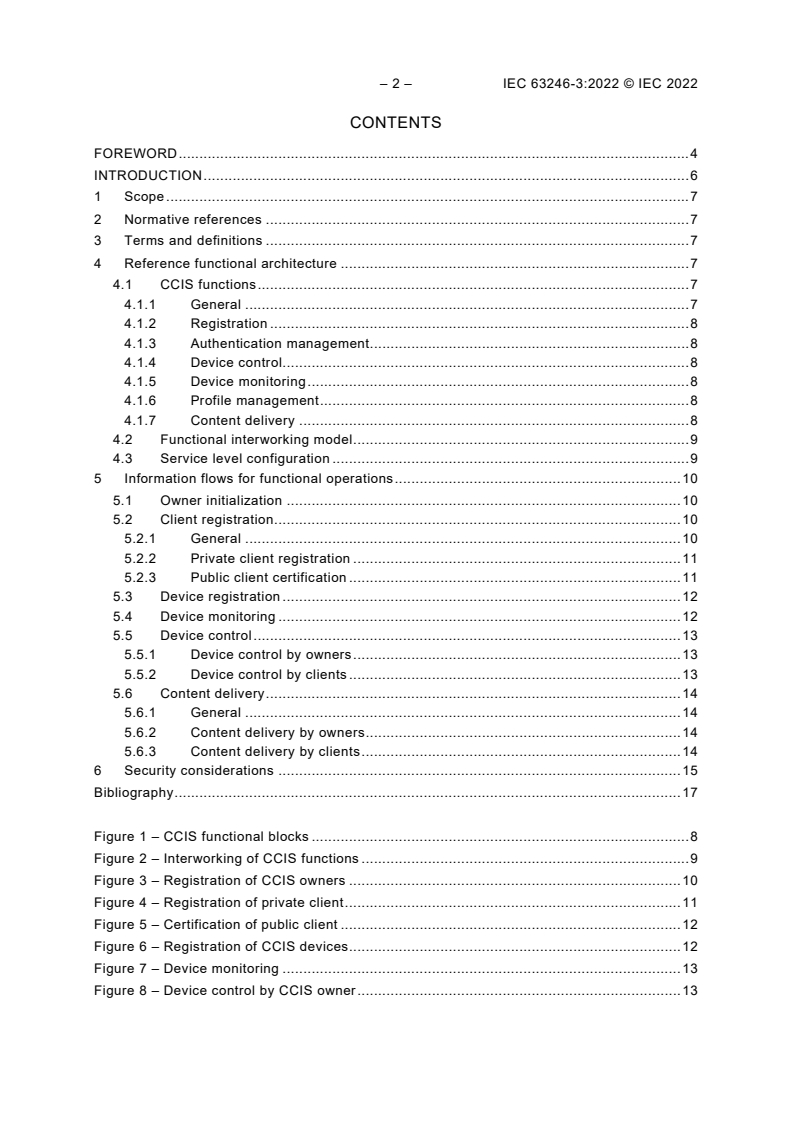
– 2 – IEC 63246-3:2022 © IEC 2022
CONTENTS
FOREWORD . 4
INTRODUCTION . 6
1 Scope . 7
2 Normative references . 7
3 Terms and definitions . 7
4 Reference functional architecture . 7
4.1 CCIS functions . 7
4.1.1 General . 7
4.1.2 Registration . 8
4.1.3 Authentication management. 8
4.1.4 Device control. 8
4.1.5 Device monitoring . 8
4.1.6 Profile management . 8
4.1.7 Content delivery . 8
4.2 Functional interworking model . 9
4.3 Service level configuration . 9
5 Information flows for functional operations . 10
5.1 Owner initialization . 10
5.2 Client registration. 10
5.2.1 General . 10
5.2.2 Private client registration . 11
5.2.3 Public client certification . 11
5.3 Device registration . 12
5.4 Device monitoring . 12
5.5 Device control . 13
5.5.1 Device control by owners . 13
5.5.2 Device control by clients . 13
5.6 Content delivery . 14
5.6.1 General . 14
5.6.2 Content delivery by owners . 14
5.6.3 Content delivery by clients . 14
6 Security considerations . 15
Bibliography . 17
Figure 1 – CCIS functional blocks . 8
Figure 2 – Interworking of CCIS functions . 9
Figure 3 – Registration of CCIS owners . 10
Figure 4 – Registration of private client . 11
Figure 5 – Certification of public client . 12
Figure 6 – Registration of CCIS devices . 12
Figure 7 – Device monitoring . 13
Figure 8 – Device control by CCIS owner . 13
Figure 9 – Device control by CCIS client . 14
Figure 10 – Content delivery by CCIS owner . 14
Figure 11 – Content delivery by CCIS client . 15
Figure 12 – Secure communication using public-private and secret keys . 16
Table 1 – CCIS service level configuration . 10
– 4 – IEC 63246-3:2022 © IEC 2022
INTERNATIONAL ELECTROTECHNICAL COMMISSION
____________
CONFIGURABLE CAR INFOTAINMENT SERVICES (CCIS) –
Part 3: Framework
FOREWORD
1) The International Electrotechnical Commission (IEC) is a worldwide organization for standardization comprising
all national electrotechnical committees (IEC National Committees). The object of IEC is to promote international
co-operation on all questions concerning standardization in the electrical and electronic fields. To this end and
in addition to other activities, IEC publishes International Standards, Technical Specifications, Technical Reports,
Publicly Available Specifications (PAS) and Guides (hereafter referred to as “IEC Publication(s)”). Their
preparation is entrusted to technical committees; any IEC National Committee interested in the subject dealt with
may participate in this preparatory work. International, governmental and non-governmental organizations liaising
with the IEC also participate in this preparation. IEC collaborates closely with the International Organization for
Standardization (ISO) in accordance with conditions determined by agreement between the two organizations.
2) The formal decisions or agreements of IEC on technical matters express, as nearly as possible, an international
consensus of opinion on the relevant subjects since each technical committee has representation from all
interested IEC National Committees.
3) IEC Publications have the form of recommendations for international use and are accepted by IEC National
Committees in that sense. While all reasonable efforts are made to ensure that the technical content of IEC
Publications is accurate, IEC cannot be held responsible for the way in which they are used or for any
misinterpretation by any end user.
4) In order to promote international uniformity, IEC National Committees undertake to apply IEC Publications
transparently to the maximum extent possible in their national and regional publications. Any divergence between
any IEC Publication and the corresponding national or regional publication shall be clearly indicated in the latter.
5) IEC itself does not provide any attestation of conformity. Independent certification bodies provide conformity
assessment services and, in some areas, access to IEC marks of conformity. IEC is not responsible for any
services carried out by independent certification bodies.
6) All users should ensure that they have the latest edition of this publication.
7) No liability shall attach to IEC or its directors, employees, servants or agents including individual experts and
members of its technical committees and IEC National Committees for any personal injury, property damage or
other damage of any nature whatsoever, whether direct or indirect, or for costs (including legal fees) and
expenses arising out of the publication, use of, or reliance upon, this IEC Publication or any other IEC
Publications.
8) Attention is drawn to the Normative references cited in this publication. Use of the referenced publications is
indispensable for the correct application of this publication.
9) Attention is drawn to the possibility that some of the elements of this IEC Publication may be the subject of patent
rights. IEC shall not be held responsible for identifying any or all such patent rights.
IEC 63246-3 has been prepared by technical area 17: Multimedia systems and equipment for
vehicles, of IEC technical committee 100: Audio, video and multimedia systems and equipment.
It is an International Standard.
The text of this International Standard is based on the following documents:
Draft Report on voting
100/3509/CDV 100/3628/RVC
Full information on the voting for its approval can be found in the report on voting indicated in
the above table.
The language used for the development of this International Standard is English.
A list of all parts in the IEC 63246 series, published under the general title Configurable car
infotainment services (CCIS), can be found on the IEC website.
This document was drafted in accordance with ISO/IEC Directives, Part 2, and developed in
accordance with ISO/IEC Directives, Part 1 and ISO/IEC Directives, IEC Supplement, available
at www.iec.ch/members_experts/refdocs. The main document types developed by IEC are
described in greater detail at www.iec.ch/standardsdev/publications.
The committee has decided that the contents of this document will remain unchanged until the
stability date indicated on the IEC website under webstore.iec.ch in the data related to the
specific document. At this date, the document will be
• reconfirmed,
• withdrawn,
• replaced by a revised edition, or
• amended.
– 6 – IEC 63246-3:2022 © IEC 2022
INTRODUCTION
The market for car infotainment services (also known as "in-vehicle infotainment systems") has
been growing rapidly, as reflected by the growth of the associated industries. It is expected that
a variety of car infotainment (or multimedia) devices and services will be developed in the future.
Such devices include navigation, cameras, speakers, headrest displays, air-conditioners,
thermometers, heated seats, and lights. It is also expected that some devices will be developed
to provide 4-dimensional experiences for users.
Car infotainment systems typically include A/V features (such as standard radio and CD players),
and two-way communications tools, as well as hands-free phone connections, vehicle voice
commands, and other types of interactive audios or videos. Car infotainment systems have
evolved to allow passengers to watch movies and other visual media (for example, DVD players
installed on the rear seats). Another distinctive feature of future car infotainment systems is
mobile device connectivity. Newer vehicles will provide a wide range of systems that allow
devices (e.g. smartphones and laptops) to be connected to a variety of services embedded in
the vehicle.
From this observation, there is a crucial need for standardization to provide car infotainment
users with more enhanced services so as to easily manage and control infotainment devices as
well as content within a car.
The purpose of the IEC 63246 series is to specify the general considerations, requirements,
framework, and protocols to provide car users with the functionality of managing and controlling
device and content resources within a car.
The IEC 63246 series consists of the following parts:
– Part 1: General;
– Part 2: Requirements;
– Part 3: Framework; and
– Part 4: Protocol.
IEC 63246-1 describes the general considerations of CCIS, which includes the CCIS system
model and the types of CCIS users with the associated service flows.
IEC 63246-2 describes the requirements for CCIS, which include the CCIS functional entities,
the communication model, and the functional requirements.
IEC 63246-3 describes the CCIS framework, which includes the information flows between
functional entities and the CCIS operations, such as registration, device monitoring and control,
and data transfer.
IEC 63246-4 describes the CCIS protocol, which includes the protocol messages and
parameters, protocol procedures, implementation guidelines, etc.
CONFIGURABLE CAR INFOTAINMENT SERVICES (CCIS) –
Part 3: Framework
1 Scope
This part of IEC 63246 describes the CCIS framework, which includes the information flows for
registration, device monitoring and control, and content delivery between CCIS functional
entities.
2 Normative references
The following document is referred to in the text in such a way that some or all of their content
constitutes requirements of this document. For dated references, only the edition cited applies.
For undated references, the latest edition of the referenced document (including any
amendments) applies.
IEC 63246-1, Configurable car infotainment services – Part 1: General
3 Terms and definitions
For the purposes of this document, the terms and definitions given in IEC 63246-1 apply.
ISO and IEC maintain terminological databases for use in standardization at the following
addresses:
• IEC Electropedia: available at http://www.electropedia.org/
• ISO Online browsing platform: available at http://www.iso.org/obp
4 Reference functional architecture
4.1 CCIS functions
4.1.1 General
CCIS functions are divided into several functional blocks as depicted in Figure 1: registration,
authentication, device control, device monitoring, profile management, and content delivery.
– 8 – IEC 63246-3:2022 © IEC 2022
Figure 1 – CCIS functional blocks
4.1.2 Registration
There are many users and devices in the CCIS system. The CCIS master performs the
registration function to manage users and devices, which may include the provision of services
by authority and automatic certification by storing the profile of registered users and devices.
4.1.3 Authentication management
CCIS can provide different level of services as per the level of authority of the CCIS user. The
CCIS master performs the authority check for users by using an authentication key. For this
purpose, a CCIS user shall obtain the authentication key from the CCIS master.
4.1.4 Device control
CCIS users can control CCIS devices. To control a specific CCIS device, its occupation status
needs to be checked, since a CCIS device can be occupied by another user. When the device
is available, the user can transmit a control message to the device via the CCIS master.
4.1.5 Device monitoring
Each device shall report its latest profile information to the CCIS master. Such status reports
may be generated periodically or by a specific event. The periodic report is generated based
on a timer, whereas the event-driven report is generated when the device status is changed. In
certain cases, the CCIS master can first send a query message to a device.
4.1.6 Profile management
For effective support of CCIS services, the CCIS master shall store and manage the profile
information, such as metadata of the registered users and devices. This profile information will
be referred to during the functional operations of the CCIS.
4.1.7 Content delivery
CCIS provides a content delivery function for exchange of contents, such as multimedia data,
between users and devices via the CCIS master. The content delivery function may include the
content delivery initialization and the content transfer. The content delivery initialization is
performed to check the authority of the concerned user to use the content delivery service. The
error control operation can be performed to provide reliability for content transfer between the
device and the master, and between the user and the master.
4.2 Functional interworking model
Each CCIS function is performed between the CCIS functional entities by interworking with the
other functions, as shown in Figure 2, in which the authentication function is interworking with
the registration, device control and content delivery functions.
Figure 2 – Interworking of CCIS functions
The registration function is applied to users and devices. All users and devices shall be
registered with the CCIS master. In the registration process, the authentication/certification
function is used to check the identity or authority. In particular, the registration of private/public
clients and CCIS devices needs the authentication check and admission by the car owner or
the temporary owner.
The CCIS users perform the device control and content delivery functions with the CCIS devices
with the help of the CCIS master, in which the authentication process with the owners is
performed. The device monitoring function is performed between the devices and the CCIS
master.
4.3 Service level configuration
CCIS may provide different service levels for CCIS users. For this purpose, each CCIS service
is categorized into "service level high", "service level medium", and "service level low". Table 1
shows an example of the service level configurations, in which each CCIS service is classified
as one of three levels (high, medium, low), by considering the service features (mission-critical
or not) and the overall impact on the CCIS system.
– 10 – IEC 63246-3:2022 © IEC 2022
Table 1 – CCIS service level configuration
Service level Service level Service level
CCIS services
high medium low
System settings ✓
Device registration and deregistration ✓
Authority check
✓
Client registration and deregistration
✓
Usage of shared service ✓
Usage of high-level personal service ✓
Usage of medium-level personal service ✓
Usage of low-level personal service ✓
In general, car owners will use all services with the high, medium, and low levels. Temporary
owners can use the services with the medium and low levels, whereas private clients and public
clients can use only the services with the low level.
5 Information flows for functional operations
5.1 Owner initialization
The CCIS owner, car owner and temporary owner, shall be registered with the CCIS master in
the owner initialization operation, before the CCIS service begins. This is because all CCIS
services are performed with the control of the CCIS owner.
Figure 3 shows the information flows for CCIS owner registration. The CCIS master periodically
broadcasts its general information that includes its own identification or the contact address for
registration. A CCIS user, who wishes to be the CCIS owner, transmits the registration request
message to the CCIS master. Then, the CCIS master sends the owner the response message
that contains the owner ID generated at the time of registration. After that, the certification
information request and response messages are exchanged between the owner and the master
in which the certification-related information and the authentication key will be exchanged.
Figure 3 – Registration of CCIS owners
5.2 Client registration
5.2.1 General
Car owners and temporary owners shall be registered with the CCIS master in the initialization
operation before CCIS services begins. In the meantime, the client (private client or public client)
shall be registered with the CCIS master in the registration operation after CCIS services begin,
since its registration needs a permission from the car owner or the temporary owner.
5.2.2 Private client registration
Figure 4 shows the information flows for private client registration. A CCIS user that wants to
be a private client transmits a registration request message to the CCIS master. Upon receiving
the registration request, the CCIS master requests from the car owner or the temporary owner
an authority check for registration. At this time, the car owner or the temporary owner shall be
able to communicate with the CCIS master. The authority check is performed in the three-way
handshaking process (request, response, and confirmation). When the CCIS master obtains the
authority from the car owner or the temporary owner, the CCIS master stores the profile of the
private client in its own repository and transmits a response message including the client ID to
the private client. After that, the certification information request and response messages are
exchanged between the client and the master in which the certification-related information and
authentication key will be exchanged.
Figure 4 – Registration of private client
5.2.3 Public client certification
The public client is a temporary user for the CCIS service. Accordingly, the certification process
is performed instead of a normal registration process, in which the CCIS master does not need
to store the client information. The CCIS master generates an authentication key for the public
client in the certification operation.
Figure 5 shows the information flows for public client certification. The public client transmits a
request message for certification operation. The CCIS master performs the three-way
handshaking operations with the owners so as to get a permission. After that, the CCIS master
transmits a response message including the authentication key to the public client.
– 12 – IEC 63246-3:2022 © IEC 2022
Figure 5 – Certification of public client
5.3 Device registration
The CCIS device shall be registered with the CCIS master to provide services to the CCIS user,
and the device registration needs the permission of the car owner.
Figure 6 shows the CCIS device registration. The CCIS master periodically broadcasts its
general information to the prospective devices. Then, a CCIS device transmits a notification
message to the CCIS master and waits for a registration request. The CCIS master now informs
the car owner of the discovery of a CCIS device. With the permission of the car owner, the CCIS
master sends a registration request message to CCIS device. In response to the registration
request message, the CCIS device sends its own profile information, including the identifier, a
list of functional interaction it can provide, and a level of authority for the functional interaction.
Then, the CCIS master stores the profile and informs the registration result to the car owner.
Figure 6 – Registration of CCIS devices
5.4 Device monitoring
With the help of device monitoring, the CCIS master can keep and manage the up-to-date profile
of CCIS devices. Figure 7 shows the CCIS device monitoring operations. The CCIS device
periodically transmits a message containing its status to the CCIS master. In addition, when a
change of device profile occurs, the changed information is immediately reported to the CCIS
master. In certain cases, the CCIS master can first query the profile of CCIS device (e.g. when
a device does not send any report to the CCIS master after a long time). When a CCIS device
receives a query message, it shall immediately transmit its status report to the CCIS master.
The CCIS master can transfer the up-to-date profile of CCIS devices to the CCIS user.
Figure 7 – Device monitoring
5.5 Device control
5.5.1 Device control by owners
CCIS users can control the CCIS devices. Figure 8 shows the operations of device control for
car owners and temporary owners. Car owners or temporary owners request the occupation of
a specific CCIS device to the CCIS master for device control. Then, the CCIS master informs
the owner of the availability and status of the concerned device. If the occupation request is
successfully performed, the owner can send a control request message to the CCIS master.
Based on this request, the CCIS master performs the device control operation and sends
feedback to the owner.
Figure 8 – Device control by CCIS owner
5.5.2 Device control by clients
Differently from the device control by the CCIS owner, private clients or public clients may
obtain permission for device control from the CCIS owner, since their authority level is lower
than that of the CCIS owner. Figure 9 shows the device control operations by clients, in which
the authority check operations are added between the master and the owner to obtain
permission for device control. The CCIS master first sends Authority_Check_Request to the
owner. The owner will respond with Authority_Check_Response. Finally, the CCIS master
confirms with Authority_Check_Confirmation. The remaining operations are the same with those
for the CCIS owner.
– 14 – IEC 63246-3:2022 © IEC 2022
Figure 9 – Device control by CCIS client
5.6 Content delivery
5.6.1 General
The CCIS users can exchange a large volume of multimedia data contents with CCIS devices,
such as importing recorded video from event video data recorders (EVDRs) or media file
transfer with headrest display. The content delivery operations will be performed slightly
differently by owners and clients.
5.6.2 Content delivery by owners
Figure 10 shows the content delivery operations by car owners or temporary owners. The CCIS
user sends a content delivery request message to the CCIS master before content transfer. The
CCIS master performs an authority check on this request message. The CCIS master transmits
a notification message to the CCIS device so as to prepare content transmission. When the
CCIS master receives a response from the device, it also transmits a response message to the
CCIS user. If the request is successful, content transfer begins between the CCIS user and
CCIS device via the CCIS master. During content transmission, the error control (error check
and retransmission of lost messages) can be performed.
Figure 10 – Content delivery by CCIS owner
5.6.3 Content delivery by clients
Figure 11 shows the content delivery operations by clients. When a client requests content
delivery, the CCIS master shall perform the authority check process with the owner, as
described in 5.5.2 (see Figure 9). If the authority check operations are successfully completed,
the content transfer begins between the client and the device via the CCIS master. The
remaining operations are the same as those for CCIS owners.
Figure 11 – Content delivery by CCIS client
6 Security considerations
Secure communication is required for data delivery between the CCIS master and CCIS
users/devices. In this document, the IEEE public-private key mechanism is used for data
delivery from CCIS users/devices to the CCIS master, whereas the secret key mechanism is
used for data delivery from the CCIS master to CCIS users/devices.
The CCIS master shall generate a secret key for each CCIS user or device, and this secret key
shall be informed to the corresponding CCIS user or device in the registration phase. When the
CCIS master wants to send a message to a CCIS user or device, this secret key will be used
for encryption and decryption of the message.
The CCIS master shall also generate its public and private keys for the public-private key
mechanism. The public key of the CCIS master will be informed to CCIS users/devices, as per
the request of the CCIS users/devices. When the CCIS user or device wants to send a message
to the CCIS master, the CCIS user or device will encrypt the message by using the public key
of the CCIS master. The CCIS master will use its private key for decryption of the message.
Figure 12 describes general operations on how to generate and deliver the public-private keys
and secret key between the CCIS master and CCIS users/devices. The CCIS master generates
and transmits a secret key during the registration of the concerned CCIS user or device. In the
meantime, the public key of the CCIS master is delivered to the CCIS users/device, as the
response of the public key request.
As shown in Figure 12, in the device control operation, the public-private keys and secret keys
are used for secure communication. The CCIS user sends Device_Control_Request to the CCIS
master by using the public key of the CCIS master, and the CCIS master will decrypt the
message by using its private key. The CCIS master then sends Device_Control_Transmission
to the CCIS device by using the secret key of the CCIS device, and the device will decrypt the
message by using the same secret key. The reverse message delivery operations are done in
the same way.
– 16 – IEC 63246-3:2022 © IEC 2022
Figure 12 – Secure communication using public-private and secret keys
Bibliography
IEC 63246-2, Configurable car infotainment services – Part 2: Requirements
ISO/IEC 27034-1:2011, Information technology – Security techniques – Application security –
Overview and concepts
ISO/IEC 27034-2:2015, Information technology – Security techniques – Application security –
Organization normative framework
ISO/IEC 27034-3:2018, Information technology – Security techniques – Application security –
Application security management process
ISO/IEC 27034-5:2017, Information technology – Security techniques – Application security –
Protocols and application security control data structure
ISO/IEC 27034-6:2016, Information technology – Security techniques – Application security –
Case studies
ISO/IEC 27034-7:2018, Information technology – Security techniques – Application security –
Assurance prediction framework
IEEE 1363:2000, IEEE Standard Specification for Public-Key Cryptography
___________
– 18 – IEC 63246-3:2022 © IEC 2022
SOMMAIRE
AVANT-PROPOS . 20
INTRODUCTION . 22
1 Domaine d'application . 23
2 Références normatives . 23
3 Termes et définitions . 23
4 Architecture fonctionnelle de référence . 23
4.1 Fonctions CCIS . 23
4.1.1 Généralités . 23
4.1.2 Enregistrement . 24
4.1.3 Gestion d'authentification . 24
4.1.4 Contrôle des dispositifs . 24
4.1.5 Surveillance des dispositifs . 24
4.1.6 Gestion des profils . 24
4.1.7 Diffusion de contenu . 25
4.2 Modèle d'interconnexion fonctionnelle . 25
4.3 Configuration des niveaux de service . 25
5 Flux d'informations pour les opérations fonctionnelles . 26
5.1 Initialisation du propriétaire . 26
5.2 Enregistrement des clients . 27
5.2.1 Généralités . 27
5.2.2 Enregistrement des clients privés . 27
5.2.3 Certification du client public . 27
5.3 Enregistrement des dispositifs . 28
5.4 Surveillance des dispositifs . 28
5.5 Contrôle des dispositifs . 29
5.5.1 Contrôle des dispositifs par les propriétaires . 29
5.5.2 Contrôle des dispositifs par les clients . 29
5.6 Diffusion de contenu . 30
5.6.1 Généralités . 30
5.6.2 Diffusion de contenu par les propriétaires . 30
5.6.3 Diffusion de contenu par les clients . 31
6 Considérations en matière de sécurité . 31
Bibliographie . 34
Figure 1 – Blocs fonctionnels CCIS . 24
Figure 2 – Interconnexion des fonctions CCIS . 25
Figure 3 – Enregistrement des propriétaires CCIS . 26
Figure 4 – Enregistrement d'un client privé . 27
Figure 5 – Certification d'un client public . 28
Figure 6 – Enregistrement des dispositifs CCIS . 28
Figure 7 – Surveillance des dispositifs . 29
Figure 8 – Contrôle des dispositifs par un propriétaire CCIS . 29
Figure 9 – Contrôle des dispositifs par un client CCIS . 30
Figure 10 – Diffusion de contenu par un propriétaire CCIS . 31
Figure 11 – Diffusion de contenu par un client CCIS . 31
Figure 12 – Communication sécurisée à l'aide de clés publiques-privées et de clés
secrètes . 33
Tableau 1 – Configuration des niveaux de service CCIS . 26
– 20 – IEC 63246-3:2022 © IEC 2022
COMMISSION ÉLECTROTECHNIQUE INTERNATIONALE
____________
SERVICES D'INFODIVERTISSEMENTS
CONFIGURABLES POUR LES VÉHICULES (CCIS) –
Partie 3: Cadre
AVANT-PROPOS
1) La Commission Electrotechnique Internationale (IEC) est une organisation mondiale de normalisation composée
de l'ensemble des comités électrotechniques nationaux (Comités nationaux de l’IEC). L’IEC a pour objet de
favoriser la coopération internationale pour toutes les questions de normalisation dans les domaines de
l'électricité et de l'électronique. À cet effet, l’IEC – entre autres activités – publie des Normes internationales,
des Spécifications techniques, des Rapports techniques, des Spécifications accessibles au public (PAS) et des
Guides (ci-après dénommés "Publication(s) de l’IEC"). Leur élaboration est confiée à des comités d'études, aux
travaux desquels tout Comité national intéressé par le sujet traité peut participer. Les organisations
internationales, gouvernementales et non gouvernementales, en liaison avec l’IEC, participent également aux
travaux. L’IEC collabore étroitement avec l'Organisation Internationale de Normalisation (ISO), selon des
conditions fixées par accord entre les deux organisations.
2) Les décisions ou accords officiels de l’IEC concernant les questions techniques représentent, dans la mesure du
possible, un accord international sur les sujets étudiés, étant donné que les Comités nationaux de l’IEC intéressés
sont représentés dans chaque comité d’études.
3) Les Publications de l’IEC se présentent sous la forme de recommandations internationales et sont agréées
comme telles par les Comités nationaux de l’IEC. Tous les efforts raisonnables sont entrepris afin que l’IEC
s'assure de l'exactitude du contenu technique de ses publicati
...