


IEC 62290-2:2014
(Main)Railway applications - Urban guided transport management and command/control systems - Part 2: Functional requirements specification
General Information
- Abstract
IEC 62290-2:2014 specifies the functional requirements of UGTMSs (Urban Guided Transport Management and Command/Control Systems) for use in urban guided passenger transport lines and networks. This part of IEC 62290 is applicable for new lines or for upgrading existing signalling and command control systems. This part of IEC 62290 is applicable to applications using:
- continuous data transmission;
- continuous supervision of train movements by train protection profile;
- localisation of trains by external wayside equipment or reporting trains.
The main technical changes with regard to the previous edition are as follows: all terms and definitions have been moved to Part 1.
- Status
- Published
- Publication Date
- 09-Jul-2014
- Technical Committee
- TC 9 - Electrical equipment and systems for railways
- Drafting Committee
- WG 40 - TC 9/WG 40
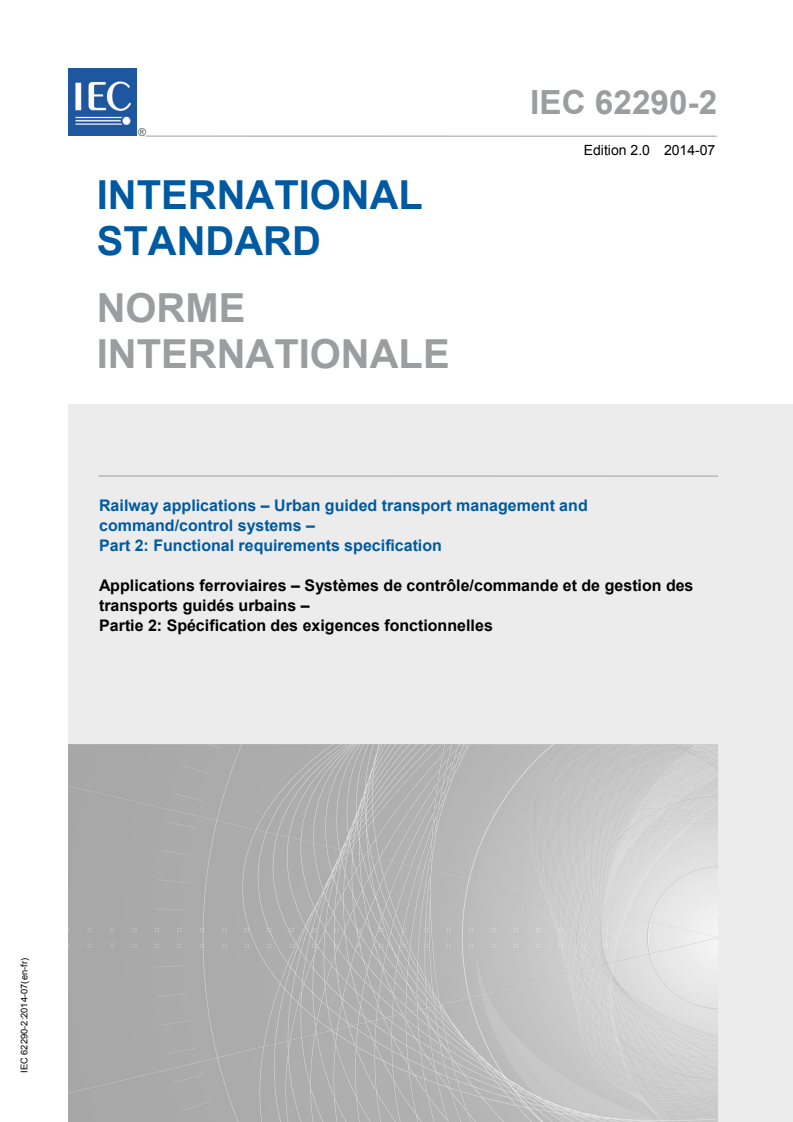
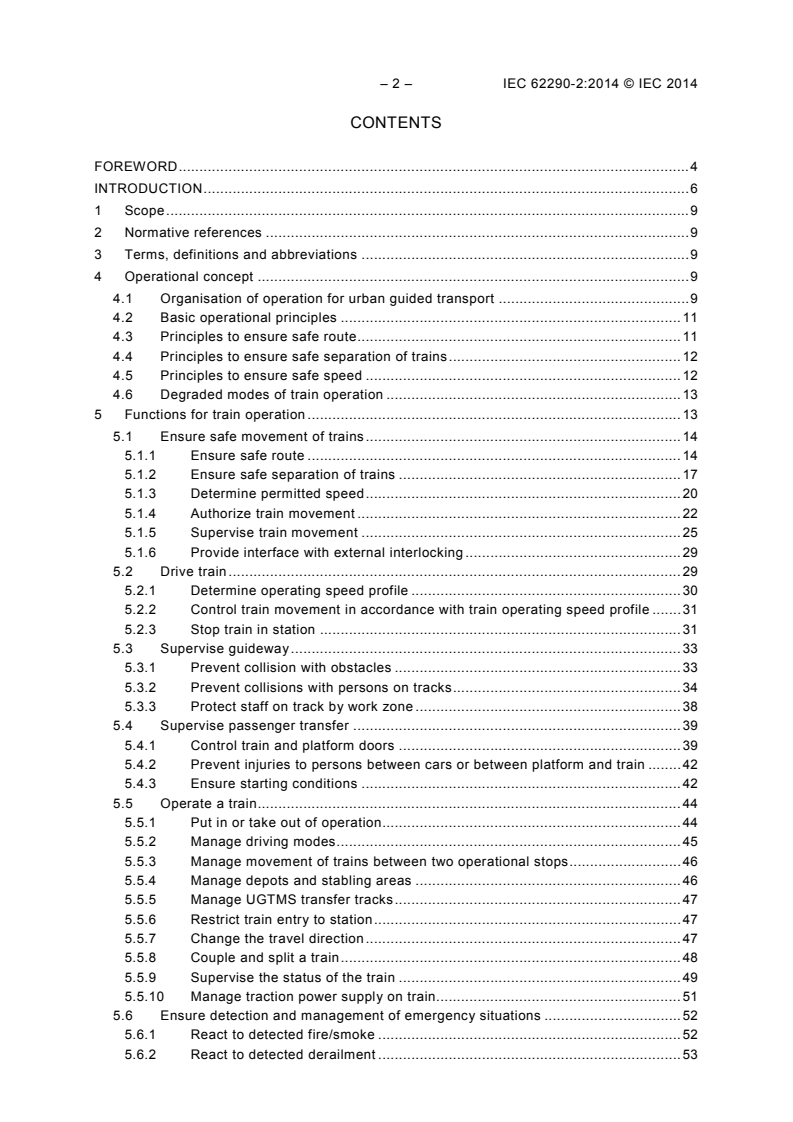
Overview
IEC 62290-2:2014 is an international standard developed by the International Electrotechnical Commission (IEC) that specifies the functional requirements for Urban Guided Transport Management and Command/Control Systems (UGTMS). This standard targets urban guided passenger transport lines and networks, offering specifications applicable for both new systems and upgrading existing signalling and command/control infrastructures. It focuses on systems that utilize continuous data transmission, train protection profiles with continuous supervision, and train localisation through wayside equipment or train reporting.
This standard plays a crucial role in ensuring the safety, reliability, and efficiency of urban guided transport networks, providing detailed functional criteria necessary for urban transit operators, system designers, and integrators.
Key Topics
Safe Train Movement Assurance
IEC 62290-2 defines functional requirements to ensure safe routing, separation of trains, speed determination, and train movement authorization. It includes continuous supervision aligned with train protection profiles, which enhances operational safety.Train Operation and Control
The standard outlines functions related to driving trains, such as enforcing speed profiles, automatic stopping at stations, and controlling train movements according to operational parameters.Guideway and Passenger Supervision
Important safety features include collision prevention with obstacles and persons on tracks, work zone protection, and control of doors to prevent injuries during passenger transfer.Emergency Detection and Handling
Functional requirements cover detection and reaction protocols for emergencies such as fire, derailment, broken rails, passenger requests, and loss of train integrity, enhancing operational robustness.Operational Management Functions
IEC 62290-2 establishes functions for managing daily timetables, regulating train services, handling operational disturbances, and supervising train tracking and equipment status.Interfaces and Communication
The standard specifies requirements for interfaces with human-machine interfaces (HMIs), communication systems for passengers and staff, passenger information systems, and passenger surveillance systems.Maintenance and Resource Management
Provisions are made for supporting system maintenance and managing rolling stock and staff resources, including assignment and reassignment functions.
Applications
The practical applications of IEC 62290-2:2014 are extensive in the urban transit sector:
New Urban Transport Systems
Design and implementation of command and control systems for new guided urban transport lines, ensuring compliance with international safety and operational standards.Upgrading Existing Systems
Enhancing existing signalling and command/control systems with state-of-the-art functionalities to improve safety, efficiency, and passenger experience.Safety-Critical Urban Signalling
Application in continuous or semi-continuous monitoring environments where ensuring train separation, route integrity, and speed adherence is vital.Integrated Operations Control
Deployment within control centers for real-time operation management, emergency handling, and passenger information dissemination.
Urban transit operators, signalling engineers, system integrators, and manufacturers can leverage the standard to develop or improve reliable and interoperable transport management systems in compliance with IEC requirements.
Related Standards
IEC 62290-2 is part of the IEC 62290 series which addresses urban guided transport systems:
IEC 62290-1 – Covers terms, definitions, and system description, establishing foundational concepts and nomenclature referenced in Part 2.
Other IEC railway signalling standards that may complement IEC 62290-2 include specifications on communication protocols, safety integrity levels, and rolling stock control.
Alignment with ISO standards concerning urban transit operations and safety may also be considered, fostering interoperability and harmonization across international urban guided transport networks.
Keywords: IEC 62290-2, urban guided transport management, command/control systems, functional requirements, passenger transport, train supervision, train protection, signalling systems, railway safety standards, urban transit operations, continuous data transmission, emergency management, operational timetable, train separation, collision prevention, IEC standards.
Relations
- Effective Date
- 05-Sep-2023
- Effective Date
- 05-Sep-2023
Get Certified
Connect with accredited certification bodies for this standard

IRIS Certification (UNIFE)
International Railway Industry Standard certification.

TÜV SÜD Rail GmbH
TÜV SÜD railway certification services.

Bureau Veritas Railway Certification
Railway and transportation certification.
Sponsored listings
Frequently Asked Questions
IEC 62290-2:2014 is a standard published by the International Electrotechnical Commission (IEC). Its full title is "Railway applications - Urban guided transport management and command/control systems - Part 2: Functional requirements specification". This standard covers: IEC 62290-2:2014 specifies the functional requirements of UGTMSs (Urban Guided Transport Management and Command/Control Systems) for use in urban guided passenger transport lines and networks. This part of IEC 62290 is applicable for new lines or for upgrading existing signalling and command control systems. This part of IEC 62290 is applicable to applications using: - continuous data transmission; - continuous supervision of train movements by train protection profile; - localisation of trains by external wayside equipment or reporting trains. The main technical changes with regard to the previous edition are as follows: all terms and definitions have been moved to Part 1.
IEC 62290-2:2014 specifies the functional requirements of UGTMSs (Urban Guided Transport Management and Command/Control Systems) for use in urban guided passenger transport lines and networks. This part of IEC 62290 is applicable for new lines or for upgrading existing signalling and command control systems. This part of IEC 62290 is applicable to applications using: - continuous data transmission; - continuous supervision of train movements by train protection profile; - localisation of trains by external wayside equipment or reporting trains. The main technical changes with regard to the previous edition are as follows: all terms and definitions have been moved to Part 1.
IEC 62290-2:2014 is classified under the following ICS (International Classification for Standards) categories: 45.060.01 - Railway rolling stock in general. The ICS classification helps identify the subject area and facilitates finding related standards.
IEC 62290-2:2014 has the following relationships with other standards: It is inter standard links to IEC 62290-2:2025, IEC 62290-2:2011. Understanding these relationships helps ensure you are using the most current and applicable version of the standard.
IEC 62290-2:2014 is available in PDF format for immediate download after purchase. The document can be added to your cart and obtained through the secure checkout process. Digital delivery ensures instant access to the complete standard document.
Standards Content (Sample)
IEC 62290-2 ®
Edition 2.0 2014-07
INTERNATIONAL
STANDARD
NORME
INTERNATIONALE
Railway applications – Urban guided transport management and
command/control systems –
Part 2: Functional requirements specification
Applications ferroviaires – Systèmes de contrôle/commande et de gestion des
transports guidés urbains –
Partie 2: Spécification des exigences fonctionnelles
All rights reserved. Unless otherwise specified, no part of this publication may be reproduced or utilized in any form
or by any means, electronic or mechanical, including photocopying and microfilm, without permission in writing from
either IEC or IEC's member National Committee in the country of the requester. If you have any questions about IEC
copyright or have an enquiry about obtaining additional rights to this publication, please contact the address below or
your local IEC member National Committee for further information.
Droits de reproduction réservés. Sauf indication contraire, aucune partie de cette publication ne peut être reproduite
ni utilisée sous quelque forme que ce soit et par aucun procédé, électronique ou mécanique, y compris la photocopie
et les microfilms, sans l'accord écrit de l'IEC ou du Comité national de l'IEC du pays du demandeur. Si vous avez des
questions sur le copyright de l'IEC ou si vous désirez obtenir des droits supplémentaires sur cette publication, utilisez
les coordonnées ci-après ou contactez le Comité national de l'IEC de votre pays de résidence.
IEC Central Office Tel.: +41 22 919 02 11
3, rue de Varembé Fax: +41 22 919 03 00
CH-1211 Geneva 20 info@iec.ch
Switzerland www.iec.ch
About the IEC
The International Electrotechnical Commission (IEC) is the leading global organization that prepares and publishes
International Standards for all electrical, electronic and related technologies.
About IEC publications
The technical content of IEC publications is kept under constant review by the IEC. Please make sure that you have the
latest edition, a corrigenda or an amendment might have been published.
IEC Catalogue - webstore.iec.ch/catalogue Electropedia - www.electropedia.org
The stand-alone application for consulting the entire The world's leading online dictionary of electronic and
bibliographical information on IEC International Standards, electrical terms containing more than 30 000 terms and
Technical Specifications, Technical Reports and other definitions in English and French, with equivalent terms in 14
documents. Available for PC, Mac OS, Android Tablets and additional languages. Also known as the International
iPad. Electrotechnical Vocabulary (IEV) online.
IEC publications search - www.iec.ch/searchpub IEC Glossary - std.iec.ch/glossary
The advanced search enables to find IEC publications by a More than 55 000 electrotechnical terminology entries in
variety of criteria (reference number, text, technical English and French extracted from the Terms and Definitions
committee,…). It also gives information on projects, replaced clause of IEC publications issued since 2002. Some entries
and withdrawn publications. have been collected from earlier publications of IEC TC 37,
77, 86 and CISPR.
IEC Just Published - webstore.iec.ch/justpublished
Stay up to date on all new IEC publications. Just Published IEC Customer Service Centre - webstore.iec.ch/csc
details all new publications released. Available online and If you wish to give us your feedback on this publication or
also once a month by email. need further assistance, please contact the Customer Service
Centre: csc@iec.ch.
A propos de l'IEC
La Commission Electrotechnique Internationale (IEC) est la première organisation mondiale qui élabore et publie des
Normes internationales pour tout ce qui a trait à l'électricité, à l'électronique et aux technologies apparentées.
A propos des publications IEC
Le contenu technique des publications IEC est constamment revu. Veuillez vous assurer que vous possédez l’édition la
plus récente, un corrigendum ou amendement peut avoir été publié.
Catalogue IEC - webstore.iec.ch/catalogue Electropedia - www.electropedia.org
Application autonome pour consulter tous les renseignements
Le premier dictionnaire en ligne de termes électroniques et
bibliographiques sur les Normes internationales,
électriques. Il contient plus de 30 000 termes et définitions en
Spécifications techniques, Rapports techniques et autres
anglais et en français, ainsi que les termes équivalents dans
documents de l'IEC. Disponible pour PC, Mac OS, tablettes
14 langues additionnelles. Egalement appelé Vocabulaire
Android et iPad.
Electrotechnique International (IEV) en ligne.
Recherche de publications IEC - www.iec.ch/searchpub
Glossaire IEC - std.iec.ch/glossary
Plus de 55 000 entrées terminologiques électrotechniques, en
La recherche avancée permet de trouver des publications IEC
en utilisant différents critères (numéro de référence, texte, anglais et en français, extraites des articles Termes et
comité d’études,…). Elle donne aussi des informations sur les Définitions des publications IEC parues depuis 2002. Plus
projets et les publications remplacées ou retirées. certaines entrées antérieures extraites des publications des
CE 37, 77, 86 et CISPR de l'IEC.
IEC Just Published - webstore.iec.ch/justpublished
Service Clients - webstore.iec.ch/csc
Restez informé sur les nouvelles publications IEC. Just
Published détaille les nouvelles publications parues. Si vous désirez nous donner des commentaires sur cette
Disponible en ligne et aussi une fois par mois par email. publication ou si vous avez des questions contactez-nous:
csc@iec.ch.
IEC 62290-2 ®
Edition 2.0 2014-07
INTERNATIONAL
STANDARD
NORME
INTERNATIONALE
Railway applications – Urban guided transport management and
command/control systems –
Part 2: Functional requirements specification
Applications ferroviaires – Systèmes de contrôle/commande et de gestion des
transports guidés urbains –
Partie 2: Spécification des exigences fonctionnelles
INTERNATIONAL
ELECTROTECHNICAL
COMMISSION
COMMISSION
ELECTROTECHNIQUE
PRICE CODE
INTERNATIONALE
CODE PRIX XB
ICS 45.060 ISBN 978-2-8322-1661-3
– 2 – IEC 62290-2:2014 © IEC 2014
CONTENTS
FOREWORD . 4
INTRODUCTION . 6
1 Scope . 9
2 Normative references . 9
3 Terms, definitions and abbreviations . 9
4 Operational concept . 9
4.1 Organisation of operation for urban guided transport . 9
4.2 Basic operational principles . 11
4.3 Principles to ensure safe route . 11
4.4 Principles to ensure safe separation of trains . 12
4.5 Principles to ensure safe speed . 12
4.6 Degraded modes of train operation . 13
5 Functions for train operation . 13
5.1 Ensure safe movement of trains . 14
5.1.1 Ensure safe route . 14
5.1.2 Ensure safe separation of trains . 17
5.1.3 Determine permitted speed . 20
5.1.4 Authorize train movement . 22
5.1.5 Supervise train movement . 25
5.1.6 Provide interface with external interlocking . 29
5.2 Drive train . 29
5.2.1 Determine operating speed profile . 30
5.2.2 Control train movement in accordance with train operating speed profile . 31
5.2.3 Stop train in station . 31
5.3 Supervise guideway . 33
5.3.1 Prevent collision with obstacles . 33
5.3.2 Prevent collisions with persons on tracks . 34
5.3.3 Protect staff on track by work zone . 38
5.4 Supervise passenger transfer . 39
5.4.1 Control train and platform doors . 39
5.4.2 Prevent injuries to persons between cars or between platform and train . 42
5.4.3 Ensure starting conditions . 42
5.5 Operate a train . 44
5.5.1 Put in or take out of operation . 44
5.5.2 Manage driving modes . 45
5.5.3 Manage movement of trains between two operational stops . 46
5.5.4 Manage depots and stabling areas . 46
5.5.5 Manage UGTMS transfer tracks . 47
5.5.6 Restrict train entry to station . 47
5.5.7 Change the travel direction . 47
5.5.8 Couple and split a train . 48
5.5.9 Supervise the status of the train . 49
5.5.10 Manage traction power supply on train. 51
5.6 Ensure detection and management of emergency situations . 52
5.6.1 React to detected fire/smoke . 52
5.6.2 React to detected derailment . 53
5.6.3 React to detected or suspected broken rail . 53
5.6.4 Manage passenger requests . 54
5.6.5 React to loss of train integrity . 55
5.6.6 Supervise closed and locked status of train doors . 56
6 Functions for operation management and supervision . 57
6.1 Manage the daily timetable . 57
6.1.1 Import timetables . 57
6.1.2 Select the timetable . 57
6.1.3 Modify the operational timetable . 58
6.2 Manage the train service . 58
6.2.1 Manage train missions . 58
6.2.2 Set routes automatically . 60
6.2.3 Regulate trains . 61
6.2.4 Ensure connecting services . 61
6.2.5 Manage operational disturbances . 62
6.2.6 Dispatch trains . 62
6.3 Supervise train operations . 63
6.3.1 Supervise train tracking . 63
6.3.2 Supervise trains and wayside equipment . 64
6.3.3 Supervise passengers . 65
6.4 Control traction power . 66
6.4.1 Monitor traction power supply . 66
6.4.2 Command traction power supply . 66
6.4.3 Control regenerative braking . 66
6.5 Manage the interface with the HMI . 66
6.5.1 Manage the interface with operations control HMI . 67
6.5.2 Manage the interface with the train HMI . 67
6.6 Provide interface with the communication system for passengers and staff . 67
6.7 Provide interface with the passengers information system . 68
6.8 Provide interface with passenger surveillance system . 68
6.9 Support maintenance . 68
6.10 Manage rolling stock and staff resources . 69
6.10.1 Assign rolling stock to operation needs . 69
6.10.2 Assign or reassign train staff . 69
Bibliography . 71
Figure 1 – The three-step process followed by the UGTMS standard . 7
Figure 2 – Organisation of operation . 10
Figure 3 – Train protection profile and speed supervision . 13
Figure 4 – Specification of a safe route . 14
– 4 – IEC 62290-2:2014 © IEC 2014
INTERNATIONAL ELECTROTECHNICAL COMMISSION
____________
RAILWAY APPLICATIONS –
URBAN GUIDED TRANSPORT MANAGEMENT
AND COMMAND/CONTROL SYSTEMS –
Part 2: Functional requirements specification
FOREWORD
1) The International Electrotechnical Commission (IEC) is a worldwide organization for standardization comprising
all national electrotechnical committees (IEC National Committees). The object of IEC is to promote
international co-operation on all questions concerning standardization in the electrical and electronic fields. To
this end and in addition to other activities, IEC publishes International Standards, Technical Specifications,
Technical Reports, Publicly Available Specifications (PAS) and Guides (hereafter referred to as “IEC
Publication(s)”). Their preparation is entrusted to technical committees; any IEC National Committee interested
in the subject dealt with may participate in this preparatory work. International, governmental and non-
governmental organizations liaising with the IEC also participate in this preparation. IEC collaborates closely
with the International Organization for Standardization (ISO) in accordance with conditions determined by
agreement between the two organizations.
2) The formal decisions or agreements of IEC on technical matters express, as nearly as possible, an international
consensus of opinion on the relevant subjects since each technical committee has representation from all
interested IEC National Committees.
3) IEC Publications have the form of recommendations for international use and are accepted by IEC National
Committees in that sense. While all reasonable efforts are made to ensure that the technical content of IEC
Publications is accurate, IEC cannot be held responsible for the way in which they are used or for any
misinterpretation by any end user.
4) In order to promote international uniformity, IEC National Committees undertake to apply IEC Publications
transparently to the maximum extent possible in their national and regional publications. Any divergence
between any IEC Publication and the corresponding national or regional publication shall be clearly indicated in
the latter.
5) IEC itself does not provide any attestation of conformity. Independent certification bodies provide conformity
assessment services and, in some areas, access to IEC marks of conformity. IEC is not responsible for any
services carried out by independent certification bodies.
6) All users should ensure that they have the latest edition of this publication.
7) No liability shall attach to IEC or its directors, employees, servants or agents including individual experts and
members of its technical committees and IEC National Committees for any personal injury, property damage or
other damage of any nature whatsoever, whether direct or indirect, or for costs (including legal fees) and
expenses arising out of the publication, use of, or reliance upon, this IEC Publication or any other IEC
Publications.
8) Attention is drawn to the Normative references cited in this publication. Use of the referenced publications is
indispensable for the correct application of this publication.
9) Attention is drawn to the possibility that some of the elements of this IEC Publication may be the subject of
patent rights. IEC shall not be held responsible for identifying any or all such patent rights.
International Standard IEC 62290-2 has been prepared by IEC technical committee 9:
Electrical equipment and systems for railways.
This second edition cancels and replaces the first edition issued in 2011. It constitutes a
technical revision.
The main technical changes with regard to the previous edition are as follows:
– all terms and definitions have been moved to Part 1.
The text of this standard is based on the following documents:
FDIS Report on voting
9/1914/FDIS 9/1942/RVD
Full information on the voting for the approval of this standard can be found in the report on
voting indicated in the above table.
This publication has been drafted in accordance with the ISO/IEC Directives, Part 2.
A list of all parts of IEC 62290 series, under the general title Railway applications – Urban
guided transport management and command/control systems, can be found on the IEC
website.
The committee has decided that the contents of this publication will remain unchanged until
the stability date indicated on the IEC web site under "http://webstore.iec.ch" in the data
related to the specific publication. At this date, the publication will be
• reconfirmed,
• withdrawn,
• replaced by a revised edition, or
• amended.
– 6 – IEC 62290-2:2014 © IEC 2014
INTRODUCTION
IEC 62290 standard series specifies the functional, system and interface requirements for the
command, control, and management systems intended to be used on urban, guided
passenger transport lines and networks. This series does not apply to lines that are operated
under specific railway regulations, unless otherwise specified by the authority having
jurisdiction.
These systems are designated here as Urban Guided Transport Management and
Command/Control Systems (UGTMS). UGTMS cover a wide range of operations needs from
non-automated (GOA1) to unattended (GOA4) operation. A line may be equipped with
UGTMS on its full length or only partly equipped.
This series does not specifically address security issues. However, aspects of safety
requirements may apply to ensuring security within the urban guided transit system.
The main objective of this series is to achieve interoperability, interchangeability and
compatibility.
This series is a recommendation for those transport authorities wishing to introduce
interoperable, interchangeable and compatible equipment.
It is the responsibility of the transport authority concerned in accordance with the authority
having jurisdiction to decide on how to apply this series and to take into account their
particular needs.
IEC 62290 series is also intended to support applications for upgrading existing signalling and
command control systems. In this case, interchangeability and compatibility could be ensured
only for the additional UGTMS equipment. Checking the possibility for upgrading existing
equipment and the level of interoperability is the responsibility of the transport authority
concerned.
Application of the series should take into account the differences between the various
networks operated in different nations. Those differences include operational and regulatory
requirements as well as different safety cultures.
This series defines a catalogue of UGTMS requirements split into mandatory and optional
functions. The functions used are based on the given grade of automation. By fulfilling the
requirements, a supplier can create one or more generic applications including all mandatory
functions and all or a subset of optional functions. A generic application will achieve
interoperability within the defined specific application conditions. Customising a generic
application will create a specific application taking into account of local conditions such as
track layout and headway requirements. It is the choice of supplier and transport authority to
add additional functions to a generic or specific application. These additional functions are not
described in this series.
According to IEC 62278, it is the responsibility of the transport authority, in agreement with
the authority having jurisdiction, to decide, taking into account their risk acceptance principles
to conduct specific hazard and risk analysis for each specific application. The safety levels for
the functions of each specific application have to be determined by a specific risk analysis.
Terms like "safety related command", "safety conditions", "safe station departure" are
mentioned without having performed any hazard analysis.
Standard series IEC 62290 is intended to consist of four parts:
• Part 1 “System principles and fundamental concepts” provides an introduction to the
standard and deals with the main concepts, the system definition, the principles and
the basic functions of UGTMS (Urban Guided Transport Management and
Command/Control Systems).
The three other parts correspond to the three steps (see Figure 1) required in the process of
specifying UGTMS and are to be used accordingly.
• Part 2 “Functional requirements specification” specifies the functional requirements
associated to the basic functions provided by Part 1, within the system boundaries and
interfaces as defined in Figure 3 of Part 1.
The FRS (Functional Requirements Specification) identifies and defines the functions
that are necessary to operate an urban guided transport system. Two types of
functions are distinguished for a given grade of automation: mandatory functions (e.g.
train detection) and optional functions (e.g. interfaces to passenger information and
passenger surveillance systems). Requirements of functions have the same allocation,
unless they are marked otherwise.
• Part 3 (under consideration) “System requirements specifications” deals with the
architecture of the system and the allocation of the requirements and functions
identified in Part 2 to architecture constituents.
The SRS (System Requirement Specification) specifies the architecture of a UGTMS
system, with mandatory and optional constituents.
• Part 4 (under consideration) “Interface specifications” deals with the definition of the
interfaces, as well as the data exchanged by them (FIS and FFFIS), for the
interoperable and interchangeable constituents identified in Part 3.
For interfaces between UGTMS constituents, the logical interface or FIS (Functional
Interface Specification) and/or the physical and logical interface or FFFIS (Form Fit
Functional Interface Specification) will be considered.
NOTE The specific structures of Part 3 and Part 4 will be established following completion of Part 2 to
accommodate optional and mandatory constituents, and to reflect local conditions. In principle, only one FIS or/and
FFFIS will be defined for the same interface. However, when justified in some cases, several FISs or several
FFFISs will be defined for the same interface.
Functional
requirements
(FRS)
System requirements
(SRS)
Interface requirements
(FIS or/and FFFIS)
IEC 891/11
Figure 1 – The three-step process followed by the UGTMS standard
Requirements are those necessary to fulfil all operational needs for safe and orderly operation
requested by transport authorities without regard to technical solutions.
– 8 – IEC 62290-2:2014 © IEC 2014
The chosen level of detail in describing requirements enables customers as well as authorities
having jurisdiction to be assured that generic applications delivered by different suppliers will
cover at least the same functionality as specified in this part of IEC 62290.
Requirements which are established by this series are indicated clearly with a requirement
identification number related to the function to be covered.
RAILWAY APPLICATIONS –
URBAN GUIDED TRANSPORT MANAGEMENT
AND COMMAND/CONTROL SYSTEMS –
Part 2: Functional requirements specification
1 Scope
This part of IEC 62290 specifies the functional requirements of UGTMSs (Urban Guided
Transport Management and Command/Control Systems) for use in urban guided passenger
transport lines and networks. This part of IEC 62290 is applicable for new lines or for
upgrading existing signalling and command control systems.
This part of IEC 62290 is applicable to applications using:
• continuous data transmission
• continuous supervision of train movements by train protection profile
• localisation of trains by external wayside equipment or reporting trains.
This standard is not applicable to existing command and control systems or projects in
progress prior to the effective date of this standard.
In this Part 2 of the standard, the functional requirements set the framework to which detailed
functions should be added to define any generic or specific application.
Because of that, although this part of the standard is applicable as a basis to define SRS, FIS
and FFFIS, elements may be added for a generic or specific application.
2 Normative references
The following documents, in whole or in part, are normatively referenced in this document and
are indispensable for its application. For dated references, only the edition cited applies. For
undated references, the latest edition of the referenced document (including any
amendments) applies.
IEC 62290-1, Railway applications – Urban guided transport management and
command/control systems – Part 1: System principles and fundamental concepts
3 Terms, definitions and abbreviations
For the purposes of this document, the terms, definitions and abbreviations given in
IEC 62290-1 apply.
4 Operational concept
4.1 Organisation of operation for urban guided transport
The organisation of operation for public transport is structured generally into the following
tasks and carried out by using infrastructure (guideway and its elements) and trains (see
Figure 2):
– 10 – IEC 62290-2:2014 © IEC 2014
• planning operation (Offices for planning operation including timetable, train- and staff
resources), which is out of the scope of this standard,
• operations management and supervision (Operations Control Centre) as described in
Clause 6,
• execute train operations, as described in Clause 5,
• maintenance for all facilities and equipment of the transport system, especially
infrastructure, trains, UGTMS equipment. Maintenance is out of the scope of this
standard but UGTMS supports maintenance as described in 6.9.
Operations planning
Ti metable
Operations
Duty roster
statistics
Train service table
Office
Manage train Supervise
Maintenance
services operations
Operations management
Trains
and supervision
Infrastructure
Operations control centre
Workshops
Train o peration
Ensure Drive Supervise Supervise Detect and
Operate
safe trains guideway passenger manage
trains
movement transfer emergency
of trains situations
IEC 892/11
Figure 2 – Organisation of operation
This operations organisation hierarchy provides an overview of UGTMS functions of this
functional requirements specification. It is also a first approach for a system hierarchy to be
described in the System Requirement Specification (SRS). Train operations are enabled by
command-control equipment situated both at the wayside and onboard, which interfaces to
the OCC equipment. Operation management and supervision is carried out from the OCC
which provides also the interface to operations control HMI to operate and display all
functions required by UGTMS.
The task of operations planning contains all necessary measures to prepare operation.
Operation planning has to provide the operation management and supervision level with all
necessary information to execute train operation and will be provided with information from
management and supervision level to enable adjustment of the planning process for
operational needs.
Operations management and supervision include all measures which are necessary to ensure
operations in normal, perturbed and failure situations.
The functions to be realised on this level are described in Clause 6.
4.2 Basic operational principles
UGTMS can be applied to a wide range of urban guided transport systems and the specific
UGTMS operational requirements for a given application will depend on the required grade of
automation. The following basic operational principles will however apply for all UGTMS
applications.
UGTMS will have precise knowledge of the limits of UGTMS territory which can include both
mainline and yard tracks.
UGTMS will include the capability to perform verification checks of the UGTMS onboard
equipment prior to entering UGTMS territory. The checks should be performed sufficiently in
advance of entry into UGTMS territory to verify the proper operation of the UGTMS onboard
equipment, including any UGTMS wayside equipment dependencies.
Under normal circumstances, it should not be necessary for a train to come to a stop when
entering or exiting UGTMS territory, unless required for other safety or operational reasons.
UGTMS-equipped trains can include passenger trains, non-passenger trains and maintenance
trains and different functional requirements may apply to the different types of train. For
example, non-passenger trains and maintenance trains will normally not be required to stop at
passenger stations on the mainline.
UGTMS-equipped trains will be capable of operating in various driving modes, depending on
the grade of automation and on the operational status of the UGTMS onboard and/or wayside
equipment.
UGTMS will ensure a safe route, safe train separation, and the safe speed of all UGTMS-
equipped trains operating in UGTMS territory. Trains can be operated manually by a train
driver, or automatically by UGTMS depending on the grade of automation. When operating
automatically, some functions (such as door operation) may continue to be the responsibility
of the train staff.
Trains not equipped with UGTMS onboard equipment, and/or trains with inoperative UGTMS
onboard equipment, that are operating in UGTMS territory will operate under the protection of
either a separate fall-back wayside signal system or operating procedures, or a combination
of both, as specified by the transport authority. (See also 4.6 below).
Commands from staff shall be provided via the interface with the operations control HMI.
Systems are run either with or without a timetable, for example by using headway regulation
only.
4.3 Principles to ensure safe route
The operational purpose of setting routes is to allow trains to travel to different destinations in
the network.
UGTMS permits trains to be manually or automatically routed between any defined origin and
destination in accordance with the train service requirements for the line, predefined routing
– 12 – IEC 62290-2:2014 © IEC 2014
rules, and any UGTMS user-directed service strategy. Where applicable to the specific track
configuration, automatic routing will support the proper merging and diverging of trains at
junctions, the turnback of trains, the movement of trains from/to yards and train storage
areas, and the rerouting of trains in response to service disruptions and/or planned outages.
UGTMS will ensure a safe route for all UGTMS trains in all grades of automation.
To prevent train collisions and derailments, train movement will not be authorized until the
route is set and locked. The route will be locked prior to the train entering the route and route
locking will be maintained while the train is within the route. Routes will be released by
manual commands or by movement of trains.
Ensuring a safe route is either a UGTMS function or an external function, in the latter case
appropriate interface shall be provided.
4.4 Principles to ensure safe separation of trains
The required design and operating headways for the line will be as specified by the transport
authority. The design headway for a line involves many factors that are outside of UGTMS
(e.g. track alignment, gradients, track speed limits, train acceleration and braking rates,
station dwell times, terminal track configurations, driver reaction times, etc.). These factors
shall be specified by the transport authority. UGTMS factors contributing to achievable
headways include accuracy of train location and train speed determination, resolution of
movement authority limits for a given train, frequency at which location reports and movement
authorities are updated, data communication delays, and UGTMS equipment reaction times
for both UGTMS wayside and UGTMS onboard equipment.
UGTMS will provide safe train separation assurance in all grades of automation based on the
principle of an instantaneous stop of a preceding train. Safe train separation may be achieved
using either fixed block or moving block principles.
To ensure safe train separation, UGTMS establishes an absolute movement authority limit for
each train based on the determined location of the train ahead. This absolute movement
authority limit represents the limit of movement protection for a following train, with
appropriate consideration of the location margin inaccuracy of the preceding train (including
any rollback tolerance).
4.5 Principles to ensure safe speed
UGTMS will provide overspeed protection in all grades of automation to ensure that the train's
actual speed will not exceed its safe speed. The safe speed will be derived with consideration
of both permanent and temporary speed limits within the train's movement authority as well as
any permanent or temporary speed restrictions applicable to the train.
UGTMS ensures that a train does not travel beyond the train protection profile by supervising
train movement along the authorized route to a defined target point (see Figure 3). The
distance between the target point and movement authority limit is a variable safety distance,
as determined by the safe braking model, to ensure that the limit of movement protection will
not be exceeded. The safe braking model includes consideration of factors such as location
margin inaccuracy of following train, train length, allowable overspeed permitted by the
UGTMS system, maximum speed measurement error, UGTMS reaction times and latencies,
maximum train acceleration rate possible at the time an overspeed condition is detected by
UGTMS, worst-case reaction times to disable the propulsion system and apply the emergency
brakes following detection of an overspeed condition, and emergency brake rate, etc.
Speed restriction(s) within train’s intended route
Movement authority limit
Train protection
profile
Authorized speed
Train location
Target point
Safety margin
IEC 893/11
Figure 3 – Train protection profile and speed supervision
According to the safe braking model, any violation of the train protection profile will not result
in the train being beyond the movement authority limit.
4.6 Degraded modes of train operation
It is a basic operational principle to continue to move trains with a level of safety potentially
degraded in the event of UGTMS equipment failures, possibly at reduced operating speeds
and/or increased operating headways when compared to normal train operations. As a
consequence, UGTMS will support degraded modes of operation in the event of failure, and
will continue to provide train protection with minimum reliance on adherence to operating
procedures. This will be achieved through functional elements of UGTMS itself, through a
separate non-UGTMS fall-back wayside signal system (if specified by the transport authority),
or through strict adherence to operating procedures, or through a combination of any or all of
the above.
Degraded modes of train operation should take advantage of the functional capabilities of
UGTMS in order to eliminate hazards to passengers and staff while continuing to provide
passenger train service. Specifically, degraded modes of train operations in UGTMS territory
should address those UGTMS equipment failures that affect all trains operating within a
particular area of control or a particular train operating within any area of control.
For all functions of UGTMS a non-communicating train or a train with inoperative onboard
equipment shall be handled in the same way as a non-equipped train.
5 Functions for train operation
This clause contains all functions which are necessary for train operation to be provided by
UGTMS.
– 14 – IEC 62290-2:2014 © IEC 2014
5.1 Ensure safe movement of trains
Ensuring safe movement of trains is achieved by:
• Ensuring a safe route for each train; this can be done internally (addressed in 5.1.1) or
externally with an interface with external interlocking (addressed in 5.1.6)
• Determining the location of all trains and limits of safe train separation (addressed in
5.1.2)
• Determining the actual train speed (addressed in 5.1.5.1) and the maximum allowable
train speeds (addressed in 5.1.3)
• Authorizing train movement in accordance with a movement authority limit and train
protection profile (addressed in 5.1.4)
• Supervising train movement in accordance with this movement authority limit and train
protection profile (addressed in 5.1.5)
5.1.1 Ensure safe route
Mandatory: all GOAs if "Ensure safe route" functions are provided by UGTMS
This subclause contains all functions necessary to command, control and check route
elements, set and release routes.
In order to prevent train collision and derailment, a route is to be considered as safe, if all
requested elements of the guideway are locked in the required position to prevent concurrent
use by another train.
A safe route consists of one or more related route elements which are used for:
• area between route origin (RO) to route destination (RD),
• flank protection purposes, and
• the overlap (OVL).
FPA
FPA
RD
RO
RO
RD
OVL
OVL
Combined route
IEC 894/11
Key
RO route origin
RD route destination
OVL overlap
FPA flank protection area
Figure 4 – Specification of a safe route
The logical element route is seen from UGTMS as a combination of route elements with
specified conditions. A route shall be described taking into account the following conditions:
• route origin as a location, where authorization to enter the route shall be given,
• route elements between route origin and route destination, which are to be traversed
by the train,
• route elements of overlap, which are reserved for safety reasons in case of deviations
from an authorized train movement,
• route elements in the flank protection area, which avoid or detect unauthorized flank
movement.
An overlap can be replaced by a following safe route building a combined route (see
Figure 4).
The description of each route for a specific application is usually provided in a “route
interlocking table” as an input to UGTMS. The “route interlocking table” specifies also the site
specific required conditions for each route element in the defined route as a demand for
customising the generic application for site-specific needs.
5.1.1.1 Set and protect route
5.1.1.1.1 Set route
Mandatory: all GOAs
This function is intended to set a route by command provided via the operations control HMI
or by the function set routes automatically.
#REQ_5.1.1.1.1-1#
UGTMS shall set a route by command provided via the interface with the operations control
HMI or by the function set routes automatically.
#REQ_5.1.1.1.1-2#
For the route to be set, UGTMS shall determine the route elements required based on the
route origin and destination, including elements required for flank protection, and for overlap.
#REQ_5.1.1.1.1-3#
For the route to
...