

IEC 61800-5-2:2007
(Main)Adjustable speed electrical power drive systems - Part 5-2: Safety requirements - Functional
General Information
- Abstract
IEC 61800-5-2:2007 specifies requirements and makes recommendations for the design and development, integration and validation of PDS(SR)s in terms of their functional safety considerations. It applies to adjustable speed electric drive systems covered by the other parts of the IEC 61800 series of standards. IEC 61800-5-2, which is a product standard, sets out safety-related considerations of PDS(SR)s in terms of the framework of IEC 61508, and introduces requirements for PDS(SR)s as subsystems of a safety-related system. It is intended to facilitate the realisation of the electrical/electronic/programmable electronic (E/E/PE) elements of a PDS(SR) in relation to the safety performance of safety function(s) of a PDS.
- Status
- Published
- Publication Date
- 15-Jul-2007
- Technical Committee
- SC 22G - Adjustable speed electric power drive systems (PDS)
- Drafting Committee
- WG 6 - TC 22/SC 22G/WG 6
- Current Stage
- DELPUB - Deleted Publication
- Start Date
- 18-Apr-2016
- Completion Date
- 28-Aug-2026
Buy Documents
IEC 61800-5-2:2007 - Adjustable speed electrical power drive systems - Part 5-2: Safety requirements - Functional Released:7/16/2007
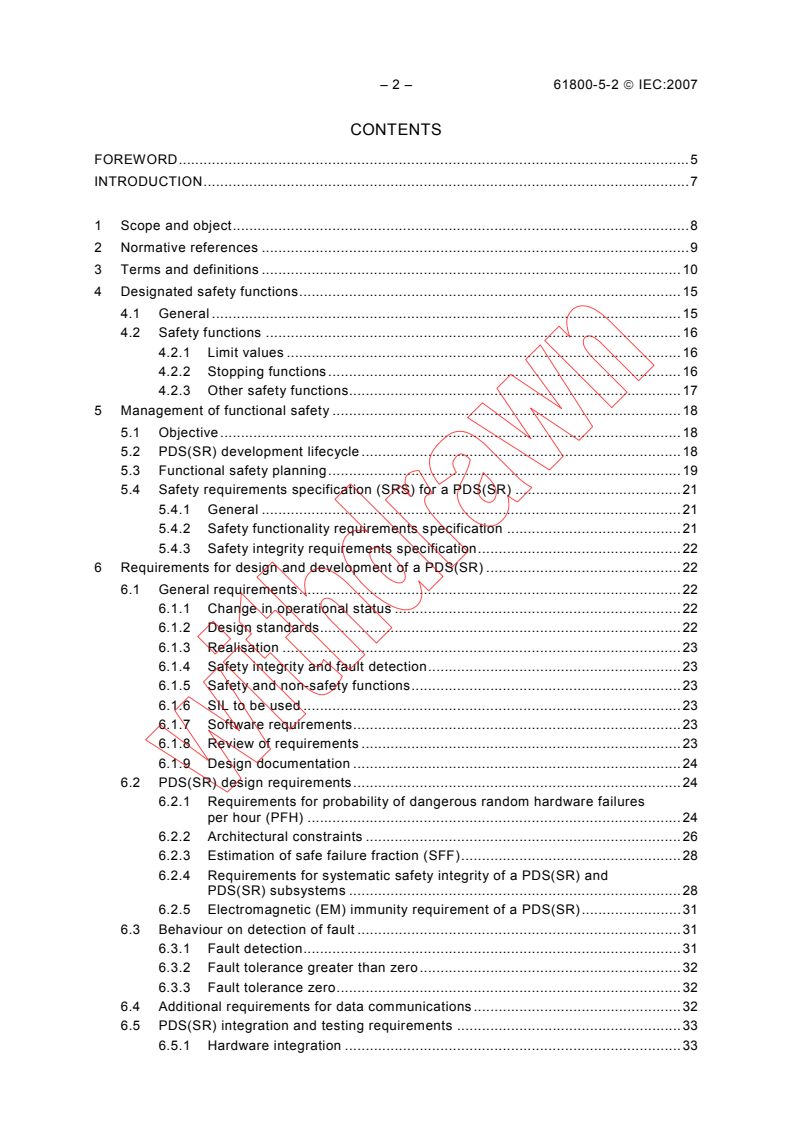
IEC 61800-5-2:2007 - Adjustable speed electrical power drive systems - Part 5-2: Safety requirements - Functional Released:7/16/2007
Overview
IEC 61800-5-2:2007, published by the International Electrotechnical Commission (IEC), specifies functional safety requirements for adjustable speed electrical power drive systems (PDS(SR)) used in safety-related applications. This standard provides essential guidance on the design, development, integration, and validation of PDS(SR)s with respect to functional safety, within the context and framework of IEC 61508. As a product-specific standard, IEC 61800-5-2 focuses on the safety performance of PDS(SR)s, ensuring their suitability as subsystems of an overall safety-related system in industrial environments.
Key Topics
- Functional Safety of PDS(SR)s: Establishes requirements and best practices in design and development, addressing both hardware and software elements within power drive systems for achieving functional safety.
- Safety Functions: Outlines various safety functions of PDS(SR)s, such as limit values, stopping functions, and integrated safety-related control mechanisms, essential for preventing hazardous conditions.
- Safety Requirements Specification (SRS): Provides a methodology for specifying the safety functions and their required performance, forming the foundation for integration and verification.
- Lifecycle Management: Details the PDS(SR) development lifecycle, from initial planning through design, integration, testing, validation, and eventual modification, emphasizing systematic approaches to managing functional safety.
- Design and Integration Requirements: Addresses architectural considerations, fault detection, electromagnetic immunity, and other factors impacting the reliability and integrity of PDS(SR)s.
Applications
IEC 61800-5-2 is widely applicable in sectors where adjustable speed electrical drive systems are used as part of safety-related control systems. Typical applications include:
- Industrial Automation and Machinery: Machine tools, robotics, production equipment, conveyors, cranes, and material handling systems rely on PDS(SR) for safe motion and process control.
- Process Industries: Used in equipment such as mixers, pumps, fans, papermaking machinery, rolling mills, cement kilns, and extrusion machines, where reliable drive systems are critical for maintaining safety during continuous operation.
- Integration with Safety Systems: Facilitates the integration of PDS(SR) into broader safety architectures using the principles of IEC 61508 and related sector standards (e.g., IEC 61511, IEC 61513, IEC 62061, ISO 13849).
By providing a consistent set of requirements and recommendations for functional safety, IEC 61800-5-2 enables manufacturers, control system integrators, and machinery designers to select, implement, and validate power drive systems that meet modern safety demands. Properly applied, this standard supports compliance, reduces risk, and fosters trust in automation and process safety.
Related Standards
When implementing IEC 61800-5-2:2007, consider alignment with the following international standards for comprehensive safety coverage:
- IEC 61508 series: Functional safety of electrical/electronic/programmable electronic safety-related systems
- IEC 61800-1/-2/-3/-4/-5-1: Various parts of the IEC 61800 series, covering general requirements, EMC, and other safety aspects of adjustable speed electric drive systems
- ISO 13849: Safety-related parts of control systems for machinery
- IEC 62061: Functional safety of safety-related control systems in machinery
- IEC 60204-1: Safety of machinery - Electrical equipment of machines
Practical Value
Applying IEC 61800-5-2 promotes:
- Reduced risk of hazardous failures in adjustable speed drive applications
- Standardized methods for functional safety throughout the drive system lifecycle
- Facilitated integration and interoperability with existing safety-related systems and international regulatory compliance
- Clear communication of safety-related capabilities between drive manufacturers, system integrators, and end users
For organizations involved in the deployment of adjustable speed electrical power drive systems, IEC 61800-5-2 is a vital reference to ensure functional safety and regulatory assurance in demanding and safety-critical environments.
Relations
- Referred By
EN ISO 19085-1:2017 - Woodworking machines - Safety - Part 1: Common requirements (ISO 19085-1:2017) - Effective Date
- 25-Aug-2026
- Effective Date
- 25-Aug-2026
- Referred By
EN ISO 28881:2022 - Machine tools - Safety - Electrical discharge machines (ISO 28881:2022) - Effective Date
- 25-Aug-2026
- Effective Date
- 25-Aug-2026
- Effective Date
- 25-Aug-2026
- Effective Date
- 25-Aug-2026
- Effective Date
- 25-Aug-2026
- Effective Date
- 25-Aug-2026
- Referred By
EN ISO 16089:2015 - Machine tools - Safety - Stationary grinding machines (ISO 16089:2015) - Effective Date
- 25-Aug-2026
- Effective Date
- 05-Sep-2023
Buy Documents
IEC 61800-5-2:2007 - Adjustable speed electrical power drive systems - Part 5-2: Safety requirements - Functional Released:7/16/2007
IEC 61800-5-2:2007 - Adjustable speed electrical power drive systems - Part 5-2: Safety requirements - Functional Released:7/16/2007
Get Certified
Connect with accredited certification bodies for this standard

IMQ S.p.A. (Certification)
Italian electrical product certification.

SLG Prüf- und Zertifizierungs GmbH
German testing and certification body.

UL Solutions
Global safety science company with testing, inspection and certification.
Sponsored listings
Frequently Asked Questions
IEC 61800-5-2:2007 is a standard published by the International Electrotechnical Commission (IEC). Its full title is "Adjustable speed electrical power drive systems - Part 5-2: Safety requirements - Functional". This standard covers: IEC 61800-5-2:2007 specifies requirements and makes recommendations for the design and development, integration and validation of PDS(SR)s in terms of their functional safety considerations. It applies to adjustable speed electric drive systems covered by the other parts of the IEC 61800 series of standards. IEC 61800-5-2, which is a product standard, sets out safety-related considerations of PDS(SR)s in terms of the framework of IEC 61508, and introduces requirements for PDS(SR)s as subsystems of a safety-related system. It is intended to facilitate the realisation of the electrical/electronic/programmable electronic (E/E/PE) elements of a PDS(SR) in relation to the safety performance of safety function(s) of a PDS.
IEC 61800-5-2:2007 specifies requirements and makes recommendations for the design and development, integration and validation of PDS(SR)s in terms of their functional safety considerations. It applies to adjustable speed electric drive systems covered by the other parts of the IEC 61800 series of standards. IEC 61800-5-2, which is a product standard, sets out safety-related considerations of PDS(SR)s in terms of the framework of IEC 61508, and introduces requirements for PDS(SR)s as subsystems of a safety-related system. It is intended to facilitate the realisation of the electrical/electronic/programmable electronic (E/E/PE) elements of a PDS(SR) in relation to the safety performance of safety function(s) of a PDS.
IEC 61800-5-2:2007 is classified under the following ICS (International Classification for Standards) categories: 13.110 - Safety of machinery; 29.130.99 - Other switchgear and controlgear; 29.200 - Rectifiers. Convertors. Stabilized power supply. The ICS classification helps identify the subject area and facilitates finding related standards.
IEC 61800-5-2:2007 has the following relationships with other standards: It is inter standard links to EN ISO 19085-1:2017, EN ISO 19085-6:2017, EN ISO 28881:2022, EN ISO 19085-8:2018, EN ISO 23125:2015, EN ISO 23125:2010, EN ISO 10218-2:2011, EN ISO 19085-9:2020, EN ISO 16089:2015, IEC 61800-5-2:2016. Understanding these relationships helps ensure you are using the most current and applicable version of the standard.
IEC 61800-5-2:2007 is available in PDF format for immediate download after purchase. The document can be added to your cart and obtained through the secure checkout process. Digital delivery ensures instant access to the complete standard document.
Standards Content (Sample)
INTERNATIONAL IEC
STANDARD 61800-5-2
First edition
2007-07
Adjustable speed electrical power drive systems –
Part 5-2:
Safety requirements –
Functional
Reference number
All rights reserved. Unless otherwise specified, no part of this publication may be reproduced or utilized in any form
or by any means, electronic or mechanical, including photocopying and microfilm, without permission in writing from
either IEC or IEC's member National Committee in the country of the requester.
If you have any questions about IEC copyright or have an enquiry about obtaining additional rights to this publication,
please contact the address below or your local IEC member National Committee for further information.
IEC Central Office
3, rue de Varembé
CH-1211 Geneva 20
Switzerland
Email: inmail@iec.ch
Web: www.iec.ch
About the IEC
The International Electrotechnical Commission (IEC) is the leading global organization that prepares and publishes
International Standards for all electrical, electronic and related technologies.
About IEC publications
The technical content of IEC publications is kept under constant review by the IEC. Please make sure that you have the
latest edition, a corrigenda or an amendment might have been published.
ƒ Catalogue of IEC publications: www.iec.ch/searchpub
The IEC on-line Catalogue enables you to search by a variety of criteria (reference number, text, technical committee,…).
It also gives information on projects, withdrawn and replaced publications.
ƒ IEC Just Published: www.iec.ch/online_news/justpub
Stay up to date on all new IEC publications. Just Published details twice a month all new publications released. Available
on-line and also by email.
ƒ Customer Service Centre: www.iec.ch/webstore/custserv
If you wish to give us your feedback on this publication or need further assistance, please visit the Customer Service
Centre FAQ or contact us:
Email:
csc@iec.ch
Tel.: +41 22 919 02 11
Fax: +41 22 919 03 00
INTERNATIONAL IEC
STANDARD 61800-5-2
First edition
2007-07
Adjustable speed electrical power drive systems –
Part 5-2:
Safety requirements –
Functional
PRICE CODE
Commission Electrotechnique Internationale XB
International Electrotechnical Commission
МеждународнаяЭлектротехническаяКомиссия
For price, see current catalogue
– 2 – 61800-5-2 © IEC:2007(E)
CONTENTS
FOREWORD.5
INTRODUCTION.7
1 Scope and object.8
2 Normative references .9
3 Terms and definitions .10
4 Designated safety functions.15
4.1 General .15
4.2 Safety functions .16
4.2.1 Limit values .16
4.2.2 Stopping functions.16
4.2.3 Other safety functions.17
5 Management of functional safety .18
5.1 Objective.18
5.2 PDS(SR) development lifecycle .18
5.3 Functional safety planning.19
5.4 Safety requirements specification (SRS) for a PDS(SR) .21
5.4.1 General .21
5.4.2 Safety functionality requirements specification .21
5.4.3 Safety integrity requirements specification.22
6 Requirements for design and development of a PDS(SR) .22
6.1 General requirements.22
6.1.1 Change in operational status .22
6.1.2 Design standards.22
6.1.3 Realisation .23
6.1.4 Safety integrity and fault detection.23
6.1.5 Safety and non-safety functions.23
6.1.6 SIL to be used .23
6.1.7 Software requirements.23
6.1.8 Review of requirements .23
6.1.9 Design documentation .24
6.2 PDS(SR) design requirements.24
6.2.1 Requirements for probability of dangerous random hardware failures
per hour (PFH) .24
6.2.2 Architectural constraints .26
6.2.3 Estimation of safe failure fraction (SFF).28
6.2.4 Requirements for systematic safety integrity of a PDS(SR) and
PDS(SR) subsystems .28
6.2.5 Electromagnetic (EM) immunity requirement of a PDS(SR).31
6.3 Behaviour on detection of fault .31
6.3.1 Fault detection.31
6.3.2 Fault tolerance greater than zero.32
6.3.3 Fault tolerance zero.32
6.4 Additional requirements for data communications.32
6.5 PDS(SR) integration and testing requirements .33
6.5.1 Hardware integration .33
61800-5-2 © IEC:2007(E) – 3 –
6.5.2 Software integration .33
6.5.3 Modifications during integration .33
6.5.4 Applicable integration tests.33
6.5.5 Test documentation .34
7 Information for use .34
7.1 Information and instructions for safe application of a PDS(SR) .34
8 Verification and validation .35
8.1 General .35
8.2 Verification .36
8.3 Validation .36
8.4 Documentation .36
9 Test requirements .36
9.1 Planning of tests .36
9.2 Test documentation.36
10 Modification.37
10.1 Objective.37
10.2 Requirements.37
10.2.1 Modification request .37
10.2.2 Impact analysis.37
10.2.3 Authorization .37
10.2.4 Documentation .37
Annex A (informative) Sequential task table.38
Annex B (informative) Example for determination of PFH .41
Annex C (informative) Available failure rate databases .52
Annex D (informative) Fault lists and fault exclusions .54
Bibliography.64
Figure 1 – Functional elements of a PDS(SR) .9
Figure 2 – PDS(SR) development lifecycle.19
Figure 3 – Architectures for data communication ( a) White channel; b) Black channel) .33
Figure B.1 – Example PDS(SR) .41
Figure B.2 – Subsystems of the PDS(SR) .42
Figure B.3 – Function blocks of subsystem A/B.43
Figure B.4 – Reliability model (Markov) of subsystem A/B.46
Figure B.5 – Function blocks of subsystem PS/VM.48
Figure B.6 – Reliability model (Markov) of subsystem PS/VM .50
Table 1 – Alphabetical list of definitions .11
Table 2 – Safety integrity levels: target failure measures for a PDS(SR) safety function .24
Table 3 – Hardware safety integrity: architectural constraints on type A safety-related
subsystems.27
Table 4 – Hardware safety integrity: architectural constraints on type B safety-related
subsystems.28
– 4 – 61800-5-2 © IEC:2007(E)
Table B.1 – Determination of DC factor of subsystem A/B.45
Table B.2 – PFH value calculation results for subsystem A/B.47
Table B.3 – Determination of DC factor of subsystem A/B.48
Table B.4 – PFH value calculation results for subsystem PS/VM.51
Table D.1 – Conductors/cables .55
Table D.2 – Printed wiring boards/assemblies.55
Table D.3 – Terminal block .56
Table D.4 – Multi-pin connector .56
Table D.5 – Electromechanical devices (for example relay, contactor relays).57
Table D.6 – Transformers .57
Table D.7 – Inductances .58
Table D.8 – Resistors .58
Table D.9 – Resistor networks .58
Table D.10 – Potentiometers.59
Table D.11 – Capacitors .59
Table D.12 – Discrete semiconductors (for example diodes, Zener diodes, transistors,
triacs, GTO thyristors, IGBTs, voltage regulators, quartz crystal, phototransistors, light-
emitting diodes [LEDs]).59
Table D.13 – Optocouplers .60
Table D.14 – Non-programmable integrated circuits.60
Table D.15 – Programmable and/or complex integrated circuits .61
Table D.16 – Motion and position feedback sensors .62
61800-5-2 © IEC:2007(E) – 5 –
INTERNATIONAL ELECTROTECHNICAL COMMISSION
___________
ADJUSTABLE SPEED ELECTRICAL
POWER DRIVE SYSTEMS –
Part 5-2: Safety requirements –
Functional
FOREWORD
1) The International Electrotechnical Commission (IEC) is a worldwide organization for standardization comprising
all national electrotechnical committees (IEC National Committees). The object of IEC is to promote
international co-operation on all questions concerning standardization in the electrical and electronic fields. To
this end and in addition to other activities, IEC publishes International Standards, Technical Specifications,
Technical Reports, Publicly Available Specifications (PAS) and Guides (hereafter referred to as “IEC
Publication(s)”). Their preparation is entrusted to technical committees; any IEC National Committee interested
in the subject dealt with may participate in this preparatory work. International, governmental and non-
governmental organizations liaising with the IEC also participate in this preparation. IEC collaborates closely
with the International Organization for Standardization (ISO) in accordance with conditions determined by
agreement between the two organizations.
2) The formal decisions or agreements of IEC on technical matters express, as nearly as possible, an international
consensus of opinion on the relevant subjects since each technical committee has representation from all
interested IEC National Committees.
3) IEC Publications have the form of recommendations for international use and are accepted by IEC National
Committees in that sense. While all reasonable efforts are made to ensure that the technical content of IEC
Publications is accurate, IEC cannot be held responsible for the way in which they are used or for any
misinterpretation by any end user.
4) In order to promote international uniformity, IEC National Committees undertake to apply IEC Publications
transparently to the maximum extent possible in their national and regional publications. Any divergence
between any IEC Publication and the corresponding national or regional publication shall be clearly indicated in
the latter.
5) IEC provides no marking procedure to indicate its approval and cannot be rendered responsible for any
equipment declared to be in conformity with an IEC Publication.
6) All users should ensure that they have the latest edition of this publication.
7) No liability shall attach to IEC or its directors, employees, servants or agents including individual experts and
members of its technical committees and IEC National Committees for any personal injury, property damage or
other damage of any nature whatsoever, whether direct or indirect, or for costs (including legal fees) and
expenses arising out of the publication, use of, or reliance upon, this IEC Publication or any other IEC
Publications.
8) Attention is drawn to the Normative references cited in this publication. Use of the referenced publications is
indispensable for the correct application of this publication.
9) Attention is drawn to the possibility that some of the elements of this IEC Publication may be the subject of
patent rights. IEC shall not be held responsible for identifying any or all such patent rights.
International Standard IEC 61800-5-2 has been prepared by subcommittee 22G: Adjustable
speed electric drive systems incorporating semiconductor power converters, of IEC technical
committee 22: Power electronic systems and equipment.
The text of this standard is based on the following documents:
FDIS Report on voting
22G/179/FDIS 22G/182/RVD
Full information on the voting for the approval of this standard can be found in the report on
voting indicated in the above table.
This publication has been drafted in accordance with the ISO/IEC Directives, Part 2.
– 6 – 61800-5-2 © IEC:2007(E)
A list of all parts of the IEC 61800 series, published under the general title Adjustable speed
electric drive systems, can be found on the IEC website.
The committee has decided that the contents of this publication will remain unchanged until
the maintenance result date indicated on the IEC web site under "http://webstore.iec.ch" in
the data related to the specific publication. At this date, the publication will be
• reconfirmed;
• withdrawn;
• replaced by a revised edition, or
• amended.
A bilingual version of this publication may be issued at a later date.
61800-5-2 © IEC:2007(E) – 7 –
INTRODUCTION
As a result of automation, demand for increased production and reduced operator physical
effort, control systems of machinery and plant items play an increasing role in the
achievement of overall safety. These control systems increasingly employ complex electrical/
electronic/programmable electronic devices and systems.
Prominent amongst these devices and systems are adjustable speed electrical power drive
systems (PDS) that are suitable for use in safety-related applications (PDS(SR)).
Examples of industrial applications are:
• machine tools, robots, production test equipment, test benches;
• papermaking machines, textile production machines, calendars in the rubber industry;
• process lines in plastics, chemicals or metal production, rolling-mills;
• cement crushing machines, cement kilns, mixers, centrifuges, extrusion machines;
• drilling machines;
• conveyors, materials handling machines, hoisting equipment (cranes, gantries, etc);
• pumps, fans, etc.
This standard can also be used as a reference for developers using PDS(SR) for other
applications.
Users of this standard should be aware that some type C standards for machinery currently
refer to ISO 13849-1 for safety-related control systems. In this case, PDS(SR) manufacturers
may be requested to provide further information (e.g. category and/or performance level) to
facilitate the integration of a PDS(SR) into the safety-related control systems of such
machinery.
NOTE ”Type C standards” are defined in ISO 12100-1 as machine safety standards dealing with detailed safety
requirements for a particular machine or group of machines.
Previously, in the absence of standards, there has been a reluctance to accept electronic, and
in particular programmable electronic, devices and systems in safety-related functions
because of uncertainty regarding the safety performance of such technology.
There are many situations where control systems that incorporate a PDS(SR) are employed,
for example as part of safety measures that have been provided to achieve risk reduction. A
typical case is guard interlocking in order to exclude personnel from hazards where access to
the danger zone is only possible when rotating parts have attained a safe condition. This part
of IEC 61800 gives a methodology to identify the contribution made by a PDS(SR) to
identified safety functions and to enable the appropriate design of the PDS(SR) and
verification that it meets the required performance.
Measures are given to co-ordinate the safety performance of the PDS(SR) with the intended
risk reduction taking into account the probabilities and consequences of its random and
systematic faults.
– 8 – 61800-5-2 © IEC:2007(E)
ADJUSTABLE SPEED ELECTRICAL
POWER DRIVE SYSTEMS –
Part 5-2: Safety requirements –
Functional
1 Scope and object
This part of IEC 61800 specifies requirements and makes recommendations for the design
and development, integration and validation of PDS(SR)s in terms of their functional safety
considerations. It applies to adjustable speed electric drive systems covered by the other
parts of the IEC 61800 series of standards.
NOTE 1 The term “integration” refers to the PDS(SR) itself, not to its incorporation into the safety-related
application.
This International Standard is only applicable where functional safety of a PDS(SR) is claimed
and the PDS(SR) is operating in the high demand or continuous mode (see 3.10). For low
demand applications, see IEC 61508.
This part of IEC 61800, which is a product standard, sets out safety-related considerations of
PDS(SR)s in terms of the framework of IEC 61508, and introduces requirements for
PDS(SR)s as subsystems of a safety-related system. It is intended to facilitate the realisation
of the electrical/electronic/ programmable electronic (E/E/PE) elements of a PDS(SR) in
relation to the safety performance of safety function(s) of a PDS.
Manufacturers and suppliers of PDS(SR)s by using the normative requirements of this part of
IEC 61800 will indicate to users (control system integrators, machinery and plant designers,
etc.) the safety performance for their equipment. This will facilitate the incorporation of a
PDS(SR) into a safety-related control system using the principles of IEC 61508, and possibly
its specific sector implementations (for example IEC 61511, IEC 61513, IEC 62061) or
ISO 13849.
Conformity with this part of IEC 61800 fulfils all the requirements of IEC 61508 that are
necessary for a PDS(SR).
This part of IEC 61800 does not specify requirements for:
• the hazard and risk analysis of a particular application;
• the identification of safety functions for that application;
• the initial allocation of SILs to those safety functions;
• the driven equipment except for interface arrangements;
• secondary hazards (for example from failure in a production or manufacturing process);
• the electrical, thermal and energy safety considerations, which are covered in
IEC 61800-5-1;
• the PDS(SR) manufacturing process;
• the validity of signals and commands to the PDS(SR).
NOTE 2 The functional safety requirements of a PDS(SR) are dependent on the application, and must be
considered as a part of the overall risk assessment of the installation. Where the supplier of the PDS(SR) is not
also responsible for the driven equipment, the installation designer is responsible for the risk assessment, and for
specifying the functional and safety integrity requirements of the PDS(SR).
61800-5-2 © IEC:2007(E) – 9 –
NOTE 3 Even though malevolent actions can influence the functional safety of PDS(SR), security aspects are not
considered in this standard.
This part of IEC 61800 only applies to PDS(SR)s implementing safety functions with a SIL not
greater than SIL 3.
Figure 1 shows the functional elements of a PDS(SR) that are considered in this part of
IEC 61800.
PDS(SR))
Control section
Diagnostic functions
Modulation
External signals
Communications Torque/speed/position
and
and control
and I/O control
protection
Sensors
Power section Motor
Power
IEC 1224/07
Figure 1 – Functional elements of a PDS(SR)
NOTE Figure 1 shows a logical representation of a PDS(SR) rather than its physical description.
2 Normative references
The following referenced documents are indispensable for the application of this document.
For dated references, only the edition cited applies. For undated references, the latest edition
of the referenced document (including any amendments) applies.
NOTE 1 This does not mean that compliance is required with all clauses of the referenced documents, but rather
that this document makes a reference that cannot be understood in the absence of the referenced documents.
NOTE 2 References to various parts of IEC 61508 are undated, except where specific clauses are indicated.
IEC 60204-1, Safety of machinery – Electrical equipment of machines – Part 1: General
requirements
IEC 61508 (all parts), Functional safety of electrical/electronic/programmable electronic
safety-related systems
IEC 61508-1:1998, Functional safety of electrical/electronic/programmable electronic safety-
related systems – Part 1: General requirements
IEC 61508-2:2000, Functional safety of electrical/electronic/programmable electronic safety-
related systems – Part 2: Requirements for electrical/electronic/programmable electronic
safety-related systems
– 10 – 61800-5-2 © IEC:2007(E)
IEC 61508-3:1998, Functional safety of electrical/electronic/programmable electronic safety-
related systems – Part 3: Software requirements
IEC 61508-5, Functional safety of electrical/electronic/programmable electronic safety-related
systems – Part 5: Examples of methods for the determination of safety integrity levels
IEC 61508-6:2000, Functional safety of electrical/electronic/programmable electronic safety-
related systems – Part 6: Guidelines on the application of IEC 61508-2 and IEC 61508-3
IEC 61508-7:2000, Functional safety of electrical/electronic/programmable electronic safety-
related systems – Part 7: Overview of techniques and measures
IEC 61800-1, Adjustable speed electrical power drive systems – Part 1: General requirements
– Rating specifications for low voltage adjustable speed d.c. power drive systems
IEC 61800-2, Adjustable speed electrical power drive systems – Part 2: General requirements
– Rating specifications for low voltage adjustable frequency a.c. power drive systems
IEC 61800-3, Adjustable speed electrical power drive systems – Part 3: EMC requirements
and specific test methods
IEC 61800-4, Adjustable speed electrical power drive systems – Part 4: General requirements
– Rating specifications for a.c. power drive systems above 1 000 V a.c. and not exceeding
35 kV
IEC 61800-5-1:2003, Adjustable speed electrical power drive systems – Part 5-1: Safety
requirements – Electrical, thermal and energy
IEC 62280 (all parts), Railway applications – Communication, signalling and processing
systems
3 Terms and definitions
For the purposes of this document, the following terms and definitions apply.
NOTE 1 For an alphabetical list of definitions, see Table 1.
61800-5-2 © IEC:2007(E) – 11 –
Table 1 – Alphabetical list of definitions
Term Definition Term Definition
number number
common cause failure 0 safe failure 3.17
dangerous failure 3.2 safe failure fraction (SFF) 3.18
diagnostic coverage (DC) 3.3 safety function(s) (of a PDS(SR)) 3.19
diagnostic test(s) 3.4 safety integrity 3.20
fault reaction function 3.5 safety integrity level (SIL) 3.21
functional safety 3.6 safety-related system 3.22
hazard 3.7 safety requirements specification (SRS) 3.23
installation 3.8 SIL capability 0
mission time 3.10 subsystem 3.25
mode of operation 3.11 systematic failure 3.26
PDS(SR) 3.14 systematic safety integrity 0
PFH 3.15 validation 3.25
proof test 3.16 verification 3.26
NOTE 2 Throughout this international standard, references to the following definitions are identified by writing
them in italic script.
3.1
common cause failure
failure, which is the result of one or more events, causing coincident failures of two or more
separate channels in a multiple channel system, leading to failure of the safety function
[IEC 61508-4:1998; definition 3.6.10]
3.2
dangerous failure
failure which has the potential to put the safety-related system in a hazardous or fail-to-
function state
[IEC 61508-4:1998; definition 3.6.7]
3.3
diagnostic coverage
DC
fractional decrease in the probability of dangerous hardware failures resulting from the
operation of the automatic diagnostic tests
[IEC 61508-4:1998; definition 3.8.6]
NOTE 1 This can also be expressed as the ratio of the sum of the detected dangerous failure rates λ to the
DD
sum of the total dangerous failure rates λ : DC = Σλ /Σλ .
D DD D
NOTE 2 Diagnostic coverage may exist for the whole or parts of a safety-related system. For example, diagnostic
coverage may exist for sensors and/or logic system and/or final elements.
3.4
diagnostic test(s)
test(s) intended to detect faults or failures and produce a specified output information or
activity when a fault or failure is detected
– 12 – 61800-5-2 © IEC:2007(E)
3.5
fault reaction function
function that is initiated when a fault or failure within the PDS(SR), which could cause a loss
of the safety function, is detected, and which is intended to maintain the safe condition of the
installation or prevent hazardous conditions arising at the installation
3.6
functional safety
part of the overall safety relating to the EUC (equipment under control) and the EUC control
system which depends on the correct functioning of the E/E/PE (electrical/electronic/
programmable electronic) safety-related systems, other technology safety-related systems
and external risk reduction facilities
[IEC 61508-4:1998; definition 3.1.9]
NOTE This standard only considers those aspects in the definition of functional safety that depend on the correct
functioning of the PDS(SR).
3.7
hazard
potential source of harm
[ISO/IEC Guide 51:1999, definition 3.5]
NOTE 1 The term includes danger to persons arising within a short time scale (for example, fire and explosion)
and also those that have a long-term effect on a person’s health (for example, release of a toxic substance).
NOTE 2 IEC 61508-4:1998 (modified) defines hazardous situation as: circumstance in which people, property or
the environment are exposed to one or more hazards or hazardous events.
3.8
installation
equipment or equipments including at least the PDS(SR) and the driven equipment
NOTE: The word “installation” is also used in this international standard to denote the process of installing a
PDS(SR). In these cases, the word does not appear in italics.
3.9
mission time
specified cumulative operating time of the PDS(SR) during its overall lifetime
3.10
mode of operation
way in which a safety-related system is intended to be used, with respect to the frequency of
demands made upon it
[IEC 61508-4:1998; definition 3.5.12, modified]
NOTE 1 Two modes of operation are considered in IEC 61508:
- low demand mode: where the frequency of demands for operation made on a safety-related system is no
greater than one per year and no greater than twice the proof-test frequency;
- high demand or continuous mode: where the frequency of demands for operation made on a safety-related
system is greater than one per year or greater than twice the proof-test frequency.
The low demand mode of operation is not generally considered to be relevant for PDS(SR) applications. Therefore,
in this standard, PDS(SR)s are only considered to operate in the high demand or continuous mode.
NOTE 2 Demand mode means that a safety function is only performed on request (demand) in order to transfer
the installation into a specified state.
NOTE 3 Continuous mode means that a safety function is performed continuously, i.e. the PDS(SR) is
continuously controlling the installation and a (dangerous) failure of its function can result in a hazard.
61800-5-2 © IEC:2007(E) – 13 –
3.11
PDS(SR)
adjustable speed electrical power drive system suitable for use in safety-related applications
3.12
PFH
probability of a dangerous random hardware failure per hour
NOTE in IEC 62061:2005, the abbreviation PFH is used.
D
3.13
proof test
periodic test performed to detect faults in a safety-related system so that, if necessary, the
system can be restored to an “as new” condition or as close as practical to this condition
NOTE Proof tests are normally undertaken to reveal dangerous faults which are undetected by diagnostic tests.
The effectiveness of the proof test will be dependent upon how close to the “as new” condition the system is
restored. For the proof test to be fully effective, it will be necessary to detect 100 % of all dangerous faults.
Although, in practice, 100 % is not easily achieved for other than low-complexity systems, this should be the target.
[IEC 61508-4:1998; definition 3.8.5, modified]
3.14
safe failure
failure which does not have the potential to put the safety-related system in a hazardous or
fail-to-function state
(IEC 61508-4:1998; definition 3.6.8)
3.15
safe failure fraction
SFF
ratio of the average rate of safe failures plus detected dangerous failures of a PDS(SR)
subsystem to the total average failure rate of that subsystem
SFF = (Σλ + Σλ )/(Σλ + Σλ ).
S DD S D
NOTE See Annex C of IEC 61508-2:2000.
3.16
safety function(s) (of a PDS(SR))
function(s) with a specified safety performance, to be implemented in whole or in part by a
PDS(SR), which is(are) intended to maintain the safe condition of the installation or prevent
hazardous conditions arising at the installation
3.17
safety integrity
probability of a PDS(SR) satisfactorily performing a required safety function under all stated
conditions
NOTE 1 The higher the level of safety integrity of the PDS(SR)(s), the lower the probability that the PDS(SR)(s)
will fail to carry out the required safety function.
NOTE 2 The safety integrity may not be the same for each safety function performed by the PDS(SR).
(IEC 61508-4:1998; definition 3.5.2, modified)
3.18
safety integrity level
SIL
discrete level (one out of a possible four) for specifying the safety integrity requirements of a
safety function allocated (in whole or in part) to a PDS(SR)
– 14 – 61800-5-2 © IEC:2007(E)
NOTE 1 SIL 4 has the highest level of safety integrity and SIL 1 has the lowest.
NOTE 2 SIL 4 is not considered in this standard as it is not relevant to the risk reduction requirements normally
associated with PDS(SR)s. For requirements applicable to SIL 4, see IEC 61508.
(IEC 61508-4:1998; definition 3.5.6, modified)
3.19
safety-related system
designated system that both
− implements the required safety functions necessary to achieve or maintain a safe state for
the EUC; and
− is intended to achieve, on its own or with other E/E/PE safety-related systems, other
technology safety-related systems or external risk reduction facilities, the necessary
safety integrity for the required safety functions
3.20
safety requirements specification
SRS
specification containing all the requirements of the safety functions that have to be performed
by the PDS(SR)
3.21
SIL capability
maximum SIL that can be claimed to have been achieved by the design of a PDS(SR) in
terms of the systematic safety integrity and the architectural constraints on hardware safety
integrity
NOTE Each of the designated safety functions that a PDS(SR) is intended to perform can be associated with a
different SIL capability.
3.22
subsystem
part of the top-level architectural design of a safety-related system, failure of which results in
failure of a safety function
NOTE 1 A PDS(SR) can itself be a subsystem, or be made up from a number of separate subsystems, which
when put together implement the safety function under consideration. A subsystem can have more than one
channel.
NOTE 2 Examples of subsystems of a PDS(SR) are encoder, power section, control section (see Figure 1).
3.23
systematic failure
failure related in a deterministic way to a certain cause, which can only be eliminated by a
modification of the design or of the manufacturing process, operational procedures,
documentation or other relevant factors
NOTE Examples of causes of systematic failures include human error in:
ƒ the safety requirements specification;
ƒ the design, manufacture, installation, operation of the hardware;
ƒ the design, implementation of the software.
(IEC 61508-4:1998; definition 3.6.6)
3.24
systematic safety integrity
part of the safety integrity of safety-related systems relating to systematic failures in a
dangerous mode of failure
(IEC 61508-4:1998; definition 3.5.4)
61800-5-2 © IEC:2007(E) – 15 –
NOTE Systematic safety integrity cannot usually be quantified.
3.25
validation
confirmation by examination and provision of objective evidence that the particular
requirements for a specific intended use are fulfilled
(IEC 61508-4:1998; definition 3.8.2)
NOTE Validation is the activity of demonstrating that the PDS(SR), before or after installation, meets in all
respects the safety requirements specification.
3.26
verification
confirmation by examination and provision of objective evidence that the requirements have
been fulfilled
(IEC 61508-4:1998; definition 3.8.1)
4 Designated safety functions
4.1 General
This clause describes functions of a PDS(SR) that may be designated as safety-related by the
PDS(SR) supplier. The designated safety functions in this clause are not considered to form
an exhaustive list. In some cases, further safety-related systems external to the PDS(SR) (for
example a mechanical brake) may be necessary to maintain the safe condition when electrical
power is removed.
The technical measures required to implement these functions depend on the SIL capability
and the required probability of dangerous hardware failure, as indicated in the safety
requirements specification. The technical measures are described in Clause 6.
Each safety function may require safe input and/or output signalling in order to accomplish
necessary communication with (or activation of) other functions, subsystems or systems
(which may or may not be safety-related). The integrity of the interfaces shall be included in
the determination of the SIL of the associated safety function.
Some of the safety functions perform monitoring tasks only, some perform a safety relevant
control or other actions. Therefore, a distinction must be made between:
− the reaction on violation of limits (only relevant for monitoring functions):
the reaction function when a violation of limits is detected during the correct operation of
the safety function; and
− the fault reaction function:
the reaction function when diagnostics detect a fault within the safety function.
Both reaction functions shall take into account the possible safe states for the application.
On selecting the appropriate reaction function, it has to be considered that parts of the
PDS(SR) may not be functioning.
Timing requirements for the actions required following detection of a fault are specified in the
safety requirements specification (see 5.4.2).
The names of the safety functions include the words “safe” or “safely” to indicate that these
functions may be used in a safety-related application on the grounds of a judgement (i.e. risk
– 16 – 61800-5-2 © IEC:2007(E)
analysis) of that specific application, resulting in safety-relevant functions and their integrity to
be performed by the PDS(SR).
4.2 Safety functions
4.2.1 Limit values
Where a safety function relies on limit value(s) for any parameter(s), the maximum
tolerance(s) for the limit value(s) shall be defined.
NOTE Specification of any limit value should take into account possible exceeding of the limit value in case of
violation of the limit. For example, specification of the position limit value(s) in 4.2.3.8 should take into account the
maximum allowable overtravel distance(s).
A particular safety function may have one or more specified limit values, which can be
selected during operation.
4.2.2 Stopping functions
4.2.2.1 General
A variety of stopping methods is available for every type of PDS.
The control requirements for initiating the stopping sequence and maintaining a hold mode
upon reaching standstill are application-specific. Separate manual operations and
connections to control circuits may be necessary to achieve the desired performance of the
stop functions.
Any particular requirements for stopping performance should be specified by the installation
designer. The following examples of stop functions are often used in practice.
4.2.2.2 Safe torque off (STO)
Power, that can cause rotation (or motion in the case of a linear motor), is not applied to the
motor. The PDS(SR) will not provide energy to the motor which can generate torque (or force
in the case of a linear motor).
NOTE 1 This safety function corresponds to an uncontrolled stop in accordance with stop category 0 of
IEC 60204-1.
NOTE 2 This safety function may be used where power removal is required to prevent an unexpected start-up.
NOTE 3 In circumstances where external influences (for example, falling of suspended loads) are present,
additional measures (for example, mechanical brakes) may be necessary to prevent any hazard.
NOTE 4 Electronic means and contactors are not adequate for protection against electric shock, and additional
measures for isolation may be necessary.
4.2.2.3 Safe stop 1 (SS1)
The PDS(SR) either
a) initiates and controls the motor deceleration rate within set limits to stop the motor and
initiates the STO function (see 4.2.2.2) when the motor speed is below a specified limit; or
b) initiates and monitors the motor deceleration rate within set limits to stop the motor and
initiates the STO function when the motor speed is below a specified limit; or
c) initiates the motor deceleration and initiates the STO function after an application specific
time delay.
NOTE This safety function corresponds to a controlled stop in accordance wit
...
IEC 61800-5-2 ®
Edition 1.0 2007-07
INTERNATIONAL
STANDARD
NORME
INTERNATIONALE
colour
inside
Adjustable speed electrical power drive systems –
Part 5-2: Safety requirements – Functional
Entraînements électriques de puissance à vitesse variable –
Partie 5-2: Exigences de sécurité – Fonctionnelle
All rights reserved. Unless otherwise specified, no part of this publication may be reproduced or utilized in any form
or by any means, electronic or mechanical, including photocopying and microfilm, without permission in writing from
either IEC or IEC's member National Committee in the country of the requester.
If you have any questions about IEC copyright or have an enquiry about obtaining additional rights to this publication,
please contact the address below or your local IEC member National Committee for further information.
Droits de reproduction réservés. Sauf indication contraire, aucune partie de cette publication ne peut être reproduite ni
utilisée sous quelque forme que ce soit et par aucun procédé, électronique ou mécanique, y compris la photocopie et les
microfilms, sans l'accord écrit de la CEI ou du Comité national de la CEI du pays du demandeur.
Si vous avez des questions sur le copyright de la CEI ou si vous désirez obtenir des droits supplémentaires sur cette
publication, utilisez les coordonnées ci-après ou contactez le Comité national de la CEI de votre pays de résidence.
IEC Central Office Tel.: +41 22 919 02 11
3, rue de Varembé Fax: +41 22 919 03 00
CH-1211 Geneva 20 info@iec.ch
Switzerland www.iec.ch
About the IEC
The International Electrotechnical Commission (IEC) is the leading global organization that prepares and publishes
International Standards for all electrical, electronic and related technologies.
About IEC publications
The technical content of IEC publications is kept under constant review by the IEC. Please make sure that you have the
latest edition, a corrigenda or an amendment might have been published.
Useful links:
IEC publications search - www.iec.ch/searchpub Electropedia - www.electropedia.org
The advanced search enables you to find IEC publications The world's leading online dictionary of electronic and
by a variety of criteria (reference number, text, technical electrical terms containing more than 30 000 terms and
committee,…). definitions in English and French, with equivalent terms in
It also gives information on projects, replaced and additional languages. Also known as the International
withdrawn publications. Electrotechnical Vocabulary (IEV) on-line.
IEC Just Published - webstore.iec.ch/justpublished Customer Service Centre - webstore.iec.ch/csc
Stay up to date on all new IEC publications. Just Published If you wish to give us your feedback on this publication
details all new publications released. Available on-line and or need further assistance, please contact the
also once a month by email. Customer Service Centre: csc@iec.ch.
A propos de la CEI
La Commission Electrotechnique Internationale (CEI) est la première organisation mondiale qui élabore et publie des
Normes internationales pour tout ce qui a trait à l'électricité, à l'électronique et aux technologies apparentées.
A propos des publications CEI
Le contenu technique des publications de la CEI est constamment revu. Veuillez vous assurer que vous possédez
l’édition la plus récente, un corrigendum ou amendement peut avoir été publié.
Liens utiles:
Recherche de publications CEI - www.iec.ch/searchpub Electropedia - www.electropedia.org
La recherche avancée vous permet de trouver des Le premier dictionnaire en ligne au monde de termes
publications CEI en utilisant différents critères (numéro de électroniques et électriques. Il contient plus de 30 000
référence, texte, comité d’études,…). termes et définitions en anglais et en français, ainsi que
Elle donne aussi des informations sur les projets et les les termes équivalents dans les langues additionnelles.
publications remplacées ou retirées. Egalement appelé Vocabulaire Electrotechnique
International (VEI) en ligne.
Just Published CEI - webstore.iec.ch/justpublished
Service Clients - webstore.iec.ch/csc
Restez informé sur les nouvelles publications de la CEI.
Just Published détaille les nouvelles publications parues. Si vous désirez nous donner des commentaires sur
Disponible en ligne et aussi une fois par mois par email. cette publication ou si vous avez des questions
contactez-nous: csc@iec.ch.
IEC 61800-5-2 ®
Edition 1.0 2007-07
INTERNATIONAL
STANDARD
NORME
INTERNATIONALE
colour
inside
Adjustable speed electrical power drive systems –
Part 5-2: Safety requirements – Functional
Entraînements électriques de puissance à vitesse variable –
Partie 5-2: Exigences de sécurité – Fonctionnelle
INTERNATIONAL
ELECTROTECHNICAL
COMMISSION
COMMISSION
ELECTROTECHNIQUE
PRICE CODE
INTERNATIONALE
CODE PRIX XB
ICS 13.110; 29.200 ISBN 978-2-83220-595-2
– 2 – 61800-5-2 IEC:2007
CONTENTS
FOREWORD . 5
INTRODUCTION . 7
1 Scope and object . 8
2 Normative references . 9
3 Terms and definitions . 10
4 Designated safety functions . 15
4.1 General . 15
4.2 Safety functions . 16
4.2.1 Limit values . 16
4.2.2 Stopping functions . 16
4.2.3 Other safety functions. 17
5 Management of functional safety . 18
5.1 Objective . 18
5.2 PDS(SR) development lifecycle . 18
5.3 Functional safety planning . 19
5.4 Safety requirements specification (SRS) for a PDS(SR) . 21
5.4.1 General . 21
5.4.2 Safety functionality requirements specification . 21
5.4.3 Safety integrity requirements specification . 22
6 Requirements for design and development of a PDS(SR) . 22
6.1 General requirements . 22
6.1.1 Change in operational status . 22
6.1.2 Design standards. 22
6.1.3 Realisation . 23
6.1.4 Safety integrity and fault detection . 23
6.1.5 Safety and non-safety functions . 23
6.1.6 SIL to be used . 23
6.1.7 Software requirements . 23
6.1.8 Review of requirements . 23
6.1.9 Design documentation . 24
6.2 PDS(SR) design requirements . 24
6.2.1 Requirements for probability of dangerous random hardware failures
per hour (PFH) . 24
6.2.2 Architectural constraints . 26
6.2.3 Estimation of safe failure fraction (SFF) . 28
6.2.4 Requirements for systematic safety integrity of a PDS(SR) and
PDS(SR) subsystems . 28
6.2.5 Electromagnetic (EM) immunity requirement of a PDS(SR) . 31
6.3 Behaviour on detection of fault . 31
6.3.1 Fault detection . 31
6.3.2 Fault tolerance greater than zero . 32
6.3.3 Fault tolerance zero . 32
6.4 Additional requirements for data communications . 32
6.5 PDS(SR) integration and testing requirements . 33
6.5.1 Hardware integration . 33
61800-5-2 IEC:2007 – 3 –
6.5.2 Software integration . 33
6.5.3 Modifications during integration . 33
6.5.4 Applicable integration tests . 33
6.5.5 Test documentation . 34
7 Information for use . 34
7.1 Information and instructions for safe application of a PDS(SR) . 34
8 Verification and validation . 35
8.1 General . 35
8.2 Verification . 36
8.3 Validation . 36
8.4 Documentation . 36
9 Test requirements . 36
9.1 Planning of tests . 36
9.2 Test documentation . 36
10 Modification . 37
10.1 Objective . 37
10.2 Requirements . 37
10.2.1 Modification request . 37
10.2.2 Impact analysis. 37
10.2.3 Authorization . 37
10.2.4 Documentation . 37
Annex A (informative) Sequential task table . 38
Annex B (informative) Example for determination of PFH . 41
Annex C (informative) Available failure rate databases . 52
Annex D (informative) Fault lists and fault exclusions . 54
Bibliography . 64
Figure 1 – Functional elements of a PDS(SR) . 9
Figure 2 – PDS(SR) development lifecycle . 19
Figure 3 – Architectures for data communication ( a) White channel; b) Black channel) . 33
Figure B.1 – Example PDS(SR) . 41
Figure B.2 – Subsystems of the PDS(SR) . 42
Figure B.3 – Function blocks of subsystem A/B . 43
Figure B.4 – Reliability model (Markov) of subsystem A/B . 46
Figure B.5 – Function blocks of subsystem PS/VM. 48
Figure B.6 – Reliability model (Markov) of subsystem PS/VM . 50
Table 1 – Alphabetical list of definitions . 11
Table 2 – Safety integrity levels: target failure measures for a PDS(SR) safety function . 24
Table 3 – Hardware safety integrity: architectural constraints on type A safety-related
subsystems . 27
Table 4 – Hardware safety integrity: architectural constraints on type B safety-related
subsystems . 28
– 4 – 61800-5-2 IEC:2007
Table B.1 – Determination of DC factor of subsystem A/B . 45
Table B.2 – PFH value calculation results for subsystem A/B . 47
Table B.3 – Determination of DC factor of subsystem A/B . 48
Table B.4 – PFH value calculation results for subsystem PS/VM . 51
Table D.1 – Conductors/cables . 55
Table D.2 – Printed wiring boards/assemblies . 55
Table D.3 – Terminal block . 56
Table D.4 – Multi-pin connector . 56
Table D.5 – Electromechanical devices (for example relay, contactor relays) . 57
Table D.6 – Transformers . 57
Table D.7 – Inductances . 58
Table D.8 – Resistors . 58
Table D.9 – Resistor networks . 58
Table D.10 – Potentiometers. 59
Table D.11 – Capacitors . 59
Table D.12 – Discrete semiconductors (for example diodes, Zener diodes, transistors,
triacs, GTO thyristors, IGBTs, voltage regulators, quartz crystal, phototransistors, light-
emitting diodes [LEDs]) . 59
Table D.13 – Optocouplers . 60
Table D.14 – Non-programmable integrated circuits . 60
Table D.15 – Programmable and/or complex integrated circuits . 61
Table D.16 – Motion and position feedback sensors . 62
61800-5-2 IEC:2007 – 5 –
INTERNATIONAL ELECTROTECHNICAL COMMISSION
___________
ADJUSTABLE SPEED ELECTRICAL
POWER DRIVE SYSTEMS –
Part 5-2: Safety requirements –
Functional
FOREWORD
1) The International Electrotechnical Commission (IEC) is a worldwide organization for standardization comprising
all national electrotechnical committees (IEC National Committees). The object of IEC is to promote
international co-operation on all questions concerning standardization in the electrical and electronic fields. To
this end and in addition to other activities, IEC publishes International Standards, Technical Specifications,
Technical Reports, Publicly Available Specifications (PAS) and Guides (hereafter referred to as “IEC
Publication(s)”). Their preparation is entrusted to technical committees; any IEC National Committee interested
in the subject dealt with may participate in this preparatory work. International, governmental and non-
governmental organizations liaising with the IEC also participate in this preparation. IEC collaborates closely
with the International Organization for Standardization (ISO) in accordance with conditions determined by
agreement between the two organizations.
2) The formal decisions or agreements of IEC on technical matters express, as nearly as possible, an international
consensus of opinion on the relevant subjects since each technical committee has representation from all
interested IEC National Committees.
3) IEC Publications have the form of recommendations for international use and are accepted by IEC National
Committees in that sense. While all reasonable efforts are made to ensure that the technical content of IEC
Publications is accurate, IEC cannot be held responsible for the way in which they are used or for any
misinterpretation by any end user.
4) In order to promote international uniformity, IEC National Committees undertake to apply IEC Publications
transparently to the maximum extent possible in their national and regional publications. Any divergence
between any IEC Publication and the corresponding national or regional publication shall be clearly indicated in
the latter.
5) IEC provides no marking procedure to indicate its approval and cannot be rendered responsible for any
equipment declared to be in conformity with an IEC Publication.
6) All users should ensure that they have the latest edition of this publication.
7) No liability shall attach to IEC or its directors, employees, servants or agents including individual experts and
members of its technical committees and IEC National Committees for any personal injury, property damage or
other damage of any nature whatsoever, whether direct or indirect, or for costs (including legal fees) and
expenses arising out of the publication, use of, or reliance upon, this IEC Publication or any other IEC
Publications.
8) Attention is drawn to the Normative references cited in this publication. Use of the referenced publications is
indispensable for the correct application of this publication.
9) Attention is drawn to the possibility that some of the elements of this IEC Publication may be the subject of
patent rights. IEC shall not be held responsible for identifying any or all such patent rights.
International Standard IEC 61800-5-2 has been prepared by subcommittee 22G: Adjustable
speed electric drive systems incorporating semiconductor power converters, of IEC technical
committee 22: Power electronic systems and equipment.
This bilingual version (2013-01) corresponds to the monolingual English version, published in
2007-07.
The text of this standard is based on the following documents:
FDIS Report on voting
22G/179/FDIS 22G/182/RVD
Full information on the voting for the approval of this standard can be found in the report on
voting indicated in the above table.
– 6 – 61800-5-2 IEC:2007
The French version of this standard has not been voted upon.
This publication has been drafted in accordance with the ISO/IEC Directives, Part 2.
A list of all parts of the IEC 61800 series, published under the general title Adjustable speed
electric drive systems, can be found on the IEC website.
The committee has decided that the contents of this publication will remain unchanged until
the maintenance result date indicated on the IEC web site under "http://webstore.iec.ch" in
the data related to the specific publication. At this date, the publication will be
• reconfirmed;
• withdrawn;
• replaced by a revised edition, or
• amended.
IMPORTANT – The 'colour inside' logo on the cover page of this publication indicates
that it contains colours which are considered to be useful for the correct
understanding of its contents. Users should therefore print this document using a
colour printer.
61800-5-2 IEC:2007 – 7 –
INTRODUCTION
As a result of automation, demand for increased production and reduced operator physical
effort, control systems of machinery and plant items play an increasing role in the
achievement of overall safety. These control systems increasingly employ complex electrical/
electronic/programmable electronic devices and systems.
Prominent amongst these devices and systems are adjustable speed electrical power drive
systems (PDS) that are suitable for use in safety-related applications (PDS(SR)).
Examples of industrial applications are:
• machine tools, robots, production test equipment, test benches;
• papermaking machines, textile production machines, calendars in the rubber industry;
• process lines in plastics, chemicals or metal production, rolling-mills;
• cement crushing machines, cement kilns, mixers, centrifuges, extrusion machines;
• drilling machines;
• conveyors, materials handling machines, hoisting equipment (cranes, gantries, etc);
• pumps, fans, etc.
This standard can also be used as a reference for developers using PDS(SR) for other
applications.
Users of this standard should be aware that some type C standards for machinery currently
refer to ISO 13849-1 for safety-related control systems. In this case, PDS(SR) manufacturers
may be requested to provide further information (e.g. category and/or performance level) to
facilitate the integration of a PDS(SR) into the safety-related control systems of such
machinery.
NOTE ”Type C standards” are defined in ISO 12100-1 as machine safety standards dealing with detailed safety
requirements for a particular machine or group of machines.
Previously, in the absence of standards, there has been a reluctance to accept electronic, and
in particular programmable electronic, devices and systems in safety-related functions
because of uncertainty regarding the safety performance of such technology.
There are many situations where control systems that incorporate a PDS(SR) are employed,
for example as part of safety measures that have been provided to achieve risk reduction. A
typical case is guard interlocking in order to exclude personnel from hazards where access to
the danger zone is only possible when rotating parts have attained a safe condition. This part
of IEC 61800 gives a methodology to identify the contribution made by a PDS(SR) to
identified safety functions and to enable the appropriate design of the PDS(SR) and
verification that it meets the required performance.
Measures are given to co-ordinate the safety performance of the PDS(SR) with the intended
risk reduction taking into account the probabilities and consequences of its random and
systematic faults.
– 8 – 61800-5-2 IEC:2007
ADJUSTABLE SPEED ELECTRICAL
POWER DRIVE SYSTEMS –
Part 5-2: Safety requirements –
Functional
1 Scope and object
This part of IEC 61800 specifies requirements and makes recommendations for the design
and development, integration and validation of PDS(SR)s in terms of their functional safety
considerations. It applies to adjustable speed electric drive systems covered by the other
parts of the IEC 61800 series of standards.
NOTE 1 The term “integration” refers to the PDS(SR) itself, not to its incorporation into the safety-related
application.
This International Standard is only applicable where functional safety of a PDS(SR) is claimed
and the PDS(SR) is operating in the high demand or continuous mode (see 3.10). For low
demand applications, see IEC 61508.
This part of IEC 61800, which is a product standard, sets out safety-related considerations of
PDS(SR)s in terms of the framework of IEC 61508, and introduces requirements for
PDS(SR)s as subsystems of a safety-related system. It is intended to facilitate the realisation
of the electrical/electronic/ programmable electronic (E/E/PE) elements of a PDS(SR) in
relation to the safety performance of safety function(s) of a PDS.
Manufacturers and suppliers of PDS(SR)s by using the normative requirements of this part of
IEC 61800 will indicate to users (control system integrators, machinery and plant designers,
etc.) the safety performance for their equipment. This will facilitate the incorporation of a
PDS(SR) into a safety-related control system using the principles of IEC 61508, and possibly
its specific sector implementations (for example IEC 61511, IEC 61513, IEC 62061) or
ISO 13849.
Conformity with this part of IEC 61800 fulfils all the requirements of IEC 61508 that are
necessary for a PDS(SR).
This part of IEC 61800 does not specify requirements for:
• the hazard and risk analysis of a particular application;
• the identification of safety functions for that application;
• the initial allocation of SILs to those safety functions;
• the driven equipment except for interface arrangements;
• secondary hazards (for example from failure in a production or manufacturing process);
• the electrical, thermal and energy safety considerations, which are covered in
IEC 61800-5-1;
• the PDS(SR) manufacturing process;
• the validity of signals and commands to the PDS(SR).
NOTE 2 The functional safety requirements of a PDS(SR) are dependent on the application, and must be
considered as a part of the overall risk assessment of the installation. Where the supplier of the PDS(SR) is not
also responsible for the driven equipment, the installation designer is responsible for the risk assessment, and for
specifying the functional and safety integrity requirements of the PDS(SR).
61800-5-2 IEC:2007 – 9 –
NOTE 3 Even though malevolent actions can influence the functional safety of PDS(SR), security aspects are not
considered in this standard.
This part of IEC 61800 only applies to PDS(SR)s implementing safety functions with a SIL not
greater than SIL 3.
Figure 1 shows the functional elements of a PDS(SR) that are considered in this part of
IEC 61800.
PDS(SR))
Control section
Diagnostic functions
Modulation
External signals
Communications Torque/speed/position
and
and control
and I/O control
protection
Sensors
Power section Motor
Power
IEC 1224/07
Figure 1 – Functional elements of a PDS(SR)
NOTE Figure 1 shows a logical representation of a PDS(SR) rather than its physical description.
2 Normative references
The following referenced documents are indispensable for the application of this document.
For dated references, only the edition cited applies. For undated references, the latest edition
of the referenced document (including any amendments) applies.
NOTE 1 This does not mean that compliance is required with all clauses of the referenced documents, but rather
that this document makes a reference that cannot be understood in the absence of the referenced documents.
NOTE 2 References to various parts of IEC 61508 are undated, except where specific clauses are indicated.
IEC 60204-1, Safety of machinery – Electrical equipment of machines – Part 1: General
requirements
IEC 61508 (all parts), Functional safety of electrical/electronic/programmable electronic
safety-related systems
IEC 61508-1:1998, Functional safety of electrical/electronic/programmable electronic safety-
related systems – Part 1: General requirements
IEC 61508-2:2000, Functional safety of electrical/electronic/programmable electronic safety-
related systems – Part 2: Requirements for electrical/electronic/programmable electronic
safety-related systems
– 10 – 61800-5-2 IEC:2007
IEC 61508-3:1998, Functional safety of electrical/electronic/programmable electronic safety-
related systems – Part 3: Software requirements
IEC 61508-5, Functional safety of electrical/electronic/programmable electronic safety-related
systems – Part 5: Examples of methods for the determination of safety integrity levels
IEC 61508-6:2000, Functional safety of electrical/electronic/programmable electronic safety-
related systems – Part 6: Guidelines on the application of IEC 61508-2 and IEC 61508-3
IEC 61508-7:2000, Functional safety of electrical/electronic/programmable electronic safety-
related systems – Part 7: Overview of techniques and measures
IEC 61800-1, Adjustable speed electrical power drive systems – Part 1: General requirements
– Rating specifications for low voltage adjustable speed d.c. power drive systems
IEC 61800-2, Adjustable speed electrical power drive systems – Part 2: General requirements
– Rating specifications for low voltage adjustable frequency a.c. power drive systems
IEC 61800-3, Adjustable speed electrical power drive systems – Part 3: EMC requirements
and specific test methods
IEC 61800-4, Adjustable speed electrical power drive systems – Part 4: General requirements
– Rating specifications for a.c. power drive systems above 1 000 V a.c. and not exceeding
35 kV
IEC 61800-5-1:2003, Adjustable speed electrical power drive systems – Part 5-1: Safety
requirements – Electrical, thermal and energy
IEC 62280 (all parts), Railway applications – Communication, signalling and processing
systems
3 Terms and definitions
For the purposes of this document, the following terms and definitions apply.
NOTE 1 For an alphabetical list of definitions, see Table 1.
61800-5-2 IEC:2007 – 11 –
Table 1 – Alphabetical list of definitions
Term Definition Term Definition
number number
common cause failure 3.1 safe failure 3.14
dangerous failure 3.2 safe failure fraction (SFF) 3.15
diagnostic coverage (DC) 3.3 safety function(s) (of a PDS(SR)) 3.16
diagnostic test(s) 3.4 safety integrity 3.17
fault reaction function 3.5 safety integrity level (SIL) 3.18
functional safety 3.6 safety-related system 3.19
hazard 3.7 safety requirements specification (SRS) 3.20
installation 3.8 SIL capability 3.21
mission time 3.9 subsystem 3.22
mode of operation 3.10 systematic failure 3.23
PDS(SR) 3.11 systematic safety integrity 3.24
PFH 3.12 validation 3.25
proof test 3.13 verification 3.26
NOTE 2 Throughout this international standard, references to the following definitions are identified by writing
them in italic script.
3.1
common cause failure
failure, which is the result of one or more events, causing coincident failures of two or more
separate channels in a multiple channel system, leading to failure of the safety function
[IEC 61508-4:1998; definition 3.6.10]
3.2
dangerous failure
failure which has the potential to put the safety-related system in a hazardous or fail-to-
function state
[IEC 61508-4:1998; definition 3.6.7]
3.3
diagnostic coverage
DC
fractional decrease in the probability of dangerous hardware failures resulting from the
operation of the automatic diagnostic tests
[IEC 61508-4:1998; definition 3.8.6]
NOTE 1 This can also be expressed as the ratio of the sum of the detected dangerous failure rates λ to the
DD
sum of the total dangerous failure rates λ : DC = Σλ /Σλ .
D DD D
NOTE 2 Diagnostic coverage may exist for the whole or parts of a safety-related system. For example, diagnostic
coverage may exist for sensors and/or logic system and/or final elements.
3.4
diagnostic test(s)
test(s) intended to detect faults or failures and produce a specified output information or
activity when a fault or failure is detected
– 12 – 61800-5-2 IEC:2007
3.5
fault reaction function
function that is initiated when a fault or failure within the PDS(SR), which could cause a loss
of the safety function, is detected, and which is intended to maintain the safe condition of the
installation or prevent hazardous conditions arising at the installation
3.6
functional safety
part of the overall safety relating to the EUC (equipment under control) and the EUC control
system which depends on the correct functioning of the E/E/PE (electrical/electronic/
programmable electronic) safety-related systems, other technology safety-related systems
and external risk reduction facilities
[IEC 61508-4:1998; definition 3.1.9]
NOTE This standard only considers those aspects in the definition of functional safety that depend on the correct
functioning of the PDS(SR).
3.7
hazard
potential source of harm
[ISO/IEC Guide 51:1999, definition 3.5]
NOTE 1 The term includes danger to persons arising within a short time scale (for example, fire and explosion)
and also those that have a long-term effect on a person’s health (for example, release of a toxic substance).
NOTE 2 IEC 61508-4:1998 (modified) defines hazardous situation as: circumstance in which people, property or
the environment are exposed to one or more hazards or hazardous events.
3.8
installation
equipment or equipments including at least the PDS(SR) and the driven equipment
NOTE The word “installation” is also used in this international standard to denote the process of installing a
PDS(SR). In these cases, the word does not appear in italics.
3.9
mission time
specified cumulative operating time of the PDS(SR) during its overall lifetime
3.10
mode of operation
way in which a safety-related system is intended to be used, with respect to the frequency of
demands made upon it
[IEC 61508-4:1998; definition 3.5.12, modified]
NOTE 1 Two modes of operation are considered in IEC 61508:
- low demand mode: where the frequency of demands for operation made on a safety-related system is no
greater than one per year and no greater than twice the proof-test frequency;
- high demand or continuous mode: where the frequency of demands for operation made on a safety-related
system is greater than one per year or greater than twice the proof-test frequency.
The low demand mode of operation is not generally considered to be relevant for PDS(SR) applications. Therefore,
in this standard, PDS(SR)s are only considered to operate in the high demand or continuous mode.
NOTE 2 Demand mode means that a safety function is only performed on request (demand) in order to transfer
the installation into a specified state.
NOTE 3 Continuous mode means that a safety function is performed continuously, i.e. the PDS(SR) is
continuously controlling the installation and a (dangerous) failure of its function can result in a hazard.
61800-5-2 IEC:2007 – 13 –
3.11
PDS(SR)
adjustable speed electrical power drive system suitable for use in safety-related applications
3.12
PFH
probability of a dangerous random hardware failure per hour
NOTE in IEC 62061:2005, the abbreviation PFH is used.
D
3.13
proof test
periodic test performed to detect faults in a safety-related system so that, if necessary, the
system can be restored to an “as new” condition or as close as practical to this condition
NOTE Proof tests are normally undertaken to reveal dangerous faults which are undetected by diagnostic tests.
The effectiveness of the proof test will be dependent upon how close to the “as new” condition the system is
restored. For the proof test to be fully effective, it will be necessary to detect 100 % of all dangerous faults.
Although, in practice, 100 % is not easily achieved for other than low-complexity systems, this should be the target.
[IEC 61508-4:1998; definition 3.8.5, modified]
3.14
safe failure
failure which does not have the potential to put the safety-related system in a hazardous or
fail-to-function state
(IEC 61508-4:1998; definition 3.6.8)
3.15
safe failure fraction
SFF
ratio of the average rate of safe failures plus detected dangerous failures of a PDS(SR)
subsystem to the total average failure rate of that subsystem
SFF = (Σλ + Σλ )/(Σλ + Σλ ).
S DD S D
NOTE See Annex C of IEC 61508-2:2000.
3.16
safety function(s) (of a PDS(SR))
function(s) with a specified safety performance, to be implemented in whole or in part by a
PDS(SR), which is(are) intended to maintain the safe condition of the installation or prevent
hazardous conditions arising at the installation
3.17
safety integrity
probability of a PDS(SR) satisfactorily performing a required safety function under all stated
conditions
NOTE 1 The higher the level of safety integrity of the PDS(SR)(s), the lower the probability that the PDS(SR)(s)
will fail to carry out the required safety function.
NOTE 2 The safety integrity may not be the same for each safety function performed by the PDS(SR).
(IEC 61508-4:1998; definition 3.5.2, modified)
3.18
safety integrity level
SIL
discrete level (one out of a possible four) for specifying the safety integrity requirements of a
safety function allocated (in whole or in part) to a PDS(SR)
– 14 – 61800-5-2 IEC:2007
NOTE 1 SIL 4 has the highest level of safety integrity and SIL 1 has the lowest.
NOTE 2 SIL 4 is not considered in this standard as it is not relevant to the risk reduction requirements normally
associated with PDS(SR)s. For requirements applicable to SIL 4, see IEC 61508.
(IEC 61508-4:1998; definition 3.5.6, modified)
3.19
safety-related system
designated system that both
− implements the required safety functions necessary to achieve or maintain a safe state for
the EUC; and
− is intended to achieve, on its own or with other E/E/PE safety-related systems, other
technology safety-related systems or external risk reduction facilities, the necessary
safety integrity for the required safety functions
3.20
safety requirements specification
SRS
specification containing all the requirements of the safety functions that have to be performed
by the PDS(SR)
3.21
SIL capability
maximum SIL that can be claimed to have been achieved by the design of a PDS(SR) in
terms of the systematic safety integrity and the architectural constraints on hardware safety
integrity
NOTE Each of the designated safety functions that a PDS(SR) is intended to perform can be associated with a
different SIL capability.
3.22
subsystem
part of the top-level architectural design of a safety-related system, failure of which results in
failure of a safety function
NOTE 1 A PDS(SR) can itself be a subsystem, or be made up from a number of separate subsystems, which
when put together implement the safety function under consideration. A subsystem can have more than one
channel.
NOTE 2 Examples of subsystems of a PDS(SR) are encoder, power section, control section (see Figure 1).
3.23
systematic failure
failure related in a deterministic way to a certain cause, which can only be eliminated by a
modification of the design or of the manufacturing process, operational procedures,
documentation or other relevant factors
NOTE Examples of causes of systematic failures include human error in:
the safety requirements specification;
the design, manufacture, installation, operation of the hardware;
the design, implementation of the software.
(IEC 61508-4:1998; definition 3.6.6)
3.24
systematic safety integrity
part of the safety integrity of safety-related systems relating to systematic failures in a
dangerous mode of failure
(IEC 61508-4:1998; definition 3.5.4)
61800-5-2 IEC:2007 – 15 –
NOTE Systematic safety integrity cannot usually be quantified.
3.25
validation
confirmation by examination and provision of objective evidence that the particular
requirements for a specific intended use are fulfilled
(IEC 61508-4:1998; definition 3.8.2)
NOTE Validation is the activity of demonstrating that the PDS(SR), before or after installation, meets in all
respects the safety requirements specification.
3.26
verification
confirmation by examination and provision of objective evidence that the requirements have
been fulfilled
(IEC 61508-4:1998; definition 3.8.1)
4 Designated safety functions
4.1 General
This clause describes functions of a PDS(SR) that may be designated as safety-related by the
PDS(SR) supplier. The designated safety functions in this clause are not considered to form
an exhaustive list. In some cases, further safety-related systems external to the PDS(SR) (for
example a mechanical brake) may be necessary to maintain the safe condition when electrical
power is removed.
The technical measures required to implement these functions depend on the SIL capability
and the required probability of dangerous hardware failure, as indicated in the safety
requirements specification. The technical measures are described in Clause 6.
Each safety function may require safe input and/or output signalling in order to accomplish
necessary communication with (or activation of) other functions, subsystems or systems
(which may or may not be safety-related). The integrity of the interfaces shall be included in
the determination of the SIL of the associated safety function.
Some of the safety functions perform monitoring tasks only, some perform a safety relevant
control or other actions. Therefore, a distinction must be made between:
− the reaction on violation of limits (only relevant for monitoring functions):
the rea
...