

IEC 60076-5:2006
(Main)Power transformers - Part 5: Ability to withstand short circuit
General Information
- Abstract
Identifies the requirements for power transformers to sustain without damage the effects of overcurrents originated by external short circuits. Describes the calculation procedures used to demonstrate the thermal ability of a power transformer to withstand such overcurrents and both the special test and the theoretical evaluation method used to demonstrate the ability to withstand the relevant dynamic effects.
- Status
- Published
- Publication Date
- 06-Feb-2006
- Technical Committee
- TC 14 - Power transformers
- Drafting Committee
- MT 2 - TC 14/MT 2
- Current Stage
- PPUB - Publication issued
- Start Date
- 07-Feb-2006
- Completion Date
- 28-Feb-2006
Buy Documents
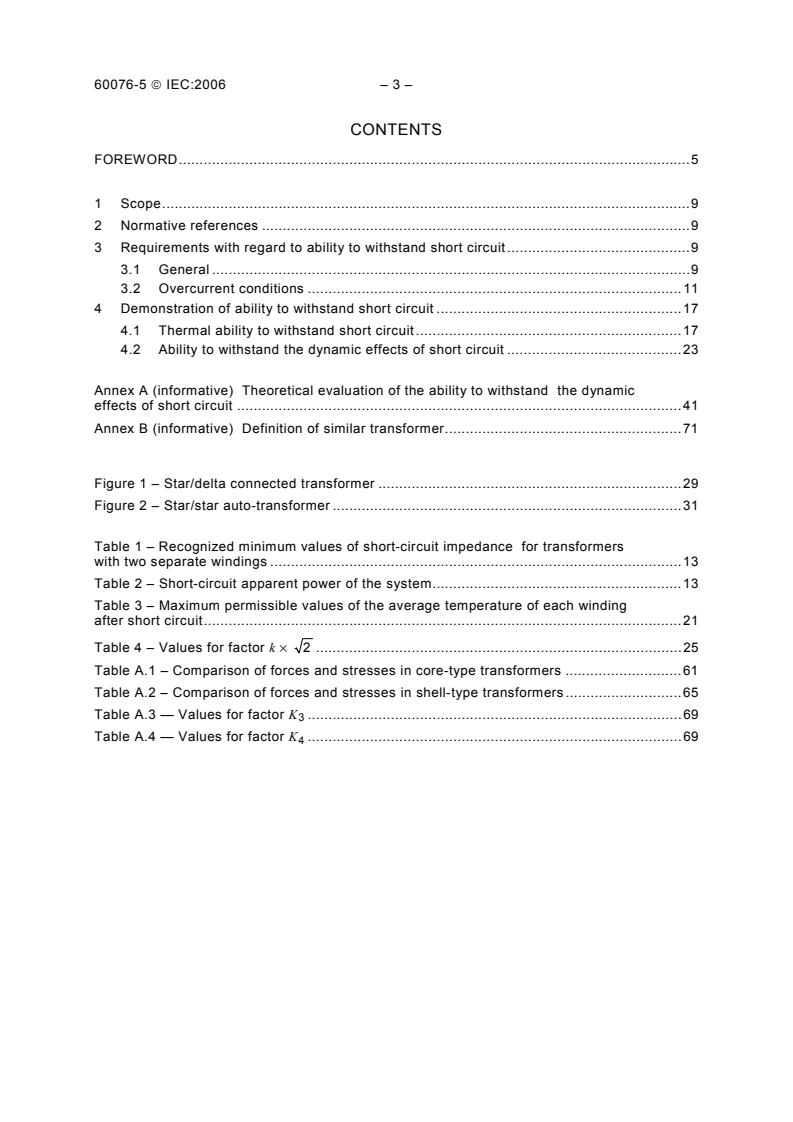
IEC 60076-5:2006 - Power transformers - Part 5: Ability to withstand short circuit Released:2/7/2006
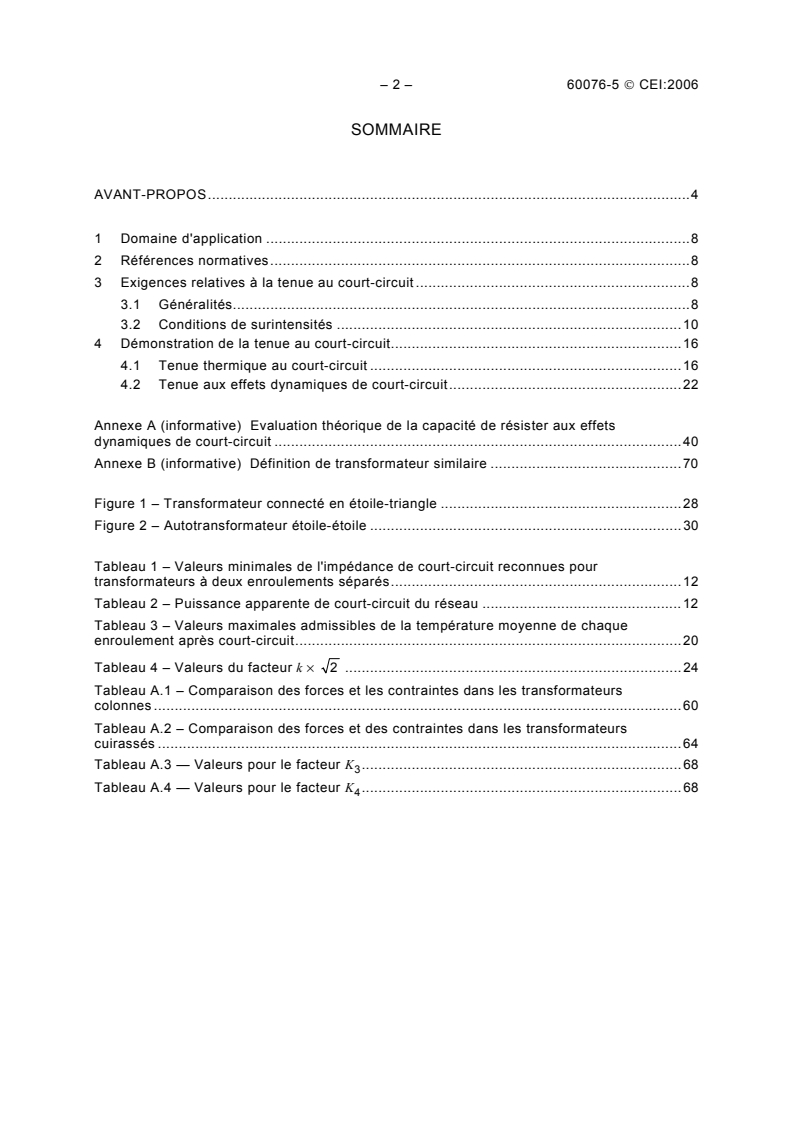
IEC 60076-5:2006 - Transformateurs de puissance - Partie 5: Tenue au court-circuit Released:2/7/2006
IEC 60076-5:2006 - Power transformers - Part 5: Ability to withstand short circuit Released:2/7/2006
Overview
IEC 60076-5:2006 - Power transformers - Part 5: Ability to withstand short circuit defines the requirements, calculation methods and test procedures for demonstrating that power transformers can withstand overcurrents caused by external short circuits without damage. It covers both the thermal and dynamic effects of short-circuit currents and applies to transformers within the scope of IEC 60076‑1.
Key concepts in the standard include:
- External short circuits (three‑phase, line‑to‑line, double‑earth, line‑to‑earth)
- Thermal ability to withstand overcurrents (calculation procedures)
- Dynamic effects (special test and theoretical evaluation)
Key Topics and Requirements
- Scope of faults: External short circuits are not limited to three‑phase faults; the standard explicitly includes single‑line‑to‑earth and other fault types.
- Thermal verification: Procedures for calculating the transformer’s thermal ability to sustain short‑circuit overcurrents (r.m.s. heating effects and permissible winding temperature rises).
- Dynamic verification: Methods to demonstrate the ability to withstand electrodynamic forces produced by peak short‑circuit currents - via a special short‑circuit test or theoretical evaluation (see Annex A, informative).
- Short‑circuit impedance and system contribution: Guidance on calculating symmetrical short‑circuit currents using transformer short‑circuit impedance plus system impedance; recognized minimum impedances by rated power are tabulated (categories I–III).
- Category I: 25 kVA to 2 500 kVA
- Category II: 2 501 kVA to 100 000 kVA
- Category III: above 100 000 kVA
- System short‑circuit apparent power: Default values for short‑circuit apparent power by system voltage are provided where purchaser data are not available (Table 2).
- Special application considerations: Low‑impedance regulating transformers, generator/rotating‑machine connections, booster transformers where agreed current limits may apply.
- Annex B (informative): Definition of a “similar transformer” for evaluation/acceptance.
Applications and Who Uses It
IEC 60076‑5 is essential for:
- Transformer manufacturers - design, rating plates, and factory testing to demonstrate short‑circuit withstand capability.
- Purchasers and utilities - specifying required short‑circuit withstand levels and system short‑circuit data.
- Design and protection engineers - assessing short‑circuit thermal and dynamic effects for system planning and protection coordination.
- Test laboratories - conducting special short‑circuit tests and applying theoretical evaluation methods.
Practical uses include specifying transformer impedance, selecting suitable windings and bracing, defining maximum allowed overcurrents for booster units, and validating designs for systems with high fault levels.
Related Standards
- IEC 60076‑1 (General)
- IEC 60076‑3 (Insulation levels, dielectric tests)
- IEC 60076‑8 (Application guide)
- IEC 60076‑11 (Dry‑type transformers)
Keywords: IEC 60076-5, power transformers, withstand short circuit, short-circuit impedance, thermal ability, dynamic effects, short-circuit test, transformer design, transformer testing.
Relations
- Effective Date
- 05-Sep-2023
Buy Documents
IEC 60076-5:2006 - Power transformers - Part 5: Ability to withstand short circuit Released:2/7/2006
IEC 60076-5:2006 - Transformateurs de puissance - Partie 5: Tenue au court-circuit Released:2/7/2006
IEC 60076-5:2006 - Power transformers - Part 5: Ability to withstand short circuit Released:2/7/2006
Get Certified
Connect with accredited certification bodies for this standard

IMQ S.p.A. (Certification)
Italian electrical product certification.

SLG Prüf- und Zertifizierungs GmbH
German testing and certification body.

UL Solutions
Global safety science company with testing, inspection and certification.
Sponsored listings
Frequently Asked Questions
IEC 60076-5:2006 is a standard published by the International Electrotechnical Commission (IEC). Its full title is "Power transformers - Part 5: Ability to withstand short circuit". This standard covers: Identifies the requirements for power transformers to sustain without damage the effects of overcurrents originated by external short circuits. Describes the calculation procedures used to demonstrate the thermal ability of a power transformer to withstand such overcurrents and both the special test and the theoretical evaluation method used to demonstrate the ability to withstand the relevant dynamic effects.
Identifies the requirements for power transformers to sustain without damage the effects of overcurrents originated by external short circuits. Describes the calculation procedures used to demonstrate the thermal ability of a power transformer to withstand such overcurrents and both the special test and the theoretical evaluation method used to demonstrate the ability to withstand the relevant dynamic effects.
IEC 60076-5:2006 is classified under the following ICS (International Classification for Standards) categories: 29.180 - Transformers. Reactors. The ICS classification helps identify the subject area and facilitates finding related standards.
IEC 60076-5:2006 has the following relationships with other standards: It is inter standard links to IEC 60076-5:2000. Understanding these relationships helps ensure you are using the most current and applicable version of the standard.
IEC 60076-5:2006 is available in PDF format for immediate download after purchase. The document can be added to your cart and obtained through the secure checkout process. Digital delivery ensures instant access to the complete standard document.
Standards Content (Sample)
INTERNATIONAL IEC
STANDARD 60076-5
Third edition
2006-02
Power transformers –
Part 5:
Ability to withstand short circuit
This English-language version is derived from the original
bilingual publication by leaving out all French-language
pages. Missing page numbers correspond to the French-
language pages.
Reference number
Publication numbering
As from 1 January 1997 all IEC publications are issued with a designation in the
60000 series. For example, IEC 34-1 is now referred to as IEC 60034-1.
Consolidated editions
The IEC is now publishing consolidated versions of its publications. For example,
edition numbers 1.0, 1.1 and 1.2 refer, respectively, to the base publication, the
base publication incorporating amendment 1 and the base publication incorporating
amendments 1 and 2.
Further information on IEC publications
The technical content of IEC publications is kept under constant review by the IEC,
thus ensuring that the content reflects current technology. Information relating to
this publication, including its validity, is available in the IEC Catalogue of
publications (see below) in addition to new editions, amendments and corrigenda.
Information on the subjects under consideration and work in progress undertaken
by the technical committee which has prepared this publication, as well as the list
of publications issued, is also available from the following:
• IEC Web Site (www.iec.ch)
• Catalogue of IEC publications
The on-line catalogue on the IEC web site (www.iec.ch/searchpub) enables you to
search by a variety of criteria including text searches, technical committees
and date of publication. On-line information is also available on recently issued
publications, withdrawn and replaced publications, as well as corrigenda.
• IEC Just Published
This summary of recently issued publications (www.iec.ch/online_news/ justpub)
is also available by email. Please contact the Customer Service Centre (see
below) for further information.
• Customer Service Centre
If you have any questions regarding this publication or need further assistance,
please contact the Customer Service Centre:
Email: custserv@iec.ch
Tel: +41 22 919 02 11
Fax: +41 22 919 03 00
INTERNATIONAL IEC
STANDARD 60076-5
Third edition
2006-02
Power transformers –
Part 5:
Ability to withstand short circuit
IEC 2006 Copyright - all rights reserved
No part of this publication may be reproduced or utilized in any form or by any means, electronic or mechanical,
including photocopying and microfilm, without permission in writing from the publisher.
International Electrotechnical Commission, 3, rue de Varembé, PO Box 131, CH-1211 Geneva 20, Switzerland
Telephone: +41 22 919 02 11 Telefax: +41 22 919 03 00 E-mail: inmail@iec.ch Web: www.iec.ch
PRICE CODE
W
Commission Electrotechnique Internationale
International Electrotechnical Commission
МеждународнаяЭлектротехническаяКомиссия
For price, see current catalogue
60076-5 IEC:2006 – 3 –
CONTENTS
FOREWORD.5
1 Scope.9
2 Normative references .9
3 Requirements with regard to ability to withstand short circuit.9
3.1 General .9
3.2 Overcurrent conditions .11
4 Demonstration of ability to withstand short circuit .17
4.1 Thermal ability to withstand short circuit.17
4.2 Ability to withstand the dynamic effects of short circuit .23
Annex A (informative) Theoretical evaluation of the ability to withstand the dynamic
effects of short circuit .41
Annex B (informative) Definition of similar transformer.71
Figure 1 – Star/delta connected transformer .29
Figure 2 – Star/star auto-transformer .31
Table 1 – Recognized minimum values of short-circuit impedance for transformers
with two separate windings .13
Table 2 – Short-circuit apparent power of the system.13
Table 3 – Maximum permissible values of the average temperature of each winding
after short circuit.21
Table 4 – Values for factor k × 2 .25
Table A.1 – Comparison of forces and stresses in core-type transformers .61
Table A.2 – Comparison of forces and stresses in shell-type transformers.65
Table A.3 — Values for factor K .69
Table A.4 — Values for factor K .69
60076-5 IEC:2006 – 5 –
INTERNATIONAL ELECTROTECHNICAL COMMISSION
____________
POWER TRANSFORMERS –
Part 5: Ability to withstand short circuit
FOREWORD
1) The International Electrotechnical Commission (IEC) is a worldwide organization for standardization comprising
all national electrotechnical committees (IEC National Committees). The object of IEC is to promote
international co-operation on all questions concerning standardization in the electrical and electronic fields. To
this end and in addition to other activities, IEC publishes International Standards, Technical Specifications,
Technical Reports, Publicly Available Specifications (PAS) and Guides (hereafter referred to as “IEC
Publication(s)”). Their preparation is entrusted to technical committees; any IEC National Committee interested
in the subject dealt with may participate in this preparatory work. International, governmental and non-
governmental organizations liaising with the IEC also participate in this preparation. IEC collaborates closely
with the International Organization for Standardization (ISO) in accordance with conditions determined by
agreement between the two organizations.
2) The formal decisions or agreements of IEC on technical matters express, as nearly as possible, an international
consensus of opinion on the relevant subjects since each technical committee has representation from all
interested IEC National Committees.
3) IEC Publications have the form of recommendations for international use and are accepted by IEC National
Committees in that sense. While all reasonable efforts are made to ensure that the technical content of IEC
Publications is accurate, IEC cannot be held responsible for the way in which they are used or for any
misinterpretation by any end user.
4) In order to promote international uniformity, IEC National Committees undertake to apply IEC Publications
transparently to the maximum extent possible in their national and regional publications. Any divergence
between any IEC Publication and the corresponding national or regional publication shall be clearly indicated in
the latter.
5) IEC provides no marking procedure to indicate its approval and cannot be rendered responsible for any
equipment declared to be in conformity with an IEC Publication.
6) All users should ensure that they have the latest edition of this publication.
7) No liability shall attach to IEC or its directors, employees, servants or agents including individual experts and
members of its technical committees and IEC National Committees for any personal injury, property damage or
other damage of any nature whatsoever, whether direct or indirect, or for costs (including legal fees) and
expenses arising out of the publication, use of, or reliance upon, this IEC Publication or any other IEC
Publications.
8) Attention is drawn to the Normative references cited in this publication. Use of the referenced publications is
indispensable for the correct application of this publication.
9) Attention is drawn to the possibility that some of the elements of this IEC Publication may be the subject of
patent rights. IEC shall not be held responsible for identifying any or all such patent rights.
International Standard IEC 60076-5 has been prepared by IEC technical committee 14: Power
transformers.
This third edition cancels and replaces the second edition published in 2000. This third edition
constitutes a technical revision.
This edition includes the following significant technical changes with respect to the previous
edition:
a) introduction of Annex A (informative) – “Theoretical evaluation of the ability to withstand
the dynamic effects of short circuit”, in place of previous Annex B (normative) –
“Calculation method for the demonstration of the ability to withstand short circuit” (blank);
b) introduction of Annex B (informative) – “Definition of similar transformer”, in place of
previous Annex A (informative) – “Guidance for the identification of a similar transformer”.
60076-5 IEC:2006 – 7 –
The text of this standard is based on the following documents:
FDIS Report on voting
14/518/FDIS 14/523/RVD
Full information on the voting for the approval of this standard can be found in the report on
voting indicated in the above table.
This publication has been drafted in accordance with the ISO/IEC Directives, Part 2.
IEC 60076 consists of the following parts, under the general title Power transformers:
Part 1: General
Part 2: Temperature rise
Part 3: Insulation levels, dielectric tests and external clearances in air
Part 4: Guide to the lightning impulse and switching impulse testing – Power transformers
and reactors
Part 5: Ability to withstand short circuit
Part 6: Reactors
Part 7: Loading guide for oil-immersed power transformers
Part 8: Application guide
Part 10: Determination of sound levels
Part 10-1: Determination of sound levels – Application guide
Part 11: Dry-type transformers
Part 12: Loading guide for dry-type power transformers
Part 13: Self-protected liquid-filled transformers
Part 14: Design and application of liquid-immersed power transformers using high-
temperature insulation materials
Part 15: Gas-filled-type power tranformers
The committee has decided that the contents of this publication will remain unchanged until
the maintenance result date indicated on the IEC web site under "http://webstore.iec.ch" in
the data related to the specific publication. At this date, the publication will be
• reconfirmed;
• withdrawn;
• replaced by a revised edition, or
• amended.
—————————
Under consideration.
60076-5 IEC:2006 – 9 –
POWER TRANSFORMERS –
Part 5: Ability to withstand short circuit
1 Scope
This part of IEC 60076 identifies the requirements for power transformers to sustain without
damage the effects of overcurrents originated by external short circuits. It describes the
calculation procedures used to demonstrate the thermal ability of a power transformer to
withstand such overcurrents and both the special test and the theoretical evaluation method
used to demonstrate the ability to withstand the relevant dynamic effects. The requirements
apply to transformers as defined in the scope of IEC 60076-1.
2 Normative references
The following referenced documents are indispensable for the application of this document.
For dated references, only the edition cited applies. For undated references, the latest edition
of the referenced document (including any amendments) applies.
IEC 60076-1:1993, Power transformers – Part 1: General
Amendment 1 (1999)
IEC 60076-3:2000, Power Transformers – Part 3: Insulation levels, dielectric tests and
external clearances in air
IEC 60076-8:1997, Power transformers – Part 8: Application guide
IEC 60076-11:2004, Power transformers – Part 11: Dry-type transformers
3 Requirements with regard to ability to withstand short circuit
3.1 General
Transformers together with all equipment and accessories shall be designed and constructed
to withstand without damage the thermal and dynamic effects of external short circuits under
the conditions specified in 3.2.
External short circuits are not restricted to three-phase short circuits; they include line-to-line,
double-earth and line-to-earth faults. The currents resulting from these conditions in the
windings are designated as overcurrents in this part of IEC 60076.
—————————
There exists a consolidated edition 2.1 (2000) that includes edition 2.0 and its amendment.
60076-5 IEC:2006 – 11 –
3.2 Overcurrent conditions
3.2.1 General considerations
3.2.1.1 Application conditions requiring special consideration
The following situations affecting overcurrent magnitude, duration, or frequency of occurrence
require special consideration and shall be clearly identified in transformer specifications:
– regulating transformers with very low impedance that depend on the impedance of directly
connected apparatus to limit overcurrents;
– unit generator transformers susceptible to high overcurrents produced by connection of
the generator to the system out of synchronism;
– transformers directly connected to rotating machines, such as motors or synchronous
condensers, that can act as generators to feed current into the transformer under system
fault conditions;
– special transformers and transformers installed in systems characterized by high fault
rates (see 3.2.6);
– operating voltage higher than rated maintained at the unfaulted terminal(s) during a fault
condition.
3.2.1.2 Current limitations concerning booster transformers
When the combined impedance of the booster transformer and the system results in short-
circuit current levels for which the transformer cannot feasibly or economically be designed to
withstand, the manufacturer and the purchaser shall mutually agree on the maximum allowed
overcurrent. In this case, provision should be made by the purchaser to limit the overcurrent
to the maximum value determined by the manufacturer and stated on the rating plate.
3.2.2 Transformers with two separate windings
3.2.2.1 For the purpose of this standard, three categories for the rated power of three-phase
transformers or three-phase banks are recognized:
– category I: 25 kVA to 2 500 kVA;
– category II: 2 501 kVA to 100 000 kVA;
– category III: above 100 000 kVA.
3.2.2.2 In the absence of other specifications, the symmetrical short-circuit current (for the
r.m.s. value, see 4.1.2) shall be calculated using the measured short-circuit impedance of the
transformer plus the system impedance.
For transformers of category I, the contribution of the system impedance shall be neglected in
the calculation of the short-circuit current if this impedance is equal to, or less than, 5 % of
the short-circuit impedance of the transformer.
The peak value of the short-circuit current shall be calculated in accordance with 4.2.3.
3.2.2.3 Commonly recognized minimum values for the short-circuit impedance of
transformers at the rated current (principal tapping) are given in Table 1. If lower values are
required, the ability of the transformer to withstand short circuit shall be subject to agreement
between the manufacturer and the purchaser.
60076-5 IEC:2006 – 13 –
Table 1 – Recognized minimum values of short-circuit impedance
for transformers with two separate windings
Short-circuit impedance at rated current
Rated power Minimum short-circuit impedance
kVA %
25 to 630 4,0
631 to 1 250 5,0
1 251 to 2 500 6,0
2 501 to 6 300 7,0
6 301 to 25 000 8,0
25 001 to 40 000 10,0
40 001 to 63 000 11,0
63 001 to 100 000 12,5
above 100 000 >12,5
NOTE 1 Values for rated power greater than 100 000 kVA are generally subject to agreement
between manufacturer and purchaser.
NOTE 2 In the case of single-phase units connected to form a three-phase bank, the value of
rated power applies to three-phase bank rating.
3.2.2.4 The short-circuit apparent power of the system at the transformer location should be
specified by the purchaser in his enquiry in order to obtain the value of the symmetrical short-
circuit current to be used for the design and tests.
If the short-circuit apparent power of the system is not specified, the values given in Table 2
shall be used.
Table 2 – Short-circuit apparent power of the system
Short-circuit apparent power
Highest voltage for equipment, U MVA
m
kV Current European practice Current North American
practice
7,2; 12; 17,5 and 24 500 500
36 1 000 1 500
52 and 72,5 3 000 5 000
100 and 123 6 000 15 000
145 and 170 10 000 15 000
245 20 000 25 000
300 30 000 30 000
362 35 000 35 000
420 40 000 40 000
525 60 000 60 000
765 83 500 83 500
NOTE If not specified, a value between 1 and 3 should be considered for the ratio of zero-sequence to
positive-sequence impedance of the system.
60076-5 IEC:2006 – 15 –
3.2.2.5 For transformers with two separate windings, normally only the three-phase short
circuit is taken into account, as the consideration of this case is substantially adequate to
cover also the other possible types of fault (exception is made in the special case considered
in the note to 3.2.5).
NOTE In the case of winding in zigzag connection, the single-line-to-earth fault current may reach values higher
than the three-phase short-circuit current. However, these high values are limited, in the two limbs concerned, to a
half of the coil and furthermore the currents in the other star-connected winding are lower than for a three-phase
short circuit. Electrodynamic hazard to the winding assembly may be higher either at three- or single-phase short
circuit depending on the winding design. The manufacturer and the purchaser should agree which kind of short
circuit is to be considered.
3.2.3 Transformers with more than two windings and auto-transformers
The overcurrents in the windings, including stabilizing windings and auxiliary windings, shall
be determined from the impedances of the transformer and the system(s). Account shall be
taken of the different forms of system faults that can arise in service, for example, line-to-
earth faults and line-to-line faults associated with the relevant system and transformer
earthing conditions (see IEC 60076-8). The characteristics of each system (at least the short-
circuit apparent power level and the range of the ratio between zero-sequence impedance and
positive-sequence impedance) shall be specified by the purchaser in his enquiry.
Delta-connected stabilizing windings of three-phase transformers shall be capable of
withstanding the overcurrents resulting from different forms of system faults that can arise in
service associated with relevant system earthing conditions.
In the case of single-phase transformers connected to form a three-phase bank, the
stabilizing winding shall be capable of withstanding a short circuit on its terminals, unless
the purchaser specifies that special precautions will be taken to avoid the risk of line-to-line
short circuits.
NOTE It may not be economical to design auxiliary windings to withstand short circuits on their terminals. In such
cases, the overcurrent level should be limited by appropriate means, such as series reactors or, in some instances,
fuses. Care should be taken to guard against faults in the zone between the transformer and the protective
apparatus.
3.2.4 Booster transformers
The impedance of booster transformers can be very low and, therefore, the overcurrents in
the windings are determined mainly by the characteristics of the system at the location of the
transformer. These characteristics shall be specified by the purchaser in his enquiry.
If a booster transformer is directly associated to a transformer for the purpose of voltage
amplitude and/or phase variation, it shall be capable of withstanding the overcurrents
resulting from the combined impedance of the two machines.
3.2.5 Transformers directly associated with other apparatus
Where a transformer is directly associated with other apparatus, the impedance of which
would limit the short-circuit current, the sum of the impedance of the transformer, the system
and the directly associated apparatus may, by agreement between the manufacturer and the
purchaser, be taken into account.
60076-5 IEC:2006 – 17 –
This applies, for example, to unit generator transformers if the connection between generator
and transformer is constructed in such a way that the possibility of line-to-line or double-earth
faults in this region is negligible.
NOTE If the connection between generator and transformer is constructed in this way, the most severe short-
circuit conditions may occur, in the case of a star/delta-connected unit generator transformer with earthed neutral,
when a line-to-earth fault occurs on the system connected to the star-connected winding, or in the case of
out-of-phase synchronization.
3.2.6 Special transformers and transformers to be installed in systems
characterized by high fault rates
The ability of the transformer to withstand frequent overcurrents, arising from the particular
application (for example, arc furnace transformers and stationary transformers for traction
systems), or the condition of operation (for example, high number of faults occurring in the
connected system(s)), shall be subjected to special agreement between the manufacturer and
the purchaser. Notice of any abnormal operation conditions expected in the system(s) shall be
given by the purchaser to the manufacturer in advance.
3.2.7 Tap-changing equipment
Where fitted, tap-changing equipment shall be capable of carrying the same overcurrents due
to short circuits as the windings. However, the on-load tap-changer is not required to be
capable of switching the short-circuit current.
3.2.8 Neutral terminal
The neutral terminal of windings with star or zigzag connection shall be designed for the
highest overcurrent that can flow through this terminal.
4 Demonstration of ability to withstand short circuit
The requirements of this clause apply to both oil-immersed and dry-type transformers as
specified in IEC 60076-1 and IEC 60076-11, respectively.
4.1 Thermal ability to withstand short circuit
4.1.1 General
According to this standard, the thermal ability to withstand short circuit shall be demonstrated
by calculation. This calculation shall be carried out in accordance with the requirements
of 4.1.2 to 4.1.5.
4.1.2 Value of symmetrical short-circuit current I
For three-phase transformers with two separate windings, the r.m.s. value of the symmetrical
short-circuit current I shall be calculated as follows:
U
I = (kA) (1)
3 ×()Z + Z
t s
where
Z is the short-circuit impedance of the system.
s
U
s
Z = , in ohms (Ω) per phase (equivalent star connection) (2)
s
S
60076-5 IEC:2006 – 19 –
where
U is the rated voltage of the system, in kilovolts (kV);
s
S is the short-circuit apparent power of the system, in megavoltamperes (MVA).
U and Z are defined as follows:
t
a) for the principal tapping:
U is the rated voltage U of the winding under consideration, in kilovolts (kV);
r
Z is the short-circuit impedance of the transformer referred to the winding under
t
consideration; it is calculated as follows:
z × U
t r
Z = , in ohms (Ω) per phase (equivalent star connection) (3)
t
100 × S
r
where
z is the measured short-circuit impedance at rated current and frequency at the principal
t
tap and at reference temperature, as a percentage;
S is the rated power of the transformer, in megavoltamperes (MVA);
r
b) for tappings other than the principal tapping:
U is, unless otherwise specified, the tapping voltage of the winding under consideration,
in kilovolts (kV);
Z is the short-circuit impedance of the transformer referred to the winding and the
t
tapping under consideration, in ohms (Ω) per phase.
For transformers having more than two windings, auto-transformers, booster transformers and
transformers directly associated with other apparatus, the overcurrents are calculated in
accordance with 3.2.3, 3.2.4 or 3.2.5, as appropriate.
For all transformers, excluding the case given in 3.2.2.2, the effect of the short-circuit
impedance of the system(s) shall be taken into consideration.
NOTE At the zigzag connected windings, the short-circuit current for a single-line-to-earth fault may reach
considerably higher values than at the three-phase fault. This increase in current should be taken into
consideration when calculating the temperature rise of the zigzag winding.
4.1.3 Duration of the symmetrical short-circuit current
The duration of the current I to be used for the calculation of the thermal ability to withstand
short circuit shall be 2 s unless a different duration is specified.
NOTE For auto-transformers and for transformers with short-circuit current exceeding 25 times the rated current,
a short-circuit current duration below 2 s may be adopted by agreement between the manufacturer and the
purchaser.
4.1.4 Maximum permissible value of the average temperature of each winding
The average temperature θ of each winding after loading with a symmetrical short-circuit
current I of a value and duration as specified in 4.1.2 and 4.1.3, respectively, shall not exceed
the maximum value stated in Table 3 at any tapping position.
—————————
Here symbols Z and z are used instead of Z and z, respectively, adopted for the same quantities in
t t
IEC 60076-1, for the sake of clarity in connection with the content of 4.2.3.
For the definition of tapping voltage, see 5.2 of IEC 60076-1.
60076-5 IEC:2006 – 21 –
The initial winding temperature θ to be used in equations (4) and (5) shall correspond to the
sum of the maximum permissible ambient temperature and the temperature rise of the winding
at rated conditions measured by resistance. If the measured winding temperature rise is not
available, then the initial winding temperature θ shall correspond to the sum of the maximum
permissible ambient temperature and the temperature rise allowed for the winding insulation
system.
Table 3 – Maximum permissible values of the average temperature
of each winding after short circuit
Insulation system Maximum value of
temperature, temperature,
Transformer type
°C °C
(thermal class in brackets)
Copper Aluminium
Oil-immersed 105 (A) 250 200
105 (A) 180 180
120 (E) 250 200
130 (B) 350 200
Dry 155 (F) 350 200
180 (H) 350 200
200 350 200
220 350 200
NOTE 1 In the case of windings made of high tensile strength aluminium alloys, higher maximum
values of temperature, but not exceeding those relevant to copper, may be allowed by agreement
between the manufacturer and the purchaser.
NOTE 2 When insulation systems other than thermal class A are employed in oil-immersed
transformers, different maximum values of temperature may be allowed by agreement between the
manufacturer and the purchaser.
4.1.5 Calculation of temperature θ
The average temperature θ attained by the winding after short circuit shall be calculated by
the formula:
2 ×()θ + 235 ()θ
2 × + 225
0 0
θ = θ + for copper (4) θ = θ + for aluminium (5)
1 0 1 0
106 000 45 700
−1 −1
2 2
J × t J × t
where
θ is the initial winding temperature, in degrees Celsius (°C);
J is the short-circuit current density, based on the r.m.s. value of the symmetrical short-
circuit current, in amperes per square millimetre (A/mm );
t is the duration, in seconds (s).
NOTE Equations (4) and (5) are based on adiabatic conditions and are valid for only a short-time duration, not
exceeding 10 s. The coefficients are based on the following material properties:
Copper Aluminium
Specific heat at 100 °C (J/kg⋅ °C) 398,4 928
Density at 100 °C (kg/m ) 8 894 2 685
Resistivity at 100 °C (µΩ⋅m) 0,022 4 0,035 5
60076-5 IEC:2006 – 23 –
4.2 Ability to withstand the dynamic effects of short circuit
4.2.1 General
If required by the purchaser, the ability to withstand the dynamic effects of short circuit shall
be demonstrated either
– by tests, or
– by calculation and design and manufacture considerations.
The choice of method of demonstration to be used shall be subject to agreement between the
purchaser and the manufacturer prior to placing the order.
When a short-circuit test is selected, it shall be regarded as a special test (see 3.11.3 of
IEC 60076-1) and it shall be specified prior to placing the order. The test shall be carried out
in accordance with the requirements in 4.2.2 to 4.2.7.
Large power transformers sometimes cannot be tested according to this standard due, for
example, to testing limitations. In these cases, the testing conditions shall be agreed between
the purchaser and the manufacturer.
When demonstration based on calculation and design and manufacture considerations is
selected, the guidelines given in Annex A shall be followed.
4.2.2 Condition of the transformer before the short-circuit tests
4.2.2.1 Unless otherwise agreed, the tests shall be carried out on a new transformer ready
for service. Protection accessories, such as a gas-and-oil-actuated relay and pressure-relief
device, shall be mounted on the transformer during the test.
NOTE The mounting of accessories having no influence on behaviour during short circuit (for example,
detachable cooling equipment) is not required.
4.2.2.2 Prior to the short-circuit tests, the transformer shall be subjected to the routine tests
which are specified in IEC 60076-1. However, the lightning impulse test is not required at this
stage.
If the windings are provided with tappings, the reactance and, if required, also the resistance
shall be measured for the tapping positions at which short-circuit tests will be carried out.
All the reactance measurements shall be to a repeatability of better than ±0,2 %.
A report containing the result of the routine tests shall be available at the beginning of short-
circuit tests.
4.2.2.3 At the beginning of short-circuit tests, the average temperature of the winding shall
preferably be between 10 °C and 40 °C (see 10.1 of IEC 60076-1).
During the tests, winding temperature may increase owing to the circulation of the short-
circuit current. This aspect shall be taken into consideration when arranging the test circuit for
transformers of category I.
60076-5 IEC:2006 – 25 –
4.2.3 Test current peak value î for two-winding transformers
The test shall be performed with current holding maximum asymmetry as regards the phase
under test.
The amplitude î of the first peak of the asymmetrical test current is calculated as follows:
î = I × k ×2 (6)
where the symmetrical short-circuit current I is determined in accordance with 4.1.2.
The factor k accounts for the initial offset of the test current and 2 accounts for the peak-
to-r.m.s. value of a sinusoidal wave.
The factor k × 2 , or peak factor, depends on the ratio X/R
where
X is the sum of the reactances of the transformer and the system (X + X ), in ohms (Ω);
t s
R is the sum of resistances of the transformer and the system (R + R ), in ohms (Ω), where
t s
R is at reference temperature (see 10.1 of IEC 60076-1).
t
When the short-circuit impedance of the system is included in the short-circuit current
calculation, the X/R ratio of the system, if not specified, shall be assumed to be equal to that
of the transformer. Table 4 specifies the value for the peak factor as a function of the X/R ratio
to be used for practical purposes .
Table 4 – Values for factor k × 2
X/R 1 1,5 2 3 4 5 6 8 10 14
1,51 1,64 1,76 1,95 2,09 2,19 2,27 2,38 2,46 2,55
k × 2
NOTE For other values of X/R between 1 and 14, the factor k × 2 may be determined by linear interpolation.
NOTE When Z < 0,05 Z , instead of X and R (in ohms), x and r may be used for the principal tapping where
s t t t t t
x is the reactive component of z , in per cent (%);
t t
r is the resistance component, at reference temperature, of z , in per cent (%);
t t
z is the short-circuit impedance of the transformer, at reference temperature, in per cent (%).
t
If not otherwise specified, in the case X/R >14 the factor k × 2 is assumed to be equal to
1,8 × 2 = 2,55 for transformers of category II;
1,9 × 2 = 2,69 for transformers of category III.
—————————
Table 4 is based on the following expression for the peak factor:
–(φ+π/2)R/X
k × 2 = (1+(e )sinφ) × 2
where
e is the base of natural logarithm;
φ is the phase angle which is equal to arctan X/R, in radians.
60076-5 IEC:2006 – 27 –
4.2.4 Tolerance on the asymmetrical peak and symmetrical r.m.s. value
of the short-circuit test current
If the duration of the short-circuit test is sufficiently long, the asymmetrical current having first
peak amplitude î will change into the symmetrical current having r.m.s. value I (see 4.1.2).
The peak value of the current obtained in testing shall not deviate by more than 5 % and the
symmetrical current by more than 10 % from the respective specified value.
4.2.5 Short-circuit testing procedure for transformers with two windings
4.2.5.1 In order to obtain a test current according to 4.2.4, the no-load voltage of the source
may be higher than the rated voltage of the winding supplied. The short-circuiting of
the winding may either follow (post-set short circuit) or precede (pre-set short circuit) the
6.
application of the voltage to the other winding of the transformer
If the post-set short circuit is used, the voltage shall not exceed 1,15 times the rated voltage
of the winding, unless otherwise agreed between the manufacturer and the purchaser.
If the pre-set short circuit is used for a transformer with single-concentric windings, the supply
should preferably be connected to the winding furthest from the core. The winding closer to
the core is to be short-circuited in order to avoid saturation of the magnetic core which could
lead to an excessive magnetizing current superimposed on the short-circuit current during the
first few cycles.
When available testing facilities require the supply to be connected to the inner winding,
special precautions shall be taken, for example, pre-magnetization of the core, to prevent the
inrush of magnetizing current.
For transformers with sandwich windings or transformers with double-concentric windings, the
pre-set short-circuit method shall be used only after agreement between the manufacturer and
the purchaser.
In order to avoid injurious overheating, an appropriate time interval shall occur between
successive overcurrent applications. This time shall be defined by agreement between the
manufacturer and the purchaser.
NOTE When testing transformers of category I, it might be necessary to consider the change of X/R factor caused
by the temperature increase during the test and provide for its compensation in the test circuit.
4.2.5.2 To obtain the initial peak value of the current (see 4.2.3) in the phase winding under
test, the moment of switching on shall be adjusted by means of a synchronous switch.
In order to check the values î and I of the test currents, oscillographic records shall always be
taken.
In order to obtain the maximum asymmetry of the current in one of the phase windings, the
switching-on shall occur at the moment the voltage applied to this winding passes through
zero.
—————————
Another testing procedure consists of applying simultaneously two opposite-phase voltages to the two windings
under test. The two windings can be supplied either from the same power source or from two separate and
synchronized power sources. The method is advantageous in preventing any saturation of the core and will
reduce the power requirement of the supply.
60076-5 IEC:2006 – 29 –
NOTE 1 For star-connected windings, the maximum asymmetry is obtained by switching on when the phase
voltage passes through zero. The factor k of the peak value î can be determined from oscillograms of the line
currents. For three-phase tests on delta-connected windings, this condition is obtained by switching on when the
line-to-line voltage passes through zero. One of the methods of determining the factor k is by switching on during
the preliminary adjustment tests at a maximum of the line-to-line voltage. In this case, the factor k is found from
oscillograms of the line currents.
Another method for determining the phase current in a delta-connected winding is by suitably interconnecting the
secondary windings of the current transformers measuring the line currents. The oscillograph can be set to record
the phase currents.
NOTE 2 For transformers with star-zigzag connection belonging to category I and with constant flux voltage
variation having value for x /r ≤ 3 (see 4.2.3), the three phases are switched on simultaneously without the use of a
t t
synchronous switch. For other transformers with star-zigzag connection, the method of switching on is subject to
agreement between the manufacturer and the purchaser.
4.2.5.3 The frequency of the test supply shall be, in principle, the rated frequency of the
transformer. Nevertheless, if agreed between the purchaser and the manufacturer, it is
permissible to test 60 Hz transformers with a 50 Hz power supply and 50 Hz transformers with
a 60 Hz power supply provided that the prescribed test current values, as required in 4.2.3
and 4.2.4, are obtained.
This procedure requires that the voltage of the test supply is suitably adjusted with respect to
the rated voltage of the transformer.
4.2.5.4 For three-phase transformers, a three-phase supply should be used, as long as the
requirements in 4.2.4 can be met. If this is not the case, a single-phase supply, as described
below, may be used. For delta-connected windings, the single-phase supply is provided
between two corners of the delta and the voltage during the test shall be the same as the
voltage between phases during a three-phase test. For star-connected windings, the single-
phase voltage is supplied between one line terminal and the other two line terminals
connected together. The single-phase voltage during the test shall be equal to 3 /2 times the
voltage between phases during the three-phase test.
Examples of two possible single-phase test arrangements simulating the three-phase test are
given in Figures 1 and 2.
S
Z
s
IEC 2708/05
Components
Z test system impedance;
s
S synchronous switch for a post-set short circuit or rigid connection bar for a pre-set short circuit.
Figure 1 – Star/delta connected transformer
60076-5 IEC:2006 – 31 –
S
Z
s
IEC 2709/05
Components
Z test system impedance;
s
S synchronous switch for a post-set short circuit or rigid connection bar for a pre-set short circuit.
Figure 2 – Star/star auto-transformer
NOTE 1 The use of tests with single-phase supply applies mainly to transformers of category II or III and is
seldom of interest for category I transformers.
NOTE 2 For star-connected windings with non-uniform insulation, it is necessary to check whether or not the
insulation of the neutral is sufficient for single-phase testing.
NOTE 3 If, for star-connected windings, the power supply is insufficient for the single-phase testing described
above and the neutral is available, the manufacturer and the purchaser may agree upon the use of single-phase
power supply between line terminal and the neutral, provided that the neutral is capable of carrying the relevant
current. With this test arrangement, it might be convenient to mutually connect the corresponding terminals of the
phases not submitted to test in order to better control their voltage, provided that this is feasible and the circuitry is
correct.
4.2.5.5 In the absence of any particular specification, the number of tests on three-phase
and single-phase transformers is determined as follows, not including preliminary adjustment
tests carried out at less than 70 % of the specified current to check the proper functioning of
the test set-up with regard to the moment of switching on, the current setting, the damping
and the duration.
For categories I and II single-phase transformers, the number of tests shall be three. Unless
otherwise specified, the three tests on a single-phase transformer with tappings are made in a
different position of the tap-changer, i.e. one test in the position corresponding to the highest
voltage ratio, one test on the principal tapping and one test in the position corresponding to
the lowest voltage ratio.
For categories I and II three-phase transformers, the total number of tests shall be nine, i.e.
three tests on each phase. Unless otherwise specified, the nine tests on a three-phase
transformer with tappings are made in different positions of the tap changer, i.e. three tests in
the position corresponding to the highest voltage ratio on one of the outer phases, three tests
on the principal tapping on the middle phase and three tests in the position corresponding to
the lowest voltage ratio on the other outer phase.
For transformers of category III, an agreement between the manufacturer and the purchaser
is always needed with regard to the number of tests and the position of the tap-changer.
However, in order to simulate as closely as possible the effects of repetitive short-circuit
events likely to occur in service, to allow a better monitoring of the behaviour of the unit under
test and to permit a meaningful judgement in connection with possible variations of the
measured short-circuit impedance, it is recommended that the number of tests is as follows:
– for single-phase transformers: three;
– for three-phase transformers: nine.
60076-5 IEC:2006 – 33 –
With regard to tap-changer position and test sequence, the same procedure as described for
transformers of categories I and II is recommended.
The duration of each test shall be
– 0,5 s for transformers of category I,
– 0,25 s for transformers of categories II and III,
with a tolerance of ±10 %.
4.2.6 Short-circuit testing procedure for transformers with more than two
windings and auto-transformers
Various fault conditions may be considered for transformers with more than two windings and
auto-transformers (see 3.2.3). In general, such conditions are of a mor
...
NORME CEI
INTERNATIONALE 60076-5
Troisième édition
2006-02
Transformateurs de puissance –
Partie 5:
Tenue au court-circuit
Cette version française découle de la publication d’origine
bilingue dont les pages anglaises ont été supprimées.
Les numéros de page manquants sont ceux des pages
supprimées.
Numéro de référence
CEI 60076-5:2006(F)
Numérotation des publications
Depuis le 1er janvier 1997, les publications de la CEI sont numérotées à partir de
60000. Ainsi, la CEI 34-1 devient la CEI 60034-1.
Editions consolidées
Les versions consolidées de certaines publications de la CEI incorporant les
amendements sont disponibles. Par exemple, les numéros d’édition 1.0, 1.1 et 1.2
indiquent respectivement la publication de base, la publication de base incorporant
l’amendement 1, et la publication de base incorporant les amendements 1 et 2
Informations supplémentaires sur les publications de la CEI
Le contenu technique des publications de la CEI est constamment revu par la CEI
afin qu'il reflète l'état actuel de la technique. Des renseignements relatifs à cette
publication, y compris sa validité, sont disponibles dans le Catalogue des
publications de la CEI (voir ci-dessous) en plus des nouvelles éditions, amende-
ments et corrigenda. Des informations sur les sujets à l’étude et l’avancement des
travaux entrepris par le comité d’études qui a élaboré cette publication, ainsi que la
liste des publications parues, sont également disponibles par l’intermédiaire de:
• Site web de la CEI (www.iec.ch)
• Catalogue des publications de la CEI
Le catalogue en ligne sur le site web de la CEI (www.iec.ch/searchpub) vous permet
de faire des recherches en utilisant de nombreux critères, comprenant des
recherches textuelles, par comité d’études ou date de publication. Des informations
en ligne sont également disponibles sur les nouvelles publications, les publications
remplacées ou retirées, ainsi que sur les corrigenda.
• IEC Just Published
Ce résumé des dernières publications parues (www.iec.ch/online_news/justpub)
est aussi disponible par courrier électronique. Veuillez prendre contact avec le
Service client (voir ci-dessous) pour plus d’informations.
• Service clients
Si vous avez des questions au sujet de cette publication ou avez besoin de
renseignements supplémentaires, prenez contact avec le Service clients:
Email: custserv@iec.ch
Tél: +41 22 919 02 11
Fax: +41 22 919 03 00
NORME CEI
INTERNATIONALE 60076-5
Troisième édition
2006-02
Transformateurs de puissance –
Partie 5:
Tenue au court-circuit
IEC 2006 Droits de reproduction réservés
Aucune partie de cette publication ne peut être reproduite ni utilisée sous quelque forme que ce soit et par aucun
procédé, électronique ou mécanique, y compris la photocopie et les microfilms, sans l'accord écrit de l'éditeur.
International Electrotechnical Commission, 3, rue de Varembé, PO Box 131, CH-1211 Geneva 20, Switzerland
Telephone: +41 22 919 02 11 Telefax: +41 22 919 03 00 E-mail: inmail@iec.ch Web: www.iec.ch
CODE PRIX
W
Commission Electrotechnique Internationale
International Electrotechnical Commission
МеждународнаяЭлектротехническаяКомиссия
Pour prix, voir catalogue en vigueur
– 2 – 60076-5 CEI:2006
SOMMAIRE
AVANT-PROPOS.4
1 Domaine d'application .8
2 Références normatives.8
3 Exigences relatives à la tenue au court-circuit .8
3.1 Généralités.8
3.2 Conditions de surintensités .10
4 Démonstration de la tenue au court-circuit.16
4.1 Tenue thermique au court-circuit .16
4.2 Tenue aux effets dynamiques de court-circuit.22
Annexe A (informative) Evaluation théorique de la capacité de résister aux effets
dynamiques de court-circuit .40
Annexe B (informative) Définition de transformateur similaire .70
Figure 1 – Transformateur connecté en étoile-triangle .28
Figure 2 – Autotransformateur étoile-étoile .30
Tableau 1 – Valeurs minimales de l'impédance de court-circuit reconnues pour
transformateurs à deux enroulements séparés.12
Tableau 2 – Puissance apparente de court-circuit du réseau .12
Tableau 3 – Valeurs maximales admissibles de la température moyenne de chaque
enroulement après court-circuit.20
Tableau 4 – Valeurs du facteur k × 2 .24
Tableau A.1 – Comparaison des forces et les contraintes dans les transformateurs
colonnes .60
Tableau A.2 – Comparaison des forces et des contraintes dans les transformateurs
cuirassés .64
Tableau A.3 — Valeurs pour le facteur K .68
Tableau A.4 — Valeurs pour le facteur K .68
– 4 – 60076-5 CEI:2006
COMMISSION ÉLECTROTECHNIQUE INTERNATIONALE
____________
TRANSFORMATEURS DE PUISSANCE –
Partie 5: Tenue au court-circuit
AVANT-PROPOS
1) La Commission Électrotechnique Internationale (CEI) est une organisation mondiale de normalisation
composée de l'ensemble des comités électrotechniques nationaux (Comités nationaux de la CEI). La CEI a
pour objet de favoriser la coopération internationale pour toutes les questions de normalisation dans les
domaines de l'électricité et de l'électronique. A cet effet, la CEI – entre autres activités – publie des Normes
internationales, des Spécifications techniques, des Rapports techniques, des Spécifications accessibles au
public (PAS) et des Guides (ci-après dénommés «Publication(s) de la CEI»). Leur élaboration est confiée à des
comités d'études, aux travaux desquels tout Comité national intéressé par le sujet traité peut participer. Les
organisations internationales, gouvernementales et non gouvernementales, en liaison avec la CEI, participent
également aux travaux. La CEI collabore étroitement avec l'Organisation Internationale de Normalisation (ISO),
selon des conditions fixées par accord entre les deux organisations.
2) Les décisions ou accords officiels de la CEI concernant les questions techniques représentent, dans la mesure
du possible, un accord international sur les sujets étudiés, étant donné que les Comités nationaux intéressés
sont représentés dans chaque comité d’études.
3) Les publications de la CEI se présentent sous la forme de recommandations internationales et sont agréées
comme tels par les Comités nationaux de la CEI. Tous les efforts raisonnables sont entrepris afin que la CEI
s'assure de l'exactitude du contenu technique de ses publications; la CEI ne peut pas être tenue responsable
de l'éventuelle mauvaise utilisation ou interprétation qui en est faite par un quelconque utilisateur final
4) Dans le but d'encourager l'uniformité internationale, les Comités nationaux de la CEI s'engagent, dans toute la
mesure possible, à appliquer de façon transparente les Publications de la CEI dans leurs publications
nationales et régionales. Toute divergence entre la norme de la CEI et la norme nationale ou régionale
correspondante doit être indiquée en termes clairs dans cette dernière.
5) La CEI n’a fixé aucune procédure concernant le marquage comme indication d’approbation et sa responsabilité
n’est pas engagée quand un matériel est déclaré conforme à l’une de ses normes.
6) Tous les utilisateurs doivent s'assurer qu'ils sont en possession de la dernière édition de cette publication.
7) Aucune responsabilité ne doit être imputée à la CEI, à ses administrateurs, employés, auxiliaires ou
mandataires, y compris ses experts particuliers et les membres de ses comités d'études et des Comités
nationaux de la CEI, pour tout préjudice causé en cas de dommages corporels et matériels, ou de tout autre
dommage de quelque nature que ce soit, directe ou indirecte, ou pour supporter les coûts (y compris les frais
de justice) et les dépenses découlant de la publication ou de l'utilisation de cette Publication de la CEI ou de
toute autre Publication de la CEI, ou au crédit qui lui est accordé.
8) L'attention est attirée sur les références normatives citées dans cette publication. L'utilisation de publications
référencées est indispensable pour une application correcte de la présente publication.
9) L’attention est attirée sur le fait que certains des éléments de la présente Publication de la CEI peuvent faire
l’objet de droits de propriété intellectuelle ou de droits analogues. La CEI ne saurait être tenue pour
responsable de ne pas avoir identifié de tels droits de propriété et de ne pas avoir signalé leur existence.
La Norme internationale CEI 60076-5 a été établie par le comité d’études 14 de la CEI:
Transformateurs de puissance.
Cette troisième édition annule et remplace la seconde édition publiée en 2000. Cette
troisième édition constitue une révision technique.
Cette édition comprend les modifications techniques majeures suivantes par rapport à
l'édition précédente de la norme:
a) introduction de l'Annexe A (informative) – «Evaluation théorique de la capacité de résister
aux effets dynamiques de court-circuit», au lieu de l'Annexe B (normative) précédente –
«Méthode de calcul pour la démonstration de la tenue au court-circuit » (à blanc);
b) introduction de l'Annexe B (informative) – «Définition de transformateur similaire», au lieu
de l'Annexe A (informative) précédente – «Guide pour l'identification d'un transformateur
similaire».
– 6 – 60076-5 CEI:2006
Le texte de la présente norme est issu des documents suivants:
FDIS Rapport de vote
14/518/FDIS 14/523/RVD
Le rapport de vote indiqué dans le tableau ci-dessus donne toute information sur le vote ayant
abouti à l'approbation de la présente Norme.
Cette publication a été rédigée selon les Directives ISO/CEI, Partie 2.
La CEI 60076 comprend les parties suivantes présentées sous le titre général Transfor-
mateurs de puissance:
Partie 1: Généralités
Partie 2: Echauffement
Partie 3: Niveaux d'isolement, essais diélectriques et distances d'isolement dans l'air
Partie 4: Guide pour les essais au choc de foudre et au choc de manoeuvre –
Transformateurs de puissance et bobines d'inductance
Partie 5: Tenue au court-circuit
Partie 6: Réacteurs
Partie 7: Guide de charge pour transformateurs immergés dans l'huile
Partie 8: Guide d'application
Partie 10: Détermination des niveaux de bruit
Partie 10-1: Détermination des niveaux de bruit – Guide d'application
Partie 11: Transformateurs de type sec
Partie 12: Guide de charge pour transformateurs de type sec
Partie 13: Transformateurs auto-protégés remplis de liquide
Partie 14: Conception et application des transformateurs de puissance immergés dans du
liquide utilisant des matériaux isolants haute température
Partie 15: Gas-filled-type power transformers (titre français non disponible)
Le comité a décidé que le contenu de cette publication ne sera pas modifié avant la date de
maintenance indiquée sur le site web de la CEI sous «http://webstore.iec.ch» dans les
données relatives à la publication recherchée. A cette date, la publication sera
• reconduite;
• supprimée;
• remplacée par une édition révisée, ou
• amendée.
—————————
A l'étude.
– 8 – 60076-5 CEI:2006
TRANSFORMATEURS DE PUISSANCE –
Partie 5: Tenue au court-circuit
1 Domaine d'application
La présente partie de la CEI 60076 identifie les exigences pour les transformateurs de
puissance pour résister sans dommage aux effets des surcharges occasionnées par des
courts-circuits externes. Elle décrit les procédés de calcul utilisés pour démontrer l'aptitude
thermique d'un transformateur de puissance à supporter de telles surcharges ainsi que l'essai
spécial et la méthode de calcul utilisée pour démontrer son aptitude à résister aux effets
mécaniques afférents. Les exigences s'appliquent aux transformateurs définis dans le
domaine d'application de la CEI 60076-1.
2 Références normatives
Les documents de références suivants sont indispensables pour l'application du présent
document. Pour des références datées, seule l'édition citée s'applique. Pour les références
non datées, la dernière édition du document de référence s’applique (y compris les éventuels
amendements).
CEI 60076-1:1993, Transformateurs de puissance – Partie 1: Généralités
Amendement 1 (1999)
CEI 60076-3:2000, Transformateurs de puissance – Partie 3: Niveaux d’isolement, essais
diélectriques et distances d’isolement dans l’air
CEI 60076-8:1997, Transformateurs de puissance – Partie 8: Guide d’application
CEI 60076-11:2004, Transformateurs de puissance – Partie 11: Transformateurs de type sec
3 Exigences relatives à la tenue au court-circuit
3.1 Généralités
Les transformateurs ainsi que tout l'équipement et les accessoires doivent être conçus et
construits pour résister sans dommage aux effets thermiques et mécaniques des courts-
circuits extérieurs dans les conditions spécifiées en 3.2.
Les courts-circuits extérieurs ne sont pas limités aux courts-circuits triphasés; ils com-
prennent les défauts entre phases, entre deux phases et la terre et entre phase et terre. Les
courants issus de ces conditions dans les enroulements sont désignés comme surintensités
dans la présente partie de la CEI 60076.
—————————
Parue également la version 2.1 ( 2000 ) regroupant l’édition 2 de 1993 et son amendement de 1999.
– 10 – 60076-5 CEI:2006
3.2 Conditions de surintensités
3.2.1 Considérations générales
3.2.1.1 Conditions d'application nécessitant une considération particulière
Les situations suivantes qui affectent l’amplitude, la durée ou la fréquence d'apparition de
surintensité, nécessitent une considération particulière et doivent être clairement indiquées
dans les spécifications:
– les transformateurs de régulation à très basse impédance, qui dépendent de l'impédance
des appareils directement connectés pour limiter les surintensités;
– les transformateurs élévateurs sensibles aux fortes surintensités produites par la
connexion du générateur au réseau hors synchronisme;
– les transformateurs directement connectés à des machines tournantes telles que les
moteurs ou les condensateurs synchrones qui peuvent se comporter comme des
générateurs pour fournir du courant au transformateur dans les conditions de défaut du
réseau;
– les transformateurs spéciaux et les transformateurs installés dans les réseaux
caractérisés par des taux de défaut élevés (voir 3.2.6);
– la tension de fonctionnement supérieure à la tension assignée maintenue à la borne ou
aux bornes non défectueuses durant une condition de défaut.
3.2.1.2 Limitations en courant relatives aux transformateurs survolteurs-dévolteurs
Quand l’impédance combinée du transformateur survolteur-dévolteur et du réseau conduit à
un niveau de courant de court-circuit tel que le transformateur ne peut pas, soit
physiquement, soit économiquement, être conçu pour résister, le constructeur et l'acheteur
doivent se mettre d'accord sur la surintensité maximale admise. Dans ce cas, il convient que
l'acheteur prenne des dispositions pour limiter la surintensité à la valeur maximale déterminée
par le constructeur et indiquée sur la plaque signalétique.
3.2.2 Transformateurs à deux enroulements séparés
3.2.2.1 Pour les besoins de la présente norme, on distingue, pour les transformateurs
triphasés ou les bancs de transformateur en triphasé, trois catégories selon la puissance
assignée:
– catégorie I: 25 kVA à 2 500 kVA;
– catégorie II: 2 501 kVA à 100 000 kVA;
– catégorie III: au-delà de 100 000 kVA.
3.2.2.2 En l'absence d'autres spécifications, le courant de court-circuit symétrique (en valeur
efficace, voir 4.1.2) doit être calculé en tenant compte de l'impédance de court-circuit du
transformateur et de l'impédance du réseau.
Pour les transformateurs de la catégorie I, on doit négliger dans le calcul du courant de court-
circuit, l'impédance du réseau si celle-ci est égale ou inférieure à 5 % de l'impédance de
court-circuit du transformateur.
La valeur de crête du courant de court-circuit doit être calculée selon les indications de 4.2.3.
3.2.2.3 Le Tableau 1 donne les valeurs minimales communément reconnues pour
l’impédance de court-circuit des transformateurs pour le courant assigné (pour la prise
principale). Si des valeurs plus faibles sont spécifiées, la tenue au court-circuit du
transformateur doit faire l'objet d'un accord entre le constructeur et l'acheteur.
– 12 – 60076-5 CEI:2006
Tableau 1 – Valeurs minimales de l'impédance de court-circuit reconnues
pour transformateurs à deux enroulements séparés
Impédance de court-circuit au courant assigné
Puissance assignée Impédance minimale de court-circuit
kVA %
de 25 à 630 4,0
631 à 1 250 5,0
1 251 à 2 500 6,0
2 501 à 6 300 7,0
6 301 à 25 000 8,0
25 001 à 40 000 10,0
40 001 à 63 000 11,0
63 001 à 100 000 12,5
supérieur à 100 000 >12,5
NOTE 1 Pour les puissances nominales supérieures à 100 000 kVA, les valeurs font
généralement l'objet d'un accord entre le constructeur et l'acheteur.
NOTE 2 Dans le cas d'éléments monophasés destinés à constituer un groupe triphasé, les
valeurs de puissance nominale s'entendent comme étant celles du banc de transformateur en
triphasé.
3.2.2.4 Il appartient à l'acheteur de spécifier dans son appel d'offres la puissance apparente
de court-circuit du réseau à l'endroit où est installé le transformateur afin d'obtenir la valeur
du courant de court-circuit symétrique à utiliser dans le calcul et dans les essais.
Si le niveau de la puissance apparente de court-circuit du réseau n'est pas spécifié, on doit
utiliser les valeurs données au Tableau 2.
Tableau 2 – Puissance apparente de court-circuit du réseau
Tension la plus élevée pour le Puissance apparente de court-circuit
matériel (U )
m
MVA
kV
Pratique européenne courante Pratique nord-américaine
courante
7,2; 12; 17,5 et 24 500 500
36 1 000 1 500
52 et 72,5 3 000 5 000
100 et 123 6 000 15 000
145 et 170 10 000 15 000
245 20 000 25 000
300 30 000 30 000
362 35 000 35 000
420 40 000 40 000
525 60 000 60 000
83 500
765 83 500
NOTE Si ce n'est pas spécifié, il convient de considérer une valeur comprise entre 1 et 3 pour le rapport
des impédances homopolaire et directe du réseau.
– 14 – 60076-5 CEI:2006
3.2.2.5 Pour les transformateurs à deux enroulements séparés, seul le court-circuit triphasé
est normalement pris en compte car il est considéré comme couvrant de manière adéquate
tous les autres types de défauts possibles (exception faite du cas spécial traité dans la note
de 3.2.5).
NOTE Dans le cas d'enroulement connectés en zig-zag, le courant de défaut entre phase et terre peut atteindre
des valeurs supérieures à celles d'un courant de court-circuit triphasé. Cependant, ces fortes valeurs sont limitées
dans les deux phases concernées, à un demi enroulement et, de plus, les courants dans les autres enroulements
connectés en étoile sont inférieurs à ceux du courant de court-circuit triphasé. Les risques électrodynamiques de
l’ensemble des enroulements peuvent être supérieurs soit en court-circuit triphasé, soit en court-circuit monophasé
ceci dépendant de la technologie des enroulements. Il est recommandé que le constructeur et l'acheteur se
mettent d'accord sur le type de court-circuit à prendre en considération.
3.2.3 Transformateurs à plus de deux enroulements et autotransformateurs
Les surintensités dans les enroulements, y compris les enroulements de stabilisation et les
enroulements auxiliaires, doivent être déterminées à partir des impédances du transformateur
et de celles du ou des réseaux. Il doit être tenu compte des différents types de défauts
pouvant intervenir en service sur le réseau, par exemple les défauts entre phase et terre et
les défauts entre phases, associés aux conditions de mise à la terre du réseau et du
transformateur en question; voir la CEI 60076-8. Les caractéristiques de chaque réseau (au
moins le niveau de la puissance apparente de court-circuit et la gamme dans laquelle est
compris le rapport entre l'impédance homopolaire et l'impédance directe) doivent être
spécifiées par l'acheteur dans son appel d'offre.
Les enroulements de stabilisation montés en triangle des transformateurs triphasés doivent
pouvoir résister aux surintensités résultant des différentes possibilités de défauts du réseau
qui peuvent survenir en fonctionnement avec les conditions de mise à la terre du réseau
concerné.
Dans le cas de transformateurs monophasés raccordés de manière à constituer un groupe
triphasé, les enroulements de stabilisation doivent pouvoir supporter un court-circuit à leurs
bornes, à moins que l'acheteur n'ait spécifié que des précautions spéciales seront prises pour
éviter tout risque de court-circuit entre phases.
NOTE Il peut ne pas être économique de dimensionner les enroulements auxiliaires pour résister aux court-
circuits sur leurs bornes. Dans de tels cas, il faut que le niveau des surintensités soit limité par des moyens
appropriés tels des bobines d'inductances séries ou, dans certains cas, des fusibles. Des précautions doivent être
prises pour se prémunir contre les défauts dans la zone comprise entre le transformateur et l'appareillage de
protection.
3.2.4 Transformateurs survolteurs-dévolteurs
L’impédance des transformateurs survolteurs-dévolteurs peut être très faible et, par
conséquent, les surintensités dans les enroulements sont déterminées principalement par les
caractéristiques du réseau à l'endroit où est installé le transformateur. Ces caractéristiques
doivent être spécifiées par l'acheteur dans son appel d'offre.
Si un transformateur survolteur-dévolteur est directement associé à un transformateur pour
les besoins de variation de la tension et ou de déphasage, il doit être capable de résister aux
surintensités résultant de l'impédance combinée des deux appareils.
3.2.5 Transformateurs directement associés à d'autres appareils
Lorsqu'un transformateur est directement associé à d'autres appareils dont l'impédance
limiterait le courant de court-circuit, on peut prendre en compte, après accord entre le
constructeur et l'acheteur, la somme des impédances du transformateur, du réseau et des
appareils directement associés.
– 16 – 60076-5 CEI:2006
Cela s'applique, par exemple, aux transformateurs élévateurs si la connexion entre le
générateur et le transformateur est faite de telle sorte que la possibilité d'un défaut entre
phases ou entre deux phases et la terre se produisant à cet endroit soit négligeable.
NOTE Si la connexion entre le générateur et le transformateur est faite de cette façon, les conditions de court-
circuit les plus sévères peuvent se produire, dans le cas d'un transformateur élévateur connecté en étoile-triangle
avec neutre à la terre, lorsqu'un défaut entre phase et terre se produit sur le réseau raccordé à l'enroulement
connecté en étoile ou dans le cas d'une non-synchronisation des phases.
3.2.6 Transformateurs spéciaux et transformateurs installés dans des réseaux
caractérisés par un fort taux de défaut
La tenue d'un transformateur aux surintensités fréquentes provenant d’applications particu-
lières (par exemple les transformateurs de four à arc ou les transformateurs fixes alimentant
des appareils de traction) ou de conditions d'exploitation particulières (par exemple, un grand
nombre de défauts se produit dans les réseaux connectés) doit faire l'objet d'un accord entre
le constructeur et l'acheteur. L'acheteur doit informer à l'avance le constructeur des
conditions anormales de fonctionnement prévues.
3.2.7 Dispositif de changement de prise
Lorsque le transformateur en est muni, le dispositif de changement de prise doit être capable
de supporter les mêmes surintensités dues aux courts-circuits que les enroulements.
Cependant, le changeur de prise en charge n’est pas prévu pour commuter le courant de
court-circuit.
3.2.8 Borne neutre
La borne neutre des enroulements connectés en étoile ou en zigzag doit être conçue pour la
surintensité la plus élevée qui peut traverser cette borne.
4 Démonstration de la tenue au court-circuit
Les exigences de cet article s'appliquent à la fois aux transformateurs immergés dans l'huile
et aux transformateurs de type sec, tels qu'ils sont spécifiés respectivement dans la
CEI 60076-1 et la CEI 60076-11.
4.1 Tenue thermique au court-circuit
4.1.1 Généralités
Selon la présente norme, la tenue thermique au court-circuit doit être démontrée par le calcul.
Ce calcul doit être réalisé conformément aux exigences de 4.1.2 à 4.1.5.
4.1.2 Valeur du courant de court-circuit symétrique I
Pour les transformateurs triphasés avec deux enroulements séparés, la valeur efficace du
courant de court-circuit symétrique I doit être calculée comme suit:
U
I = [kA] (1)
()
3 × Z + Z
t s
où
Z est l'impédance de court-circuit du réseau.
s
U
s
Z = , en ohms (Ω) par phase (équivalent au montage étoile); (2)
s
S
– 18 – 60076-5 CEI:2006
où
U est la tension assignée du réseau, en kilovolts (kV);
s
S est la puissance apparente de court-circuit du réseau, en mégavoltampères (MVA).
U et Z sont définies comme suit:
t
a) pour la prise principale:
U est la tension assignée U de l'enroulement considéré, en kilovolts (kV);
r
Z est l'impédance de court-circuit du transformateur assimilée à l'enroulement à l’étude;
t
elle est calculée comme suit:
z × U
t r
Z = , en ohms (Ω) par phase (équivalent au montage étoile) (3)
t
100 × S
r
où
z est l'impédance de court-circuit mesurée à courant et fréquence assignés pour la prise
t
principale et pour la température de référence, exprimée en pourcentage;
S est la puissance assignée du transformateur, en mégavoltampères (MVA);
r
b) pour les prises autres que la prise principale:
U est, sauf spécification contraire, la tension de prise de l'enroulement à l’étude, en
kilovolts (kV);
Z est l'impédance de court-circuit du transformateur assimilée à l'enroulement et à la
t
prise considérée, en ohms (Ω) par phase.
Pour les transformateurs ayant plus de deux enroulements, les autotransformateurs, les
transformateurs survolteurs-dévolteurs et les transformateurs directement associés à d'autres
appareils, les surintensités sont calculées suivant 3.2.3, 3.2.4 ou 3.2.5, selon le cas.
Pour tous les transformateurs, excepté les cas donnés en 3.2.2.2, l'effet de l'impédance de
court-circuit du ou des réseaux doit être pris en compte.
NOTE Dans le cas des enroulements connectés en zigzag, le courant de court-circuit pour un défaut entre phase
et terre peut atteindre des valeurs considérablement plus élevées que pour un défaut triphasé. Il est recommandé
de prendre en compte l'accroissement de ce courant dans le calcul de l'élévation de température de l'enroulement
zigzag.
4.1.3 Durée du courant de court-circuit symétrique
Sauf spécification contraire, la durée du courant I à utiliser dans le calcul concernant la tenue
thermique au court-circuit doit être de 2 s.
NOTE Pour les autotransformateurs et pour les transformateurs avec un courant de court-circuit dépassant 25
fois le courant nominal, on peut adopter, après accord entre le constructeur et l'acheteur, une durée du courant de
court-circuit inférieure à 2 s.
4.1.4 Valeur maximale moyenne autorisée de la température de chaque enroulement
La température moyenne θ de chaque enroulement, après le passage du courant de court-
circuit symétrique I de valeur et de durée spécifiées respectivement en 4.1.2 et 4.1.3, ne doit
pas dépasser la valeur maximale indiquée au Tableau 3, quelle que soit la prise de réglage .
—————————
Pour plus de compréhension du contenu de 4.2.3, les symboles Z et z sont ici utilisés respectivement pour Z
t t
et z et pour les mêmes données que dans la CEI 60076-1.
Pour la définition de «tension de prise», voir 5.2 de la CEI 60076-1.
– 20 – 60076-5 CEI:2006
La température initiale d'enroulement θ à utiliser dans les équations (4) et (5) doit
correspondre à la somme de la température ambiante maximale admissible et de l'échauf-
fement correspondant de l’enroulement au régime assigné mesuré par variation de
résistance. Si l'échauffement mesuré de l'enroulement n'est pas disponible, alors la
température initiale θ doit correspondre à la somme de la température ambiante maximale
autorisée, et de l'échauffement autorisé pour le système d'isolation de l’enroulement.
Tableau 3 – Valeurs maximales admissibles de la température moyenne
de chaque enroulement après court-circuit
Température du Valeur maximale de
système d'isolation température
Type de
°C °C
transformateur
(classe thermique entre
Cuivre Aluminium
parenthèses)
Immergé dans l'huile 105 (A) 250 200
105 (A) 180 180
120 (E) 250 200
130 (B) 350 200
Sec 155 (F) 350 200
180 (H) 350 200
200 350 200
220 350 200
NOTE 1 Dans le cas d'enroulements faits avec des alliages d'aluminium haute résistance à la traction,
des valeurs maximales de température plus élevées peuvent être autorisées après accord entre
fabricant et acheteur, mais sans jamais excéder celles du cuivre.
NOTE 2 Si des systèmes d'isolation utilisés dans les transformateurs immergés dans l'huile sont
autres que de classe A, des valeurs maximales différentes de température peuvent être permises après
accord entre constructeur et acheteur.
4.1.5 Calcul de la température θ
La température moyenne θ atteinte par l'enroulement après court-circuit doit être calculée
d'après la formule:
2 ×()θ + 235 2 ×()θ + 225
0 0
θ = θ + pour le cuivre (4) θ = θ + pour l'aluminium (5)
1 0 1 0
106 000 45 700
−1 −1
2 2
J × t
J × t
où
θ est la température d’enroulement initiale, en degrés Celsius (°C);
J est la densité de courant de court-circuit, en ampères par millimètre carré (A/mm ), basée
sur la valeur efficace du courant de court-circuit symétrique;
t est la durée, en secondes (s).
NOTE Les équations (4) et (5) sont basées sur des conditions adiabatiques et sont valables seulement pour une
courte durée, n'excédant pas 10 s. Les coefficients sont basés sur les propriétés suivantes des matériaux:
Cuivre Aluminium
398,4 928
Chaleur spécifique à 100 °C (J/kg⋅°C)
Densité à 100 °C (kg/m ) 8 894 2 685
0,0224 0,0355
Résistivité à 100 °C (µΩ⋅m)
– 22 – 60076-5 CEI:2006
4.2 Tenue aux effets dynamiques de court-circuit
4.2.1 Généralités
Si cela est prescrit par l'acheteur, la tenue aux effets dynamiques de court-circuit doit être
démontrée:
– par essais, ou
– par calcul et considérations de conception et de fabrication .
Le choix de la méthode de démonstration à utiliser doit faire l'objet d'un accord entre acheteur
et constructeur avant de passer commande.
Quand l'essai de court-circuit a été choisi, il doit être considéré comme un essai spécial (voir
3.11.3 de la CEI 60076-1) et doit être spécifié avant de passer commande. L’essai doit être
réalisé conformément aux exigences de 4.2.2 à 4.2.7.
Parfois, des transformateurs de forte puissance ne peuvent pas être testés suivant la
présente norme, par exemple pour des limitations d’essai. Dans ces cas, les conditions
d'essai doivent faire l'objet d'un accord entre acheteur et constructeur.
Lorsqu’une démonstration basée sur le calcul et des considérations de conception et de
fabrication est choisie, les lignes directrices données dans l'Annexe A doivent être suivies.
4.2.2 Conditions du transformateur avant les essais de court-circuit
4.2.2.1 Sauf convention contraire, les essais doivent être réalisés sur un transformateur
neuf prêt à être mis en service. Des accessoires de protection tels qu’un relais actionné gaz
et huile et une soupape de pression doivent être montés sur le transformateur durant l'essai.
NOTE Le montage d’accessoires n'ayant aucune influence sur le comportement durant l'essai de court-circuit
n'est pas exigé (par exemple équipement de refroidissement démontables).
4.2.2.2 Préalablement aux essais de court-circuit, le transformateur doit être soumis aux
essais de routine spécifiés dans la CEI 60076-1. Cependant, l’essai au choc de foudre n’est
pas exigé à ce stade.
Si les enroulements sont munis de prises, la réactance et si nécessaire la résistance doivent
être mesurées sur les positions de réglage pour lesquelles les essais de court-circuit seront
effectués.
Toutes les mesures de réactances doivent être reproductibles avec un écart inférieur à
±0,2 %.
Un compte rendu contenant les résultats des essais de routine doit être disponible dès le
début des essais de court-circuit.
4.2.2.3 Au début des essais de court-circuit, la température moyenne des enroulements doit
être de préférence entre 10 °C et 40 °C (voir 10.1 de la CEI 60076-1).
Pendant les essais, la température d’enroulement peut augmenter du fait de la circulation du
courant de court-circuit. Cet aspect doit être pris en considération lors de la mise au point du
circuit d'essai pour les transformateurs de catégorie I.
– 24 – 60076-5 CEI:2006
4.2.3 Valeur de crête du courant d'essai î pour les transformateurs à deux
enroulements
L’essai doit être réalisé avec l'asymétrie du courant maintenue maximale en ce qui concerne
la phase en essai.
L'amplitude î de la première crête du courant d'essai asymétrique est calculée comme suit:
î = I × k ×2 (6)
où le courant de court-circuit symétrique I est déterminé conformément à 4.1.2.
Le facteur k prend en compte le décalage initial du courant d'essai et 2 prend en compte la
valeur de crête par rapport à la valeur efficace d'une onde sinusoïdale.
Le facteur k × 2 , ou facteur de crête, dépend du rapport X/R,
où
X est la somme des réactances du transformateur et du réseau (X + X ), en ohms (Ω);
t s
R est la somme des résistances du transformateur et du réseau (R + R ), en ohms (Ω), où R
t s t
est à la température de référence (voir 10.1 de la CEI 60076-1).
Si l'impédance de court-circuit du réseau est incluse dans le calcul du courant de court-
circuit, le rapport X/R du réseau, s'il n'est pas spécifié, doit être supposé comme égal à celui
du transformateur. Le Tableau 4 spécifie la valeur du facteur de crête en fonction du rapport
X/R à utiliser à des fins pratiques .
Tableau 4 – Valeurs du facteur k × 2
X/R 1 1,5 2 3 4 5 6 8 10 14
1,51 1,64 1,76 1,95 2,09 2,19 2,27 2,38 2,46 2,55
k × 2
NOTE Pour les autres valeurs du rapport X/R comprises entre 1 et 14, le facteur k × 2 peut être déterminé par
interpolation linéaire.
NOTE Lorsque Z < 0,05 Z , on peut utiliser pour la prise principale x et r au lieu de X et R (en ohms), où
s t t t t t
x est la composante réactive de z , en pourcentage (%);
t t
r est la composante résistive, à température de référence, de z , en pourcentage (%);
t t
z est l’impédance de court-circuit du transformateur, à la température de référence, en pourcentage (%).
t
Sauf spécification contraire, dans le cas X/R >14, le facteur k × 2 est supposé être égal à:
1,8 × 2 = 2,55 pour les transformateurs de catégorie II,
1,9 × 2 = 2,69 pour les transformateurs de catégorie III.
—————————
Le Tableau 4 est basé sur l'expression suivante pour le facteur de crête:
–(φ+π/2)R/X
k × 2 = (1+(e )sinφ) × 2
où
e est la base du logarithme naturel;
φ est l'angle de phase qui est égal à arctan X/R, en radians.
– 26 – 60076-5 CEI:2006
4.2.4 Tolérance sur la valeur de crête asymétrique et la valeur efficace symétrique du
courant d'essai de court-circuit
Si la durée de l’essai de court-circuit est suffisamment longue, le courant asymétrique dont la
première amplitude de crête î se transformera en courant symétrique de valeur efficace I (voir
4.1.2).
La valeur de crête du courant obtenu dans les essais ne doit pas s'écarter de plus de 5 % et
le courant symétrique ne doit pas s'écarter de plus de 10 % de la valeur spécifiée respective.
4.2.5 Procédure d’essai de court-circuit pour les transformateurs à deux
enroulements
4.2.5.1 Pour obtenir le courant d'essai conformément à 4.2.4, la tension à vide de la source
peut être plus élevée que la tension nominale de l'enroulement alimenté. La mise en court-
circuit de l'enroulement peut soit suivre (court-circuit post-établi), soit précéder (court-circuit
préétabli) la mise sous tension de l'autre enroulement du transformateur .
Dans le cas d’un court-circuit post-établi, la tension ne doit pas dépasser 1,15 fois la tension
nominale de l'enroulement, sauf accord contraire entre le constructeur et l'acheteur.
Si le court-circuit préétabli est utilisé pour un transformateur à enroulements concentriques
simples, il convient que l'alimentation se fasse de préférence par l'enroulement le plus
éloigné du noyau, L'enroulement le plus proche du noyau doit être court-circuité de façon à
éviter la saturation du noyau magnétique, qui pourrait entraîner un appel de courant
magnétisant excessif superposé au courant de court-circuit pendant les premières périodes.
Si des facilités d’essai nécessitent que l'alimentation soit connectée à l'enroulement intérieur,
des précautions spéciales doivent être prises, par exemple la prémagnétisation du noyau
pour éviter l'enclenchement du courant magnétisant .
Pour les transformateurs à enroulements alternés ou les transformateurs à enroulements
concentriques doubles, la méthode du court-circuit préétabli ne doit être utilisée qu'après
accord entre le constructeur et l'acheteur.
Pour éviter un suréchauffement préjudiciable, un intervalle de temps approprié doit intervenir
entre les applications successives de surintensités. Cette durée doit être définie par accord
entre l'acheteur et le constructeur.
NOTE Lors des essais de transformateurs de catégorie I, il peut être nécessaire de considérer le changement du
facteur X/R causé par l'augmentation de température durant l'essai et d'y fournir une compensation dans le circuit
d'essai.
4.2.5.2 Pour obtenir la valeur de crête initiale du courant (voir 4.2.3) dans l'enroulement de
phase en essai, l'instant d'enclenchement doit être réglé au moyen d’un interrupteur
synchrone.
Pour vérifier les valeurs des courants d'essai î et I, des enregistrements avec oscilloscope
doivent toujours être faits.
Pour obtenir l'asymétrie maximale du courant dans un des enroulements de phase, il faut que
l'enclenchement se produise au moment du passage à zéro de la tension appliquée à cet
enroulement.
—————————
Une autre procédure d'essai consiste à appliquer simultanément deux tensions en opposition de phase aux
deux enroulements en essai. Les deux enroulements peuvent être alimentés soit par la même source de
puissance ou par deux sources de puissance séparées et synchronisées. Cette méthode est avantageuse dans
la prévention de toute saturation du noyau et réduira l’exigence de puissance requise de l'alimentation.
– 28 – 60076-5 CEI:2006
NOTE 1 Pour les enroulements connectés en étoile, l'asymétrie maximale est obtenue en enclenchant lorsque la
tension de phase passe par zéro. Le facteur k de la valeur de crête î peut être déterminé à partir des
oscillogrammes des courants de phase. Pour les essais triphasés sur des enroulements connectés en triangle,
cette condition est réalisée en enclenchant lorsque la tension entre phases passe par zéro. Une des méthodes de
détermination du facteur k consiste à enclencher pendant les essais de réglage préliminaires lorsque la tension
entre phases passe par un maximum. Dans ce cas, on détermine le facteur k à partir des oscillogrammes des
courants de phase.
Une autre méthode pour déterminer les courants de phase d'un enroulement connecté en triangle consiste à
interconnecter de façon convenable, les enroulements secondaires des transformateurs de courant, mesurant les
courants de phase. L'oscillographe peut être réglé pour enregistrer les courants de phase.
NOTE 2 Pour les transformateurs à connexion en étoile-zigzag appartenant à la catégorie I et avec une variation
de tension à flux constant, ayant une valeur x /r ≤ 3 (voir 4.2.3), les trois phases sont enclenchées simultanément
t t
sans utiliser d'interrupteur synchrone. Pour les autres transformateurs à connexion en étoile-zigzag, les modalités
d'enclenchement font l'objet d'un accord entre le constructeur et l'acheteur.
4.2.5.3 La fréquence de l'alimentation d'essai doit être, en principe, la fréquence assignée
du transformateur. Toutefois, après accord entre l'acheteur et le constructeur, il est permis de
tester des transformateurs 60 Hz avec une alimentation 50 Hz et des transformateurs 50 Hz
avec une alimentation 60 Hz, à condition que l'on obtienne les valeurs des courants d'essai
prescrites comme spécifié en 4.2.3 et 4.2.4.
Cette procédure nécessite que la tension de l'alimentation d'essai soit convenablement
ajustée par rapport à la tension assignée du transformateur.
4.2.5.4 Pour les transformateurs triphasés, il convient d'utiliser une source d'alimentation
triphasée, tant que les exigences de 4.2.4 peuvent être respectées. Si ce n'est pas le cas, on
peut utiliser une source monophasée, comme indiqué ci-dessous. Pour les enroulements
connectés en triangle, la source monophasée est branchée entre deux points du triangle et la
tension durant l'essai doit être la même que la tension entre phases lors d’un essai triphasé.
Pour les enroulements connectés en étoile, la source monophasée est branchée entre une
borne de ligne et les deux autres bornes réunies La tension monophasée durant l'essai doit
être égale à 3 /2 fois la tension entre phases lors d’un essai triphasé.
Des exemples de deux schémas d'essai monophasés possibles simulant un essai triphasé
sont donnés aux Figures 1 et 2.
S
Z
s
IEC 2708/05
Composants
Z impédance du réseau d'essai
s
S interrupteur synchrone pour un court-circuit post-établi ou barre de connexion rigide pour un court-circuit
pré-établi.
Figure 1 – Transformateur connecté en étoile/triangle
– 30 – 60076-5 CEI:2006
S
Z
s
IEC 2
...
IEC 60076-5
Edition 3.0 2006-02
INTERNATIONAL
STANDARD
NORME
INTERNATIONALE
Power transformers –
Part 5: Ability to withstand short circuit
Transformateurs de puissance –
Partie 5: Tenue au court-circuit
All rights reserved. Unless otherwise specified, no part of this publication may be reproduced or utilized in any form or by
any means, electronic or mechanical, including photocopying and microfilm, without permission in writing from either IEC or
IEC's member National Committee in the country of the requester.
If you have any questions about IEC copyright or have an enquiry about obtaining additional rights to this publication,
please contact the address below or your local IEC member National Committee for further information.
Droits de reproduction réservés. Sauf indication contraire, aucune partie de cette publication ne peut être reproduite
ni utilisée sous quelque forme que ce soit et par aucun procédé, électronique ou mécanique, y compris la photocopie
et les microfilms, sans l'accord écrit de la CEI ou du Comité national de la CEI du pays du demandeur.
Si vous avez des questions sur le copyright de la CEI ou si vous désirez obtenir des droits supplémentaires sur cette
publication, utilisez les coordonnées ci-après ou contactez le Comité national de la CEI de votre pays de résidence.
IEC Central Office
3, rue de Varembé
CH-1211 Geneva 20
Switzerland
Email: inmail@iec.ch
Web: www.iec.ch
About the IEC
The International Electrotechnical Commission (IEC) is the leading global organization that prepares and publishes
International Standards for all electrical, electronic and related technologies.
About IEC publications
The technical content of IEC publications is kept under constant review by the IEC. Please make sure that you have the
latest edition, a corrigenda or an amendment might have been published.
ƒ Catalogue of IEC publications: www.iec.ch/searchpub
The IEC on-line Catalogue enables you to search by a variety of criteria (reference number, text, technical committee,…).
It also gives information on projects, withdrawn and replaced publications.
ƒ IEC Just Published: www.iec.ch/online_news/justpub
Stay up to date on all new IEC publications. Just Published details twice a month all new publications released. Available
on-line and also by email.
ƒ Electropedia: www.electropedia.org
The world's leading online dictionary of electronic and electrical terms containing more than 20 000 terms and definitions
in English and French, with equivalent terms in additional languages. Also known as the International Electrotechnical
Vocabulary online.
ƒ Customer Service Centre: www.iec.ch/webstore/custserv
If you wish to give us your feedback on this publication or need further assistance, please visit the Customer Service
Centre FAQ or contact us:
Email: csc@iec.ch
Tel.: +41 22 919 02 11
Fax: +41 22 919 03 00
A propos de la CEI
La Commission Electrotechnique Internationale (CEI) est la première organisation mondiale qui élabore et publie des
normes internationales pour tout ce qui a trait à l'électricité, à l'électronique et aux technologies apparentées.
A propos des publications CEI
Le contenu technique des publications de la CEI est constamment revu. Veuillez vous assurer que vous possédez
l’édition la plus récente, un corrigendum ou amendement peut avoir été publié.
ƒ Catalogue des publications de la CEI: www.iec.ch/searchpub/cur_fut-f.htm
Le Catalogue en-ligne de la CEI vous permet d’effectuer des recherches en utilisant différents critères (numéro de référence,
texte, comité d’études,…). Il donne aussi des informations sur les projets et les publications retirées ou remplacées.
ƒ Just Published CEI: www.iec.ch/online_news/justpub
Restez informé sur les nouvelles publications de la CEI. Just Published détaille deux fois par mois les nouvelles
publications parues. Disponible en-ligne et aussi par email.
ƒ Electropedia: www.electropedia.org
Le premier dictionnaire en ligne au monde de termes électroniques et électriques. Il contient plus de 20 000 termes et
définitions en anglais et en français, ainsi que les termes équivalents dans les langues additionnelles. Egalement appelé
Vocabulaire Electrotechnique International en ligne.
ƒ Service Clients: www.iec.ch/webstore/custserv/custserv_entry-f.htm
Si vous désirez nous donner des commentaires sur cette publication ou si vous avez des questions, visitez le FAQ du
Service clients ou contactez-nous:
Email: csc@iec.ch
Tél.: +41 22 919 02 11
Fax: +41 22 919 03 00
IEC 60076-5
Edition 3.0 2006-02
INTERNATIONAL
STANDARD
NORME
INTERNATIONALE
Power transformers –
Part 5: Ability to withstand short circuit
Transformateurs de puissance –
Partie 5: Tenue au court-circuit
INTERNATIONAL
ELECTROTECHNICAL
COMMISSION
COMMISSION
ELECTROTECHNIQUE
PRICE CODE
INTERNATIONALE
W
CODE PRIX
ICS 29.180 ISBN 2-8318-8466-7
60076-5 IEC:2006 –– 2 – 3 – 60076-5 © IEC:2006
CONTENTS
FOREWORD.3
1 Scope.5
2 Normative references .5
3 Requirements with regard to ability to withstand short circuit.5
3.1 General .5
3.2 Overcurrent conditions .6
4 Demonstration of ability to withstand short circuit .9
4.1 Thermal ability to withstand short circuit.9
4.2 Ability to withstand the dynamic effects of short circuit .12
Annex A (informative) Theoretical evaluation of the ability to withstand the dynamic
effects of short circuit .21
Annex B (informative) Definition of similar transformer.36
Figure 1 – Star/delta connected transformer .15
Figure 2 – Star/star auto-transformer .16
Table 1 – Recognized minimum values of short-circuit impedance for transformers
with two separate windings .7
Table 2 – Short-circuit apparent power of the system.7
Table 3 – Maximum permissible values of the average temperature of each winding
after short circuit.11
Table 4 – Values for factor k × 2 .13
Table A.1 – Comparison of forces and stresses in core-type transformers .31
Table A.2 – Comparison of forces and stresses in shell-type transformers.33
Table A.3 — Values for factor K .35
Table A.4 — Values for factor K .35
60076-5 © IEC:200660076-5 IEC:2006 –– 3 – 5 –
INTERNATIONAL ELECTROTECHNICAL COMMISSION
____________
POWER TRANSFORMERS –
Part 5: Ability to withstand short circuit
FOREWORD
1) The International Electrotechnical Commission (IEC) is a worldwide organization for standardization comprising
all national electrotechnical committees (IEC National Committees). The object of IEC is to promote
international co-operation on all questions concerning standardization in the electrical and electronic fields. To
this end and in addition to other activities, IEC publishes International Standards, Technical Specifications,
Technical Reports, Publicly Available Specifications (PAS) and Guides (hereafter referred to as “IEC
Publication(s)”). Their preparation is entrusted to technical committees; any IEC National Committee interested
in the subject dealt with may participate in this preparatory work. International, governmental and non-
governmental organizations liaising with the IEC also participate in this preparation. IEC collaborates closely
with the International Organization for Standardization (ISO) in accordance with conditions determined by
agreement between the two organizations.
2) The formal decisions or agreements of IEC on technical matters express, as nearly as possible, an international
consensus of opinion on the relevant subjects since each technical committee has representation from all
interested IEC National Committees.
3) IEC Publications have the form of recommendations for international use and are accepted by IEC National
Committees in that sense. While all reasonable efforts are made to ensure that the technical content of IEC
Publications is accurate, IEC cannot be held responsible for the way in which they are used or for any
misinterpretation by any end user.
4) In order to promote international uniformity, IEC National Committees undertake to apply IEC Publications
transparently to the maximum extent possible in their national and regional publications. Any divergence
between any IEC Publication and the corresponding national or regional publication shall be clearly indicated in
the latter.
5) IEC provides no marking procedure to indicate its approval and cannot be rendered responsible for any
equipment declared to be in conformity with an IEC Publication.
6) All users should ensure that they have the latest edition of this publication.
7) No liability shall attach to IEC or its directors, employees, servants or agents including individual experts and
members of its technical committees and IEC National Committees for any personal injury, property damage or
other damage of any nature whatsoever, whether direct or indirect, or for costs (including legal fees) and
expenses arising out of the publication, use of, or reliance upon, this IEC Publication or any other IEC
Publications.
8) Attention is drawn to the Normative references cited in this publication. Use of the referenced publications is
indispensable for the correct application of this publication.
9) Attention is drawn to the possibility that some of the elements of this IEC Publication may be the subject of
patent rights. IEC shall not be held responsible for identifying any or all such patent rights.
International Standard IEC 60076-5 has been prepared by IEC technical committee 14: Power
transformers.
This third edition cancels and replaces the second edition published in 2000. This third edition
constitutes a technical revision.
This edition includes the following significant technical changes with respect to the previous
edition:
a) introduction of Annex A (informative) – “Theoretical evaluation of the ability to withstand
the dynamic effects of short circuit”, in place of previous Annex B (normative) –
“Calculation method for the demonstration of the ability to withstand short circuit” (blank);
b) introduction of Annex B (informative) – “Definition of similar transformer”, in place of
previous Annex A (informative) – “Guidance for the identification of a similar transformer”.
60076-5 IEC:2006 –– 4 – 7 – 60076-5 © IEC:2006
The text of this standard is based on the following documents:
FDIS Report on voting
14/518/FDIS 14/523/RVD
Full information on the voting for the approval of this standard can be found in the report on
voting indicated in the above table.
This publication has been drafted in accordance with the ISO/IEC Directives, Part 2.
IEC 60076 consists of the following parts, under the general title Power transformers:
Part 1: General
Part 2: Temperature rise
Part 3: Insulation levels, dielectric tests and external clearances in air
Part 4: Guide to the lightning impulse and switching impulse testing – Power transformers
and reactors
Part 5: Ability to withstand short circuit
Part 6: Reactors
Part 7: Loading guide for oil-immersed power transformers
Part 8: Application guide
Part 10: Determination of sound levels
Part 10-1: Determination of sound levels – Application guide
Part 11: Dry-type transformers
Part 12: Loading guide for dry-type power transformers
Part 13: Self-protected liquid-filled transformers
Part 14: Design and application of liquid-immersed power transformers using high-
temperature insulation materials
Part 15: Gas-filled-type power tranformers
The committee has decided that the contents of this publication will remain unchanged until
the maintenance result date indicated on the IEC web site under "http://webstore.iec.ch" in
the data related to the specific publication. At this date, the publication will be
• reconfirmed;
• withdrawn;
• replaced by a revised edition, or
• amended.
—————————
Under consideration.
60076-5 © IEC:200660076-5 IEC:2006 –– 5 – 9 –
POWER TRANSFORMERS –
Part 5: Ability to withstand short circuit
1 Scope
This part of IEC 60076 identifies the requirements for power transformers to sustain without
damage the effects of overcurrents originated by external short circuits. It describes the
calculation procedures used to demonstrate the thermal ability of a power transformer to
withstand such overcurrents and both the special test and the theoretical evaluation method
used to demonstrate the ability to withstand the relevant dynamic effects. The requirements
apply to transformers as defined in the scope of IEC 60076-1.
2 Normative references
The following referenced documents are indispensable for the application of this document.
For dated references, only the edition cited applies. For undated references, the latest edition
of the referenced document (including any amendments) applies.
IEC 60076-1:1993, Power transformers – Part 1: General
Amendment 1 (1999)
IEC 60076-3:2000, Power Transformers – Part 3: Insulation levels, dielectric tests and
external clearances in air
IEC 60076-8:1997, Power transformers – Part 8: Application guide
IEC 60076-11:2004, Power transformers – Part 11: Dry-type transformers
3 Requirements with regard to ability to withstand short circuit
3.1 General
Transformers together with all equipment and accessories shall be designed and constructed
to withstand without damage the thermal and dynamic effects of external short circuits under
the conditions specified in 3.2.
External short circuits are not restricted to three-phase short circuits; they include line-to-line,
double-earth and line-to-earth faults. The currents resulting from these conditions in the
windings are designated as overcurrents in this part of IEC 60076.
—————————
There exists a consolidated edition 2.1 (2000) that includes edition 2.0 and its amendment.
60076-5 IEC:2006 –– 6 – 11 – 60076-5 © IEC:2006
3.2 Overcurrent conditions
3.2.1 General considerations
3.2.1.1 Application conditions requiring special consideration
The following situations affecting overcurrent magnitude, duration, or frequency of occurrence
require special consideration and shall be clearly identified in transformer specifications:
– regulating transformers with very low impedance that depend on the impedance of directly
connected apparatus to limit overcurrents;
– unit generator transformers susceptible to high overcurrents produced by connection of
the generator to the system out of synchronism;
– transformers directly connected to rotating machines, such as motors or synchronous
condensers, that can act as generators to feed current into the transformer under system
fault conditions;
– special transformers and transformers installed in systems characterized by high fault
rates (see 3.2.6);
– operating voltage higher than rated maintained at the unfaulted terminal(s) during a fault
condition.
3.2.1.2 Current limitations concerning booster transformers
When the combined impedance of the booster transformer and the system results in short-
circuit current levels for which the transformer cannot feasibly or economically be designed to
withstand, the manufacturer and the purchaser shall mutually agree on the maximum allowed
overcurrent. In this case, provision should be made by the purchaser to limit the overcurrent
to the maximum value determined by the manufacturer and stated on the rating plate.
3.2.2 Transformers with two separate windings
3.2.2.1 For the purpose of this standard, three categories for the rated power of three-phase
transformers or three-phase banks are recognized:
– category I: 25 kVA to 2 500 kVA;
– category II: 2 501 kVA to 100 000 kVA;
– category III: above 100 000 kVA.
3.2.2.2 In the absence of other specifications, the symmetrical short-circuit current (for the
r.m.s. value, see 4.1.2) shall be calculated using the measured short-circuit impedance of the
transformer plus the system impedance.
For transformers of category I, the contribution of the system impedance shall be neglected in
the calculation of the short-circuit current if this impedance is equal to, or less than, 5 % of
the short-circuit impedance of the transformer.
The peak value of the short-circuit current shall be calculated in accordance with 4.2.3.
3.2.2.3 Commonly recognized minimum values for the short-circuit impedance of
transformers at the rated current (principal tapping) are given in Table 1. If lower values are
required, the ability of the transformer to withstand short circuit shall be subject to agreement
between the manufacturer and the purchaser.
60076-5 © IEC:200660076-5 IEC:2006 –– 7 – 13 –
Table 1 – Recognized minimum values of short-circuit impedance
for transformers with two separate windings
Short-circuit impedance at rated current
Rated power Minimum short-circuit impedance
kVA %
25 to 630 4,0
631 to 1 250 5,0
1 251 to 2 500 6,0
2 501 to 6 300 7,0
6 301 to 25 000 8,0
25 001 to 40 000 10,0
40 001 to 63 000 11,0
63 001 to 100 000 12,5
above 100 000 >12,5
NOTE 1 Values for rated power greater than 100 000 kVA are generally subject to agreement
between manufacturer and purchaser.
NOTE 2 In the case of single-phase units connected to form a three-phase bank, the value of
rated power applies to three-phase bank rating.
3.2.2.4 The short-circuit apparent power of the system at the transformer location should be
specified by the purchaser in his enquiry in order to obtain the value of the symmetrical short-
circuit current to be used for the design and tests.
If the short-circuit apparent power of the system is not specified, the values given in Table 2
shall be used.
Table 2 – Short-circuit apparent power of the system
Short-circuit apparent power
Highest voltage for equipment, U MVA
m
kV Current European practice Current North American
practice
7,2; 12; 17,5 and 24 500 500
36 1 000 1 500
52 and 72,5 3 000 5 000
100 and 123 6 000 15 000
145 and 170 10 000 15 000
245 20 000 25 000
300 30 000 30 000
362 35 000 35 000
420 40 000 40 000
525 60 000 60 000
765 83 500 83 500
NOTE If not specified, a value between 1 and 3 should be considered for the ratio of zero-sequence to
positive-sequence impedance of the system.
60076-5 IEC:2006 –– 8 – 15 – 60076-5 © IEC:2006
3.2.2.5 For transformers with two separate windings, normally only the three-phase short
circuit is taken into account, as the consideration of this case is substantially adequate to
cover also the other possible types of fault (exception is made in the special case considered
in the note to 3.2.5).
NOTE In the case of winding in zigzag connection, the single-line-to-earth fault current may reach values higher
than the three-phase short-circuit current. However, these high values are limited, in the two limbs concerned, to a
half of the coil and furthermore the currents in the other star-connected winding are lower than for a three-phase
short circuit. Electrodynamic hazard to the winding assembly may be higher either at three- or single-phase short
circuit depending on the winding design. The manufacturer and the purchaser should agree which kind of short
circuit is to be considered.
3.2.3 Transformers with more than two windings and auto-transformers
The overcurrents in the windings, including stabilizing windings and auxiliary windings, shall
be determined from the impedances of the transformer and the system(s). Account shall be
taken of the different forms of system faults that can arise in service, for example, line-to-
earth faults and line-to-line faults associated with the relevant system and transformer
earthing conditions (see IEC 60076-8). The characteristics of each system (at least the short-
circuit apparent power level and the range of the ratio between zero-sequence impedance and
positive-sequence impedance) shall be specified by the purchaser in his enquiry.
Delta-connected stabilizing windings of three-phase transformers shall be capable of
withstanding the overcurrents resulting from different forms of system faults that can arise in
service associated with relevant system earthing conditions.
In the case of single-phase transformers connected to form a three-phase bank, the
stabilizing winding shall be capable of withstanding a short circuit on its terminals, unless
the purchaser specifies that special precautions will be taken to avoid the risk of line-to-line
short circuits.
NOTE It may not be economical to design auxiliary windings to withstand short circuits on their terminals. In such
cases, the overcurrent level should be limited by appropriate means, such as series reactors or, in some instances,
fuses. Care should be taken to guard against faults in the zone between the transformer and the protective
apparatus.
3.2.4 Booster transformers
The impedance of booster transformers can be very low and, therefore, the overcurrents in
the windings are determined mainly by the characteristics of the system at the location of the
transformer. These characteristics shall be specified by the purchaser in his enquiry.
If a booster transformer is directly associated to a transformer for the purpose of voltage
amplitude and/or phase variation, it shall be capable of withstanding the overcurrents
resulting from the combined impedance of the two machines.
3.2.5 Transformers directly associated with other apparatus
Where a transformer is directly associated with other apparatus, the impedance of which
would limit the short-circuit current, the sum of the impedance of the transformer, the system
and the directly associated apparatus may, by agreement between the manufacturer and the
purchaser, be taken into account.
60076-5 © IEC:200660076-5 IEC:2006 –– 9 – 17 –
This applies, for example, to unit generator transformers if the connection between generator
and transformer is constructed in such a way that the possibility of line-to-line or double-earth
faults in this region is negligible.
NOTE If the connection between generator and transformer is constructed in this way, the most severe short-
circuit conditions may occur, in the case of a star/delta-connected unit generator transformer with earthed neutral,
when a line-to-earth fault occurs on the system connected to the star-connected winding, or in the case of
out-of-phase synchronization.
3.2.6 Special transformers and transformers to be installed in systems
characterized by high fault rates
The ability of the transformer to withstand frequent overcurrents, arising from the particular
application (for example, arc furnace transformers and stationary transformers for traction
systems), or the condition of operation (for example, high number of faults occurring in the
connected system(s)), shall be subjected to special agreement between the manufacturer and
the purchaser. Notice of any abnormal operation conditions expected in the system(s) shall be
given by the purchaser to the manufacturer in advance.
3.2.7 Tap-changing equipment
Where fitted, tap-changing equipment shall be capable of carrying the same overcurrents due
to short circuits as the windings. However, the on-load tap-changer is not required to be
capable of switching the short-circuit current.
3.2.8 Neutral terminal
The neutral terminal of windings with star or zigzag connection shall be designed for the
highest overcurrent that can flow through this terminal.
4 Demonstration of ability to withstand short circuit
The requirements of this clause apply to both oil-immersed and dry-type transformers as
specified in IEC 60076-1 and IEC 60076-11, respectively.
4.1 Thermal ability to withstand short circuit
4.1.1 General
According to this standard, the thermal ability to withstand short circuit shall be demonstrated
by calculation. This calculation shall be carried out in accordance with the requirements
of 4.1.2 to 4.1.5.
4.1.2 Value of symmetrical short-circuit current I
For three-phase transformers with two separate windings, the r.m.s. value of the symmetrical
short-circuit current I shall be calculated as follows:
U
I = (kA) (1)
3 ×()Z + Z
t s
where
Z is the short-circuit impedance of the system.
s
U
s
Z = , in ohms (Ω) per phase (equivalent star connection) (2)
s
S
60076-5 IEC:2006 –– 10 – 19 – 60076-5 © IEC:2006
where
U is the rated voltage of the system, in kilovolts (kV);
s
S is the short-circuit apparent power of the system, in megavoltamperes (MVA).
U and Z are defined as follows:
t
a) for the principal tapping:
U is the rated voltage U of the winding under consideration, in kilovolts (kV);
r
Z is the short-circuit impedance of the transformer referred to the winding under
t
consideration; it is calculated as follows:
z × U
t r
Z = , in ohms (Ω) per phase (equivalent star connection) (3)
t
100 × S
r
where
z is the measured short-circuit impedance at rated current and frequency at the principal
t
tap and at reference temperature, as a percentage;
S is the rated power of the transformer, in megavoltamperes (MVA);
r
b) for tappings other than the principal tapping:
U is, unless otherwise specified, the tapping voltage of the winding under consideration,
in kilovolts (kV);
Z is the short-circuit impedance of the transformer referred to the winding and the
t
tapping under consideration, in ohms (Ω) per phase.
For transformers having more than two windings, auto-transformers, booster transformers and
transformers directly associated with other apparatus, the overcurrents are calculated in
accordance with 3.2.3, 3.2.4 or 3.2.5, as appropriate.
For all transformers, excluding the case given in 3.2.2.2, the effect of the short-circuit
impedance of the system(s) shall be taken into consideration.
NOTE At the zigzag connected windings, the short-circuit current for a single-line-to-earth fault may reach
considerably higher values than at the three-phase fault. This increase in current should be taken into
consideration when calculating the temperature rise of the zigzag winding.
4.1.3 Duration of the symmetrical short-circuit current
The duration of the current I to be used for the calculation of the thermal ability to withstand
short circuit shall be 2 s unless a different duration is specified.
NOTE For auto-transformers and for transformers with short-circuit current exceeding 25 times the rated current,
a short-circuit current duration below 2 s may be adopted by agreement between the manufacturer and the
purchaser.
4.1.4 Maximum permissible value of the average temperature of each winding
The average temperature θ of each winding after loading with a symmetrical short-circuit
current I of a value and duration as specified in 4.1.2 and 4.1.3, respectively, shall not exceed
the maximum value stated in Table 3 at any tapping position.
—————————
Here symbols Z and z are used instead of Z and z, respectively, adopted for the same quantities in
t t
IEC 60076-1, for the sake of clarity in connection with the content of 4.2.3.
For the definition of tapping voltage, see 5.2 of IEC 60076-1.
60076-5 © IEC:200660076-5 IEC:2006 –– 11 – 21 –
The initial winding temperature θ to be used in equations (4) and (5) shall correspond to the
sum of the maximum permissible ambient temperature and the temperature rise of the winding
at rated conditions measured by resistance. If the measured winding temperature rise is not
available, then the initial winding temperature θ shall correspond to the sum of the maximum
permissible ambient temperature and the temperature rise allowed for the winding insulation
system.
Table 3 – Maximum permissible values of the average temperature
of each winding after short circuit
Insulation system Maximum value of
temperature, temperature,
Transformer type
°C °C
(thermal class in brackets)
Copper Aluminium
Oil-immersed 105 (A) 250 200
105 (A) 180 180
120 (E) 250 200
130 (B) 350 200
Dry 155 (F) 350 200
180 (H) 350 200
200 350 200
220 350 200
NOTE 1 In the case of windings made of high tensile strength aluminium alloys, higher maximum
values of temperature, but not exceeding those relevant to copper, may be allowed by agreement
between the manufacturer and the purchaser.
NOTE 2 When insulation systems other than thermal class A are employed in oil-immersed
transformers, different maximum values of temperature may be allowed by agreement between the
manufacturer and the purchaser.
4.1.5 Calculation of temperature θ
The average temperature θ attained by the winding after short circuit shall be calculated by
the formula:
2 ×()θ + 235 ()θ
2 × + 225
0 0
θ = θ + for copper (4) θ = θ + for aluminium (5)
1 0 1 0
106 000 45 700
−1 −1
2 2
J × t J × t
where
θ is the initial winding temperature, in degrees Celsius (°C);
J is the short-circuit current density, based on the r.m.s. value of the symmetrical short-
circuit current, in amperes per square millimetre (A/mm );
t is the duration, in seconds (s).
NOTE Equations (4) and (5) are based on adiabatic conditions and are valid for only a short-time duration, not
exceeding 10 s. The coefficients are based on the following material properties:
Copper Aluminium
Specific heat at 100 °C (J/kg⋅ °C) 398,4 928
Density at 100 °C (kg/m ) 8 894 2 685
Resistivity at 100 °C (µΩ⋅m) 0,022 4 0,035 5
60076-5 IEC:2006 –– 12 – 23 – 60076-5 © IEC:2006
4.2 Ability to withstand the dynamic effects of short circuit
4.2.1 General
If required by the purchaser, the ability to withstand the dynamic effects of short circuit shall
be demonstrated either
– by tests, or
– by calculation and design and manufacture considerations.
The choice of method of demonstration to be used shall be subject to agreement between the
purchaser and the manufacturer prior to placing the order.
When a short-circuit test is selected, it shall be regarded as a special test (see 3.11.3 of
IEC 60076-1) and it shall be specified prior to placing the order. The test shall be carried out
in accordance with the requirements in 4.2.2 to 4.2.7.
Large power transformers sometimes cannot be tested according to this standard due, for
example, to testing limitations. In these cases, the testing conditions shall be agreed between
the purchaser and the manufacturer.
When demonstration based on calculation and design and manufacture considerations is
selected, the guidelines given in Annex A shall be followed.
4.2.2 Condition of the transformer before the short-circuit tests
4.2.2.1 Unless otherwise agreed, the tests shall be carried out on a new transformer ready
for service. Protection accessories, such as a gas-and-oil-actuated relay and pressure-relief
device, shall be mounted on the transformer during the test.
NOTE The mounting of accessories having no influence on behaviour during short circuit (for example,
detachable cooling equipment) is not required.
4.2.2.2 Prior to the short-circuit tests, the transformer shall be subjected to the routine tests
which are specified in IEC 60076-1. However, the lightning impulse test is not required at this
stage.
If the windings are provided with tappings, the reactance and, if required, also the resistance
shall be measured for the tapping positions at which short-circuit tests will be carried out.
All the reactance measurements shall be to a repeatability of better than ±0,2 %.
A report containing the result of the routine tests shall be available at the beginning of short-
circuit tests.
4.2.2.3 At the beginning of short-circuit tests, the average temperature of the winding shall
preferably be between 10 °C and 40 °C (see 10.1 of IEC 60076-1).
During the tests, winding temperature may increase owing to the circulation of the short-
circuit current. This aspect shall be taken into consideration when arranging the test circuit for
transformers of category I.
60076-5 © IEC:200660076-5 IEC:2006 –– 13 – 25 –
4.2.3 Test current peak value î for two-winding transformers
The test shall be performed with current holding maximum asymmetry as regards the phase
under test.
The amplitude î of the first peak of the asymmetrical test current is calculated as follows:
î = I × k ×2 (6)
where the symmetrical short-circuit current I is determined in accordance with 4.1.2.
The factor k accounts for the initial offset of the test current and 2 accounts for the peak-
to-r.m.s. value of a sinusoidal wave.
The factor k × 2 , or peak factor, depends on the ratio X/R
where
X is the sum of the reactances of the transformer and the system (X + X ), in ohms (Ω);
t s
R is the sum of resistances of the transformer and the system (R + R ), in ohms (Ω), where
t s
R is at reference temperature (see 10.1 of IEC 60076-1).
t
When the short-circuit impedance of the system is included in the short-circuit current
calculation, the X/R ratio of the system, if not specified, shall be assumed to be equal to that
of the transformer. Table 4 specifies the value for the peak factor as a function of the X/R ratio
to be used for practical purposes .
Table 4 – Values for factor k × 2
X/R 1 1,5 2 3 4 5 6 8 10 14
1,51 1,64 1,76 1,95 2,09 2,19 2,27 2,38 2,46 2,55
k × 2
NOTE For other values of X/R between 1 and 14, the factor k × 2 may be determined by linear interpolation.
NOTE When Z < 0,05 Z , instead of X and R (in ohms), x and r may be used for the principal tapping where
s t t t t t
x is the reactive component of z , in per cent (%);
t t
r is the resistance component, at reference temperature, of z , in per cent (%);
t t
z is the short-circuit impedance of the transformer, at reference temperature, in per cent (%).
t
If not otherwise specified, in the case X/R >14 the factor k × 2 is assumed to be equal to
1,8 × 2 = 2,55 for transformers of category II;
1,9 × 2 = 2,69 for transformers of category III.
—————————
Table 4 is based on the following expression for the peak factor:
–(φ+π/2)R/X
k × 2 = (1+(e )sinφ) × 2
where
e is the base of natural logarithm;
φ is the phase angle which is equal to arctan X/R, in radians.
60076-5 IEC:2006 –– 14 – 27 – 60076-5 © IEC:2006
4.2.4 Tolerance on the asymmetrical peak and symmetrical r.m.s. value
of the short-circuit test current
If the duration of the short-circuit test is sufficiently long, the asymmetrical current having first
peak amplitude î will change into the symmetrical current having r.m.s. value I (see 4.1.2).
The peak value of the current obtained in testing shall not deviate by more than 5 % and the
symmetrical current by more than 10 % from the respective specified value.
4.2.5 Short-circuit testing procedure for transformers with two windings
4.2.5.1 In order to obtain a test current according to 4.2.4, the no-load voltage of the source
may be higher than the rated voltage of the winding supplied. The short-circuiting of
the winding may either follow (post-set short circuit) or precede (pre-set short circuit) the
6.
application of the voltage to the other winding of the transformer
If the post-set short circuit is used, the voltage shall not exceed 1,15 times the rated voltage
of the winding, unless otherwise agreed between the manufacturer and the purchaser.
If the pre-set short circuit is used for a transformer with single-concentric windings, the supply
should preferably be connected to the winding furthest from the core. The winding closer to
the core is to be short-circuited in order to avoid saturation of the magnetic core which could
lead to an excessive magnetizing current superimposed on the short-circuit current during the
first few cycles.
When available testing facilities require the supply to be connected to the inner winding,
special precautions shall be taken, for example, pre-magnetization of the core, to prevent the
inrush of magnetizing current.
For transformers with sandwich windings or transformers with double-concentric windings, the
pre-set short-circuit method shall be used only after agreement between the manufacturer and
the purchaser.
In order to avoid injurious overheating, an appropriate time interval shall occur between
successive overcurrent applications. This time shall be defined by agreement between the
manufacturer and the purchaser.
NOTE When testing transformers of category I, it might be necessary to consider the change of X/R factor caused
by the temperature increase during the test and provide for its compensation in the test circuit.
4.2.5.2 To obtain the initial peak value of the current (see 4.2.3) in the phase winding under
test, the moment of switching on shall be adjusted by means of a synchronous switch.
In order to check the values î and I of the test currents, oscillographic records shall always be
taken.
In order to obtain the maximum asymmetry of the current in one of the phase windings, the
switching-on shall occur at the moment the voltage applied to this winding passes through
zero.
—————————
Another testing procedure consists of applying simultaneously two opposite-phase voltages to the two windings
under test. The two windings can be supplied either from the same power source or from two separate and
synchronized power sources. The method is advantageous in preventing any saturation of the core and will
reduce the power requirement of the supply.
60076-5 © IEC:200660076-5 IEC:2006 –– 15 – 29 –
NOTE 1 For star-connected windings, the maximum asymmetry is obtained by switching on when the phase
voltage passes through zero. The factor k of the peak value î can be determined from oscillograms of the line
currents. For three-phase tests on delta-connected windings, this condition is obtained by switching on when the
line-to-line voltage passes through zero. One of the methods of determining the factor k is by switching on during
the preliminary adjustment tests at a maximum of the line-to-line voltage. In this case, the factor k is found from
oscillograms of the line currents.
Another method for determining the phase current in a delta-connected winding is by suitably interconnecting the
secondary windings of the current transformers measuring the line currents. The oscillograph can be set to record
the phase currents.
NOTE 2 For transformers with star-zigzag connection belonging to category I and with constant flux voltage
variation having value for x /r ≤ 3 (see 4.2.3), the three phases are switched on simultaneously without the use of a
t t
synchronous switch. For other transformers with star-zigzag connection, the method of switching on is subject to
agreement between the manufacturer and the purchaser.
4.2.5.3 The frequency of the test supply shall be, in principle, the rated frequency of the
transformer. Nevertheless, if agreed between the purchaser and the manufacturer, it is
permissible to test 60 Hz transformers with a 50 Hz power supply and 50 Hz transformers with
a 60 Hz power supply provided that the prescribed test current values, as required in 4.2.3
and 4.2.4, are obtained.
This procedure requires that the voltage of the test supply is suitably adjusted with respect to
the rated voltage of the transformer.
4.2.5.4 For three-phase transformers, a three-phase supply should be used, as long as the
requirements in 4.2.4 can be met. If this is not the case, a single-phase supply, as described
below, may be used. For delta-connected windings, the single-phase supply is provided
between two corners of the delta and the voltage during the test shall be the same as the
voltage between phases during a three-phase test. For star-connected windings, the single-
phase voltage is supplied between one line terminal and the other two line terminals
connected together. The single-phase voltage during the test shall be equal to 3 /2 times the
voltage between phases during the three-phase test.
Examples of two possible single-phase test arrangements simulating the three-phase test are
given in Figures 1 and 2.
S
Z
s
IEC 2708/05
Components
Z test system impedance;
s
S synchronous switch for a post-set short circuit or rigid connection bar for a pre-set short circuit.
Figure 1 – Star/delta connected transformer
60076-5 IEC:2006 –– 16 – 31 – 60076-5 © IEC:2006
S
Z
s
IEC 2709/05
Components
Z test system impedance;
s
S synchronous switch for a post-set short circuit or rigid connection bar for a pre-set short circuit.
Figure 2 – Star/star auto-transformer
NOTE 1 The use of tests with single-phase supply applies mainly to transformers of category II or III and is
seldom of interest for category I transformers.
NOTE 2 For star-connected windings with non-uniform insulation, it is necessary to check whether or not the
insulation of the neutral is sufficient for single-phase testing.
NOTE 3 If, for star-connected windings, the power supply is insufficient for the single-phase testing described
above and the neutral is available, the manufacturer and the purchaser may agree upon the use of single-phase
power supply between line terminal and the neutral, provided that the neutral is capable of carrying the relevant
current. With this test arrangement, it might be convenient to mutually connect the corresponding terminals of the
phases not submitted to test in order to better control their voltage, provided that this is feasible and the circuitry is
correct.
4.2.5.5 In the absence of any particular specification, the number of tests on three-phase
and single-phase transformers is determined as follows, not including preliminary adjustment
tests carried out at less than 70 % of the specified current to check the proper functioning of
the test set-up with regard to the moment of switching on, the current setting, the damping
and the duration.
For categories I and II single-phase transformers, the number of tests shall be three. Unless
otherwise specified, the three tests on a single-phase transformer with tappings are made in a
different position of the tap-changer, i.e. one test in the position corresponding to the highest
voltage ratio, one test on the principal tappin
...