

IEC 60974-4:2010
(Main)Arc welding equipment - Part 4: Periodic inspection and testing
General Information
- Abstract
IEC 60974-4:2010 specifies test procedures for periodic inspection and, after repair, to ensure electrical safety. These test procedures are also applicable for maintenance. This standard is applicable to power sources for arc welding and allied processes designed in accordance with IEC 60974-1 or IEC 60974-6. Stand-alone ancillary equipment designed in accordance with other part of IEC 60974 may be tested in accordance with relevant requirement of this part of IEC 60974. This second edition cancels and replaces the first edition published in 2006. It constitutes a technical revision. The main significant technical changes with respect to the previous edition are the following:
- title is amended;
- scope is extended to equipment designed in accordance with IEC 60974-6;
- complementary instructions from the manufacturer shall be followed;
- qualification of test personnel is clarified (see 4.1);
- plasma cutting power sources are excluded from no-load voltage test (see 5.6);
- voltage reducing device functional test is simplified (see 6.3);
- supply voltage is recorded in test report (see 7.1).
- Status
- Published
- Publication Date
- 26-Aug-2010
- Technical Committee
- TC 26 - Electric welding
- Drafting Committee
- WG 1 - TC 26/WG 1
- Current Stage
- DELPUB - Deleted Publication
- Start Date
- 21-Jul-2016
- Completion Date
- 28-Aug-2026
Overview
IEC 60974-4:2010 is an international standard published by the International Electrotechnical Commission (IEC) focusing on arc welding equipment. This second edition details the periodic inspection and testing procedures essential for ensuring the electrical safety of welding power sources and related equipment. The standard applies specifically to power sources designed in accordance with IEC 60974-1 and IEC 60974-6, extending the scope from the previous edition. It addresses test procedures following maintenance or repair, aiming to reduce hazards and maintain operational reliability.
Key updates in this edition include an expanded scope, specific qualifications for test personnel, refined test procedures, and detailed documentation requirements, reinforcing safe and effective usage of arc welding equipment.
Key Topics
Scope and Applicability
IEC 60974-4 covers power sources for arc welding and allied processes, including stand-alone ancillary equipment related to the IEC 60974 series. It excludes new power sources and engine-driven power sources from the testing scope.Periodic Inspection and Testing Procedures
The standard emphasizes the importance of tests such as:- Visual inspection for damages and electrical integrity
- Checking continuity of protective circuits
- Measuring insulation resistance
- Monitoring welding circuit leakage current and primary leakage current
- Functional tests including no-load voltage verification (with exclusions for plasma cutting power sources)
- Simplified testing for voltage reducing devices and control functions
Qualification of Test Personnel
Testing must be conducted by qualified personnel - either instructed persons for basic testing or experts for tests requiring access to internal components. This measure ensures both safety and accuracy during testing.Documentation and Test Reporting
Comprehensive documentation is mandatory, including recording test conditions such as ambient temperature and supply voltage. Test reports must be maintained following repairs or periodic inspections to verify compliance and facilitate future maintenance.Maintenance and Repair Guidelines
Maintenance must align with manufacturer instructions, and equipment repairs should be followed by prescribed tests to guarantee a return to safe operating conditions.
Applications
IEC 60974-4:2010 serves a crucial role for:
Welding Equipment Manufacturers
To design power sources and ancillary equipment that meet standardized safety and testing requirements.Quality Assurance Teams
To implement consistent inspection routines that ensure arc welding equipment operates safely over time.Technical Maintenance Personnel
Providing clear guidance on how to properly inspect, test, and document conditions of welding power sources during maintenance and post-repair phases.Safety Officers in Industrial Environments
To schedule and verify periodic inspections and testing that minimize electrical hazards during welding operations.
The practical value of this standard lies in enhancing operational safety, preventing electrical shock hazards, and maintaining equipment reliability in industries utilizing arc welding technology.
Related Standards
IEC 60974-1: Arc Welding Equipment – Welding Power Sources
Defines construction and performance requirements for welding power sources, complementing IEC 60974-4’s testing focus.IEC 60974-6: Arc Welding Equipment – Limited Duty Manual Metal Arc Welding Power Sources
Extends requirements specifically for limited duty manual arc welding power sources included in this standard’s scope.IEC 61557-4: Electrical Safety in Low Voltage Distribution
Provides guidelines on testing insulation resistance and earth connections, relevant for the insulation and leakage current tests described.IEC 60050 Series (Electrotechnical Vocabulary)
Offers standard definitions for technical terms used throughout IEC 60974-4, supporting clear and consistent communication.
Keywords: IEC 60974-4, arc welding equipment, periodic inspection, electrical safety, welding power sources, maintenance testing, test procedures, welding equipment standards, leakage current testing, welding equipment repair, IEC welding standards.
Relations
- Effective Date
- 05-Sep-2023
- Effective Date
- 05-Sep-2023
Get Certified
Connect with accredited certification bodies for this standard

DVS-ZERT GmbH
German welding certification society.
CARES (UK Certification Authority for Reinforcing Steels)
UK certification for reinforcing steels and construction.
EWF/IIW (European/International Welding Federation)
International welding personnel certification.
Sponsored listings
Frequently Asked Questions
IEC 60974-4:2010 is a standard published by the International Electrotechnical Commission (IEC). Its full title is "Arc welding equipment - Part 4: Periodic inspection and testing". This standard covers: IEC 60974-4:2010 specifies test procedures for periodic inspection and, after repair, to ensure electrical safety. These test procedures are also applicable for maintenance. This standard is applicable to power sources for arc welding and allied processes designed in accordance with IEC 60974-1 or IEC 60974-6. Stand-alone ancillary equipment designed in accordance with other part of IEC 60974 may be tested in accordance with relevant requirement of this part of IEC 60974. This second edition cancels and replaces the first edition published in 2006. It constitutes a technical revision. The main significant technical changes with respect to the previous edition are the following: - title is amended; - scope is extended to equipment designed in accordance with IEC 60974-6; - complementary instructions from the manufacturer shall be followed; - qualification of test personnel is clarified (see 4.1); - plasma cutting power sources are excluded from no-load voltage test (see 5.6); - voltage reducing device functional test is simplified (see 6.3); - supply voltage is recorded in test report (see 7.1).
IEC 60974-4:2010 specifies test procedures for periodic inspection and, after repair, to ensure electrical safety. These test procedures are also applicable for maintenance. This standard is applicable to power sources for arc welding and allied processes designed in accordance with IEC 60974-1 or IEC 60974-6. Stand-alone ancillary equipment designed in accordance with other part of IEC 60974 may be tested in accordance with relevant requirement of this part of IEC 60974. This second edition cancels and replaces the first edition published in 2006. It constitutes a technical revision. The main significant technical changes with respect to the previous edition are the following: - title is amended; - scope is extended to equipment designed in accordance with IEC 60974-6; - complementary instructions from the manufacturer shall be followed; - qualification of test personnel is clarified (see 4.1); - plasma cutting power sources are excluded from no-load voltage test (see 5.6); - voltage reducing device functional test is simplified (see 6.3); - supply voltage is recorded in test report (see 7.1).
IEC 60974-4:2010 is classified under the following ICS (International Classification for Standards) categories: 25.160.30 - Welding equipment. The ICS classification helps identify the subject area and facilitates finding related standards.
IEC 60974-4:2010 has the following relationships with other standards: It is inter standard links to IEC 60974-4:2006, IEC 60974-4:2016. Understanding these relationships helps ensure you are using the most current and applicable version of the standard.
IEC 60974-4:2010 is available in PDF format for immediate download after purchase. The document can be added to your cart and obtained through the secure checkout process. Digital delivery ensures instant access to the complete standard document.
Standards Content (Sample)
IEC 60974-4 ®
Edition 2.0 2010-08
INTERNATIONAL
STANDARD
NORME
INTERNATIONALE
Arc welding equipment –
Part 4: Periodic inspection and testing
Matériel de soudage à l’arc –
Partie 4: Inspection et essais périodiques
All rights reserved. Unless otherwise specified, no part of this publication may be reproduced or utilized in any form or by
any means, electronic or mechanical, including photocopying and microfilm, without permission in writing from either IEC or
IEC's member National Committee in the country of the requester.
If you have any questions about IEC copyright or have an enquiry about obtaining additional rights to this publication,
please contact the address below or your local IEC member National Committee for further information.
Droits de reproduction réservés. Sauf indication contraire, aucune partie de cette publication ne peut être reproduite
ni utilisée sous quelque forme que ce soit et par aucun procédé, électronique ou mécanique, y compris la photocopie
et les microfilms, sans l'accord écrit de la CEI ou du Comité national de la CEI du pays du demandeur.
Si vous avez des questions sur le copyright de la CEI ou si vous désirez obtenir des droits supplémentaires sur cette
publication, utilisez les coordonnées ci-après ou contactez le Comité national de la CEI de votre pays de résidence.
IEC Central Office
3, rue de Varembé
CH-1211 Geneva 20
Switzerland
Email: inmail@iec.ch
Web: www.iec.ch
About the IEC
The International Electrotechnical Commission (IEC) is the leading global organization that prepares and publishes
International Standards for all electrical, electronic and related technologies.
About IEC publications
The technical content of IEC publications is kept under constant review by the IEC. Please make sure that you have the
latest edition, a corrigenda or an amendment might have been published.
ƒ Catalogue of IEC publications: www.iec.ch/searchpub
The IEC on-line Catalogue enables you to search by a variety of criteria (reference number, text, technical committee,…).
It also gives information on projects, withdrawn and replaced publications.
ƒ IEC Just Published: www.iec.ch/online_news/justpub
Stay up to date on all new IEC publications. Just Published details twice a month all new publications released. Available
on-line and also by email.
ƒ Electropedia: www.electropedia.org
The world's leading online dictionary of electronic and electrical terms containing more than 20 000 terms and definitions
in English and French, with equivalent terms in additional languages. Also known as the International Electrotechnical
Vocabulary online.
ƒ Customer Service Centre: www.iec.ch/webstore/custserv
If you wish to give us your feedback on this publication or need further assistance, please visit the Customer Service
Centre FAQ or contact us:
Email: csc@iec.ch
Tel.: +41 22 919 02 11
Fax: +41 22 919 03 00
A propos de la CEI
La Commission Electrotechnique Internationale (CEI) est la première organisation mondiale qui élabore et publie des
normes internationales pour tout ce qui a trait à l'électricité, à l'électronique et aux technologies apparentées.
A propos des publications CEI
Le contenu technique des publications de la CEI est constamment revu. Veuillez vous assurer que vous possédez
l’édition la plus récente, un corrigendum ou amendement peut avoir été publié.
ƒ Catalogue des publications de la CEI: www.iec.ch/searchpub/cur_fut-f.htm
Le Catalogue en-ligne de la CEI vous permet d’effectuer des recherches en utilisant différents critères (numéro de référence,
texte, comité d’études,…). Il donne aussi des informations sur les projets et les publications retirées ou remplacées.
ƒ Just Published CEI: www.iec.ch/online_news/justpub
Restez informé sur les nouvelles publications de la CEI. Just Published détaille deux fois par mois les nouvelles
publications parues. Disponible en-ligne et aussi par email.
ƒ Electropedia: www.electropedia.org
Le premier dictionnaire en ligne au monde de termes électroniques et électriques. Il contient plus de 20 000 termes et
définitions en anglais et en français, ainsi que les termes équivalents dans les langues additionnelles. Egalement appelé
Vocabulaire Electrotechnique International en ligne.
ƒ Service Clients: www.iec.ch/webstore/custserv/custserv_entry-f.htm
Si vous désirez nous donner des commentaires sur cette publication ou si vous avez des questions, visitez le FAQ du
Service clients ou contactez-nous:
Email: csc@iec.ch
Tél.: +41 22 919 02 11
Fax: +41 22 919 03 00
IEC 60974-4 ®
Edition 2.0 2010-08
INTERNATIONAL
STANDARD
NORME
INTERNATIONALE
Arc welding equipment –
Part 4: Periodic inspection and testing
Matériel de soudage à l’arc –
Partie 4: Inspection et essais périodiques
INTERNATIONAL
ELECTROTECHNICAL
COMMISSION
COMMISSION
ELECTROTECHNIQUE
PRICE CODE
INTERNATIONALE
P
CODE PRIX
ICS 25.160 ISBN 978-2-88912-158-8
– 2 – 60974-4 © IEC:2010
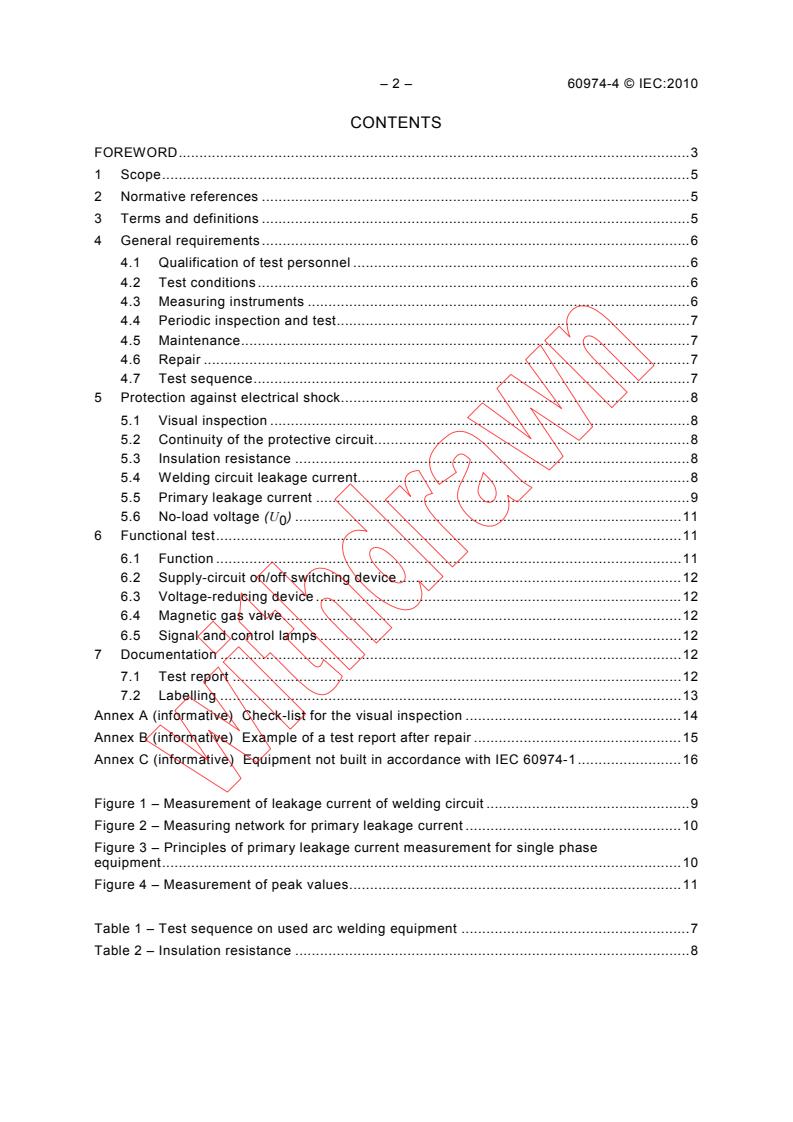
CONTENTS
FOREWORD.3
1 Scope.5
2 Normative references .5
3 Terms and definitions .5
4 General requirements .6
4.1 Qualification of test personnel .6
4.2 Test conditions.6
4.3 Measuring instruments .6
4.4 Periodic inspection and test.7
4.5 Maintenance.7
4.6 Repair .7
4.7 Test sequence.7
5 Protection against electrical shock.8
5.1 Visual inspection .8
5.2 Continuity of the protective circuit.8
5.3 Insulation resistance .8
5.4 Welding circuit leakage current.8
5.5 Primary leakage current .9
5.6 No-load voltage (U ) .11
6 Functional test.11
6.1 Function .11
6.2 Supply-circuit on/off switching device .12
6.3 Voltage-reducing device .12
6.4 Magnetic gas valve.12
6.5 Signal and control lamps .12
7 Documentation .12
7.1 Test report .12
7.2 Labelling .13
Annex A (informative) Check-list for the visual inspection .14
Annex B (informative) Example of a test report after repair .15
Annex C (informative) Equipment not built in accordance with IEC 60974-1.16
Figure 1 – Measurement of leakage current of welding circuit .9
Figure 2 – Measuring network for primary leakage current .10
Figure 3 – Principles of primary leakage current measurement for single phase
equipment.10
Figure 4 – Measurement of peak values.11
Table 1 – Test sequence on used arc welding equipment .7
Table 2 – Insulation resistance .8
60974-4 © IEC:2010 – 3 –
INTERNATIONAL ELECTROTECHNICAL COMMISSION
____________
ARC WELDING EQUIPMENT –
Part 4: Periodic inspection and testing
FOREWORD
1) The International Electrotechnical Commission (IEC) is a worldwide organization for standardization comprising
all national electrotechnical committees (IEC National Committees). The object of IEC is to promote
international co-operation on all questions concerning standardization in the electrical and electronic fields. To
this end and in addition to other activities, IEC publishes International Standards, Technical Specifications,
Technical Reports, Publicly Available Specifications (PAS) and Guides (hereafter referred to as “IEC
Publication(s)”). Their preparation is entrusted to technical committees; any IEC National Committee interested
in the subject dealt with may participate in this preparatory work. International, governmental and non-
governmental organizations liaising with the IEC also participate in this preparation. IEC collaborates closely
with the International Organization for Standardization (ISO) in accordance with conditions determined by
agreement between the two organizations.
2) The formal decisions or agreements of IEC on technical matters express, as nearly as possible, an international
consensus of opinion on the relevant subjects since each technical committee has representation from all
interested IEC National Committees.
3) IEC Publications have the form of recommendations for international use and are accepted by IEC National
Committees in that sense. While all reasonable efforts are made to ensure that the technical content of IEC
Publications is accurate, IEC cannot be held responsible for the way in which they are used or for any
misinterpretation by any end user.
4) In order to promote international uniformity, IEC National Committees undertake to apply IEC Publications
transparently to the maximum extent possible in their national and regional publications. Any divergence
between any IEC Publication and the corresponding national or regional publication shall be clearly indicated in
the latter.
5) IEC itself does not provide any attestation of conformity. Independent certification bodies provide conformity
assessment services and, in some areas, access to IEC marks of conformity. IEC is not responsible for any
services carried out by independent certification bodies.
6) All users should ensure that they have the latest edition of this publication.
7) No liability shall attach to IEC or its directors, employees, servants or agents including individual experts and
members of its technical committees and IEC National Committees for any personal injury, property damage or
other damage of any nature whatsoever, whether direct or indirect, or for costs (including legal fees) and
expenses arising out of the publication, use of, or reliance upon, this IEC Publication or any other IEC
Publications.
8) Attention is drawn to the Normative references cited in this publication. Use of the referenced publications is
indispensable for the correct application of this publication.
9) Attention is drawn to the possibility that some of the elements of this IEC Publication may be the subject of
patent rights. IEC shall not be held responsible for identifying any or all such patent rights.
International Standard IEC 60974-4 has been prepared by IEC technical committee 26:
Electric welding.
This second edition cancels and replaces the first edition published in 2006. It constitutes a
technical revision.
The main significant technical changes with respect to the previous edition are the following:
– title is amended;
– scope is extended to equipment designed in accordance with IEC 60974-6;
– complementary instructions from the manufacturer shall be followed;
– qualification of test personnel is clarified (see 4.1);
– plasma cutting power sources are excluded from no-load voltage test (see 5.6);
– voltage reducing device functional test is simplified (see 6.3);
– supply voltage is recorded in test report (see 7.1).
– 4 – 60974-4 © IEC:2010
The text of this standard is based on the following documents:
FDIS Report on voting
26/422/FDIS 26/428/RVD
Full information on the voting for the approval of this standard can be found in the report on
voting indicated in the above table.
This publication has been drafted in accordance with the ISO/IEC Directives, Part 2.
The list of all the parts of the IEC 60974 series, under the general title Arc welding equipment,
can be found on the IEC website.
The committee has decided that the contents of this publication will remain unchanged until
the stability date indicated on the IEC web site under "http://webstore.iec.ch" in the data
related to the specific publication. At this date, the publication will be
• reconfirmed,
• withdrawn,
• replaced by a revised edition, or
• amended.
60974-4 © IEC:2010 – 5 –
ARC WELDING EQUIPMENT –
Part 4: Periodic inspection and testing
1 Scope
This part of IEC 60974 specifies test procedures for periodic inspection and, after repair, to
ensure electrical safety. These test procedures are also applicable for maintenance.
This standard is applicable to power sources for arc welding and allied processes designed in
accordance with IEC 60974-1 or IEC 60974-6. Stand-alone ancillary equipment designed in
accordance with other part of IEC 60974 may be tested in accordance with relevant
requirement of this part of IEC 60974.
NOTE 1 The welding power source may be tested with any ancillary equipment fitted that could affect the test
results.
This standard is not applicable to testing of new power sources or engine-driven power
sources.
NOTE 2 For a power source not built in accordance with IEC 60974-1, see Annex C.
2 Normative references
The following referenced documents are indispensable for the application of this document.
For dated references, only the edition cited applies. For undated references, the latest edition
of the referenced document (including any amendments) applies.
IEC 60050-151, International Electrotechnical Vocabulary (IEV) – Part 151: Electrical and
magnetic devices
IEC 60050-195, International Electrotechnical Vocabulary (IEV) – Part 195: Earthing and
protection against electric shock
IEC 60050-851, International Electrotechnical Vocabulary (IEV) – Part 851: Electric welding
IEC 60974-1:2005, Arc welding equipment – Part 1: Welding power sources
IEC 60974-6, Arc welding equipment – Part 6: Limited duty manual metal arc welding power
sources
IEC 61557-4, Electrical safety in low voltage distribution systems up to 1 000 V a.c. and
1 500 V d.c. – Equipment for testing, measuring or monitoring of protective measures –
Part 4: Resistance of earth connection and equipotential bonding
3 Terms and definitions
For the purposes of this document, the terms and definitions given in the IEC 60050-151, the
IEC 60050-195, the IEC 60050-851, the IEC 60974-1, as well as the following, apply.
– 6 – 60974-4 © IEC:2010
3.1
expert
competent person
skilled person
a person who can judge the work assigned and recognize possible hazards on the basis of
professional training, knowledge, experience and knowledge of the relevant equipment
NOTE Several years of practice in the relevant technical field may be taken into consideration in assessment of
professional training.
[IEC 60974-1:2005, 3.3]
3.2
instructed person
person informed about the tasks assigned and about the possible hazards involved in
neglectful behaviour
NOTE If necessary, the person has undergone some training
[IEC 60974-1:2005, 3.4]
3.3
periodic inspection and test
examination carried out at specified intervals to reduce the risk of hazard
3.4
maintenance
service carried out at specified intervals to reduce the risk of hazard and failure
3.5
repair
restore to a safe and intended operating condition
3.6
test personnel
instructed person or expert that has been trained and authorized to perform periodic
inspection and testing
4 General requirements
4.1 Qualification of test personnel
Tests of welding equipment can be hazardous and shall be carried out by an instructed
person or expert in the field of electrical repair, preferably also familiar with welding, cutting
and allied processes. Instructed persons should be considered qualified for simple periodic
testing and maintenance provided the equipment enclosure does not have to be opened.
NOTE Hazardous voltages and currents inside the equipment enclosure may cause shock, burn or death. Only
expert test personnel may open the equipment.
4.2 Test conditions
Tests shall be carried out at an ambient air temperature between 10 °C and 40 °C on dry and
cleaned welding equipment.
4.3 Measuring instruments
The accuracy of measuring instruments shall be class 2.5 as a minimum, except for the
measurement of insulation resistance, where the accuracy of the instruments is not specified
but shall be taken into account for the measurement.
60974-4 © IEC:2010 – 7 –
4.4 Periodic inspection and test
The periodic inspection and test specified in Table 1 shall be carried out.
Tests shall be documented in a test report in accordance with 7.1.
During the tests, complementary instructions from the manufacturer shall be followed.
4.5 Maintenance
The manufacturer’s maintenance schedule and instructions shall be followed.
Tests shall be documented in a test report in accordance with 7.1.
4.6 Repair
After repair or replacement of a component which restores a welding or cutting function, an
expert shall select appropriate tests to be carried out, as specified in Table 1.
NOTE After a minor repair such as replacement of a lamp, wheel or under carriage, the tests given in Table 1 may
not be necessary.
Tests shall be documented in a test report in accordance with 7.1.
During the tests, complementary instructions from the manufacturer shall be observed (for
example, circuit diagrams, spare part list, functional test of power source and ancillary
equipment, etc.).
4.7 Test sequence
The test sequence is given in Table 1.
Table 1 – Test sequence on used arc welding equipment
Periodic inspection and test After repair
a) Visual inspection in accordance with 5.1 a) Visual inspection in accordance with 5.1
b) Electrical test: b) Electrical test:
– protective conductor resistance in accordance with – protective conductor resistance in accordance
5.2 with 5.2
a a
– insulation resistance in accordance with 5.3 – insulation resistance in accordance with 5.3
– no-load voltage in accordance with 5.6 – no-load voltage in accordance with 5.6
c) Functional test: c) Functional test:
– no requirement – function in accordance with 6.1
– supply-circuit on/off switching device in
accordance with 6.2
– voltage-reducing device in accordance with 6.3
– magnetic gas valve in accordance with 6.4
– signal and control lamps in accordance with 6.5
d) Documentation in accordance with Clause 7 d) Documentation in accordance with Clause 7
a
If the insulation resistance test cannot be carried out without disconnection of any component of the equipment to
be tested (e.g. interference suppression networks, protection capacitors or surge protection component), the
insulation resistance test may be replaced by both the primary and welding circuit leakage current tests in
accordance with 5.4 and 5.5.
– 8 – 60974-4 © IEC:2010
5 Protection against electrical shock
5.1 Visual inspection
Visual inspection shall be carried out in accordance with the conditions of use of welding
equipment and the manufacturer’s instructions.
An example of items for a visual inspection is given in Annex A.
5.2 Continuity of the protective circuit
For mains-powered welding equipment of protection class I, including ancillary equipment (for
example, cooling system) having mains connecting cables up to a length of 5,0 m, the
maximum measured protective conductor resistance shall not exceed 0,3 Ω.
For cables longer than 5,0 m, the permissible value of the protective conductor resistance is
increased by 0,1 Ω per additional 7,5 m cable. The maximum permissible value of the
protective conductor resistance is 1 Ω.
Conformity shall be checked by measuring the resistance between the protective conductor
contact at the plug and exposed conductive parts with testing equipment according to
IEC 61557-4.
During the measurement, the cables shall be bent, flexed or twisted along the whole length,
especially in the vicinity of cable entries into the enclosure, in order to detect interruptions in
the protective conductor.
5.3 Insulation resistance
The insulation resistance shall be not less than the values given in Table 2.
Table 2 – Insulation resistance
a
Measurement Resistance Insulation
Double or
Supply circuit to welding circuit 5,0 MΩ
reinforced
Welding circuit to protective circuit 2,5 MΩ Basic
Supply circuit to protective circuit 2,5 MΩ Basic
Supply circuit Double or
b
to accessible surfaces 5,0 MΩ
of Class II equipment reinforced
a Control circuits are tested together with the circuit to which they are galvanically connected.
b For measurement to accessible non-conductive surfaces, such surfaces shall be considered to be
covered by metal foil.
Conformity shall be checked by the stabilized measurement of the insulation resistance by
application of a d.c. voltage of 500 V at room temperature.
During the measurement, torches shall be disconnected, solid-state electronic components
and their protective devices may be short-circuited and liquid cooling units shall be tested
without liquid.
5.4 Welding circuit leakage current
The leakage current between the welding outlets and the protective conductor terminal shall
not exceed 10 mA a.c. r.m.s.
60974-4 © IEC:2010 – 9 –
Conformity shall be checked by measurement of the leakage current with a circuit as shown in
Figure 1 at the rated supply voltage and no-load condition.
The measuring circuit shall have a total resistance of 1 750 Ω ± 250 Ω and be shunted by a
capacitor so that the time constant of the circuit will be 225 μs ± 15 μs.
In the case of 1 750 Ω, the capacitor will be 130 nF.
130 nF
mA
1 750 Ω
IEC 1904/06
NOTE For class II equipment, use the PE-terminal of earthed supply circuit network.
Figure 1 – Measurement of leakage current of welding circuit
5.5 Primary leakage current
The primary leakage current in the external protective conductor shall not exceed
a) 5 mA r.m.s. for plug-connected equipment rated up to and including 32 A;
b) 10 mA r.m.s. for plug-connected equipment rated more than 32 A;
c) 10 mA r.m.s. for equipment for permanent connection, without special measures for the
protective conductor;
d) 5 % of the rated input current per phase, for equipment for permanent connection with a
reinforced protective conductor.
Conformity shall be checked using the measuring circuit shown in Figure 2 with a
conventional voltmeter under the following conditions:
• the welding equipment is
– isolated from the ground plane;
– supplied by the rated supply voltage;
– not connected to the protective earth except through measurement
components;
• the output circuit is in the no-load condition;
• interference suppression capacitors shall not be disconnected.
NOTE 1 The circuit given in Figure 2 is used to obtain reproducible results.
– 10 – 60974-4 © IEC:2010
R C
S S
A
R
B
R U C U
B 1 2
IEC 1905/06
Key
A, B test terminals U rated supply voltage
R 1 500 Ω R 10 000 Ω
S 1
R U conventional load voltage
500 Ω
B 2
C C
0,22 μF 0,022 μF
S 1
U
Leakage current I =
PE
R
B
Figure 2 – Measuring network for primary leakage current
The measurement of the primary leakage current may be made direct or in the form of a
difference current measurement (see Figure 3). Instead of the ammeter shown in Figure 3, the
measuring circuit in Figure 2 shall be used. The tolerance of the component values in the
measurement circuit shall not exceed ±5 %.
Equipment for permanent connection with a reinforced protective conductor shall be tested
according to the manufacturer’s specification.
PE N/L L
PE N/L L
Measuring
Measuring
instrument
instrument
A
A
A
A
I I I
PE Out In I I I
Out In Dif.
B
B
Power
Power
source
source
IEC 1906/06
IEC 1907/06
Principle of direct measurement Principle of measurement according to the
difference current procedure
Figure 3 – Principles of primary leakage current measurement
for single phase equipment
NOTE 2 Caution! A qualified person should perform this test. The protective conductor is disabled for this test.
60974-4 © IEC:2010 – 11 –
5.6 No-load voltage (U )
The peak values of the maximum no-load voltage at all possible settings of the power source
shall not exceed the values given in Table 13 of IEC 60974-1 when the power source is
supplied at rated supply voltage and frequency.
Before testing, arc striking and stabilizing devices shall, if necessary, be removed or by-
passed according to the manufacturer’s instructions (see also instructions for use or
manufacturer’s testing instructions).
The no-load voltage is measured between welding output terminals. If this is not possible for
safety or control reasons, the no-load voltage is measured between torch and welding return
cable connection. This test is not required for plasma cutting power sources.
If rated reduced no-load voltage (U ) or rated switched no-load voltage (U ) are defined on
R S
the rating plate, U or U shall be measured instead of U .
R S 0
Conformity shall be checked by measurement of
a) r.m.s. values
A true r.m.s. meter is used with a resistance of the external welding circuit of 5 kΩ.
b) peak values
To obtain reproducible measurements of peak values, omitting impulses which are not
dangerous, a circuit is used as shown in Figure 4.
1 kΩ
0,2 kΩ
U
0 10 nF
6,8 μF V
0-5 kΩ
1 = Diode 1N4007 or similar
IEC 1908/06
Figure 4 – Measurement of peak values
The voltmeter shall indicate mean values. The measurement range chosen shall be as near
as possible to the actual value of the no-load voltage. The voltmeter shall have an internal
resistance of at least 1 MΩ.
The tolerance of the component values in the measurement circuit shall not exceed ±5 %. The
minimum power for the resistor of 0,2 kΩ is 65 W. The rheostat shall withstand a current value
of 0,6 A. The capacitor shall have a minimum voltage rating of 200 V.
6 Functional test
6.1 Function
Each safety-related function judged as relevant by the test personnel shall be checked for
correct operation.
– 12 – 60974-4 © IEC:2010
Conformity shall be checked by operating the device and by checking whether the welding
power source operates correctly.
6.2 Supply-circuit on/off switching device
Where an integral supply-circuit on/off switching device (for example, switch, contactor or
circuit-breaker) is fitted, this shall:
a) open or close all ungrounded mains conductors;
b) clearly indicate whether the circuit is open or closed.
Conformity shall be checked by visual inspection and measurement.
6.3 Voltage-reducing device
Where a voltage-reducing device is fitted, this shall indicate satisfactory operation.
Conformity shall be checked by visual inspection of indicator in load and no-load condition.
6.4 Magnetic gas valve
Each magnetic gas valve (for example, TIG, MIG/MAG, plasma power sources), shall be
checked for correct operation.
Conformity shall be checked by visual inspection and the following operations or by a test
specified by the manufacturer.
a) Function
Operate the trigger of the torch and check by means of the gas flow whether the magnetic
gas valve operates.
b) Leakage
Pressurize the system and verify there is no leak, for example, there is no pressure drop.
NOTE Attention should be paid to the fact that also flexible gas tubes and their connections may leak.
6.5 Signal and control lamps
Each signal or control lamp fitted shall be checked for correct operation.
Conformity shall be checked by visual inspection.
7 Documentation
7.1 Test report
The test report shall include
a) identification of tested arc welding equipment;
b) date of testing;
c) supply voltage;
d) test results;
e) signature, identification of the test personnel and his organization;
f) identification of testing equipment.
60974-4 © IEC:2010 – 13 –
The test report, after repair, shall include all the tests given in Table 1 and an indication shall
be made if a particular test has not been carried out.
An example of a test report is given in Annex B.
7.2 Labelling
A label shall be attached to the equipment to indicate that it has passed the test.
The label shall state the date of testing or recommended date for next inspection depending
on local regulation.
– 14 – 60974-4 © IEC:2010
Annex A
(informative)
Check-list for the visual inspection
During visual inspection, the following listed items should be checked.
a) Torch/electrode holder, welding current return clamp
• missing or defective insulation
• defective connections
• defective, damaged switches
• other damage
b) Mains supply
• defective, damaged cable
• deformed, faulty plug
• broken or thermally damaged plug pins
• ineffective cable anchorage
• cables and plugs unsuitable for the intended use and performance
c) Welding circuit
• defective, damaged cable
• deformed, faulty or thermally damaged coupler/sockets
• ineffective cable anchorage
• cables and couplers unsuitable for the intended use and performance
d) Enclosure
• missing or damaged parts
• unauthorised modifications
• cooling openings blocked or missing air filters
• signs of overload and improper use
• missing or defective protective devices, for example, gas cylinder holder
• missing or defective wheels, lifting means, holder, etc.
• defective wire reel mounting means
• conductive objects placed in the enclosure
e) Controls and indicators
• defective switches, meters and lamps
• defective pressure regulator or flowmeter
• incorrect fuses accessible from outside the enclosure
f) General condition
• excessive dust or pollution
• cooling liquid circuit leaking or incorrect cooling liquid level
• defective gas hoses and connections
• poor legibility of markings and labelling
• other damage or signs of improper use
60974-4 © IEC:2010 – 15 –
Annex B
(informative)
Example of a test report after repair
Test report
Company: Sample Ltd. Location: London Torchham WH15 B4
Equipment: Arc welding power source Type: Freefried S/N: 123456
Manufacturer: Freefried Electric Ltd. Protection class:
Testing equipment: Multimeter D6, Metaframe, measuring circuits as given in IEC 60974-4.
Mains voltage V r.m.s 230
Test point: Limit Measured values
Visual inspection --- OK
Protective conductor resistance ---
R 0,2
PE [Ω] ≤ 0,3 Ω
Insulation resistance ---
- Input circuit/
Protective circuit (500 V) R [MΩ] ≥ 2,5 MΩ N/A
I-P
- Welding circuit/
Protective circuit (500 V) R [MΩ] ≥ 2,5 MΩ N/A
W-P
- Input circuit/
Welding circuit (500 V) R [MΩ] ≥ 5 MΩ N/A
I-W
Primary leakage current ---
- Plug-connected
equipment rated up to
≤ 5 mA
32 A I [mA] 2
PE
- Plug-connected
equipment rated more
≤ 10 mA
than 32 A I [mA]
PE
- Permanent connection
≤ 10 mA
without special measures I [mA]
PE
- Equipment with reinforced
≤ 5 %
protective conductor I [mA]
PE
Welding circuit leakage current ---
0,568
I [mA] ≤ 10 mA
PE
No-load voltage ---
U [V ] N/A
0 AC ≤68 V
peak
S
With marked
U [V ] N/A
0 DC
≤113 V
peak
U [V ] 110
0 AC ≤113 V
peak
S
Without marked
U [V ] N/A
0 DC
≤113 V
peak
Functional test --- ok
Test passed
Test personnel name --- Myself
Test personnel signature
--- Me
Date --- 05-10-09
Remarks (result of visual inspection or functional test): None __________________________________
Testing company: Checkmates Limited ____________________________________________________
Address: London Weldshire WG3 A7 ______________________________________________________
Repair: replacement of broken main switch _________________________________________________
N/A: Not applicable to the repair according to the investigator
– 16 – 60974-4 © IEC:2010
Annex C
(informative)
Equipment not built in accordance with IEC 60974-1
Welding equipment not built in accordance with IEC 60974-1 (for example, built prior to the
publication date of the first edition (1989)) may not meet all requirements of this standard.
In this case, the investigator should state in his report as follows:
– the requirements which have not been met;
– the extend to which the requirement has not been met;
– the assessment of the risk deriving there of;
– the corrective measures when necessary.
The report should enable the owner to take the right decision. In some cases the equipment
will need to be taken out of service.
___________
– 18 – 60974-4 © CEI:2010
SOMMAIRE
AVANT-PROPOS.19
1 Domaine d’application .21
2 Références normatives.21
3 Termes et définitions .22
4 Exigences générales .22
4.1 Qualification du personnel d'essai .22
4.2 Conditions d’essai .23
4.3 Instruments de mesure.23
4.4 Inspection périodique et essai .23
4.5 Maintenance.23
4.6 Réparation .23
4.7 Séquence d’essai .23
5 Protection contre les chocs électriques.24
5.1 Examen visuel.24
5.2 Continuité du circuit de protection .24
5.3 Résistance d’isolement.24
5.4 Courant de fuite du circuit de soudage .25
5.5 Courant de fuite primaire.26
5.6 Tension à vide (U ) .27
6 Essai fonctionnel .28
6.1 Fonctionnement.28
6.2 Dispositif de commutation marche/arrêt du circuit d’alimentation .28
6.3 Dispositif réducteur de tension .28
6.4 Electrovanne à gaz.28
6.5 Lampes témoin et lampes de contrôle .29
7 Documentation .29
7.1 Rapport d’essai .29
7.2 Etiquetage.29
Annexe A (informative) Liste de contrôle pour l’examen visuel.30
Annexe B (informative) Exemple de rapport d’essai après réparation.31
Annexe C (informative) Matériel non construit conformément à la CEI 60974-1.32
Figure 1 – Mesure du courant de fuite du circuit de soudage .25
Figure 2 – Circuit de mesure pour le courant de fuite primaire .26
Figure 3 – Principes de mesure du courant de fuite primaire pour les équipements
monophasés .27
Figure 4 – Mesure des valeurs crête .28
Tableau 1 – Séquence d’essai sur le matériel de soudage à l’arc utilisé .23
Tableau 2 – Résistance d’isolement.25
60974-4 © CEI:2010 – 19 –
COMMISSION ÉLECTROTECHNIQUE INTERNATIONALE
____________
MATÉRIEL DE SOUDAGE À L’ARC –
Partie 4: Inspection et essais périodiques
AVANT-PROPOS
1) La Commission Electrotechnique Internationale (CEI) est une organisation mondiale de normalisation
composée de l'ensemble des comités électrotechniques nationaux (Comités nationaux de la CEI). La CEI a
pour objet de favoriser la coopération internationale pour toutes les questions de normalisation dans les
domaines de l'électricité et de l'électronique. A cet effet, la CEI – entre autres activités – publie des Normes
internationales, des Spécifications techniques, des Rapports techniques, des Spécifications accessibles au
public (PAS) et des Guides (ci-après dénommés "Publication(s) de la CEI"). Leur élaboration est confiée à des
comités d'études, aux travaux desquels tout Comité national intéressé par le sujet traité peut participer. Les
organisations internationales, gouvernementales et non gouvernementales, en liaison avec la CEI, participent
également aux travaux. La CEI collabore étroitement avec l'Organisation Internationale de Normalisation (ISO),
selon des conditions fixées par accord entre les deux organisations.
2) Les décisions ou accords officiels de la CEI concernant les questions techniques représentent, dans la mesure
du possible, un accord international sur les sujets étudiés, étant donné que les Comités nationaux de la CEI
intéressés sont représentés dans chaque comité d’études.
3) Les Publications de la CEI se présentent sous la forme de recommandations internationales et sont agréées
comme telles par les Comités nationaux de la CEI. Tous les efforts raisonnables sont entrepris afin que la CEI
s'assure de l'exactitude du contenu technique de ses publications; la CEI ne peut pas être tenue responsable
de l'éventuelle mauvaise utilisation ou interprétation qui en est faite par un quelconque utilisateur final.
4) Dans le but d'encourager l'uniformité internationale, les Comités nationaux de la CEI s'engagent, dans toute la
mesure possible, à appliquer de façon transparente les Publications de la CEI dans leurs publications
nationales et régionales. Toutes divergences entre toutes Publications de la CEI et toutes publications
nationales ou régionales correspondantes doivent être indiquées en termes clairs dans ces dernières.
5) La CEI elle-même ne fournit aucune attestation de conformité. Des organismes de certification indépendants
fournissent des services d'évaluation de conformité et, dans certains secteurs, accèdent aux marques de
conformité de la CEI. La CEI n'est responsable d'aucun des services effectués par les organismes de
certification indépendants.
6) Tous les utilisateurs doivent s'assurer qu'ils sont en possession de la dernière édition de cette publication.
7) Aucune responsabilité ne doit être imputée à la CEI, à ses administrateurs, employés, auxiliaires ou
mandataires, y compris ses experts particuliers et les membres de ses comités d'études et des Comités
nationaux de la CEI, pour tout préjudice causé en cas de dommages corporels et matériels, ou de tout autre
dommage de quelque nature que ce soit, directe ou indirecte, ou pour supporter les coûts (y compris les frais
de justice) et les dépenses découlant de la publication ou de l'utilisation de cette Publication de la CEI ou de
toute autre Publication de la CEI, ou au crédit qui lui est accordé.
8) L'attention est attirée sur les références normatives citées dans cette publication. L'utilisation de publications
référencées est obligatoire pour une application correcte de la présente publication.
9) L’attention est attirée sur le fait que certains des éléments de la présente Publication de la CEI peuvent faire
l’objet de droits de propriété intellectuelle ou de droits analogues. La CEI ne saurait être tenue pour
responsable de ne pas avoir identifié de tels droits de propriété et de ne pas avoir signalé leur existence.
La Norme internationale CEI 60974-4 a été établie par le comité d'études 26 de la CEI:
Soudage électrique.
Cette seconde édition annule et remplace la première édition parue en 2006. Elle constitue
une révision technique.
Les modifications majeures par rappor
...