

ISO/TS 12869-2:2024
(Main)Water quality — Detection and quantification of Legionella spp. and/or Legionella pneumophila by concentration and genic amplification by quantitative polymerase chain reaction (qPCR) — Part 2: On-site methods
General Information
- Abstract
This document provides the guidelines, minimum requirements and performance characteristics intended to guarantee that manufactured systems intended for on-site/field use (i.e. outside the laboratory) provide reliable and reproducible results. This document specifies the requirements for technologies that enable on-site detection and quantification of Legionella spp. and L. pneumophila using a quantitative polymerase chain reaction assay (qPCR). It specifies general methodological requirements, performance evaluation requirements and quality control requirements. This document is intended to be used by manufacturers of these technologies so that they produce detection systems that end users can operate safely and effectively. End users will be guided by this document to adhere to manufacturer’s instructions, to ensure user competency and to perform the necessary controls. Technical details specified in this document are given for information only. Any other technical solutions complying with the performance requirements are suitable. NOTE For validation and performance requirements, see Clause 9. This document is intended to be applied in the bacteriological investigation of all types of water (hot or cold water, cooling tower water, etc.), unless the nature and/or content of suspended matter and/or background microorganisms interfere with the determination. This interference can result in an adverse effect on both the detection limit and the quantification limit. The results are expressed as the number of genome units of Legionella spp. and/or L. pneumophila per millilitre (or litre) of sample. Although the method described in this document is applicable to all types of water, some additives, such as chemicals used for water treatment, can interfere with and/or affect the sensitivity of the method. The qPCR methods do not give any information about the physiological state of the Legionella. However, there are on-site qPCR methodologies which are able to distinguish intact bacteria from free DNA.
- Status
- Published
- Publication Date
- 04-Apr-2024
- Technical Committee
- ISO/TC 147/SC 4 - Microbiological methods
- Drafting Committee
- ISO/TC 147/SC 4 - Microbiological methods
- Current Stage
- 6060 - International Standard published
- Start Date
- 05-Apr-2024
- Due Date
- 25-Apr-2025
- Completion Date
- 05-Apr-2024
Buy Documents

ISO/TS 12869-2:2024 - Water quality — Detection and quantification of Legionella spp. and/or Legionella pneumophila by concentration and genic amplification by quantitative polymerase chain reaction (qPCR) — Part 2: On-site methods Released:5. 04. 2024
Overview
ISO/TS 12869-2:2024 specifies guidelines, minimum requirements and performance characteristics for on‑site (field) systems that detect and quantify Legionella spp. and Legionella pneumophila using concentration steps followed by quantitative polymerase chain reaction (qPCR). It helps manufacturers design reliable portable detection systems and guides end users on safe operation, quality control and verification. Results are reported as genome units per millilitre (or litre) of water. The scope covers the bacteriological investigation of all water types (hot/cold water, cooling tower water, etc.), noting that suspended matter or water-treatment chemicals can affect sensitivity.
Key Topics and Requirements
- Performance characteristics: Minimum criteria manufacturers must demonstrate for on‑site qPCR systems (see Clause 9 for validation and performance requirements).
- Sampling and concentration: Procedures for sample collection and concentrating bacteria prior to qPCR to achieve representative results.
- qPCR methodology: Requirements for DNA amplification, target sequences, primers and probes, amplification mix preparation, and quantitative detection workflow.
- Limits and calibration: Verification of calibration function, PCR limit of detection (LOD) and limit of quantification (LOQ) and the theoretical LOQ of the whole method.
- Recovery, precision and robustness: Protocols for assessing bacterial recovery/accuracy, reproducibility, intermediate precision and robustness of the whole method.
- Quality control: Mandatory controls such as positive/negative controls, no‑template controls and inhibition controls; monitoring and calibration linking to primary standards.
- Usability and end‑user requirements: Manufacturer instructions, end‑user competency, proficiency testing and usability validation (human factors testing).
- Operational considerations: Premises, apparatus and consumables, reagent handling, decontamination, maintenance, waste management and reporting of results.
- Annexes: Manufacturer and end‑user responsibilities, HFT protocol and example on‑site verification protocol.
Applications & Who Uses It
- Manufacturers of portable or field qPCR systems - to design, validate and document products that meet international performance and quality requirements.
- Environmental and public‑health laboratories, facilities management, water treatment operators and building owners - for on‑site screening and routine monitoring of Legionella risk in cooling towers, hot and cold water systems, spas and other water systems.
- Regulatory bodies and consultants - to evaluate compliance, validate field methods and support risk assessment and outbreak investigations.
Note: qPCR detects genomic material and does not inherently indicate bacterial viability; however, on‑site qPCR workflows may incorporate approaches to distinguish intact cells from free DNA.
Related standards
- This is Part 2: On‑site methods of ISO/TS 12869. Users should consult other parts of ISO/TS 12869 and applicable ISO water‑quality and molecular‑diagnostics standards for complementary laboratory procedures, sampling standards and quality frameworks.
Buy Documents
ISO/TS 12869-2:2024 - Water quality — Detection and quantification of Legionella spp. and/or Legionella pneumophila by concentration and genic amplification by quantitative polymerase chain reaction (qPCR) — Part 2: On-site methods Released:5. 04. 2024
Frequently Asked Questions
ISO/TS 12869-2:2024 is a technical specification published by the International Organization for Standardization (ISO). Its full title is "Water quality — Detection and quantification of Legionella spp. and/or Legionella pneumophila by concentration and genic amplification by quantitative polymerase chain reaction (qPCR) — Part 2: On-site methods". This standard covers: This document provides the guidelines, minimum requirements and performance characteristics intended to guarantee that manufactured systems intended for on-site/field use (i.e. outside the laboratory) provide reliable and reproducible results. This document specifies the requirements for technologies that enable on-site detection and quantification of Legionella spp. and L. pneumophila using a quantitative polymerase chain reaction assay (qPCR). It specifies general methodological requirements, performance evaluation requirements and quality control requirements. This document is intended to be used by manufacturers of these technologies so that they produce detection systems that end users can operate safely and effectively. End users will be guided by this document to adhere to manufacturer’s instructions, to ensure user competency and to perform the necessary controls. Technical details specified in this document are given for information only. Any other technical solutions complying with the performance requirements are suitable. NOTE For validation and performance requirements, see Clause 9. This document is intended to be applied in the bacteriological investigation of all types of water (hot or cold water, cooling tower water, etc.), unless the nature and/or content of suspended matter and/or background microorganisms interfere with the determination. This interference can result in an adverse effect on both the detection limit and the quantification limit. The results are expressed as the number of genome units of Legionella spp. and/or L. pneumophila per millilitre (or litre) of sample. Although the method described in this document is applicable to all types of water, some additives, such as chemicals used for water treatment, can interfere with and/or affect the sensitivity of the method. The qPCR methods do not give any information about the physiological state of the Legionella. However, there are on-site qPCR methodologies which are able to distinguish intact bacteria from free DNA.
This document provides the guidelines, minimum requirements and performance characteristics intended to guarantee that manufactured systems intended for on-site/field use (i.e. outside the laboratory) provide reliable and reproducible results. This document specifies the requirements for technologies that enable on-site detection and quantification of Legionella spp. and L. pneumophila using a quantitative polymerase chain reaction assay (qPCR). It specifies general methodological requirements, performance evaluation requirements and quality control requirements. This document is intended to be used by manufacturers of these technologies so that they produce detection systems that end users can operate safely and effectively. End users will be guided by this document to adhere to manufacturer’s instructions, to ensure user competency and to perform the necessary controls. Technical details specified in this document are given for information only. Any other technical solutions complying with the performance requirements are suitable. NOTE For validation and performance requirements, see Clause 9. This document is intended to be applied in the bacteriological investigation of all types of water (hot or cold water, cooling tower water, etc.), unless the nature and/or content of suspended matter and/or background microorganisms interfere with the determination. This interference can result in an adverse effect on both the detection limit and the quantification limit. The results are expressed as the number of genome units of Legionella spp. and/or L. pneumophila per millilitre (or litre) of sample. Although the method described in this document is applicable to all types of water, some additives, such as chemicals used for water treatment, can interfere with and/or affect the sensitivity of the method. The qPCR methods do not give any information about the physiological state of the Legionella. However, there are on-site qPCR methodologies which are able to distinguish intact bacteria from free DNA.
ISO/TS 12869-2:2024 is classified under the following ICS (International Classification for Standards) categories: 07.100.20 - Microbiology of water. The ICS classification helps identify the subject area and facilitates finding related standards.
ISO/TS 12869-2:2024 is available in PDF format for immediate download after purchase. The document can be added to your cart and obtained through the secure checkout process. Digital delivery ensures instant access to the complete standard document.
Standards Content (Sample)
Technical
Specification
ISO/TS 12869-2
First edition
Water quality — Detection and
2024-04
quantification of Legionella spp.
and/or Legionella pneumophila
by concentration and genic
amplification by quantitative
polymerase chain reaction
(qPCR) —
Part 2:
On-site methods
Qualité de l'eau — Détection et quantification de Legionella spp.
et/ou Legionella pneumophila par concentration et amplification
génique par réaction de polymérisation en chaîne quantitative
(qPCR) —
Partie 2: Méthodes sur site
Reference number
© ISO 2024
All rights reserved. Unless otherwise specified, or required in the context of its implementation, no part of this publication may
be reproduced or utilized otherwise in any form or by any means, electronic or mechanical, including photocopying, or posting on
the internet or an intranet, without prior written permission. Permission can be requested from either ISO at the address below
or ISO’s member body in the country of the requester.
ISO copyright office
CP 401 • Ch. de Blandonnet 8
CH-1214 Vernier, Geneva
Phone: +41 22 749 01 11
Email: copyright@iso.org
Website: www.iso.org
Published in Switzerland
ii
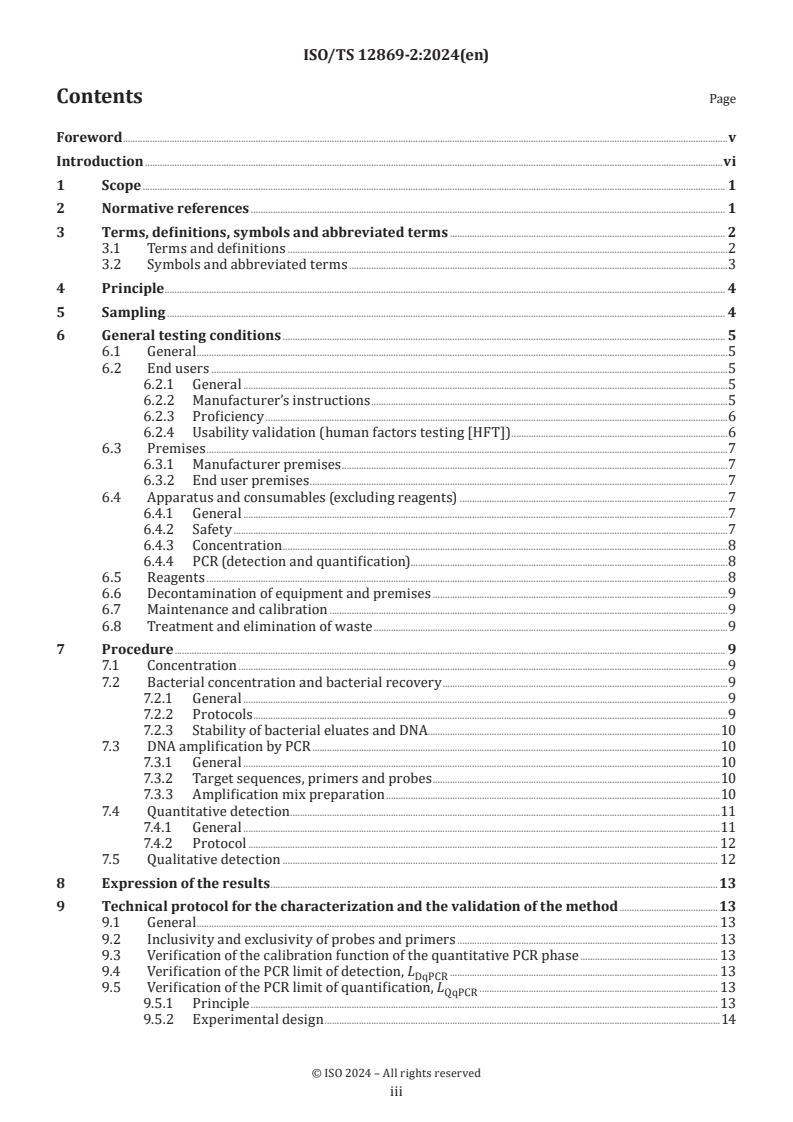
Contents Page
Foreword .v
Introduction .vi
1 Scope . 1
2 Normative references . 1
3 Terms, definitions, symbols and abbreviated terms . 2
3.1 Terms and definitions .2
3.2 Symbols and abbreviated terms .3
4 Principle . 4
5 Sampling . 4
6 General testing conditions . 5
6.1 General .5
6.2 End users .5
6.2.1 General .5
6.2.2 Manufacturer’s instructions .5
6.2.3 Proficiency .6
6.2.4 Usability validation (human factors testing [HFT]) .6
6.3 Premises .7
6.3.1 Manufacturer premises .7
6.3.2 End user premises .7
6.4 Apparatus and consumables (excluding reagents) .7
6.4.1 General .7
6.4.2 Safety .7
6.4.3 Concentration .8
6.4.4 PCR (detection and quantification).8
6.5 Reagents .8
6.6 Decontamination of equipment and premises .9
6.7 Maintenance and calibration .9
6.8 Treatment and elimination of waste .9
7 Procedure . 9
7.1 Concentration .9
7.2 Bacterial concentration and bacterial recovery .9
7.2.1 General .9
7.2.2 Protocols .9
7.2.3 Stability of bacterial eluates and DNA.10
7.3 DNA amplification by PCR .10
7.3.1 General .10
7.3.2 Target sequences, primers and probes .10
7.3.3 Amplification mix preparation .10
7.4 Quantitative detection .11
7.4.1 General .11
7.4.2 Protocol . 12
7.5 Qualitative detection . 12
8 Expression of the results .13
9 Technical protocol for the characterization and the validation of the method .13
9.1 General . 13
9.2 Inclusivity and exclusivity of probes and primers . 13
9.3 V erification of the calibration function of the quantitative PCR phase . 13
9.4 V erification of the PCR limit of detection, L . 13
DqPCR
9.5 V erification of the PCR limit of quantification, L . 13
QqPCR
9.5.1 Principle . 13
9.5.2 Experimental design .14
iii
9.5.3 Analysis of results .14
9.5.4 Theoretical limit of quantification of the whole method .14
9.6 Recovery/accuracy.14
9.6.1 Principle .14
9.6.2 Protocol for preparation of bacteria .14
9.7 Precision . . . 15
9.7.1 General . 15
9.7.2 Reproducibility . 15
9.7.3 Intermediate precision . 15
9.8 Robustness . 15
9.9 Measurement uncertainty of the whole method .16
9.10 On-site verification by end user .16
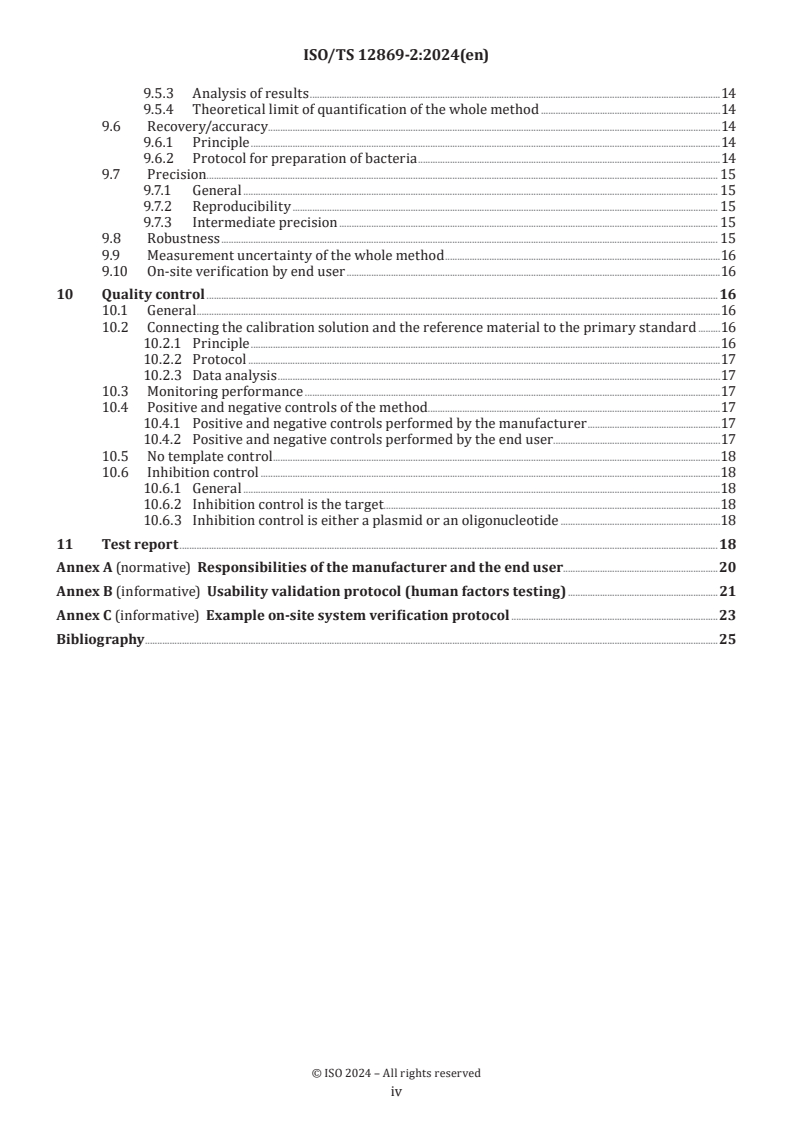
10 Quality control .16
10.1 General .16
10.2 Connecting the calibration solution and the reference material to the primary standard .16
10.2.1 Principle .16
10.2.2 Protocol .17
10.2.3 Data analysis .17
10.3 M onitoring performance .17
10.4 Positive and negative controls of the method.17
10.4.1 Positive and negative controls performed by the manufacturer .17
10.4.2 Positive and negative controls performed by the end user .17
10.5 No template control .18
10.6 Inhibition control .18
10.6.1 General .18
10.6.2 Inhibition control is the target . .18
10.6.3 Inhibition control is either a plasmid or an oligonucleotide .18
11 Test report .18
Annex A (normative) Responsibilities of the manufacturer and the end user.20
Annex B (informative) Usability validation protocol (human factors testing) .21
Annex C (informative) Example on-site system verification protocol .23
Bibliography .25
iv
Foreword
ISO (the International Organization for Standardization) is a worldwide federation of national standards
bodies (ISO member bodies). The work of preparing International Standards is normally carried out through
ISO technical committees. Each member body interested in a subject for which a technical committee
has been established has the right to be represented on that committee. International organizations,
governmental and non-governmental, in liaison with ISO, also take part in the work. ISO collaborates closely
with the International Electrotechnical Commission (IEC) on all matters of electrotechnical standardization.
The procedures used to develop this document and those intended for its further maintenance are described
in the ISO/IEC Directives, Part 1. In particular, the different approval criteria needed for the different types
of ISO document should be noted. This document was drafted in accordance with the editorial rules of the
ISO/IEC Directives, Part 2 (see www.iso.org/directives).
ISO draws attention to the possibility that the implementation of this document may involve the use of (a)
patent(s). ISO takes no position concerning the evidence, validity or applicability of any claimed patent
rights in respect thereof. As of the date of publication of this document, ISO had not received notice of (a)
patent(s) which may be required to implement this document. However, implementers are cautioned that
this may not represent the latest information, which may be obtained from the patent database available at
www.iso.org/patents. ISO shall not be held responsible for identifying any or all such patent rights.
Any trade name used in this document is information given for the convenience of users and does not
constitute an endorsement.
For an explanation of the voluntary nature of standards, the meaning of ISO specific terms and expressions
related to conformity assessment, as well as information about ISO's adherence to the World Trade
Organization (WTO) principles in the Technical Barriers to Trade (TBT), see www.iso.org/iso/foreword.html.
This document was prepared by Technical Committee ISO/TC 147, Water quality, Subcommittee SC 4,
Microbiological methods.
A list of all parts in the ISO 12869 series can be found on the ISO website.
Any feedback or questions on this document should be directed to the user’s national standards body. A
complete listing of these bodies can be found at www.iso.org/members.html.
v
Introduction
ISO/TS 12869 provides the guidelines, minimum requirements and performance characteristics intended
to guarantee that the quantification of L. pneumophila or Legionella spp. by amplification of specific DNA
sequences (PCR) and real time detection of specific DNA sequences (PCR) and real-time detection of specific
fluorophores is reproducible between methodologies completed by different laboratories.
Similar to ISO/TS 12869, this document specifies a method to determine recovery of the bacteria and
subsequent DNA amplification (lysis efficiency is not estimated).
vi
Technical Specification ISO/TS 12869-2:2024(en)
Water quality — Detection and quantification of Legionella
spp. and/or Legionella pneumophila by concentration and
genic amplification by quantitative polymerase chain reaction
(qPCR) —
Part 2:
On-site methods
1 Scope
This document provides the guidelines, minimum requirements and performance characteristics intended
to guarantee that manufactured systems intended for on-site/field use (i.e. outside the laboratory) provide
reliable and reproducible results.
This document specifies the requirements for technologies that enable on-site detection and quantification
of Legionella spp. and L. pneumophila using a quantitative polymerase chain reaction assay (qPCR). It
specifies general methodological requirements, performance evaluation requirements and quality control
requirements. This document is intended to be used by manufacturers of these technologies so that they
produce detection systems that end users can operate safely and effectively. End users will be guided by
this document to adhere to manufacturer’s instructions, to ensure user competency and to perform the
necessary controls.
Technical details specified in this document are given for information only. Any other technical solutions
complying with the performance requirements are suitable.
NOTE For validation and performance requirements, see Clause 9.
This document is intended to be applied in the bacteriological investigation of all types of water (hot or cold
water, cooling tower water, etc.), unless the nature and/or content of suspended matter and/or background
microorganisms interfere with the determination. This interference can result in an adverse effect on both
the detection limit and the quantification limit.
The results are expressed as the number of genome units of Legionella spp. and/or L. pneumophila
per millilitre (or litre) of sample.
Although the method described in this document is applicable to all types of water, some additives, such as
chemicals used for water treatment, can interfere with and/or affect the sensitivity of the method.
The qPCR methods do not give any information about the physiological state of the Legionella. However,
there are on-site qPCR methodologies which are able to distinguish intact bacteria from free DNA.
2 Normative references
The following documents are referred to in the text in such a way that some or all of their content constitutes
requirements of this document. For dated references, only the edition cited applies. For undated references,
the latest edition of the referenced document (including any amendments) applies.
ISO 5667-1, Water quality — Sampling — Part 1: Guidance on the design of sampling programmes and sampling
techniques
ISO 19458, Water quality — Sampling for microbiological analysis
ISO/TS 12869:2019, Water quality — Detection and quantification of Legionella spp. and/or Legionella
pneumophila by concentration and genic amplification by quantitative polymerase chain reaction (qPCR)
ISO 11731, Water quality — Enumeration of Legionella
3 Terms, definitions, symbols and abbreviated terms
3.1 Terms and definitions
For the purposes of this document, the terms and definitions given in ISO/TS 12869 and the following apply.
ISO and IEC maintain terminology databases for use in standardization at the following addresses:
— ISO Online browsing platform: available at https:// www .iso .org/ obp
— IEC Electropedia: available at https:// www .electropedia .org/
3.1.1
Legionella spp.
several species of Legionella, including L. pneumophila
3.1.2
polymerase chain reaction inhibition control
PCR inhibition control
materials and processes used to assess if the sample DNA extract contains (a) PCR inhibitor(s)
Note 1 to entry: The control can be a plasmid, an oligonucleotide or the L. pneumophila genomic DNA. A specific probe
shall be used to detect the inhibition control.
3.1.3
bacterial recovery
evaluation of the reported quantity of bacteria by the on-site qPCR (3.1.7) system when a known quantity of
reference material is tested
3.1.4
working calibration solution
L. pneumophila DNA calibrated solutions, derived from a standard solution, for which accuracy is determined
by an independent method (e.g. digital droplet PCR) used to establish the calibration curve
3.1.5
negative control of the method
control for monitoring the whole process in this method (from filtration to extraction to qPCR)
3.1.6
no template control
NTC
control for monitoring qPCR reagent amplification
3.1.7
on-site qPCR
qPCR testing that can occur immediately after sample collection, such that sample preservation is not
required (e.g. sodium thiosulfate)
Note 1 to entry: On-site qPCR is validated for use by non-laboratory personnel that have been trained in the procedure.
3.1.8
concentration device
device that prepares a water sample for qPCR amplification
Note 1 to entry: This kind of device is designed such that it can be used safely and effectively by non-laboratory trained
personnel.
3.1.9
threshold cycle
C
t
Note 1 to entry: number of PCR cycles (denaturation and amplification) required to replicate the DNA copies originally
present in the sample, so that the concentration of DNA exceeds the detection limit
Note 2 to entry: The C value is the intercept of the line that represents the DNA concentration of a sample with
t
fluorescent base line.
3.1.10
genome unit
GU
Note 1 to entry: unit representing a single copy of bacterial genomic DNA
3.1.11
graphical user interface
GUI
on-screen controls of the testing equipment which can describe sample concentration and analysis procedure
Note 1 to entry: The interface is designed such that it can be used and understood by non-laboratory personnel that
have been trained in the procedure.
3.1.12
end user
operator
individual who performs the assay on the test system
3.1.13
critical task
step in the on-site test workflow that can lead to a hazardous situation, such as an incorrect test result and/
or injury to the test operator (3.1.12), if performed incorrectly
3.1.14
batch
manufacturing production run used to generate one or more lots of finished goods
3.2 Symbols and abbreviated terms
C threshold cycle
t
D optical density at 600 nm
opt600
L (detection limit of the qPCR) lowest number of genome units that give a positive result in the
DqPCR
qPCR with 90 % confidence
L (quantification limit of the qPCR) lowest number of genome units that can be quantified with
QqPCR
an accuracy less than or equal to 0,20 log unit
V volume of the bacterial sample in the reaction
b
V final volume of the reaction
f
V volume of water in the reaction
w
BCYE buffered charcoal yeast extract
BSA bovine serum albumin
DMSO dimethyl sulfoxide
GMP good manufacturing practice
GU genome unit
GUI graphical user interface
HFT human factors testing
NTC no template control
OD optical density
PPE personal protective equipment
QC quality control
UNG uracil-DNA N-glycosylase
4 Principle
The detection and quantification of Legionella spp. or L. pneumophila by on-site qPCR are carried out in
three phases:
— concentration of bacteria from water samples by the concentration device;
— recovery of the bacteria from the concentration device and transfer of the bacteria to a vessel or apparatus
in which bacterial lysis and DNA extraction occur; PCR can then proceed in the same apparatus or an
additional step can be required to transfer the extracted DNA to a PCR reaction;
— amplification, detection and quantification of one or more specific DNA sequences belonging to the
Legionella genus and/or L. pneumophila species by real-time PCR.
5 Sampling
Sampling shall be in accordance with ISO 19458, however one of the main advantages of on-site testing is
the ability to test samples immediately after collection, thus mitigating the known effects of time on sample
quality (see Reference [1]). The manufacturer shall indicate to the end user the acceptable holding times
between sample collection and analysis. These time intervals can vary between water sources (e.g. potable
water without biocides present versus cooling tower samples that contain biocides). The manufacturer shall
validate these holding times, which will be provided in the instructions (see 6.2.2).
Sampling conditions (e.g. water treatment, temperature, turbidity, time that water was run prior to sampling)
shall be indicated on the test report if they are known. Manufacturers will validate conditions, including
temperature and commonly used chemicals (e.g. biocides, neutralizing agents, anti-corrosives) in intended
sample types, that are compatible with the testing system. Manufacturers will indicate the compatible
sample conditions to end users. Samples shall not be exposed to conditions that the manufacturer has not
validated.
Biocides (bactericides or bacteriostatics) are sometimes used, in particular in cooling tower circuits. The
presence of biocides, however, can lead to under quantification of the analyte, therefore the presence
of biocides shall thus be declared and indicated on the test report if it is known. When inhibition of PCR
sufficient to result in under quantification is detected, the test result shall be suppressed and a warning
message specifying that interference was encountered shall be provided to the end user. Where appropriate,
sample containers shall contain a suitable neutralizing agent (refer to ISO 19458). As it is not always possible
to neutralize these products, minimizing the elapsed time between sample collection and analysis is
recommended.
Manufacturers shall indicate to end users the need for a sampling plan and refer users to ISO 5667-1 for
guidance.
6 General testing conditions
6.1 General
PCR is a sensitive detection method, the results of which can be affected by aerosols, dust and other particles
which can contain contaminating DNA. It is therefore essential to physically separate the different stages of
the analysis. The on-site qPCR concentration device shall be designed in such a way to prevent this type of
contamination.
The principles to be applied are as follows:
— single use concentration device and qPCR reagent;
— procedures for eliminating DNA traces and amplicons shall be described to the user in the event of
accidental contamination of the premises or apparatus;
— regular manufacturing quality controls shall be used to demonstrate the effectiveness of the
concentration device and qPCR reagent production procedures with the objective of ensuring that there
is no contaminating Legionella DNA or PCR products/amplicons (see 10.4).
The manufacturer and the end users shall fulfil the responsibilities listed in Annex A.
6.2 End users
6.2.1 General
All personnel who perform on-site qPCR shall be provided with instructions to operate the system, as well as
training materials as needed. Instructions shall be provided as a physical copy of the instructions, a training
video or interactive instructions provided by a graphical user interface (GUI).
The test operators shall wear personal protective equipment required for sample collection as per
jurisdictional guidelines. Gloves are required. They shall be disposable and talc-free.
As the qPCR results shall be analysed and interpreted by software and expressed to the user via the GUI
in appropriate units (e.g. GU/ml or GU/l), the operator shall not require additional advanced training or
experience in PCR data analysis. Likewise, the presence of inhibition shall be determined, via PCR inhibition
control, by automated analysis of the data by the software.
6.2.2 Manufacturer’s instructions
Instructions shall be provided to end users by manufacturers. The instructions shall include clear and
specific information necessary to safely and effectively perform tests on-site. The following topics shall be
included in the manufacturer’s instructions to end users.
— Intended use: Statement of the test system input material(s) and result output(s) and how the results
may be used. The latter shall include a statement notifying the end user to be aware of jurisdictional
requirements and how they can affect how the results are used. The intended end user shall also be
provided.
— Warnings and precautions: Description of safety measures required to avoid any risk of harm to the
operator or other individuals when the test is performed. Risks considered shall include the risk of
exposure to aerosolized Legionella as well as any critical concerns that can lead to incorrect results or
expose the operator to risk (such as do not use if damaged, store consumables as indicated, follow critical
steps in the instructions/workflow, etc.). Detailed handling and waste disposal instructions shall also be
provided.
— Personal protective equipment (PPE): Description of the appropriate PPE required by users to handle
and use the system safely, including protection from the risk of exposure to aerosolized Legionella.
— Storage/operating conditions: Temperature, humidity and any other environmental requirements for
storage and safe and effective use of the consumables and equipment.
— Training requirements: Clear description of the program that test operators have to complete prior to
being considered proficient in the test system. This can range from use of a quick reference guide to
in-person training by a manufacturer-trained trainer. All training programs shall be validated by the
manufacturer (refer to 6.2.4).
— Workflow instructions for samples and any control tests including:
— step-by-step workflow instructions,
— any pertinent warnings around steps critical to test success/accuracy,
— sample holding times and
— any other time constraints
— warnings to users not to open the amplified DNA container.
— Controls: Description of internal and external controls and suggested frequency to perform external
controls. The instructions shall also indicate:
— how to proceed when control tests fail, which may entail calibration or maintenance;
— that if the control procedures result in a test system being out of control, the results of any tests
performed prior to control failure are invalidated; and
— external control tests may be performed at a frequency based on test frequency (e.g. if several tests
are performed per week, weekly control tests can be adequate, while weekly control tests will be
unnecessary if testing is performed semi-monthly).
— Troubleshooting: Any troubleshooting procedures including how to perform a test if the sample is
inhibitory. This may be the dilution of the sample and/or a decreased sample input into the test system.
All troubleshooting procedures, including their usability, shall be validated by the manufacturer.
— Test results: Example test result and interpretation instructions.
— Maintenance and calibration: Any maintenance and calibration procedures required (see 6.7).
— Decontamination: Detailed and validated decontamination procedures that are compatible with the
testing equipment, as well as indications of when to perform the decontamination procedures.
— Performance characteristics: Summary of the results of the manufacturer’s accuracy and precision
validation studies. Any information about substances or circumstances that may interfere with testing,
including matrix and sample storage conditions, shall also be included in this section.
6.2.3 Proficiency
Analysis of samples shall only be conducted by personnel having documented proficiency. Proficiency shall
be verified through the use of external controls and user proficiency guidelines shall be provided by the
manufacturer.
Representative, intended end users (defined by the manufacturer) shall complete the manufacturer’s
training program (which can involve training by a designated trainer, self-training and/or reading guides or
instructions) and then perform tests using the manufactured system with representative test inputs and/
or controls. Test results shall be within the accuracy requirements specified in ISO/TS 12869:2019, Clause 9.
6.2.4 Usability validation (human factors testing [HFT])
The manufacturer shall validate the usability of the system by the intended end user. Validation of the
usability shall demonstrate that intended users, upon completion of any required training, can perform the
test safely and effectively, by adhering to the manufacturer’s instructions. The manufacturer shall perform
risk analysis to identify critical steps in the workflow that affect test safety and accuracy. Any critical steps
in the test shall be specifically assessed during usability validation. The pass criteria for usability validation
shall include successful completion of all critical steps by intended users and adherence to all safety
requirements. An example usability validation protocol is provided in Annex B.
6.3 Premises
6.3.1 Manufacturer premises
The following operations shall be physically separated by design:
a) preparation of PCR reagents (reaction mixtures);
b) concentration of samples and/or DNA extraction;
c) PCR amplification.
The preparation of PCR reagents shall be performed following good manufacturing practices (GMPs).
The operating and storage conditions compatible with the test system (equipment and consumables) shall
be validated by the manufacturer, who will inform the end user of these requirements.
6.3.2 End user premises
The manufacturer shall validate the operating conditions (e.g. temperature, humidity, illumination) of the
test system. The validated operating environment shall represent the expected operating conditions of the
intended end user(s) and will be provided to the end user by the manufacturer.
The end user shall perform the assay in an area that conforms to the operating conditions specified
by the manufacturer. The end user shall store the equipment and consumables in accordance with the
manufacturer’s instructions. The records of operating and storage conditions shall be maintained by the
end user.
Regardless of the amplicon detection and amplification system used, no sample container (e.g. PCR tube)
shall be opened after amplification.
6.4 Apparatus and consumables (excluding reagents)
6.4.1 General
All used consumables shall be free of Legionella DNA.
6.4.2 Safety
When working with Legionella, manufacturers shall adhere to the following safety warning provided in
ISO/TS 12869:
WARNING — Legionella spp. shall be handled safely by experienced microbiologists on the open
bench in a conventional microbiology laboratory conforming to containment level 2. Infection by
Legionella spp. is caused by inhalation of the organism; hence, it is advisable to assess all techniques
for their ability to produce aerosols. In case of doubt, carry out the work in a safety cabinet.
The manufacturer of any device or system used to process Legionella bacteria shall provide safety warnings
and precautions for the end user regarding the handling of samples potentially containing Legionella
pneumophila, a pathogen ordinarily requiring level 2 containment. All devices used to process the samples
shall be designed to minimize the generation of aerosols and shall inactivate the bacteria once present in a
concentrated form. The following techniques are known to generate aerosols and shall not be included in
procedures in which living Legionella samples are used:
— pouring or other transfer techniques that produce splashing;
— flipping open caps of containers of Legionella samples;
— flicking or shaking containers of Legionella samples;
— vortexing containers of Legionella samples;
— pipette mixing Legionella samples.
6.4.3 Concentration
A concentration device suitable for on-site testing may contain a membrane filter. Such a filter shall be
made of polycarbonate or any other compound with a low capacity for adsorption of protein or DNA, with a
nominal porosity of 0,45 µm or less. Membrane filters containing cellulose or glass fibre are not suitable and
shall not be used. The concentration device shall be designed to be used by non-laboratory trained personnel
and validated instructions for use shall be provided.
6.4.4 PCR (detection and quantification)
6.4.4.1 Real-time thermocycler
Device used for amplification by PCR which, after each thermal cycle, detects and records a fluorescent
signal which is proportional to the amount of amplification product (genome units).
6.4.4.2 Consumables
The consumables shall be free from nucleases, PCR inhibitors and Legionella DNA. The design of consumables
shall prevent contamination of the testing equipment with the water sample. Regular quality control tests
(e.g. external negative control in the form of a no template control [NTC]) performed by the end user
(refer to 10.4.2) will verify the absence of contamination. Any decontamination procedures of reusable
consumables shall be validated by the manufacturer to have expunged any Legionella or Legionella DNA to
below the detection limits of the testing system.
6.4.4.3 Graphical user interface
The PCR thermocycler, or a separate device, will contain software that will interpret the fluorescent
signal from the thermocycler and translate it to the amount of DNA product present in the water source
in appropriate units (e.g. GU/ml or GU/l). The GUI will display the result in a format that is clear and
unambiguous to the end user and shall alert the user in the event of an unsuccessful test. The GUI will also
guide the user through any necessary steps required to execute a successful test.
6.5 Reagents
All reagents used shall be free from nucleases, PCR inhibitors and Legionella DNA. PCR grade water shall be
used in the manufacture of all solutions.
For on-site testing, reagents shall be dispensed in single use aliquots. Manufacturers of on-site testing
reagents shall follow GMPs in order to ensure traceability and viability, including the absence of any
contamination, of all reagents.
PCR reaction mixes shall be produced by the manufacturer (see Table 1 for an example of PCR reaction mix
components) and shall go through all necessary quality controls before being provided to the user (see 10.4
and 10.5).
6.6 Decontamination of equipment and premises
Manufacturers of on-site testing devices shall minimize the potential for contamination of end user
equipment and premises by the design of the system. Any decontamination procedure and the frequency of
such a procedure shall be provided in the manufacturer’s instructions (see 6.2.2).
In the event of accidental or non-accidental contamination at the manufacturing facility, equipment and
premises, refer to ISO/TS 12869:2019, 6.6.
6.7 Maintenance and calibration
Manufacturers shall design testing equipment such that it does not require maintenance and/or calibration;
regular external testing and internal quality control systems can
...