


ISO 15883-4:2008
(Main)Washer-disinfectors — Part 4: Requirements and tests for washer-disinfectors employing chemical disinfection for thermolabile endoscopes
Washer-disinfectors — Part 4: Requirements and tests for washer-disinfectors employing chemical disinfection for thermolabile endoscopes
ISO 15883-4:2008 specifies the particular requirements, including performance, for washer-disinfectors (WDs) that are intended to be used for cleaning and chemical disinfection of thermolabile endoscopes. ISO 15883-4:2008 also specifies the performance requirements for the cleaning and disinfection of the washer-disinfector and its components and accessories which may be required to achieve the necessary performance. The methods, instrumentation and instructions required for type testing, works testing, validation (installation, operational and performance qualification on first installation), routine control and monitoring and re-validation, periodically and after essential repairs, are also specified. ISO 15883-4:2008 can be used by prospective purchasers and manufacturers as the basis of agreement on the specification of WD manufacturers of endoscopes, cleaning products, disinfecting products, and also by users.
Laveurs désinfecteurs — Partie 4: Exigences et essais pour les laveurs désinfecteurs destinés à la désinfection chimique des endoscopes thermolabiles
L'ISO 15883-4:2008 spécifie les exigences particulières, notamment les performances, relatives aux laveurs désinfecteurs (LD) destinés à être utilisés pour le nettoyage et la désinfection chimique des endoscopes thermosensibles. L'ISO 15883-4:2008 spécifie également les exigences de performance relatives au nettoyage et à la désinfection du laveur désinfecteur ainsi que de ses composants et accessoires qui peuvent être nécessaires pour atteindre les performances voulues. Les méthodes, l'instrumentation et les instructions nécessaires pour les essais de type, de fonctionnement, la validation (qualification opérationnelle de l'installation et des performances lors de la première installation), le contrôle de routine, la surveillance et la revalidation, réalisés périodiquement et après des réparations essentielles, sont également spécifiés. L'ISO 15883-4:2008 peut être utilisée par des fabricants ou des acheteurs potentiels comme une base d'accord entre les spécifications des fabricants d'endoscopes, de produits de nettoyage et de produits désinfectants. Elle peut également être exploitée par les utilisateurs.
General Information
- Status
- Withdrawn
- Publication Date
- 28-Apr-2008
- Withdrawal Date
- 28-Apr-2008
- Technical Committee
- ISO/TC 198 - Sterilization of health care products
- Drafting Committee
- ISO/TC 198 - Sterilization of health care products
- Current Stage
- 9599 - Withdrawal of International Standard
- Start Date
- 12-Nov-2018
- Completion Date
- 12-Feb-2026
Relations
- Effective Date
- 09-Feb-2026
- Effective Date
- 12-Feb-2026
- Effective Date
- 09-Mar-2013
Get Certified
Connect with accredited certification bodies for this standard

BSI Group
BSI (British Standards Institution) is the business standards company that helps organizations make excellence a habit.

TÜV Rheinland
TÜV Rheinland is a leading international provider of technical services.

TÜV SÜD
TÜV SÜD is a trusted partner of choice for safety, security and sustainability solutions.
Sponsored listings
Frequently Asked Questions
ISO 15883-4:2008 is a standard published by the International Organization for Standardization (ISO). Its full title is "Washer-disinfectors — Part 4: Requirements and tests for washer-disinfectors employing chemical disinfection for thermolabile endoscopes". This standard covers: ISO 15883-4:2008 specifies the particular requirements, including performance, for washer-disinfectors (WDs) that are intended to be used for cleaning and chemical disinfection of thermolabile endoscopes. ISO 15883-4:2008 also specifies the performance requirements for the cleaning and disinfection of the washer-disinfector and its components and accessories which may be required to achieve the necessary performance. The methods, instrumentation and instructions required for type testing, works testing, validation (installation, operational and performance qualification on first installation), routine control and monitoring and re-validation, periodically and after essential repairs, are also specified. ISO 15883-4:2008 can be used by prospective purchasers and manufacturers as the basis of agreement on the specification of WD manufacturers of endoscopes, cleaning products, disinfecting products, and also by users.
ISO 15883-4:2008 specifies the particular requirements, including performance, for washer-disinfectors (WDs) that are intended to be used for cleaning and chemical disinfection of thermolabile endoscopes. ISO 15883-4:2008 also specifies the performance requirements for the cleaning and disinfection of the washer-disinfector and its components and accessories which may be required to achieve the necessary performance. The methods, instrumentation and instructions required for type testing, works testing, validation (installation, operational and performance qualification on first installation), routine control and monitoring and re-validation, periodically and after essential repairs, are also specified. ISO 15883-4:2008 can be used by prospective purchasers and manufacturers as the basis of agreement on the specification of WD manufacturers of endoscopes, cleaning products, disinfecting products, and also by users.
ISO 15883-4:2008 is classified under the following ICS (International Classification for Standards) categories: 11.080.10 - Sterilizing equipment. The ICS classification helps identify the subject area and facilitates finding related standards.
ISO 15883-4:2008 has the following relationships with other standards: It is inter standard links to EN ISO 15883-7:2016, EN ISO 15883-4:2009, ISO 15883-4:2018. Understanding these relationships helps ensure you are using the most current and applicable version of the standard.
ISO 15883-4:2008 is available in PDF format for immediate download after purchase. The document can be added to your cart and obtained through the secure checkout process. Digital delivery ensures instant access to the complete standard document.
Standards Content (Sample)
INTERNATIONAL ISO
STANDARD 15883-4
First edition
2008-05-01
Washer-disinfectors —
Part 4:
Requirements and tests for washer-
disinfectors employing chemical
disinfection for thermolabile endoscopes
Laveurs désinfecteurs —
Partie 4: Exigences et essais pour les laveurs désinfecteurs destinés à
la désinfection chimique des endoscopes thermolabiles
Reference number
©
ISO 2008
PDF disclaimer
This PDF file may contain embedded typefaces. In accordance with Adobe's licensing policy, this file may be printed or viewed but
shall not be edited unless the typefaces which are embedded are licensed to and installed on the computer performing the editing. In
downloading this file, parties accept therein the responsibility of not infringing Adobe's licensing policy. The ISO Central Secretariat
accepts no liability in this area.
Adobe is a trademark of Adobe Systems Incorporated.
Details of the software products used to create this PDF file can be found in the General Info relative to the file; the PDF-creation
parameters were optimized for printing. Every care has been taken to ensure that the file is suitable for use by ISO member bodies. In
the unlikely event that a problem relating to it is found, please inform the Central Secretariat at the address given below.
© ISO 2008
All rights reserved. Unless otherwise specified, no part of this publication may be reproduced or utilized in any form or by any means,
electronic or mechanical, including photocopying and microfilm, without permission in writing from either ISO at the address below or
ISO's member body in the country of the requester.
ISO copyright office
Case postale 56 • CH-1211 Geneva 20
Tel. + 41 22 749 01 11
Fax + 41 22 749 09 47
E-mail copyright@iso.org
Web www.iso.org
Published in Switzerland
ii © ISO 2008 – All rights reserved
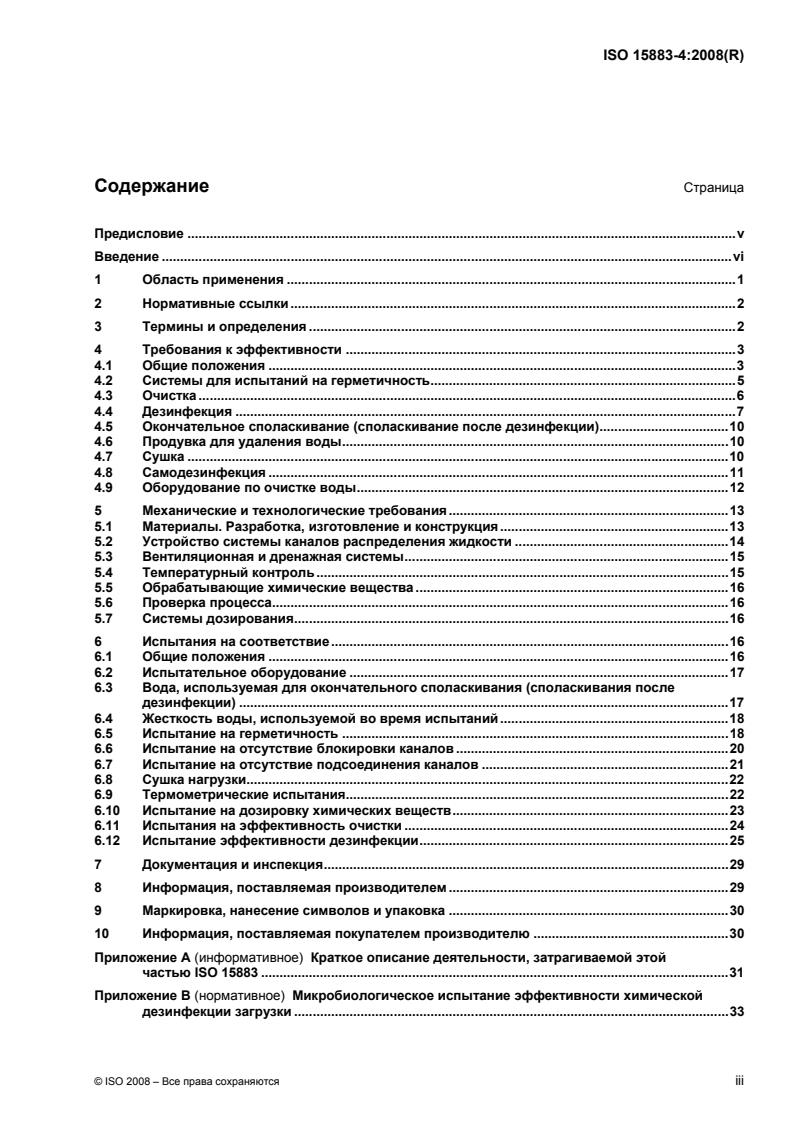
Contents Page
Foreword. v
Introduction . vi
1 Scope . 1
2 Normative references . 2
3 Terms and definitions. 2
4 Performance requirements . 3
4.1 General. 3
4.2 Systems for leak testing . 4
4.3 Cleaning. 6
4.4 Disinfecting . 7
4.5 Final (post-disinfection) rinsing . 9
4.6 Purging to remove rinse water. 9
4.7 Drying. 9
4.8 Self-disinfection. 10
4.9 Water treatment equipment . 11
5 Mechanical and process requirements . 12
5.1 Materials ― Design, manufacture and construction. 12
5.2 Device channel irrigation system. 12
5.3 Venting and drainage systems. 13
5.4 Temperature control. 14
5.5 Process chemicals. 14
5.6 Process verification. 14
5.7 Dosing systems . 14
6 Testing for conformity. 14
6.1 General. 14
6.2 Test equipment . 15
6.3 Water used for final (post-disinfection) rinsing. 15
6.4 Hardness of water used during type testing. 15
6.5 Leak test . 16
6.6 Channels non-obstruction test. 18
6.7 Channels non-connection test . 19
6.8 Load dryness. 20
6.9 Thermometric tests. 20
6.10 Chemical dosing tests. 21
6.11 Tests of cleaning efficacy . 22
6.12 Test of disinfection efficacy . 23
7 Documentation and inspection . 27
8 Information to be supplied by the manufacturer. 27
9 Marking, labelling and packaging . 28
10 Information to be requested from the purchaser by the manufacturer . 28
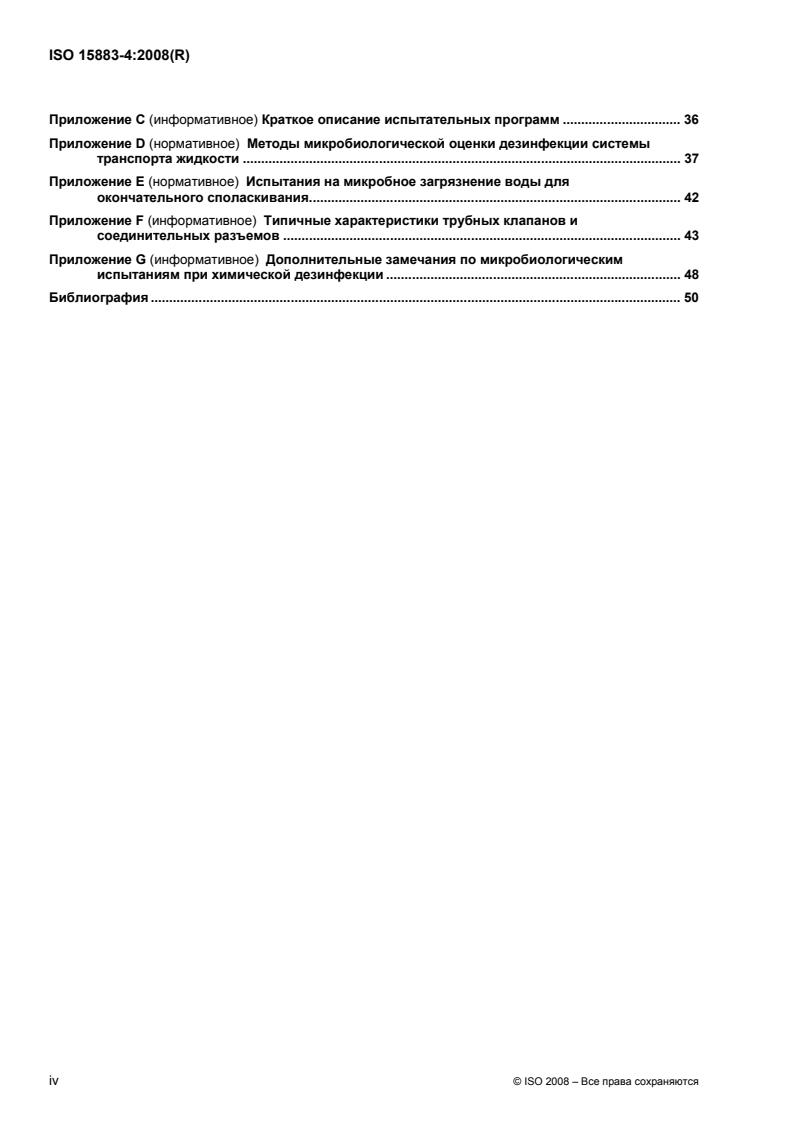
Annex A (informative) Summary of activities covered by this Part of ISO 15883. 29
Annex B (normative) Microbiological testing of the efficacy of chemical disinfection of the load. 31
Annex C (informative) Summary of test programmes . 34
Annex D (normative) Methods for microbiological evaluation of disinfection of liquid transport
system. 35
Annex E (normative) Tests for microbial contamination of post-disinfection rinse water. 40
Annex F (informative) Typical specifications of trumpet valves and connection ports. 41
Annex G (informative) Additional notes on microbiological testing of chemical disinfection
processes. 46
Bibliography . 48
iv © ISO 2008 – All rights reserved
Foreword
ISO (the International Organization for Standardization) is a worldwide federation of national standards bodies
(ISO member bodies). The work of preparing International Standards is normally carried out through ISO
technical committees. Each member body interested in a subject for which a technical committee has been
established has the right to be represented on that committee. International organizations, governmental and
non-governmental, in liaison with ISO, also take part in the work. ISO collaborates closely with the
International Electrotechnical Commission (IEC) on all matters of electrotechnical standardization.
International Standards are drafted in accordance with the rules given in the ISO/IEC Directives, Part 2.
The main task of technical committees is to prepare International Standards. Draft International Standards
adopted by the technical committees are circulated to the member bodies for voting. Publication as an
International Standard requires approval by at least 75 % of the member bodies casting a vote.
Attention is drawn to the possibility that some of the elements of this document may be the subject of patent
rights. ISO shall not be held responsible for identifying any or all such patent rights.
ISO 15883-4 was prepared by Technical Committee ISO/TC 198, Sterilization of health care products.
ISO 15883 consists of the following parts, under the general title Washer-disinfectors:
⎯ Part 1: General requirements, terms and definitions and tests
⎯ Part 2: Requirements and tests for washer-disinfectors employing thermal disinfection for surgical
instruments, anaesthetic equipment, bowls, dishes, receivers, utensils, glassware, etc.
⎯ Part 3: Requirements and tests for washer-disinfectors employing thermal disinfection for human waste
containers
⎯ Part 4: Requirements and tests for washer-disinfectors employing chemical disinfection for thermolabile
endoscopes
⎯ Part 5: Test soils and methods for demonstrating cleaning efficacy
Introduction
It is recommended that this introduction be read in conjunction with the introduction to ISO 15883-1.
The washer-disinfectors specified in this part of ISO 15883 are intended to process devices which can be
immersed in water or aqueous solutions. For some devices this will require that, prior to processing, relevant
parts of the device are protected from immersion in accordance with the device manufacturer’s operating
instructions.
Fields of application within the scope of the ISO 15883 series include laboratory, veterinary, dental and
pharmaceutical applications and other specific applications, such as washer-disinfectors for bedsteads and
transport carts and the disinfection of crockery and cutlery intended for use with immunologically
compromised patients.
Requirements for washer-disinfectors for other applications are specified in other parts of ISO 15883.
Safety requirements for washer-disinfectors are given in IEC 61010-2-040.
With respect to the potential adverse effects on the quality of water intended for human consumption caused
by the washer-disinfectors:
a) note that, until verifiable European criteria are adopted, existing national regulations concerning the use
and/or the characteristics of the washer-disinfectors remain in force;
b) this part of ISO 15883 provides no information as to whether the washer-disinfectors may be used without
restriction in any of the member states of the EU or EFTA.
vi © ISO 2008 – All rights reserved
INTERNATIONAL STANDARD ISO 15883-4:2008(E)
Washer-disinfectors —
Part 4:
Requirements and tests for washer-disinfectors employing
chemical disinfection for thermolabile endoscopes
1 Scope
This part of ISO 15883 specifies the particular requirements, including performance, for washer-disinfectors
(WDs) that are intended to be used for cleaning and chemical disinfection of thermolabile endoscopes.
This part of ISO 15883 also specifies the performance requirements for the cleaning and disinfection of the
washer-disinfector and its components and accessories which may be required to achieve the necessary
performance.
The methods, instrumentation and instructions required for type testing, works testing, validation (installation,
operational and performance qualification on first installation), routine control and monitoring and re-validation,
periodically and after essential repairs, are also specified.
NOTE 1 In addition, Annex A gives guidance on an appropriate division of responsibility for the range of activities
covered by this part of ISO 15883.
NOTE 2 WDs complying with this part of ISO 15883 can also be used for cleaning and chemical disinfection of other
thermolabile re-usable medical devices for which the device manufacturer has recommended this method of disinfection.
WDs complying with the requirements of this part of ISO 15883 are not intended for cleaning and disinfection
of medical devices, including endoscopic accessories, which are heat stable and can be disinfected or
sterilized by thermal methods (see ISO 15883-1:2006, 4.1.5).
The specified performance requirements of this part of ISO 15883 may not ensure the inactivation or removal
of the causative agent(s) (prion protein) of transmissible spongiform encephalopathies.
NOTE 3 If it is considered that prion protein might be present, particular care is needed in the choice of disinfectants
and cleaning agents to ensure that the chemicals used do not react with the prion protein in a manner that may inhibit its
removal or inactivation from the load or washer-disinfector.
This part of ISO 15883 can be used by prospective purchasers and manufacturers as the basis of agreement
on the specification of WD manufacturers of endoscopes, cleaning products, disinfecting products, and also
by users.
2 Normative references
The following referenced documents are indispensable for the application of this document. For dated
references, only the edition cited applies. For undated references, the latest edition of the referenced
document (including any amendments) applies.
ISO 11731-2, Water quality — Detection and enumeration of Legionella — Part 2: Direct membrane filtration
method for waters with low bacterial counts
ISO 15883-1:2006, Washer-disinfectors — Part 1: General requirements, terms and definitions and tests
ISO/TS 15883-5:2005, Washer-disinfectors — Part 5: Test soils and methods for demonstrating cleaning
efficacy
IEC 61010-2-040, Safety requirements for electrical equipment for measurement, control, and laboratory
use ― Part 2-040: Particular requirements for sterilizers and washer-disinfectors used to treat medical
materials
3 Terms and definitions
For the purposes of this document, the terms and definitions given in ISO 15883-1 and the following apply.
3.1
air break
physical separation in water supply pipes to prevent back syphonage into the water supply from a device
connected to it
NOTE See EN 1717.
3.2
inoculated carrier
supporting material on or in which a defined number of viable test organisms has been deposited
[ISO 11138-1:2006, definition 3.10]
3.3
leak test
test intended to establish that the surface covering the device and/or lining a device channel is intact to the
extent necessary to maintain a slightly positive pressure
3.4
liquid transport systems
those components of the washer-disinfector used to store, pump or transport water and/or solutions within the
washer-disinfector, excluding pipework before the air break
3.5
microbial inactivation factor
measured change in microbial population, expressed as log , caused by the lethal effect of the disinfectant
3.6
microbial reduction factor
measured change in microbial population expressed as log caused by the combination of the microbial
inactivation factor and the physical removal of microorganisms
3.7
obstruction
partial or complete blockage
2 © ISO 2008 – All rights reserved
3.8
self-disinfection cycle
operating cycle under the control of the automatic controller, for use without any load in the washer-disinfector,
which is intended to disinfect all liquid transport systems’ piping, chamber(s), tanks and other components
which come into contact with the water and/or solutions used for cleaning, disinfecting and rinsing the load
NOTE This does not include disinfection of any pipework between the disinfectant supply and the control valve,
where single-use, multi-dose containers are used to provide process chemicals for use in the washer-disinfector.
3.9
thermolabile
damaged by exposure to temperatures within the range used for thermal disinfection
NOTE The minimum temperature for thermal disinfection specified in ISO 15883-1 is 65 °C.
4 Performance requirements
4.1 General
4.1.1 The WD shall conform to ISO 15883-1:2006 with the exception of the following subclauses:
⎯ 4.2.3 (washing stage);
⎯ 4.3.1 (specification for thermal disinfection);
⎯ 5.3.2.5 (microbial quality of final rinse water);
⎯ 6.4.2 (test for quality of final rinse water);
⎯ 6.5.6 (test for chamber venting to prevent pressurization by steam);
⎯ 6.7.2 (tests on trolleys for handling loads outside the WD);
⎯ 6.8.2 (load temperature test);
⎯ 6.10 (cleaning efficacy test; 6.10.2 modified by 6.11 of this part of ISO 15883).
NOTE These subclauses have been replaced or modified in this part of ISO 15883.
4.1.2 Each device, including any device channels and/or cavities, shall be processed by the WD as follows:
a) leak testing (where appropriate) in accordance with 4.2;
b) cleaning (which may include several stages) in accordance with 4.3;
c) disinfecting in accordance with 4.4;
d) final rinsing in accordance with 4.5;
e) purging of rinse water in accordance with 4.6;
f) drying (when appropriate) in accordance with 4.7.
4.1.3 After the complete process in the WD the endoscope shall be free from vegetative bacteria (but not
necessarily spores) and other contamination. The combination of the cleaning process and the disinfection
process shall be designed to achieve this condition, recognising the high level of bacterial contamination that
may exist, see Bibliography [24], [25] and [26]. It shall be necessary to take into account other factors such as
the design of connectors. The WD manufacturer shall demonstrate this capability during type testing for all the
types of endoscope that the WD is designed to process.
NOTE 1 Demonstration of the capability of the complete cycle may be provided during type testing by employing a
modification of the method described in Annex B, using the organism previously established as most resistant to the
disinfectant, with real endoscope(s) and/or the method given in ISO/TS 15883-5:2005, Annex I.
NOTE 2 The efficacy of the process (including cleaning and disinfection) depends on a number of factors which include
a) the nature (characteristics) of the device being processed;
b) the extent and nature of the soiling to be removed;
c) the temperature;
d) the mechanical energy (type, output);
e) purging to remove rinse water;
f) the detergent system;
g) the nature, volume, concentration and temperature of the cleaning and disinfectant solutions and their ability to wet
the surfaces to be cleaned and disinfected;
h) the duration of the various process stages;
i) the removal of suspended soil.
4.1.4 The WD manufacturer’s instructions shall recommend that any requirements, e.g. for manual cleaning
and or disassembly of the endoscope, prior to processing in the WD, provided by the device manufacturer
should be followed.
4.1.5 The value of any process variable that affects the efficacy of the cycle shall be pre-set and adjustment
shall require the use of a key, code or tool (see also ISO 15883-1:2006, 5.18.3, 5.18.8 and 5.18.12).
4.1.6 The means to control the volume of process chemicals admitted shall deliver the set volume to an
accuracy of ± 5 % or better.
4.1.7 When the WD uses two or more different process chemicals, means shall be provided to ensure that
connection is made to the correct container of process chemical.
NOTE The labelling and/or colour coding of connectors, containers and/or tubes alone may not be sufficient to meet
the requirement.
4.1.8 The WD manufacturer’s instructions shall recommend that heat-stable endoscopic accessories to
thermolabile devices should be thermally disinfected and/or sterilized. [See 8 j) and ISO 15883-1:2006, 4.1.5].
4.2 Systems for leak testing
4.2.1 The requirements of 4.2 shall apply only to WDs intended to process endoscopes which require a test
to verify that the device is watertight.
NOTE This test is intended to demonstrate that the endoscope will not be damaged by liquid ingress during the WD
operating cycle. It is regarded only as a test of the integrity of the endoscope when all parameters of the WD leak test
(e.g. pressure, duration, maximum leak accepted) are consistent with those specified by the endoscope manufacturer.
4 © ISO 2008 – All rights reserved
4.2.2 The WD shall be provided with either
a) means to carry out an automatic leak test on the endoscope which shall be completed before the load
comes into contact with process fluids in the WD
or
b) instructions for use that include the requirement to carry out the test manually prior to processing through
the WD.
NOTE 1 An alternative method specified by the endoscope manufacturer can be used for determining the integrity of
the endoscope when appropriate.
NOTE 2 WDs with an automatic leak test can include a user selectable option to repeat the leak test at the end of the
process and/or independently of a normal process cycle.
4.2.3 For WDs having an automatic leak test, the automatic controller shall prevent the continuation of the
operating cycle and operate an audible and visible alarm indicating a leak test failure if a leak is detected in an
endoscope.
Variations in temperature may adversely affect the sensitivity of the leak test and the WD manufacturer should
state the temperature range permitted in the WD during the automatic leak test, if fitted [see 8 f)].
NOTE 1 A leak test failure indicates that the device is likely to be damaged by further processing; a satisfactory leak
test does not provide absolute assurance that the device will not be damaged by further processing.
NOTE 2 An automatic leak test which maintains a positive pressure throughout the cycle can provide an additional
safety level.
4.2.4 In WDs provided with an automatic leak test:
⎯ the systems for connection of the device to the WD shall be designed so that the fittings provided by the
WD manufacturer and intended for irrigation of the endoscope channel(s) cannot be connected to the
endoscope leak test connector;
⎯ the connection system between the endoscope and the WD shall be designed so that the leak test
connector on the WD cannot be connected to the endoscope channel(s) to be irrigated;
⎯ the means used to monitor the pressure inside the device (e.g. pressure transducer) shall be independent
from the means used to control the initial pressure (e.g. pressure regulating valve);
⎯ the system used to pressurize the device during each leak test shall be provided with a means of
preventing over-pressurization of the device in the event of failure of the pressure control system;
⎯ the extent and duration of pressurization and the pressure drop or air flow which will be used to indicate a
failure shall be either in accordance with the device manufacturer’s instructions for the devices which the
WD is intended to process, or independently verified by the WD manufacturer.
4.2.5 For WDs with an automatic leak test, means shall be provided to automatically warn the user with an
audible and/or visible alarm after the initiation of the operating cycle if the leak test connectors were not
connected to the endoscopes.
4.2.6 WDs with an automatic leak test shall be tested in accordance with 6.5.
4.3 Cleaning
4.3.1 General
All surfaces (internal and external) of the endoscope(s) which are required to be disinfected by the WD shall
be cleaned. (See ISO 15883-1:2006, 4.2.1.1, 5.1.10 and 6.10.2).
NOTE Some endoscope(s) have component parts (e.g. electronic connectors) which their manufacturer recommends
should not be immersed in water or aqueous solutions. These component parts will be processed in accordance with the
manufacturer’s instructions and then protected from immersion during processing in the WD (see 5.1.2).
Cleaning shall comprise washing with a detergent solution which may, when necessary, be preceded by
flushing. Washing shall be followed by rinsing unless the conditions specified in 4.3.4 have been met.
4.3.2 Flushing
When necessary, the WD shall provide means to flush the internal and external surfaces of the endoscope.
NOTE Flushing before washing might be necessary to eliminate soils or to avoid any interaction between the
chemicals used during pre-treatment and those of the WD processing cycle.
The flushing water or solution shall be discharged during or after each process cycle and shall not be re-used.
4.3.3 Washing
The WD manufacturer shall specify the detergent(s) to be used, as established during type testing [see 8 m)].
The detergent solution shall be discharged during or after each process cycle and shall not be re-used.
The temperature of the detergent solution throughout the washing stage shall be monitored to ensure that it
remains within the limits specified by the manufacturer of the detergent and be compatible with the
temperature limits for the device(s) to be processed.
This shall be achieved either
a) by controlling the temperature of the detergent solution
or
b) where appropriate, by operating the WD at ambient temperature with a means of preventing operation of
the WD when the detergent temperature is outside the specified temperature range.
4.3.4 Post-washing rinsing
Rinsing between washing and disinfection shall be used to reduce the concentration of residues (process
chemicals and soiling including microbial contamination) to a level established as not exceeding that which
would impair the efficacy of the disinfection process.
Rinsing shall take place between washing and disinfection unless it can be demonstrated that:
a) there is no reaction between incompatible process chemicals being used for each of these phases;
b) there is no adverse reaction between suspended or residual soiling and the disinfectant.
The interaction between the disinfectant and residual soiling shall be tested under conditions in which soiling
is at or above the maximum level that may occur in use and the disinfectant is at or below the minimum
specified in-use concentration.
The rinse water quality shall be specified by the WD manufacturer; this shall be of, at least, potable quality.
6 © ISO 2008 – All rights reserved
4.3.5 Determination of cleaning efficacy
Cleaning efficacy shall be determined in accordance with 6.11.
4.4 Disinfecting
4.4.1 General
National regulatory requirements may specify approval procedures for disinfectants to be used in WDs for
medical devices. Compliance with these national requirements shall be deemed to meet the requirements of
4.4 within the territory where these requirements apply.
The capability of the WD to provide disinfection of the device shall be deemed to have been established if,
when the WD is tested as specified in 6.12.6 under the specified conditions of disinfectant concentration,
volume, temperature and contact time the required microbial inactivation factor is attained (see 4.4.2.4).
The choice of disinfectant shall ensure that the spectrum of activity is appropriate for the intended use. The
efficacy of disinfectants may be seriously impaired by residual soiling, inorganic salts etc. remaining on the
device(s) and therefore an effective cleaning prior to disinfection is required.
NOTE Other process chemicals, e.g. detergents can react with and seriously impair the activity of disinfectants if they
are not removed before the disinfection stage.
4.4.2 Efficacy of the disinfectant
4.4.2.1 The following tests are based on the use of aqueous solutions of a disinfectant. Other systems
based on gaseous disinfectants are not excluded; equivalent tests are required.
4.4.2.2 When tested in accordance with 6.12.2, the in vitro efficacy of the disinfectant shall be
demonstrated.
4.4.2.3 A specific neutralization method for the disinfectant shall be validated in accordance with 6.12.2.6.
NOTE These data can be provided by the disinfectant manufacturer.
4.4.2.4 When tested in accordance with 6.12.2 and 6.12.6 for the minimum exposure time at the
minimum concentration and the minimum temperature to be used in the WD the disinfectant shall
demonstrate:
a) at least a log 6 inactivation of vegetative bacteria including yeasts and yeast-like fungi;
b) at least a log 5 inactivation of mycobacteria;
c) at least a log 4 inactivation of fungal spores and viruses.
NOTE 1 The inactivation values specified are regarded as the minimum necessary for endoscopes; they may be
different from the values specified in other standards to permit a label claim for biocidal activity.
NOTE 2 National regulatory authorities can require higher inactivation values.
4.4.2.5 The disinfectant chosen shall also be active against bacterial endospores.
When tested at the minimum concentration and the minimum temperature to be used in the WD when
processing endoscopes, the disinfectant should reduce the population of bacterial spores by not less than
log 6 within 5 h of exposure, or at an equivalent rate. The disinfectant should be tested against spores of
known high resistance to the disinfectant from both aerobic and anaerobic organisms.
4.4.2.6 The experimental conditions of tests intended to demonstrate the microbicidal activity of the
disinfectant in vitro shall consider the conditions of use of the disinfectant. Thus, when there is no rinsing
between cleaning and disinfection, the disinfectant shall be tested in the presence of interfering substances
(see also 4.3.4), and, for example, dirty conditions.
NOTE Demonstration by the disinfectant manufacturer that the disinfectant meets the above requirements may be
made employing methods based on relevant published standards or other relevant publications (e.g. EN 13624, EN 13727,
EN 14348, EN 14476, EN 14561, EN 14562, AOAC sporicidal test, ASTM E2111-00).
4.4.3 Temperature
The temperature of the disinfectant solution throughout the disinfection stage shall be monitored to ensure
that it remains within the limits specified by the manufacturer of the disinfectant and be compatible with the
temperature limits for the device(s) to be processed.
This shall be achieved either by controlling the temperature of the disinfectant solution or, where appropriate,
by operating the WD at ambient temperature with means to prevent operation of the WD when the disinfectant
temperature is outside the specified temperature range.
4.4.4 Process monitoring
The process monitoring of each operating cycle by the automatic controller shall include verification that the
process conditions specified by the WD manufacturer as necessary and sufficient for disinfection to take place
(e.g. disinfectant concentration, temperature and contact time) were attained (see also 5.5).
Microbial testing (e.g. with biological indicators or inoculated carriers) of the disinfection stage on each cycle
shall not be used to meet this requirement.
NOTE Confirmation of the concentration of disinfectant can require e.g. measurement of the volume of disinfectant
and water admitted together with a certificate of conformity from the disinfectant supplier for the concentration of the
disinfectant, together with data to support the shelf life, expiry date etc. (see also 4.4.5.2).
4.4.5 Disinfectant use
4.4.5.1 General
The WD manufacturer shall specify the disinfectant(s) to be used, as established during type testing (see 8 m).
Disinfectant solutions shall either be discharged after a single use during each cycle or re-used for a limited
number of cycles (see 4.4.4). Discharge after a single use, during each cycle, is the preferred option.
4.4.5.2 Re-use of disinfectant solutions
If the WD is designed to allow the same disinfectant solution to be used on two or more consecutive operating
cycles then care shall be taken to ensure that the activity and safety (e.g. accumulation of foreign material,
device compatibility) of the disinfectant solution is not impaired during its working life.
This shall include the following.
a) The WD manufacturer shall specify the means which shall be used to ensure that the disinfectant solution
has retained the required anti-microbial activity. These means shall be based on validation studies, which
would normally be carried out by the disinfectant manufacturer, to determine a suitable parameter, or
parameters, which may be monitored to indicate the anti-microbial activity of the disinfectant. Suitable
parameters may include e.g. pH, stability, the concentration of the active ingredient and adjuvants that
may also affect performance.
NOTE Minor changes in formulation of the disinfectant can have a significant effect on storage life, anti-microbial
activity etc.
8 © ISO 2008 – All rights reserved
b) The WD manufacturer shall recommend to the user the maximum period or number of operating cycles for
which the disinfectant may be used. This shall be based on validated experimental data.
c) When validated use conditions (maximum period or number of operating cycles) are exceeded, the
automatic controller shall operate an audible and visible alarm and prevent the use of the operating cycle
until chemicals are changed.
The WD manufacturer should recommend that the user monitor the disinfectant concentration using a
chemical indicator specific for the disinfectant to show that the disinfectant is at or above the minimum
recommended concentration (see also 4.4.4).
4.5 Final (post-disinfection) rinsing
4.5.1 The chemical purity of the final rinse water used after the disinfection stage shall be in accordance
with ISO 15883-1:2006, 5.3.2.5.
4.5.2 The final rinse water shall meet the requirements for microbiological quality as given in 4.9.2.2.
4.5.3 When medical devices that are intended to come into contact with the bloodstream or other normally
sterile areas of the body are to be processed the level of bacterial endotoxins in the final rinse water shall be
controlled and monitored within the limits specified in national regulations. (See ISO 15883-1:2006, 6.4.2.3).
4.5.4 On completion of the final rinse stage the water shall not be stored for subsequent re-use in the
rinsing stage of subsequent cycles.
4.6 Purging to remove rinse water
4.6.1 The WD shall include a means of purging rinse water from the channels of the endoscope(s) at the
end of the final rinse stage.
NOTE On completion of the automatic cycle the outer surface of the device should not have so much surface water
that it would need to be wiped dry before use.
4.6.2 When at the end of the rinsing stage the channels of the device are purged with air to remove most of
the remaining rinse water, the air shall be oil free and shall be filtered through a filter providing not less than
99,99 % arrestance to particles of 0,2 µm and larger.
4.6.3 When the WD is intended to eliminate the residual water from the channels of the endoscope it shall
be tested in accordance with 6.8.
4.7 Drying
4.7.1 Either the WD shall have a user selectable drying stage, or the instructions for use shall indicate that
the device and the channels of the device shall be dried prior to storage in accordance with the device
manufacturer’s instructions [see 8 j), 2nd dash].
NOTE 1 Automatic cycles in which the device is not completely dried are intended for use with devices which will be
used without storage. Storage of incompletely dried devices can lead to contamination with, and growth of, micro-
organisms.
NOTE 2 Purging with 0,2 µm filtered alcohol (e.g. 70 % iso-propanol) can be used to aid drying, if compatible with the
device.
4.7.2 The quality of air used during the drying stage shall be at least that defined in 4.6.2.
4.7.3 When tested in accordance with 6.8 there shall be no visible droplets of moisture.
4.8 Self-disinfection
4.8.1 A self-disinfection cycle shall be provided to ensure that the WD does not become a focus for
contamination of the load and to provide a means of disinfecting the WD after interventions for maintenance,
repairs or testing (see also ISO 15883-1:2006, 5.3.1.2).
NOTE 1 The self-disinfection process is intended also to deal with the situation where the WD has become
contaminated. The piping used to convey rinse water to the endoscope, if contaminated, can easily develop a layer of
biofilm containing many microorganisms in a state in which they are highly resistant to chemical disinfection.
NOTE 2 Thermal disinfection using moist heat is the preferred method. The temperature used can be higher than the
normal maximum operating temperature available for the loaded WD.
If the use of thermal disinfection is not possible, a disinfectant different from that used for disinfecting the
endoscope should be used. The use of the same disinfectant carries the risk of allowing organisms resistant
to that particular disinfectant to proliferate.
NOTE 3 Disinfection cannot be relied upon to inactivate all bacterial spores.
4.8.2 A WD in which the endoscope process cycle provides for disinfection of the chamber and all piping
and tanks which come into contact with the water or solutions used for cleaning, disinfecting and rinsing the
load shall be deemed to meet this requirement without the provision of an additional self-disinfection cycle.
4.8.3 The manufacturer shall provide details of the parts of the WD subjected to the self-disinfection cycle
and whether this cycle includes the water treatment equipment (see 4.9).
4.8.4 When different from the normal operating cycle the WD self-disinfection cycle shall:
⎯ be operated under the control of the automatic controller;
⎯ be a user selectable cycle;
⎯ provide for disinfection of the chamber and all liquid transport systems;
⎯ include means to warn the user that the WD shall be operated without any load in the chamber and, so
far as may be practicable, include means to verify that no device is present before the cycle will operate;
⎯ in the case of thermal self-disinfection of the WD, ensure that all the parts of the heating system and the
associated pipework, via which the water or the steam reach the WD tank, attain an A value of at
least 600.
4.8.5 The self-disinfection cycle shall ensure that a WD that has become contaminated through failure of
the water treatment equipment can be effectively disinfected. Compliance shall be verified by testing in
accordance with 6.12.5. The performance shall be deemed to be satisfactory if the final microbial count is
1)
10 cfu/100 ml or fewer after carrying out a self-disinfection cycle.
4.8.6 Thermal disinfection systems shall be evaluated by thermometric monitoring of the system with
sensors placed at those parts of the system specified by the WD manufacturer as representative of the lowest
temperatures in the system. The entire system subjected to thermal disinfection shall attain the required
disinfection temperature.
4.8.7 For chemical disinfection systems a microbiological test shall be required. The test shall be designed
to ensure that the self-disinfection cycle will disinfect contaminated tubing by evaluating the effect of the cycle
against a biofilm containing Pseudomonas aeruginosa (see ISO/TS 15883-5:2005, Annex F). The capability of
the WD to provide self-disinfection shall be deemed to have been established if, when tested in accordance
with 6.12.3, the required microbial reduction factor has been achieved.
1) cfu = colony forming units.
10 © ISO 2008 – All rights reserved
4.8.8 National regulatory requirements may specify approval procedures for validating self-disinfection of
WDs for medical devices. Compliance with these national requirements shall be deemed to meet the
requirements of 4.8 within the territory where these requirements apply.
4.9 Water treatment equipment
4.9.1 General
Means shall be provided to ensure that water treatment equipment that is part of the WD (softeners,
de-ionizers, filters etc.) is operated within the limits (e.g. flow rates, supply pressures) specified by the
manufacturer of the water treatment equipment.
4.9.2 Disinfection of water treatment equipment
4.9.2.1 When the water treatment equipment is a part of the WD, the former shall be designed and
constructed so that it can be periodically submitted to a disinfection procedure. Guidance on the minimum
frequency with which the equipment shall be disinfected shall be stated by the WD manufacturer according to
the information supplied by the purchaser for the quality of the water supply and the manufacturer of the water
treatment equipment [see 8 n)].
NOTE The disinfection of the water treatment equipment can be carried out during a self-disinfection cycle.
The actual frequency should be decided by the user based upon known, e.g. seasonal, variations in the
quality of water supplied to the WD and the operational history of the water treatment equipment.
The disinfection method shall not cause any damage to, nor impair the efficacy of, the treatment equipment.
The efficacy of the water equipment disinfection procedure to provide self-disinfection shall be deemed to
have been established if, when tested in accordance with the methods given in 6.12.4 and 6.12.5 there shall
be less than 10 cfu recovered from each of two 100 ml samples and other controlling parameters have been
achieved.
4.9.2.2 If the water treatment equipment is not part of the WD, the WD manufacturer shall specify the
requirements for water supplied to the WD. This shall include specification of the permissible microbial
contamin
...
NORME ISO
INTERNATIONALE 15883-4
Première édition
2008-05-01
Laveurs désinfecteurs —
Partie 4:
Exigences et essais pour les laveurs
désinfecteurs destinés à la désinfection
chimique des endoscopes thermolabiles
Washer-disinfectors —
Part 4: Requirements and tests for washer-disinfectors employing
chemical disinfection for thermolabile endoscopes
Numéro de référence
©
ISO 2008
PDF – Exonération de responsabilité
Le présent fichier PDF peut contenir des polices de caractères intégrées. Conformément aux conditions de licence d'Adobe, ce fichier
peut être imprimé ou visualisé, mais ne doit pas être modifié à moins que l'ordinateur employé à cet effet ne bénéficie d'une licence
autorisant l'utilisation de ces polices et que celles-ci y soient installées. Lors du téléchargement de ce fichier, les parties concernées
acceptent de fait la responsabilité de ne pas enfreindre les conditions de licence d'Adobe. Le Secrétariat central de l'ISO décline toute
responsabilité en la matière.
Adobe est une marque déposée d'Adobe Systems Incorporated.
Les détails relatifs aux produits logiciels utilisés pour la création du présent fichier PDF sont disponibles dans la rubrique General Info
du fichier; les paramètres de création PDF ont été optimisés pour l'impression. Toutes les mesures ont été prises pour garantir
l'exploitation de ce fichier par les comités membres de l'ISO. Dans le cas peu probable où surviendrait un problème d'utilisation,
veuillez en informer le Secrétariat central à l'adresse donnée ci-dessous.
DOCUMENT PROTÉGÉ PAR COPYRIGHT
© ISO 2008
Droits de reproduction réservés. Sauf prescription différente, aucune partie de cette publication ne peut être reproduite ni utilisée sous
quelque forme que ce soit et par aucun procédé, électronique ou mécanique, y compris la photocopie et les microfilms, sans l'accord écrit
de l'ISO à l'adresse ci-après ou du comité membre de l'ISO dans le pays du demandeur.
ISO copyright office
Case postale 56 • CH-1211 Geneva 20
Tel. + 41 22 749 01 11
Fax. + 41 22 749 09 47
E-mail copyright@iso.org
Web www.iso.org
Publié en Suisse
ii © ISO 2008 – Tous droits réservés
Sommaire Page
Avant-propos. v
Introduction . vi
1 Domaine d'application. 1
2 Références normatives . 2
3 Termes et définitions. 2
4 Exigences de performances . 3
4.1 Généralités . 3
4.2 Systèmes pour l'essai d'étanchéité . 5
4.3 Nettoyage. 6
4.4 Désinfection . 7
4.5 Rinçage final (après désinfection) . 9
4.6 Purge en vue de l'élimination de l'eau de rinçage. 10
4.7 Séchage . 10
4.8 Autodésinfection. 10
4.9 Système de traitement de l'eau . 11
5 Exigences mécaniques et exigences relatives au procédé. 13
5.1 Matériaux ― Conception, fabrication et construction. 13
5.2 Système d'irrigation des canaux du dispositif . 13
5.3 Systèmes de mise à l'air et de vidange . 14
5.4 Contrôle de la température . 14
5.5 Produits chimiques du procédé . 15
5.6 Vérification du procédé. 15
5.7 Systèmes de dosage . 15
6 Essais de conformité. 15
6.1 Généralités . 15
6.2 Équipement d'essai . 16
6.3 Eau utilisée pour le rinçage final (après désinfection) . 16
6.4 Dureté de l'eau pour les essais de type . 17
6.5 Essai d'étanchéité. 17
6.6 Essai de non-obstruction des canaux. 19
6.7 Essai de détection des défauts de raccordement des canaux . 20
6.8 Séchage de la charge . 21
6.9 Essais thermométriques . 21
6.10 Essais de dosage des produits chimiques . 22
6.11 Essais d'efficacité du nettoyage . 23
6.12 Essais d'efficacité de la désinfection . 24
7 Documentation et inspection . 28
8 Informations devant être fournies par le fabricant. 28
9 Marquage, étiquetage, emballage . 29
10 Informations demandées par le fabricant du LD à l'acheteur . 29
Annexe A (informative) Récapitulatif des activités couvertes par la présente partie de l'ISO 15883. 30
Annexe B (normative) Essais microbiologiques d'efficacité de la désinfection chimique . 32
Annexe C (informative) Récapitulatif des programmes d'essais . 35
Annexe D (normative) Méthodes d'évaluation microbiologique de la désinfection du système
de transport des liquides . 37
Annexe E (normative) Essais relatifs à la contamination microbienne de l'eau de rinçage
après désinfection . 42
Annexe F (informative) Spécifications types de cages à pistons et d'orifices de raccordement . 44
Annexe G (informative) Notes complémentaires relatives aux essais microbiologiques
sur les procédés de désinfection chimique . 49
Bibliographie . 51
iv © ISO 2008 – Tous droits réservés
Avant-propos
L'ISO (Organisation internationale de normalisation) est une fédération mondiale d'organismes nationaux de
normalisation (comités membres de l'ISO). L'élaboration des Normes internationales est en général confiée
aux comités techniques de l'ISO. Chaque comité membre intéressé par une étude a le droit de faire partie du
comité technique créé à cet effet. Les organisations internationales, gouvernementales et non
gouvernementales, en liaison avec l'ISO participent également aux travaux. L'ISO collabore étroitement avec
la Commission électrotechnique internationale (CEI) en ce qui concerne la normalisation électrotechnique.
Les Normes internationales sont rédigées conformément aux règles données dans les Directives ISO/CEI,
Partie 2.
La tâche principale des comités techniques est d'élaborer les Normes internationales. Les projets de Normes
internationales adoptés par les comités techniques sont soumis aux comités membres pour vote. Leur
publication comme Normes internationales requiert l'approbation de 75 % au moins des comités membres
votants.
L'attention est appelée sur le fait que certains des éléments du présent document peuvent faire l'objet de
droits de propriété intellectuelle ou de droits analogues. L'ISO ne saurait être tenue pour responsable de ne
pas avoir identifié de tels droits de propriété et averti de leur existence.
L'ISO 15883-4 a été élaborée par le comité technique ISO/TC 198, Stérilisation des produits de santé.
L'ISO 15883 comprend les parties suivantes, présentées sous le titre général Laveurs désinfecteurs:
⎯ Partie 1: Exigences générales, termes et définitions et essais
⎯ Partie 2: Exigences et essais pour laveurs désinfecteurs destinés à la désinfection thermique des
instruments chirurgicaux, du matériel d'anesthésie, des bacs, plats, récipients, ustensiles, de la verrerie,
etc.
⎯ Partie 3: Exigences et essais pour laveurs désinfecteurs destinés à la désinfection thermique de
récipients à déjections humaines
⎯ Partie 4: Exigences et essais pour les laveurs désinfecteurs destinés à la désinfection chimique des
endoscopes thermolabiles
⎯ Partie 5: Essais de souillures et méthodes pour démontrer l'efficacité de nettoyage
Introduction
Il est recommandé de lire cette introduction conjointement avec l'introduction de ISO 15883-1.
Les laveurs désinfecteurs spécifiés dans la présente partie de l'ISO 15883 sont destinés à traiter des
dispositifs qui peuvent être immergés dans l'eau ou dans des solutions aqueuses. Pour certains dispositifs, il
sera nécessaire de protéger, avant le traitement et conformément aux instructions du fabricant, les parties du
dispositif susceptibles d'être endommagées par cette immersion.
Le domaine d'application de la série de l'ISO 15883 inclut les laboratoires, la médecine vétérinaire, l'art
dentaire et la pharmacie, ainsi que d'autres applications spécifiques telles que les laveurs désinfecteurs pour
les châlits et les chariots et la désinfection de la vaisselle et des couverts destinés à être utilisés avec des
patients immunodéprimés.
Les exigences applicables aux laveurs désinfecteurs utilisés pour toute autre application sont spécifiées dans
les autres parties de l'ISO 15883.
Les exigences de sécurité pour les laveurs désinfecteurs sont spécifiées dans la CEI 61010-2-040.
En ce qui concerne les éventuels effets indésirables des laveurs désinfecteurs sur la qualité de l'eau destinée
à la consommation humaine:
a) noter que, jusqu'à l'adoption de critères européens vérifiables, les réglementations nationales en vigueur
relatives à l'utilisation et/ou aux caractéristiques des laveurs désinfecteurs s'appliquent;
b) la présente partie de l'ISO 15883 ne fournit aucune information concernant l'existence de restrictions
d'utilisation pour les laveurs désinfecteurs dans les pays membres de l'UE ou de l'AELE.
vi © ISO 2008 – Tous droits réservés
NORME INTERNATIONALE ISO 15883-4:2008(F)
Laveurs désinfecteurs —
Partie 4:
Exigences et essais pour les laveurs désinfecteurs destinés à la
désinfection chimique des endoscopes thermolabiles
1 Domaine d'application
La présente partie de l'ISO 15883 spécifie les exigences particulières, notamment les performances, relatives
aux laveurs désinfecteurs (LD) destinés à être utilisés pour le nettoyage et la désinfection chimique des
endoscopes thermosensibles.
La présente partie de l'ISO 15883 spécifie également les exigences de performance relatives au nettoyage et
à la désinfection du laveur désinfecteur ainsi que de ses composants et accessoires qui peuvent être
nécessaires pour atteindre les performances voulues.
Les méthodes, l'instrumentation et les instructions nécessaires pour les essais de type, de fonctionnement, la
validation (qualification opérationnelle de l'installation et des performances lors de la première installation), le
contrôle de routine, la surveillance et la revalidation, réalisés périodiquement et après des réparations
essentielles, sont également spécifiés.
NOTE 1 En outre, l'Annexe A donne des directives quant à un partage approprié des responsabilités en ce qui
concerne les différentes activités traitées par la présente partie de ISO 15883.
NOTE 2 Les LD conformes à la présente partie de l'ISO 15883 peuvent également être utilisés pour le nettoyage et la
désinfection chimique d'autres dispositifs médicaux réutilisables, thermosensibles, pour lesquels le fabricant a
recommandé cette méthode de désinfection.
Les LD conformes aux exigences de la présente partie de l'ISO 15883 ne sont pas destinés à être utilisés
pour le nettoyage et la désinfection des dispositifs médicaux, y compris les accessoires des endoscopes, qui
sont thermostables et qui peuvent être désinfectés ou stérilisés par des méthodes thermiques (voir
l'ISO 15883-1:2006, 4.1.5).
Les exigences de performance spécifiées dans la présente partie de l'ISO 15883 ne peuvent pas garantir
l'inactivation ou l'élimination du ou des agents pathogènes (protéine du prion) à l'origine des encéphalopathies
spongiformes transmissibles.
NOTE 3 Si la protéine du prion est susceptible d'être présente sur la charge à traiter, les désinfectants et les agents de
nettoyage doivent être soigneusement choisis en s'assurant que les produits chimiques utilisés ne réagissent pas avec la
protéine du prion, de telle façon que cela inhibe son inactivation ou son élimination de la charge ou du laveur désinfecteur.
La présente partie de ISO 15883 peut être utilisée par des fabricants ou des acheteurs potentiels comme une
base d'accord entre les spécifications des fabricants d'endoscopes, de produits de nettoyage et de produits
désinfectants. Elle peut également être exploitée par les utilisateurs.
2 Références normatives
Les documents de référence suivants sont indispensables pour l'application du présent document. Pour les
références datées, seule l'édition citée s'applique. Pour les références non datées, la dernière édition du
document de référence s'applique (y compris les éventuels amendements).
ISO 11731-2, Qualité de l'eau — Recherche et dénombrement des Legionella — Partie 2: Méthode par
filtration directe sur membrane pour les eaux à faible teneur en bactéries
ISO 15883-1:2006, Laveurs désinfecteurs — Partie 1: Exigences générales, termes et définitions et essais
ISO/TS 15883-5:2005, Laveurs désinfecteurs — Partie 5: Essais de souillures et méthodes pour démontrer
l'efficacité de nettoyage
CEI 61010-2-040, Règles de sécurité pour appareils électriques de mesurage, de régulation et de
laboratoire — Partie 2-040: Exigences particulières pour stérilisateurs et laveurs désinfecteurs utilisés pour
traiter le matériel médical
3 Termes et définitions
Pour les besoins du présent document, les termes et définitions donnés dans l'ISO 15883-1 ainsi que les
suivants s'appliquent.
3.1
disconnexion
séparation physique dans le circuit d'alimentation en eau afin d'empêcher le reflux d'eau d'un dispositif vers le
réseau d'alimentation auquel il est raccordé
NOTE Voir l'EN 1717.
3.2
porte-germes inoculé
support sur ou dans lequel a été déposé un nombre défini d'organismes d'essai viables
[ISO 11138-1:2006, définition 3.10]
3.3
essai d'étanchéité
essai destiné à établir que la surface recouvrant le dispositif et/ou tapissant un canal du dispositif est intacte
de façon à maintenir une légère pression positive
3.4
systèmes de transport des liquides
composants du laveur désinfecteur utilisés pour stocker, pomper ou transporter de l'eau et/ou des solutions à
l'intérieur du laveur désinfecteur, à l'exception des canalisations situées avant la disconnexion
3.5
taux d'inactivation de la flore microbienne
modification mesurée de la population microbienne, exprimée en unités log , due à l'effet létal du
désinfectant
3.6
taux de réduction de la flore microbienne
modification mesurée de la population microbienne, exprimée en unités log , due à l'effet combiné de
l'inactivation de la flore microbienne et de l'élimination physique des micro-organismes
2 © ISO 2008 – Tous droits réservés
3.7
obstruction
blocage partiel ou total
3.8
cycle d'autodésinfection
cycle contrôlé par l'automate, réalisé sans charge, destiné à désinfecter tout le système de transport des
liquides, les cuve(s), les réservoirs et les autres composants en contact avec l'eau et/ou les solutions utilisées
pour le nettoyage, la désinfection et le rinçage de la charge
NOTE Cela n'inclut pas la désinfection des canalisations reliant la source de désinfectant et la vanne de commande,
par laquelle les réservoirs multidoses ou à usage unique sont censés alimenter le laveur désinfecteur en produits
chimiques.
3.9
thermosensible
susceptible d'être endommagé par une exposition aux températures utilisées lors de la désinfection thermique
NOTE La température minimale de désinfection thermique spécifiée dans ISO 15883-1 est de 65 °C.
4 Exigences de performances
4.1 Généralités
4.1.1 Le LD doit être conforme à l'ISO 15883-1, à l'exception des paragraphes suivants:
⎯ 4.2.3 (étape de lavage);
⎯ 4.3.1 (spécification pour la désinfection thermique);
⎯ 5.3.2.5 (qualité microbienne de l'eau de rinçage final);
⎯ 6.4.2 (essai de qualité de l'eau de rinçage final);
⎯ 6.5.6 (essai de mise à l'air des cuves afin de prévenir leur pressurisation par la vapeur);
⎯ 6.7.2 (essais sur les chariots destinés à la manutention de la charge à l'extérieur du LD);
⎯ 6.8.2 (essai de température de la charge);
⎯ 6.10 (essai d'efficacité du nettoyage); 6.10.2 modifié par 6.11 de la présente partie de l'ISO 15883).
NOTE Ces paragraphes ont été remplacés ou modifiés dans la présente partie de l'ISO 15883.
4.1.2 Chaque dispositif, y compris les canaux et/ou les cavités du dispositif, doit être traité dans le LD
comme suit:
a) essai d'étanchéité (le cas échéant), conformément à 4.2;
b) nettoyage (qui peut comprendre plusieurs étapes), conformément à 4.3;
c) désinfection, conformément à 4.4;
d) rinçage final, conformément à 4.5;
e) purge de l'eau de rinçage, conformément à 4,6;
f) séchage (le cas échéant), conformément à 4.7.
4.1.3 Au terme de ces étapes, l'endoscope doit être exempt de bactéries végétatives (mais pas
obligatoirement de spores) et de toute trace de contamination. La combinaison du nettoyage et de la
désinfection doit permettre d'atteindre cet objectif, tout en sachant que de hauts niveaux de contamination
bactérienne peuvent exister, voir Bibliographie [24], [25] et [26]. Il est nécessaire de prendre en compte
d'autres facteurs, comme la conception des raccords. Le fabricant du LD doit démontrer lors des essais de
type, la capacité du LD à atteindre ce niveau de performance, pour tous les types d'endoscope destinés à être
traités par le LD.
NOTE 1 La démonstration de la capacité du cycle complet peut être fournie lors des essais de type, en utilisant une
modification de la méthode décrite dans l'Annexe B et en utilisant l'organisme défini au préalable, comme étant le plus
résistant au désinfectant, avec un ou plusieurs endoscopes authentiques et/ou en utilisant la méthode donnée
dans l'ISO/TS 15883-5:2005, Annexe I.
NOTE 2 L'efficacité du procédé (notamment le nettoyage et la désinfection) dépend d'un certain nombre de facteurs,
notamment
a) la nature (caractéristiques) du dispositif traité,
b) la quantité et la nature des souillures à éliminer,
c) la température,
d) l'énergie mécanique (type, importance),
e) la purge pour éliminer l'eau de rinçage,
f) le système de détergent,
g) la nature, le volume, la concentration et la température des solutions de nettoyage et de désinfection et leur capacité
à mouiller les surfaces à nettoyer et à désinfecter,
h) la durée des diverses étapes du processus,
i) l'élimination des souillures en suspension.
4.1.4 Les instructions du fabricant du LD doivent spécifier qu'il convient de respecter toutes les exigences
du fabricant du dispositif à traiter, par exemple le nettoyage et/ou le démontage de certaines parties de
l'endoscope avant son traitement dans le LD.
4.1.5 La valeur de toute variable du procédé affectant l'efficacité d'un cycle doit être préétablie et son
réglage doit nécessiter une clé, un code ou un outil (voir également l'ISO 15883-1:2006, 5.18.3, 5.18.8
et 5.18.12).
4.1.6 Le dispositif de contrôle du volume de produits chimiques admis doit permettre de délivrer le volume
défini avec une exactitude de ± 5 % ou mieux.
4.1.7 Lorsque le LD utilise plusieurs produits chimiques, il doit être muni d'un dispositif garantissant que le
raccordement a bien été fait avec le bon réservoir de produit.
NOTE L'étiquetage et/ou l'utilisation de code couleur pour les raccords, les bidons et/ou des tubes seuls peuvent ne
pas suffire pour satisfaire aux exigences.
4.1.8 Les instructions du fabricant du LD doivent recommander qu'il convient de désinfecter thermiquement
et/ou de stériliser les accessoires thermostables des endoscopes thermosensibles [Voir 8 j) ainsi
que l'ISO 15883-1:2006, 4.1.5].
4 © ISO 2008 – Tous droits réservés
4.2 Systèmes pour l'essai d'étanchéité
4.2.1 Les exigences de 4.2 s'appliquent uniquement aux LD destinés à traiter les endoscopes nécessitant
un essai pour vérifier que le dispositif est étanche.
NOTE Cet essai est destiné à démontrer que l'endoscope ne sera pas endommagé par la pénétration de liquide lors
du cycle de fonctionnement du LD. Il est uniquement considéré comme un essai d'intégrité de l'endoscope lorsque tous
les paramètres de l'essai d'étanchéité du LD (par exemple pression, durée, fuite maximale acceptée) sont conformes à
ceux spécifiés par le fabricant de l'endoscope.
4.2.2 Le LD doit être fourni soit
a) avec des moyens de réaliser un essai d'étanchéité automatique de l'endoscope qui doit être effectué
avant qu'il entre en contact avec les fluides du procédé dans le LD,
soit
b) avec des instructions d'utilisation incluant l'exigence d'effectuer l'essai d'étanchéité manuellement avant
traitement dans le LD.
NOTE 1 Le cas échéant, une autre méthode spécifiée par le fabricant de l'endoscope peut être utilisée pour déterminer
l'intégrité de l'endoscope.
NOTE 2 Les LD dotés d'un dispositif d'essai d'étanchéité automatique peuvent inclure une option sélectionnable par
l'utilisateur lui permettant de répéter l'essai d'étanchéité à la fin du cycle et/ou en dehors d'un cycle de traitement normal.
4.2.3 Pour les LD dotés d'un essai d'étanchéité automatique, l'automate doit, si une fuite est détectée au
niveau d'un endoscope, empêcher la poursuite du cycle et déclencher une alarme sonore et visuelle indiquant
l'échec de l'essai d'étanchéité.
Les variations de température peuvent affecter la sensibilité de l'essai d'étanchéité; il convient donc que le
fabricant du LD indique la plage de températures maximale autorisée dans le LD lors de l'essai d'étanchéité
automatique, s'il existe [voir 8 f)].
NOTE 1 L'échec d'un essai d'étanchéité indique que le dispositif est susceptible d'être endommagé si le traitement est
poursuivi; un essai d'étanchéité satisfaisant ne garantit pas de manière absolue que le dispositif ne sera pas endommagé
par la suite du traitement.
NOTE 2 Un essai d'étanchéité automatique maintenant une pression positive pendant toute la durée du cycle peut
offrir un niveau de sécurité supérieur.
4.2.4 Dans les LD dotés d'un essai d'étanchéité automatique
⎯ les systèmes utilisés pour raccorder le dispositif au LD doivent être conçus de sorte que les raccords
fournis par le fabricant du LD et destinés à la mise en eau du (des) canal(aux) de l'endoscope ne
puissent pas être raccordés au raccord destiné à l'essai d'étanchéité de l'endoscope,
⎯ le système de raccordement entre l'endoscope et le LD doit être conçu de sorte que le raccord destiné à
l'essai d'étanchéité sur le LD ne puisse pas être raccordé au(x) canal(aux) de l'endoscope destiné à être
irrigué,
⎯ les moyens utilisés pour surveiller la pression à l'intérieur du dispositif (capteur de pression, par exemple)
doivent être indépendants des moyens utilisés pour contrôler la pression initiale (par exemple régulateur
de pression),
⎯ le système utilisé pour pressuriser le dispositif lors d'un essai d'étanchéité doit être doté de moyens
permettant d'éviter toute surpressurisation du dispositif en cas de défaillance du système de contrôle de
la pression,
⎯ l'ampleur et la durée de la pressurisation ainsi que la chute de pression ou le débit d'air qui sera utilisé
pour signaler un défaut d'étanchéité doivent être soit conformes aux instructions du fabricant du dispositif
pour tous les dispositifs que le LD est destiné à traiter, soit vérifiés de manière indépendante par le
fabricant du LD.
4.2.5 Pour les LD dotés d'un essai d'étanchéité automatique, un signal d'alarme visuel ou auditif doit avertir
automatiquement l'utilisateur dès le démarrage du cycle si les connections de l'essai d'étanchéité ne sont pas
raccordés à l'endoscope.
4.2.6 Les LD dotés d'un essai d'étanchéité automatique doivent être soumis à essai conformément à 6.5.
4.3 Nettoyage
4.3.1 Généralités
Toutes les surfaces (internes et externes) des endoscopes devant être désinfectés par le LD doivent être
nettoyées. (Voir l'ISO 15883-1:2006, 4.2.1.1, 5.1.10 et 6.10.2).
NOTE Certains endoscopes ont des composants (raccords électroniques, par exemple) pour lesquels le fabricant
recommande d'éviter une immersion dans de l'eau ou dans des solutions aqueuses. Ces composants seront traités
conformément aux instructions du fabricant, puis protégés de l'immersion lors du traitement dans le LD (voir 5.1.2).
Le nettoyage doit intégrer un lavage avec une solution détergente, qui peut, si nécessaire, être précédé d'un
rinçage préliminaire. Le lavage doit être suivi d'un rinçage sauf si les conditions spécifiées en 4.3.4 ont été
satisfaites.
4.3.2 Rinçage préliminaire
Si nécessaire, le LD doit être doté de moyens permettant d'effectuer un rinçage préliminaire des surfaces
internes et externes de l'endoscope.
NOTE Un rinçage préliminaire avant lavage peut être nécessaire pour éliminer les souillures ou pour éviter toute
interaction éventuelle entre les produits chimiques utilisés lors du prétraitement et ceux utilisés lors du cycle de traitement
du LD.
L'eau ou la solution utilisée lors du rinçage préliminaire doit être éliminée pendant ou après chaque cycle de
traitement et elle ne doit pas être réutilisée.
4.3.3 Lavage
Le fabricant du LD doit spécifier le(s) détergent(s) à utiliser, tel(s) qu'établi(s) lors des essais de type [voir
8 m)].
La solution détergente doit être éliminée pendant ou après chaque cycle de traitement et ne doit pas être
réutilisée.
Pendant toute la phase de lavage, la température de la solution détergente doit être contrôlée afin de garantir
le respect des limites de température spécifiées par le fabricant du détergent et d'être compatible avec les
limites de température tolérées par le ou les dispositif(s) destiné(s) à être traité(s).
Cela doit être obtenu soit
a) en contrôlant la température de la solution détergente,
soit,
b) le cas échéant, en faisant fonctionner le LD à température ambiante avec un moyen permettant
d'empêcher le fonctionnement du LD lorsque la température du détergent est en dehors des limites
spécifiées.
6 © ISO 2008 – Tous droits réservés
4.3.4 Rinçage intermédiaire
Un rinçage doit être réalisé entre le lavage et la désinfection pour réduire la concentration en résidus (produits
chimiques du procédé et souillures, y compris la contamination microbienne) à un niveau établi comme
n'excédant pas celui susceptible d'altérer l'efficacité du procédé de désinfection.
Un rinçage entre le lavage et la désinfection doit être obligatoire, sauf s'il est possible de démontrer
a) l'absence de réaction entre des produits incompatibles utilisés pour chacune de ces phases, et
b) l'absence de réaction indésirable entre les souillures en suspension ou résiduelles et le désinfectant.
Les interactions possibles entre le désinfectant et les souillures résiduelles doivent être évaluées dans des
conditions où la quantité de souillures est supérieure ou égale à la quantité maximale observée lors de
l'utilisation et la concentration du désinfectant est inférieure ou égale à la concentration minimale d'utilisation
spécifiée.
La qualité de l'eau de rinçage doit être spécifiée par le fabricant du LD; elle doit être au moins de qualité
potable.
4.3.5 Détermination de l'efficacité du nettoyage
L'efficacité du nettoyage doit être déterminée conformément aux essais décrits en 6.11.
4.4 Désinfection
4.4.1 Généralités
Des exigences réglementaires nationales peuvent spécifier les procédures d'homologation pour les
désinfectants utilisés dans les LD pour les dispositifs médicaux. Un désinfectant conforme à ces exigences
nationales doit être considéré comme satisfaisant aux exigences de 4.4 sur le territoire pour lequel ces
exigences s'appliquent.
La capacité du LD à désinfecter le dispositif doit être considérée comme établie si, lorsque le LD est soumis à
essai tel que spécifié en 6.12.6 dans les conditions spécifiées de concentration en désinfectant, de volume,
de température et de temps de contact, le taux d'inactivation de la flore microbienne requis est atteint
(voir 4.4.2.4).
Le choix du désinfectant doit garantir que le spectre d'activité est adapté à l'usage prévu. L'efficacité des
désinfectants peut être sérieusement altérée par la présence de souillures résiduelles, de sels inorganiques
etc., encore présents sur le (les) dispositif(s); un nettoyage efficace avant la désinfection est donc nécessaire.
NOTE D'autres produits chimiques du procédé, par exemple les détergents, peuvent réagir avec les désinfectants et
altérer sérieusement leur efficacité s'ils ne sont pas éliminés avant la phase de désinfection.
4.4.2 Efficacité du désinfectant
4.4.2.1 Les essais suivants sont basés sur l'utilisation de solutions aqueuses d'un désinfectant.
L'utilisation d'autres systèmes, fondés sur des désinfectants gazeux, n'est pas exclue; des essais équivalents
sont alors nécessaires.
4.4.2.2 Lors des essais décrits en 6.12.2, l'efficacité in vitro du désinfectant doit être démontrée.
4.4.2.3 Une méthode de neutralisation spécifique au désinfectant doit être validée conformément à
6.12.2.6.
NOTE Ces données peuvent être fournies par le fabricant du désinfectant.
4.4.2.4 Lors des essais réalisés conformément à 6.12.2 et à 6.12.6 pendant le temps de contact minimal
à la concentration minimale et à la température minimale utilisées dans le LD, le désinfectant doit démontrer
a) une inactivation d'au moins 6 unités log de la population de bactéries végétatives, y compris des
levures et des champignons lévuliformes,
b) une inactivation d'au moins 5 unités log des mycobactéries,
c) une inactivation d'au moins 4 unités log de la population de spores de champignons et de virus.
NOTE 1 Les valeurs d'inactivation spécifiées sont considérées comme le minimum requis pour les endoscopes; elles
peuvent différer des valeurs spécifiées dans d'autres normes pour permettre de revendiquer une activité biocide.
NOTE 2 Les organismes de réglementation nationaux peuvent exiger des valeurs d'inactivation supérieures.
4.4.2.5 Le désinfectant choisi doit également être actif sur les endospores bactériennes.
Lorsque le désinfectant est soumis à essai à la concentration et à la température minimales pouvant être
utilisées dans le LD lors du traitement des endoscopes, il convient qu'il réduise la population de spores
bactériennes d'au moins 6 unités log après 5 h d'exposition ou à un taux équivalent. Il convient de
soumettre le désinfectant à essai à l'aide de spores présentant une résistance élevée connue au désinfectant
et provenant d'organismes aussi bien aérobies qu'anaérobies.
4.4.2.6 Les conditions expérimentales des essais visant à démontrer l'activité microbicide du désinfectant
in vitro doivent tenir compte de ses conditions d'utilisation. Ainsi, si aucun rinçage n'est effectué entre le
nettoyage et la désinfection, le désinfectant doit être soumis à essai en présence de substances interférentes
(voir également 4.3.4) correspondant, par exemple, à des conditions de saleté.
NOTE Le fabricant peut démontrer la conformité du désinfectant avec les exigences définies ci-avant en utilisant des
méthodes fondées sur les normes publiées ou sur d'autres publications adaptées (par exemple l'EN 13624, l'EN 13727,
l'EN 14348, l'EN 14476, l'EN 14561, l'EN 14562, l'essai d'activité sporicide de l'AOAC, ASTM E2111-00).
4.4.3 Température
Pendant toute la phase de désinfection, la température de la solution désinfectante doit être surveillée afin de
garantir le respect des limites de température spécifiées par le fabricant du désinfectant et être compatible
avec les températures tolérées par le ou les dispositif(s) destiné(s) à être traité(s).
Cela doit être réalisé soit
a) en contrôlant la température de la solution désinfectante,
soit,
b) le cas échéant, en faisant fonctionner le LD à température ambiante avec un dispositif permettant
d'empêcher le fonctionnement du LD lorsque la température du désinfectant est en dehors de la plage de
température spécifiée.
4.4.4 Surveillance du procédé
La surveillance du procédé de chaque cycle de fonctionnement par l'automate doit inclure la vérification que
les conditions de fonctionnement spécifiées par le fabricant du LD comme nécessaires et suffisantes pour que
la désinfection ait lieu (concentration en désinfectant, température et temps de contact, par exemple) ont bien
été atteintes (voir également 5.5).
L'évaluation microbiologique (par exemple avec des indicateurs biologiques ou des supports inoculés) de la
phase de désinfection à chaque cycle ne doit pas être utilisée pour satisfaire à cette exigence.
NOTE La confirmation de la concentration du désinfectant peut nécessiter, par exemple, un mesurage du volume de
désinfectant et d'eau admis, accompagné d'un certificat de conformité délivré par le fournisseur du désinfectant pour la
concentration du désinfectant et des données démontrant la durée de conservation, la date de péremption, etc. (voir
également 4.4.5.2).
8 © ISO 2008 – Tous droits réservés
4.4.5 Utilisation du désinfectant
4.4.5.1 Généralités
Le fabricant du LD doit spécifier le(s) désinfectant(s) à utiliser, tels qu'établis lors des essais de type
[voir 8 m)].
Les solutions désinfectantes doivent être soit éliminées lors de chaque cycle après une seule utilisation, soit
réutilisées pour un nombre limité de cycles (voir 4.4.4). L'élimination lors de chaque cycle après une seule
utilisation est préférable.
4.4.5.2 Réutilisation des solutions désinfectantes
Si le LD est conçu pour permettre l'utilisation de la même solution désinfectante pour au moins deux cycles de
fonctionnement consécutifs, alors des précautions doivent êtres prises pour s'assurer que l'activité et la
sécurité (par exemple accumulation de matières étrangères, compatibilité avec le dispositif) de la solution
désinfectante ne sont pas altérées pendant la période d'utilisation.
Cela doit inclure les dispositions suivantes:
a) le fabricant du LD doit spécifier les mesures à prendre pour garantir que la solution désinfectante a
conservé l'activité antimicrobienne requise. Ces mesures doivent être fondées sur des études, qui
devraient normalement être menées par le fabricant du désinfectant, afin de déterminer le ou les
paramètres appropriés qui pourront être contrôlés pour indiquer l'activité antimicrobienne du désinfectant.
Les paramètres appropriés peuvent notamment être, par exemple le pH, la stabilité, la concentration en
principes actifs et en adjuvants qui peuvent également affecter les performances;
NOTE Des modifications mineures de la formulation du désinfectant peuvent avoir un effet important sur sa durée de
conservation, son activité antimicrobienne, etc.
b) le fabricant du LD doit recommander à l'utilisateur la période maximale ou le nombre maximal de cycles
de fonctionnement pendant lesquels le désinfectant peut être utilisé. Cela doit être fondé sur des
données d'essais validées;
c) lorsque les conditions d'utilisation validées (période maximale ou nombre maximal de cycles de
fonctionnement) sont dépassées, l'automate doit déclencher une alarme sonore et visuelle et empêcher
la poursuite du cycle jusqu'à ce que les produits chimiques aient été changés.
Il convient que le fabricant du LD recommande à l'utilisateur de surveiller la concentration du désinfectant au
moyen d'un indicateur chimique spécifique au désinfectant, en vue de montrer que la concentration du
désinfectant est supérieure ou égale à la concentration minimale recommandée (voir également 4.4.4).
4.5 Rinçage final (après désinfection)
4.5.1 La pureté chimique de l'eau de rinçage final utilisée après la phase de désinfection doit être conforme
à l'ISO 15883-1:2006, 5.3.2.5.
4.5.2 L'eau de rinçage final doit satisfaire aux exigences relatives à la qualité microbiologique spécifiées
en 4.9.2.2.
4.5.3 Lorsque des dispositifs médicaux destinés à entrer en contact avec le sang, ou d'autres zones du
corps normalement stériles, doivent être traités, le niveau d'endotoxines bactériennes dans l'eau du rinçage
final doit être contrôlé et maintenu dans les limites spécifiées dans les réglementations nationales.
(Voir l'ISO 15883-1:2006, 6.4.2.3).
4.5.4 Au terme de la phase de rinçage final, l'eau ne doit pas être stockée pour être réutilisée pour les
phases de rinçage d'autres cycles.
4.6 Purge en vue de l'élimination de l'eau de rinçage
4.6.1 Le LD doit comporter un moyen pour purger l'eau de rinçage présente dans les canaux de
l' (des) endoscope(s) à la fin de la phase de rinçage final.
NOTE À la fin du cycle automatique, il convient que la surface extérieure du dispositif ne présente pas une quantité
d'eau nécessitant que le dispositif soit essuyé avant utilisation.
4.6.2 Lorsque, à la fin de la phase de rinçage, les canaux du dispositif sont purgés à l'air afin d'éliminer la
majeure partie de l'eau de rinçage restante, l'air doit être exempt d'huile et être filtré sur un filtre arrêtant au
moins 99,99 % des particules de 0,2 µm et plus.
4.6.3 Lorsque le LD est conçu pour éliminer l'eau résiduelle des canaux de l'endoscope, il doit être soumis
à essai conformément à 6.8.
4.7 Séchage
4.7.1 Soit le LD doit disposer d'une phase de séchage sélectionnable par l'utilisateur, soit les instructions
d'utilisation indiquent clairement que le dispositif et les canaux du dispositif doivent être séchés avant
e
stockage conformément aux instructions du fabricant du dispositif [voir 8 j), 2 tiret].
NOTE 1 Les cycles automatiques au cours desquels le dispositif n'est pas complètement séché sont conçus pour les
dispositifs qui seront utilisés sans stockage. Le stockage de dispositifs incomplètement séchés peut entraîner une
contamination par des micro-organismes ou la croissance de ces derniers.
NOTE 2 Une purge avec de l'alcool filtré à 0,2 µm (par exemple de l'isopropanol à 70 %) peut être réalisée pour
faciliter le séchage, si cela est compatible avec le dispositif.
4.7.2 La qualité de l'air utilisé pendant la phase de séchage doit être au moins telle que définie en 4.6.2.
4.7.3 Lorsque les essais sont réalisés conformément aux essais décrits en 6.8, il ne doit pas y avoir de
gouttelettes d'humidité visibles.
4.8 Autodésinfection
4.8.1 Un cycle d'autodésinfection doit être prévu pour empêcher que le LD ne devienne une source de
contamination de la charge et pour permettre la désinfection du LD après des interventions de maintenance,
des réparations ou des essais (voir également l'ISO 15883-1:2006, 5.3.1.2).
NOTE 1 L'autodésinfection est également conçue pour traiter les cas où le LD est contaminé. Une éventuelle
contamination des canalisations amenant l'eau de rinçage à l'endoscope peut entraîner la formation d'un biofilm contenant
de nombreux micro-organismes pouvant s'avérer très résistants à la désinfection chimique.
NOTE 2 La désinfection thermique utilisant la chaleur humide est la méthode à utiliser de préférence. La température
utilisée peut être plus élevée que la température de fonctionnement maximale normalement disponible pour le LD chargé.
Si le recours à la désinfection thermique est impossible, il convient d'utiliser un désinfectant différent de celui
utilisé pour désinfecter l'endoscope. L'utilisation du même désinfectant risque de favoriser la prolifération des
organismes résistants à ce désinfectant particulier.
NOTE 3 La désinfection ne permet pas d'inactiver toutes les spores bactériennes.
4.8.2 Un LD dans lequel le cycle de traitement de l'endoscope prévoit la désinfection de la cuve et de
toutes les canalisations et réservoirs entrant en contact avec l'eau ou les solutions utilisées pour le nettoyage,
la désinfection et le rinçage de la charge, doit être considéré comme conforme à cette exigence sans qu'il soit
nécessaire de prévoir un cycle d'autodésinfection supplémenta
...
МЕЖДУНАРОДНЫЙ ISO
15883-4
СТАНДАРТ
Первое издание
2008-05-01
Аппараты для отмывки и
дезинфекции.
Часть 4.
Требования и испытания аппаратов
для отмывки и дезинфекции,
использующих химические
дезинфицирующие средства для
термолабильных эндоскопов
Washer-disinfectors —
Part 4:
Requirements and tests for washer-disinfectors employing chemical
disinfection for thermolabile endoscopes
Ответственность за подготовку русской версии несёт GOST R
(Российская Федерация) в соответствии со статьёй 18.1 Устава ISO
Ссылочный номер
©
ISO 2008
Отказ от ответственности при работе в PDF
Настоящий файл PDF может содержать интегрированные шрифты. В соответствии с условиями лицензирования, принятыми
фирмой Adobe, этот файл можно распечатать или смотреть на экране, но его нельзя изменить, пока не будет получена
лицензия на интегрированные шрифты и они не будут установлены на компьютере, на котором ведется редактирование. В
случае загрузки настоящего файла заинтересованные стороны принимают на себя ответственность за соблюдение
лицензионных условий фирмы Adobe. Центральный секретариат ISO не несет никакой ответственности в этом отношении.
Adobe - торговый знак фирмы Adobe Systems Incorporated.
Подробности, относящиеся к программным продуктам, использованные для создания настоящего файла PDF, можно найти в
рубрике General Info файла; параметры создания PDF были оптимизированы для печати. Были приняты во внимание все
меры предосторожности с тем, чтобы обеспечить пригодность настоящего файла для использования комитетами-членами
ISO. В редких случаях возникновения проблемы, связанной со сказанным выше, просьба проинформировать Центральный
секретариат по адресу, приведенному ниже.
ДОКУМЕНТ ЗАЩИЩЕН АВТОРСКИМ ПРАВОМ
Все права сохраняются. Если не указано иное, никакую часть настоящей публикации нельзя копировать или использовать в
какой-либо форме или каким-либо электронным или механическим способом, включая фотокопии и микрофильмы, без
предварительного письменного согласия ISO по адресу ниже или представительства ISO в соответствующей стране.
Бюро авторского права ISO
Почтовый ящик 56 • CH-1211 Женева 20
Тел. + 41 22 749 01 11
Факс + 41 22 749 09 47
E-mail copyright@iso.org
Web www.iso.org
Опубликовано в Швейцарии
ii © ISO 2008 – Все права сохраняются
Содержание Страница
Предисловие .v
Введение .vi
1 Область применения .1
2 Нормативные ссылки .2
3 Термины и определения .2
4 Требования к эффективности .3
4.1 Общие положения .3
4.2 Системы для испытаний на герметичность.5
4.3 Очистка .6
4.4 Дезинфекция .7
4.5 Окончательное споласкивание (споласкивание после дезинфекции).10
4.6 Продувка для удаления воды.10
4.7 Сушка .10
4.8 Самодезинфекция .11
4.9 Оборудование по очистке воды.12
5 Механические и технологические требования.13
5.1 Материалы. Разработка, изготовление и конструкция .13
5.2 Устройство системы каналов распределения жидкости .14
5.3 Вентиляционная и дренажная системы.15
5.4 Температурный контроль.15
5.5 Обрабатывающие химические вещества .16
5.6 Проверка процесса.16
5.7 Системы дозирования.16
6 Испытания на соответствие.16
6.1 Общие положения .16
6.2 Испытательное оборудование .17
6.3 Вода, используемая для окончательного споласкивания (споласкивания после
дезинфекции) .17
6.4 Жесткость воды, используемой во время испытаний.18
6.5 Испытание на герметичность .18
6.6 Испытание на отсутствие блокировки каналов .20
6.7 Испытание на отсутствие подсоединения каналов .21
6.8 Сушка нагрузки.22
6.9 Термометрические испытания.22
6.10 Испытание на дозировку химических веществ.23
6.11 Испытания на эффективность очистки .24
6.12 Испытание эффективности дезинфекции.25
7 Документация и инспекция.29
8 Информация, поставляемая производителем .29
9 Маркировка, нанесение символов и упаковка .30
10 Информация, поставляемая покупателем производителю .30
Приложение A (информативное) Краткое описание деятельности, затрагиваемой этой
частью ISO 15883 .31
Приложение B (нормативное) Микробиологическое испытание эффективности химической
дезинфекции загрузки .33
Приложение C (информативное) Краткое описание испытательных программ . 36
Приложение D (нормативное) Методы микробиологической оценки дезинфекции системы
транспорта жидкости . 37
Приложение E (нормативное) Испытания на микробное загрязнение воды для
окончательного споласкивания. 42
Приложение F (информативное) Типичные характеристики трубных клапанов и
соединительных разъемов . 43
Приложение G (информативное) Дополнительные замечания по микробиологическим
испытаниям при химической дезинфекции . 48
Библиография . 50
iv © ISO 2008 – Все права сохраняются
Предисловие
Международная организация по стандартизации (ISO) является всемирной федерацией национальных
организаций по стандартизации (комитетов-членов ISO). Разработка международных стандартов
обычно осуществляется техническими комитетами ISO. Каждый комитет-член, заинтересованный в
деятельности, для которой был создан технический комитет, имеет право быть представленным в этом
комитете. Международные правительственные и неправительственные организации, имеющие связи с
ISO, также принимают участие в работах. Что касается стандартизации в области электротехники, то
ISO работает в тесном сотрудничестве с Международной электротехнической комиссией (IEC).
Проекты международных стандартов разрабатываются в соответствии с правилами Директив ISO/IEC,
Часть 2.
Основная задача технических комитетов заключается в подготовке международных стандартов.
Проекты международных стандартов, принятые техническими комитетами, рассылаются комитетам-
членам на голосование. Их опубликование в качестве международных стандартов требует одобрения
не менее 75 % комитетов-членов, принимающих участие в голосовании.
Следует иметь в виду, что некоторые элементы настоящего международного стандарта могут быть
объектом патентных прав. ISO не может нести ответственность за идентификацию какого-либо одного
или всех патентных прав.
ISO 15883-4 был подготовлен Техническим Комитетом ISO/TC 198, Стерилизация изделий
медицинского назначения.
ISO 15883 состоит из следующих частей под общим заголовком Аппараты для отмывки и
дезинфекции:
Часть 1. Общие требования, термины и определения и испытания
Часть 2. Требования и испытания аппаратов для отмывки и дезинфекции с применением
термической дезинфекции хирургических инструментов, оборудования для анестезии, чаш,
ресиверов, посуды и т.д.
Часть 3. Требования и испытания аппаратов для отмывки и дезинфекции с применением
термальной дезинфекции контейнеров для выделений человеческого организма
Часть 4. Требования и испытания аппаратов для отмывки и дезинфекции с применением
химических дезинфицирующих средств для термолабильных эндоскопов
Часть 5. Испытательные среды для демонстрации эффективности очистки
Введение
Введение данной части ISO 15883 рекомендуется рассматривать совместно с введением стандарта
ISO 15883-1.
Аппараты для отмывки и дезинфекции, указанные в настоящей части ISO 15883, предназначены для
обработки оборудования, которые может быть погружено в воду или водный раствор. Для этого для
некоторых устройств до обработки потребуется защиту соответствующих частей данного устройства от
воздействия среды погружения в соответствии с инструкцией по эксплуатации устройства.
Область применения в рамках серии ISO 15883 включает применение в лабораториях, ветеринарных,
стоматологических и фармацевтических и других специфических областях, таких как мойка для
дезинфекции кроватей и транспортных тележек, дезинфекции посуды и столовых приборов,
предназначенных для использования пациентами с иммунологическими угрозами.
Требования к аппаратам для отмывки и дезинфекции для других областей возможного применения
даны в других частях ISO 15883.
Требования безопасности аппаратов для отмывки и дезинфекции приведены в IEC 61010-2-040.
Что касается возможного неблагоприятного воздействия на качество воды, предназначенной для
потребления человеком, вызванного отмывкой и дезинфекцией:
a) отметим, что до принятия доказуемых европейских критериев, в силе остаются существующие
национальные нормы в отношении использования и/или характеристик аппаратов для отмывки и
дезинфекции;
b) данная часть стандарта ISO 15883 не дает никакой информации относительно возможности
использования без ограничений аппаратов для отмывки и дезинфекции в любом из государств-
членов ЕС или ЕFTA.
vi © ISO 2008 – Все права сохраняются
МЕЖДУНАРОДНЫЙ СТАНДАРТ ISO 15883-4:2008(R)
Аппараты для отмывки и дезинфекции.
Часть 4.
Требования и испытания аппаратов для отмывки и
дезинфекции с применением химических дезинфицирующих
средств для термолабильных эндоскопов
1 Область применения
Данная часть ISO 15883 определяет особые требования, в том числе по эксплуатационным
характеристиками, к аппаратам для отмывки и дезинфекции (washer-disinfectors, WD), которые
предполагается использовать для очистки и химической дезинфекции термолабильных эндоскопов.
Данная часть ISO 15883 также определяет требования к очистке и дезинфекции аппаратов для
отмывки и дезинфекции и их компонентов и аксессуаров, необходимых для достижения требуемых
рабочих характеристик.
Также указаны методы, инструменты и инструкции, необходимые для проведения типовых и рабочих
испытаний, валидации (установки, аттестации эксплуатации и эксплуатируемого оборудования при
первом запуске), текущего контроля и наблюдения и повторной проверки, периодической и после
необходимого ремонта.
ПРИМЕЧАНИЕ 1 Кроме того, в Приложении А даны указания относительно надлежащего разделения
ответственности для ряда видов деятельности, охватываемых данной частью ISO 15883.
ПРИМЕЧАНИЕ 2 WD, изготовленные в соответствии с данной частью ISO 15883, также могут использоваться
для очистки и химической дезинфекции других термолабильных медицинских устройств повторного применения,
для которых производитель рекомендовал такой метод дезинфекции.
WD, изготовленные в соответствии с требованиями данной части ISO 15883, не предназначены для
очистки и дезинфекции медицинских изделий, в том числе эндоскопических аксессуаров, являющихся
термически стабильными и поддающихся дезинфекции и стерилизации термическими методами
(см. ISO 15883-1:2006, 4.1. 5).
Требования, предусмотренные настоящей частью стандарта ISO 15883, могут не обеспечивать
дезактивацию или удаление возбудителя(ей) (прионных белков) трансмиссивной губчатой
энцефалопатии.
ПРИМЕЧАНИЕ 3 Если предполагается, что могут присутствовать прионные белки, необходимо уделить особое
внимание выбору дезинфицирующего и моющего средств. Используемые химические вещества не должны
реагировать с прионными белками так, что их удаление или дезактивация при помощи аппаратов для отмывки и
дезинфекции будет невозможна.
Данная часть стандарта ISO 15883 может использоваться потенциальными покупателями и
производителями в качестве основы для соглашения по спецификации WD для производителей
эндоскопов, чистящих средств, дезинфицирующей продукции, а также пользователями.
2 Нормативные ссылки
Ссылка на следующий документ обязательна при использовании данного документа. Для
датированных ссылок применяются только указанное по тексту издание. Для недатированных ссылок
необходимо использовать самое последнее издание нормативного ссылочного документа (включая
любые изменения).
ISO 11731-2, Качество воды. Обнаружение и подсчет легионелл. Часть 2. Метод прямой
фильтрации через мембранный фильтр для воды с низким количеством бактерий
ISO 15883-1:2006, Аппараты для мойки-дезинфекции. Часть 1. Общие требования, термины,
определения и испытания
ISO/TS 15883-5:2005, Аппараты для мойки-дезинфекции. Часть 5. Загрязнения для проведения
испытания и методы, демонстрирующие эффективность мойки
IEC 61010-2-040, Требования к безопасности электрооборудования для проведения измерений,
управления и лабораторного использования. Часть 2-040. Частные требования к паровым
автоклавам и моечным машинам с дезинфекцией для обработки медицинских материалов
3 Термины и определения
В рамках данного документа приняты термины и определения, данные в стандарте ISO 15883-1 и
следующие:
3.1
разделитель воздуха
air break
физическое разделение в водопроводных трубах для предотвращения обратного суфонажа в источник
воды от устройства, подключенного к нему
ПРИМЕЧАНИЕ См. EN 1717.
3.2
засеянный носитель
inoculated carrier
вспомогательный материал, в котором сохранено определенное количество жизнеспособных
организмов
[ISO 11138-1:2006, определение 3.10]
3.3
испытание на герметичность
leak test
испытание, призванное установить, что поверхность, покрывающая устройство и/или покрытие канала
устройства способна обеспечивать работу при слегка положительном давлении
3.4
система транспорта жидкости
liquid transport systems
компоненты аппарата для отмывки и дезинфекции, использующиеся для хранения, в качестве
насососной функции или функции транспорта воды и/или растворов в аппараты для отмывки и
дезинфекции, за исключением трубопроводов до разделителя воздуха
2 © ISO 2008 – Все права сохраняются
3.5
фактор микробной инактивации
microbial inactivation factor
измеренное изменение микробной популяции, выраженное в десятичном логарифме вызванное
,
летальным эффектом дезинфицирующих средств
3.6
фактор микробного сокращения
microbial reduction factor
измеренное изменение микробной популяции, выраженное в десятичном логарифме, вызванное
сочетанием фактора микробной инактивации и физического удаления микроорганизмов
3.7
обструкция
obstruction
частичная или полная блокировка
3.8
цикл само дезинфекции
self-disinfection cycle
рабочий цикл, контролируемый автоматически, используемый без какой-либо нагрузки в аппарате для
отмывки и дезинфекции, предназначенный для дезинфекции трубопроводов всех систем транспорта
жидкости, камер, емкостей и других компонентов, контактирующих с водой и/или раствором,
используемым для очистки, дезинфекции и промывки нагрузки
ПРИМЕЧАНИЕ Этот цикл не включают дезинфекции любых трубопроводов от источника дезинфицирующих
средств до контролирующих клапанов, где используются одноразовые мультидозовые контейнеры для
обеспечения химических веществ, использующихся в аппаратах для отмывки и дезинфекции.
3.9
термолабильность
thermolabile
повреждение в результате воздействия температуры в диапазоне, используемом для термического
обеззараживания
ПРИМЕЧАНИЕ Минимальная температура термического обеззараживания определена в ISO 15883-1 и
составляет 65 °C.
4 Требования к эффективности
4.1 Общие положения
4.1.1 WD должен соответствовать стандарту ISO 15883-1:2006 за исключением следующих пунктов:
4.2.3 (этапы отмывки);
4.3.1 (особенности термической дезинфекции);
5.3.2.5 (микробиологическое качество воды для последнего споласкивания);
6.4.2 (испытания на качество воды для последнего споласкивания);
6.5.6 (испытание на вентиляцию камеры во избежание превышения давления пара);
6.7.2 (испытания на тележках по переноске нагрузки из WD);
6.8.2 (испытания на температуру нагрузки);
6.10 (испытание на эффективность очистки; 6.10.2 заменяется 6.11 данной части стандарта ISO 15883).
ПРИМЕЧАНИЕ Эти подразделы заменяются или изменяются данной частью стандарта ISO 15883.
4.1.2 Каждое устройство, включая любые каналы и/или полости устройства, должны быть
обработаны WD в соответствии со следующим:
a) испытание на герметичность (если возможно) в соответствии с 4.2;
b) очистка (может состоять из нескольких этапов) в соответствии с 4.3;
c) дезинфекция в соответствии с 4.4;
d) окончательное споласкивание в соответствии с 4.5;
e) очистка промывочной воды в соответствии с 4.6;
f) сушка (если возможно) в соответствии с 4.7.
4.1.3 После полного процесса в WD эндоскоп должен быть чист от вегетативных бактерий (но не
обязательно от спор) и других загрязнений. Сочетание процесса очистки и процесса дезинфекции
должно быть направлено на достижение этого состояния, оценивая высокий уровень бактериального
загрязнения, который может существовать, см. Библиографию [24], [25] и [26]. Возможно, будет
необходимо принять во внимание другие факторы, такие, как конструкция соединителей.
Производитель WD должен показать эту возможность во время проведения типовых испытаний для
всех видов эндоскопов, для которых разработан процесс обработки в WD.
ПРИМЕЧАНИЕ 1 Возможности полного цикла могут быть представлены в ходе типовых испытаний путем
использования модификации метода, описанного в Приложении B, используя ранее выведенные наиболее
устойчивые к дезинфицирующим средствам организмы с реальными эндоскопами, и/или метода, описанного в
Приложении I стандарта ISO/TS 15883-5:2005.
ПРИМЕЧАНИЕ 2 Эффективность процесса (в том числе очистки и дезинфекции) зависит от ряда факторов,
которые включают:
a) свойства (характеристики) обрабатываемого изделия;
b) степень и характер удаляемого загрязнения;
c) температуру;
d) механическую энергию (тип, источник);
e) очистку и удаление промывочной воды;
f) систему моющих средств;
g) свойства, объем, концентрацию и температуры растворов для очистки и дезинфекции и их способность
смачивать поверхности, подлежащие очистке и дезинфекции;
h) длительность различных этапов процесса;
i) удаление взвешенной среды.
4.1.4 Любые требования, предъявляемые производителем изделий, обрабатываемых в WD,
например требования к ручной очистке и/или разборке эндоскопа до обработки в WD, которые должны
соблюдаться, должны быть отражены инструкции производителя WD.
4 © ISO 2008 – Все права сохраняются
4.1.5 Предварительно должны быть определены значения любых отклонений процесса, которые
влияют на эффективность цикла, и корректировка должна требовать использования ключа, кода или
инструмента (см. также ISO 15883-1:2006, 5.18.3, 5.18. 8 и 5.18.12).
4.1.6 Средства управления объемом обрабатывающих химических веществ должны устанавливать
данный объем с точностью не хуже ± 5%.
4.1.7 Если в WD используется два и более различных обрабатывающих химических средств,
должны быть предусмотрены устройства для удостоверения соединения нужного контейнера с
обрабатывающим химическим веществом.
ПРИМЕЧАНИЕ Маркировка и/или цветовое кодирование разъемов, контейнеров и/или трубок, само по себе не
может быть достаточным для удовлетворения данного требования.
4.1.8 В инструкции производителя WD необходимы рекомендации по термостабильным
эндоскопическим аксессуарам для термолабильных изделий, обрабатываемых в WD. [См. 8 j) и ISO
15883-1:2006, 4.1.5].
4.2 Системы для испытаний на герметичность
4.2.1 Требования 4.2 применимы только к WD, предназначенным для обработки эндоскопов,
требующих проверочных испытаний на водонепроницаемость изделия.
ПРИМЕЧАНИЕ Данное испытание призвано показать, что эндоскоп не будет поврежден от попадания жидкости
в ходе рабочего цикла WD. Оно рассматривается только как проверка целостности эндоскопа, при соответствии
всех параметров испытания WD на герметичность (например, давления, продолжительности, максимальной
утечки) указанным производителем эндоскопа.
4.2.2 В WD должны быть предусмотрены:
j) средства для осуществления автоматического испытания на герметичность эндоскопа, которое
должно завершиться до контакта нагрузки с рабочими жидкостями WD
или
k) инструкции по использованию, включающие требования о проведении испытаний вручную до
обработки в WD.
ПРИМЕЧАНИЕ 1 Если возможно, может использоваться альтернативный метод определения герметичности,
указанный производителем эндоскопа.
ПРИМЕЧАНИЕ 2 WD с автоматическим испытанием на герметичность может включать в себя, по выбору
пользователя, возможность повторить испытание на герметичность в конце процесса и/или независимо от
нормального цикла процесса.
4.2.3 Автоматический регулятор WD с автоматическим испытанием на герметичность не
препятствует продолжению цикла эксплуатации и подает визуальный и звуковой сигнал, указывающий
на невозможность проведения испытания на герметичность, если обнаружена утечка в эндоскопе.
Перепады температуры могут негативно повлиять на чувствительность испытания на герметичность и
производитель WD должен указываться разрешенные температурные рамки в WD в ходе
автоматического испытания на утечки, если таковые установлены [см. 8 f)].
ПРИМЕЧАНИЕ 1 Неудачное испытание на герметичность означает, что устройство может быть повреждено при
дальнейшей обработке; положительное испытание на герметичность не дает абсолютной гарантии того, что
устройство не будет повреждено во время дальнейшей обработки.
ПРИМЕЧАНИЕ 2 Автоматическое испытание на утечки, поддерживающие положительное давление на
протяжении всего цикла, может обеспечить дополнительный уровень безопасности.
4.2.4 В WD с автоматическим испытанием на утечки:
системы для соединения изделий с WD должны быть сконструированы таким образом, чтобы
соединители, поставляемые производителем WD и предназначенные для подачи жидкости в
канал эндоскопа, не могли быть подключены к соединителю для проведения испытаний на утечки
эндоскопа;
соединительная система между эндоскопом и WD должна быть сконструирована таким образом,
что соединитель для проведения испытаний на герметичность на WD не мог быть подключен к
каналу эндоскопа, в который подается жидкость;
средства, используемые для контроля давления внутри изделия (например, датчик давления),
должны быть независимыми от средств, используемых для контроля первоначального давления
(например, клапана регулировки давления);
система, используемая для подачи давления на изделие в течение каждого испытания на
герметичность, должна быть оснащена средствами предотвращения подачи чрезмерного
давления в изделии в случае выхода из строя системы контроля давления;
уровень и продолжительность приложения давления и перепад давлений или воздушного потока,
которые будут использоваться для обозначения отказа, должны или соответствовать инструкциям
производителя изделий, обрабатываемых в WD, или проверяться независимо производителями WD.
4.2.5 Для WD с автоматическим испытанием на герметичность должны быть предусмотрены
устройства для автоматического предупреждения пользователя звуковым и/или визуальным сигналом
тревоги после начала рабочего цикла, если соединитель для проведения испытания на герметичность
не был подключен к эндоскопу.
4.2.6 WD с автоматическим испытанием на герметичность должен испытываться в соответствии с 6.5.
4.3 Очистка
4.3.1 Общие положения
Все поверхности (внутренние и внешние) эндоскопа, требующие дезинфекции в WD, необходимо
очистить. (См. ISO 15883-1:2006, 4.2.1.1, 5.1.10 и 6.10.2).
ПРИМЕЧАНИЕ У некоторых эндоскопов имеются составные части (например, электронные разъемы), которые
производитель не рекомендует погружать в воду или водные растворы. Эти комплектующие необходимо
обрабатывать в соответствии с инструкциями производителя, а затем защищать от погружения во время
обработки в WD (см. 5.1.2).
Очистка должна состоять из отмывки с моющим раствором, которой, при необходимости, может
предшествовать промывка. Отмывка должна сопровождаться споласкиванием, при выполнении
условий, указанных в 4.3.4.
4.3.2 Промывка струей жидкости
При необходимости, WD должен обеспечивать средства для промывки струей жидкости внутренних и
внешних поверхностей эндоскопа.
ПРИМЕЧАНИЕ Промывка струей перед отмывкой может быть необходима для удаления загрязнений, или во
избежание каких-либо взаимодействий между химическими веществами, используемыми в процессе
предварительной обработки, и веществами, участвующими в цикле обработки в WD.
Вода или раствор для промывки струей должны меняться во время или после каждого рабочего цикла
и повторно не использоваться.
6 © ISO 2008 – Все права сохраняются
4.3.3 Отмывка
Производитель WD должен указать моющие средства, которые могут использоваться, признанные
пригодными во время типовых испытаний [см. 8 m)].
Моющий раствор должен заменяться во время или после каждого рабочего цикла и не может
использоваться повторно.
Необходимо контролировать температуру моющего раствора на всех этапах отмывки для обеспечения
ее нахождения в пределах, установленных заводом-изготовителем моющих средств. Также она
должна быть совместима с температурными рамками, установленными для обрабатываемого изделия.
Это может достигаться
a) путем контроля температуры моющего раствора
или
b) если приемлемо, возвращением WD к комнатной температуре путем остановки рабочего цикла
при выходе температуры моющего раствора за указанные температурные рамки.
4.3.4 Споласкивание после отмывки
Для снижения концентрации отходов (обрабатывающие химические вещества и загрязнения, включая
микробное) до уровня, не превышающего установленную величину, как не наносящую вред
эффективности процесса дезинфекции, необходимо производить споласкивание между отмывкой и
дезинфекцией.
Споласкивание осуществляется между отмывкой и дезинфекции и производится до тех пор, пока не
будет доказано что:
a) нет никакой реакции между несовместимыми обрабатывающими химическими веществами,
использующимися в каждом из этих этапов;
b) нет неблагоприятных реакций между взвешенным или остаточным загрязнениями и
дезинфицирующими средствами.
Взаимодействие между дезинфицирующими средствами и остаточным загрязнением должно быть
испытано в условиях, когда загрязнение на максимальном уровне или выше, а концентрация
дезинфицирующих средств на минимальном уровне или ниже указанного для использования.
Качество воды для споласкивания должно быть указано заводом-изготовителем WD; по крайней мере,
качество должно быть на уровне качества питьевой воды.
4.3.5 Определение эффективности очистки
Эффективность очистки определяется в соответствии с 6.11.
4.4 Дезинфекция
4.4.1 Общие положения
Национальные нормативные требования могут определять процедуры утверждения используемых
дезинфицирующих средств для WD медицинского оборудования. Подразумевается, что соответствие
данным национальным требованиям обеспечивает выполнение требований 4.4 на территории, на
которой применяются данные требования.
Возможность WD проводить дезинфекцию изделий считается принятой, если после испытания WD в
соответствии с 6.12.6 при указанных условиях концентрации, объема, температуры дезинфицирующих
средств и времени контакта, достигается необходимый фактор микробной инактивации (см. 4.4.2.4).
Выбор дезинфицирующих средств должен обеспечивать приемлемость всего спектра активности
средства для предполагаемого использования. Эффективность дезинфицирующих средств может
серьезно зависеть от остаточного загрязнения, неорганических солей т.д. оставшихся на изделии;
следовательно, до дезинфекции необходима эффективная очистка.
ПРИМЕЧАНИЕ Другие обрабатывающие химические вещества, например моющие средства, могут вступать в
реакцию и, следовательно, серьезно влиять на активность дезинфицирующих средств, если они не были удалены
перед этапом дезинфекции.
4.4.2 Эффективность дезинфекции
4.4.2.1 Испытания, описанные далее, основаны на использовании водных растворов
дезинфицирующих средств. Другие системы, основанные на использовании газообразных
дезинфицирующих средств, не исключается, однако требуют эквивалентных испытаний.
4.4.2.2 При проведении испытания в соответствии с 6.12.2, должна быть доказана in vitro
эффективность дезинфицирующих средств.
4.4.2.3 Конкретный метод нейтрализации дезинфицирующих средств должен быть подтвержден в
соответствии с 6.12.2.6.
ПРИМЕЧАНИЕ Эти данные могут быть предоставлены производителем дезинфицирующего средства.
4.4.2.4 При проведении испытания в соответствии с 6.12.2 и 6.12.6 на минимальное время
воздействия при минимальной концентрации и минимальной температуре, используемым в WD,
дезинфицирующее средство должен показать:
a) инактивацию вегетативных бактерий, включая дрожжи и дрожжеподобные грибы, по крайней мере,
в log 6 раз;
b) инактивацию микобактерий, по крайней мере, в log 5 раз;
c) инактивацию грибковых спор и вирусов, по крайней мере, в log 4 раз.
ПРИМЕЧАНИЕ 1 Указанные значения инактивации рассматриваются как минимально необходимые для
эндоскопов, они могут отличаться от значений, указанных в других стандартах, разрешающих иной уровень
биоцидной активности.
ПРИМЕЧАНИЕ 2 Национальные регулирующие органы могут потребоваться более высокие значения
инактивации.
4.4.2.5 Выбранные дезинфицирующие средства должны быть действенными при борьбе с
бактериальными эндоспорами.
При испытании на минимальные концентрацию и температуру, используемые в WD при обработке
эндоскопов, дезинфицирующие средства должны уменьшить популяцию бактериальных эндоспор не
менее чем в log 6 в течение 5 ч обработки или до соответствующего уровня. Дезинфицирующие
средства должно быть проверены на спорах с известной высокой устойчивостью к дезинфицирующим
средствам, как аэробных, так и анаэробных.
4.4.2.6 Экспериментальные условия проведения испытания, призванного выявить бактерицидную
активность дезинфицирующих средств in vitro, рассматриваются как условия использования
дезинфицирующих средств. Таким образом, при отсутствии споласкивания между очисткой и
дезинфекцией, дезинфицирующие средства должны испытываться в присутствии побочных
взаимодействующих веществ (см. также 4.3.4), и, к примеру, в грязных условиях.
8 © ISO 2008 – Все права сохраняются
ПРИМЕЧАНИЕ Демонстрация изготовителем дезинфицирующих средств соответствия его продукции выше
названным требованиям может быть проведена с использованием методов, основанных на соответствующих
опубликованных стандартах или других соответствующих публикациях (например, EN 13624, EN 13727, EN 14348,
EN 14476, EN 14561, EN 14562, AOAC спорицидное испытание, ASTM E2111-00).
4.4.3 Температура
Необходимо контролировать температуру дезинфицирующего раствора на всех этапах дезинфекции
для обеспечения ее нахождения в пределах, установленных заводом-изготовителем моющих средств.
Также она должна быть совместима с температурными рамками, установленными для
обрабатываемого изделия.
Это может быть достигнуто или путем регулирования температуры дезинфицирующего раствора или,
при необходимости, путем возвращения WD к комнатной температуре при помощи остановки цикла
WD, если температура дезинфицирующего раствора выходит за рамки установленного диапазона
температур.
4.4.4 Контроль процесса
Контроль процесса каждого операционного цикла автоматическим контроллером должен включать
проверку соответствия условий процесса указанным изготовителем WD в качестве необходимых и
достаточных для дезинфекции (например, концентрация, температура дезинфицирующих средств и
время контакта) (см. также 5.5).
Микробное испытание (например, с биологическими индикаторами или засеянными носителями)
дезинфекции на каждом этапе цикла не должно использоваться для удовлетворения этого требования.
ПРИМЕЧАНИЕ Подтверждение концентрации дезинфицирующего средства может потребовать, например,
измерения объема дезинфицирующего средства и воды, допускаемых к смешиванию, вместе со свидетельством о
соответствии концентрации от поставщика дезинфицирующего средства и данными по сроку годности, дате
окончиния срока действия и т.д. (см. также 4.4.5.2).
4.4.5 Использование дезинфицирующих средств
4.4.5.1 Общие положения
Производитель WD должен указать дезинфицирующие средства, которые могут использоваться,
признанные пригодными во время типовых испытаний [см. 8 m)].
Растворы дезинфицирующих средств должны или заменяться после однократного использования в
ходе каждого цикла или использоваться повторно в течение ограниченного числа циклов (см. 4.4.4).
Замена после однократного применения, в ходе каждого цикла, является предпочтительным
вариантом.
4.4.5.2 Повторное использование растворов дезинфицирующих средств
Если WD разработан таким образом, что один и тот же раствор дезинфицирующих средств может
использоваться в двух или более последовательных рабочих циклах, то необходимо принять меры к
тому, чтобы активность и безопасность (например, накопление постороннего материала,
совместимость изделий) раствора дезинфицирующих средств не была нарушена во время рабочего
цикла данного раствора.
Это может включать следующие пункты.
a) Производитель WD должен определить средства, которые используются для гарантии того, что
раствор дезинфицирующих средств сохраняет необходимую антимикробную активность. Эти
средства должны основываться на проверочных исследованиях, которых обычно осуществляется
производителем дезинфицирующего средства для определения подходящего параметра или
параметров, которые могут контролироваться с целью указания антимикробной активности
дезинфицирующих средств. Подходящие параметры могут включать, например, рН, стабильность,
концентрацию активного ингредиента и дополнительные парамерты, которые могут повлиять на
производительность.
ПРИМЕЧАНИЕ Незначительные изменения в составе дезинфицирующих средств может оказать существенное
влияние на срок хранения, антимикробную активность и др.
b) Производитель WD должен рекомендовать пользователю максимальный срок или количество
циклов использования дезинфицирующих средств. Рекомендации должны быть основаны на
экспериментальных данных.
c) При превышении проверенных условия использования (максимальный срок или количество
циклов), автоматический контроллер должен подать визуальный и звуковой сигнал и не допустить
запуска рабочего цикла до замены химических веществ.
Производитель WD должен рекомендовать пользователю следить за концентрацией
дезинфицирующих средств при помощи химических индикаторов для конкретного дезинфицирующего
средства, чтобы удостовериться, что концентрация дезинфицирующего вещества на уровне или выше
минимально рекомендованной концентрации (см. также 4.4.4).
4.5 Окончательное споласкивание (споласкивание после дезинфекции)
4.5.1 Химическая чистота воды для окончательного споласкивания, используемой после этапа
дезинфекции, должна соответствовать 5.3.2.5 стандарта ISO 15883-1:2006.
4.5.2 Вода для окончательного споласкивания должна отвечать требованиям по
микробиологическому качеству в соответствии с 4.9.2.2.
4.5.3 При обработке медицинских иззделий, предназначенных для контакта с кровотоком или иными
стерильными в норме областями тела, необходимо контролировать и мониторировать процесс
окончательного споласкивания, чтобы уровень бактериальных эндотоксинов оставался в пределах,
указанных в национальных требованиях. (См. ISO 15883-1:2006, 6.4.2.3).
4.5.4 По завершении заключительного этапа окончательного споласкивания, вода не должна
сохраняться для последующего повторного использования в стадии споласкивания в последующих
циклах.
4.6 Продувка для удаления воды
4.6.1 WD должен включать средства очистки каналов эндоскопа от воды в конце заключительного
этапа споласкивания.
ПРИМЕЧАНИЕ После завершения автоматического цикла внешниеяя поверхность устройства не должна быть
настолько влажной, чтобы была необходимость в ее сушке перед использованием.
4.6.2 В конце стадии споласкивания каналы устройства продувают воздухом для удаления большей
части оставшейся воды для споласкивания; воздух должен быть обезжиренным и отфильтрованным
на фильтре, обеспечивающем задержку не менее 99,99% частиц размером 0,2 мкм и более.
4.6.3 Если WD предназначена для устранения остаточной воды из каналов эндоскопа, она должна
быть испытана в соответствии с 6.8.
4.7 Сушка
4.7.1 Либо у WD должна быть выбираемая пользователем стадия сушки или в инструкции по
эксплуатации должно быть указано, что изделие и каналы изделия необходимо высушить перед
хранением в соответствии с инструкцией производителя изделия [см.8 j), вторая черта].
10 © ISO 2008 – Все права сохраняются
ПРИМЕЧАНИЕ 1 Автоматические циклы, в которых изделие не высушивается полностью, предназначены для
использования с изделиями, которые будут использоваться без хранения. Хранение неполностью высушеных
изделий может привести к загрязнению микроорганизмами и их росту.
ПРИМЕЧАНИЕ 2 Продувка при помощи фильтрованного спирта с размером частиц 0,2 мкм (например, 70% изо-
пропанол) может являться дополнительной сушкой, если она совместима с изделием.
4.7.2 Качество воздуха, используемого в процессе на этапе сушки должно, по крайней мере,
соответствовать 4.6.2.
4.7.3 При проведении испытания в соответствии с 6.8 не должно быть никаких видимых капель влаги.
4.8 Самодезинфекция
4.8.1 Цикл самодезинфекции должен проводиться для того, чтобы WD не стал причиной загрязнения
нагрузки, после вмешательств для технического обслуживания, ремонта или испытаний (см. также ISO
15883-1:2006, 5.3.1.2).
ПРИМЕЧАНИЕ 1 Процесс самодезинфекции предназначен также для случаев загрязнения WD. Если вода для
споласкивания загрязнена, в трубопроводах, используемых для ее подачи, легко может вырасти пленка из
микроорганизмов, находящихся в состоянии высокой резинстентности к химической дезинфекции.
ПРИМЕЧАНИЕ 2 Предпочтительным методом является термическая дезинфекция. Используемая температура
может быть выше, чем нормальная максимальная рабочая температура для WD с нагрузкой.
Если использование термической дезинфекции невозможно, используемые дезинфицирующие
средства должны отличаться от средств, используемых для дезинфекции эндоскопов. Использование
одного и того же дезинфицирующего средства несет в себе риск появления устойчивости к этому
конкретному дезинфицирующему средству у микроорганизмов.
ПРИМЕЧАНИЕ 3 Дезинфекция не может являться основанием для инактивации всех бактериальных спор.
4.8.2 WD, в котором цикл обработки эндоскопа обеспечивает дезинфекцию емкости и всех
трубопроводов и резервуаров, вступающих в контакт с водой или растворами для очистки,
дезинфекции и промывки нагрузки считается удовлетворительным по этому требованию без
необходимости проведения дополнительного цикла самодезинфекции.
4.8.3 Изготовитель должен представить подробную информацию о частях WD, подвергающихся
самодезинфекции, а также информацию о том, включает ли этот цикл в себя оборудование для
очистки воды (см. 4.9).
4.8.4 Если цикл самодезинфекции отличается от нормального рабочего цикла, то он должен:
производиться под контролем автоматического контроллера;
иметь возможность выбираться пользователем;
обеспечивать дезинфекцию камеры и всех систем транспорта жидкости;
включать средства предупреждения пользователей о том, что WD должен эксплуатироваться без
какой-либо нагрузки в камере и, насколько это практически возможно, включать средства проверки
отсутствия изделий в камере перед началом работы цикла;
в случае термической самодезинфекции WD, убедитесь, что все части нагревательной системы и
связанные с ними
...
Questions, Comments and Discussion
Ask us and Technical Secretary will try to provide an answer. You can facilitate discussion about the standard in here.
Loading comments...