

ISO 8168:2025
(Main)Aerospace — Bolts, with MJ threads, made of heat and corrosion resisting steel, strength class 1 100 MPa — Procurement specification
General Information
- Abstract
This document specifies the characteristics and quality assurance requirements for MJ thread bolts made of heat and corrosion resisting steel, of strength class 1 100 MPa, for aerospace construction. It is applicable whenever it is referenced in a definition document.
- Status
- Published
- Publication Date
- 24-Jul-2025
- Technical Committee
- ISO/TC 20/SC 4 - Aerospace fastener systems
- Drafting Committee
- ISO/TC 20/SC 4 - Aerospace fastener systems
- Current Stage
- 6060 - International Standard published
- Start Date
- 25-Jul-2025
- Due Date
- 31-Oct-2025
- Completion Date
- 25-Jul-2025
Overview
ISO 8168:2025 - "Aerospace - Bolts, with MJ threads, made of heat and corrosion resisting steel, strength class 1 100 MPa - Procurement specification" is an International Standard that defines the characteristics, manufacturing and quality assurance requirements for MJ-thread bolts used in aerospace construction. It is a procurement specification intended to be applied whenever referenced in a definition document (e.g., drawing or contract). The standard targets bolts made of heat- and corrosion-resisting steel with a strength class of 1 100 MPa and replaces the previous (2016) edition with updated sampling, dimensional and mechanical test requirements.
Key Topics and Requirements
- Material and strength class: Bolts must be of heat- and corrosion-resisting steel meeting requirements defined in the applicable definition document and strength class 1 100 MPa.
- Manufacturing controls: Requirements for forging, heat treatment, thread forming (threads rolled after full heat treatment), surface condition, and permissible surface coatings. Heads must be formed by hot or cold forging and blanks shall not be heat-treated more than twice.
- Quality assurance: Manufacturers must be capable of continuous compliant production and are encouraged to operate a recognized quality management system. Quality records must be retained for at least 10 years.
- Inspection and sampling:
- Qualification inspection: Typically performed on each bolt type/diameter; e.g., 25 bolts selected from a single inspection lot by simple random sampling.
- Production acceptance: Sampling plans follow AS/EN 9138 and the sampling tables in ISO 8168. Acceptance inspections include visual, dimensional and mechanical tests.
- Mechanical tests: Tensile strength and double-shear strength tests are specified (ISO 7961 test methods). The standard lists exceptions for short or special bolts where tensile/double-shear tests do not apply.
- Non-destructive testing: References include ISO 3452-1 (penetrant testing) for detecting surface-breaking defects.
- Statistical Process Control (SPC): SPC may be substituted for final sampling if validated, documented and approved by the qualifying body (not applicable to destructive tests).
- Annexes: Informative annexes provide cross-sectional area and load formulae for tensile and double-shear calculations.
Applications and Who Uses It
ISO 8168:2025 is used by:
- Aerospace fastener manufacturers and heat-treatment shops to define production and test methods for MJ-thread bolts.
- Procurement and supply chain engineers specifying bolts for aircraft and space vehicle assemblies.
- Quality managers, inspectors and auditors implementing acceptance criteria and sampling plans.
- Design and stress engineers requiring consistent mechanical property and sizing data for bolted joints.
Keywords: ISO 8168:2025, MJ threads, aerospace bolts, heat and corrosion resisting steel, strength class 1100 MPa, procurement specification, quality assurance, sampling, tensile strength, double shear, SPC.
Related standards
- ISO 5855-2 (MJ threads - limit dimensions)
- ISO 7961 (Bolts - test methods)
- ISO 3452-1 (Penetrant testing)
- AS/EN 9138 (Statistical product acceptance)
- ASTM E112 (Grain size determination)
Relations
- Effective Date
- 05-Nov-2022
Get Certified
Connect with accredited certification bodies for this standard

BUREAU VERITAS Certification Germany
Bureau Veritas certification in Germany.

Element Materials Technology
Materials testing and product certification.

AQMS Ltd.
AQMS provides ISO certification to SMEs across the UK.
Sponsored listings
Frequently Asked Questions
ISO 8168:2025 is a standard published by the International Organization for Standardization (ISO). Its full title is "Aerospace — Bolts, with MJ threads, made of heat and corrosion resisting steel, strength class 1 100 MPa — Procurement specification". This standard covers: This document specifies the characteristics and quality assurance requirements for MJ thread bolts made of heat and corrosion resisting steel, of strength class 1 100 MPa, for aerospace construction. It is applicable whenever it is referenced in a definition document.
This document specifies the characteristics and quality assurance requirements for MJ thread bolts made of heat and corrosion resisting steel, of strength class 1 100 MPa, for aerospace construction. It is applicable whenever it is referenced in a definition document.
ISO 8168:2025 is classified under the following ICS (International Classification for Standards) categories: 49.030.20 - Bolts, screws, studs. The ICS classification helps identify the subject area and facilitates finding related standards.
ISO 8168:2025 has the following relationships with other standards: It is inter standard links to ISO 8168:2016. Understanding these relationships helps ensure you are using the most current and applicable version of the standard.
ISO 8168:2025 is available in PDF format for immediate download after purchase. The document can be added to your cart and obtained through the secure checkout process. Digital delivery ensures instant access to the complete standard document.
Standards Content (Sample)
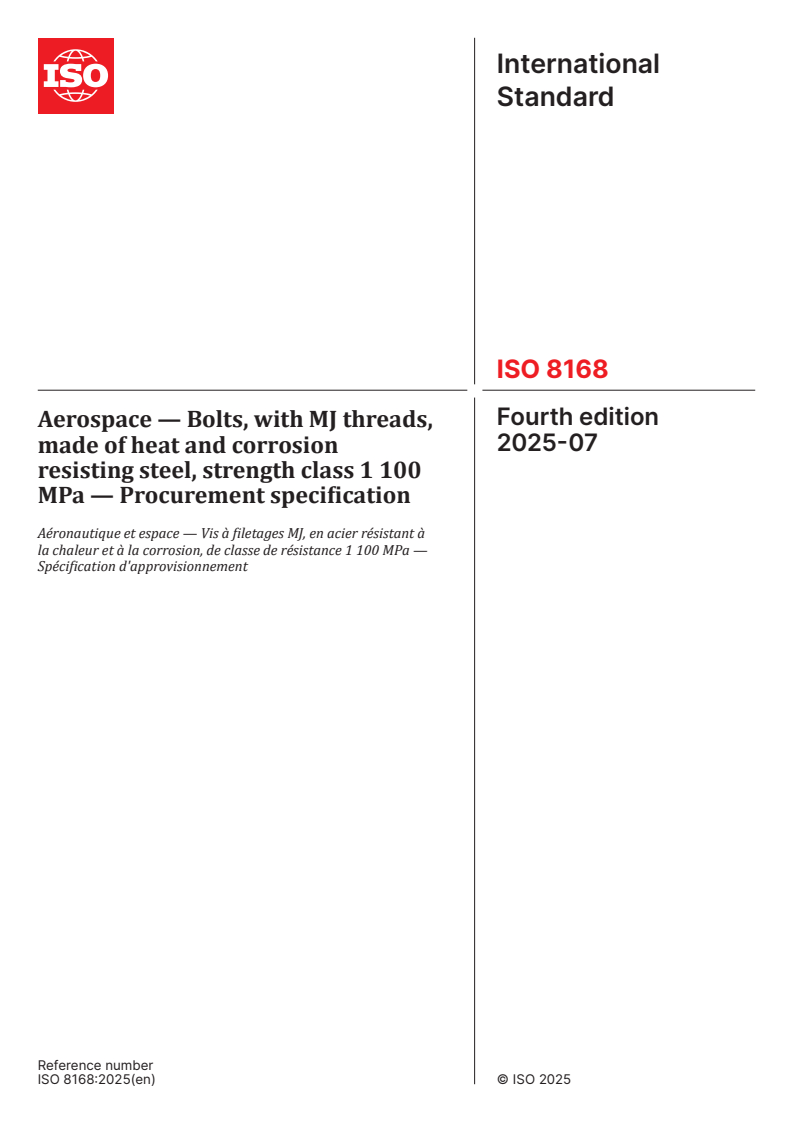
International
Standard
ISO 8168
Fourth edition
Aerospace — Bolts, with MJ threads,
2025-07
made of heat and corrosion
resisting steel, strength class 1 100
MPa — Procurement specification
Aéronautique et espace — Vis à filetages MJ, en acier résistant à
la chaleur et à la corrosion, de classe de résistance 1 100 MPa —
Spécification d'approvisionnement
Reference number
© ISO 2025
All rights reserved. Unless otherwise specified, or required in the context of its implementation, no part of this publication may
be reproduced or utilized otherwise in any form or by any means, electronic or mechanical, including photocopying, or posting on
the internet or an intranet, without prior written permission. Permission can be requested from either ISO at the address below
or ISO’s member body in the country of the requester.
ISO copyright office
CP 401 • Ch. de Blandonnet 8
CH-1214 Vernier, Geneva
Phone: +41 22 749 01 11
Email: copyright@iso.org
Website: www.iso.org
Published in Switzerland
ii
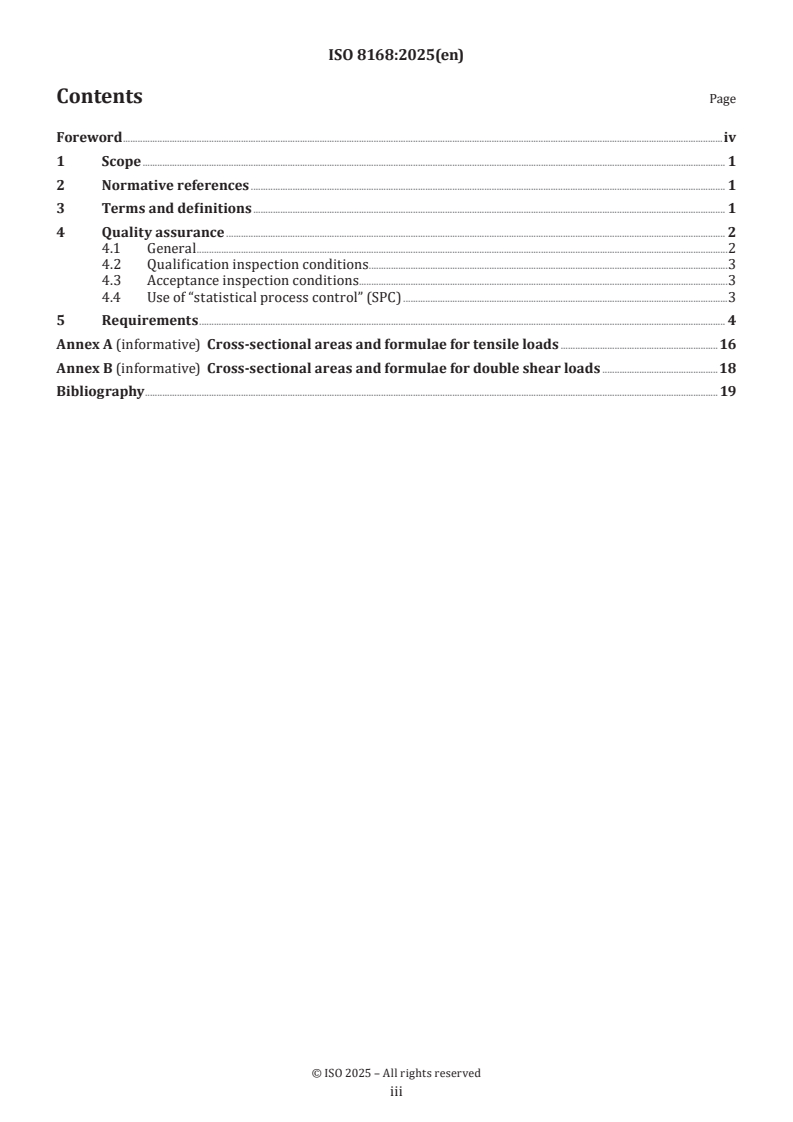
Contents Page
Foreword .iv
1 Scope . 1
2 Normative references . 1
3 Terms and definitions . 1
4 Quality assurance . 2
4.1 General .2
4.2 Qualification inspection conditions . . .3
4.3 Acceptance inspection conditions . .3
4.4 Use of “statistical process control” (SPC) .3
5 Requirements . 4
Annex A (informative) Cross-sectional areas and formulae for tensile loads .16
Annex B (informative) Cross-sectional areas and formulae for double shear loads .18
Bibliography . 19
iii
Foreword
ISO (the International Organization for Standardization) is a worldwide federation of national standards
bodies (ISO member bodies). The work of preparing International Standards is normally carried out through
ISO technical committees. Each member body interested in a subject for which a technical committee
has been established has the right to be represented on that committee. International organizations,
governmental and non-governmental, in liaison with ISO, also take part in the work. ISO collaborates closely
with the International Electrotechnical Commission (IEC) on all matters of electrotechnical standardization.
The procedures used to develop this document and those intended for its further maintenance are described
in the ISO/IEC Directives, Part 1. In particular, the different approval criteria needed for the different types
of ISO document should be noted. This document was drafted in accordance with the editorial rules of the
ISO/IEC Directives, Part 2 (see www.iso.org/directives).
ISO draws attention to the possibility that the implementation of this document may involve the use of (a)
patent(s). ISO takes no position concerning the evidence, validity or applicability of any claimed patent
rights in respect thereof. As of the date of publication of this document, ISO had not received notice of (a)
patent(s) which may be required to implement this document. However, implementers are cautioned that
this may not represent the latest information, which may be obtained from the patent database available at
www.iso.org/patents. ISO shall not be held responsible for identifying any or all such patent rights.
Any trade name used in this document is information given for the convenience of users and does not
constitute an endorsement.
For an explanation of the voluntary nature of standards, the meaning of ISO specific terms and expressions
related to conformity assessment, as well as information about ISO's adherence to the World Trade
Organization (WTO) principles in the Technical Barriers to Trade (TBT), see www.iso.org/iso/foreword.html.
This document was prepared by Technical Committee ISO/TC 20, Aircraft and space vehicles, Subcommittee
SC 4, Aerospace fastener systems.
This fourth edition cancels and replaces the third edition (ISO 8168:2016), which has been technically
revised.
The main changes are as follows:
— editorial revision of the document;
— new tables for sampling;
— additional requirements in Table 1, item no 2 "Dimensions";
— additional requirements in Table 1 item no 4-1 "Tensile strength";
— additional requirements in Table 1 item no 4-3 "Hardness";
— additional requirements in Table 1 item no 4 "Recess removal torque".
Any feedback or questions on this document should be directed to the user’s national standards body.
A complete listing of these bodies can be found at www.iso.org/members.html.
iv
International Standard ISO 8168:2025(en)
Aerospace — Bolts, with MJ threads, made of heat and
corrosion resisting steel, strength class 1 100 MPa —
Procurement specification
1 Scope
This document specifies the characteristics and quality assurance requirements for MJ thread bolts made of
heat and corrosion resisting steel, of strength class 1 100 MPa, for aerospace construction.
It is applicable whenever it is referenced in a definition document.
2 Normative references
The following documents are referred to in the text in such a way that some or all of their content constitutes
requirements of this document. For dated references, only the edition cited applies. For undated references,
the latest edition of the referenced document (including any amendments) applies.
ISO 3452-1, Non-destructive testing — Penetrant testing — Part 1: General principles
ISO 5855-2, Aerospace — MJ threads — Part 2: Limit dimensions for bolts and nuts
ISO 7961, Aerospace — Bolts — Test methods
AS/EN 9138, Aerospace Series - Quality Management Systems Statistical Product Acceptance Requirements
1)
ASTM E112:2004, Standard Test Methods for Determining Average Grain Size
3 Terms and definitions
For the purposes of this document, the following terms and definitions apply.
ISO and IEC maintain terminology databases for use in standardization at the following addresses:
— ISO Online browsing platform: available at https:// www .iso .org/ obp
— IEC Electropedia: available at https:// www .electropedia .org/
3.1
batch
quantity of finished parts, manufactured using the same process, from a single material cast (single heat
of alloy), having the same definition document (3.3) number, diameter, heat-treated together to the same
specified condition and produced as one continuous run
3.2
inspection lot
quantity of bolts from a single production batch (3.1) having the same definition document (3.3) number
3.3
definition document
document specifying directly or indirectly all the requirements for products
Note 1 to entry: The definition document may be an International Standard, an in-house standard or a drawing.
1) Published by: ASTM International (US) https:// www .astm .org/ .
3.4
crack
rupture in the material which may extend in any direction and which may be intercrystalline or
transcrystalline in character
3.5
seam
longitudinal open surface defect
3.6
lap
surface defect caused by folding over metal fins or sharp corners and then forming them into the surface
3.7
crevice
hollow area at thread crest
3.8
inclusions
non-metallic particles originating from the material manufacturing process
Note 1 to entry: These particles may be isolated or arranged in strings.
3.9
sampling plan
plan according to which one or more samples are taken in order to obtain information and possibly reach a
decision
Note 1 to entry: In this document, each sampling plan specifies the number of bolts to be inspected as a function of the
size of the batch (3.1) and the acceptance number [number of defective items acceptable (Ac); see ISO 2859-1].
3.10
simple random sampling
sampling of n items from a population of N items in such a way that all possible combinations of n items have
the same probability of being chosen
3.11
grip length
shank length
dimension from top of head (flush head bolt) or underhead bearing surface (protruding head bolt) to the end
of full cylindrical portion of shank, excluding the thread radius at shank/slope transition
3.12
IRR
initial reliability requirement
inspection reliability requirement
minimum acceptable outgoing yield or probability of conformance
4 Quality assurance
4.1 General
The manufacturer shall be capable of providing a continuous production of bolts complying with the
quality requirements specified in this document. The manufacturer should implement a recognized quality
management system.
2)
The purpose of qualification inspections of bolts is to check that the design and manufacturing conditions
of a bolt allow it to satisfy the requirements of this document.
2) In order to simplify the text, the term “inspections” used in this document also refers to “inspections and tests”.
Quality documentation for parts produced in accordance with this document shall be maintained for a
minimum period of 10 years.
The purpose of a production acceptance inspection of a bolt is to check, as simply as possible, using a method
which is inexpensive but representative of the actual conditions of use, with the uncertainty inherent in
statistical sampling, that the bolt satisfies the requirements of this document.
Production acceptance inspections shall be carried out by, or under the responsibility of, the manufacturer.
4.2 Qualification inspection conditions
Unless otherwise specified, the inspection shall be carried out on:
— each type and diameter of bolt;
— 25 bolts selected from a single inspection lot by simple random sampling.
The test programme can be reduced, or the qualification granted, without inspection: any such decision
shall be based on the results obtained on similar types and diameters of bolts provided that the design and
manufacturing conditions are identical.
The inspections shall be repeated on any bolt if the manufacturing conditions have been modified.
Table 2 indicates the allocation of bolt samples for the inspections.
4.3 Acceptance inspection conditions
Inspections shall be carried out on each production batch or inspection lot. Bolts from the batch or lot to be
inspected shall be selected by simple random sampling.
Each bolt may be submitted to several inspections, provided that none of the characteristics to be verified
has been previously altered during any of these inspections.
Acceptance inspections and tests are specified in Table 1. They shall be carried out on each production batch
or inspection lot. Table 1 specifies the test methods and sampling tables to be used for each test. Fasteners
from the batch to be tested shall be selected by sampling in accordance with AS/EN 9138.
The bolts to be subjected to destructive inspections may be those on which non-destructive inspections
have been carried out.
If a more stringent inspection is deemed necessary, all or part of the qualification inspections may be
performed during the acceptance inspections. In this case, the number of bolts submitted is the same as that
submitted for the qualification inspection.
Production batches or inspection lots declared unacceptable after the production acceptance inspections
shall be submitted for re-inspection only after all the defective units have been removed and/or defects
have been corrected. In this case, the attribute(s) that caused the rejection shall be verified using a sample
of twice the normal size but the maximum number of allowed defective items shall be the same as in the
original inspection.
4.4 Use of “statistical process control” (SPC)
When a characteristic is obtained by a controlled statistical process, the manufacturer has the option, in
order to declare conformity of the characteristic, to forgo the final systematic sampling provided in this
document, if she or he can formally justify this choice by the standards quoted in it as a basis.
This justification includes the following phases:
— analysis of the key characteristics of the product;
— analysis of the risks for each implemented process;
— determination of the parameters and/or characteristics to be respected under SPC;
— determination of the capabilities of each process;
— drawing up of an inspection plan and integration in the manufacturing process;
— drawing up of routes and control charts (e.g. ISO 7870-3, ISO 7870-1, ISO 7870-2);
— use of control charts for data consolidation;
— determination of the audits to be run and the control to be carried out to ensure reliability of the device.
To be usable in production, this process shall be validated beforehand by the qualifying body, either during
the qualification phase, or a posteriori according to the case, by analysing the justificatory file and the
results of the qualification inspections such as provided for in Clause 5. Such an SPC process is not applicable
to destructive tests.
5 Requirements
The requirements given in Table 1, unless otherwise specified, shall apply to bolts that are ready for use.
The test temperature, unless otherwise specified, shall be the ambient temperature. These requirements
complement the requirements of all other standards or specifications referenced in the definition document.
Table 1 — Requirements and test methods
Item no Characteristic Requirement Inspection and Designa- Sample
a
test method tion size
1 Material In accordance with the See material standard As required
definition document by semi-fin-
ished prod-
uct
2 Dimensions In accordance with the Standard gauging Q 20
definition document
ISO 5855-2 shall apply. A Table 3 and
Dimensions shall include the
Table 4 to 7
chemical applied or electroplat-
ed finishes designated on the
detailed drawing. Dimensions
shall exclude paint and similar
coating, metallic dips and dry
film lubricants.
3 Manufacturing
3-1 Forging The heads of the bolts shall be According to the Q
formed by a hot or cold forging manufacturing route
process before heat treatment.
In the case of hot forging, the The equipment used
equipment shall ensure that a shall be approved.
constant temperature of less
than 1 090 °C is guaranteed
throughout the production batch.
3-2 Heat treatment The forged blanks shall be According to the pro- Q
heat-treated to produce the prop- cess route
erties required by the definition
The equipment used
document. Blanks shall not be
shall be approved.
heat-treated more than twice.
3-3 Removal of If machining is required, it is
...