

ISO 21384-2:2021
(Main)Unmanned aircraft systems — Part 2: UAS components
General Information
- Abstract
This document specifies requirements for ensuring the quality and safety of the design and manufacture of unmanned aircraft systems (UAS) that include unmanned aircraft (UA), remote pilot stations (RPS), datalinks, payloads, and associated support equipment. This document includes information regarding the unmanned aircraft, any associated remote pilot station (RPS)(s), the command and control links (C2 Link), any other required data links (e.g. payload, traffic management information, vehicle identification) and any other system elements as can be required. This document does not cover passenger carrying UAS or technical requirements for the design and manufacturing for UAS components. This document does not include equipment considerations unique to compliance with UA traffic management systems. The document is applicable to the reasonable expected use of a UAS. This document is applicable: a) to UAS designed for use where a State aviation authority has determined a Certificate of Airworthiness (C of A) is not required; b) where a C of A is required, to complement technical standards published by the aviation authority for the purposes of building the certification basis; or c) as an alternative means of compliance if acceptable to the aviation authority.
- Status
- Published
- Publication Date
- 09-Dec-2021
- Technical Committee
- ISO/TC 20/SC 16 - Unmanned aircraft systems
- Drafting Committee
- ISO/TC 20/SC 16/WG 2 - Product manufacturing and maintenance
- Current Stage
- 6060 - International Standard published
- Start Date
- 10-Dec-2021
- Due Date
- 05-Dec-2021
- Completion Date
- 10-Dec-2021


Overview
ISO 21384-2:2021 - Unmanned aircraft systems - Part 2: UAS components defines system-level requirements to ensure the quality and safety of unmanned aircraft systems (UAS) that include unmanned aircraft (UA), remote pilot stations (RPS), command-and-control (C2) links, payloads and associated support equipment. The standard addresses expected operational use of UAS and is applicable where a State aviation authority has determined a Certificate of Airworthiness is not required, to complement certification technical standards, or as an accepted alternative means of compliance. It explicitly excludes passenger‑carrying UAS and equipment considerations unique to UAS traffic management systems.
Key topics and technical requirements
ISO 21384-2 covers a broad set of component- and system-level topics important for UAS safety, reliability and supportability:
- General design requirements - function, reliability, maintainability, documentation and support considerations for UAS as systems.
- Aircraft structures - construction, damage tolerance and durability expectations for UA structures and attached/moving parts.
- Propulsion and thrust systems - risk management for engines/motors, propellers/rotors, mounting and installation practices.
- Electrical systems and energy sources - airborne and ground electrical safety, power systems for RPS, battery protection and handling, fuels and fuel‑cell safeguards.
- Flight control and avionics - flight control system hardware/software design, actuators, diagnostics, sensors (GNSS, IMU, altimeter, airspeed, optical), redundancy and failure‑mode management.
- C2 Link and data features - performance, antenna design, operational requirements, latency/delay characteristics, reliability and security.
- Remote Pilot Station (RPS) - ergonomic and human‑factors design, monitoring and mission planning tools, functional and structural requirements.
- Support, transport and labeling - packaging, storage, labelling, maintenance planning and documentation for lifecycle support.
The standard emphasizes safety, traceability, lifecycle supportability, redundancy, and security rather than prescribing component-level manufacturing processes.
Practical applications and who uses it
ISO 21384-2 is used by:
- UAS manufacturers and system integrators designing compliant systems and selecting components.
- Product engineers and safety managers establishing design, testing and documentation practices.
- Maintenance and operations teams planning supportability, packaging and transport procedures.
- Certification bodies and national aviation authorities as a complement or alternative means of compliance.
- Procurement specialists and third‑party test labs evaluating UAS performance, reliability and security.
This standard helps align UAS development with recognized safety and quality expectations, reducing regulatory risk and improving interoperability.
Related standards
- Other parts of the ISO 21384 series (system-level and operational guidance) and applicable national aviation certification standards and airworthiness guidance are commonly referenced alongside ISO 21384-2 for comprehensive compliance and certification strategies.
Keywords: ISO 21384-2, UAS components, unmanned aircraft systems, C2 link, remote pilot station, flight control, UAS safety, battery protection, UAS design requirements.
Get Certified
Connect with accredited certification bodies for this standard

BSI Group
BSI (British Standards Institution) is the business standards company that helps organizations make excellence a habit.

Bureau Veritas
Bureau Veritas is a world leader in laboratory testing, inspection and certification services.

DNV
DNV is an independent assurance and risk management provider.
Sponsored listings
Frequently Asked Questions
ISO 21384-2:2021 is a standard published by the International Organization for Standardization (ISO). Its full title is "Unmanned aircraft systems — Part 2: UAS components". This standard covers: This document specifies requirements for ensuring the quality and safety of the design and manufacture of unmanned aircraft systems (UAS) that include unmanned aircraft (UA), remote pilot stations (RPS), datalinks, payloads, and associated support equipment. This document includes information regarding the unmanned aircraft, any associated remote pilot station (RPS)(s), the command and control links (C2 Link), any other required data links (e.g. payload, traffic management information, vehicle identification) and any other system elements as can be required. This document does not cover passenger carrying UAS or technical requirements for the design and manufacturing for UAS components. This document does not include equipment considerations unique to compliance with UA traffic management systems. The document is applicable to the reasonable expected use of a UAS. This document is applicable: a) to UAS designed for use where a State aviation authority has determined a Certificate of Airworthiness (C of A) is not required; b) where a C of A is required, to complement technical standards published by the aviation authority for the purposes of building the certification basis; or c) as an alternative means of compliance if acceptable to the aviation authority.
This document specifies requirements for ensuring the quality and safety of the design and manufacture of unmanned aircraft systems (UAS) that include unmanned aircraft (UA), remote pilot stations (RPS), datalinks, payloads, and associated support equipment. This document includes information regarding the unmanned aircraft, any associated remote pilot station (RPS)(s), the command and control links (C2 Link), any other required data links (e.g. payload, traffic management information, vehicle identification) and any other system elements as can be required. This document does not cover passenger carrying UAS or technical requirements for the design and manufacturing for UAS components. This document does not include equipment considerations unique to compliance with UA traffic management systems. The document is applicable to the reasonable expected use of a UAS. This document is applicable: a) to UAS designed for use where a State aviation authority has determined a Certificate of Airworthiness (C of A) is not required; b) where a C of A is required, to complement technical standards published by the aviation authority for the purposes of building the certification basis; or c) as an alternative means of compliance if acceptable to the aviation authority.
ISO 21384-2:2021 is classified under the following ICS (International Classification for Standards) categories: 49.020 - Aircraft and space vehicles in general. The ICS classification helps identify the subject area and facilitates finding related standards.
ISO 21384-2:2021 is available in PDF format for immediate download after purchase. The document can be added to your cart and obtained through the secure checkout process. Digital delivery ensures instant access to the complete standard document.
Standards Content (Sample)
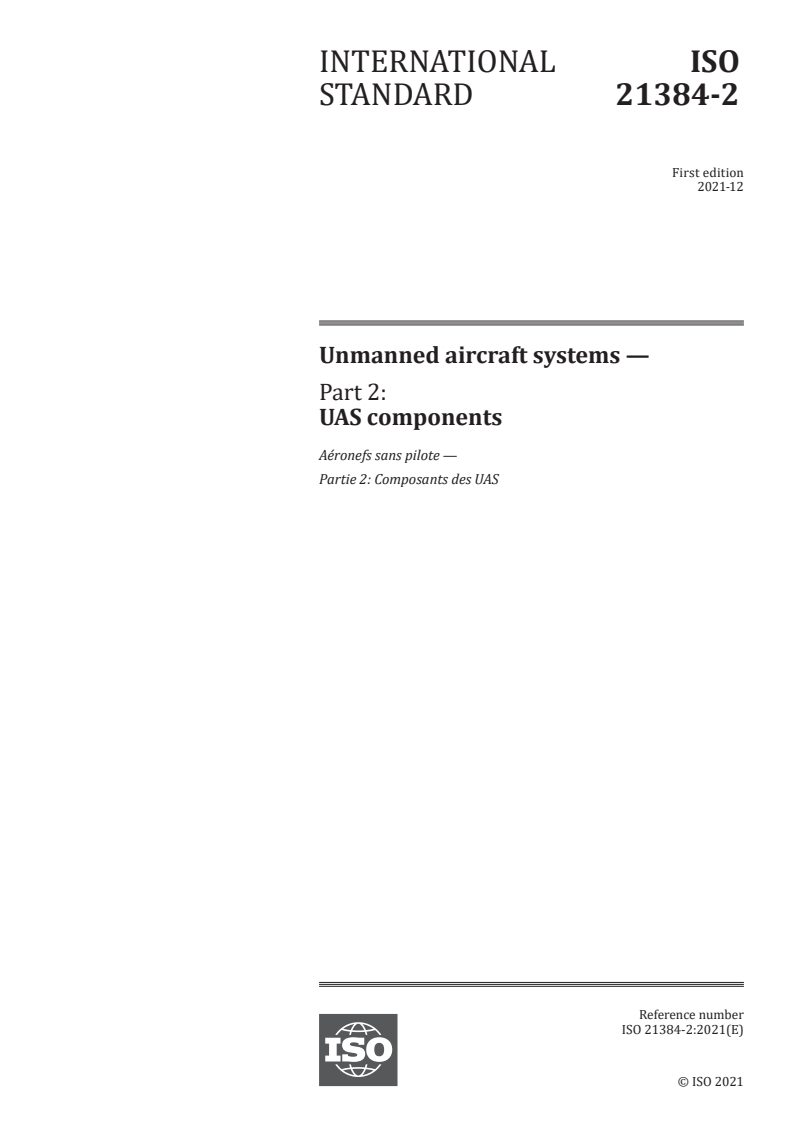
INTERNATIONAL ISO
STANDARD 21384-2
First edition
2021-12
Unmanned aircraft systems —
Part 2:
UAS components
Aéronefs sans pilote —
Partie 2: Composants des UAS
Reference number
© ISO 2021
All rights reserved. Unless otherwise specified, or required in the context of its implementation, no part of this publication may
be reproduced or utilized otherwise in any form or by any means, electronic or mechanical, including photocopying, or posting on
the internet or an intranet, without prior written permission. Permission can be requested from either ISO at the address below
or ISO’s member body in the country of the requester.
ISO copyright office
CP 401 • Ch. de Blandonnet 8
CH-1214 Vernier, Geneva
Phone: +41 22 749 01 11
Email: copyright@iso.org
Website: www.iso.org
Published in Switzerland
ii
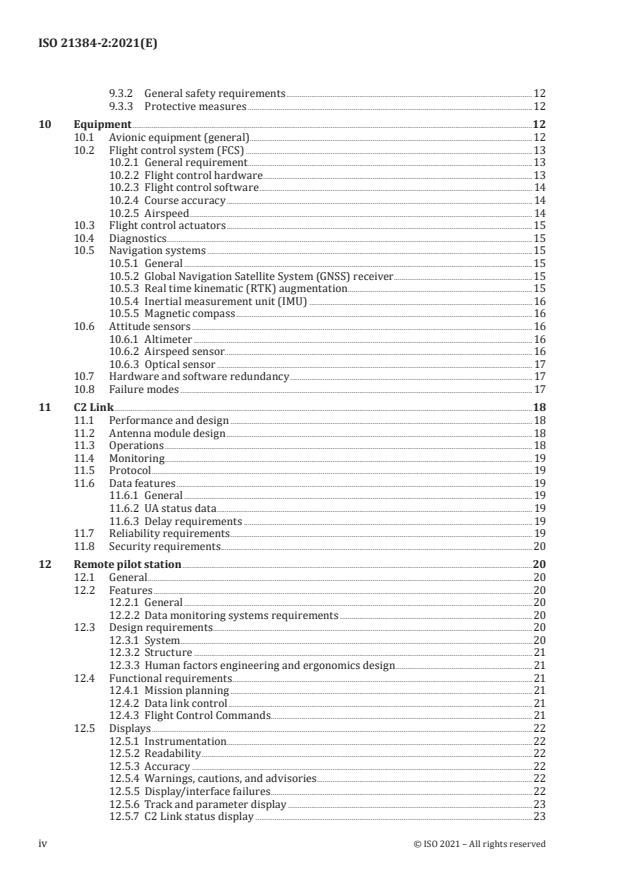
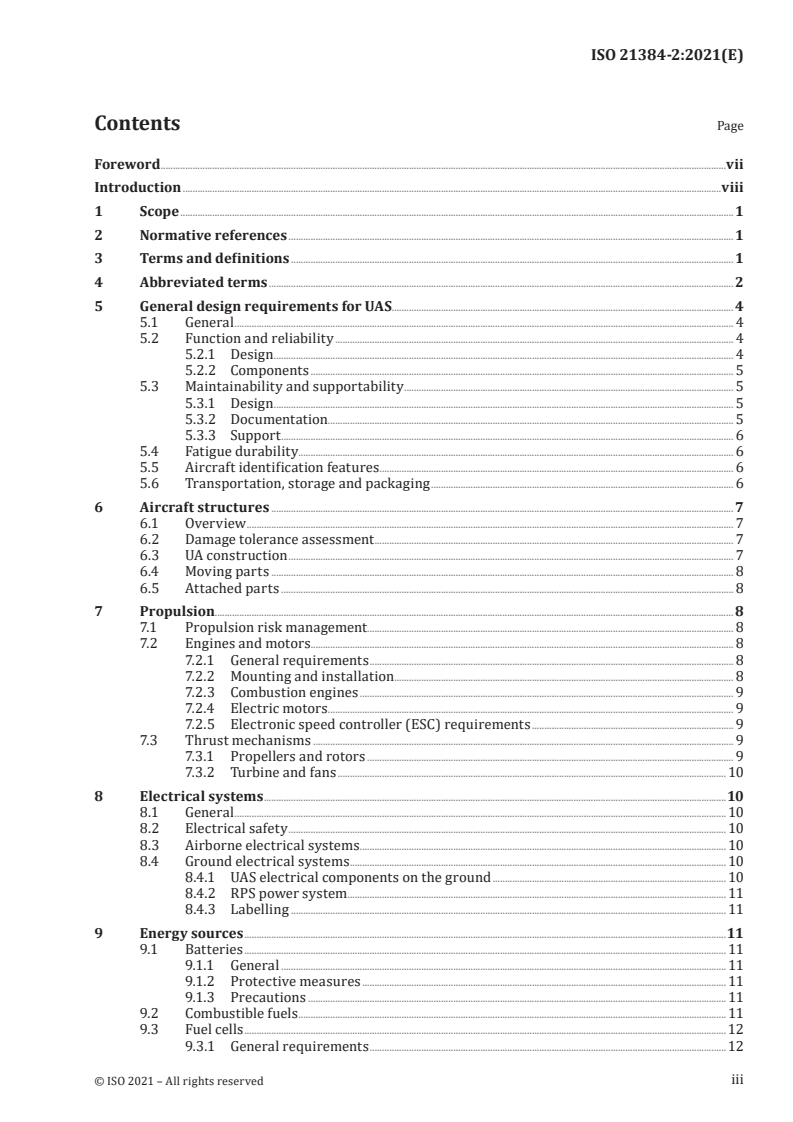
Contents Page
Foreword .vii
Introduction .viii
1 Scope . 1
2 Normative references . 1
3 Terms and definitions . 1
4 Abbreviated terms . 2
5 General design requirements for UAS. 4
5.1 General . 4
5.2 Function and reliability . 4
5.2.1 Design . 4
5.2.2 Components . 5
5.3 Maintainability and supportability . 5
5.3.1 Design . 5
5.3.2 Documentation. 5
5.3.3 Support . 6
5.4 Fatigue durability . 6
5.5 Aircraft identification features . 6
5.6 Transportation, storage and packaging . 6
6 Aircraft structures . 7
6.1 Overview . 7
6.2 Damage tolerance assessment . 7
6.3 UA construction . 7
6.4 Moving parts . 8
6.5 Attached parts . 8
7 Propulsion . 8
7.1 Propulsion risk management . 8
7.2 Engines and motors . . 8
7.2.1 General requirements . 8
7.2.2 Mounting and installation . 8
7.2.3 Combustion engines . 9
7.2.4 Electric motors . 9
7.2.5 Electronic speed controller (ESC) requirements . 9
7.3 Thrust mechanisms . 9
7.3.1 Propellers and rotors . 9
7.3.2 Turbine and fans . 10
8 Electrical systems .10
8.1 General . 10
8.2 Electrical safety . 10
8.3 Airborne electrical systems . 10
8.4 Ground electrical systems . 10
8.4.1 UAS electrical components on the ground . 10
8.4.2 RPS power system . 11
8.4.3 Labelling . 11
9 Energy sources .11
9.1 Batteries . 11
9.1.1 General . 11
9.1.2 Protective measures . 11
9.1.3 Precautions . 11
9.2 Combustible fuels . 11
9.3 Fuel cells .12
9.3.1 General requirements .12
iii
9.3.2 General safety requirements .12
9.3.3 Protective measures .12
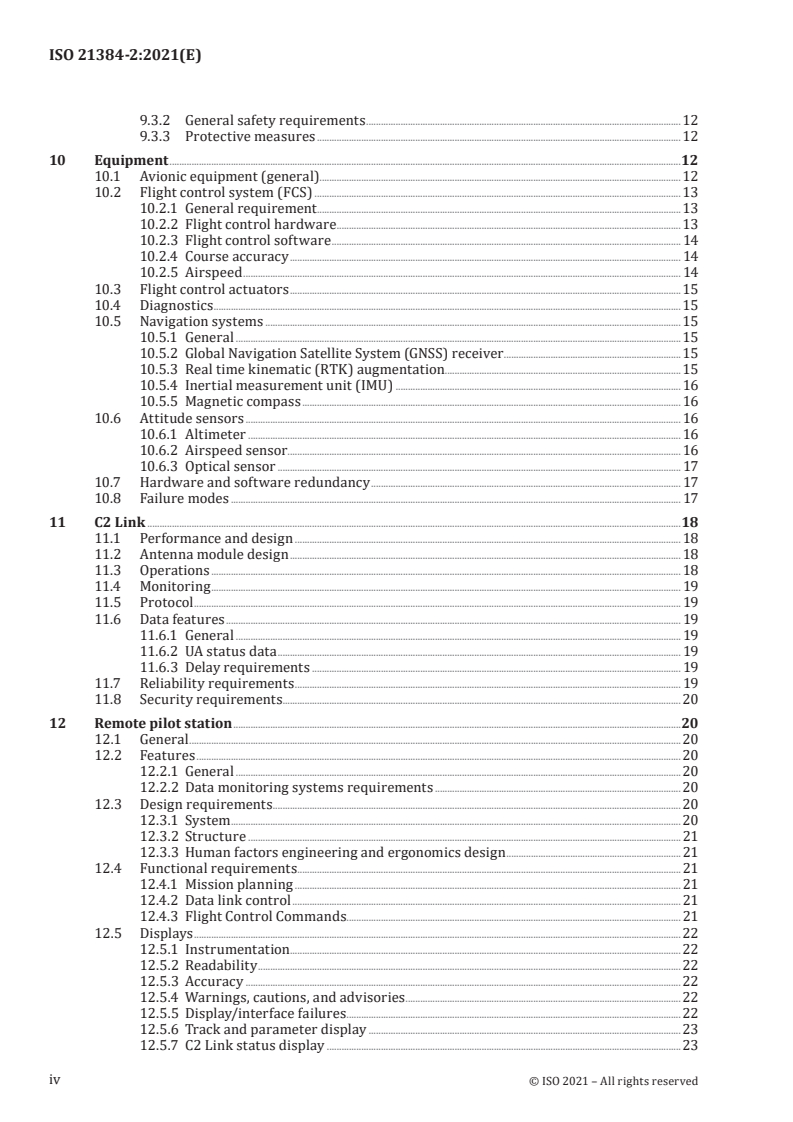
10 Equipment .12
10.1 Avionic equipment (general). 12
10.2 Flight control system (FCS) . 13
10.2.1 General requirement . .13
10.2.2 Flight control hardware .13
10.2.3 Flight control software . 14
10.2.4 Course accuracy . 14
10.2.5 Airspeed . 14
10.3 Flight control actuators .15
10.4 Diagnostics . 15
10.5 Navigation systems . 15
10.5.1 General .15
10.5.2 Global Navigation Satellite System (GNSS) receiver . 15
10.5.3 Real time kinematic (RTK) augmentation. 15
10.5.4 Inertial measurement unit (IMU) . 16
10.5.5 Magnetic compass . 16
10.6 Attitude sensors . 16
10.6.1 Altimeter . 16
10.6.2 Airspeed sensor. 16
10.6.3 Optical sensor . 17
10.7 Hardware and software redundancy . 17
10.8 Failure modes . 17
11 C2 Link .18
11.1 Performance and design . 18
11.2 Antenna module design . 18
11.3 Operations . 18
11.4 Monitoring . 19
11.5 Protocol . 19
11.6 Data features . 19
11.6.1 General . 19
11.6.2 UA status data . 19
11.6.3 Delay requirements . 19
11.7 Reliability requirements . 19
11.8 Security requirements . . 20
12 Remote pilot station .20
12.1 General . 20
12.2 Features . 20
12.2.1 General .20
12.2.2 Data monitoring systems requirements . 20
12.3 Design requirements . 20
12.3.1 System . 20
12.3.2 Structure . 21
12.3.3 Human factors engineering and ergonomics design . 21
12.4 Functional requirements . . 21
12.4.1 Mission planning . 21
12.4.2 Data link control . 21
12.4.3 Flight Control Commands. 21
12.5 Displays . 22
12.5.1 Instrumentation. 22
12.5.2 Readability . 22
12.5.3 Accuracy . 22
12.5.4 Warnings, cautions, and advisories . 22
12.5.5 Display/interface failures . 22
12.5.6 Track and parameter display . 23
12.5.7 C2 Link status display .23
iv
12.5.8 Telemetry parameter record . 23
12.6 Performance requirements . 23
12.6.1 Environmental adaptability . 23
12.6.2 Reliability . 24
12.7 Safety. 24
12.8 Collision avoidance (CA) systems . 24
13 Payload .24
13.1 General requirements . 24
13.2 Safety marking . 25
13.3 Wiring design. 25
13.4 Payload power supply . 25
13.5 Storage requirement.25
14 Airworthiness .25
14.1 Documentation . 25
14.1.1 Instructions . 25
14.1.2 Manuals and handbooks . 25
14.1.3 Procedural changes . 26
14.2 Composition of an operator’s manual . 26
14.2.1 Technical specifications . 26
14.2.2 Flight performance . 26
14.2.3 Aircraft weights .26
14.2.4 Flight control accuracy .26
14.2.5 Dimensions . 27
14.2.6 Atmospheric and other environments adaptability . 27
14.3 Electromagnetic compatibility considerations . 27
14.4 Noise . 27
14.5 Built-in test and monitoring . 27
14.6 System safety program .28
14.6.1 Selection of design materials .28
14.6.2 Properties and processes .28
14.6.3 Mass properties .28
14.6.4 Corrosion .29
14.6.5 Material limitations .29
14.6.6 Fire hazards .29
14.6.7 Equipment separation .29
15 UAS software .29
15.1 Software architecture and design .29
15.2 Safety. 30
15.3 Security . 30
15.4 Software compliance.30
15.5 Software development life cycle . 30
16 Other considerations .30
16.1 Ground equipment . .30
16.2 Multi vehicle control . 31
16.3 Jamming and spoofing . 31
17 Automation .31
17.1 General . 31
17.2 Software development lifecycle . 31
17.3 Remote pilot intervention. 32
17.4 System data collection . 32
17.5 Automation risk assessment . 32
17.6 Automation system architecture . 32
Annex A (informative) Software risk management .33
Annex B (informative) Electromagnetic environmental effects (E3) .36
v
Bibliography .38
vi
Foreword
ISO (the International Organization for Standardization) is a worldwide federation of national standards
bodies (ISO member bodies). The work of preparing International Standards is normally carried out
through ISO technical committees. Each member body interested in a subject for which a technical
committee has been established has the right to be represented on that committee. International
organizations, governmental and non-governmental, in liaison with ISO, also take part in the work.
ISO collaborates closely with the International Electrotechnical Commission (IEC) on all matters of
electrotechnical standardization.
The procedures used to develop this document and those intended for its further maintenance are
described in the ISO/IEC Directives, Part 1. In particular, the different approval criteria needed for the
different types of ISO documents should be noted. This document was drafted in accordance with the
editorial rules of the ISO/IEC Directives, Part 2 (see www.iso.org/directives).
Attention is drawn to the possibility that some of the elements of this document may be the subject of
patent rights. ISO shall not be held responsible for identifying any or all such patent rights. Details of
any patent rights identified during the development of the document will be in the Introduction and/or
on the ISO list of patent declarations received (see www.iso.org/patents).
Any trade name used in this document is information given for the convenience of users and does not
constitute an endorsement.
For an explanation of the voluntary nature of standards, the meaning of ISO specific terms and
expressions related to conformity assessment, as well as information about ISO's adherence to
the World Trade Organization (WTO) principles in the Technical Barriers to Trade (TBT), see
www.iso.org/iso/foreword.html.
This document was prepared by Technical Committee ISO/TC 20, Aircraft and space vehicles,
Subcommittee SC 16, Unmanned aircraft systems.
Any feedback or questions on this document should be directed to the user’s national standards body. A
complete listing of these bodies can be found at www.iso.org/members.html.
vii
Introduction
The use of unmanned aircraft systems (UAS) or drones, for commercial and recreational purposes has
grown in popularity over the last several years. There are many application markets growing rapidly,
such as motion pictures and film, security, inspections as well as many uses by organizations to increase
public safety. It has been a challenge for operators to use these aircraft due to the lack of regulation and
lack of common manufacturing methods a regulator would recognize as safe.
The purpose of this document is to shape a general architecture for the quality and safety of
the manufacture of UAS. By addressing the UAS components separately, the document enables
manufacturers to focus on the applicable design requirements in order to better promote international
trade and basis for future development while enhancing the safety of UAS operations.
viii
INTERNATIONAL STANDARD ISO 21384-2:2021(E)
Unmanned aircraft systems —
Part 2:
UAS components
1 Scope
This document specifies requirements for ensuring the quality and safety of the design and manufacture
of unmanned aircraft systems (UAS) that include unmanned aircraft (UA), remote pilot stations (RPS),
datalinks, payloads, and associated support equipment.
This document includes information regarding the unmanned aircraft, any associated remote pilot
station (RPS)(s), the command and control links (C2 Link), any other required data links (e.g. payload,
traffic management information, vehicle identification) and any other system elements as can be
required. This document does not cover passenger carrying UAS or technical requirements for the
design and manufacturing for UAS components.
This document does not include equipment considerations unique to compliance with UA traffic
management systems.
The document is applicable to the reasonable expected use of a UAS.
This document is applicable:
a) to UAS designed for use where a State aviation authority has determined a Certificate of
Airworthiness (C of A) is not required;
b) where a C of A is required, to complement technical standards published by the aviation authority
for the purposes of building the certification basis; or
c) as an alternative means of compliance if acceptable to the aviation authority.
2 Normative references
The following documents are referred to in the text in such a way that some or all of their content
constitutes requirements of this document. For dated references, only the edition cited applies. For
undated references, the latest edition of the referenced document (including any amendments) applies.
ISO 6858, Aircraft — Ground support electrical supplies — General requirements
IEC 62133 (all parts), Secondary cells and batteries containing alkaline or other non-acid electrolytes
— Safety requirements for portable sealed secondary cells, and for batteries made from them, for use in
portable applications
IEC 62368-1, Audio/video, information and communication technology equipment — Part 1: Safety
requirements
3 Terms and definitions
For the purposes of this document, the following terms and definitions apply.
ISO and IEC maintain terminology databases for use in standardization at the following addresses:
— ISO Online browsing platform: available at https:// www .iso .org/ obp
— IEC Electropedia: available at https:// www .electropedia .org/
3.1
airframe
mechanical structure of an aircraft which typically includes the fuselage, wings and undercarriage and
excludes the propulsion system (3.8)
3.2
avionics
electronics as applied to aviation which include propulsion system (3.8) controls, FCS, navigation,
communications, flight recorders, lighting systems, threat detection, fuel systems, electro-optic/
infrared (EO/IR) systems, weather radar, performance monitors, and systems that carry out various
mission and flight management tasks
3.3
C2 Link
data link between the remotely piloted aircraft and the remote pilot station for the purposes of
managing the flight
3.4
controlled airspace
airspace of defined dimensions within which air traffic control service (ATS) is provided in accordance
with the airspace classification
Note 1 to entry: Controlled airspace is a generic term which covers ATS airspace classes A, B, C, D and E.
3.5
flight plan
specified information provided to ATS units, relative to an intended flight or portion of a flight of an
aircraft
3.6
ground speed
horizontal speed of a UA relative to the ground
3.7
maintenance
performance of tasks required to ensure the reliability (3.9) of an aircraft, including any one or
combination of overhaul, inspection, replacement, defect rectification, and the embodiment of a
modification or repair
3.8
propulsion system
engines and motors using components such as propellers and turbine engines that are necessary for
propulsion generation and affect the control or safety of flight.
3.9
reliability
ability of a system or component to function under stated conditions for a specified period of time
3.10
vulnerability
flaw or defect, if exploited, could result in a security or safety compromise
4 Abbreviated terms
C2 Link command and control link
CA collision avoidance
C of A certificate of airworthiness
COTS commercial off the shelf
C-UAS counter-UAS
DoD Department of Defence
E3 electromagnetic environmental effects
EMC electromagnetic compatibility
EME electromagnetic environment
EMI electromagnetic interference
EMSEC emanations security
EO/IR electro-optical/infrared
ESC electronic speed controller
EUROCAE European Organisation for Civil Aviation Equipment
FCS flight control system
GNSS Global Navigation Satellite System
HERF hazardous electromagnetic radiation to fuel
HERO hazardous electromagnetic radiation to ordnance
HITL human in the loop
HUMS health and usage monitoring systems
ICAO International Civil Aviation Organization
IMU inertial measurement unit
RPS remote pilot station
RTK real time kinematic
SDLC software development life cycle
UA unmanned aircraft
UAS unmanned aircraft system
UPS uninterruptable power supply
UV ultra-violet
VLOS visual line of sight
VTOL vertical take-off and landing
WGS world geodetic system
5 General design requirements for UAS
5.1 General
The systems related to the design of a UAS consist of the:
a) unmanned aircraft;
b) communication systems;
c) mission payloads;
d) RPS;
e) support equipment.
5.2 Function and reliability
5.2.1 Design
The following minimum concepts shall be incorporated in the design to ensure the functionality and
reliability of the UAS, wherever possible:
a) simplify the design criteria to reduce the product complexity;
b) identify the components critical to flight safety;
c) ensure the functionality and reliability of the UAS throughout the operational flight envelope,
applying safety margins and redundancy for components critical to flight safety;
d) minimise stress to the components and mechanical parts;
e) establish thermal design criteria throughout the components selection, circuit design and
structural design to enable reliability over a wide temperature range;
f) conduct an EMI/EMC evaluation and design mitigations for harmful effects of electromagnetic
radiation from the operational environment as well as those produced by other components of the
UAS;
NOTE Additional information on electromagnetic environmental effects can be found in Annex B.
g) adopt software reliability design and analysis tools;
h) apply environmental protection in the design and materials to limit the environmental effects on
components critical to flight safety;
i) apply protections designed to avoid damage to the UAS during the packaging, handling,
transportation and storage;
j) establish specific design approach and references to evaluate gust loads, whenever UA configuration
leads to extremely severe loads;
k) establish manoeuvre safe operation provisions or limitations, in case of manual commands or
semi-automatic commands, to ensure operational flight loads limit to be respected;
l) adopt software reliability design, including cybersecurity requirements, and analysis tools.
5.2.2 Components
The manufacturer shall document the following minimum component reliability for components
identified as “critical” in 5.2.1 b):
a) mission time between fatal failures;
b) mean time between failures or failure rate;
c) mean time between maintenance;
d) cumulative failure rate.
5.3 Maintainability and supportability
5.3.1 Design
The UAS design shall ensure:
a) the interchangeability and standardization of parts;
b) that detachable parts cannot be incorrectly assembled;
c) that replaceable parts are readily accessible for maintenance;
d) that diagnostic testing points are readily accessible;
e) there is a method to track parts and components to identify, monitor and promptly act on present
or future failures within the UAS;
f) that the maintenance and support requirements document is presented in a clear, consistent and
unambiguous manner.
5.3.2 Documentation
The manufacturer shall document the maintenance requirements for components identified as “critical”
in 5.2.1 b) and make them available to the operator. The following factors shall be included:
a) mean repair time or repair rate;
b) mean maintenance time;
c) propulsion system replacement time;
d) maintenance schedules and instructions;
e) repair and replace instructions;
f) troubleshooting information;
g) structural inspectio
...
INTERNATIONAL ISO
STANDARD 21384-2
First edition
2021-12
Unmanned aircraft systems —
Part 2:
UAS components
Aéronefs sans pilote —
Partie 2: Composants des UAS
Reference number
© ISO 2021
All rights reserved. Unless otherwise specified, or required in the context of its implementation, no part of this publication may
be reproduced or utilized otherwise in any form or by any means, electronic or mechanical, including photocopying, or posting on
the internet or an intranet, without prior written permission. Permission can be requested from either ISO at the address below
or ISO’s member body in the country of the requester.
ISO copyright office
CP 401 • Ch. de Blandonnet 8
CH-1214 Vernier, Geneva
Phone: +41 22 749 01 11
Email: copyright@iso.org
Website: www.iso.org
Published in Switzerland
ii
Contents Page
Foreword .vii
Introduction .viii
1 Scope . 1
2 Normative references . 1
3 Terms and definitions . 1
4 Abbreviated terms . 2
5 General design requirements for UAS. 4
5.1 General . 4
5.2 Function and reliability . 4
5.2.1 Design . 4
5.2.2 Components . 5
5.3 Maintainability and supportability . 5
5.3.1 Design . 5
5.3.2 Documentation. 5
5.3.3 Support . 6
5.4 Fatigue durability . 6
5.5 Aircraft identification features . 6
5.6 Transportation, storage and packaging . 6
6 Aircraft structures . 7
6.1 Overview . 7
6.2 Damage tolerance assessment . 7
6.3 UA construction . 7
6.4 Moving parts . 8
6.5 Attached parts . 8
7 Propulsion . 8
7.1 Propulsion risk management . 8
7.2 Engines and motors . . 8
7.2.1 General requirements . 8
7.2.2 Mounting and installation . 8
7.2.3 Combustion engines . 9
7.2.4 Electric motors . 9
7.2.5 Electronic speed controller (ESC) requirements . 9
7.3 Thrust mechanisms . 9
7.3.1 Propellers and rotors . 9
7.3.2 Turbine and fans . 10
8 Electrical systems .10
8.1 General . 10
8.2 Electrical safety . 10
8.3 Airborne electrical systems . 10
8.4 Ground electrical systems . 10
8.4.1 UAS electrical components on the ground . 10
8.4.2 RPS power system . 11
8.4.3 Labelling . 11
9 Energy sources .11
9.1 Batteries . 11
9.1.1 General . 11
9.1.2 Protective measures . 11
9.1.3 Precautions . 11
9.2 Combustible fuels . 11
9.3 Fuel cells .12
9.3.1 General requirements .12
iii
9.3.2 General safety requirements .12
9.3.3 Protective measures .12
10 Equipment .12
10.1 Avionic equipment (general). 12
10.2 Flight control system (FCS) . 13
10.2.1 General requirement . .13
10.2.2 Flight control hardware .13
10.2.3 Flight control software . 14
10.2.4 Course accuracy . 14
10.2.5 Airspeed . 14
10.3 Flight control actuators .15
10.4 Diagnostics . 15
10.5 Navigation systems . 15
10.5.1 General .15
10.5.2 Global Navigation Satellite System (GNSS) receiver . 15
10.5.3 Real time kinematic (RTK) augmentation. 15
10.5.4 Inertial measurement unit (IMU) . 16
10.5.5 Magnetic compass . 16
10.6 Attitude sensors . 16
10.6.1 Altimeter . 16
10.6.2 Airspeed sensor. 16
10.6.3 Optical sensor . 17
10.7 Hardware and software redundancy . 17
10.8 Failure modes . 17
11 C2 Link .18
11.1 Performance and design . 18
11.2 Antenna module design . 18
11.3 Operations . 18
11.4 Monitoring . 19
11.5 Protocol . 19
11.6 Data features . 19
11.6.1 General . 19
11.6.2 UA status data . 19
11.6.3 Delay requirements . 19
11.7 Reliability requirements . 19
11.8 Security requirements . . 20
12 Remote pilot station .20
12.1 General . 20
12.2 Features . 20
12.2.1 General .20
12.2.2 Data monitoring systems requirements . 20
12.3 Design requirements . 20
12.3.1 System . 20
12.3.2 Structure . 21
12.3.3 Human factors engineering and ergonomics design . 21
12.4 Functional requirements . . 21
12.4.1 Mission planning . 21
12.4.2 Data link control . 21
12.4.3 Flight Control Commands. 21
12.5 Displays . 22
12.5.1 Instrumentation. 22
12.5.2 Readability . 22
12.5.3 Accuracy . 22
12.5.4 Warnings, cautions, and advisories . 22
12.5.5 Display/interface failures . 22
12.5.6 Track and parameter display . 23
12.5.7 C2 Link status display .23
iv
12.5.8 Telemetry parameter record . 23
12.6 Performance requirements . 23
12.6.1 Environmental adaptability . 23
12.6.2 Reliability . 24
12.7 Safety. 24
12.8 Collision avoidance (CA) systems . 24
13 Payload .24
13.1 General requirements . 24
13.2 Safety marking . 25
13.3 Wiring design. 25
13.4 Payload power supply . 25
13.5 Storage requirement.25
14 Airworthiness .25
14.1 Documentation . 25
14.1.1 Instructions . 25
14.1.2 Manuals and handbooks . 25
14.1.3 Procedural changes . 26
14.2 Composition of an operator’s manual . 26
14.2.1 Technical specifications . 26
14.2.2 Flight performance . 26
14.2.3 Aircraft weights .26
14.2.4 Flight control accuracy .26
14.2.5 Dimensions . 27
14.2.6 Atmospheric and other environments adaptability . 27
14.3 Electromagnetic compatibility considerations . 27
14.4 Noise . 27
14.5 Built-in test and monitoring . 27
14.6 System safety program .28
14.6.1 Selection of design materials .28
14.6.2 Properties and processes .28
14.6.3 Mass properties .28
14.6.4 Corrosion .29
14.6.5 Material limitations .29
14.6.6 Fire hazards .29
14.6.7 Equipment separation .29
15 UAS software .29
15.1 Software architecture and design .29
15.2 Safety. 30
15.3 Security . 30
15.4 Software compliance.30
15.5 Software development life cycle . 30
16 Other considerations .30
16.1 Ground equipment . .30
16.2 Multi vehicle control . 31
16.3 Jamming and spoofing . 31
17 Automation .31
17.1 General . 31
17.2 Software development lifecycle . 31
17.3 Remote pilot intervention. 32
17.4 System data collection . 32
17.5 Automation risk assessment . 32
17.6 Automation system architecture . 32
Annex A (informative) Software risk management .33
Annex B (informative) Electromagnetic environmental effects (E3) .36
v
Bibliography .38
vi
Foreword
ISO (the International Organization for Standardization) is a worldwide federation of national standards
bodies (ISO member bodies). The work of preparing International Standards is normally carried out
through ISO technical committees. Each member body interested in a subject for which a technical
committee has been established has the right to be represented on that committee. International
organizations, governmental and non-governmental, in liaison with ISO, also take part in the work.
ISO collaborates closely with the International Electrotechnical Commission (IEC) on all matters of
electrotechnical standardization.
The procedures used to develop this document and those intended for its further maintenance are
described in the ISO/IEC Directives, Part 1. In particular, the different approval criteria needed for the
different types of ISO documents should be noted. This document was drafted in accordance with the
editorial rules of the ISO/IEC Directives, Part 2 (see www.iso.org/directives).
Attention is drawn to the possibility that some of the elements of this document may be the subject of
patent rights. ISO shall not be held responsible for identifying any or all such patent rights. Details of
any patent rights identified during the development of the document will be in the Introduction and/or
on the ISO list of patent declarations received (see www.iso.org/patents).
Any trade name used in this document is information given for the convenience of users and does not
constitute an endorsement.
For an explanation of the voluntary nature of standards, the meaning of ISO specific terms and
expressions related to conformity assessment, as well as information about ISO's adherence to
the World Trade Organization (WTO) principles in the Technical Barriers to Trade (TBT), see
www.iso.org/iso/foreword.html.
This document was prepared by Technical Committee ISO/TC 20, Aircraft and space vehicles,
Subcommittee SC 16, Unmanned aircraft systems.
Any feedback or questions on this document should be directed to the user’s national standards body. A
complete listing of these bodies can be found at www.iso.org/members.html.
vii
Introduction
The use of unmanned aircraft systems (UAS) or drones, for commercial and recreational purposes has
grown in popularity over the last several years. There are many application markets growing rapidly,
such as motion pictures and film, security, inspections as well as many uses by organizations to increase
public safety. It has been a challenge for operators to use these aircraft due to the lack of regulation and
lack of common manufacturing methods a regulator would recognize as safe.
The purpose of this document is to shape a general architecture for the quality and safety of
the manufacture of UAS. By addressing the UAS components separately, the document enables
manufacturers to focus on the applicable design requirements in order to better promote international
trade and basis for future development while enhancing the safety of UAS operations.
viii
INTERNATIONAL STANDARD ISO 21384-2:2021(E)
Unmanned aircraft systems —
Part 2:
UAS components
1 Scope
This document specifies requirements for ensuring the quality and safety of the design and manufacture
of unmanned aircraft systems (UAS) that include unmanned aircraft (UA), remote pilot stations (RPS),
datalinks, payloads, and associated support equipment.
This document includes information regarding the unmanned aircraft, any associated remote pilot
station (RPS)(s), the command and control links (C2 Link), any other required data links (e.g. payload,
traffic management information, vehicle identification) and any other system elements as can be
required. This document does not cover passenger carrying UAS or technical requirements for the
design and manufacturing for UAS components.
This document does not include equipment considerations unique to compliance with UA traffic
management systems.
The document is applicable to the reasonable expected use of a UAS.
This document is applicable:
a) to UAS designed for use where a State aviation authority has determined a Certificate of
Airworthiness (C of A) is not required;
b) where a C of A is required, to complement technical standards published by the aviation authority
for the purposes of building the certification basis; or
c) as an alternative means of compliance if acceptable to the aviation authority.
2 Normative references
The following documents are referred to in the text in such a way that some or all of their content
constitutes requirements of this document. For dated references, only the edition cited applies. For
undated references, the latest edition of the referenced document (including any amendments) applies.
ISO 6858, Aircraft — Ground support electrical supplies — General requirements
IEC 62133 (all parts), Secondary cells and batteries containing alkaline or other non-acid electrolytes
— Safety requirements for portable sealed secondary cells, and for batteries made from them, for use in
portable applications
IEC 62368-1, Audio/video, information and communication technology equipment — Part 1: Safety
requirements
3 Terms and definitions
For the purposes of this document, the following terms and definitions apply.
ISO and IEC maintain terminology databases for use in standardization at the following addresses:
— ISO Online browsing platform: available at https:// www .iso .org/ obp
— IEC Electropedia: available at https:// www .electropedia .org/
3.1
airframe
mechanical structure of an aircraft which typically includes the fuselage, wings and undercarriage and
excludes the propulsion system (3.8)
3.2
avionics
electronics as applied to aviation which include propulsion system (3.8) controls, FCS, navigation,
communications, flight recorders, lighting systems, threat detection, fuel systems, electro-optic/
infrared (EO/IR) systems, weather radar, performance monitors, and systems that carry out various
mission and flight management tasks
3.3
C2 Link
data link between the remotely piloted aircraft and the remote pilot station for the purposes of
managing the flight
3.4
controlled airspace
airspace of defined dimensions within which air traffic control service (ATS) is provided in accordance
with the airspace classification
Note 1 to entry: Controlled airspace is a generic term which covers ATS airspace classes A, B, C, D and E.
3.5
flight plan
specified information provided to ATS units, relative to an intended flight or portion of a flight of an
aircraft
3.6
ground speed
horizontal speed of a UA relative to the ground
3.7
maintenance
performance of tasks required to ensure the reliability (3.9) of an aircraft, including any one or
combination of overhaul, inspection, replacement, defect rectification, and the embodiment of a
modification or repair
3.8
propulsion system
engines and motors using components such as propellers and turbine engines that are necessary for
propulsion generation and affect the control or safety of flight.
3.9
reliability
ability of a system or component to function under stated conditions for a specified period of time
3.10
vulnerability
flaw or defect, if exploited, could result in a security or safety compromise
4 Abbreviated terms
C2 Link command and control link
CA collision avoidance
C of A certificate of airworthiness
COTS commercial off the shelf
C-UAS counter-UAS
DoD Department of Defence
E3 electromagnetic environmental effects
EMC electromagnetic compatibility
EME electromagnetic environment
EMI electromagnetic interference
EMSEC emanations security
EO/IR electro-optical/infrared
ESC electronic speed controller
EUROCAE European Organisation for Civil Aviation Equipment
FCS flight control system
GNSS Global Navigation Satellite System
HERF hazardous electromagnetic radiation to fuel
HERO hazardous electromagnetic radiation to ordnance
HITL human in the loop
HUMS health and usage monitoring systems
ICAO International Civil Aviation Organization
IMU inertial measurement unit
RPS remote pilot station
RTK real time kinematic
SDLC software development life cycle
UA unmanned aircraft
UAS unmanned aircraft system
UPS uninterruptable power supply
UV ultra-violet
VLOS visual line of sight
VTOL vertical take-off and landing
WGS world geodetic system
5 General design requirements for UAS
5.1 General
The systems related to the design of a UAS consist of the:
a) unmanned aircraft;
b) communication systems;
c) mission payloads;
d) RPS;
e) support equipment.
5.2 Function and reliability
5.2.1 Design
The following minimum concepts shall be incorporated in the design to ensure the functionality and
reliability of the UAS, wherever possible:
a) simplify the design criteria to reduce the product complexity;
b) identify the components critical to flight safety;
c) ensure the functionality and reliability of the UAS throughout the operational flight envelope,
applying safety margins and redundancy for components critical to flight safety;
d) minimise stress to the components and mechanical parts;
e) establish thermal design criteria throughout the components selection, circuit design and
structural design to enable reliability over a wide temperature range;
f) conduct an EMI/EMC evaluation and design mitigations for harmful effects of electromagnetic
radiation from the operational environment as well as those produced by other components of the
UAS;
NOTE Additional information on electromagnetic environmental effects can be found in Annex B.
g) adopt software reliability design and analysis tools;
h) apply environmental protection in the design and materials to limit the environmental effects on
components critical to flight safety;
i) apply protections designed to avoid damage to the UAS during the packaging, handling,
transportation and storage;
j) establish specific design approach and references to evaluate gust loads, whenever UA configuration
leads to extremely severe loads;
k) establish manoeuvre safe operation provisions or limitations, in case of manual commands or
semi-automatic commands, to ensure operational flight loads limit to be respected;
l) adopt software reliability design, including cybersecurity requirements, and analysis tools.
5.2.2 Components
The manufacturer shall document the following minimum component reliability for components
identified as “critical” in 5.2.1 b):
a) mission time between fatal failures;
b) mean time between failures or failure rate;
c) mean time between maintenance;
d) cumulative failure rate.
5.3 Maintainability and supportability
5.3.1 Design
The UAS design shall ensure:
a) the interchangeability and standardization of parts;
b) that detachable parts cannot be incorrectly assembled;
c) that replaceable parts are readily accessible for maintenance;
d) that diagnostic testing points are readily accessible;
e) there is a method to track parts and components to identify, monitor and promptly act on present
or future failures within the UAS;
f) that the maintenance and support requirements document is presented in a clear, consistent and
unambiguous manner.
5.3.2 Documentation
The manufacturer shall document the maintenance requirements for components identified as “critical”
in 5.2.1 b) and make them available to the operator. The following factors shall be included:
a) mean repair time or repair rate;
b) mean maintenance time;
c) propulsion system replacement time;
d) maintenance schedules and instructions;
e) repair and replace instructions;
f) troubleshooting information;
g) structural inspectio
...