


ISO 14620-3:2021
(Main)Space systems — Safety requirements — Part 3: Flight safety systems
General Information
- Abstract
This document sets out the minimum requirements for flight safety systems (FSSs), including flight termination systems (FTSs, externally controlled systems or on-board automatic systems), tracking systems, and telemetry data transmitting systems (TDTSs) for commercial or non-commercial launch activities of orbital or suborbital, unmanned space vehicles. The intent is to minimize the risk of injury or damage to persons, property or the environment resulting from the launching of space vehicles. This document can be applied by any country, by any international organization, whether intergovernmental or not, and by any agency or operator undertaking the launching of space vehicles. This document is intended to be applied by any person, organization, entity, operator or launch authority participating in commercial or non-commercial launch activities of orbital, or suborbital, unmanned space vehicles unless more restrictive requirements are imposed by the launch site country.
- Status
- Published
- Publication Date
- 03-Aug-2021
- Technical Committee
- ISO/TC 20/SC 14 - Space systems and operations
- Drafting Committee
- ISO/TC 20/SC 14/WG 5 - Space System Program Management and Quality
- Current Stage
- 9020 - International Standard under periodical review
- Start Date
- 15-Jul-2026
- Completion Date
- 15-Jul-2026
Buy Documents


ISO 14620-3:2021 - Space systems -- Safety requirements
ISO 14620-3:2021 - Space systems — Safety requirements — Part 3: Flight safety systems/4/2021
Overview
ISO 14620-3:2021 - Space systems - Safety requirements - Part 3: Flight safety systems - defines minimum international requirements for flight safety systems (FSSs) used in commercial and non‑commercial launches of orbital or suborbital, unmanned space vehicles. The standard covers flight termination systems (FTSs) (externally controlled or onboard automatic), range tracking systems (RTS), and telemetry data transmitting systems (TDTSs). Its primary intent is to minimize risk of injury, property damage and environmental harm from launch activities and to provide a common safety baseline for operators, launch authorities and range organizations.
Key topics and technical requirements
Scope & applicability
- Applies to orbital and suborbital, unmanned launch activities unless overridden by more restrictive launch‑site rules.
- Can be adopted by countries, international organizations, agencies, operators and launch authorities.
Flight safety system (FSS) fundamentals
- FSS comprises flight-, ground- or space‑based hardware and software for monitoring and protecting people and property.
- FSS may include FTS, RTS and TDTS.
Tracking and telemetry
- All launch vehicles and spent stages (unless risk demonstrated otherwise) must include tracking devices or means for real‑time position/velocity monitoring and instantaneous impact point prediction.
- TDTS must downlink vehicle performance, FTS and tracking status and function through the end of range safety responsibility.
Flight termination system (FTS) requirements
- FTS required when a vehicle or stage can violate the defined safety envelope.
- FTS flight equipment reliability ≥ 0.999, or must conform to quantitative requirements in ISO 14620‑2 if stricter.
- Systems must eliminate single failure points (SFPs) that could inhibit or spur undesired outputs; verify via SFP analysis.
- Termination action must render propulsive systems non‑propulsive; specific measures for liquid and solid propellants (e.g., engine shutdown, destruct charges to destroy pressure integrity).
- Redundancy for active components, cables, batteries and ordnance; physical separation of redundant lines where feasible.
- External FTS: antenna/receiver/decoder compatibility with ground support equipment (GSE); RF path assurance; antenna coverage >95% of the radiation sphere; response time sufficient to maintain the safety envelope.
- Safe and arm (S&A) devices: interlocks, fault tolerance, pre‑launch testing, means to remotely interrupt initiation energy.
Operational controls
- Loss of accurate vehicle position normally requires FTS initiation or mission/range rules to specify otherwise.
- Inability to ascertain position should stop launch countdown.
- Radioactive payloads must meet applicable regulatory compliance.
Applications - who uses this standard
- Launch vehicle designers and systems engineers (FTS, telemetry and tracking design)
- Launch operators and vehicle integrators (pre‑flight checks, mission rules)
- Range operators, spaceports and ground support equipment (GSE) providers (compatibility and coverage)
- Safety engineers, regulators and certification bodies (risk analysis, SFP analysis, reliability demonstration)
- Insurance underwriters and compliance officers assessing launch safety measures
Related standards
- ISO 14620‑1 - System safety (safety analysis, overall principles)
- ISO 14620‑2 - Launch site operations (quantitative flight safety requirements)
- ISO 10795 - Space systems vocabulary (terms and definitions)
ISO 14620-3:2021 provides a practical, safety‑focused framework for FSS design, verification and operations that supports consistent, internationally harmonized launch safety practices. Keywords: ISO 14620-3:2021, flight safety systems, flight termination system, telemetry, range tracking, launch vehicle safety.
Relations
- Effective Date
- 12-Oct-2020
Buy Documents
ISO 14620-3:2021 - Space systems -- Safety requirements
ISO 14620-3:2021 - Space systems — Safety requirements — Part 3: Flight safety systems/4/2021
Get Certified
Connect with accredited certification bodies for this standard

BUREAU VERITAS Certification Germany
Bureau Veritas certification in Germany.

Element Materials Technology
Materials testing and product certification.

AQMS Ltd.
AQMS provides ISO certification to SMEs across the UK.
Sponsored listings
Frequently Asked Questions
ISO 14620-3:2021 is a standard published by the International Organization for Standardization (ISO). Its full title is "Space systems — Safety requirements — Part 3: Flight safety systems". This standard covers: This document sets out the minimum requirements for flight safety systems (FSSs), including flight termination systems (FTSs, externally controlled systems or on-board automatic systems), tracking systems, and telemetry data transmitting systems (TDTSs) for commercial or non-commercial launch activities of orbital or suborbital, unmanned space vehicles. The intent is to minimize the risk of injury or damage to persons, property or the environment resulting from the launching of space vehicles. This document can be applied by any country, by any international organization, whether intergovernmental or not, and by any agency or operator undertaking the launching of space vehicles. This document is intended to be applied by any person, organization, entity, operator or launch authority participating in commercial or non-commercial launch activities of orbital, or suborbital, unmanned space vehicles unless more restrictive requirements are imposed by the launch site country.
This document sets out the minimum requirements for flight safety systems (FSSs), including flight termination systems (FTSs, externally controlled systems or on-board automatic systems), tracking systems, and telemetry data transmitting systems (TDTSs) for commercial or non-commercial launch activities of orbital or suborbital, unmanned space vehicles. The intent is to minimize the risk of injury or damage to persons, property or the environment resulting from the launching of space vehicles. This document can be applied by any country, by any international organization, whether intergovernmental or not, and by any agency or operator undertaking the launching of space vehicles. This document is intended to be applied by any person, organization, entity, operator or launch authority participating in commercial or non-commercial launch activities of orbital, or suborbital, unmanned space vehicles unless more restrictive requirements are imposed by the launch site country.
ISO 14620-3:2021 is classified under the following ICS (International Classification for Standards) categories: 49.140 - Space systems and operations. The ICS classification helps identify the subject area and facilitates finding related standards.
ISO 14620-3:2021 has the following relationships with other standards: It is inter standard links to ISO 14620-3:2005. Understanding these relationships helps ensure you are using the most current and applicable version of the standard.
ISO 14620-3:2021 is available in PDF format for immediate download after purchase. The document can be added to your cart and obtained through the secure checkout process. Digital delivery ensures instant access to the complete standard document.
Standards Content (Sample)
INTERNATIONAL ISO
STANDARD 14620-3
Second edition
2021-08
Space systems — Safety
requirements —
Part 3:
Flight safety systems
Systèmes spatiaux — Exigences de sécurité —
Partie 3: Systèmes de sauvegarde en vol
Reference number
©
ISO 2021
© ISO 2021
All rights reserved. Unless otherwise specified, or required in the context of its implementation, no part of this publication may
be reproduced or utilized otherwise in any form or by any means, electronic or mechanical, including photocopying, or posting
on the internet or an intranet, without prior written permission. Permission can be requested from either ISO at the address
below or ISO’s member body in the country of the requester.
ISO copyright office
CP 401 • Ch. de Blandonnet 8
CH-1214 Vernier, Geneva
Phone: +41 22 749 01 11
Email: copyright@iso.org
Website: www.iso.org
Published in Switzerland
ii © ISO 2021 – All rights reserved
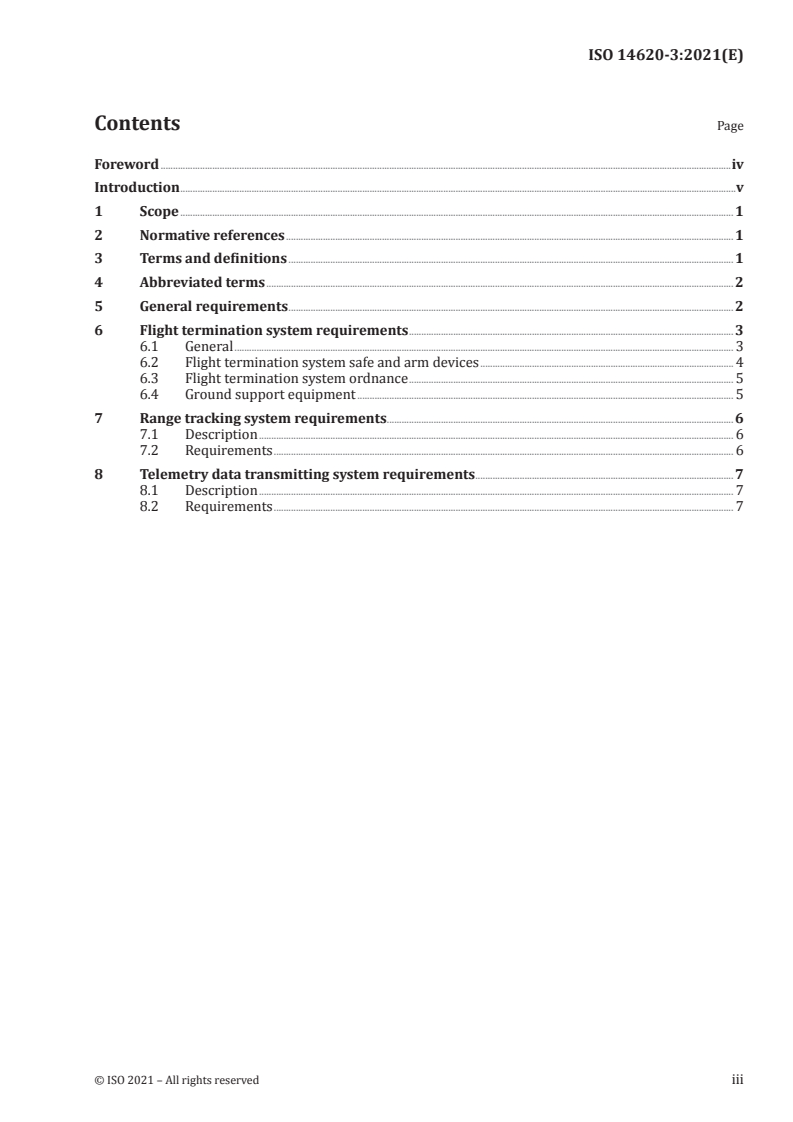
Contents Page
Foreword .iv
Introduction .v
1 Scope . 1
2 Normative references . 1
3 Terms and definitions . 1
4 Abbreviated terms . 2
5 General requirements . 2
6 Flight termination system requirements . 3
6.1 General . 3
6.2 Flight termination system safe and arm devices . 4
6.3 Flight termination system ordnance . 5
6.4 Ground support equipment . 5
7 Range tracking system requirements . 6
7.1 Description . 6
7.2 Requirements . 6
8 Telemetry data transmitting system requirements . 7
8.1 Description . 7
8.2 Requirements . 7
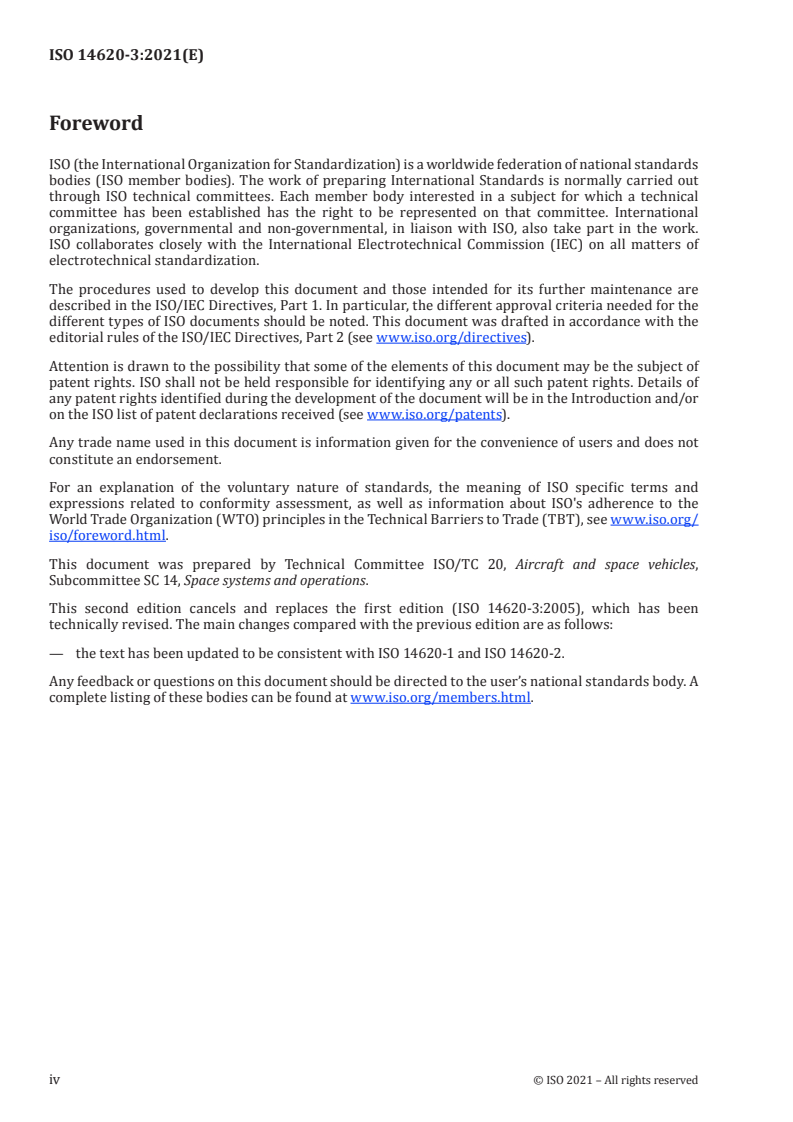
Foreword
ISO (the International Organization for Standardization) is a worldwide federation of national standards
bodies (ISO member bodies). The work of preparing International Standards is normally carried out
through ISO technical committees. Each member body interested in a subject for which a technical
committee has been established has the right to be represented on that committee. International
organizations, governmental and non-governmental, in liaison with ISO, also take part in the work.
ISO collaborates closely with the International Electrotechnical Commission (IEC) on all matters of
electrotechnical standardization.
The procedures used to develop this document and those intended for its further maintenance are
described in the ISO/IEC Directives, Part 1. In particular, the different approval criteria needed for the
different types of ISO documents should be noted. This document was drafted in accordance with the
editorial rules of the ISO/IEC Directives, Part 2 (see www .iso .org/ directives).
Attention is drawn to the possibility that some of the elements of this document may be the subject of
patent rights. ISO shall not be held responsible for identifying any or all such patent rights. Details of
any patent rights identified during the development of the document will be in the Introduction and/or
on the ISO list of patent declarations received (see www .iso .org/ patents).
Any trade name used in this document is information given for the convenience of users and does not
constitute an endorsement.
For an explanation of the voluntary nature of standards, the meaning of ISO specific terms and
expressions related to conformity assessment, as well as information about ISO's adherence to the
World Trade Organization (WTO) principles in the Technical Barriers to Trade (TBT), see www .iso .org/
iso/ foreword .html.
This document was prepared by Technical Committee ISO/TC 20, Aircraft and space vehicles,
Subcommittee SC 14, Space systems and operations.
This second edition cancels and replaces the first edition (ISO 14620-3:2005), which has been
technically revised. The main changes compared with the previous edition are as follows:
— the text has been updated to be consistent with ISO 14620-1 and ISO 14620-2.
Any feedback or questions on this document should be directed to the user’s national standards body. A
complete listing of these bodies can be found at www .iso .org/ members .html.
iv © ISO 2021 – All rights reserved
Introduction
Space launch activities can present hazards to people and damage to property and the environment.
International space treaties adopted by the United Nations impose legal liabilities on countries involved
in launching space vehicles to provide compensation for certain injuries and damages incurred as the
result of such launches.
This document affects the safety of exposed people, property and environment, as well as countries
and organizations conducting commercial or civil launch activities.
INTERNATIONAL STANDARD ISO 14620-3:2021(E)
Space systems — Safety requirements —
Part 3:
Flight safety systems
1 Scope
This document sets out the minimum requirements for flight safety systems (FSSs), including flight
termination systems (FTSs, externally controlled systems or on-board automatic systems), tracking
systems, and telemetry data transmitting systems (TDTSs) for commercial or non-commercial launch
activities of orbital or suborbital, unmanned space vehicles. The intent is to minimize the risk of injury
or damage to persons, property or the environment resulting from the launching of space vehicles.
This document can be applied by any country, by any international organization, whether
intergovernmental or not, and by any agency or operator undertaking the launching of space vehicles.
This document is intended to be applied by any person, organization, entity, operator or launch
authority participating in commercial or non-commercial launch activities of orbital, or suborbital,
unmanned space vehicles unless more restrictive requirements are imposed by the launch site country.
2 Normative references
The following documents are referred to in the text in such a way that some or all of their content
constitutes requirements of this document. For dated references, only the edition cited applies. For
undated references, the latest edition of the referenced document (including any amendments) applies.
ISO 10795, Space systems — Programme management and quality — Vocabulary
ISO 14620-1, Space systems — Safety requirements — Part 1: System safety
ISO 14620-2, Space systems — Safety requirements — Part 2: Launch site operations
3 Terms and definitions
For the purposes of this document, the terms and definitions given in ISO 10795, ISO 14620-2 and the
following apply.
ISO and IEC maintain terminological databases for use in standardization at the following addresses:
— ISO Online browsing platform: available at https:// www .iso .org/ obp
— IEC Electropedia: available at http:// www .electropedia .org/
3.1
flight safety system
combination of flight-, ground- or space-based hardware and software designed, installed and/or
operated specifically for providing flight safety
Note 1 to entry: This combination of equipment, facilities, procedures and personnel required to monitor
operations provides protection to personnel and property both foreign and domestic from any damage that can
be caused by a non-nominal flight.
Note 2 to entry: The flight safety system may include flight termination systems (3.2), telemetry data transmitting
systems (3.6) and range tracking systems (3.4).
3.2
flight termination system
explosive or other disabling or thrust-terminating equipment installed in a launch vehicle, plus any
associated ground equipment, for terminating the flight of a malfunctioning vehicle or stage
3.3
launch
initial action to place, or attempt to place, a launch vehicle and payload, if any, in a suborbital trajectory,
in Earth orbit in outer space, or otherwise in outer space
3.4
range tracking system
combination of flight-, ground- or space-based hardware and software designed, installed and/or
operated specifically for tracking a launch vehicle
3.5
safety envelope
area designated for launch (3.3) and preorbital flight that is cleared of uninvolved persons or where the
risk of injury, fatality or property damage to the public is below a designated threshold probability (3.7)
3.6
telemetry data transmitting system
combination of flight- or space-based hardware and software, designed, installed or operated for down-
linking vehicle and flight system performance and health data to flight safety operators
3.7
threshold probability
probability that loss or damage will exceed a specified level
Note 1 to entry: Threshold probability is a quantitative measure that represents the probability of occurrence
associated with unplanned events or levels of damage caused by launch-related activities.
4 Abbreviated terms
FSS flight safety system
FTS flight termination system
GNSS global navigation satellite system
GSE ground support equipment
RTS range tracking system
S&A safe and arm
SFP single failure point
TDTS telemetry data transmitting system
5 General requirements
5.1 All launch vehicles shall incorporate tracking devices or establish means of tracking that enable
real-time monitoring of vehicle position and velocity, and prediction of instantaneous impact points
throughout the launch phase where it is necessary to satisfy the safety envelope requirement.
2 © ISO 2021 – All rights reserved
5.2 All spent stages shall incorporate tracking devices or establish means of tracking that enable real-
time monitoring of vehicle position and velocity, except when pre-flight analysis establishes that the
stage separation activity will not result in an unknown or hazardous impact area or dispersion.
5.3 All launch vehicles shall incorporate TDTSs for monitoring vehicle performance data and the FTS
and tracking system status that are capable of functioning throughout the launch phase until the end of
range safety responsibility.
5.4 Any launch vehicle having a stage, motor or component capable of violating the defined safety
envelope shall be equipped with an FTS that interrupts the flight of the vehicle if it diverts from its
predicted flight trajectory and has sufficient energy to become a threat to public safety.
5.5 All the FTSs, telemetry and tracking systems of launch
...
INTERNATIONAL ISO
STANDARD 14620-3
Second edition
2021-08
Space systems — Safety
requirements —
Part 3:
Flight safety systems
Systèmes spatiaux — Exigences de sécurité —
Partie 3: Systèmes de sauvegarde en vol
Reference number
©
ISO 2021
© ISO 2021
All rights reserved. Unless otherwise specified, or required in the context of its implementation, no part of this publication may
be reproduced or utilized otherwise in any form or by any means, electronic or mechanical, including photocopying, or posting
on the internet or an intranet, without prior written permission. Permission can be requested from either ISO at the address
below or ISO’s member body in the country of the requester.
ISO copyright office
CP 401 • Ch. de Blandonnet 8
CH-1214 Vernier, Geneva
Phone: +41 22 749 01 11
Email: copyright@iso.org
Website: www.iso.org
Published in Switzerland
ii © ISO 2021 – All rights reserved
Contents Page
Foreword .iv
Introduction .v
1 Scope . 1
2 Normative references . 1
3 Terms and definitions . 1
4 Abbreviated terms . 2
5 General requirements . 2
6 Flight termination system requirements . 3
6.1 General . 3
6.2 Flight termination system safe and arm devices . 4
6.3 Flight termination system ordnance . 5
6.4 Ground support equipment . 5
7 Range tracking system requirements . 6
7.1 Description . 6
7.2 Requirements . 6
8 Telemetry data transmitting system requirements . 7
8.1 Description . 7
8.2 Requirements . 7
Foreword
ISO (the International Organization for Standardization) is a worldwide federation of national standards
bodies (ISO member bodies). The work of preparing International Standards is normally carried out
through ISO technical committees. Each member body interested in a subject for which a technical
committee has been established has the right to be represented on that committee. International
organizations, governmental and non-governmental, in liaison with ISO, also take part in the work.
ISO collaborates closely with the International Electrotechnical Commission (IEC) on all matters of
electrotechnical standardization.
The procedures used to develop this document and those intended for its further maintenance are
described in the ISO/IEC Directives, Part 1. In particular, the different approval criteria needed for the
different types of ISO documents should be noted. This document was drafted in accordance with the
editorial rules of the ISO/IEC Directives, Part 2 (see www .iso .org/ directives).
Attention is drawn to the possibility that some of the elements of this document may be the subject of
patent rights. ISO shall not be held responsible for identifying any or all such patent rights. Details of
any patent rights identified during the development of the document will be in the Introduction and/or
on the ISO list of patent declarations received (see www .iso .org/ patents).
Any trade name used in this document is information given for the convenience of users and does not
constitute an endorsement.
For an explanation of the voluntary nature of standards, the meaning of ISO specific terms and
expressions related to conformity assessment, as well as information about ISO's adherence to the
World Trade Organization (WTO) principles in the Technical Barriers to Trade (TBT), see www .iso .org/
iso/ foreword .html.
This document was prepared by Technical Committee ISO/TC 20, Aircraft and space vehicles,
Subcommittee SC 14, Space systems and operations.
This second edition cancels and replaces the first edition (ISO 14620-3:2005), which has been
technically revised. The main changes compared with the previous edition are as follows:
— the text has been updated to be consistent with ISO 14620-1 and ISO 14620-2.
Any feedback or questions on this document should be directed to the user’s national standards body. A
complete listing of these bodies can be found at www .iso .org/ members .html.
iv © ISO 2021 – All rights reserved
Introduction
Space launch activities can present hazards to people and damage to property and the environment.
International space treaties adopted by the United Nations impose legal liabilities on countries involved
in launching space vehicles to provide compensation for certain injuries and damages incurred as the
result of such launches.
This document affects the safety of exposed people, property and environment, as well as countries
and organizations conducting commercial or civil launch activities.
INTERNATIONAL STANDARD ISO 14620-3:2021(E)
Space systems — Safety requirements —
Part 3:
Flight safety systems
1 Scope
This document sets out the minimum requirements for flight safety systems (FSSs), including flight
termination systems (FTSs, externally controlled systems or on-board automatic systems), tracking
systems, and telemetry data transmitting systems (TDTSs) for commercial or non-commercial launch
activities of orbital or suborbital, unmanned space vehicles. The intent is to minimize the risk of injury
or damage to persons, property or the environment resulting from the launching of space vehicles.
This document can be applied by any country, by any international organization, whether
intergovernmental or not, and by any agency or operator undertaking the launching of space vehicles.
This document is intended to be applied by any person, organization, entity, operator or launch
authority participating in commercial or non-commercial launch activities of orbital, or suborbital,
unmanned space vehicles unless more restrictive requirements are imposed by the launch site country.
2 Normative references
The following documents are referred to in the text in such a way that some or all of their content
constitutes requirements of this document. For dated references, only the edition cited applies. For
undated references, the latest edition of the referenced document (including any amendments) applies.
ISO 10795, Space systems — Programme management and quality — Vocabulary
ISO 14620-1, Space systems — Safety requirements — Part 1: System safety
ISO 14620-2, Space systems — Safety requirements — Part 2: Launch site operations
3 Terms and definitions
For the purposes of this document, the terms and definitions given in ISO 10795, ISO 14620-2 and the
following apply.
ISO and IEC maintain terminological databases for use in standardization at the following addresses:
— ISO Online browsing platform: available at https:// www .iso .org/ obp
— IEC Electropedia: available at http:// www .electropedia .org/
3.1
flight safety system
combination of flight-, ground- or space-based hardware and software designed, installed and/or
operated specifically for providing flight safety
Note 1 to entry: This combination of equipment, facilities, procedures and personnel required to monitor
operations provides protection to personnel and property both foreign and domestic from any damage that can
be caused by a non-nominal flight.
Note 2 to entry: The flight safety system may include flight termination systems (3.2), telemetry data transmitting
systems (3.6) and range tracking systems (3.4).
3.2
flight termination system
explosive or other disabling or thrust-terminating equipment installed in a launch vehicle, plus any
associated ground equipment, for terminating the flight of a malfunctioning vehicle or stage
3.3
launch
initial action to place, or attempt to place, a launch vehicle and payload, if any, in a suborbital trajectory,
in Earth orbit in outer space, or otherwise in outer space
3.4
range tracking system
combination of flight-, ground- or space-based hardware and software designed, installed and/or
operated specifically for tracking a launch vehicle
3.5
safety envelope
area designated for launch (3.3) and preorbital flight that is cleared of uninvolved persons or where the
risk of injury, fatality or property damage to the public is below a designated threshold probability (3.7)
3.6
telemetry data transmitting system
combination of flight- or space-based hardware and software, designed, installed or operated for down-
linking vehicle and flight system performance and health data to flight safety operators
3.7
threshold probability
probability that loss or damage will exceed a specified level
Note 1 to entry: Threshold probability is a quantitative measure that represents the probability of occurrence
associated with unplanned events or levels of damage caused by launch-related activities.
4 Abbreviated terms
FSS flight safety system
FTS flight termination system
GNSS global navigation satellite system
GSE ground support equipment
RTS range tracking system
S&A safe and arm
SFP single failure point
TDTS telemetry data transmitting system
5 General requirements
5.1 All launch vehicles shall incorporate tracking devices or establish means of tracking that enable
real-time monitoring of vehicle position and velocity, and prediction of instantaneous impact points
throughout the launch phase where it is necessary to satisfy the safety envelope requirement.
2 © ISO 2021 – All rights reserved
5.2 All spent stages shall incorporate tracking devices or establish means of tracking that enable real-
time monitoring of vehicle position and velocity, except when pre-flight analysis establishes that the
stage separation activity will not result in an unknown or hazardous impact area or dispersion.
5.3 All launch vehicles shall incorporate TDTSs for monitoring vehicle performance data and the FTS
and tracking system status that are capable of functioning throughout the launch phase until the end of
range safety responsibility.
5.4 Any launch vehicle having a stage, motor or component capable of violating the defined safety
envelope shall be equipped with an FTS that interrupts the flight of the vehicle if it diverts from its
predicted flight trajectory and has sufficient energy to become a threat to public safety.
5.5 All the FTSs, telemetry and tracking systems of launch
...