


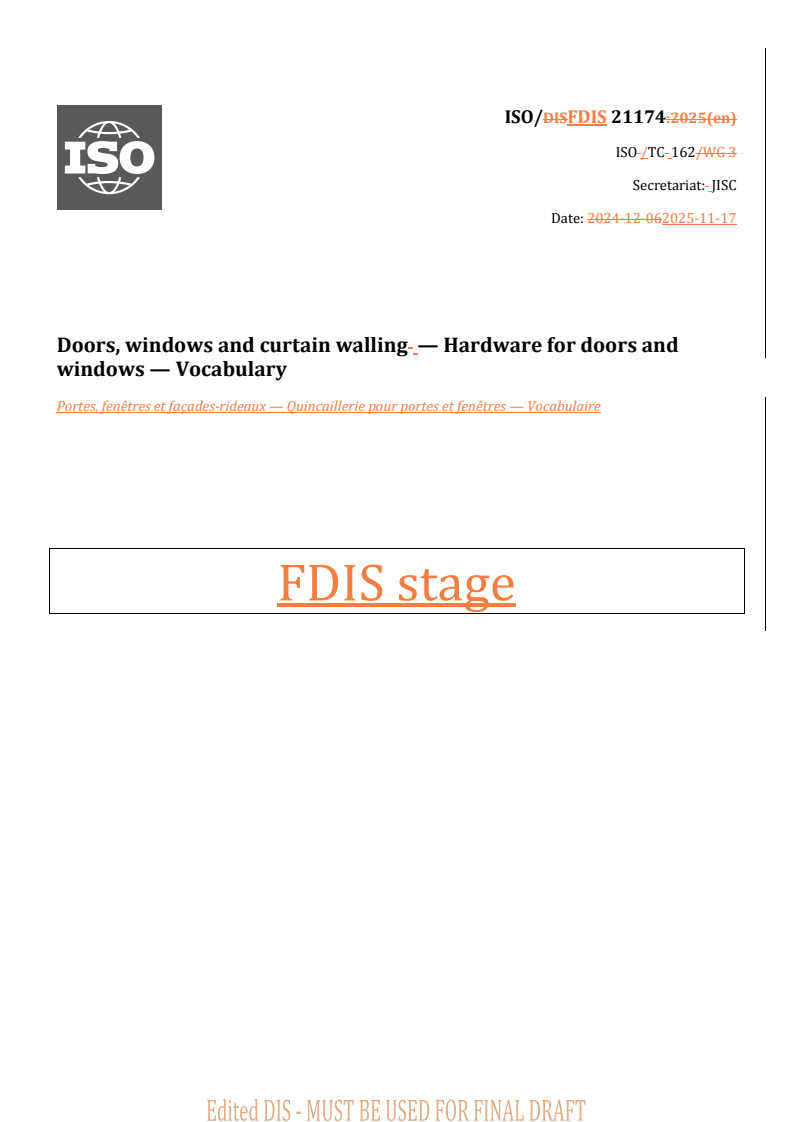
ISO/FDIS 21174
(Main)Doors, windows and curtain walling - Hardware for doors and windows - Vocabulary
Doors, windows and curtain walling - Hardware for doors and windows - Vocabulary
This ISO standard specifies the terminology for hardware used in windows and pedestrian doors. Hardware in this document refers to building hardware. This document mainly only refers to the terminology of hardware used for the connection between window sash/casement, door leaf, and their corresponding frames as well as the hardware used for operating the window sash/casement and door leaf. This document is neither for the terminology of fixing elements used as a means of connecting the hardware to the door and window sash/casement profile or frame, nor the hardware used for connection between door/ window frame and their openings, such as screws, bolts, etc. This document does not set out physical definitions related to performance requirements and associated test methods of the hardware.
Portes, fenêtres et façades-rideaux — Quincaillerie pour portes et fenêtres — Vocabulaire
General Information
- Status
- Not Published
- Technical Committee
- ISO/TC 162 - Doors, windows and curtain walling
- Drafting Committee
- ISO/TC 162 - Doors, windows and curtain walling
- Current Stage
- 5020 - FDIS ballot initiated: 2 months. Proof sent to secretariat
- Start Date
- 01-Dec-2025
- Completion Date
- 01-Dec-2025
Overview
ISO/FDIS 21174:2025 - Doors, windows and curtain walling - Hardware for doors and windows - Vocabulary establishes standardized terminology for building hardware used with windows and pedestrian doors. Published at the FDIS stage by ISO/TC 162 (secretariat JISC), the document organizes and defines terms for components that connect and operate door leaves, window sashes/casements and their frames. Illustrative figures are provided in Annex A to support the vocabulary.
Key points:
- Defines vocabulary for door hardware, window hardware, and components used in curtain walling contexts.
- Focuses on terms for connection and operating elements (hinges, handles, locks, spindles, latches, espagnolette, etc.).
- Explicitly excludes fixing elements (screws, bolts) and does not prescribe performance test methods or physical performance definitions.
Key topics
- Scope and structure: Terms are grouped into six categories-generic hardware, operating elements, fastening elements, supporting elements, hold‑open/controlling elements, and hardware for specific systems-making the vocabulary practical for manufacturers and specifiers.
- Common terms defined: examples include backset, building hardware, hinge, latch, lock, key, spindle, lever/flush/window handles, rosette, espagnolette, and limiting/restrictor devices.
- Operating elements: detailed terminology for window operators (geared handles, click mechanisms, crank handles) and door fittings (backplates, escutcheons, entrance sets).
- Illustrations: Annex A gives visual references for defined terms to reduce ambiguity in communication and documentation.
- Limitations: The standard does not cover fixing elements (screws, bolts) or provide performance/test method definitions.
Applications
ISO/FDIS 21174 is a practical reference for anyone who needs consistent, unambiguous terminology in the doors and windows supply chain:
- Manufacturers of locks, hinges, handles, espagnolette systems, and window/door fittings for consistent product descriptions and datasheets.
- Architects and specifiers writing technical specifications or procurement documents for building facades, curtain walling, and pedestrian doors.
- Test houses and certification bodies that require agreed vocabulary when referencing hardware components (note: performance standards are separate).
- Technical writers, translators, and standards committees working on harmonizing multilingual documentation and international standards.
Related resources
- ISO Online Browsing Platform (OBP) and IEC Electropedia for standard terminology databases.
- Developed under ISO/TC 162 (Doors, windows and curtain walling). For performance, testing and installation requirements, consult related ISO standards in the doors and windows series (see national bodies or ISO catalog for cross-references).
Keywords: ISO/FDIS 21174, hardware for doors and windows, building hardware vocabulary, door hardware terminology, window hardware terminology, hinges, locks, handles, spindle, espagnolette, sash, casement.
ISO/FDIS 21174 - Doors, windows and curtain walling — Hardware for doors and windows — Vocabulary Released:17. 11. 2025
REDLINE ISO/FDIS 21174 - Doors, windows and curtain walling — Hardware for doors and windows — Vocabulary Released:17. 11. 2025
Frequently Asked Questions
ISO/FDIS 21174 is a draft published by the International Organization for Standardization (ISO). Its full title is "Doors, windows and curtain walling - Hardware for doors and windows - Vocabulary". This standard covers: This ISO standard specifies the terminology for hardware used in windows and pedestrian doors. Hardware in this document refers to building hardware. This document mainly only refers to the terminology of hardware used for the connection between window sash/casement, door leaf, and their corresponding frames as well as the hardware used for operating the window sash/casement and door leaf. This document is neither for the terminology of fixing elements used as a means of connecting the hardware to the door and window sash/casement profile or frame, nor the hardware used for connection between door/ window frame and their openings, such as screws, bolts, etc. This document does not set out physical definitions related to performance requirements and associated test methods of the hardware.
This ISO standard specifies the terminology for hardware used in windows and pedestrian doors. Hardware in this document refers to building hardware. This document mainly only refers to the terminology of hardware used for the connection between window sash/casement, door leaf, and their corresponding frames as well as the hardware used for operating the window sash/casement and door leaf. This document is neither for the terminology of fixing elements used as a means of connecting the hardware to the door and window sash/casement profile or frame, nor the hardware used for connection between door/ window frame and their openings, such as screws, bolts, etc. This document does not set out physical definitions related to performance requirements and associated test methods of the hardware.
ISO/FDIS 21174 is classified under the following ICS (International Classification for Standards) categories: 01.040.91 - Construction materials and building (Vocabularies); 91.060.50 - Doors and windows. The ICS classification helps identify the subject area and facilitates finding related standards.
ISO/FDIS 21174 is available in PDF format for immediate download after purchase. The document can be added to your cart and obtained through the secure checkout process. Digital delivery ensures instant access to the complete standard document.
Standards Content (Sample)
FINAL DRAFT
International
Standard
ISO/TC 162
Doors, windows and curtain
Secretariat: JISC
walling — Hardware for doors and
Voting begins on:
windows — Vocabulary
2025-12-01
Portes, fenêtres et façades-rideaux — Quincaillerie pour portes et
Voting terminates on:
fenêtres — Vocabulaire
2026-01-26
RECIPIENTS OF THIS DRAFT ARE INVITED TO SUBMIT,
WITH THEIR COMMENTS, NOTIFICATION OF ANY
RELEVANT PATENT RIGHTS OF WHICH THEY ARE AWARE
AND TO PROVIDE SUPPOR TING DOCUMENTATION.
IN ADDITION TO THEIR EVALUATION AS
BEING ACCEPTABLE FOR INDUSTRIAL, TECHNO
LOGICAL, COMMERCIAL AND USER PURPOSES, DRAFT
INTERNATIONAL STANDARDS MAY ON OCCASION HAVE
TO BE CONSIDERED IN THE LIGHT OF THEIR POTENTIAL
TO BECOME STAN DARDS TO WHICH REFERENCE MAY BE
MADE IN NATIONAL REGULATIONS.
Reference number
FINAL DRAFT
International
Standard
ISO/TC 162
Doors, windows and curtain
Secretariat: JISC
walling — Hardware for doors and
Voting begins on:
windows — Vocabulary
Portes, fenêtres et façades-rideaux — Quincaillerie pour portes et
Voting terminates on:
fenêtres — Vocabulaire
RECIPIENTS OF THIS DRAFT ARE INVITED TO SUBMIT,
WITH THEIR COMMENTS, NOTIFICATION OF ANY
RELEVANT PATENT RIGHTS OF WHICH THEY ARE AWARE
AND TO PROVIDE SUPPOR TING DOCUMENTATION.
© ISO 2025
IN ADDITION TO THEIR EVALUATION AS
All rights reserved. Unless otherwise specified, or required in the context of its implementation, no part of this publication may
BEING ACCEPTABLE FOR INDUSTRIAL, TECHNO
LOGICAL, COMMERCIAL AND USER PURPOSES, DRAFT
be reproduced or utilized otherwise in any form or by any means, electronic or mechanical, including photocopying, or posting on
INTERNATIONAL STANDARDS MAY ON OCCASION HAVE
the internet or an intranet, without prior written permission. Permission can be requested from either ISO at the address below
TO BE CONSIDERED IN THE LIGHT OF THEIR POTENTIAL
or ISO’s member body in the country of the requester.
TO BECOME STAN DARDS TO WHICH REFERENCE MAY BE
MADE IN NATIONAL REGULATIONS.
ISO copyright office
CP 401 • Ch. de Blandonnet 8
CH-1214 Vernier, Geneva
Phone: +41 22 749 01 11
Email: copyright@iso.org
Website: www.iso.org
Published in Switzerland Reference number
ii
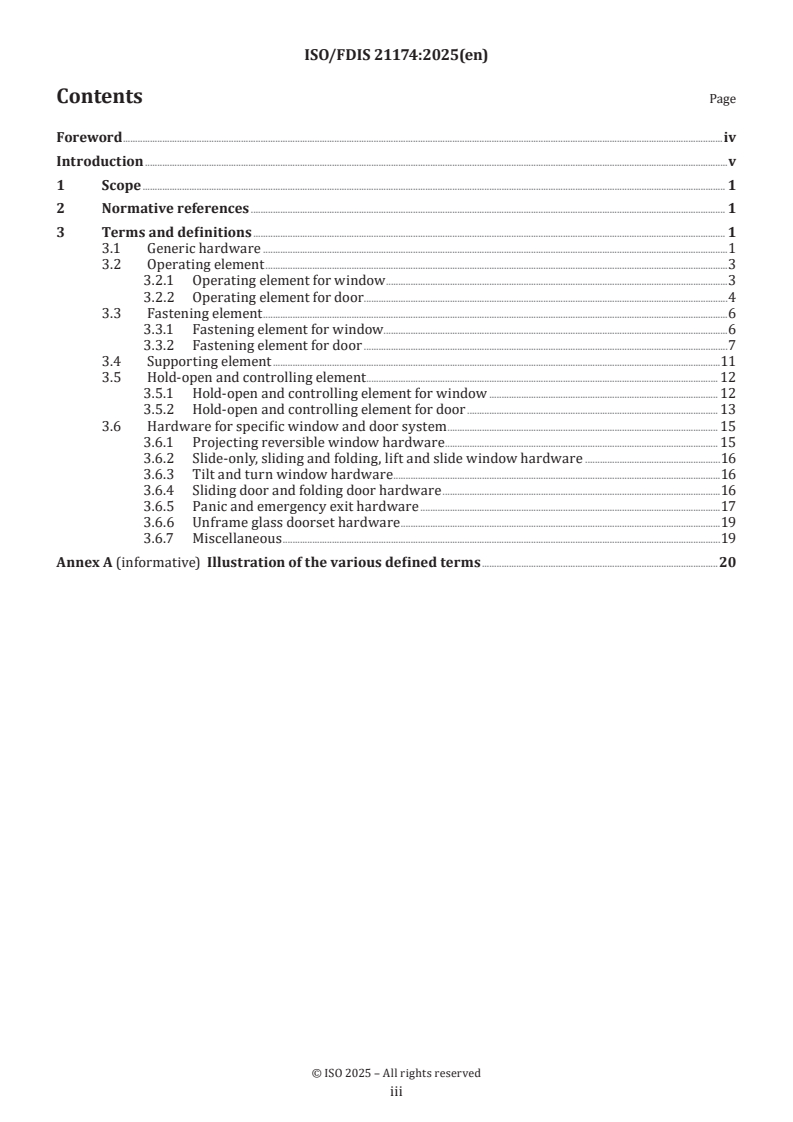
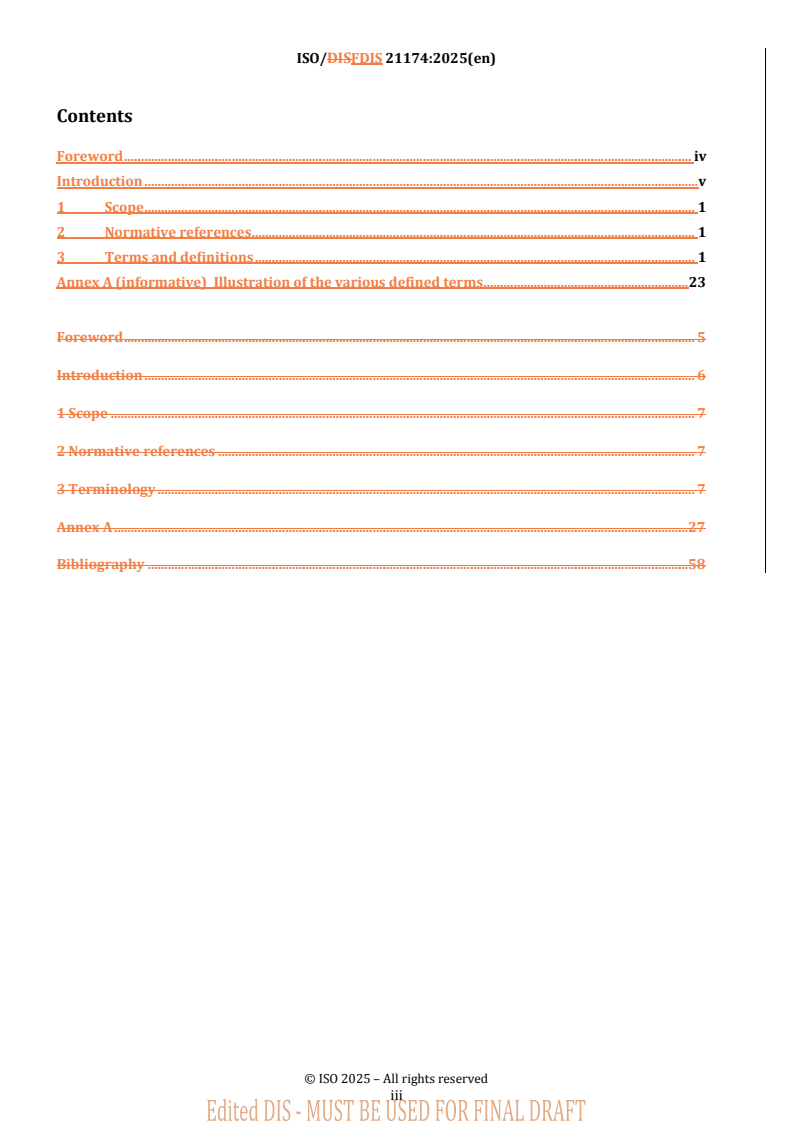
Contents Page
Foreword .iv
Introduction .v
1 Scope . 1
2 Normative references . 1
3 Terms and definitions . 1
3.1 Generic hardware .1
3.2 Operating element .3
3.2.1 Operating element for window .3
3.2.2 Operating element for door . .4
3.3 Fastening element .6
3.3.1 Fastening element for window.6
3.3.2 Fastening element for door .7
3.4 Supporting element .11
3.5 Hold-open and controlling element . 12
3.5.1 Hold-open and controlling element for window . 12
3.5.2 Hold-open and controlling element for door . 13
3.6 Hardware for specific window and door system . 15
3.6.1 Projecting reversible window hardware . 15
3.6.2 Slide-only, sliding and folding, lift and slide window hardware .16
3.6.3 Tilt and turn window hardware .16
3.6.4 Sliding door and folding door hardware .16
3.6.5 Panic and emergency exit hardware .17
3.6.6 Unframe glass doorset hardware .19
3.6.7 Miscellaneous .19
Annex A (informative) Illustration of the various defined terms .20
iii
Foreword
ISO (the International Organization for Standardization) is a worldwide federation of national standards
bodies (ISO member bodies). The work of preparing International Standards is normally carried out through
ISO technical committees. Each member body interested in a subject for which a technical committee
has been established has the right to be represented on that committee. International organizations,
governmental and non-governmental, in liaison with ISO, also take part in the work. ISO collaborates closely
with the International Electrotechnical Commission (IEC) on all matters of electrotechnical standardization.
The procedures used to develop this document and those intended for its further maintenance are described
in the ISO/IEC Directives, Part 1. In particular, the different approval criteria needed for the different types
of ISO document should be noted. This document was drafted in accordance with the editorial rules of the
ISO/IEC Directives, Part 2 (see www.iso.org/directives).
ISO draws attention to the possibility that the implementation of this document may involve the use of (a)
patent(s). ISO takes no position concerning the evidence, validity or applicability of any claimed patent
rights in respect thereof. As of the date of publication of this document, ISO had not received notice of (a)
patent(s) which may be required to implement this document. However, implementers are cautioned that
this may not represent the latest information, which may be obtained from the patent database available at
www.iso.org/patents. ISO shall not be held responsible for identifying any or all such patent rights.
Any trade name used in this document is information given for the convenience of users and does not
constitute an endorsement.
For an explanation of the voluntary nature of standards, the meaning of ISO specific terms and expressions
related to conformity assessment, as well as information about ISO's adherence to the World Trade
Organization (WTO) principles in the Technical Barriers to Trade (TBT), see www.iso.org/iso/foreword.html.
This document was prepared by Technical Committee ISO/TC 162, Doors, windows and curtain walling.
Any feedback or questions on this document should be directed to the user’s national standards body. A
complete listing of these bodies can be found at www.iso.org/members.html.
iv
Introduction
For ease of use, terms and definitions are divided into 6 categories as follows:
— subclause 3.1 generic hardware - refers to hardware products or components or expressions commonly
used in the window and door market or industry;
— subclause 3.2 operating element - refers to components, operated by hand or electronic driving, used
to open, close and/or lock door leaf or window casement/sash directly or by driving the transmission
mechanism to do so, e.g. fixed handle, lever handle, knob;
— subclause 3.3 fastening element - refers to components that prevent the relative displacement between the
door leaf or window casement/sash and the surrounding frame in a closed position, e.g. espagnolette, lock;
— subclause 3.4 supporting element - refers to component that connects door leaf or window casement/
sash to their surrounding frame and bears the door leaf or window casement/sash, e.g. hinge, roller.
Usually, they will be designed to bear the dead-load required for the acceptable operation of the door leaf
or window casement/ sash, and
— subclause 3.5 hold-open and controlling element, - refers to components that can limit the opening angle
of door leaf and window casement/sash relative to their frame, e.g. limiting restrictor, and/or allow
the door leaf and window casement/sash to be retained in a specific position, e.g. safety restrictor or
hold open device, and/or return the door leaf and window casement/sash to a closed position e.g. door
closing device, and/or drive the door leaf and window casement/sash open electronically e.g. swing door
operator;
— subclause 3.6 hardware for specific window and door systems - refers to those used particularly in/on
certain window and door systems.
Illustrative figures for the terms are given in the Annex A.
v
FINAL DRAFT International Standard ISO/FDIS 21174:2025(en)
Doors, windows and curtain walling — Hardware for doors
and windows — Vocabulary
1 Scope
This document defines terms relating to hardware used in windows and pedestrian doors.
This document mainly defines terms for hardware used for the connection between window sash/casement,
door leaf and their corresponding frames, as well as the hardware used for operating the window sash/
casement and door leaf.
This document does not define terms for fixing elements used as a means of connecting the hardware to the
door and window sash/casement profile or frame, nor for hardware used for connection between the door/
window frame and their openings, such as screws, bolts, etc.
This document does not give physical definitions related to performance requirements and associated test
methods of the hardware.
2 Normative references
There are no normative references in this document.
3 Terms and definitions
ISO and IEC maintain terminology databases for use in standardization at the following addresses:
— ISO Online browsing platform: available at https:// www .iso .org/ obp
— IEC Electropedia: available at https:// www .electropedia .org/
3.1 Generic hardware
3.1.1
backset
horizontal distance measured from the outside face of the lock to the centreline of the hole of the spindle
(3.1.15)
Note 1 to entry: See Figure A.10 and Figure A.16
3.1.2
building hardware
component of doors, windows, hatches and similar construction products to provide them with a specified
function, mainly opening and closing, locking, fixation and sealing
3.1.3
door fitting
items of building hardware (3.1.2) to be fitted to a door
3.1.4
fastener
component used to open, close, and secure a door, window, shutter, or gate
3.1.5
fastening
fixing of one component of a building element to another
3.1.6
fittings
small components, other than fasteners (3.1.4), fixed to a primary component for a specific purpose
3.1.7
handle
operating device, where applicable with locking mechanism, with which the window/door hardware can be
mechanically operated
3.1.7.1
flush handle
recessed handle (3.1.7) that sits flush with the surface of the sash or door leaf
Note 1 to entry: Also known as recessed pulls or flush pulls (3.2.2.10).
3.1.7.2
window handle
operating mechanism with which the window hardware can be mechanically operated to open and close
the window
Note 1 to entry: See Figure A.1, Figure A.2 and Figure A.3.
3.1.8
hinge
device used for connecting the door/window frame and its leaf/casement, supporting and rotating the door
leaf and window casement on a fixed axis for opening
Note 1 to entry: See Figure A.20, Figure A.21, Figure A.22, Figure A.23, Figure A.24, Figure A.25, Figure A.26,
Figure A.27, Figure A.28, Figure A.30, and Figure A.44.
3.1.9
latch
self-engaging fastener (3.1.4) which restrains a movable component (e.g. door leaf) in a closed position and
which can be released
Note 1 to entry: See Figure A.15.
3.1.10
lever handle
rotatable operating element designed as a lever which engages a spindle (3.1.15) passing through a window
or a door
Note 1 to entry: See Figure A.1, Figure A.2, Figure A.3, Figure A.4, and Figure A.5.
3.1.11
lock
fastener (3.1.4) which secures a movable component in a closed position within a door frame and which is
operated by a key (3.1.12) or other device
Note 1 to entry: See Figure A.14, Figure A.15, Figure A.16 and Figure A.18.
3.1.12
key
device that is removable and portable and is used to operate the lock (3.1.11)
Note 1 to entry: See Figure A.1, Figure A.2, Figure A.3, Figure A.14, Figure A.15, and Figure A.16.
3.1.13
window fittings
window furniture
items of building hardware (3.1.2) to be fitted to a window
3.1.14
safety device
component for doors and windows which is intended to prevent injuries and protect users of a building
3.1.15
spindle
connecting element to transfer the torque from the handle (3.1.7) to the rotatable part of lock (3.1.11)
Note 1 to entry: See Figure A.2, Figure A.4 and Figure A.6.
Note 2 to entry: Square spindles are very common, but other shaped spindles are also permissible.
3.2 Operating element
3.2.1 Operating element for window
3.2.1.1
connector
fork
connecting element to transfer the torque from the geared-handle (3.2.1.3) to the slideable part of the
window espagnolette (3.3.1.2)
Note 1 to entry: See Figure A.1.
Note 2 to entry: Otherwise known as engaging piece, tongue or slider
3.2.1.2
click mechanism
assembly of components to position the handle (3.1.7) in the defined click positions with the tilt& turn
hardware’s operation positions
Note 1 to entry: See Figure A.1 and Figure A.2.
3.2.1.3
geared-handle
operating mechanism with which the window hardware can be mechanically operated and connector
(3.2.1.1) that serves as the connecting element
Note 1 to entry: See Figure A.1.
3.2.1.4
key-operated locking mechanism
assembly of components for securing the hardware's set position, enabling the further operation only with
appropriate means (e.g. a key (3.1.12))
Note 1 to entry: See Figure A.1, Figure A.2 and Figure A.3.
3.2.1.5
key-operated lockable hardware
component for securing the hardware's set position, enabling the further operation only with appropriate
means (e.g. a key (3.1.12))
3.2.1.6
non-key-operated locking mechanism
assembly of components for securing the handle's (3.1.7) set position, enabling the further operation without
appropriate means
Note 1 to entry: Examples of non-key-operated locking mechanisms include designs with deactivation of the locking
mechanism via "push-to-open", button- or thumb-operation.
3.2.1.7
non-key-operated locking hardware
component, which can be locked and/or unlocked without the use of a key (3.1.12)
Note 1 to entry: An example of non-key-operated locking hardware is a PTO (push to open) window handle (3.1.7.2).
3.2.1.8
non-lockable hardware
component for securing the hardware's set position without appropriate means (e.g. a key (3.1.12))
3.2.1.9
rosette
screw-fixed base body located on the window profile that serves as a rotatable window handle
(3.1.7.2) mounting
Note 1 to entry: See Figure A.1, Figure A.2 and Figure A.3.
3.2.1.10
window crank handle
component used to manually open the casement by rotating the handle (3.1.7)
3.2.1.11
window fastener handle
operating device where applicable with releasable and/ or locking mechanism, to hold the window in a
closed position
Note 1 to entry: See Figure A.3.
Note 2 to entry: Also known as Cockspur handles.
3.2.2 Operating element for door
3.2.2.1
backplate
element generally, but not essentially, rectangular in plan whose purpose is, firstly, functional, providing a
bearing for the rotation of a door lever handle (3.1.10) or knob (3.2.2.4) and the means of attachment to the
door; and, secondly, decorative, working as a trim plate (3.2.2.17) to cover holes provided in the door for the
passage of spindles (3.1.15), keys (3.1.12) or lock cylinders (3.3.2.7)
Note 1 to entry: See Figure A.4 and Figure A.5.
3.2.2.2
baseplate
element generally, but not essentially, rectangular in plan whose purpose is, firstly, functional, providing a
bearing for the rotation of a door lever handle (3.1.10) or knob (3.2.2.4) and the means of attachment to the
door; and secondly, decorative, working as a trim plate (3.2.2.17) to cover holes provided in the door for the
passage of spindles (3.1.15), keys (3.1.12) or lock cylinders (3.3.2.7)
Note 1 to entry: See Figure A.4.
3.2.2.3
bow handle
pull for use on heavy doors
Note 1 to entry: See Figure A.7.
3.2.2.4
door knob
fixed or rotatable operating elements wherein:
a) the rotatable element will usually engage a spindle (3.1.15) passing through the door and operate the
latch mechanism when rotated, so that the latch bolt (3.3.2.19) is withdrawn to unlatch the door; and
b) the fixed element is used to pull the door open or push the door closed
Note 1 to entry: See Figure A.6 and Figure A.15.
3.2.2.5
emergency release
facility provided on the external plate (3.2.2.8) that enables the door to be opened in case of emergency
Note 1 to entry: See Figure A.5.
3.2.2.6
entrance set
set with a lever handle (3.1.10) on the one side of the door and e.g. a door knob (3.2.2.4) or bar on the other
3.2.2.7
escutcheon
surround with a shaped hole to accommodate a key (3.1.12) or a lock cylinder (3.3.2.7), with or without a
pivoted cover plate intended primarily to protect the door leaf from abrasion caused by keys (3.1.12)
Note 1 to entry: See Figure A.6.
3.2.2.8
external plate
backplate (3.2.2.1) or rose (3.2.2.18) that is fitted on the external face of a door
Note 1 to entry: See Figure A.4, Figure A.5 and Figure A.6.
3.2.2.9
fixed handle
handle (3.1.7) which is fixed against rotation and is used to pull the door to the open or closed position
3.2.2.10
flush pull
fitting (3.1.6) providing a recessed finger hold for sideways or pulling movement
3.2.2.11
half set
single lever handle (3.1.10) or knob (3.2.2.4) attached to a plate or rose (3.2.2.18) which enables operation of
the lock (3.1.11) or latch (3.1.9) from one side of the door only
3.2.2.12
indicator
device that is visible from the exterior of the door to indicate whether the door is locked or unlocked
3.2.2.13
internal plate
backplate (3.2.2.1) or rose (3.2.2.18) that is fitted on the internal face of a door
Note 1 to entry: See Figure A.5.
3.2.2.14
latchplate
backplate (3.2.2.1) adapted for use with a latch (3.1.9) and having no keyhole or cylinder aperture
3.2.2.15
lockplate
backplate (3.2.2.1) having an aperture for use with a cylinder (3.3.2.7) or lever key (3.1.12)
Note 1 to entry: See Figure A.4.
3.2.2.16
pull handle
fixed handle (3.2.2.9) mounted on a door leaf providing a means to open and close a door leaf by hand
Note 1 to entry: See Figure A.8.
3.2.2.17
trim plate
component of an assembly of two parts that fit together to form a backplate (3.2.2.1) or rose (3.2.2.18) which
is fastened to baseplate (3.2.2.2) as a decorative cover
Note 1 to entry: See Figure A.4 and Figure A.6.
3.2.2.18
rose
element generally circular, but which may have equi-axial or approximately equi-axial shapes such as square
or octagonal, that otherwise has the same features as a backplate (3.2.2.1)
Note 1 to entry: See Figure A.6.
3.2.2.19
set of door furniture
two lever handles (3.1.10) or knobs (3.2.2.4) with two lockplates (3.2.2.15) or latchplates (3.2.2.14) (or,
alternatively, roses (3.2.2.18) and escutcheons (3.2.2.7)), complete with a spindle (3.1.15) and fastening
elements to operate the latch (3.1.9)
Note 1 to entry: See Figure A.4, . Figure A.5 and Figure A.6
3.2.2.20
thumb turn
small T-handle, knob (3.2.2.4) or other handle (3.1.7) fitted on the internal plate (3.2.2.13) of a set of bathroom
lock furniture (3.2.2.19) that operates a lock deadbolt (3.3.2.11) to provide privacy rather than high security
Note 1 to entry: See Figure A.5.
3.3 Fastening element
3.3.1 Fastening element for window
3.3.1.1
cam keeper
cam keep
component to accept the cam, e.g. mushroom cam (3.3.1.4) or roller cam (3.3.1.5), from the window or door
locking mechanism
Note 1 to entry: See Figure A.9.
3.3.1.2
espagnolette
locking mechanism for windows and door height windows that usually have a maximum handle
movement of 180°
Note 1 to entry: See Figure A.10.
3.3.1.3
finger catches
locking device for windows that can be operated by a finger
Note 1 to entry: See Figure A.11.
3.3.1.4
mushroom cam
component attached to a moving shaft which is mushroom shaped and which engages in the cam keeper
(3.3.1.1) to enable the door/window to be closed
Note 1 to entry: See Figure A.9.
3.3.1.5
roller cam
component attached to a moving shaft which is cylindrical shaped and which engages in the cam keeper
(3.3.1.1) to enable the door/window to be closed
Note 1 to entry: See Figure A.9.
3.3.1.6
sash fastener
device to secure, in the closed position, the sashes of a double or single hung vertically sliding window and
the sashes of a horizontally sliding window
Note 1 to entry: See Figure A.12.
3.3.1.7
roller catch
device with one or more rolling parts which help a door leaf/ window casement/sash to be kept in the closed
position
Note 1 to entry: See Figure A.13.
3.3.2 Fastening element for door
3.3.2.1
anti-separation point
locking point (3.3.2.25) designed to prevent the separation of a door leaf from its frame or adjacent door leaf
in the plane of the door
Note 1 to entry: See Figure A.14.
Note 2 to entry: Examples of anti-separation points are hook and mushroom types.
3.3.2.2
bored latch set
fastener (3.1.4) that comprises an integral assembly of door furniture with a tubular latch (3.3.2.39)
Note 1 to entry: See Figure A.15.
3.3.2.3
bored lock set
fastener (3.1.4) that comprises an integral assembly of door furniture with a tubular lock (3.1.11)
Note 1 to entry: See Figure A.15.
3.3.2.4
bolt
device for securing, or helping to secure, a door or window in the closed position, comprising a suitably
guided moving member, operable from the protected side only by hand or foot, either directly using a knob
(3.2.2.4) or slide, or indirectly using a lever/handle (3.1.7) or rack and pinion mechanism
Note 1 to entry: See Figure A.14, Figure A.16, Figure A.45, Figure A.46 and Figure A.47.
3.3.2.5
cam
component of the cylinder (3.3.2.7) to provide the movement to effect locking
Note 1 to entry: See Figure A.17.
3.3.2.6
clenching point
arrangement of components to draw together a door and its frame in the door closing direction to reduce
distortion of the door and/or compress seal (may also be a locking point (3.3.2.25) and/or anti-separation
point (3.3.2.1))
Note 1 to entry: See Figure A.14.
3.3.2.7
cylinder
device, usually distinct from its associated lock (3.1.11) or latch (3.1.9), operated by the key (3.1.12)
Note 1 to entry: See Figure A.14 and Figure A.16.
3.3.2.8
construction key
device which is temporarily used instead of a cylinder (3.3.2.7) during the construction phase of a project
3.3.2.9
cylinder core/plug
cylindrical portion of the cylinder (3.3.2.7), which rotates when the correct key (3.1.12) is used
Note 1 to entry: See Figure A.17.
3.3.2.10
cylinder lock
lock (3.1.11) in which the lock mechanism (3.3.2.23) is operated by one or more cylinders (3.3.2.7)
Note 1 to entry: See Figure A.14 and Figure A.16.
3.3.2.11
deadbolt
movable part of a lock (3.1.11) that usually engages a locking plate (3.3.2.26) and withdraws into a lock case
(3.3.2.23) that is operated at least in one direction by a key (3.1.12), handle (3.1.7) or thumb turn (3.2.2.20)
Note 1 to entry: See Figure A.16.
3.3.2.12
deadlocking
action of moving a bolt (3.3.2.4) to a thrown position where pushing back of the bolt (3.3.2.4) is positively
prevented
3.3.2.13
detaining element
component which is moved by a key (3.1.12) into a pre-determined position to allow the bolt (3.3.2.4) to be
operated
3.3.2.14
differ
variation between lock mechanisms (3.3.2.23) of similar design due to differences in the lift and/or position
of the detaining elements (3.3.2.13)
3.3.2.15
flush bolt
lever or sliding action bolt (3.3.2.4) which usually secures the inactive leaf when mounted does not project
above the surface of the leaf
3.3.2.16
follower
part of a lock (3.1.11) that operates latch bolt (3.3.2.19) and/or deadbolt(s) (3.3.2.11) when turned by a spindle
(3.1.15)
Note 1 to entry: See Figure A.14 and Figure A.16.
3.3.2.17
forend
part of a case through which the lock (3.1.11) is fixed to the door leaf and through which the latch bolt
(3.3.2.19) and/or deadbolt (3.3.2.11) pass
Note 1 to entry: See Figure A.14 and Figure A.16.
3.3.2.18
hook latch bolt
hook-shaped bolt (3.3.2.4) grappling the locking plate (3.3.2.26) to secure a door leaf
Note 1 to entry: See Figure A.14.
3.3.2.19
latch bolt
spring-loaded movable part of a lock (3.1.11) that usually engages a component fixed to a frame, and
withdraws into a lock case (3.3.2.23) that automatically engages a locking plate (3.3.2.26) to keep the door
leaf in its closed position
Note 1 to entry: See Figure A.14, Figure A.16 and Figure A.47.
3.3.2.20
lever lock
lock (3.1.11) with integral differs (3.3.2.14) operated by a key (3.1.12)
3.3.2.21
lock case
part of a lock (3.1.11) in which the lock mechanism (3.3.2.23) is housed
Note 1 to entry: See Figure A.14 and Figure A.16.
3.3.2.22
lockable follo
...
ISO/DISFDIS 21174:2025(en)
ISO /TC 162/WG 3
Secretariat: JISC
Date: 2024-12-062025-11-17
Doors, windows and curtain walling — Hardware for doors and
windows — Vocabulary
Portes, fenêtres et façades-rideaux — Quincaillerie pour portes et fenêtres — Vocabulaire
FDIS stage
All rights reserved. Unless otherwise specified, or required in the context of its implementation, no part of this publication
may be reproduced or utilized otherwise in any form or by any means, electronic or mechanical, including photocopying,
or posting on the internet or an intranet, without prior written permission. Permission can be requested from either ISO
at the address below or ISO'sISO’s member body in the country of the requester.
ISO copyright office
Case postale 56 • CP 401 • Ch. de Blandonnet 8
CH-12111214 Vernier, Geneva 20
Tel.Phone: + 41 22 749 01 11
Fax + 41 22 749 09 47
E-mail: copyright@iso.org
Web www.iso.org
Website: www.iso.org
Published in Switzerland.
ii
ISO/DISFDIS 21174:2025(en)
Contents
Foreword . iv
Introduction . v
1 Scope . 1
2 Normative references . 1
3 Terms and definitions . 1
Annex A (informative) Illustration of the various defined terms . 23
Foreword . 5
Introduction . 6
1 Scope . 7
2 Normative references . 7
3 Terminology . 7
Annex A .27
Bibliography .58
iii
Foreword
ISO (the International Organization for Standardization) is a worldwide federation of national standards
bodies (ISO member bodies). The work of preparing International Standards is normally carried out through
ISO technical committees. Each member body interested in a subject for which a technical committee has been
established has the right to be represented on that committee. International organizations, governmental and
non-governmental, in liaison with ISO, also take part in the work. ISO collaborates closely with the
International Electrotechnical Commission (IEC) on all matters of electrotechnical standardization.
The procedures used to develop this document and those intended for its further maintenance are described
in the ISO/IEC Directives, Part 1. In particular, the different approval criteria needed for the different types of
ISO document should be noted. This document was drafted in accordance with the editorial rules of the
ISO/IEC Directives, Part 2 (see www.iso.org/directiveswww.iso.org/directives).
ISO draws attention to the possibility that the implementation of this document may involve the use of (a)
patent(s). ISO takes no position concerning the evidence, validity or applicability of any claimed patent rights
in respect thereof. As of the date of publication of this document, ISO had not received notice of (a) patent(s)
which may be required to implement this document. However, implementers are cautioned that this may not
represent the latest information, which may be obtained from the patent database available at
www.iso.org/patents.www.iso.org/patents. ISO shall not be held responsible for identifying any or all such
patent rights.
Any trade name used in this document is information given for the convenience of users and does not
constitute an endorsement.
For an explanation of the voluntary nature of standards, the meaning of ISO specific terms and expressions
related to conformity assessment, as well as information about ISO's adherence to the World Trade
Organization (WTO) principles in the Technical Barriers to Trade (TBT), see
www.iso.org/iso/foreword.htmlwww.iso.org/iso/foreword.html.
This document was prepared by Technical Committee ISO/TC 162, Doors, windows and curtain walling.
Any feedback or questions on this document should be directed to the user’s national standards body. A
complete listing of these bodies can be found at www.iso.org/members.htmlwww.iso.org/members.html.
iv
ISO/DISFDIS 21174:2025(en)
Introduction
To facilitate usabilityFor ease of this document, use, terms and definitions are divided into 6 categories as
follows:
— — subclause 3.10 generic hardware - refers to hardware products or components or expressions
commonly used in the window and door market or industry;
— — subclause 3.23.2 operating element - refers to components, operated by hand or electronic driving,
used to open, close and/or lock door leaf or window casement/sash directly or by driving the transmission
mechanism to do so, e.g. fixed handle, lever handle, knob;
— — subclause 3.33.3 fastening element - refers to components that prevent the relative displacement
between the door leaf or window casement/sash and the surrounding frame in a closed position, e.g.
espagnolette, lock;
— — subclause 3.43.4 supporting element - refers to component that connects door leaf or window
casement/ sash to their surrounding frame and bears the door leaf or window casement/sash, e.g. hinge,
roller. Usually, they will be designed to bear the dead-load required for the acceptable operation of the
door leaf or window casement/ sash, and
— — subclause 3.53.5 hold-open and controlling element, - refers to components that can limit the opening
angle of door leaf and window casement/sash relative to their frame, e.g. limiting restrictor, and/or allow
the door leaf and window casement/sash to be retained in a specific position, e.g. safety restrictor or hold
open device, and/or return the door leaf and window casement/sash to a closed position e.g. door closing
device, and/or drive the door leaf and window casement/sash open electronically e.g. swing door
operator;
— — subclause 3.63.6 hardware for specific window and door systems - refers to those used particularly
in/on certain window and door systems.
Illustrative figures for the terms are given in the Annex A.0.
v
DRAFT International Standard ISO/DIS 21174:2025(en)
Doors, windows and curtain walling — Hardware for doors and
windows — Vocabulary
1 Scope
This document defines terms relating to hardware used in windows and pedestrian doors.
This document mainly defines terms for hardware used for the connection between window sash/casement,
door leaf and their corresponding frames, as well as the hardware used for operating the window
sash/casement and door leaf.
This document does not define terms for fixing elements used as a means of connecting the hardware to the
door and window sash/casement profile or frame, nor for hardware used for connection between the
door/window frame and their openings, such as screws, bolts, etc.
This document does not give physical definitions related to performance requirements and associated test
methods of the hardware.
2 Normative references
There are no normative references in this document.
3 Terms and definitions
ISO and IEC maintain terminology databases for use in standardization at the following addresses:
— — ISO Online browsing platform: available at https://www.iso.org/obphttps://www.iso.org/obp
— — IEC Electropedia: available at https://www.electropedia.org/https://www.electropedia.org/
3.1 Generic hardware
3.1.1 3.1.1
backset
horizontal distance measured from the outside face of the lock to the centreline of the hole of the spindle
(3.1.15) (Error! Reference source not found.)
Note 1 to entry: See Figure A.10 and Figure A.16
3.1.2Note 1 to entry: See 0 and 0
3.1.2
building hardware
component of doors, windows, hatches and similar construction products to provide them with a specified
function, mainly opening and closing, locking, fixation and sealing
3.1.3 3.1.3
door fitting
items of building hardware (3.1.2)(Error! Reference source not found.) to be fitted to a door
3.1.4 3.1.4
fastener
component used to open, close, and secure a door, window, shutter, or gate
3.1.5 3.1.5
fastening
fixing of one component of a building element to an another
3.1.6 3.1.6
fittings
small components, other than fasteners (3.1.4),(Error! Reference source not found.), fixed to a primary
component for a specific purpose
3.1.7 3.1.7
handle
operating device, where applicable with locking mechanism, with which the window/door hardware can be
mechanically operated3.1.7.1operated
3.1.7.1
flush handle
recessed handle (3.1.7)(Error! Reference source not found.) that sits flush with the surface of the sash or
door leaf
Note 1 to entry: Also known as recessed pulls or flush pulls (3.2.2.10).(Error! Reference source not found.).
3.1.7.13.1.7.2 3.1.7.2
window handle
operating mechanism with which the window hardware can be mechanically operated to open and close the
window
Note 1 to entry: See Figure A.1, Figure A.2 and Figure A.3.
3.1.8Note 1 to entry: See 0, 0 and 0.
3.1.8
hinge
device used for connecting the door/window frame and its leaf/casement, supporting and rotating the door
leaf and window casement on a fixed axis for opening
Note 1 to entry: See Figure A.20, Figure A.21, Figure A.22, Figure A.23, Figure A.24, Figure A.25, Figure A.26, Figure A.27,
Figure A.28, Figure A.30, and Figure A.44.
3.1.9
Note 1 to entry: See 0, 0, 0, 0, 0, 0, 0, 0, 0, 0, and 0.
3.1.9
latch
self-engaging fastener (3.1.4)(Error! Reference source not found.) which restrains a movable component
(e.g. door leaf) in a closed position and which can be released
Note 1 to entry: See Figure A.15.0.
ISO/DISFDIS 21174:2025(en)
3.1.93.1.10 3.1.10
lever handle
rotatable operating element designed as a lever which engages a spindle (3.1.15)(Error! Reference source
not found.) passing through a window or a door
Note 1 to entry: See Figure A.1, Figure A.2, Figure A.3, Figure A.4, and Figure A.5.
3.1.11Note 1 to entry: See 0, 0, 0, 0, and 0.
3.1.103.1.11
lock
fastener (3.1.4)fastener (Error! Reference source not found.) which secures a movable component in a
closed position within a door frame and which is operated by a key (3.1.12)(Error! Reference source not
found.) or other device
Note 1 to entry: See Figure A.14, Figure A.15, Figure A.16 and Figure A.18.
3.1.12Note 1 to entry: See 0, 0, 0 and 0.
3.1.113.1.12
key
device that is removable and portable and is used to operate the lock (3.1.11)(Error! Reference source not
found.)
Note 1 to entry: See Figure A.1, Figure A.2, Figure A.3, Figure A.14, Figure A.15, and Figure A.16.
3.1.13
Note 1 to entry: See 0, 0, 0, 0, 0, and 0.
3.1.13
window fittings
window furniture
items of building hardware (3.1.2)(Error! Reference source not found.) to be fitted to a window
3.1.123.1.14 3.1.14
safety device
component for doors and windows which is intended to prevent injuries and protect users of a building
3.1.133.1.15 3.1.15
spindle
connecting element to transfer the torque from the handle (3.1.7)(Error! Reference source not found.) to
the rotatable part of lock (3.1.11) (Error! Reference source not found.)
Note 1 to entry: See Figure A.2, Figure A.4 and Figure A.6.
Note 1 to entry: See 0, 0 and 0.
Note 2 to entry: Square spindles are very common, but other shaped spindles are also permissible.
3.2 Operating element
3.2.1 Operating element for window
3.2.1.1 3.2.1.1
connector
fork
connecting element to transfer the torque from the geared-handle (3.2.1.3)(Error! Reference source not
found.) to the slideable part of the window espagnolette (3.3.1.2) (Error! Reference source not found.)
Note 1 to entry: See Figure A.1.0.
Note 2 to entry: Otherwise known as engaging piece, tongue or slider
3.2.1.2 3.2.1.2
click mechanism
assembly of components to position the handle (3.1.7)(Error! Reference source not found.) in the defined
click positions with the tilt& turn hardware’s operation positions
Note 1 to entry: See Figure A.1 and Figure A.2.
3.2.1.3Note 1 to entry: See 0 and 0.
3.2.1.3
geared-handle
operating mechanism with which the window hardware can be mechanically operated and connector
(3.2.1.1)(Error! Reference source not found.) that serves as the connecting element
Note 1 to entry: See Figure A.1.0.
3.2.1.4 3.2.1.4
key-operated locking mechanism
assembly of components for securing the hardware's set position, enabling the further operation only with
appropriate means (e.g. a key (3.1.12)) a key (Error! Reference source not found.))
Note 1 to entry: See Figure A.1, Figure A.2 and Figure A.3.
3.2.1.5Note 1 to entry: See 0, 0 and 0.
3.2.1.5
key-operated lockable hardware
component for securing the hardware's set position, enabling the further operation only with appropriate
means (e.g. a key (3.1.12))a key (Error! Reference source not found.))
3.2.1.6 3.2.1.6
non-key-operated locking mechanism
assembly of components for securing the handle's (3.1.7)(Error! Reference source not found.) set position,
enabling the further operation without appropriate means
Note 1 to entry: Some examples Examples of non-key-operated locking mechanisms areinclude designs with the
deactivation of the locking mechanism by ""via "push-to-open"",", button- or thumb-operation".
3.2.1.7 3.2.1.7
non-key-operated locking hardware
component, which can be locked and/or unlocked without the use of a key (3.1.12)(Error! Reference source
not found.)
ISO/DISFDIS 21174:2025(en)
Note 1 to entry: An example of non-key-operated locking hardware is a PTO (push to open) window handle
(3.1.7.2).(Error! Reference source not found.).
3.2.1.8 3.2.1.8
non-lockable hardware
component for securing the hardware's set position without appropriate means (e.g. a key (3.1.12))a key
(Error! Reference source not found.))
3.2.1.9 3.2.1.9
rosette
screw-fixed base body located on the window profile that serves as a rotatable window handle
(3.1.7.2) mounting (Error! Reference source not found.) mounting
Note 1 to entry: See Figure A.1, Figure A.2 and Figure A.3.
3.2.1.10
Note 1 to entry: See 0, 0 and 0.
3.2.1.10
window crank handle
component used to manually open the casement by rotating the handle (3.1.7)(Error! Reference source not
found.)
3.2.1.103.2.1.11 3.2.1.11
window fastener handle
operating device where applicable with releasable and/ or locking mechanism, to hold the window in a closed
position
Note 1 to entry: See Figure A.3.0.
Note 2 to entry: Also known as Cockspur handles.
3.2.2 Operating element for door
3.2.2.1 3.2.2.1
backplate
element generally, but not essentially, rectangular in plan whose purpose is, firstly, functional, providing a
bearing for the rotation of a door lever handle (3.1.10)(Error! Reference source not found.) or knob
(3.2.2.4)(Error! Reference source not found.) and the means of attachment to the door; and, secondly,
decorative, working as a trim plate (3.2.2.17)(Error! Reference source not found.) to cover holes provided
in the door for the passage of spindles (3.1.15) ,(Error! Reference source not found.), keys (3.1.12)(Error!
Reference source not found.) or lock cylinders (3.3.2.7)(Error! Reference source not found.)
Note 1 to entry: See Figure A.4 and Figure A.5.
3.2.2.2Note 1 to entry: See 0 and 0.
3.2.2.2
baseplate
element generally, but not essentially, rectangular in plan whose purpose is, firstly, functional, providing a
bearing for the rotation of a door lever handle (3.1.10)(Error! Reference source not found.) or knob
(3.2.2.4)(Error! Reference source not found.) and the means of attachment to the door; and secondly,
decorative, working as a trim plate (3.2.2.17)(Error! Reference source not found.) to cover holes provided
in the door for the passage of spindles (3.1.15),(Error! Reference source not found.), keys (3.1.12)(Error!
Reference source not found.) or lock cylinders (3.3.2.7) (Error! Reference source not found.)
Note 1 to entry: See Figure A.4.0.
3.2.2.3 3.2.2.3
bow handle
pull for use on heavy doors
Note 1 to entry: See Figure A.7.0.
3.2.2.4 3.2.2.4
door knob
fixed or rotatable operating elements wherein a) :
a) the rotatable element will usually engage a spindle (3.1.15)(Error! Reference source not found.) passing
through the door and operate the latch mechanism when rotated, so that the latch bolt (3.3.2.19)(Error!
Reference source not found.) is withdrawn to unlatch the door; and b)
a)b) the fixed element is used to pull the door open or push the door closed
Note 1 to entry: See Figure A.6 and Figure A.15.
3.2.2.5
Note 1 to entry: See 0 and 0.
3.2.2.5
emergency release
facility provided on the external plate (3.2.2.8)(Error! Reference source not found.) that enables the door
to be opened in case of emergency
Note 1 to entry: See Figure A.5.0.
3.2.2.53.2.2.6 3.2.2.6
entrance set
set with a lever handle (3.1.10)(Error! Reference source not found.) on the one side of the door and e.g. a
door knob (3.2.2.4)(Error! Reference source not found.) or bar on the other
3.2.2.63.2.2.7 3.2.2.7
escutcheon
surround with a shaped hole to accommodate a key (3.1.12)(Error! Reference source not found.) or a lock
cylinder (3.3.2.7),(Error! Reference source not found.), with or without a pivoted cover plate intended
primarily to protect the door leaf from abrasion caused by keys (3.1.12) (Error! Reference source not
found.)
Note 1 to entry: See Figure A.6.0.
3.2.2.73.2.2.8 3.2.2.8
external plate
backplate (3.2.2.1)(Error! Reference source not found.) or rose (3.2.2.18)(Error! Reference source not
found.) that is fitted on the external face of a door
Note 1 to entry: See Figure A.4, Figure A.5 and Figure A.6.
3.2.2.9
Note 1 to entry: See 0, 0 and 0.
3.2.2.9
fixed handle
handle (3.1.7)(Error! Reference source not found.) which is fixed against rotation and is used to pull the
door to the open or closed position
ISO/DISFDIS 21174:2025(en)
3.2.2.83.2.2.10 3.2.2.10
flush pull
fitting (3.1.6)(Error! Reference source not found.) providing a recessed finger hold for sideways or pulling
movement
3.2.2.93.2.2.11 3.2.2.11
half set
single lever handle (3.1.10)(Error! Reference source not found.) or knob (3.2.2.4)(Error! Reference source
not found.) attached to a plate or rose (3.2.2.18)(Error! Reference source not found.) which enables
operation of the lock (3.1.11)(Error! Reference source not found.) or latch (3.1.9)(Error! Reference source
not found.) from one side of the door only
3.2.2.103.2.2.12 3.2.2.12
indicator
device that is visible from the exterior of the door to indicate whether the door is locked or unlocked
3.2.2.113.2.2.13 3.2.2.13
internal plate
backplate (3.2.2.1)(Error! Reference source not found.) or rose (3.2.2.18)(Error! Reference source not
found.) that is fitted on the internal face of a door
Note 1 to entry: See Figure A.5.0.
3.2.2.123.2.2.14 3.2.2.14
latchplate
backplate (3.2.2.1)(Error! Reference source not found.) adapted for use with a latch (3.1.9)(Error!
Reference source not found.) and having no keyhole or cylinder aperture
3.2.2.133.2.2.15 3.2.2.15
lockplate
backplate (3.2.2.1)(Error! Reference source not found.) having an aperture for use with a cylinder
(3.3.2.7)(Error! Reference source not found.) or lever key (3.1.12) (Error! Reference source not found.)
Note 1 to entry: See Figure A.4.0.
3.2.2.143.2.2.16 3.2.2.16
pull handle
fixed handle (3.2.2.9)(Error! Reference source not found.) mounted on a door leaf providing a means to
open and close a door leaf by hand
Note 1 to entry: See Figure A.8.0.
3.2.2.153.2.2.17 3.2.2.17
trim plate
component of an assembly of two parts that fit together to form a backplate (3.2.2.1)(Error! Reference
source not found.) or rose (3.2.2.18)(Error! Reference source not found.) which is fastened to baseplate
(3.2.2.2)(Error! Reference source not found.) as a decorative cover
Note 1 to entry: See Figure A.4 and Figure A.6.
3.2.2.18Note 1 to entry: See 0 and 0.
3.2.2.163.2.2.18
rose
element generally circular, but which may have equi-axial or approximately equi-axial shapes such as square
or octagonal, that otherwise has the same features as a backplate (3.2.2.1) (Error! Reference source not
found.)
Note 1 to entry: See Figure A.6.0.
3.2.2.173.2.2.19 3.2.2.19
set of door furniture
two lever handles (3.1.10)(Error! Reference source not found.) or knobs (3.2.2.4)(Error! Reference source
not found.) with two lockplates (3.2.2.15)(Error! Reference source not found.) or latchplates
(3.2.2.14)(Error! Reference source not found.) (or, alternatively, roses (3.2.2.18)(Error! Reference source
not found.) and escutcheons (3.2.2.7)),(Error! Reference source not found.)), complete with a spindle
(3.1.15)(Error! Reference source not found.) and fastening elements to operate the latch (3.1.9) (Error!
Reference source not found.)
Note 1 to entry: See Figure A.4, . Figure A.5 and Figure A.6
3.2.2.20
Note 1 to entry: See 0, . 0 and 0
3.2.2.20
thumb turn
small T-handle, knob (3.2.2.4)(Error! Reference source not found.) or other handle (3.1.7)(Error!
Reference source not found.) fitted on the internal plate (3.2.2.13)(Error! Reference source not found.) of
a set of bathroom lock furniture (3.2.2.19)(Error! Reference source not found.) that operates a lock deadbolt
(3.3.2.11)(Error! Reference source not found.) to provide privacy rather than high security
Note 1 to entry: See Figure A.5.0.
3.3 Fastening element
3.3.1 Fastening element for window
3.3.1.1 3.3.1.1
cam keeper
cam keep
component to accept the cam, e.g. mushroom cam (3.3.1.4)(Error! Reference source not found.) or roller
cam (3.3.1.5),(Error! Reference source not found.), from the window or door locking mechanism
Note 1 to entry: See Figure A.9.3.3.1.20.
3.3.1.2
espagnolette
locking mechanism for windows and door height windows that usually have a maximum handle movement of
180°
Note 1 to entry: See Figure A.10.0.
3.3.1.3 3.3.1.3
finger catches
locking device for windows that can be operated by a finger
Note 1 to entry: See Figure A.11.0.
3.3.1.4 3.3.1.4
mushroom cam
component attached to a moving shaft which is mushroom shaped and which engages in the cam keeper
(3.3.1.1) (Error! Reference source not found.) to enable the door/window to be closed
Note 1 to entry: See Figure A.9.0.
ISO/DISFDIS 21174:2025(en)
3.3.1.5 3.3.1.5
roller cam
component attached to a moving shaft which is cylindrical shaped and which engages in the cam keeper
(3.3.1.1)(Error! Reference source not found.) to enable the door/window to be closed
Note 1 to entry: See Figure A.9.0.
3.3.1.6 3.3.1.6
sash fastener
device to secure, in the closed position, the sashes of a double or single hung vertically sliding window and the
sashes of a horizontally sliding window
Note 1 to entry: See Figure A.12.0.
3.3.1.7 3.3.1.7
roller catch
device with one or more rolling parts which help a door leaf/ window casement/sash to be kept in the closed
position
Note 1 to entry: See Figure A.13.0.
3.3.2 Fastening element for door
3.3.2.1 3.3.2.1
anti-separation point
locking point (3.3.2.25)locking point (Error! Reference source not found.) designed to prevent the
separation of a door leaf from its frame or adjacent door leaf in the plane of the door
Note 1 to entry: See Figure A.14.0.
Note 2 to entry: Examples of anti-separation points are hook and mushroom types.
3.3.2.2 3.3.2.2
bored latch set
fastener (3.1.4)(Error! Reference source not found.) that comprises an integral assembly of door furniture
with a tubular latch (3.3.2.39)(Error! Reference source not found.)
Note 1 to entry: See Figure A.15.0.
3.3.2.3 3.3.2.3
bored lock set
fastener (3.1.4)(Error! Reference source not found.) that comprises an integral assembly of door furniture
with a tubular lock (3.1.11) (Error! Reference source not found.)
Note 1 to entry: See Figure A.15.0.
3.3.2.4 3.3.2.4
bolt
device for securing, or helping to secure, a door or window in the closed position, comprising a suitably guided
moving member, operable from the protected side only by hand or foot, either directly using a knob
(3.2.2.4)(Error! Reference source not found.) or slide, or indirectly using a lever/handle (3.1.7)(Error!
Reference source not found.) or rack and pinion mechanism
Note 1 to entry: See Figure A.14, Figure A.16, Figure A.45, Figure A.46 and Figure A.47.
3.3.2.5Note 1 to entry: See 0, 0, 0, 0 and 0.
3.3.2.5
cam
component of the cylinder (3.3.2.7)(Error! Reference source not found.) to provide the
movement to effect locking
Note 1 to entry: See Figure A.17.0.
3.3.2.6 3.3.2.6
clenching point
arrangement of components to draw together a door and its frame in the door closing direction to reduce
distortion of the door and/or compress seal (may also be a locking point (3.3.2.25)(Error! Reference source
not found.) and/or anti-separation point (3.3.2.1)) (Error! Reference source not found.))
Note 1 to entry: See Figure A.14.0.
3.3.2.7 3.3.2.7
cylinder
device, usually distinct from its associated lock (3.1.11)(Error! Reference source not found.) or latch
(3.1.9),(Error! Reference source not found.), operated by the key (3.1.12) (Error! Reference source not
found.)
Note 1 to entry: See Figure A.14 and Figure A.16.
3.3.2.8
Note 1 to entry: See 0 and 0.
3.3.2.8
construction key
device which is temporarily used instead of a cylinder (3.3.2.7)(Error! Reference source not found.) during
the construction phase of a project
3.3.2.83.3.2.9 3.3.2.9
cylinder core/plug
cylindrical portion of the cylinder (3.3.2.7),(Error! Reference source not found.), which rotates when the
correct key (3.1.12)(Error! Reference source not found.) is used
Note 1 to entry: See Figure A.17.0.
3.3.2.93.3.2.10 3.3.2.10
cylinder lock
lock (3.1.11)(Error! Reference source not found.) in which the lock mechanism (3.3.2.23)(Error! Reference
source not found.) is operated by one or more cylinders (3.3.2.7) (Error! Reference source not found.)
Note 1 to entry: See Figure A.14 and Figure A.16.
3.3.2.11
Note 1 to entry: See 0 and 0.
3.3.2.11
deadbolt
movable part of a lock (3.1.11)(Error! Reference source not found.) that usually engages a locking plate
(3.3.2.26)(Error! Reference source not found.) and withdraws into a lock case (3.3.2.23)(Error! Reference
source not found.) that is operated at least in one direction by a key (3.1.12),(Error! Reference source not
found.), handle (3.1.7)(Error! Reference source not found.) or thumb turn (3.2.2.20) (Error! Reference
source not found.)
Note 1 to entry: See Figure A.16.0.
ISO/DISFDIS 21174:2025(en)
3.3.2.103.3.2.12 3.3.2.12
deadlocking
action of moving a bolt (3.3.2.4)(Error! Reference source not found.) to a thrown position where pushing
back of the bolt (3.3.2.4)(Error! Reference source not found.) is positively prevented
3.3.2.113.3.2.13 3.3.2.13
detaining element
component which is moved by a key (3.1.12)(Error! Reference source not found.) into a pre-determined
position to allow the bolt (3.3.2.4)(Error! Reference source not found.) to be operated
3.3.2.123.3.2.14 3.3.2.14
differ
variation between lock mechanisms (3.3.2.23)(Error! Reference source not found.) of similar design due to
differences in the lift and/or position of the detaining elements (3.3.2.13) (Error! Reference source not
found.)
3.3.2.133.3.2.15 3.3.2.15
flush bolt
lever or sliding action bolt (3.3.2.4)(Error! Reference source not found.) which usually secures the inactive
leaf when mounted does not project above the surface of the leaf
3.3.2.143.3.2.16 3.3.2.16
follower
part of a lock (3.1.11)(Error! Reference source not found.) that operates latch bolt (3.3.2.19)(Error!
Reference source not found.) and/or deadbolt(s) (3.3.2.11)(Error! Reference source not found.) when
turned by a spindle (3.1.15) (Error! Reference source not found.)
Note 1 to entry: See Figure A.14 and Figure A.16.
3.3.2.17
Note 1 to entry: See 0 and 0.
3.3.2.17
forend
part of a case through which the lock (3.1.11)(Error! Reference source not found.) is fixed to the door leaf
and through which the latch bolt (3.3.2.19)(Error! Reference source not found.) and/or deadbolt
(3.3.2.11)(Error! Reference source not found.) pass
Note 1 to entry: See Figure A.14 and Figure A.16.
3.3.2.18
Note 1 to entry: See 0 and 0.
3.3.2.18
hook latch bolt
hook-shaped bolt (3.3.2.4)(Error! Reference source not found.) grappling the locking plate
(3.3.2.26)(Error! Reference source not found.) to secure a door leaf
Note 1 to entry: See Figure A.14.0.
3.3.2.153.3.2.19 3.3.2.19
latch bolt
spring-loaded movable part of a lock (3.1.11)(Error! Reference source not found.) that usually engages a
component fixed to a frame, and withdraws into a lock case (3.3.2.23)(Error! Reference source not found.)
that automatically engages a locking plate (3.3.2.26)(Error! Reference source not found.) to keep the door
leaf in its closed position
Note 1 to entry: See Figure A.14, Figure A.16 and Figure A.47.
3.3.2.20
Note 1 to entry: See 0, 0 and 0.
3.3.2.20
lever lock
lock (3.1.11)(Error! Reference source not found.) with integral differs (3.3.2.14)(Error! Reference source
not found.) operated by a key (3.1.12)(Error! Reference source not found.)
3.3.2.163.3.2.21 3.3.2.21
lock case
part of a lock (3.1.11)(Error! Reference source not found.) in which the lock mechanism (3.3.2.23)(Error!
Reference source not found.) is housed
Note 1 to entry: See Figure A.14 and Figure A.16.
3.3.2.22
Note 1 to entry: See 0 and 0.
3.3.2.22
lockable follower
mechanism operated by a key (3.1.12)(Error! Reference source not found.) to block the rotation of the
follower (3.3.2.16)(Error! Reference source not found.) inside a lock case (3.3.2.21)(Error! Reference
source not found.) or the rotation of a handle (3.1.7)/(Error! Reference source not found.)/ knob
(3.2.2.4)(Error! Reference source not found.) when it is a part of the lock (3.1.11) (Error! Reference source
not found.)
Note 1 to entry: See Figure A.14 and Figure A.16.
3.3.2.23
Note 1 to entry: See 0 and 0.
3.3.2.23
lock mechanism
constituent parts of a lock (3.1.11)(Error! Reference source not found.) that operate the deadbolt
(3.3.2.11)(Error! Reference source not found.) and/or latch bolt (3.3.2.19),(Error! Reference source not
found.), where required, providing the differs (3.3.2.14) (Error! Reference source not found.)
Note 1 to entry: See Figure A.14 and Figure A.16.
3.3.2.24Note 1 to entry: See 0 and 0.
3.3.2.173.3.2.24
locking plate
striking plate
keeper
component, which is usually fixed to a door frame to engage at least a locking point (3.3.2.25)(Error!
Reference source not found.) or, latch bolt (3.3.2.19)(Error! Reference source not found.) or an anti-
separation point (3.3.2.1)(Error! Reference source not found.) or a clenching point (3.3.2.6)Note 1 to entry:
See Figure A.14, Figure A.15 and Figure A.16.(Error! Reference source not found.)
3.3.2.25
Note 1 to entry: See 0, 0 and 0.
ISO/DISFDIS 21174:2025(en)
3.3.2.25
locking point
arrangement of components interacting between a deadbolt (3.3.2.11)(Error! Reference source not found.)
or anti-separation point (3.3.2.1)(Error! Reference source not found.) and locking plate (3.3.2.24)(Error!
Reference source not found.) for security purpose
3.3.2.183.3.2.26 3.3.2.26
locking snib
manual device, usually in the form of a small lever or knob, operable after installation and which can be
operated to prevent the deadbolt (3.3.2.11)(Error! Reference source not found.) or latch bolt
(3.3.2.19)(Error! Reference source not found.) from being thrown or withdrawn, or to change the function
of a lock (3.1.11)(Error! Reference source not found.)
3.3.2.193.3.2.27 3.3.2.27
master key system
combination of lock cylinders (3.3.2.7)(Error! Reference source not found.) and related keys (3.1.12)(Error!
Reference source not found.) with different codings and/or profiles which are in functional relation
3.3.2.203.3.2.28 3.3.2.28
mortise lock
lock (3.1.11)(Error! Reference source not found.) installed within the cavity cut at the edge of a door
Note 1 to entry: See Figure A.14,Figure A.15 and Figure A.16.
3.3.2.29
Note 1 to entry: See 0, 0 and 0.
3.3.2.29
multi-point lock
lock (3.1.11)lock (Error! Reference source not found.) comprising at least two points of interaction
(security, anti-separation or clenching) interlinked and centrally controlled, where usually at least two points
are more than 200 mm apart in locked or thrown position
3.3.2.213.3.2.30 3.3.2.30
padlock
independent locking device comprising a body, a key mechanism, a locking mechanism and shackle
Note 1 to entry: See Figure A.18.0.
3.3.2.223.3.2.31 3.3.2.31
rim lock
rim latch
lock (3.1.11)(Error! Reference source not found.) or latch (3.1.9)(Error! Reference source not found.)
that is mounted to the surface of a door, rather than mortised into the door
3.3.2.233.3.2.32 3.3.2.32
shared latch action
latch action in which withdrawal of the latch bolt (3.3.2.19)(Error! Reference source not found.) is by means
of a handle (3.1.7)(Error! Reference source not found.) or key (3.1.12)(Error! Reference source not
found.)
3.3.2.243.3.2.33 3.3.2.33
shoot
sliding part of a door or window bolt (3.3.2.4) (Error! Reference source not found.)
3.3.2.253.3.2.34 3.3.2.34
shoot keep
fitting (3.1.6)(Error! Reference source not found.) (usually attached to the fixed outer frame of a door )
which receives the shoot (3.3.2.36)(Error! Reference source not found.)
3.3.2.263.3.2.35 3.3.2.35
roller latch
roller mechanism which engages in the door frame and holds the door in the closed position
Note 1 to entry: See Figure A.19.0.
3.3.2.273.3.2.36 3.3.2.36
staple
surface-mounted strike
3.3.2.283.3.2.37 3.3.2.37
thumb latch
small pivoted part above the grip of a handle (3.1.7)(Error! Reference source not found.) intended to be
pressed by the thumb to operate the latch bolt (3.3.2.19)(Error! Reference source not found.)
3.3.2.293.3.2.38 3.3.2.38
tubular bolt
bolt (3.3.2.4)(Error! Reference source not found.) having a tubular case
3.3.2.303.3.2.39 3.3.2.39
tubular latch
lock (3.1.11)lock (Error! Reference source not found.) having a tubular-shaped case and requiring
bored(round) holes rather than a chiselled rectangular mortise
Note 1 to entry: See Figure A.15.0.
3.4 Supporting element
3.4.1 3.4.1
butt hinge
type of hinge (3.1.8)(Error! Reference source not found.) designed to be mortised into the door edge and
into the rebate of a door frame
Note 1 to entry: See Figure A.20.0.
3.4.2 3.4.2
concealed hinge
hinge (3.1.8)(Error! Reference source not found.) not exposed in the surface of a door or a window in a
closed condition
Note 1 to entry: See Figure A.21 and A.22.
3.4.3
Note 1 to entry: See 0 and 0.
3.4.3
fixed-pin hinge
single-axis pivot with more than two knuckles, with fixed pin
Note 1 to entry: See Figure A.23.0.
ISO/DISFDIS 21174:2025(en)
3.4.33.4.4 3.4.4
lift-off hinge
single-axis pivot with only two knuckles, one of which can be removed
Note 1 to entry: See Figure A.23.0.
3.4.43.4.5 3.4.5
multi-axis hinge
device used for connecting the door and its leaf, supporting and rotating the door leaf on more than one axis
for opening
Note 1 to entry: See Figure A.22 and Figure A.26.
Note 1 to entry: See 0 and 0.
Note 2 to entry: It’s also Also known as a concealed hinge (3.4.2).(Error! Reference source not found.).
3.4.53.4.6 3.4.6
parallel geometry stay hinge
hinge mechanism which has one or more link arms connecting the frame to the opening casement; projecting
parallel to the plane of the frame; the freedom of movement of the parallel geometry stay hinge system is
either controlled by the friction between some or all of its moveable components or through an adjustable
friction system
Note 1 to entry: See Figure A.27 and Figure A.28.
3.4.7
Note 1 to entry: See 0 and 0.
3.4.7
pivot hinge
component that allows a door leaf or window to rotate around a central point
3.4.63.4.8 3.4.8
roll
singular wheel in a roller (3.4.9) (Error! Reference source not found.)
Note 1 to entry: See Figure A.29.0.
3.4.73.4.9 3.4.9
roller
assembly of one or more rolls (3.4.8)(Error! Reference source not found.) in a single, or multiple, casing,
which supports horizontal sliding windows, or sliding folding windows and or door height windows, which
may be aligned in a straight line or rotate about an axis for sliding folding windows and door height windows
(otherwise known as a bogey)
Note 1 to entry: See Figure A.29 and Figure A.44.
3.4.10Note 1 to entry: See 0 and 0.
3.4.83.4.10
sash balance
device, generally fitted in a pair and used to counter-balance the mass of a vertically moving sash throughout
its full travel
3.4.93.4.11 3.4.11
variable geometry stay hinge
friction hinge
hinge mechanism which has one or more link arms connecting the frame to the opening casement; the point
about which the casement pivots being near the outer end of a link arm; the freedom of movement of the
variable geometry stay hinge system is either controlled by the friction between some or all of its moveable
components or through an adjustable friction system
Note 1 to entry: See Figure A.24 and Figure A.25.
3.4.12
Note 1 to entry: See 0 and 0.
3.4.12
visible hinge
hinge (3.1.8)(Error! Reference source not found.) exposed in the surface of a door or a window in a closed
condition
Note 1 to entry: See Figure A.30.0.
3.5 Hold-open and controlling element
3.5.1 Hold-open and controlling element for window
3.5.1.1 3.5.1.1
child safety restrictor
robust mechanical device intended to limit the initial movement of an active sash/casement in a
predetermined position to prevent the passage of small children
3.5.1.2 3.5.1.2
limiting restrictor
device intended to limit the movement of an active sash to a predetermined position, including the maximum
opening stop
Note 1 to entry: See Figure A.31 and Figure A.32.
3.5.1.2.1
Note 1 to entry: See 0 and 0.
3.5.1.2.1
lockable stay arm
stay (arm) fitting with mechanism to fix the opening angle of window casement
Note 1 to entry: See Figure A.31.0.
3.5.1.3 3.5.1.3
holding restrictor
mechanical device which is intended to hold the active sash or casement in a predetermined position,
including peg type casement stays
3.5.1.4 3.5.1.4
reverse restrictor
mechanical device which holds a reversed active sash securely for cleaning
3.5.1.5 3.5.1.5
stay arm
device for limiting the maximum opening angle of a window casement
ISO/DISFDIS 21174:2025(en)
Note 1 to entry: See Figure A.31.0.
3.5.1.6 3.5.1.6
support arm
arm connecting the window casement and frame to control direction of opening
Note 1 to entry: See Figure A.31 and Figure 32.
Note 1 to entry: See 0 and 0.
3.5.2 Hold-open and controlling element for door
3.5.2.1 3.5.2.1
powered swing door operator
closing device for swing doors that incorporates a powered opening mechanism
3.5.2.2 3.5.2.2
back check
inbuilt buffer which helps to prevent a door leaf being flung wide open
3.5.2.3 3.5.2.3
carry bar
component that ensures, in the case of the inactive leaf being operated first, that the active is moved beyond
the waiting position
3.5.2.4 3.5.2.4
door coordinator device
door selector
device that ensures that a double leaf doorset will always close in the correct sequence
Note 1 to entry: See Figure A.33.0.
3.5.2.5 3.5.2.5
door stop
device installed in the range of movement of the door leaf to limit its opening travel
Note 1 to entry: See Figure A.34.0.
3.5.2.6 3.5.2.6
door closer
controlled door closing device
any manually operated door closing mechanism where the energy for closing is generated by the user upon
opening the door, and when released, returns the door to the closed position, in a controlled manner
Note 1 to entry: The term includes all arms, bracket, shoes, top centres, floor pivots and other parts supplied with the
device and necessary for its installation and operation.
Note 2 to entry: See Figure A.35, Figure A.36 and Figure A.37.
3.5.2.7
Note 2 to entry: See 0, 0 and 0.
3.5.2.7
double action door closer
door closer (3.5.2.6)(Error! Reference source not found.) which allows operation of a door in both directions
Note 1 to entry: See Figure A.36.0.
3.5.2.73.5.2.8 3.5.2.8
double arm swing coordinator
door coordinator device (3.5.2.4)(Error! Reference source not found.) with two arms of different length
Note 1 to entry: See Figure A.33 and Figure A.42.
3.5.2.9
Note 1 to entry: See 0 and 0.
3.5.2.9
electrically powered hold-open door closer
door closer (3.5.2.6)(Error! Reference source not found.) that incorporates an electrically powered hold-
open
Note 1 to entry: See Figure A.3
...
Questions, Comments and Discussion
Ask us and Technical Secretary will try to provide an answer. You can facilitate discussion about the standard in here.
Loading comments...