


ISO/IEC 14443-3:2011
(Main)Identification cards — Contactless integrated circuit cards — Proximity cards — Part 3: Initialization and anticollision
Identification cards — Contactless integrated circuit cards — Proximity cards — Part 3: Initialization and anticollision
ISO/IEC 14443-3:2011 describes: polling for proximity cards or objects (PICCs) entering the field of a proximity coupling device (PCD); the byte format, the frames and timing used during the initial phase of communication between PCDs and PICCs; the initial Request and Answer to Request command content; methods to detect and communicate with one PICC among several PICCs (anticollision); other parameters required to initialize communications between a PICC and PCD; optional means to ease and speed up the selection of one PICC among several PICCs based on application criteria. Protocol and commands used by higher layers and by applications and which are used after the initial phase are described in ISO/IEC 14443-4. ISO/IEC 14443-3:2011 is applicable to PICCs of Type A and of Type B (as described in ISO/IEC 14443-2).
Cartes d'identification — Cartes à circuit(s) intégré(s) sans contact — Cartes de proximité — Partie 3: Initialisation et anticollision
General Information
- Status
- Withdrawn
- Publication Date
- 11-Apr-2011
- Withdrawal Date
- 11-Apr-2011
- Technical Committee
- ISO/IEC JTC 1/SC 17 - Cards and security devices for personal identification
- Drafting Committee
- ISO/IEC JTC 1/SC 17/WG 8 - Integrated circuit cards without contacts
- Current Stage
- 9599 - Withdrawal of International Standard
- Start Date
- 27-May-2016
- Completion Date
- 12-Feb-2026
Relations
- Effective Date
- 09-Feb-2026
- Effective Date
- 09-Feb-2026
- Effective Date
- 09-Feb-2026
- Effective Date
- 09-Feb-2026
- Effective Date
- 27-Nov-2021
- Effective Date
- 04-Sep-2021
- Effective Date
- 10-Jul-2021
- Effective Date
- 25-Apr-2020
- Effective Date
- 21-Nov-2015
- Effective Date
- 15-Apr-2008
- Effective Date
- 15-Apr-2008
- Effective Date
- 15-Apr-2008

Get Certified
Connect with accredited certification bodies for this standard

BSI Group
BSI (British Standards Institution) is the business standards company that helps organizations make excellence a habit.

NYCE
Mexican standards and certification body.
Sponsored listings
Frequently Asked Questions
ISO/IEC 14443-3:2011 is a standard published by the International Organization for Standardization (ISO). Its full title is "Identification cards — Contactless integrated circuit cards — Proximity cards — Part 3: Initialization and anticollision". This standard covers: ISO/IEC 14443-3:2011 describes: polling for proximity cards or objects (PICCs) entering the field of a proximity coupling device (PCD); the byte format, the frames and timing used during the initial phase of communication between PCDs and PICCs; the initial Request and Answer to Request command content; methods to detect and communicate with one PICC among several PICCs (anticollision); other parameters required to initialize communications between a PICC and PCD; optional means to ease and speed up the selection of one PICC among several PICCs based on application criteria. Protocol and commands used by higher layers and by applications and which are used after the initial phase are described in ISO/IEC 14443-4. ISO/IEC 14443-3:2011 is applicable to PICCs of Type A and of Type B (as described in ISO/IEC 14443-2).
ISO/IEC 14443-3:2011 describes: polling for proximity cards or objects (PICCs) entering the field of a proximity coupling device (PCD); the byte format, the frames and timing used during the initial phase of communication between PCDs and PICCs; the initial Request and Answer to Request command content; methods to detect and communicate with one PICC among several PICCs (anticollision); other parameters required to initialize communications between a PICC and PCD; optional means to ease and speed up the selection of one PICC among several PICCs based on application criteria. Protocol and commands used by higher layers and by applications and which are used after the initial phase are described in ISO/IEC 14443-4. ISO/IEC 14443-3:2011 is applicable to PICCs of Type A and of Type B (as described in ISO/IEC 14443-2).
ISO/IEC 14443-3:2011 is classified under the following ICS (International Classification for Standards) categories: 35.240.15 - Identification cards. Chip cards. Biometrics. The ICS classification helps identify the subject area and facilitates finding related standards.
ISO/IEC 14443-3:2011 has the following relationships with other standards: It is inter standard links to CEN/TS 16794-1:2015, CEN ISO/TR 24014-3:2013, CEN/TS 16794-2:2015, CEN/TS 15480-1:2012, ISO/IEC 14443-3:2011/Amd 2:2012, ISO/IEC 14443-3:2011/Amd 1:2011, ISO/IEC 14443-3:2011/Amd 6:2014, ISO/IEC 14443-3:2011/Amd 3:2014, ISO/IEC 14443-3:2016, ISO/IEC 14443-3:2001/Amd 1:2005, ISO/IEC 14443-3:2001, ISO/IEC 14443-3:2001/Amd 3:2006. Understanding these relationships helps ensure you are using the most current and applicable version of the standard.
ISO/IEC 14443-3:2011 is available in PDF format for immediate download after purchase. The document can be added to your cart and obtained through the secure checkout process. Digital delivery ensures instant access to the complete standard document.
Standards Content (Sample)
INTERNATIONAL ISO/IEC
STANDARD 14443-3
Second edition
2011-04-15
Identification cards — Contactless
integrated circuit cards — Proximity
cards
Part 3:
Initialization and anticollision
Cartes d'identification — Cartes à circuit(s) intégré(s) sans contact —
Cartes de proximité
Partie 3: Initialisation et anticollision
Reference number
©
ISO/IEC 2011
© ISO/IEC 2011
All rights reserved. Unless otherwise specified, no part of this publication may be reproduced or utilized in any form or by any means,
electronic or mechanical, including photocopying and microfilm, without permission in writing from either ISO at the address below or
ISO's member body in the country of the requester.
ISO copyright office
Case postale 56 • CH-1211 Geneva 20
Tel. + 41 22 749 01 11
Fax + 41 22 749 09 47
E-mail copyright@iso.org
Web www.iso.org
Published in Switzerland
ii © ISO/IEC 2011 – All rights reserved
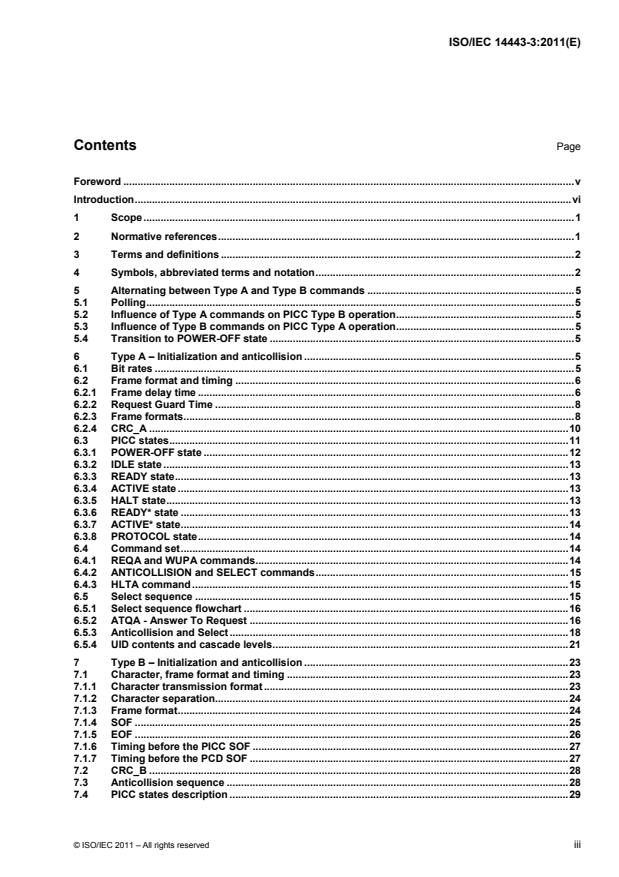
Contents Page
Foreword .v
Introduction.vi
1 Scope.1
2 Normative references.1
3 Terms and definitions .2
4 Symbols, abbreviated terms and notation.2
5 Alternating between Type A and Type B commands .5
5.1 Polling.5
5.2 Influence of Type A commands on PICC Type B operation.5
5.3 Influence of Type B commands on PICC Type A operation.5
5.4 Transition to POWER-OFF state .5
6 Type A – Initialization and anticollision .5
6.1 Bit rates .5
6.2 Frame format and timing .6
6.2.1 Frame delay time .6
6.2.2 Request Guard Time .8
6.2.3 Frame formats.8
6.2.4 CRC_A .10
6.3 PICC states.11
6.3.1 POWER-OFF state .12
6.3.2 IDLE state .13
6.3.3 READY state.13
6.3.4 ACTIVE state .13
6.3.5 HALT state.13
6.3.6 READY* state .13
6.3.7 ACTIVE* state.14
6.3.8 PROTOCOL state.14
6.4 Command set.14
6.4.1 REQA and WUPA commands.14
6.4.2 ANTICOLLISION and SELECT commands.15
6.4.3 HLTA command .15
6.5 Select sequence .15
6.5.1 Select sequence flowchart .16
6.5.2 ATQA - Answer To Request .16
6.5.3 Anticollision and Select.18
6.5.4 UID contents and cascade levels.21
7 Type B – Initialization and anticollision .23
7.1 Character, frame format and timing .23
7.1.1 Character transmission format .23
7.1.2 Character separation.24
7.1.3 Frame format.24
7.1.4 SOF .25
7.1.5 EOF .26
7.1.6 Timing before the PICC SOF .27
7.1.7 Timing before the PCD SOF .27
7.2 CRC_B .28
7.3 Anticollision sequence .28
7.4 PICC states description .29
© ISO/IEC 2011 – All rights reserved iii
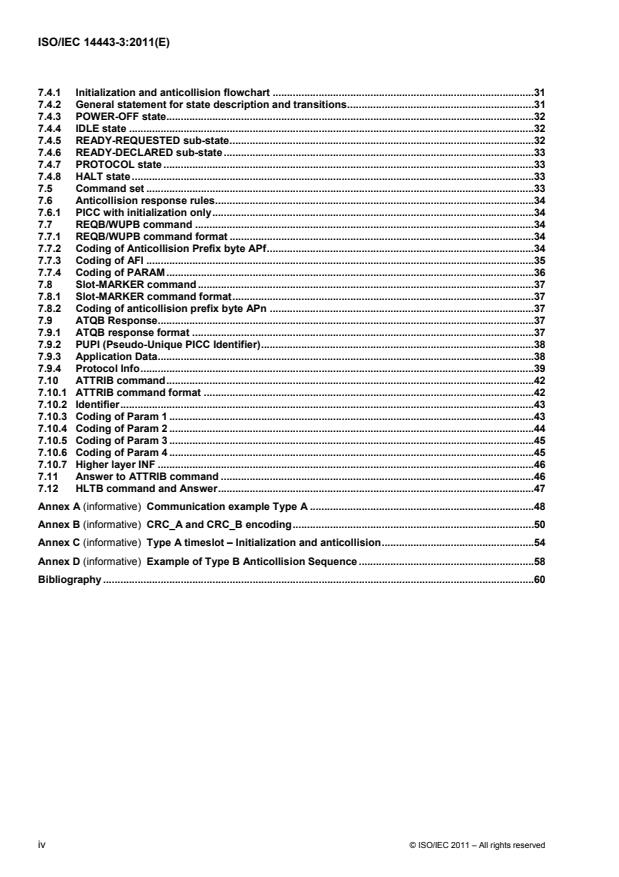
7.4.1 Initialization and anticollision flowchart .31
7.4.2 General statement for state description and transitions.31
7.4.3 POWER-OFF state.32
7.4.4 IDLE state .32
7.4.5 READY-REQUESTED sub-state.32
7.4.6 READY-DECLARED sub-state.33
7.4.7 PROTOCOL state .33
7.4.8 HALT state .33
7.5 Command set .33
7.6 Anticollision response rules.34
7.6.1 PICC with initialization only.34
7.7 REQB/WUPB command .34
7.7.1 REQB/WUPB command format .34
7.7.2 Coding of Anticollision Prefix byte APf.34
7.7.3 Coding of AFI .35
7.7.4 Coding of PARAM .36
7.8 Slot-MARKER command .37
7.8.1 Slot-MARKER command format.37
7.8.2 Coding of anticollision prefix byte APn .37
7.9 ATQB Response.37
7.9.1 ATQB response format .37
7.9.2 PUPI (Pseudo-Unique PICC Identifier).38
7.9.3 Application Data.38
7.9.4 Protocol Info.39
7.10 ATTRIB command.42
7.10.1 ATTRIB command format .42
7.10.2 Identifier.43
7.10.3 Coding of Param 1 .43
7.10.4 Coding of Param 2 .44
7.10.5 Coding of Param 3 .45
7.10.6 Coding of Param 4 .45
7.10.7 Higher layer INF .46
7.11 Answer to ATTRIB command .46
7.12 HLTB command and Answer.47
Annex A (informative) Communication example Type A .48
Annex B (informative) CRC_A and CRC_B encoding.50
Annex C (informative) Type A timeslot – Initialization and anticollision.54
Annex D (informative) Example of Type B Anticollision Sequence .58
Bibliography .60
iv © ISO/IEC 2011 – All rights reserved
Foreword
ISO (the International Organization for Standardization) and IEC (the International Electrotechnical
Commission) form the specialized system for worldwide standardization. National bodies that are members of
ISO or IEC participate in the development of International Standards through technical committees
established by the respective organization to deal with particular fields of technical activity. ISO and IEC
technical committees collaborate in fields of mutual interest. Other international organizations, governmental
and non-governmental, in liaison with ISO and IEC, also take part in the work. In the field of information
technology, ISO and IEC have established a joint technical committee, ISO/IEC JTC 1.
International Standards are drafted in accordance with the rules given in the ISO/IEC Directives, Part 2.
The main task of the joint technical committee is to prepare International Standards. Draft International
Standards adopted by the joint technical committee are circulated to national bodies for voting. Publication as
an International Standard requires approval by at least 75 % of the national bodies casting a vote.
ISO/IEC 14443-3 was prepared by Joint Technical Committee ISO/IEC JTC 1, Information technology,
Subcommittee SC 17, Cards and personal identification.
This second edition cancels and replaces the first edition (ISO/IEC 14443-3:2001), which has been technically
revised.
It also incorporates the Amendments ISO/IEC 14443-3:2001/Amd.1:2005 and ISO/IEC 14443-3:2001/
Amd.3:2006, and the Technical Corrigendum ISO/IEC 14443-3:2001/Amd.1:2005/Cor.1:2006.
ISO/IEC 14443 consists of the following parts, under the general title Identification cards — Contactless
integrated circuit cards — Proximity cards:
⎯ Part 1: Physical characteristics
⎯ Part 2: Radio frequency power and signal interface
⎯ Part 3: Initialization and anticollision
⎯ Part 4: Transmission protocol
© ISO/IEC 2011 – All rights reserved v
Introduction
ISO/IEC 14443 is one of a series of International Standards describing the parameters for identification cards
as defined in ISO/IEC 7810, and the use of such cards for international interchange.
This part of ISO/IEC 14443 describes polling for proximity cards entering the field of a proximity coupling
device, the byte format and framing, the initial Request and Answer to Request command content, methods to
detect and communicate with one proximity card among several proximity cards (anticollision) and other
parameters required to initialize communications between a proximity card and a proximity coupling device.
Protocols and commands used by higher layers and by applications and which are used after the initial phase
are described in ISO/IEC 14443-4.
ISO/IEC 14443 is intended to allow operation of proximity cards in the presence of other contactless cards
conforming to ISO/IEC 10536 and ISO/IEC 15693.
The International Organization for Standardization (ISO) and International Electrotechnical Commission (IEC)
draw attention to the fact that it is claimed that compliance with this document may involve the use of patents.
ISO and IEC take no position concerning the evidence, validity and scope of these patent rights.
The holders of these patent rights have assured ISO and IEC that they are willing to negotiate licences under
reasonable and non discriminatory terms and conditions with applicants throughout the world. In this respect,
the statements of the holders of these patent rights are registered with the ISO and IEC. Information may be
obtained from:
Patent holder Details
FRANCE TELECOM US Patent US5359323
Orange Labs
38-40 rue de Général Leclerc
92794 Issy-les-Moulineaux
France
INNOVOTRON WO 9936877A1
1 Rue Danton Europe 0 901 670
75006 Paris French Patent App 97.02501
France Int Pat App
PCT/FR98/00132
Innovatron Electronique / RATP
subclause 7.3, 7.6 and 7.7
French Patent App 98.00383
Int Pat App
PCT/FR99/00079
Innovatron Electronique / RATP
subclause 7.3, 7.4.5, 7.6, 7.7, 7.8
MOTOROLA Details not available.
Motorola ESG
Now:
Freescale Semiconductor Inc.
6501 William Cannon Drive West
Austin, Texas 78735
USA
vi © ISO/IEC 2011 – All rights reserved
PHILIPS PHO 94.520
Philips Intellectual Property & Standards EP-PS 066 9591
High Tech Campus 44 (BE,CH,DE,DK,ES,FR,GB,IT,NL,SE)
5656 AE Eindhoven AT-PS 401 127
The Netherlands Related to “anticollision” as specified in
ISO/IEC 14443-3
Attention is drawn to the possibility that some of the elements of this document may be the subject of patent
rights other than those identified above. ISO and IEC shall not be held responsible for identifying any or all
such patent rights.
© ISO/IEC 2011 – All rights reserved vii
INTERNATIONAL STANDARD ISO/IEC 14443-3:2011(E)
Identification cards — Contactless integrated circuit cards —
Proximity cards
Part 3:
Initialization and anticollision
1 Scope
This part of ISO/IEC 14443 describes:
⎯ polling for proximity cards or objects (PICCs) entering the field of a proximity coupling device (PCD);
⎯ the byte format, the frames and timing used during the initial phase of communication between PCDs and
PICCs;
⎯ the initial Request and Answer to Request command content;
⎯ methods to detect and communicate with one PICC among several PICCs (anticollision);
⎯ other parameters required to initialize communications between a PICC and PCD;
⎯ optional means to ease and speed up the selection of one PICC among several PICCs based on
application criteria.
Protocol and commands used by higher layers and by applications and which are used after the initial phase
are described in ISO/IEC 14443-4.
This part of ISO/IEC 14443 is applicable to PICCs of Type A and of Type B (as described in
ISO/IEC 14443-2).
NOTE 1 Part of the timing of data communication is defined in ISO/IEC 14443-2.
NOTE 2 Test methods for this International Standard are defined in ISO/IEC 10373-6.
2 Normative references
The following referenced documents are indispensable for the application of this document. For dated
references, only the edition cited applies. For undated references, the latest edition of the referenced
document (including any amendments) applies.
ISO/IEC 13239, Information technology — Telecommunications and information exchange between
systems — High-level data link control (HDLC) procedures
ISO/IEC 7816-4:2005, Identification cards — Integrated circuit cards — Part 4: Organization, security and
commands for interchange
ISO/IEC 7816-6, Identification cards — Integrated circuit cards — Part 6: Interindustry data elements for
interchange
© ISO/IEC 2011 – All rights reserved 1
ISO/IEC 14443-2, Identification cards — Contactless integrated circuit cards — Proximity cards — Part 2:
Radio frequency power and signal interface
ISO/IEC 14443-4, Identification cards — Contactless integrated circuit cards — Proximity cards — Part 4:
Transmission protocol
3 Terms and definitions
For the purposes of this document, the terms and definitions given in ISO/IEC 14443-2 and the following
apply.
3.1
anticollision loop
algorithm used to prepare for dialogue between PCD and one or more PICCs out of the total number of PICCs
responding to a request command
3.2
byte
byte consisting of 8 bits of data designated b8 to b1, from the most significant bit (MSB, b8) to the least
significant bit (LSB, b1)
3.3
collision
transmission by two PICCs in the same PCD energizing field and during the same time period, such that the
PCD is unable to distinguish from which PICC the data originated
3.4
frame
sequence of data bits and optional error detection bits, with frame delimiters at start and end
3.5
higher layer protocol
protocol layer (not described in this part of ISO/IEC 14443) that makes use of the protocol layer defined in this
part of ISO/IEC 14443 to transfer information belonging to the application or higher layers of protocol not
described in this part of ISO/IEC 14443
3.6
request command
command requesting PICCs of the appropriate type to respond if they are available for initialization
4 Symbols, abbreviated terms and notation
For the purposes of this document, the following symbols, abbreviated terms and notation apply.
ADC Application Data Coding, Type B
AFI Application Family Identifier, card preselection criteria by application, Type B
APf Anticollision Prefix f, used in REQB/WUPB, Type B
APn Anticollision Prefix n, used in Slot-MARKER command, Type B
ATQA Answer To reQuest, Type A
ATQB Answer To reQuest, Type B
2 © ISO/IEC 2011 – All rights reserved
ATTRIB PICC selection command, Type B
BCC Block Check Character (UID CLn check byte), Type A
CID Card IDentifier
CLn Cascade Level n, Type A
CT Cascade Tag, Type A
CRC_A Cyclic Redundancy Check error detection code, Type A
CRC_B Cyclic Redundancy Check error detection code, Type B
D Divisor
E End of communication, Type A
EGT Extra Guard Time, Type B
EOF End Of Frame, Type B
etu elementary time unit
FDT Frame Delay Time PCD to PICC, Type A
fc carrier frequency
FO Frame Option, Type B
fs subcarrier frequency
FWI Frame Waiting time Integer
FWT Frame Waiting Time
HLTA HaLT command, Type A
HLTB HaLT command, Type B
ID IDentification number, Type A
INF INFormation field belonging to higher layer, Type B
LSB Least Significant Bit
MBL Maximum Buffer Length, Type B
MBLI Maximum Buffer Length Index, Type B
MSB Most Significant Bit
N Number of anticollision slots, Type B
n Variable integer value as defined in the specific clause
NAD Node ADdress
NVB Number of Valid Bits, Type A
© ISO/IEC 2011 – All rights reserved 3
P Odd Parity bit, Type A
PCD Proximity Coupling Device
PICC Proximity Card or object
PUPI Pseudo-Unique PICC Identifier, Type B
R Slot number chosen by the PICC during the anticollision sequence, Type B
REQA REQuest command, Type A
REQB REQuest command, Type B
RFU Reserved for Future Use by ISO/IEC
S Start of communication, Type A
SAK Select AcKnowledge, Type A
SEL SELect code, Type A
SELECT SELECT command, Type A
SFGI Start-up Frame Guard time Integer
SFGT Start-up Frame Guard Time
SOF Start Of Frame, Type B
TR0 Guard Time as defined in ISO/IEC 14443-2, Type B
TR1 Synchronization Time as defined in ISO/IEC 14443-2, Type B
TR2 Frame delay Time PICC to PCD, Type B
UID Unique IDentifier, Type A
UID CLn Unique IDentifier of CLn, Type A
uidn Byte number n of Unique IDentifier, n ≥ 0
WUPA Wake-UP command, Type A
WUPB Wake-UP command, Type B
For the purposes of this document, the following notation applies:
⎯ (xxxxx)b Data bit representation;
⎯ 'XY' Hexadecimal notation, equal to XY to the base 16.
4 © ISO/IEC 2011 – All rights reserved
5 Alternating between Type A and Type B commands
5.1 Polling
In order to detect PICCs which are in the operating field, a PCD shall send repeated Request commands. The
PCD shall send REQA (or WUPA) and REQB (or WUPB) in any sequence using an equal or configurable duty
cycle when polling Type A and Type B. In addition the PCD may send other commands as described in
Annex C.
When a PICC is exposed to an unmodulated operating field (see ISO/IEC 14443-2) it shall be able to accept a
request within 5 ms.
EXAMPLE 1 When a PICC Type A receives any Type B command it shall be able to accept a REQA (or WUPA) within
5 ms of unmodulated operating field.
EXAMPLE 2 When a PICC Type B receives any Type A command it shall be able to accept a REQB (or WUPB) within
5 ms of unmodulated operating field.
EXAMPLE 3 When a PICC Type A is exposed to field activation it shall be able to accept a REQA (or WUPA) within
5 ms of unmodulated operating field.
EXAMPLE 4 When a PICC Type B is exposed to field activation it shall be able to accept a REQB (or WUPB) within
5 ms of unmodulated operating field.
NOTE In order to detect PICCs requiring 5 ms, PCDs should periodically present an unmodulated field of at least
5,1 ms duration (prior to both Type A and Type B Request commands), but may poll more rapidly because PICCs may
react faster.
5.2 Influence of Type A commands on PICC Type B operation
A PICC Type B shall either go to IDLE state (be able to accept a REQB) or be able to continue a transaction
in progress after receiving any Type A command.
5.3 Influence of Type B commands on PICC Type A operation
A PICC Type A shall either go to IDLE state (be able to accept a REQA) or be able to continue a transaction
in progress after receiving any Type B command.
5.4 Transition to POWER-OFF state
The PICC shall be in the POWER-OFF state no later than 5 ms after the operating field is switched off.
6 Type A – Initialization and anticollision
This section describes the initialization and anticollision sequence applicable for PICCs of Type A.
A PICC or PCD sending RFU bits shall set these bits to the value indicated herein or to (0)b if no value is
given. A PICC or PCD receiving RFU bits shall disregard the value of these bits and shall maintain and not
change its function, unless explicitly stated otherwise.
6.1 Bit rates
Communication between PCD and PICC can be achieved with four different bit rates.
Bit rates of fc / 64, fc / 32 and fc / 16 are optional and may be independently supported by PCD and PICC in
each communication direction, defined in Table 1.
© ISO/IEC 2011 – All rights reserved 5
Table 1 — Bit rates
Divisor D etu Bit rate
1 128 / fc (~ 9,4 µs) fc / 128 (~ 106 kbit/s)
2 (optional) 128 / (2 fc) (~ 4,7 µs) fc / 64 (~ 212 kbit/s)
4 (optional) 128 / (4 fc) (~ 2,4 µs) fc / 32 (~ 424 kbit/s)
8 (optional) 128 / (8 fc) (~ 1,2 µs) fc / 16 (~ 848 kbit/s)
NOTE The initial bit rate is fc / 128. This applies for the whole initialization and anticollision sequence.
6.2 Frame format and timing
This section defines the frame format and timing used during communication initialization and anticollision. For
bit representation and coding refer to ISO/IEC 14443-2.
Frames shall be transferred in pairs, PCD to PICC followed by PICC to PCD, using the sequence:
⎯ PCD frame:
⎯ PCD start of communication
⎯ information and, where required, error detection bits sent by the PCD
⎯ PCD end of communication
⎯ Frame delay time PCD to PICC
⎯ PICC frame:
⎯ PICC start of communication
⎯ information and, where required, error detection bits sent by the PICC
⎯ PICC end of communication
⎯ Frame delay time PICC to PCD
NOTE The frame delay time (FDT) from PCD to PICC overlaps the PCD end of communication.
6.2.1 Frame delay time
The frame delay time is defined as the time between two frames transmitted in opposite directions.
6.2.1.1 Frame delay time PCD to PICC
This is the time between the end of the last pause transmitted by the PCD and the first modulation edge within
the start bit transmitted by the PICC and shall respect the timing defined in Figure 1 and Table 2 where n is an
integer value.
Table 2 defines values for n and FDT depending on the command type and the logic state of the last
transmitted data bit in this command.
6 © ISO/IEC 2011 – All rights reserved
Last data bit transmitted by PCD First modulation of PICC
FDT
1 etu 2 etu
logic "1" End of communication Start of
(E) communication (S)
FDT
1 etu 2 etu
Start of
logic "0" End of communication
(E) communication (S)
Figure 1 — Frame delay time PCD to PICC
Table 2 — Frame delay time PCD to PICC
Command type n (integer value) FDT
last bit = (1)b last bit = (0)b
REQA command 9 (n x 128 + 84) / fc (n x 128 + 20) / fc
WUPA command [ = 1236 / fc ] [ = 1172 / fc ]
ANTICOLLISION command
SELECT command
All other commands at bit rates
PCD to PICC PICC to PCD
fc / 128 (n x 128 + 84) / fc (n x 128 + 20) / fc
≥ 9
fc / 64 (n x 128 + 148) / fc (n x 128 + 116) / fc
≥ 8
fc / 128
fc / 32 (n x 128 + 116) / fc (n x 128 + 100) / fc
≥ 8
fc / 16 (n x 128 + 100) / fc (n x 128 + 92) / fc
≥ 8
fc / 128 or fc / 64 or fc / 64 or fc / 32 or Not applicable
≥ 1116 / fc ≥ 1116 / fc
fc / 32 or fc / 16 fc / 16
For anticollision, all PICCs in the field shall respond in a synchronous way to the commands: REQA, WUPA,
ANTICOLLISION and SELECT.
The FDT measurement starts at the beginning of the rising edge as specified in ISO/IEC 14443-2 and
illustrated with small circles in Figure 3 for fc / 128 and Figure 6 for other bit rates.
The measured FDT shall be between the value given in Table 2 and the value given in Table 2 + 0,4 µs.
NOTE The PCD should accept a response with a FDT tolerance of –1 / fc to (+0,4 µs + 1 / fc).
6.2.1.2 Frame delay time PICC to PCD
This is the time between the last modulation transmitted by the PICC and the first pause transmitted by the
PCD and shall be at least 1172 / fc.
© ISO/IEC 2011 – All rights reserved 7
NOTE To enhance interoperability it is recommended that an additional waiting time of 10 / fc is incorporated in the
PCD operation.
6.2.2 Request Guard Time
The Request Guard Time is defined as the minimum time between the start bits of two consecutive REQA or
WUPA commands. It has the value 7000 / fc.
NOTE To enhance interoperability it is recommended that an additional waiting time of 100 / fc is incorporated in the
PCD operation.
6.2.3 Frame formats
The following frame types are defined:
⎯ short frames;
⎯ standard frames;
⎯ bit oriented anticollision frame.
6.2.3.1 Short frame
A short frame is used to initiate communication and consists of, in the following order as illustrated in Figure 2:
⎯ start of communication;
⎯ 7 data bits transmitted LSB first (for coding see Table 3);
⎯ end of communication.
No parity bit is added.
LSB MSB
S b1 b2b3 b4 b5 b6 b7 E
Figure 2 — Short frame
6.2.3.2 Standard frame
Standard frames are used for data exchange and consist of, in the following order:
⎯ start of communication;
⎯ n x (8 data bits + odd parity bit), with n ≥ 1. The LSB of each byte is transmitted first. Each byte is
followed by an odd parity bit. The parity bit P is set such that the number of 1s is odd in (b1 to b8, P);
⎯ end of communication.
The PCD standard frame is illustrated in Figure 3.
8 © ISO/IEC 2011 – All rights reserved
Figure 3 — PCD standard frame
As an exception the last parity bit of a PICC standard frame shall be inverted if this frame is transmitted with
bit rate of fc / 64, fc / 32 or fc / 16. PICC standard frames are illustrated in Figure 4.
PICC standard frames for bit rate of fc/128
LSB
b1 b8 b1 b8
S P P b1 b8 P
1st byte 2nd byte nth byte E
odd parity at the
odd parity odd parity
end of the frame
PICC standard frames for bit rates of fc/64, fc/32 and fc/16
LSB
b1 b8 b1 b8 b1
b8
S P P P E
1st byte 2nd byte nth byte
even parity at the
odd parity odd parity
end of the frame
Figure 4 — PICC standard frames
6.2.3.3 Bit oriented anticollision frame
The PCD shall be designed to detect a collision that occurs when at least two PICCs simultaneously transmit
bit patterns with one or more bit positions in which at least two PICCs transmit complementary values. In this
case the bit patterns merge and the carrier is modulated with the subcarrier for the whole (100%) bit duration
(see ISO/IEC 14443-2, 8.2.5.1).
Bit oriented anticollision frames shall only be used during bit frame anticollision loops and are standard frames
with a length of 7 bytes, split into two parts:
⎯ part 1 for transmission from PCD to PICC;
⎯ part 2 for transmission from PICC to PCD.
For the length of part 1 and part 2, the following rules shall apply:
⎯ rule 1: The sum of data bits shall be 56;
⎯ rule 2: The minimum length of part 1 shall be 16 data bits;
⎯ rule 3: The maximum length of part 1 shall be 48 data bits.
Consequently, the minimum length of part 2 shall be 8 data bit and the maximum length shall be 40 data bits.
© ISO/IEC 2011 – All rights reserved 9
Since the split can occur at any bit position within a byte, two cases are defined:
⎯ case FULL BYTE: Split after a complete byte. A parity bit is added after the last data bit of part 1;
⎯ case SPLIT BYTE: Split within a byte. No parity bit is added after the last data bit of part 1.
The Block Check Character (BCC) is calculated as exclusive-or over the 4 previous bytes.
The following examples for case FULL BYTE and case SPLIT BYTE define the bit organization and order of
bit transmission, illustrated in Figures 5 and 6.
NOTE These examples include proper values for NVB and BCC.
Figure 5 —Bit organization and transmission of bit oriented anticollision frame, case FULL BYTE
Figure 6 — Bit organization and transmission of bit oriented anticollision frame, case SPLIT BYTE
For a SPLIT BYTE, the first parity bit of part 2 shall be ignored by the PCD.
6.2.4 CRC_A
A frame that includes CRC_A shall only be considered correct if it is received with a valid CRC_A value.
The frame CRC_A is a function of k data bits, which consist of all the data bits in the frame, excluding parity
bits, S and E, and the CRC_A itself. Since data is encoded in bytes, the number of bits k is a multiple of 8.
10 © ISO/IEC 2011 – All rights reserved
For error checking, the two CRC_A bytes are sent in the standard frame, after the bytes and before the E. The
CRC_A is as defined in ISO/IEC 13239, but the initial register content shall be '6363' and the register content
shall not be inverted after calculation.
For examples refer to Annex B.
6.3 PICC states
The following sections provide descriptions of the states for a PICC of Type A specific to the anticollision
sequence.
The following state diagram in Figure 7 specifies all possible state transitions caused by commands of this
part of ISO/IEC 14443. PICCs shall react to valid received frames only. No response shall be sent when
transmission errors are detected except for PICCs in ACTIVE or ACTIVE* state.
The following symbols apply for the state diagram shown in Figure 7.
AC ANTICOLLISION command (matched UID)
nAC ANTICOLLISION command (not matched UID)
SELECT SELECT command (matched UID)
nSELECT SELECT command (not matched UID)
RATS RATS command, defined in ISO/IEC 14443-4
DESELECT DESELECT command, defined in ISO/IEC 14443-4
Error transmission error detected or unexpected frame
© ISO/IEC 2011 – All rights reserved 11
Figure 7 — PICC Type A state diagram
PICCs being compliant with ISO/IEC 14443-3 but not selected with RATS from ISO/IEC 14443-4 may leave
the ACTIVE or ACTIVE* state by proprietary commands.
6.3.1 POWER-OFF state
Description:
In the POWER-OFF state, the PICC is not powered by a PCD operating field.
State exit conditions and transitions:
If the PICC is in an energizing magnetic field greater than H (see ISO/IEC 14443-2), it shall enter its IDLE
min
state within a delay not greater than defined in Clause 5.
12 © ISO/IEC 2011 – All rights reserved
6.3.2 IDLE state
Description:
In the IDLE state, the PICC is powered. It listens for commands and shall recognize REQA and WUPA
commands.
State exit conditions and transitions:
The PICC enters the READY state after it has received a valid REQA or WUPA command and transmitted its
ATQA.
6.3.3 READY state
Description:
In the READY state, the bit frame anticollision method shall be applied. Cascade levels are handled inside this
state to get the complete UID.
State exit conditions and transitions:
The PICC enters the ACTIVE state when it is selected with its complete UID.
6.3.4 ACTIVE state
Description:
If the PICC complies with ISO/IEC 14443-4 then the PICC shall be ready to accept the protocol activation
command (RATS) as specified in ISO/IEC 14443-4, else it may proceed with non ISO/IEC 14443-4 protocol.
State exit conditions and transitions:
The PICC enters the HALT state when a valid HLTA command is received.
NOTE In the higher layer protocol, specific commands may be defined to return the PICC to its HALT state.
6.3.5 HALT state
Description:
In the HALT state, the PICC shall respond only to a WUPA command.
State exit conditions and transitions:
The PICC enters the READY* state after it has received a valid WUPA command and transmitted its ATQA.
6.3.6 READY* state
Description:
The READY* state is similar to the READY state. The differences are the transitions specified in Figure 7. The
bit frame anticollision method shall be applied. Cascade levels are handled inside this state to get complete
UID.
State exit conditions and transitions:
The PICC enters the ACTIVE* state when it is selected with its complete UID.
© ISO/IEC 2011 – All rights reserved 13
6.3.7 ACTIVE* state
Description:
The ACTIVE* state is similar to the ACTIVE state The differences are the transitions specified in Figure 7. If
the PICC complies with ISO/IEC 14443-4 then the PICC shall be ready to accept the protocol activation
command (RATS) as specified in ISO/IEC 14443-4, else it may proceed with non ISO/IEC 14443-4 protocol.
State exit conditions and transitions:
The PICC enters the HALT state when a valid HLTA command is received.
6.3.8 PROTOCOL state
Description:
In the PROTOCOL state, the PICC behaves according to ISO/IEC 14443-4.
6.4 Command set
The commands used by the PCD to manage communication with several PICCs are:
⎯ REQA;
⎯ WUPA;
⎯ ANTICOLLISION;
⎯ SELECT;
⎯ HLTA.
The commands use the byte and frame formats described above.
6.4.1 REQA and WUPA commands
The REQA and WUPA commands are sent by the PCD to probe the field for PICCs of Type A. They are
transmitted within a short frame. See Figure 7 to check in which cases PICCs actually have to answer to these
respective commands.
Particularly the WUPA command is sent by the PCD to put PICCs which have entered the HALT state back
into the READY* state. They shall then participate in further anticollision and selection procedures.
Table 3 shows the coding of REQA and WUPA commands which use the Short frame format.
Table 3 — Coding of Short Frame
b7 b6 b5 b4 b3 b2 b1 Meaning
0 1 0 0 1 1 0 '26' = REQA
1 0 1 0 0 1 0 '52' = WUPA
0 1 1 0 1 0 1 '35' = Optional timeslot method, see Annex C
1 0 0 x x x x '40' to '4F' = Proprietary
1 1 1 1 x x x '78' to '7F' = Proprietary
all other values RFU
14 © ISO/IEC 2011 – All rights reserved
A PCD sending an RFU value is not compliant with this standard.
A PICC receiving an RFU value should consider the short frame as an error (see Figure 7) and should not
send a response.
6.4.2 ANTICOLLISION and SELECT commands
These commands are used during an anticollision loop (see Figures 5 and 6). The ANTICOLLISION and
SELECT commands consist of:
⎯ select code SEL (1 byte);
⎯ number of valid bits NVB (1 byte, for coding see Table 8);
⎯ 0 to 40 data bits of UID CLn according to the value of NVB.
NOTE The composition of UID CLn for the different UID sizes is shown in Figure 12.
SEL specifies the cascade level CLn.
The ANTICOLLISION command is transmitted within bit oriented anticollision frame.
The SELECT command is transmitted within standard frame.
As long as NVB does not specify 40 valid bits, the command is called ANTICOLLISION command, where the
PICC remains in READY or READY* state.
If NVB specifies 40 data bits of UID CLn (NVB = '70'), a CRC_A shall be appended. This command is called
SELECT command.
If the PICC has transmitted the complete UID, it transits from READY state to ACTIVE state or from READY*
state to ACTIVE* state and indicates in its SAK response that UID is complete.
Otherwise, the PICC remains in READY or READY* state and the PCD shall initiate a new anticollision loop
with increased cascade level.
6.4.3 HLTA command
The HLTA command consists of two bytes followed by CRC_A and shall be transmitted within a standard
frame, defined in Figure 8.
S '50' '00' CRC_A E
Figure 8 — Standard frame containing HLTA command
If the PICC responds with any modulation during a period of 1 ms after the end of the frame containing the
HLTA command, this response shall be interpreted as 'not acknowledge'.
NOTE The PCD should apply an additional waiting time margin of 0,1 ms.
6.5 Select sequence
The purpose of the select sequence is to get the UID from one PICC and to select this PICC for further
communication.
© ISO/IEC 2011 – All rights reserved 15
6.5.1 Select sequence flowchart
The select sequence is specified in Figure 9.
ISO/IEC 14443-3
START
Send REQA
Receive ATQA
Select
cascade level 1
Increase Perform bit frame
cascade level anticollison loop
UID complete, PICC not
compliant to
UID not complete
ISO/IEC 14443-4
Check SAK
UID complete, PICC
compliant to
ISO/IEC 14443-4
ISO/IEC 14443-4
Proprietary
Proceed with commands and protocols commands
defined in ISO/IEC 14443-4 and protocols
Figure 9 — Initialization and anticollision flowchart for PCD
NOTE PICCs may use ATQA bit combinations of b9 to b12 for indication of proprietary methods.
PICCs that do not support the mandatory bit frame anticollision are not compliant with this standard.
6.5.2 ATQA - Answer To Request
After a REQA command is transmitted by the PCD, all PICCs in the IDLE state shall respond synchron
...
Questions, Comments and Discussion
Ask us and Technical Secretary will try to provide an answer. You can facilitate discussion about the standard in here.
Loading comments...