

ISO 248-1:2021
(Main)Rubber, raw — Determination of volatile-matter content — Part 1: Hot-mill method and oven method
General Information
- Abstract
This document specifies two methods for the determination of volatile-matter content in raw rubbers by using a hot mill or an oven. These methods are applicable to the determination of the volatile-matter content in the “R” group of rubbers listed in ISO 1629. These are rubbers having an unsaturated carbon chain, for example natural rubber and synthetic rubbers derived at least partly from di-olefins. These methods can also be applicable to other raw rubbers, but in these cases it is necessary to demonstrate that the change in mass is due solely to loss of actual volatile matter and not to rubber degradation. The hot-mill method is not applicable to natural rubber, to synthetic rubbers which are too difficult to handle on a hot mill or to synthetic rubbers in powder or chip form. The two methods do not necessarily give identical results. Therefore, in the case of dispute, the oven method, procedure A, is the reference method. NOTE The applicability of each test method to various types of rubber is summarized in Annex A.
- Status
- Published
- Publication Date
- 29-Jun-2021
- Drafting Committee
- ISO/TC 45/SC 3/WG 5 - Synthetic and reclaimed rubber
- Current Stage
- 9093 - International Standard confirmed
- Start Date
- 05-Jun-2026
- Completion Date
- 29-Aug-2026
Buy Documents


ISO 248-1:2021 - Rubber, raw -- Determination of volatile-matter content
ISO 248-1:2021 - Rubber, raw — Determination of volatile-matter content — Part 1: Hot-mill method and oven method/30/2021


ISO 248-1:2021 - Caoutchouc brut -- Détermination des matières volatiles
ISO 248-1:2021 - Caoutchouc brut — Détermination des matières volatiles — Partie 1: Méthode par mélangeage à chaud et méthode par étuvage/30/2021
Overview
ISO 248-1:2021 specifies two standardized laboratory methods for determining the volatile‑matter content of raw rubbers: the hot‑mill method and the oven method. The standard applies primarily to rubbers in the “R” group of ISO 1629 (rubbers with unsaturated carbon chains, e.g., natural rubber and di‑olefin‑derived synthetics). It also allows use on other raw rubbers only when it can be demonstrated that mass loss is due solely to volatiles and not to rubber degradation. Note: the two methods can give different results; oven method, procedure A, is the reference method in case of dispute.
Key topics and requirements
- Two test routes:
- Hot‑mill method (procedures A and B) - material is sheeted/milled on a heated laboratory mill until mass stabilizes.
- Oven method (procedures A and B) - material is dried in a ventilated oven to constant mass.
- Applicability limits:
- Hot‑mill method is not applicable to natural rubber, to synthetics that are difficult to handle on a mill, or to powders/chips.
- Oven method is suitable for natural rubber and many synthetic types.
- Apparatus & conditions:
- Hot‑mill roll surface temperature typically maintained at 105 °C ± 5 °C with roll clearance 0.25 mm ± 0.05 mm.
- Oven (ventilated, preferably air‑circulating) maintained at 105 °C ± 3 °C.
- Balances: hot‑mill tests use balances to 0.1 g; oven method specifies balances to 0.1 mg for precise determinations.
- Sample handling:
- Homogenization (Annex B) is required for some procedures; sample sizes and test‑portion masses are specified (e.g., ~250 g for homogenization, ~10 g oven test portion for natural rubber).
- Results & precision:
- Mass loss is expressed as percent volatile‑matter; the standard provides the calculation formulae and precision data (see Annex C).
- Ancillary guidance:
- Annex A summarizes method applicability; Annex B details homogenization; Annex C gives precision/ITP results.
Applications
- Quality control of incoming raw rubber and production batches.
- Supplier verification and acceptance testing.
- Research and development of rubber grades and processing conditions.
- Contract testing laboratories offering standardized volatile‑matter assays.
- Troubleshooting processing issues related to moisture and volatile residues.
Who uses this standard
- Rubber manufacturers and compounders
- Quality assurance and laboratory personnel in the rubber industry
- Independent testing laboratories
- Procurement and materials engineers specifying incoming raw materials
Related standards
- ISO 1629 (rubber classification)
- ISO 1795 (sampling and preparative procedures)
- ISO 2393 (mixing mill equipment and procedures)
Keywords: ISO 248-1:2021, volatile-matter content, raw rubber testing, hot-mill method, oven method, natural rubber, synthetic rubber, homogenization, laboratory mill, raw rubber quality control.
Relations
- Effective Date
- 23-Apr-2020
Buy Documents
ISO 248-1:2021 - Rubber, raw -- Determination of volatile-matter content
ISO 248-1:2021 - Rubber, raw — Determination of volatile-matter content — Part 1: Hot-mill method and oven method/30/2021
ISO 248-1:2021 - Caoutchouc brut -- Détermination des matières volatiles
ISO 248-1:2021 - Caoutchouc brut — Détermination des matières volatiles — Partie 1: Méthode par mélangeage à chaud et méthode par étuvage/30/2021
Get Certified
Connect with accredited certification bodies for this standard

DIN CERTCO
DIN Group product certification.

Smithers Quality Assessments
US management systems and product certification.
Sponsored listings
Frequently Asked Questions
ISO 248-1:2021 is a standard published by the International Organization for Standardization (ISO). Its full title is "Rubber, raw — Determination of volatile-matter content — Part 1: Hot-mill method and oven method". This standard covers: This document specifies two methods for the determination of volatile-matter content in raw rubbers by using a hot mill or an oven. These methods are applicable to the determination of the volatile-matter content in the “R” group of rubbers listed in ISO 1629. These are rubbers having an unsaturated carbon chain, for example natural rubber and synthetic rubbers derived at least partly from di-olefins. These methods can also be applicable to other raw rubbers, but in these cases it is necessary to demonstrate that the change in mass is due solely to loss of actual volatile matter and not to rubber degradation. The hot-mill method is not applicable to natural rubber, to synthetic rubbers which are too difficult to handle on a hot mill or to synthetic rubbers in powder or chip form. The two methods do not necessarily give identical results. Therefore, in the case of dispute, the oven method, procedure A, is the reference method. NOTE The applicability of each test method to various types of rubber is summarized in Annex A.
This document specifies two methods for the determination of volatile-matter content in raw rubbers by using a hot mill or an oven. These methods are applicable to the determination of the volatile-matter content in the “R” group of rubbers listed in ISO 1629. These are rubbers having an unsaturated carbon chain, for example natural rubber and synthetic rubbers derived at least partly from di-olefins. These methods can also be applicable to other raw rubbers, but in these cases it is necessary to demonstrate that the change in mass is due solely to loss of actual volatile matter and not to rubber degradation. The hot-mill method is not applicable to natural rubber, to synthetic rubbers which are too difficult to handle on a hot mill or to synthetic rubbers in powder or chip form. The two methods do not necessarily give identical results. Therefore, in the case of dispute, the oven method, procedure A, is the reference method. NOTE The applicability of each test method to various types of rubber is summarized in Annex A.
ISO 248-1:2021 is classified under the following ICS (International Classification for Standards) categories: 83.040.10 - Latex and raw rubber. The ICS classification helps identify the subject area and facilitates finding related standards.
ISO 248-1:2021 has the following relationships with other standards: It is inter standard links to ISO 248-1:2011. Understanding these relationships helps ensure you are using the most current and applicable version of the standard.
ISO 248-1:2021 is available in PDF format for immediate download after purchase. The document can be added to your cart and obtained through the secure checkout process. Digital delivery ensures instant access to the complete standard document.
Standards Content (Sample)
INTERNATIONAL ISO
STANDARD 248-1
Second edition
2021-06
Rubber, raw — Determination of
volatile-matter content —
Part 1:
Hot-mill method and oven method
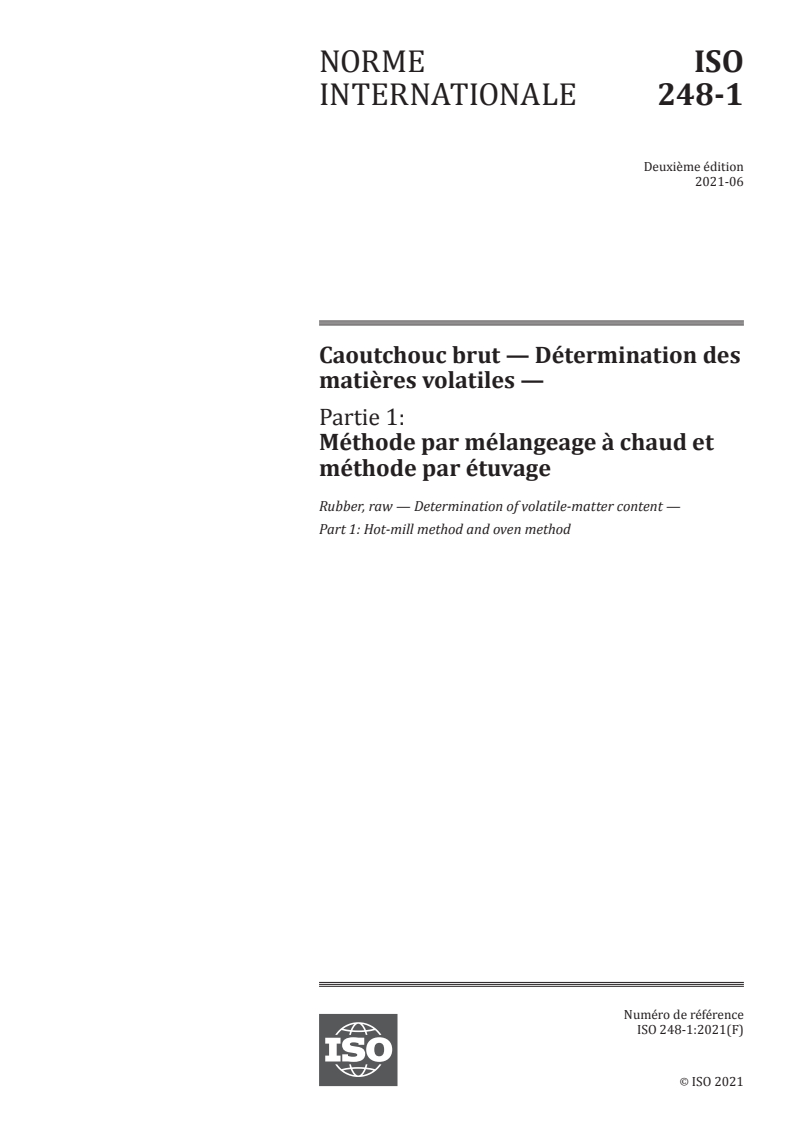
Caoutchouc brut — Détermination des matières volatiles —
Partie 1: Méthode par mélangeage à chaud et méthode par étuvage
Reference number
©
ISO 2021
© ISO 2021
All rights reserved. Unless otherwise specified, or required in the context of its implementation, no part of this publication may
be reproduced or utilized otherwise in any form or by any means, electronic or mechanical, including photocopying, or posting
on the internet or an intranet, without prior written permission. Permission can be requested from either ISO at the address
below or ISO’s member body in the country of the requester.
ISO copyright office
CP 401 • Ch. de Blandonnet 8
CH-1214 Vernier, Geneva
Phone: +41 22 749 01 11
Email: copyright@iso.org
Website: www.iso.org
Published in Switzerland
ii © ISO 2021 – All rights reserved
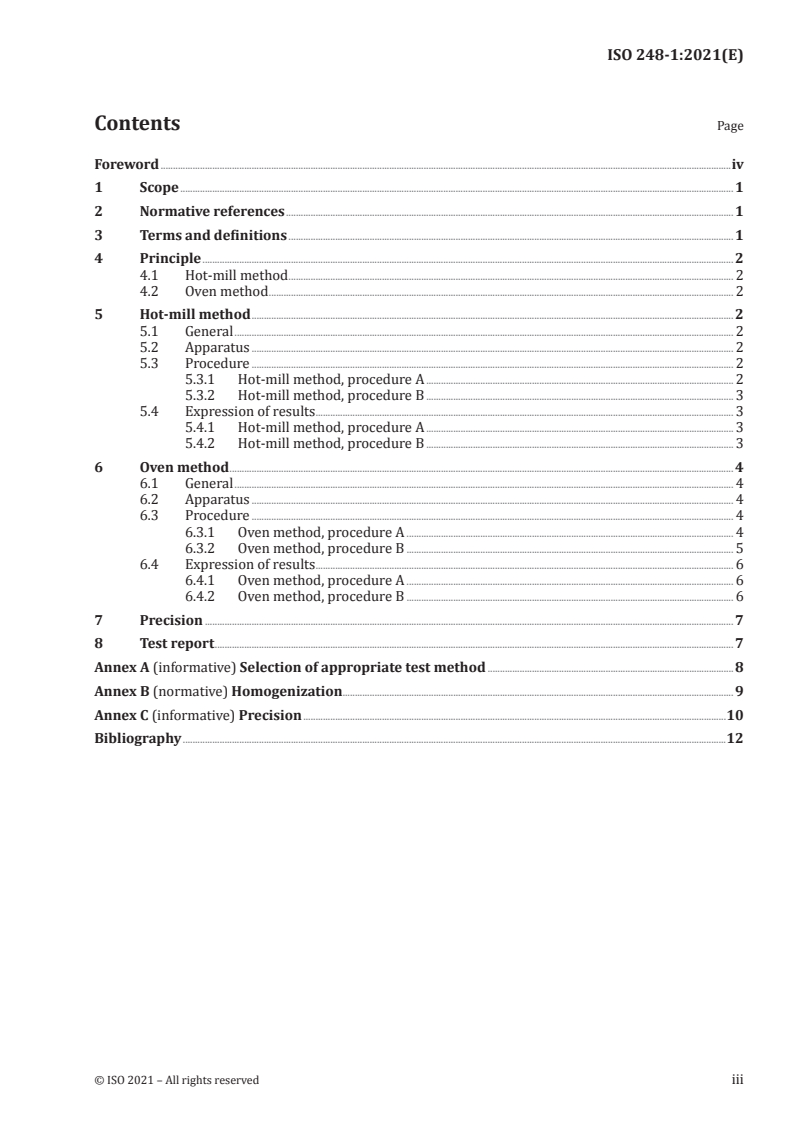
Contents Page
Foreword .iv
1 Scope . 1
2 Normative references . 1
3 Terms and definitions . 1
4 Principle . 2
4.1 Hot-mill method . 2
4.2 Oven method . 2
5 Hot-mill method . 2
5.1 General . 2
5.2 Apparatus . 2
5.3 Procedure . 2
5.3.1 Hot-mill method, procedure A . 2
5.3.2 Hot-mill method, procedure B . 3
5.4 Expression of results . 3
5.4.1 Hot-mill method, procedure A . 3
5.4.2 Hot-mill method, procedure B . 3
6 Oven method . 4
6.1 General . 4
6.2 Apparatus . 4
6.3 Procedure . 4
6.3.1 Oven method, procedure A . 4
6.3.2 Oven method, procedure B . 5
6.4 Expression of results . 6
6.4.1 Oven method, procedure A . 6
6.4.2 Oven method, procedure B . 6
7 Precision . 7
8 Test report . 7
Annex A (informative) Selection of appropriate test method . 8
Annex B (normative) Homogenization. 9
Annex C (informative) Precision .10
Bibliography .12
Foreword
ISO (the International Organization for Standardization) is a worldwide federation of national standards
bodies (ISO member bodies). The work of preparing International Standards is normally carried out
through ISO technical committees. Each member body interested in a subject for which a technical
committee has been established has the right to be represented on that committee. International
organizations, governmental and non-governmental, in liaison with ISO, also take part in the work.
ISO collaborates closely with the International Electrotechnical Commission (IEC) on all matters of
electrotechnical standardization.
The procedures used to develop this document and those intended for its further maintenance are
described in the ISO/IEC Directives, Part 1. In particular, the different approval criteria needed for the
different types of ISO documents should be noted. This document was drafted in accordance with the
editorial rules of the ISO/IEC Directives, Part 2 (see www .iso .org/ directives).
Attention is drawn to the possibility that some of the elements of this document may be the subject of
patent rights. ISO shall not be held responsible for identifying any or all such patent rights. Details of
any patent rights identified during the development of the document will be in the Introduction and/or
on the ISO list of patent declarations received (see www .iso .org/ patents).
Any trade name used in this document is information given for the convenience of users and does not
constitute an endorsement.
For an explanation of the voluntary nature of standards, the meaning of ISO specific terms and
expressions related to conformity assessment, as well as information about ISO's adherence to the
World Trade Organization (WTO) principles in the Technical Barriers to Trade (TBT), see www .iso .org/
iso/ foreword .html.
This document was prepared by Technical Committee ISO/TC 45, Rubber and rubber products,
Subcommittee SC 3, Raw materials (including latex) for use in the rubber industry.
This second edition cancels and replaces the first edition (ISO 248-1:2011), which has been technically
revised.
The main changes compared to the previous edition are as follows:
— in 6.2.1, update of the tolerance temperature of the oven;
— in 6.3.1 and 6.3.2, update of the procedure: mass of the test sample, drying of the test portion,
temperature, requirements on the aluminium tray;
— update of the formulae;
— in Annex B, update of the homogenization procedure for natural rubber;
— in Annex C, addition of the precision data from an ITP conducted in 2020 for natural rubber.
A list of all parts in the ISO 248 series can be found on the ISO website.
Any feedback or questions on this document should be directed to the user’s national standards body. A
complete listing of these bodies can be found at www .iso .org/ members .html.
iv © ISO 2021 – All rights reserved
INTERNATIONAL STANDARD ISO 248-1:2021(E)
Rubber, raw — Determination of volatile-matter content —
Part 1:
Hot-mill method and oven method
WARNING — Persons using this document should be familiar with normal laboratory practice.
This document does not purport to address all of the safety problems, if any, associated with its
use. It is the responsibility of the user to establish appropriate safety and health practices.
IMPORTANT — Certain procedures specified in this document might involve the use or
generation of substances, or the generation of waste, that could constitute a local environmental
hazard. Reference should be made to appropriate documentation on safe handling and disposal
after use.
1 Scope
This document specifies two methods for the determination of volatile-matter content in raw rubbers
by using a hot mill or an oven.
These methods are applicable to the determination of the volatile-matter content in the “R” group
of rubbers listed in ISO 1629. These are rubbers having an unsaturated carbon chain, for example
natural rubber and synthetic rubbers derived at least partly from di-olefins. These methods can also
be applicable to other raw rubbers, but in these cases it is necessary to demonstrate that the change in
mass is due solely to loss of actual volatile matter and not to rubber degradation.
The hot-mill method is not applicable to natural rubber, to synthetic rubbers which are too difficult to
handle on a hot mill or to synthetic rubbers in powder or chip form.
The two methods do not necessarily give identical results. Therefore, in the case of dispute, the oven
method, procedure A, is the reference method.
NOTE The applicability of each test method to various types of rubber is summarized in Annex A.
2 Normative references
The following documents are referred to in the text in such a way that some or all of their content
constitutes requirements of this document. For dated references, only the edition cited applies. For
undated references, the latest edition of the referenced document (including any amendments) applies.
ISO 1795, Rubber, raw natural and raw synthetic — Sampling and further preparative procedures
ISO 2393, Rubber test mixes — Preparation, mixing and vulcanization — Equipment and procedures
3 Terms and definitions
For the purposes of this document, the terms and definitions given in ISO 1795 and the following apply.
ISO and IEC maintain terminological databases for use in standardization at the following addresses:
— ISO Online browsing platform: available at https:// www .iso .org/ obp
— IEC Electropedia: available at http:// www .electropedia .org/
3.1
test portion
quantity of rubber taken from the test sample or laboratory sample for the purpose of a single specific
test, for example the amount actually weighted out for a single determination of the volatile-matter
content
4 Principle
4.1 Hot-mill method
A test portion is sheeted out on a heated mill until all volatile matter is driven off. The loss in mass
during milling is calculated and expressed as volatile-matter content.
4.2 Oven method
A test portion is dried in an oven to constant mass. The loss in mass is calculated and expressed as the
volatile-matter content.
5 Hot-mill method
5.1 General
5.1.1 Two procedures are specified, as follows.
— Hot-mill method, procedure A: a test sample is homogenized using a laboratory mill, and a test
portion from the homogenized test sample is dried to constant mass using a hot mill.
— Hot-mill method, procedure B: a test portion is dried to constant mass using a hot mill.
NOTE Procedure B is a simplified method which does not include a homogenization process.
5.1.2 When the sample is flaky or becomes sticky on the hot mill, making weighing difficult or
impossible, the oven method shall be used.
5.1.3 The number of test portions shall be agreed between the interested parties.
5.2 Apparatus
5.2.1 Mixing mill, complying with the requirements of ISO 2393.
5.2.2 Balance, capable of weighing to the nearest 0,1 g.
5.3 Procedure
5.3.1 Hot-mill method, procedure A
5.3.1.1 Take a test sample of about 250 g from the laboratory sample in accordance with ISO 1795 and
homogenize it in accordance with Annex B. Weigh to the nearest 0,1 g before and after homogenization
(masses m and m , respectively). Cut the test portions needed for chemical and physical tests from the
1 2
homogenized test sample, if necessary.
5.3.1.2 Adjust the clearance of the mill rolls to 0,25 mm ± 0,05 mm, using lead strips as specified in
ISO 2393. Maintain the surface temperature of the rolls at 105 °C ± 5 °C.
2 © ISO 2021 – All rights reserved
5.3.1.3 Pass a weighed test portion (mass m ), preferably of 100 g or more, taken from the homogenized
test sample repeatedly through the mill for 4 min. Do not allow the test portion to band and take care to
prevent any loss of material. Weigh the test portion to the nearest 0,1 g. Pass the test portion through the
mill for an additional 2 min and reweigh. If the masses at the end of the 4 min and 6 min periods differ by
less than 0,1 g, calculate the volatile-matter content.
If not, continue passing the test portion through the mill for 2 min periods until the mass does not
decrease by more than 0,1 g between successive weighings (final mass m ). Before each weighing, allow
the test portion to cool to room temperature in a desiccator.
5.3.2 Hot-mill method, procedure B
5.3.2.1 Take a test portion of about 250 g from the laboratory sample and weigh to the nearest 0,1 g
(mass m ).
5.3.2.2 Adjust the clearance of the mill roll to 0,25 mm ± 0,05 mm, using lead strips as specified in
ISO 2393. Maintain the surface temperature of the rolls at 105 °C ± 5 °C. Pass the test portion repeatedly
through the mill for 4 min. Do not allow the test portion to band and take care to prevent any loss of
material. Weigh to the nearest 0,1 g, followed by passing through the mill for an additional 2 min and
reweigh.
5.3.2.3 If the difference in mass of the test portion before and after it is passed through the rolls is less
than 0,1 g, the test portion is considered to be well dried. If it is not well dried, continue passing the test
portion through the rolls for an additional 2 min until the mass difference is less than 0,1 g (final mass
m ).
NOTE Cooling in a desiccator before weighing is desirable.
5.4 Expression of results
5.4.1 Hot-mill method, procedure A
The volatile-matter content w is given, as a percent mass fraction, by Formula (1):
mm×
w =−1 ×100 (1)
mm×
where
m is the mass, in grams, of the test sample before homogenization;
m is the mass, in grams, of the test sample after homogenization;
m is the mass, in grams, of the test portion before milling;
m is the mass, in grams, of the test portion after milling.
5.4.2 Hot-mill method, procedure B
The volatile-matter content w is given, as a percent mass fraction, by Formula (2):
mm−
w = ×100 (2)
m
where
m is the mass, in grams, of the test portion before milling;
m is the mass, in grams, of the test portion aft
...
INTERNATIONAL ISO
STANDARD 248-1
Second edition
2021-06
Rubber, raw — Determination of
volatile-matter content —
Part 1:
Hot-mill method and oven method
Caoutchouc brut — Détermination des matières volatiles —
Partie 1: Méthode par mélangeage à chaud et méthode par étuvage
Reference number
©
ISO 2021
© ISO 2021
All rights reserved. Unless otherwise specified, or required in the context of its implementation, no part of this publication may
be reproduced or utilized otherwise in any form or by any means, electronic or mechanical, including photocopying, or posting
on the internet or an intranet, without prior written permission. Permission can be requested from either ISO at the address
below or ISO’s member body in the country of the requester.
ISO copyright office
CP 401 • Ch. de Blandonnet 8
CH-1214 Vernier, Geneva
Phone: +41 22 749 01 11
Email: copyright@iso.org
Website: www.iso.org
Published in Switzerland
ii © ISO 2021 – All rights reserved
Contents Page
Foreword .iv
1 Scope . 1
2 Normative references . 1
3 Terms and definitions . 1
4 Principle . 2
4.1 Hot-mill method . 2
4.2 Oven method . 2
5 Hot-mill method . 2
5.1 General . 2
5.2 Apparatus . 2
5.3 Procedure . 2
5.3.1 Hot-mill method, procedure A . 2
5.3.2 Hot-mill method, procedure B . 3
5.4 Expression of results . 3
5.4.1 Hot-mill method, procedure A . 3
5.4.2 Hot-mill method, procedure B . 3
6 Oven method . 4
6.1 General . 4
6.2 Apparatus . 4
6.3 Procedure . 4
6.3.1 Oven method, procedure A . 4
6.3.2 Oven method, procedure B . 5
6.4 Expression of results . 6
6.4.1 Oven method, procedure A . 6
6.4.2 Oven method, procedure B . 6
7 Precision . 7
8 Test report . 7
Annex A (informative) Selection of appropriate test method . 8
Annex B (normative) Homogenization. 9
Annex C (informative) Precision .10
Bibliography .12
Foreword
ISO (the International Organization for Standardization) is a worldwide federation of national standards
bodies (ISO member bodies). The work of preparing International Standards is normally carried out
through ISO technical committees. Each member body interested in a subject for which a technical
committee has been established has the right to be represented on that committee. International
organizations, governmental and non-governmental, in liaison with ISO, also take part in the work.
ISO collaborates closely with the International Electrotechnical Commission (IEC) on all matters of
electrotechnical standardization.
The procedures used to develop this document and those intended for its further maintenance are
described in the ISO/IEC Directives, Part 1. In particular, the different approval criteria needed for the
different types of ISO documents should be noted. This document was drafted in accordance with the
editorial rules of the ISO/IEC Directives, Part 2 (see www .iso .org/ directives).
Attention is drawn to the possibility that some of the elements of this document may be the subject of
patent rights. ISO shall not be held responsible for identifying any or all such patent rights. Details of
any patent rights identified during the development of the document will be in the Introduction and/or
on the ISO list of patent declarations received (see www .iso .org/ patents).
Any trade name used in this document is information given for the convenience of users and does not
constitute an endorsement.
For an explanation of the voluntary nature of standards, the meaning of ISO specific terms and
expressions related to conformity assessment, as well as information about ISO's adherence to the
World Trade Organization (WTO) principles in the Technical Barriers to Trade (TBT), see www .iso .org/
iso/ foreword .html.
This document was prepared by Technical Committee ISO/TC 45, Rubber and rubber products,
Subcommittee SC 3, Raw materials (including latex) for use in the rubber industry.
This second edition cancels and replaces the first edition (ISO 248-1:2011), which has been technically
revised.
The main changes compared to the previous edition are as follows:
— in 6.2.1, update of the tolerance temperature of the oven;
— in 6.3.1 and 6.3.2, update of the procedure: mass of the test sample, drying of the test portion,
temperature, requirements on the aluminium tray;
— update of the formulae;
— in Annex B, update of the homogenization procedure for natural rubber;
— in Annex C, addition of the precision data from an ITP conducted in 2020 for natural rubber.
A list of all parts in the ISO 248 series can be found on the ISO website.
Any feedback or questions on this document should be directed to the user’s national standards body. A
complete listing of these bodies can be found at www .iso .org/ members .html.
iv © ISO 2021 – All rights reserved
INTERNATIONAL STANDARD ISO 248-1:2021(E)
Rubber, raw — Determination of volatile-matter content —
Part 1:
Hot-mill method and oven method
WARNING — Persons using this document should be familiar with normal laboratory practice.
This document does not purport to address all of the safety problems, if any, associated with its
use. It is the responsibility of the user to establish appropriate safety and health practices.
IMPORTANT — Certain procedures specified in this document might involve the use or
generation of substances, or the generation of waste, that could constitute a local environmental
hazard. Reference should be made to appropriate documentation on safe handling and disposal
after use.
1 Scope
This document specifies two methods for the determination of volatile-matter content in raw rubbers
by using a hot mill or an oven.
These methods are applicable to the determination of the volatile-matter content in the “R” group
of rubbers listed in ISO 1629. These are rubbers having an unsaturated carbon chain, for example
natural rubber and synthetic rubbers derived at least partly from di-olefins. These methods can also
be applicable to other raw rubbers, but in these cases it is necessary to demonstrate that the change in
mass is due solely to loss of actual volatile matter and not to rubber degradation.
The hot-mill method is not applicable to natural rubber, to synthetic rubbers which are too difficult to
handle on a hot mill or to synthetic rubbers in powder or chip form.
The two methods do not necessarily give identical results. Therefore, in the case of dispute, the oven
method, procedure A, is the reference method.
NOTE The applicability of each test method to various types of rubber is summarized in Annex A.
2 Normative references
The following documents are referred to in the text in such a way that some or all of their content
constitutes requirements of this document. For dated references, only the edition cited applies. For
undated references, the latest edition of the referenced document (including any amendments) applies.
ISO 1795, Rubber, raw natural and raw synthetic — Sampling and further preparative procedures
ISO 2393, Rubber test mixes — Preparation, mixing and vulcanization — Equipment and procedures
3 Terms and definitions
For the purposes of this document, the terms and definitions given in ISO 1795 and the following apply.
ISO and IEC maintain terminological databases for use in standardization at the following addresses:
— ISO Online browsing platform: available at https:// www .iso .org/ obp
— IEC Electropedia: available at http:// www .electropedia .org/
3.1
test portion
quantity of rubber taken from the test sample or laboratory sample for the purpose of a single specific
test, for example the amount actually weighted out for a single determination of the volatile-matter
content
4 Principle
4.1 Hot-mill method
A test portion is sheeted out on a heated mill until all volatile matter is driven off. The loss in mass
during milling is calculated and expressed as volatile-matter content.
4.2 Oven method
A test portion is dried in an oven to constant mass. The loss in mass is calculated and expressed as the
volatile-matter content.
5 Hot-mill method
5.1 General
5.1.1 Two procedures are specified, as follows.
— Hot-mill method, procedure A: a test sample is homogenized using a laboratory mill, and a test
portion from the homogenized test sample is dried to constant mass using a hot mill.
— Hot-mill method, procedure B: a test portion is dried to constant mass using a hot mill.
NOTE Procedure B is a simplified method which does not include a homogenization process.
5.1.2 When the sample is flaky or becomes sticky on the hot mill, making weighing difficult or
impossible, the oven method shall be used.
5.1.3 The number of test portions shall be agreed between the interested parties.
5.2 Apparatus
5.2.1 Mixing mill, complying with the requirements of ISO 2393.
5.2.2 Balance, capable of weighing to the nearest 0,1 g.
5.3 Procedure
5.3.1 Hot-mill method, procedure A
5.3.1.1 Take a test sample of about 250 g from the laboratory sample in accordance with ISO 1795 and
homogenize it in accordance with Annex B. Weigh to the nearest 0,1 g before and after homogenization
(masses m and m , respectively). Cut the test portions needed for chemical and physical tests from the
1 2
homogenized test sample, if necessary.
5.3.1.2 Adjust the clearance of the mill rolls to 0,25 mm ± 0,05 mm, using lead strips as specified in
ISO 2393. Maintain the surface temperature of the rolls at 105 °C ± 5 °C.
2 © ISO 2021 – All rights reserved
5.3.1.3 Pass a weighed test portion (mass m ), preferably of 100 g or more, taken from the homogenized
test sample repeatedly through the mill for 4 min. Do not allow the test portion to band and take care to
prevent any loss of material. Weigh the test portion to the nearest 0,1 g. Pass the test portion through the
mill for an additional 2 min and reweigh. If the masses at the end of the 4 min and 6 min periods differ by
less than 0,1 g, calculate the volatile-matter content.
If not, continue passing the test portion through the mill for 2 min periods until the mass does not
decrease by more than 0,1 g between successive weighings (final mass m ). Before each weighing, allow
the test portion to cool to room temperature in a desiccator.
5.3.2 Hot-mill method, procedure B
5.3.2.1 Take a test portion of about 250 g from the laboratory sample and weigh to the nearest 0,1 g
(mass m ).
5.3.2.2 Adjust the clearance of the mill roll to 0,25 mm ± 0,05 mm, using lead strips as specified in
ISO 2393. Maintain the surface temperature of the rolls at 105 °C ± 5 °C. Pass the test portion repeatedly
through the mill for 4 min. Do not allow the test portion to band and take care to prevent any loss of
material. Weigh to the nearest 0,1 g, followed by passing through the mill for an additional 2 min and
reweigh.
5.3.2.3 If the difference in mass of the test portion before and after it is passed through the rolls is less
than 0,1 g, the test portion is considered to be well dried. If it is not well dried, continue passing the test
portion through the rolls for an additional 2 min until the mass difference is less than 0,1 g (final mass
m ).
NOTE Cooling in a desiccator before weighing is desirable.
5.4 Expression of results
5.4.1 Hot-mill method, procedure A
The volatile-matter content w is given, as a percent mass fraction, by Formula (1):
mm×
w =−1 ×100 (1)
mm×
where
m is the mass, in grams, of the test sample before homogenization;
m is the mass, in grams, of the test sample after homogenization;
m is the mass, in grams, of the test portion before milling;
m is the mass, in grams, of the test portion after milling.
5.4.2 Hot-mill method, procedure B
The volatile-matter content w is given, as a percent mass fraction, by Formula (2):
mm−
w = ×100 (2)
m
where
m is the mass, in grams, of the test portion before milling;
m is the mass, in grams, of the test portion aft
...
NORME ISO
INTERNATIONALE 248-1
Deuxième édition
2021-06
Caoutchouc brut — Détermination des
matières volatiles —
Partie 1:
Méthode par mélangeage à chaud et
méthode par étuvage
Rubber, raw — Determination of volatile-matter content —
Part 1: Hot-mill method and oven method
Numéro de référence
©
ISO 2021
DOCUMENT PROTÉGÉ PAR COPYRIGHT
© ISO 2021
Tous droits réservés. Sauf prescription différente ou nécessité dans le contexte de sa mise en œuvre, aucune partie de cette
publication ne peut être reproduite ni utilisée sous quelque forme que ce soit et par aucun procédé, électronique ou mécanique,
y compris la photocopie, ou la diffusion sur l’internet ou sur un intranet, sans autorisation écrite préalable. Une autorisation peut
être demandée à l’ISO à l’adresse ci-après ou au comité membre de l’ISO dans le pays du demandeur.
ISO copyright office
Case postale 401 • Ch. de Blandonnet 8
CH-1214 Vernier, Genève
Tél.: +41 22 749 01 11
E-mail: copyright@iso.org
Web: www.iso.org
Publié en Suisse
ii © ISO 2021 – Tous droits réservés
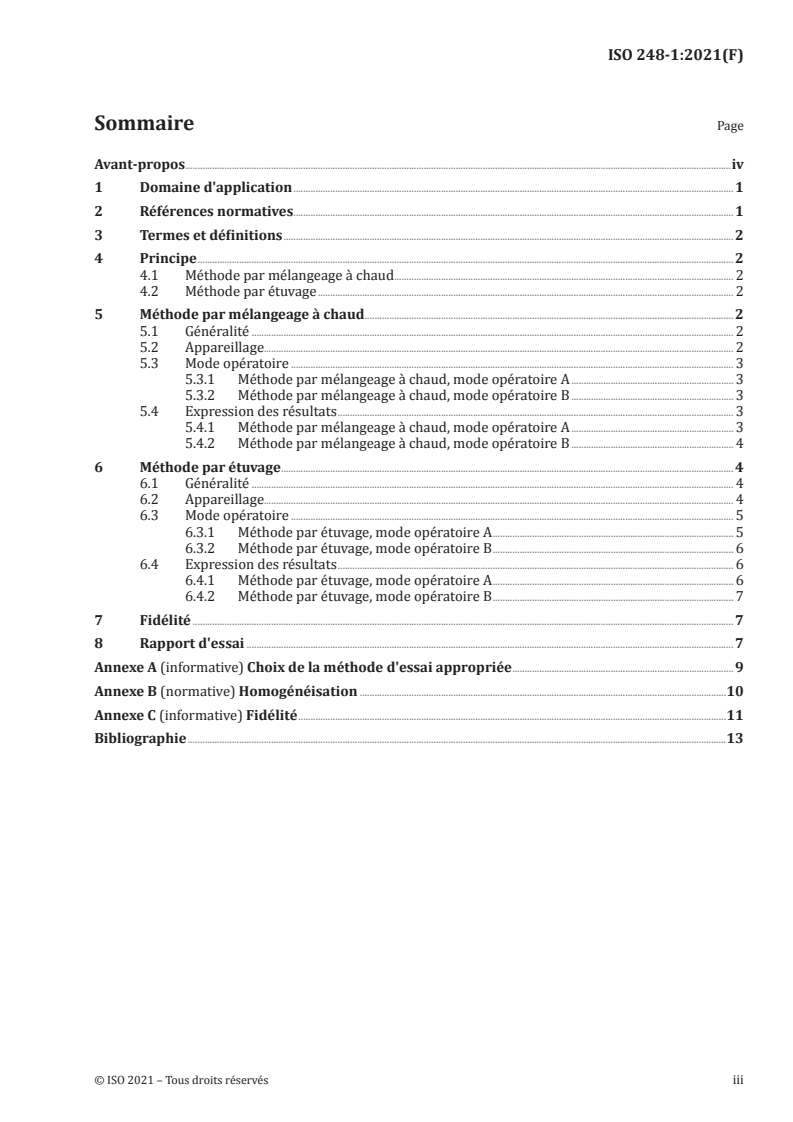
Sommaire Page
Avant-propos .iv
1 Domaine d'application . 1
2 Références normatives . 1
3 Termes et définitions . 2
4 Principe . 2
4.1 Méthode par mélangeage à chaud . 2
4.2 Méthode par étuvage . 2
5 Méthode par mélangeage à chaud . 2
5.1 Généralité . 2
5.2 Appareillage. 2
5.3 Mode opératoire . 3
5.3.1 Méthode par mélangeage à chaud, mode opératoire A . 3
5.3.2 Méthode par mélangeage à chaud, mode opératoire B . 3
5.4 Expression des résultats . 3
5.4.1 Méthode par mélangeage à chaud, mode opératoire A . 3
5.4.2 Méthode par mélangeage à chaud, mode opératoire B . 4
6 Méthode par étuvage . 4
6.1 Généralité . 4
6.2 Appareillage. 4
6.3 Mode opératoire . 5
6.3.1 Méthode par étuvage, mode opératoire A . 5
6.3.2 Méthode par étuvage, mode opératoire B . 6
6.4 Expression des résultats . 6
6.4.1 Méthode par étuvage, mode opératoire A . 6
6.4.2 Méthode par étuvage, mode opératoire B . 7
7 Fidélité . 7
8 Rapport d'essai . 7
Annexe A (informative) Choix de la méthode d'essai appropriée . 9
Annexe B (normative) Homogénéisation .10
Annexe C (informative) Fidélité .11
Bibliographie .13
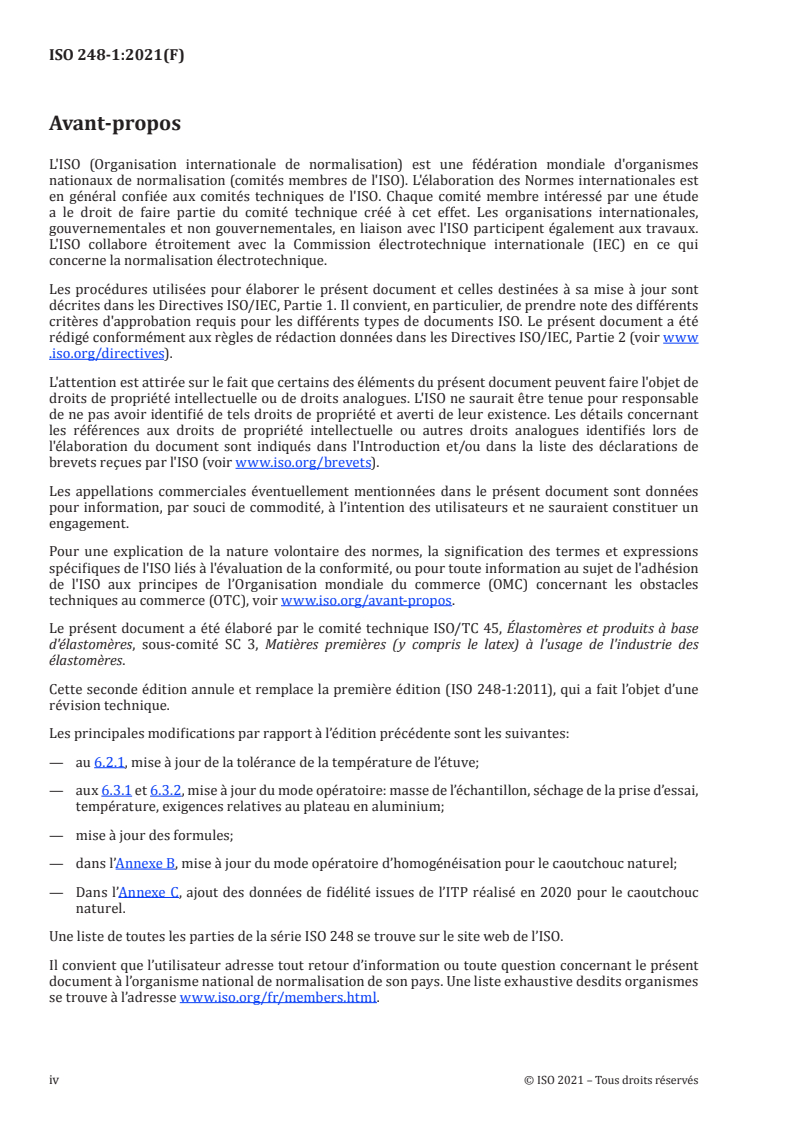
Avant-propos
L'ISO (Organisation internationale de normalisation) est une fédération mondiale d'organismes
nationaux de normalisation (comités membres de l'ISO). L'élaboration des Normes internationales est
en général confiée aux comités techniques de l'ISO. Chaque comité membre intéressé par une étude
a le droit de faire partie du comité technique créé à cet effet. Les organisations internationales,
gouvernementales et non gouvernementales, en liaison avec l'ISO participent également aux travaux.
L'ISO collabore étroitement avec la Commission électrotechnique internationale (IEC) en ce qui
concerne la normalisation électrotechnique.
Les procédures utilisées pour élaborer le présent document et celles destinées à sa mise à jour sont
décrites dans les Directives ISO/IEC, Partie 1. Il convient, en particulier, de prendre note des différents
critères d'approbation requis pour les différents types de documents ISO. Le présent document a été
rédigé conformément aux règles de rédaction données dans les Directives ISO/IEC, Partie 2 (voir www
.iso .org/ directives).
L'attention est attirée sur le fait que certains des éléments du présent document peuvent faire l'objet de
droits de propriété intellectuelle ou de droits analogues. L'ISO ne saurait être tenue pour responsable
de ne pas avoir identifié de tels droits de propriété et averti de leur existence. Les détails concernant
les références aux droits de propriété intellectuelle ou autres droits analogues identifiés lors de
l'élaboration du document sont indiqués dans l'Introduction et/ou dans la liste des déclarations de
brevets reçues par l'ISO (voir www .iso .org/ brevets).
Les appellations commerciales éventuellement mentionnées dans le présent document sont données
pour information, par souci de commodité, à l’intention des utilisateurs et ne sauraient constituer un
engagement.
Pour une explication de la nature volontaire des normes, la signification des termes et expressions
spécifiques de l'ISO liés à l'évaluation de la conformité, ou pour toute information au sujet de l'adhésion
de l'ISO aux principes de l’Organisation mondiale du commerce (OMC) concernant les obstacles
techniques au commerce (OTC), voir www .iso .org/ avant -propos.
Le présent document a été élaboré par le comité technique ISO/TC 45, Élastomères et produits à base
d'élastomères, sous-comité SC 3, Matières premières (y compris le latex) à l'usage de l'industrie des
élastomères.
Cette seconde édition annule et remplace la première édition (ISO 248-1:2011), qui a fait l’objet d’une
révision technique.
Les principales modifications par rapport à l’édition précédente sont les suivantes:
— au 6.2.1, mise à jour de la tolérance de la température de l’étuve;
— aux 6.3.1 et 6.3.2, mise à jour du mode opératoire: masse de l’échantillon, séchage de la prise d’essai,
température, exigences relatives au plateau en aluminium;
— mise à jour des formules;
— dans l’Annexe B, mise à jour du mode opératoire d’homogénéisation pour le caoutchouc naturel;
— Dans l’Annexe C, ajout des données de fidélité issues de l’ITP réalisé en 2020 pour le caoutchouc
naturel.
Une liste de toutes les parties de la série ISO 248 se trouve sur le site web de l’ISO.
Il convient que l’utilisateur adresse tout retour d’information ou toute question concernant le présent
document à l’organisme national de normalisation de son pays. Une liste exhaustive desdits organismes
se trouve à l’adresse www .iso .org/ fr/ members .html.
iv © ISO 2021 – Tous droits réservés
NORME INTERNATIONALE ISO 248-1:2021(F)
Caoutchouc brut — Détermination des matières
volatiles —
Partie 1:
Méthode par mélangeage à chaud et méthode par étuvage
AVERTISSEMENT — Il convient que l'utilisateur du présent document connaisse bien les
pratiques courantes de laboratoire. Le présent document n'a pas pour but de traiter tous les
problèmes de sécurité qui sont, le cas échéant, liés à son utilisation. Il incombe à l'utilisateur
d'établir des pratiques appropriées en matière d'hygiène et de sécurité.
IMPORTANT — Certains modes opératoires spécifiés dans le présent document peuvent
impliquer l'utilisation ou la génération de substances ou de déchets pouvant représenter
un danger environnemental local. Il convient de se référer à la documentation appropriée
concernant la manipulation et l'élimination après usage en toute sécurité.
1 Domaine d'application
Le présent document spécifie deux méthodes pour la détermination de la teneur en matières volatiles
des caoutchoucs bruts par mélangeage à chaud ou par étuvage.
Ces méthodes sont applicables à la détermination de la teneur en matières volatiles des caoutchoucs du
groupe «R» répertoriés dans l'ISO 1629. Ce sont des caoutchoucs ayant une chaîne carbonée non saturée,
par exemple le caoutchouc naturel et les caoutchoucs synthétiques dérivés, au moins partiellement, de
diènes conjugués. Ces méthodes peuvent également être applicables à d'autres caoutchoucs mais, dans
ces cas, il est nécessaire de démontrer que la variation de masse n'est due qu'à la perte des matières
volatiles d'origine et non à la dégradation du caoutchouc.
La méthode par mélangeage à chaud n'est pas applicable au caoutchouc naturel, aux caoutchoucs
synthétiques qui sont trop difficiles à traiter par mélangeage à chaud ou aux caoutchoucs synthétiques
en poudre ou en chips.
Les méthodes d'essai n'aboutissent pas nécessairement aux mêmes résultats. Par conséquent, en cas de
litige, la méthode par étuvage, mode opératoire A, est la méthode de référence.
NOTE L'applicabilité de chaque méthode d'essai aux différents types de caoutchouc est résumée dans
l'Annexe A.
2 Références normatives
Les documents suivants sont cités dans le texte de sorte qu’ils constituent, pour tout ou partie de leur
contenu, des exigences du présent document. Pour les références datées, seule l’édition citée s’applique.
Pour les références non datées, la dernière édition du document de référence s'applique (y compris les
éventuels amendements).
ISO 1795, Caoutchouc, naturel brut et synthétique brut — Méthodes d'échantillonnage et de préparation
ultérieure
ISO 2393, Mélanges d'essais à base de caoutchouc — Mélangeage, préparation et vulcanisation —
Appareillage et modes opératoires
3 Termes et définitions
Pour les besoins du présent document, les termes et définitions donnés dans l'ISO 1795 ainsi que les
suivants s'appliquent.
L’ISO et l’IEC tiennent à jour des bases de données terminologiques destinées à être utilisées en
normalisation, consultables aux adresses suivantes:
— ISO Online browsing platform: disponible à l’adresse https:// www .iso .org/ obp
— IEC Electropedia: disponible à l’adresse https:// www .electropedia .org/
3.1
prise d'essai
quantité de caoutchouc prélevée dans l'échantillon pour essai ou dans l'échantillon pour laboratoire
pour les besoins d'un essai spécifique unique, par exemple la quantité réellement pesée et utilisée pour
une détermination unique de la teneur en matières volatiles
4 Principe
4.1 Méthode par mélangeage à chaud
Une prise d'essai est mise en feuille mince sur des cylindres chauffés, jusqu'à disparition de toutes
les matières volatiles. La perte de masse au cours du mélangeage est calculée et exprimée en tant que
teneur en matières volatiles.
4.2 Méthode par étuvage
Une prise d'essai est séchée dans une étuve jusqu'à obtention d'une masse constante. La perte de masse
est calculée et exprimée en tant que teneur en matières volatiles.
5 Méthode par mélangeage à chaud
5.1 Généralité
5.1.1 Deux modes opératoires sont spécifiés, comme suit.
— Méthode par mélangeage à chaud, mode opératoire A: un échantillon pour essai est homogénéisé à
l'aide d'un mélangeur de laboratoire, et une prise d'essai obtenue à partir de l'échantillon pour essai
homogénéisé est séchée au moyen d'un mélangeur à chaud jusqu'à obtention d'une masse constante.
— Méthode par mélangeage à chaud, mode opératoire B: une prise d'essai est séchée au moyen d'un
mélangeur à chaud jusqu'à obtention d'une masse constante.
NOTE Le mode opératoire B est une méthode simplifiée qui ne comprend pas de phase d'homogénéisation.
5.1.2 Si l'échantillon s'écaille ou devient collant sur les cylindres du mélangeur à chaud, rendant la
pesée difficile ou impossible, la méthode par étuvage doit être utilisée.
5.1.3 Le nombre de prises d'essai doit faire l'objet d'un accord entre les parties intéressées.
5.2 Appareillage
5.2.1 Mélangeur, conforme aux exigences de l'ISO 2393.
5.2.2 Balance, permettant de peser à 0,1 g près.
2 © ISO 2021 – Tous droits réservés
5.3 Mode opératoire
5.3.1 Méthode par mélangeage à chaud, mode opératoire A
5.3.1.1 Prélever un échantillon pour essai d'environ 250 g à partir de l'échantillon de laboratoire
conformément à l'ISO 1795 et l’homogénéiser conformément à l’Annexe B. Peser à 0,1 g près avant et
après homogénéisation (masses m et m , respectivement). Découper les prises d'essai nécessaires pour
1 2
les analyses chimiques et essais physiques à partir de l'échantillon pour essai homogénéisé, si nécessaire.
5.3.1.2 Régler l'écartement des cylindres du mélangeur à 0,25 mm ± 0,05 mm, en utilisant des
bandes de plomb, comme spécifié dans l'ISO 2393. Maintenir la température de surface des cylindres à
105 °C ± 5 °C.
5.3.1.3 Passer plusieurs fois une prise d'essai pesée (masse m ), de préférence de 100 g ou plus,
prélevée de l'échantillon homogénéisé, dans le mélangeur pendant 4 min. Ne pas laisser la prise d'essai
s'agglomérer et prendre soin d'éviter toute perte de caoutchouc. Peser la prise d'essai à 0,1 g près. Passer
à nouveau la prise d'essai dans le mélangeur pendant encore 2 min et la peser à nouveau. Si les masses à
la fin des périodes de 4 min et 6 min diffèrent de moins de 0,1 g, calculer la teneur en matières volatiles.
Dans le cas contraire, poursuivre le passage de la prise d'essai dans le mélangeur pendant des périodes
de 2 min jusqu'à ce que la réduction de masse ne dépasse pas 0,1 g entre deux pesées successives
(masse finale m ). Avant chaque pesée, laisser refroidir la prise d'essai à température ambiante dans un
dessiccateur.
5.3.2 Méthode par mélangeage à chaud, mode opératoire B
5.3.2.1 Prélever une prise d'essai d'environ 250 g à partir de l'échantillon de laboratoire et la peser à
0,1 g près (masse m ).
5.3.2.2 Régler l'écartement des cylindres du mélangeur à 0,25 mm ± 0,05 mm, en utilisant des
bandes de plomb, comme spécifié dans l'ISO 2393. Maintenir la température de surface des cylindres à
105 °C ± 5 °C. Faire passer à plusieurs reprise la prise d'essai dans le mélangeur pendant 4 min. Ne pas
laisser la prise d’essai former un manchon et prendre soin d’éviter toute perte de matière. Peser à 0,1 g
près, suivi par des passages dans le mélangeur pendant 2 min supplémentaires et peser à nouveau.
5.3.2.3 Si la différence de masse de la prise d'essai, avant et après passage dans le mélangeur, est
inférieure à 0,1 g, la prise d'essai est considérée comme étant bien sèche. Si elle n’est pas bien sèche,
poursuivre le passage de la prise d'essai dans le mélangeur pendant 2 min supplémentaires jusqu'à ce
que la différence de masse soit inférieure à 0,1 g (masse finale m ).
NOTE Le refroidissement dans un dessiccateur avant la pesée est souhaitable.
5.4 Expression des résultats
5.4.1 Méthode par mélangeage à chaud, mode opératoire A
La teneur en matières volatiles w , exprimée en fraction massique en pourcentage, est donnée par la
Formule (1):
mm×
w =−1 ×100 (1)
1
mm×
13
où
m est la masse, en grammes, de l’échantillon pour essai avant homogénéisation;
m est la masse, en grammes, de l’échantillon pour essai après homogénéisation;
m est la masse, en grammes, de la prise d'essai avant passage dans le mélangeur;
m est la masse, en grammes, de la prise d'essai après passage dans le mélangeur.
5.4.2 Méthode par mélangeage à chaud, mode opératoire B
La teneur en matières volatiles w , exprimée en fraction massique en pourcentage, est donnée par la
Formule (2):
mm−
w = ×100 (2)
m
où
m est la masse, en grammes, de la prise d’essai avant passage dans le mélangeur;
m est la masse, en grammes, de la prise d’essai après passage dans le mélangeur.
6 Méthode par étuvage
6.1 Généralité
6.1.1 Deux modes opératoires sont spécifiés, comme suit.
— Méthode par étuvage, mode opératoire A: un échantillon pour essai est homogénéisé au moyen
d'un mélangeur de laboratoire, et une prise d'essai obtenue à partir de l'échantillon pour essai
homogénéisé est séchée dans une étuve jusqu'à obtention d'une masse constante. Si l'échantillon est
sous forme de poudre, ou impossible à peser avant et après homogénéisation, un échantillon
...
NORME ISO
INTERNATIONALE 248-1
Deuxième édition
2021-06
Caoutchouc brut — Détermination des
matières volatiles —
Partie 1:
Méthode par mélangeage à chaud et
méthode par étuvage
Rubber, raw — Determination of volatile-matter content —
Part 1: Hot-mill method and oven method
Numéro de référence
©
ISO 2021
DOCUMENT PROTÉGÉ PAR COPYRIGHT
© ISO 2021
Tous droits réservés. Sauf prescription différente ou nécessité dans le contexte de sa mise en œuvre, aucune partie de cette
publication ne peut être reproduite ni utilisée sous quelque forme que ce soit et par aucun procédé, électronique ou mécanique,
y compris la photocopie, ou la diffusion sur l’internet ou sur un intranet, sans autorisation écrite préalable. Une autorisation peut
être demandée à l’ISO à l’adresse ci-après ou au comité membre de l’ISO dans le pays du demandeur.
ISO copyright office
Case postale 401 • Ch. de Blandonnet 8
CH-1214 Vernier, Genève
Tél.: +41 22 749 01 11
E-mail: copyright@iso.org
Web: www.iso.org
Publié en Suisse
ii © ISO 2021 – Tous droits réservés
Sommaire Page
Avant-propos .iv
1 Domaine d'application . 1
2 Références normatives . 1
3 Termes et définitions . 2
4 Principe . 2
4.1 Méthode par mélangeage à chaud . 2
4.2 Méthode par étuvage . 2
5 Méthode par mélangeage à chaud . 2
5.1 Généralité . 2
5.2 Appareillage. 2
5.3 Mode opératoire . 3
5.3.1 Méthode par mélangeage à chaud, mode opératoire A . 3
5.3.2 Méthode par mélangeage à chaud, mode opératoire B . 3
5.4 Expression des résultats . 3
5.4.1 Méthode par mélangeage à chaud, mode opératoire A . 3
5.4.2 Méthode par mélangeage à chaud, mode opératoire B . 4
6 Méthode par étuvage . 4
6.1 Généralité . 4
6.2 Appareillage. 4
6.3 Mode opératoire . 5
6.3.1 Méthode par étuvage, mode opératoire A . 5
6.3.2 Méthode par étuvage, mode opératoire B . 6
6.4 Expression des résultats . 6
6.4.1 Méthode par étuvage, mode opératoire A . 6
6.4.2 Méthode par étuvage, mode opératoire B . 7
7 Fidélité . 7
8 Rapport d'essai . 7
Annexe A (informative) Choix de la méthode d'essai appropriée . 9
Annexe B (normative) Homogénéisation .10
Annexe C (informative) Fidélité .11
Bibliographie .13
Avant-propos
L'ISO (Organisation internationale de normalisation) est une fédération mondiale d'organismes
nationaux de normalisation (comités membres de l'ISO). L'élaboration des Normes internationales est
en général confiée aux comités techniques de l'ISO. Chaque comité membre intéressé par une étude
a le droit de faire partie du comité technique créé à cet effet. Les organisations internationales,
gouvernementales et non gouvernementales, en liaison avec l'ISO participent également aux travaux.
L'ISO collabore étroitement avec la Commission électrotechnique internationale (IEC) en ce qui
concerne la normalisation électrotechnique.
Les procédures utilisées pour élaborer le présent document et celles destinées à sa mise à jour sont
décrites dans les Directives ISO/IEC, Partie 1. Il convient, en particulier, de prendre note des différents
critères d'approbation requis pour les différents types de documents ISO. Le présent document a été
rédigé conformément aux règles de rédaction données dans les Directives ISO/IEC, Partie 2 (voir www
.iso .org/ directives).
L'attention est attirée sur le fait que certains des éléments du présent document peuvent faire l'objet de
droits de propriété intellectuelle ou de droits analogues. L'ISO ne saurait être tenue pour responsable
de ne pas avoir identifié de tels droits de propriété et averti de leur existence. Les détails concernant
les références aux droits de propriété intellectuelle ou autres droits analogues identifiés lors de
l'élaboration du document sont indiqués dans l'Introduction et/ou dans la liste des déclarations de
brevets reçues par l'ISO (voir www .iso .org/ brevets).
Les appellations commerciales éventuellement mentionnées dans le présent document sont données
pour information, par souci de commodité, à l’intention des utilisateurs et ne sauraient constituer un
engagement.
Pour une explication de la nature volontaire des normes, la signification des termes et expressions
spécifiques de l'ISO liés à l'évaluation de la conformité, ou pour toute information au sujet de l'adhésion
de l'ISO aux principes de l’Organisation mondiale du commerce (OMC) concernant les obstacles
techniques au commerce (OTC), voir www .iso .org/ avant -propos.
Le présent document a été élaboré par le comité technique ISO/TC 45, Élastomères et produits à base
d'élastomères, sous-comité SC 3, Matières premières (y compris le latex) à l'usage de l'industrie des
élastomères.
Cette seconde édition annule et remplace la première édition (ISO 248-1:2011), qui a fait l’objet d’une
révision technique.
Les principales modifications par rapport à l’édition précédente sont les suivantes:
— au 6.2.1, mise à jour de la tolérance de la température de l’étuve;
— aux 6.3.1 et 6.3.2, mise à jour du mode opératoire: masse de l’échantillon, séchage de la prise d’essai,
température, exigences relatives au plateau en aluminium;
— mise à jour des formules;
— dans l’Annexe B, mise à jour du mode opératoire d’homogénéisation pour le caoutchouc naturel;
— Dans l’Annexe C, ajout des données de fidélité issues de l’ITP réalisé en 2020 pour le caoutchouc
naturel.
Une liste de toutes les parties de la série ISO 248 se trouve sur le site web de l’ISO.
Il convient que l’utilisateur adresse tout retour d’information ou toute question concernant le présent
document à l’organisme national de normalisation de son pays. Une liste exhaustive desdits organismes
se trouve à l’adresse www .iso .org/ fr/ members .html.
iv © ISO 2021 – Tous droits réservés
NORME INTERNATIONALE ISO 248-1:2021(F)
Caoutchouc brut — Détermination des matières
volatiles —
Partie 1:
Méthode par mélangeage à chaud et méthode par étuvage
AVERTISSEMENT — Il convient que l'utilisateur du présent document connaisse bien les
pratiques courantes de laboratoire. Le présent document n'a pas pour but de traiter tous les
problèmes de sécurité qui sont, le cas échéant, liés à son utilisation. Il incombe à l'utilisateur
d'établir des pratiques appropriées en matière d'hygiène et de sécurité.
IMPORTANT — Certains modes opératoires spécifiés dans le présent document peuvent
impliquer l'utilisation ou la génération de substances ou de déchets pouvant représenter
un danger environnemental local. Il convient de se référer à la documentation appropriée
concernant la manipulation et l'élimination après usage en toute sécurité.
1 Domaine d'application
Le présent document spécifie deux méthodes pour la détermination de la teneur en matières volatiles
des caoutchoucs bruts par mélangeage à chaud ou par étuvage.
Ces méthodes sont applicables à la détermination de la teneur en matières volatiles des caoutchoucs du
groupe «R» répertoriés dans l'ISO 1629. Ce sont des caoutchoucs ayant une chaîne carbonée non saturée,
par exemple le caoutchouc naturel et les caoutchoucs synthétiques dérivés, au moins partiellement, de
diènes conjugués. Ces méthodes peuvent également être applicables à d'autres caoutchoucs mais, dans
ces cas, il est nécessaire de démontrer que la variation de masse n'est due qu'à la perte des matières
volatiles d'origine et non à la dégradation du caoutchouc.
La méthode par mélangeage à chaud n'est pas applicable au caoutchouc naturel, aux caoutchoucs
synthétiques qui sont trop difficiles à traiter par mélangeage à chaud ou aux caoutchoucs synthétiques
en poudre ou en chips.
Les méthodes d'essai n'aboutissent pas nécessairement aux mêmes résultats. Par conséquent, en cas de
litige, la méthode par étuvage, mode opératoire A, est la méthode de référence.
NOTE L'applicabilité de chaque méthode d'essai aux différents types de caoutchouc est résumée dans
l'Annexe A.
2 Références normatives
Les documents suivants sont cités dans le texte de sorte qu’ils constituent, pour tout ou partie de leur
contenu, des exigences du présent document. Pour les références datées, seule l’édition citée s’applique.
Pour les références non datées, la dernière édition du document de référence s'applique (y compris les
éventuels amendements).
ISO 1795, Caoutchouc, naturel brut et synthétique brut — Méthodes d'échantillonnage et de préparation
ultérieure
ISO 2393, Mélanges d'essais à base de caoutchouc — Mélangeage, préparation et vulcanisation —
Appareillage et modes opératoires
3 Termes et définitions
Pour les besoins du présent document, les termes et définitions donnés dans l'ISO 1795 ainsi que les
suivants s'appliquent.
L’ISO et l’IEC tiennent à jour des bases de données terminologiques destinées à être utilisées en
normalisation, consultables aux adresses suivantes:
— ISO Online browsing platform: disponible à l’adresse https:// www .iso .org/ obp
— IEC Electropedia: disponible à l’adresse https:// www .electropedia .org/
3.1
prise d'essai
quantité de caoutchouc prélevée dans l'échantillon pour essai ou dans l'échantillon pour laboratoire
pour les besoins d'un essai spécifique unique, par exemple la quantité réellement pesée et utilisée pour
une détermination unique de la teneur en matières volatiles
4 Principe
4.1 Méthode par mélangeage à chaud
Une prise d'essai est mise en feuille mince sur des cylindres chauffés, jusqu'à disparition de toutes
les matières volatiles. La perte de masse au cours du mélangeage est calculée et exprimée en tant que
teneur en matières volatiles.
4.2 Méthode par étuvage
Une prise d'essai est séchée dans une étuve jusqu'à obtention d'une masse constante. La perte de masse
est calculée et exprimée en tant que teneur en matières volatiles.
5 Méthode par mélangeage à chaud
5.1 Généralité
5.1.1 Deux modes opératoires sont spécifiés, comme suit.
— Méthode par mélangeage à chaud, mode opératoire A: un échantillon pour essai est homogénéisé à
l'aide d'un mélangeur de laboratoire, et une prise d'essai obtenue à partir de l'échantillon pour essai
homogénéisé est séchée au moyen d'un mélangeur à chaud jusqu'à obtention d'une masse constante.
— Méthode par mélangeage à chaud, mode opératoire B: une prise d'essai est séchée au moyen d'un
mélangeur à chaud jusqu'à obtention d'une masse constante.
NOTE Le mode opératoire B est une méthode simplifiée qui ne comprend pas de phase d'homogénéisation.
5.1.2 Si l'échantillon s'écaille ou devient collant sur les cylindres du mélangeur à chaud, rendant la
pesée difficile ou impossible, la méthode par étuvage doit être utilisée.
5.1.3 Le nombre de prises d'essai doit faire l'objet d'un accord entre les parties intéressées.
5.2 Appareillage
5.2.1 Mélangeur, conforme aux exigences de l'ISO 2393.
5.2.2 Balance, permettant de peser à 0,1 g près.
2 © ISO 2021 – Tous droits réservés
5.3 Mode opératoire
5.3.1 Méthode par mélangeage à chaud, mode opératoire A
5.3.1.1 Prélever un échantillon pour essai d'environ 250 g à partir de l'échantillon de laboratoire
conformément à l'ISO 1795 et l’homogénéiser conformément à l’Annexe B. Peser à 0,1 g près avant et
après homogénéisation (masses m et m , respectivement). Découper les prises d'essai nécessaires pour
1 2
les analyses chimiques et essais physiques à partir de l'échantillon pour essai homogénéisé, si nécessaire.
5.3.1.2 Régler l'écartement des cylindres du mélangeur à 0,25 mm ± 0,05 mm, en utilisant des
bandes de plomb, comme spécifié dans l'ISO 2393. Maintenir la température de surface des cylindres à
105 °C ± 5 °C.
5.3.1.3 Passer plusieurs fois une prise d'essai pesée (masse m ), de préférence de 100 g ou plus,
prélevée de l'échantillon homogénéisé, dans le mélangeur pendant 4 min. Ne pas laisser la prise d'essai
s'agglomérer et prendre soin d'éviter toute perte de caoutchouc. Peser la prise d'essai à 0,1 g près. Passer
à nouveau la prise d'essai dans le mélangeur pendant encore 2 min et la peser à nouveau. Si les masses à
la fin des périodes de 4 min et 6 min diffèrent de moins de 0,1 g, calculer la teneur en matières volatiles.
Dans le cas contraire, poursuivre le passage de la prise d'essai dans le mélangeur pendant des périodes
de 2 min jusqu'à ce que la réduction de masse ne dépasse pas 0,1 g entre deux pesées successives
(masse finale m ). Avant chaque pesée, laisser refroidir la prise d'essai à température ambiante dans un
dessiccateur.
5.3.2 Méthode par mélangeage à chaud, mode opératoire B
5.3.2.1 Prélever une prise d'essai d'environ 250 g à partir de l'échantillon de laboratoire et la peser à
0,1 g près (masse m ).
5.3.2.2 Régler l'écartement des cylindres du mélangeur à 0,25 mm ± 0,05 mm, en utilisant des
bandes de plomb, comme spécifié dans l'ISO 2393. Maintenir la température de surface des cylindres à
105 °C ± 5 °C. Faire passer à plusieurs reprise la prise d'essai dans le mélangeur pendant 4 min. Ne pas
laisser la prise d’essai former un manchon et prendre soin d’éviter toute perte de matière. Peser à 0,1 g
près, suivi par des passages dans le mélangeur pendant 2 min supplémentaires et peser à nouveau.
5.3.2.3 Si la différence de masse de la prise d'essai, avant et après passage dans le mélangeur, est
inférieure à 0,1 g, la prise d'essai est considérée comme étant bien sèche. Si elle n’est pas bien sèche,
poursuivre le passage de la prise d'essai dans le mélangeur pendant 2 min supplémentaires jusqu'à ce
que la différence de masse soit inférieure à 0,1 g (masse finale m ).
NOTE Le refroidissement dans un dessiccateur avant la pesée est souhaitable.
5.4 Expression des résultats
5.4.1 Méthode par mélangeage à chaud, mode opératoire A
La teneur en matières volatiles w , exprimée en fraction massique en pourcentage, est donnée par la
Formule (1):
mm×
w =−1 ×100 (1)
1
mm×
13
où
m est la masse, en grammes, de l’échantillon pour essai avant homogénéisation;
m est la masse, en grammes, de l’échantillon pour essai après homogénéisation;
m est la masse, en grammes, de la prise d'essai avant passage dans le mélangeur;
m est la masse, en grammes, de la prise d'essai après passage dans le mélangeur.
5.4.2 Méthode par mélangeage à chaud, mode opératoire B
La teneur en matières volatiles w , exprimée en fraction massique en pourcentage, est donnée par la
Formule (2):
mm−
w = ×100 (2)
m
où
m est la masse, en grammes, de la prise d’essai avant passage dans le mélangeur;
m est la masse, en grammes, de la prise d’essai après passage dans le mélangeur.
6 Méthode par étuvage
6.1 Généralité
6.1.1 Deux modes opératoires sont spécifiés, comme suit.
— Méthode par étuvage, mode opératoire A: un échantillon pour essai est homogénéisé au moyen
d'un mélangeur de laboratoire, et une prise d'essai obtenue à partir de l'échantillon pour essai
homogénéisé est séchée dans une étuve jusqu'à obtention d'une masse constante. Si l'échantillon est
sous forme de poudre, ou impossible à peser avant et après homogénéisation, un échantillon
...