

ISO 8637-1:2024
(Main)Extracorporeal systems for blood purification — Part 1: Haemodialysers, haemodiafilters, haemofilters and haemoconcentrators
General Information
- Abstract
This document specifies requirements and test methods for haemodialysers, haemodiafilters, haemofilters and haemoconcentrators, hereinafter collectively referred to as “the device”, for use in humans. This document does not apply to: — extracorporeal blood circuits; — plasmafilters; — haemoperfusion devices; — vascular access devices; — blood pumps; — systems to prepare, maintain or monitor dialysis fluid; — systems or equipment intended to perform haemodialysis, haemodiafiltration, haemofiltration or haemoconcentration; — reprocessing procedures and equipment. NOTE 1 Requirements for extracorporeal blood circuits for haemodialysers, haemodiafilters and haemofilters are specified in ISO 8637-2. NOTE 2 Requirements for plasmafilters are specified in ISO 8637-3.
- Status
- Published
- Publication Date
- 30-May-2024
- Technical Committee
- ISO/TC 150/SC 2 - Cardiovascular implants and extracorporeal systems
- Drafting Committee
- ISO/TC 150/SC 2 - Cardiovascular implants and extracorporeal systems
- Current Stage
- 9092 - International Standard to be revised
- Start Date
- 13-Oct-2025
- Completion Date
- 29-Aug-2026


Overview
ISO 8637-1:2024 - "Extracorporeal systems for blood purification - Part 1: Haemodialysers, haemodiafilters, haemofilters and haemoconcentrators" specifies safety, performance and test requirements for these blood purification devices intended for human use. This second edition updates terminology, revises test methods (including an example for endotoxin transfer), and clarifies labelling and documentation expectations. The standard focuses on the device itself and excludes whole dialysis systems and several accessory items (see Related Standards).
Key topics and technical requirements
The standard defines mandatory requirements and test methods across these areas:
- Biological safety and haemocompatibility: evaluation in line with ISO 10993 series to reduce adverse blood–material interactions.
- Sterility and non‑pyrogenicity: requirements and test methods for terminal sterilization and endotoxin control.
- Mechanical characteristics:
- Structural integrity and blood compartment integrity to prevent leaks or air ingress.
- Standardized blood compartment connectors and fluid connectors to ensure compatibility.
- Performance characteristics and measurements:
- Solute clearance (haemodialysers, haemodiafilters).
- Sieving coefficients (all listed devices) to quantify solute transfer.
- Ultrafiltration rate and ultrafiltration coefficient for fluid removal performance.
- Blood compartment volume and pressure drop across the device.
- Endotoxin transfer assessment to guard against pyrogenic risk.
- Shelf life, labelling and packaging: required information on device, container and accompanying documentation to support safe use and reprocessing instructions (where applicable).
The document provides specific test methods (Section 5) for each requirement and aligns dimensional specifications to ensure compatibility with extracorporeal circuits detailed in ISO 8637‑2.
Applications and who uses this standard
ISO 8637-1:2024 is essential for:
- Medical device manufacturers designing and validating haemodialysers, haemodiafilters, haemofilters and haemoconcentrators.
- Test laboratories performing conformity, sterility and performance testing.
- Regulatory bodies and notified bodies evaluating submissions and compliance.
- Biomedical engineers and procurement teams assessing device compatibility and safety for clinical settings.
- R&D teams developing next‑generation blood purification membranes and modules.
Adoption helps ensure device safety, interoperability with extracorporeal circuits, reliable performance and clear labelling for clinical use.
Related standards
- ISO 8637-2: extracorporeal blood circuits (compatibility with blood port dimensions)
- ISO 8637-3: plasmafilters
- ISO 10993 series: biological evaluation of medical devices
- ISO 11607-1/2: packaging for terminally sterilized medical devices
- ISO 14971: risk management for medical devices
- ISO 20417, ISO 17664‑1, ISO 80369‑7 (connectors)
Keywords: ISO 8637-1:2024, haemodialyser, haemodiafilter, haemofilter, haemoconcentrator, extracorporeal blood purification, dialysis standards, sterility, haemocompatibility, ultrafiltration, sieving coefficient, endotoxin transfer.
Relations
- Effective Date
- 21-Sep-2024
- Effective Date
- 25-Feb-2023
Get Certified
Connect with accredited certification bodies for this standard

BSI Group
BSI (British Standards Institution) is the business standards company that helps organizations make excellence a habit.

TÜV Rheinland
TÜV Rheinland is a leading international provider of technical services.

TÜV SÜD
TÜV SÜD is a trusted partner of choice for safety, security and sustainability solutions.
Sponsored listings
Frequently Asked Questions
ISO 8637-1:2024 is a standard published by the International Organization for Standardization (ISO). Its full title is "Extracorporeal systems for blood purification — Part 1: Haemodialysers, haemodiafilters, haemofilters and haemoconcentrators". This standard covers: This document specifies requirements and test methods for haemodialysers, haemodiafilters, haemofilters and haemoconcentrators, hereinafter collectively referred to as “the device”, for use in humans. This document does not apply to: — extracorporeal blood circuits; — plasmafilters; — haemoperfusion devices; — vascular access devices; — blood pumps; — systems to prepare, maintain or monitor dialysis fluid; — systems or equipment intended to perform haemodialysis, haemodiafiltration, haemofiltration or haemoconcentration; — reprocessing procedures and equipment. NOTE 1 Requirements for extracorporeal blood circuits for haemodialysers, haemodiafilters and haemofilters are specified in ISO 8637-2. NOTE 2 Requirements for plasmafilters are specified in ISO 8637-3.
This document specifies requirements and test methods for haemodialysers, haemodiafilters, haemofilters and haemoconcentrators, hereinafter collectively referred to as “the device”, for use in humans. This document does not apply to: — extracorporeal blood circuits; — plasmafilters; — haemoperfusion devices; — vascular access devices; — blood pumps; — systems to prepare, maintain or monitor dialysis fluid; — systems or equipment intended to perform haemodialysis, haemodiafiltration, haemofiltration or haemoconcentration; — reprocessing procedures and equipment. NOTE 1 Requirements for extracorporeal blood circuits for haemodialysers, haemodiafilters and haemofilters are specified in ISO 8637-2. NOTE 2 Requirements for plasmafilters are specified in ISO 8637-3.
ISO 8637-1:2024 is classified under the following ICS (International Classification for Standards) categories: 11.040.40 - Implants for surgery, prosthetics and orthotics. The ICS classification helps identify the subject area and facilitates finding related standards.
ISO 8637-1:2024 has the following relationships with other standards: It is inter standard links to ISO/FDIS 8637-1, ISO 8637-1:2017. Understanding these relationships helps ensure you are using the most current and applicable version of the standard.
ISO 8637-1:2024 is available in PDF format for immediate download after purchase. The document can be added to your cart and obtained through the secure checkout process. Digital delivery ensures instant access to the complete standard document.
Standards Content (Sample)
International
Standard
ISO 8637-1
Second edition
Extracorporeal systems for blood
2024-05
purification —
Part 1:
Haemodialysers, haemodiafilters,
haemofilters and
haemoconcentrators
Systèmes extracorporels pour la purification du sang —
Partie 1: Hémodialyseurs, hémodiafiltres, hémofiltres et
hémoconcentrateurs
Reference number
ISO 8637-1:2024(en)
© ISO 2024
All rights reserved. Unless otherwise specified, or required in the context of its implementation, no part of this publication may
be reproduced or utilized otherwise in any form or by any means, electronic or mechanical, including photocopying, or posting on
the internet or an intranet, without prior written permission. Permission can be requested from either ISO at the address below
or ISO’s member body in the country of the requester.
ISO copyright office
CP 401 • Ch. de Blandonnet 8
CH-1214 Vernier, Geneva
Phone: +41 22 749 01 11
Email: copyright@iso.org
Website: www.iso.org
Published in Switzerland
ii
ISO 8637-1:2024(en)
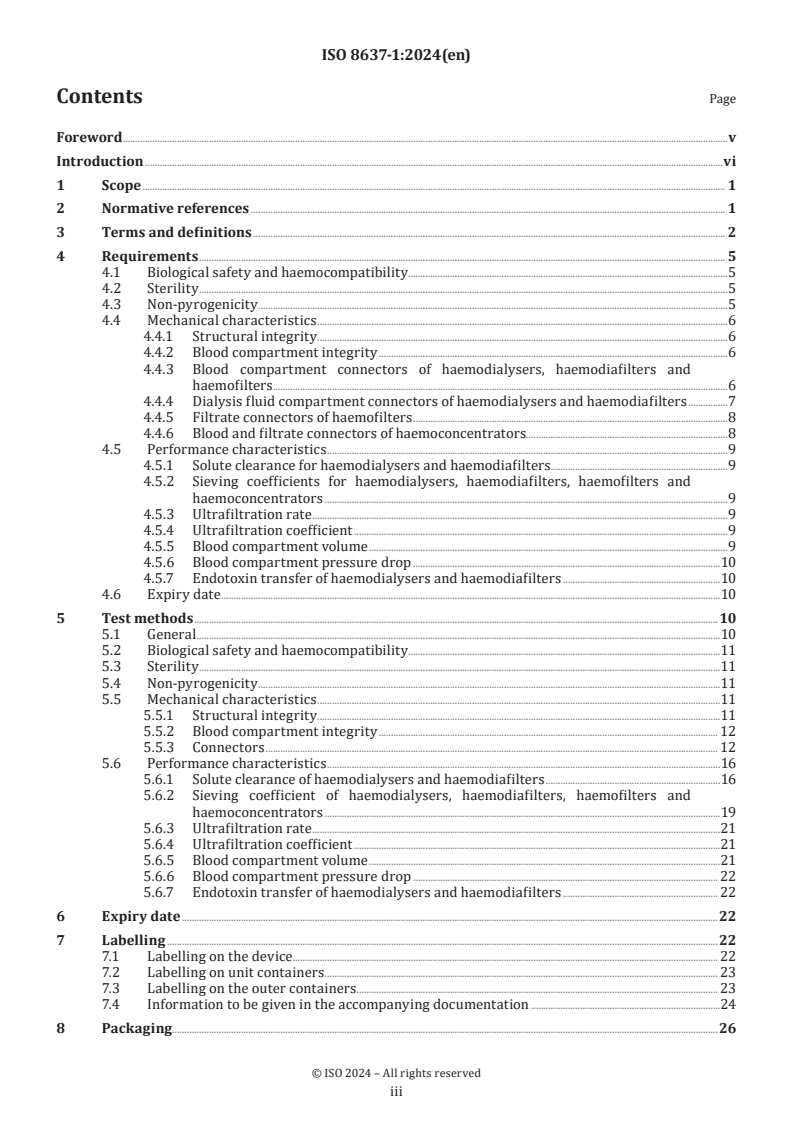
Contents Page
Foreword .v
Introduction .vi
1 Scope . 1
2 Normative references . 1
3 Terms and definitions . 2
4 Requirements . 5
4.1 Biological safety and haemocompatibility .5
4.2 Sterility .5
4.3 Non-pyrogenicity .5
4.4 Mechanical characteristics .6
4.4.1 Structural integrity.6
4.4.2 Blood compartment integrity .6
4.4.3 Blood compartment connectors of haemodialysers, haemodiafilters and
haemofilters . .6
4.4.4 Dialysis fluid compartment connectors of haemodialysers and haemodiafilters .7
4.4.5 Filtrate connectors of haemofilters .8
4.4.6 Blood and filtrate connectors of haemoconcentrators.8
4.5 Performance characteristics .9
4.5.1 Solute clearance for haemodialysers and haemodiafilters .9
4.5.2 Sieving coefficients for haemodialysers, haemodiafilters, haemofilters and
haemoconcentrators .9
4.5.3 Ultrafiltration rate .9
4.5.4 Ultrafiltration coefficient .9
4.5.5 Blood compartment volume .9
4.5.6 Blood compartment pressure drop .10
4.5.7 Endotoxin transfer of haemodialysers and haemodiafilters .10
4.6 Expiry date .10
5 Test methods . 10
5.1 General .10
5.2 Biological safety and haemocompatibility .11
5.3 Sterility .11
5.4 Non-pyrogenicity .11
5.5 Mechanical characteristics .11
5.5.1 Structural integrity.11
5.5.2 Blood compartment integrity . 12
5.5.3 Connectors . 12
5.6 Performance characteristics .16
5.6.1 Solute clearance of haemodialysers and haemodiafilters .16
5.6.2 Sieving coefficient of haemodialysers, haemodiafilters, haemofilters and
haemoconcentrators .19
5.6.3 Ultrafiltration rate .21
5.6.4 Ultrafiltration coefficient .21
5.6.5 Blood compartment volume .21
5.6.6 Blood compartment pressure drop . 22
5.6.7 Endotoxin transfer of haemodialysers and haemodiafilters . 22
6 Expiry date .22
7 Labelling .22
7.1 Labelling on the device. 22
7.2 Labelling on unit containers . 23
7.3 Labelling on the outer containers . 23
7.4 Information to be given in the accompanying documentation .24
8 Packaging.26
iii
ISO 8637-1:2024(en)
Annex A (informative) Endotoxin transfer assessment .27
Bibliography .30
iv
ISO 8637-1:2024(en)
Foreword
ISO (the International Organization for Standardization) is a worldwide federation of national standards
bodies (ISO member bodies). The work of preparing International Standards is normally carried out through
ISO technical committees. Each member body interested in a subject for which a technical committee
has been established has the right to be represented on that committee. International organizations,
governmental and non-governmental, in liaison with ISO, also take part in the work. ISO collaborates closely
with the International Electrotechnical Commission (IEC) on all matters of electrotechnical standardization.
The procedures used to develop this document and those intended for its further maintenance are described
in the ISO/IEC Directives, Part 1. In particular, the different approval criteria needed for the different types
of ISO document should be noted. This document was drafted in accordance with the editorial rules of the
ISO/IEC Directives, Part 2 (see www.iso.org/directives).
ISO draws attention to the possibility that the implementation of this document may involve the use of (a)
patent(s). ISO takes no position concerning the evidence, validity or applicability of any claimed patent
rights in respect thereof. As of the date of publication of this document, ISO had not received notice of (a)
patent(s) which may be required to implement this document. However, implementers are cautioned that
this may not represent the latest information, which may be obtained from the patent database available at
www.iso.org/patents. ISO shall not be held responsible for identifying any or all such patent rights.
Any trade name used in this document is information given for the convenience of users and does not
constitute an endorsement.
For an explanation of the voluntary nature of standards, the meaning of ISO specific terms and expressions
related to conformity assessment, as well as information about ISO's adherence to the World Trade
Organization (WTO) principles in the Technical Barriers to Trade (TBT), see www.iso.org/iso/foreword.html.
This document was prepared by Technical committee ISO/TC 150, Implants for surgery, Subcommittee SC 2,
Cardiovascular implants and extracorporeal systems.
This second edition cancels and replaces the first version of this document (ISO 8637-1:2017), which has
been technically revised.
The main changes are as follows:
— terms and definitions have been aligned with those defined in other parts of the ISO 8637 series;
— additional figures relating to gauges used to test dimensional compliance have been added;
— test methods have been revised and an example of a test method for endotoxin transfer measurement
has been added;
— requirements for accompanying documentation have been revised.
A list of all parts in the ISO 8637 series can be found on the ISO website.
Any feedback or questions on this document should be directed to the user’s national standards body. A
complete listing of these bodies can be found at www.iso.org/members.html.
v
ISO 8637-1:2024(en)
Introduction
This document is concerned with devices intended for haemodialysis, haemodiafiltration, haemofiltration
and haemoconcentration in humans. If such a device is used with an extracorporeal circuit, the dimensions
of the blood ports and filtrate ports have been specified to ensure compatibility of the device with the
extracorporeal blood circuit specified in ISO 8637-2. The design and dimensions have been selected to
minimize the risk of leakage of blood and the ingress of air.
The requirements specified in this document will help to ensure safety and satisfactory function.
It was not found practicable to specify materials of construction. This document therefore requires only that
materials which have been used have been tested and that the methods and results are made available upon
request.
There is no intention to specify, or to set limits on, the performance characteristics of the devices because
such restrictions are unnecessary for the qualified user and would limit the alternatives available when
choosing a device for a specific application. The performance characteristics together with their methods
of measurement have been revised and updated to take into consideration developments in technology that
have occurred since the publication of the previous edition of this document.
vi
International Standard ISO 8637-1:2024(en)
Extracorporeal systems for blood purification —
Part 1:
Haemodialysers, haemodiafilters, haemofilters and
haemoconcentrators
1 Scope
This document specifies requirements and test methods for haemodialysers, haemodiafilters, haemofilters
and haemoconcentrators, hereinafter collectively referred to as “the device”, for use in humans.
This document does not apply to:
— extracorporeal blood circuits;
— plasmafilters;
— haemoperfusion devices;
— vascular access devices;
— blood pumps;
— systems to prepare, maintain or monitor dialysis fluid;
— systems or equipment intended to perform haemodialysis, haemodiafiltration, haemofiltration or
haemoconcentration;
— reprocessing procedures and equipment.
NOTE 1 Requirements for extracorporeal blood circuits for haemodialysers, haemodiafilters and haemofilters are
specified in ISO 8637-2.
NOTE 2 Requirements for plasmafilters are specified in ISO 8637-3.
2 Normative references
The following documents are referred to in the text in such a way that some or all of their content constitutes
requirements of this document. For dated references, only the edition cited applies. For undated references,
the latest edition of the referenced document (including any amendments) applies.
ISO 10993-1, Biological evaluation of medical devices — Part 1: Evaluation and testing within a risk
management process
ISO 10993-4, Biological evaluation of medical devices — Part 4: Selection of tests for interactions with blood
ISO 10993-7, Biological evaluation of medical devices — Part 7: Ethylene oxide sterilization residuals
ISO 10993-11, Biological evaluation of medical devices — Part 11: Tests for systemic toxicity
ISO 11737-2, Sterilization of health care products — Microbiological methods — Part 2: Tests of sterility
performed in the definition, validation and maintenance of a sterilization process
ISO 11607-1, Packaging for terminally sterilized medical devices — Part 1: Requirements for materials, sterile
barrier systems and packaging systems
ISO 8637-1:2024(en)
ISO 11607-2, Packaging for terminally sterilized medical devices — Part 2: Validation requirements for forming,
sealing and assembly processes
ISO 14971, Medical devices — Application of risk management to medical devices
ISO 17664-1, Processing of health care products — Information to be provided by the medical device
manufacturer for the processing of medical devices — Part 1: Critical and semi-critical medical devices
ISO 20417, Medical devices — Information to be supplied by the manufacturer
ISO 80369-7:2021, Small-bore connectors for liquids and gases in healthcare applications — Part 7: Connectors
for intravascular or hypodermic applications
3 Terms and definitions
For the purposes of this document, the following terms and definitions apply.
ISO and IEC maintain terminology databases for use in standardization at the following addresses:
— ISO Online browsing platform: available at https:// www .iso .org/ obp
— IEC Electropedia: available at https:// www .electropedia .org/
3.1
blood compartment
part of a haemodialyser (3.16), haemodiafilter (3.14), haemofilter (3.18) or haemoconcentrator (3.13) through
which blood is intended to pass
3.2
blood compartment volume
volume which is needed to fill the blood compartment
Note 1 to entry: For hollow fibre devices, the blood compartment volume includes the volume of the hollow fibres plus
the headers.
3.3
blood compartment connector
blood connector
cone type connector to permit the entry and exit of blood and to connect the device to blood tubing sets
Note 1 to entry: Historically the term blood port was used.
3.4
clearance
volume of a solution from which a solute is completely removed per unit time
3.5
convection
transport of a solvent across a semipermeable membrane resulting from a pressure differential across the
membrane
Note 1 to entry: Convective solute transport supplements diffusive transport as a result of “solute drag” whereby
solutes contained in the solvent are co-transported with the solvent.
3.6
convective therapy
form of renal replacement therapy that removes uremic toxins from blood either by convection solely or by a
combination of diffusion and convection through a semipermeable membrane
Note 1 to entry: Convective therapies remove toxins from the blood by removing fluid from the device in excess of that
required to achieve the patient’s target fluid balance, thereby requiring infusion of replacement fluid into the patient’s
blood. In contrast, haemodialysis removes fluid from the device only to correct the patient’s fluid weight gain realized
between dialysis treatments.
ISO 8637-1:2024(en)
Note 2 to entry: Haemofiltration and haemodiafiltration are types of convective therapies.
Note 3 to entry: Haemoconcentrators are fluid removal devices used during cardiac surgery.
3.7
dialysis fluid
aqueous fluid containing electrolytes and, usually, buffer and glucose, which is intended to exchange solutes
with blood during haemodialysis (3.17) or haemodiafiltration (3.15)
Note 1 to entry: The term “dialysis fluid” is used throughout this document to mean the fluid (made from dialysis
water and concentrates) which is delivered to the haemodialyser or haemodiafilter by a dialysis fluid delivery system.
Phrases such as “dialysate”, “dialysis solution” or “dialysing fluid” can be used in place of dialysis fluid.
Note 2 to entry: The dialysis fluid entering the haemodialyser or haemodiafilter is referred to as “fresh dialysis fluid”,
while the fluid leaving the haemodialyser or haemodiafilter is referred to as “spent dialysis fluid” or “effluent”.
Note 3 to entry: Dialysis fluid does not include pre-packaged fluids used in some renal replacement therapies.
3.8
dialysis fluid compartment
part of a haemodialyser (3.16) or haemodiafilter (3.14) through which dialysis fluid (3.7) is intended to pass
3.9
dialysis fluid connector
dialysate connector
connector forming part of the device to permit the passage of dialysis fluid through the device and to link
the device to equipment producing the dialysis fluid
3.10
diffusion
transport of solutes across a semipermeable membrane, caused by a concentration gradient
3.11
filtrate
fluid removed from the blood across the semipermeable membrane contained in a haemodialyser (3.16),
haemodiafilter (3.14), haemofilter (3.18) or haemoconcentrator (3.13), due to a pressure gradient (including
the contributions of both hydrostatic and oncotic pressures) across the semipermeable membrane
Note 1 to entry: In a haemodialyser and haemodiafilter, the fluid removed is mixed with dialysis fluid flowing through
the device.
3.12
haemoconcentration
convective process with the purpose of removing excess plasma water from the patient’s blood volume, that
has been expanded by physiologic fluid, as typically required during cardiac surgery
3.13
haemoconcentrator
device intended to perform haemoconcentration (3.12)
3.14
haemodiafilter
device intended to perform haemodiafiltration (3.15)
ISO 8637-1:2024(en)
3.15
haemodiafiltration
HDF
process whereby concentrations of water-soluble substances in a patient's blood and an excess of fluid of a
patient are corrected by a simultaneous combination of haemodialysis (3.17) and haemofiltration (3.19)
Note 1 to entry: Diffusive solute removal is achieved using a dialysis fluid stream as in haemodialysis. Enhanced
convective solute removal is achieved by adding ultrafiltration in excess of that needed to achieve the desired weight
loss; fluid balance is maintained by the infusion of a replacement solution into the blood circuit either before (pre-
dilution haemodiafiltration) or after (post-dilution haemodiafiltration) or a combination of the two (mixed dilution
haemodiafiltration).
[SOURCE: IEC 60601-2-16:2018, 201.3.209, modified — Note 1 to entry has been added.]
3.16
haemodialyser
device intended to perform haemodialysis (3.17)
3.17
haemodialysis
HD
process whereby concentrations of water-soluble substances in a patient's blood and an excess of fluid of
a patient are corrected by bidirectional diffusive transport and ultrafiltration across a semipermeable
membrane separating the blood from the dialysis fluid
Note 1 to entry: This process typically includes fluid removal by filtration. This process is usually also accompanied by
diffusion of substances from the dialysis fluid into the blood.
[SOURCE: IEC 60601-2-16:2018, 201.3.209]
3.18
haemofilter
device intended to perform haemofiltration (3.19)
3.19
haemofiltration
HF
process whereby concentrations of water-soluble substances in a patient’s blood and an excess of fluid of a
patient are corrected by convective transport via ultrafiltration and partial replacement by a substitution
fluid resulting in the required net fluid removal
[SOURCE: IEC 60601-2-16:2018, 201.3.211]
Note 1 to entry: In haemofiltration, there is no dialysis fluid stream.
3.20
labelling
written, printed, graphic or electronic matter that is affixed to a device (haemodialyser, haemodiafilter,
haemofilter or haemoconcentrator) or any of its containers or wrappers, or accompanies a device and which
is related to identification, technical description and use of that device, but excluding shipping documents
3.21
sieving coefficient
ratio of a solute concentration in the filtrate to the simultaneous concentration of the same solute in the plasma
3.22
transmembrane pressure
TMP
p
TM
mean pressure exerted across a semipermeable membrane
ISO 8637-1:2024(en)
Note 1 to entry: For practical reasons, the mean TMP is generally expressed as either:
— the difference between arithmetic means of inlet and outlet pressures of the blood and dialysis fluid compartments
of a haemodialyser or a haemodiafilter; or
— the difference between the arithmetic mean of the inlet and outlet pressures of the blood compartment and the
filtrate pressure of a haemofilter or a haemoconcentrator.
3.23
ultrafiltration
UF
pressure driven process employing a hydraulic pressure gradient applied to a semipermeable membrane
Note 1 to entry: In haemodialysis treatment, ultrafiltration generally refers to the removal process used to remove
excess fluid from the patient.
3.24
ultrafiltration coefficient
permeability of the device to plasma water
Note 1 to entry: The ultrafiltration coefficient is generally expressed in millilitres per hour per millimetre of mercury.
3.25
ultrafiltration rate
UFR
filtrate flow rate from the blood compartment to the dialysis fluid compartment caused by a pressure
gradient or pressure differential across the membrane measured as volume per time
Note 1 to entry: Ultrafiltration rate is expressed in ml/min or l/h.
4 Requirements
4.1 Biological safety and haemocompatibility
Parts of the device that are intended to come into direct or indirect contact with blood shall be evaluated for
freedom from biological hazards, in accordance with 5.2. If the device is labelled for reuse, testing shall be
performed after reprocessing following the manufacturer's instructions for use.
Attention is drawn to the need to establish whether national regulations or national standards governing
toxicology and biocompatibility testing exist in the country in which the device is produced and, if applicable,
in the countries in which the device is to be marketed.
4.2 Sterility
The blood pathway of the device shall be sterile and the state of sterility of the device shall comply with the
manufacturer's statement [see 7.2 h)].
Compliance shall be verified in accordance with 5.3.
4.3 Non-pyrogenicity
The blood pathway of the device shall be non-pyrogenic and the state of non-pyrogenicity of the device shall
comply with the manufacturer's statement [see 7.2 h)].
Compliance shall be verified in accordance with 5.4.
ISO 8637-1:2024(en)
4.4 Mechanical characteristics
4.4.1 Structural integrity
The device external casing shall be capable of withstanding a positive pressure of 1,5 times of the
manufacturer's recommended maximum pressure above atmospheric pressure and a negative pressure not
exceeding 66,7 kPa (500 mmHg) below atmospheric pressure, when tested in accordance with 5.5.1.
4.4.2 Blood compartment integrity
When exposing the blood compartment of the device to a validated test procedure performed at 1,5 times of
the manufacturer's maximum recommended transmembrane pressure, the blood compartment shall not leak.
Compliance with this requirement shall be verified in accordance with 5.5.2.
4.4.3 Blood compartment connectors of haemodialysers, haemodiafilters and haemofilters
Except where the device and the extracorporeal blood circuit are designed as an integral system, the
dimensions of the blood compartment connectors shall be as given in Figure 1 and Table 1.
Compliance with this requirement shall be verified in accordance with 5.5.3.2.
Figure 1 — Cone blood inlet and outlet blood compartment connector of haemodialysers,
haemodiafilters or haemofilters
ISO 8637-1:2024(en)
Table 1 — Dimensions of the blood compartment connector
a b c d
E F G H J K P α β γ
mm mm mm mm mm mm mm ° °
Minimum 10,8 0,85 5,97 — —
Nominal 10 or more 9 or more 8 13 or more 11,0 1,10 6,00 15 15 6:100
Maximum 11,3 1,35 6,03 — —
Key
E length of tapered region
F length of tapered region
G thread pitch
H root diameter
J crest diameter
K thread crest width
P cone diameter
α angle of thread
β angle of thread
γ dimension taper rate
a
Double thread pitch.
b
Altered upper tolerance to accommodate different components and materials.
c
Revised dimension and tolerances based on existing manufacturing practice.
d
Cone's plane of reference: square A. This dimension is measured as a projection on the front face. See Figure 1 (Z).
4.4.4 Dialysis fluid compartment connectors of haemodialysers and haemodiafilters
Except where the haemodialyser or haemodiafilter and the dialysis fluid circuit are designed as an integral
system, the dimensions of the dialysis fluid compartment connectors shall be as given in Figure 2 and
Table 2.
Compliance with this requirement shall be verified in accordance with 5.5.3.3.
Figure 2 — Main fitting dimensions of the dialysis fluid inlet and outlet connector
ISO 8637-1:2024(en)
Table 2 — Main fitting dimensions of the dialysis fluid inlet and outlet connector
a b
E F G H J K P S α β X
mm mm mm mm mm mm mm ° ° °
Minimum 10,1 13,0 17,8 14,8 12,3 12,0
22 or
Nominal 10,2 13,1 17,8 0,5 14,9 12,4 12,1 45 45 45
more
Maximum 10,3 13,2 18,1 14,9 12,5 12,2
Key
E testing length
F reference length
G testing length range
H cone diameter
J cone diameter
K cone diameter
P diameter
S diameter
α angle of sealing surface
β angle of sealing surface
X angle of sealing surface
a
It defines the necessary length and diameter for engagement with the socket connectors of dialysis fluid circuit.
b
Together with α, it defines diameter of the sealing surface for the dialysis fluid connectors.
4.4.5 Filtrate connectors of haemofilters
Except where the haemofilter and the filtrate circuit are designed as an integral system, the filtrate
connectors of haemofilters shall follow either
a) the design of Figure 2, or
b) the Luer lock connector design of ISO 80369-7:2021, Figures B.1 and B.3.
Compliance with this requirement shall be verified in accordance with 5.5.3.4.
4.4.6 Blood and filtrate connectors of haemoconcentrators
4.4.6.1 Blood connectors
The blood and filtrate connectors of haemoconcentrators shall allow for a secure connection to the tubing
which is to be used with the device.
Non-locking connectors shall not separate under an axial force of 25 N applied for 15 s.
Except where the device and the extracorporeal blood circuit are designed as an integral system, the
dimensions of the blood compartment connectors shall be as given in Figure 1 and Table 1.
Dimensional compliance shall be determined using any one or combination of the following: digital contact
measurement instruments, optical measurement, three-dimensional X-ray imaging, analogue gauges or
another validated method. The dimensional compliance assessment may involve destructive methods to
gain access to features for measurement.
Compliance with this requirement shall be verified in accordance with 5.5.3.5.
ISO 8637-1:2024(en)
4.4.6.2 Filtrate connectors
Except where the haemoconcentrators are designed as an integral system, the filtrate connector design
shall follow
a) the design of Figure 2, or
b) the non-locking connection for direct attachment of the tubing, or
c) the Luer lock connector design of ISO 80369-7:2021, Figures B.1 and B.3.
If non-locking connectors are used, they shall not separate under an axial force of 25 N applied for 15 s.
Compliance with this requirement shall be verified in accordance with 5.5.3.5.
4.5 Performance characteristics
4.5.1 Solute clearance for haemodialysers and haemodiafilters
The clearance of urea, creatinine, phosphate and vitamin B shall be determined in accordance with 5.6.1.
Blood and dialysis fluid flow rates shall cover the manufacturer's specified range.
NOTE As a supplement, urea mass transfer area coefficient (KoA) results are included.
4.5.2 Sieving coefficients for haemodialysers, haemodiafilters, haemofilters and
haemoconcentrators
For haemodialysers, haemodiafilters and haemofilters, the sieving coefficients (SCs) for albumin, inulin, and
β -microglobulin or myoglobin shall be determined in accordance with 5.6.2.
Additionally, the following middle molecular weight proteins are of known clinical interest and represent a
range of molecular weights across the middle molecular spectrum. The manufacturer can choose to report
the SC for either these compounds or other middle molecular proteins, or both, to provide performance
characteristics if the SC for these proteins is larger than or equal to 0,1:
— kappa free light chains (κ-FLC, 23 kDa);
— complement factor D (CFD, 24 kDa);
— alpha 1-microglobulin (α1-M, 33 kDa);
— chitinase-3-like-protein 1 (YKL-40, 40 kDa);
— lambda free light chains (λ-FLC, 45 kDa).
For haemoconcentrators, the sieving coefficient for albumin shall be determined in accordance with 5.6.2.
4.5.3 Ultrafiltration rate
The ultrafiltration rate shall be determined if the device is intended for convective therapies in accordance
with 5.6.3.
4.5.4 Ultrafiltration coefficient
The ultrafiltration coefficient shall be determined in accordance with 5.6.4.
4.5.5 Blood compartment volume
The volume of the blood compartment shall be determined in accordance with 5.6.5.
ISO 8637-1:2024(en)
If the blood compartment volume is stable or constant over the clinical range of pressures, a single
measurement is sufficient. If the blood compartment volume varies with pressure, the blood compartment
volume over the clinical range of pressures shall be established.
4.5.6 Blood compartment pressure drop
The pressure drop of the blood compartment shall be determined in accordance with 5.6.6.
4.5.7 Endotoxin transfer of haemodialysers and haemodiafilters
The manufacturer shall determine that the risk to the patient is acceptable regarding pyrogenic response
due to endotoxin transfer between the dialysis fluid pathway and the blood fluid pathway during preparation
and therapy, and considering the results of endotoxin transfer testing.
Compliance with this requirement shall be verified in accordance with 5.6.7.
4.6 Expiry date
The biological safety, sterility, performance data and mechanical integrity of the device shall be proven after
storage for a period corresponding to the expiry date. The expiry date can be established with validated
accelerated stability studies and shall be confirmed by real time aging data.
Compliance shall be verified in accordance with Clause 6.
5 Test methods
5.1 General
The requirements specified in Clause 4 shall be determined prior to marketing a new type of device and
shall be re-evaluated after changes in the device that can alter its performance.
If labelled for multiple uses, devices shall be tested for structural integrity, biological safety and performance
after reprocessing in accordance with the manufacturer's instructions to characterize the effects of the
recommended cleaning agent and germicide on membrane performance.
For the tests, device sample size shall be risk based and shall be capable of demonstrating that the test
results meet the full range of specifications of the manufacturer with statistical confidence.
Configuration of the disposable samples used for the tests shall be representative of the final production
configuration, including sterilization.
Measurements shall be made in vitro at (37 ± 1) °C. When the relationship between variables is nonlinear,
sufficient determinations shall be made to permit interpolation between the data points. The techniques of
measurement given in this document are reference tests. Other test methods may be used, provided they
have been validated and shown to be precise and reproducible.
The test systems shown do not indicate all the necessary details of a practicable test apparatus. The design
and construction of actual test systems and the establishment of actual test systems shall also address
factors contributing to measurement error, including, but not limited to:
— pressure measurement errors due to static head effects and dynamic pressure drops;
— parameter stabilization time;
— uncontrolled temperature variations at the non-constant flow rates;
— pH;
— degradation of test substances due to heat, light and time;
ISO 8637-1:2024(en)
— degassing of test fluids;
— trapped air; and
— system contamination by foreign material, algae and bacteria.
NOTE Clause 5 contains tests that are of a type-testing nature, which are carried out prior to the marketing of
a new device or when changes are made to the device or its manufacturing processes. Others are of a quality control
nature, which are repeated on a regular basis according to quality management system requirements.
5.2 Biological safety and haemocompatibility
The biological safety of haemodialysers, haemodiafilters, haemofilters and haemoconcentrators pathways
that are intended to come into direct or indirect contact with the patient's blood shall be evaluated on
— samples of each new type of device prior to its marketing, or
— after any change in the materials of construction of that type of device, or
— after any change in the method of sterilization.
If labelled for multiple use, testing shall demonstrate the safety of the device before first use and after
reprocessing in accordance with the manufacturer's instructions. Testing shall be carried out in accordance
with ISO 10993-1, ISO 10993-4, ISO 10993-7 or ISO 10993-11, as relevant.
5.3 Sterility
Compliance with 4.2 shall be verified by inspection of the records to show that the device has been exposed
to a sterilization process that has been validated in accordance with ISO 11737-2.
5.4 Non-pyrogenicity
Compliance with 4.3 shall be verified in accordance with ISO 10993-11.
NOTE ISO 10993-11 does not specifically address the requirements for endotoxin mediated pyrogenicity test
methods but makes reference to ANSI/AAMI ST72.
5.5 Mechanical characteristics
5.5.1 Structural integrity
5.5.1.1 General
The requirements of 4.4.1 shall be verified by the test methods given in 5.5.1.2 and 5.5.1.3.
5.5.1.2 Positive pressure test
Completely fill the device with degassed water at (37 ± 1) °C. Seal all connectors except the connector to
which pressure is applied. Apply a positive air pressure 1,5 times of the manufacturer's recommended
maximum pressure and seal the apparatus. After 10 min, record the pressure and visually examine the
device for leaks.
Alternately, a constant air pressure (1,5 times of the manufacturer’s recommended maximum pressure) can
be applied and the device can be submerged in water to test for air leakage.
5.5.1.3 Negative pressure test
Completely fill the device with degassed water at (37 ± 1) °C. Seal all connectors except the connector to which
pressure is applied. Place the device under sub-atmospheric pressure of 1,5 times of the manufacturer's
recommended maximum pressure, unless that sub-atmospheric pressure exceeds 66,7 kPa (500 mmHg) or
ISO 8637-1:2024(en)
is not specified. In that case, apply a sub-atmospheric pressure of at least 66,7 kPa (500 mm Hg). Seal the
apparatus. After 10 min, record the pressure and visually examine the device for leaks.
Alternately, a constant negative air pressure of 66,7 kPa (500 mmHg) can be applied and the device can be
submerged in water to test for water leakage.
5.5.2 Blood compartment integrity
Compliance to 4.4.2 shall be determined by review of the validation records for the test procedure.
5.5.3 Connectors
5.5.3.1 General
All connectors shall provide a safe connection. In the case of blood connectors, to ensure a safe connection,
excessive leakage of air from the outside or loss of blood to the environment shall be avoided and in the case
of dialysis fluid connectors, the ingress of air or the leakage of dialysis fluid shall be avoided.
The degree of acceptable leakage rate, minimum separation force, minimum separation torque and
maximum connection torque shall be defined in accordance with the manufacturer’s risk management
process. Boundary parameters used in tests such as torques, connection forces and disconnection forces as
well as holding times, ambient temperatures, must be considered and defined as part of the manufacturer's
assessment for the use of the product.
5.5.3.2 Blood compartment connectors of haemodialysers, haemodiafilters and haemofilters
Compliance with 4.4.3 shall be determined by dimensional inspection meeting the requirements of Figure 1
and Table 1.
Dimensional compliance shall be determined using any one or combination of the following: digital contact
measurement instruments, optical measurement, three-dimensional X-ray imaging, analogue gauges or
other validated method.
Functional compliance is demonstrated by tests and acceptance criteria derived from the risk management
process. Where appropriate, reference may be made to ISO 80369-20, which specifies test methods to
evaluate the performance of small bore connectors in healthcare applications.
The analogue gauge described in Figures 3 to 5 is suitable for determining conformity to the Table 1
specification for cone diameter, P, and dimensional taper rate, γ. Figure 3 indicates the required dimensions
and tolerances of the gauge. Figure 4 illustrates a socket reference connector to measure the cone. The gauge
shown in Figure 3 conforms to the dimensions and tolerances of the socket reference connector. Figure 5
illustrates a cone engaged with the gauge meeting the specifications for cone diameter and taper rate of
Table 1 within the acceptance window “a”.
NOTE Dimensional assessment can involve destructive methods to gain access to features for measurement.
5.5.3.3 Dialysis fluid compartment connectors of haemodialysers and haemodiafilters
Compliance shall be determined by dimensional inspection meeting the requirements of Figure 2 and
Table 2 and determined using any one or combination of: digital contact measurement instruments, optical
measurement, three-dimensional X-ray imaging, analogue gauges or another validated method.
Functional compliance is demonstrated by tests and acceptance criteria derived from the risk management
process.
NOTE Dimensional assessment can involve destructive methods to gain access to features for measurement.
ISO 8637-1:2024(en)
5.5.3.4 Filtrate connectors of haemofilters
For c
...