

ISO 17168-4:2025
(Main)Fine ceramics (advanced ceramics, advanced technical ceramics) — Test method for air-purification performance of semiconducting photocatalytic materials under indoor lighting environment — Part 4: Removal of formaldehyde
General Information
- Abstract
This document specifies a test method for the determination of the air-purification performance, with regards to the removal of formaldehyde, of materials that contain a photocatalyst or have photocatalytic films on the surface, usually made from semiconducting metal oxides such as titanium dioxide or other ceramic materials, by continuous exposure of a test piece to the model air pollutant under illumination from indoor light. This document is applicable for use with different kinds of materials, such as construction materials in flat sheet, board or plate shape, which are the basic forms of materials for various applications. This document also applies to materials in honeycomb form, and to plastic or paper materials containing ceramic microcrystals and composites. This document does not apply to powder or granular photocatalytic materials. This test method is usually applicable to photocatalytic materials produced for air purification. This method is not suitable for the determination of other performance attributes of photocatalytic materials, i.e. decomposition of water contaminants, self-cleaning, antifogging and antibacterial actions.
- Status
- Published
- Publication Date
- 06-Nov-2025
- Technical Committee
- ISO/TC 206 - Fine ceramics
- Drafting Committee
- ISO/TC 206/WG 9 - Photocatalysis
- Current Stage
- 6060 - International Standard published
- Start Date
- 07-Nov-2025
- Due Date
- 12-Mar-2026
- Completion Date
- 07-Nov-2025
Buy Documents
ISO 17168-4:2025 - Fine ceramics (advanced ceramics, advanced technical ceramics) — Test method for air-purification performance of semiconducting photocatalytic materials under indoor lighting environment — Part 4: Removal of formaldehyde Released:7. 11. 2025
Overview
ISO 17168-4:2025 - Fine ceramics (advanced ceramics) - Test method for air‑purification performance of semiconducting photocatalytic materials under indoor lighting environment - Part 4: Removal of formaldehyde specifies a laboratory method to quantify how effectively photocatalytic materials remove formaldehyde (HCHO) from air under typical indoor illumination. The standard covers semiconducting photocatalysts (for example, titanium dioxide and other ceramic materials) in sheet, board, plate, honeycomb, or composite forms - but excludes powder or granular photocatalysts.
Key topics and technical requirements
- Test principle: Continuous exposure of a test piece in a flow‑type photoreactor to a model formaldehyde‑containing air stream while illuminated by an indoor light source; measurement of removed HCHO (µmol) and removal percentage.
- Apparatus components: test gas supply, photoreactor, light source, UV sharp cut‑off filter, airtight optical window, and analytical measurement system.
- Reactor geometry & materials:
- Planar test piece placed in a 50 mm wide trough with a 5.0 mm ± 0.5 mm air gap to the window.
- Window materials: quartz or borosilicate glass (minimal absorption > 300 nm).
- Recommended construction materials for low adsorption: acrylic resin, stainless steel, glass, fluorocarbon polymers.
- Gas supply & concentrations:
- Continuous humidified test gas flow with stable formaldehyde supply (standard cylinder gas ≈ 20 µl/l typically used).
- Typical flow controller capacities noted (e.g., pollutant gas ~100 ml/min; dry/wet air ~1 000 ml/min).
- Controls & corrections: Dark tests to separate simple adsorption from photocatalytic oxidation; calculations for removal quantity and percentage; reporting requirements and procedures for lower‑performance test pieces.
- Safety & competence: Addresses hazardous gas handling and references laboratory competence (ISO/IEC 17025).
Applications and who uses it
- Manufacturers of photocatalytic building materials, coatings, tiles and composite panels use ISO 17168-4:2025 to validate formaldehyde removal performance for indoor‑use products.
- Test and calibration laboratories apply the standardized method for product certification, R&D benchmarking and quality control.
- Material scientists and product developers use the method during formulation and scale‑up to quantify indoor‑light‑activated air purification.
- Indoor air quality (IAQ) specialists, architects and building product specifiers rely on results from this method when assessing material contributions to formaldehyde mitigation in occupied spaces.
Related standards
- ISO 17168-1 (NO removal method)
- ISO 14605 and ISO 24448 (light source specifications for indoor testing)
- ISO 16000-3 (formaldehyde sampling and analysis)
- ISO/IEC 17025 (laboratory competence)
ISO 17168-4:2025 provides a reproducible, application‑focused test method for evaluating formaldehyde removal by semiconducting photocatalytic materials under realistic indoor lighting - a practical tool for manufacturers, labs and IAQ professionals.
Relations
- Effective Date
- 16-Mar-2024
Buy Documents
ISO 17168-4:2025 - Fine ceramics (advanced ceramics, advanced technical ceramics) — Test method for air-purification performance of semiconducting photocatalytic materials under indoor lighting environment — Part 4: Removal of formaldehyde Released:7. 11. 2025
Frequently Asked Questions
ISO 17168-4:2025 is a standard published by the International Organization for Standardization (ISO). Its full title is "Fine ceramics (advanced ceramics, advanced technical ceramics) — Test method for air-purification performance of semiconducting photocatalytic materials under indoor lighting environment — Part 4: Removal of formaldehyde". This standard covers: This document specifies a test method for the determination of the air-purification performance, with regards to the removal of formaldehyde, of materials that contain a photocatalyst or have photocatalytic films on the surface, usually made from semiconducting metal oxides such as titanium dioxide or other ceramic materials, by continuous exposure of a test piece to the model air pollutant under illumination from indoor light. This document is applicable for use with different kinds of materials, such as construction materials in flat sheet, board or plate shape, which are the basic forms of materials for various applications. This document also applies to materials in honeycomb form, and to plastic or paper materials containing ceramic microcrystals and composites. This document does not apply to powder or granular photocatalytic materials. This test method is usually applicable to photocatalytic materials produced for air purification. This method is not suitable for the determination of other performance attributes of photocatalytic materials, i.e. decomposition of water contaminants, self-cleaning, antifogging and antibacterial actions.
This document specifies a test method for the determination of the air-purification performance, with regards to the removal of formaldehyde, of materials that contain a photocatalyst or have photocatalytic films on the surface, usually made from semiconducting metal oxides such as titanium dioxide or other ceramic materials, by continuous exposure of a test piece to the model air pollutant under illumination from indoor light. This document is applicable for use with different kinds of materials, such as construction materials in flat sheet, board or plate shape, which are the basic forms of materials for various applications. This document also applies to materials in honeycomb form, and to plastic or paper materials containing ceramic microcrystals and composites. This document does not apply to powder or granular photocatalytic materials. This test method is usually applicable to photocatalytic materials produced for air purification. This method is not suitable for the determination of other performance attributes of photocatalytic materials, i.e. decomposition of water contaminants, self-cleaning, antifogging and antibacterial actions.
ISO 17168-4:2025 is classified under the following ICS (International Classification for Standards) categories: 81.060.30 - Advanced ceramics. The ICS classification helps identify the subject area and facilitates finding related standards.
ISO 17168-4:2025 has the following relationships with other standards: It is inter standard links to ISO 17168-4:2018. Understanding these relationships helps ensure you are using the most current and applicable version of the standard.
ISO 17168-4:2025 is available in PDF format for immediate download after purchase. The document can be added to your cart and obtained through the secure checkout process. Digital delivery ensures instant access to the complete standard document.
Standards Content (Sample)
International
Standard
ISO 17168-4
Second edition
Fine ceramics (advanced ceramics,
2025-11
advanced technical ceramics) —
Test method for air-purification
performance of semiconducting
photocatalytic materials under
indoor lighting environment —
Part 4:
Removal of formaldehyde
Reference number
© ISO 2025
All rights reserved. Unless otherwise specified, or required in the context of its implementation, no part of this publication may
be reproduced or utilized otherwise in any form or by any means, electronic or mechanical, including photocopying, or posting on
the internet or an intranet, without prior written permission. Permission can be requested from either ISO at the address below
or ISO’s member body in the country of the requester.
ISO copyright office
CP 401 • Ch. de Blandonnet 8
CH-1214 Vernier, Geneva
Phone: +41 22 749 01 11
Email: copyright@iso.org
Website: www.iso.org
Published in Switzerland
ii
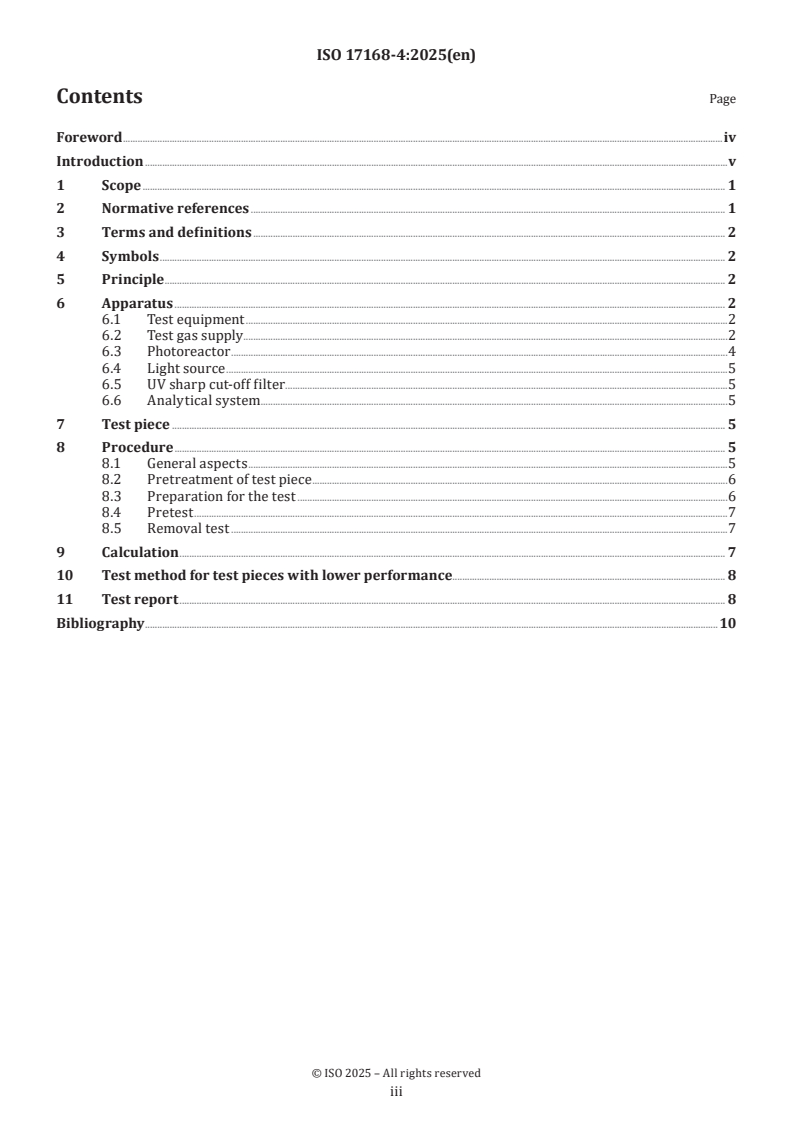
Contents Page
Foreword .iv
Introduction .v
1 Scope . 1
2 Normative references . 1
3 Terms and definitions . 2
4 Symbols . 2
5 Principle . 2
6 Apparatus . 2
6.1 Test equipment .2
6.2 Test gas supply .2
6.3 Photoreactor .4
6.4 Light source .5
6.5 UV sharp cut-off filter .5
6.6 Analytical system.5
7 Test piece . 5
8 Procedure . 5
8.1 General aspects .5
8.2 Pretreatment of test piece .6
8.3 Preparation for the test .6
8.4 Pretest .7
8.5 Removal test .7
9 Calculation . 7
10 Test method for test pieces with lower performance . 8
11 Test report . 8
Bibliography .10
iii
Foreword
ISO (the International Organization for Standardization) is a worldwide federation of national standards
bodies (ISO member bodies). The work of preparing International Standards is normally carried out through
ISO technical committees. Each member body interested in a subject for which a technical committee
has been established has the right to be represented on that committee. International organizations,
governmental and non-governmental, in liaison with ISO, also take part in the work. ISO collaborates closely
with the International Electrotechnical Commission (IEC) on all matters of electrotechnical standardization.
The procedures used to develop this document and those intended for its further maintenance are described
in the ISO/IEC Directives, Part 1. In particular, the different approval criteria needed for the different types
of ISO document should be noted. This document was drafted in accordance with the editorial rules of the
ISO/IEC Directives, Part 2 (see www.iso.org/directives).
ISO draws attention to the possibility that the implementation of this document may involve the use of (a)
patent(s). ISO takes no position concerning the evidence, validity or applicability of any claimed patent
rights in respect thereof. As of the date of publication of this document, ISO had not received notice of (a)
patent(s) which may be required to implement this document. However, implementers are cautioned that
this may not represent the latest information, which may be obtained from the patent database available at
www.iso.org/patents. ISO shall not be held responsible for identifying any or all such patent rights.
Any trade name used in this document is information given for the convenience of users and does not
constitute an endorsement.
For an explanation of the voluntary nature of standards, the meaning of ISO specific terms and expressions
related to conformity assessment, as well as information about ISO's adherence to the World Trade
Organization (WTO) principles in the Technical Barriers to Trade (TBT), see www.iso.org/iso/foreword.html.
This document was prepared by Technical Committee ISO/TC 206, Fine ceramics.
This second edition cancels and replaces the first edition (ISO 17168-4:2018), which has been technically
revised.
The main changes are as follows:
— normative reference to ISO 24448 added to Clause 2 and 6.4.
A list of all parts in the ISO 17168 series can be found on the ISO website.
Any feedback or questions on this document should be directed to the user’s national standards body. A
complete listing of these bodies can be found at www.iso.org/members.html.
iv
Introduction
A photocatalyst is a substance that performs decomposition and removal of contaminants, self-cleaning,
antifogging, deodorization and antibacterial actions under photoirradiation. Its application has expanded
considerably in recent years. The application of photocatalysts for indoor spaces has increasingly been
sought as a solution to indoor environmental problems. Since conventional photocatalysts are responsive
only to ultraviolet light, studies have been made to develop an indoor-light-active photocatalyst that makes
effective use of indoor light, which room lights mainly emit, and thus demonstrates high photocatalytic
performance indoors. The development has recently led to the commercialization of various indoor-light-
active photocatalytic products, and there has been demand for the establishment of test methods to evaluate
the performance of this type of photocatalyst.
This document, with ISO 17168-1 and ISO 22197-4 as the basis, is intended to provide a testing method to
determine the performance of indoor-light-active photocatalytic materials with regards to the removal of
formaldehyde, a particularly relevant volatile organic compound (VOC) that can cause sick-house syndrome,
enabling swift distribution of photocatalytic products and thus contributing to a safe and clean environment.
v
International Standard ISO 17168-4:2025(en)
Fine ceramics (advanced ceramics, advanced technical
ceramics) — Test method for air-purification performance
of semiconducting photocatalytic materials under indoor
lighting environment —
Part 4:
Removal of formaldehyde
WARNING — The use of this document can involve hazardous materials, operations and equipment.
It is necessary to check that there are no leaks from the gas flow paths, and to properly dispose
of exhaust gas and wastewater. This document does not purport to address all of the safety or
environmental problems associated with its use.
1 Scope
This document specifies a test method for the determination of the air-purification performance, with
regards to the removal of formaldehyde, of materials that contain a photocatalyst or have photocatalytic
films on the surface, usually made from semiconducting metal oxides such as titanium dioxide or other
ceramic materials, by continuous exposure of a test piece to the model air pollutant under illumination from
indoor light.
This document is applicable for use with different kinds of materials, such as construction materials
in flat sheet, board or plate shape, which are the basic forms of materials for various applications. This
document also applies to materials in honeycomb form, and to plastic or paper materials containing
ceramic microcrystals and composites. This document does not apply to powder or granular photocatalytic
materials.
This test method is usually applicable to photocatalytic materials produced for air purification. This
method is not suitable for the determination of other performance attributes of photocatalytic materials, i.e.
decomposition of water contaminants, self-cleaning, antifogging and antibacterial actions.
2 Normative references
The following documents are referred to in the text in such a way that some or all of their content constitutes
requirements of this document. For dated references, only the edition cited applies. For undated references,
the latest edition of the referenced document (including any amendments) applies.
ISO 14605, Fine ceramics (advanced ceramics, advanced technical ceramics) — Light source for testing
semiconducting photocatalytic materials used under indoor lighting environment
ISO 16000-3, Indoor air — Part 3: Determination of formaldehyde and other carbonyl compounds in indoor and
test chamber air — Active sampling method
ISO/IEC 17025, General requirements for the competence of testing and calibration laboratories
ISO 17168-1, Fine ceramics (advanced ceramics, advanced technical ceramics) — Test method for air purification
performance of semiconducting photocatalytic materials under indoor lighting environment — Part 1: Removal
of nitric oxide
ISO 24448, Fine ceramics (advanced ceramics, advanced technical ceramics) — LED light source for testing
semiconducting photocatalytic materials used under indoor lighting environment
3 Terms and definitions
For the purposes of this document, the terms and definitions given in ISO 17168-1 apply.
ISO and IEC maintain terminology databases for use in standardization at the following addresses:
— ISO Online browsing platform: available at https:// www .iso .org/ obp
— IEC Electropedia: available at https:// www .electropedia .org/
4 Symbols
f flow rate of test gas converted into that at the standard state (0 °C, 101,3 kPa)
ϕ formaldehyde volume fraction at the reactor exit (µl/l)
F
ϕ formaldehyde volume fraction at the reactor exit under dark conditions (µl/l)
FD
ϕ supply volume fraction of formaldehyde (µl/l)
F0
n removal quantity, by test piece, of formaldehyde (µmol)
F
R removal percentage, by test piece, of formaldehyde (%)
F
5 Principle
This document deals with the development, comparison, quality assurance, characterization, reliability and
[1]
design data generation of photocatalytic materials . The method described is intended to obtain the air-
purification performance of photocatalytic materials by exposing a test piece to model polluted air under
illumination by indoor light. Formaldehyde (HCHO) is chosen because it is a typical indoor air pollutant
[2]
that causes the so-called sick building syndrome . The test piece, placed in a flow-type photoreactor, is
activated by indoor light illumination, and adsorbs and oxidizes gas-phase formaldehyde to form carbon
dioxide (CO ) and other oxidation products. The air purification performance is determined from the
amount of formaldehyde removed by the test piece (μmol). The simple adsorption of HCHO by the test piece
(not due to photocatalysis) is evaluated by tests in the dark. However, some test pieces are very absorbent,
and it is possible that a stable concentration of formaldehyde is not attained in the designated test time.
The photocatalytic activity can depend on physical and chemical properties of pollutants, mainly due to
the adsorption process involved. For a better evaluation of air purification performance of photocatalytic
materials, it is recommended that one or more suitable test methods are combined, as provided in other
parts of the ISO 17168 series.
6 Apparatus
6.1 Test equipment
The test equipment enables a photocatalytic material to be examined for its pollutant-removal capability by
supplying the test gas continuously, while providing photoirradiation to activate the photocatalyst. It is the
same as
...