


ISO/IEC DTR 5259-6
(Main)Artificial intelligence — Data quality for analytics and machine learning (ML) — Part 6: Visualization framework for data quality
Artificial intelligence — Data quality for analytics and machine learning (ML) — Part 6: Visualization framework for data quality
Intelligence artificielle — Qualité des données pour les analyses de données et l’apprentissage automatique — Partie 6: Cadre de visualisation pour la qualité des données
General Information
- Status
- Not Published
- Technical Committee
- ISO/IEC JTC 1/SC 42 - Artificial intelligence
- Drafting Committee
- ISO/IEC JTC 1/SC 42 - Artificial intelligence
- Current Stage
- 5020 - FDIS ballot initiated: 2 months. Proof sent to secretariat
- Start Date
- 25-Dec-2025
- Completion Date
- 25-Dec-2025
Overview
ISO/IEC DTR 5259-6 (2025) - "Artificial intelligence - Data quality for analytics and machine learning (ML) - Part 6: Visualization framework for data quality" - defines a structured visualization framework for data quality in analytics and ML. Produced by ISO/IEC JTC 1/SC 42 (secretariat ANSI), this technical report helps stakeholders interpret and act on data quality measures by mapping stakeholder perspectives, dataset properties, data quality models, and life‑cycle stages to appropriate visualization approaches.
Key topics
- Visualization framework: A formal mapping from stakeholder ([A]) and perspective ([B]) through dataset properties ([C]), usage context ([D]) and DQMLC stage ([F]) to data quality requirements ([G]), characteristics ([H]), measures ([I]) and visualization methods ([K]).
- Data quality management life cycle (DQMLC): Use of visualization across DQMLC stages to support measurement, assessment, improvement and reporting.
- Stakeholders & perspectives: Coverage of AI producers, providers, developers, partners, users and external actors with “make / use / impact” perspectives to tailor visualization goals.
- Dataset properties: Importance of dataset and statistical properties (see Annex B) as inputs to quality measurement and visualization design.
- Data quality model & characteristics: Selection of data quality characteristics adapted from ISO/IEC 25024 and ISO 8000 to inform which measures to visualize.
- Measures, assessment & considerations: Guidance on representing correlated data quality measures, visualization considerations and common pitfalls (e.g., cognitive biases such as pareidolia and apophenia).
- Examples: Practical visualization examples and recommended methods for reporting and exploratory analysis (Clause 7).
Applications and who should use it
This document is practical for organizations and roles responsible for trustworthy AI and ML pipelines:
- AI producers & data engineers: Design and document data quality models and dashboards during data planning and specification.
- AI developers & ML engineers: Visualize measurement outputs to debug training datasets (missing values, outliers, biases).
- Data stewards & quality managers: Monitor and report data quality metrics across the DQMLC.
- Regulators, auditors & decision‑makers: Use visualizations to assess transparency and trustworthiness of AI systems.
- Benefits include improved data quality assessment, clearer communication across teams, enhanced explainability of ML inputs, and support for compliance and governance.
Related standards
- ISO/IEC 5259-1:2024 (overview and terminology)
- ISO/IEC 5259 series (data quality for analytics and ML)
- ISO/IEC 22989:2022 (AI concepts & terminology)
- ISO/IEC 5339:2024 (stakeholder perspectives)
- ISO/IEC 23751 and ISO/IEC 25024 / ISO 8000 (dataset properties and quality characteristics)
Keywords: data quality visualization, machine learning, data quality measures, DQMLC, dataset properties, AI stakeholders, data quality model.


ISO/IEC DTR 5259-6 - Artificial intelligence — Data quality for analytics and machine learning (ML) — Part 6: Visualization framework for data quality Released:11. 12. 2025
REDLINE ISO/IEC DTR 5259-6 - Artificial intelligence — Data quality for analytics and machine learning (ML) — Part 6: Visualization framework for data quality Released:11. 12. 2025
Get Certified
Connect with accredited certification bodies for this standard

BSI Group
BSI (British Standards Institution) is the business standards company that helps organizations make excellence a habit.

NYCE
Mexican standards and certification body.
Sponsored listings
Frequently Asked Questions
ISO/IEC DTR 5259-6 is a draft published by the International Organization for Standardization (ISO). Its full title is "Artificial intelligence — Data quality for analytics and machine learning (ML) — Part 6: Visualization framework for data quality". This standard covers: Artificial intelligence — Data quality for analytics and machine learning (ML) — Part 6: Visualization framework for data quality
Artificial intelligence — Data quality for analytics and machine learning (ML) — Part 6: Visualization framework for data quality
ISO/IEC DTR 5259-6 is classified under the following ICS (International Classification for Standards) categories: 35.020 - Information technology (IT) in general. The ICS classification helps identify the subject area and facilitates finding related standards.
ISO/IEC DTR 5259-6 is available in PDF format for immediate download after purchase. The document can be added to your cart and obtained through the secure checkout process. Digital delivery ensures instant access to the complete standard document.
Standards Content (Sample)
FINAL DRAFT
Technical
Report
ISO/IEC JTC 1/SC 42
Artificial intelligence — Data
Secretariat: ANSI
quality for analytics and machine
Voting begins on:
learning (ML) —
2025-12-25
Part 6:
Voting terminates on:
2026-02-19
Visualization framework for data
quality
RECIPIENTS OF THIS DRAFT ARE INVITED TO SUBMIT,
WITH THEIR COMMENTS, NOTIFICATION OF ANY
RELEVANT PATENT RIGHTS OF WHICH THEY ARE AWARE
AND TO PROVIDE SUPPOR TING DOCUMENTATION.
IN ADDITION TO THEIR EVALUATION AS
BEING ACCEPTABLE FOR INDUSTRIAL, TECHNO-
LOGICAL, COMMERCIAL AND USER PURPOSES, DRAFT
INTERNATIONAL STANDARDS MAY ON OCCASION HAVE
TO BE CONSIDERED IN THE LIGHT OF THEIR POTENTIAL
TO BECOME STAN DARDS TO WHICH REFERENCE MAY BE
MADE IN NATIONAL REGULATIONS.
Reference number
FINAL DRAFT
Technical
Report
ISO/IEC JTC 1/SC 42
Artificial intelligence — Data
Secretariat: ANSI
quality for analytics and machine
Voting begins on:
learning (ML) —
Part 6:
Voting terminates on:
Visualization framework for data
quality
RECIPIENTS OF THIS DRAFT ARE INVITED TO SUBMIT,
WITH THEIR COMMENTS, NOTIFICATION OF ANY
RELEVANT PATENT RIGHTS OF WHICH THEY ARE AWARE
AND TO PROVIDE SUPPOR TING DOCUMENTATION.
© ISO/IEC 2025
IN ADDITION TO THEIR EVALUATION AS
All rights reserved. Unless otherwise specified, or required in the context of its implementation, no part of this publication may
BEING ACCEPTABLE FOR INDUSTRIAL, TECHNO-
LOGICAL, COMMERCIAL AND USER PURPOSES, DRAFT
be reproduced or utilized otherwise in any form or by any means, electronic or mechanical, including photocopying, or posting on
INTERNATIONAL STANDARDS MAY ON OCCASION HAVE
the internet or an intranet, without prior written permission. Permission can be requested from either ISO at the address below
TO BE CONSIDERED IN THE LIGHT OF THEIR POTENTIAL
or ISO’s member body in the country of the requester.
TO BECOME STAN DARDS TO WHICH REFERENCE MAY BE
MADE IN NATIONAL REGULATIONS.
ISO copyright office
CP 401 • Ch. de Blandonnet 8
CH-1214 Vernier, Geneva
Phone: +41 22 749 01 11
Email: copyright@iso.org
Website: www.iso.org
Published in Switzerland Reference number
© ISO/IEC 2025 – All rights reserved
ii
Contents Page
Foreword .iv
Introduction .v
1 Scope .1
2 Normative references .1
3 Terms and definitions .1
4 Symbols and abbreviated terms.1
5 Data quality management . 2
5.1 General .2
5.2 Data life cycle stages .2
5.3 Data quality management life cycle (DQMLC) .3
5.4 Data quality concept framework .3
5.5 Data quality management and visualization .3
6 Visualization framework for data quality .3
6.1 General .3
6.2 Stakeholders and their perspectives .4
6.3 Dataset properties .4
6.4 Data quality management life cycle stages and processes .4
6.5 Data quality model .4
6.5.1 General .4
6.5.2 Data quality characteristics .4
6.6 Data quality measures .5
6.7 Data quality assessment .5
6.8 Applying the visualization framework .5
7 Data visualization . 6
7.1 General .6
7.2 Visualization considerations .7
7.2.1 General .7
7.2.2 Applicable visualization methods .7
7.3 Visualization examples .7
7.3.1 General .7
7.3.2 Dataset characteristics .8
7.3.3 Analytics and ML context and stakeholders .8
7.3.4 Visualization of dataset properties .9
7.3.5 Visualization of data quality characteristics .11
7.4 Summary .14
Annex A (informative) AI stakeholders’ perspectives.15
Annex B (informative) Dataset properties .17
Bibliography . 19
© ISO/IEC 2025 – All rights reserved
iii
Foreword
ISO (the International Organization for Standardization) is a worldwide federation of national standards
bodies (ISO member bodies). The work of preparing International Standards is normally carried out through
ISO technical committees. Each member body interested in a subject for which a technical committee
has been established has the right to be represented on that committee. International organizations,
governmental and non-governmental, in liaison with ISO, also take part in the work. ISO collaborates closely
with the International Electrotechnical Commission (IEC) on all matters of electrotechnical standardization.
The procedures used to develop this document and those intended for its further maintenance are described
in the ISO/IEC Directives, Part 1. In particular, the different approval criteria needed for the different types
of ISO documents should be noted. This document was drafted in accordance with the editorial rules of the
ISO/IEC Directives, Part 2 (see www.iso.org/directives).
Attention is drawn to the possibility that some of the elements of this document may be the subject of patent
rights. ISO shall not be held responsible for identifying any or all such patent rights. Details of any patent
rights identified during the development of the document will be in the Introduction and/or on the ISO list of
patent declarations received (see www.iso.org/patents).
Any trade name used in this document is information given for the convenience of users and does not
constitute an endorsement.
For an explanation of the voluntary nature of standards, the meaning of ISO specific terms and expressions
related to conformity assessment, as well as information about ISO's adherence to the World Trade
Organization (WTO) principles in the Technical Barriers to Trade (TBT), see www.iso.org/iso/foreword.html.
This document was prepared by Technical Committee ISO/IEC JTC 1, Information technology, Subcommittee
SC 42, Artificial intelligence.
This document is intended to be used in conjunction with all parts of the ISO/IEC 5259 series.
A list of all parts in the ISO/IEC 5259 series can be found on the ISO website.
Any feedback or questions on this document should be directed to the user’s national standards body. A
complete listing of these bodies can be found at www.iso.org/members.html.
© ISO/IEC 2025 – All rights reserved
iv
Introduction
Visualization can be used to augment data quality management by displaying a data quality measure
generated by the measurement function in a tangible and meaningful manner for assessment by the
stakeholder. Visualization can be used in any data quality management process in a data quality management
life cycle as part of the development and making of the artificial intelligence (AI) system. For example, it is
useful as part of data quality reporting for documenting the data quality management process. It can also
stimulate cognitive responses from the stakeholder in exploratory data analysis which can lead to more
insights (e.g. detection of missing data, outliers, anomalies, deviations, errors, making comparisons and
potential relationships among the observations). On the other hand, visualization also has its pitfalls that
stem from cognitive biases such as pareidolia and apophenia.
Visualization can also help in explaining to stakeholders how the application built from the data makes its
predictions by providing some transparency to the choice of and input to machine learning (ML) algorithms.
This can contribute to the trustworthiness of an AI system by stakeholders who use the AI system and have
different expectations.
The background of data quality management is described in Clause 5. A visualization framework for data
quality based on data quality management concepts is described in Clause 6. Illustration of the application of
the visualization framework with practical use cases is presented in Clause 7. Annex A provides information
on AI stakeholders’ perspectives and Annex B provides information on database properties.
© ISO/IEC 2025 – All rights reserved
v
FINAL DRAFT Technical Report ISO/IEC DTR 5259-6:2025(en)
Artificial intelligence — Data quality for analytics and
machine learning (ML) —
Part 6:
Visualization framework for data quality
1 Scope
This document describes a visualization framework for data quality in analytics and machine learning (ML).
The aim is to enable stakeholders using visualization methods to assess the results of data quality measures.
This visualization framework supports data quality goals.
2 Normative references
The following documents are referred to in the text in such a way that some or all of their content constitutes
requirements of this document. For dated references, only the edition cited applies. For undated references,
the latest edition of the referenced document (including any amendments) applies.
ISO/IEC 22989:2022, Information technology — Artificial intelligence — Artificial intelligence concepts and
terminology
ISO/IEC 5259-1:2024, Artificial intelligence — Data quality for analytics and machine learning (ML) — Part 1:
Overview, terminology, and examples
3 Terms and definitions
For the purposes of this document, the terms and definitions given in ISO/IEC 5259-1 and ISO/IEC 22989
and the following apply.
ISO and IEC maintain terminology databases for use in standardization at the following addresses:
— ISO Online browsing platform: available at https:// www .iso .org/ obp
— IEC Electropedia: available at https:// www .electropedia .org/
4 Symbols and abbreviated terms
AI artificial intelligence
DQMLC data quality management life cycle
ML machine learning
© ISO/IEC 2025 – All rights reserved
5 Data quality management
5.1 General
Data quality for analytics and ML is described in the ISO/IEC 5259 series. The various components of data
quality management from these International Standards and their relationships are summarized in Figure 1.
Figure 1 also shows how this document is positioned as a companion to the rest of the series.
Key
Data life cycle stage
Process in data quality management
Element in data quality management
Coverage of ISO/IEC 5259 series
Data quality management life cycle (DQMLC)
stage (data motivation and conceptualization not shown here)
Primary development pathway
Feedback pathway
NOTE Data provenance, security and privacy from ISO/IEC 5259-1:2024 Figure 1 are not included in this figure.
Change management and configuration management from ISO/IEC 5259-4:2024, Figure 1 are also not included in this
figure.
Figure 1 — Summary of data quality management for analytics and ML
5.2 Data life cycle stages
The data life cycle stages shown in Figure 1 are described in ISO/IEC 5259-1:2024, Figure 3 and the rationale
with requirements of each stage are described in ISO/IEC 5259-1:2024, 5.3.2.2 to 5.3.2.7 inclusive. The data
life cycles stages are generic in nature and further refinement for the purpose of data quality management
are discussed in 5.3.
© ISO/IEC 2025 – All rights reserved
5.3 Data quality management life cycle (DQMLC)
The generic data life cycle in Figure 1 is refined for data quality management purposes in ISO/IEC 5259-3:2024,
7.2.1. Each DQMLC stage is in synchrony with one or two data life cycle stages. These DQMLC stages provide
feedback to a continuous validation and verification process. Data quality management processes described
in 5.4 are used throughout the stages of the DQMLC.
5.4 Data quality concept framework
A data quality concept framework is described in ISO/IEC 5259-1:2024, 5.2. This framework shows that data
quality management of a dataset involves the following processes: data quality model, data quality measures,
data quality assessment, data quality improvement and data quality reporting. The specific documents from
the ISO/IEC 5259 series for each process are shown in Figure 1 as spanning over all the stages of the data
quality management life cycle.
5.5 Data quality management and visualization
Visualization can be used in any of the data quality management processes in the DQMLC to support
stakeholders’ understanding in assessing the results of data quality measures to achieve data quality goals.
6 Visualization framework for data quality
6.1 General
Based on the summary of data quality management for analytics and ML in Clause 5, Clause 6 describes
a visualization framework for data quality that enables and supports stakeholders’ performance of the
processes in the DQMLC in assessing the results of data quality measures.
The visualization framework is described as follows and illustrated in Figure 2:
For a stakeholder [A] with certain perspective [B] working with a dataset and its properties [C] within
an analytics and ML usage context [D] in performing a data quality management process [E] during a
particular stage of a data quality management life cycle [F], what are the data quality requirements
[G] and associated data quality characteristics of interest [H]? What are the correlated data quality
measures [I] with their visualization considerations [J] and applicable visualization methods [K]?
Figure 2 — Visualization framework for data quality
The relationships between the visualization framework and other International Standards are also shown
in Figure 2. The stakeholders of the AI system are defined in ISO/IEC 22989 and ISO/IEC 5339 together with
their respective “make”, “use” or “impact” perspectives. The data quality components of the visualization
framework are from the ISO/IEC 5259 series on data quality. The stakeholders’ perspectives and the data
quality context, needs, requirements and characteristics are delineated with the appropriate data quality
measures. This document takes the visualization considerations of these data measures and suggests
applicable visualization methods illustrated with examples that reference the [A] to [K] notation used in
Figure 2.
© ISO/IEC 2025 – All rights reserved
6.2 Stakeholders and their perspectives
The visualization framework can be employed by stakeholders ([A] in Figure 2) in performing the processes
in the DQMLC on a dataset within an analytics and ML usage context ([D] in Figure 2). These stakeholders are
the AI producers, AI providers, AI developers and AI partners such as data providers (ISO/IEC 22989:2022,
5.17).
The stakeholders’ perspectives ([B] in Figure 2) are based on the make, use and impact perspectives of
stakeholders in AI applications described in ISO/IEC 5339:2024, 6 (see Annex A).
Other stakeholders such as AI customers and AI users have their perspectives on using the AI application.
The visualization framework can be employed by them for improving their understanding of how the AI
system and AI application were built from data and algorithms in an AI application. This can contribute to
the trustworthiness of the AI application.
The deployment and use of an AI application by AI customers and AI users can also have impact on the
stakeholders’ community and its relevant authorities such as policy makers and regulators. The visualization
framework can be of use for these external stakeholders in performing their roles.
6.3 Dataset properties
The visualization framework includes a dataset and its properties [C] because they are important
considerations in how the data are going to be used in the usage context of analytics and ML [D]. These
properties (including statistical properties) and the needs and requirement of the stakeholders are
inputs to the data quality model (see Figure 3). The knowledge of these dataset properties is also needed
in the preparation of the dataset to feed into quality measurement functions. Dataset properties from
ISO/IEC 23751:2022 are detailed with an ex
...
ISO/IEC JTC 1/SC 42
Secretariat: ANSI
Date: 2025-12-10
Artificial intelligence — Data quality for analytics and machine
learning (ML) —
Part 6:
Visualization framework for data quality
FDIS stage
© ISO #### – All rights reserved
ISO/IEC TR WDDTR 5259-6:202X(E:(en)
© ISO/IEC 2025
All rights reserved. Unless otherwise specified, or required in the context of its implementation, no part of this publication
may be reproduced or utilized otherwise in any form or by any means, electronic or mechanical, including photocopying,
or posting on the internet or an intranet, without prior written permission. Permission can be requested from either ISO
at the address below or ISO’s member body in the country of the requester.
ISO copyright office
CP 401 • Ch. de Blandonnet 8
CH-1214 Vernier, Geneva
Phone: + 41 22 749 01 11
EmailE-mail: copyright@iso.org
Website: www.iso.orgwww.iso.org
Published in Switzerland
© ISO #### /IEC 2025 – All rights reserved
ii
ISO/IEC TR WDDTR 5259-6:202X(E:(en)
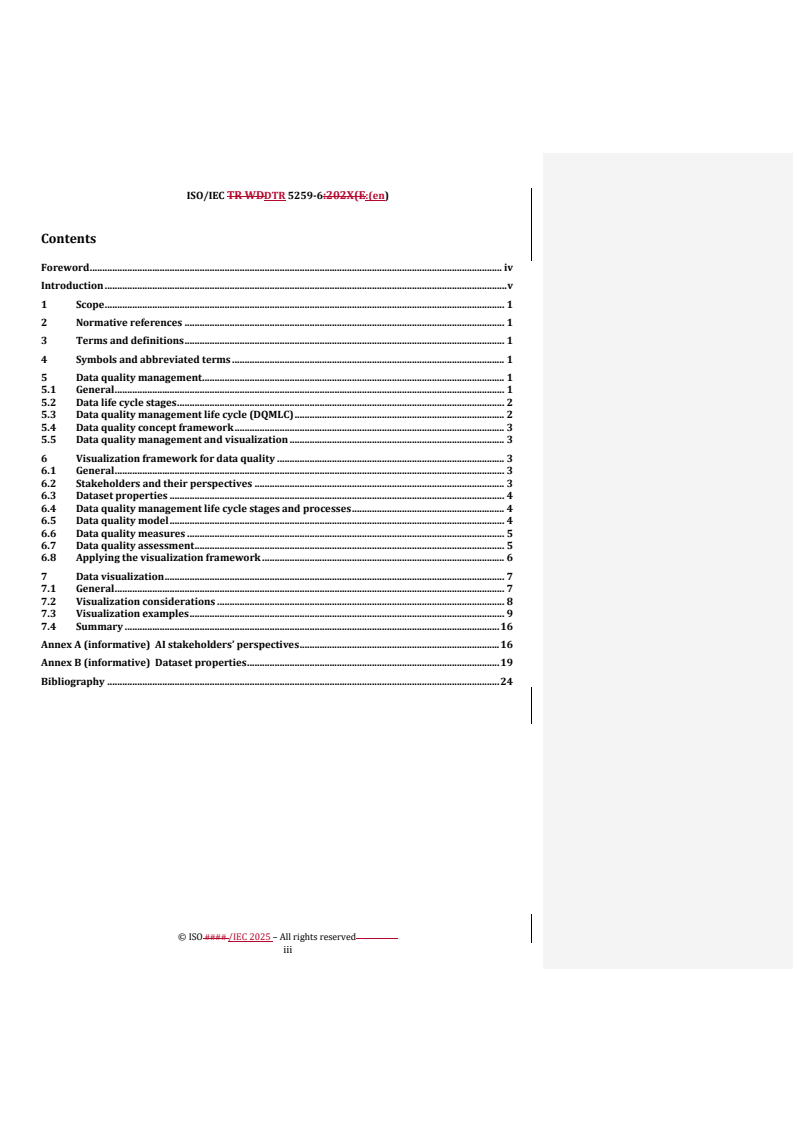
Contents
Foreword . iv
Introduction . v
1 Scope . 1
2 Normative references . 1
3 Terms and definitions . 1
4 Symbols and abbreviated terms . 1
5 Data quality management . 1
5.1 General . 1
5.2 Data life cycle stages . 2
5.3 Data quality management life cycle (DQMLC) . 2
5.4 Data quality concept framework . 3
5.5 Data quality management and visualization . 3
6 Visualization framework for data quality . 3
6.1 General . 3
6.2 Stakeholders and their perspectives . 3
6.3 Dataset properties . 4
6.4 Data quality management life cycle stages and processes . 4
6.5 Data quality model . 4
6.6 Data quality measures . 5
6.7 Data quality assessment . 5
6.8 Applying the visualization framework . 6
7 Data visualization . 7
7.1 General . 7
7.2 Visualization considerations . 8
7.3 Visualization examples . 9
7.4 Summary . 16
Annex A (informative) AI stakeholders’ perspectives . 16
Annex B (informative) Dataset properties . 19
Bibliography . 24
© ISO #### /IEC 2025 – All rights reserved
iii
ISO/IEC TR WDDTR 5259-6:202X(E:(en)
Foreword
ISO (the International Organization for Standardization) is a worldwide federation of national standards
bodies (ISO member bodies). The work of preparing International Standards is normally carried out through
ISO technical committees. Each member body interested in a subject for which a technical committee has been
established has the right to be represented on that committee. International organizations, governmental and
non-governmental, in liaison with ISO, also take part in the work. ISO collaborates closely with the
International Electrotechnical Commission (IEC) on all matters of electrotechnical standardization.
The procedures used to develop this document and those intended for its further maintenance are described
in the ISO/IEC Directives, Part 1. In particular, the different approval criteria needed for the different types of
ISO documents should be noted. This document was drafted in accordance with the editorial rules of the
ISO/IEC Directives, Part 2 (see www.iso.org/directives).
Field Code Changed
Attention is drawn to the possibility that some of the elements of this document may be the subject of patent
rights. ISO shall not be held responsible for identifying any or all such patent rights. Details of any patent rights
identified during the development of the document will be in the Introduction and/or on the ISO list of patent
declarations received (see www.iso.org/patents).
Any trade name used in this document is information given for the convenience of users and does not
constitute an endorsement.
For an explanation of the voluntary nature of standards, the meaning of ISO specific terms and expressions
related to conformity assessment, as well as information about ISO's adherence to the World Trade
Organization (WTO) principles in the Technical Barriers to Trade (TBT), see www.iso.org/iso/foreword.html.
This document was prepared by Technical Committee ISO/IEC JTC 1, Information technology, Subcommittee
SC 42, Artificial intelligence.
This document is intended to be used in conjunction with all parts of the ISO/IEC 5259 series.
A list of all parts in the ISO/IEC 5259 series can be found on the ISO website.
Any feedback or questions on this document should be directed to the user’s national standards body. A
complete listing of these bodies can be found at www.iso.org/members.html.
Field Code Changed
© ISO #### /IEC 2025 – All rights reserved
iv
ISO/IEC TR WDDTR 5259-6:202X(E:(en)
Introduction
Visualization can be used to augment data quality management by displaying a data quality measure
generated by the measurement function in a tangible and meaningful manner for assessment by the
stakeholder. Visualization can be used in any data quality management process in a data quality management
life cycle as part of the development and making of the artificial intelligence (AI) system. For example, it is
useful as part of data quality reporting for documenting the data quality management process. It can also
stimulate cognitive responses from the stakeholder in exploratory data analysis which can lead to more
insights (e.g. detection of missing data, outliers, anomalies, deviations, errors, making comparisons and
potential relationships among the observations). On the other hand, visualization also has its pitfalls that stem
from cognitive biases such as pareidolia and apophenia.
Visualization can also help in explaining to stakeholders how the application built from the data makes its
predictions by providing some transparency to the choice of and input to machine learning (ML) algorithms.
This can contribute to the trustworthiness of an AI system by stakeholders who use the AI system and have
different expectations.
The background of data quality management is described in Clause 5Clause 5. A visualization framework for
data quality based on data quality management concepts is described in Clause 6Clause 6. Illustration of the
application of the visualization framework with practical use cases is presented in Clause 7Clause 7. Annex A.
Annex A provides information on AI stakeholders’ perspectives and Annex BAnnex B provides information on
database properties.
© ISO #### /IEC 2025 – All rights reserved
v
Artificial intelligence — Data quality for analytics and machine
learning (ML) — —
Part 6:
Visualization framework for data quality
1 Scope
This document describes a visualization framework for data quality in analytics and machine learning. (ML).
The aim is to enable stakeholders using visualization methods to assess the results of data quality measures.
This visualization framework supports data quality goals.
2 Normative references
The following documents are referred to in the text in such a way that some or all of their content constitutes
requirements of this document. For dated references, only the edition cited applies. For undated references,
the latest edition of the referenced document (including any amendments) applies.
ISO/IEC 22989:2022, Information technology — Artificial intelligence — Artificial intelligence concepts and
terminology
ISO/IEC 5259-1:2024, Artificial intelligence — Data quality for analytics and machine learning (ML) — Part 1:
Overview, terminology, and examples
3 Terms and definitions
For the purposes of this document, the terms and definitions given in ISO/IEC 5259-1 and ISO/IEC 22989 and
the following apply.
ISO and IEC maintain terminologicalterminology databases for use in standardization at the following
addresses:
— — ISO Online browsing platform: available at https://www.iso.org/obp
— — IEC Electropedia: available at https://www.electropedia.org/
4 Symbols and abbreviated terms
AI artificial intelligence
DQMLC data quality management life cycle
ML machine learning
5 Data quality management
5.1 General
Data quality for analytics and ML is described in the ISO/IEC 5259 series. The various components of data
quality management from these International Standards and their relationships are summarized in
Figure 1Figure 1. Figure 1. Figure 1 also shows how this document is positioned as a companion to the rest of
the series.
© ISO #### /IEC 2025 – All rights reserved
Key
Data life cycle stage
Process in data quality management
Element in data quality management
Coverage of ISO/IEC 5259 series
Data quality management life cycle (DQMLC) stage (data motivation and conceptualization not shown here)
Primary development pathway
Feedback pathway
NOTE Data provenance, security and privacy from ISO/IEC 5259-1:2024 Figure 1 are not included in this figure.
Change management and configuration management from ISO/IEC 5259-4:20232024, Figure 1 are also not included in
this figure.
Figure 1 — Summary of data quality management for analytics and ML
5.2 Data life cycle stages
The data life cycle stages shown in Figure 1Figure 1 are described in ISO/IEC 5259-1:2024, Figure 3 and the
[2]
rationale with requirements of each stage are described in ISO/IEC 5259-1:2024 ,, 5.3.2.2 thruto 5.3.2.7
inclusive. The data life cycles stages are generic in nature and further refinement for the purpose of data
quality management are discussed in 5.35.3.
5.3 Data quality management life cycle (DQMLC)
The generic data life cycle in Figure 1Figure 1 is refined for data quality management purposes in ISO/IEC
5259-3:2024,, 7.2.1. Each DQMLC stage is in synchrony with one or two data life cycle stages. These DQMLC
stages provide feedback to a continuous validation and verification process. Data quality management
processes described in 5.45.4 are used throughout the stages of the DQMLC.
© ISO #### /IEC 2025 – All rights reserved
5.4 Data quality concept framework
A data quality concept framework is described in ISO/IEC 5259-1:2024,, 5.2. This framework shows that data
quality management of a dataset involves the following processes: data quality model, data quality measures,
data quality assessment, data quality improvement and data quality reporting. The specific documents from
the ISO/IEC 5259 series for each process are shown in Figure 1Figure 1 as spanning over all the stages of the
data quality management life cycle.
5.5 Data quality management and visualization
Visualization can be used in any of the data quality management processes in the DQMLC to support
stakeholders’ understanding in assessing the results of data quality measures to achieve data quality goals.
6 Visualization framework for data quality
6.1 General
Based on the summary of data quality management for analytics and ML in Clause 5Clause 5, this clause, Clause
6 describes a visualization framework for data quality that enables and supports stakeholders’ performance
of the processes in the DQMLC in assessing the results of data quality measures.
The visualization framework is described as follows and illustrated in Figure 2Figure 2::
For a stakeholder [A] with certain perspective [B] working with a dataset and its properties [C] within an
analytics and ML usage context [D] in performing a data quality management process [E] during a
particular stage of a data quality management life cycle [F], what are the data quality requirements [G]
and associated data quality characteristics of interest [H]? What are the correlated data quality measures
[I] with their visualization considerations [J] and applicable visualization methods [K]?
Figure 2 — Visualization framework for data quality
The relationships between the visualization framework and other International Standards are also shown in
Figure 2Figure 2. The stakeholders of the AI system are defined in ISO/IEC 22989 and ISO/IEC 5339 together
with their respective “make”, “use” or “impact” perspectives. The data quality components of the visualization
framework are from the ISO/IEC 5259 series on data quality. The stakeholders’ perspectives and the data
quality context, needs, requirements and characteristics are delineated with the appropriate data quality
measures. This document takes the visualization considerations of these data measures and suggests
applicable visualization methods illustrated with examples that reference the [A] to [K] notation used in
Figure 2Figure 2.
6.2 Stakeholders and their perspectives
The visualization framework can be employed by stakeholders ([A] in Figure 2Figure 2)) in performing the
processes in the DQMLC on a dataset within an analytics and ML usage context ([D] in Figure 2Figure 2).).
© ISO #### /IEC 2025 – All rights reserved
These stakeholders are the AI producers, AI providers, AI developers and AI partners such as data providers
(ISO/IEC 22989:2022, 5.17).
The stakeholders’ perspectives ([B] in Figure 2Figure 2)) are based on the make, use and impact perspectives
of stakeholders in AI applications described in ISO/IEC 5339:2024, 6 (see Annex AAnnex A).).
Other stakeholders such as AI customers and AI users have their perspectives on using the AI application. The
visualization framework can be employed by them for improving their understanding of how the AI system
and AI application were built from data and algorithms in an AI application. This can contribute to the
trustworthiness of the AI application.
The deployment and use of an AI application by AI customers and AI users can also have impact on the
stakeholders’ community and its relevant authorities such as policy makers and regulators. The visualization
framework can be of use for these external stakeholders in performing their roles.
6.3 Dataset properties
The visualization framework includes a dataset and its properties [C] because they are important
considerations in how the data are going to be used in the usage context of analytics and ML [D]. These
properties (including statistical properties) and the needs and requirement of the stakeholders are inputs to
the data quality model (see Figure 3Figure 3).). The knowledge of these dataset properties is also needed in
the preparation of the dataset to feed into quality measurement functions. Dataset properties from ISO/IEC
23751:2022-02 are detailed with an example in Annex B Annex B.
6.4 Data quality management life cycle stages and processes
Stakeholders are aligned with their roles in performing data quality management processes ([E] in
Figure 2Figure 2)) during different stages of the data quality management life cycle ([F] in Figure 2Figure 2).).
For example, an AI producer can define the data quality model with data quality requirements ([G] in
Figure 2Figure 2)) during the data specification and data planning stages.
6.5 Data quality model
6.5.1 General
A data quality model or a dataset is established by the make stakeholders based on their business objectives
and the specific analytics and ML usage context. For example, this can depend on the application environment
of the resultant AI system where data quality requirements are regulated.
6.5.2 Data quality characteristics
The defined set of data quality characteristics([H] in Figure 2Figure 2)) in the data quality model can be drawn
from the data quality characteristics that are adapted from ISO/IEC 25000 (in particular, ISO/IEC 25024)) and
ISO 8000 series in ISO/IEC 5259-2 as shown in Table 1Table 1. Of particular interest are the data quality
characteristics that are for higher quality ML models and applications. The data quality model also specifies
the requirements for each selected data quality characteristic. All of the output of data quality measurement
function of the characteristics are in ratio form (either A/B or 1-A/B), except in the efficiency quality
characteristics.
© ISO #### /IEC 2025 – All rights reserved
Table 1 — Data quality characteristics (adapted from ISO/IEC 5259-2:2024, Figure 3)
Output of measurement function
Data quality
Grouping
characteristics
ISO/IEC 25024 ISO/IEC 5259-2
Inherent Accuracy Table 1 Table 9
Completeness Table 2 Table 10
Consistency Table 3 Table 15
Credibility Table 4 Table 12
Currentness Table 5 Table 6
Inherent and Accessibility Tables 6.1, 6.2 Table 1
system-dependent Compliance Table 7.1 Table 11
Confidentiality Tables 8.1, 8.2
Efficiency Tables 9.1, 9.2 Table 8
Precision Table 10.1, 10.2 Table 13
Traceability Table 11.1, 11.2
Understandability Table 12.1, 12.2 Table 15
System-dependent Availability Table 13
Portability Table 14 Table 4
Recoverability Table 15
For higher quality ML Auditability Table 2
models and applications Identifiability Table 3
Effectiveness Table 7
Balance Table 14
Diversity Table 16
Relevance Table 17
Representativeness Table 18
Similarity Table 19
Timeliness Table 20
6.6 Data quality measures
To measure each data quality characteristic specified in the data quality model for a dataset, one or more of
its associated data quality measures ([I] in Figure 2Figure 2)) are selected for quantification. A list of
associated data quality measures for data quality characteristics is provided in ISO/IEC 5259-2:2024,, 6.
6.7 Data quality assessment
The selected data quality me
...
Questions, Comments and Discussion
Ask us and Technical Secretary will try to provide an answer. You can facilitate discussion about the standard in here.
Loading comments...