

ISO 8:2019
(Main)Information and documentation — Presentation and identification of periodicals
General Information
- Abstract
This document establishes the minimum characteristics required for the presentation and identification of periodicals including not only the obvious traditional elements that print periodicals typically display (e.g. title, ISSN, publisher, date), but also the "footprints" of periodicals published on digital dynamic media that enable them to be traced along the path of their history, such as changes of URL and publisher or content provider. Furthermore, this document provides information about persistent identifiers, using ISSN, and citation of periodicals (especially when published online or digitized and when titles have changed). It also makes specific recommendations for presentation and identification aspects of retrospective digitization of periodicals. This document is applicable to a subcategory of continuing resources identifiable as "periodicals" (see Clause 3). NOTE 1 For the purposes of this document, newspapers are not considered to be periodicals; therefore, specialized information relevant only to newspapers is not included. This document does not specifically address or apply to books, including series of books, nor to content that is continuously updated such as loose-leaf services, databases, online reference works, and most websites. NOTE 2 For information about series titles, see ISO 7275. This document focuses only on elements of periodicals — printed, born-digital or retrospectively digitized — that relate to the presentation of title and supporting descriptive information, as well as practices related to title identification and content access over time. Therefore, this document is not concerned with the overall design of the periodical, except where that design affects the presentation of the title and has unintended consequences for resource discovery and access to earlier content. Neither is it concerned with the technical specifications for print, born-digital or digitized periodicals. The recommendations might not apply in all circumstances, and do not always accommodate certain artistic, technical or advertising considerations. This document contains recommendations intended to enable editors and publishers of periodicals to identify and present key information in a form that will help users discover, cite and access their information over time and through any changes. This benefits all stakeholders of the periodical supply chain: publishers, content providers, authors, librarians, and researchers. The recommendations address the following: — display of periodical title(s) and other critical identifying information: issues, numbering systems, pagination, etc.; — retention of title and citation information under which articles were originally published; — display of title histories, i.e. changes in titles over time together with their dates of coverage; — specification of appropriate metadata for digital periodicals; NOTE 3 This document concentrates on metadata elements which are applicable at the title-level and does not provide guidelines for complete article-level metadata. — display of correct ISSN, including different ISSN for each format, language edition, and for changed titles; — retention and display of vital publication information across the duration of a periodical, including: publisher names, numbering and dates, editors, editorial boards, and sponsoring organizations, and frequency of publication; — graphic design that supports clarity and consistency of information, particularly title information and inclusion of information that allows easy access to all content; — special considerations for retrospective digitization; — usage of persistent identifiers for identification of periodical titles and articles; — long-term preservation of periodical information across time.
- Status
- Published
- Publication Date
- 31-Mar-2019
- Technical Committee
- ISO/TC 46 - Information and documentation
- Drafting Committee
- ISO/TC 46 - Information and documentation
- Current Stage
- 9093 - International Standard confirmed
- Start Date
- 05-Sep-2024
- Completion Date
- 29-Aug-2026
Buy Documents

ISO 8:2019 - Information and documentation -- Presentation and identification of periodicals
ISO 8:2019 - Information and documentation — Presentation and identification of periodicals/1/2019
ISO 8:2019 - Information et documentation -- Présentation et identification des périodiques
ISO 8:2019 - Information et documentation — Présentation et identification des périodiques/1/2019
Overview
ISO 8:2019 - Information and documentation - Presentation and identification of periodicals - defines the minimum characteristics and recommendations for how periodicals should present and identify title and descriptive information across media. Updated in 2019 from the original 1977 edition, this standard expands guidance to print, born-digital and retrospectively digitized periodicals, covering title presentation, persistent identifiers (notably ISSN), citation practice, and the “footprints” of digital periodicals (URL and publisher changes) that affect long‑term discoverability and access.
Key topics and technical requirements
- Title presentation and variants: Clear display of title(s), parallel/multilingual titles, running and spine titles to support consistent discovery.
- Title history and changes: Documentation and display of title changes, with dates of coverage to preserve citation integrity when titles merge, divide or change.
- Persistent identifiers: Use and correct display of ISSN and other persistent identifiers; separate ISSNs for different formats, language editions and changed titles.
- Metadata for digital periodicals: Title-level metadata recommendations to enable reliable identification and linking across platforms (article-level metadata is out of scope).
- Retention of publication information: Consistent recording/display of publisher names, numbering, dates, editors, sponsoring organizations and publication frequency over a title’s lifespan.
- Enumeration, chronology and pagination: Guidance on numbering systems, chronological statements and pagination that affect citation and access.
- Graphic design for clarity: Design recommendations that ensure title and identification data are legible and discoverable without constraining artistic choices.
- Retrospective digitization: Specific recommendations for digitizing backfiles, including suitable preservation file formats (e.g., PDF/A, EPUB) and related practices.
- Long‑term preservation and linking: Advice on title-level linking, identifier persistence and maintaining access across URL/publisher/content-provider changes.
Practical applications and who uses ISO 8:2019
- Publishers and editors: Implement consistent title display, ISSN management and title-history statements to support discoverability and citation.
- Content providers and platform developers: Design UI and metadata schemas that surface canonical title information and persistent identifiers.
- Librarians and cataloguers: Apply guidance for catalog records, linking, and handling title changes, mergers and divisions.
- Archivists and digital preservation teams: Inform digitization workflows, selection of archival file formats and preservation metadata.
- Researchers and authors: Understand proper citation of periodicals, especially for online or digitized material and titles that have changed.
Related standards and notes
- ISO 8:2019 complements other documentation standards (see Annex A on linking and Annex B on metadata) and references practices such as NISO RP‑16‑2013. For series titles, consult ISO 7275. Implementers should align ISO 8:2019 recommendations with local cataloguing and identifier policies to maximize interoperability and long‑term access.
Relations
- Effective Date
- 25-Oct-2014
Buy Documents
ISO 8:2019 - Information and documentation -- Presentation and identification of periodicals
ISO 8:2019 - Information and documentation — Presentation and identification of periodicals/1/2019
ISO 8:2019 - Information et documentation -- Présentation et identification des périodiques
ISO 8:2019 - Information et documentation — Présentation et identification des périodiques/1/2019
Frequently Asked Questions
ISO 8:2019 is a standard published by the International Organization for Standardization (ISO). Its full title is "Information and documentation — Presentation and identification of periodicals". This standard covers: This document establishes the minimum characteristics required for the presentation and identification of periodicals including not only the obvious traditional elements that print periodicals typically display (e.g. title, ISSN, publisher, date), but also the "footprints" of periodicals published on digital dynamic media that enable them to be traced along the path of their history, such as changes of URL and publisher or content provider. Furthermore, this document provides information about persistent identifiers, using ISSN, and citation of periodicals (especially when published online or digitized and when titles have changed). It also makes specific recommendations for presentation and identification aspects of retrospective digitization of periodicals. This document is applicable to a subcategory of continuing resources identifiable as "periodicals" (see Clause 3). NOTE 1 For the purposes of this document, newspapers are not considered to be periodicals; therefore, specialized information relevant only to newspapers is not included. This document does not specifically address or apply to books, including series of books, nor to content that is continuously updated such as loose-leaf services, databases, online reference works, and most websites. NOTE 2 For information about series titles, see ISO 7275. This document focuses only on elements of periodicals — printed, born-digital or retrospectively digitized — that relate to the presentation of title and supporting descriptive information, as well as practices related to title identification and content access over time. Therefore, this document is not concerned with the overall design of the periodical, except where that design affects the presentation of the title and has unintended consequences for resource discovery and access to earlier content. Neither is it concerned with the technical specifications for print, born-digital or digitized periodicals. The recommendations might not apply in all circumstances, and do not always accommodate certain artistic, technical or advertising considerations. This document contains recommendations intended to enable editors and publishers of periodicals to identify and present key information in a form that will help users discover, cite and access their information over time and through any changes. This benefits all stakeholders of the periodical supply chain: publishers, content providers, authors, librarians, and researchers. The recommendations address the following: — display of periodical title(s) and other critical identifying information: issues, numbering systems, pagination, etc.; — retention of title and citation information under which articles were originally published; — display of title histories, i.e. changes in titles over time together with their dates of coverage; — specification of appropriate metadata for digital periodicals; NOTE 3 This document concentrates on metadata elements which are applicable at the title-level and does not provide guidelines for complete article-level metadata. — display of correct ISSN, including different ISSN for each format, language edition, and for changed titles; — retention and display of vital publication information across the duration of a periodical, including: publisher names, numbering and dates, editors, editorial boards, and sponsoring organizations, and frequency of publication; — graphic design that supports clarity and consistency of information, particularly title information and inclusion of information that allows easy access to all content; — special considerations for retrospective digitization; — usage of persistent identifiers for identification of periodical titles and articles; — long-term preservation of periodical information across time.
This document establishes the minimum characteristics required for the presentation and identification of periodicals including not only the obvious traditional elements that print periodicals typically display (e.g. title, ISSN, publisher, date), but also the "footprints" of periodicals published on digital dynamic media that enable them to be traced along the path of their history, such as changes of URL and publisher or content provider. Furthermore, this document provides information about persistent identifiers, using ISSN, and citation of periodicals (especially when published online or digitized and when titles have changed). It also makes specific recommendations for presentation and identification aspects of retrospective digitization of periodicals. This document is applicable to a subcategory of continuing resources identifiable as "periodicals" (see Clause 3). NOTE 1 For the purposes of this document, newspapers are not considered to be periodicals; therefore, specialized information relevant only to newspapers is not included. This document does not specifically address or apply to books, including series of books, nor to content that is continuously updated such as loose-leaf services, databases, online reference works, and most websites. NOTE 2 For information about series titles, see ISO 7275. This document focuses only on elements of periodicals — printed, born-digital or retrospectively digitized — that relate to the presentation of title and supporting descriptive information, as well as practices related to title identification and content access over time. Therefore, this document is not concerned with the overall design of the periodical, except where that design affects the presentation of the title and has unintended consequences for resource discovery and access to earlier content. Neither is it concerned with the technical specifications for print, born-digital or digitized periodicals. The recommendations might not apply in all circumstances, and do not always accommodate certain artistic, technical or advertising considerations. This document contains recommendations intended to enable editors and publishers of periodicals to identify and present key information in a form that will help users discover, cite and access their information over time and through any changes. This benefits all stakeholders of the periodical supply chain: publishers, content providers, authors, librarians, and researchers. The recommendations address the following: — display of periodical title(s) and other critical identifying information: issues, numbering systems, pagination, etc.; — retention of title and citation information under which articles were originally published; — display of title histories, i.e. changes in titles over time together with their dates of coverage; — specification of appropriate metadata for digital periodicals; NOTE 3 This document concentrates on metadata elements which are applicable at the title-level and does not provide guidelines for complete article-level metadata. — display of correct ISSN, including different ISSN for each format, language edition, and for changed titles; — retention and display of vital publication information across the duration of a periodical, including: publisher names, numbering and dates, editors, editorial boards, and sponsoring organizations, and frequency of publication; — graphic design that supports clarity and consistency of information, particularly title information and inclusion of information that allows easy access to all content; — special considerations for retrospective digitization; — usage of persistent identifiers for identification of periodical titles and articles; — long-term preservation of periodical information across time.
ISO 8:2019 is classified under the following ICS (International Classification for Standards) categories: 01.140.40 - Publishing. The ICS classification helps identify the subject area and facilitates finding related standards.
ISO 8:2019 has the following relationships with other standards: It is inter standard links to ISO 8:1977. Understanding these relationships helps ensure you are using the most current and applicable version of the standard.
ISO 8:2019 is available in PDF format for immediate download after purchase. The document can be added to your cart and obtained through the secure checkout process. Digital delivery ensures instant access to the complete standard document.
Standards Content (Sample)
SLOVENSKI STANDARD
01-oktober-2019
Nadomešča:
SIST ISO 8:1996
Informatika in dokumentacija - Oblikovanje periodičnih publikacij
Information and documentation -- Presentation and identification of periodicals
Information et documentation -- Présentation des périodiques
Ta slovenski standard je istoveten z: ISO 8:2019
ICS:
01.140.40 Založništvo Publishing
2003-01.Slovenski inštitut za standardizacijo. Razmnoževanje celote ali delov tega standarda ni dovoljeno.
INTERNATIONAL ISO
STANDARD 8
Second edition
2019-04
Information and documentation —
Presentation and identification of
periodicals
Information et documentation — Présentation et identification des
périodiques
Reference number
©
ISO 2019
© ISO 2019
All rights reserved. Unless otherwise specified, or required in the context of its implementation, no part of this publication may
be reproduced or utilized otherwise in any form or by any means, electronic or mechanical, including photocopying, or posting
on the internet or an intranet, without prior written permission. Permission can be requested from either ISO at the address
below or ISO’s member body in the country of the requester.
ISO copyright office
CP 401 • Ch. de Blandonnet 8
CH-1214 Vernier, Geneva
Phone: +41 22 749 01 11
Fax: +41 22 749 09 47
Email: copyright@iso.org
Website: www.iso.org
Published in Switzerland
ii © ISO 2019 – All rights reserved
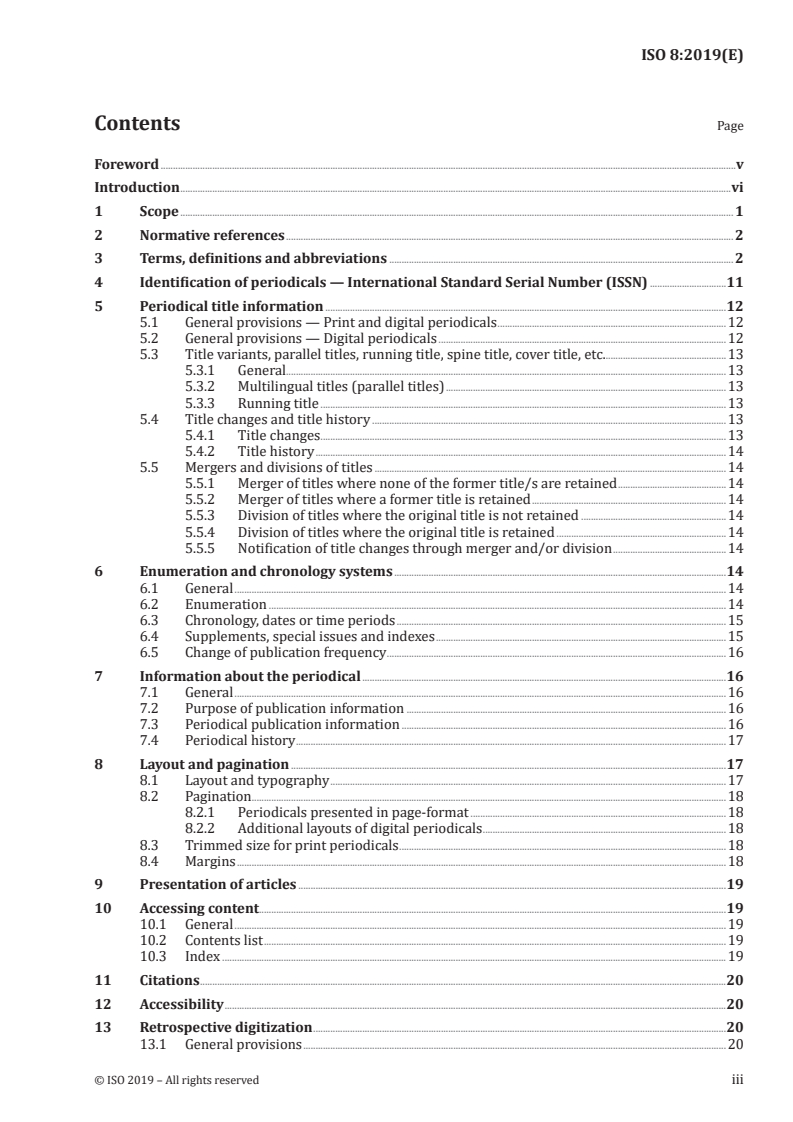
Contents Page
Foreword .v
Introduction .vi
1 Scope . 1
2 Normative references . 2
3 Terms, definitions and abbreviations . 2
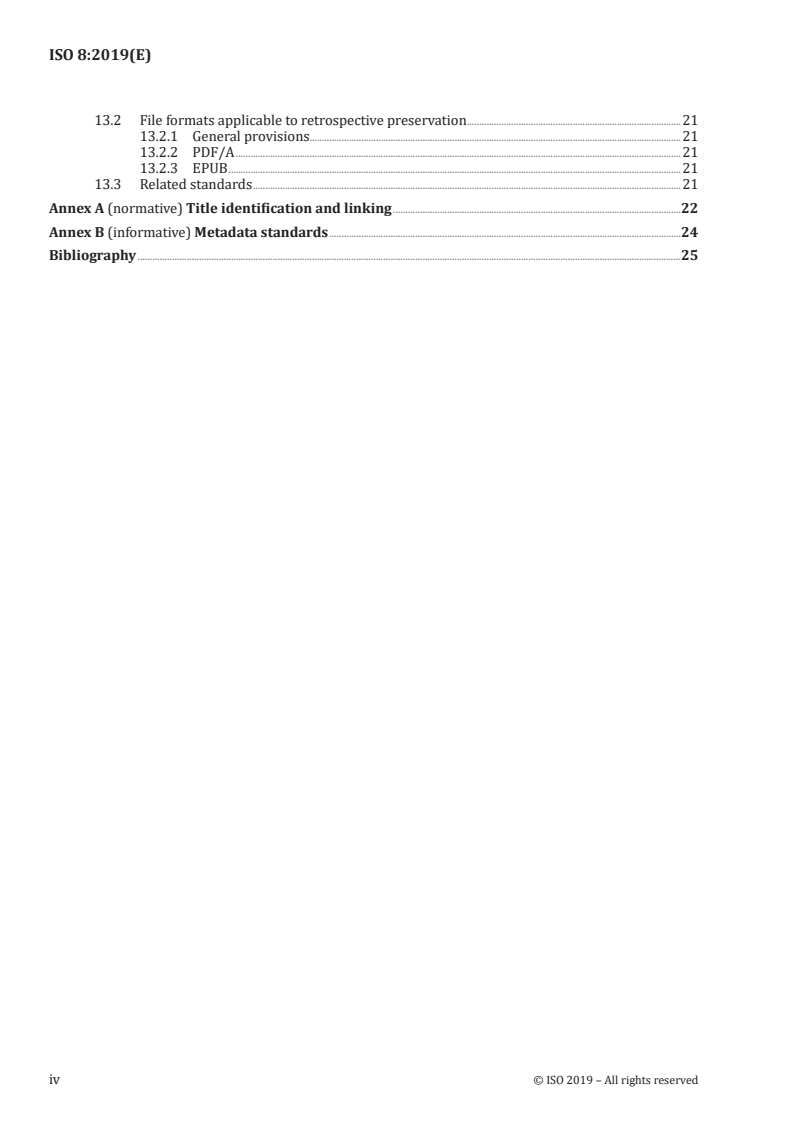
4 Identification of periodicals — International Standard Serial Number (ISSN) .11
5 Periodical title information .12
5.1 General provisions — Print and digital periodicals .12
5.2 General provisions — Digital periodicals .12
5.3 Title variants, parallel titles, running title, spine title, cover title, etc.13
5.3.1 General.13
5.3.2 Multilingual titles (parallel titles) .13
5.3.3 Running title .13
5.4 Title changes and title history .13
5.4.1 Title changes . .13
5.4.2 Title history .14
5.5 Mergers and divisions of titles .14
5.5.1 Merger of titles where none of the former title/s are retained .14
5.5.2 Merger of titles where a former title is retained .14
5.5.3 Division of titles where the original title is not retained .14
5.5.4 Division of titles where the original title is retained .14
5.5.5 Notification of title changes through merger and/or division .14
6 Enumeration and chronology systems .14
6.1 General .14
6.2 Enumeration .14
6.3 Chronology, dates or time periods .15
6.4 Supplements, special issues and indexes .15
6.5 Change of publication frequency .16
7 Information about the periodical .16
7.1 General .16
7.2 Purpose of publication information .16
7.3 Periodical publication information .16
7.4 Periodical history .17
8 Layout and pagination .17
8.1 Layout and typography .17
8.2 Pagination.18
8.2.1 Periodicals presented in page-format .18
8.2.2 Additional layouts of digital periodicals .18
8.3 Trimmed size for print periodicals .18
8.4 Margins .18
9 Presentation of articles .19
10 Accessing content.19
10.1 General .19
10.2 Contents list .19
10.3 Index .19
11 Citations .20
12 Accessibility .20
13 Retrospective digitization .20
13.1 General provisions .20
13.2 File formats applicable to retrospective preservation .21
13.2.1 General provisions.21
13.2.2 PDF/A .21
13.2.3 EPUB .21
13.3 Related standards .21
Annex A (normative) Title identification and linking .22
Annex B (informative) Metadata standards .24
Bibliography .25
iv © ISO 2019 – All rights reserved
Foreword
ISO (the International Organization for Standardization) is a worldwide federation of national standards
bodies (ISO member bodies). The work of preparing International Standards is normally carried out
through ISO technical committees. Each member body interested in a subject for which a technical
committee has been established has the right to be represented on that committee. International
organizations, governmental and non-governmental, in liaison with ISO, also take part in the work.
ISO collaborates closely with the International Electrotechnical Commission (IEC) on all matters of
electrotechnical standardization.
The procedures used to develop this document and those intended for its further maintenance are
described in the ISO/IEC Directives, Part 1. In particular the different approval criteria needed for the
different types of ISO documents should be noted. This document was drafted in accordance with the
editorial rules of the ISO/IEC Directives, Part 2 (see www .iso .org/directives).
Attention is drawn to the possibility that some of the elements of this document may be the subject of
patent rights. ISO shall not be held responsible for identifying any or all such patent rights. Details of
any patent rights identified during the development of the document will be in the Introduction and/or
on the ISO list of patent declarations received (see www .iso .org/patents).
Any trade name used in this document is information given for the convenience of users and does not
constitute an endorsement.
For an explanation on the voluntary nature of standards, the meaning of ISO specific terms and
expressions related to conformity assessment, as well as information about ISO's adherence to the
World Trade Organization (WTO) principles in the Technical Barriers to Trade (TBT) see the following
URL: www .iso .org/iso/foreword .html.
This document was prepared by Technical Committee ISO/TC 46, Information and documentation.
This second edition cancels and replaces the first edition (ISO 8:1977), which has been technically
revised. The main changes compared to the previous edition are as follows:
— the scope has been expanded to include digital publishing, and recommendations applicable to all
possible media.
Any feedback or questions on this document should be directed to the user’s national standards body. A
complete listing of these bodies can be found at www .iso .org/members .html.
Introduction
Periodicals, whatever their medium, play a critical role in the information society, and more specifically
in the global information infrastructure. Citations to articles in scholarly journals, whether in print or
in electronic journals, form the basis for much scholarly research. Popular trade magazines as well as
newsletters are used by authors, researchers, and students of all ages. Search, discovery, and use of the
wide range of today’s periodicals require that they provide reliable identification and display of key
information by following standardized principles and procedures.
When ISO/R 8-1954, the predecessor to ISO 8, was published, there was no digital publishing, nor were
there identification standards such as ISSN or ISBN. The evolution of the publishing market in recent
decades, the use of media other than paper, and the evolution of identification standards have made it
necessary to revise ISO 8 to include recommendations applicable to all possible media.
This document is based in part on the first edition of ISO 8 for its recommendations pertaining to print
[1]
periodicals, and on NISO RP-16-2013 , for its recommendations concerning digital periodicals.
vi © ISO 2019 – All rights reserved
INTERNATIONAL STANDARD ISO 8:2019(E)
Information and documentation — Presentation and
identification of periodicals
1 Scope
This document establishes the minimum characteristics required for the presentation and identification
of periodicals including not only the obvious traditional elements that print periodicals typically
display (e.g. title, ISSN, publisher, date), but also the “footprints” of periodicals published on digital
dynamic media that enable them to be traced along the path of their history, such as changes of URL
and publisher or content provider. Furthermore, this document provides information about persistent
identifiers, using ISSN, and citation of periodicals (especially when published online or digitized and
when titles have changed). It also makes specific recommendations for presentation and identification
aspects of retrospective digitization of periodicals.
This document is applicable to a subcategory of continuing resources identifiable as “periodicals” (see
Clause 3).
NOTE 1 For the purposes of this document, newspapers are not considered to be periodicals; therefore,
specialized information relevant only to newspapers is not included.
This document does not specifically address or apply to books, including series of books, nor to content
that is continuously updated such as loose-leaf services, databases, online reference works, and most
websites.
NOTE 2 For information about series titles, see ISO 7275.
This document focuses only on elements of periodicals — printed, born-digital or retrospectively
digitized — that relate to the presentation of title and supporting descriptive information, as well as
practices related to title identification and content access over time. Therefore, this document is not
concerned with the overall design of the periodical, except where that design affects the presentation
of the title and has unintended consequences for resource discovery and access to earlier content.
Neither is it concerned with the technical specifications for print, born-digital or digitized periodicals.
The recommendations might not apply in all circumstances, and do not always accommodate certain
artistic, technical or advertising considerations.
This document contains recommendations intended to enable editors and publishers of periodicals
to identify and present key information in a form that will help users discover, cite and access their
information over time and through any changes. This benefits all stakeholders of the periodical supply
chain: publishers, content providers, authors, librarians, and researchers.
The recommendations address the following:
— display of periodical title(s) and other critical identifying information: issues, numbering systems,
pagination, etc.;
— retention of title and citation information under which articles were originally published;
— display of title histories, i.e. changes in titles over time together with their dates of coverage;
— specification of appropriate metadata for digital periodicals;
NOTE 3 This document concentrates on metadata elements which are applicable at the title-level and
does not provide guidelines for complete article-level metadata.
— display of correct ISSN, including different ISSN for each format, language edition, and for
changed titles;
— retention and display of vital publication information across the duration of a periodical, including:
publisher names, numbering and dates, editors, editorial boards, and sponsoring organizations, and
frequency of publication;
— graphic design that supports clarity and consistency of information, particularly title information
and inclusion of information that allows easy access to all content;
— special considerations for retrospective digitization;
— usage of persistent identifiers for identification of periodical titles and articles;
— long-term preservation of periodical information across time.
2 Normative references
The following documents are referred to in the text in such a way that some or all of their content
constitutes requirements of this document. For dated references, only the edition cited applies. For
undated references, the latest edition of the referenced document (including any amendments) applies.
ISO 18, Documentation — Contents list of periodicals
ISO 215, Documentation — Presentation of contributions to periodicals and other serials
ISO 690, Information and documentation — Guidelines for bibliographic references and citations to
information resources
ISO 999, Information and documentation — Guidelines for the content, organization and presentation
of indexes
ISO 3297, Information and documentation — International standard serial number (ISSN)
ISO 8601, Data elements and interchange formats — Information interchange — Representation of dates
and times
3 Terms, definitions and abbreviations
For the purposes of this document, the following terms and definitions apply.
ISO and IEC maintain terminological databases for use in standardization at the following addresses:
— ISO Online browsing platform: available at https: //www .iso .org/obp
— IEC Electropedia: available at http: //www .electropedia .org/
3.1 Types of serial publications
3.1.1
born digital serial
serial that from the outset has been created in digital form
Note 1 to entry: See also ISO 18461:2016, 2.5.7.
Note 2 to entry: Compare to retrospectively digitized content.
[SOURCE: ISO 5127:2017, 3.3.3.05, modified — The word "serial" has been added to the term and Note2
to entry has been added.]
2 © ISO 2019 – All rights reserved
3.1.2
continuing resource
publication, in any medium, that is issued over time with no predetermined conclusion and made
available to the public
[SOURCE: ISO 5127:2017, 3.4.1.05]
3.1.3
integrating resource
publication, either finite or with no predetermined conclusion, that is added to or changed by updates
that do not remain discrete and are integrated into the whole and made available to the public in any
product form
[SOURCE: ISO 5127:2017, 3.4.1.06, modified — The example has been omitted.]
3.1.4
digital serial
serial that has been retrospectively digitized or born digital
3.1.5
electronic journal
e-journal
serial digital document, licensed or not, where searchable text is prevalent, and which can be seen in
analogy to a print serial publication
[SOURCE: ISO 5127:2017, 3.3.3.35, modified — Notes to entry have been omitted.]
3.1.6
journal
periodical devoted to disseminating original research and commentary on current developments in a
specific discipline, subdiscipline, field of study or profession, published over a period of time, or article
by article online
EXAMPLE Journal of Clinical Epidemiology.
3.1.7
periodical
serial generally characterized by variety of contents and contributors, both within one issue (3.3.9) of
the publication and from one issue to another
Note 1 to entry: Each issue or part is usually composed of more than one intellectual contribution (article, essay,
review, note, etc.); issues or parts are not substituted by updating issues or parts.
Note 2 to entry: The periodical has no predetermined conclusion.
[SOURCE: ISO 5127:2017, 3.4.1.28.02]
3.1.8
serial
publication in print or in non-print form, issued in successive parts, usually having numerical or
chronological designations, and intended to be continued indefinitely, whatever its periodicity
Note 1 to entry: Serials can include periodicals, journals, newspapers, annuals, etc.
Note 2 to entry: Publications of limited duration (e.g. newsletters of events) are also considered serials.
[SOURCE: ISO 5127:2017, 3. 4.1.28.01]
3.1.9
special issue
issue (3.3.9) of a periodical focused on a certain topic and/or published with a chronology (3.3.1) outside
of the official publication schedule
3.1.10
retrospectively digitized serial
serial that was not published in digital form initially but was converted to a digital medium at a later date
3.2 Content of periodicals
3.2.1
article
document in the form of an independent text forming a part of a publication
[SOURCE: ISO 5127:2017, 3.5.8.06]
3.2.2
back matter
material appearing at the end of the periodical, after the main articles
Note 1 to entry: This includes bibliography, index, endnotes, list of advertisers, reader response card, etc.
3.2.3
citation
reference in one document to another document or to part of it
[SOURCE: ISO 5127:2017, 3.5.8.16]
3.2.4
front matter
material that precedes the first page of text, before the main articles
Note 1 to entry: It includes the half title, frontispiece (illustration usually facing the first page or title page—
more common in books), title page, contents list, letters to or from the editor, acknowledgements (or list of
contributors), list of illustrations, list of tables, names of editors and editorial board members, and masthead
information; may also include header information or journal leader, which usually includes the metadata
concerning the periodical itself as well as metadata concerning the issue of the periodical and the individual
article(s).
Note 2 to entry: See definition for preliminary pages ISO 5127:2017, 3.5.7.01, which includes front matter.
3.2.5
title page
page in a volume which contains full bibliographic information, normally found at the beginning of the
publication/digitized document
Note 1 to entry: A title page found in digital serials (3.1.4) is usually on the homepage.
[SOURCE: ISO 5127:2017, 3.5.7.02, modified — Note 1 to entry has been replaced.]
3.3 Descriptive elements for periodicals
3.3.1
chronology
indication of the date of publication (3.3.3) or date of issue of a component of a multi-part resource,
distinguishing it from other components of the same resource
EXAMPLE October 2017.
Note 1 to entry: The chronology may reflect the date of coverage, publication, copyright, or printing.
Note 2 to entry: See also enumeration (3.3.6).
[SOURCE: ISO 20775:2009, 3.1.3, modified — An example and two notes to entry have been added.]
4 © ISO 2019 – All rights reserved
3.3.2
current title
name of a periodical that is presently in use
Note 1 to entry: See also former title (3.3.7) and succeeding title (3.3.11).
3.3.3
date of publication
date on which a work is published
[SOURCE: ISO 5127:2017, 3.3.4.10]
3.3.4
nominal date of publication
date of publication (3.3.3) as formally indicated in the publication
[SOURCE: ISO 5127:2017, 3.3.4.11]
3.3.5
actual date of publication
date on which a publication is actually available, particularly in respect to a given place or places
[SOURCE: ISO 5127:2017, 3.3.4.12]
3.3.6
enumeration
sequential numeric/alphabetic designation used by a publisher on a multipart or serial unit to
identify the individual bibliographic or physical parts and to show the relationship of each part to the
bibliographic unit as a whole
EXAMPLE 1 Volume 4, Number 10.
EXAMPLE 2 Volume 4, Issue 10.
Note 1 to entry: See also chronology (3.3.1).
[SOURCE: ISO 10324:1997, 3.22, modified — Example and note to entry have been added.]
3.3.7
former title
previous name of a periodical
Note 1 to entry: See also current title (3.3.2) and succeeding title (3.3.11).
3.3.8
frequency
scheduled period of release of issues of a periodical
EXAMPLE Quarterly.
3.3.9
issue
one of the usually regularly appearing, self-contained and physically independent parts, marketed
individually, of which a serial is constituted, usually bearing a numerical or chronological designation,
e.g. issue number
[SOURCE: ISO 5127:2017, 3.4.1.28.17, modified — Notes to entry have been omitted; the definition has
been modified to add an example of "chronological designation".]
3.3.10
running title
title, normally abridged, repeated on each text page within a serial
[SOURCE: ISO 5127:2017, 3.7.4.13, modified — Note 1 to entry has been omitted.]
3.3.11
succeeding title
title of a periodical that continues another title (in whole or in part), or which absorbs it (in whole or in
part), or which has resulted from a split of the title or its merger with another title
Note 1 to entry: See also current title (3.3.2) and former title (3.3.7).
3.3.12
title
words or symbols at the head of a document that identify it and normally distinguish it from other
documents
Note 1 to entry: May define as precisely as possible the special field of knowledge and activity dealt with in that
periodical.
[SOURCE: ISO 5127:2017, 3.7.4.01, modified — Note 1 to entry has been replaced.]
3.3.13
volume
set of several issues of a periodical published over a certain period of time, usually the year; it can be
identified by a numerical or chronological designation, i.e. volume number
3.4 Identifiers and locators
3.4.1
bar code
digital coding system showing an eye-visible linear array of rectangular marks of (possibly) varying
width, height and vertical alignment, separated by spaces of (possibly) varying width in which the
positioning and size of marks and spaces are used to code information to identify various types of
material objects
[SOURCE: ISO 5127:2017, 3.2.5.11, modified — Note to entry has been omitted.]
3.4.2
Global Trade Item Number
GTIN
unique number from a standard code used internationally to identify products and packaging units
Note 1 to entry: See ISO 22742:2010, 3.25, 3.43 and 3.12; ISO/TS 16791:2014, 3.1.1.
Note 2 to entry: Up to 2009, this number was known as the “European article number” / EAN.
Note 3 to entry: Usually, the identifying number is incorporated in the bar code (3.4.1) and represented below the
bar code.
[SOURCE: ISO 5127:2017, 3.2.5.12, modified — A third note to entry has been added.]
3.4.3
digital object identifier
DOI
standardized string for identifying a physical, digital, or abstract object and providing persistent
resolution to the object or information about it
Note 1 to entry: DOI is specified in ISO 26324.
6 © ISO 2019 – All rights reserved
Note 2 to entry: The unqualified use of “DOI” alone can be ambiguous. Therefore, “DOI” is always used in
conjunction with a specific noun.
[SOURCE: ISO 5127:2017, 3.2.5.17, modified — A second note to entry has been added.]
3.4.4
DOI name
string that specifies a unique object within the DOI system (3.4.6)
[SOURCE: ISO 26324:2012, 3.4, modified — Notes to entry have been omitted.]
3.4.5
DOI suffix
character string of any length chosen by the DOI registrant which shall be unique to the prefix element
that precedes it
Note 1 to entry: The suffix can be a sequential number or it might incorporate an identifier generated from or
based on another system used by the registrant, e.g. ISSN (3.4.7).
Note 2 to entry: Adapted from ISO 26324:2012, 4.1.3.
3.4.6
DOI system
social and technical infrastructure for the assignment and administration of DOI names (3.4.4)
as identifiers in computer-readable form through assignment, resolution, referent description,
administration, etc.
[SOURCE: ISO 26324:2012, 3.6]
3.4.7
International Standard Serial Number
ISSN
international standard code identifying a serial or continuing resource (3.1.2)
Note 1 to entry: See ISO 3297.
Note 2 to entry: Identifier is unique and defined for a specific medium, assigned by the ISSN Network.
[SOURCE: ISO 5127:2017, 3.2.5.03, modified — Notes to entry have been edited.]
3.4.8
ISSN-L
linking ISSN designated by the ISSN Network to enable collocation or linking among the different
medium versions of a continuing resource (3.1.2)
Note 1 to entry: See ISO 3297.
[SOURCE: ISO 5127:2017, 3.2.5.04, modified — A note to entry has been added.]
3.4.9
ISSN Manual
document published by the ISSN Registration Authority which complements the standard by providing
technical guidelines for its implementation
3.4.10
Uniform Resource Identifier
URI
compact sequence of characters that identifies an abstract or physical resource
[SOURCE: ISO 5127:2017, 3.1.9.20, modified — Note to entry has been omitted.]
3.4.11
Uniform Resource Locator
URL
mechanism for identifying resources on the internet such as webpages, by specifying the address of the
resource and the access protocol used
[SOURCE: ISO 5127:2017, 3.1.9.21, modified — Note to entry has been omitted.]
3.4.12
Uniform Resource Name
URN
persistent, location-independent, resource identifier used for recognition of, and access to,
characteristics of the resource or the resource itself
[SOURCE: ISO 5127:2017, 3.1.9.22]
3.5 Stakeholders
3.5.1
content provider
organization whose function is to commission, create, collect, validate, host, distribute and trade
information in electronic form
[SOURCE: ISO 5127:2017, 3.2.3.22, modified — Note to entry has been omitted.]
3.5.2
ISSN Network
intergovernmental organization whose purpose is to identify serials and other continuing resources
(3.1.2) globally
Note 1 to entry: See ISO 3297.
Note 2 to entry: It is administered by the designated ISO 3297 Registration Authority.
3.5.3
International Digital Publishing Forum
IDPF
trade association for the digital publishing industry, merged into W3C (3.5.6)
3.5.4
publisher
publishing house
organization or individual whose predominant activity is to commission, create, collect, validate, host
and distribute information in printed and/or in electronic form
[SOURCE: ISO 5127:2017, 3.2.3.15, modified — Notes to entry have been omitted.]
3.5.5
sponsoring body
corporate body or organization that issued the item or that is associated with its authorship
[SOURCE: ISO 10161-1:2014, 3.6.160]
3.5.6
World Wide Web Consortium
W3C
international community that develops open standards to ensure the long-term growth of the Web
8 © ISO 2019 – All rights reserved
3.6 Formats and protocols
3.6.1
EPUB
distribution and interchange format standard for digital publications and documents based on Web
Standards, which defines a means of representing, packaging and encoding structured and semantically
enhanced Web content for distribution in a single-file format
[SOURCE: W3C]
3.6.2
Hypertext Markup Language
HTML
standardized system for tagging text files to achieve font, colour, graphic, and hyperlink effects on
World Wide Web pages
3.6.3
Hypertext Transfer (or Transport) Protocol
HTTP
system of rules used to move data on the World Wide Web
3.6.4
article identifier
unique string assigned to a digital article for identification
3.6.5
Journal Article Tag Suite
JATS
set of XML elements and attributes for tagging journal articles and describes three article models
[6]
Note 1 to entry: It is an application of NISO Z39.96-2015 .
3.6.6
link resolver
automated system based on the OpenURL protocol that converts citation metadata into one or more
locations where the cited content may be found
3.6.7
OpenURL
standardized URL that incorporates context-sensitive information from a service request and uses a
mediating link resolver (3.6.6) service to determine which of a number of potential targets best match
the context of the request
Note 1 to entry: OpenURL is specified in the standard ANSI/NISO Z39.88.
[SOURCE: ISO 5127:2017, 3.2.5.23]
3.6.8
Extensible Markup Language
XML
markup language that encodes information in a way that is machine-processable as well as human-
readable
[SOURCE: ISO 5127:2017, 3.1.9.19]
3.6.9
MAchine-Readable Cataloguing
MARC
family of format standards for the storage and exchange of bibliographic records and related
information in machine-readable form
Note 1 to entry: All MARC standards conform to ISO 2709.
[SOURCE: ISO 25577:2017, 3.1]
3.6.10
MAchine Readable Cataloging eXtensible Markup Language
MARCXML
flexible framework or schema for working with MARC records in an XML environment
Note 1 to entry: See ISO 25577.
3.6.11
Metadata Object Description Standard
MODS
XML schema for a bibliographic element set, used for a variety of purposes including library applications
3.6.12
Namespace Identifier
NID
string of characters to identify an online resource within an identity space on the Internet for use with
Uniform Resource Names (URNs)
3.6.13
namespace-specific string
NSS
mandatory string of ASCII characters that conforms to the URN syntax requirements and provides a
name that is useful within the relevant documentation example
3.6.14
Dublin Core metadata
DC
set of 15 basic metadata elements and associated attributes for resource description in cross-
disciplinary environments
Note 1 to entry: DC is specified in ISO 15836.
[SOURCE: ISO 5127:2017, 3.1.10.26.05]
3.6.15
ONline Information eXchange
ONIX
XML standard metadata format developed by EDItEUR for use primarily within the book trade
3.6.16
Portable Document Format
PDF
digital form for representing electronic documents to enable users to exchange and view electronic
documents independent of the environment in which they were created or the environment in which
they are viewed or printed
Note 1 to entry: See ISO 32000-1.
3.6.17
eXtensible Metadata Platform
XMP
file labelling technology that enables embedding metadata into the files themselves
10 © ISO 2019 – All rights reserved
3.7 Miscellaneous
3.7.1
digitization
process of converting analogue materials into digital form
[SOURCE: ISO 5127:2017, 3.1.1.47]
3.7.2
major title change
alterations to a periodical title that are significant enough to require a new ISSN assignment and
bibliographic description, as determined by the ISSN Manual (3.4.9) and library cataloguing rules
3.7.3
metadata
data about other data, documents, or records that describes their content, context, structure, data
format, provenance, and/or rights attached to them
Note 1 to entry: Typical metadata about a periodical includes its title, ISSN, date, publisher, and subject
information.
[SOURCE: ISO 5127:2017, 3.1.10.26.01, modified — Note 1 to entry has been replaced.]
3.7.4
point
pt
unit of measure for font size, leading, and other items on a printed page
4 Identification of periodicals — International Standard Serial Number (ISSN)
Periodicals are identified worldwide via the assignment of an International Standard Serial Number
and a key title. The ISSN is specified in ISO 3297 and it is an unambiguous numerical identifier that
uniquely identifies a periodical title for searching, file matching, and other applications in libraries,
information databases, the supply chain, rights management and other environments.
It is necessary to obtain a separate ISSN for each medium version of a periodical as defined by the ISSN
Manual. When the same periodical or other continuing resource is produced in different media for
which different ISSN and key titles are assigned, then the ISSN of all medium versions shall appear
together on each version in a prominent location, each with additional distinguishing information. The
Linking ISSN (ISSN-L) that collocates the medium versions shall also be displayed.
An ISSN shall consist of eight digits from the code points in the range U+0030 to U+0039 corresponding
to Arabic numerals 0 to 9. The last digit or check digit (extreme right, low-order position) can also use
the Latin capital letter X (code point U+0058). The check digit shall be calculated on a modulus 11 basis
with weights 8 to 2, using X in lieu of 10 where 10 would occur as a check digit. The ISSN shall be
constructed as two groups of four digits separated by a hyphen (U+002D). The characters that comprise
an ISSN are defined as code points from ISO/IEC 10646.
Since ISSNs are likely to be used in the same context as codes designed for other purposes, when an
ISSN is presented for human perception, it should, to avoid confusion, be preceded by the prefix ISSN
(U+0047, U+0053, U+0053, U+004E) and a space (U+0020).
EXAMPLE ISSN 2274-1011 (Print), ISSN 2265-6405 (Online), ISSN-L 2265-6405 (Linking ISSN).
Requirements for obtaining and using ISSN are found in Annex A.
5 Periodical title information
5.1 General provisions — Print and digital periodicals
The following provisions are applicable to all formats in which a periodical is published (e.g. print,
digital/online, CD-ROM).
Provide the full title in a prominent, clear, and consistent manner everywhere it is possible to control
the title presentation.
Use the same title for all formats of a periodical.
5.2 General provisions — Digital periodicals
5.2.1 The following provisions are particularly relevant and important to periodical content that has
either been retrospectively digitized or where the title of a born-digital periodical has had a major change.
5.2.2 The title’s history and its relationship to former titles shall be clearly stated on the periodical
homepage. It is not acceptable practice to put all digital content under the current title as that would
render many existing citations useless. Librarians, library catalogues and the ISSN Network may be
excellent sources of information about title histories. (See also 5.4.2).
5.2.3 Periodical information at the title level (including title and former titles each with their associated
ISSN, subtitle, enumeration and date range, name of current publisher, place of publication, frequency,
and other identifiers when applicable) should be supplied on the periodical homepage or other suitable
location. Periodical information at the issue level (including title, volume number, issue number, nominal
date of publication, name of current publisher, and ISSN) should also be specified on the title page of
each article.
5.2.4 All content from a former title(s) should be identified under the title in which it was originally
made available, and not the current title. The original name and numbering of volumes and issues shall
be preserved in the digital version.
5.2.5 The title in a citation shall be the title that was in use at the time the periodical content was
originally made available. It is important for publishers or those responsible for retrospective digitization
to retain the original title to preserve the integrity of citations to periodicals.
5.2.6 Any “Cite as” feature should be constructed to use the title, volume, issue, publication date and
ISSN under which the content was originally published.
5.2.7 All outputs by the publisher or content provider (e.g. contents list alerts, information given to
link resolvers, errata, corrigenda, retractions, and exporting or e-mailing citations or articles) should use
the periodical title and other identifying citation information under which the content was originally
published.
5.2.8 Metadata on the homepage for periodical and article data shall be both human and machine
readable; that is, presented in such a way that applications can parse the metadata and identify the
elements used.
5.2.9 Rights and access information shall be clearly indicated at the title and article level, as relevant,
especially when the publisher or platform for digital content changes.
12 © ISO 2019 – All rights reserved
5.3 Title variants, parallel titles, running title, spine title, cover title, etc.
5.3.1 General
Variant titles, running titles, and cover titles, among others, shall be consistently presented in print
periodicals. When a digital periodical is published in PDF format, the same principle of consistency
applies since the PDF is a digital representation of the print pages. Title information can appear on a
web p
...
INTERNATIONAL ISO
STANDARD 8
Second edition
2019-04
Information and documentation —
Presentation and identification of
periodicals
Information et documentation — Présentation et identification des
périodiques
Reference number
©
ISO 2019
© ISO 2019
All rights reserved. Unless otherwise specified, or required in the context of its implementation, no part of this publication may
be reproduced or utilized otherwise in any form or by any means, electronic or mechanical, including photocopying, or posting
on the internet or an intranet, without prior written permission. Permission can be requested from either ISO at the address
below or ISO’s member body in the country of the requester.
ISO copyright office
CP 401 • Ch. de Blandonnet 8
CH-1214 Vernier, Geneva
Phone: +41 22 749 01 11
Fax: +41 22 749 09 47
Email: copyright@iso.org
Website: www.iso.org
Published in Switzerland
ii © ISO 2019 – All rights reserved
Contents Page
Foreword .v
Introduction .vi
1 Scope . 1
2 Normative references . 2
3 Terms, definitions and abbreviations . 2
4 Identification of periodicals — International Standard Serial Number (ISSN) .11
5 Periodical title information .12
5.1 General provisions — Print and digital periodicals .12
5.2 General provisions — Digital periodicals .12
5.3 Title variants, parallel titles, running title, spine title, cover title, etc.13
5.3.1 General.13
5.3.2 Multilingual titles (parallel titles) .13
5.3.3 Running title .13
5.4 Title changes and title history .13
5.4.1 Title changes . .13
5.4.2 Title history .14
5.5 Mergers and divisions of titles .14
5.5.1 Merger of titles where none of the former title/s are retained .14
5.5.2 Merger of titles where a former title is retained .14
5.5.3 Division of titles where the original title is not retained .14
5.5.4 Division of titles where the original title is retained .14
5.5.5 Notification of title changes through merger and/or division .14
6 Enumeration and chronology systems .14
6.1 General .14
6.2 Enumeration .14
6.3 Chronology, dates or time periods .15
6.4 Supplements, special issues and indexes .15
6.5 Change of publication frequency .16
7 Information about the periodical .16
7.1 General .16
7.2 Purpose of publication information .16
7.3 Periodical publication information .16
7.4 Periodical history .17
8 Layout and pagination .17
8.1 Layout and typography .17
8.2 Pagination.18
8.2.1 Periodicals presented in page-format .18
8.2.2 Additional layouts of digital periodicals .18
8.3 Trimmed size for print periodicals .18
8.4 Margins .18
9 Presentation of articles .19
10 Accessing content.19
10.1 General .19
10.2 Contents list .19
10.3 Index .19
11 Citations .20
12 Accessibility .20
13 Retrospective digitization .20
13.1 General provisions .20
13.2 File formats applicable to retrospective preservation .21
13.2.1 General provisions.21
13.2.2 PDF/A .21
13.2.3 EPUB .21
13.3 Related standards .21
Annex A (normative) Title identification and linking .22
Annex B (informative) Metadata standards .24
Bibliography .25
iv © ISO 2019 – All rights reserved
Foreword
ISO (the International Organization for Standardization) is a worldwide federation of national standards
bodies (ISO member bodies). The work of preparing International Standards is normally carried out
through ISO technical committees. Each member body interested in a subject for which a technical
committee has been established has the right to be represented on that committee. International
organizations, governmental and non-governmental, in liaison with ISO, also take part in the work.
ISO collaborates closely with the International Electrotechnical Commission (IEC) on all matters of
electrotechnical standardization.
The procedures used to develop this document and those intended for its further maintenance are
described in the ISO/IEC Directives, Part 1. In particular the different approval criteria needed for the
different types of ISO documents should be noted. This document was drafted in accordance with the
editorial rules of the ISO/IEC Directives, Part 2 (see www .iso .org/directives).
Attention is drawn to the possibility that some of the elements of this document may be the subject of
patent rights. ISO shall not be held responsible for identifying any or all such patent rights. Details of
any patent rights identified during the development of the document will be in the Introduction and/or
on the ISO list of patent declarations received (see www .iso .org/patents).
Any trade name used in this document is information given for the convenience of users and does not
constitute an endorsement.
For an explanation on the voluntary nature of standards, the meaning of ISO specific terms and
expressions related to conformity assessment, as well as information about ISO's adherence to the
World Trade Organization (WTO) principles in the Technical Barriers to Trade (TBT) see the following
URL: www .iso .org/iso/foreword .html.
This document was prepared by Technical Committee ISO/TC 46, Information and documentation.
This second edition cancels and replaces the first edition (ISO 8:1977), which has been technically
revised. The main changes compared to the previous edition are as follows:
— the scope has been expanded to include digital publishing, and recommendations applicable to all
possible media.
Any feedback or questions on this document should be directed to the user’s national standards body. A
complete listing of these bodies can be found at www .iso .org/members .html.
Introduction
Periodicals, whatever their medium, play a critical role in the information society, and more specifically
in the global information infrastructure. Citations to articles in scholarly journals, whether in print or
in electronic journals, form the basis for much scholarly research. Popular trade magazines as well as
newsletters are used by authors, researchers, and students of all ages. Search, discovery, and use of the
wide range of today’s periodicals require that they provide reliable identification and display of key
information by following standardized principles and procedures.
When ISO/R 8-1954, the predecessor to ISO 8, was published, there was no digital publishing, nor were
there identification standards such as ISSN or ISBN. The evolution of the publishing market in recent
decades, the use of media other than paper, and the evolution of identification standards have made it
necessary to revise ISO 8 to include recommendations applicable to all possible media.
This document is based in part on the first edition of ISO 8 for its recommendations pertaining to print
[1]
periodicals, and on NISO RP-16-2013 , for its recommendations concerning digital periodicals.
vi © ISO 2019 – All rights reserved
INTERNATIONAL STANDARD ISO 8:2019(E)
Information and documentation — Presentation and
identification of periodicals
1 Scope
This document establishes the minimum characteristics required for the presentation and identification
of periodicals including not only the obvious traditional elements that print periodicals typically
display (e.g. title, ISSN, publisher, date), but also the “footprints” of periodicals published on digital
dynamic media that enable them to be traced along the path of their history, such as changes of URL
and publisher or content provider. Furthermore, this document provides information about persistent
identifiers, using ISSN, and citation of periodicals (especially when published online or digitized and
when titles have changed). It also makes specific recommendations for presentation and identification
aspects of retrospective digitization of periodicals.
This document is applicable to a subcategory of continuing resources identifiable as “periodicals” (see
Clause 3).
NOTE 1 For the purposes of this document, newspapers are not considered to be periodicals; therefore,
specialized information relevant only to newspapers is not included.
This document does not specifically address or apply to books, including series of books, nor to content
that is continuously updated such as loose-leaf services, databases, online reference works, and most
websites.
NOTE 2 For information about series titles, see ISO 7275.
This document focuses only on elements of periodicals — printed, born-digital or retrospectively
digitized — that relate to the presentation of title and supporting descriptive information, as well as
practices related to title identification and content access over time. Therefore, this document is not
concerned with the overall design of the periodical, except where that design affects the presentation
of the title and has unintended consequences for resource discovery and access to earlier content.
Neither is it concerned with the technical specifications for print, born-digital or digitized periodicals.
The recommendations might not apply in all circumstances, and do not always accommodate certain
artistic, technical or advertising considerations.
This document contains recommendations intended to enable editors and publishers of periodicals
to identify and present key information in a form that will help users discover, cite and access their
information over time and through any changes. This benefits all stakeholders of the periodical supply
chain: publishers, content providers, authors, librarians, and researchers.
The recommendations address the following:
— display of periodical title(s) and other critical identifying information: issues, numbering systems,
pagination, etc.;
— retention of title and citation information under which articles were originally published;
— display of title histories, i.e. changes in titles over time together with their dates of coverage;
— specification of appropriate metadata for digital periodicals;
NOTE 3 This document concentrates on metadata elements which are applicable at the title-level and
does not provide guidelines for complete article-level metadata.
— display of correct ISSN, including different ISSN for each format, language edition, and for
changed titles;
— retention and display of vital publication information across the duration of a periodical, including:
publisher names, numbering and dates, editors, editorial boards, and sponsoring organizations, and
frequency of publication;
— graphic design that supports clarity and consistency of information, particularly title information
and inclusion of information that allows easy access to all content;
— special considerations for retrospective digitization;
— usage of persistent identifiers for identification of periodical titles and articles;
— long-term preservation of periodical information across time.
2 Normative references
The following documents are referred to in the text in such a way that some or all of their content
constitutes requirements of this document. For dated references, only the edition cited applies. For
undated references, the latest edition of the referenced document (including any amendments) applies.
ISO 18, Documentation — Contents list of periodicals
ISO 215, Documentation — Presentation of contributions to periodicals and other serials
ISO 690, Information and documentation — Guidelines for bibliographic references and citations to
information resources
ISO 999, Information and documentation — Guidelines for the content, organization and presentation
of indexes
ISO 3297, Information and documentation — International standard serial number (ISSN)
ISO 8601, Data elements and interchange formats — Information interchange — Representation of dates
and times
3 Terms, definitions and abbreviations
For the purposes of this document, the following terms and definitions apply.
ISO and IEC maintain terminological databases for use in standardization at the following addresses:
— ISO Online browsing platform: available at https: //www .iso .org/obp
— IEC Electropedia: available at http: //www .electropedia .org/
3.1 Types of serial publications
3.1.1
born digital serial
serial that from the outset has been created in digital form
Note 1 to entry: See also ISO 18461:2016, 2.5.7.
Note 2 to entry: Compare to retrospectively digitized content.
[SOURCE: ISO 5127:2017, 3.3.3.05, modified — The word "serial" has been added to the term and Note2
to entry has been added.]
2 © ISO 2019 – All rights reserved
3.1.2
continuing resource
publication, in any medium, that is issued over time with no predetermined conclusion and made
available to the public
[SOURCE: ISO 5127:2017, 3.4.1.05]
3.1.3
integrating resource
publication, either finite or with no predetermined conclusion, that is added to or changed by updates
that do not remain discrete and are integrated into the whole and made available to the public in any
product form
[SOURCE: ISO 5127:2017, 3.4.1.06, modified — The example has been omitted.]
3.1.4
digital serial
serial that has been retrospectively digitized or born digital
3.1.5
electronic journal
e-journal
serial digital document, licensed or not, where searchable text is prevalent, and which can be seen in
analogy to a print serial publication
[SOURCE: ISO 5127:2017, 3.3.3.35, modified — Notes to entry have been omitted.]
3.1.6
journal
periodical devoted to disseminating original research and commentary on current developments in a
specific discipline, subdiscipline, field of study or profession, published over a period of time, or article
by article online
EXAMPLE Journal of Clinical Epidemiology.
3.1.7
periodical
serial generally characterized by variety of contents and contributors, both within one issue (3.3.9) of
the publication and from one issue to another
Note 1 to entry: Each issue or part is usually composed of more than one intellectual contribution (article, essay,
review, note, etc.); issues or parts are not substituted by updating issues or parts.
Note 2 to entry: The periodical has no predetermined conclusion.
[SOURCE: ISO 5127:2017, 3.4.1.28.02]
3.1.8
serial
publication in print or in non-print form, issued in successive parts, usually having numerical or
chronological designations, and intended to be continued indefinitely, whatever its periodicity
Note 1 to entry: Serials can include periodicals, journals, newspapers, annuals, etc.
Note 2 to entry: Publications of limited duration (e.g. newsletters of events) are also considered serials.
[SOURCE: ISO 5127:2017, 3. 4.1.28.01]
3.1.9
special issue
issue (3.3.9) of a periodical focused on a certain topic and/or published with a chronology (3.3.1) outside
of the official publication schedule
3.1.10
retrospectively digitized serial
serial that was not published in digital form initially but was converted to a digital medium at a later date
3.2 Content of periodicals
3.2.1
article
document in the form of an independent text forming a part of a publication
[SOURCE: ISO 5127:2017, 3.5.8.06]
3.2.2
back matter
material appearing at the end of the periodical, after the main articles
Note 1 to entry: This includes bibliography, index, endnotes, list of advertisers, reader response card, etc.
3.2.3
citation
reference in one document to another document or to part of it
[SOURCE: ISO 5127:2017, 3.5.8.16]
3.2.4
front matter
material that precedes the first page of text, before the main articles
Note 1 to entry: It includes the half title, frontispiece (illustration usually facing the first page or title page—
more common in books), title page, contents list, letters to or from the editor, acknowledgements (or list of
contributors), list of illustrations, list of tables, names of editors and editorial board members, and masthead
information; may also include header information or journal leader, which usually includes the metadata
concerning the periodical itself as well as metadata concerning the issue of the periodical and the individual
article(s).
Note 2 to entry: See definition for preliminary pages ISO 5127:2017, 3.5.7.01, which includes front matter.
3.2.5
title page
page in a volume which contains full bibliographic information, normally found at the beginning of the
publication/digitized document
Note 1 to entry: A title page found in digital serials (3.1.4) is usually on the homepage.
[SOURCE: ISO 5127:2017, 3.5.7.02, modified — Note 1 to entry has been replaced.]
3.3 Descriptive elements for periodicals
3.3.1
chronology
indication of the date of publication (3.3.3) or date of issue of a component of a multi-part resource,
distinguishing it from other components of the same resource
EXAMPLE October 2017.
Note 1 to entry: The chronology may reflect the date of coverage, publication, copyright, or printing.
Note 2 to entry: See also enumeration (3.3.6).
[SOURCE: ISO 20775:2009, 3.1.3, modified — An example and two notes to entry have been added.]
4 © ISO 2019 – All rights reserved
3.3.2
current title
name of a periodical that is presently in use
Note 1 to entry: See also former title (3.3.7) and succeeding title (3.3.11).
3.3.3
date of publication
date on which a work is published
[SOURCE: ISO 5127:2017, 3.3.4.10]
3.3.4
nominal date of publication
date of publication (3.3.3) as formally indicated in the publication
[SOURCE: ISO 5127:2017, 3.3.4.11]
3.3.5
actual date of publication
date on which a publication is actually available, particularly in respect to a given place or places
[SOURCE: ISO 5127:2017, 3.3.4.12]
3.3.6
enumeration
sequential numeric/alphabetic designation used by a publisher on a multipart or serial unit to
identify the individual bibliographic or physical parts and to show the relationship of each part to the
bibliographic unit as a whole
EXAMPLE 1 Volume 4, Number 10.
EXAMPLE 2 Volume 4, Issue 10.
Note 1 to entry: See also chronology (3.3.1).
[SOURCE: ISO 10324:1997, 3.22, modified — Example and note to entry have been added.]
3.3.7
former title
previous name of a periodical
Note 1 to entry: See also current title (3.3.2) and succeeding title (3.3.11).
3.3.8
frequency
scheduled period of release of issues of a periodical
EXAMPLE Quarterly.
3.3.9
issue
one of the usually regularly appearing, self-contained and physically independent parts, marketed
individually, of which a serial is constituted, usually bearing a numerical or chronological designation,
e.g. issue number
[SOURCE: ISO 5127:2017, 3.4.1.28.17, modified — Notes to entry have been omitted; the definition has
been modified to add an example of "chronological designation".]
3.3.10
running title
title, normally abridged, repeated on each text page within a serial
[SOURCE: ISO 5127:2017, 3.7.4.13, modified — Note 1 to entry has been omitted.]
3.3.11
succeeding title
title of a periodical that continues another title (in whole or in part), or which absorbs it (in whole or in
part), or which has resulted from a split of the title or its merger with another title
Note 1 to entry: See also current title (3.3.2) and former title (3.3.7).
3.3.12
title
words or symbols at the head of a document that identify it and normally distinguish it from other
documents
Note 1 to entry: May define as precisely as possible the special field of knowledge and activity dealt with in that
periodical.
[SOURCE: ISO 5127:2017, 3.7.4.01, modified — Note 1 to entry has been replaced.]
3.3.13
volume
set of several issues of a periodical published over a certain period of time, usually the year; it can be
identified by a numerical or chronological designation, i.e. volume number
3.4 Identifiers and locators
3.4.1
bar code
digital coding system showing an eye-visible linear array of rectangular marks of (possibly) varying
width, height and vertical alignment, separated by spaces of (possibly) varying width in which the
positioning and size of marks and spaces are used to code information to identify various types of
material objects
[SOURCE: ISO 5127:2017, 3.2.5.11, modified — Note to entry has been omitted.]
3.4.2
Global Trade Item Number
GTIN
unique number from a standard code used internationally to identify products and packaging units
Note 1 to entry: See ISO 22742:2010, 3.25, 3.43 and 3.12; ISO/TS 16791:2014, 3.1.1.
Note 2 to entry: Up to 2009, this number was known as the “European article number” / EAN.
Note 3 to entry: Usually, the identifying number is incorporated in the bar code (3.4.1) and represented below the
bar code.
[SOURCE: ISO 5127:2017, 3.2.5.12, modified — A third note to entry has been added.]
3.4.3
digital object identifier
DOI
standardized string for identifying a physical, digital, or abstract object and providing persistent
resolution to the object or information about it
Note 1 to entry: DOI is specified in ISO 26324.
6 © ISO 2019 – All rights reserved
Note 2 to entry: The unqualified use of “DOI” alone can be ambiguous. Therefore, “DOI” is always used in
conjunction with a specific noun.
[SOURCE: ISO 5127:2017, 3.2.5.17, modified — A second note to entry has been added.]
3.4.4
DOI name
string that specifies a unique object within the DOI system (3.4.6)
[SOURCE: ISO 26324:2012, 3.4, modified — Notes to entry have been omitted.]
3.4.5
DOI suffix
character string of any length chosen by the DOI registrant which shall be unique to the prefix element
that precedes it
Note 1 to entry: The suffix can be a sequential number or it might incorporate an identifier generated from or
based on another system used by the registrant, e.g. ISSN (3.4.7).
Note 2 to entry: Adapted from ISO 26324:2012, 4.1.3.
3.4.6
DOI system
social and technical infrastructure for the assignment and administration of DOI names (3.4.4)
as identifiers in computer-readable form through assignment, resolution, referent description,
administration, etc.
[SOURCE: ISO 26324:2012, 3.6]
3.4.7
International Standard Serial Number
ISSN
international standard code identifying a serial or continuing resource (3.1.2)
Note 1 to entry: See ISO 3297.
Note 2 to entry: Identifier is unique and defined for a specific medium, assigned by the ISSN Network.
[SOURCE: ISO 5127:2017, 3.2.5.03, modified — Notes to entry have been edited.]
3.4.8
ISSN-L
linking ISSN designated by the ISSN Network to enable collocation or linking among the different
medium versions of a continuing resource (3.1.2)
Note 1 to entry: See ISO 3297.
[SOURCE: ISO 5127:2017, 3.2.5.04, modified — A note to entry has been added.]
3.4.9
ISSN Manual
document published by the ISSN Registration Authority which complements the standard by providing
technical guidelines for its implementation
3.4.10
Uniform Resource Identifier
URI
compact sequence of characters that identifies an abstract or physical resource
[SOURCE: ISO 5127:2017, 3.1.9.20, modified — Note to entry has been omitted.]
3.4.11
Uniform Resource Locator
URL
mechanism for identifying resources on the internet such as webpages, by specifying the address of the
resource and the access protocol used
[SOURCE: ISO 5127:2017, 3.1.9.21, modified — Note to entry has been omitted.]
3.4.12
Uniform Resource Name
URN
persistent, location-independent, resource identifier used for recognition of, and access to,
characteristics of the resource or the resource itself
[SOURCE: ISO 5127:2017, 3.1.9.22]
3.5 Stakeholders
3.5.1
content provider
organization whose function is to commission, create, collect, validate, host, distribute and trade
information in electronic form
[SOURCE: ISO 5127:2017, 3.2.3.22, modified — Note to entry has been omitted.]
3.5.2
ISSN Network
intergovernmental organization whose purpose is to identify serials and other continuing resources
(3.1.2) globally
Note 1 to entry: See ISO 3297.
Note 2 to entry: It is administered by the designated ISO 3297 Registration Authority.
3.5.3
International Digital Publishing Forum
IDPF
trade association for the digital publishing industry, merged into W3C (3.5.6)
3.5.4
publisher
publishing house
organization or individual whose predominant activity is to commission, create, collect, validate, host
and distribute information in printed and/or in electronic form
[SOURCE: ISO 5127:2017, 3.2.3.15, modified — Notes to entry have been omitted.]
3.5.5
sponsoring body
corporate body or organization that issued the item or that is associated with its authorship
[SOURCE: ISO 10161-1:2014, 3.6.160]
3.5.6
World Wide Web Consortium
W3C
international community that develops open standards to ensure the long-term growth of the Web
8 © ISO 2019 – All rights reserved
3.6 Formats and protocols
3.6.1
EPUB
distribution and interchange format standard for digital publications and documents based on Web
Standards, which defines a means of representing, packaging and encoding structured and semantically
enhanced Web content for distribution in a single-file format
[SOURCE: W3C]
3.6.2
Hypertext Markup Language
HTML
standardized system for tagging text files to achieve font, colour, graphic, and hyperlink effects on
World Wide Web pages
3.6.3
Hypertext Transfer (or Transport) Protocol
HTTP
system of rules used to move data on the World Wide Web
3.6.4
article identifier
unique string assigned to a digital article for identification
3.6.5
Journal Article Tag Suite
JATS
set of XML elements and attributes for tagging journal articles and describes three article models
[6]
Note 1 to entry: It is an application of NISO Z39.96-2015 .
3.6.6
link resolver
automated system based on the OpenURL protocol that converts citation metadata into one or more
locations where the cited content may be found
3.6.7
OpenURL
standardized URL that incorporates context-sensitive information from a service request and uses a
mediating link resolver (3.6.6) service to determine which of a number of potential targets best match
the context of the request
Note 1 to entry: OpenURL is specified in the standard ANSI/NISO Z39.88.
[SOURCE: ISO 5127:2017, 3.2.5.23]
3.6.8
Extensible Markup Language
XML
markup language that encodes information in a way that is machine-processable as well as human-
readable
[SOURCE: ISO 5127:2017, 3.1.9.19]
3.6.9
MAchine-Readable Cataloguing
MARC
family of format standards for the storage and exchange of bibliographic records and related
information in machine-readable form
Note 1 to entry: All MARC standards conform to ISO 2709.
[SOURCE: ISO 25577:2017, 3.1]
3.6.10
MAchine Readable Cataloging eXtensible Markup Language
MARCXML
flexible framework or schema for working with MARC records in an XML environment
Note 1 to entry: See ISO 25577.
3.6.11
Metadata Object Description Standard
MODS
XML schema for a bibliographic element set, used for a variety of purposes including library applications
3.6.12
Namespace Identifier
NID
string of characters to identify an online resource within an identity space on the Internet for use with
Uniform Resource Names (URNs)
3.6.13
namespace-specific string
NSS
mandatory string of ASCII characters that conforms to the URN syntax requirements and provides a
name that is useful within the relevant documentation example
3.6.14
Dublin Core metadata
DC
set of 15 basic metadata elements and associated attributes for resource description in cross-
disciplinary environments
Note 1 to entry: DC is specified in ISO 15836.
[SOURCE: ISO 5127:2017, 3.1.10.26.05]
3.6.15
ONline Information eXchange
ONIX
XML standard metadata format developed by EDItEUR for use primarily within the book trade
3.6.16
Portable Document Format
PDF
digital form for representing electronic documents to enable users to exchange and view electronic
documents independent of the environment in which they were created or the environment in which
they are viewed or printed
Note 1 to entry: See ISO 32000-1.
3.6.17
eXtensible Metadata Platform
XMP
file labelling technology that enables embedding metadata into the files themselves
10 © ISO 2019 – All rights reserved
3.7 Miscellaneous
3.7.1
digitization
process of converting analogue materials into digital form
[SOURCE: ISO 5127:2017, 3.1.1.47]
3.7.2
major title change
alterations to a periodical title that are significant enough to require a new ISSN assignment and
bibliographic description, as determined by the ISSN Manual (3.4.9) and library cataloguing rules
3.7.3
metadata
data about other data, documents, or records that describes their content, context, structure, data
format, provenance, and/or rights attached to them
Note 1 to entry: Typical metadata about a periodical includes its title, ISSN, date, publisher, and subject
information.
[SOURCE: ISO 5127:2017, 3.1.10.26.01, modified — Note 1 to entry has been replaced.]
3.7.4
point
pt
unit of measure for font size, leading, and other items on a printed page
4 Identification of periodicals — International Standard Serial Number (ISSN)
Periodicals are identified worldwide via the assignment of an International Standard Serial Number
and a key title. The ISSN is specified in ISO 3297 and it is an unambiguous numerical identifier that
uniquely identifies a periodical title for searching, file matching, and other applications in libraries,
information databases, the supply chain, rights management and other environments.
It is necessary to obtain a separate ISSN for each medium version of a periodical as defined by the ISSN
Manual. When the same periodical or other continuing resource is produced in different media for
which different ISSN and key titles are assigned, then the ISSN of all medium versions shall appear
together on each version in a prominent location, each with additional distinguishing information. The
Linking ISSN (ISSN-L) that collocates the medium versions shall also be displayed.
An ISSN shall consist of eight digits from the code points in the range U+0030 to U+0039 corresponding
to Arabic numerals 0 to 9. The last digit or check digit (extreme right, low-order position) can also use
the Latin capital letter X (code point U+0058). The check digit shall be calculated on a modulus 11 basis
with weights 8 to 2, using X in lieu of 10 where 10 would occur as a check digit. The ISSN shall be
constructed as two groups of four digits separated by a hyphen (U+002D). The characters that comprise
an ISSN are defined as code points from ISO/IEC 10646.
Since ISSNs are likely to be used in the same context as codes designed for other purposes, when an
ISSN is presented for human perception, it should, to avoid confusion, be preceded by the prefix ISSN
(U+0047, U+0053, U+0053, U+004E) and a space (U+0020).
EXAMPLE ISSN 2274-1011 (Print), ISSN 2265-6405 (Online), ISSN-L 2265-6405 (Linking ISSN).
Requirements for obtaining and using ISSN are found in Annex A.
5 Periodical title information
5.1 General provisions — Print and digital periodicals
The following provisions are applicable to all formats in which a periodical is published (e.g. print,
digital/online, CD-ROM).
Provide the full title in a prominent, clear, and consistent manner everywhere it is possible to control
the title presentation.
Use the same title for all formats of a periodical.
5.2 General provisions — Digital periodicals
5.2.1 The following provisions are particularly relevant and important to periodical content that has
either been retrospectively digitized or where the title of a born-digital periodical has had a major change.
5.2.2 The title’s history and its relationship to former titles shall be clearly stated on the periodical
homepage. It is not acceptable practice to put all digital content under the current title as that would
render many existing citations useless. Librarians, library catalogues and the ISSN Network may be
excellent sources of information about title histories. (See also 5.4.2).
5.2.3 Periodical information at the title level (including title and former titles each with their associated
ISSN, subtitle, enumeration and date range, name of current publisher, place of publication, frequency,
and other identifiers when applicable) should be supplied on the periodical homepage or other suitable
location. Periodical information at the issue level (including title, volume number, issue number, nominal
date of publication, name of current publisher, and ISSN) should also be specified on the title page of
each article.
5.2.4 All content from a former title(s) should be identified under the title in which it was originally
made available, and not the current title. The original name and numbering of volumes and issues shall
be preserved in the digital version.
5.2.5 The title in a citation shall be the title that was in use at the time the periodical content was
originally made available. It is important for publishers or those responsible for retrospective digitization
to retain the original title to preserve the integrity of citations to periodicals.
5.2.6 Any “Cite as” feature should be constructed to use the title, volume, issue, publication date and
ISSN under which the content was originally published.
5.2.7 All outputs by the publisher or content provider (e.g. contents list alerts, information given to
link resolvers, errata, corrigenda, retractions, and exporting or e-mailing citations or articles) should use
the periodical title and other identifying citation information under which the content was originally
published.
5.2.8 Metadata on the homepage for periodical and article data shall be both human and machine
readable; that is, presented in such a way that applications can parse the metadata and identify the
elements used.
5.2.9 Rights and access information shall be clearly indicated at the title and article level, as relevant,
especially when the publisher or platform for digital content changes.
12 © ISO 2019 – All rights reserved
5.3 Title variants, parallel titles, running title, spine title, cover title, etc.
5.3.1 General
Variant titles, running titles, and cover titles, among others, shall be consistently presented in print
periodicals. When a digital periodical is published in PDF format, the same principle of consistency
applies since the PDF is a digital representation of the print pages. Title information can appear on a
web page or other digital resource in a header bar, a homepage, or other parts of the site. The principle
of consistency of presentation across digital resources applies where variants of a title are used.
The order of the titles shall not be changed from issue to issue.
5.3.2 Multilingual titles (parallel titles)
Parallel titles should be displayed with equal prominence for periodicals where all the texts are
published in the different title languages or which arbitrarily use one or the other languages for each of
the articles.
5.3.3 Running title
Periodicals that are represented in page format should carry the information necessary for rapid
identification on every page or pair of even odd pages. This information should appear in the header
or footer, and it shall be in the same position on each page. A running title may be abbreviated in
accordance with the international standard for the abbreviation of titles of periodicals (
...
INTERNATIONAL ISO
STANDARD 8
Second edition
2019-04
Information and documentation —
Presentation and identification of
periodicals
Information et documentation — Présentation et identification des
périodiques
Reference number
©
ISO 2019
© ISO 2019
All rights reserved. Unless otherwise specified, or required in the context of its implementation, no part of this publication may
be reproduced or utilized otherwise in any form or by any means, electronic or mechanical, including photocopying, or posting
on the internet or an intranet, without prior written permission. Permission can be requested from either ISO at the address
below or ISO’s member body in the country of the requester.
ISO copyright office
CP 401 • Ch. de Blandonnet 8
CH-1214 Vernier, Geneva
Phone: +41 22 749 01 11
Fax: +41 22 749 09 47
Email: copyright@iso.org
Website: www.iso.org
Published in Switzerland
ii © ISO 2019 – All rights reserved
Contents Page
Foreword .v
Introduction .vi
1 Scope . 1
2 Normative references . 2
3 Terms, definitions and abbreviations . 2
4 Identification of periodicals — International Standard Serial Number (ISSN) .11
5 Periodical title information .12
5.1 General provisions — Print and digital periodicals .12
5.2 General provisions — Digital periodicals .12
5.3 Title variants, parallel titles, running title, spine title, cover title, etc.13
5.3.1 General.13
5.3.2 Multilingual titles (parallel titles) .13
5.3.3 Running title .13
5.4 Title changes and title history .13
5.4.1 Title changes . .13
5.4.2 Title history .14
5.5 Mergers and divisions of titles .14
5.5.1 Merger of titles where none of the former title/s are retained .14
5.5.2 Merger of titles where a former title is retained .14
5.5.3 Division of titles where the original title is not retained .14
5.5.4 Division of titles where the original title is retained .14
5.5.5 Notification of title changes through merger and/or division .14
6 Enumeration and chronology systems .14
6.1 General .14
6.2 Enumeration .14
6.3 Chronology, dates or time periods .15
6.4 Supplements, special issues and indexes .15
6.5 Change of publication frequency .16
7 Information about the periodical .16
7.1 General .16
7.2 Purpose of publication information .16
7.3 Periodical publication information .16
7.4 Periodical history .17
8 Layout and pagination .17
8.1 Layout and typography .17
8.2 Pagination.18
8.2.1 Periodicals presented in page-format .18
8.2.2 Additional layouts of digital periodicals .18
8.3 Trimmed size for print periodicals .18
8.4 Margins .18
9 Presentation of articles .19
10 Accessing content.19
10.1 General .19
10.2 Contents list .19
10.3 Index .19
11 Citations .20
12 Accessibility .20
13 Retrospective digitization .20
13.1 General provisions .20
13.2 File formats applicable to retrospective preservation .21
13.2.1 General provisions.21
13.2.2 PDF/A .21
13.2.3 EPUB .21
13.3 Related standards .21
Annex A (normative) Title identification and linking .22
Annex B (informative) Metadata standards .24
Bibliography .25
iv © ISO 2019 – All rights reserved
Foreword
ISO (the International Organization for Standardization) is a worldwide federation of national standards
bodies (ISO member bodies). The work of preparing International Standards is normally carried out
through ISO technical committees. Each member body interested in a subject for which a technical
committee has been established has the right to be represented on that committee. International
organizations, governmental and non-governmental, in liaison with ISO, also take part in the work.
ISO collaborates closely with the International Electrotechnical Commission (IEC) on all matters of
electrotechnical standardization.
The procedures used to develop this document and those intended for its further maintenance are
described in the ISO/IEC Directives, Part 1. In particular the different approval criteria needed for the
different types of ISO documents should be noted. This document was drafted in accordance with the
editorial rules of the ISO/IEC Directives, Part 2 (see www .iso .org/directives).
Attention is drawn to the possibility that some of the elements of this document may be the subject of
patent rights. ISO shall not be held responsible for identifying any or all such patent rights. Details of
any patent rights identified during the development of the document will be in the Introduction and/or
on the ISO list of patent declarations received (see www .iso .org/patents).
Any trade name used in this document is information given for the convenience of users and does not
constitute an endorsement.
For an explanation on the voluntary nature of standards, the meaning of ISO specific terms and
expressions related to conformity assessment, as well as information about ISO's adherence to the
World Trade Organization (WTO) principles in the Technical Barriers to Trade (TBT) see the following
URL: www .iso .org/iso/foreword .html.
This document was prepared by Technical Committee ISO/TC 46, Information and documentation.
This second edition cancels and replaces the first edition (ISO 8:1977), which has been technically
revised. The main changes compared to the previous edition are as follows:
— the scope has been expanded to include digital publishing, and recommendations applicable to all
possible media.
Any feedback or questions on this document should be directed to the user’s national standards body. A
complete listing of these bodies can be found at www .iso .org/members .html.
Introduction
Periodicals, whatever their medium, play a critical role in the information society, and more specifically
in the global information infrastructure. Citations to articles in scholarly journals, whether in print or
in electronic journals, form the basis for much scholarly research. Popular trade magazines as well as
newsletters are used by authors, researchers, and students of all ages. Search, discovery, and use of the
wide range of today’s periodicals require that they provide reliable identification and display of key
information by following standardized principles and procedures.
When ISO/R 8-1954, the predecessor to ISO 8, was published, there was no digital publishing, nor were
there identification standards such as ISSN or ISBN. The evolution of the publishing market in recent
decades, the use of media other than paper, and the evolution of identification standards have made it
necessary to revise ISO 8 to include recommendations applicable to all possible media.
This document is based in part on the first edition of ISO 8 for its recommendations pertaining to print
[1]
periodicals, and on NISO RP-16-2013 , for its recommendations concerning digital periodicals.
vi © ISO 2019 – All rights reserved
INTERNATIONAL STANDARD ISO 8:2019(E)
Information and documentation — Presentation and
identification of periodicals
1 Scope
This document establishes the minimum characteristics required for the presentation and identification
of periodicals including not only the obvious traditional elements that print periodicals typically
display (e.g. title, ISSN, publisher, date), but also the “footprints” of periodicals published on digital
dynamic media that enable them to be traced along the path of their history, such as changes of URL
and publisher or content provider. Furthermore, this document provides information about persistent
identifiers, using ISSN, and citation of periodicals (especially when published online or digitized and
when titles have changed). It also makes specific recommendations for presentation and identification
aspects of retrospective digitization of periodicals.
This document is applicable to a subcategory of continuing resources identifiable as “periodicals” (see
Clause 3).
NOTE 1 For the purposes of this document, newspapers are not considered to be periodicals; therefore,
specialized information relevant only to newspapers is not included.
This document does not specifically address or apply to books, including series of books, nor to content
that is continuously updated such as loose-leaf services, databases, online reference works, and most
websites.
NOTE 2 For information about series titles, see ISO 7275.
This document focuses only on elements of periodicals — printed, born-digital or retrospectively
digitized — that relate to the presentation of title and supporting descriptive information, as well as
practices related to title identification and content access over time. Therefore, this document is not
concerned with the overall design of the periodical, except where that design affects the presentation
of the title and has unintended consequences for resource discovery and access to earlier content.
Neither is it concerned with the technical specifications for print, born-digital or digitized periodicals.
The recommendations might not apply in all circumstances, and do not always accommodate certain
artistic, technical or advertising considerations.
This document contains recommendations intended to enable editors and publishers of periodicals
to identify and present key information in a form that will help users discover, cite and access their
information over time and through any changes. This benefits all stakeholders of the periodical supply
chain: publishers, content providers, authors, librarians, and researchers.
The recommendations address the following:
— display of periodical title(s) and other critical identifying information: issues, numbering systems,
pagination, etc.;
— retention of title and citation information under which articles were originally published;
— display of title histories, i.e. changes in titles over time together with their dates of coverage;
— specification of appropriate metadata for digital periodicals;
NOTE 3 This document concentrates on metadata elements which are applicable at the title-level and
does not provide guidelines for complete article-level metadata.
— display of correct ISSN, including different ISSN for each format, language edition, and for
changed titles;
— retention and display of vital publication information across the duration of a periodical, including:
publisher names, numbering and dates, editors, editorial boards, and sponsoring organizations, and
frequency of publication;
— graphic design that supports clarity and consistency of information, particularly title information
and inclusion of information that allows easy access to all content;
— special considerations for retrospective digitization;
— usage of persistent identifiers for identification of periodical titles and articles;
— long-term preservation of periodical information across time.
2 Normative references
The following documents are referred to in the text in such a way that some or all of their content
constitutes requirements of this document. For dated references, only the edition cited applies. For
undated references, the latest edition of the referenced document (including any amendments) applies.
ISO 18, Documentation — Contents list of periodicals
ISO 215, Documentation — Presentation of contributions to periodicals and other serials
ISO 690, Information and documentation — Guidelines for bibliographic references and citations to
information resources
ISO 999, Information and documentation — Guidelines for the content, organization and presentation
of indexes
ISO 3297, Information and documentation — International standard serial number (ISSN)
ISO 8601, Data elements and interchange formats — Information interchange — Representation of dates
and times
3 Terms, definitions and abbreviations
For the purposes of this document, the following terms and definitions apply.
ISO and IEC maintain terminological databases for use in standardization at the following addresses:
— ISO Online browsing platform: available at https: //www .iso .org/obp
— IEC Electropedia: available at http: //www .electropedia .org/
3.1 Types of serial publications
3.1.1
born digital serial
serial that from the outset has been created in digital form
Note 1 to entry: See also ISO 18461:2016, 2.5.7.
Note 2 to entry: Compare to retrospectively digitized content.
[SOURCE: ISO 5127:2017, 3.3.3.05, modified — The word "serial" has been added to the term and Note2
to entry has been added.]
2 © ISO 2019 – All rights reserved
3.1.2
continuing resource
publication, in any medium, that is issued over time with no predetermined conclusion and made
available to the public
[SOURCE: ISO 5127:2017, 3.4.1.05]
3.1.3
integrating resource
publication, either finite or with no predetermined conclusion, that is added to or changed by updates
that do not remain discrete and are integrated into the whole and made available to the public in any
product form
[SOURCE: ISO 5127:2017, 3.4.1.06, modified — The example has been omitted.]
3.1.4
digital serial
serial that has been retrospectively digitized or born digital
3.1.5
electronic journal
e-journal
serial digital document, licensed or not, where searchable text is prevalent, and which can be seen in
analogy to a print serial publication
[SOURCE: ISO 5127:2017, 3.3.3.35, modified — Notes to entry have been omitted.]
3.1.6
journal
periodical devoted to disseminating original research and commentary on current developments in a
specific discipline, subdiscipline, field of study or profession, published over a period of time, or article
by article online
EXAMPLE Journal of Clinical Epidemiology.
3.1.7
periodical
serial generally characterized by variety of contents and contributors, both within one issue (3.3.9) of
the publication and from one issue to another
Note 1 to entry: Each issue or part is usually composed of more than one intellectual contribution (article, essay,
review, note, etc.); issues or parts are not substituted by updating issues or parts.
Note 2 to entry: The periodical has no predetermined conclusion.
[SOURCE: ISO 5127:2017, 3.4.1.28.02]
3.1.8
serial
publication in print or in non-print form, issued in successive parts, usually having numerical or
chronological designations, and intended to be continued indefinitely, whatever its periodicity
Note 1 to entry: Serials can include periodicals, journals, newspapers, annuals, etc.
Note 2 to entry: Publications of limited duration (e.g. newsletters of events) are also considered serials.
[SOURCE: ISO 5127:2017, 3. 4.1.28.01]
3.1.9
special issue
issue (3.3.9) of a periodical focused on a certain topic and/or published with a chronology (3.3.1) outside
of the official publication schedule
3.1.10
retrospectively digitized serial
serial that was not published in digital form initially but was converted to a digital medium at a later date
3.2 Content of periodicals
3.2.1
article
document in the form of an independent text forming a part of a publication
[SOURCE: ISO 5127:2017, 3.5.8.06]
3.2.2
back matter
material appearing at the end of the periodical, after the main articles
Note 1 to entry: This includes bibliography, index, endnotes, list of advertisers, reader response card, etc.
3.2.3
citation
reference in one document to another document or to part of it
[SOURCE: ISO 5127:2017, 3.5.8.16]
3.2.4
front matter
material that precedes the first page of text, before the main articles
Note 1 to entry: It includes the half title, frontispiece (illustration usually facing the first page or title page—
more common in books), title page, contents list, letters to or from the editor, acknowledgements (or list of
contributors), list of illustrations, list of tables, names of editors and editorial board members, and masthead
information; may also include header information or journal leader, which usually includes the metadata
concerning the periodical itself as well as metadata concerning the issue of the periodical and the individual
article(s).
Note 2 to entry: See definition for preliminary pages ISO 5127:2017, 3.5.7.01, which includes front matter.
3.2.5
title page
page in a volume which contains full bibliographic information, normally found at the beginning of the
publication/digitized document
Note 1 to entry: A title page found in digital serials (3.1.4) is usually on the homepage.
[SOURCE: ISO 5127:2017, 3.5.7.02, modified — Note 1 to entry has been replaced.]
3.3 Descriptive elements for periodicals
3.3.1
chronology
indication of the date of publication (3.3.3) or date of issue of a component of a multi-part resource,
distinguishing it from other components of the same resource
EXAMPLE October 2017.
Note 1 to entry: The chronology may reflect the date of coverage, publication, copyright, or printing.
Note 2 to entry: See also enumeration (3.3.6).
[SOURCE: ISO 20775:2009, 3.1.3, modified — An example and two notes to entry have been added.]
4 © ISO 2019 – All rights reserved
3.3.2
current title
name of a periodical that is presently in use
Note 1 to entry: See also former title (3.3.7) and succeeding title (3.3.11).
3.3.3
date of publication
date on which a work is published
[SOURCE: ISO 5127:2017, 3.3.4.10]
3.3.4
nominal date of publication
date of publication (3.3.3) as formally indicated in the publication
[SOURCE: ISO 5127:2017, 3.3.4.11]
3.3.5
actual date of publication
date on which a publication is actually available, particularly in respect to a given place or places
[SOURCE: ISO 5127:2017, 3.3.4.12]
3.3.6
enumeration
sequential numeric/alphabetic designation used by a publisher on a multipart or serial unit to
identify the individual bibliographic or physical parts and to show the relationship of each part to the
bibliographic unit as a whole
EXAMPLE 1 Volume 4, Number 10.
EXAMPLE 2 Volume 4, Issue 10.
Note 1 to entry: See also chronology (3.3.1).
[SOURCE: ISO 10324:1997, 3.22, modified — Example and note to entry have been added.]
3.3.7
former title
previous name of a periodical
Note 1 to entry: See also current title (3.3.2) and succeeding title (3.3.11).
3.3.8
frequency
scheduled period of release of issues of a periodical
EXAMPLE Quarterly.
3.3.9
issue
one of the usually regularly appearing, self-contained and physically independent parts, marketed
individually, of which a serial is constituted, usually bearing a numerical or chronological designation,
e.g. issue number
[SOURCE: ISO 5127:2017, 3.4.1.28.17, modified — Notes to entry have been omitted; the definition has
been modified to add an example of "chronological designation".]
3.3.10
running title
title, normally abridged, repeated on each text page within a serial
[SOURCE: ISO 5127:2017, 3.7.4.13, modified — Note 1 to entry has been omitted.]
3.3.11
succeeding title
title of a periodical that continues another title (in whole or in part), or which absorbs it (in whole or in
part), or which has resulted from a split of the title or its merger with another title
Note 1 to entry: See also current title (3.3.2) and former title (3.3.7).
3.3.12
title
words or symbols at the head of a document that identify it and normally distinguish it from other
documents
Note 1 to entry: May define as precisely as possible the special field of knowledge and activity dealt with in that
periodical.
[SOURCE: ISO 5127:2017, 3.7.4.01, modified — Note 1 to entry has been replaced.]
3.3.13
volume
set of several issues of a periodical published over a certain period of time, usually the year; it can be
identified by a numerical or chronological designation, i.e. volume number
3.4 Identifiers and locators
3.4.1
bar code
digital coding system showing an eye-visible linear array of rectangular marks of (possibly) varying
width, height and vertical alignment, separated by spaces of (possibly) varying width in which the
positioning and size of marks and spaces are used to code information to identify various types of
material objects
[SOURCE: ISO 5127:2017, 3.2.5.11, modified — Note to entry has been omitted.]
3.4.2
Global Trade Item Number
GTIN
unique number from a standard code used internationally to identify products and packaging units
Note 1 to entry: See ISO 22742:2010, 3.25, 3.43 and 3.12; ISO/TS 16791:2014, 3.1.1.
Note 2 to entry: Up to 2009, this number was known as the “European article number” / EAN.
Note 3 to entry: Usually, the identifying number is incorporated in the bar code (3.4.1) and represented below the
bar code.
[SOURCE: ISO 5127:2017, 3.2.5.12, modified — A third note to entry has been added.]
3.4.3
digital object identifier
DOI
standardized string for identifying a physical, digital, or abstract object and providing persistent
resolution to the object or information about it
Note 1 to entry: DOI is specified in ISO 26324.
6 © ISO 2019 – All rights reserved
Note 2 to entry: The unqualified use of “DOI” alone can be ambiguous. Therefore, “DOI” is always used in
conjunction with a specific noun.
[SOURCE: ISO 5127:2017, 3.2.5.17, modified — A second note to entry has been added.]
3.4.4
DOI name
string that specifies a unique object within the DOI system (3.4.6)
[SOURCE: ISO 26324:2012, 3.4, modified — Notes to entry have been omitted.]
3.4.5
DOI suffix
character string of any length chosen by the DOI registrant which shall be unique to the prefix element
that precedes it
Note 1 to entry: The suffix can be a sequential number or it might incorporate an identifier generated from or
based on another system used by the registrant, e.g. ISSN (3.4.7).
Note 2 to entry: Adapted from ISO 26324:2012, 4.1.3.
3.4.6
DOI system
social and technical infrastructure for the assignment and administration of DOI names (3.4.4)
as identifiers in computer-readable form through assignment, resolution, referent description,
administration, etc.
[SOURCE: ISO 26324:2012, 3.6]
3.4.7
International Standard Serial Number
ISSN
international standard code identifying a serial or continuing resource (3.1.2)
Note 1 to entry: See ISO 3297.
Note 2 to entry: Identifier is unique and defined for a specific medium, assigned by the ISSN Network.
[SOURCE: ISO 5127:2017, 3.2.5.03, modified — Notes to entry have been edited.]
3.4.8
ISSN-L
linking ISSN designated by the ISSN Network to enable collocation or linking among the different
medium versions of a continuing resource (3.1.2)
Note 1 to entry: See ISO 3297.
[SOURCE: ISO 5127:2017, 3.2.5.04, modified — A note to entry has been added.]
3.4.9
ISSN Manual
document published by the ISSN Registration Authority which complements the standard by providing
technical guidelines for its implementation
3.4.10
Uniform Resource Identifier
URI
compact sequence of characters that identifies an abstract or physical resource
[SOURCE: ISO 5127:2017, 3.1.9.20, modified — Note to entry has been omitted.]
3.4.11
Uniform Resource Locator
URL
mechanism for identifying resources on the internet such as webpages, by specifying the address of the
resource and the access protocol used
[SOURCE: ISO 5127:2017, 3.1.9.21, modified — Note to entry has been omitted.]
3.4.12
Uniform Resource Name
URN
persistent, location-independent, resource identifier used for recognition of, and access to,
characteristics of the resource or the resource itself
[SOURCE: ISO 5127:2017, 3.1.9.22]
3.5 Stakeholders
3.5.1
content provider
organization whose function is to commission, create, collect, validate, host, distribute and trade
information in electronic form
[SOURCE: ISO 5127:2017, 3.2.3.22, modified — Note to entry has been omitted.]
3.5.2
ISSN Network
intergovernmental organization whose purpose is to identify serials and other continuing resources
(3.1.2) globally
Note 1 to entry: See ISO 3297.
Note 2 to entry: It is administered by the designated ISO 3297 Registration Authority.
3.5.3
International Digital Publishing Forum
IDPF
trade association for the digital publishing industry, merged into W3C (3.5.6)
3.5.4
publisher
publishing house
organization or individual whose predominant activity is to commission, create, collect, validate, host
and distribute information in printed and/or in electronic form
[SOURCE: ISO 5127:2017, 3.2.3.15, modified — Notes to entry have been omitted.]
3.5.5
sponsoring body
corporate body or organization that issued the item or that is associated with its authorship
[SOURCE: ISO 10161-1:2014, 3.6.160]
3.5.6
World Wide Web Consortium
W3C
international community that develops open standards to ensure the long-term growth of the Web
8 © ISO 2019 – All rights reserved
3.6 Formats and protocols
3.6.1
EPUB
distribution and interchange format standard for digital publications and documents based on Web
Standards, which defines a means of representing, packaging and encoding structured and semantically
enhanced Web content for distribution in a single-file format
[SOURCE: W3C]
3.6.2
Hypertext Markup Language
HTML
standardized system for tagging text files to achieve font, colour, graphic, and hyperlink effects on
World Wide Web pages
3.6.3
Hypertext Transfer (or Transport) Protocol
HTTP
system of rules used to move data on the World Wide Web
3.6.4
article identifier
unique string assigned to a digital article for identification
3.6.5
Journal Article Tag Suite
JATS
set of XML elements and attributes for tagging journal articles and describes three article models
[6]
Note 1 to entry: It is an application of NISO Z39.96-2015 .
3.6.6
link resolver
automated system based on the OpenURL protocol that converts citation metadata into one or more
locations where the cited content may be found
3.6.7
OpenURL
standardized URL that incorporates context-sensitive information from a service request and uses a
mediating link resolver (3.6.6) service to determine which of a number of potential targets best match
the context of the request
Note 1 to entry: OpenURL is specified in the standard ANSI/NISO Z39.88.
[SOURCE: ISO 5127:2017, 3.2.5.23]
3.6.8
Extensible Markup Language
XML
markup language that encodes information in a way that is machine-processable as well as human-
readable
[SOURCE: ISO 5127:2017, 3.1.9.19]
3.6.9
MAchine-Readable Cataloguing
MARC
family of format standards for the storage and exchange of bibliographic records and related
information in machine-readable form
Note 1 to entry: All MARC standards conform to ISO 2709.
[SOURCE: ISO 25577:2017, 3.1]
3.6.10
MAchine Readable Cataloging eXtensible Markup Language
MARCXML
flexible framework or schema for working with MARC records in an XML environment
Note 1 to entry: See ISO 25577.
3.6.11
Metadata Object Description Standard
MODS
XML schema for a bibliographic element set, used for a variety of purposes including library applications
3.6.12
Namespace Identifier
NID
string of characters to identify an online resource within an identity space on the Internet for use with
Uniform Resource Names (URNs)
3.6.13
namespace-specific string
NSS
mandatory string of ASCII characters that conforms to the URN syntax requirements and provides a
name that is useful within the relevant documentation example
3.6.14
Dublin Core metadata
DC
set of 15 basic metadata elements and associated attributes for resource description in cross-
disciplinary environments
Note 1 to entry: DC is specified in ISO 15836.
[SOURCE: ISO 5127:2017, 3.1.10.26.05]
3.6.15
ONline Information eXchange
ONIX
XML standard metadata format developed by EDItEUR for use primarily within the book trade
3.6.16
Portable Document Format
PDF
digital form for representing electronic documents to enable users to exchange and view electronic
documents independent of the environment in which they were created or the environment in which
they are viewed or printed
Note 1 to entry: See ISO 32000-1.
3.6.17
eXtensible Metadata Platform
XMP
file labelling technology that enables embedding metadata into the files themselves
10 © ISO 2019 – All rights reserved
3.7 Miscellaneous
3.7.1
digitization
process of converting analogue materials into digital form
[SOURCE: ISO 5127:2017, 3.1.1.47]
3.7.2
major title change
alterations to a periodical title that are significant enough to require a new ISSN assignment and
bibliographic description, as determined by the ISSN Manual (3.4.9) and library cataloguing rules
3.7.3
metadata
data about other data, documents, or records that describes their content, context, structure, data
format, provenance, and/or rights attached to them
Note 1 to entry: Typical metadata about a periodical includes its title, ISSN, date, publisher, and subject
information.
[SOURCE: ISO 5127:2017, 3.1.10.26.01, modified — Note 1 to entry has been replaced.]
3.7.4
point
pt
unit of measure for font size, leading, and other items on a printed page
4 Identification of periodicals — International Standard Serial Number (ISSN)
Periodicals are identified worldwide via the assignment of an International Standard Serial Number
and a key title. The ISSN is specified in ISO 3297 and it is an unambiguous numerical identifier that
uniquely identifies a periodical title for searching, file matching, and other applications in libraries,
information databases, the supply chain, rights management and other environments.
It is necessary to obtain a separate ISSN for each medium version of a periodical as defined by the ISSN
Manual. When the same periodical or other continuing resource is produced in different media for
which different ISSN and key titles are assigned, then the ISSN of all medium versions shall appear
together on each version in a prominent location, each with additional distinguishing information. The
Linking ISSN (ISSN-L) that collocates the medium versions shall also be displayed.
An ISSN shall consist of eight digits from the code points in the range U+0030 to U+0039 corresponding
to Arabic numerals 0 to 9. The last digit or check digit (extreme right, low-order position) can also use
the Latin capital letter X (code point U+0058). The check digit shall be calculated on a modulus 11 basis
with weights 8 to 2, using X in lieu of 10 where 10 would occur as a check digit. The ISSN shall be
constructed as two groups of four digits separated by a hyphen (U+002D). The characters that comprise
an ISSN are defined as code points from ISO/IEC 10646.
Since ISSNs are likely to be used in the same context as codes designed for other purposes, when an
ISSN is presented for human perception, it should, to avoid confusion, be preceded by the prefix ISSN
(U+0047, U+0053, U+0053, U+004E) and a space (U+0020).
EXAMPLE ISSN 2274-1011 (Print), ISSN 2265-6405 (Online), ISSN-L 2265-6405 (Linking ISSN).
Requirements for obtaining and using ISSN are found in Annex A.
5 Periodical title information
5.1 General provisions — Print and digital periodicals
The following provisions are applicable to all formats in which a periodical is published (e.g. print,
digital/online, CD-ROM).
Provide the full title in a prominent, clear, and consistent manner everywhere it is possible to control
the title presentation.
Use the same title for all formats of a periodical.
5.2 General provisions — Digital periodicals
5.2.1 The following provisions are particularly relevant and important to periodical content that has
either been retrospectively digitized or where the title of a born-digital periodical has had a major change.
5.2.2 The title’s history and its relationship to former titles shall be clearly stated on the periodical
homepage. It is not acceptable practice to put all digital content under the current title as that would
render many existing citations useless. Librarians, library catalogues and the ISSN Network may be
excellent sources of information about title histories. (See also 5.4.2).
5.2.3 Periodical information at the title level (including title and former titles each with their associated
ISSN, subtitle, enumeration and date range, name of current publisher, place of publication, frequency,
and other identifiers when applicable) should be supplied on the periodical homepage or other suitable
location. Periodical information at the issue level (including title, volume number, issue number, nominal
date of publication, name of current publisher, and ISSN) should also be specified on the title page of
each article.
5.2.4 All content from a former title(s) should be identified under the title in which it was originally
made available, and not the current title. The original name and numbering of volumes and issues shall
be preserved in the digital version.
5.2.5 The title in a citation shall be the title that was in use at the time the periodical content was
originally made available. It is important for publishers or those responsible for retrospective digitization
to retain the original title to preserve the integrity of citations to periodicals.
5.2.6 Any “Cite as” feature should be constructed to use the title, volume, issue, publication date and
ISSN under which the content was originally published.
5.2.7 All outputs by the publisher or content provider (e.g. contents list alerts, information given to
link resolvers, errata, corrigenda, retractions, and exporting or e-mailing citations or articles) should use
the periodical title and other identifying citation information under which the content was originally
published.
5.2.8 Metadata on the homepage for periodical and article data shall be both human and machine
readable; that is, presented in such a way that applications can parse the metadata and identify the
elements used.
5.2.9 Rights and access information shall be clearly indicated at the title and article level, as relevant,
especially when the publisher or platform for digital content changes.
12 © ISO 2019 – All rights reserved
5.3 Title variants, parallel titles, running title, spine title, cover title, etc.
5.3.1 General
Variant titles, running titles, and cover titles, among others, shall be consistently presented in print
periodicals. When a digital periodical is published in PDF format, the same principle of consistency
applies since the PDF is a digital representation of the print pages. Title information can appear on a
web page or other digital resource in a header bar, a homepage, or other parts of the site. The principle
of consistency of presentation across digital resources applies where variants of a title are used.
The order of the titles shall not be changed from issue to issue.
5.3.2 Multilingual titles (parallel titles)
Parallel titles should be displayed with equal prominence for periodicals where all the texts are
published in the different title languages or which arbitrarily use one or the other languages for each of
the articles.
5.3.3 Running title
Periodicals that are represented in page format should carry the information necessary for rapid
identification on every page or pair of even odd pages. This information should appear in the header
or footer, and it shall be in the same position on each page. A running title may be abbreviated in
accordance with the international standard for the abbreviation of titles of periodicals (
...
NORME ISO
INTERNATIONALE 8
Deuxième édition
2019-04
Information et documentation —
Présentation et identification des
périodiques
Information and documentation — Presentation and identification of
periodicals
Numéro de référence
©
ISO 2019
DOCUMENT PROTÉGÉ PAR COPYRIGHT
© ISO 2019
Tous droits réservés. Sauf prescription différente ou nécessité dans le contexte de sa mise en œuvre, aucune partie de cette
publication ne peut être reproduite ni utilisée sous quelque forme que ce soit et par aucun procédé, électronique ou mécanique,
y compris la photocopie, ou la diffusion sur l’internet ou sur un intranet, sans autorisation écrite préalable. Une autorisation peut
être demandée à l’ISO à l’adresse ci-après ou au comité membre de l’ISO dans le pays du demandeur.
ISO copyright office
Case postale 401 • Ch. de Blandonnet 8
CH-1214 Vernier, Genève
Tél.: +41 22 749 01 11
Fax: +41 22 749 09 47
E-mail: copyright@iso.org
Web: www.iso.org
Publié en Suisse
ii © ISO 2019 – Tous droits réservés
Sommaire Page
Avant-propos .v
Introduction .vi
1 Domaine d’application . 1
2 Références normatives . 2
3 Termes, définitions et abréviations . 2
4 Identification des périodiques — Numéro international de publication en série (ISSN) .11
5 Informations sur le titre des périodiques .12
5.1 Dispositions générales — Périodiques imprimés et numériques .12
5.2 Dispositions générales — Périodiques numériques .12
5.3 Variantes de titre, titres parallèles, titre courant, titre au dos, titre de couverture, etc. .13
5.3.1 Généralités .13
5.3.2 Titres multilingues (titres parallèles).13
5.3.3 Titre courant .13
5.4 Changements de titre et historique du titre .14
5.4.1 Changements de titre .14
5.4.2 Historique du titre .14
5.5 Fusions et scissions de titres .14
5.5.1 Fusion de titres sans conservation des titres précédents .14
5.5.2 Fusion de titres avec conservation d’un titre précédent .14
5.5.3 Scission de titres sans conservation du titre original .14
5.5.4 Scission de titres avec conservation du titre original .14
5.5.5 Notification des changements de titres dans le cadre d’une fusion et/ou
d’une scission . .15
6 Systèmes de numérotation et de datation .15
6.1 Généralités .15
6.2 Numérotation .15
6.3 Indication chronologique, dates et périodes .16
6.4 Suppléments, hors-séries et index .16
6.5 Changement de fréquence de publication .16
7 Informations concernant le périodique .16
7.1 Généralités .16
7.2 Objectifs des informations concernant la publication .17
7.3 Informations sur la publication des périodiques .17
7.4 Historique du périodique.18
8 Disposition et pagination .18
8.1 Disposition et typographie .18
8.2 Pagination.18
8.2.1 Périodiques présentés sous forme paginée .18
8.2.2 Présentations spécifiques aux périodiques numériques .19
8.3 Format fini des périodiques imprimés .19
8.4 Marges .19
9 Présentation des articles .19
10 Accès au contenu .20
10.1 Généralités .20
10.2 Sommaire .20
10.3 Index .20
11 Citations .21
12 Accessibilité .21
13 Rétronumérisation .21
13.1 Dispositions générales .21
13.2 Formats de fichiers applicables à la rétropréservation .22
13.2.1 Dispositions générales .22
13.2.2 PDF/A .22
13.2.3 EPUB .22
13.3 Normes associées .22
Annexe A (normative) Identification du titre et liaison .23
Annexe B (informative) Normes sur les métadonnées .25
Bibliographie .26
iv © ISO 2019 – Tous droits réservés
Avant-propos
L’ISO (Organisation internationale de normalisation) est une fédération mondiale d’organismes
nationaux de normalisation (comités membres de l’ISO). L'élaboration des Normes internationales est
en général confiée aux comités techniques de l'ISO. Chaque comité membre intéressé par une étude
a le droit de faire partie du comité technique créé à cet effet. Les organisations internationales,
gouvernementales et non gouvernementales, en liaison avec l’ISO, participent également aux travaux.
L’ISO collabore étroitement avec la Commission électrotechnique internationale (IEC) en ce qui
concerne la normalisation électrotechnique.
Les procédures utilisées pour élaborer le présent document et celles destinées à sa mise à jour sont
décrites dans les Directives ISO/IEC, Partie 1. Il convient en particulier de prendre note des différents
critères d’approbation requis pour les différents types de documents ISO. Le présent document a été
rédigé conformément aux règles de rédaction données dans les Directives ISO/IEC, Partie 2 (voir www
.iso .org/directives).
L'attention est attirée sur le fait que certains des éléments du présent document peuvent faire l'objet de
droits de propriété intellectuelle ou de droits analogues. L’ISO ne saurait être tenue pour responsable
de ne pas avoir identifié de tels droits de propriété et averti de leur existence. Les détails concernant
les références aux droits de propriété intellectuelle ou autres droits analogues identifiés lors de
l'élaboration du document sont indiqués dans l'Introduction et/ou dans la liste des déclarations de
brevets reçues par l'ISO (voir www .iso .org/brevets).
Les appellations commerciales éventuellement mentionnées dans le présent document sont données
pour information, par souci de commodité, à l’intention des utilisateurs et ne sauraient constituer un
engagement.
Pour une explication de la nature volontaire des normes, la signification des termes et expressions
spécifiques de l’ISO liés à l’évaluation de la conformité, ou pour toute information au sujet de l’adhésion
de l’ISO aux principes de l’Organisation mondiale du commerce (OMC) concernant les obstacles
techniques au commerce (OTC), voir le lien suivant: www .iso .org/iso/foreword .html.
Le présent document a été élaboré par le comité technique ISO/TC 46, Information et documentation.
Cette deuxième édition annule et remplace la première édition (ISO 8:1977) qui a fait l'objet d'une
révision technique. Les principales modifications par rapport à l’édition précédente sont les suivantes:
— le domaine d'application a été élargi aux publications numériques ainsi qu’aux recommandations
applicables à tous les supports éventuels.
Il convient que l’utilisateur adresse tout retour d’information ou toute question concernant le présent
document à l’organisme national de normalisation de son pays. Une liste exhaustive desdits organismes
se trouve à l'adresse www .iso .org/members .html.
Introduction
Quel que soit leur support, les périodiques jouent un rôle primordial dans la société de l’information,
et en particulier dans l’infrastructure globale de l’information. Les citations des articles dans les
revues académiques, imprimées ou électroniques, constituent la base d’un grand nombre de recherches
académiques. Les magazines spécialisés de grande diffusion ainsi que les lettres d'actualité sont utilisés
par les auteurs, les chercheurs et les étudiants de tous âges. De nombreux périodiques actuels sont
utilisés dans la recherche et pour la découverte de ressources. Il convient par conséquent d’identifier
et de présenter correctement les informations essentielles qu’ils contiennent conformément à des
principes et procédures normalisés.
Lorsque l’ISO/R 8-1954, qui a précédé l’ISO 8, a été publiée, ni les publications numériques ni les normes
d’identification tels que l'ISSN ou l'ISBN n’existaient. L’évolution du marché de la publication aux
cours des dernières décennies, l’utilisation de supports autres que le papier et l’évolution des normes
d’identification ont rendu nécessaire la révision de l’ISO 8 et l'inclusion de recommandations applicables
à tous les supports possibles.
Le présent document est en partie fondé sur la première édition de l’ISO 8 pour ses recommandations en
[1]
matière de périodiques imprimés, ainsi que sur le guide NISO RP-16-2013 , pour ses recommandations
relatives aux périodiques numériques.
vi © ISO 2019 – Tous droits réservés
NORME INTERNATIONALE ISO 8:2019(F)
Information et documentation — Présentation et
identification des périodiques
1 Domaine d’application
Le présent document a pour objet d’établir les caractéristiques minimales requises en matière de
présentation et d’identification des périodiques comprenant non seulement les éléments habituels
évidents, généralement présents dans les périodiques imprimés (par exemple titre, ISSN, éditeur,
date), mais également les éléments de traçabilité portés par les périodiques publiés sur un support
dynamique numérique qui permettent de reconstituer leur parcours au fil du temps, tels que les
changements d’URL et d’éditeur ou de fournisseur de contenu. Par ailleurs, le présent document fournit
des informations sur les identifiants pérennes, utilisant l'ISSN, et sur les citations des périodiques (en
particulier lorsqu’ils ont été publiés en ligne ou numérisés et lorsque les titres ont été modifiés). Il
émet également des recommandations spécifiques en matière de présentation et d’identification des
périodiques rétronumérisés.
Le présent document s’applique à une sous-catégorie de ressources continues identifiables en tant que
«périodiques» (voir Article 3).
NOTE 1 Pour les besoins du présent document, les journaux ne sont pas considérés comme des périodiques;
par conséquent, les informations concernant uniquement les journaux ne sont pas incluses.
Le présent document ne s’adresse ou ne s’applique pas spécifiquement aux livres, y compris aux séries
de livres, ni aux contenus mis à jour en continu tels que les publications à feuillets mobiles, les bases de
données, les ouvrages de référence en ligne et la plupart des sites web.
NOTE 2 Voir l’ISO 7275 pour des informations sur les titres des collections.
Le présent document se concentre uniquement sur les éléments des périodiques (imprimés, nativement
numériques ou rétronumérisés) relatifs à la présentation du titre et à d’autres informations descriptives,
ainsi qu’aux pratiques associées à l’identification du titre et à l’accès au contenu au cours du temps. Le
présent document ne concerne donc pas la conception générale du périodique excepté lorsque ladite
conception a une incidence sur la présentation du titre et des conséquences imprévues sur la découverte
des ressources et sur l’accès aux contenus déjà publiés. Il ne concerne pas non plus les spécifications
techniques relatives aux périodiques imprimés, nativement numériques ou rétronumérisés. Les
recommandations fournies peuvent ne pas s’appliquer à toutes les situations et ne sont pas toujours
adaptées à certaines préoccupations d'ordre artistique, technique ou publicitaire.
Le présent document contient des recommandations dont l’objectif est de permettre aux rédacteurs
en chef et aux éditeurs de périodiques d’identifier et de présenter des informations essentielles
dans un format qui aidera les utilisateurs à découvrir, à citer et à accéder, au fil du temps et au gré
des modifications qu’elles subissent, aux informations données. Il constitue par conséquent une aide
précieuse pour toutes les parties prenantes de la chaîne d'approvisionnement du périodique: éditeurs,
fournisseurs de contenu, auteurs, bibliothécaires et chercheurs.
Les recommandations traitent des aspects suivants:
— affichage des titres des périodiques et autres informations d’identification critiques: livraisons,
systèmes de numérotation, pagination, etc.;
— conservation des informations relatives au titre et aux citations sous lesquels les articles ont été
publiés à l’origine;
— affichage de l’historique des titres, c’est-à-dire des modifications subies par les titres au cours du
temps avec leurs dates de couverture respectives;
— spécification des métadonnées appropriées aux périodiques numériques;
NOTE 3 Le présent document se concentre sur les éléments de métadonnées applicables au niveau du
titre et ne fournit pas de directives concernant les métadonnées exhaustives au niveau de l'article.
— affichage de l'ISSN correct, y compris celui correspondant à chaque format, à chaque édition
linguistique et aux titres modifiés;
— conservation et affichage des informations primordiales relatives à la publication depuis la naissance
du périodique, en particulier: le nom des éditeurs, la numérotation et les dates, les rédacteurs en
chef, les comités de rédaction et les collectivités éditrices ainsi que la fréquence de publication;
— conception graphique garantissant la clarté et la cohérence des informations, en particulier les
informations sur les titres et l'inclusion d'informations facilitant l’accès à tous les contenus;
— aspects spécifiques à la rétronumérisation;
— utilisation d'identifiants pérennes pour l'identification des titres et des articles du périodique;
— conservation à long terme des informations du périodique au cours du temps.
2 Références normatives
Les documents suivants cités dans le texte constituent, pour tout ou partie de leur contenu, des
exigences du présent document. Pour les références datées, seule l'édition citée s'applique. Pour les
références non datées, la dernière édition du document de référence s’applique (y compris les éventuels
amendements).
ISO 18, Documentation — Sommaire des périodiques
ISO 215, Documentation — Présentation des articles de périodiques et autres publications en série
ISO 690, Information et documentation — Principes directeurs pour la rédaction des références
bibliographiques et des citations des ressources d'information
ISO 999, Information et documentation — Principes directeurs pour l'élaboration, la structure et la
présentation des index
ISO 3297, Information et documentation — Numéro international normalisé des publications en série (ISSN)
ISO 8601, Éléments de données et formats d'échange — Échange d'information — Représentation de la
date et de l'heure
3 Termes, définitions et abréviations
Pour les besoins du présent document, les termes et définitions suivants s'appliquent.
L’ISO et l’IEC tiennent à jour des bases de données terminologiques destinées à être utilisées en
normalisation, consultables aux adresses suivantes:
— ISO Online browsing platform: disponible à l'adresse https: //www .iso .org/obp
— IEC Electropedia: disponible à l'adresse http: //www .electropedia .org/
3.1 Types de périodiques
3.1.1
périodique nativement numérique
périodique créé dès l’origine sous forme numérique
Note 1 à l'article: Voir aussi ISO 18461:2016, 2.5.7.
2 © ISO 2019 – Tous droits réservés
Note 2 à l'article: Par opposition à contenu rétronumérisé.
[SOURCE: ISO 5127:2017, 3.3.3.05, modifiée — Le mot «périodique» a été ajouté aux termes et la Note 2
à l'article a été ajoutée.]
3.1.2
ressource continue
ressource sur tout support dont la publication se poursuit au cours du temps sans que la fin en soit
prédéterminée, et qui est mise à la disposition du public
[SOURCE: ISO 5127:2017, 3.4.1.05]
3.1.3
ressource intégratrice
publication, dont la fin de parution est ou non prédéterminée, augmentée ou modifiée par des mises à
jour qui ne restent pas distinctes, mais qui sont intégrées à l'ensemble de la ressource et publiées sous
n’importe quelle forme de produit
[SOURCE: ISO 5127:2017, 3.4.1.06, modifiée — L’exemple a été omis.]
3.1.4
périodique numérique
périodique rétronumérisé ou nativement numérique
3.1.5
revue électronique
revue en ligne
périodique numérique, sous licence ou non, que l’on peut interroger majoritairement en mode plein
texte, et qui se présente sous une forme analogue à celle d'une publication en série imprimée
[SOURCE: ISO 5127:2017, 3.3.3.35, modifiée— Les notes à l'article ont été omises.]
3.1.6
revue
périodique dédié à la diffusion de la recherche originale et de commentaires relatifs à des
développements en cours dans une discipline, une sous-discipline, un domaine d’étude ou une profession
spécifique, publié au cours d’une certaine période, ou encore article par article en ligne
EXEMPLE Revue d'épidémiologie et de santé publique.
3.1.7
périodique
publication en série généralement caractérisée par la variété de son contenu et de ses contributeurs, au
sein d’une même livraison (3.3.9) de la publication mais aussi d’une livraison à l’autre
Note 1 à l'article: Chaque livraison ou partie est habituellement composée de plusieurs contributions
intellectuelles (articles, essais, comptes rendus critiques, notes, etc.). Les livraisons ou parties ne sont pas
remplacées par des mises à jour de ces livraisons ou parties.
Note 2 à l'article: Le périodique ne comprend pas de conclusion prédéterminée.
[SOURCE: ISO 5127:2017, 3.4.1.28.02]
3.1.8
publication en série
publication imprimée ou non, livrée en parties successives, s'enchaînant en général numériquement ou
chronologiquement, pendant une durée non limitée à l’avance, quelle que soit sa périodicité
Note 1 à l'article: Les publications en série comprennent les périodiques, les revues, les journaux, les publications
annuelles, etc.
Note 2 à l'article: Les publications dont la durée de parution est limitée (par exemple les lettres d'actualité
d'événements) sont considérées comme des publications en série.
[SOURCE: ISO 5127:2017, 3. 4.1.28.01]
3.1.9
hors-série
livraison (3.3.9) d’un périodique consacré pour l'essentiel à un sujet particulier et/ou publié avec une
indication chronologique (3.3.1) en dehors de sa publication officielle habituelle
3.1.10
publication en série rétronumérisée
publication en série non publiée sous forme numérique à l’origine mais qui a été convertie par la suite
en support numérique
3.2 Contenu des périodiques
3.2.1
article
document sous forme de texte indépendant formant une partie d'une publication
[SOURCE: ISO 5127:2017, 3.5.8.06]
3.2.2
partie postliminaire
partie apparaissant à la fin du périodique, après les principaux articles
Note 1 à l'article: Elle comprend la Bibliographie, l’index, les notes en fin d’ouvrage, la liste des annonceurs, le
courrier des lecteurs, etc.
3.2.3
citation
référence dans un document à un autre document ou à une partie de celui-ci
[SOURCE: ISO 5127:2017, 3.5.8.16]
3.2.4
partie préliminaire
contenu qui précède la première page du texte, avant les principaux articles
Note 1 à l'article: Elle comprend habituellement le faux titre, le frontispice (illustration située généralement en
en regard de la première page ou de la page de titre - plus courant dans les livres), la page de titre, le sommaire,
les lettres adressées à la rédaction ou publiées par elle, les remerciements (ou la liste des contributeurs), la liste
des illustrations, la liste des tableaux, le nom des rédacteurs et des membres du comité de rédaction, et l’ours.
Elles peuvent également inclure des informations ou un bandeau de tête qui comprennent généralement les
métadonnées associées au périodique lui-même ainsi que les métadonnées relatives à la livraison du périodique
et aux articles individuels.
Note 2 à l'article: Voir définition des pages préliminaires ISO 5127:2017, 3.5.7.01, qui comprennent les parties
préliminaires.
3.2.5
page de titre
page d’un volume qui contient toutes les informations bibliographiques, généralement située au début
de la publication/document numérisé
Note 1 à l'article: La page de titre des périodiques numériques (3.1.4) est généralement située sur la page d’accueil
de ces derniers.
[SOURCE: ISO 5127:2017, 3.5.7.02, modifiée — La Note 1 à l’article a été remplacée.]
4 © ISO 2019 – Tous droits réservés
3.3 Éléments descriptifs des périodiques
3.3.1
indication chronologique
indication de la date de publication (3.3.3) ou de la date de livraison d’un composant d’une ressource en
plusieurs parties, qui le distingue des autres composants de ladite ressource
EXEMPLE Octobre 2017.
Note 1 à l'article: L'indication chronologique peut refléter la date de couverture, la date de publication, la date de
copyright ou la date de l’achevé d’imprimer.
Note 2 à l'article: Voir aussi numérotation (3.3.6).
[SOURCE: ISO 20775:2009, 3.1.3, modifiée — Un exemple et deux notes à l’article ont été ajoutés.]
3.3.2
titre actuel
nom du périodique en cours d’utilisation
Note 1 à l'article: Voir aussi titre précédent (3.3.7) et titre suivant (3.3.11).
3.3.3
date de publication
date à laquelle une œuvre a été publiée
[SOURCE: ISO 5127:2017, 3.3.4.10]
3.3.4
date nominale de publication
date de publication (3.3.3) telle que formellement indiquée sur la publication
[SOURCE: ISO 5127:2017, 3.3.4.11]
3.3.5
date réelle de publication
date à laquelle une publication est réellement mise à disposition, en particulier par rapport à une ou
plusieurs localisations précises
[SOURCE: ISO 5127:2017, 3.3.4.12]
3.3.6
numérotation
indication séquentielle numérique ou alphabétique utilisée par l'éditeur d’une unité en plusieurs parties
ou publiée en série pour en identifier les différentes parties bibliographiques ou matérielles et pour
indiquer la relation de chacune des parties avec l’unité bibliographique dans son ensemble
EXEMPLE Volume 4, Numéro 10.
Note 1 à l'article: Voir également indication chronologique (3.3.1).
[SOURCE: ISO 10324:1997, 3.22, modifiée — Exemple et note à l’article ont été ajoutés.]
3.3.7
titre(s) précédent(s)
ancien(s) nom(s) du périodique
Note 1 à l'article: Voir aussi titre actuel (3.3.2) et titre suivant (3.3.11).
3.3.8
fréquence de parution
périodicité programmée pour la publication des livraisons d’un périodique
EXEMPLE Trimestriel.
3.3.9
livraison
une des parties apparaissant en général régulièrement, autonome et physiquement indépendante,
commercialisée à titre individuel, constituant un périodique, portant habituellement une mention
numérique ou chronologique, par exemple, un numéro de livraison
[SOURCE: ISO 5127:2017, 3.4.1.28.17, modifiée — Les notes à l’article ont été omises. La définition a été
modifiée pour ajouter un exemple de mention chronologique.]
3.3.10
titre courant
titre, en principe abrégé, répété sur chaque page de texte dans un périodique
[SOURCE: ISO 5127:2017, 3.7.4.13, modifiée — La Note 1 à l’article a été omise.]
3.3.11
titre suivant
titre d’un périodique qui constitue la suite totale ou partielle d’un autre titre ou qui l'absorbe (totalement
ou en partie) ou encore qui résulte d’une division du titre ou de sa fusion avec un autre titre
Note 1 à l'article: Voir aussi titre actuel (3.3.2) et titre précédent (3.3. 7).
3.3.12
titre
mots ou symboles en tête d’un document qui identifient celui-ci et le différencient généralement d’autres
documents
Note 1 à l'article: Il peut définir, le plus exactement possible, le domaine spécifique de connaissance et d'activité
dont traite le périodique.
[SOURCE: ISO 5127:2017, 3.7.4.01, modifiée — La Note 1 à l’article a été remplacée.]
3.3.13
volume
ensemble de livraisons multiples d’un périodique publié sur une certaine période, en général une année;
il peut être identifié par une mention numérique ou chronologique, par exemple, le numéro du volume
3.4 Identifiants et adresses de localisation
3.4.1
code à barres
système de codage numérique consistant en une succession linéaire visible à l’œil nu de marques
rectangulaires présentant (éventuellement) des largeurs, des hauteurs et un alignement vertical
variables, séparées par des espaces de (éventuellement) différentes largeurs, dans lequel le
positionnement et la taille des marques et des espaces sont utilisés pour coder les informations servant
à identifier différents types d'objets matériels
[SOURCE: ISO 5127:2017, 3.2.5.11, modifiée — La Note à l’article a été omise.]
3.4.2
GTIN
code article international (Global Trade Item Number)
numéro unique procédant d’un code standard utilisé au niveau international pour identifier des
produits et des unités d’emballage
Note 1 à l'article: Voir ISO 22742:2010, 3.25, 3.43 et 3.12; ISO/TS 16791:2014, 3.1.1.
6 © ISO 2019 – Tous droits réservés
Note 2 à l'article: Jusqu’en 2009, ce code était nommé «European article number» / EAN.
Note 3 à l'article: Le code d’identification est généralement intégré dans le code à barre (3.4.1) et représenté sous
celui-ci.
[SOURCE: ISO 5127:2017, 3.2.5.12, modifiée — Une troisième note à l’article a été ajoutée.]
3.4.3
identifiant numérique d'objet (digital object identifier)
DOI
chaîne normalisée permettant d’identifier un objet physique, abstrait ou numérique et de fournir une
résolution pérenne à l’objet ou aux informations relatives à cet objet
Note 1 à l'article: Le DOI est défini dans l’ISO 26324.
Note 2 à l'article: L'utilisation non qualifiée de «DOI» seul peut être ambiguë. Par conséquent, «DOI» est toujours
utilisé conjointement avec un nom spécifique.
[SOURCE: ISO 5127:2017, 3.2.5.17, modifiée — Une seconde note à l’article a été ajoutée.]
3.4.4
nom DOI
chaîne qui spécifie un objet unique au sein du système DOI (3.4.6)
[SOURCE: ISO 26324:2012, 3.4, modifiée — Les notes à l'article ont été omises.]
3.4.5
suffixe DOI
chaîne de caractères de toute longueur sélectionnée par le déclarant du DOI, qui doit être unique par
rapport au préfixe qui la précède
Note 1 à l'article: Ce suffixe peut être un nombre séquentiel ou éventuellement incorporer un identifiant généré
par un autre système utilisé par le déclarant ou fondé sur ce système, par exemple l'ISSN (3.4.7).
Note 2 à l'article: Adapté de l’ISO 26324:2012, 4.1.3.
3.4.6
système DOI
infrastructure sociale et technique destinée à l'attribution et à l'administration de noms DOI (3.4.4) en
tant qu'identifiants sous une forme lisible par un ordinateur passant par l'attribution, la résolution, la
description du référent, l'administration, etc
[SOURCE: ISO 26324:2012, 3.6]
3.4.7
numéro international normalisé des publications en série
ISSN
code international normalisé identifiant un périodique ou une ressource continue (3.1.2)
Note 1 à l'article: Voir l’ISO 3297.
Note 2 à l'article: L’identifiant est unique et est défini pour un support spécifique, attribué par le réseau de l'ISSN.
[SOURCE: ISO 5127:2017, 3.2.5.03, modifiée— Les notes à l'article ont été éditées.]
3.4.8
ISSN-L
ISSN de liaison désigné par le réseau de l’ISSN pour permettre de regrouper ou de lier entre elles les
versions sur différents supports d’une ressource continue (3.1.2)
Note 1 à l'article: Voir l'ISO 3297
[SOURCE: ISO 5127:2017, 3.2.5.04, modifiée — Une note à l’article a été ajoutée.]
3.4.9
Manuel de l’ISSN
document publié par l’Autorité d'enregistrement de l’ISSN qui, en complément de la norme, fournit des
directives techniques pour sa mise en œuvre
3.4.10
Uniform Resource Identifier
URI
séquence compacte de caractères qui identifie une ressource abstraite ou physique
[SOURCE: ISO 5127:2017, 3.1.9.20, modifiée — La note à l’article a été omise.]
3.4.11
Uniform Resource Locator
URL
mécanisme qui permet d’identifier des ressources sur Internet telles que les sites web, en spécifiant
l'adresse de la ressource et le protocole d'accès utilisé
[SOURCE: ISO 5127:2017, 3.1.9.21, modifiée — La Note à l’article a été omise.]
3.4.12
Uniform Resource Name
URN
identifiant d’une ressource, pérenne, indépendant de sa localisation, utilisé pour la reconnaissance et
l'accès aux caractéristiques de la ressource ou de la ressource elle-même
[SOURCE: ISO 5127:2017, 3.1.9.22]
3.5 Parties prenantes
3.5.1
fournisseur de contenu
organisation dont l'activité consiste à commanditer, élaborer, regrouper, valider, héberger, diffuser et
commercialiser des informations sous forme électronique
[SOURCE: ISO 5127:2017, 3.2.3.22, modifiée — La Note à l’article a été omise.]
3.5.2
réseau de l'ISSN
organisation intergouvernementale qui a pour mission d’identifier des publications en série et autres
ressources continues (3.1.2) à l’échelle internationale
Note 1 à l'article: Voir ISO 3297.
Note 2 à l'article: Il est géré par l'Autorité d'enregistrement désignée de l’ISO 3297.
3.5.3
International Digital Publishing Forum
IDPF
association professionnelle du secteur de l’édition numérique qui a fusionné au sein du W3C (3.5.6)
3.5.4
éditeur
maison d’édition
organisation ou personne dont l'activité principale consiste à commanditer, élaborer, regrouper, valider,
héberger et diffuser des informations sous forme imprimée et/ou électronique
[SOURCE: ISO 5127:2017, 3.2.3.15, modifiée— Les notes à l'article ont été omises.]
8 © ISO 2019 – Tous droits réservés
3.5.5
organisme de parrainage
organisme ou collectivité qui a édité le sujet traité ou qui s’est associé avec sa collectivité éditrice
[SOURCE: ISO 10161-1:2014, 3.6.160]
3.5.6
World Wide Web Consortium
W3C
communauté internationale qui élabore des normes ouvertes visant à garantir la croissance à long
terme du web
3.6 Formats et protocoles
3.6.1
EPUB
norme des formats de diffusion et d’échanges pour les publications et les documents numériques basés
sur des normes du web, qui définit un moyen de représenter, de conditionner et de coder un contenu
web structuré et enrichi du point de vue sémantique pour permettre une diffusion dans un format de
fichier unique
[SOURCE: W3C]
3.6.2
Hypertext Markup Language
HTML
système normalisé de balisage de fichiers texte permettant de définir la police, la couleur, le graphisme
et les hyperliens pour la création de pages web
3.6.3
Hypertext Transfer (or Transport) Protocol
HTTP
système de règles utilisées pour communiquer des données sur l'internet
3.6.4
identifiant de l'article
chaîne unique attribuée à un article numérique en vue de son identification
3.6.5
Journal Article Tag Suite
JATS
ensemble d’éléments et d’attributs XML pour le balisage des articles d’une revue et qui décrit trois
modèles d’article
[6]
Note 1 à l'article: Il s’agit d’une application de la norme NISO Z39.96-2015 .
3.6.6
résolveur de lien
système automatisé reposant sur un protocole OpenURL qui fait le lien entre les métadonnées d’une
citation et un ou plusieurs emplacements qui contiennent la citation en question
3.6.7
OpenURL
URL normalisée incorporant des informations sensibles au contexte provenant d'une demande
de service et utilisant un service de résolveur de lien (3.6.6) médiateur pour déterminer la cible qui
correspond le mieux au contexte de la demande, parmi les nombreuses cibles potentielles
Note 1 à l'article: OpenURL est spécifié dans la Norme ANSI/NISO Z39.88.
[SOURCE: ISO 5127:2017, 3.2.5.23]
3.6.8
Extensible Markup Language
XML
langage de balisage qui code les informations de manière à permettre leur traitement par une machine
tout en étant lisible à l'œil nu
[SOURCE: ISO 5127:2017, 3.1.9.19]
3.6.9
MAchine-Readable Cataloguing
MARC
famille de formats normalisés pour le stockage et l'échange de notices bibliographiques et d'informations
connexes sous une forme lisible par machine
Note 1 à l'article: Toutes les normes MARC sont conformes à l’ISO 2709.
[SOURCE: ISO 25577:2017, 3.1]
3.6.10
MAchine Readable Cataloging eXtensible Markup Language
MARCXML
structure ou schéma flexible permettant de travailler avec les documents d'activité de MARC dans un
environnement XML
Note 1 à l'article: Voir ISO 25577.
3.6.11
Metadata Object Description Standard
MODS
schéma XML pour un ensemble d’éléments bibliographiques, utilisé à des fins diverses, y compris les
applications de bibliothèques
3.6.12
Namespace Identifier
NID
chaîne de caractères servant à identifier une ressource en ligne dans un espace d’identité sur l'internet
en vue de son utilisation avec des Uniform Resource Names (URN)
3.6.13
namespace-specific string
NSS
chaîne obligatoire de caractères ASCII conformes aux exigences de syntaxe de l’URN et fournissant un
nom utile dans l’exemple de documentation considéré
3.6.14
métadonnées Dublin Core
DC
ensemble de 15 éléments de base de métadonnées fondamentaux et leurs attributs respectifs
permettant la description de ressources dans des environnements interdisciplinaires
Note 1 à l'article: Le DC est défini dans l’ISO 15836.
[SOURCE: ISO 5127:2017, 3.1.10.26.05]
3.6.15
ONline Information eXchange
ONIX
format normalisé de métadonnées en XML développé par EDItEUR pour être utilisé principalement
dans le commerce du livre
10 © ISO 2019 – Tous droits réservés
3.6.16
Portable Document Format
PDF
forme numérique pour la représentation de documents électroniques permettant aux utilisateurs
d'échanger et de visualiser des documents électroniques indépendamment de l'environnement dans
lequel ils ont été créés ou de l'environnement dans lequel ils sont visualisés ou imprimés
Note 1 à l'article: Voir l’ISO 32000-1.
3.6.17
eXtensible Metadata Platform
XMP
technologie d'étiquetage des fichiers qui permet d'intégrer des métadonnées dans les fichiers eux-mêmes
3.7 Divers
3.7.1
numérisation
processus de transformation, sous forme numérique, de données analogiques
[SOURCE: ISO 5127:2017, 3.1.1.47]
3.7.2
changement majeur de titre
modification suffisamment importante du titre d’un périodique pour nécessiter l’attribution d’un
nouvel ISSN et une nouvelle description bibliographique, comme établi dans le Manuel de l'ISSN et les
règles de catalogage en bibliothèque
3.7.3
métadonnées
données relatives à d'autres données, documents ou notices qui décrivent leur contenu, leur contexte,
leur structure, leur format de date, leur provenance et/ou les droits y afférant
Note 1 à l'article: Les métadonnées principales d’un périodique comprennent son titre, son ISSN, sa date, son
éditeur et des informations sur le sujet traité.
[SOURCE: ISO 5127:2017, 3.1.10.26.01, modifiée — La note 1 à l'article a été remplacée.]
3.7.4
point
pt
unité de mesure de la taille de police, de l’interlignage et des autres éléments d’une page imprimée
4 Identification des périodiques — Numéro international de publication
en série (ISSN)
Les périodiques sont identifiés au niveau international via l’attribution d’un numéro international
normalisé des publications en série et d'un titre clé. L'ISSN est spécifié dans l'ISO 3297 et constitue
un identifiant numérique univoque qui identifie de manière unique un titre de périodique pour la
recherche, la correspondance de fichiers et d'autres applications dans les bibliothèques, les bases de
données, la chaîne d'approvisionnement, la gestion de droits et autres environnements.
Il est nécessaire d'obtenir un ISSN distinct pour chaque version d’un périodique créée sur un support
différent, comme défini dans le Manuel de l’ISSN. Lorsqu’un même périodique, ou une autre ressource
continue, est publié sur des supports différents et que des ISSN et des titres clés différents lui ont été
attribués, les ISSN des versions créées sur des supports distincts doivent figurer ensemble et bien en
apparence, sur chaque version, chacun d’entre eux avec des informations complémentaires permettant
de les distinguer. L’ISSN de liaison (ISSN-L) qui regroupe les versions sur des supports différents doit
également être affiché.
Un ISSN doit être formé de huit caractères numériques issus des points de code de U+0030 à U+0039
correspondant aux chiffres arabes de 0 à 9. Le dernier chiffre, ou encore le caractère de contrôle (situé
à l’extrémité droite dans la position de plus bas niveau), peut aussi être la lettre X en majuscule (point
de code U+0058). Le chiffre de contrôle doit être établi par un calcul utilisant le modulo 11, avec les
facteurs de pondération 8 à 2, en prenant X au lieu de 10 si 10 est le chiffre de contrôle. L’ISSN doit
être structuré en deux groupes de quatre chiffres séparés par un tiret (U+002D). Les caractères qui
composent un ISSN sont définis en tant que points de code issus de l’ISO/IEC 10646.
Les ISSN sont susceptibles d’être utilisés dans le même contexte que des codes conçus pour d'autres
usages. Par conséquent, il convient de les faire précéder du préfixe ISSN (
...
NORME ISO
INTERNATIONALE 8
Deuxième édition
2019-04
Information et documentation —
Présentation et identification des
périodiques
Information and documentation — Presentation and identification of
periodicals
Numéro de référence
©
ISO 2019
DOCUMENT PROTÉGÉ PAR COPYRIGHT
© ISO 2019
Tous droits réservés. Sauf prescription différente ou nécessité dans le contexte de sa mise en œuvre, aucune partie de cette
publication ne peut être reproduite ni utilisée sous quelque forme que ce soit et par aucun procédé, électronique ou mécanique,
y compris la photocopie, ou la diffusion sur l’internet ou sur un intranet, sans autorisation écrite préalable. Une autorisation peut
être demandée à l’ISO à l’adresse ci-après ou au comité membre de l’ISO dans le pays du demandeur.
ISO copyright office
Case postale 401 • Ch. de Blandonnet 8
CH-1214 Vernier, Genève
Tél.: +41 22 749 01 11
Fax: +41 22 749 09 47
E-mail: copyright@iso.org
Web: www.iso.org
Publié en Suisse
ii © ISO 2019 – Tous droits réservés
Sommaire Page
Avant-propos .v
Introduction .vi
1 Domaine d’application . 1
2 Références normatives . 2
3 Termes, définitions et abréviations . 2
4 Identification des périodiques — Numéro international de publication en série (ISSN) .11
5 Informations sur le titre des périodiques .12
5.1 Dispositions générales — Périodiques imprimés et numériques .12
5.2 Dispositions générales — Périodiques numériques .12
5.3 Variantes de titre, titres parallèles, titre courant, titre au dos, titre de couverture, etc. .13
5.3.1 Généralités .13
5.3.2 Titres multilingues (titres parallèles).13
5.3.3 Titre courant .13
5.4 Changements de titre et historique du titre .14
5.4.1 Changements de titre .14
5.4.2 Historique du titre .14
5.5 Fusions et scissions de titres .14
5.5.1 Fusion de titres sans conservation des titres précédents .14
5.5.2 Fusion de titres avec conservation d’un titre précédent .14
5.5.3 Scission de titres sans conservation du titre original .14
5.5.4 Scission de titres avec conservation du titre original .14
5.5.5 Notification des changements de titres dans le cadre d’une fusion et/ou
d’une scission . .15
6 Systèmes de numérotation et de datation .15
6.1 Généralités .15
6.2 Numérotation .15
6.3 Indication chronologique, dates et périodes .16
6.4 Suppléments, hors-séries et index .16
6.5 Changement de fréquence de publication .16
7 Informations concernant le périodique .16
7.1 Généralités .16
7.2 Objectifs des informations concernant la publication .17
7.3 Informations sur la publication des périodiques .17
7.4 Historique du périodique.18
8 Disposition et pagination .18
8.1 Disposition et typographie .18
8.2 Pagination.18
8.2.1 Périodiques présentés sous forme paginée .18
8.2.2 Présentations spécifiques aux périodiques numériques .19
8.3 Format fini des périodiques imprimés .19
8.4 Marges .19
9 Présentation des articles .19
10 Accès au contenu .20
10.1 Généralités .20
10.2 Sommaire .20
10.3 Index .20
11 Citations .21
12 Accessibilité .21
13 Rétronumérisation .21
13.1 Dispositions générales .21
13.2 Formats de fichiers applicables à la rétropréservation .22
13.2.1 Dispositions générales .22
13.2.2 PDF/A .22
13.2.3 EPUB .22
13.3 Normes associées .22
Annexe A (normative) Identification du titre et liaison .23
Annexe B (informative) Normes sur les métadonnées .25
Bibliographie .26
iv © ISO 2019 – Tous droits réservés
Avant-propos
L’ISO (Organisation internationale de normalisation) est une fédération mondiale d’organismes
nationaux de normalisation (comités membres de l’ISO). L'élaboration des Normes internationales est
en général confiée aux comités techniques de l'ISO. Chaque comité membre intéressé par une étude
a le droit de faire partie du comité technique créé à cet effet. Les organisations internationales,
gouvernementales et non gouvernementales, en liaison avec l’ISO, participent également aux travaux.
L’ISO collabore étroitement avec la Commission électrotechnique internationale (IEC) en ce qui
concerne la normalisation électrotechnique.
Les procédures utilisées pour élaborer le présent document et celles destinées à sa mise à jour sont
décrites dans les Directives ISO/IEC, Partie 1. Il convient en particulier de prendre note des différents
critères d’approbation requis pour les différents types de documents ISO. Le présent document a été
rédigé conformément aux règles de rédaction données dans les Directives ISO/IEC, Partie 2 (voir www
.iso .org/directives).
L'attention est attirée sur le fait que certains des éléments du présent document peuvent faire l'objet de
droits de propriété intellectuelle ou de droits analogues. L’ISO ne saurait être tenue pour responsable
de ne pas avoir identifié de tels droits de propriété et averti de leur existence. Les détails concernant
les références aux droits de propriété intellectuelle ou autres droits analogues identifiés lors de
l'élaboration du document sont indiqués dans l'Introduction et/ou dans la liste des déclarations de
brevets reçues par l'ISO (voir www .iso .org/brevets).
Les appellations commerciales éventuellement mentionnées dans le présent document sont données
pour information, par souci de commodité, à l’intention des utilisateurs et ne sauraient constituer un
engagement.
Pour une explication de la nature volontaire des normes, la signification des termes et expressions
spécifiques de l’ISO liés à l’évaluation de la conformité, ou pour toute information au sujet de l’adhésion
de l’ISO aux principes de l’Organisation mondiale du commerce (OMC) concernant les obstacles
techniques au commerce (OTC), voir le lien suivant: www .iso .org/iso/foreword .html.
Le présent document a été élaboré par le comité technique ISO/TC 46, Information et documentation.
Cette deuxième édition annule et remplace la première édition (ISO 8:1977) qui a fait l'objet d'une
révision technique. Les principales modifications par rapport à l’édition précédente sont les suivantes:
— le domaine d'application a été élargi aux publications numériques ainsi qu’aux recommandations
applicables à tous les supports éventuels.
Il convient que l’utilisateur adresse tout retour d’information ou toute question concernant le présent
document à l’organisme national de normalisation de son pays. Une liste exhaustive desdits organismes
se trouve à l'adresse www .iso .org/members .html.
Introduction
Quel que soit leur support, les périodiques jouent un rôle primordial dans la société de l’information,
et en particulier dans l’infrastructure globale de l’information. Les citations des articles dans les
revues académiques, imprimées ou électroniques, constituent la base d’un grand nombre de recherches
académiques. Les magazines spécialisés de grande diffusion ainsi que les lettres d'actualité sont utilisés
par les auteurs, les chercheurs et les étudiants de tous âges. De nombreux périodiques actuels sont
utilisés dans la recherche et pour la découverte de ressources. Il convient par conséquent d’identifier
et de présenter correctement les informations essentielles qu’ils contiennent conformément à des
principes et procédures normalisés.
Lorsque l’ISO/R 8-1954, qui a précédé l’ISO 8, a été publiée, ni les publications numériques ni les normes
d’identification tels que l'ISSN ou l'ISBN n’existaient. L’évolution du marché de la publication aux
cours des dernières décennies, l’utilisation de supports autres que le papier et l’évolution des normes
d’identification ont rendu nécessaire la révision de l’ISO 8 et l'inclusion de recommandations applicables
à tous les supports possibles.
Le présent document est en partie fondé sur la première édition de l’ISO 8 pour ses recommandations en
[1]
matière de périodiques imprimés, ainsi que sur le guide NISO RP-16-2013 , pour ses recommandations
relatives aux périodiques numériques.
vi © ISO 2019 – Tous droits réservés
NORME INTERNATIONALE ISO 8:2019(F)
Information et documentation — Présentation et
identification des périodiques
1 Domaine d’application
Le présent document a pour objet d’établir les caractéristiques minimales requises en matière de
présentation et d’identification des périodiques comprenant non seulement les éléments habituels
évidents, généralement présents dans les périodiques imprimés (par exemple titre, ISSN, éditeur,
date), mais également les éléments de traçabilité portés par les périodiques publiés sur un support
dynamique numérique qui permettent de reconstituer leur parcours au fil du temps, tels que les
changements d’URL et d’éditeur ou de fournisseur de contenu. Par ailleurs, le présent document fournit
des informations sur les identifiants pérennes, utilisant l'ISSN, et sur les citations des périodiques (en
particulier lorsqu’ils ont été publiés en ligne ou numérisés et lorsque les titres ont été modifiés). Il
émet également des recommandations spécifiques en matière de présentation et d’identification des
périodiques rétronumérisés.
Le présent document s’applique à une sous-catégorie de ressources continues identifiables en tant que
«périodiques» (voir Article 3).
NOTE 1 Pour les besoins du présent document, les journaux ne sont pas considérés comme des périodiques;
par conséquent, les informations concernant uniquement les journaux ne sont pas incluses.
Le présent document ne s’adresse ou ne s’applique pas spécifiquement aux livres, y compris aux séries
de livres, ni aux contenus mis à jour en continu tels que les publications à feuillets mobiles, les bases de
données, les ouvrages de référence en ligne et la plupart des sites web.
NOTE 2 Voir l’ISO 7275 pour des informations sur les titres des collections.
Le présent document se concentre uniquement sur les éléments des périodiques (imprimés, nativement
numériques ou rétronumérisés) relatifs à la présentation du titre et à d’autres informations descriptives,
ainsi qu’aux pratiques associées à l’identification du titre et à l’accès au contenu au cours du temps. Le
présent document ne concerne donc pas la conception générale du périodique excepté lorsque ladite
conception a une incidence sur la présentation du titre et des conséquences imprévues sur la découverte
des ressources et sur l’accès aux contenus déjà publiés. Il ne concerne pas non plus les spécifications
techniques relatives aux périodiques imprimés, nativement numériques ou rétronumérisés. Les
recommandations fournies peuvent ne pas s’appliquer à toutes les situations et ne sont pas toujours
adaptées à certaines préoccupations d'ordre artistique, technique ou publicitaire.
Le présent document contient des recommandations dont l’objectif est de permettre aux rédacteurs
en chef et aux éditeurs de périodiques d’identifier et de présenter des informations essentielles
dans un format qui aidera les utilisateurs à découvrir, à citer et à accéder, au fil du temps et au gré
des modifications qu’elles subissent, aux informations données. Il constitue par conséquent une aide
précieuse pour toutes les parties prenantes de la chaîne d'approvisionnement du périodique: éditeurs,
fournisseurs de contenu, auteurs, bibliothécaires et chercheurs.
Les recommandations traitent des aspects suivants:
— affichage des titres des périodiques et autres informations d’identification critiques: livraisons,
systèmes de numérotation, pagination, etc.;
— conservation des informations relatives au titre et aux citations sous lesquels les articles ont été
publiés à l’origine;
— affichage de l’historique des titres, c’est-à-dire des modifications subies par les titres au cours du
temps avec leurs dates de couverture respectives;
— spécification des métadonnées appropriées aux périodiques numériques;
NOTE 3 Le présent document se concentre sur les éléments de métadonnées applicables au niveau du
titre et ne fournit pas de directives concernant les métadonnées exhaustives au niveau de l'article.
— affichage de l'ISSN correct, y compris celui correspondant à chaque format, à chaque édition
linguistique et aux titres modifiés;
— conservation et affichage des informations primordiales relatives à la publication depuis la naissance
du périodique, en particulier: le nom des éditeurs, la numérotation et les dates, les rédacteurs en
chef, les comités de rédaction et les collectivités éditrices ainsi que la fréquence de publication;
— conception graphique garantissant la clarté et la cohérence des informations, en particulier les
informations sur les titres et l'inclusion d'informations facilitant l’accès à tous les contenus;
— aspects spécifiques à la rétronumérisation;
— utilisation d'identifiants pérennes pour l'identification des titres et des articles du périodique;
— conservation à long terme des informations du périodique au cours du temps.
2 Références normatives
Les documents suivants cités dans le texte constituent, pour tout ou partie de leur contenu, des
exigences du présent document. Pour les références datées, seule l'édition citée s'applique. Pour les
références non datées, la dernière édition du document de référence s’applique (y compris les éventuels
amendements).
ISO 18, Documentation — Sommaire des périodiques
ISO 215, Documentation — Présentation des articles de périodiques et autres publications en série
ISO 690, Information et documentation — Principes directeurs pour la rédaction des références
bibliographiques et des citations des ressources d'information
ISO 999, Information et documentation — Principes directeurs pour l'élaboration, la structure et la
présentation des index
ISO 3297, Information et documentation — Numéro international normalisé des publications en série (ISSN)
ISO 8601, Éléments de données et formats d'échange — Échange d'information — Représentation de la
date et de l'heure
3 Termes, définitions et abréviations
Pour les besoins du présent document, les termes et définitions suivants s'appliquent.
L’ISO et l’IEC tiennent à jour des bases de données terminologiques destinées à être utilisées en
normalisation, consultables aux adresses suivantes:
— ISO Online browsing platform: disponible à l'adresse https: //www .iso .org/obp
— IEC Electropedia: disponible à l'adresse http: //www .electropedia .org/
3.1 Types de périodiques
3.1.1
périodique nativement numérique
périodique créé dès l’origine sous forme numérique
Note 1 à l'article: Voir aussi ISO 18461:2016, 2.5.7.
2 © ISO 2019 – Tous droits réservés
Note 2 à l'article: Par opposition à contenu rétronumérisé.
[SOURCE: ISO 5127:2017, 3.3.3.05, modifiée — Le mot «périodique» a été ajouté aux termes et la Note 2
à l'article a été ajoutée.]
3.1.2
ressource continue
ressource sur tout support dont la publication se poursuit au cours du temps sans que la fin en soit
prédéterminée, et qui est mise à la disposition du public
[SOURCE: ISO 5127:2017, 3.4.1.05]
3.1.3
ressource intégratrice
publication, dont la fin de parution est ou non prédéterminée, augmentée ou modifiée par des mises à
jour qui ne restent pas distinctes, mais qui sont intégrées à l'ensemble de la ressource et publiées sous
n’importe quelle forme de produit
[SOURCE: ISO 5127:2017, 3.4.1.06, modifiée — L’exemple a été omis.]
3.1.4
périodique numérique
périodique rétronumérisé ou nativement numérique
3.1.5
revue électronique
revue en ligne
périodique numérique, sous licence ou non, que l’on peut interroger majoritairement en mode plein
texte, et qui se présente sous une forme analogue à celle d'une publication en série imprimée
[SOURCE: ISO 5127:2017, 3.3.3.35, modifiée— Les notes à l'article ont été omises.]
3.1.6
revue
périodique dédié à la diffusion de la recherche originale et de commentaires relatifs à des
développements en cours dans une discipline, une sous-discipline, un domaine d’étude ou une profession
spécifique, publié au cours d’une certaine période, ou encore article par article en ligne
EXEMPLE Revue d'épidémiologie et de santé publique.
3.1.7
périodique
publication en série généralement caractérisée par la variété de son contenu et de ses contributeurs, au
sein d’une même livraison (3.3.9) de la publication mais aussi d’une livraison à l’autre
Note 1 à l'article: Chaque livraison ou partie est habituellement composée de plusieurs contributions
intellectuelles (articles, essais, comptes rendus critiques, notes, etc.). Les livraisons ou parties ne sont pas
remplacées par des mises à jour de ces livraisons ou parties.
Note 2 à l'article: Le périodique ne comprend pas de conclusion prédéterminée.
[SOURCE: ISO 5127:2017, 3.4.1.28.02]
3.1.8
publication en série
publication imprimée ou non, livrée en parties successives, s'enchaînant en général numériquement ou
chronologiquement, pendant une durée non limitée à l’avance, quelle que soit sa périodicité
Note 1 à l'article: Les publications en série comprennent les périodiques, les revues, les journaux, les publications
annuelles, etc.
Note 2 à l'article: Les publications dont la durée de parution est limitée (par exemple les lettres d'actualité
d'événements) sont considérées comme des publications en série.
[SOURCE: ISO 5127:2017, 3. 4.1.28.01]
3.1.9
hors-série
livraison (3.3.9) d’un périodique consacré pour l'essentiel à un sujet particulier et/ou publié avec une
indication chronologique (3.3.1) en dehors de sa publication officielle habituelle
3.1.10
publication en série rétronumérisée
publication en série non publiée sous forme numérique à l’origine mais qui a été convertie par la suite
en support numérique
3.2 Contenu des périodiques
3.2.1
article
document sous forme de texte indépendant formant une partie d'une publication
[SOURCE: ISO 5127:2017, 3.5.8.06]
3.2.2
partie postliminaire
partie apparaissant à la fin du périodique, après les principaux articles
Note 1 à l'article: Elle comprend la Bibliographie, l’index, les notes en fin d’ouvrage, la liste des annonceurs, le
courrier des lecteurs, etc.
3.2.3
citation
référence dans un document à un autre document ou à une partie de celui-ci
[SOURCE: ISO 5127:2017, 3.5.8.16]
3.2.4
partie préliminaire
contenu qui précède la première page du texte, avant les principaux articles
Note 1 à l'article: Elle comprend habituellement le faux titre, le frontispice (illustration située généralement en
en regard de la première page ou de la page de titre - plus courant dans les livres), la page de titre, le sommaire,
les lettres adressées à la rédaction ou publiées par elle, les remerciements (ou la liste des contributeurs), la liste
des illustrations, la liste des tableaux, le nom des rédacteurs et des membres du comité de rédaction, et l’ours.
Elles peuvent également inclure des informations ou un bandeau de tête qui comprennent généralement les
métadonnées associées au périodique lui-même ainsi que les métadonnées relatives à la livraison du périodique
et aux articles individuels.
Note 2 à l'article: Voir définition des pages préliminaires ISO 5127:2017, 3.5.7.01, qui comprennent les parties
préliminaires.
3.2.5
page de titre
page d’un volume qui contient toutes les informations bibliographiques, généralement située au début
de la publication/document numérisé
Note 1 à l'article: La page de titre des périodiques numériques (3.1.4) est généralement située sur la page d’accueil
de ces derniers.
[SOURCE: ISO 5127:2017, 3.5.7.02, modifiée — La Note 1 à l’article a été remplacée.]
4 © ISO 2019 – Tous droits réservés
3.3 Éléments descriptifs des périodiques
3.3.1
indication chronologique
indication de la date de publication (3.3.3) ou de la date de livraison d’un composant d’une ressource en
plusieurs parties, qui le distingue des autres composants de ladite ressource
EXEMPLE Octobre 2017.
Note 1 à l'article: L'indication chronologique peut refléter la date de couverture, la date de publication, la date de
copyright ou la date de l’achevé d’imprimer.
Note 2 à l'article: Voir aussi numérotation (3.3.6).
[SOURCE: ISO 20775:2009, 3.1.3, modifiée — Un exemple et deux notes à l’article ont été ajoutés.]
3.3.2
titre actuel
nom du périodique en cours d’utilisation
Note 1 à l'article: Voir aussi titre précédent (3.3.7) et titre suivant (3.3.11).
3.3.3
date de publication
date à laquelle une œuvre a été publiée
[SOURCE: ISO 5127:2017, 3.3.4.10]
3.3.4
date nominale de publication
date de publication (3.3.3) telle que formellement indiquée sur la publication
[SOURCE: ISO 5127:2017, 3.3.4.11]
3.3.5
date réelle de publication
date à laquelle une publication est réellement mise à disposition, en particulier par rapport à une ou
plusieurs localisations précises
[SOURCE: ISO 5127:2017, 3.3.4.12]
3.3.6
numérotation
indication séquentielle numérique ou alphabétique utilisée par l'éditeur d’une unité en plusieurs parties
ou publiée en série pour en identifier les différentes parties bibliographiques ou matérielles et pour
indiquer la relation de chacune des parties avec l’unité bibliographique dans son ensemble
EXEMPLE Volume 4, Numéro 10.
Note 1 à l'article: Voir également indication chronologique (3.3.1).
[SOURCE: ISO 10324:1997, 3.22, modifiée — Exemple et note à l’article ont été ajoutés.]
3.3.7
titre(s) précédent(s)
ancien(s) nom(s) du périodique
Note 1 à l'article: Voir aussi titre actuel (3.3.2) et titre suivant (3.3.11).
3.3.8
fréquence de parution
périodicité programmée pour la publication des livraisons d’un périodique
EXEMPLE Trimestriel.
3.3.9
livraison
une des parties apparaissant en général régulièrement, autonome et physiquement indépendante,
commercialisée à titre individuel, constituant un périodique, portant habituellement une mention
numérique ou chronologique, par exemple, un numéro de livraison
[SOURCE: ISO 5127:2017, 3.4.1.28.17, modifiée — Les notes à l’article ont été omises. La définition a été
modifiée pour ajouter un exemple de mention chronologique.]
3.3.10
titre courant
titre, en principe abrégé, répété sur chaque page de texte dans un périodique
[SOURCE: ISO 5127:2017, 3.7.4.13, modifiée — La Note 1 à l’article a été omise.]
3.3.11
titre suivant
titre d’un périodique qui constitue la suite totale ou partielle d’un autre titre ou qui l'absorbe (totalement
ou en partie) ou encore qui résulte d’une division du titre ou de sa fusion avec un autre titre
Note 1 à l'article: Voir aussi titre actuel (3.3.2) et titre précédent (3.3. 7).
3.3.12
titre
mots ou symboles en tête d’un document qui identifient celui-ci et le différencient généralement d’autres
documents
Note 1 à l'article: Il peut définir, le plus exactement possible, le domaine spécifique de connaissance et d'activité
dont traite le périodique.
[SOURCE: ISO 5127:2017, 3.7.4.01, modifiée — La Note 1 à l’article a été remplacée.]
3.3.13
volume
ensemble de livraisons multiples d’un périodique publié sur une certaine période, en général une année;
il peut être identifié par une mention numérique ou chronologique, par exemple, le numéro du volume
3.4 Identifiants et adresses de localisation
3.4.1
code à barres
système de codage numérique consistant en une succession linéaire visible à l’œil nu de marques
rectangulaires présentant (éventuellement) des largeurs, des hauteurs et un alignement vertical
variables, séparées par des espaces de (éventuellement) différentes largeurs, dans lequel le
positionnement et la taille des marques et des espaces sont utilisés pour coder les informations servant
à identifier différents types d'objets matériels
[SOURCE: ISO 5127:2017, 3.2.5.11, modifiée — La Note à l’article a été omise.]
3.4.2
GTIN
code article international (Global Trade Item Number)
numéro unique procédant d’un code standard utilisé au niveau international pour identifier des
produits et des unités d’emballage
Note 1 à l'article: Voir ISO 22742:2010, 3.25, 3.43 et 3.12; ISO/TS 16791:2014, 3.1.1.
6 © ISO 2019 – Tous droits réservés
Note 2 à l'article: Jusqu’en 2009, ce code était nommé «European article number» / EAN.
Note 3 à l'article: Le code d’identification est généralement intégré dans le code à barre (3.4.1) et représenté sous
celui-ci.
[SOURCE: ISO 5127:2017, 3.2.5.12, modifiée — Une troisième note à l’article a été ajoutée.]
3.4.3
identifiant numérique d'objet (digital object identifier)
DOI
chaîne normalisée permettant d’identifier un objet physique, abstrait ou numérique et de fournir une
résolution pérenne à l’objet ou aux informations relatives à cet objet
Note 1 à l'article: Le DOI est défini dans l’ISO 26324.
Note 2 à l'article: L'utilisation non qualifiée de «DOI» seul peut être ambiguë. Par conséquent, «DOI» est toujours
utilisé conjointement avec un nom spécifique.
[SOURCE: ISO 5127:2017, 3.2.5.17, modifiée — Une seconde note à l’article a été ajoutée.]
3.4.4
nom DOI
chaîne qui spécifie un objet unique au sein du système DOI (3.4.6)
[SOURCE: ISO 26324:2012, 3.4, modifiée — Les notes à l'article ont été omises.]
3.4.5
suffixe DOI
chaîne de caractères de toute longueur sélectionnée par le déclarant du DOI, qui doit être unique par
rapport au préfixe qui la précède
Note 1 à l'article: Ce suffixe peut être un nombre séquentiel ou éventuellement incorporer un identifiant généré
par un autre système utilisé par le déclarant ou fondé sur ce système, par exemple l'ISSN (3.4.7).
Note 2 à l'article: Adapté de l’ISO 26324:2012, 4.1.3.
3.4.6
système DOI
infrastructure sociale et technique destinée à l'attribution et à l'administration de noms DOI (3.4.4) en
tant qu'identifiants sous une forme lisible par un ordinateur passant par l'attribution, la résolution, la
description du référent, l'administration, etc
[SOURCE: ISO 26324:2012, 3.6]
3.4.7
numéro international normalisé des publications en série
ISSN
code international normalisé identifiant un périodique ou une ressource continue (3.1.2)
Note 1 à l'article: Voir l’ISO 3297.
Note 2 à l'article: L’identifiant est unique et est défini pour un support spécifique, attribué par le réseau de l'ISSN.
[SOURCE: ISO 5127:2017, 3.2.5.03, modifiée— Les notes à l'article ont été éditées.]
3.4.8
ISSN-L
ISSN de liaison désigné par le réseau de l’ISSN pour permettre de regrouper ou de lier entre elles les
versions sur différents supports d’une ressource continue (3.1.2)
Note 1 à l'article: Voir l'ISO 3297
[SOURCE: ISO 5127:2017, 3.2.5.04, modifiée — Une note à l’article a été ajoutée.]
3.4.9
Manuel de l’ISSN
document publié par l’Autorité d'enregistrement de l’ISSN qui, en complément de la norme, fournit des
directives techniques pour sa mise en œuvre
3.4.10
Uniform Resource Identifier
URI
séquence compacte de caractères qui identifie une ressource abstraite ou physique
[SOURCE: ISO 5127:2017, 3.1.9.20, modifiée — La note à l’article a été omise.]
3.4.11
Uniform Resource Locator
URL
mécanisme qui permet d’identifier des ressources sur Internet telles que les sites web, en spécifiant
l'adresse de la ressource et le protocole d'accès utilisé
[SOURCE: ISO 5127:2017, 3.1.9.21, modifiée — La Note à l’article a été omise.]
3.4.12
Uniform Resource Name
URN
identifiant d’une ressource, pérenne, indépendant de sa localisation, utilisé pour la reconnaissance et
l'accès aux caractéristiques de la ressource ou de la ressource elle-même
[SOURCE: ISO 5127:2017, 3.1.9.22]
3.5 Parties prenantes
3.5.1
fournisseur de contenu
organisation dont l'activité consiste à commanditer, élaborer, regrouper, valider, héberger, diffuser et
commercialiser des informations sous forme électronique
[SOURCE: ISO 5127:2017, 3.2.3.22, modifiée — La Note à l’article a été omise.]
3.5.2
réseau de l'ISSN
organisation intergouvernementale qui a pour mission d’identifier des publications en série et autres
ressources continues (3.1.2) à l’échelle internationale
Note 1 à l'article: Voir ISO 3297.
Note 2 à l'article: Il est géré par l'Autorité d'enregistrement désignée de l’ISO 3297.
3.5.3
International Digital Publishing Forum
IDPF
association professionnelle du secteur de l’édition numérique qui a fusionné au sein du W3C (3.5.6)
3.5.4
éditeur
maison d’édition
organisation ou personne dont l'activité principale consiste à commanditer, élaborer, regrouper, valider,
héberger et diffuser des informations sous forme imprimée et/ou électronique
[SOURCE: ISO 5127:2017, 3.2.3.15, modifiée— Les notes à l'article ont été omises.]
8 © ISO 2019 – Tous droits réservés
3.5.5
organisme de parrainage
organisme ou collectivité qui a édité le sujet traité ou qui s’est associé avec sa collectivité éditrice
[SOURCE: ISO 10161-1:2014, 3.6.160]
3.5.6
World Wide Web Consortium
W3C
communauté internationale qui élabore des normes ouvertes visant à garantir la croissance à long
terme du web
3.6 Formats et protocoles
3.6.1
EPUB
norme des formats de diffusion et d’échanges pour les publications et les documents numériques basés
sur des normes du web, qui définit un moyen de représenter, de conditionner et de coder un contenu
web structuré et enrichi du point de vue sémantique pour permettre une diffusion dans un format de
fichier unique
[SOURCE: W3C]
3.6.2
Hypertext Markup Language
HTML
système normalisé de balisage de fichiers texte permettant de définir la police, la couleur, le graphisme
et les hyperliens pour la création de pages web
3.6.3
Hypertext Transfer (or Transport) Protocol
HTTP
système de règles utilisées pour communiquer des données sur l'internet
3.6.4
identifiant de l'article
chaîne unique attribuée à un article numérique en vue de son identification
3.6.5
Journal Article Tag Suite
JATS
ensemble d’éléments et d’attributs XML pour le balisage des articles d’une revue et qui décrit trois
modèles d’article
[6]
Note 1 à l'article: Il s’agit d’une application de la norme NISO Z39.96-2015 .
3.6.6
résolveur de lien
système automatisé reposant sur un protocole OpenURL qui fait le lien entre les métadonnées d’une
citation et un ou plusieurs emplacements qui contiennent la citation en question
3.6.7
OpenURL
URL normalisée incorporant des informations sensibles au contexte provenant d'une demande
de service et utilisant un service de résolveur de lien (3.6.6) médiateur pour déterminer la cible qui
correspond le mieux au contexte de la demande, parmi les nombreuses cibles potentielles
Note 1 à l'article: OpenURL est spécifié dans la Norme ANSI/NISO Z39.88.
[SOURCE: ISO 5127:2017, 3.2.5.23]
3.6.8
Extensible Markup Language
XML
langage de balisage qui code les informations de manière à permettre leur traitement par une machine
tout en étant lisible à l'œil nu
[SOURCE: ISO 5127:2017, 3.1.9.19]
3.6.9
MAchine-Readable Cataloguing
MARC
famille de formats normalisés pour le stockage et l'échange de notices bibliographiques et d'informations
connexes sous une forme lisible par machine
Note 1 à l'article: Toutes les normes MARC sont conformes à l’ISO 2709.
[SOURCE: ISO 25577:2017, 3.1]
3.6.10
MAchine Readable Cataloging eXtensible Markup Language
MARCXML
structure ou schéma flexible permettant de travailler avec les documents d'activité de MARC dans un
environnement XML
Note 1 à l'article: Voir ISO 25577.
3.6.11
Metadata Object Description Standard
MODS
schéma XML pour un ensemble d’éléments bibliographiques, utilisé à des fins diverses, y compris les
applications de bibliothèques
3.6.12
Namespace Identifier
NID
chaîne de caractères servant à identifier une ressource en ligne dans un espace d’identité sur l'internet
en vue de son utilisation avec des Uniform Resource Names (URN)
3.6.13
namespace-specific string
NSS
chaîne obligatoire de caractères ASCII conformes aux exigences de syntaxe de l’URN et fournissant un
nom utile dans l’exemple de documentation considéré
3.6.14
métadonnées Dublin Core
DC
ensemble de 15 éléments de base de métadonnées fondamentaux et leurs attributs respectifs
permettant la description de ressources dans des environnements interdisciplinaires
Note 1 à l'article: Le DC est défini dans l’ISO 15836.
[SOURCE: ISO 5127:2017, 3.1.10.26.05]
3.6.15
ONline Information eXchange
ONIX
format normalisé de métadonnées en XML développé par EDItEUR pour être utilisé principalement
dans le commerce du livre
10 © ISO 2019 – Tous droits réservés
3.6.16
Portable Document Format
PDF
forme numérique pour la représentation de documents électroniques permettant aux utilisateurs
d'échanger et de visualiser des documents électroniques indépendamment de l'environnement dans
lequel ils ont été créés ou de l'environnement dans lequel ils sont visualisés ou imprimés
Note 1 à l'article: Voir l’ISO 32000-1.
3.6.17
eXtensible Metadata Platform
XMP
technologie d'étiquetage des fichiers qui permet d'intégrer des métadonnées dans les fichiers eux-mêmes
3.7 Divers
3.7.1
numérisation
processus de transformation, sous forme numérique, de données analogiques
[SOURCE: ISO 5127:2017, 3.1.1.47]
3.7.2
changement majeur de titre
modification suffisamment importante du titre d’un périodique pour nécessiter l’attribution d’un
nouvel ISSN et une nouvelle description bibliographique, comme établi dans le Manuel de l'ISSN et les
règles de catalogage en bibliothèque
3.7.3
métadonnées
données relatives à d'autres données, documents ou notices qui décrivent leur contenu, leur contexte,
leur structure, leur format de date, leur provenance et/ou les droits y afférant
Note 1 à l'article: Les métadonnées principales d’un périodique comprennent son titre, son ISSN, sa date, son
éditeur et des informations sur le sujet traité.
[SOURCE: ISO 5127:2017, 3.1.10.26.01, modifiée — La note 1 à l'article a été remplacée.]
3.7.4
point
pt
unité de mesure de la taille de police, de l’interlignage et des autres éléments d’une page imprimée
4 Identification des périodiques — Numéro international de publication
en série (ISSN)
Les périodiques sont identifiés au niveau international via l’attribution d’un numéro international
normalisé des publications en série et d'un titre clé. L'ISSN est spécifié dans l'ISO 3297 et constitue
un identifiant numérique univoque qui identifie de manière unique un titre de périodique pour la
recherche, la correspondance de fichiers et d'autres applications dans les bibliothèques, les bases de
données, la chaîne d'approvisionnement, la gestion de droits et autres environnements.
Il est nécessaire d'obtenir un ISSN distinct pour chaque version d’un périodique créée sur un support
différent, comme défini dans le Manuel de l’ISSN. Lorsqu’un même périodique, ou une autre ressource
continue, est publié sur des supports différents et que des ISSN et des titres clés différents lui ont été
attribués, les ISSN des versions créées sur des supports distincts doivent figurer ensemble et bien en
apparence, sur chaque version, chacun d’entre eux avec des informations complémentaires permettant
de les distinguer. L’ISSN de liaison (ISSN-L) qui regroupe les versions sur des supports différents doit
également être affiché.
Un ISSN doit être formé de huit caractères numériques issus des points de code de U+0030 à U+0039
correspondant aux chiffres arabes de 0 à 9. Le dernier chiffre, ou encore le caractère de contrôle (situé
à l’extrémité droite dans la position de plus bas niveau), peut aussi être la lettre X en majuscule (point
de code U+0058). Le chiffre de contrôle doit être établi par un calcul utilisant le modulo 11, avec les
facteurs de pondération 8 à 2, en prenant X au lieu de 10 si 10 est le chiffre de contrôle. L’ISSN doit
être structuré en deux groupes de quatre chiffres séparés par un tiret (U+002D). Les caractères qui
composent un ISSN sont définis en tant que points de code issus de l’ISO/IEC 10646.
Les ISSN sont susceptibles d’être utilisés dans le même contexte que des codes conçus pour d'autres
usages. Par conséquent, il convient de les faire précéder du préfixe ISSN (
...