


ISO 22675:2006
(Main)Prosthetics — Testing of ankle-foot devices and foot units — Requirements and test methods
Prosthetics — Testing of ankle-foot devices and foot units — Requirements and test methods
ISO 22675:2006 primarily specifies a cyclic test procedure for ankle-foot devices and foot units of external lower limb prostheses, distinguished by the potential to realistically simulate those loading conditions of the complete stance phase of walking from heel strike to toe-off that are relevant to the verification of performance requirements such as strength, durability and service life. In addition, ISO 22675:2006 specifies a static test procedure for prosthetic ankle-foot devices and foot units, consisting of a static proof test and a static ultimate strength test, distinguished, besides other features, by the potential to generate heel and forefoot forces at lines of action conforming to those occurring at the instants of maximum heel and forefoot loading during the cyclic test.
Prothèses — Essais d'articulations cheville-pied et unités de pied — Exigences et méthodes d'essai
L'ISO 22675:2006 spécifie essentiellement un mode opératoire d'essais cycliques portant sur les ensembles cheville-pied et les unités de pied des prothèses externes pour membres inférieurs. Ce mode opératoire se distingue par la possibilité de modéliser de manière réaliste les conditions de mise en contrainte pendant la phase complète d'appui lors de la marche (depuis l'attaque au talon jusqu'au décollement des orteils), qui sont pertinentes pour la vérification des exigences de performances telles que la résistance, la durabilité et la durée de vie de l'appareil. En outre, l'ISO 22675:2006 spécifie un mode opératoire d'essai statique portant sur les ensembles cheville-pied et unités de pied prothétiques, qui comprend un essai statique de charge et un essai de résistance à la rupture. L'essai se distingue, entre autres, par la possibilité de générer des forces du talon et de l'avant du pied au niveau de lignes d'action comparables à celles développées au moment où s'exercent les contraintes maximales au niveau du talon et de l'avant du pied lors de l'essai cyclique.
General Information
- Status
- Withdrawn
- Publication Date
- 13-Sep-2006
- Withdrawal Date
- 13-Sep-2006
- Technical Committee
- ISO/TC 168 - Prosthetics and orthotics
- Drafting Committee
- ISO/TC 168/WG 3 - Testing
- Current Stage
- 9599 - Withdrawal of International Standard
- Start Date
- 26-May-2016
- Completion Date
- 12-Feb-2026
Relations
- Effective Date
- 12-Feb-2026
- Effective Date
- 06-Jun-2022
- Effective Date
- 21-Aug-2021
- Effective Date
- 21-Nov-2015
ISO 22675:2006 - Prosthetics -- Testing of ankle-foot devices and foot units -- Requirements and test methods
ISO 22675:2006 - Protheses -- Essais d'articulations cheville-pied et unités de pied -- Exigences et méthodes d'essai

Get Certified
Connect with accredited certification bodies for this standard

BSI Group
BSI (British Standards Institution) is the business standards company that helps organizations make excellence a habit.

TÜV Rheinland
TÜV Rheinland is a leading international provider of technical services.

TÜV SÜD
TÜV SÜD is a trusted partner of choice for safety, security and sustainability solutions.
Sponsored listings
Frequently Asked Questions
ISO 22675:2006 is a standard published by the International Organization for Standardization (ISO). Its full title is "Prosthetics — Testing of ankle-foot devices and foot units — Requirements and test methods". This standard covers: ISO 22675:2006 primarily specifies a cyclic test procedure for ankle-foot devices and foot units of external lower limb prostheses, distinguished by the potential to realistically simulate those loading conditions of the complete stance phase of walking from heel strike to toe-off that are relevant to the verification of performance requirements such as strength, durability and service life. In addition, ISO 22675:2006 specifies a static test procedure for prosthetic ankle-foot devices and foot units, consisting of a static proof test and a static ultimate strength test, distinguished, besides other features, by the potential to generate heel and forefoot forces at lines of action conforming to those occurring at the instants of maximum heel and forefoot loading during the cyclic test.
ISO 22675:2006 primarily specifies a cyclic test procedure for ankle-foot devices and foot units of external lower limb prostheses, distinguished by the potential to realistically simulate those loading conditions of the complete stance phase of walking from heel strike to toe-off that are relevant to the verification of performance requirements such as strength, durability and service life. In addition, ISO 22675:2006 specifies a static test procedure for prosthetic ankle-foot devices and foot units, consisting of a static proof test and a static ultimate strength test, distinguished, besides other features, by the potential to generate heel and forefoot forces at lines of action conforming to those occurring at the instants of maximum heel and forefoot loading during the cyclic test.
ISO 22675:2006 is classified under the following ICS (International Classification for Standards) categories: 11.040.40 - Implants for surgery, prosthetics and orthotics. The ICS classification helps identify the subject area and facilitates finding related standards.
ISO 22675:2006 has the following relationships with other standards: It is inter standard links to EN ISO 22675:2006, ISO 13397-4:1997, ISO 22675:2006/FDAmd 1, ISO 22675:2016. Understanding these relationships helps ensure you are using the most current and applicable version of the standard.
ISO 22675:2006 is available in PDF format for immediate download after purchase. The document can be added to your cart and obtained through the secure checkout process. Digital delivery ensures instant access to the complete standard document.
Standards Content (Sample)
INTERNATIONAL ISO
STANDARD 22675
First edition
2006-10-01
Prosthetics — Testing of ankle-foot
devices and foot units — Requirements
and test methods
Prothèses — Essais d'articulations cheville-pied et unités de pied —
Exigences et méthodes d'essai
Reference number
©
ISO 2006
PDF disclaimer
This PDF file may contain embedded typefaces. In accordance with Adobe's licensing policy, this file may be printed or viewed but
shall not be edited unless the typefaces which are embedded are licensed to and installed on the computer performing the editing. In
downloading this file, parties accept therein the responsibility of not infringing Adobe's licensing policy. The ISO Central Secretariat
accepts no liability in this area.
Adobe is a trademark of Adobe Systems Incorporated.
Details of the software products used to create this PDF file can be found in the General Info relative to the file; the PDF-creation
parameters were optimized for printing. Every care has been taken to ensure that the file is suitable for use by ISO member bodies. In
the unlikely event that a problem relating to it is found, please inform the Central Secretariat at the address given below.
© ISO 2006
All rights reserved. Unless otherwise specified, no part of this publication may be reproduced or utilized in any form or by any means,
electronic or mechanical, including photocopying and microfilm, without permission in writing from either ISO at the address below or
ISO's member body in the country of the requester.
ISO copyright office
Case postale 56 • CH-1211 Geneva 20
Tel. + 41 22 749 01 11
Fax + 41 22 749 09 47
E-mail copyright@iso.org
Web www.iso.org
Published in Switzerland
ii © ISO 2006 – All rights reserved
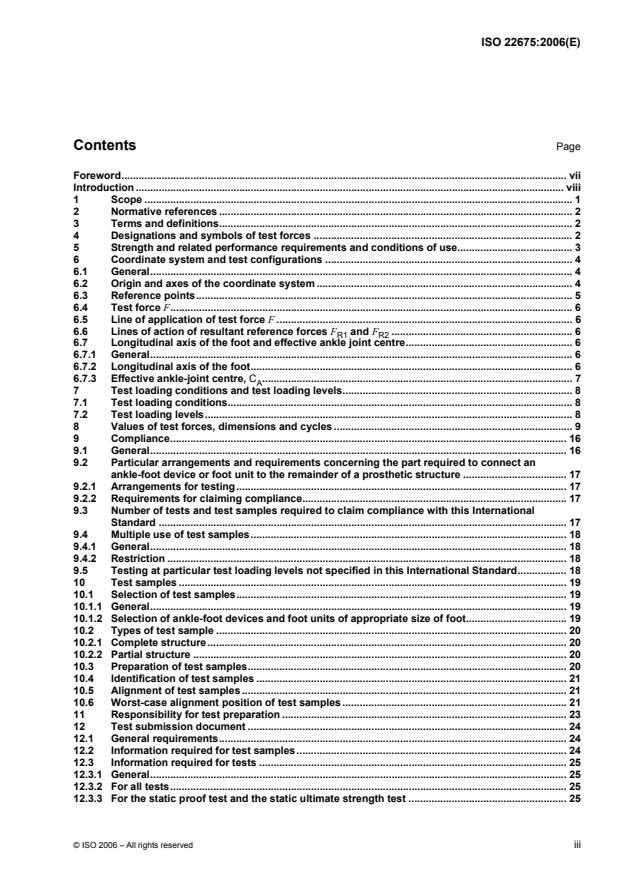
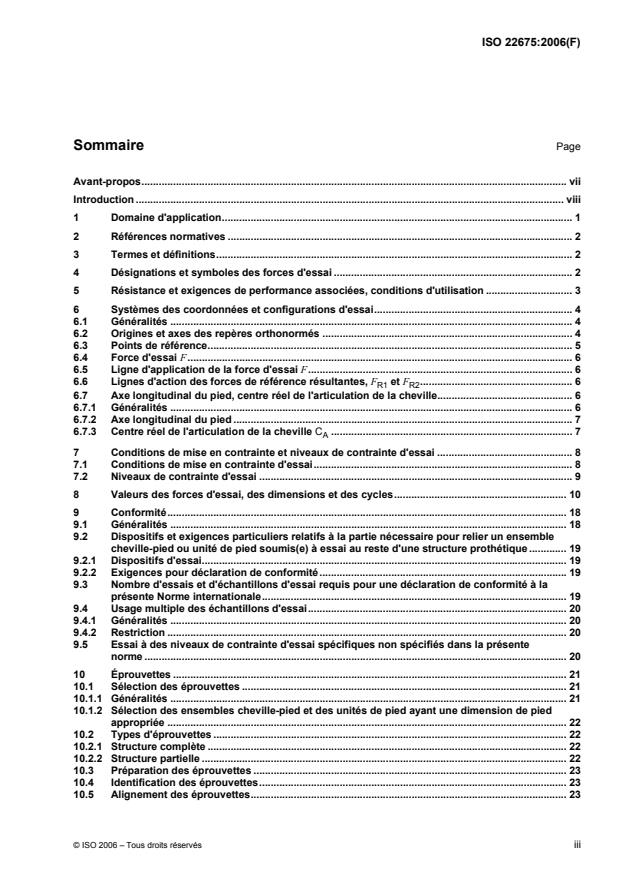
Contents Page
Foreword. vii
Introduction . viii
1 Scope . 1
2 Normative references . 2
3 Terms and definitions. 2
4 Designations and symbols of test forces . 2
5 Strength and related performance requirements and conditions of use. 3
6 Coordinate system and test configurations . 4
6.1 General. 4
6.2 Origin and axes of the coordinate system . 4
6.3 Reference points. 5
6.4 Test force F. 6
6.5 Line of application of test force F . 6
6.6 Lines of action of resultant reference forces F and F . 6
R1 R2
6.7 Longitudinal axis of the foot and effective ankle joint centre. 6
6.7.1 General. 6
6.7.2 Longitudinal axis of the foot. 6
6.7.3 Effective ankle-joint centre, C . 7
A
7 Test loading conditions and test loading levels. 8
7.1 Test loading conditions. 8
7.2 Test loading levels. 8
8 Values of test forces, dimensions and cycles . 9
9 Compliance. 16
9.1 General. 16
9.2 Particular arrangements and requirements concerning the part required to connect an
ankle-foot device or foot unit to the remainder of a prosthetic structure . 17
9.2.1 Arrangements for testing. 17
9.2.2 Requirements for claiming compliance.17
9.3 Number of tests and test samples required to claim compliance with this International
Standard . 17
9.4 Multiple use of test samples. 18
9.4.1 General. 18
9.4.2 Restriction . 18
9.5 Testing at particular test loading levels not specified in this International Standard. 18
10 Test samples . 19
10.1 Selection of test samples. 19
10.1.1 General. 19
10.1.2 Selection of ankle-foot devices and foot units of appropriate size of foot. 19
10.2 Types of test sample . 20
10.2.1 Complete structure. 20
10.2.2 Partial structure . 20
10.3 Preparation of test samples. 20
10.4 Identification of test samples . 21
10.5 Alignment of test samples . 21
10.6 Worst-case alignment position of test samples . 21
11 Responsibility for test preparation . 23
12 Test submission document . 24
12.1 General requirements. 24
12.2 Information required for test samples. 24
12.3 Information required for tests . 25
12.3.1 General. 25
12.3.2 For all tests. 25
12.3.3 For the static proof test and the static ultimate strength test . 25
12.3.4 For the static ultimate strength test. 25
12.3.5 For the cyclic test. 25
13 Equipment. 26
13.1 General . 26
13.2 End attachments . 26
13.2.1 General . 26
13.2.2 Proof test of end attachments . 26
13.3 Jig (optional). 28
13.4 Test equipment. 28
13.4.1 Test equipment to perform static heel and forefoot loading. 28
13.4.2 Test equipment to perform cyclic loading.30
14 Accuracy . 37
14.1 General . 37
14.2 Accuracy of equipment . 37
14.3 Accuracy of procedure . 38
15 Test principles. 38
15.1 General . 38
15.2 Static test procedure . 39
15.3 Cyclic test procedure. 39
16 Test procedures . 39
16.1 Test loading requirements . 39
16.1.1 Preparation for test loading . 39
16.1.2 Test loading conditions. 43
16.2 Static proof test. 43
16.2.1 Test method. 43
16.2.2 Performance requirement . 45
16.2.3 Compliance conditions. 45
16.3 Static ultimate strength test. 47
16.3.1 Test method. 47
16.3.2 Performance requirements . 50
16.3.3 Compliance conditions. 50
16.4 Cyclic test . 52
16.4.1 Test method. 52
16.4.2 Performance requirements . 54
16.4.3 Compliance conditions. 55
17 Test laboratory/facility log . 58
17.1 General requirements . 58
17.2 Specific requirements. 58
18 Test report. 58
18.1 General requirements . 58
18.2 Specific requirements. 59
18.3 Options. 59
19 Classification and designation . 59
19.1 General . 59
19.2 Examples of classification and designation . 59
20 Labelling. 60
20.1 General . 60
20.2 Use of mark "*)" and warning symbol. 61
20.3 Examples of label layout . 61
20.4 Label placement . 62
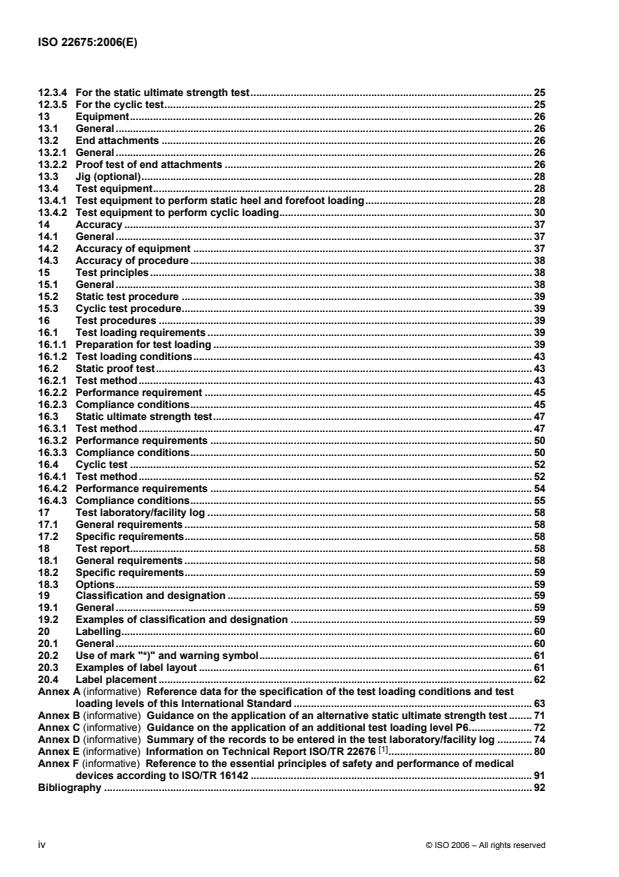
Annex A (informative) Reference data for the specification of the test loading conditions and test
loading levels of this International Standard .63
Annex B (informative) Guidance on the application of an alternative static ultimate strength test . 71
Annex C (informative) Guidance on the application of an additional test loading level P6. 72
Annex D (informative) Summary of the records to be entered in the test laboratory/facility log . 74
[1]
Annex E (informative) Information on Technical Report ISO/TR 22676 . 80
Annex F (informative) Reference to the essential principles of safety and performance of medical
devices according to ISO/TR 16142 . 91
Bibliography . 92
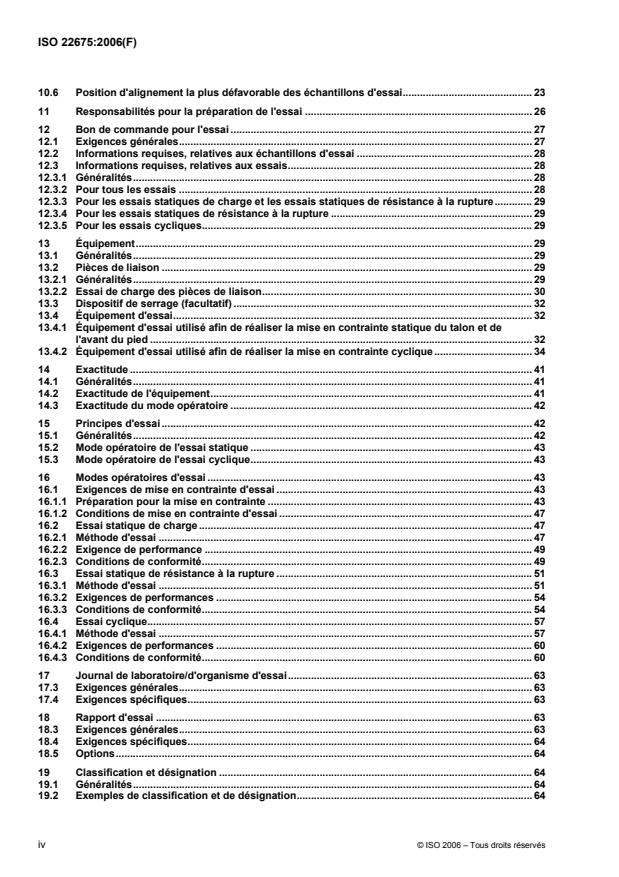
iv © ISO 2006 – All rights reserved
Figure 1 — Coordinate system with reference parameters. 5
Figure 2 — Determination of longitudinal axis of foot (see 6.7.2) and effective ankle-joint centre
C (see 6.7.3) . 7
A
Figure 3 — Illustration of reference points for the establishment of thresholds listed in Table 10
for specification of the loading profile of the cyclic test. 14
Figure 4 — Illustration of specific set-up of left-sided test sample with top load application
point P . 23
T
Figure 5 — Diagrammatic view of test equipment according to 13.4.1 and 13.4.2 with test sample. 35
Figure 6 — Profiles of test force F (t) and tilting angle γ(t) as synchronized functions of time,
c
determining the loading condition of the cyclic test of this International Standard . 36
Figure 7 — Test force F (γ) of test loading level P5 as function of tilting angle γ(t) of foot platform. 37
c
Figure 8 — Preparation for test loading of static test procedure [see 16.1.1 a)] . 42
Figure 9 — Flowchart for the static proof test specified in 16.2.1.46
Figure 10 — Flowchart for the static ultimate strength test specified in 16.3.1. 51
Figure 11 — Flowchart for the cyclic test specified in 16.4.1 Continued on Figure 12. 56
Figure 12 — Flowchart for the cyclic test specified in 16.4.1 Continued from Figure 11 . 57
Figure 13 — General concept for the label layout. 60
Figure 14 — Models for the label layout. 61
Figure A.1 — Illustration of different components of loading. 69
Figure A.2 — Illustration of the dependence of the position of the top load application point P on
T
the foot length L — (see A.2.2.3). 70
Figure E.1 — Effect of f-position of tilting axis TA of foot platform on the elevation E of the foot at
the instants of heel contact and toe-off. 83
Figure E.2 — Effect of u-position of tilting axis TA of foot platform on the A/P displacement ∆f of
the foot at the instant of toe-off. 84
Figure E.3 — Illustration of the effect of A-P displacement ∆f on the angular movement ∆ϕ
of the test sample about the top load application point P . 85
T
Figure E.4 — Illustration of possibilities of transposing the top load application point P
T
for compensation of the dependence of the position of the tilting axis TA of the foot
platform on the foot length L . 88
Figure E.5 — Illustration of the effect of a fixed compromise offset u of the tilting axis TA
TA, C
of the foot platform on the A-P displacement ∆f at the foot [see E.3.4.2 c) 2)] . 89
Table 1 — Designations and symbols of test forces . 2
Table 2 — Categories of strength addressed in this International Standard, together with the
related performance requirements and test methods for their verification . 3
Table 3 — Test forces and relevant references . 9
Table 4 — Values of bottom offsets f (heel) and f (forefoot) for given values of foot length
B1, L B2, L
L, relevant to the design and/or adjustment of the rigid foot dummy required to simulate
the effective lever arms of an ankle-foot device or foot unit in the proof test of end
attachments (see 13.2.2) . 10
Table 5 — Test forces of the proof test of end attachments for test loading levels P5, P4 and P3
(see 13.2.1). 10
Table 6 — Total length of test samples and segmental lengths of end attachments. 11
Table 7 — Coordinates of top load application point P and tilting axis TA of foot platform based
T
on given values of foot length L, for all test loading levels. 12
Table 8 — Angles of toe-out position of foot and specific tilting positions of foot platform, for all
test loading levels . 12
Table 9 — Test forces for all tests and prescribed number of cycles for the cyclic test, for test
loading levels P5, P4 and P3 (see 16.2, 16.3 and 16.4). 13
Table 10 — Thresholds according to Figure 3 for specification of the application of the loading
profile of the cyclic test . 15
Table 11 — Data specifying the values of tilting angle γ(t) and test force F (t) illustrated in
c
Figure 6 in 30 ms time increments for guidance on their application. 16
Table 12 — Number of tests and test samples required to claim compliance with this
International Standard . 19
Table 13 — Option for end attachments of specific design .26
Table A.1 — Magnitudes of resultant reference forces F and F . 66
R1x R2x
Table C.1 — Test forces of the proof test of end attachments for test loading level P6
(see 13.2.2.1) . 72
Table C.2 — Test forces for all tests and prescribed number of cycles for the cyclic test,
for test loading level P6 (see 16.2, 16.3 and 16.4) . 73
Table E.1 — Contents of ISO/TR 22676 and list of corresponding clauses/subclauses of this
International Standard, in which selected items are dealt with . 81
Table E.2 — Possibilities of transposing the top load application point P for compensation of
T
the dependence of the position of the tilting axis TA of the foot platform on the foot
length L. 90
Table F.1 — Correspondence between this International Standard and the essential principles of
ISO/TR 16142 . 91
vi © ISO 2006 – All rights reserved
Foreword
ISO (the International Organization for Standardization) is a worldwide federation of national standards bodies
(ISO member bodies). The work of preparing International Standards is normally carried out through ISO
technical committees. Each member body interested in a subject for which a technical committee has been
established has the right to be represented on that committee. International organizations, governmental and
non-governmental, in liaison with ISO, also take part in the work. ISO collaborates closely with the
International Electrotechnical Commission (IEC) on all matters of electrotechnical standardization.
International Standards are drafted in accordance with the rules given in the ISO/IEC Directives, Part 2.
The main task of technical committees is to prepare International Standards. Draft International Standards
adopted by the technical committees are circulated to the member bodies for voting. Publication as an
International Standard requires approval by at least 75 % of the member bodies casting a vote.
Attention is drawn to the possibility that some of the elements of this document may be the subject of patent
rights. ISO shall not be held responsible for identifying any or all such patent rights.
ISO 22675 was prepared by Technical Committee ISO/TC 168, Prosthetics and orthotics.
Introduction
This International Standard offers alternatives to the structural tests on ankle-foot devices and foot units
specified in 17.2 of ISO 10328:2006, which still suffer from several “weaknesses”, such as:
a) the inconsistency of the lines of application of the heel and forefoot test forces with those of the test forces
of test loading conditions I and II for the principal structural tests specified in 16.2 (static tests) and 16.3
(cyclic test) of ISO 10328:2006;
b) the unrealistic course and magnitude of loading in the phase between the instants of maximum heel and
forefoot loading during the cyclic test;
c) the effect of periodical “stepping in a hollow” during the cyclic test, resulting from simultaneous heel and
forefoot loading at different angles.
In this relation it is important to note that the complexity of the test equipment required for the testing of ankle-
foot devices and foot units specified in this International Standard is low, comparable to that of the test
equipment required for the corresponding separate structural tests specified in ISO 10328. Apparently, basic
components of both types of test equipment are similar and can be re-used in a modified design.
Finally, it has to be noted that the potential of the general concept applied to the test procedures specified in
this International Standard allows other applications directed to the assessment of specific performance
characteristics of ankle-foot devices and foot units that may be of relevance in the future.
In order to allow continuity of testing by checking the test methods for ankle-foot devices and foot units
specified in this International Standard against those specified in 17.2 of ISO 10328:2006, a transition period
will be established, during which both test methods are valid. For practical reasons, this transition period will
be adapted to the period of time after which the systematic review of ISO 10328:2006 and this International
Standard is indicated. The systematic review of both standards is expected to result, among other outcomes,
in the finding on whether the test methods specified in this International Standard have demonstrated their
suitability.
NOTE Further guidance on the specification of the test loading conditions and test loading levels and on the design
of appropriate test equipment is given in a separate document, published as a Technical Report (see Bibliography).
viii © ISO 2006 – All rights reserved
INTERNATIONAL STANDARD ISO 22675:2006(E)
Prosthetics — Testing of ankle-foot devices and foot units —
Requirements and test methods
1 Scope
IMPORTANT — This International Standard is suitable for the assessment of the conformity of
prosthetic ankle-foot devices and foot units with the strength requirements specified in 4.4 of
ISO 22523:2006 (see NOTE 1). Prosthetic ankle-foot devices and foot units on the market, which have
demonstrated their compliance with the strength requirements specified in 4.4 of EN 12523:1999
through submission to the relevant tests of ISO 10328:1996, need not be retested to this International
Standard.
WARNING — This International Standard is not suitable to serve as a guide for the selection of a
specific ankle-foot device or foot unit in the prescription of an individual lower limb prosthesis! Any
disregard of this warning can result in a safety risk for amputees.
This International Standard primarily specifies a cyclic test procedure for ankle-foot devices and foot units of
external lower limb prostheses, distinguished by the potential to realistically simulate those loading conditions
of the complete stance phase of walking from heel strike to toe-off that are relevant to the verification of
performance requirements such as strength, durability and service life.
This potential is of particular importance for the assessment of the performance of a variety of recent designs
of ankle-foot devices and foot units with specific characteristics that will only develop under realistic conditions
of loading.
In addition, this International Standard specifies a static test procedure for prosthetic ankle-foot devices and
foot units, consisting of a static proof test and a static ultimate strength test, distinguished, besides other
features, (see NOTE 2) by the potential to generate heel and forefoot forces at lines of action conforming to
those occurring at the instants of maximum heel and forefoot loading during the cyclic test.
The loading conditions addressed in the third paragraph are characterized by a loading profile determined by
the resultant vector of the vertical and horizontal (A-P) ground reaction forces and by a locomotion profile
determined by the tibia angle.
The test loading conditions specified in this International Standard are characterized by standardized formats
of these loading and locomotion profiles, to be uniformly applied by the cyclic and static test procedures to
each sample of ankle-foot device or foot unit submitted for test.
According to the concept of the tests of this International Standard, each sample of ankle-foot device or foot
unit submitted for test is, nevertheless, free to develop its individual performance under load.
NOTE 1 ISO 22523 (formerly EN 12523) addresses those of the Essential Requirements listed in Annex I of the
European Medical Device Directive 93/42/EEC that are applicable to external limb prostheses and external orthoses.
NOTE 2 The lines of action of the heel and forefoot forces generated by the static test procedure specified in this
International Standard approach those determining the sagittal plane loading of the test loading conditions I and II for the
principal structural tests specified in ISO 10328, without changing the values of the angles of the heel and forefoot
platform(s) for the structural tests on ankle-foot devices and foot units specified in ISO 10328.
2 Normative references
The following referenced documents are indispensable for the application of this document. For dated
references, only the edition cited applies. For undated references, the latest edition of the referenced
document (including any amendments) applies.
ISO 8549-1, Prosthetics and orthotics — Vocabulary — Part 1: General terms for external limb prostheses
and external orthoses
ISO 10328:2006, Prosthetics — Structural testing of lower limb prostheses — Requirements and test methods
ISO 22523:2006, External limb prostheses and external orthoses — Requirements and test methods
3 Terms and definitions
For the purposes of this document, the terms and definitions given in ISO 8549-1 and the following apply.
3.1
proof strength
static load representing an occasional severe event, which can be sustained by the ankle-foot device or foot
unit and still allow it to function as intended
3.2
ultimate strength
static load representing a gross single event, which can be sustained by the ankle-foot device or foot unit but
which could render it thereafter unusable
3.3
fatigue strength
cyclic load that can be sustained by the ankle-foot device or foot unit for a given number of cycles
3.4
batch
set of test samples of an ankle-foot device or foot unit submitted together to a test laboratory/facility to
undertake tests to demonstrate compliance with one or more requirements of this International Standard
4 Designations and symbols of test forces
The designations and symbols of all relevant test forces are listed in Table 1.
Table 1 — Designations and symbols of test forces
Designation Symbol
Test forces
F, F , F
1 2
Settling test force F
set
Stabilizing test force F
stab
Proof test force of end attachments F
pa
Static proof test force on heel/forefoot F , F
1sp 2sp
Static ultimate test force on heel/forefoot F , F
1su 2su
Pulsating test force F (t); F (γ)
c c
1st and 2nd maximum value of pulsating test force F , F
1cmax 2cmax
Intermediate minimum value of pulsating test force F
cmin
Final static test force on heel/forefoot F , F
1fin 2fin
NOTE Further details of the test forces listed are given in Table 3.
2 © ISO 2006 – All rights reserved
5 Strength and related performance requirements and conditions of use
5.1 According to 4.4.1 of ISO 22523:2006, a prosthetic ankle-foot device or foot unit “… shall have the
strength to sustain the loads occurring during use by amputees […] in the manner intended by the
manufacturer for that device according to his written instructions on its intended use”.
For the assessment of the conformity of ankle-foot devices and foot units with the above requirement
(see also Scope), this International Standard provides means of determining different categories of strength.
These are defined in 3.1 to 3.3 and listed in Table 2, together with the related performance requirements and
the test methods for their verification.
5.2 In order to satisfy the general requirement in 5.1 for a specific ankle-foot device or foot unit, the
following safety concept shall apply:
The device shall
a) comply with the requirements of this International Standard (see 9.1 and 9.2) for a specific test loading
level (see 7.2)
and
b) be used in accordance with the body mass limit specified by the manufacturer in consideration of the
intended use of that device (see NOTE).
The conditions in a) and b) are regarded in both the classification and designation of ankle-foot devices and
foot units according to Clause 19 and their labelling according to Clause 20.
NOTE The statement of the body mass limit not to be exceeded by amputees is part of the conditions of use to be
specified, with justification, by the manufacturer in his written instructions on the intended use of a specific ankle-foot
device or foot unit, taking account of all other factors affecting the loads expected to be exerted on that ankle-foot device
or foot unit by amputees (see Clause A.1).
Table 2 — Categories of strength addressed in this International Standard,
together with the related performance requirements and test methods for their verification
a
Category of strength Related performance requirement Test method for verification
Structure shall sustain static loading by the proof
Static proof test (16.2.1), successively
Proof strength (see 3.1) test forces F and F at the prescribed
1sp 2sp
applying heel and forefoot loading.
values for the prescribed time (see 16.2.2).
Structure shall sustain static loading by the Static ultimate strength test (16.3.1),
Ultimate strength (see 3.2) ultimate test forces F and F at the separately applying heel and forefoot
1su 2su
prescribed values (see 16.3.2). loading.
Structure shall sustain successively (see 16.4.2)
Cyclic test procedure (16.4.1),
1) cyclic loading by the pulsating test force
F (t) or F (γ) at the prescribed profile for the
c c repeatedly applying a loading profile
Fatigue strength (see 3.3) prescribed number of cycles and
simulating the stance phase of walking,
followed by final static heel and forefoot
2) final static loading by the final test forces
loading.
F and F at the prescribed values for
1fin 2fin
the prescribed time.
a
The performance requirements related to a specific category of strength are specified in full in an individual subclause following the
subclause in which the test method for their verification is specified.
6 Coordinate system and test configurations
6.1 General
The test configurations of this International Standard are defined in a manner similar to that applied in
ISO 10328.
Each test configuration shall be defined in a two-dimensional, rectangular coordinate system (see Figure 1).
Each test configuration specifies reference parameters both for the position of the line of application of the test
force and for the alignment of test samples within the coordinate system.
6.2 Origin and axes of the coordinate system
The origin and the axes of the coordinate system are specified in a) to c) in relation to a prosthesis which is
standing on the ground in an upright position. In Figure 1 the ground is represented by the bottom plane B.
If a test sample is not in the vertical position, the axes of the coordinate system shall be rotated to correspond.
a) The origin 0 of the coordinate system is located in the bottom plane B.
b) The u-axis extends from the origin 0 perpendicular to the bottom plane B and passes through the effective
ankle-joint centre C , specified in 6.7.3 (see Figure 1). Its positive direction is upwards (in the proximal
A
direction).
NOTE The u-axis also passes through the effective knee-joint centre C (see Figure 1). This may be relevant to
K
the setting-up of test samples of specific designs of ankle-foot devices or foot units which extend towards the knee
unit of a lower limb prosthesis and which, therefore, may also require the knowledge of the position of the effective
knee joint centre.
c) The f-axis extends from the origin 0 perpendicular to the u-axis (see Figure 1). Its positive direction is
forward towards the toe (in the anterior direction).
4 © ISO 2006 – All rights reserved
Key
B bottom plane (see 6.2)
0 origin of coordinate system [see 6.2 a)]
u (upward) axis of coordinate system [see 6.2 b)]
f (forward) axis of coordinate system [see 6.2 c)]
C effective ankle-joint centre [see 6.2 b) and 6.7.3]
A
C effective knee-joint centre [see NOTE of 6.2 b)]
K
P top load application point (see 6.3)
T
P , P knee load reference points (see 6.3)
K1 K2
P , P ankle load reference points (see 6.3)
A1 A2
P , P bottom load application points (see 6.3)
B1 B2
1 line of application of test force F (see 6.5)
2 line of action of resultant reference force F (heel loading) (see 6.6)
R1
3 line of action of resultant reference force F (forefoot loading) (see 6.6)
R2
Figure 1 — Coordinate system with reference parameters
6.3 Reference points
The reference points determine the position of the line of application of the test force F (see 6.5) and the lines
of action of the resultant reference forces F (heel loading) and F (forefoot loading) (see 6.6 and
R1 R2
Figure A.1) within the f-u-plane of the coordinate system (see 6.2 and Figure 1). The coordinates of the
reference points are as follows:
⎯ top load application point (see NOTE 1), P (f , u );
T T T
⎯ knee load reference point, P (f , u )
K K K
⎯ ankle load reference point (see NOTE 2), P (f , u );
A A A
⎯ bottom load application point, P (f , 0)
B B
The only reference point to be defined and specified for the application of the test principles outlined in 15.1 is
the top load application point P , at which the test force F (see 6.4) is applied to the test sample (see Figure 1).
T
The reference points at knee, ankle and bottom level are required to specify the lines of action of the resultant
reference forces F and F .
R1 R2
IMPORTANT — In the subsequent clauses of this International Standard, the f-coordinates are also
referred to as OFFSETS.
NOTE 1 If appropriate, the dependence of the position of the top load application point P (f , u ) on the foot length L is
T T T
indicated by the additional suffix 'L' in the form P (f , u ) (see 10.5, 16.1.1, A.2.2.3, A.2.4.1, E.3.4.2, Figures 4 and 5
T, L T, L T, L
and Table 7). If appropriate, general suffix 'L' may be replaced by specific values (see Figures A.2 and E.4).
NOTE 2 If the ankle load reference point P (f , u ) describes the position of specific lines of action as illustrated in
A A A
Figure 1 for heel loading by resultant reference force F and forefoot loading by resultant reference force F , this may
R1 R2
be indicated by the additional suffixes '1' for heel loading and '2' for forefoot loading in the form P (f , u ) or
A1 A1 A1
P (f , u ), if appropriate (see A.2.2). The additional suffixes '1' and '2' are also used to identify the f -offsets addressed
A2 A2 A2 B
in 13.2.2.2.1 and listed in Table 4.
6.4 Test force F
The test force F is a single load applied to the top load application point P specified i
...
NORME ISO
INTERNATIONALE 22675
Première édition
2006-10-01
Prothèses — Essais d'articulations
cheville-pied et unités de pied —
Exigences et méthodes d'essai
Prosthetics — Testing of ankle-foot devices and foot units —
Requirements and test methods
Numéro de référence
©
ISO 2006
PDF – Exonération de responsabilité
Le présent fichier PDF peut contenir des polices de caractères intégrées. Conformément aux conditions de licence d'Adobe, ce fichier
peut être imprimé ou visualisé, mais ne doit pas être modifié à moins que l'ordinateur employé à cet effet ne bénéficie d'une licence
autorisant l'utilisation de ces polices et que celles-ci y soient installées. Lors du téléchargement de ce fichier, les parties concernées
acceptent de fait la responsabilité de ne pas enfreindre les conditions de licence d'Adobe. Le Secrétariat central de l'ISO décline toute
responsabilité en la matière.
Adobe est une marque déposée d'Adobe Systems Incorporated.
Les détails relatifs aux produits logiciels utilisés pour la création du présent fichier PDF sont disponibles dans la rubrique General Info
du fichier; les paramètres de création PDF ont été optimisés pour l'impression. Toutes les mesures ont été prises pour garantir
l'exploitation de ce fichier par les comités membres de l'ISO. Dans le cas peu probable où surviendrait un problème d'utilisation,
veuillez en informer le Secrétariat central à l'adresse donnée ci-dessous.
© ISO 2006
Droits de reproduction réservés. Sauf prescription différente, aucune partie de cette publication ne peut être reproduite ni utilisée sous
quelque forme que ce soit et par aucun procédé, électronique ou mécanique, y compris la photocopie et les microfilms, sans l'accord écrit
de l'ISO à l'adresse ci-après ou du comité membre de l'ISO dans le pays du demandeur.
ISO copyright office
Case postale 56 • CH-1211 Geneva 20
Tel. + 41 22 749 01 11
Fax. + 41 22 749 09 47
E-mail copyright@iso.org
Web www.iso.org
Publié en Suisse
ii © ISO 2006 – Tous droits réservés
Sommaire Page
Avant-propos. vii
Introduction . viii
1 Domaine d'application. 1
2 Références normatives . 2
3 Termes et définitions. 2
4 Désignations et symboles des forces d'essai . 2
5 Résistance et exigences de performance associées, conditions d'utilisation . 3
6 Systèmes des coordonnées et configurations d'essai. 4
6.1 Généralités . 4
6.2 Origines et axes des repères orthonormés . 4
6.3 Points de référence. 5
6.4 Force d'essai F. 6
6.5 Ligne d'application de la force d'essai F. 6
6.6 Lignes d'action des forces de référence résultantes, F et F . 6
R1 R2
6.7 Axe longitudinal du pied, centre réel de l'articulation de la cheville. 6
6.7.1 Généralités . 6
6.7.2 Axe longitudinal du pied . 7
6.7.3 Centre réel de l'articulation de la cheville C . 7
A
7 Conditions de mise en contrainte et niveaux de contrainte d'essai . 8
7.1 Conditions de mise en contrainte d'essai. 8
7.2 Niveaux de contrainte d'essai . 9
8 Valeurs des forces d'essai, des dimensions et des cycles. 10
9 Conformité. 18
9.1 Généralités . 18
9.2 Dispositifs et exigences particuliers relatifs à la partie nécessaire pour relier un ensemble
cheville-pied ou unité de pied soumis(e) à essai au reste d'une structure prothétique . 19
9.2.1 Dispositifs d'essai. 19
9.2.2 Exigences pour déclaration de conformité. 19
9.3 Nombre d'essais et d'échantillons d'essai requis pour une déclaration de conformité à la
présente Norme internationale. 19
9.4 Usage multiple des échantillons d'essai. 20
9.4.1 Généralités . 20
9.4.2 Restriction . 20
9.5 Essai à des niveaux de contrainte d'essai spécifiques non spécifiés dans la présente
norme . 20
10 Éprouvettes . 21
10.1 Sélection des éprouvettes . 21
10.1.1 Généralités . 21
10.1.2 Sélection des ensembles cheville-pied et des unités de pied ayant une dimension de pied
appropriée . 22
10.2 Types d'éprouvettes . 22
10.2.1 Structure complète . 22
10.2.2 Structure partielle . 22
10.3 Préparation des éprouvettes . 23
10.4 Identification des éprouvettes. 23
10.5 Alignement des éprouvettes. 23
10.6 Position d'alignement la plus défavorable des échantillons d'essai. 23
11 Responsabilités pour la préparation de l'essai . 26
12 Bon de commande pour l'essai . 27
12.1 Exigences générales. 27
12.2 Informations requises, relatives aux échantillons d'essai . 28
12.3 Informations requises, relatives aux essais.28
12.3.1 Généralités. 28
12.3.2 Pour tous les essais . 28
12.3.3 Pour les essais statiques de charge et les essais statiques de résistance à la rupture. 29
12.3.4 Pour les essais statiques de résistance à la rupture . 29
12.3.5 Pour les essais cycliques. 29
13 Équipement. 29
13.1 Généralités. 29
13.2 Pièces de liaison . 29
13.2.1 Généralités. 29
13.2.2 Essai de charge des pièces de liaison. 30
13.3 Dispositif de serrage (facultatif) . 32
13.4 Équipement d'essai. 32
13.4.1 Équipement d'essai utilisé afin de réaliser la mise en contrainte statique du talon et de
l'avant du pied . 32
13.4.2 Équipement d'essai utilisé afin de réaliser la mise en contrainte cyclique. 34
14 Exactitude . 41
14.1 Généralités. 41
14.2 Exactitude de l'équipement. 41
14.3 Exactitude du mode opératoire . 42
15 Principes d'essai . 42
15.1 Généralités. 42
15.2 Mode opératoire de l'essai statique . 43
15.3 Mode opératoire de l'essai cyclique. 43
16 Modes opératoires d'essai . 43
16.1 Exigences de mise en contrainte d'essai .43
16.1.1 Préparation pour la mise en contrainte . 43
16.1.2 Conditions de mise en contrainte d'essai .47
16.2 Essai statique de charge . 47
16.2.1 Méthode d'essai . 47
16.2.2 Exigence de performance . 49
16.2.3 Conditions de conformité. 49
16.3 Essai statique de résistance à la rupture . 51
16.3.1 Méthode d'essai . 51
16.3.2 Exigences de performances . 54
16.3.3 Conditions de conformité. 54
16.4 Essai cyclique. 57
16.4.1 Méthode d'essai . 57
16.4.2 Exigences de performances . 60
16.4.3 Conditions de conformité. 60
17 Journal de laboratoire/d'organisme d'essai. 63
17.3 Exigences générales. 63
17.4 Exigences spécifiques. 63
18 Rapport d'essai . 63
18.3 Exigences générales. 63
18.4 Exigences spécifiques. 64
18.5 Options. 64
19 Classification et désignation . 64
19.1 Généralités. 64
19.2 Exemples de classification et de désignation. 64
iv © ISO 2006 – Tous droits réservés
20 Étiquetage. 65
20.1 Généralités . 65
20.2 Utilisation du signe «*)» et symbole d'avertissement. 66
20.3 Exemples de mise en forme de l'étiquette . 66
20.4 Emplacement de l'étiquette . 67
Annex A (informative) Reference data for the specification of the test loading conditions and test
loading levels of this International Standard.68
Annex B (informative) Guidance on the application of an alternative static ultimate strength test. 76
Annex C (informative) Guidance on the application of an additional test loading level P6 . 77
Annex D (informative) Summary of the records to be entered in the test laboratory/facility log . 79
[1]
Annex E (informative) Information on Technical Report ISO/TR 22676 . 85
Annex F (informative) Reference to the essential principles of safety and performance of medical
devices according to ISO/TR 16142. 96
Bibliographie . 97
Figure 1 — Système de coordonnées avec paramètres de référence . 5
Figure 2 — Détermination de l'axe longitudinal du pied (voir 6.7.2) et du centre réel de
l'articulation de la cheville C (voir 6.7.3) . 8
A
Figure 3 — Illustration des points de référence pour la détermination des seuils répertoriés dans
le Tableau 10, en vue de la spécification du profil de mise en contrainte de l'essai
cyclique. 16
Figure 4 — Illustration du montage spécifique de l'échantillon d'essai gauche avec point
supérieur d'application de la contrainte P . 25
T
Figure 5 — Vue en coupe de l'équipement d'essai conformément à 13.4.1 et à 13.4.2 avec
l'échantillon d'essai . 39
Figure 6 — Profils de la force d'essai F (t) et de l'angle d'inclinaison γ(t) comme fonctions de
c
temps synchronisées, déterminant la condition de contrainte de l'essai cyclique de la
présente Norme internationale. 40
Figure 7 — Force d'essai F (γ) de niveau de contrainte d'essai P5 comme fonction de l'angle
c
d'inclinaison γ(t) de la plate-forme de pied. 41
Figure 8 — Préparation pour la mise en contrainte d'essai pour le mode opératoire d'essai
statique [voir 16.1.1 a)]. 46
Figure 9 — Organigramme d'essai statique de charge, spécifié en 16.2.1. 50
Figure 10 — Organigramme d'essai statique de résistance à la rupture, spécifié en 16.3.1. 56
Figure 11 — Organigramme d'essai cyclique, spécifié en 16.4.1 (suite à la Figure 12). 61
Figure 12 — Organigramme d'essai cyclique, spécifié en 16.4.1 (suite de la Figure 11). 62
Figure 13 — Concept général de mise en forme de l'étiquette . 66
Figure 14 — Modèles de mise en forme de l'étiquette. 67
Figure A.1 — Illustration of different components of loading. 74
Figure A.2 — Illustration of the dependence of the position of the top load application point P on
T
the foot length L — (see A.2.2.3). 75
Figure E.1 — Effect of f-position of tilting axis TA of foot platform on the elevation E of the foot at
the instants of heel contact and toe-off. 88
Figure E.2 — Effect of u-position of tilting axis TA of foot platform on the A/P displacement ∆f of
the foot at the instant of toe-off. 89
Figure E.3 — Illustration of the effect of A-P displacement ∆f on the angular movement ∆ϕ
of the test sample about the top load application point P . 90
T
Figure E.4 — Illustration of possibilities of transposing the top load application point P
T
for compensation of the dependence of the position of the tilting axis TA of the foot
platform on the foot length L . 93
Figure E.5 — Illustration of the effect of a fixed compromise offset u of the tilting axis TA
TA, C
of the foot platform on the A-P displacement ∆f at the foot [see E.3.4.2 c) 2)]. 94
Tableau 1 — Désignations et symboles des forces d'essai . 3
Tableau 2 — Catégories de résistance définies dans la présente norme, exigences de
performance afférentes et méthodes d'essai pour leur contrôle. 4
Tableau 3 — Forces d'essai et références correspondantes . 11
Tableau 4 — Valeurs des décalages inférieurs f (talon) et f (partie antérieure du pied) pour
, ,
B1 L B2 L
des valeurs données de la longueur de pied, L, correspondant à la conception et/ou à
l'ajustement du pied factice nécessaire à la simulation des bras de levier réels d'un
ensemble cheville-pied ou d'une unité de pied, lors de l'essai de charge des pièces de
liaison (voir 13.2.1). 12
Tableau 5 — Forces d'essai de l'essai de charge des pièces de liaison relatives aux niveaux de
mise en contrainte d'essai P5, P4 et P3 (voir 13.2.1). 12
Tableau 6 — Longueur totale des échantillons d'essai et des longueurs segmentaires des pièces
de liaison. 13
Tableau 7 — Coordonnées du point supérieur d'application de la contrainte P et de l'axe
T
d'inclinaison TA de la plate-forme de pied, sur la base des valeurs données de la
longueur de pied, L, pour tous les niveaux de mise en contrainte d'essai. 14
Tableau 8 — Angles de la position «éversion» du pied et positions d'inclinaison spécifiques de la
plate-forme de pied, pour tous les niveaux de mise en contrainte d'essai . 14
Tableau 9 — Forces d'essai pour tous les essais et nombre requis de cycles pour l'essai cyclique,
pour les niveaux de mise en contrainte d'essai P5, P4 et P3 (voir 16.2, 16.3 et 16.4) . 15
Tableau 10 — Seuils conformes à la Figure 3 en vue de la spécification du profil de mise en
contrainte de l'essai cyclique . 17
Tableau 11 — Données spécifiant les valeurs de l'angle d'inclinaison γ(t) et de la force d'essai
F (t) illustrés à la Figure 6, par paliers de 30 ms, à titre d'indication sur leur application . 18
c
Tableau 12 — Nombre d'essais et d'échantillons d'essai requis pour la déclaration de conformité
à la présente Norme internationale . 21
Tableau 13 — Option relative aux pièces de liaison de conception spécifique . 30
Table A.1 — Magnitudes of resultant reference forces F and F . 71
R1x R2x
Table C.1 — Test forces of the proof test of end attachments for test loading level P6
(see 13.2.2.1) . 77
Table C.2 — Test forces for all tests and prescribed number of cycles for the cyclic test,
for test loading level P6 (see 16.2, 16.3 and 16.4) . 78
Table E.1 — Contents of ISO/TR 22676 and list of corresponding clauses/subclauses of this
International Standard, in which selected items are dealt with . 86
Table E.2 — Possibilities of transposing the top load application point P for compensation of
T
the dependence of the position of the tilting axis TA of the foot platform on the foot
length L. 95
Table F.1 — Correspondence between this International Standard and the essential principles of
ISO/TR 16142 . 96
vi © ISO 2006 – Tous droits réservés
Avant-propos
L'ISO (Organisation internationale de normalisation) est une fédération mondiale d'organismes nationaux de
normalisation (comités membres de l'ISO). L'élaboration des Normes internationales est en général confiée
aux comités techniques de l'ISO. Chaque comité membre intéressé par une étude a le droit de faire partie du
comité technique créé à cet effet. Les organisations internationales, gouvernementales et non
gouvernementales, en liaison avec l'ISO participent également aux travaux. L'ISO collabore étroitement avec
la Commission électrotechnique internationale (CEI) en ce qui concerne la normalisation électrotechnique.
Les Normes internationales sont rédigées conformément aux règles données dans les Directives ISO/CEI,
Partie 2.
La tâche principale des comités techniques est d'élaborer les Normes internationales. Les projets de Normes
internationales adoptés par les comités techniques sont soumis aux comités membres pour vote. Leur
publication comme Normes internationales requiert l'approbation de 75 % au moins des comités membres
votants.
L'attention est appelée sur le fait que certains des éléments du présent document peuvent faire l'objet de
droits de propriété intellectuelle ou de droits analogues. L'ISO ne saurait être tenue pour responsable de ne
pas avoir identifié de tels droits de propriété et averti de leur existence.
L'ISO 22675 a été élaborée par le comité technique ISO/TC 168, Prothèses et orthèses.
Introduction
La présente Norme internationale suggère des solutions alternatives aux essais de structure portant sur les
ensembles cheville-pied et les unités de pied spécifiés dans l'ISO 10328:2006, 17.2, qui présentent encore
plusieurs «points faibles», tels que:
a) une incohérence des lignes d'application des forces d'essai du talon et de l'avant du pied par rapport aux
forces d'essai des conditions de mise en contrainte I et II, pour les principaux essais de structure
spécifiés en 16.2 (essais statiques) et en 16.3 (essai cyclique) de l'ISO 10328:2006;
b) un cours et une amplitude improbables de la contrainte appliquée lors de la phase comprise entre les
moments de contraintes maximales appliquées au talon et à l'avant du pied lors de l'essai cyclique;
c) l'effet d'un «pas dans le creux» périodique lors de l'essai cyclique, résultant d'une contrainte appliquée
simultanément au talon et à l'avant du pied sous des angles différents.
Dans ce contexte, il est important de noter que le matériel d'essai requis pour l'évaluation des ensembles
cheville-pied et des unités de pied, spécifié dans la présente Norme internationale, est peu complexe,
c'est-à-dire qu'il est comparable au matériel d'essai requis pour les essais de structure correspondants
spécifiés dans l'ISO 10328. Les composants de base des deux types de matériel d'équipement sont
apparemment similaires et peuvent être réutilisés dans un autre modèle.
Enfin, il doit être noté que le concept général, appliqué aux modes opératoires d'essai spécifiés dans la
présente Norme internationale, permet d'autres applications destinées à l'évaluation de caractéristiques de
performances spécifiques aux ensembles cheville-pied et aux unités de pied qui pourront s'avérer pertinentes
ultérieurement.
Pour permettre de garantir la continuité des essais en vérifiant les méthodes d'essai applicables aux
ensembles cheville-pied et aux pieds spécifiées dans la présente Norme internationale par rapport à celles
spécifiées dans l'ISO 10328:2006, 17.2, une période transitoire sera établie durant laquelle les deux
méthodes d'essai seront réputées valides. Pour faciliter sa mise en œuvre, la période transitoire s'achèvera
au moment de la révision systématique de l'ISO 10328:2006 et de la présente Norme internationale. La
révision systématique des deux normes vise, entre autres, à déterminer l'efficacité des méthodes d'essai
spécifiées dans la présente Norme internationale.
NOTE D'autres recommandations relatives à la spécification des conditions et des niveaux de mise en contrainte
pendant l'essai ainsi qu'à la conception de matériel d'essai adéquat sont disponibles dans un document publié en tant que
Rapport technique (voir Bibliographie).
viii © ISO 2006 – Tous droits réservés
NORME INTERNATIONALE ISO 22675:2006(F)
Prothèses — Essais d'articulations cheville-pied et unités de
pied — Exigences et méthodes d'essai
1 Domaine d'application
IMPORTANT — La présente Norme internationale permet d'évaluer la conformité des ensembles
cheville-pied et unités de pied prothétiques aux exigences de résistance spécifiées en 4.4 de
l'ISO 22523:2006 (voir la NOTE 1). Les ensembles cheville-pied et pieds prothétiques commercialisés,
conformes aux exigences concernant la résistance spécifiées en 4.4 de l'EN 12523:1999 après
soumission aux essais appropriés de l'ISO 10328-1:1996, sont réputés conformes à la présente Norme
internationale.
AVERTISSEMENT — La présente Norme internationale n'a pas pour objectif de proposer des critères
permettant de choisir un ensemble cheville-pied ou une unité de pied prothétique spécifique lors de la
prescription d'une prothèse de membre inférieur! La non-prise en compte de cet avertissement peut
entraîner des risques pour la sécurité des personnes amputées.
La présente Norme internationale spécifie essentiellement un mode opératoire d'essais cycliques portant sur
les ensembles cheville-pied et les unités de pied des prothèses externes pour membres inférieurs. Ce mode
opératoire se distingue par la possibilité de modéliser, de manière réaliste, les conditions de mise en
contrainte pendant la phase complète d'appui lors de la marche (depuis l'attaque au talon jusqu'au
décollement des orteils), qui sont pertinentes pour la vérification des exigences de performances telles que la
résistance, la durabilité et la durée de vie de l'appareil.
Cela est particulièrement important dans le cadre de l'évaluation des performances de divers ensembles
cheville-pied et unités de pied de conception récente et qui présentent des caractéristiques visibles
uniquement dans des conditions de mise en contrainte réalistes.
En outre, la présente Norme internationale spécifie un mode opératoire d'essai statique portant sur les
ensembles cheville-pied et unités de pied prothétiques, qui comprend un essai statique de charge et un essai
statique de résistance à la rupture. L'essai se distingue, entre autres (voir NOTE 2), par la possibilité de
générer des forces du talon et de l'avant du pied au niveau de lignes d'action comparables à celles
développées au moment où s'exercent les contraintes maximales au niveau du talon et de l'avant du pied lors
de l'essai cyclique.
Les conditions de mise en contrainte traitées dans le troisième paragraphe se caractérisent par un profil de
contrainte, déterminé par le vecteur qui résulte des forces verticales et horizontales (A-P) de réaction du sol,
et par un profil de locomotion, déterminé par l'angle du tibia.
Les conditions de mise en contrainte d'essai spécifiées dans la présente norme se caractérisent par les
formats type de ces profils de contrainte et de locomotion, utilisés de manière systématique dans les modes
opératoires d'essais cyclique et statique auxquels est soumis chaque échantillon d'ensemble cheville-pied ou
d'unité de pied.
Néanmoins, le concept des essais de la présente norme, permet que chaque échantillon d'ensemble
cheville-pied ou d'unité de pied soumis à essai développe ses propres performances sous contrainte.
NOTE 1 L'ISO 22523 (anciennement EN 12523) traite des exigences essentielles, énumérées dans l'Annexe I de la
Directive européenne 93/42/CEE concernant les dispositifs médicaux, s'appliquant aux prothèses de membres et aux
orthèses externes.
NOTE 2 Les lignes d'action des forces du talon et de l'avant du pied, générées par le mode opératoire d'essai statique
spécifié dans la présente norme, sont comparables à celles déterminant la contrainte du plan sagittal lors des conditions
de mise en contrainte I et II pour les essais principaux de structure spécifiés dans l'ISO 10328, sans changer les valeurs
des angles de la/des plate(s)-forme(s) du talon et de l'avant du pied pour les essais de structure portant sur les ensembles
cheville-pied et les unités de pied spécifiés dans l'ISO 10328.
2 Références normatives
Les documents de référence suivants sont indispensables pour l'application du présent document. Pour les
références datées, seule l'édition citée s'applique. Pour les références non datées, la dernière édition du
document de référence s'applique (y compris les éventuels amendements).
ISO 8549-1, Prothèses et orthèses — Vocabulaire — Partie 1: Termes généraux pour prothèses de membre
et orthèses externes
ISO 10328:2006, Prothèses — Essais portant sur la structure des prothèses de membres inférieurs —
Exigences et méthodes d'essai
ISO 22523:2006, Prothèses de membre externes et orthèses externes — Exigences et méthodes d'essai
3 Termes et définitions
Pour les besoins du présent document, les termes et définitions donnés dans l'ISO 8549-1 ainsi que les
suivants s'appliquent.
3.1
résistance à la charge
contrainte statique survenue lors d'un incident grave occasionnel, pouvant être supportée par l'ensemble
cheville-pied ou unité de pied tout en permettant son utilisation normale
3.2
résistance à la rupture
contrainte statique survenue lors d'un seul incident grave, pouvant être supportée par l'ensemble cheville-pied
ou unité de pied, mais qui peut la rendre inutilisable
3.3
résistance à la fatigue
contrainte cyclique pouvant être supportée par l'ensemble cheville-pied ou des unités de pied pendant un
nombre de cycles déterminé
3.4
lot
ensemble des échantillons d'essai d'un ensemble cheville-pied ou unité de pied envoyés à un laboratoire
d'essai chargé de réaliser les essais de conformité avec une ou plusieurs exigences de la présente norme
4 Désignations et symboles des forces d'essai
Les désignations et symboles de toutes les forces d'essai figurent dans le Tableau 1.
2 © ISO 2006 – Tous droits réservés
Tableau 1 — Désignations et symboles des forces d'essai
Désignation Symbole
Forces d'essai F, F , F
1 2
Force de mise en place F
set
Force d'essai de stabilisation F
stab
Force d'essai sous contrainte appliquée aux éléments de jonction F
pa
Force d'essai statique de charge appliquée au talon/à l'avant du pied F , F
1sp 2sp
Force d'essai statique de rupture appliquée au talon/à l'avant du pied F , F
1su 2su
Force d'essai périodique F (t); F (γ)
c c
e e
1 et 2 valeurs maximales de force d'essai périodique F , F
1cmax 2cmax
Valeur minimale intermédiaire de force d'essai périodique F
cmin
Force d'essai statique sous contrainte appliquée au talon/à l'avant du pied F , F
1fin 2fin
NOTE Des détails supplémentaires concernant les forces d'essai sont indiqués dans le Tableau 3.
5 Résistance et exigences de performance associées, conditions d'utilisation
5.1 Conformément à l'ISO 22523:2006, 4.4.1, un ensemble cheville-pied ou une unité de pied prothétique
«… Une prothèse ou une orthèse doit avoir une résistance suffisante pour pouvoir supporter les contraintes
liées à son l'utilisation par une personne amputée […], dans des conditions normales prévues par le fabricant
et décrites dans son mode d'emploi».
Dans le cadre de l'évaluation de la conformité des ensembles cheville-pied et unités de pied aux exigences
décrites plus haut (voir aussi le Domaine d'application), la présente norme constitue un outil permettant de
déterminer les différentes catégories de résistance. Ces catégories sont définies de 3.1 à 3.3 et figurent dans
le Tableau 2, ainsi que les exigences de performances afférentes et les méthodes d'essai permettant de les
contrôler.
5.2 Pour satisfaire aux exigences générales spécifiées en 5.1 relatives à un ensemble cheville-pied ou à
une unité de pied spécifique, les dispositions de sécurité suivantes s'appliquent:
L'appareil doit
a) être conforme aux exigences de la présente Norme internationale (voir 9.1 et 9.2) pour un niveau de
contrainte d'essai spécifique (voir 7.2);
et
b) être utilisé dans les limites de masse corporelle spécifiées par le fabricant pour l'usage prévu de l'appareil
(voir NOTE).
Les conditions décrites en a) et b) sont respectées à la fois dans la classification et la désignation des
ensembles cheville-pied et des unités de pied conformément à l'Article 19 et dans leur étiquetage
conformément à l'Article 20.
NOTE L'indication de la limite de masse corporelle ne devant pas être dépassée par les personnes amputées figure
dans les conditions d'utilisation spécifiée, justification à l'appui, par le fabricant dans le mode d'emploi d'un ensemble
cheville-pied ou d'une unité de pied spécifique et tient compte de tous les autres facteurs agissant sur les charges qui vont
être exercées sur cet appareil de cheville-pied ou d'une unité de pied (voir Article A.1).
Tableau 2 — Catégories de résistance définies dans la présente norme, exigences de performance
afférentes et méthodes d'essai pour leur contrôle
a
Catégorie de résistance Exigences de performance afférentes Méthode d'essai pour leur contrôle
Résistance à la charge La structure doit supporter une mise en Essai statique de charge (voir 16.2.1),
(voir 3.1) contrainte statique dans le cas de forces d'essai appliqué successivement au talon et à
de charge F et F pour des valeurs et des l'avant du pied.
1sp 2sp
durées spécifiées (voir 16.2.2).
Résistance à la rupture La structure doit supporter une mise en Essai statique de résistance à la rupture
(voir 3.2) contrainte statique dans le cas de forces d'essai (voir 16.3.1) appliqué séparément au
de rupture F et F pour des valeurs talon et à l'avant du pied.
1su 2su
spécifiées (voir 16.3.2).
Résistance à la fatigue La structure doit supporter successivement Mode opératoire d'essai cyclique
(voir 3.3) (voir 16.4.2) (voir 16.4.1)
1) une mise en contrainte cyclique dans le cas appliquant de manière répétée un profil
de la force d'essai périodique F (t) ou F (γ) de contrainte stimulant la phase d'appui
c c
pour un profil spécifié et des nombres de de la marche, suivie d'une contrainte
cycles spécifiés; statique finale au talon et à l'avant.
2) une mise en contrainte statique finale dans
le cas de forces d'essai finales F et F
1fin 2fin
pour des valeurs et des durées spécifiées.
a
Les exigences concernant les performances relatives à une catégorie de résistance spécifique sont spécifiées intégralement dans
un paragraphe distinct à la suite du paragraphe dans lequel la méthode d'essai servant à leur contrôle est spécifiée.
6 Systèmes des coordonnées et configurations d'essai
6.1 Généralités
Les configurations d'essai de la présente norme sont définies de la même manière que celles qui s'appliquent
dans l'ISO 10328.
Chaque configuration d'essai doit être définie dans un repère orthonormé bidimensionnel (voir Figure 1).
Chaque configuration d'essai spécifie des paramètres de référence tant pour la position de la droite
d'application de la force d'essai que pour l'alignement des échantillons d'essai par rapport au repère
orthonormé.
6.2 Origines et axes des repères orthonormés
Les origines et les axes du repère orthonormé sont spécifiés de a) à c) pour une prothèse positionnée à la
verticale sur le sol. À la Figure 1, le sol est représenté par le plan inférieur B.
Si l'échantillon d'essai n'est pas en position verticale, il est nécessaire d'imprimer une rotation aux axes du
repère pour qu'ils correspondent à la position considérée.
a) L'origine 0 du repère orthonormé est situé sur le plan inférieur B.
b) L'axe u est une droite qui part de l'origine 0 perpendiculaire au plan inférieur B et qui passe par le centre
réel de l'articulation de la cheville C , spécifié en 6.7.3 (voir Figure 1). Sa direction positive est vers le
A
haut (en direction proximale).
NOTE L'axe u passe également par le centre réel de l'articulation du genou C (voir Figure 1). Cela peut s'avérer
K
pertinent pour le réglage des échantillons d'essai des conceptions spécifiques des ensembles cheville-pied et des unités
de pied, qui se prolongent vers l'unité de genou d'une prothèse de membre inférieur, et qui peuvent, par conséquent,
nécessiter également la connaissance de la position du centre réel de l'articulation du genou.
4 © ISO 2006 – Tous droits réservés
c) L'axe f est une droite qui part de l'origine 0, perpendiculaire à l'axe u (voir Figure 1). Sa direction positive
est vers l'
...
МЕЖДУНАРОДНЫЙ ISO
СТАНДАРТ
Первое издание
2006-10-01
Протезирование. Испытание устройств
голеностоп-стопа и узлов стопы.
Требования и методы испытания
Prosthetics — Testing of ankle-foot devices and foot units —
Requirements and test methods
Ответственность за подготовку русской версии несёт GOST R
(Российская Федерация) в соответствии со статьёй 18.1 Устава ISO
Ссылочный номер
©
ISO 2006
ДОКУМЕНТ ЗАЩИЩЕН АВТОРСКИМ ПРАВОМ
Все права сохраняются. Если не указано иное, никакую часть настоящей публикации нельзя копировать или использовать в
какой-либо форме или каким-либо электронным или механическим способом, включая фотокопии и микрофильмы, без
предварительного письменного согласия ISO, которое должно быть получено после запроса о разрешении, направленного по
адресу, приведенному ниже, или в комитет-член ISO в стране запрашивающей стороны.
ISO copyright office
Case postale 56 • CH-1211 Geneva 20
Tel. + 41 22 749 01 11
Fax + 41 22 749 09 47
E-mail copyright@iso.org
Web www.iso.org
Опубликовано в Швейцарии
ii © ISO 2006 – Все права сохраняются
Содержание Страница
Предисловие . vii
Введение . viii
1 Область применения . 1
2 Нормативные ссылки . 2
3 Термины и определения . 2
4 Наименование и обозначение испытательных сил . 3
5 Требования к прочности и соответствующим характеристикам, а также условия
использования . 3
6 Система координат и схемы испытаний . 4
6.1 Общие положения . 4
6.2 Оси и начало системы координат . 4
6.3 Контрольные точки . 5
6.4 Испытательная сила F . 6
6.5 Линия приложения испытательной силы F . 6
6.6 Линии действия результирующих контрольных сил F и F . . 6
R1 R2
6.7 Продольная ось стопы и обобщенный центр голеностопного сустава . 6
6.7.1 Общие положения . 6
6.7.2 Продольная ось стопы . 7
6.7.3 Обобщенный центр голеностопного сустава, C . 7
A
7 Условия нагружения и уровни нагрузки при испытаниях . 8
7.1 Условия нагружения . 8
7.2 Уровни применяемых нагрузок . 9
8 Значения испытательных сил, размеров и циклов . 9
9 Соответствие . 18
9.1 Общие положения . 18
9.2 Особые соглашения и требования, касающиеся элемента, требуемого для
соединения устройства голеностоп-стопа или узла стопы с остальной конструкцией
протеза . 18
9.2.1 Соглашения для испытания . 18
9.2.2 Требования при подтверждении соответствия . 18
9.3 Число испытаний и испытываемых образцов для подтверждения соответствия
этому международному мтандарту. 19
9.4 Многократное использование испытываемых образцов . 19
9.4.1 Общие положения . 19
9.4.2 Ограничения . 19
9.5 Испытания при специальных уровнях нагрузок, не определенных этим
международным стандартом . 20
10 Испытываемые образцы . 21
10.1.1 Общие положения . 21
10.1.2 Выбор устройств голеностоп-стопа или узлов стопы, соответствующих размеру
стопы. 21
10.2 Виды испытываеимых образцов . 21
10.2.1 Полная конструкция . 21
10.2.2 Частичная конструкция . 21
10.3 Подготовка испытываемых образцов . 22
10.4 Идентификация испытываемых образцов . 22
10.5 Установка испытываемых образцов . 22
10.6 Положение наихудшей ориентации испытываемых образцов .23
11 Ответственность за подготовку испытания .25
12 Сопроводительный документ на испытания .26
12.1 Общие требования .26
12.2 Требуемая информация об образцах .26
12.3 Требуемая информация об испытаниях .27
12.3.1 Общие положения .27
12.3.2 Для всех испытаний .27
12.3.3 Для статического оценочного испытания и испытания на предельную прочность .27
12.3.4 Для статического испытания на предельную прочность .27
12.3.5 Для циклического испытания .28
13 Оборудование .28
13.1 Общие положения .28
13.2 Концевые соединения .28
13.2.1 Общие положения .28
13.2.2 Оценочные испытания концевых креплений .28
13.3 Сборочное приспособление (дополнительное) .31
13.4 Испытательное оборудование .31
13.4.1 Испытательное оборудование для обеспечения статических нагрузок на пятку и
носок .31
13.4.2 Испытательное оборудование для проведения циклических нагружений .32
14 Точность .40
14.1 Общие положения .40
14.2 Точность оборудования .40
14.3 Погрешность измерения .41
15 Концепция испытания .41
15.1 Общие положения .41
15.2 Статические испытания .42
15.3 Циклические испытания .42
16 Основные испытания на прочность .43
16.1 Требования к нагружению .43
16.1.1 Подготовка к нагружению .43
16.1.2 Условия нагружения при испытании .47
16.2 Статическое оценочное испытание .47
16.2.1 Метод испытания .47
16.2.2 Оценочное требование .49
16.2.3 Условия соответствия .49
16.3 Статическое испытание на предельную прочность .51
16.3.1 Метод испытания .51
16.3.2 Оценочные требования .54
16.3.3 Условия соответствия .55
16.4 Циклическое испытание .57
16.4.1 Метод испытания .57
16.4.2 Оценочные требования .60
16.4.3 Условия соответствия .60
17 Протокол лабораторного испытания .63
17.1 Общие требования .63
17.2 Специальные требования .63
18 Протокол испытания .63
18.1 Общие требования .63
18.2 Специальные требования .64
18.3 Дополнительные требования .64
19 Классификация и обозначения. .64
19.1 Общие положения .64
19.2 Примеры классификации и обозначения .64
iv © ISO 2006 – Все права сохраняются
20 Маркировка . 65
20.1 Общие положения . 65
∗
20.2 Применение знака “ )” и предупреждающего знака . 65
20.3 Образцы этикеток . 66
20.4 Размещение этикетки . 66
Приложение A (информативное) Исходные данные для определения условий нагружения и
уровней нагрузки данного международного стандарта . 67
Приложение B (информативное) Руководство по применению альтернативных статических
испытаний на предельную прочность . 75
Приложение C (информативное) Руководство по применению дополнительного уровня
испытательных нагрузок P6. . 76
Приложение D (информативное) Данные, подлежащие включению в протокол
испытательной лаборатории/центра . 78
Приложение E (информативное) Информация о Техническом Отчете ISO/TR 22676 [1] . 84
Приложение F (информативное) Ссылка на основные принципы безопасности и
характеристики медицинских устройств, соответствующие ISO/TR 16142 . 95
Библиография . 96
Рисунок 1 – Система координат и контрольные параметры . 5
Рисунок 2 – Определение продольной оси стопы (см.6.7.2) и обобщенного центра
голеностопного сустава C (см.6.7.3) . 8
A
Рисунок 3 – Иллюстрация контрольных точек для установления границ, перечисленных в
Таблице 10 для определения профиля нагрузки при циклических испытаниях . 15
Рисунок 4 – Специфическая установка левого испытываемого образца с верхней точкой
приложения нагрузки PT . 25
Рисунок 5 - Схематическое изображение испытательного оборудования согласно
13.4.1 и13.4.2 с испытываемым образцом. . 38
Рисунок 6 -Зависимости испытательной силы F (t) и угла отклонения γ(t) как функции времени,
C
причем условия нагружения определены для циклических испытаний данного
Международного Стандарта. . 39
Рисунок 7 – Испытательная сила F (γ) при уровне нагружения P5 как функция угла отклонения
C
γ(t) платформы стопы. . 40
Рисунок 8 – Подготовка к процедуре статических испытаний на прочность [см.16.1.1. a)] . 46
Рисунок 9 – Блок-схема для статических оценочных испытаний, определенных в 16.2.1 . 50
Рисунок 10 – Блок-схема для статического испытания на предельную прочность,
определенного в 16.3.1 . 56
Рисунок 11 – Блок-схема циклического испытания устройств голеностоп-стопа и узлов стоп,
определенного в 16.4.1 . 61
Рисунок 12 – Блок-схема циклического испытания устройств голеностоп-стопа и узлов стоп,
определенного в 16.4.1.12 . 62
Рисунок 13 – Общий принцип дизайна этикетки . 65
Рисунок 14 - Образцы этикеток . 66
Рисунок А 1 – Схема различных составляющих нагрузок . 73
Рисунок А 2 – Иллюстрация зависимости положения верхней точки приложения нагрузки P
T
от длины стопы L – (см. A.2.2.3) . 74
Рисунок Е 1 – Влияние f-расположения оси наклона TA платформы стопы на подъем E
стопы в моменты контакта пятки и пальца. . 87
Рисунок Е 2 – Влияние u-положения оси наклона TA платформы стопы на A-P смещение ∆f
стопы в момент подъема пальца . 88
Рисунок Е 3 - Иллюстрация влияния A-P смещения ∆f на угловое смещение ∆ϕ
испытываемого образца относительно верхней точки приложения нагрузки P . 89
T
Рисунок Е 4 – Иллюстрация возможностей переноса верхней точки приложения
нагрузки P для компенсации зависимости положения оси наклона TA платформы
T
стопы от длины стопы L . 92
Рисунок Е 5 – Иллюстрация влияния виксированного согласованного смещения u оси
TA,C
смещения TA платформы стопы на A-P смещение ∆f стопы [см. E.3.4.2 c) 2)] . 93
Таблица 1 - Наименование и обозначение испытательных сил . 3
Таблица 2 – Виды прочности, приведенные в этом международном стандарте, вместе
с соответствующими требованиями к рабочим характеристикам и методы их проверки . 4
Таблица 3 - Испытательные силы и соответствующие ссылки . 10
Таблица 4 – Значения смещений подошвы f B1,L (пятка) и f B2,L (носок) для заданных
значений длины стопы L данной конструкции, и/или установка жесткой стопы макета,
которая требуется для моделирования эффективного плеча рычага устройства
голеностоп-стопа или узла стопы при проверочных испытаниях концевых соединений
(см. 13.2.2) . 11
Таблица 5 – Испытательные силы для проверочного испытания концевого
соединения при уровнях нагрузок P5, P4 и P3 (см.13.2.1) . 11
Таблица 6 – Общая длина испытываемых образцов и длины сегментов концевых
соединений . 12
Таблица 7 – Координаты верхней точки приложения нагрузки P и оси отклонения основания
T
стопы в зависимости от длины стопы L, при всех уровнях нагрузки . 13
Таблица 8 – Углы при положении стопы «носок наружу» и отклоненное положение основания
стопы, для всех уровней нагрузок. . 13
Таблица 9 – Испытательные силы для всех испытаний и предписанное число циклов для
периодических испытаний при уровнях нагрузок P5, P4 и P3 (см. 16.2, 16.3 и 16.4) . 14
Таблица 10 – Граничные значения параметров, проиллюстрированные на Рисунок 3 для
определения применяемого профиля нагрузки при циклическом испытании . 16
Таблица 11 – Данные, определяющие значения угла наклона γ(t) и испытательной
силы F (t), проиллюстрированные на Рисунок 6 во временном интервале 30 мс для
c
удобства использования . 17
Таблица 12 – Число испытаний и испытываемых образцов, требуемых
для установления соответствия Данному международному стандарту . 20
Таблица 13 – Разновидности специальных концевых соединений . 29
Таблица А 1 – Значения результирующих контрольных сил F и F . 70
R1x R2x
Таблица С 1 – Испытательные силы при оценочном испытании концевых соединений
при уровне испытательных нагрузок P6 (см. 13.2.2.1) . 76
Таблица С 2 – Испытательные силы и предписанное число циклов при циклических
испытаниях, для уровня нагрузок P6 (см.16.2, 16.3 и 16.4) . 77
Таблица Е 1 - Соответствие настоящего стандарта основным положениям ISO/TR 22676 . 84
Таблица Е 2 – Возможности переноса верхней точки приложения нагрузки P
T
для компенсации зависимости положения оси наклона TA платформы стопы от длины
стопы L . 94
Таблица F 1 - Соответствие настоящего стандарта основным положениям ISO/TR 16142 . 95
vi © ISO 2006 – Все права сохраняются
Предисловие
Международная организация по стандартизации (ISO) является всемирной федерацией национальных
организаций по стандартизации (комитетов-членов ISO). Разработка международных стандартов
обычно осуществляется техническими комитетами ISO. Каждый комитет-член ISO, заинтересованный
в деятельности, для которой был создан технический комитет, имеет право быть представленным в
этом комитете. Международные организации, правительственные и неправительственные, имеющие
связи с ISO, также принимают участие в работах. ISO непосредственно сотрудничает с
Международной электротехнической комиссией (IEC) по всем вопросам электротехнической
стандартизации.
Международные стандарты разрабатываются в соответствии с правилами, приведенными в
Директивах ISO/IEC, Часть 2.
Основная задача технических комитетов состоит в подготовке международных стандартов. Проекты
международных стандартов, одобренные техническими комитетами, рассылаются комитетам-членам
на голосование. Их опубликование в качестве международных стандартов требует одобрения, по
меньшей мере, 75 % комитетов-членов, принимающих участие в голосовании.
Следует иметь в виду, что некоторые элементы настоящего документа могут быть объектом патентных
прав. ISO не должен нести ответственность за идентификацию какого-либо одного или всех патентных
прав.
ISO 22675 подготовлен Техническим комитетом ISO/TC 168, Протезирование и ортезирование.
Введение
Этот международный стандарт представляет альтернативу основным испытаниям устройств
голеностоп-стопа и узлов стопы, определенных в 17.2 ISO 10328:2006, которые все еще страдают от
нескольких "недостатков", таких как:
a) несовпадения направлений приложения испытательных сил к пятке или передней части стопы по
сравнению с испытательными силами в соответствии с условиями I и II для испытаний,
определенных в 16.2 (статические испытания) и 16.3 (циклические испытания) ISO 10328:2006;
b) нереальное направление и значение нагрузки в моменты между максимальными нагрузками на
пятку и переднюю часть стопы при циклических испытаниях;
c) эффект периодического “шага в пустоту” во время циклических испытаний, что происходит при
одновременном нагружении задней и передней части узла стопы при разных углах.
В этой связи важно отметить, что усложнение испытательного оборудования, требующегося при
испытании устройств голеностоп-стопа и узлов стопы, определенного в этом стандарте незначительно,
по сравнению с испытательным оборудованием, требующимся для соответствующих раздельных
испытаний определенных в ISO 10328. Очевидно, основные компоненты обоих типов испытательного
оборудования подобны и могут многократно использоваться в измененном проекте.
И, наконец, необходимо заметить, что возможности общей концепции, примененной в испытательных
процедурах, которые определены в этом международном стандарте, допускают другие применения,
направленные на оценку отдельных рабочих характеристик голеностопного сустава и узлов стопы, что,
может быть, окажется важным в будущем.
Для того чтобы обеспечить непрерывность испытаний, сравнивая испытательный методы для
голеностопного узла и узлов стопы, определенные в этом международном стандарте с такими же,
определенными в 17.2 ISO 10328:2006, можно будет установить переходный период, в течении
которого применимы оба метода. На практике, этот переходный период должен соответствовать
времени, по истечении которого проводится периодический пересмотр ISO 10328:2006 и этого
международного стандарта. Как ожидается, периодический пересмотр обоих стандартов, с учетом
других результатов, позволит определить, продемонстрировали ли, методы испытаний, определенные
в этом международном стандарте свою пригодность.
ПРИМЕЧАНИЕ Дополнительное руководство по определению условий испытательных нагрузок и уровней
испытательных нагрузок и по проектированию подходящего испытательного оборудования дано в отдельном
документе, опубликованном как Технический Отчет (см. Библиографию).
viii © ISO 2006 – Все права сохраняются
МЕЖДУНАРОДНЫЙ СТАНДАРТ ISO 22675:2006(R)
Протезирование. Испытание устройств голеностоп-стопа и
узлов стопы. Требования и методы испытания
1 Область применения
ВАЖНО – Этот международный стандарт подходит для определения соответствия
устройств голеностоп-стопа узлов стопы требованиям прочности, определенным в 4.4
ISO 22523:2006 (см. ПРИМЕЧАНИЕ 1). Те устройства голеностоп-стопа и узлы стопы,
которые находятся в продаже и подтвердили свое соответствие требованиям
прочности, определенным в 4.4 EN 12523:1999, посредством удовлетворения
основным испытаниям ISO 10328:1996, не требуют повторных проверок на
соответствие данному международному стандарту.
ПРЕДУПРЕЖДЕНИЕ – Этот международный стандарт не подходит в качестве
руководства при выборе специального устройства голеностоп-стопа и узлов стопы
касательно индивидуального протеза нижней конечности! Любое игнорирование этого
предупреждения может быть опасным для инвалидов.
Этот международный стандарт, прежде всего, определяет процедуру циклических испытаний для
устройств голеностоп-стопа узлов стопы внешнего протеза нижней конечности, которая характеризует
реальную возможность моделировать условия нагружения на всех стадиях ходьбы – от упора на пятку
к пальцу стопы, что является уместной проверкой требований к рабочим характеристикам, таким как
прочность, износостойкость и срок службы.
Эта возможность особенно важна для оценки рабочих характеристик набора новых конструкций
устройств голеностоп-стопа и узлов стопы со специфическими характеристиками, которые
проявляются только при реальных условиях нагружения.
В добавление ко всему, этот международный стандарт определяет процедуру статических испытаний
устройства голеностоп-стопа и узлов стопы, состоящую из предварительного статического испытания и
испытания на предельную прочность, которая характеризует, помимо всего прочего, (см.
ПРИМЕЧАНИЕ 2) за счет возможности создания усилий на пятку и переднюю часть стопы по
направлениям действия, соответствующим тем, которые возникают при максимальной нагрузке на
пятку и переднюю часть стопы во время циклических испытаний.
Условия нагружения, к которым обращаются в третьем параграфе, характеризуются профилем
нагрузки, определенным как результирующий вектор вертикальной и горизонтальной (A-P) силы
реакции опоры и видом передвижения, определяемого углом голени.
Условия испытательных нагружений в этом международном стандарте характеризуются
стандартизированными видами этих нагрузок и типов перемещения, что позволяет унифицировать
применение циклических и статических процедур испытания для каждого образца устройства
голеностоп-стопа и узла стопы, проходящего испытания.
Согласно концепции испытаний этого международного стандарта, каждый образец устройства
голеностоп-стопа и узла стопы, проходящего испытания, имеет, однако, возможность проявлять
индивидуальные характеристики под нагрузкой.
ПРИМЕЧАНИЕ 1 ISO 22523 (ранее EN 12523) адресовано к тем основным требованиям, перечисленным в
Приложении 1 Директивы Европейских Медицинских Устройств 93/42/EEC, которые применимы к внешним
протезам конечностей и ортопедическим устройствам.
ПРИМЕЧАНИЕ 2 Направления действия сил, приложенных к пятке и передней части стопы, возникающих во
время процедуры статических испытаний, определенные в этом международном стандарте, приближены к тем,
которые определяют сагиттальную плоскость нагрузки по условиям I и II для основных испытаний, определенных в
ISO 10328, без изменения углов оснований пятки и передней части стопы при испытаниях устройств голеностоп-
стопа и узлов стопы, определенных в ISO 10328.
2 Нормативные ссылки
Следующие документы обязательны при применении этого стандарта. Для датированных ссылок
применяют только издание, на которое сделана ссылка. Для недатированных ссылок применяют самое
последнее издание документа, на который ссылаются (включая любые изменения).
ISO 8549-1, Протезирование и ортезирование. Словарь. Часть 1. Основные термины для наружных
протезов конечностей и ортопедических устройств
ISO 10328:2006, Протезирование. Испытания конструкции протезов нижних конечностей.
Требования и методы испытания
ISO 22523:2006 Наружные протезы конечностей и ортопедические устройства. Требования и
методы испытания
3 Термины и определения
Для целей данного стандарта применяются термины и определения по ISO 8549-1, а также термины и
определения, приведенные ниже.
3.1
оценочная прочность
proof strength
статическая нагрузка, которая может иногда возникнуть, и которую устройство голеностоп-стопа или
узел стопы способен выдержать без потери способности к функционированию.
3.2
предельная прочность
ultimate strength
статическая нагрузка, которая возникает одноразово, и при которой устройство голеностоп-стопа или
узел стопы выдерживает, но после этого может оказаться не пригодным
3.3
усталостная прочность
fatigue strength
периодическая нагрузка, которую выдерживает устройство голеностоп-стопа или узел стопы для
заданного числа циклов
3.4
серия
batch
количество испытываемых образцов устройств голеностоп-стопа или узлов стопы представленных
одновременно для проведения лабораторных испытаний на предмет соответствия одному или
нескольким требованиям настоящего международного стандарта
2 © ISO 2006 – Все права сохраняются
4 Наименование и обозначение испытательных сил
Наименование и обозначение испытательных сил приведены в Таблице 1.
Таблица 1 - Наименование и обозначение испытательных сил
Наименование Обозначение
Испытательные силы F, F , F
1 2
Опресовочная испытательная сила F
set
Стабилизирующая испытательная сила F
stab
Оценочная испытательная сила концевых соединений F
pa
Статическая оценочная испытательная сила на пятку/носок F , F
1sp 2sp
Статическая предельная испытательная сила на пятку/носок F , F
1su 2su
Периодическая испытательная сила F (t); F (γ)
с с
1-ое и 2-ое максимальные значения периодической испытательной силы
F , F
1cmax 2cmax
Среднее минимальное значение испытательной силы F
сmin
Конечная статическая испытательная сила на пятку/носок F ; F
1fin 2fin
Примечание Более подробное описание указанных испытательных сил приведено в Таблице 3.
5 Требования к прочности и соответствующим характеристикам, а также
условия использования
5.1 Согласно 4.4.1 ISO 22523:2006, устройство голеностоп-стопа или узел стопы “…должен иметь
такую прочность, чтобы выдерживать нагрузки, возникающие во время его использования
пациентом с ампутированной ногой […] в соответствии с назначением производителя для такого
устройства и согласно инструкции по его использованию”.
Для оценки соответствия устройств голеностоп-стопа и узлов стопы вышеуказанному требованию (см.
также Область применения), этот международный стандарт обеспечивает возможность определения
трех категорий прочности. Они определены в 3.1 – 3.3 и приведены в Таблице 2, вместе с
требованиями для соответствующих технических характеристик и методами испытаний для их
проверки.
5.2 Для того, чтобы удовлетворить общее требование 5.1, к конкретному устройству голеностоп-стопа
или узлу стопы должна быть применена следующая концепция обеспечения безопасности:
Устройство должно
a) соответствовать требованиям настоящего стандарта (см. 9.1 и 9.2) при испытании на конкретном
уровне нагрузки (см. 7.2)
и
b) использоваться в соответствии с ограничением массы тела, определенном производителем с
учетом возможностей использования этого устройства (см. ПРИМЕЧАНИЕ).
Условия в а) и b) принимаются во внимание, как при классификации и обозначении устройств
голеностоп-стопа и узлов стопы в соответствии с Разделом 19, так и при их маркировке в соответствии
с Разделом 20.
ПРИМЕЧАНИЕ Заявленная предельная масса тела пользователя, являясь заданным условием использования,
должна быть обоснована в письменных инструкциях производителя, с учетом специфических условий
использования устройства голеностоп-стопа или узла стопы, причем принимаются во внимание все другие
факторы, влияющие на ожидаемые нагрузки, возникающие при использовании этого устройства или узла стопы
(см. Раздел A.1).
Таблица 2 – Виды прочности, приведенные в этом международном стандарте, вместе с
соответствующими требованиями к рабочим характеристикам и методы их проверки
Требования при выполнении Испытательный метод
Вид прочности a
испытания проверки
Конструкция должна выдерживать Статическое оценочное
статическую нагрузку силами F и F , испытание (16.2.1) с
1sp 2sp
Оценочная прочность (см. 3.1)
определенной величины в течение последовательным
определенного времени (см. 16.2.2) нагружением пятки и носка.
Конструкция должна выдерживать Статическое испытание на
статическую нагрузку предельными предельную прочность
Предельная прочность (см. 3.2)
силами F и F , определенной (16.3.1) с раздельным
1su 2su
величины (см. 16.2.2) нагружением пятки и носка
Конструкция должна последовательно
выдерживать (см 16.4.2)
Процедура циклических
испытаний (16.4.1),
1) периодическую нагрузку переменной
испытательной силой F или F
с(t) с( )
γ
определенного вида в течении повторяющееся нагружение
Усталостная прочность (см. 3.3)
определенного количества циклов и
силами имитирующими
состояние ходьбы с
2) заключительное статическое
окончательным
нагружение испытательными силами
нагружением пятки и носка
F и F определенной величины в
1fin 2fin
течении определенного времени
a
Требования к характеристикам, относящимся к конкретному виду прочности, определены окончательно в отдельном
подразделе, следующим за подразделом, в котором испытательный метод по их проверке определен.
6 Система координат и схемы испытаний
6.1 Общие положения
Схемы испытаний в настоящем стандарте определены таким же образом, как и в ISO 10328.
Каждая схема испытания представлена в двухмерной прямоугольной системе координат (см. Рисунок 1).
В каждой схеме испытания определяются параметры, которые задают как расположение направления
действия испытательных сил, так и установки испытываемых образцов в этой системе координат.
6.2 Оси и начало системы координат
Оси и начало системы координат определены в a) – c) по отношению к протезу, который стоит на
поверхности в вертикальном положении. На Рисунок 1 эта поверхность представлена плоскостью
подошвы B.
Если испытательный образец находится не в вертикальном положении, оси системы координат
должны быть повернуты соответствующим образом:
a) Начало системы координат 0 располагается на плоскости подошвы B.
b) Ось u от начала системы координат 0 перпендикулярно плоскости подошвы проходит через
обобщенный центр голеностопного сустава C , определенный в 6.7.3 (см. Рисунок 1). Ее
A
положительное направление вверх (по кратчайшему направлению).
4 © ISO 2006 – Все права сохраняются
ПРИМЕЧАНИЕ U ось также проходит через обобщенный центр коленного сустава C (см. Рисунок 1). Это
k
можно обеспечить путем установки конкретного устройства голеностопного сустава или узла стопы, который
является продолжением коленного узла протеза нижней конечности и, следовательно, зависит от положения
обобщенного коленного центра.
c) Ось f проходит через начало системы координат перпендикулярно оси u (см. Рисунок 1). Ее
положительное направление вперед к носку (по направлению вперед).
Обозначение
B плоскость подошвы (см. 6.2)
0 начало системы координат (см.6.2 a))
u (вверх) ось системы координат (см. 6.2 b))
f (вперед) ось системы координат (см.
C обобщенный центр голеностопного сустава (см. 6.2 b) и 6.7.3)
A
C обобщенный центр коленного сустава (см. ПРИМЕЧАНИЕ к 6.2 b))
K
P верхняя точка приложения нагрузки (см. 6.3)
T
P , P контрольные точки приложения нагрузки к колену (см. 6.3)
K1 К2
P , P контрольные точки приложения нагрузки к голеностопу (6.3)
A1 A2
P , P точки приложения нагрузки к подошве (см. 6.3)
B1 B2
1 направление приложения испытательной силы
2 направление действия результирующей контрольной силы F (нагрузка на пятку) (см. 6.6)
R1
3 направление действия результирующей контрольной силы F (нагрузка на носок) (см. 6.6)
R1
Рисунок 1 – Система координат и контрольные параметры
6.3 Контрольные точки
Контрольные точки определяют положение направления приложения испытательной силы F (см. 6.5) и
направления действия результирующих контрольных сил F (нагрузка на пятку) и направление
R1
действия результирующей контрольной силы F (нагрузка на носок) (см. 6.6 и Рисунок 1) в
R2
координатах плоскости f-u (см. 6.2 и Рисунок 1). Координаты контрольных точек следующие:
- верхняя точка приложения нагрузки (см. ПРИМЕЧАНИЕ 1) P (f ,u );
T T T
- контрольная точка приложения нагрузки к колену P (f ,u );
K K K
- контрольная точка приложения нагрузки к голеностопу (см. ПРИМЕЧАНИЕ 2) P (f ,u );
A A A
- точка приложения нагрузки на подошву P (f ,0).
B B
Единственной точкой, которая определяется для применения в испытаниях, в общих чертах описанных
в 15.1, является верхняя точка приложения нагрузки P , в которой испытательная сила F (см. 6.4)
T
приложена к испытательному образцу (см. Рисунок 1).
Контрольные точки колена, голеностопа и поверхности подошвы должны быть определены по
направлениям действия результирующих контрольных сил F и F .
R1 R2
ВАЖНО – В последующих пунктах этого международного стандарта, f - координаты также
упомянуты как СМЕЩЕНИЯ.
ПРИМЕЧАНИЕ 1 При необходимости, зависимость положения верхней точки приложения нагрузки от длины
стопы P (f ,u ) указывается дополнительным индексом “ L” в записи P (f ,u ) (см. 10.5, 16.1.1, A.2.2.3, A.2.4.1,
T T T T T,L T
E.3.4.2, Рисунок 4 и 5 и Таблица 7). При необходимости, общий индекс “L” может быть заменен конкретными
значениями (см. Рисунки A.2 и E.4).
ПРИМЕЧАНИЕ 2 Если контрольная точка нагрузки голеностопа P (f , u ) описывает положение конкретного
A A A
направление действия, как проиллюстрировано на Рисунок 1 для нагружения пятки результирующей контрольной
силой F и нагружения передней части стопы результирующей контрольной силой F , при необходимости, это
R1 R2
может быть указано дополнительным индексом “1” для пятки и “2” для нагрузки передней части стопы в виде P
A1
(f , u ) или P (f , u ) (см. A.2.2). Дополнительные индексы “1” и “2” используются также для определения f
A1 A1 A2 A2 A2 B
смещений, которые указаны в 13.2.2.2.1 и описаны в Таблице 4.
6.4 Испытательная сила F
Испытательная сила F – это одиночная сила, приложенная к верхней точке приложения нагрузки P ,
T
определенной в 6.3 вдоль направления ее действия, определенного в 6.5.
ПРИМЕЧАНИЕ Во время испытания составляющая силы F перпендикулярная направлению приложения
H
испытательной силы F зависит, как показано на Рисунок A.1 от испытательного аппарата.
6.
...
Questions, Comments and Discussion
Ask us and Technical Secretary will try to provide an answer. You can facilitate discussion about the standard in here.
Loading comments...