

ISO/IEC TR 18016:2003
(Main)Information technology — Message Handling Systems (MHS): Interworking with Internet e-mail
General Information
- Abstract
ISO/IEC TR 18016:2003 identifies documents that specify how implementations of the MHS defined in the ITU-T X.400 series Recommendations | ISO/IEC 10021 may interwork with implementations of Internet e-mail. No requirements for conformance to this Technical Report are imposed.
- Status
- Published
- Publication Date
- 10-Nov-2003
- Drafting Committee
- ISO/IEC JTC 1/SC 6/WG 7 - Network, transport and future network
- Current Stage
- 9093 - International Standard confirmed
- Start Date
- 26-May-2015
- Completion Date
- 29-Aug-2026

Overview
ISO/IEC TR 18016:2003 - "Information technology - Message Handling Systems (MHS) - Interworking with Internet e-mail" is a Technical Report that identifies the documents and normative references which describe how Message Handling Systems (MHS) based on the ITU‑T X.400 series / ISO/IEC 10021 can interwork with Internet e‑mail environments (SMTP/RFC‑822/MIME). This is a type 3 Technical Report (state‑of‑the‑art) produced by ISO/IEC JTC 1/SC 6. The report itself does not impose conformance requirements; rather it collects and points to the specifications and RFCs needed for MHS ↔ Internet e‑mail interoperability.
Key topics
- Scope of interworking between MHS (X.400 / ISO/IEC 10021) and Internet e‑mail (RFC‑822/MIME).
- Normative reference list of MHS documents (X.400 series / ISO/IEC 10021 parts) that cover: system and service overview, overall architecture, message transfer, message store, protocols, interpersonal messaging, routing, management and logging.
- Relevant Internet e‑mail RFCs that define mapping and gateway behavior, including:
- RFC 1494 (X.400 ↔ RFC‑822 message body equivalences)
- RFC 1506 (Tutorial on gatewaying between X.400 and Internet mail)
- RFC 2156 (MIXER - Mime Internet X.400 Enhanced Relay)
- RFC 2157 (Mapping between X.400 and RFC‑822/MIME message bodies)
- Interoperability considerations documented by ISO/IEC and ITU‑T recommendations-routing, message format mapping, and management guidance (as referenced).
- Non‑normative nature: the TR is informational; compliance is defined by the underlying referenced standards and RFCs rather than this report.
Practical applications
- Designing and deploying mail gateways that translate between X.400-based MHS and Internet e‑mail systems (SMTP/MIME).
- Guiding system architects and vendors who need to ensure message format, envelope, and routing compatibility across MHS and Internet mail domains.
- Supporting migration projects from X.400 infrastructures to Internet e‑mail while maintaining interoperability.
- Assisting messaging system managers and operations teams with references for routing, logging, and management when integrating heterogeneous messaging systems.
- Informing interoperability testing and compliance validation by pointing to the authoritative mapping and gateway RFCs.
Who uses this standard
- Messaging gateway developers, system integrators, telecom and IT architects, standards bodies, and organizations maintaining legacy X.400 deployments that must interoperate with modern Internet e‑mail.
Related standards
- ITU‑T X.400 series / ISO/IEC 10021 parts (system overview, architecture, MTS, message store, protocols, routing)
- RFC 1494, RFC 1506, RFC 2156, RFC 2157 (X.400 ↔ RFC‑822/MIME mapping and gateway guidance)
Keywords: ISO/IEC TR 18016:2003, MHS, X.400, Internet e‑mail, interworking, gatewaying, RFC2157, MIXER, MIME, message interoperability.
Get Certified
Connect with accredited certification bodies for this standard

BSI Group
BSI (British Standards Institution) is the business standards company that helps organizations make excellence a habit.

NYCE
Mexican standards and certification body.
Sponsored listings
Frequently Asked Questions
ISO/IEC TR 18016:2003 is a technical report published by the International Organization for Standardization (ISO). Its full title is "Information technology — Message Handling Systems (MHS): Interworking with Internet e-mail". This standard covers: ISO/IEC TR 18016:2003 identifies documents that specify how implementations of the MHS defined in the ITU-T X.400 series Recommendations | ISO/IEC 10021 may interwork with implementations of Internet e-mail. No requirements for conformance to this Technical Report are imposed.
ISO/IEC TR 18016:2003 identifies documents that specify how implementations of the MHS defined in the ITU-T X.400 series Recommendations | ISO/IEC 10021 may interwork with implementations of Internet e-mail. No requirements for conformance to this Technical Report are imposed.
ISO/IEC TR 18016:2003 is classified under the following ICS (International Classification for Standards) categories: 35.240.20 - IT applications in office work. The ICS classification helps identify the subject area and facilitates finding related standards.
ISO/IEC TR 18016:2003 is available in PDF format for immediate download after purchase. The document can be added to your cart and obtained through the secure checkout process. Digital delivery ensures instant access to the complete standard document.
Standards Content (Sample)
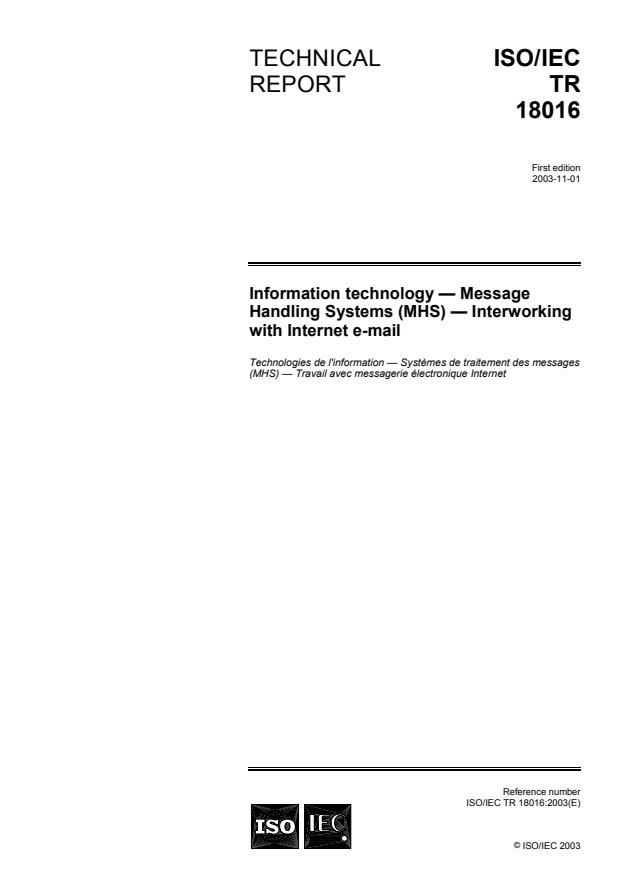
TECHNICAL ISO/IEC
REPORT TR
First edition
2003-11-01
Information technology — Message
Handling Systems (MHS) — Interworking
with Internet e-mail
Technologies de l'information — Systèmes de traitement des messages
(MHS) — Travail avec messagerie électronique Internet
Reference number
©
ISO/IEC 2003
PDF disclaimer
This PDF file may contain embedded typefaces. In accordance with Adobe's licensing policy, this file may be printed or viewed but
shall not be edited unless the typefaces which are embedded are licensed to and installed on the computer performing the editing. In
downloading this file, parties accept therein the responsibility of not infringing Adobe's licensing policy. The ISO Central Secretariat
accepts no liability in this area.
Adobe is a trademark of Adobe Systems Incorporated.
Details of the software products used to create this PDF file can be found in the General Info relative to the file; the PDF-creation
parameters were optimized for printing. Every care has been taken to ensure that the file is suitable for use by ISO member bodies. In
the unlikely event that a problem relating to it is found, please inform the Central Secretariat at the address given below.
© ISO/IEC 2003
All rights reserved. Unless otherwise specified, no part of this publication may be reproduced or utilized in any form or by any means,
electronic or mechanical, including photocopying and microfilm, without permission in writing from either ISO at the address below or
ISO's member body in the country of the requester.
ISO copyright office
Case postale 56 • CH-1211 Geneva 20
Tel. + 41 22 749 01 11
Fax + 41 22 749 09 47
E-mail copyright@iso.org
Web www.iso.org
Published in Switzerland
ii © ISO/IEC 2003 — All rights reserved
Foreword
ISO (the International Organization for Standardization) and IEC (the International Electrotechnical
Commission) form the specialized system for worldwide standardization. National bodies that are members of
ISO or IEC participate in the development of International Standards through technical committees
established by the respective organization to deal with particular fields of technical activity. ISO and IEC
technical committees collaborate in fields of mutual interest. Other international organizations, governmental
and non-governmental, in liaison with ISO and IEC, also take part in the work. In the field of information
technology, ISO and IEC have established a joint technical committee, ISO/IEC JTC 1.
International Standards are drafted in accordance with the rules given in the ISO/IEC Directives, Part 2.
The main task of the joint technical committee is to prepare International Standards. Draft International
Standards adopted by the joint technical committee are circulated to national bodies for voting. Publication as
an International Standard requires approval by at least 75 % of the national bodies casting a vote.
In exceptional circumstances, the joint technical committee may propose the publication of a Technical Report
of one of the following types:
— type 1, when the required support cannot be obtained for the publication of an International Standard,
despite repeated efforts;
— type 2, when the subject is still under technical development or where for any other reason there is the
future but not immediate possibility of an agreement on an International Standard;
— type 3, when the joint technical committee has collected data of a different kind from that which is
normally published as an International Standard (“state of the art”, for example).
Technical Reports of types 1 and 2 are subject to review within three years of publication, to decide whether
they can be transformed into International Standards. Technical Reports of type 3 do not necessarily have to
be reviewed until the data they provide are considered to be no longer valid or usef
...