

ISO 9147:1987
(Main)Pig-irons — Definition and classification
General Information
- Abstract
Defines pig-irons and the subdivision of pig-irons into different classes. An annex gives sampling and preparation of samples intended for the determination of the chemical composition of pig-irons.
- Status
- Published
- Publication Date
- 02-Sep-1987
- Technical Committee
- ISO/TC 25 - Cast irons and pig irons
- Drafting Committee
- ISO/TC 25 - Cast irons and pig irons
- Current Stage
- 9093 - International Standard confirmed
- Start Date
- 14-Dec-2022
- Completion Date
- 29-Aug-2026
Buy Documents
ISO 9147:1987 - Pig-irons — Definition and classification Released:9/3/1987
ISO 9147:1987 - Fontes brutes — Définition et classification Released:9/3/1987
ISO 9147:1987 - Fontes brutes — Définition et classification Released:9/3/1987
Overview
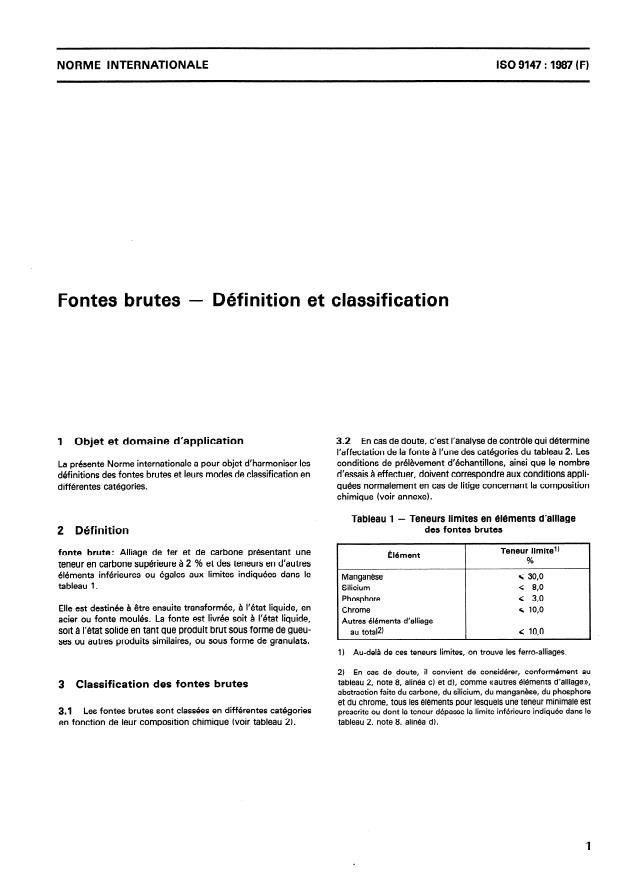
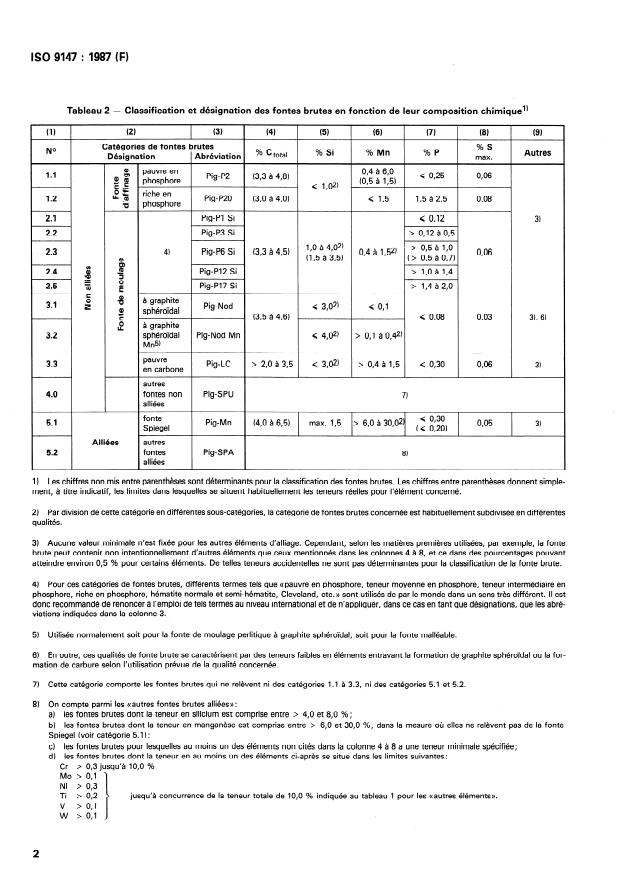
ISO 9147:1987 - "Pig‑irons - Definition and classification" is an international standard that defines pig‑iron as an iron‑carbon alloy with more than 2% carbon and specifies limits for other elements (for example: Mn < 30.0%, Si < 8.0%, P ≤ 3.0%, Cr < 10.0%, and total other alloying elements up to 10.0%). The document establishes a classification system for pig‑irons by chemical composition, provides standard designations/abbreviations for classes (e.g., Pig‑P2, Pig‑Nod, Pig‑SPU, Pig‑SPA), and includes an integral annex detailing sampling and preparation of samples for determination of chemical composition.
Key topics and technical requirements
- Definition and scope
- Pig‑iron intended for further processing in the molten state or delivered solid (pigs, granulates, etc.).
- Classification
- Subdivision into classes and grades based on chemical composition (carbon, silicon, manganese, phosphorus, chromium and “other” elements).
- Class designations and abbreviations are provided to avoid ambiguous regional terminology.
- Element limits
- General limit values for major elements (see table in the standard); materials exceeding those limits are considered ferro‑alloys.
- Sampling and sample preparation (annex)
- Sampling procedures for pig‑iron in the solid state, with minimum numbers of pigs per batch specified (table‑based).
- Two procedures (A and B) for carbon determination; Procedure A is to be used in disputes.
- Drilling technique for machineable pigs: initial hole 12–14 mm diameter, optional second hole 20–24 mm to collect larger chips; remove surface scale before analysis.
- Reduction of chips to analysis size: ~1–2 mm for carbon determination and <0.20 mm for other elements.
- Analysis methods
- Both chemical and spectrographic methods are acceptable; spectrographic sample prep must align with methods giving equivalent results.
Applications
- Establishing unambiguous contract specifications and material acceptance criteria for pig‑iron deliveries.
- Guiding quality control and laboratory procedures for chemical analysis of pig‑iron feedstock.
- Supporting procurement, metallurgical processing (steelmaking, cast‑iron manufacture) and dispute resolution over declared chemical composition.
- Standardizing terminology and classification across international supply chains.
Who should use ISO 9147
- Pig‑iron producers and foundries
- Steelmakers and cast‑iron manufacturers using pig‑iron as raw material
- Quality control laboratories and metallurgical analysts
- Procurement, inspection and standards professionals involved in material specifications
Related standards
- ISO 9147 references and aligns with other ISO methods for chemical analysis and spectrographic analysis of metals; users should apply the appropriate ISO analytical standards when performing tests.
Relations
- Effective Date
- 25-Aug-2026
Buy Documents
ISO 9147:1987 - Pig-irons — Definition and classification Released:9/3/1987
ISO 9147:1987 - Fontes brutes — Définition et classification Released:9/3/1987
ISO 9147:1987 - Fontes brutes — Définition et classification Released:9/3/1987
Get Certified
Connect with accredited certification bodies for this standard

Element Materials Technology
Materials testing and product certification.

Inštitut za kovinske materiale in tehnologije
Institute of Metals and Technology. Materials testing, metallurgical analysis, NDT.
Sponsored listings
Frequently Asked Questions
ISO 9147:1987 is a standard published by the International Organization for Standardization (ISO). Its full title is "Pig-irons — Definition and classification". This standard covers: Defines pig-irons and the subdivision of pig-irons into different classes. An annex gives sampling and preparation of samples intended for the determination of the chemical composition of pig-irons.
Defines pig-irons and the subdivision of pig-irons into different classes. An annex gives sampling and preparation of samples intended for the determination of the chemical composition of pig-irons.
ISO 9147:1987 is classified under the following ICS (International Classification for Standards) categories: 77.080.10 - Irons. The ICS classification helps identify the subject area and facilitates finding related standards.
ISO 9147:1987 has the following relationships with other standards: It is inter standard links to EN ISO 14284:2002. Understanding these relationships helps ensure you are using the most current and applicable version of the standard.
ISO 9147:1987 is available in PDF format for immediate download after purchase. The document can be added to your cart and obtained through the secure checkout process. Digital delivery ensures instant access to the complete standard document.
Standards Content (Sample)
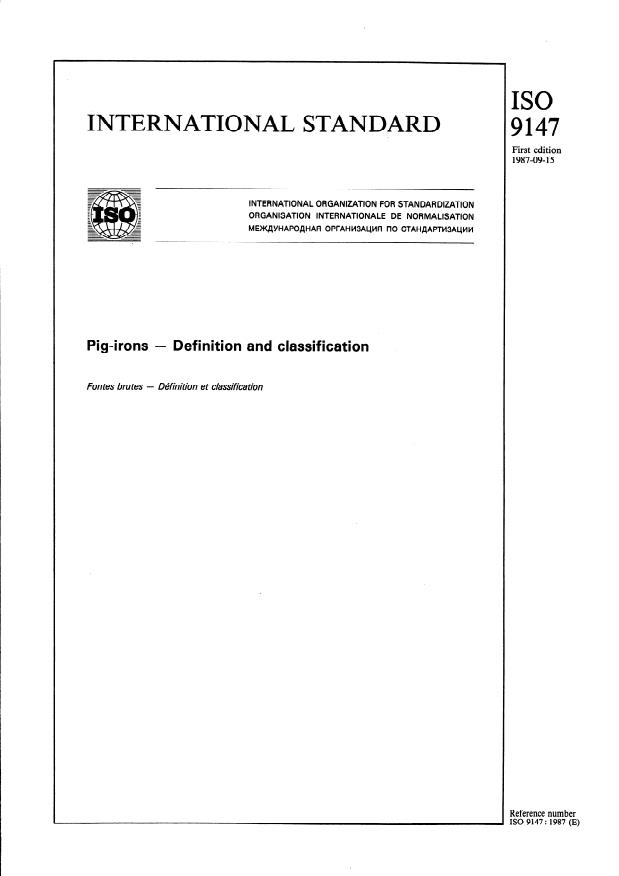
IS0
INTERNATIONAL STANDARD
First edition
1987-09-U
INTERNATIONAL ORGANIZATION FOR STANDARDIZATION
ORGANISATION INTERNATIONALE DE NORMALISATION
MEWYHAPOAHAFI OPrAHM3AL(Mfl fl0 CTAHflAPTMSA~MM
Pig-irons - Definition and classification
Fontes brutes - DB finition et classification
Reference number
IS0 9147: 1987 (E)
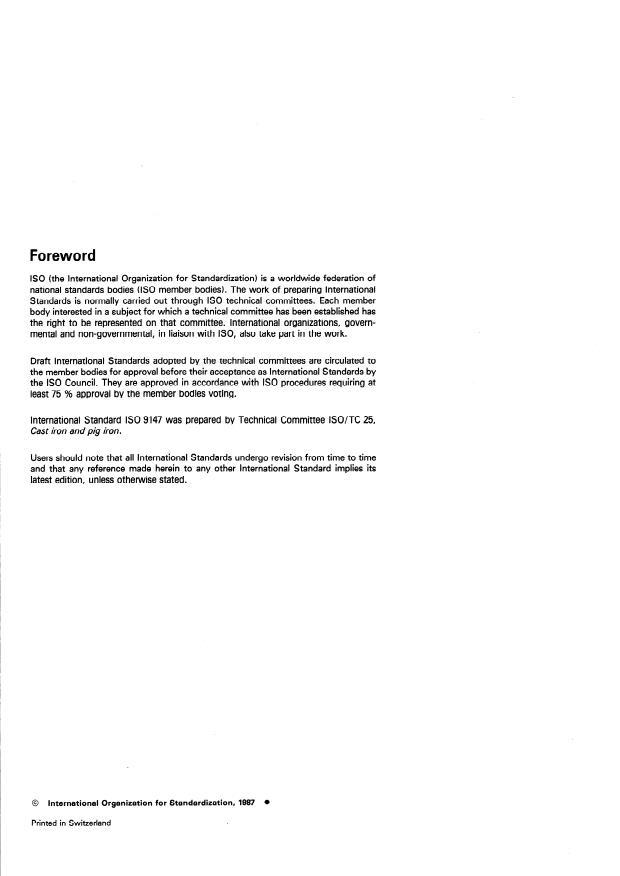
Foreword
IS0 (the International Organization for Standardization) is a worldwide federation of
national standards bodies (IS0 member bodies). The work of preparing International
Standards is normally carried out through IS0 technical committees. Each member
body interested in a subject for which a technical committee has been established has
the right to be represented on that committee. International organizations, govern-
mental and non-governmental, in liaison with ISO, also take part in the work.
Draft International Standards adopted by the technical committees are circulated to
the member bodies for approval before their acceptance as International Standards by
the IS0 Council. They are approved in accordance with IS0 procedures requiring at
least 75 % approval by the member bodies voting.
International Standard IS0 9147 was prepared by Technical Committee ISO/TC 25,
Cast iron and pig iron.
Users should note that all International Standards undergo revision from time to time
and that any reference made herein to any other International Standard implies its
latest edition, unless otherwise stated.
0 International Organization for Standardization, 1987
Printed in Switzerland
IS0 9147 : 1987 (E)
INTERNATIONAL STANDARD
Pig-irons - Definition and classification
3.2 In cases of doubt, the correct classification of the pig-
1 Scope and field of application
iron into one of the classes indicated in table 2 shall be deter-
mined by check analysis. The conditions for sampling, in-
This International Standard defines pig-irons and the sub-
division of pig-irons into different classes. cluding the conditions for the number of tests, shall correspond
to the conditions usually applied in cases of dispute for
deliveries of disputed chemical composition (see annex).
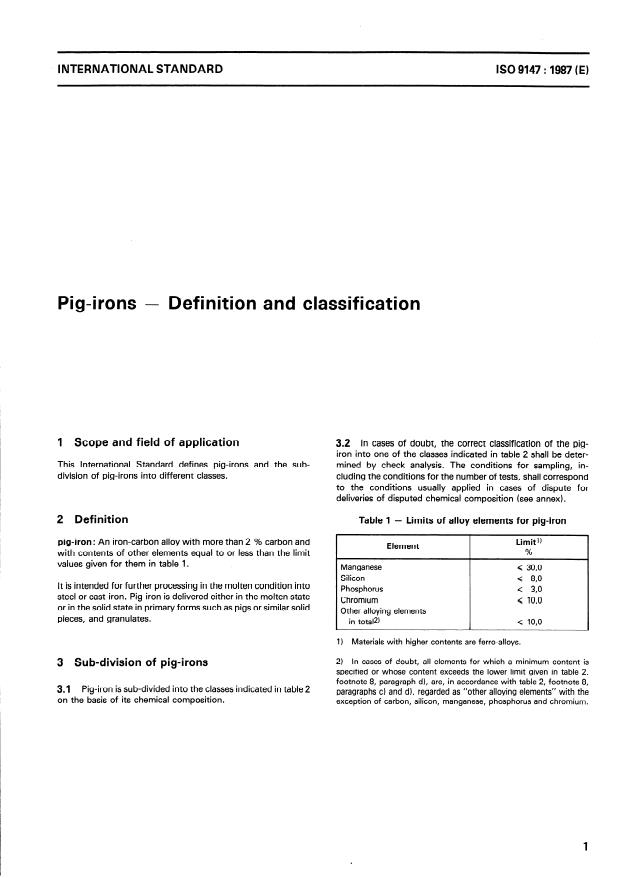
stable I - Limits of alloy elements for pig-iron
2 Definition
Limit’)
pig-iron: An iron-carbon alloy with more than 2 % carbon and
Element
%
with contents of other elements equal to or less than the limit
values given for them in table 1.
< 30,o
~ Manganese
~ Silicon < 8,0
It is intended for further processing in the molten condition into
~ Phosphorus Q 3,0
I
steel or cast-iron. Pig-iron is delivered either in the molten state
~ Chromium < IO,0
or in the solid state in primary forms such as pigs or similar solid
Other alloying elements
pieces, and granulates.
in totalz) 4 IO,0
Materials with higher contents are ferro-alloys.
1)
2) In cases of doubt, all elements for which a minimum content is
3 Sub-division of pig-irons
specified or whose content exceeds the lower limit given in table 2,
footnote 8, paragraph d), are, in accordance with table 2, footnote 8,
3.1 Pig-iron is sub-divided into the classes indicated in table 2
paragraphs c) and d), regarded as “other alloying elements” with the
on the basis of its chemical composition. exception of carbon, silicon, manganese, phosphorus and chromium.
IS0 9147 : 1987 (E)
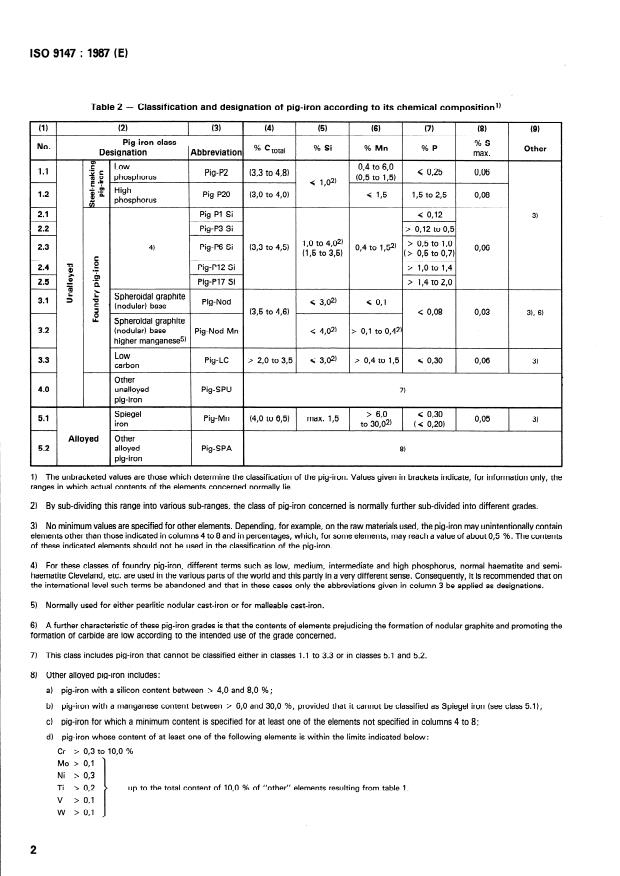
Table 2 - Classification and designation of pig-iron according to its chemical compositionl)
(3)
(1) (2) (4) (5) (6) (7) (8) (9)
Pig-iron class
% s
No.
% Si % Mn % P Other
% Ctotal
Designation Abbreviation max.
6 0,25 0,06
1.1 : F Low Pig- P2 (3,3 to 4,8) 0,4 to 6,0
f E phosphorus
(0,5 to I,!3
6 1,02) .
’ ‘& High
1.2 z ‘E Pig- P20 (3,O to 4,O) 6 1,5 I,5 to 2,5 0,08
8 phosphorus
2.1 Pig-PI Si 6 0,12 3)
2.2 Pig-P3 Si > 0,12 to 0,5
I,0 to 4,021 > 0,5tol,O
2.3 4) Pig-P6 Si (3,3 to 4,5) 0,4 to 1,521
(I,5 to 3,5) ( > 0,5 to 0,7) Ofo6
E
Pig-PI2 Si > 1,o to I,4
2.4 : .+
Pig-PI7 Si > 1,4to2,0
2.5 = n E
E
3.1 =) 6 5 , Spheroidal (nodular) base graphite Pig-Nod 6 3,021 6 0,l
I2 (3,5 to 4,6) . 6 0,08 0,03 31, 6)
Spheroidal graphite
3.2
(nodular) base Pig-Nod Mn 6 4,02) > 0,l to o/P)
higher manganeses)
3.3 Low Pig-LC > 2,0 to 3,5 6 3,@) > 0,4 to I,5 6 0,30 0,06 3)
carbon
Other
4.0 unalloyed Pig-SPU 7)
pig-iron
5.1 Spiegel Pig-Mn (4,O to 6,5) max. I,5 > 6,0 6 0,30 0,05 3)
iron to 30,02) (6 0,201
Alloyed Other
5.2 alloyed Pig-SPA 8)
pig-iron
1) The unbracketed values are those which determine the classification of the pig-iron. Values given in brackets indicate, for information only, the
ranges in which actual contents of the elements concerned normally lie.
2) By sub-dividing this range into various sub-ranges, the class of pig-iron concerned is normally further sub-divided into different grades.
3) No minimum values are specified for other elements. Depending, for example, on the raw materials used, the pig-iron may unintentionally contain
elements other than those indicated in columns 4 to 8 and in percentages, which, for some elements, may reach a value of about 0,5 %. The contents
of these indicated elements should not be used in the classification of the pig-iron.
4) For these classes of foundry pig-iron, different terms such as low, medium, intermediate and high phosphorus, normal haematite and semi-
haematite Cleveland, etc. are used in the various parts of the world and this partly in a very different sense. Consequently, it is recommended that on
the international level such terms be abandoned and that in these cases only the abbreviations given in column 3 be applied as designations.
5) Normally used for either pearlitic nodular cast-iron or for malleable cast-iron.
6) A further characteristic of these pig-iron grades is that the contents of elements prejudicing the formation of nodular graphite and promoting the
formation of ca
...
ISO
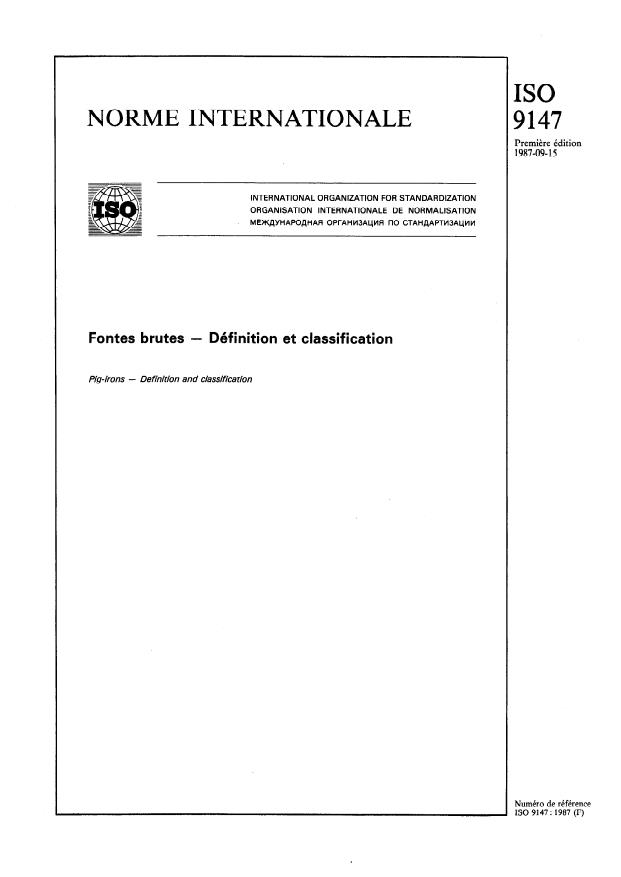
NORME INTERNATIONALE
Première édition
1987-09- 15
INTERNATIONAL ORGANIZATION FOR STANDARDIZATION
ORGANISATION INTERNATIONALE DE NORMALISATION
MEX~YHAPOJJHAFI OPf-AHM3A~MR fl0 CTAH~APTM3A~MM
Fontes brutes - Définition et classification
Pis-irons - De finition and classification
Numéro de référence
1 ISO 9147: 1987 (F)
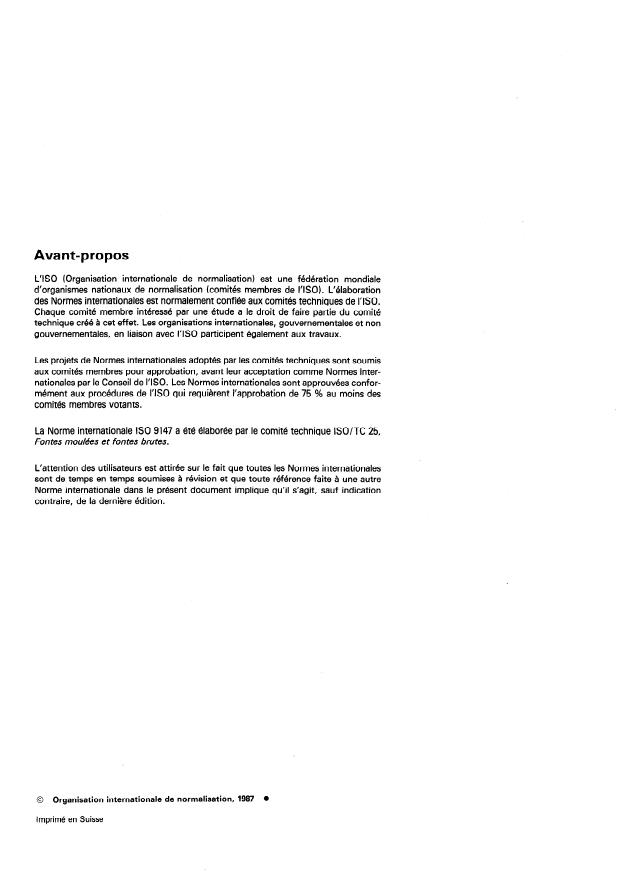
Avant-propos
L’ISO (Organisation internationale de normalisation) est une fédération mondiale
d’organismes nationaux de normalisation (comités membres de I’ISO). L’élaboration
des Normes internationales est normalement confiée aux comités techniques de I’ISO.
Chaque comité membre intéressé par une étude a le droit de faire partie du comité
technique créé à cet effet. Les organisations internationales, gouvernementales et non
gouvernementales, en liaison avec I’ISO participent également aux travaux.
Les projets de Normes internationales adoptés par les comités techniques sont soumis
aux comités membres pour approbation, avant leur acceptation comme Normes inter-
nationales par le Conseil de I’ISO. Les Normes internationales sont approuvées confor-
mément aux procédures de I’ISO qui requièrent l’approbation de 75 % au moins des
comités membres votants.
La Norme internationale ISO 9147 a été élaborée par le comité technique ISO/TC 25,
Fontes moul4es et fontes brutes.
L’attention des utilisateurs est attirée sur le fait que toutes les Normes internationales
sont de temps en temps soumises à révision et que toute référence faite à une autre
Norme internationale dans le présent document implique qu’il s’agit, sauf indication
contraire, de la dernière édition.
Organisation internationale de normalisation, 1987
Imprimé en Suisse
NORME INTERNATIONALE ISO 9147 : 1987 (F)
Fontes brutes - Définition et classification
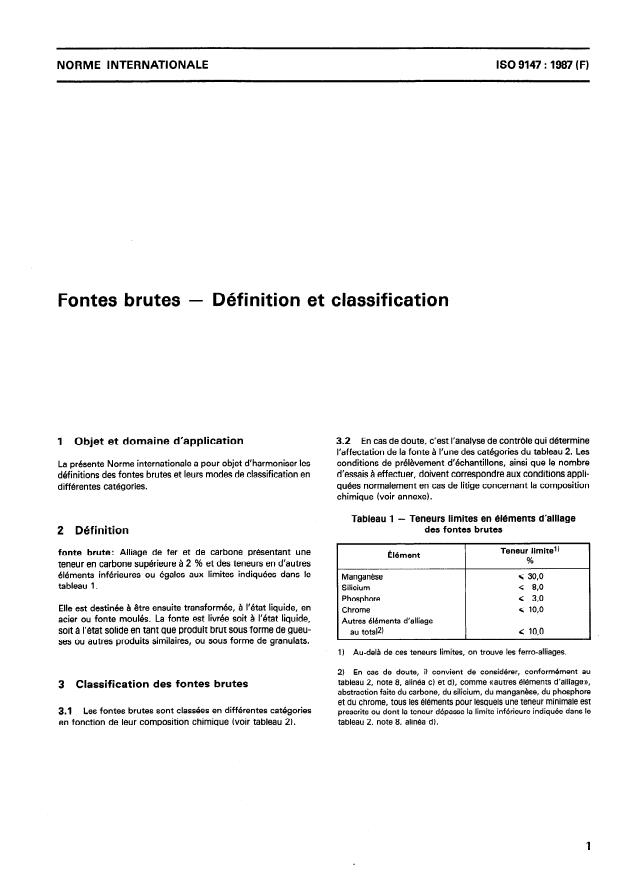
3.2 En cas de doute, c’est l’analyse de contrôle qui determine
1 Objet et domaine d’application
l’affectation de la fonte à l’une des catégories du tableau 2. Les
La présente Norme internationale a pour objet d’harmoniser les conditions de prélèvement d’échantillons, ainsi que le nombre
d’essais à effectuer, doivent correspondre aux conditions appli-
définitions des fontes brutes et leurs modes de classification en
quées normalement en cas de litige concernant la composition
différentes catégories.
chimique (voir annexe).
Tableau 1 - Teneurs limites en éléments d’alliage
des fontes brutes
2 Définition
Teneur limitel)
fonte brute: Alliage de fer et de carbone présentant une
ÉMment
%
teneur en carbone supérieure à 2 % et des teneurs en d’autres
éléments inférieures ou égales aux limites indiquées dans le
< 30,o
Manganése
tableau 1.
Silicium < 8,0
Phosphore < 3,0
Elle est destinée à être ensuite transformée, à l’état liquide, en
Chrome < 10,o
acier ou fonte moulés. La fonte est livrée soit à l’état liquide,
Autres éléments d’alliage
soit à l’état solide en tant que produit brut sous forme de gueu-
au totalz) < 10,o
/
ses ou autres produits similaires, ou sous forme de granulats.
1) Au-delà de ces teneurs limites, on trouve les ferro-alliages.
2) En cas de doute, il convient de considérer, conformément au
tableau 2, note 8, alinéa c) et d), comme «autres éléments d’alliage»,
3 Classification des fontes brutes
abstraction faite du carbone, du silicium, du manganése, du phosphore
et du chrome, tous les éléments pour lesquels une teneur minimale est
3.1 Les fontes brutes sont classées en différentes catégories prescrite ou dont la teneur dépasse la limite inférieure indiquée dans le
tableau 2, note 8, alinéa d).
en fonction de leur composition chimique (voir tableau 2).
ISO 9147 : 1987 (F)
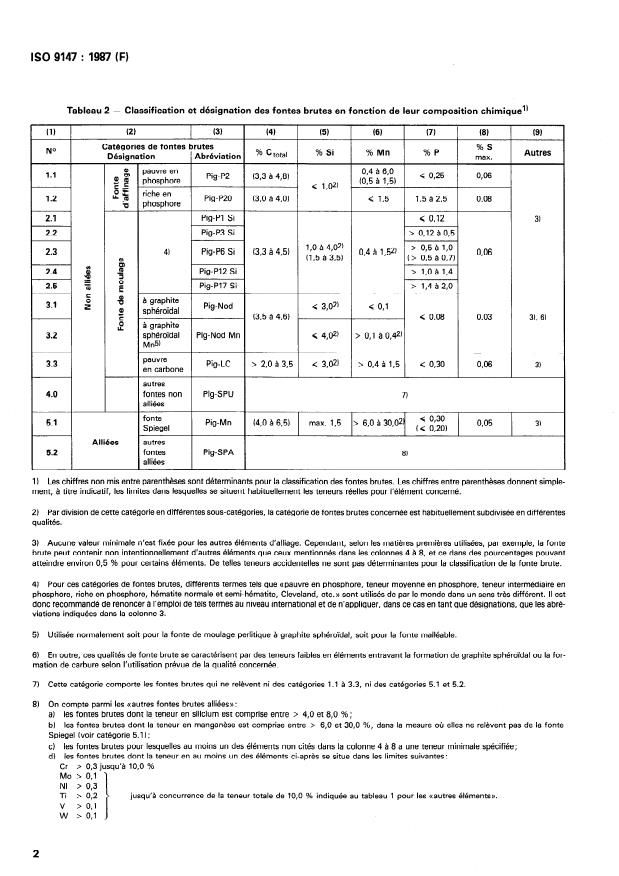
Tableau 2 - Classification et désignation des fontes brutes en fonction de leur composition chimique’)
(3)
(1) (2) (4) (5) (6) (7) (8) (9)
Catégories de fontes brutes
%S
NO
% Si % Mn % P Autres
o/o c total
Désignation Abréviation
max.
a3
pauvre en
0,4 à 6,0
1.1 Pig- P2 < 0,25 0,06
(3,3 à 4,8)
d
E= phosphore < 1,021 (0,5 à 1,5)
OLC
riche en
k%
1.2 b phosphore Pig- P20 (3,O à 4,O) a 1,5 1,5 à 2,5 0,08
2.1 Pis-PI Si < 0,12 3)
2.2 Pig-P3 Si > 0,12 à 0,5
1,o à 4,021 > 0,5 à 1,o
Pig-P6 Si
2.3 4) (3,3 à 4,5) 0,4 à 1,52) 0,06
(1,5 à 3,5) ( > 0,5 à 0,7)
P,
2.4 ti 2 Pis-PI2 Si > l,o à 1,4
2.5 = 0
Pig-P17 Si
> 1,4à2,0
E
3.1 E à graphite
g
Pig-Nod
2 < 3,02) < 0,l
sphéroïdal
E
E . (3,5 à 4,6) - < 0,08 0,03 31, 6)
à graphite
u,
3.2 sphéroïdal Pig-Nod Mn < 4,021 > 0,l à 0,421
Mn5)
3.3 pauvre Pig-LC > 2,0 à 3,5 < 3,021 > 0,4 à 1,5 < 0,30 o,m 31
en carbone
autres
fontes non Pis-S PU
4.0 7)
alliées
5.1 fonte
Pig-M n (4,O à 65) max. 1,5 > 6,0 à 30,02) ’ Of3’ 0,05
3)
Spiegel (< 0,20)
Alliées autres
5.2 fontes Pig-SPA
8)
alliées
1) Les chiffres non mis entre parenthéses sont déterminants pour la classification des fontes brutes. Les chiffres entre parenthèses donnent simple-
ment, à titre indicatif, les limites dans lesquelles se situent habituellement les teneurs réelles pour l’élément concerné.
2) Par division de cette catégorie en différentes sous-catégories, la catégorie de fontes brutes concernée est habituellement subdivisée en différentes
qualités.
3) Aucune valeur minimale n’est fixée pour les autres éléments d’alliage. Cependant, selon les matières premières utilisées, par exemple, la fonte
brute peut contenir non intentionnellement d’autres éléments que ceux mentionnés dans les colonnes 4 à 8, et ce dans des pourcentages pouvant
atteindre environ 0,5 % pour certains éléments. De telles teneurs accidentelles ne sont pas déterminantes pour la classification de la fonte brute.
4) Pour ces catégories de fontes brutes, différents termes tels que «pauvre en phosphore, teneur moyenne en phosphore, teneur intermédiaire en
phosphore, riche en phosphore, hématite normale et semi-hématite, Cleveland, etc. 1) sont utilisés de par le monde dans un sens trés différent. II est
donc recommandé de renoncer à l’emploi de tels termes au niveau international et de n’appliquer, dans ce cas en tant que désignations, que les abré-
viations indiquées dans la colonne 3.
5) Utilisée normalement soit pour la fonte de moulage perlitique à graphite sphéroi’dal, soit pour la fonte malléable.
6) En outre, ces qualités de fonte brute se caractérisent par des teneurs faibles en éléments entravant la formation de graphite sphéroidal ou la for-
matio
...
ISO
NORME INTERNATIONALE
Première édition
1987-09- 15
INTERNATIONAL ORGANIZATION FOR STANDARDIZATION
ORGANISATION INTERNATIONALE DE NORMALISATION
MEX~YHAPOJJHAFI OPf-AHM3A~MR fl0 CTAH~APTM3A~MM
Fontes brutes - Définition et classification
Pis-irons - De finition and classification
Numéro de référence
1 ISO 9147: 1987 (F)
Avant-propos
L’ISO (Organisation internationale de normalisation) est une fédération mondiale
d’organismes nationaux de normalisation (comités membres de I’ISO). L’élaboration
des Normes internationales est normalement confiée aux comités techniques de I’ISO.
Chaque comité membre intéressé par une étude a le droit de faire partie du comité
technique créé à cet effet. Les organisations internationales, gouvernementales et non
gouvernementales, en liaison avec I’ISO participent également aux travaux.
Les projets de Normes internationales adoptés par les comités techniques sont soumis
aux comités membres pour approbation, avant leur acceptation comme Normes inter-
nationales par le Conseil de I’ISO. Les Normes internationales sont approuvées confor-
mément aux procédures de I’ISO qui requièrent l’approbation de 75 % au moins des
comités membres votants.
La Norme internationale ISO 9147 a été élaborée par le comité technique ISO/TC 25,
Fontes moul4es et fontes brutes.
L’attention des utilisateurs est attirée sur le fait que toutes les Normes internationales
sont de temps en temps soumises à révision et que toute référence faite à une autre
Norme internationale dans le présent document implique qu’il s’agit, sauf indication
contraire, de la dernière édition.
Organisation internationale de normalisation, 1987
Imprimé en Suisse
NORME INTERNATIONALE ISO 9147 : 1987 (F)
Fontes brutes - Définition et classification
3.2 En cas de doute, c’est l’analyse de contrôle qui determine
1 Objet et domaine d’application
l’affectation de la fonte à l’une des catégories du tableau 2. Les
La présente Norme internationale a pour objet d’harmoniser les conditions de prélèvement d’échantillons, ainsi que le nombre
d’essais à effectuer, doivent correspondre aux conditions appli-
définitions des fontes brutes et leurs modes de classification en
quées normalement en cas de litige concernant la composition
différentes catégories.
chimique (voir annexe).
Tableau 1 - Teneurs limites en éléments d’alliage
des fontes brutes
2 Définition
Teneur limitel)
fonte brute: Alliage de fer et de carbone présentant une
ÉMment
%
teneur en carbone supérieure à 2 % et des teneurs en d’autres
éléments inférieures ou égales aux limites indiquées dans le
< 30,o
Manganése
tableau 1.
Silicium < 8,0
Phosphore < 3,0
Elle est destinée à être ensuite transformée, à l’état liquide, en
Chrome < 10,o
acier ou fonte moulés. La fonte est livrée soit à l’état liquide,
Autres éléments d’alliage
soit à l’état solide en tant que produit brut sous forme de gueu-
au totalz) < 10,o
/
ses ou autres produits similaires, ou sous forme de granulats.
1) Au-delà de ces teneurs limites, on trouve les ferro-alliages.
2) En cas de doute, il convient de considérer, conformément au
tableau 2, note 8, alinéa c) et d), comme «autres éléments d’alliage»,
3 Classification des fontes brutes
abstraction faite du carbone, du silicium, du manganése, du phosphore
et du chrome, tous les éléments pour lesquels une teneur minimale est
3.1 Les fontes brutes sont classées en différentes catégories prescrite ou dont la teneur dépasse la limite inférieure indiquée dans le
tableau 2, note 8, alinéa d).
en fonction de leur composition chimique (voir tableau 2).
ISO 9147 : 1987 (F)
Tableau 2 - Classification et désignation des fontes brutes en fonction de leur composition chimique’)
(3)
(1) (2) (4) (5) (6) (7) (8) (9)
Catégories de fontes brutes
%S
NO
% Si % Mn % P Autres
o/o c total
Désignation Abréviation
max.
a3
pauvre en
0,4 à 6,0
1.1 Pig- P2 < 0,25 0,06
(3,3 à 4,8)
d
E= phosphore < 1,021 (0,5 à 1,5)
OLC
riche en
k%
1.2 b phosphore Pig- P20 (3,O à 4,O) a 1,5 1,5 à 2,5 0,08
2.1 Pis-PI Si < 0,12 3)
2.2 Pig-P3 Si > 0,12 à 0,5
1,o à 4,021 > 0,5 à 1,o
Pig-P6 Si
2.3 4) (3,3 à 4,5) 0,4 à 1,52) 0,06
(1,5 à 3,5) ( > 0,5 à 0,7)
P,
2.4 ti 2 Pis-PI2 Si > l,o à 1,4
2.5 = 0
Pig-P17 Si
> 1,4à2,0
E
3.1 E à graphite
g
Pig-Nod
2 < 3,02) < 0,l
sphéroïdal
E
E . (3,5 à 4,6) - < 0,08 0,03 31, 6)
à graphite
u,
3.2 sphéroïdal Pig-Nod Mn < 4,021 > 0,l à 0,421
Mn5)
3.3 pauvre Pig-LC > 2,0 à 3,5 < 3,021 > 0,4 à 1,5 < 0,30 o,m 31
en carbone
autres
fontes non Pis-S PU
4.0 7)
alliées
5.1 fonte
Pig-M n (4,O à 65) max. 1,5 > 6,0 à 30,02) ’ Of3’ 0,05
3)
Spiegel (< 0,20)
Alliées autres
5.2 fontes Pig-SPA
8)
alliées
1) Les chiffres non mis entre parenthéses sont déterminants pour la classification des fontes brutes. Les chiffres entre parenthèses donnent simple-
ment, à titre indicatif, les limites dans lesquelles se situent habituellement les teneurs réelles pour l’élément concerné.
2) Par division de cette catégorie en différentes sous-catégories, la catégorie de fontes brutes concernée est habituellement subdivisée en différentes
qualités.
3) Aucune valeur minimale n’est fixée pour les autres éléments d’alliage. Cependant, selon les matières premières utilisées, par exemple, la fonte
brute peut contenir non intentionnellement d’autres éléments que ceux mentionnés dans les colonnes 4 à 8, et ce dans des pourcentages pouvant
atteindre environ 0,5 % pour certains éléments. De telles teneurs accidentelles ne sont pas déterminantes pour la classification de la fonte brute.
4) Pour ces catégories de fontes brutes, différents termes tels que «pauvre en phosphore, teneur moyenne en phosphore, teneur intermédiaire en
phosphore, riche en phosphore, hématite normale et semi-hématite, Cleveland, etc. 1) sont utilisés de par le monde dans un sens trés différent. II est
donc recommandé de renoncer à l’emploi de tels termes au niveau international et de n’appliquer, dans ce cas en tant que désignations, que les abré-
viations indiquées dans la colonne 3.
5) Utilisée normalement soit pour la fonte de moulage perlitique à graphite sphéroi’dal, soit pour la fonte malléable.
6) En outre, ces qualités de fonte brute se caractérisent par des teneurs faibles en éléments entravant la formation de graphite sphéroidal ou la for-
matio
...