

ISO 4700:2015
(Main)Iron ore pellets for blast furnace and direct reduction feedstocks — Determination of the crushing strength
General Information
- Abstract
ISO 4700:2015 specifies a method to provide a measure of the compressive load attained to cause breakage of pellets. This International Standard is applicable to hot bonded pellets.
- Status
- Published
- Publication Date
- 04-Aug-2015
- Technical Committee
- ISO/TC 102/SC 3 - Physical testing
- Drafting Committee
- ISO/TC 102/SC 3 - Physical testing
- Current Stage
- 9093 - International Standard confirmed
- Start Date
- 12-Aug-2026
- Completion Date
- 29-Aug-2026
Buy Documents
ISO 4700:2015 - Iron ore pellets for blast furnace and direct reduction feedstocks -- Determination of the crushing strength
ISO 4700:2015 - Iron ore pellets for blast furnace and direct reduction feedstocks — Determination of the crushing strength/5/2015
Overview
ISO 4700:2015 defines a standardized laboratory method to determine the crushing strength of iron ore pellets used as blast furnace and direct reduction feedstocks. The standard applies to hot bonded pellets and gives a repeatable procedure to measure the compressive load that causes pellet breakage. Results are intended for quality control, contractual specifications and research, enabling consistent comparison between laboratories.
Key topics and requirements
- Scope: Measures the compressive load to cause pellet breakage for hot bonded pellets.
- Sample preparation
- Pellet size range: −12.5 mm +10.0 mm.
- Test sample: at least 1 kg (dry basis).
- Oven-dry to constant mass at 105 °C ± 5 °C, then cool to room temperature.
- Test portion: Random selection of ≥ 60 pellets (minimum), or more where precision demands.
- Apparatus
- Two surface‑hardened steel, parallel flat platens.
- Platen speed adjustable 10–20 mm/min (constant speed recommended).
- Load transmission: load cell or lever; load cell capacity ≥ 10 kN.
- Load indicator/recorder with suitable response and graduation.
- Procedure
- Compress single pellets centrally between platens at specified speed.
- Test ends when either the load drops to ≤ 50% of the maximum recorded or the platen gap reduces to 50% of initial mean pellet diameter.
- For automatic equipment, exclude individual pellet strength values < 10 daN from result calculations.
- Expression of results: Crushing strength (CS) = arithmetic mean of measured values, reported in decanewtons per pellet to one decimal place.
- Reporting: Test report must reference ISO 4700 and include sample identification, test laboratory, dates, operator signature, CS, standard deviation, pellet size distribution, number tested, platen speed and other test conditions.
- Verification: Regular calibration and checks of plates, load cell/lever, indicators and recording systems; maintain verification records.
Applications and users
ISO 4700:2015 is used to:
- Support quality control at pelletizing plants and steelworks.
- Define contractual acceptance criteria for pellet shipments.
- Provide data for process optimization and research into pellet performance. Primary users:
- Metallurgical laboratories and testing services
- Pellet plant QC teams and production engineers
- Steelmakers (blast furnace and direct reduction operations)
- Raw material procurement and QA personnel
- Research institutions studying pellet properties
Related standards
- ISO 3082 - Sampling and sample preparation procedures for iron ores (normative reference).
- ISO 11323 - Vocabulary for iron ore and direct reduced iron (terms and definitions).
Keywords: ISO 4700:2015, crushing strength, iron ore pellets, pellet testing, blast furnace feedstock, direct reduction feedstock, hot bonded pellets, compressive load, pellet quality control.
Relations
- Effective Date
- 26-May-2012
Buy Documents
ISO 4700:2015 - Iron ore pellets for blast furnace and direct reduction feedstocks -- Determination of the crushing strength
ISO 4700:2015 - Iron ore pellets for blast furnace and direct reduction feedstocks — Determination of the crushing strength/5/2015
Get Certified
Connect with accredited certification bodies for this standard

Bureau Veritas Chile
Bureau Veritas certification services in Chile.
Bureau Veritas Peru
Bureau Veritas certification services in Peru.
BVQI Peru
Bureau Veritas certification in Peru.
Sponsored listings
Frequently Asked Questions
ISO 4700:2015 is a standard published by the International Organization for Standardization (ISO). Its full title is "Iron ore pellets for blast furnace and direct reduction feedstocks — Determination of the crushing strength". This standard covers: ISO 4700:2015 specifies a method to provide a measure of the compressive load attained to cause breakage of pellets. This International Standard is applicable to hot bonded pellets.
ISO 4700:2015 specifies a method to provide a measure of the compressive load attained to cause breakage of pellets. This International Standard is applicable to hot bonded pellets.
ISO 4700:2015 is classified under the following ICS (International Classification for Standards) categories: 73.060.10 - Iron ores. The ICS classification helps identify the subject area and facilitates finding related standards.
ISO 4700:2015 has the following relationships with other standards: It is inter standard links to ISO 4700:2007. Understanding these relationships helps ensure you are using the most current and applicable version of the standard.
ISO 4700:2015 is available in PDF format for immediate download after purchase. The document can be added to your cart and obtained through the secure checkout process. Digital delivery ensures instant access to the complete standard document.
Standards Content (Sample)
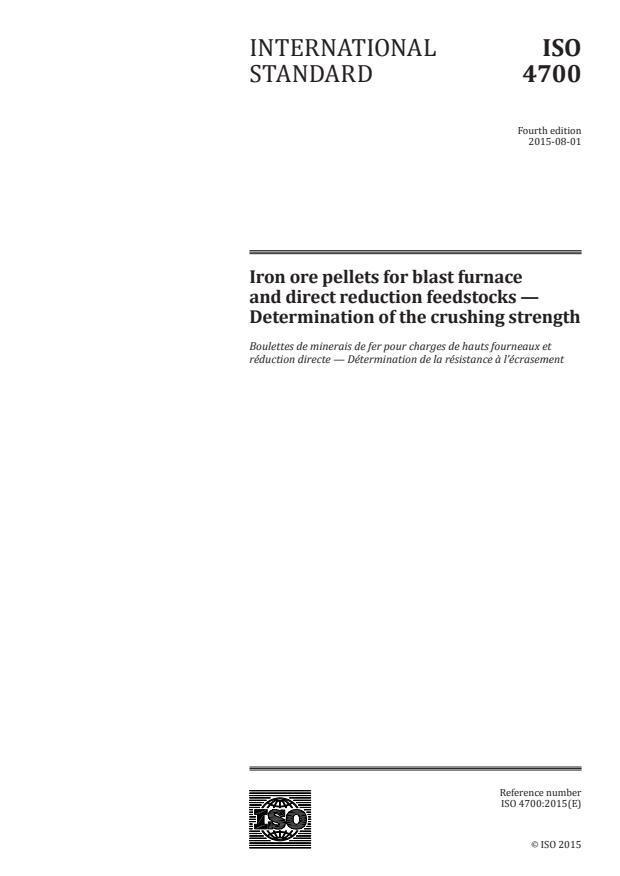
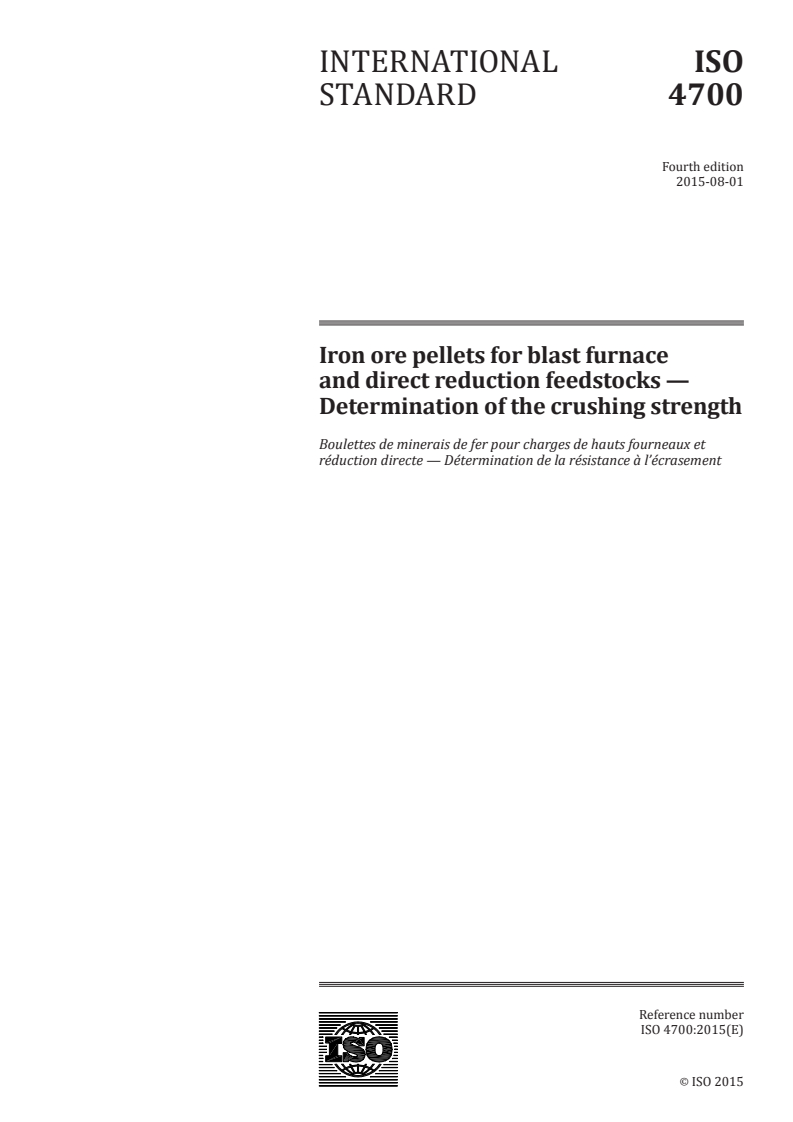
INTERNATIONAL ISO
STANDARD 4700
Fourth edition
2015-08-01
Iron ore pellets for blast furnace
and direct reduction feedstocks —
Determination of the crushing strength
Boulettes de minerais de fer pour charges de hauts fourneaux et
réduction directe — Détermination de la résistance à l’écrasement
Reference number
©
ISO 2015
© ISO 2015, Published in Switzerland
All rights reserved. Unless otherwise specified, no part of this publication may be reproduced or utilized otherwise in any form
or by any means, electronic or mechanical, including photocopying, or posting on the internet or an intranet, without prior
written permission. Permission can be requested from either ISO at the address below or ISO’s member body in the country of
the requester.
ISO copyright office
Ch. de Blandonnet 8 • CP 401
CH-1214 Vernier, Geneva, Switzerland
Tel. +41 22 749 01 11
Fax +41 22 749 09 47
copyright@iso.org
www.iso.org
ii © ISO 2015 – All rights reserved
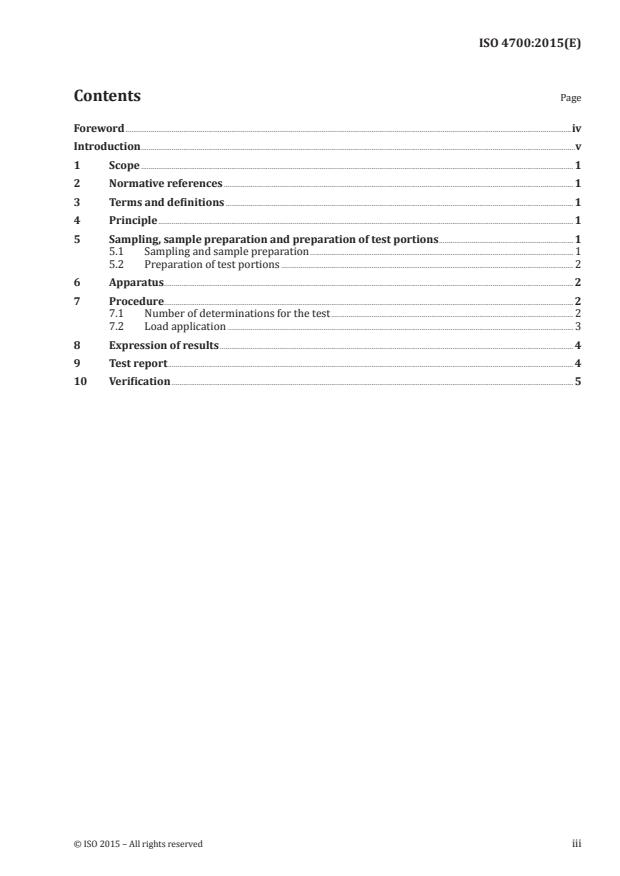
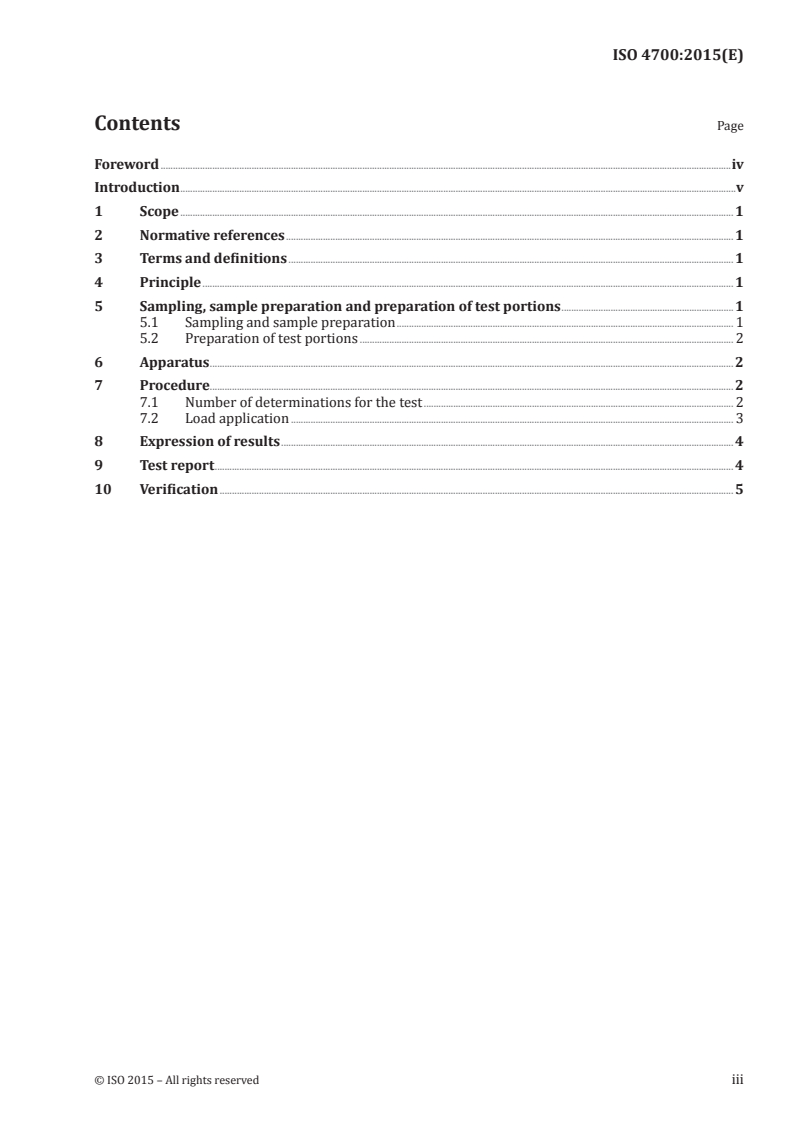
Contents Page
Foreword .iv
Introduction .v
1 Scope . 1
2 Normative references . 1
3 Terms and definitions . 1
4 Principle . 1
5 Sampling, sample preparation and preparation of test portions .1
5.1 Sampling and sample preparation . 1
5.2 Preparation of test portions . 2
6 Apparatus . 2
7 Procedure. 2
7.1 Number of determinations for the test . 2
7.2 Load application . 3
8 Expression of results . 4
9 Test report . 4
10 Verification . 5
Foreword
ISO (the International Organization for Standardization) is a worldwide federation of national standards
bodies (ISO member bodies). The work of preparing International Standards is normally carried out
through ISO technical committees. Each member body interested in a subject for which a technical
committee has been established has the right to be represented on that committee. International
organizations, governmental and non-governmental, in liaison with ISO, also take part in the work.
ISO collaborates closely with the International Electrotechnical Commission (IEC) on all matters of
electrotechnical standardization.
The procedures used to develop this document and those intended for its further maintenance are
described in the ISO/IEC Directives, Part 1. In particular the different approval criteria needed for the
different types of ISO documents should be noted. This document was drafted in accordance with the
editorial rules of the ISO/IEC Directives, Part 2 (see www.iso.org/directives).
Attention is drawn to the possibility that some of the elements of this document may be the subject of
patent rights. ISO shall not be held responsible for identifying any or all such patent rights. Details of
any patent rights identified during the development of the document will be in the Introduction and/or
on the ISO list of patent declarations received (see www.iso.org/patents).
Any trade name used in this document is information given for the convenience of users and does not
constitute an endorsement.
For an explanation on the meaning of ISO specific terms and expressions related to conformity
assessment, as well as information about ISO’s adherence to the WTO principles in the Technical
Barriers to Trade (TBT) see the following URL: Foreword - Supplementary information
The committee responsible for this document is ISO/TC 102, Iron ore and direct reduced iron,
Subcommittee SC 3, Physical testing.
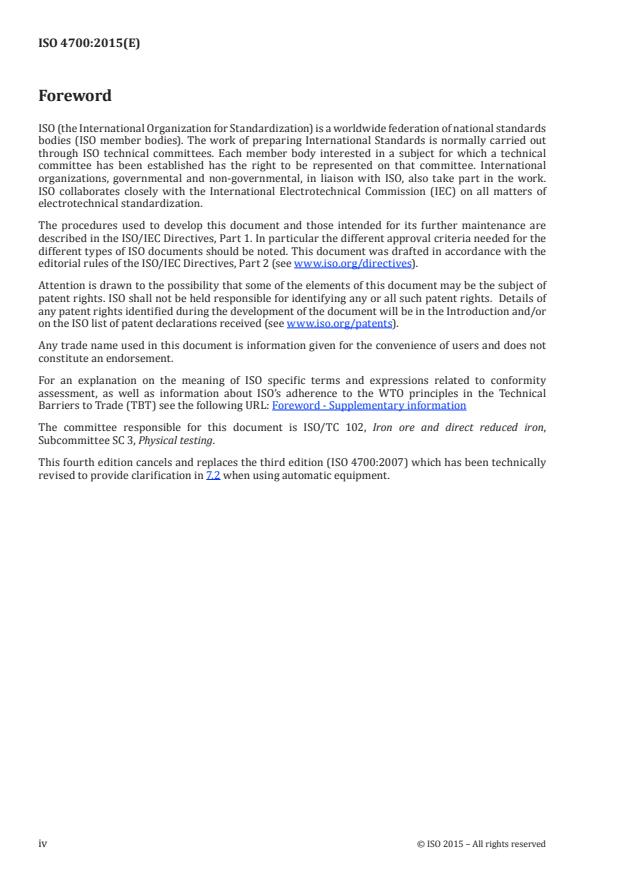
This fourth edition cancels and replaces the third edition (ISO 4700:2007) which has been technically
revised to provide clarification in 7.2 when using automatic equipment.
iv © ISO 2015 – All rights reserved
Introduction
This International Standard concerns one of a number of physical test methods that have been developed
to measure various physical parameters and characteristics and to evaluate the behaviour of iron
ores, including reducibility, disintegration, crushing strength, apparent density, etc. This method was
developed to provide a uniform procedure, validated by collaborative testing, to facilitate comparisons
of tests made in different laboratories.
The results of this test have to be considered in conjunction with other tests used to evaluate the quality
of iron ores as feedstocks for blast furnace and direct reduction processes.
This International Standard can be used to provide test results as part of a production quality-control
system, as a basis of a contract, or as part of a research project.
© ISO 2
...
INTERNATIONAL ISO
STANDARD 4700
Fourth edition
2015-08-01
Iron ore pellets for blast furnace
and direct reduction feedstocks —
Determination of the crushing strength
Boulettes de minerais de fer pour charges de hauts fourneaux et
réduction directe — Détermination de la résistance à l’écrasement
Reference number
©
ISO 2015
© ISO 2015, Published in Switzerland
All rights reserved. Unless otherwise specified, no part of this publication may be reproduced or utilized otherwise in any form
or by any means, electronic or mechanical, including photocopying, or posting on the internet or an intranet, without prior
written permission. Permission can be requested from either ISO at the address below or ISO’s member body in the country of
the requester.
ISO copyright office
Ch. de Blandonnet 8 • CP 401
CH-1214 Vernier, Geneva, Switzerland
Tel. +41 22 749 01 11
Fax +41 22 749 09 47
copyright@iso.org
www.iso.org
ii © ISO 2015 – All rights reserved
Contents Page
Foreword .iv
Introduction .v
1 Scope . 1
2 Normative references . 1
3 Terms and definitions . 1
4 Principle . 1
5 Sampling, sample preparation and preparation of test portions .1
5.1 Sampling and sample preparation . 1
5.2 Preparation of test portions . 2
6 Apparatus . 2
7 Procedure. 2
7.1 Number of determinations for the test . 2
7.2 Load application . 3
8 Expression of results . 4
9 Test report . 4
10 Verification . 5
Foreword
ISO (the International Organization for Standardization) is a worldwide federation of national standards
bodies (ISO member bodies). The work of preparing International Standards is normally carried out
through ISO technical committees. Each member body interested in a subject for which a technical
committee has been established has the right to be represented on that committee. International
organizations, governmental and non-governmental, in liaison with ISO, also take part in the work.
ISO collaborates closely with the International Electrotechnical Commission (IEC) on all matters of
electrotechnical standardization.
The procedures used to develop this document and those intended for its further maintenance are
described in the ISO/IEC Directives, Part 1. In particular the different approval criteria needed for the
different types of ISO documents should be noted. This document was drafted in accordance with the
editorial rules of the ISO/IEC Directives, Part 2 (see www.iso.org/directives).
Attention is drawn to the possibility that some of the elements of this document may be the subject of
patent rights. ISO shall not be held responsible for identifying any or all such patent rights. Details of
any patent rights identified during the development of the document will be in the Introduction and/or
on the ISO list of patent declarations received (see www.iso.org/patents).
Any trade name used in this document is information given for the convenience of users and does not
constitute an endorsement.
For an explanation on the meaning of ISO specific terms and expressions related to conformity
assessment, as well as information about ISO’s adherence to the WTO principles in the Technical
Barriers to Trade (TBT) see the following URL: Foreword - Supplementary information
The committee responsible for this document is ISO/TC 102, Iron ore and direct reduced iron,
Subcommittee SC 3, Physical testing.
This fourth edition cancels and replaces the third edition (ISO 4700:2007) which has been technically
revised to provide clarification in 7.2 when using automatic equipment.
iv © ISO 2015 – All rights reserved
Introduction
This International Standard concerns one of a number of physical test methods that have been developed
to measure various physical parameters and characteristics and to evaluate the behaviour of iron
ores, including reducibility, disintegration, crushing strength, apparent density, etc. This method was
developed to provide a uniform procedure, validated by collaborative testing, to facilitate comparisons
of tests made in different laboratories.
The results of this test have to be considered in conjunction with other tests used to evaluate the quality
of iron ores as feedstocks for blast furnace and direct reduction processes.
This International Standard can be used to provide test results as part of a production quality-control
system, as a basis of a contract, or as part of a research project.
© ISO 2
...