


ISO/IEC 24570:2005
(Main)Software engineering — NESMA functional size measurement method version 2.1 — Definitions and counting guidelines for the application of Function Point Analysis
Software engineering — NESMA functional size measurement method version 2.1 — Definitions and counting guidelines for the application of Function Point Analysis
ISO/IEC 24570:2004: specifies a method to measure functional size of software, gives guidelines how to determine the components of functional size of software, specifies how to calculate the functional size as aresult of the method, and gives guidelines for the application of the method.
Ingénierie du logiciel — Méthode de mesure de la taille fonctionnelle NESMA, version 2.1 — Définitions et manuel des pratiques de comptage pour l'application de l'analyse des points fonctionnels
General Information
- Status
- Withdrawn
- Publication Date
- 16-Feb-2005
- Withdrawal Date
- 16-Feb-2005
- Technical Committee
- ISO/IEC JTC 1/SC 7 - Software and systems engineering
- Drafting Committee
- ISO/IEC JTC 1/SC 7 - Software and systems engineering
- Current Stage
- 9599 - Withdrawal of International Standard
- Start Date
- 25-Jan-2018
- Completion Date
- 12-Feb-2026
Relations
- Effective Date
- 10-Dec-2016
Get Certified
Connect with accredited certification bodies for this standard

BSI Group
BSI (British Standards Institution) is the business standards company that helps organizations make excellence a habit.

BSCIC Certifications Pvt. Ltd.
Established 2006, accredited by NABCB, JAS-ANZ, EIAC, IAS. CDSCO Notified Body.

Intertek India Pvt. Ltd.
Delivers Assurance, Testing, Inspection & Certification since 1993 with 26 labs and 32 offices.
Sponsored listings
Frequently Asked Questions
ISO/IEC 24570:2005 is a standard published by the International Organization for Standardization (ISO). Its full title is "Software engineering — NESMA functional size measurement method version 2.1 — Definitions and counting guidelines for the application of Function Point Analysis". This standard covers: ISO/IEC 24570:2004: specifies a method to measure functional size of software, gives guidelines how to determine the components of functional size of software, specifies how to calculate the functional size as aresult of the method, and gives guidelines for the application of the method.
ISO/IEC 24570:2004: specifies a method to measure functional size of software, gives guidelines how to determine the components of functional size of software, specifies how to calculate the functional size as aresult of the method, and gives guidelines for the application of the method.
ISO/IEC 24570:2005 is classified under the following ICS (International Classification for Standards) categories: 35.080 - Software. The ICS classification helps identify the subject area and facilitates finding related standards.
ISO/IEC 24570:2005 has the following relationships with other standards: It is inter standard links to ISO/IEC 24570:2018. Understanding these relationships helps ensure you are using the most current and applicable version of the standard.
ISO/IEC 24570:2005 is available in PDF format for immediate download after purchase. The document can be added to your cart and obtained through the secure checkout process. Digital delivery ensures instant access to the complete standard document.
Standards Content (Sample)
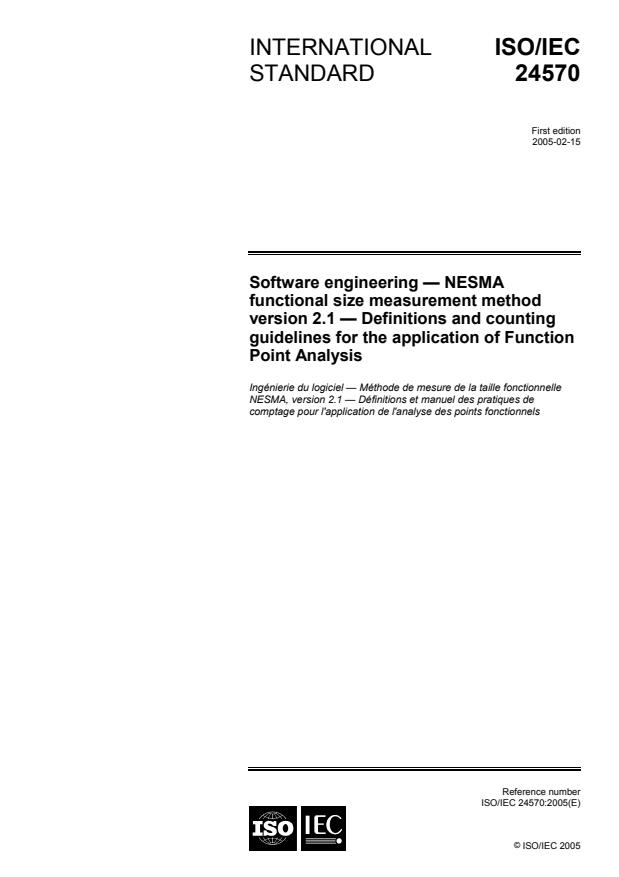
INTERNATIONAL ISO/IEC
STANDARD 24570
First edition
2005-02-15
Software engineering — NESMA
functional size measurement method
version 2.1 — Definitions and counting
guidelines for the application of Function
Point Analysis
Ingénierie du logiciel — Méthode de mesure de la taille fonctionnelle
NESMA, version 2.1 — Définitions et manuel des pratiques de
comptage pour l'application de l'analyse des points fonctionnels
Reference number
©
ISO/IEC 2005
PDF disclaimer
This PDF file may contain embedded typefaces. In accordance with Adobe's licensing policy, this file may be printed or viewed but
shall not be edited unless the typefaces which are embedded are licensed to and installed on the computer performing the editing. In
downloading this file, parties accept therein the responsibility of not infringing Adobe's licensing policy. The ISO Central Secretariat
accepts no liability in this area.
Adobe is a trademark of Adobe Systems Incorporated.
Details of the software products used to create this PDF file can be found in the General Info relative to the file; the PDF-creation
parameters were optimized for printing. Every care has been taken to ensure that the file is suitable for use by ISO member bodies. In
the unlikely event that a problem relating to it is found, please inform the Central Secretariat at the address given below.
© ISO/IEC 2005
All rights reserved. Unless otherwise specified, no part of this publication may be reproduced or utilized in any form or by any means,
electronic or mechanical, including photocopying and microfilm, without permission in writing from either ISO at the address below or
ISO's member body in the country of the requester.
ISO copyright office
Case postale 56 • CH-1211 Geneva 20
Tel. + 41 22 749 01 11
Fax + 41 22 749 09 47
E-mail copyright@iso.org
Web www.iso.org
Published in Switzerland
ii © ISO/IEC 2005 – All rights reserved
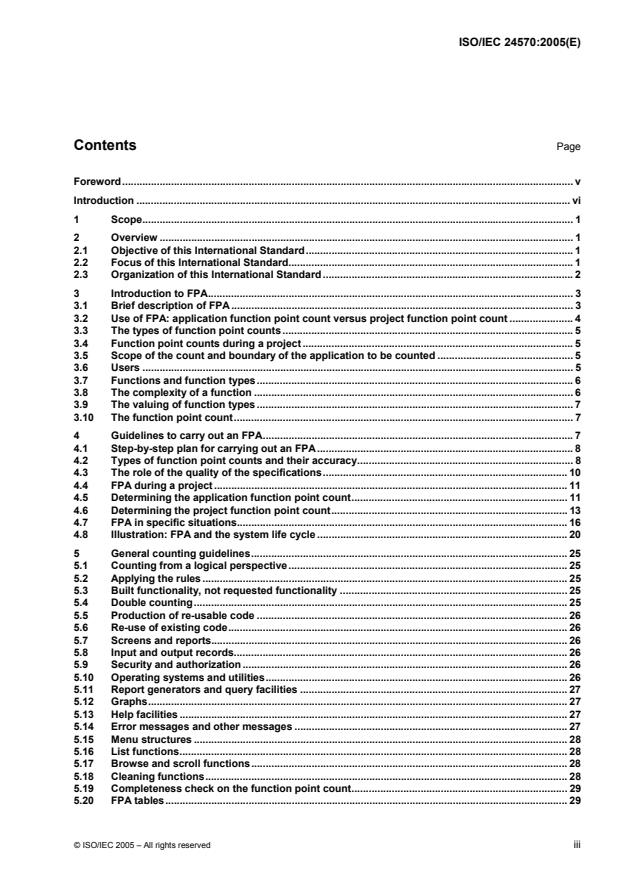
Contents Page
Foreword. v
Introduction . vi
1 Scope. 1
2 Overview . 1
2.1 Objective of this International Standard. 1
2.2 Focus of this International Standard. 1
2.3 Organization of this International Standard . 2
3 Introduction to FPA. 3
3.1 Brief description of FPA . 3
3.2 Use of FPA: application function point count versus project function point count . 4
3.3 The types of function point counts . 5
3.4 Function point counts during a project . 5
3.5 Scope of the count and boundary of the application to be counted . 5
3.6 Users . 5
3.7 Functions and function types. 6
3.8 The complexity of a function . 6
3.9 The valuing of function types . 7
3.10 The function point count. 7
4 Guidelines to carry out an FPA. 7
4.1 Step-by-step plan for carrying out an FPA. 8
4.2 Types of function point counts and their accuracy. 8
4.3 The role of the quality of the specifications. 10
4.4 FPA during a project. 11
4.5 Determining the application function point count. 11
4.6 Determining the project function point count. 13
4.7 FPA in specific situations. 16
4.8 Illustration: FPA and the system life cycle . 20
5 General counting guidelines. 25
5.1 Counting from a logical perspective. 25
5.2 Applying the rules . 25
5.3 Built functionality, not requested functionality . 25
5.4 Double counting. 25
5.5 Production of re-usable code . 26
5.6 Re-use of existing code. 26
5.7 Screens and reports. 26
5.8 Input and output records. 26
5.9 Security and authorization . 26
5.10 Operating systems and utilities. 26
5.11 Report generators and query facilities . 27
5.12 Graphs. 27
5.13 Help facilities . 27
5.14 Error messages and other messages .27
5.15 Menu structures . 28
5.16 List functions. 28
5.17 Browse and scroll functions. 28
5.18 Cleaning functions. 28
5.19 Completeness check on the function point count. 29
5.20 FPA tables. 29
© ISO/IEC 2005 – All rights reserved iii
5.21 Deriving logical files (data functions) from a normalized data model .30
5.22 Shared use of data .34
6 Internal Logical files.35
6.1 Definition of an internal logical file.35
6.2 Counting internal logical files .36
6.3 Determining the complexity of internal logical files .37
7 External Interface Files .38
7.1 Definition of an external interface file .38
7.2 Counting external interface files.38
7.3 Determining the complexity of external interface files.40
8 External inputs.40
8.1 Definition of an external input.41
8.2 Counting external inputs .42
8.3 Determining the complexity of external inputs .44
9 External Outputs.45
9.1 Definition of an external output .45
9.2 Counting external outputs.47
9.3 Determining the complexity of external outputs.50
10 External inquiries .51
10.1 Definition of an external inquiry.51
10.2 Counting external inquiries.52
10.3 Determining the complexity of external inquiries .53
11 Practical Situations and their solutions.54
11.1 Standard authorization functions .55
11.2 Specific authorization functions.55
11.3 Report generator and query facility.56
11.4 Help functions.56
11.5 Error messages.57
11.6 Menu structures.57
11.7 FPA tables .58
11.8 Denormalization.59
11.9 Counting logical files (data functions).61
11.10 Combined external inputs .65
11.11 Counting a transaction file .66
11.12 Reports on different media.67
11.13 Daily and weekly processing.69
11.14 Conversion.69
11.15 External outputs with summary information.70
11.16 The number of data elements on a report.72
11.17 Combined external outputs.72
11.18 Combination effects with functions .77
11.19 Querying with several search keys.79
11.20 Screens with list function.81
11.21 Browse and scroll functions .82
11.22 Selection screens and changing data with a search key .85
11.23 Direct and delayed processing .89
11.24 Case study of a customer application.91
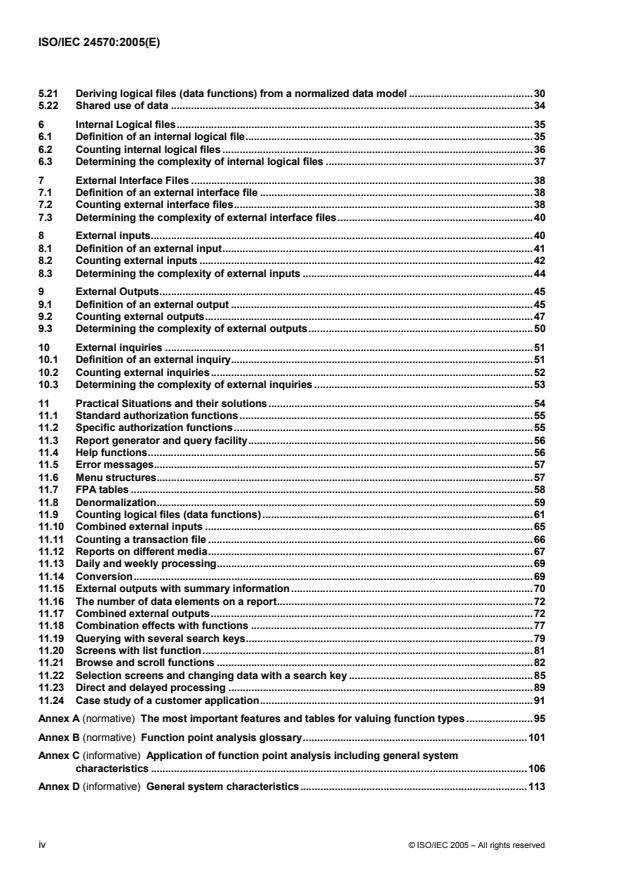
Annex A (normative) The most important features and tables for valuing function types .95
Annex B (normative) Function point analysis glossary.101
Annex C (informative) Application of function point analysis including general system
characteristics .106
Annex D (informative) General system characteristics.113
iv © ISO/IEC 2005 – All rights reserved
Foreword
ISO (the International Organization for Standardization) and IEC (the International Electrotechnical
Commission) form the specialized system for worldwide standardization. National bodies that are members of
ISO or IEC participate in the development of International Standards through technical committees established
by the respective organization to deal with particular fields of technical activity. ISO and IEC technical
committees collaborate in fields of mutual interest. Other international organizations, governmental and non-
governmental, in liaison with ISO and IEC, also take part in the work. In the field of information technology, ISO
and IEC have established a joint technical committee, ISO/IEC JTC 1.
International Standards are drafted in accordance with the rules given in the ISO/IEC Directives, Part 2.
The main task of the joint technical committee is to prepare International Standards. Draft International
Standards adopted by the joint technical committee are circulated to national bodies for voting. Publication as
an International Standard requires approval by at least 75 % of the national bodies casting a vote.
Attention is drawn to the possibility that some of the elements of this document may be the subject of patent
rights. ISO and IEC shall not be held responsible for identifying any or all such patent rights.
ISO/IEC 24570 was prepared by Joint Technical Committee ISO/IEC JTC 1, Information technology,
Subcommittee SC 7, Software and system engineering.
© ISO/IEC 2005 – All rights reserved v
Introduction
Version 1.0 (November 1990)
The NESMA Board set up a counting guidelines committee devoted to the standardization of counting
guidelines/definitions in September of 1989. The committee's task was and (still) is to draw up and maintain a
NESMA FPA manual.
Version 1.1 (May 1991)
Version 1.1 is a reprint of version 1.0. Except for the improvement of some minor errors, the two versions are
the same.
Addendum (May 1994)
The manual Definitions And Counting Guidelines For The Application Of Function Point Analysis satisfies a
great need and has become a standard in the Netherlands within a short time.
In May of 1991 the Board of the NESMA set up the work group "FPA Case Study" and gave it the task of
developing a case study that would present the application of FPA and counting guidelines within a context.
While developing the case study, the work group felt that a number of definitions of counting guidelines
needed to be more precise:
• The derivation of logical files from a data model in third normal-form (the so-called denormalization
rules)
• A more concrete definition of the concept of FPA table
• Uniform treatment of selection screens
• Dealing with combination effects of functions
The Counting Guidelines Committee established additional counting guidelines for these topics after extensive
discussion took place both within the committee itself and within the work group FPA Case Study.
You will find the additional counting guidelines necessary and/or helpful when working out the case. In view of
the issue date of the case (mid 1994), the NESMA Board decided to issue these additional counting guidelines
as an Addendum to version 1.1 of the Counting Guidelines Manual.
Version 2.0 (April 1996)
This new version of the manual Definitions And Counting Guidelines For The Application Of Function Point
Analysis incorporates the following improvements:
• The guidelines recorded in the addendum have now been integrated into the manual
• A large number of points in the guidelines have been further clarified
• The results of extensive consultation with the IFPUG have been processed
• The manual's accessibility has been increased further as a result of editorial improvements
• Many examples and illustrations have been added
vi © ISO/IEC 2005 – All rights reserved
The committee is of the opinion that the changes made are chiefly an elaboration and further illustration of the
guidelines drawn up earlier. In modifying the manual, the committee has worked in such a way that the
changes made have as little effect as possible on the results of a function point analysis. Appendix D goes
further into this.
The guidelines published in this manual have been applied to a rather large case study with the title, FPA Case
Study "Hotel" For The Application of Function Point Analysis. Applying the guidelines in practice is explained in
this document in detail.
The publication of this version takes precedence over versions 1.0 and 1.1, as well as the Addendum.
English translation of version 2.0 (November 1997)
This English version of the manual is an accurate translation of the Dutch version
Version 2.1 Unadjusted (February 2002)
This version has been developed for the manual to be an ISO recognized standard. The main adaptation is the
exclusion of the General System Characteristics. This exclusion conforms to the ISO standard 14143-1
Functional Size Measurement.
Reason for this International Standard
The NESMA was set up in the spring of 1989. (At that time it was called the NEFPUG.) During its first meeting
in June, it carried out a study among its participants in order to survey which subjects they were interested in.
The standardization of counting guidelines/definitions was high on the list. In reaction to this, the NESMA
Board decided to set up a committee devoted to this topic. This committee set itself the task of putting together
a International Standard for the theoretical application and the practical use of function point analysis (FPA) .
Over the years a number of "dialects" have arisen for FPA. These dialects complicate the goal of determining
the number of function points and make it almost impossible for organizations to compare results. One
insufficiently acknowledged reason for this is that different interpretations of the "Albrecht" method have arisen.
This International Standard hopes to provide clarity by formulating standards for the definitions and counting
guidelines that pertain to FPA.
Intended audience
This International Standard is meant for everyone who performs function point counts; i.e., both for people who
count according to the NESMA rules and for those who use the IFPUG rules. For those using the IFPUG rules,
the NESMA International Standard can be a valuable supplement to the IFPUG International Standard if the
differences stated on the website “WWW.NESMA.ORG” are taken into account. The NESMA International
Standard, after all, contains many hints, guidelines, and examples that can be of value to every FPA counter. It
is assumed that the reader has some knowledge of FPA. Nevertheless, we have also attempted to produce as
complete a International Standard as possible that includes sufficient introductory material and explanation for
the new FPA user. For both the maintenance of the IFPUG International Standard and the NESMA
International Standard there is a co-operation between the IFPUG CPC and the NESMA CPC.
Departure points of this International Standard
The NESMA FPA method is in principle applicable to all Functional domains.
The following documentation has served as the foundation for this International Standard:
• IBM CIS & A Guideline 313, AD/M Productivity Measurement and Estimate Validation, November 1,
1984.
The abbreviation FPA is used for the term Function Point Analysis.
© ISO/IEC 2005 – All rights reserved vii
This is an internal IBM publication. The method described in it is usually referred to as Albrecht '84.
Future versions
When changes and supplements to this International Standard prove necessary in the future, an entire new
version will be produced
viii © ISO/IEC 2005 – All rights reserved
INTERNATIONAL STANDARD ISO/IEC 24570:2005(E)
Software engineering — NESMA functional size measurement
methode version 2.1 — Definitions and counting guidelines for
the application of Function Point Analysis
1 Scope
This International Standard:
a) specifies a method to measure the functional size of software,
b) gives guidelines on how to determine the components of functional size of software,
c) specifies how to calculate the functional size as a result of the method, and
d) gives guidelines for the application of the method.
2 Overview
This clause provides an overview to the International Standard "Definitions and counting guidelines for the
application of function point analysis". The following questions are answered: What is its aim (subclause 2.1)?
What is its focus (subclause 2.2)? How is it laid out (subclause 2.3)?
2.1 Objective of this International Standard
The International Standard attempts to provide a theoretical framework by presenting definitions and standard
guidelines. It also tries to illustrate the counting guidelines as concretely as possible by using several practical
situations.
2.2 Focus of this International Standard
The International Standard focuses on how the functional size of an application is determined. The
International Standard does not go into any of the aspects that play a role when project budgeting is drawn up
on the basis of this functional size; e.g., productivity standards and productivity attributes. This particular topic
has been described in the manual “Budgeting on the basis of logical design using function point analysis”, also
by the NESMA.
© ISO/IEC 2005 – All rights reserved 1
Figure 1 indicates what this International Standard will and will not cover.
Determining / evaluating the costs of a project
Determining the size of an application
Function types Productivity attributes
Internal logical files People
Skills
Methods
External interface files
Techniques
Resources / Tools
External inputs
System environment
Project management
External outputs
User organization
Starting situation
External inquiries
Project type
⇓
function point count
= scope
Figure 1 — Scope of the International Standard
2.3 Organization of this International Standard
The terms and concepts used in the International Standard are explained in Clause 2 and defined in Annex B.
Clause 3 provides an introduction to FPA and in which the functional aspect of FPA is emphasized. It will also
spell out briefly what FPA is and explains the terms that form the basis for the concept of FPA. Matters such
as distinguishing between an application function point count and a project function point count are examined,
just as are other various types of function point counts, the role of FPA during a project, users, and function
point count.
Clause 4 provides you with an overview of the position of FPA in a project and with the types of function point
counts that can be carried out during the life cycle of an application. In other words, the chapter will explain
when points can be counted and what information is needed minimally in order to count. The chapter will also
give a step-by-step plan for carrying out a function point analysis and indicates how projects, applications, and
packages should be counted. Each of these requires their approach.
Clause 5 states general counting guidelines for a function point count.
Clauses 6, 7, 8, 9 and 10 give successively the definitions and guidelines used to identify function types and to
determine the complexity of function types for internal logical files, external interface files, external inputs,
external outputs, and external inquiries. The guidelines are broken down per function type for identifying the
function type concerned, for determining the number of data element types, and for determining the number of
record types or referenced logical files.
Clause 11 provides several practical situations and their solutions. The counting guidelines are not repeated
explicitly here, but reference is made to the relevant guideline(s) or section(s) on which a solution is based.
Annex A is meant to be a short summary of the guidelines and contains the most important features of each
function type, as well as the tables for valuing the function types.
Annex B contains the definitions of the terms that this International Standard uses.
2 © ISO/IEC 2005 – All rights reserved
For backward compatibility with previous adjusted function point counts, Annex C describes the application of
FPA with the general system characteristics that lead to a value adjustment factor with which the adjusted
function point count can be determined from the function point count.
Annex D describes the general system characteristics.
The Alphabetic index of keywords is given after the table of contents.
This International Standard has been set up in such a way that the reader does not necessarily have to start at
Clause 1 before continuing on to Clause 2, then 3 and 4 etc. Instead, he can look up what he thinks is
important to him. For one person, specific counting guidelines for a particular function type may be important,
while someone else may want a more general frame of reference for an initial introduction to FPA.
3 Introduction to FPA
This chapter gives a short description of FPA and explains a number of important concepts related to it. More
specifically, section 3.1 provides a brief synopsis of FPA. Sections 3.2 through 3.4 distinguish between the
different kinds of function point counts. Sections 3.5 through 3.9 discuss each of the following successively
within the context of FPA:
• The boundaries in which counting takes place
• Users
• Function types
• The complexity of a function type
• The valuing of function types
Section 3.10 defines the term " function point count" and describes how it is determined.
3.1 Brief description of FPA
3.1.1 Background, purpose and application of FPA
FPA was developed by A.J. Albrecht at IBM between 1974-1979 as a result of productivity research into a
large number of projects. The first version of FPA was introduced in 1979, followed by adaptations based on
practical experiences in 1983 and 1984.
FPA is currently applied in countless organizations throughout the entire world. Experiences with the technique
are exchanged in user groups: the International Function Point Users Group (IFPUG), the Australian Software
Metrics Association (ASMA), the United Kingdom Software Metrics Association (UKSMA), the NESMA, and
various other national user groups.
FPA introduces a unit, the function point, to help measure the size of an application that is to be developed or
maintained. The word "application" within the framework of FPA means "an automated information system".
The function point expresses the quantity of information processing that an application provides a user. This
unit of measurement is separate from the way in which the information processing is realized in a technological
sense. A function point is an abstract term and can be compared somewhat to so-called "rental points". Rental
points are based on the number of rooms in a house, the surface area of these rooms, the number of facilities
the house has, and the location of the house. This then serves as a measurement for a residence offered to a
potential tenant.
FPA was first used to measure the productivity of system development and system maintenance after an
application was built. It soon became clear that the technique could also be used to support project budgeting
because the data needed for an FPA can be made available early on in a project.
This FPA method may be applied to all functional domains.
© ISO/IEC 2005 – All rights reserved 3
3.1.2 Rationale behind FPA
The three separate words that make up the term "Function Point Analysis" can be used to explain the way of
thinking behind FPA.
Function
As mentioned earlier, FPA bases itself on the functionality that an application provides a user (see section 3.6).
Because users see only the "outside" or the boundary (see section 3.5) of an application, FPA examines the
specifications that describe the application's exchange of information with its environment. Functionality is
derived from incoming and outgoing information flows (these can be both data or control information), as well
as from the logical files that an application contains or uses. The functionality of an application is measured by
determining the function types. (See section 3.7.)
Point
The complexity of each function type is determined according to certain standard guidelines. (See section 3.8.)
Each function is worth a number of points, depending on its complexity (section 3.9). The sum of these points
yields the number of function points (section 3.10. This is the basis for project budgeting.
Analysis
FPA is the analysis of an application or the analysis of the description/specification of an application in order to
establish its number of function points. The act of establishing the quantity of an application's function points is
also called function point counting.
In order to be able to carry out a function point count the following must first be determined:
• Purpose of the function point count (section 2.2)
• Scope and boundaries of the application or project to be counted (section 2.5)
This concludes a summary of the methodology and a brief description of FPA. The sections that follow explain
the various terms used in FPA.
3.2 Use of FPA: application function point count versus project function point count
Function point counts can be linked to applications or to projects. This means that a distinction is made
between the following two objectives:
• Determining the application function point count
• Determining the project function point count
Application function point count:
The number of function points that measures the amount of functionality that an application is to
supply or has already supplied to a user. It also measures the size of an application that must be
maintained.
Project function point count:
The number of function points that measures the amount of functionality of a new application or of
changes to an existing application. Changes to an existing application pertain to adding, changing, and
deleting functions. The project function point count is an essential parameter when determining the
effort and lead-time required for a project.
Determining the application function point count is elaborated on in section 4.5. Section 4.6 discusses the
project function point count further.
4 © ISO/IEC 2005 – All rights reserved
3.3 The types of function point counts
One of three kinds of function point counts can be chosen, depending on the degree of detail of the
specifications available. The following represent the different types of function point counts. Note that they are
listed by degree of detail, number one having the least detail and number three the most:
1. Indicative function point count
2. Estimated function point count
3. Detailed function point count
These function point counts are explained further in section 4.2.
3.4 Function point counts during a project
Function point counts can be carried out at different times during a project. They can therefore be related to
the phases of a project; e.g., the planning phase, the execution phase, and the evaluation phase. As a result,
the following breakdown of function point counting arises: the initial function point count, the interim function
point count, and the final function point count. These counts are discussed further in section 4.4.
3.5 Scope of the count and boundary of the application to be counted
The scope of the count is the set of functional requirements/specifications to be included in the function point
count. When you have determined the scope you can define the boundary, the conceptual interface between
the application and its users.
As indicated earlier in section 3.1, the scope of the count and the boundary of an application to be counted
plays an important role in FPA. Consequently, the boundaries of the application to be counted must first be
determined in order to be able to carry out a function point count.
The boundary is necessary in order to be able to determine:
• The application that certain data belongs to
• Which data crosses the boundary
As mentioned in section 3.2, a distinction is made between a function point count for an application and a
function point count for a project. Section 4.5.1 provides guidelines for determining the application function
point count and section 4.6.1 gives guidelines for determining the project function point count.
3.6 Users
FPA acknowledges three kinds of users:
• The people and/or organizations that use or are going to use the application to be measured. This
category includes the following: end-users, functional managers, and operators.
• The owner and/or employee(s) who determine(s) the requirements and wishes included in the
specifications. These requirements and wishes are recorded on the basis of the demands of the end-
user(s) for example, but also on the basis of requirements that a government or its legislation can
impose on the application.
• Other applications that use the data or the functions of the application to be counted.
Because the function point count takes place from the perspective of the user, it is always necessary to have it
done in cooperation with the user or, at the very least, to have the result of the count verified by the user. The
user, after all, is the only one who can determine whether a certain function is being requested.
© ISO/IEC 2005 – All rights reserved 5
3.7 Functions and function types
The function point count measures the size of the functions of an application or a part of an application. The
count revolves around the what and not the how of the application furnished. Only those components that the
user requests, that he can recognize, and that he considers significant are assessed. These components are
called functions or base functional components. A function belongs to a function type.
FPA defines functions as follows:
The five types of components of which an application exists, as seen from the perspective of FPA.
These components determine the amount of functionality an application provides to a user.
Function types are categorized into two main groups:
• Data function types
• Transactional function types
A data function type is:
A logical group of data seen from the perspective of the user.
FPA distinguishes between:
• Internal logical files
• External interface files
A transactional function type is:
A succession of actions that the user sees as a single work unit. FPA distinguishes between:
• External inputs
• External outputs
• External inquiries
Each function type is discussed further in chapters 5 through 9.
3.8 The complexity of a function
The complexity of a function is defined as follows:
The weight of a function on the basis of which a number of function points are allocated to the
function.
The complexity of a function is determined by using the appropriate complexity matrix. A separate table has
been defined for each function type. Complexity depends on the number of data element types and the
number of referenced logical files connected to a given function. Three levels of complexity are distinguished:
Low: Few data element types and/or referenced logical files are involved with the function
Average: The function is neither low nor high as regards complexity
High: Many data element types and/or referenced logical files are involved with the function
6 © ISO/IEC 2005 – All rights reserved
3.9 The valuing of function types
After the complexity of a function has been determined as described in chapters 5 through 9, the number of
function points can be allocated to the function. This should be done according to the rating illustrated in the
table below.
Table 1 — Function point table for determining the value of function types
ILF EIF EI EO EQ
Low 7 5 3 4 3
Average 10 7 4 5 4
High 15 10 6 7 6
ILF = Internal logical file
EIF = External interface file
EI = External input
EO = External output
EQ = External inquiry
Specifications are enough to identify functions and their type when carrying out an estimated function point
count (see section 4.2.2), but it will be difficult to determine the complexity of these functions. In such a case, a
data function is rated as low, while the rating average is used for a transactional function.
3.10 The function point count
The function point count is the sum of the number of function points assigned to each of the functions (in the
way described above) that lie within the boundaries of the object to be counted; i.e., the application or the
project.
A NESMA-FSM-method measurement result on the FUR/specifications for a piece of software shall be labeled
according to the following convention:
F(unction) P(oint) (ISO/IEC 24570:2003, NESMA FSM method V2.1).
The values for the function types are defined in Annex A.
4 Guidelines to carry out an FPA
This chapter indicates how function point analysis should be carried out. To this end, section 4.1 will first
present a generally applicable step-by-step plan. Section 4.2 will then indicate how you should act when
dealing with an indicative, estimated, and detailed function point count. Section 4.3 goes into the role of the
quality of specifications, while section 4.4 explains the use of FPA during a project. Sections 4.5 and 4.6 show
how an application and a project function point count are determined in the event of development and in the
event of enhancement, respectively. Section 4.7 states what you must take into consideration when dealing
with the different ways of recording specifications. Section 4.8 concludes the chapter with an illustration of how
the different types of function point counts can be applied during the life cycle of an application. For illustration
purposes, this section will assume a general system life cycle as a phasing method for the life cycle of an
application.
© ISO/IEC 2005 – All rights reserved 7
4.1 Step-by-step plan for carrying out an FPA
Below follows a step-by-step plan to perform a function point count.
Step 1: Collect the available documentation. The documentation that should be present for an
indicative function point count, an estimated function point count, and a detailed function point
count is described in sections 4.2.1, 4.2.2, and 4.2.3, respectively.
Step 2: Determine who the users of the application are. (See section 3.6.) Determine from which other
application(s) the application to be counted receives and/or uses data.
Step 3: Establish whether an application function point count or a project function point count must be
carried out. If an application function point count must be performed, follow the instructions
stated in section 4.5. If a project function point count must be performed, follow the
instructions found in section 4.6.
Step 4: Identify the functions and determine their type and complexity according to the guidelines
described in chapters 5 thr
...
Questions, Comments and Discussion
Ask us and Technical Secretary will try to provide an answer. You can facilitate discussion about the standard in here.
Loading comments...