

ISO 20474-9:2017
(Main)Earth-moving machinery — Safety — Part 9: Requirements for pipelayers
General Information
- Abstract
ISO 20474-9:2017 gives the safety requirements specific to pipelayers as defined in ISO 6165. It is intended to be used in conjunction with ISO 20474-1, which specifies general safety requirements common to two or more earth-moving machine families. The specific requirements given in this document take precedence over the general requirements of ISO 20474-1. ISO 20474-9:2017 deals with all significant hazards, hazardous situations and events relevant to the earth-moving machinery within its scope (see ISO 20474-1:2017, Annex A) when used as intended or under conditions of misuse reasonably foreseeable by the manufacturer. It specifies the appropriate technical measures for eliminating or reducing risks arising from relevant hazards, hazardous situations or events during commissioning, operation and maintenance. ISO 20474-9:2017 is not applicable to machines manufactured before the date of its publication.
- Status
- Published
- Publication Date
- 06-Jul-2017
- Technical Committee
- ISO/TC 127/SC 2 - Safety, ergonomics and general requirements
- Drafting Committee
- ISO/TC 127/SC 2 - Safety, ergonomics and general requirements
- Parallel Committee
- ISO/TC 23/SC 15 - Machinery for forestry
- Current Stage
- 9093 - International Standard confirmed
- Start Date
- 06-Dec-2022
- Completion Date
- 29-Aug-2026
Overview
ISO 20474-9:2017 - "Earth‑moving machinery - Safety - Part 9: Requirements for pipelayers" defines the machine-specific safety requirements for pipelayers (as per ISO 6165). It is a type‑C standard intended to be used together with ISO 20474-1 (general safety requirements for earth‑moving machinery). Where Part 9 contains more specific provisions, those take precedence. The standard covers significant hazards during commissioning, operation and maintenance and is not applicable to machines manufactured before its publication date.
Key topics and technical requirements
- Scope & definitions
- Applies to side‑boom and rotating pipelayers; pipelayer defined per ISO 6165.
- Operator station & protection
- If a cab is fitted, add a motorized washer and wipers in the working direction.
- Rotating pipelayers must be fitted with a ROPS meeting ISO 12117‑2.
- Stability and lifting equipment
- Lifting equipment must comply with ISO 8813.
- Load lowering control: operators must be able to control and stop lowering; free‑fall release allowed for hook‑winch only.
- Pipe‑laying brakes: automatically applied when controls released or power fails; designed to withstand 1.5 × rated lift capacity under manufacturer‑specified conditions.
- Hooks: tested to 2× WLL without permanent deformation and breaking force 4× WLL (ISO 7597). Hooks used for other tasks require a safety latch.
- Rope selection must follow ISO 16625.
- Rear‑mounted winches
- If fitted, ISO 20474‑1 requirements apply except where the load‑hoist mechanism is specified by ISO 7136.
- Winch marking: maximum rated bare drum pull per ISO 19472.
- Noise measurement
- Sound power and operator‑station emission are measured to ISO 6393 and ISO 6394 respectively.
- Information for use
- Safety labels and operator’s manual must include pipelayer‑specific symbols and instructions (e.g., team operation, boom/hoist procedures, winch use). Winch symbol per ISO 9244 / ISO 6405‑2 symbol no. 18.
Applications and who uses it
ISO 20474-9:2017 is used by:
- Manufacturers & OEMs designing and certifying pipelayers to meet international safety expectations
- Design engineers specifying lifting systems, hooks, ropes and braking controls
- Safety/compliance officers and third‑party assessors verifying machine conformity
- Fleet managers & maintenance teams implementing safe operating procedures and manuals
- Regulators and procurement specialists referencing machine safety requirements in tenders and legislation
Related standards
- ISO 20474-1 (General requirements)
- ISO 6165 (Machine types/terms)
- ISO 8813 (Lift capacity for pipelayers)
- ISO 12117‑2 (ROPS)
- ISO 7597 (Hooks), ISO 16625 (Wire ropes)
- ISO 6393 / ISO 6394 (Noise)
- ISO 9244, ISO 19472 (labels, winch marking)
Keywords: ISO 20474-9:2017, pipelayers safety standard, earth‑moving machinery, pipelayer requirements, side‑boom pipelayer, rotating pipelayer, lifting equipment, winch safety, ROPS, operator’s manual.
Relations
- Consolidated By
ISO 11979-8:2017 - Ophthalmic implants — Intraocular lenses — Part 8: Fundamental requirements - Effective Date
- 06-Jun-2022
- Effective Date
- 03-Nov-2011
Frequently Asked Questions
ISO 20474-9:2017 is a standard published by the International Organization for Standardization (ISO). Its full title is "Earth-moving machinery — Safety — Part 9: Requirements for pipelayers". This standard covers: ISO 20474-9:2017 gives the safety requirements specific to pipelayers as defined in ISO 6165. It is intended to be used in conjunction with ISO 20474-1, which specifies general safety requirements common to two or more earth-moving machine families. The specific requirements given in this document take precedence over the general requirements of ISO 20474-1. ISO 20474-9:2017 deals with all significant hazards, hazardous situations and events relevant to the earth-moving machinery within its scope (see ISO 20474-1:2017, Annex A) when used as intended or under conditions of misuse reasonably foreseeable by the manufacturer. It specifies the appropriate technical measures for eliminating or reducing risks arising from relevant hazards, hazardous situations or events during commissioning, operation and maintenance. ISO 20474-9:2017 is not applicable to machines manufactured before the date of its publication.
ISO 20474-9:2017 gives the safety requirements specific to pipelayers as defined in ISO 6165. It is intended to be used in conjunction with ISO 20474-1, which specifies general safety requirements common to two or more earth-moving machine families. The specific requirements given in this document take precedence over the general requirements of ISO 20474-1. ISO 20474-9:2017 deals with all significant hazards, hazardous situations and events relevant to the earth-moving machinery within its scope (see ISO 20474-1:2017, Annex A) when used as intended or under conditions of misuse reasonably foreseeable by the manufacturer. It specifies the appropriate technical measures for eliminating or reducing risks arising from relevant hazards, hazardous situations or events during commissioning, operation and maintenance. ISO 20474-9:2017 is not applicable to machines manufactured before the date of its publication.
ISO 20474-9:2017 is classified under the following ICS (International Classification for Standards) categories: 53.100 - Earth-moving machinery. The ICS classification helps identify the subject area and facilitates finding related standards.
ISO 20474-9:2017 has the following relationships with other standards: It is inter standard links to ISO 11979-8:2017, ISO 20474-9:2008. Understanding these relationships helps ensure you are using the most current and applicable version of the standard.
ISO 20474-9:2017 is available in PDF format for immediate download after purchase. The document can be added to your cart and obtained through the secure checkout process. Digital delivery ensures instant access to the complete standard document.
Standards Content (Sample)
INTERNATIONAL ISO
STANDARD 20474-9
Second edition
2017-07
Earth-moving machinery — Safety —
Part 9:
Requirements for pipelayers
Engins de terrassement — Sécurité —
Partie 9: Exigences applicables aux tracteurs poseurs de canalisations
Reference number
©
ISO 2017
© ISO 2017, Published in Switzerland
All rights reserved. Unless otherwise specified, no part of this publication may be reproduced or utilized otherwise in any form
or by any means, electronic or mechanical, including photocopying, or posting on the internet or an intranet, without prior
written permission. Permission can be requested from either ISO at the address below or ISO’s member body in the country of
the requester.
ISO copyright office
Ch. de Blandonnet 8 • CP 401
CH-1214 Vernier, Geneva, Switzerland
Tel. +41 22 749 01 11
Fax +41 22 749 09 47
copyright@iso.org
www.iso.org
ii © ISO 2017 – All rights reserved
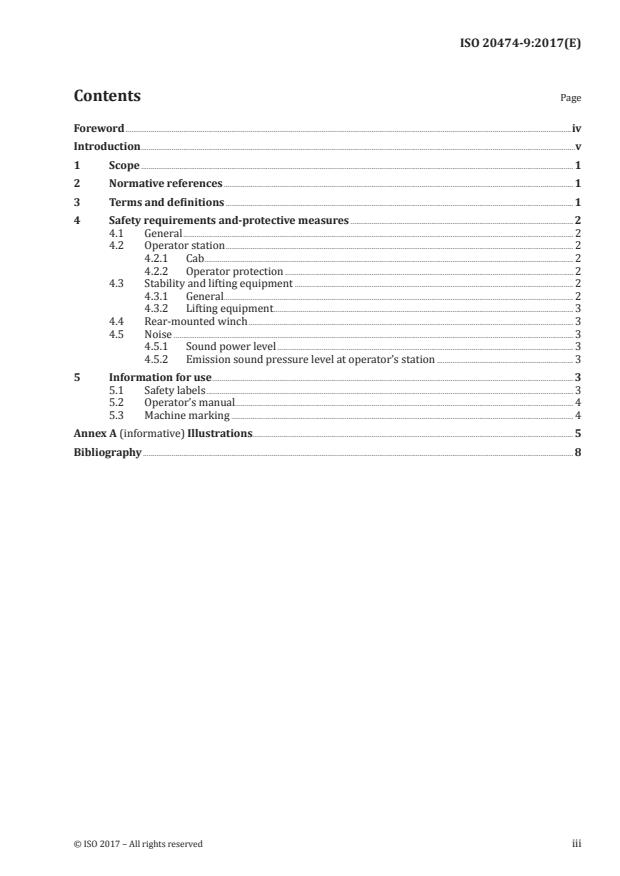
Contents Page
Foreword .iv
Introduction .v
1 Scope . 1
2 Normative references . 1
3 Terms and definitions . 1
4 Safety requirements and-protective measures . 2
4.1 General . 2
4.2 Operator station . 2
4.2.1 Cab . 2
4.2.2 Operator protection . 2
4.3 Stability and lifting equipment . 2
4.3.1 General. 2
4.3.2 Lifting equipment . 3
4.4 Rear-mounted winch . 3
4.5 Noise . 3
4.5.1 Sound power level . 3
4.5.2 Emission sound pressure level at operator’s station . 3
5 Information for use . 3
5.1 Safety labels . 3
5.2 Operator’s manual. 4
5.3 Machine marking . 4
Annex A (informative) Illustrations. 5
Bibliography . 8
Foreword
ISO (the International Organization for Standardization) is a worldwide federation of national standards
bodies (ISO member bodies). The work of preparing International Standards is normally carried out
through ISO technical committees. Each member body interested in a subject for which a technical
committee has been established has the right to be represented on that committee. International
organizations, governmental and non-governmental, in liaison with ISO, also take part in the work.
ISO collaborates closely with the International Electrotechnical Commission (IEC) on all matters of
electrotechnical standardization.
The procedures used to develop this document and those intended for its further maintenance are
described in the ISO/IEC Directives, Part 1. In particular the different approval criteria needed for the
different types of ISO documents should be noted. This document was drafted in accordance with the
editorial rules of the ISO/IEC Directives, Part 2 (see www .iso .org/ directives).
Attention is drawn to the possibility that some of the elements of this document may be the subject of
patent rights. ISO shall not be held responsible for identifying any or all such patent rights. Details of
any patent rights identified during the development of the document will be in the Introduction and/or
on the ISO list of patent declarations received (see www .iso .org/ patents).
Any trade name used in this document is information given for the convenience of users and does not
constitute an endorsement.
For an explanation on the voluntary nature of standards, the meaning of ISO specific terms and
expressions related to conformity assessment, as well as information about ISO’s adherence to the
World Trade Organization (WTO) principles in the Technical Barriers to Trade (TBT) see the following
URL: w w w . i s o .org/ iso/ foreword .html
This document was prepared by Technical Committee ISO/TC 127, Earth-moving machinery,
Subcommittee SC 2, Safety, ergonomics and general requirements.
This second edition cancels and replaces the first edition (ISO 20474-9:2008), which has been
technically revised with the following changes:
— normative references have been updated;
— references to national and regional provisions in the withdrawn ISO/TS 20474-14 have been deleted;
— new terms and definitions, and safety requirements and protective measures, have been added.
It is intended to be used in conjunction with ISO 20474-1.
A list of all parts in the ISO 20474 series, published under the general title, Earth-moving machinery —
Safety, can be found on the ISO website.
iv © ISO 2017 – All rights reserved
Introduction
This document is a type-C standard as stated in ISO 12100.
The machinery concerned and the extent to which hazards, hazardous situations or hazardous events
are covered are indicated in the Scope of this document.
When requirements of this type-C standard are different from those which are stated in type-A or B
standards, the requirements of this type-C standard take precedence over the requirements of the
other standards for machines that have been designe
...