

ISO 5463:2024
(Main)Geometrical product specifications (GPS) — Rotary axis form-measuring instruments — Design and metrological characteristics
General Information
- Abstract
This document specifies the most important design and metrological characteristics of rotary axis form-measuring instruments. It is not applicable to coordinate measurement systems as defined by the ISO 10360 series, whether the systems are fitted with a rotary axis or not, except by special agreement.
- Status
- Published
- Publication Date
- 15-Sep-2024
- Current Stage
- 6060 - International Standard published
- Start Date
- 16-Sep-2024
- Due Date
- 01-Jun-2024
- Completion Date
- 16-Sep-2024
Buy Documents


ISO 5463:2024 - Geometrical product specifications (GPS) — Rotary axis form-measuring instruments — Design and metrological characteristics Released:16. 09. 2024

ISO 5463:2024 - Spécification géométrique des produits (GPS) — Instruments de mesure de forme a axe rotatif — Caractéristiques de conception et caractéristiques métrologiques Released:16. 09. 2024
Overview
ISO 5463:2024 - Geometrical product specifications (GPS) - Rotary axis form‑measuring instruments - Design and metrological characteristics defines the principal design and metrological characteristics for instruments that measure form deviations using a rotary axis. The standard covers instruments that acquire radial and axial deviations in a cylindrical coordinate system (longitudinal, radial and angular directions) and specifies what manufacturers, calibrators and users need to know about construction, probe systems and metrological performance. It explicitly excludes coordinate measuring systems (CMMs) as defined in the ISO 10360 series, except by special agreement.
Key technical topics and requirements
- Scope and definitions
- Definitions for rotary axis form‑measuring instruments, centring, levelling and probe terminology.
- The cylindrical measuring coordinate system (R, H, θ) and origin conventions.
- Design characteristics
- Generic construction principles and layout for rotary‑axis instruments.
- Types and variants described (e.g., rotating workpiece instruments - vertical/horizontal, between‑centres; stationary workpiece instruments).
- Probe system design: contact probes and other probe types (stylus, tip and arm).
- Metrological characteristics
- Rating operating condition including environmental and operating conditions that affect performance.
- Probe characteristics: reference point specification, probe error and dynamic response considerations.
- Requirements and guidance for correction of form deviations and treatment of material measure corrections.
- Conformity and uncertainty
- Determination of conformity to specification, including measurement uncertainty assessment and decision rules for acceptance/rejection.
- Supporting annexes
- Normative Annex A for rotating workpiece instruments and informative annexes on artefacts, probe dynamics, incidental machine effects (“cresting”), other probe types and the GPS matrix relationship.
Practical applications and who uses this standard
ISO 5463:2024 is intended for:
- Manufacturers and designers of rotary axis form‑measuring instruments (spindles, test rigs).
- Metrology and calibration laboratories developing test procedures and uncertainty budgets.
- Quality and inspection engineers who verify form, run‑out and extracted surface deviations in cylindrical coordinates.
- Machine tool and inspection equipment suppliers integrating rotary measuring axes. Practical uses include specifying instrument design and performance, creating acceptance and verification procedures, and ensuring consistent measurement traceability for form measurements performed on rotating parts or by rotating fixtures.
Related standards (context)
- ISO 14638 (GPS matrix model) - positions ISO 5463 within the GPS system.
- ISO 8015 (fundamental GPS rules) and ISO 14253‑1 (decision rules) - apply unless otherwise stated.
- ISO 14978, ISO/IEC Guide 98‑3 (GUM) and ISO/IEC Guide 99 (VIM) - referenced for measuring equipment concepts and uncertainty.
Keywords: ISO 5463:2024, rotary axis form‑measuring instruments, GPS, metrological characteristics, probe error, measurement uncertainty, design characteristics.
Relations
- Effective Date
- 12-Feb-2026
- Effective Date
- 06-Jun-2022
Buy Documents
ISO 5463:2024 - Geometrical product specifications (GPS) — Rotary axis form-measuring instruments — Design and metrological characteristics Released:16. 09. 2024
ISO 5463:2024 - Spécification géométrique des produits (GPS) — Instruments de mesure de forme a axe rotatif — Caractéristiques de conception et caractéristiques métrologiques Released:16. 09. 2024
Get Certified
Connect with accredited certification bodies for this standard

BSMI (Bureau of Standards, Metrology and Inspection)
Taiwan's standards and inspection authority.
Sponsored listings
Frequently Asked Questions
ISO 5463:2024 is a standard published by the International Organization for Standardization (ISO). Its full title is "Geometrical product specifications (GPS) — Rotary axis form-measuring instruments — Design and metrological characteristics". This standard covers: This document specifies the most important design and metrological characteristics of rotary axis form-measuring instruments. It is not applicable to coordinate measurement systems as defined by the ISO 10360 series, whether the systems are fitted with a rotary axis or not, except by special agreement.
This document specifies the most important design and metrological characteristics of rotary axis form-measuring instruments. It is not applicable to coordinate measurement systems as defined by the ISO 10360 series, whether the systems are fitted with a rotary axis or not, except by special agreement.
ISO 5463:2024 is classified under the following ICS (International Classification for Standards) categories: 17.040.30 - Measuring instruments; 17.040.40 - Geometrical Product Specification (GPS). The ICS classification helps identify the subject area and facilitates finding related standards.
ISO 5463:2024 has the following relationships with other standards: It is inter standard links to EN ISO 5463:2024, ISO 4586-2:2018. Understanding these relationships helps ensure you are using the most current and applicable version of the standard.
ISO 5463:2024 is available in PDF format for immediate download after purchase. The document can be added to your cart and obtained through the secure checkout process. Digital delivery ensures instant access to the complete standard document.
Standards Content (Sample)
International
Standard
ISO 5463
First edition
Geometrical product specifications
2024-09
(GPS) — Rotary axis form-
measuring instruments — Design
and metrological characteristics
Spécification géométrique des produits (GPS) — Instruments de
mesure de forme à axe rotatif — Caractéristiques de conception
et caractéristiques métrologiques
Reference number
© ISO 2024
All rights reserved. Unless otherwise specified, or required in the context of its implementation, no part of this publication may
be reproduced or utilized otherwise in any form or by any means, electronic or mechanical, including photocopying, or posting on
the internet or an intranet, without prior written permission. Permission can be requested from either ISO at the address below
or ISO’s member body in the country of the requester.
ISO copyright office
CP 401 • Ch. de Blandonnet 8
CH-1214 Vernier, Geneva
Phone: +41 22 749 01 11
Email: copyright@iso.org
Website: www.iso.org
Published in Switzerland
ii
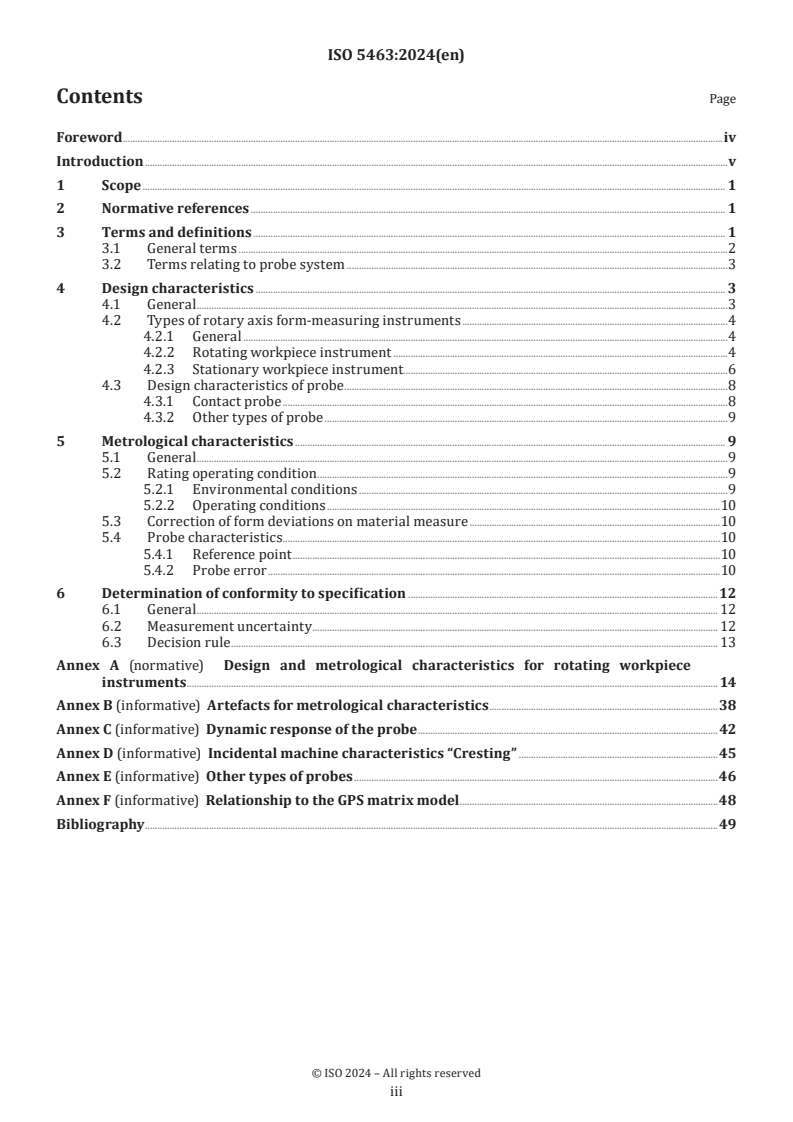
Contents Page
Foreword .iv
Introduction .v
1 Scope . 1
2 Normative references . 1
3 Terms and definitions . 1
3.1 General terms .2
3.2 Terms relating to probe system .3
4 Design characteristics . 3
4.1 General .3
4.2 Types of rotary axis form-measuring instruments .4
4.2.1 General .4
4.2.2 Rotating workpiece instrument .4
4.2.3 Stationary workpiece instrument.6
4.3 Design characteristics of probe .8
4.3.1 Contact probe .8
4.3.2 Other types of probe .9
5 Metrological characteristics . 9
5.1 General .9
5.2 Rating operating condition . .9
5.2.1 Environmental conditions .9
5.2.2 Operating conditions .10
5.3 Correction of form deviations on material measure .10
5.4 Probe characteristics . .10
5.4.1 Reference point .10
5.4.2 Probe error .10
6 Determination of conformity to specification .12
6.1 General . 12
6.2 Measurement uncertainty . . 12
6.3 Decision rule . 13
Annex A (normative) Design and metrological characteristics for rotating workpiece
instruments . 14
Annex B (informative) Artefacts for metrological characteristics .38
Annex C (informative) Dynamic response of the probe .42
Annex D (informative) Incidental machine characteristics “Cresting” .45
Annex E (informative) Other types of probes .46
Annex F (informative) Relationship to the GPS matrix model .48
Bibliography .49
iii
Foreword
ISO (the International Organization for Standardization) is a worldwide federation of national standards
bodies (ISO member bodies). The work of preparing International Standards is normally carried out through
ISO technical committees. Each member body interested in a subject for which a technical committee
has been established has the right to be represented on that committee. International organizations,
governmental and non-governmental, in liaison with ISO, also take part in the work. ISO collaborates closely
with the International Electrotechnical Commission (IEC) on all matters of electrotechnical standardization.
The procedures used to develop this document and those intended for its further maintenance are described
in the ISO/IEC Directives, Part 1. In particular, the different approval criteria needed for the different types
of ISO document should be noted. This document was drafted in accordance with the editorial rules of the
ISO/IEC Directives, Part 2 (see www.iso.org/directives).
ISO draws attention to the possibility that the implementation of this document may involve the use of (a)
patent(s). ISO takes no position concerning the evidence, validity or applicability of any claimed patent
rights in respect thereof. As of the date of publication of this document, ISO had not received notice of (a)
patent(s) which may be required to implement this document. However, implementers are cautioned that
this may not represent the latest information, which may be obtained from the patent database available at
www.iso.org/patents. ISO shall not be held responsible for identifying any or all such patent rights.
Any trade name used in this document is information given for the convenience of users and does not
constitute an endorsement.
For an explanation of the voluntary nature of standards, the meaning of ISO specific terms and expressions
related to conformity assessment, as well as information about ISO's adherence to the World Trade
Organization (WTO) principles in the Technical Barriers to Trade (TBT), see www.iso.org/iso/foreword.html.
This document was prepared by Technical Committee ISO/TC 213, Dimensional and geometrical product
specifications and verification, in collaboration with the European Committee for Standardization (CEN)
Technical Committee CEN/TC 290, Dimensional and geometrical product specification and verification, in
accordance with the Agreement on technical cooperation between ISO and CEN (Vienna Agreement).
Any feedback or questions on this document should be directed to the user’s national standards body. A
complete listing of these bodies can be found at www.iso.org/members.html.
iv
Introduction
This document is a geometrical product specification standard and is to be regarded as a general GPS
standard (see ISO 14638). It influences chain link F of the chains of standards on form, orientation, location
and run-out.
The ISO GPS matrix model given in ISO 14638 gives an overview of the ISO GPS system, of which this document
is a part. The fundamental rules of ISO GPS given in ISO 8015 apply to this document and the default decision
rules given in ISO 14253-1 apply to specifications made in accordance with this document, unless otherwise
indicated. For more detailed information of the relation of this document to other standards and the GPS
matrix model, see Annex F.
See ISO/TR 14253-6 for additional information on the selection of alternative decision rules.
There are different types and variants of rotary axis form-measuring instrument. The metrological
characteristics described in this document apply to all types and variants.
v
International Standard ISO 5463:2024(en)
Geometrical product specifications (GPS) — Rotary axis
form-measuring instruments — Design and metrological
characteristics
1 Scope
This document specifies the most important design and metrological characteristics of rotary axis form-
measuring instruments.
It is not applicable to coordinate measurement systems as defined by the ISO 10360 series, whether the
systems are fitted with a rotary axis or not, except by special agreement.
2 Normative references
The following documents are referred to in the text in such a way that some or all of their content constitutes
requirements of this document. For dated references, only the edition cited applies. For undated references,
the latest edition of the referenced document (including any amendments) applies.
ISO 1101, Geometrical product specifications (GPS) — Geometrical tolerancing — Tolerances of form,
orientation, location and run-out
ISO 14253-5, Geometrical product specifications (GPS) — Inspection by measurement of workpieces and
measuring equipment — Part 5: Uncertainty in verification testing of indicating measuring instruments
ISO/TR 14253-6, Geometrical product specifications (GPS) — Inspection by measurement of workpieces and
measuring equipment — Part 6: Generalized decision rules for the acceptance and rejection of instruments and
workpieces
ISO 14978:2018, Geometrical product specifications (GPS) — General concepts and requirements for GPS
measuring equipment
ISO/IEC Guide 98-3, Uncertainty of measurement — Part 3: Guide to the expression of uncertainty in
measurement (GUM: 1995)
ISO/IEC Guide 99:2007, International vocabulary of metrology — Basic and general concepts and associated
terms (VIM)
3 Terms and definitions
For the purposes of this document, the terms and definitions given in ISO 1101, ISO 14978 and
ISO/IEC Guide 99 and the following apply.
ISO and IEC maintain terminology databases for use in standardization at the following addresses:
— ISO Online browsing platform: available at https:// www .iso .org/ obp
— IEC Electropedia: available at https:// www .electropedia .org/
3.1 General terms
3.1.1
rotary axis form-measuring instrument
measuring instrument having a rotary axis and quantifying local form deviations from extracted integral
surfaces in a cylindrical coordinate system
3.1.2
centring
adjusting, in a plane perpendicular to the axis of rotation, the position of the centre point of the workpiece to
be coincident to the axis of rotation of the instrument
Note 1 to entry: See Figure 1.
a) Cylinder centring
b) Sphere centring
Key
1 axis of rotation 5 centre point after centring
2 revolute workpiece before centring 6 revolute workpiece after centring
3 centre point before centring 7 orthogonal axis to the axis of rotation
4 centring displacement
Figure 1 — Centring
3.1.3
levelling
adjusting the centre line of the workpiece to be parallel to the axis of rotation or adjusting the normal vector
to a plane feature of the workpiece to be parallel to the axis of rotation
Note 1 to entry: See Figure 2.
Note 2 to entry: Levelling is often combined with, or followed by, centring in order to bring the axis of the workpiece to
be coaxial with the rotary axis of the instrument.
Key
1 axis of rotation 4 angular displacement
2 centre line of revolute workpiece before levelling 5 centre line of revolute workpiece after levelling
3 revolute workpiece before levelling 6 revolute workpiece after levelling
Figure 2 — Levelling
3.2 Terms relating to probe system
3.2.1
stylus
mechanical device consisting of a tip and an arm
4 Design characteristics
4.1 General
This measuring instrument is primarily constructed to acquire form deviations in cylindrical coordinates
through the direct measurement of radial (and axial) deviations. The design characteristics of a rotary axis
form-measuring instrument are described generically in Annex A, and depend on its type.
The cylindrical coordinate system is configured with the longitudinal axis nominally coincident with the
rotary axis and with a nominally perpendicular transverse axis.
NOTE 1 See Figure 3.
NOTE 2 Displacements measured along the longitudinal axis are designated as H and are measured from a point
specified by the manufacturer.
NOTE 3 Radius, designated as R, is measured from the rotary axis and its basic direction is the transverse axis.
NOTE 4 Rotation angle, designated as θ, is measured from a line with orientation specified by the manufacturer in
the transverse plane.
NOTE 5 Direction along the rotary axis is called “axial direction” for rotary characteristics.
NOTE 6 Outward direction around the rotary axis is called “radial direction” for rotary characteristics.
NOTE 7 Rotating direction around the rotary axis is called “angular direction” for rotary characteristics.
Key
1 origin (centre position of rotary bearing) 6 rotation angle (angular distance of transverse axis from
reference axis)
2 angular motion 7 probing point
3 axis line of rotation (longitudinal axis) 8 longitudinal distance (distance of the probing point
from the transverse plane)
4 transverse axis or radial direction 9 radial distance (of the probing point from the rotary
axis)
5 angular reference axis in the transverse plane (θ=0)
Figure 3 — Measuring coordinate system
4.2 Types of rotary axis form-measuring instruments
4.2.1 General
There are a number of different types of rotary axis form-measuring instruments, with variants of each of
these types.
4.2.2 Rotating workpiece instrument
Design characteristics of this type of instrument shall be in accordance with Annex A.
Rotating workpiece instruments include the following variants:
a) Vertical axis rotating workpiece instrument on which the workpiece is fixed on a worktable, see
Figure 4.
b) Horizontal axis rotating workpiece instrument, which is a variant of type a), where the longitudinal axis
lies in a horizontal plane, see Figure 5.
c) Vertical axis rotating workpiece between centres, which is a variant of type a), where the workpiece is
rotated between centres instead of on a worktable.
d) Horizontal axis rotating workpiece between centres, which is a variant of type b), where the workpiece
is rotated between centres instead of on a worktable.
Key
1 origin of measuring coordinate system 9 probing point radius R from rotary axis
2 angular motion 10 column
3 axis line of rotation 11 base
4 transverse axis 12 rotary spindle
5 probing point 13 longitudinal axis motion
6 workpiece 14 transverse axis motion
7 probe 15 worktable
8 probing point height H from the top plane of the
worktable
Figure 4 — Vertical axis rotating workpiece instrument
Key
1 origin of measuring coordinate system 9 probing point radius R from rotary axis
2 angular motion 10 column
3 axis line of rotation or longitudinal axis 11 base
4 transverse axis direction 12 rotary spindle
5 probing point 13 longitudinal motion
6 workpiece 14 transverse motion
7 probe 15 fixture for workpiece on worktable
8 probing point height H from worktable top plane
Figure 5 — Horizontal axis rotating workpiece instrument
4.2.3 Stationary workpiece instrument
The stationary workpiece type instruments include the following variants:
a) Vertical axis stationary workpiece instrument on which the stylus turns around the workpiece, which is
fixed on a worktable, see Figure 6.
b) Horizontal axis stationary workpiece instrument, which is a variant of type a) in which the longitudinal
axis lies in a horizontal plane, see Figure 7.
c) Horizontal axis stationary workpiece between both centres instrument, which is a variant of b), where
the workpiece is held between centres instead of in a workpiece fixture.
d) Hole insertion with stationary workpiece instrument, a variant of a type where the instrument works
inside a fixed cylindrical hole on a workpiece, see Figure 8.
Key
1 origin of measuring coordinate system 9 probing point distance R from rotary axis
2 angular motion 10 column
3 axis line of rotation 11 base
4 transverse axis 12 rotary spindle
5 probing point 13 longitudinal axis motion
6 workpiece 14 transverse axis motion
7 probe 15 worktable
8 probing point height H from the origin at the
transverse axis
Figure 6 — Vertical axis stationary workpiece instrument
Key
1 origin of measuring coordinate system 8 probing point height H from the origin at the
transverse axis
2 angular motion 9 probing point distance from rotary axis
3 axis line of rotation or transverse axis 10 base
4 longitudinal axis 11 column
5 probing point 12 rotary spindle
6 workpiece 13 transverse axis motion
7 probe 14 adjusting radius
Figure 7 — Horizontal axis stationary workpiece instrument
Key
1 origin of measurement coordinate 8 probing point height H from the origin at the
transverse axis
2 angular motion 9 radius R of workpiece at the position of the probe
contacting point
3 axis line of rotation axis 10 base
4 transverse axis
5 probing point 11 rotary spindle
6 workpiece 12 longitudinal motion
7 probe 13 axis of the lever type probe
Figure 8 — Hole insertion with stationary workpiece instrument
4.3 Design characteristics of probe
4.3.1 Contact probe
A contact probe consists of a fixed part (“main body including transducer”) (see ISO/IEC Guide 99:2007, 3.7)
and a movable part (“stylus”) which is also called the “measuring element”.
A contact probe needs a measuring force to maintain contact with the surface throughout the measurement.
Excessive force could cause bending in the measurement loop and also damage the contacting point or the
surface being measured. The measuring force should therefore be kept as small as possible.
The stylus tip should be manufactured from hard, wear-resistant material. It shall be well finished and free
of flats or other irregularities which could affect the accuracy of the instrument.
The geometrical properties of the contact element shall be sufficient for the use of the measuring instrument.
The default geometry of a stylus tip is a sphere (see Figure 9).
Key
1 diameter of cylindrical workpiece 2 tip radius of sphere stylus in any direction
Figure 9 — Sphere stylus tip geometry
4.3.2 Other types of probe
There are many different types of probe, which may have limitations on the types of materials that can be
measured. For rotary axis form-measuring instruments equipped with other probes, the manufacturer can
state each of the specifications (see Annex E).
5 Metrological characteristics
5.1 General
The metrological characteristics, other concepts and principles that are common across types and variants
are described below. Because the verification of the metrological characteristics may vary dependent on
instrument type and variant, testing and verification are described in Annex A relating to the instrument
type and variant. The testing and verification shall be carried out as specified in Annex A. The material
measures for these tests are described in Annex B.
A rotary axis form-measuring instrument can be used to measure many types of geometrical features.
The instrument may, therefore, have many different metrological characteristics. The supplier of a rotary
axis form-measuring instrument shall specify the maximum permissible error (MPE) of each metrological
characteristic. These MPEs apply when the instrument is used in accordance with the rated operating
conditions stated by manufacturer or supplier and the manufacturer’s recommendations.
NOTE The manufacturer or supplier does not need to specify MPE values for metrological characteristics that are
not included in the instrument functions or in the required measurements on the target workpiece.
The probe error is presented in 5.4, separately from Annex A, due to its potential contributor to all other
metrological characteristics of a rotary axis form-measuring instrument.
The length unit of metrological characteristics is micrometres, by default.
5.2 Rating operating condition
5.2.1 Environmental conditions
Limits for permissible environmental conditions that influence the measurements (e.g. temperature
conditions, humidity, vibration and ambient lighting at the site of installation) shall be specified by:
— the manufacturer, in the case of acceptance tests;
— the user, in the case of reverification tests.
In both cases, the user is free to choose the environmental conditions within the specified limits given in the
instrument data sheet under which testing to this document will be performed.
The user is responsible for providing the environmental conditions as stated by the manufacturer in the data
sheet. If the environment is not within the rated operating conditions, then conformity or nonconformity
decision cannot be made unless the rated operating condition are met.
5.2.2 Operating conditions
The instrument shall be operated using the procedures given in the manufacturer’s operating manual when
conducting the tests given in Annex A.
5.3 Correction of form deviations on material measure
As discussed in Annex B, many of the measurement standards needed for verifying conformity to
specification should have small form deviations. The form deviations contribute to the measurement
uncertainty of the test values. To reduce the contribution of the form deviations on the material measure to
the test uncertainty, this document allows correction of the form deviations.
NOTE The following methods are typically used for correction of the form deviation of the measurement
standards:
a) compensation of the calibrated profile method;
b) reversal error separation method (see ISO 230-7 and references [21],[22],[25] and [27]);
c) multi-step error separation method; (see references [23],[24],[25],[27],[28] and [32]).
5.4 Probe characteristics
5.4.1 Reference point
Where applicable, the probe used for form measurements shall be provided with user-accessible means
for setting the probe to zero or to the reference point. The metrological characteristics described in this
document apply when the probe is properly set in accordance with the manufacturer’s recommendations,
and the reference point is considered fixed when verifying the metrological characteristics.
5.4.2 Probe error
5.4.2.1 General
The probe error (E ) is the error of indication when the probe is in contact with a material measure, for
p
any angular motion of the material measure or of the stylus depending on the type of the rotary axis form-
measuring instrument. The probe error is calculated as the signed deviation of the probe indication from
the calibrated reference value of a material measure.
The MPE of probe error shall be specified in at least one measuring range stated by the manufacturer or
supplier.
NOTE 1 The probe error can include the sensitivity error, the linearity error, the instrumental drift, the resolution
or digital step, the repeatability, the measurement noise, the hysteresis error and the dynamic response (see Annex C).
NOTE 2 The probe error is a contributor to all metrological characteristics of the instrument.
The sensitivity shall be adjusted following the manufacturer’s recommendations prior to the probe error test.
5.4.2.2 Test method
5.4.2.2.1 Test points and range
The verification test of probe errors shall be carried out with five or more test points. The test points shall
be well distributed, as evenly as practicable, throughout the measuring range of the probe (see Figure 10).
The test points shall cover at least the central 75 % of the measuring range of the probe.
The reference point of the probe shall be at the centre (zero point) of its measuring range. This reference
point shall be located on the reference plane of the standard and be one of the test points.
Key
1 actual displacement 5 measuring range of probe
2 probe error curve 6 test point
3 probe error 7 reference point
4 test range
Figure 10 — Analysis of probe error
5.4.2.2.2 Test direction and location
The user is free to choose the probing direction (horizontal or vertical) for the probe error verification test,
if not stated otherwise by the manufacturer.
5.4.2.3 Measurement standard and testing procedure
When testing conformity to specifications, sufficient testing shall be used to establish confidence in the
results and the tester may choose suitable instruments or measurement standards from those described in
Annex B. The instrument or measurement standard used shall cover the range to be tested.
If each target step of displacement has a different probing position, the probing positions should be set along
an accurate (rotary, longitudinal or transverse) traversing motion. Probe error shall be calculated from
the measured length difference of each displacement. Typical procedures of each instrument and material
measures are also shown in Annex B.
5.4.2.4 MPE function
5.4.2.4.1 General
Maximum permissible probe error, E , is a two-sided MPE function as shown in ISO 14978:2018, 7.2.
P,MPE
5.4.2.4.2 Proportional value MPE functions
Upper limit MPE:
E = + (a + |L× b|)
P,MPE
Lower limit MPE:
E = - (a + |L× b|)
P,MPE
5.4.2.4.3 Constant value MPE functions
Upper limit MPE:
E = + a
P,MPE
Lower limit MPE:
E = - a
P,MPE
5.4.2.4.4 Proportional value MPE functions with probe range
Upper limit MPE:
E = + (a + |L× b|) / (probe range)
P,MPE
Lower limit MPE:
E = - (a + |L× b|) / (probe range)
P,MPE
where
a are positive constants stated by the manufacturer;
b is a dimensionless positive constant stated by the manufacturer;
L is the actual displacement in micrometres (L = 0 at the reference point)
The MPE of the probe error can also be indicated as a percentage of the measuring span stated by the
manufacturer when the MPE is intended to indicate using constant value. The MPE of the probe error can
also be indicated as a percentage with proportional measuring span.
6 Determination of conformity to specification
6.1 General
All errors of indication associated with the metrological characteristics shall conform to the specified
MPE values.
6.2 Measurement uncertainty
Evaluation of measurement uncertainty shall be performed in accordance with ISO/IEC Guide 98-3. When
determining conformity with specification, the measurement uncertainty associated with a test value (the
test value uncertainty) shall be evaluated in accordance with ISO 14253-5. Additional guidance is available
in ISO 14978:2018, Annex D.
6.3 Decision rule
When demonstrating conformity or non-conformity to specifications, the decision rule accompanying the
specifications shall be followed. If no decision rule is stated in the specifications, and no special agreement is
made between supplier and customer, then the default decision rule shall be simple acceptance and rejection,
with the measurement capability index, C , being one or larger, in accordance with ISO/TR 14253-6.
m
NOTE Information on the selection of an alternative decision rule can be found in ISO/TR 14253-6.
Annex A
(normative)
Design and metrological characteristics for rotating workpiece
instruments
A.1 Design characteristics
The design of this type of rotary axis form-measuring instrument shall follow the general guidelines in
ISO 14978. The design shall be such that the metrological characteristics conform to the requirements of
this document.
Table A.1 gives a list of design characteristics for this type of rotary axis form-measuring instrument.
Relevant design characteristics should be specified when communicating requirements.
Table A.1 — List of design characteristics
Design characteristics
Component Description Unit
Height mm
Width mm
Overall dimensions
Depth mm
Mass (weight) kg
AC line voltage V
Mains connection AC line frequency Hz
Apparent power input VA
Maximum test diameter mm
Measuring range Maximum measuring length on longitudinal axis mm
Maximum measuring length on transverse axis mm
Rotational speed (ω ) Hz or r/min
cyc
Traversing speed Traversing speed on longitudinal axis mm/s
Traversing speed on transverse axis mm/s
Size or diameter mm
Loading table Load capacity N (or kg)
Centring range mm
Levelling range degree
Probe type (contact or non-contact) -
Probe Maximum measuring range of probe mm or μm
Stylus tip radius on a contact probe, or a half of effective
mm or μm
spot size on a non-contact probe
NOTE 1 Table A.1 shows the most important design characteristics for a rotating workpiece form-measuring
instrument. It is possible that some of these characteristics are not applicable to some variants.
NOTE 2 In addition to the characteristics shown in Table A.1, other design characteristics can be specified by the
manufacturer, depending on the application.
A.2 Metrological characteristics
A.2.1 General
The following metrological characteristics are complementary to the probe error :
— radial error (see A.2.2);
— axial error (see A.2.3);
— longitudinal straightness error (see A.2.4);
— parallelism error (see A.2.5);
— transverse straightness error (see A.2.6);
— squareness error (see A.2.7).
Many of the metrological characteristics described in this Annex can be measured with a smaller
measurement uncertainty if error separation techniques are used to minimize uncertainty contributions
from the measurement standard.
Once the metrological characteristics have been determined, computer aided accuracy techniques may also
be used to software correct the instrument to meet the manufacturer’s specification.
In a few cases, such error separation techniques are part of the instrument's normal operation, for instance
when radial error separation techniques are used to measure high precision components.
A.2.2 Radial error
A.2.2.1 General
The radial error (E ) is the peak-to-valley roundness deviation, RONt (see ISO 12181-1) that would be
R
obtained from a longwave-pass filtered roundness profile of a perfectly round and perfectly centred section
of a measurement standard in a direction perpendicular to the axis of rotation.
The radial error shall not exceed the maximum permissible radial error.
NOTE 1 Radial error can consist of “pure radial error”, which is typically described as “radial motion error”, and
proportionally dependent error, called “tilt error” (see Figure A.1). Radial motion error cannot be separately evaluated
from tilt error.
NOTE 2 Radial error can include the effect of “closure error” (see reference [31]).
NOTE 3 Radial error can also be influenced by probe error and the remaining errors in centring as uncertainty effect.
NOTE 4 Radial error is a contributor to the measurement uncertainty of roundness or cylindricity observed on a
workpiece.
NOTE 5 Tilt error also affects axial error and can be assessed by verification of either radial or axial errors.
NOTE 6 “Closure error” can also be caused by instrument drift (see ISO/IEC Guide 99:2007, 4.21) or influences from
the environment or measurement process.
Key
1 origin of measuring coordinates 8 nominal height of probing point from origin
2 angular motion 9 distance of the probing point from rotary axis
3 axis line of rotation 10 centre of probing roundness profile
4 transverse axis 11 worktable or transverse reference plane
5 centre position of tilt error 12 rotary spindle
6 hemisphere or sphere measurement standard 13 actual probing height from tilt error centre
7 probe 14 tilt error at height
Figure A.1 — Principle of reference point of tilt error
A.2.2.2 Test method
A.2.2.2.1 General
Radial error shall be tested by measuring the roundness profile around a roundness standard, for example a
precision sphere or hemisphere (see Figure A.2).
Key
1 origin of measuring coordinates 8 measurement standard (sphere or hemisphere)
2 angular motion 9 distance of the probing point from rotary axis
3 axis line of rotation 10 height H of probing point from origin
4 reference axis on the transverse plane when testing at 11 origin of measuring coordinates and the centre of
H (paralleled to transverse axis) roundness standard when testing at H
1 2
5 measured position of rotary axis on transverse plane 12 spacer when testing at H
6 angular distance from reference axis 13 height H of probing point from origin
7 Probe 14 reference axis on the transverse plane when testing at
H
Figure A.2 — Test method for radial error
A.2.2.2.2 Test points and conditions
The verification test of radial error shall be carried out with a measuring process that has a sufficiently
small measurement uncertainty.
Probe configuration, orientation, direction, rotation speed and testing set-up conditions of the instrument
should be specified by the manufacturer or supplier.
A.2.2.2.3 Test position
The radial error may include tilt error, which is a proportional error. Tilt error also affects the axial error
and may be assessed by the evaluation of either radial or axial errors. To assess the tilt error component of
the radial error, measurements should be taken at two different positions in the longitudinal axis direction:
a) H , as close to zero of the longitudinal axis as practicable (the height of the standard is acceptable);
b) H = larger or equal to one half of the maximum travel of the longitudinal axis.
Some instruments may have a longitudinal axis with a very long maximum travel. When the maximum
travel of the longitudinal axis of the instrument is greater than 400 mm, the set-up of the measurement
standard for this test may be unstable. In this case, it is acceptable to locate H at least 200 mm from H in
2 1
the longitudinal direction.
A.2.2.3 Measurement standard and testing procedure
The radial error shall be tested with a suitable measurement standard with an appropriate uncertainty.
Typical measurement standards are shown in Annex B. When testing conformity to specifications, sufficient
testing shall be used to establish confidence in the results.
The reference fit for calculating the radial error shall be the least-squares reference circle (LSCI) (see
ISO 12181-1).
This error is calculated as the RONt of the measured roundness profile of the roundness standard (artefact)
after error separation of artefact form if required (see Figure A.3). Unless otherwise specified, the default
filter condition is 1-50 UPR, Gaussian. The number of sample points and the ratio between the diameter, d, of
the reference circle and the radius, r, of the stylus tip shall be chosen to avoid the distortion of the roundness
profile from the influence of the stylus tip.
The test measurement shall be repeated three times without changing measurement set-up (e.g. realignment,
removing reference standard) and none of the three results of the measurement shall exceed the maximum
permissible radial error.
a) Evaluation method b) Radial error on polar chart
Key
1 axis of rotation 5 circumscribed circle with the reference centre
2 roundness standard 6 inscribed circle with the reference centre
3 roundness profile as it has been modified by a filter 7 RONt with the reference circle centre
4 least-squares reference circle 8 probe
9 associated derived centre (see ISO 12181-1:2011)
Figure A.3 — Evaluation analysis method of radial error on polar chart
A.2.2.4 MPE functions
Maximum permissible radial error may be indicated in one of two different forms as follows (see ISO 14978):
a) E = a + H × b
R,MPE
b) E = c
R,MPE
where
a, c are positive constant stated by the manufacturer or supplier;
b is a dimensionless positive constant of proportionality for tilt error and is supplied by the manu-
facturer or supplier, which is stated proportionally based on the characteristics at the test position
“H ” and “H ”;
1 2
H is an absolute displacement of the probing point from the reference point in millimetres.
NOTE The performance of the rotational axis can depend on the load of the workpiece. The manufacturer or
supplier can specify more than one radial error MPE value for different spindle loading conditions as another rated
operating condition (see ISO 14978:2018, 6.1.5.3).
A.2.3 Axial error
A.2.3.1 General
The axial error (E ) is the axial circular run-out that would be obtained from a longwave-pass filtered
A
profile measured on a perfectly flat measurement standard whose surface is perfectly square to the rotary
axis. The axial error shall not exceed the maximum permissible axial error.
NOTE 1 Axial error can consist of “pure axial error”, which is typically described as “axial motion error”, and a
proportionally dependent error, called “tilt error”. Tilt error cannot be evaluated separately from axial error.
NOTE 2 Axial error can include the effect of “closure error”, which is the axial difference between the axial offset
at the starting and end points of the flatness profile. “Closure error” is usually caused by instrument drift (see
ISO/IEC Guide 99:2007, 4.21).
NOTE 3 Test value of axial error can be influenced by probe error, resolution or digital step, repeatability,
measurement noise, flatness of the standard and levelling error.
A.2.3.2 Test method
A.2.3.2.1 General
The axial error shall be tested by measuring axial circular run-out on a flatness standard (see Figure A.4) or
a centred spherical standard (see A.2.3.2.3).
Key
1 origin of measuring coordinates 6 angular distance of transverse axis from reference axis
2 angular motion 7 probe
3 axis line of rotation or longitudinal axis 8 height of probing point from transverse plane
4 transverse axis or radial direction 9 distance of probing point from rotary axis
5 reference axis on the transverse plane 10 measurement standard
Figure A.4 — Test method of axial error
A.2.3.2.2 Test points and condition
The verification test for axial error shall be carried out with a measuring process that has a sufficiently
small measurement uncertainty.
Probe configuration, orientation, direction, rotation speed and the test set-up conditions of the instrument
should be specified by the manufacturer or supplier.
A.2.3.2.3 Test position
The axial error may include tilt error, which is a proportional error. Tilt error also affects the radial error
and may be assessed by the evaluation of either radial or axial errors. It is recommended that the tilt error
component is assessed as part of the radial error (see A.2.2.2.2). Where tilt error has been assess
...
Norme
internationale
ISO 5463
Première édition
Spécification géométrique des
2024-09
produits (GPS) — Instruments de
mesure de forme à axe rotatif —
Caractéristiques de conception et
caractéristiques métrologiques
Geometrical product specifications (GPS) — Rotary axis
form-measuring instruments — Design and metrological
characteristics
Numéro de référence
DOCUMENT PROTÉGÉ PAR COPYRIGHT
© ISO 2024
Tous droits réservés. Sauf prescription différente ou nécessité dans le contexte de sa mise en œuvre, aucune partie de cette
publication ne peut être reproduite ni utilisée sous quelque forme que ce soit et par aucun procédé, électronique ou mécanique,
y compris la photocopie, ou la diffusion sur l’internet ou sur un intranet, sans autorisation écrite préalable. Une autorisation peut
être demandée à l’ISO à l’adresse ci-après ou au comité membre de l’ISO dans le pays du demandeur.
ISO copyright office
Case postale 401 • Ch. de Blandonnet 8
CH-1214 Vernier, Genève
Tél.: +41 22 749 01 11
E-mail: copyright@iso.org
Web: www.iso.org
Publié en Suisse
ii
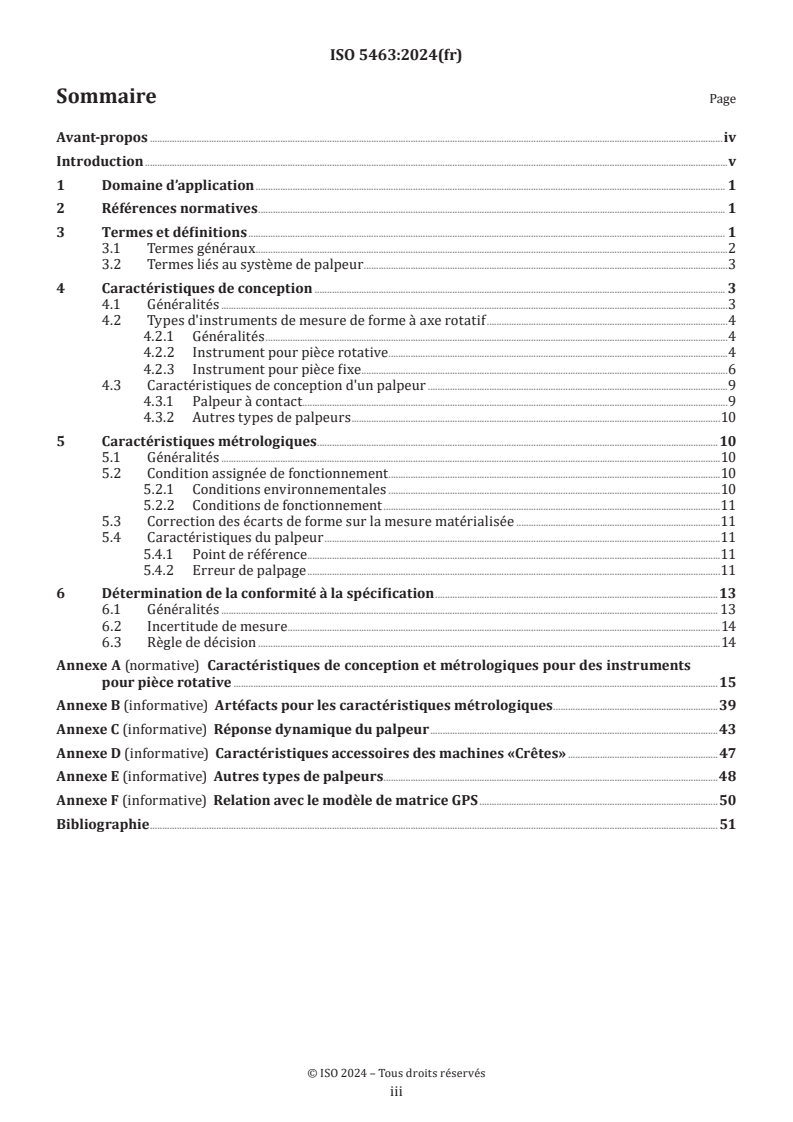
Sommaire Page
Avant-propos .iv
Introduction .v
1 Domaine d’application .1
2 Références normatives .1
3 Termes et définitions .1
3.1 Termes généraux .2
3.2 Termes liés au système de palpeur .3
4 Caractéristiques de conception . 3
4.1 Généralités .3
4.2 Types d'instruments de mesure de forme à axe rotatif .4
4.2.1 Généralités .4
4.2.2 Instrument pour pièce rotative .4
4.2.3 Instrument pour pièce fixe . .6
4.3 Caractéristiques de conception d'un palpeur .9
4.3.1 Palpeur à contact .9
4.3.2 Autres types de palpeurs .10
5 Caractéristiques métrologiques . .10
5.1 Généralités .10
5.2 Condition assignée de fonctionnement .10
5.2.1 Conditions environnementales .10
5.2.2 Conditions de fonctionnement .11
5.3 Correction des écarts de forme sur la mesure matérialisée .11
5.4 Caractéristiques du palpeur .11
5.4.1 Point de référence .11
5.4.2 Erreur de palpage .11
6 Détermination de la conformité à la spécification .13
6.1 Généralités . 13
6.2 Incertitude de mesure .14
6.3 Règle de décision .14
Annexe A (normative) Caractéristiques de conception et métrologiques pour des instruments
pour pièce rotative .15
Annexe B (informative) Artéfacts pour les caractéristiques métrologiques .39
Annexe C (informative) Réponse dynamique du palpeur .43
Annexe D (informative) Caractéristiques accessoires des machines «Crêtes» . 47
Annexe E (informative) Autres types de palpeurs .48
Annexe F (informative) Relation avec le modèle de matrice GPS .50
Bibliographie . 51
iii
Avant-propos
L'ISO (Organisation internationale de normalisation) est une fédération mondiale d'organismes nationaux
de normalisation (comités membres de l'ISO). L'élaboration des Normes internationales est en général
confiée aux comités techniques de l'ISO. Chaque comité membre intéressé par une étude a le droit de faire
partie du comité technique créé à cet effet. Les organisations internationales, gouvernementales et non
gouvernementales, en liaison avec l'ISO participent également aux travaux. L'ISO collabore étroitement avec
la Commission électrotechnique internationale (IEC) en ce qui concerne la normalisation électrotechnique.
Les procédures utilisées pour élaborer le présent document et celles destinées à sa mise à jour sont
décrites dans les Directives ISO/IEC, Partie 1. Il convient, en particulier, de prendre note des différents
critères d'approbation requis pour les différents types de documents ISO. Le présent document a
été rédigé conformément aux règles de rédaction données dans les Directives ISO/IEC, Partie 2 (voir
www.iso.org/directives).
L’ISO attire l’attention sur le fait que la mise en application du présent document peut entraîner l’utilisation
d’un ou de plusieurs brevets. L’ISO ne prend pas position quant à la preuve, à la validité et à l’applicabilité de
tout droit de propriété revendiqué à cet égard. À la date de publication du présent document, l’ISO n'avait
reçu notification qu’un ou plusieurs brevets pouvaient être nécessaires à sa mise en application. Toutefois,
il y a lieu d’avertir les responsables de la mise en application du présent document que des informations
plus récentes sont susceptibles de figurer dans la base de données de brevets, disponible à l'adresse
www.iso.org/brevets. L’ISO ne saurait être tenue pour responsable de ne pas avoir identifié tout ou partie de
tels droits de propriété.
Les appellations commerciales éventuellement mentionnées dans le présent document sont données pour
information, par souci de commodité, à l’intention des utilisateurs et ne sauraient constituer un engagement.
Pour une explication de la nature volontaire des normes, la signification des termes et expressions
spécifiques de l'ISO liés à l'évaluation de la conformité, ou pour toute information au sujet de l'adhésion de
l'ISO aux principes de l’Organisation mondiale du commerce (OMC) concernant les obstacles techniques au
commerce (OTC), voir www.iso.org/avant-propos.
Le présent document a été élaboré par le comité technique ISO/TC 213, Spécifications et vérification
dimensionnelles et géométriques des produits, en collaboration avec le comité technique CEN/TC 290,
Spécification dimensionnelle et géométrique des produits, et vérification correspondante, du Comité européen
pour la normalisation (CEN) conformément à l’Accord sur la coopération technique entre l’ISO et le CEN
(Accord de Vienne).
Il convient que l’utilisateur adresse tout retour d’information ou toute question concernant le présent
document à l’organisme national de normalisation de son pays. Une liste exhaustive desdits organismes se
trouve à l’adresse www.iso.org/fr/members.html.
iv
Introduction
Le présent document est une norme de spécification géométrique des produits et est à considérer comme
une norme GPS générale (voir l’ISO 14638). Elle influence le maillon de la chaîne F des chaînes de normes sur
la forme, l’orientation, la position et le battement.
Le modèle de matrice ISO GPS de l’ISO 14638 donne une vue d’ensemble du système ISO GPS, dont le présent
document fait partie. Les principes fondamentaux du système ISO/GPS, donnés dans l’ISO 8015, s’appliquent
au présent document et les règles de décision par défaut, données dans l’ISO 14253-1, s’appliquent aux
spécifications faites conformément au présent document, sauf indication contraire. Pour de plus amples
informations sur les relations du présent document avec les autres normes et le modèle de matrice GPS, voir
l’Annexe F.
Voir l’ISO/TR 14253-6 pour des informations complémentaires sur le choix des règles de décision alternative.
Il existe différents types et variantes d’instruments de mesure de forme à plateau tournant. Les
caractéristiques métrologiques décrites dans le présent document s’appliquent à tous les types et variantes.
v
Norme internationale ISO 5463:2024(fr)
Spécification géométrique des produits (GPS) — Instruments
de mesure de forme à axe rotatif — Caractéristiques de
conception et caractéristiques métrologiques
1 Domaine d’application
Le présent document spécifie les caractéristiques de conception et les caractéristiques métrologiques les
plus importantes des instruments de mesure de forme à plateau tournant.
Il ne s’applique pas aux systèmes de mesure de coordonnées tels que définis par la série ISO 10360, que les
systèmes soient dotés d’un axe de rotation ou non, sauf en cas d’accord spécial.
2 Références normatives
Les documents suivants sont cités dans le texte de sorte qu’ils constituent, pour tout ou partie de leur
contenu, des exigences du présent document. Pour les références datées, seule l’édition citée s’applique. Pour
les références non datées, la dernière édition du document de référence s'applique (y compris les éventuels
amendements).
ISO 1101, Spécification géométrique des produits (GPS) — Tolérancement géométrique — Tolérancement de
forme, orientation, position et battement
ISO 14253-5, Spécification géométrique des produits (GPS) — Vérification par la mesure des pièces et des
équipements de mesure — Partie 5: Incertitude liée aux essais de vérification des appareils de mesure indicateurs
ISO/TR 14253-6, Spécification géométrique des produits (GPS) — Vérification par la mesure des pièces et des
équipements de mesure — Partie 6: Règles de décision générales pour l'acceptation ou le rejet d'instruments et
de pièces
ISO 14978:2018, Spécification géométrique des produits (GPS) — Concepts et exigences généraux pour les
équipements de mesure GPS
Guide ISO/IEC 98-3, Incertitude de mesure — Partie 3: Guide pour l’expression de l’incertitude de mesure (GUM: 1995)
Guide ISO/IEC 99:2007, Vocabulaire international de métrologie — Concepts fondamentaux et généraux et
termes associés (VIM)
3 Termes et définitions
Pour les besoins du présent document, les termes et définitions de l'ISO 1101, l’ISO 14978 et le
Guide ISO/IEC 99, ainsi que les suivants s'appliquent.
L'ISO et l'IEC tiennent à jour des bases de données terminologiques destinées à être utilisées en normalisation,
consultables aux adresses suivantes:
— ISO Online browsing platform: disponible à l'adresse https:// www .iso .org/ obp
— IEC Electropedia: disponible à l'adresse https:// www .electropedia .org/
3.1 Termes généraux
3.1.1
instrument de mesure de forme à axe rotatif
instrument de mesure ayant un axe de rotation et quantifiant les écarts de forme locaux des surfaces
intégrales extraites dans un système de coordonnées cylindriques
3.1.2
centrage
réglage, dans un plan perpendiculaire à l'axe de rotation, de la position du point central de la pièce pour
qu'elle coïncide avec l'axe de rotation de l'instrument
Note 1 à l'article: Voir Figure 1.
a) Centrage du cylindre
b) Centrage de la sphère
Légende
1 axe de rotation 5 point central après centrage
2 pièce de révolution avant centrage 6 pièce de révolution après centrage
3 point central avant centrage 7 axe orthogonal à l'axe de rotation
4 déplacement du centrage
Figure 1 — Centrage
3.1.3
mise à niveau
réglage de la ligne centrale de la pièce pour qu'elle soit parallèle à l'axe de rotation, ou réglage du vecteur
normal à un élément plan de la pièce pour qu'il soit parallèle à l'axe de rotation
Note 1 à l'article: Voir Figure 2.
Note 2 à l'article: Une mise à niveau est souvent combinée avec, ou suivie par, un centrage afin de faire en sorte que
l'axe de la pièce soit coaxial avec l'axe de rotation de l'instrument.
Légende
1 axe de rotation 4 déplacement angulaire
2 ligne centrale de la pièce de révolution avant mise à 5 ligne centrale de la pièce de révolution après mise à
niveau niveau
3 pièce de révolution avant mise à niveau 6 pièce de révolution après mise à niveau
Figure 2 — Mise à niveau
3.2 Termes liés au système de palpeur
3.2.1
stylet
dispositif mécanique constitué d'une touche et d'un bras
4 Caractéristiques de conception
4.1 Généralités
Le présent instrument de mesure est principalement construit pour acquérir des écarts de forme dans
les coordonnées cylindriques par le mesurage direct d'écarts radiaux (et axiaux). Les caractéristiques de
conception d'un instrument de mesure de forme à axe rotatif sont décrites de manière générique à l'Annexe A
et dépendent de son type.
Le système de coordonnées cylindriques est configuré avec l'axe longitudinal qui coïncide nominalement
avec l'axe de rotation et avec un axe transversal nominalement perpendiculaire.
NOTE 1 Voir Figure 3.
NOTE 2 Les déplacements mesurés le long de l'axe longitudinal sont désignés par H et sont mesurés à partir d'un
point spécifié par le fabricant.
NOTE 3 Le rayon, désigné par R, est mesuré à partir de l'axe de rotation et sa direction de base est l'axe transversal.
NOTE 4 L'angle de rotation, désigné par θ, est mesuré à partir d'une ligne dont l'orientation est spécifiée par le
fabricant dans le plan transversal.
NOTE 5 La direction le long de l'axe de rotation est appelée «direction axiale» pour les caractéristiques de rotation.
NOTE 6 La direction orientée vers l'extérieur autour de l'axe de rotation est appelée «direction radiale» pour les
caractéristiques de rotation.
NOTE 7 La direction de rotation autour de l'axe de rotation est appelée «direction angulaire» pour les
caractéristiques de rotation.
Légende
1 origine (position centrale du repère de rotation) 6 angle de rotation (distance angulaire de l'axe
transversal par rapport à l'axe de référence)
2 mouvement angulaire 7 point de palpage
3 ligne d'axe de rotation (axe longitudinal) 8 distance longitudinale (distance du point de palpage
par rapport au plan transversal)
4 axe transversal ou direction radiale 9 distance radiale (du point de palpage par rapport à
l'axe de rotation)
5 axe de référence angulaire dans le plan transversal
(θ = 0)
Figure 3 — Système de coordonnées de mesure
4.2 Types d'instruments de mesure de forme à axe rotatif
4.2.1 Généralités
Il existe plusieurs différents types d'instruments de mesure de forme à axe rotatif, avec des variantes pour
chacun de ces types.
4.2.2 Instrument pour pièce rotative
Les caractéristiques de conception de ce type d'instrument doivent être conformes à l'Annexe A.
Les instruments pour pièce rotative comprennent les variantes suivantes:
a) Instrument pour pièce rotative à axe vertical sur lequel la pièce est fixée sur une table, voir Figure 4.
b) Instrument pour pièce rotative à axe horizontal, qui est une variante du type a), où l'axe longitudinal se
trouve dans un plan horizontal, voir Figure 5.
c) Pièce rotative à axe vertical entre des centres, qui est une variante du type a) où la pièce pivote entre
des centres plutôt que sur une table.
d) Pièce rotative à axe horizontal entre des centres, qui est une variante du type b) où la pièce pivote entre
des centres plutôt que sur une table.
Légende
1 origine du système de coordonnées de mesure 9 rayon du point de palpage R à partir de l'axe de
rotation
2 mouvement angulaire 10 colonne
3 ligne d'axe de rotation 11 base
4 axe transversal 12 broche rotative
5 point de palpage 13 déplacement de l'axe longitudinal
6 pièce 14 déplacement de l'axe transversal
7 palpeur 15 table
8 hauteur du point de palpage H par rapport au plan
supérieur de la table
Figure 4 — Instrument pour pièce rotative à axe vertical
Légende
1 origine du système de coordonnées de mesure 9 rayon du point de palpage R à partir de l'axe de
rotation
2 mouvement angulaire 10 colonne
3 ligne d'axe de rotation ou axe longitudinal 11 base
4 direction de l'axe transversal 12 broche rotative
5 point de palpage 13 déplacement longitudinal
6 pièce 14 déplacement transversal
7 palpeur 15 dispositif de fixation de la pièce sur la table
8 hauteur du point de palpage H par rapport au plan
supérieur de la table
Figure 5 — Instrument pour pièce rotative à axe horizontal
4.2.3 Instrument pour pièce fixe
Les instruments de type pour pièce fixe comprennent les variantes suivantes:
a) Instrument pour pièce fixe à axe vertical sur lequel le stylet tourne autour de la pièce qui est fixée sur
une table, voir Figure 6.
b) Instrument pour pièce fixe à axe horizontal, qui est une variante du type a), dans lequel l'axe longitudinal
se trouve dans un plan horizontal, voir Figure 7.
c) Instrument pour pièce fixe à axe horizontal entre deux centres, qui est une variante de b), où la pièce est
maintenue entre des centres plutôt que dans un dispositif de fixation de la pièce.
d) Insertion d'un trou avec un instrument pour pièce fixe, une variante d'un type où l'instrument fonctionne
à l'intérieur d'un trou cylindrique fixe sur une pièce, voir Figure 8.
Légende
1 origine du système de coordonnées de mesure 9 distance du point de palpage R par rapport à l'axe de
rotation
2 mouvement angulaire 10 colonne
3 ligne d'axe de rotation 11 base
4 axe transversal 12 broche rotative
5 point de palpage 13 déplacement de l'axe longitudinal
6 pièce 14 déplacement de l'axe transversal
7 palpeur 15 table
8 hauteur du point de palpage H par rapport à l'origine à
l'axe transversal
Figure 6 — Instrument pour pièce fixe à axe vertical
Légende
1 origine du système de coordonnées de mesure 8 hauteur du point de palpage H par rapport à l'origine à
l'axe transversal
2 mouvement angulaire 9 distance du point de palpage par rapport à l'axe de
rotation
3 ligne d'axe de rotation ou axe transversal 10 base
4 axe longitudinal 11 colonne
5 point de palpage 12 broche rotative
6 pièce 13 déplacement de l'axe transversal
7 palpeur 14 rayon de réglage
Figure 7 — Instrument pour pièce fixe à axe horizontal
Légende
1 origine des coordonnées de mesure 8 hauteur du point de palpage H par rapport à l'origine à
l'axe transversal
2 mouvement angulaire 9 rayon R de la pièce à la position du point de contact du
palpeur
3 ligne d'axe de l'axe de rotation 10 base
4 axe transversal
5 point de palpage 11 broche rotative
6 pièce 12 déplacement longitudinal
7 palpeur 13 axe du palpeur de type à levier
Figure 8 — Insertion d'un trou avec un instrument pour pièce fixe
4.3 Caractéristiques de conception d'un palpeur
4.3.1 Palpeur à contact
Un palpeur à contact comprend une partie fixe («corps principal incluant un transducteur») (voir
ISO/IEC Guide 99:2007, 3.7) et une partie mobile («stylet») qui est également appelée l'«élément de mesure».
Un palpeur à contact nécessite une force de mesure pour maintenir le contact avec la surface tout au long
du mesurage. Une force excessive pourrait entraîner une flexion dans la boucle de mesure, et endommager
le point de contact ou la surface mesurée. Il convient que la force de mesure soit maintenue aussi faible que
possible.
Il convient que la touche de stylet soit fabriquée dans un matériau dur et résistant à l'usure. Elle doit être bien
finie et exempte de méplats ou d'autres irrégularités qui pourraient affecter l'exactitude de l'instrument.
Les propriétés géométriques de l'élément de contact doivent être suffisantes pour l'utilisation de l'instrument
de mesure.
La géométrie par défaut d'une touche de stylet est une sphère (voir Figure 9).
Légende
1 diamètre de la pièce cylindrique 2 rayon de la touche de stylet sphérique dans une
direction quelconque
Figure 9 — Géométrie d'une touche de stylet sphérique
4.3.2 Autres types de palpeurs
Il existe de nombreux types différents de palpeurs, qui peuvent avoir des limitations sur les types de
matériaux pouvant être mesurés. Pour les instruments de mesure de forme à axe rotatif équipés d'autres
palpeurs, le fabricant peut indiquer chacune des spécifications (voir Annexe E).
5 Caractéristiques métrologiques
5.1 Généralités
Les caractéristiques métrologiques, d'autres concepts et principes qui sont courants quels que soient les
types et les variantes, sont décrits ci-dessous. Puisque la vérification des caractéristiques métrologiques
peut varier en fonction du type et de la variante de l'instrument, les essais et la vérification sont décrits
dans l’Annexe A relative au type et à la variante de l'instrument. Les essais et les vérifications doivent être
effectués conformément aux spécifications de l'Annexe A. Les mesures matérielles pour ces essais sont
décrites dans l'Annexe B.
Un instrument de mesure de forme à axe rotatif peut être utilisé pour mesurer de nombreux types d'éléments
géométriques. L'instrument peut donc avoir de nombreuses caractéristiques métrologiques différentes.
Le fournisseur d'un instrument de mesure de forme à axe rotatif doit spécifier l'erreur maximale tolérée
(EMT) de chaque caractéristique métrologique. Ces EMTs s'appliquent lorsque l'instrument est utilisé
conformément aux conditions assignées de fonctionnement indiquées par le fabricant ou le fournisseur et
aux recommandations du fabricant.
NOTE Le fabricant ou le fournisseur n'a pas besoin de spécifier des valeurs EMT pour les caractéristiques
métrologiques qui ne sont ni incluses dans les fonctions de l'instrument, ni dans les mesurages requis sur la pièce cible.
L'erreur de palpage est présentée en 5.4, séparément de l'Annexe A, en raison de sa contribution potentielle à
toutes les autres caractéristiques métrologiques d'un instrument de mesure de forme à axe rotatif.
L'unité de longueur des caractéristiques métrologiques est le micromètre, par défaut.
5.2 Condition assignée de fonctionnement
5.2.1 Conditions environnementales
Les limites à respecter pour les conditions d'environnement tolérées qui influencent les mesures (par
exemple les conditions de température, d'humidité, de vibrations et d'éclairage ambiant sur le lieu
d'installation) doivent être spécifiées par:
— le fabricant, pour les essais de réception;
— l'utilisateur, pour les essais de vérification périodique.
Dans les deux cas, l'utilisateur est libre de choisir les conditions environnementales, dans les limites
spécifiées dans la fiche technique de l'instrument dans lesquelles les essais seront effectués conformément
au présent document.
L'utilisateur a la responsabilité de fournir les conditions environnementales telles qu'indiquées par
le fabricant dans la fiche technique. Si l'environnement ne respecte pas les conditions assignées de
fonctionnement, alors la décision de conformité ou de non-conformité ne peut être prise que si les conditions
assignées de fonctionnement sont remplies.
5.2.2 Conditions de fonctionnement
Lorsque les essais de l'Annexe A sont menés, l'instrument doit fonctionner en utilisant les procédures du
manuel d'utilisation du fabricant.
5.3 Correction des écarts de forme sur la mesure matérialisée
Comme discuté à l'Annexe B, il convient que de nombreux étalons de mesure nécessaires pour vérifier la
conformité aux spécifications présentent de faibles écarts de forme. Les écarts de forme contribuent à
l'incertitude de mesure des valeurs d'essai. Pour réduire la contribution à l'incertitude d'essai des écarts de
forme sur la mesure matérialisée, le présent document autorise la correction des écarts de forme.
NOTE Les méthodes suivantes sont typiquement utilisées pour corriger l'écart de forme des étalons de mesure:
a) compensation de la méthode de profil étalonné;
b) méthode de séparation d'erreurs par inversion (voir l’ISO 230-7 et les références [21], [22],[25] et [27]);
c) méthode de séparation d'erreurs multi-étapes (voir les références [23], [24], [25], [27],[28] et [32]).
5.4 Caractéristiques du palpeur
5.4.1 Point de référence
Le cas échéant, le palpeur utilisé pour les mesures de forme doit être équipé d'un système de réglage
accessible à l'utilisateur pour la mise à zéro ou le réglage au point de référence. Les caractéristiques
métrologiques décrites dans le présent document s'appliquent lorsque le palpeur est correctement réglé
conformément aux recommandations du fabricant, et que le point de référence est considéré comme fixe lors
de la vérification des caractéristiques métrologiques.
5.4.2 Erreur de palpage
5.4.2.1 Généralités
L'erreur de palpage (E ) est l'erreur d'indication lorsque le palpeur est en contact avec une mesure
p
matérialisée, pour tout mouvement angulaire de la mesure matérialisée ou du stylet, selon le type
d’instrument de mesure de forme à axe rotatif. L’erreur de palpage est calculée comme étant l'écart signé
entre l'indication du palpeur et la valeur de référence étalonnée d'une mesure matérialisée.
L’EMT de l’erreur de palpage doit être spécifiée dans au moins une étendue de mesure indiquée par le
fabricant ou le fournisseur.
NOTE 1 L'erreur de palpage peut comprendre l'erreur de sensibilité, l'erreur de linéarité, la dérive instrumentale, la
résolution ou le pas numérique, la répétabilité, le bruit de mesure, l'erreur d'hystérésis et la réponse dynamique (voir
l'Annexe C).
NOTE 2 L'erreur de palpage est un contributeur à toutes les caractéristiques métrologiques de l'instrument.
La sensibilité doit être réglée conformément aux recommandations du fabricant avant l'essai d'erreur de
palpage.
5.4.2.2 Méthode d'essai
5.4.2.2.1 Points et étendue d'essai
L'essai de vérification des erreurs de palpage doit être effectué avec cinq points d'essai ou plus. Les points
d'essai doivent être bien répartis, aussi uniformément que possible, sur toute l'étendue de mesure du
palpeur (voir Figure 10). Les points d'essai doivent couvrir au moins 75 % de la partie centrale de l'étendue
de mesure du palpeur.
Le point de référence du palpeur doit être au centre (point zéro) de son étendue de mesure. Ce point de
référence doit être situé sur le plan de référence de l'étalon et faire partie des points d'essai.
Légende
1 déplacement réel 5 étendue de mesure du palpeur
2 courbe d'erreur de palpage 6 point d'essai
3 erreur de palpage 7 point de référence
4 étendue d'essai
Figure 10 — Analyse de l’erreur de palpage
5.4.2.2.2 Direction et position d'essai
L'utilisateur est libre de choisir la direction de palpage (horizontale ou verticale) pour l'essai de vérification
de l'erreur de palpage, sauf indication contraire du fabricant.
5.4.2.3 Étalon de mesure et mode opératoire d'essai
Lors de l'essai de conformité aux spécifications, des essais suffisants doivent être effectués pour établir la
confiance dans les résultats, et la personne effectuant les essais peut choisir des instruments ou des étalons
de mesure adaptés parmi ceux décrits à l'Annexe B. L'instrument ou l'étalon de mesure utilisé doit couvrir
l'étendue à soumettre à essai.
Si chaque étape cible de déplacement a une position de palpage différente, il convient que les positions de
palpage soient définies le long d'un mouvement de déplacement (rotatif, longitudinal ou transversal) exact.
L'erreur de palpage doit être calculée à partir de la différence de longueur mesurée de chaque déplacement.
Les modes opératoires types de chaque instrument et les mesures matérialisées sont également présentés à
l'Annexe B.
5.4.2.4 Fonction d'EMT
5.4.2.4.1 Généralités
L'erreur de palpage maximale tolérée, E , est une fonction d'EMT bilatérale comme indiqué dans
P,EMT
l'ISO 14978:2018, 7.2.
5.4.2.4.2 Fonctions d'EMT à valeur proportionnelle
Limite supérieure d'EMT:
E = + (a + |L× b|)
P,EMT
Limite inférieure d'EMT:
E = - (a + |L× b|)
P,EMT
5.4.2.4.3 Fonctions d'EMT à valeur constante
Limite supérieure d'EMT:
E = + a
P,EMT
Limite inférieure d'EMT:
E = - a
P,EMT
5.4.2.4.4 Fonctions d'EMT à valeur proportionnelle avec étendue du palpeur
Limite supérieure d'EMT:
E = + (a + |L× b|)/(étendue du palpeur)
P,EMT
Limite inférieure d'EMT:
E = - (a + |L× b|) /(étendue du palpeur)
P,EMT
où
a sont des constantes positives indiquées par le fabricant;
b est une constante positive sans dimension indiquée par le fabricant;
L est le déplacement réel en micromètres (L = 0 au point de référence)
L'EMT de l'erreur de palpage peut également être indiquée en pourcentage de l'intervalle de mesure
mentionné par le fabricant lorsque l'EMT est destinée à indiquer l'utilisation d'une valeur constante.
L'EMT de l'erreur de palpage peut également être indiquée en pourcentage avec un intervalle de mesure
proportionnel.
6 Détermination de la conformité à la spécification
6.1 Généralités
Toutes les erreurs d'indication associées aux caractéristiques métrologiques doivent être conformes aux
valeurs d'EMT spécifiées.
6.2 Incertitude de mesure
L'évaluation de l'incertitude de mesure doit être réalisée conformément à le Guide ISO/IEC 98-3. Lors de
la détermination de la conformité à la spécification, l'incertitude de mesure associée à une valeur d'essai
(l'incertitude de la valeur d'essai) doit être évaluée conformément à l'ISO 14253-5. Des lignes directrices
supplémentaires sont disponibles dans l’ISO 14978:2018, Annexe D.
6.3 Règle de décision
Pour démontrer la conformité ou la non-conformité aux spécifications, la règle de décision accompagnant
les spécifications doit être respectée. Si aucune règle de décision n'est énoncée dans les spécifications, et
qu'aucun accord spécial n'est conclu entre le fournisseur et le client, alors la règle de décision par défaut doit
être l'acceptation et le rejet simples, l'indice de capabilité à la mesure, C , étant un ou plus, conformément à
m
l'ISO/TR 14253-6.
NOTE Des informations sur le choix d'une autre règle de décision sont données dans l'ISO/TR 14253-6.
Annexe A
(normative)
Caractéristiques de conception et métrologiques pour des
instruments pour pièce rotative
A.1 Caractéristiques de conception
La conception de ce type d'instrument de mesure de forme à axe rotatif doit suivre les lignes directrices
générales de l'ISO 14978. La conception doit être telle que les caractéristiques métrologiques soient
conformes aux exigences du présent document.
Le Tableau A.1 donne une liste de caractéristiques de conception pour ce type d'instrument de mesure de
forme à axe rotatif. Il convient que les caractéristiques de conception pertinentes soient spécifiées lors de la
communication des exigences.
Tableau A.1 — Liste de caractéristiques de conception
Caractéristiques de conception
Composant Description Unité
Hauteur mm
Largeur mm
Dimensions générales
Profondeur mm
Masse (poids) kg
Tension de réseau CA V
Connexion au réseau Fréquence de réseau CA Hz
Puissance d'entrée apparente VA
Diamètre d'essai maximal mm
Étendue de mesure Longueur de mesure maximale sur l'axe longitudinal mm
Longueur de mesure maximale sur l'axe transversal mm
Vitesse de rotation (ω ) Hz ou r/min
cyc
Vitesse de déplacement Vitesse de déplacement sur l'axe longitudinal mm/s
Vitesse de déplacement sur l'axe transversal mm/s
Dimension ou diamètre mm
Table de chargement Capacité de charge N (ou kg)
Étendue de centrage mm
Étendue de mise à niveau degré
Type de palpeur (contact ou sans contact) -
Palpeur Étendue de mesure maximale du palpeur mm ou μm
Rayon de la touche de stylet sur un palpeur à contact, ou une
moitié de la dimension du faisceau efficace sur un palpeur sans mm ou μm
contact
NOTE 1 Le Tableau A.1 présente les caractéristiques de conception les plus importantes pour un instrument de
mesure de forme de pièce rotative. Il est possible que certaines de ces caractéristiques ne s'appliquent pas à certaines
variantes.
NOTE 2 En plus des caractéristiques présentées dans le Tableau A.1, d'autres caractéristiques de conception
peuvent être spécifiées par le fabricant, en fonction de l'application.
A.2 Caractéristiques métrologiques
A.2.1 Généralités
Les caractéristiques métrologiques suivantes sont complémentaires à l’erreur de palpage:
— erreur radiale (voir A.2.2);
— erreur axiale (voir A.2.3);
— erreur de rectitude longitudinale (voir A.2.4);
— erreur de parallélisme (voir A.2.5);
— erreur de rectitude transversale (voir A.2.6);
— erreur de perpendicularité (voir A.2.7).
De nombreuses caractéristiques métrologiques décrites dans la présente annexe peuvent être mesurées
avec une incertitude de mesure plus faible si des techniques de séparation des erreurs sont utilisées pour
minimiser les contributions à l'incertitude provenant de l'étalon de mesure.
Une fois les caractéristiques métrologiques déterminées, des techniques d’exactitude assistées par
ordinateur peuvent également être utilisées pour corriger par logiciel l'instrument afin qu'il réponde aux
spécifications du fabricant.
Dans quelques cas, ces techniques de séparation des erreurs font partie du fonctionnement normal de
l'instrument, par exemple lorsque des techniques de séparation des erreurs radiales sont utilisées pour
mesurer des composants de haute précision.
A.2.2 Erreur radiale
A.2.2.1 Généralités
L'erreur radiale (E ) est l'écart de circularité saillie-creux, RONt (voir l'ISO 12181-1) qui serait obtenu à
R
partir d'un profil de circularité filtré passe-bas d'une section parfaitement ronde et parfaitement centrée
d'un étalon de mesure dans une direction perpendiculaire à l'axe de rotation.
L'erreur radiale ne doit pas dépasser l'erreur radiale maximale tolérée.
NOTE 1 L'erreur radiale peut consister en une «erreur radiale pure», qui est habituellement décrite comme «erreur
de mouvement radial», et en une erreur proportionnellement dépendante appelée «erreur d'inclinaison» (voir
Figure A.1). L'erreur de mouvement radial ne peut pas être évaluée séparément de l'erreur d'inclinaison.
NOTE 2 L'erreur radiale peut inclure l'effet d'«erreur de fermeture» (voir référence [31]).
NOTE 3 L'erreur radiale peut également être influencée par l'erreur de palpage et les erreurs restantes en centrage
comme effet d'incertitude.
NOTE 4 L'erreur radiale est un contributeur aux incertitudes de mesure de la circularité ou de la cylindricité
observée sur une pièce.
NOTE 5 L'erreur d'inclinaison affecte également l'erreur axiale, et peut être évaluée par vérification des erreurs
radiales ou axiales.
NOTE 6 Une «erreur de fermeture» peut également être provoquée par la dérive instrumentale (voir le
Guide ISO/IEC 99:2007, 4.21) ou des influences de l'environnement ou du processus de mesure.
Légende
1 origine des coordonnées de mesure 8 hauteur nominale du point de palpage par rapport à
l'origine
2 mouvement angulaire 9 distance du point de palpage par rapport à l'axe de
rotation
3 ligne d'axe de rotation 10 centre du profil de circularité de palpage
4 axe transversal 11 table ou plan de référence transversal
5 position centrale d'erreur d'inclinaison 12 broche rotative
6 étalon de mesure hémisphérique ou sphérique 13 hauteur réelle de palpage par rapport au centre
d'erreur d'inclinaison
7 palpeur 14 erreur d'inclinaison à la hauteur
Figure A.1 — Principe du point de référence d'erreur d'inclinaison
A.2.2.2 Méthode d'essai
A.2.2.2.1 Généralités
L'erreur radiale doit être soumise à essai en mesurant le profil de circularité autour d'un étalon de circularité,
par exemple une sphère ou un hémisphère de précision (voir Figure A.2).
Légende
1 origine des coordonnées de mesure 8 étalon de mesure (sphère ou hémisphère)
2 mouvement angulaire 9 distance du point de palpage par rapport à l'axe de
rotation
3 ligne d'axe de rotation 10 hauteur H du point de palpage par rapport à l'origine
4 axe de référence sur le plan transversal lors d'essais à 11 origine des coordonnées de mesure et centre de
H (mis en parallèle avec l'axe transversal) l'étalon de circularité lors d'essais à H
1 2
5 position mesurée de l'axe de rotation sur le plan 12 espaceur lors d'essais à H
transversal
6 distance angulaire par rapport à l'axe de référence 13 hauteur H du point de palpage par rapport à l'origine
7 palpeur 14 axe de référence sur le plan transversal lors d'essais à
H
Figure A.2 — Méthode d'essai de l'erreur radiale
A.2.2.2.2 Points et conditions d'essai
L'essai de vérification de l'erreur radiale doit être effectué avec un processus de mesure dont l'incertitude de
mesure est suffisamment faible.
Il convient que la configuration, l'orientation, la direction, la vitesse de rotation du palpeur, et les conditions
du montage d'essai de l'instrument soient spécifiées par le fabricant ou le fournisseur.
A.2.2.2.3 Position d'essai
L'erreur radiale peut inclure l'erreur d'inclinaison, qui est une erreur proportionnelle. L'erreur d'inclinaison
affecte également l'erreur axiale et peut être estimée par l'évaluation des erreurs radiales ou axiales.
Pour évaluer la composante d'erreur d'inclinaison de l'erreur radiale, il convient que des mesurages soient
effectués à deux positions différentes dans la direction de l'axe longitudinal:
a) H , aussi proche que possible du zéro de l'axe longitudinal (la hauteur de l'étalon est acceptable);
b) H = supérieure ou égale à la moitié du déplacement maximal de l'axe longitudinal.
Certains instruments peuvent avoir un axe longitudinal avec un déplacement maximal très long. Lorsque le
déplacement maximal de l'axe longitudinal de l'instrument est supérieur à 400 mm, le réglage de l'étalon de
mesure pour cet essai peut être instable. Dans ce cas, il est acceptable de placer H à au moins 200 mm de H
2 1
dans la direction longitudinale.
A.2.2.3 Étalon de mesure et mode opératoire d'essai
L'erreur radiale doit être soumise à essai avec un étalon de mesure adapté présentant une incertitude
appropriée. Des étalons de mesure type sont présentés à Annexe B. Lors de la vérification de la conformité
aux spécifications, des essais doivent être réalisés en quantité suffisante afin d'avoir confiance dans les
résultats.
L'ajustement de référence pour le calcul de l'erreur radiale doit être le cercle de référence des moindres
carrés (LSCI) (voir l'ISO 12181-1).
Cette erreur est calculée comme étant le RONt du profil de circularité mesuré de l'étalon de circularité
(artéfact) après séparation d'erreurs de la forme de l'artéfact si nécessaire (voir Figure A.3). Sauf spécification
contraire, la condition de filtre par défaut est 1-50 UPR, Gaussienne. Le nombre de points d'échantillonnage
et le rapport e
...