

ISO 7240-32:2025
(Main)Fire detection and alarm systems — Part 32: Non-resettable line-type heat detectors
General Information
- Abstract
This document applies to non-resettable line-type heat detectors consisting of a sensing element distributed either continuously or discretely at close intervals along its length, which can be connected either directly or through a sensor control unit or an interface module to control and indicating equipment, and intended for use in fire detection and fire alarm systems installed in and around buildings and other civil engineering works. This document specifies requirements and performance criteria, and the corresponding test methods and provisions for assessment. This document also covers non-resettable line-type heat detectors intended for use in the local protection of plant (facility) and equipment. Non-resettable line-type heat detectors with special characteristics and developed for specific risks are not covered by this document.
- Status
- Published
- Publication Date
- 29-Sep-2025
- Technical Committee
- ISO/TC 21/SC 3 - Fire detection and alarm systems
- Drafting Committee
- ISO/TC 21/SC 3 - Fire detection and alarm systems
- Current Stage
- 6060 - International Standard published
- Start Date
- 30-Sep-2025
- Due Date
- 24-Aug-2025
- Completion Date
- 30-Sep-2025

Overview
ISO 7240-32:2025 is part of the ISO 7240 series dedicated to fire detection and alarm systems. This specific standard focuses on non-resettable line-type heat detectors (NLTHD), which are heat sensing devices distributed either continuously or discretely along a line, connected to control and indicating equipment-either directly or via a sensor control unit or an interface module. The standard sets out the requirements, performance criteria, test methods, and assessment provisions for NLTHD as used in fire detection and alarm systems within buildings and civil engineering works.
Non-resettable line-type heat detectors play a critical role in ensuring effective fire detection, especially in environments where point-type heat detectors are impractical due to challenging conditions or limited access.
Key Topics
- System Compatibility: Details connection methods for NLTHD to control and indicating equipment via direct or indirect interfaces.
- Performance Criteria: Specifies assessment metrics such as environmental endurance, heat response, and operational reliability.
- Testing and Evaluation: Defines rigorous laboratory and field test methods for durability, environmental tolerance, and fire sensitivity.
- Application Scope: Covers usage for building fire detection, local protection of equipment, and facility safety.
- Exclusions: Does not address devices designed for special or unique risk scenarios.
- Component Requirements: Distinct environmental classifications and test criteria for NLTHD sensing elements and sensor control units.
- Alarm and Signaling: Requirements for alarm indication, reporting faults, and compatibility with ancillary devices.
- Marking and Documentation: Outlines clear marking procedures and the need for comprehensive hardware and software documentation.
Applications
- Buildings and Facilities: NLTHD are particularly suited for use in fire alarm systems in commercial, industrial, and public buildings where environmental conditions (dust, humidity, vibration, temperature extremes) challenge point-type detectors.
- Infrastructure and Civil Engineering Works: Useful in tunnels, cable trays, conveyor systems, and areas that are difficult to access or surveil.
- Local Equipment Protection: Provides effective fire monitoring for specific equipment, such as electrical panels and machines, where continuous temperature sensing along critical components is vital.
- Retrofitting and Upgrades: Employed in upgrading existing systems for compliance with current safety standards and improving fire detection coverage.
Related Standards
- ISO 7240 Series: Includes other parts addressing different types of detectors, alarm devices, and system requirements for fire detection and alarm systems.
- IEC Standards: Works in conjunction with International Electrotechnical Commission standards for electrical and electronic fire detection equipment.
- EN 54 Series: European standards covering product features and system integration for fire safety technologies.
Keywords
Fire detection, alarm systems, line-type heat detectors, non-resettable linear heat detectors, NLTHD, ISO 7240-32, fire alarm technology, sensor control units, industrial fire safety, building fire protection, heat sensing, fire risk monitoring, international fire safety standards, test methods for heat detectors.
By specifying strict requirements and test methods for non-resettable line-type heat detectors, ISO 7240-32:2025 ensures that fire detection systems provide reliable, consistent, and verifiable levels of protection in a wide variety of challenging or critical environments. This standard serves engineers, building owners, and regulatory authorities seeking state-of-the-art fire safety compliance.
Get Certified
Connect with accredited certification bodies for this standard

CIS Institut d.o.o.
Personal Protective Equipment (PPE) certification body. Notified Body NB-2890 for EU Regulation 2016/425 PPE.

Kiwa BDA Testing
Building and construction product certification.
Kmetijski inštitut Slovenije
Agricultural Institute of Slovenia. Soil testing, plant health, agricultural product analysis.
Sponsored listings
Frequently Asked Questions
ISO 7240-32:2025 is a standard published by the International Organization for Standardization (ISO). Its full title is "Fire detection and alarm systems — Part 32: Non-resettable line-type heat detectors". This standard covers: This document applies to non-resettable line-type heat detectors consisting of a sensing element distributed either continuously or discretely at close intervals along its length, which can be connected either directly or through a sensor control unit or an interface module to control and indicating equipment, and intended for use in fire detection and fire alarm systems installed in and around buildings and other civil engineering works. This document specifies requirements and performance criteria, and the corresponding test methods and provisions for assessment. This document also covers non-resettable line-type heat detectors intended for use in the local protection of plant (facility) and equipment. Non-resettable line-type heat detectors with special characteristics and developed for specific risks are not covered by this document.
This document applies to non-resettable line-type heat detectors consisting of a sensing element distributed either continuously or discretely at close intervals along its length, which can be connected either directly or through a sensor control unit or an interface module to control and indicating equipment, and intended for use in fire detection and fire alarm systems installed in and around buildings and other civil engineering works. This document specifies requirements and performance criteria, and the corresponding test methods and provisions for assessment. This document also covers non-resettable line-type heat detectors intended for use in the local protection of plant (facility) and equipment. Non-resettable line-type heat detectors with special characteristics and developed for specific risks are not covered by this document.
ISO 7240-32:2025 is classified under the following ICS (International Classification for Standards) categories: 13.220.20 - Fire protection. The ICS classification helps identify the subject area and facilitates finding related standards.
ISO 7240-32:2025 is available in PDF format for immediate download after purchase. The document can be added to your cart and obtained through the secure checkout process. Digital delivery ensures instant access to the complete standard document.
Standards Content (Sample)
International
Standard
ISO 7240-32
First edition
Fire detection and alarm systems —
2025-09
Part 32:
Non-resettable line-type heat
detectors
Systèmes de détection et d'alarme incendie —
Partie 32: Détecteurs de chaleur de type linéaire non-
réenclenchables
Reference number
© ISO 2025
All rights reserved. Unless otherwise specified, or required in the context of its implementation, no part of this publication may
be reproduced or utilized otherwise in any form or by any means, electronic or mechanical, including photocopying, or posting on
the internet or an intranet, without prior written permission. Permission can be requested from either ISO at the address below
or ISO’s member body in the country of the requester.
ISO copyright office
CP 401 • Ch. de Blandonnet 8
CH-1214 Vernier, Geneva
Phone: +41 22 749 01 11
Email: copyright@iso.org
Website: www.iso.org
Published in Switzerland
ii
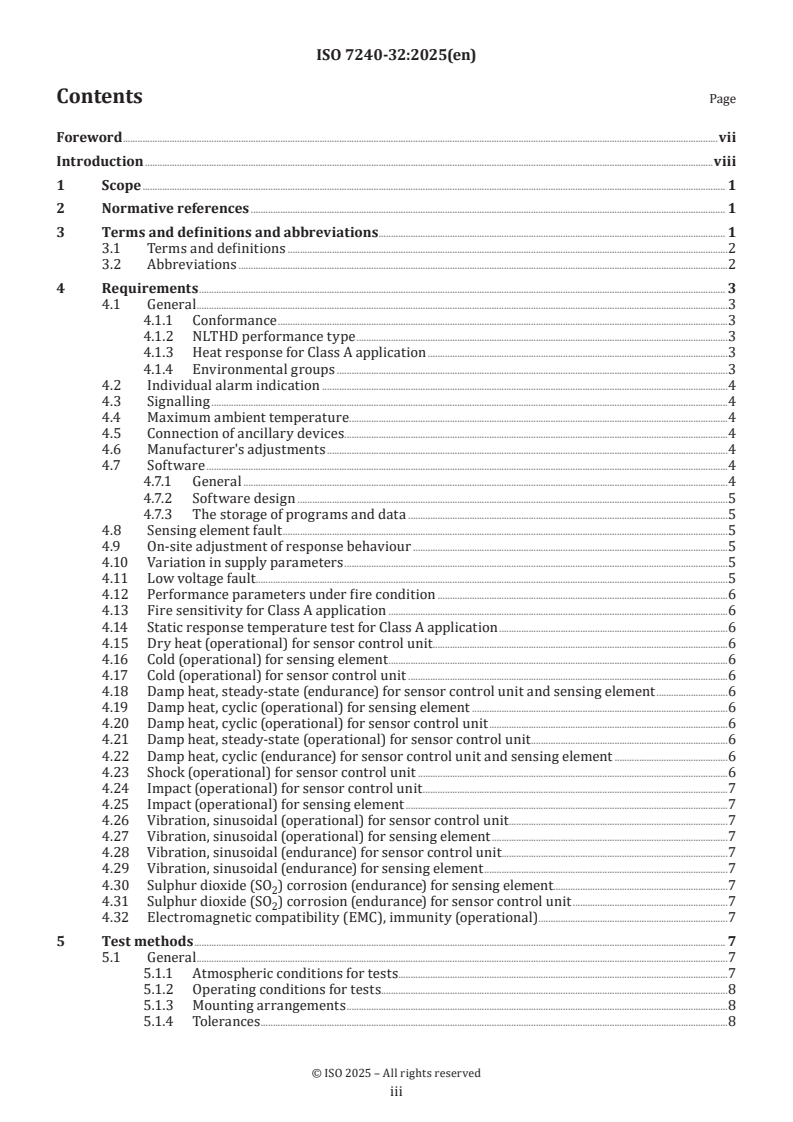
Contents Page
Foreword .vii
Introduction .viii
1 Scope . 1
2 Normative references . 1
3 Terms and definitions and abbreviations . 1
3.1 Terms and definitions .2
3.2 Abbreviations .2
4 Requirements . 3
4.1 General .3
4.1.1 Conformance .3
4.1.2 NLTHD performance type .3
4.1.3 Heat response for Class A application .3
4.1.4 Environmental groups .3
4.2 Individual alarm indication .4
4.3 Signalling .4
4.4 Maximum ambient temperature.4
4.5 Connection of ancillary devices.4
4.6 Manufacturer's adjustments .4
4.7 Software .4
4.7.1 General .4
4.7.2 Software design .5
4.7.3 The storage of programs and data .5
4.8 Sensing element fault .5
4.9 On-site adjustment of response behaviour .5
4.10 Variation in supply parameters .5
4.11 Low voltage fault.5
4.12 Performance parameters under fire condition .6
4.13 Fire sensitivity for Class A application .6
4.14 Static response temperature test for Class A application .6
4.15 Dry heat (operational) for sensor control unit .6
4.16 Cold (operational) for sensing element .6
4.17 Cold (operational) for sensor control unit .6
4.18 Damp heat, steady-state (endurance) for sensor control unit and sensing element .6
4.19 Damp heat, cyclic (operational) for sensing element .6
4.20 Damp heat, cyclic (operational) for sensor control unit .6
4.21 Damp heat, steady-state (operational) for sensor control unit .6
4.22 Damp heat, cyclic (endurance) for sensor control unit and sensing element .6
4.23 Shock (operational) for sensor control unit .6
4.24 Impact (operational) for sensor control unit .7
4.25 Impact (operational) for sensing element .7
4.26 Vibration, sinusoidal (operational) for sensor control unit .7
4.27 Vibration, sinusoidal (operational) for sensing element .7
4.28 Vibration, sinusoidal (endurance) for sensor control unit .7
4.29 Vibration, sinusoidal (endurance) for sensing element .7
4.30 Sulphur dioxide (SO ) corrosion (endurance) for sensing element .7
4.31 Sulphur dioxide (SO ) corrosion (endurance) for sensor control unit .7
4.32 Electromagnetic compatibility (EMC), immunity (operational) .7
5 Test methods . 7
5.1 General .7
5.1.1 Atmospheric conditions for tests.7
5.1.2 Operating conditions for tests.8
5.1.3 Mounting arrangements .8
5.1.4 Tolerances .8
iii
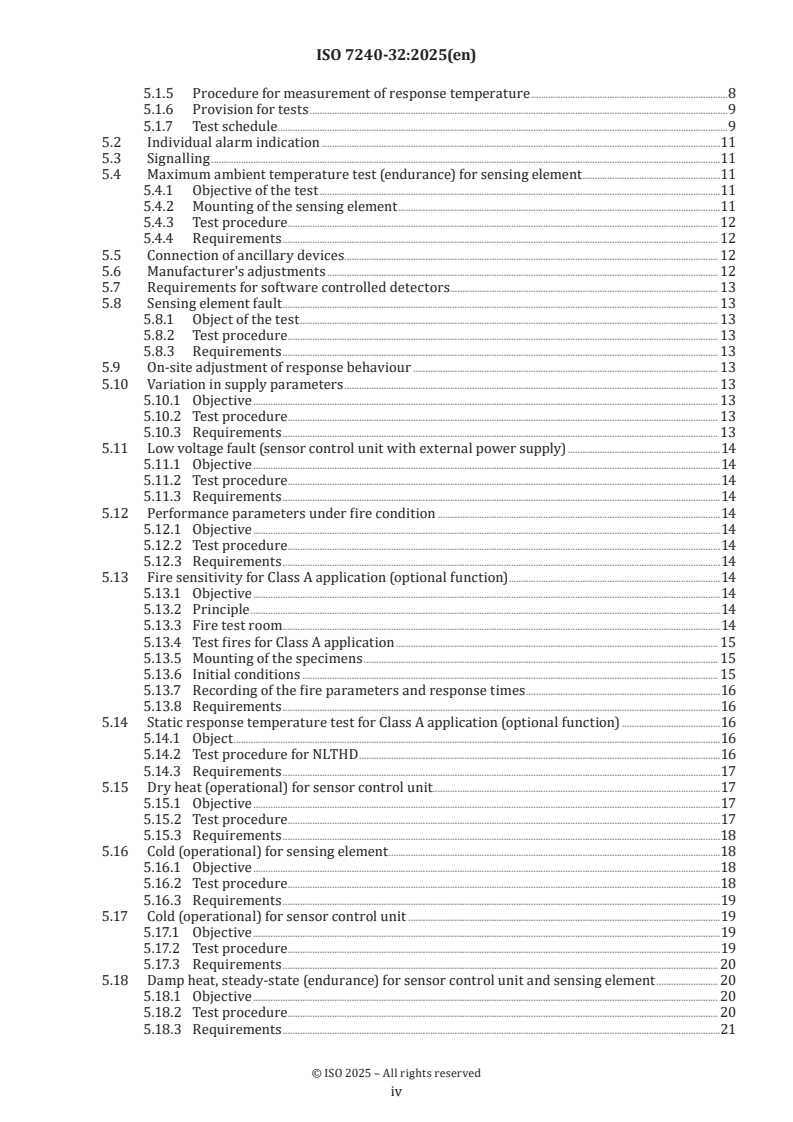
5.1.5 Procedure for measurement of response temperature .8
5.1.6 Provision for tests .9
5.1.7 Test schedule .9
5.2 Individual alarm indication .11
5.3 Signalling .11
5.4 Maximum ambient temperature test (endurance) for sensing element .11
5.4.1 Objective of the test .11
5.4.2 Mounting of the sensing element .11
5.4.3 Test procedure. 12
5.4.4 Requirements . 12
5.5 Connection of ancillary devices. 12
5.6 Manufacturer's adjustments . 12
5.7 Requirements for software controlled detectors . 13
5.8 Sensing element fault . 13
5.8.1 Object of the test . 13
5.8.2 Test procedure. 13
5.8.3 Requirements . 13
5.9 On-site adjustment of response behaviour . 13
5.10 Variation in supply parameters . 13
5.10.1 Objective . 13
5.10.2 Test procedure. 13
5.10.3 Requirements . 13
5.11 Low voltage fault (sensor control unit with external power supply) .14
5.11.1 Objective .14
5.11.2 Test procedure.14
5.11.3 Requirements .14
5.12 Performance parameters under fire condition .14
5.12.1 Objective .14
5.12.2 Test procedure.14
5.12.3 Requirements .14
5.13 Fire sensitivity for Class A application (optional function) .14
5.13.1 Objective .14
5.13.2 Principle .14
5.13.3 Fire test room .14
5.13.4 Test fires for Class A application . 15
5.13.5 Mounting of the specimens . 15
5.13.6 Initial conditions . 15
5.13.7 Recording of the fire parameters and response times .16
5.13.8 Requirements .16
5.14 Static response temperature test for Class A application (optional function) .16
5.14.1 Object .16
5.14.2 Test procedure for NLTHD .16
5.14.3 Requirements .17
5.15 Dry heat (operational) for sensor control unit .17
5.15.1 Objective .17
5.15.2 Test procedure.17
5.15.3 Requirements .18
5.16 Cold (operational) for sensing element .18
5.16.1 Objective .18
5.16.2 Test procedure.18
5.16.3 Requirements .19
5.17 Cold (operational) for sensor control unit .19
5.17.1 Objective .19
5.17.2 Test procedure.19
5.17.3 Requirements . 20
5.18 Damp heat, steady-state (endurance) for sensor control unit and sensing element . 20
5.18.1 Objective . 20
5.18.2 Test procedure. 20
5.18.3 Requirements .21
iv
5.19 Damp heat, cyclic (operational) for sensing element .21
5.19.1 Objective of the test .21
5.19.2 Test procedure.21
5.19.3 Requirements . 22
5.20 Damp heat, cyclic (operational) for sensor control unit . 22
5.20.1 Objective of the test . 22
5.20.2 Test procedure. 22
5.20.3 Requirements . 23
5.21 Damp heat, steady-state (operational) for sensor control unit .24
5.21.1 Objective of the test .24
5.21.2 Test procedure.24
5.21.3 Requirements .24
5.22 Damp heat, cyclic (endurance) for sensor control unit and sensing element . 25
5.22.1 Objective . 25
5.22.2 Test procedure. 25
5.22.3 Requirements . 25
5.23 Shock (operational) for sensor control unit . 26
5.23.1 Objective . 26
5.23.2 Test procedure. 26
5.23.3 Requirements . 26
5.24 Impact (operational) for sensor control unit .27
5.24.1 Objective .27
5.24.2 Test procedure.27
5.24.3 Requirements .27
5.25 Impact (operational) for sensing element . 28
5.25.1 Objective . 28
5.25.2 Test procedure. 28
5.25.3 Requirements . 28
5.26 Vibration, sinusoidal (operational) for sensor control unit . 29
5.26.1 Objective . 29
5.26.2 Test procedure. 29
5.26.3 Requirements . 29
5.27 Vibration, sinusoidal (operational) for sensing element . 30
5.27.1 Objective . 30
5.27.2 Test procedure. 30
5.27.3 Requirements . 30
5.28 Vibration, sinusoidal (endurance) for sensor control unit .31
5.28.1 Objective .31
5.28.2 Test procedure.31
5.28.3 Requirements .31
5.29 Vibration, sinusoidal (endurance) for sensing element .31
5.29.1 Objective .31
5.29.2 Test procedure.31
5.29.3 Requirements .32
5.30 Sulfur dioxide (SO ) corrosion (endurance) for sensing element .32
5.30.1 Objective .32
5.30.2 Test procedure.32
5.30.3 Requirements . 33
5.31 Sulfur dioxide (SO ) corrosion (endurance) for sensor control unit . 33
5.31.1 Objective . 33
5.31.2 Test procedure. 33
5.31.3 Requirements . 34
5.32 Electromagnetic compatibility (EMC), immunity (operational) . 34
5.32.1 General . 34
5.32.2 State of the specimen during conditioning . 34
5.32.3 Final measurements . 34
5.32.4 Requirements . 35
6 Test report .35
v
7 Marking . .35
7.1 General . 35
7.2 Marking of sensor control unit . 35
7.3 Marking of sensing element . 36
7.4 Marking of functional units . 36
8 Data .36
8.1 Hardware documentation . 36
8.2 Software documentation .37
Annex A (normative) Arrangement of the sensing element in the fire test room .38
Annex B (normative) Flaming liquid test fires (TF6F, TF6 and TF6S) .40
Annex C (normative) Mounting of the sensing element of NLTHD in the heat tunnel .42
Annex D (normative) Heat tunnel for response temperature measurements .44
Annex E (informative) Construction of the heat tunnel .45
Annex F (normative) Test arrangement for vibration tests for sensing element . 47
Annex G (normative) Test apparatus for impact test on the sensing element .48
vi
Foreword
ISO (the International Organization for Standardization) is a worldwide federation of national standards
bodies (ISO member bodies). The work of preparing International Standards is normally carried out through
ISO technical committees. Each member body interested in a subject for which a technical committee
has been established has the right to be represented on that committee. International organizations,
governmental and non-governmental, in liaison with ISO, also take part in the work. ISO collaborates closely
with the International Electrotechnical Commission (IEC) on all matters of electrotechnical standardization.
The procedures used to develop this document and those intended for its further maintenance are described
in the ISO/IEC Directives, Part 1. In particular, the different approval criteria needed for the different types
of ISO documents should be noted. This document was drafted in accordance with the editorial rules of the
ISO/IEC Directives, Part 2 (see www.iso.org/directives).
Attention is drawn to the possibility that some of the elements of this document may be the subject of patent
rights. ISO shall not be held responsible for identifying any or all such patent rights. Details of any patent
rights identified during the development of the document will be in the Introduction and/or on the ISO list of
patent declarations received (see www.iso.org/patents).
Any trade name used in this document is information given for the convenience of users and does not
constitute an endorsement.
For an explanation of the voluntary nature of standards, the meaning of ISO specific terms and expressions
related to conformity assessment, as well as information about ISO's adherence to the World Trade
Organization (WTO) principles in the Technical Barriers to Trade (TBT), see www.iso.org/iso/foreword.html.
This document was prepared by Technical Committee ISO/TC 21, Equipment for fire protection and fire
fighting, Subcommittee SC 3, Fire detection and alarm systems.
A list of all parts in the ISO 7240 series can be found on the ISO website.
Any feedback or questions on this document should be directed to the user’s national standards body. A
complete listing of these bodies can be found at www.iso.org/members.html.
vii
Introduction
Non-resettable line-type heat detectors (NLTHD – also known in the market as "linear heat detectors" or
"digital detectors" have been used for many years. They are incorporated into fire detection systems and
in some countries even into fire alarm systems if accepted by the relevant authorities. These detectors are
typically used in areas where point type heat detectors are presented with challenging environmental
characteristics, and also where access to the detectors can significantly influence the fire alarm system design.
This document defines the minimum system functionality for NLTHD products.
Due to the various applications for NLTHD, it is necessary to devise separate environmental classification
tests for the sensing element and the sensor control units of these systems. This document is not intended to
specify applications or how NLTHD is used in applications.
Generally, NLTHD operate using the same basic principle. However, they can have different performance
with respect to their temperature response. Therefore, they have been differentiated by a type code which
reflects the nominal alarm temperature, the tolerance range and the maximum ambient temperature at
which they can be used. There are also options for room protection classes.
viii
International Standard ISO 7240-32:2025(en)
Fire detection and alarm systems —
Part 32:
Non-resettable line-type heat detectors
1 Scope
This document applies to non-resettable line-type heat detectors consisting of a sensing element distributed
either continuously or discretely at close intervals along its length, which can be connected either directly or
through a sensor control unit or an interface module to control and indicating equipment, and intended for use
in fire detection and fire alarm systems installed in and around buildings and other civil engineering works.
This document specifies requirements and performance criteria, and the corresponding test methods and
provisions for assessment.
This document also covers non-resettable line-type heat detectors intended for use in the local protection of
plant (facility) and equipment.
Non-resettable line-type heat detectors with special characteristics and developed for specific risks are not
covered by this document.
2 Normative references
The following documents are referred to in the text in such a way that some or all of their content constitutes
requirements of this document. For dated references, only the edition cited applies. For undated references,
the latest edition of the referenced document (including any amendments) applies.
ISO 7240-1, Fire detection and alarm systems — Part 1: General and definitions
IEC 60068-2-1, Environmental testing — Part 2-1: Tests — Test A: Cold
IEC 60068-2-2, Environmental testing — Part 2-2: Tests — Test B: Dry heat
IEC 60068-2-6, Environmental testing — Part 2-6: Tests — Test Fc: Vibration (sinusoidal)
IEC 60068-2-27, Environmental testing — Part 2-27: Tests — Test Ea and guidance: Shock
IEC 60068-2-42, Environmental testing — Part 2-42: Tests — Test Kc: Sulphur dioxide test for contacts and
connections
IEC 60068-2-75, Environmental testing — Part 2-75: Tests — Test Eh: Hammer tests
IEC 60068-2-78, Environmental testing — Part 2-78: Tests — Test Cab: Damp heat, steady state
IEC 62599-2, Alarm systems — Part 2: Electromagnetic compatibility — Immunity requirements for components
of fire and security alarm systems
3 Terms and definitions and abbreviations
For the purposes of this document, the terms and definitions given in ISO 7240-1 and the following apply.
ISO and IEC maintain terminological databases for use in standardization at the following addresses:
— IEC Electropedia: available at https:// www .electropedia .org/
— ISO Online browsing platform: available at https:// www .iso .org/ obp
3.1 Terms and definitions
3.1.1
functional unit
part of a line-type heat detector in addition to the sensor control unit and the sensing element which is
essential for the function of the line-type heat detector
EXAMPLE Terminating device, filter, switch.
3.1.2
local protection application
application in which the sensing element is installed in relatively close proximity to the potential fire risk
EXAMPLE Pipelines, conveyor belts, combustion engines/turbines, rolling stock, transformers, process dryers,
cable trays, escalators, chemical process equipment, electrical equipment cabinets, ventilation systems (dust collector,
hood extractor, etc.), switch gear (e.g. printing press).
3.1.3
non-resettable line-type heat detectors
NLTHD
detector which responds to heat sensed in the vicinity of a continuous line or a series of discrete elements at
close interval along its length, and which can only respond once.
Note 1 to entry: A non-resettable line-type heat detector can consist of a sensor control unit, a sensing element and
functional units.
3.1.4
room protection application
application in which the sensing element is installed at a distance from the potential fire hazard close to the
ceiling or roof of the area to be protected
EXAMPLE car parks (open or closed), road/rail/metro tunnels, floor/ceiling voids, elevator shafts, cold stores,
warehouses, heritage buildings, aircraft hangars, spray shops, chemical storehouses, ammunition depots, refineries,
silos, etc.
3.1.5
sensing element
heat sensing part of the line-type heat detector which can be a fibre optic cable, a pneumatic tube or an
electrical cable
Note 1 to entry: A sensing element can consist of different segments separated, e.g. by functional units or splices.
Note 2 to entry: The sensing element can be connected directly to control and indicating equipment, an input/output
device or via a dedicated sensor control unit (see 3.1.6).
3.1.6
sensor control unit
unit
...