

ISO/TR 12930:2014
(Main)Seismic design examples based on ISO 23469
General Information
- Abstract
ISO/TR 12930:2014 provides seismic design examples for geotechnical works based on ISO 23469:2005 in order to demonstrate how to use this ISO standard. The design examples are intended to provide guidance to experienced practicing engineers and code writers. Geotechnical works include buried structures (e.g. buried tunnels, box culverts, pipelines, and underground storage facilities), foundations (e.g. shallow and deep foundations, and underground diaphragm walls), retaining walls (e.g. soil retaining and quay walls), pile-supported wharves and piers, earth structures (e.g. earth and rock fill dams and embankments), gravity dams, tanks, landfill and waste sites.
- Status
- Published
- Publication Date
- 18-Mar-2014
- Technical Committee
- ISO/TC 98/SC 3 - Loads, forces and other actions
- Drafting Committee
- ISO/TC 98/SC 3 - Loads, forces and other actions
- Current Stage
- 6060 - International Standard published
- Start Date
- 19-Mar-2014
- Completion Date
- 29-Aug-2026

Overview
ISO/TR 12930:2014, "Seismic design examples based on ISO 23469", is a technical report that illustrates how to apply ISO 23469:2005 to the seismic design and evaluation of geotechnical works. It provides worked design examples and practical guidance - not new prescriptive rules - intended to help experienced practicing engineers and code writers interpret and use the ISO standard for a wide range of geotechnical structures.
Key topics
The report focuses on the practical steps and technical issues involved in seismic design of geotechnical works, including:
- Two-stage approach to specifying seismic actions:
- First stage: determination of site‑specific earthquake ground motions (empirical, probabilistic and deterministic methods).
- Second stage: seismic evaluation and design of geotechnical works using simplified and detailed analyses.
- Site-specific seismic hazard analysis:
- Probabilistic seismic hazard analysis (PSHA), including evaluation of Fourier amplitude spectra, group delay time and uniform hazard spectra.
- Deterministic and semi‑empirical ground motion estimation, theoretical scenario earthquakes and site amplification assessment.
- Site response and input motion development:
- Procedures to generate ground motion time histories for site response and structural analyses.
- Seismic evaluation methods for geotechnical works:
- Simplified methods (equivalent static, Seismic Deformation Method) and detailed dynamic analyses (FEM/time‑history).
- Assessment of ground displacement, spatial variation of motions, and soil–structure interaction (SSI) effects.
- Liquefaction and ground failure:
- Evaluation techniques and design implications for foundations, retaining walls, dams, tanks and buried structures.
- Illustrative design examples covering buried tunnels, box culverts, pipelines, shallow and deep foundations, diaphragm walls, quay/retaining walls, pile‑supported wharves and piers, earth/rock fill dams, gravity dams, tanks, landfills and waste sites.
Applications
ISO/TR 12930:2014 is practical for:
- Geotechnical and structural engineers performing seismic design or assessment of foundations, retaining walls, tunnels, dams, ports and tanks.
- Design offices preparing site‑specific seismic hazard inputs and ground motion time histories.
- Code developers and regulators seeking worked examples that demonstrate application of ISO 23469 principles.
- Project teams assessing liquefaction risk, ground displacement effects and SSI in seismic regions.
Who should use it
- Experienced practicing engineers, seismic specialists and geotechnical designers.
- Code writers and reviewers looking for example methodologies consistent with ISO 23469.
Related standards
- ISO 23469:2005 - the principal ISO standard on seismic design of geotechnical works on which this TR’s examples are based.
Keywords: seismic design, geotechnical works, ISO/TR 12930, ISO 23469, site‑specific seismic hazard, ground motion, liquefaction, soil‑structure interaction, seismic evaluation, foundation design.
Get Certified
Connect with accredited certification bodies for this standard

DIBt (Deutsches Institut für Bautechnik)
German Institute for Building Technology.
DIN CERTCO
DIN Group product certification.
Zavod za gradbeništvo Slovenije (ZAG) - Inšpekcija
ZAG inspection body for construction products, structures, and materials.
Sponsored listings
Frequently Asked Questions
ISO/TR 12930:2014 is a technical report published by the International Organization for Standardization (ISO). Its full title is "Seismic design examples based on ISO 23469". This standard covers: ISO/TR 12930:2014 provides seismic design examples for geotechnical works based on ISO 23469:2005 in order to demonstrate how to use this ISO standard. The design examples are intended to provide guidance to experienced practicing engineers and code writers. Geotechnical works include buried structures (e.g. buried tunnels, box culverts, pipelines, and underground storage facilities), foundations (e.g. shallow and deep foundations, and underground diaphragm walls), retaining walls (e.g. soil retaining and quay walls), pile-supported wharves and piers, earth structures (e.g. earth and rock fill dams and embankments), gravity dams, tanks, landfill and waste sites.
ISO/TR 12930:2014 provides seismic design examples for geotechnical works based on ISO 23469:2005 in order to demonstrate how to use this ISO standard. The design examples are intended to provide guidance to experienced practicing engineers and code writers. Geotechnical works include buried structures (e.g. buried tunnels, box culverts, pipelines, and underground storage facilities), foundations (e.g. shallow and deep foundations, and underground diaphragm walls), retaining walls (e.g. soil retaining and quay walls), pile-supported wharves and piers, earth structures (e.g. earth and rock fill dams and embankments), gravity dams, tanks, landfill and waste sites.
ISO/TR 12930:2014 is classified under the following ICS (International Classification for Standards) categories: 91.080.01 - Structures of buildings in general; 93.020 - Earthworks. Excavations. Foundation construction. Underground works. The ICS classification helps identify the subject area and facilitates finding related standards.
ISO/TR 12930:2014 is available in PDF format for immediate download after purchase. The document can be added to your cart and obtained through the secure checkout process. Digital delivery ensures instant access to the complete standard document.
Standards Content (Sample)
TECHNICAL ISO/TR
REPORT 12930
First edition
2014-04-01
Seismic design examples based on
ISO 23469
Exemples de dimensionnement basés sur l'ISO 23469
Reference number
©
ISO 2014
© ISO 2014
All rights reserved. Unless otherwise specified, no part of this publication may be reproduced or utilized otherwise in any form or by any
means, electronic or mechanical, including photocopying, or posting on the internet or an intranet, without prior written permission.
Permission can be requested from either ISO at the address below or ISO’s member body in the country of the requester.
ISO copyright office
Case postale 56 CH-1211 Geneva 20
Tel. + 41 22 749 01 11
Fax + 41 22 749 09 47
E-mail copyright@iso.org
Web www.iso.org
Published in Switzerland
ii © ISO 2014 – All rights reserved
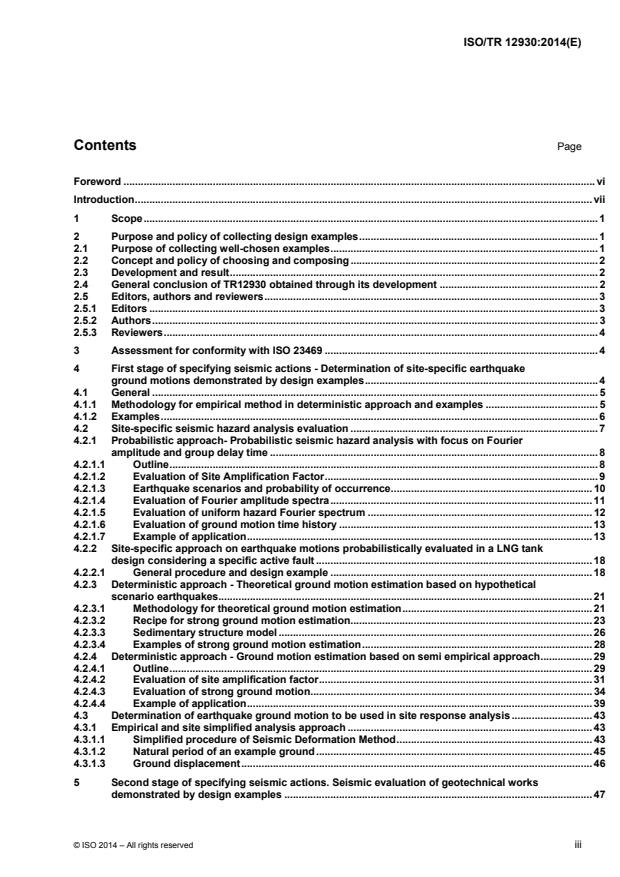
Contents Page
Foreword . vi
Introduction . vii
1 Scope . 1
2 Purpose and policy of collecting design examples . 1
2.1 Purpose of collecting well-chosen examples . 1
2.2 Concept and policy of choosing and composing . 2
2.3 Development and result . 2
2.4 General conclusion of TR12930 obtained through its development . 2
2.5 Editors, authors and reviewers . 3
2.5.1 Editors . 3
2.5.2 Authors . 3
2.5.3 Reviewers . 4
3 Assessment for conformity with ISO 23469 . 4
4 First stage of specifying seismic actions - Determination of site-specific earthquake
ground motions demonstrated by design examples . 4
4.1 General . 5
4.1.1 Methodology for empirical method in deterministic approach and examples . 5
4.1.2 Examples . 6
4.2 Site-specific seismic hazard analysis evaluation . 7
4.2.1 Probabilistic approach- Probabilistic seismic hazard analysis with focus on Fourier
amplitude and group delay time . 8
4.2.1.1 Outline . 8
4.2.1.2 Evaluation of Site Amplification Factor . 9
4.2.1.3 Earthquake scenarios and probability of occurrence . 10
4.2.1.4 Evaluation of Fourier amplitude spectra . 11
4.2.1.5 Evaluation of uniform hazard Fourier spectrum . 12
4.2.1.6 Evaluation of ground motion time history . 13
4.2.1.7 Example of application . 13
4.2.2 Site-specific approach on earthquake motions probabilistically evaluated in a LNG tank
design considering a specific active fault . 18
4.2.2.1 General procedure and design example . 18
4.2.3 Deterministic approach - Theoretical ground motion estimation based on hypothetical
scenario earthquakes. 21
4.2.3.1 Methodology for theoretical ground motion estimation . 21
4.2.3.2 Recipe for strong ground motion estimation. 23
4.2.3.3 Sedimentary structure model . 26
4.2.3.4 Examples of strong ground motion estimation . 28
4.2.4 Deterministic approach - Ground motion estimation based on semi empirical approach . 29
4.2.4.1 Outline . 29
4.2.4.2 Evaluation of site amplification factor . 31
4.2.4.3 Evaluation of strong ground motion . 34
4.2.4.4 Example of application . 39
4.3 Determination of earthquake ground motion to be used in site response analysis . 43
4.3.1 Empirical and site simplified analysis approach . 43
4.3.1.1 Simplified procedure of Seismic Deformation Method . 43
4.3.1.2 Natural period of an example ground . 45
4.3.1.3 Ground displacement . 46
5 Second stage of specifying seismic actions. Seismic evaluation of geotechnical works
demonstrated by design examples . 47
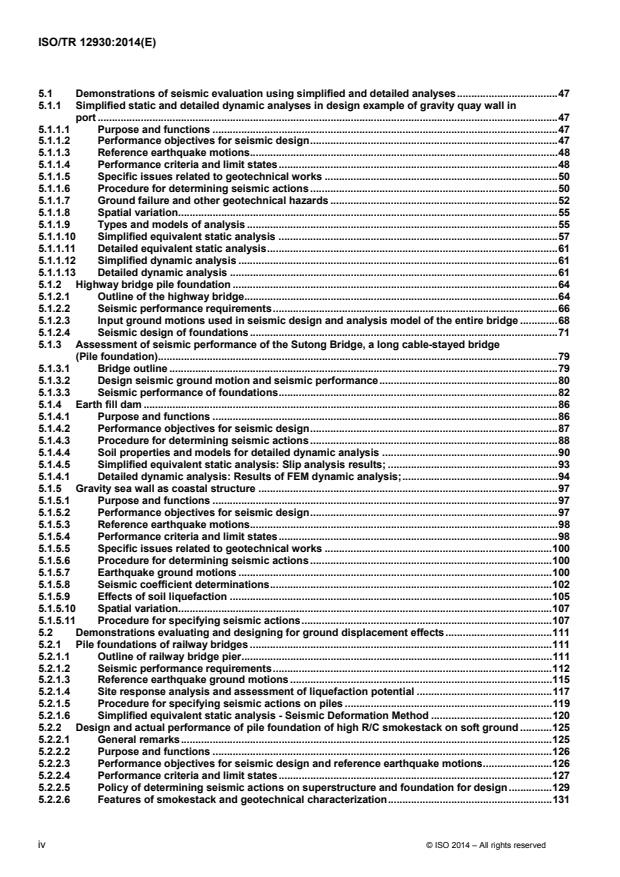
5.1 Demonstrations of seismic evaluation using simplified and detailed analyses . 47
5.1.1 Simplified static and detailed dynamic analyses in design example of gravity quay wall in
port . 47
5.1.1.1 Purpose and functions . 47
5.1.1.2 Performance objectives for seismic design . 47
5.1.1.3 Reference earthquake motions . 48
5.1.1.4 Performance criteria and limit states . 48
5.1.1.5 Specific issues related to geotechnical works . 50
5.1.1.6 Procedure for determining seismic actions . 50
5.1.1.7 Ground failure and other geotechnical hazards . 52
5.1.1.8 Spatial variation . 55
5.1.1.9 Types and models of analysis . 55
5.1.1.10 Simplified equivalent static analysis . 57
5.1.1.11 Detailed equivalent static analysis . 61
5.1.1.12 Simplified dynamic analysis . 61
5.1.1.13 Detailed dynamic analysis . 61
5.1.2 Highway bridge pile foundation . 64
5.1.2.1 Outline of the highway bridge . 64
5.1.2.2 Seismic performance requirements . 66
5.1.2.3 Input ground motions used in seismic design and analysis model of the entire bridge . 68
5.1.2.4 Seismic design of foundations . 71
5.1.3 Assessment of seismic performance of the Sutong Bridge, a long cable-stayed bridge
(Pile foundation) . 79
5.1.3.1 Bridge outline . 79
5.1.3.2 Design seismic ground motion and seismic performance . 80
5.1.3.3 Seismic performance of foundations . 82
5.1.4 Earth fill dam . 86
5.1.4.1 Purpose and functions . 86
5.1.4.2 Performance objectives for seismic design . 87
5.1.4.3 Procedure for determining seismic actions . 88
5.1.4.4 Soil properties and models for detailed dynamic analysis . 90
5.1.4.5 Simplified equivalent static analysis: Slip analysis results; . 93
5.1.4.1 Detailed dynamic analysis: Results of FEM dynamic analysis; . 94
5.1.5 Gravity sea wall as coastal structure . 97
5.1.5.1 Purpose and functions . 97
5.1.5.2 Performance objectives for seismic design . 97
5.1.5.3 Reference earthquake motions . 98
5.1.5.4 Performance criteria and limit states . 98
5.1.5.5 Specific issues related to geotechnical works . 100
5.1.5.6 Procedure for determining seismic actions . 100
5.1.5.7 Earthquake ground motions . 100
5.1.5.8 Seismic coefficient determinations . 102
5.1.5.9 Effects of soil liquefaction . 105
5.1.5.10 Spatial variation . 107
5.1.5.11 Procedure for specifying seismic actions . 107
5.2 Demonstrations evaluating and designing for ground displacement effects . 111
5.2.1 Pile foundations of railway bridges . 111
5.2.1.1 Outline of railway bridge pier . 111
5.2.1.2 Seismic performance requirements . 112
5.2.1.3 Reference earthquake ground motions . 115
5.2.1.4 Site response analysis and assessment of liquefaction potential . 117
5.2.1.5 Procedure for specifying seismic actions on piles . 119
5.2.1.6 Simplified equivalent static analysis - Seismic Deformation Method . 120
5.2.2 Design and actual performance of pile foundation of high R/C smokestack on soft ground . 125
5.2.2.1 General remarks . 125
5.2.2.2 Purpose and functions . 126
5.2.2.3 Performance objectives for seismic design and reference earthquake motions . 126
5.2.2.4 Performance criteria and limit states . 127
5.2.2.5 Policy of determining seismic actions on superstructure and foundation for design . 129
5.2.2.6 Features of smokestack and geotechnical characterization . 131
iv © ISO 2014 – All rights reserved
5.2.2.7 Models of simplified and detailed dynamic analyses for specifying seismic actions . 135
5.2.2.8 Results of detailed dynamic analyses . 138
5.2.2.9 Verification of models based on vibration tests . 139
5.2.2.10 Actual seismic behaviour of ground and smokestack . 142
5.2.2.11 Verification of models based on strong motion records . 145
5.2.3 Shallow immersed rectangular tunnel in soft soils . 150
5.2.3.1 Thessaloniki immersed roadway tunnel . 150
5.2.3.2 Behaviour of longitudinal underground structures under seismic loading . 151
5.2.3.3 Analysis methods . 152
5.2.3.4 Determination of input motion . 153
5.2.3.5 Simplified equivalent static analysis . 154
5.2.3.6 Detailed equivalent static analysis . 156
5.2.3.7 Detailed full dynamic analysis . 158
5.2.3.8 Results and discussion . 159
5.3 Demonstrations evaluating and designing for liquefaction effects . 161
5.3.1 Evaluation of 3D SSI effects of pile foundation of LNG tank model by detailed dynamic
analyses . 161
5.3.1.1 Problem description . 161
5.3.1.2 Results of analyses and discussion . 162
5.3.1.3 Consideration of results into design . 166
5.3.2 Evaluation of 3-D effects of lattice-arranged numerous piles by detailed dynamic
analyses . 166
5.3.2.1 Objectives . 166
5.3.2.2 Results of analyses and discussion . 166
5.3.3 Evaluation of pile-volume effects of a huge number of piles by detailed dynamic analyses . 169
5.3.3.1 Introduction . 169
5.3.3.2 Results of analyses and discussion . 169
5.3.3.3 Consideration of results into design . 170
5.4 Demonstrations evaluating and designing for fault displacement effects . 171
5.4.1 Seismic design abstract of road embankment taking account of surface fault rupture . 171
5.4.1.1 Purpose and functions . 171
5.4.1.2 Performance objectives and ground motions for seismic design . 172
5.4.1.3 Performance criteria . 172
5.4.1.4 Procedure for determining seismic actions . 172
5.4.1.5 Ground failure and other geotechnical hazards . 173
5.4.1.6 Types of analysis . 174
5.4.1.7 Simple static analysis. 174
5.4.1.8 Detailed dynamic analysis . 174
5.4.2 Shield tunnel subject to fault displacements (Detailed analysis) . 176
5.4.2.1 General remarks . 176
5.4.2.2 Soil conditions and shield tunnel . 176
5.4.2.3 Estimation of fault displacement at base layer . 176
5.4.2.4 Method of analysis and modelling nonlinear behaviour of soil . 178
5.4.2.5 Results of analyses . 180
5.4.2.6 Influence of fault displacement to tunnel . 183
5.4.3 Design considerations for a water pipeline access tunnel subject to earthquake hazards . 184
5.4.3.1 Purpose and functions . 184
5.4.3.2 Project description . 184
5.4.3.3 Performance objectives and reference earthquake design levels . 186
5.4.3.4 Performance criteria . 187
5.4.3.5 Specific issues related to geotechnical works . 187
5.4.3.6 Evaluation of earthquake ground motions and fault displacements . 188
5.4.3.7 Simplified equivalent static analysis . 192
Annex A (informative) Conformity with provisional sentences in ISO 23469 . 201
A.1 General . 201
Foreword
ISO (the International Organization for Standardization) is a worldwide federation of national standards bodies
(ISO member bodies). The work of preparing International Standards is normally carried out through ISO
technical committees. Each member body interested in a subject for which a technical committee has been
established has the right to be represented on that committee. International organizations, governmental and
non-governmental, in liaison with ISO, also take part in the work. ISO collaborates closely with the
International Electrotechnical Commission (IEC) on all matters of electrotechnical standardization.
The procedures used to develop this document and those intended for its further maintenance are described
in the ISO/IEC Directives, Part 1. In particular the different approval criteria needed for the different types of
ISO documents should be noted. This document was drafted in accordance with the editorial rules of the
ISO/IEC Directives, Part 2. www.iso.org/directives
Attention is drawn to the possibility that some of the elements of this document may be the subject of patent
rights. ISO shall not be held responsible for identifying any or all such patent rights. Details of any patent
rights identified during the development of the document will be in the Introduction and/or on the ISO list of
patent declarations received. www.iso.org/patents
Any trade name used in this document is information given for the convenience of users and does not
constitute an endorsement.
For an explanation on the meaning of ISO specific terms and expressions related to conformity assessment,
as well as information about ISO's adherence to the WTO principles in the Technical Barriers to Trade (TBT),
see the following URL: Foreword - Supplementary information
The committee responsible for this document is ISO/TC 98, Bases for design of structures, sous-comité SC 3,
Loads, forces and other actions.
vi © ISO 2014 – All rights reserved
Introduction
ISO 23469:2005 provides guidelines to be observed by experienced practicing engineers and code writers
when specifying seismic actions in the design of geotechnical works. It might not be so easy for code writers
and practitioners to utilize ISO 23469, because that it offers advanced philosophy and general framework of
seismic design. The purpose of this Technical Report (TR) is to provide seismic design examples based on
ISO 23469 for demonstrating how to utilize ISO 23469 in actual seismic designs to the code writers and the
practitioners. The implementation of ISO 23469 will secure the rationality of seismic safety evaluation of the
infrastructures in the world, and this TR aims at promoting the implementation.
ISO 23469 is essentially a guideline itself. Therefore, this TR should contain not explicit guidelines but design
examples without using the term 'guideline'. Thus, this TR is expected to demonstrate the utilization of
ISO 23469 by providing design examples with detailed explanation from the viewpoint of conformity with
ISO 23469 for a kind of guidance rather than to provide the detailed recommendation of specific
methodologies.
Through the development of this Technical Report, it is concluded that ISO 23469 has been and is going to be
an essential and useful guideline of seismic design of geotechnical works for experienced practicing engineers
and code writers.
TECHNICAL REPORT ISO/TR 12930:2014(E)
Seismic design examples based on ISO 23469
1 Scope
This Technical Report provides seismic design examples for geotechnical works based on ISO 23469:2005 in
order to demonstrate how to use this ISO standard. The design examples are intended to provide guidance to
experienced practicing engineers and code writers. Geotechnical works include buried structures (e.g. buried
tunnels, box culverts, pipelines, and underground storage facilities), foundations (e.g. shallow and deep
foundations, and underground diaphragm walls), retaining walls (e.g. soil retaining and quay walls), pile-
supported wharves and piers, earth structures (e.g. earth and rock fill dams and embankments), gravity dams,
tanks, landfill and waste sites.
ISO 23469 addresses important issues for seismic actions for designing geotechnical works, including effects
of site-specific response, ground displacement, soil-structure interaction and liquefaction, in a systematic
manner within a consistent framework. This International Standard presents a full range of methods for the
analysis of geotechnical works, ranging from simple to sophisticated, from which experienced practicing
engineers can choose the most appropriate option for evaluating their performance. Therefore, this Technical
Report includes well-chosen design examples that consider these important issues and covering in a
balanced way the wide range of the methods of analysis and the types of model which can be used to
evaluate seismic actions of geotechnical works.
2 Purpose and policy of collecting design examples
2.1 Purpose of collecting well-chosen examples
This Technical Report aims at collecting design examples that are basically conformable with ISO 23469.
They are expected to be design examples dealing with important things need to be covered in ISO 23469 from
the point of view of performance-based design approach. This TR should be well-balanced in included design
examples;
Focusing evaluation of reference earthquake ground motions with detailed description as a common
issue.
Having combination of simplified and detailed analyses.
Based on simplified equivalent static analysis and detailed analysis for retaining walls, buried structures
or earth structures.
Focusing consideration of soil displacements for pile foundations and buried structures.
Focusing evaluation of effects of liquefaction for retaining walls, earth structures, pile foundations.
Focusing consideration of spatial variation in the ground motions for long bridges, buried structures, or
dams.
Based on site specific dynamic response by 1-D analysis.
Based on detailed dynamic analysis by 2-D or 3-D analysis.
2.2 Concept and policy of choosing and composing
To realize the prescribed purpose of this TR, the basic concept of it is targeting to cover major distinguishing
and important issues of IS23469 by all the design examples contained in this TR. Thus, the following points
are another requirement for choosing and composing design examples.
Design examples written with cares for readers in terms of conformity with requirement and
recommendation in ISO 23469
The TR should consist of several well-chosen design examples which cover the key issues of the
ISO 23469 with well balance between them.
The TR is anticipated to be well balanced among Japan, Northern America, and Europe.
For description of manuscript, each design example is requested to
Be cared in terms of conformity with requirement and recommendation in ISO 23469
Have stress on methodology recommended by WG
— Be within 20 pages for a complete example and 8 pages for a sub-example basically
2.3 Development and result
After discussing the policy of collecting and choosing design examples, WG10 also had developed an
expected table of contents from arguments through three Working Group meetings held in 2006 and
correspondence with consideration of design practice situation in member’s countries and regions. After
registration of NP12825 in the end of this year, the WG10 repeatedly requested all the WG members and
participants of the meetings to provide possible design examples for this Technical Report. The table of
contents of the TR of design examples was almost fixed and the drafting persons for the examples were
assigned in 2008 through more four WG meetings; eight examples for the first stage of specifying seismic
action were expected to be prepared by three persons from Japan and one from Turkey and 28 examples for
the second were hopefully to be prepared by 17 persons from Japan, three from USA, one from Greece, and
one from Italy.
This NP was officially approved with the submission, in 2008, of the first Working Draft of TR12825 containing
six examples, but the NWI was subsequently re-numbered as 12930 from an administrative reason. The third
and final Working Draft of TR12930, which was developed through another three meetings in two years for
waiting design examples to be offered from countries other than Japan was submitted to TC98/SC3 in the end
of 2010 then accepted as a Draft Technical Report with a request of addition of description for a few points.
The last two year period was mainly aimed at collecting examples from countries excepting Japan.
Notwithstanding the total number of attendees in thirteen WG meetings is 87 and they came from Japan,
USA, Greece, France, Poland, Canada, Turkey, Italy, South Africa, Germany, Morocco, Romania, and Russia
(in order of total number of attendees), only prescribed persons were merely expected. Probably because that
the preparing a manuscript is a tough job with few personal incentive; i.e. a completely volunteer work.
2.4 General conclusion of TR12930 obtained through its development
Eventually seven examples for the first stage and 15 examples for the second stage were successfully
collected from thirteen persons consisting of eleven from Japan, one from USA, and one from Greece. The
total number of the 22 well-chosen design examples can almost cover major distinguishing and important
issues of IS23469 as targeting at the beginning. Through the process of preparing and editing the drafts, it
was clarified that IS23469 is useful for evaluation, assessment and review in the seismic design. Furthermore,
it was demonstrated that assessment for conformity with IS23469 in can be conducted in terms of provisional
sentences according to Clause 3 of this TR. Thus, it is concluded that IS23469 has been and is going to be an
essential and useful guideline of seismic design of geotechnical works for experienced practicing engineers
and code writers.
2 © ISO 2014 – All rights reserved
2.5 Editors, authors and reviewers
This Technical Report has general remarks and 22 well-chosen design examples written in over 200 pages
with 60 thousand words. Reviewing and editing all the manuscripts require tremendously hard works as well
as the authors preparing them. Thus, the contributions of editors, authors and reviewers are shown here.
2.5.1 Editors
Prof. Shinichiro Mori, Ehime University, Japan, Convener of ISO/TC98/SC3/WG10
Prof. Kohji Ichii, Hiroshima University, Japan
The editors mainly reviewed and checked the conformity with ISO 23469 in all the manuscripts prepared by
authors and added conformity codes corresponding sentences or paragraphs in their ends when necessary.
The editors also revised hard-to-understand, confusing or complicated English expressions, written by some
Japanese authors, by modifying the expressions and covering logical gaps.
2.5.2 Authors
Authors and Clause(s) or Subclause(s) in their charge are shown as follows:
Prof. Shinichiro Mori, Ehime University, Japan, mori@ehime-u.ac.jp
Author of Clauses 1, 2, 3, and 4, and Subclauses 5.2.2 and 5.3
Prof. Susumu Nakamura, Nihon University, Japan, s-nak@civil.ce.nihon-u.ac.jp
Author of Clause 4 and Subclauses 4.1.1, 4.2.2, and 4.3.1
Dr. Atsushi Nozu, Port and Airport Research Institute, Japan, nozu@pari.go.jp
Author of Subclauses 4.2.1 and 4.2.4
Prof. Takao Kagawa, Tottori University, Japan, kagawa@cv.tottori-u.ac.jp
Author of Subclause 4.2.3
Prof. Koji Ichii, Hiroshima University, Japan, ichiikoji@hiroshima-u.ac.jp
Author of Subclauses 5.1.1 and 5.1.5
Dr. Masaaki Yabe, Chodai Corporation, Japan, yabe-m@chodai.co.jp
Author of Subclauses 5.1.2 and 5.1.3
Dr. Shigeru Tani, National Agriculture and Food Research, Japan, stani@affrc.go.jp
Author of Subclause 5.1.4
Dr. Yoshitaka Murono, Railway Technical Research Institute, Japan, murono@rtri.or.jp
Author of Subclause 5.2.1
Prof. Kyriazis Pitilakis, Aristotle University of Thessaloniki, Greece, pitilakis@geo.civil.auth.gr
Author of Subclause 5.2.3, Member of ISO/TC98/SC3/WG10
Dr. Kiyoshi Fukutake, Shimizu Corporation, Japan, kiyoshi.fukutake@shimz.co.jp
Author of Subclauses 5.3.1, 5.3.2 and 5.3.3
Dr. Shojiro Kataoka, National Institute for Land and Infrastructure Management, Japan
kataoka-s92rc@nilim.go.jp
Author of Subclause 5.4.1
Dr. Yukio Adachi, Hanshin Expressway Company Limited, Japan
Principal author of Subclause 5.4.2
Dr. Craig A. Davis, City of Los Angeles, USA, Craig.Davis@ladwp.com
Principal author of Subclause 5.4.3, Member of ISO/TC98/SC3/WG10
Dr. Tetsuo Tobita, Kyoto University, Japan, tobita@geotech.dpri.kyoto-u.ac.jp
Author of Annex A, Member of ISO/TC98/SC3/WG10
2.5.3 Reviewers
The reviewers were basically the members of TC98/SC3/WG10 including 16 members for development of
IS23469 from 12 member bodies/countries and additional 24 members from 7 member bodies/countries. They
also provided great contributions throughout the development as well. The members of TC98/SC3 were also
potentially to be reviewers. The mirror committee of WG10 in Japan with 34 members had been also
reviewing as well as preparing the activity prior to each step in this work item.
3 Assessment for conformity with ISO 23469
Assessment of a design with regard to conformity with ISO23489 is made based on the conformity with each
provisional sentence in this ISO standard.
In the main text of each sub-sub-clause for a design example, a sentence or a paragraph corresponding to a
specific requirement which is provided in a sentence using “shall” in ISO 23469, shall be ended with a
corresponding “code” written in parentheses for being checked in terms of conformity with provisional
sentences in ISO 23469. A specific recommendation is provided in a sentence using “should” as well.
Therefore, this Technical Report adopts a code description in which a code of abbreviation consists of
numerals and an alphabet. In the code, consecutive numerals stand for clause, sub-clause, and sub-sub-
clause, respectively in principle. An alphabet in capital letter stands for “shall” and that in lower-case letter
stands for “should” in appearing order. For examples, the third sentence using “shall” in the sub-sub-clause
6.2.1 in ISO 23469 corresponds to “(621C)” and the first sentence using “should” in sub-sub-clause 8.1.4
corresponds to “(814a).” Exceptionally, zero is placed in the place for sub-clause like “(520A).”
Provisional sentences using “shall” or “should” are extracted from the main body of ISO 23469 with partial
reduction if acceptable and shown in appearing order as shown in Annex A.
4 First stage of specifying seismic actions - Determination of site-specific
earthquake ground motions demonstrated by design examples
For designing geotechnical works, reference earthquake motions are needed to specify as seismic actions at
the first stage. In order to evaluate the reference earthquake ground motions, the motions at the firm ground
are evaluated by a seismic hazard analysis based on probabilistic or deterministic approach. As the reference
earthquake motions, earthquake motions at the surface of the free field or/and at a certain depth within the
subsoil can be evaluated by site response analyses.
4 © ISO 2014 – All rights reserved
The probabilistic approach is more appropriate for the evaluation of seismic actions at scale a nation or
region. In general, the probabilistic approach in some case could lead to an underestimation of local seismic
action comparing with the deterministic approach.(Grooso S. and Mourgeris M. 2009a and 2009b)
Probabilistic seismic hazard analysis as probabilistic approach shall be used to determine earthquake ground
motion for evaluating serviceability. The earthquake ground motion for evaluating safety shall be determined
by either probabilistic or deterministic analysis is used to determine. The seismic hazard analysis should
capture the characteristics of the ground motion based on the earthquake magnitude, fault type and distance
with or without site parameters. More detail seismic hazard analysis should capture the near source effects
and directivity effects and should be based on seismic source parameters, including the geometry of seismic
faults, propagating of the fault rapture over the seismic fault, attenuation of earthquake motions from the
seismic fault, and deep basin effects. The uncertainties in the model parameters of the seismic fault,
attenuation relations, and deep basin effects shall be considered appropriately (621A, 621B, 621C 622a,
622b, 622c).
The seismic hazard analysis method includes empirical, semi-empirical, and theoretical method, and a
combination of these methods, and shall be chosen, consistent with the degree of refinement required for
analysis of the geotechnical works, based on the importance of structures, and the available information on
seismic faults and deep basin structures in the vicinity of a site. Results of seismic hazard analysis, ie NEHAP
in USA etc. may be available over a country or region from relevant authorities giving the representative
values of earthquake ground motion for use in the subsequent analysis. (622A)
Some examples to evaluate seismic hazard analyses in term of probabilistic and deterministic approach are
described in Subclause 4.2. Furthermore, some examples for site response analysis are described in
Subclause 4.3.
4.1 General
4.1.1 Methodology for empirical method in deterministic approach and examples
The simplest method among empirical methods is to combine an attenuation equation of an intensity of
earthquake motions at firm ground with the amplification characteristics of a site of interest. As for the indices
of the intensities of the earthquake motions for design, such as maximum acceleration, maximum velocity and
amplitudes of response spectra, the attenuation equations of the indices are obtained by regression analyses
using earthquake motion records in terms of the magnitude of earthquakes and the hypocentral distance.
Using the attenuation equations, a designer can estimate the indices of earthquake ground motions during
scenario earthquakes. Recent accumulation of observed earthquake motion records led to upgraded
attenuation equations that can consider the regional peculiarity or the mechanism of earthquake source. This
methodology has advantages: It is easy to evaluate the characteristics of earthquake ground motion. It has
been used for a long time for probabilistic hazard analysis corresponding estimated values to mean values of
observed motions. (622a)
An equation developed according to a theoretical formula of earthquake ground motion is adopted as an
attenuation equation. A source spectrum, S(T) consists of the terms representing both the effect of fault scale
as the magnitude M and the influence of rock stiffness in the source region, where T is the object frequency.
S(T) a(T)M c(T) (1)
The term representing the propagation of earthquake motion waves consists that of the non-elasticity
attenuation and that of geometrical damping as the following equation. The hypocentral distance X represents
the minimum distance from fault and the object site. Therefore, the accuracy of the focal location and area is
required for more accurate estimate in focal region. (622a)
P(T)log X b(T)X (2)
Adding the term associated with the relative amplification to the averag
...