


ISO 14155
(Main)Clinical investigation of medical devices for human subjects — Good clinical practice
Clinical investigation of medical devices for human subjects — Good clinical practice
This document addresses good clinical practice for the design, conduct, recording and reporting of clinical investigations carried out in human subjects to assess the clinical performance or effectiveness and safety of medical devices. For post-market clinical investigations, the principles set forth in this document are intended to be followed as far as relevant, considering the nature of the clinical investigation (see Annex I). This document specifies general requirements intended to — protect the rights, safety and well-being of human subjects, — ensure the scientific conduct of the clinical investigation and the credibility of the clinical investigation results, — define the responsibilities of the sponsor and principal investigator, and — assist sponsors, investigators, ethics committees, regulatory authorities and other bodies involved in the conformity assessment of medical devices. NOTE 1 Users of this document need to consider whether other standards and/or national requirements also apply to the investigational device(s) under consideration or the clinical investigation. If differences in requirements exist, the most stringent apply. NOTE 2 For Software as a Medical Device (SaMD) demonstration of the analytical validity (the SaMD's output is accurate for a given input), and where appropriate, the scientific validity (the SaMD's output is associated to the intended clinical condition/physiological state), and clinical performance (the SaMD's output yields a clinically meaningful association to the target use) of the SaMD, the requirements of this document apply as far as relevant (see Reference [4]). Justifications for exemptions from this document can consider the uniqueness of indirect contact between subjects and the SaMD. This document does not apply to in vitro diagnostic medical devices. However, there can be situations, dependent on the device and national or regional requirements, where users of this document might consider whether specific sections and/or requirements of this document could be applicable.
Investigation clinique des dispositifs médicaux pour sujets humains — Bonne pratique clinique
Le présent document traite des bonnes pratiques cliniques pour la conception, la conduite, l'enregistrement et l'établissement des rapports relatifs aux investigations cliniques menées sur des sujets humains en vue d'évaluer la performance clinique, l'efficacité ou la sécurité des dispositifs médicaux. Dans le cadre des investigations cliniques après mise sur le marché, les principes définis dans le présent document sont destinés à être appliqués, le cas échéant, en prenant en compte la nature de l'investigation clinique (voir Annexe I). Le présent document spécifie les exigences générales pour: — protéger les droits, la sécurité et le bien-être des sujets humains; — assurer la conduite scientifique de l'investigation clinique et la crédibilité des résultats de l'investigation; — définir les responsabilités du promoteur et de l'investigateur principal; et — aider les promoteurs, les investigateurs, les comités d'éthique, les autorités réglementaires et les autres organismes impliqués dans l'évaluation de la conformité des dispositifs médicaux. NOTE 1 Les utilisateurs du présent document doivent estimer si d'autres normes et/ou exigences nationales peuvent également s'appliquer au(x) dispositif(s) sous investigation ou à l'investigation clinique. Si différentes exigences existent, la plus stricte s'applique. NOTE 2 Pour les logiciels constituant des dispositifs médicaux (Software as a Medical Device ou SaMD), la démonstration de la validité analytique (le SaMD donne un résultat exact pour une entrée donnée), de la validité scientifique quand elle s'applique (le résultat du SaMD est associé à l'état clinique/physiologique attendu) et de la performances clinique (le résultat du SaMD a un lien cliniquement significatif avec l'utilisation cible) sont couvertes par les exigences du présent document le cas échéant (voir Référence [4]). Des dérogations au présent document peuvent être justifiées par la spécificité du contact indirect entre les sujets et le SaMD. Le présent document ne s'applique pas aux dispositifs médicaux de diagnostic in vitro. Toutefois, dans certaines situations, en fonction du dispositif et des exigences nationales ou régionales, les utilisateurs du présent document peuvent déterminer si des sections et/ou exigences spécifiques du présent document sont applicables ou non.
General Information
- Status
- Not Published
- Technical Committee
- ISO/TC 194 - Biological and clinical evaluation of medical devices
- Drafting Committee
- ISO/TC 194 - Biological and clinical evaluation of medical devices
- Current Stage
- 6000 - International Standard under publication
- Start Date
- 13-Dec-2025
- Completion Date
- 12-Feb-2026
Relations
- Effective Date
- 12-Feb-2026
- Effective Date
- 06-Mar-2023
- Effective Date
- 06-Jun-2022
Overview
ISO 14155 - Clinical investigation of medical devices for human subjects - Good clinical practice (4th edition, 2025) is the international standard that specifies Good Clinical Practice (GCP) for the design, conduct, recording and reporting of clinical investigations of medical devices. It aims to protect the rights, safety and well‑being of human subjects, ensure scientific conduct and credible results, and define the responsibilities of sponsors and principal investigators. The standard applies to pre‑ and post‑market clinical investigations (as relevant) and includes guidance for Software as a Medical Device (SaMD); it does not apply to in vitro diagnostic devices, though some sections may be useful.
Key Topics and Requirements
- Ethical requirements: informed consent, vulnerable populations, compensation, registration in publicly accessible databases, and communication with ethics committees.
- Clinical investigation planning: preparation of a Clinical Investigation Plan (CIP), justification of study design, risk management (aligned with ISO 14971), estimands and objective setting.
- Documentation: investigator’s brochure, case report forms, monitoring plan, essential documents and data control, calibration requirements.
- Safety and risk: adverse event reporting and device deficiency management, categorization of events (Annex F), residual risk assessment and procedures for suspension/termination.
- Governance: roles and responsibilities of sponsor and principal investigator, outsourcing controls, auditing, regulatory communication, data monitoring committees (DMC) and clinical events committees.
- Conduct and close‑out: site initiation and monitoring, subject accounting, investigational device accountability, clinical investigation report and document retention.
Applications and Who Uses ISO 14155
ISO 14155 is essential for:
- Medical device manufacturers and sponsors planning clinical investigations to demonstrate clinical performance, safety or effectiveness.
- Contract Research Organizations (CROs) and clinical operations teams executing device trials.
- Principal investigators, site staff and ethics committees ensuring compliant conduct and subject protection.
- Regulatory and quality teams preparing dossiers for conformity assessment and regulatory submissions.
- Developers of SaMD seeking to demonstrate analytical validity, scientific validity and clinical performance where applicable.
Practical uses include drafting CIPs, defining monitoring strategies, implementing risk management of device‑related and procedure‑related risks, structuring adverse event reporting, and establishing DMC/CED oversight.
Related Standards
- ISO 14971 (risk management for medical devices) - referenced for risk processes and residual risk assessment.
- Regional regulatory requirements (e.g., EU MDR) - follow the most stringent applicable requirements when differences exist.
ISO 14155 is the benchmark for GCP in medical device clinical investigations, supporting robust, ethical and auditable clinical evidence generation.

ISO/FDIS 14155 - Clinical investigation of medical devices for human subjects — Good clinical practice Released:10/3/2025

REDLINE ISO/FDIS 14155 - Clinical investigation of medical devices for human subjects — Good clinical practice Released:10/3/2025

ISO/FDIS 14155 - Investigation clinique des dispositifs médicaux pour sujets humains — Bonne pratique clinique Released:15. 11. 2025
Get Certified
Connect with accredited certification bodies for this standard

BSI Group
BSI (British Standards Institution) is the business standards company that helps organizations make excellence a habit.

TÜV Rheinland
TÜV Rheinland is a leading international provider of technical services.

TÜV SÜD
TÜV SÜD is a trusted partner of choice for safety, security and sustainability solutions.
Sponsored listings
Frequently Asked Questions
ISO 14155 is a draft published by the International Organization for Standardization (ISO). Its full title is "Clinical investigation of medical devices for human subjects — Good clinical practice". This standard covers: This document addresses good clinical practice for the design, conduct, recording and reporting of clinical investigations carried out in human subjects to assess the clinical performance or effectiveness and safety of medical devices. For post-market clinical investigations, the principles set forth in this document are intended to be followed as far as relevant, considering the nature of the clinical investigation (see Annex I). This document specifies general requirements intended to — protect the rights, safety and well-being of human subjects, — ensure the scientific conduct of the clinical investigation and the credibility of the clinical investigation results, — define the responsibilities of the sponsor and principal investigator, and — assist sponsors, investigators, ethics committees, regulatory authorities and other bodies involved in the conformity assessment of medical devices. NOTE 1 Users of this document need to consider whether other standards and/or national requirements also apply to the investigational device(s) under consideration or the clinical investigation. If differences in requirements exist, the most stringent apply. NOTE 2 For Software as a Medical Device (SaMD) demonstration of the analytical validity (the SaMD's output is accurate for a given input), and where appropriate, the scientific validity (the SaMD's output is associated to the intended clinical condition/physiological state), and clinical performance (the SaMD's output yields a clinically meaningful association to the target use) of the SaMD, the requirements of this document apply as far as relevant (see Reference [4]). Justifications for exemptions from this document can consider the uniqueness of indirect contact between subjects and the SaMD. This document does not apply to in vitro diagnostic medical devices. However, there can be situations, dependent on the device and national or regional requirements, where users of this document might consider whether specific sections and/or requirements of this document could be applicable.
This document addresses good clinical practice for the design, conduct, recording and reporting of clinical investigations carried out in human subjects to assess the clinical performance or effectiveness and safety of medical devices. For post-market clinical investigations, the principles set forth in this document are intended to be followed as far as relevant, considering the nature of the clinical investigation (see Annex I). This document specifies general requirements intended to — protect the rights, safety and well-being of human subjects, — ensure the scientific conduct of the clinical investigation and the credibility of the clinical investigation results, — define the responsibilities of the sponsor and principal investigator, and — assist sponsors, investigators, ethics committees, regulatory authorities and other bodies involved in the conformity assessment of medical devices. NOTE 1 Users of this document need to consider whether other standards and/or national requirements also apply to the investigational device(s) under consideration or the clinical investigation. If differences in requirements exist, the most stringent apply. NOTE 2 For Software as a Medical Device (SaMD) demonstration of the analytical validity (the SaMD's output is accurate for a given input), and where appropriate, the scientific validity (the SaMD's output is associated to the intended clinical condition/physiological state), and clinical performance (the SaMD's output yields a clinically meaningful association to the target use) of the SaMD, the requirements of this document apply as far as relevant (see Reference [4]). Justifications for exemptions from this document can consider the uniqueness of indirect contact between subjects and the SaMD. This document does not apply to in vitro diagnostic medical devices. However, there can be situations, dependent on the device and national or regional requirements, where users of this document might consider whether specific sections and/or requirements of this document could be applicable.
ISO 14155 is classified under the following ICS (International Classification for Standards) categories: 11.100.20 - Biological evaluation of medical devices. The ICS classification helps identify the subject area and facilitates finding related standards.
ISO 14155 has the following relationships with other standards: It is inter standard links to FprEN ISO 14155, ISO/IEC 17839-2:2015/Amd 1:2021, ISO 14155:2020. Understanding these relationships helps ensure you are using the most current and applicable version of the standard.
ISO 14155 is available in PDF format for immediate download after purchase. The document can be added to your cart and obtained through the secure checkout process. Digital delivery ensures instant access to the complete standard document.
Standards Content (Sample)
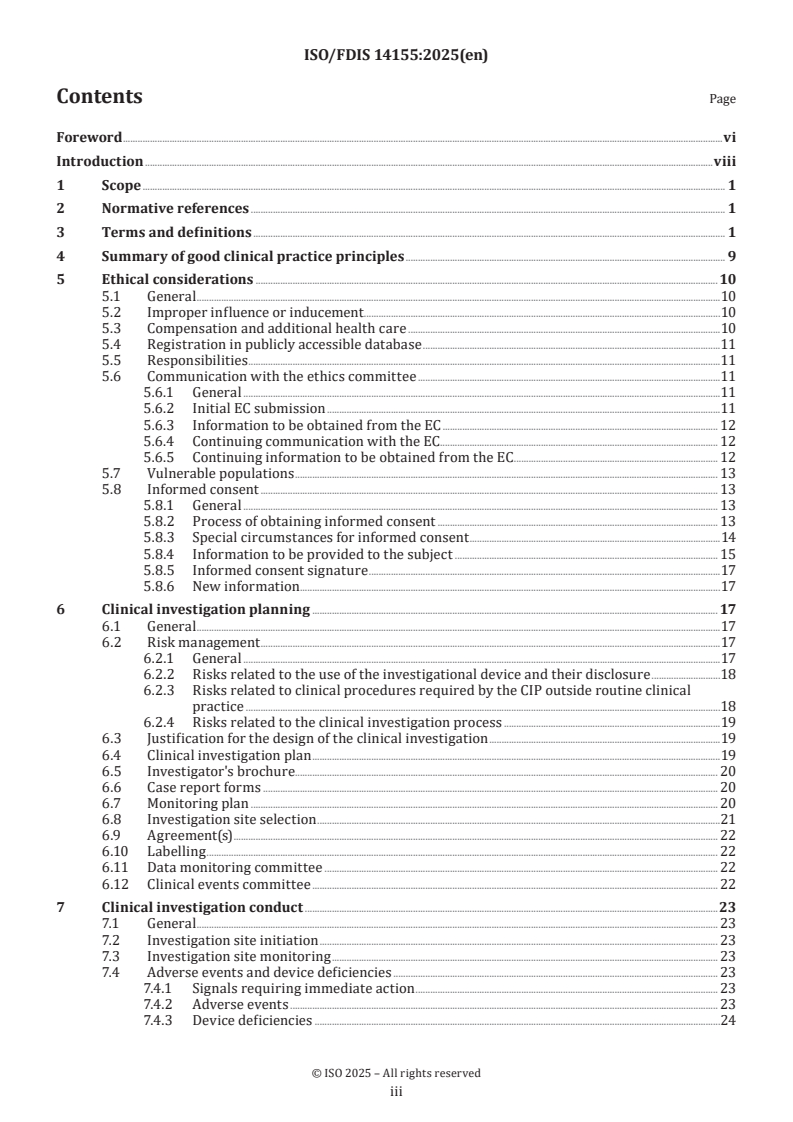
FINAL DRAFT
International
Standard
ISO/FDIS 14155
ISO/TC 194
Clinical investigation of medical
Secretariat: DIN
devices for human subjects — Good
Voting begins on:
clinical practice
2025-10-17
Investigation clinique des dispositifs médicaux pour sujets
Voting terminates on:
humains — Bonne pratique clinique
2025-12-12
RECIPIENTS OF THIS DRAFT ARE INVITED TO SUBMIT,
WITH THEIR COMMENTS, NOTIFICATION OF ANY
RELEVANT PATENT RIGHTS OF WHICH THEY ARE AWARE
AND TO PROVIDE SUPPOR TING DOCUMENTATION.
IN ADDITION TO THEIR EVALUATION AS
BEING ACCEPTABLE FOR INDUSTRIAL, TECHNO
ISO/CEN PARALLEL PROCESSING LOGICAL, COMMERCIAL AND USER PURPOSES, DRAFT
INTERNATIONAL STANDARDS MAY ON OCCASION HAVE
TO BE CONSIDERED IN THE LIGHT OF THEIR POTENTIAL
TO BECOME STAN DARDS TO WHICH REFERENCE MAY BE
MADE IN NATIONAL REGULATIONS.
Reference number
ISO/FDIS 14155:2025(en) © ISO 2025
FINAL DRAFT
ISO/FDIS 14155:2025(en)
International
Standard
ISO/FDIS 14155
ISO/TC 194
Clinical investigation of medical
Secretariat: DIN
devices for human subjects — Good
Voting begins on:
clinical practice
Investigation clinique des dispositifs médicaux pour sujets
Voting terminates on:
humains — Bonne pratique clinique
RECIPIENTS OF THIS DRAFT ARE INVITED TO SUBMIT,
WITH THEIR COMMENTS, NOTIFICATION OF ANY
RELEVANT PATENT RIGHTS OF WHICH THEY ARE AWARE
AND TO PROVIDE SUPPOR TING DOCUMENTATION.
© ISO 2025
IN ADDITION TO THEIR EVALUATION AS
All rights reserved. Unless otherwise specified, or required in the context of its implementation, no part of this publication may
BEING ACCEPTABLE FOR INDUSTRIAL, TECHNO
ISO/CEN PARALLEL PROCESSING
LOGICAL, COMMERCIAL AND USER PURPOSES, DRAFT
be reproduced or utilized otherwise in any form or by any means, electronic or mechanical, including photocopying, or posting on
INTERNATIONAL STANDARDS MAY ON OCCASION HAVE
the internet or an intranet, without prior written permission. Permission can be requested from either ISO at the address below
TO BE CONSIDERED IN THE LIGHT OF THEIR POTENTIAL
or ISO’s member body in the country of the requester.
TO BECOME STAN DARDS TO WHICH REFERENCE MAY BE
MADE IN NATIONAL REGULATIONS.
ISO copyright office
CP 401 • Ch. de Blandonnet 8
CH-1214 Vernier, Geneva
Phone: +41 22 749 01 11
Email: copyright@iso.org
Website: www.iso.org
Published in Switzerland Reference number
ISO/FDIS 14155:2025(en) © ISO 2025
ii
ISO/FDIS 14155:2025(en)
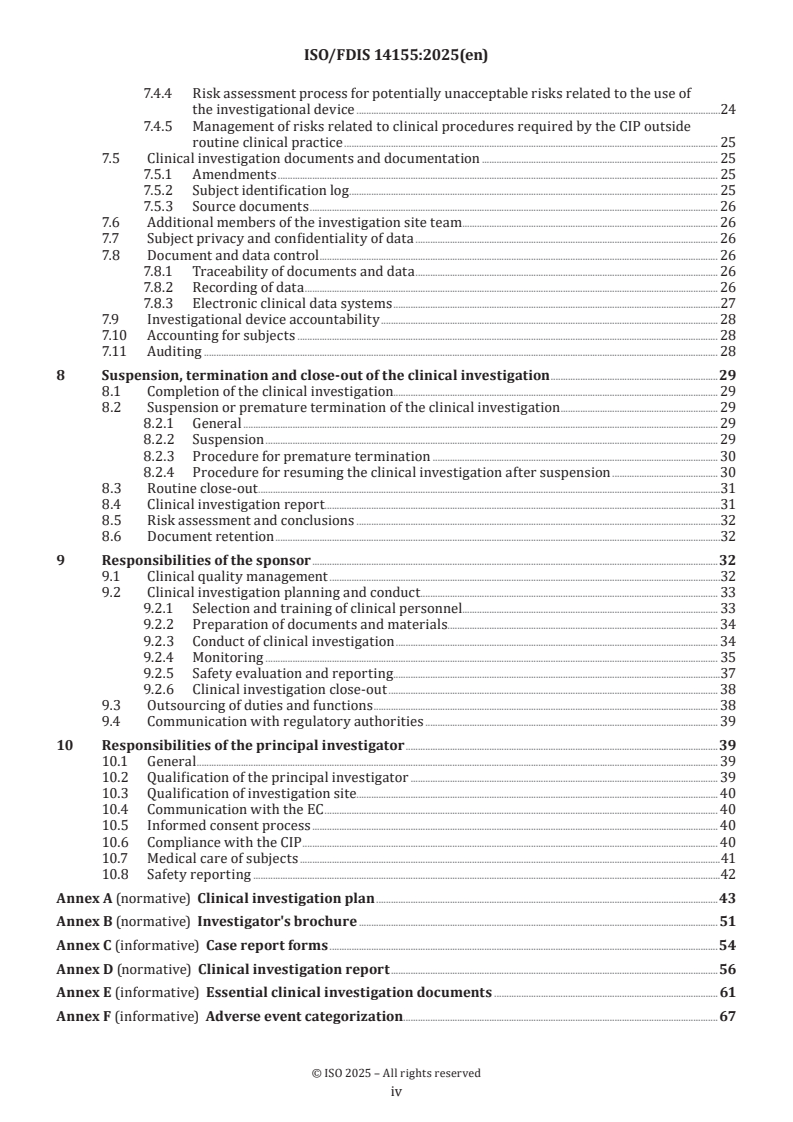
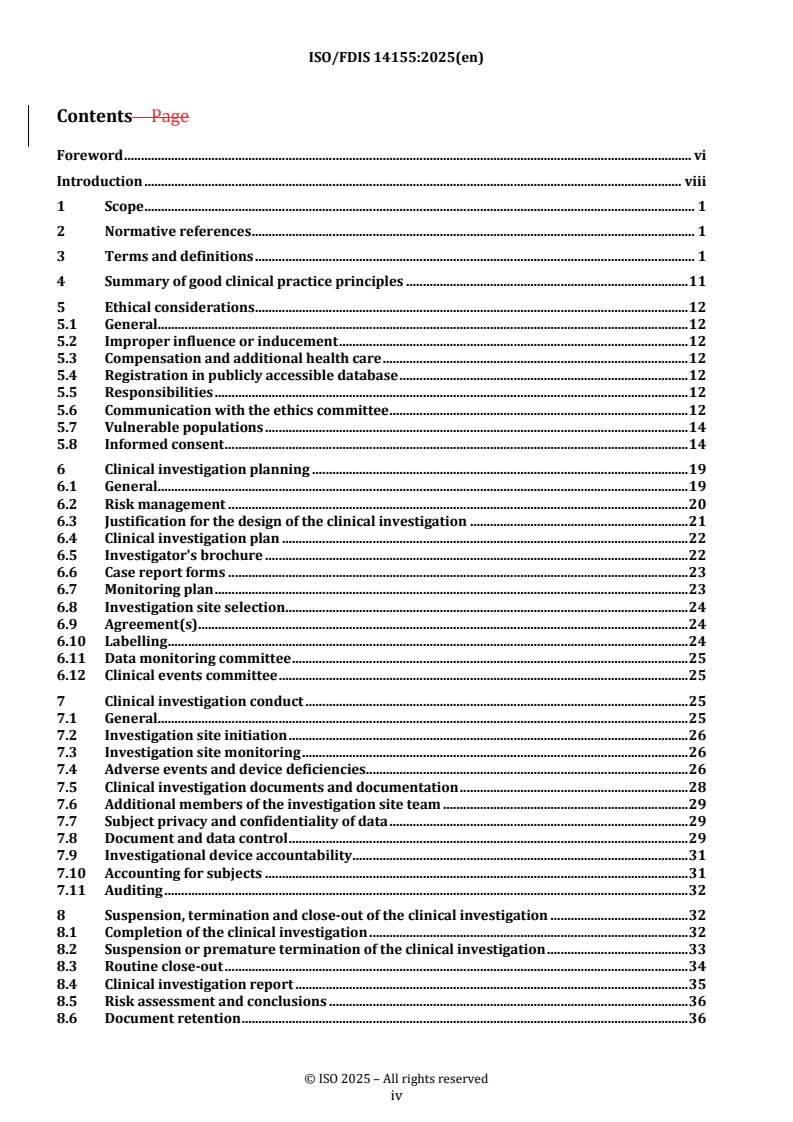
Contents Page
Foreword .vi
Introduction .viii
1 Scope . 1
2 Normative references . 1
3 Terms and definitions . 1
4 Summary of good clinical practice principles . 9
5 Ethical considerations . 10
5.1 General .10
5.2 Improper influence or inducement .10
5.3 Compensation and additional health care .10
5.4 Registration in publicly accessible database .11
5.5 Responsibilities .11
5.6 Communication with the ethics committee .11
5.6.1 General .11
5.6.2 Initial EC submission .11
5.6.3 Information to be obtained from the EC . 12
5.6.4 Continuing communication with the EC . . 12
5.6.5 Continuing information to be obtained from the EC . 12
5.7 Vulnerable populations . 13
5.8 Informed consent . 13
5.8.1 General . 13
5.8.2 Process of obtaining informed consent . 13
5.8.3 Special circumstances for informed consent .14
5.8.4 Information to be provided to the subject . 15
5.8.5 Informed consent signature .17
5.8.6 New information.17
6 Clinical investigation planning . 17
6.1 General .17
6.2 Risk management .17
6.2.1 General .17
6.2.2 Risks related to the use of the investigational device and their disclosure .18
6.2.3 Risks related to clinical procedures required by the CIP outside routine clinical
practice .18
6.2.4 Risks related to the clinical investigation process .19
6.3 Justification for the design of the clinical investigation .19
6.4 Clinical investigation plan .19
6.5 Investigator's brochure. 20
6.6 Case report forms . 20
6.7 Monitoring plan . 20
6.8 Investigation site selection .21
6.9 Agreement(s) . 22
6.10 Labelling . 22
6.11 Data monitoring committee . 22
6.12 Clinical events committee . 22
7 Clinical investigation conduct .23
7.1 General . 23
7.2 Investigation site initiation . 23
7.3 Investigation site monitoring . 23
7.4 Adverse events and device deficiencies . 23
7.4.1 Signals requiring immediate action . 23
7.4.2 Adverse events . 23
7.4.3 Device deficiencies .24
iii
ISO/FDIS 14155:2025(en)
7.4.4 Risk assessment process for potentially unacceptable risks related to the use of
the investigational device .24
7.4.5 Management of risks related to clinical procedures required by the CIP outside
routine clinical practice . 25
7.5 Clinical investigation documents and documentation . 25
7.5.1 Amendments . 25
7.5.2 Subject identification log . 25
7.5.3 Source documents . 26
7.6 Additional members of the investigation site team. 26
7.7 Subject privacy and confidentiality of data . 26
7.8 Document and data control . 26
7.8.1 Traceability of documents and data . 26
7.8.2 Recording of data . 26
7.8.3 Electronic clinical data systems .27
7.9 Investigational device accountability . 28
7.10 Accounting for subjects . 28
7.11 Auditing . 28
8 Suspension, termination and close-out of the clinical investigation .29
8.1 Completion of the clinical investigation. 29
8.2 Suspension or premature termination of the clinical investigation . 29
8.2.1 General . 29
8.2.2 Suspension . 29
8.2.3 Procedure for premature termination . 30
8.2.4 Procedure for resuming the clinical investigation after suspension . 30
8.3 Routine close-out .31
8.4 Clinical investigation report.31
8.5 Risk assessment and conclusions .32
8.6 Document retention .32
9 Responsibilities of the sponsor .32
9.1 Clinical quality management .32
9.2 Clinical investigation planning and conduct . 33
9.2.1 Selection and training of clinical personnel. 33
9.2.2 Preparation of documents and materials. 34
9.2.3 Conduct of clinical investigation . 34
9.2.4 Monitoring . 35
9.2.5 Safety evaluation and reporting .37
9.2.6 Clinical investigation close-out . 38
9.3 Outsourcing of duties and functions . 38
9.4 Communication with regulatory authorities . 39
10 Responsibilities of the principal investigator .39
10.1 General . 39
10.2 Qualification of the principal investigator . 39
10.3 Qualification of investigation site. 40
10.4 Communication with the EC . 40
10.5 Informed consent process . 40
10.6 Compliance with the CIP . 40
10.7 Medical care of subjects .41
10.8 Safety reporting .42
Annex A (normative) Clinical investigation plan .43
Annex B (normative) Investigator's brochure . 51
Annex C (informative) Case report forms .54
Annex D (normative) Clinical investigation report .56
Annex E (informative) Essential clinical investigation documents . 61
Annex F (informative) Adverse event categorization. 67
iv
ISO/FDIS 14155:2025(en)
Annex G (informative) EC responsibilities .69
Annex H (informative) Application of ISO 14971 during clinical investigations .73
Annex I (informative) Clinical development stages . 74
Annex J (informative) Clinical investigation audits .79
Annex K (informative) Clinical investigation design considerations.82
Annex ZA (informative) Relationship between this European standard and the requirements
of Regulation (EU) 2017/745 aimed to be covered .84
Bibliography .92
v
ISO/FDIS 14155:2025(en)
Foreword
ISO (the International Organization for Standardization) is a worldwide federation of national standards
bodies (ISO member bodies). The work of preparing International Standards is normally carried out through
ISO technical committees. Each member body interested in a subject for which a technical committee
has been established has the right to be represented on that committee. International organizations,
governmental and non-governmental, in liaison with ISO, also take part in the work. ISO collaborates closely
with the International Electrotechnical Commission (IEC) on all matters of electrotechnical standardization.
The procedures used to develop this document and those intended for its further maintenance are described
in the ISO/IEC Directives, Part 1. In particular, the different approval criteria needed for the different types
of ISO document should be noted. This document was drafted in accordance with the editorial rules of the
ISO/IEC Directives, Part 2 (see www.iso.org/directives).
ISO draws attention to the possibility that the implementation of this document may involve the use of (a)
patent(s). ISO takes no position concerning the evidence, validity or applicability of any claimed patent
rights in respect thereof. As of the date of publication of this document, ISO had not received notice of (a)
patent(s) which may be required to implement this document. However, implementers are cautioned that
this may not represent the latest information, which may be obtained from the patent database available at
www.iso.org/patents. ISO shall not be held responsible for identifying any or all such patent rights.
Any trade name used in this document is information given for the convenience of users and does not
constitute an endorsement.
For an explanation of the voluntary nature of standards, the meaning of ISO specific terms and expressions
related to conformity assessment, as well as information about ISO's adherence to the World Trade
Organization (WTO) principles in the Technical Barriers to Trade (TBT), see www.iso.org/iso/foreword.html.
This document was prepared by Technical Committee ISO/TC 194, Biological and clinical evaluation of medical
devices, in collaboration with the European Committee for Standardization (CEN) Technical Committee CEN/
TC 206, Biological and clinical evaluation of medical devices, in accordance with the Agreement on technical
cooperation between ISO and CEN (Vienna Agreement).
This fourth edition cancels and replaces the third edition (ISO 14155:2020), which has been technically
revised.
The main changes are as follows:
— changed definition of clinical performance (3.12);
— clarified deviations from eligibility criteria not being permitted but subject to CIP amendment (see 5.6.4);
— clarified informed consent to be obtained where applicable from subject’s legally designated
representative (see 5.8.1);
— clarified subject must be given opportunity to discuss participation with others e.g. family members
(see 5.8.2);
— clarified risk management by making clear distinction between risks related to the use of the device and
risks related to the procedures required by the CIP which are not part of routine clinical practice (see 6.2.1);
— included required assessment of residual risks (see 6.2.2);
— corrected reference to risks related to the use of the investigational device (see 6.2.1, 7.4.4, 8.2, Annex F,
Annex H and 3.2);
— added requirements (previously in Annex A) to 6.4;
— added requirement for data monitoring committee to confirm conditions for suspending or stopping the
clinical investigation (see 6.11);
— included new section on clinical events committee (see 3.7, 6.12 and Clause A.14);
vi
ISO/FDIS 14155:2025(en)
— clarified situations of reduced adverse events reporting requirements (see 7.4.2);
— included management of risks related to clinical procedures required by the CIP (see 7.4.5);
— clarified process of suspension or premature termination of the clinical investigation also in line with
updated sections 7.4.4 and Figure H.1 (see 8.2);
— updated procedure section in CIP with methods and timing for assessing, recording and analysing
variables and added requirement for calibration of equipment (see A.6.4);
— clarified requirements for non-inferiority margins and missing data (see Clause A.7);
— added requirement to justify absence of DMC involvement (see Clause A.14);
— added requirement for subject follow up and continued care to include those different from normal
practice (see Clause A.16);
— clarified aspects of local representative for better harmonisation with national regulatory requirements
(see 9.2.1);
— included requirement for implant card (see 9.2.2);
— moved general requirements to 6.4 on objective and study design (see Clause A.5);
— updated adverse events categorization clarifying terminology in updated flowchart F1 (see Annex F);
— updated Annex H in line with 6.2.1 and updated flowchart (see Annex H);
— included principles of estimands and their attributes (see, 6.4, Clause A.5, Clause A.6, Clause A.7, and
Annex K);
— included precautions (see Clause B.5), information on training on the use of investigational device (see
Clause B.2), and in-silico tests (see Clause B.3).
Any feedback or questions on this document should be directed to the user’s national standards body. A
complete listing of these bodies can be found at www.iso.org/members.html.
vii
ISO/FDIS 14155:2025(en)
Introduction
For the purpose of this document, the use of the term compliance is applied when compliance to clinical
investigation requirements and good clinical practice as per this document is required. In case of
requirements outlined in regulatory documents or other standards the term ‘conformance with’ is applied.
viii
FINAL DRAFT International Standard ISO/FDIS 14155:2025(en)
Clinical investigation of medical devices for human
subjects — Good clinical practice
1 Scope
This document specifies good clinical practice (GCP) for the design, conduct, recording and reporting of
clinical investigations carried out in human subjects to assess the clinical performance or effectiveness and
safety of medical devices.
For post-market clinical investigations, the principles set forth in this document are intended to be followed
as far as relevant, considering the nature of the clinical investigation (see Annex I).
This document specifies the general requirements intended to
— protect the rights, safety and well-being of human subjects, users or other persons,
— ensure the scientific conduct of the clinical investigation and the credibility of the clinical investigation
results,
— define the responsibilities of the sponsor and principal investigator, and
— assist sponsors, investigators, ethics committees, regulatory authorities and other bodies involved in
the conformity assessment of medical devices.
Other standards or national requirements can also apply to the investigational device(s) under consideration
or the clinical investigation(s).
NOTE For Software as a Medical Device (SaMD), where appropriate, demonstration of the analytical validity
(the SaMD’s output is accurate for a given input), the scientific validity (the SaMD’s output is associated to the
intended clinical condition/physiological state), and clinical performance (the SaMD’s output yields a clinically
meaningful association to the target use) of the SaMD, the requirements of this document apply as far as relevant
(see Reference [5]). Justifications for exemptions from this document can consider the uniqueness of indirect contact
between subjects and the SaMD.
This document does not apply to in vitro diagnostic medical devices. However, there can be situations,
dependent on the device and national or regional requirements, where users of this document can consider
whether either specific sections or requirements of this document, or both, can be applicable.
2 Normative references
The following documents are referred to in the text in such a way that some or all of their content constitutes
requirements of this document. For dated references, only the edition cited applies. For undated references,
the latest edition of the referenced document (including any amendments) applies.
ISO 14971, Medical devices — Application of risk management to medical devices
3 Terms and definitions
For the purposes of this document, the following terms and definitions apply.
ISO and IEC maintain terminology databases for use in standardization at the following addresses:
— ISO Online browsing platform: available at https:// www .iso .org/ obp
— IEC Electropedia: available at https:// www .electropedia .org/
ISO/FDIS 14155:2025(en)
3.1
adverse device effect
ADE
adverse event (3.2) related to the use of an investigational medical device (3.30)
Note 1 to entry: This definition includes adverse events resulting from insufficient or inadequate instructions for use,
deployment, implantation, installation, operation or any malfunction (3.34) of the investigational medical device.
Note 2 to entry: This definition includes any event resulting from use error (3.53) or from intentional misuse of the
investigational medical device.
Note 3 to entry: This definition applies to ‘comparator’ (3.13) if the comparator is a medical device.
3.2
adverse event
AE
untoward medical occurrence, unintended disease or injury, or any untoward clinical signs (including
abnormal laboratory findings) in subjects (3.51), users or other persons, whether or not related to the use of
the investigational medical device (3.30) and whether anticipated or unanticipated
Note 1 to entry: This definition includes events related to use of the investigational medical device or the comparator
(3.13) and the clinical procedure(s) required by the clinical investigation plan (CIP) (3.10) that are outside to routine
clinical practice but not related to the use of the device.
Note 2 to entry: For users or other persons, this definition is restricted to events related to the use of investigational
medical devices or comparators.
3.3
audit
systematic examination of activities and documents related to a clinical investigation (3.9) performed by (an)
independent (3.27) person(s), to determine whether these activities were conducted, and the data recorded,
analysed and accurately reported, in compliance with the clinical investigation plan (CIP) (3.10), standard
operating procedures, this document and in conformance with applicable regulatory requirements
3.4
audit trail
documentation that allows reconstruction of the course of events
3.5
blinding
masking
procedure in which one or more parties to the clinical investigation (3.9) are kept unaware of the treatment
assignment(s)
Note 1 to entry: Single blinding usually refers to the subject(s) (3.51) being unaware of the treatment assignment(s).
Double blinding usually refers to the subject(s), investigator(s) (3.31), monitor and, in some cases, centralized assessors
being unaware of the treatment assignment(s).
Note 2 to entry: A clinical investigation is termed ‘observer blind’, if at least the primary endpoint(s) (3.23) is/are
assessed without knowledge of whether an investigational medical device (3.30) or comparator (3.13) has been used to
treat a subject.
3.6
case report form
CRF
set of printed, optical or electronic documents for each subject (3.51) on which information to be reported to
the sponsor (3.50) is recorded, as required by the clinical investigation plan (CIP) (3.10)
ISO/FDIS 14155:2025(en)
3.7
clinical events committee
CEC
independent (3.27) committee of clinical experts that can be established by the sponsor (3.50) to ensure
consistent event assessment across participating centres and mitigate inadequate reporting risks
Note 1 to entry: For the purpose of this document, “central events committee”, ‘’clinical adjudication committee
(CAC)‘’, ‘’endpoint adjudication committee (EAC)” are considered synonymous with CEC but terminology not used in
this document.
3.8
certified copy
copy (irrespective of the type of media used) of the original record that has been verified (i.e. by a dated
signature or by generation through a validated process) to have the same information including data that
describe the context, content and structure, as the original
3.9
clinical investigation
clinical trial
clinical study
systematic investigation in one or more human subjects (3.51), undertaken to assess the clinical performance
(3.12), effectiveness (3.20) or safety of a medical device (3.35)
3.10
clinical investigation plan
CIP
protocol
document that states the rationale, objectives (3.38), design and pre-specified analysis, methodology,
organization, monitoring (3.36), conduct and record-keeping of the clinical investigation (3.9)
Note 1 to entry: As the term "protocol" has many different meanings, some not related to clinical investigation, and as
these can differ from country to country, the term CIP is used in this document.
3.11
clinical investigation report
clinical study report
document describing the design, conduct, statistical analysis and results of a clinical investigation (3.9)
3.12
clinical performance
ability of a medical device (3.35), resulting from any direct or indirect medical effects which stem from its
technical or functional characteristics, including diagnostic characteristics, to achieve its intended purpose
as claimed by the manufacturer, thereby leading to a clinical benefit for subject(s) (3.51), when used as
intended by the manufacturer
Note 1 to entry: Clinical performance can be defined under national regulations.
Note 2 to entry: Not all clinical investigations have clinical benefits to subjects e.g. healthy volunteers, clinical
investigations only gathering data etc.
3.13
comparator
medical device (3.35), therapy (e.g. active treatment, routine clinical practice), placebo, sham or no treatment,
used in the control group (3.15) in a clinical investigation (3.9)
3.14
contract research organization
CRO
person or organization contracted by the sponsor (3.50) to perform one or more of the sponsor's clinical
investigation-related duties and functions
ISO/FDIS 14155:2025(en)
3.15
control group
group of subjects (3.51) that receives the comparator (3.13)
Note 1 to entry: A control group may be concurrent or historical, or subjects may serve as their own control.
3.16
coordinating investigator
national investigator
global investigator
investigator (3.31) who is appointed by the sponsor (3.50) to assist in coordinating the work in a multicentre
clinical investigation (3.9)
3.17
data monitoring committee
DMC
data and safety monitoring board
DSMB
independent data monitoring committee
IDMC
independent (3.27) committee that can be established by the sponsor (3.50) to assess, at intervals, the
progress of the clinical investigation (3.9), the safety data or the critical clinical performance (3.12) or
effectiveness (3.20)endpoints (3.23, 3.24) and to recommend to the sponsor whether to continue, suspend,
modify or stop the clinical investigation
3.18
deviation
instance of failure to follow, intentionally or unintentionally, the requirements of the clinical investigation
plan (CIP) (3.10)
3.19
device deficiency
inadequacy in the identity, quality, durability, reliability, usability, safety or performance of a medical device
(3.35), including malfunctions (3.34), use errors (3.53), or inadequacy in the information supplied by the
manufacturer including labelling
Note 1 to entry: This definition includes device deficiencies related to the investigational medical device (3.30) or the
comparator (3.13).
3.20
effectiveness
achievement of a clinically meaningful intended result in a defined portion of the target population when the
investigational medical device (3.30) is used within its intended uses and in compliance with its instructions
for use, the investigator’s brochure (3.32) and the clinical investigation plan (CIP) (3.10), as determined by
documented scientific evidence
3.21
electronic clinical data system
hardware and software (including associated documents, such as a user manual) that creates, modifies,
maintains, archives, retrieves or transmits in digital form information related to the conduct of a clinical
investigation (3.9)
3.22
electronic record
combination of text, graphics, data, audio, imaging, or other information in digital form that is created,
modified, maintained, archived, retrieved or distributed by an electronic clinical data system (3.21)
EXAMPLE An electronic case report form (CRF).
ISO/FDIS 14155:2025(en)
3.23
endpoint
principal indicator(s) used for providing the evidence for clinical performance (3.12), effectiveness
(3.20) or safety in a clinical investigation (3.9)
3.24
endpoint
indicator(s) used for assessing the secondary objectives (3.38) of a clinical investigation (3.9)
3.25
ethics committee
EC
research ethics committee
independent ethics committee
institutional review board
independent (3.27) body whose responsibility it is to review clinical investigations (3.9) in order to protect
the rights, safety, and well-being of human subjects (3.51) participating in a clinical investigation
Note 1 to entry: The regulatory requirements pertaining to ethics committees or similar institutions vary by country
or region.
3.26
hypothesis
testable statement, derived from the objective (3.38) of the clinical investigation (3.9) to draw a conclusion
about this objective, based on a pre-specified statistical test
Note 1 to entry: The primary hypothesis is formulated based on the pre-defined primary endpoint (3.23) and is usually
used to calculate the sample size.
3.27
independent
not involved in the development of the investigational device or the conduct of a clinical investigation (3.9),
except for their specifically assigned responsibilities, in order to avoid bias or a conflict of interest
3.28
informed consent
process by which an individual voluntarily confirms willingness to participate in a particular clinical
investigation (3.9), after having been informed of all aspects of the investigation that are relevant to the
decision to participate
3.29
investigation site
investigation centre
institution or site where the clinical investigation (3.9) is carried out
3.30
investigational medical device
investigational device
medical device (3.35) being assessed for safety, clinical performance (3.12) or effectiveness (3.20) in a clinical
investigation (3.9)
Note 1 to entry: This includes medical devices already on the market that are being evaluated for new intended uses,
new populations, new materials or design changes.
Note 2 to entry: This includes medical devices already on the market that are being evaluated within their intended
use in a post-market clinical investigation (interventional or non-interventional).
ISO/FDIS 14155:2025(en)
3.31
investigator
individual member of the investigation site (3.29) team designated and supervised by the principal
investigator (3.40) at an investigation site to perform clinical investigation-related procedures or to make
important clinical investigation-related and medical treatment decisions
Note 1 to entry: An individual member of the investigation site team can also be called “sub-investigator” or “co-
investigator”.
3.32
investigator's brochure
IB
compilation of the current clinical and non-clinical information on the investigational medical device(s)
(3.30), relevant to the clinical investigation (3.9)
3.33
legally designated representative
individual, judicial, or other body authorized under applicable law to consent, on behalf of a prospective
subject (3.51), to the subject's participation in the clinical investigation (3.9)
Note 1 to entry: “legally authorized representative” or “legally acceptable representative” are other terminologies
used under national regulations for “legally designated representative” but not used in
...
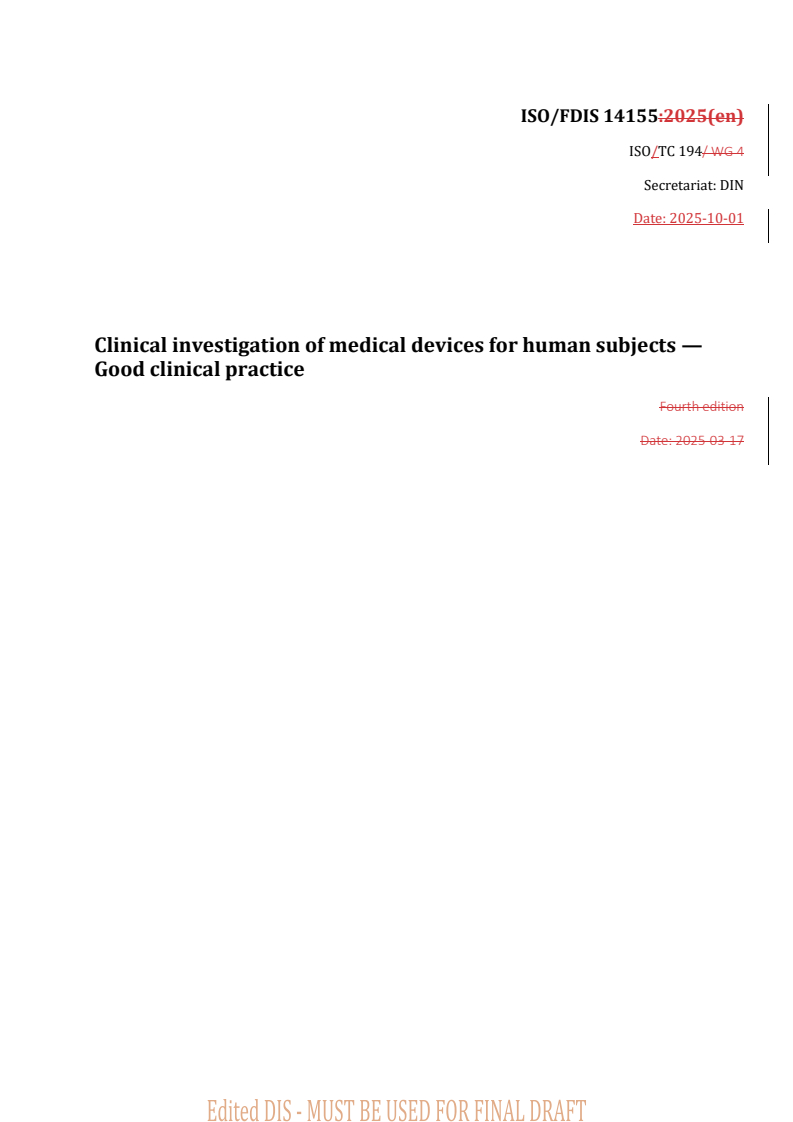
ISO/FDIS 14155:2025(en)
ISO/TC 194/ WG 4
Secretariat: DIN
Date: 2025-10-01
Clinical investigation of medical devices for human subjects —
Good clinical practice
Fourth edition
Date: 2025-03-17
ISO #####-#:####(X)
Investigation clinique des dispositifs médicaux pour sujets humains — Bonne pratique clinique
FDIS stage
2 © ISO #### – All rights reserved
ISO/FDIS 14155:2025(en)
All rights reserved. Unless otherwise specified, or required in the context of its implementation, no part of this publication
may be reproduced or utilized otherwise in any form or by any means, electronic or mechanical, including photocopying,
or posting on the internet or an intranet, without prior written permission. Permission can be requested from either ISO
at the address below or ISO’s member body in the country of the requester.
ISO copyright office
CP 401 • Ch. de Blandonnet 8
CH-1214 Vernier, Geneva
Phone: + 41 22 749 01 11
EmailE-mail: copyright@iso.org
Website: www.iso.org
Published in Switzerland
iii
ISO/FDIS 14155:2025(en)
Contents Page
Foreword . vi
Introduction . viii
1 Scope . 1
2 Normative references . 1
3 Terms and definitions . 1
4 Summary of good clinical practice principles . 11
5 Ethical considerations . 12
5.1 General. 12
5.2 Improper influence or inducement . 12
5.3 Compensation and additional health care . 12
5.4 Registration in publicly accessible database . 12
5.5 Responsibilities . 12
5.6 Communication with the ethics committee . 12
5.7 Vulnerable populations . 14
5.8 Informed consent . 14
6 Clinical investigation planning . 19
6.1 General. 19
6.2 Risk management . 20
6.3 Justification for the design of the clinical investigation . 21
6.4 Clinical investigation plan . 22
6.5 Investigator's brochure . 22
6.6 Case report forms . 23
6.7 Monitoring plan . 23
6.8 Investigation site selection. 24
6.9 Agreement(s) . 24
6.10 Labelling . 24
6.11 Data monitoring committee . 25
6.12 Clinical events committee . 25
7 Clinical investigation conduct . 25
7.1 General. 25
7.2 Investigation site initiation . 26
7.3 Investigation site monitoring . 26
7.4 Adverse events and device deficiencies. 26
7.5 Clinical investigation documents and documentation . 28
7.6 Additional members of the investigation site team . 29
7.7 Subject privacy and confidentiality of data . 29
7.8 Document and data control . 29
7.9 Investigational device accountability . 31
7.10 Accounting for subjects . 31
7.11 Auditing . 32
8 Suspension, termination and close-out of the clinical investigation . 32
8.1 Completion of the clinical investigation . 32
8.2 Suspension or premature termination of the clinical investigation . 33
8.3 Routine close-out . 34
8.4 Clinical investigation report . 35
8.5 Risk assessment and conclusions . 36
8.6 Document retention . 36
iv
ISO/FDIS 14155:2025(en)
9 Responsibilities of the sponsor. 36
9.1 Clinical quality management . 36
9.2 Clinical investigation planning and conduct . 37
9.3 Outsourcing of duties and functions . 43
9.4 Communication with regulatory authorities . 44
10 Responsibilities of the principal investigator . 44
10.1 General. 44
10.2 Qualification of the principal investigator . 44
10.3 Qualification of investigation site . 44
10.4 Communication with the EC . 45
10.5 Informed consent process . 45
10.6 Compliance with the CIP . 46
10.7 Medical care of subjects . 46
10.8 Safety reporting . 47
Annex A (normative) Clinical investigation plan . 48
Annex B (normative) Investigator's brochure . 58
Annex C (informative) Case report forms . 61
Annex D (normative) Clinical investigation report . 63
Annex E (informative) Essential clinical investigation documents . 69
Annex F (informative) Adverse event categorization . 77
Annex G (informative) EC responsibilities. 81
Annex H (informative) Application of ISO 14971 during clinical investigations . 85
Annex I (informative) Clinical development stages . 87
Annex J (informative) Clinical investigation audits . 92
Annex K (informative) Clinical investigation design considerations. 95
Annex ZA (informative) Relationship between this European standard and the requirements of
Regulation (EU) 2017/745 aimed to be covered . 97
Bibliography . 106
v
ISO/FDIS 14155:2025(en)
Foreword
ISO (the International Organization for Standardization) is a worldwide federation of national standards
bodies (ISO member bodies). The work of preparing International Standards is normally carried out through
ISO technical committees. Each member body interested in a subject for which a technical committee has been
established has the right to be represented on that committee. International organizations, governmental and
non-governmental, in liaison with ISO, also take part in the work. ISO collaborates closely with the
International Electrotechnical Commission (IEC) on all matters of electrotechnical standardization.
The procedures used to develop this document and those intended for its further maintenance are described
in the ISO/IEC Directives, Part 1. In particular, the different approval criteria needed for the different types of
ISO documentsdocument should be noted. This document was drafted in accordance with the editorial rules
of the ISO/IEC Directives, Part 2 (see www.iso.org/directives).
ISO draws attention to the possibility that the implementation of this document may involve the use of (a)
patent(s). ISO takes no position concerning the evidence, validity or applicability of any claimed patent rights
in respect thereof. As of the date of publication of this document, ISO had not received notice of (a) patent(s)
which may be required to implement this document. However, implementers are cautioned that this may not
represent the latest information, which may be obtained from the patent database available at
www.iso.org/patents. ISO shall not be held responsible for identifying any or all such patent rights.
Any trade name used in this document is information given for the convenience of users and does not
constitute an endorsement.
For an explanation of the voluntary nature of standards, the meaning of ISO specific terms and expressions
related to conformity assessment, as well as information about ISO's adherence to the World Trade
Organization (WTO) principles in the Technical Barriers to Trade (TBT), see www.iso.org/iso/foreword.html.
This document was prepared by Technical Committee ISO/TC 194, Biological and clinical evaluation of medical
devices, in collaboration with the European Committee for Standardization (CEN) Technical Committee
CEN/TC 206, Biological and clinical evaluation of medical devices, in accordance with the Agreement on
technical cooperation between ISO and CEN (Vienna Agreement).
This fourth edition cancels and replaces the third edition (ISO 14155:2020), which has been technically
revised.
The main changes are as follows:
— — Changedchanged definition of clinical performance (0(3.12););
— — Clarifiedclarified deviations from eligibility criteria not being permitted but subject to CIP amendment
(see 5.6.45.6.4););
— — Clarifiedclarified informed consent to be obtained where applicable from subject’s legally designated
representative (see 5.8.15.8.1););
— — Clarifiedclarified subject must be given opportunity to discuss participation with others e.g. family
members (see 5.8.25.8.2););
— — Clarifiedclarified risk management by making clear distinction between risks related to the use of the
device and risks related to the procedures required by the CIP which are not part of routine clinical
practice (see 6.2.16.2.1););
— — Includedincluded required assessment of residual risks (see 6.2.26.2.2););
vi
ISO/FDIS 14155:2025(en)
— — Correctedcorrected reference to risks related to the use of the investigational device (see 6.2.1, 7.4.4,
8.2, Annex F6.2.1, 7.4.4, 8.2 Annex F, Annex H, Annex H and 3.23.2););
— — Added normativeadded requirements (previously in Annex AAnnex A)) to 6.46.4;;
— — Addedadded requirement for data monitoring committee to confirm conditions for suspending or
stopping the clinical investigation (see 6.116.11););
— — Includedincluded new section on clinical events committee (see 3.73.7, 6.12, 6.12 and
Clause A.14Clause A.14););
— — Clarifiedclarified situations of reduced adverse events reporting requirements (see 7.4.27.4.2););
— — Includedincluded management of risks related to clinical procedures required by the CIP (see
7.4.57.4.5););
— — Clarifiedclarified process of suspension or premature termination of the clinical investigation also in
line with updated 7.4.4sections 7.4.4 and Figure H.1Figure H.1 (see 8.28.2););
— — Updatedupdated procedure section in CIP with methods and timing for assessing, recording and
analysing variables and added requirement for calibration of equipment (see A.6.4A.6.4););
— — Clarifiedclarified requirements for non-inferiority margins and missing data (see Clause A.7Clause
A.7););
— — Addedadded requirement to justify absence of DMC involvement (see Clause A.14Clause A.14););
— — Addedadded requirement for subject follow up and continued care to include those different from
normal practice (see Clause A.16Clause A.16););
— — Clarifiedclarified aspects of local representative for better harmonisation with national regulatory
requirements (see 9.2.19.2.1););
— — Includedincluded requirement for implant card (see 9.2.29.2.2););
— — Movedmoved general requirements to 6.46.4 on objective and study design (see Clause A.5Clause
A.5););
— — Updatedupdated adverse events categorization clarifying terminology in updated flowchart F1 (see
Annex FAnnex F););
— — Updated Annex Hupdated Annex H in line with 6.2.16.2.1 and updated flowchart (see
Annex HAnnex H););
— — Includedincluded principles of estimands and their attributes (see, 6.4, Clause A.5, Clause A.6,
Clause A.76.4, Clause A.5, Clause A.6, Clause A.7,, and Annex KAnnex K););
— — Includedincluded precautions (see Clause B.5Clause B.5),), information on training on the use of
investigational device (see Clause B.2Clause B.2),), and in-silico tests (see Clause B.3Clause B.3).).
Any feedback or questions on this document should be directed to the user’s national standards body. A
complete listing of these bodies can be found at www.iso.org/members.html.
vii
ISO/FDIS 14155:2025(en)
Introduction
For the purpose of this document, the use of the term compliance is applied when compliance to clinical
investigation requirements and good clinical practice as per this document is required. In case of requirements
outlined in regulatory documents or other standards the term ‘conformance with’ is applied.
viii
ISO/FDIS 14155:2025(en)
Clinical investigation of medical devices for human subjects — Good
clinical practice
1 Scope
This document addressesspecifies good clinical practice (GCP) for the design, conduct, recording and
reporting of clinical investigations carried out in human subjects to assess the clinical performance or
effectiveness and safety of medical devices.
For post-market clinical investigations, the principles set forth in this document are intended to be followed
as far as relevant, considering the nature of the clinical investigation (see Annex IAnnex I).).
This document specifies the general requirements intended to
— — protect the rights, safety and well-being of human subjects, users or other persons,
— — ensure the scientific conduct of the clinical investigation and the credibility of the clinical investigation
results,
— — define the responsibilities of the sponsor and principal investigator, and
— — assist sponsors, investigators, ethics committees, regulatory authorities and other bodies involved in
the conformity assessment of medical devices.
Users of this document shall consider whether otherOther standards or national requirements can also apply
to the investigational device(s) under consideration or the clinical investigation. (s).
NOTE For Software as a Medical Device (SaMD), where appropriate, demonstration of the analytical validity (the
SaMD’s output is accurate for a given input), , the scientific validity (the SaMD’s output is associated to the intended
clinical condition/physiological state), and clinical performance (the SaMD’s output yields a clinically meaningful
association to the target use) of the SaMD, the requirements of this document apply as far as relevant (see Reference [0
[5]).]). Justifications for exemptions from this document can consider the uniqueness of indirect contact between subjects
and the SaMD.
This document does not apply to in vitro diagnostic medical devices. However, there can be situations,
dependent on the device and national or regional requirements, where users of this document can consider
whether either specific sections and/or requirements of this document, or both, can be applicable.
2 Normative references
The following documents are referred to in the text in such a way that some or all of their content constitutes
requirements of this document. For dated references, only the edition cited applies. For undated references,
the latest edition of the referenced document (including any amendments) applies.
ISO 14971, Medical devices — Application of risk management to medical devices
3 Terms and definitions
For the purposes of this document, the following terms and definitions apply.
ISO and IEC maintain terminology databases for use in standardization at the following addresses:
— — ISO Online browsing platform: available at https://www.iso.org/obp
ISO/FDIS 14155:2025(en)
— — IEC Electropedia: available at https://www.electropedia.org/
3.1 3.1
adverse device effect
ADE
adverse event (3.2(3.2)) related to the use of an investigational medical device (0(3.30))
Note 1 to entry: This definition includes adverse events resulting from insufficient or inadequate instructions for use,
deployment, implantation, installation, or operation, or any malfunction (3.34(3.34)) of the investigational medical
device.
Note 2 to entry: This definition includes any event resulting from use error (3.53(3.53)) or from intentional misuse of the
investigational medical device.
Note 3 to entry: This includesdefinition applies to ‘comparator’ (3.13(3.13)) if the comparator is a medical device.
3.2 3.2
adverse event
AE
untoward medical occurrence, unintended disease or injury, or any untoward clinical signs (including
abnormal laboratory findings) in subjects (3.51(3.51),), users or other persons, whether or not related to the
use of the investigational medical device (0(3.30)) and whether anticipated or unanticipated
Note 1 to entry: This definition includes events related to the investigational medical device or the comparator (3.13).
Note 2 to entry: This definition includes events related to the use of the investigational medical device or the comparator
(3.13) and the clinical procedure(s) required by the clinical investigation plan (CIP) (0) that are outside to routine clinical
practice but not related to the use of the device.
Note 3 2 to entry: For users or other persons, this definition is restricted to events related to the use of investigational
medical devices or comparators.
3.3 3.3
audit
systematic examination of activities and documents related to a clinical investigation (3.9(3.9)) performed by
(an) independent (3.27(3.27)) person(s), to determine whether these activities were conducted, and the data
recorded, analysed and accurately reported, according toin compliance with the clinical investigation plan
(CIP) (0,), standard operating procedures, this document and in conformance with applicable regulatory
requirements
3.4 3.4
audit trail
documentation that allows reconstruction of the course of events
3.5 3.5
blinding
masking
procedure in which one or more parties to the clinical investigation (3.9(3.9)) are kept unaware of the
treatment assignment(s)
Note 1 to entry: Single blinding usually refers to the subject(s) (3.51(3.51)) being unaware of the treatment
assignment(s). Double blinding usually refers to the subject(s), investigator(s) (0(3.31),), monitor and, in some cases,
centralized assessors being unaware of the treatment assignment(s).
Note 2 to entry: A clinical investigation is termed ‘observer blind’, if at least the primary endpoint(s) (3.23(3.23)) is/are
assessed without knowledge of whether an investigational medical device (0(3.30)) or comparator (3.13(3.13)) has been
used to treat a subject.
ISO/FDIS 14155:2025(en)
3.6 3.6
case report form
CRF
set of printed, optical or electronic documents for each subject (3.51(3.51)) on which information to be
reported to the sponsor (3.50(3.50)) is recorded, as required by the clinical investigation plan (CIP) (0)
3.7 3.7
clinical events committee
CEC
independent (3.27) committee of clinical experts that can be established by the sponsor (3.50) to ensure
consistent event assessment across participating centres and mitigate inadequate reporting risks
Note 1 to entry: For the purpose of this document, “central events committee”, ‘’clinical adjudication committee (CAC)‘’,
‘’endpoint adjudication committee (EAC)’’)” are considered synonymous with CEC but terminology not used in this
document.
3.8 3.8
certified copy
copy (irrespective of the type of media used) of the original record that has been verified (i.e. by a dated
signature or by generation through a validated process) to have the same information including data that
describe the context, content, and structure, as the original
3.9 3.9
clinical investigation
clinical trial
clinical study
systematic investigation in one or more human subjects (3.51(3.51),), undertaken to assess the clinical
performance (0(3.12),), effectiveness (3.20(3.20)) or safety of a medical device (3.35(3.35))
Note 1 to entry: For the purpose of this document, “clinical trial” or “clinical study” are synonymous with “clinical
investigation” but for consistency only ‘clinical investigation’ terminology is used in this document.
3.10 3.10
clinical investigation plan
CIP
protocol
document that states the rationale, objectives (3.38(3.38),), design and pre-specified analysis, methodology,
organization, monitoring (3.36(3.36),), conduct and record-keeping of the clinical investigation (3.9(3.9))
Note 1 to entry: For As the purpose of this document “protocol” is synonymous with “CIP”. However, term "protocol" has
many different meanings, some not related to clinical investigation, and as these can differ from country to country.
Therefore, the term CIP is used in this document.
3.11 3.11
clinical investigation report
clinical study report
document describing the design, conduct, statistical analysis and results of a clinical investigation (3.9(3.9))
Note 1 to entry: For the purpose of this document ‘clinical investigation report’ is synonymous with ‘clinical study report’
but for consistency, the terminology ‘clinical investigation report’ only is used in this document.
3.12 3.12
clinical performance
ability of a medical device (3.35(3.35),), resulting from any direct or indirect medical effects which stem from
its technical or functional characteristics, including diagnostic characteristics, to achieve its intended purpose
ISO/FDIS 14155:2025(en)
as claimed by the manufacturer, thereby leading to a clinical benefit for subject(s) (3.51(3.51),), when used as
intended by the manufacturer
Note 1 to entry: Clinical performance can be defined under national regulations.
Note 2 to entry: Not all clinical investigations have clinical benefits to subjects e.g. healthy volunteers, clinical
investigations only gathering data etc.
3.13 3.13
comparator
medical device (3.35(3.35),), therapy (e.g. active treatment, routine clinical practice), placebo, sham or no
treatment, used in the control group (3.15(3.15)) in a clinical investigation (3.9(3.9))
3.14 3.14
contract research organization
CRO
person or organization contracted by the sponsor (3.50(3.50)) to perform one or more of the sponsor's clinical
investigation-related duties and functions
3.15 3.15
control group
group of subjects (3.51(3.51)) that receives the comparator (3.13(3.13))
Note 1 to entry: A control group may be concurrent or historical, or subjects may serve as their own control.
3.16 3.16
coordinating investigator
national investigator
global investigator
investigator (0 (3.31)) who is appointed by the sponsor (3.50(3.50)) to assist in coordinating the work in a
multicentre clinical investigation (3.9(3.9))
Note 1 to entry: For the purpose of this document, “national investigator” or “global investigator” are synonymous with
“coordinating investigator” but for purpose of consistency, only terminology ‘coordinating investigator’ is used in this
document.
3.17 3.17
data monitoring committee
DMC
data and safety monitoring board
DSMB
independent data monitoring committee
IDMC
independent (3.27(3.27)) committee that can be established by the sponsor (3.50(3.50)) to assess, at intervals,
the progress of the clinical investigation (3.9(3.9),), the safety data or the critical clinical performance (0(3.12))
or effectiveness (3.20(3.20) )endpoints (3.23, 3.23(3.23, 3.24)) and to recommend to the sponsor whether to
continue, suspend, modify or stop the clinical investigation
Note 1 to entry: For the purpose of this document, “data and safety monitoring board (DSMB)”, “data and safety
monitoring committee (DSMC)" or "independent data monitoring committee (IDMC)” are synonymous with DMC. For
consistency only the terminology ‘DMC’ is used in this document.
3.18 3.18
deviation
instance of failure to follow, intentionally or unintentionally, the requirements of the clinical investigation plan
(CIP) (0 (3.10))
ISO/FDIS 14155:2025(en)
3.19 3.19
device deficiency
inadequacy in the identity, quality, durability, reliability, usability, safety or performance of a medical device
(3.35(3.35),), including malfunctions (3.34(3.34),), use errors (3.53(3.53),), or inadequacy in the information
supplied by the manufacturer including labelling
Note 1 to entry: This definition includes device deficiencies related to the investigational medical device (0(3.30)) or the
comparator (3.13(3.13).).
3.20 3.20
effectiveness
achievement of a clinically meaningful intended result in a defined portion of the target population when the
investigational medical device (0(3.30)) is used within its intended uses and according toin compliance with
its instructions for use, the investigator’s brochure (3.32(3.32)) and the clinical investigation plan (CIP) (0
(3.10),), as determined by documented scientific evidence
3.21 3.21
electronic clinical data system
hardware and software (including associated documents, e.g.such as a user manual) that creates, modifies,
maintains, archives, retrieves, or transmits in digital form information related to the conduct of a clinical
investigation (3.9(3.9))
3.22 3.22
electronic record
combination of text, graphics, data, audio, imaging, or other information in digital form that is created,
modified, maintained, archived, retrieved, or distributed by aan electronic clinical data system (3.21(3.21))
EXAMPLE An electronic case report form (CRF.).
3.23 3.23
endpoint
principal indicator(s) used for providing the evidence for clinical performance (0(3.12),),
effectiveness (3.20(3.20)) or safety in a clinical investigation (3.9(3.9))
3.24 3.24
endpoint
indicator(s) used for assessing the secondary objectives (3.38(3.38)) of a clinical investigation
(3.9(3.9))
3.25 3.25
ethics committee
EC
research ethics committee
independent ethics committee
institutional review board
independent (3.27(3.27)) body whose responsibility it is to review clinical investigations (3.9(3.9)) in order to
protect the rights, safety, and well-being of human subjects (3.51(3.51)) participating in a clinical investigation
(3.9)
Note 1 to entry: For the purposes of this document, “ethics committee” is synonymous with “research ethics committee”,
“independent ethics committee” or “institutional review board”. For consistency, the terminology ‘ethics committee’ is
used throughout this document. Note 1 to entry: The regulatory requirements pertaining to ethics committees or similar
institutions vary by country or region.
ISO/FDIS 14155:2025(en)
3.26 3.26
hypothesis
testable statement, derived from the objective (3.38(3.38)) of the clinical investigation (3.9(3.9)) to draw a
conclusion about this objective, based on a pre-specified statistical test
Note 1 to entry: The primary hypothesis is formulated based on the pre-defined primary endpoint (3.23(3.23)) and is
usually used to calculate the sample size.
3.27 3.27
independent
not involved in the development of the investigational device or the conduct of a clinical investigation
(3.9(3.9),), except for their specifically assigned responsibilities, in order to avoid bias or a conflict of interest
3.28 3.28
informed consent
process by which an individual voluntarily confirms willingness to participate in a particular clinical
investigation (3.9(3.9),), after having been informed of all aspects of the investigation that are relevant to the
decision to participate
3.29 3.29
investigation site
investigation centre
institution or site where the clinical investigation (3.9(3.9)) is carried out
Note 1 to entry: For the purpose of this document, “investigation site” is synonymous with “investigation centre”. For
consistency only the terminology ‘investigation site’ is used throughout this document.
3.30 3.30
investigational medical device
investigational device
medical device (3.35(3.35)) being assessed for safety, clinical performance (0(3.12)) or effectiveness
(3.20(3.20)) in a clinical investigation (3.9(3.9))
Note 1 to entry: This includes medical devices already on the market that are being evaluated for new intended uses, new
populations, new materials or design changes.
Note 2 to entry: This includes medical devices already on the market that are being evaluated within their intended use
in a post-market clinical investigation (interventional or non-interventional).
Note 3 to entry: For the purpose of this document, the terms “investigational medical device” and “investigational device”
are used interchangeably.
3.31 3.31
investigator
individual member of the investigation site (3.29(3.29)) team designated and supervised by the principal
investigator (3.40(3.40)) at an investigation site to perform clinical investigation-related procedures or to
make important clinical investigation-related and medical treatment decisions
Note 1 to entry: An individual member of the investigation site team can also be called “sub-investigator” or “co-
investigator”.
3.32 3.32
investigator's brochure
IB
compilation of the current clinical and non-clinical information on the investigational medical device(s)
(0(3.30),), relevant to the clinical investigation (3.9(3.9))
ISO/FDIS 14155:2025(en)
3.33 3.33
legally designated representative
individual, judicial, or other body authorized under applicable law to consent, on behalf of a prospective
subject (3.51(3.51),), to the subject's participation in the clinical investigation (3.9(3.9))
Note 1 to entry: “legally authorized representative” or “legally acceptable representative” are other terminologies used
under national regulations for “legally designated representative” but not used in this document.
3.34 3.34
malfunction
failure of an investigational medical device (0(3.30)) to perform in accordance withaccording to its intended
purpose when used in accordancecompliance with the instructions for use or clinical investigation plan (CIP)
(0,), or investigator's brochure (IB) (3.32)
3.35 3.35
medical device
instrument, apparatus, implement, machine, appliance, implant, reagent for in vitro use, software, material or
other similar or related article, intended by the manufacturer to be used, alone or in combination, for human
beings, for one or more of the specific purpose(s) of:
— — diagnosis, prevention, monitoring (3.36,), treatment or alleviation of disease;
— — diagnosis, monitoring, treatment, alleviation of or compensation for an injury;
— — investigation, replacement, modification, or support of the anatomy or of a physiological process;
— — supporting or sustaining life;
— — control of conception;
— — disinfection of medical devices;
— — providing information by means of in vitro examination of specimens derived from the human body;
and does not achieve its primary intended action by pharmacological, immunological or metabolic means, in
or on the human body, but which may be assisted in its intended function by such means
Note 1 to entry: Products which may be considered to be medical devices in some jurisdictions but not in others include:
— — disinfection substances;
— — aids for persons with disabilities;
— — devices incorporating animal and/or human tissues;
— — devices for in vitro fertilization or assisted reproduction technologies.
[SOURCE: ISO 13485:2016, 3.11 (, modified –— “medical” washas been deleted in “the specific medical
purpose(s)”)])”.]
3.36 3.36
monitoring
act of overseeing the progress of a clinical investigation (3.9(3.9)) to ensure that it is conducted, recorded, and
reported in accordancecompliance with the clinical investigation plan (CIP) (0,), written procedures, this
document, and in conformance with the applicable regulatory requirements
ISO/FDIS 14155:2025(en)
Note 1 to entry: Centralized monitoring is a remote evaluation of accumulated data and compliance to provideprovides
additional monitoring capabilities thatremotely for evaluation of the accumulated data and the overall study compliance
and can complement or reduce the extent and frequency of on-site monitoring.
3.37 3.37
multicentre investigation
clinical investigation (3.9(3.9)) that is conducted according to a single clinical investigation plan (CIP) (0) and
takes place at two or more investigation sites (3.29(3.29))
3.38 3.38
objective
main purpose for conducting the clinical investigation (3.9(3.9))
3.39 3.39
point of enrolment
time at which, following recruitment (3.44(3.44)) and before any clinical investigation-related procedures are
undertaken, a subject (3.51(3.51)) signs and dates the informed consent (3.28(3.28)) form
3.40 3.40
principal investigator
qualified person responsible for conducting the clinical investigation (3.9(3.9)) at an investigation site
(3.29(3.29))
Note 1 to entry: If a clinical investigation is conducted by a team of individuals at an investigation site, the principal
investigator is responsible for leading the team.
Note 2 to entry: Whether this is the responsibility of an individual or an institution can depend on national regulations.
3.41 3.41
quality assurance
planned and systematic actions that are established to ensure that the clinical investigation (3.9(3.9)) is
performed, and that the data are generated, documented (recorded),) and reported in compliance with this
document and in conformance with the applicable regulatory requirement(s)
3.42 3.42
quality control
operational techniques and activities undertaken within the quality assurance (3.41(3.41)) system to verify
that the requirements for quality of the clinical investigation-related activities have been fulfilled
3.43 3.43
randomization
process of assigning subjects (3.51(3.51)) to the investigational medical device (0(3.30)) or control groups
(3.15(3.15)) using an established recognized statistical method based on an element of chance to determine
the unforeseeable assignment in order to reduce bias
3.44 3.44
recruitment
active efforts to identify subjects (3.51(3.51)) who can be suitable for enrolment into the clinical investigation
(3.9(3.9))
3.45 3.45
serious adverse device effect
SADE
adverse device effect (3.1(3.1)) that has resulted in any of the consequences characteristic of a serious adverse
event (3.46(3.46))
ISO/FDIS 14155:2025(en)
3.46 3.46
serious adverse event
SAE
adverse event (3.2(3.2)) that led to any of the following:
a) a) death,
b) b) serious deterioration in the health of the subject (3.51(3.51),), users, or other persons as
defined by one or more of the following:
1) 1) a life-threatening illness or injury, or
2) 2) a permanent impairment of a body structure or a body function including chronic disease, or
3) 3) in-patient or prolonged hospitalization, or
4) 4) medical or surgical intervention to prevent life-threatening illness or injury, or permanent
impairment to a body structure or a body function
c) c) foetal distress, foetal death, or a congenital abnormality, or birth defect including physical or
mental impairment.
Note 1 to entry: Planned hospitalization for a pre-existing condition, or a procedure required by the clinical investigation
plan (CIP) (0 (3.10),), without serious deterioration in health, is not considered a serious adverse event (3.46.).
3.47 3.47
serious health threat
signal from any adverse event (3.2) or device deficiency (3.19(3.19)) that indicates an imminent risk of death
or a serious deterioration in the health in subjects (3.51(3.51),), users or other persons, and that requires
prompt remedial action for other subjects, users or other persons
Note 1 to entry: This A serious health threat would include events that are of significant and unanticipated nature such
that they become alarming as a potential serious health hazard or possibility of multiple deaths occurring at short
intervals.
3.48 3.48
source data
all information in original records, certified copies (3.8(3.8)) of original records of clinical findings,
observations, or other activities in a clinical investigation (3.9(3.9),), necessary for the reconstruction and
evaluation of the clinical investigation
Note 1 to entry: This definition includes source data initially recorded in an electronic format.
3.49 3.49
source document
original or certified copy (3.8(3.8)) of printed, optical or electronic document containing source data
(3.48(3.48))
EXAMPLE Hospital records, laboratory notes, device accountability records, photographic negatives, radiographs,
records kept at the investigation site (3.29(3.29),), at the laboratories and at the medico-technical departments involved
in the clinical investigation (3.9(3.9).).
3.50 3.50
sponsor
individual, company, institution or organization taking responsibility and liability for the initiation and
management of a clinical investigation (3.9(3.9),), and arranging the financial setup
ISO/FDIS 14155:2025(en)
Note 1 to entry: When an investigator (0(3.31)) initiates, implements and takes full responsibility for the clinical
investigation, the investigator also assumes the role of the sponsor and is identified as the sponsor-investigator.
3.51 3.51
subject
individual who is or becomes a participant in a clinical investigation (3.9(3.9),), either as a recipient of the
investigational medical device (0(3.30)) or
...
PROJET FINAL
Norme
internationale
ISO/FDIS 14155
ISO/TC 194
Investigation clinique des
Secrétariat: DIN
dispositifs médicaux pour sujets
Début de vote:
humains — Bonne pratique clinique
2025-10-17
Clinical investigation of medical devices for human subjects —
Vote clos le:
Good clinical practice
2025-12-12
LES DESTINATAIRES DU PRÉSENT PROJET SONT
INVITÉS À PRÉSENTER, AVEC LEURS OBSERVATIONS,
NOTIFICATION DES DROITS DE PROPRIÉTÉ DONT ILS
AURAIENT ÉVENTUELLEMENT CONNAISSANCE ET À
FOURNIR UNE DOCUMENTATION EXPLICATIVE.
OUTRE LE FAIT D’ÊTRE EXAMINÉS POUR
ÉTABLIR S’ILS SONT ACCEPTABLES À DES FINS
INDUSTRIELLES, TECHNOLOGIQUES ET COM-MERCIALES,
AINSI QUE DU POINT DE VUE DES UTILISATEURS, LES
PROJETS DE NORMES
TRAITEMENT PARALLÈLE ISO/CEN
INTERNATIONALES DOIVENT PARFOIS ÊTRE CONSIDÉRÉS
DU POINT DE VUE DE LEUR POSSI BILITÉ DE DEVENIR DES
NORMES POUVANT
SERVIR DE RÉFÉRENCE DANS LA RÉGLEMENTATION
NATIONALE.
Numéro de référence
ISO/FDIS 14155:2025(fr) © ISO 2025
PROJET FINAL
ISO/FDIS 14155:2025(fr)
Norme
internationale
ISO/FDIS 14155
ISO/TC 194
Investigation clinique des
Secrétariat: DIN
dispositifs médicaux pour sujets
Début de vote:
humains — Bonne pratique clinique
2025-10-17
Clinical investigation of medical devices for human subjects —
Vote clos le:
Good clinical practice
2025-12-12
LES DESTINATAIRES DU PRÉSENT PROJET SONT
INVITÉS À PRÉSENTER, AVEC LEURS OBSERVATIONS,
NOTIFICATION DES DROITS DE PROPRIÉTÉ DONT ILS
AURAIENT ÉVENTUELLEMENT CONNAISSANCE ET À
FOURNIR UNE DOCUMENTATION EXPLICATIVE.
DOCUMENT PROTÉGÉ PAR COPYRIGHT
OUTRE LE FAIT D’ÊTRE EXAMINÉS POUR
ÉTABLIR S’ILS SONT ACCEPTABLES À DES FINS
© ISO 2025 INDUSTRIELLES, TECHNOLOGIQUES ET COM-MERCIALES,
AINSI QUE DU POINT DE VUE DES UTILISATEURS, LES
Tous droits réservés. Sauf prescription différente ou nécessité dans le contexte de sa mise en œuvre, aucune partie de cette
PROJETS DE NORMES
TRAITEMENT PARALLÈLE ISO/CEN
INTERNATIONALES DOIVENT PARFOIS ÊTRE CONSIDÉRÉS
publication ne peut être reproduite ni utilisée sous quelque forme que ce soit et par aucun procédé, électronique ou mécanique,
DU POINT DE VUE DE LEUR POSSI BILITÉ DE DEVENIR DES
y compris la photocopie, ou la diffusion sur l’internet ou sur un intranet, sans autorisation écrite préalable. Une autorisation peut
NORMES POUVANT
être demandée à l’ISO à l’adresse ci-après ou au comité membre de l’ISO dans le pays du demandeur.
SERVIR DE RÉFÉRENCE DANS LA RÉGLEMENTATION
NATIONALE.
ISO copyright office
Case postale 401 • Ch. de Blandonnet 8
CH-1214 Vernier, Genève
Tél.: +41 22 749 01 11
E-mail: copyright@iso.org
Web: www.iso.org
Publié en Suisse Numéro de référence
ISO/FDIS 14155:2025(fr) © ISO 2025
ii
ISO/FDIS 14155:2025(fr)
Sommaire Page
Avant-propos .vi
Introduction .viii
1 Domaine d'application . 1
2 Références normatives . 1
3 Termes et définitions . 1
4 Synthèse des principes des bonnes pratiques cliniques .10
5 Considérations éthiques .11
5.1 Généralités .11
5.2 Influence ou incitation abusives .11
5.3 Compensation et soins de santé supplémentaires .11
5.4 Enregistrement dans une base de données accessible au public .11
5.5 Responsabilités .11
5.6 Communication avec le comité d'éthique.11
5.6.1 Généralités .11
5.6.2 Soumission initiale au comité d'éthique .11
5.6.3 Informations à obtenir auprès du comité d'éthique . 12
5.6.4 Communication suivie avec le comité d'éthique . 12
5.6.5 Informations à obtenir de manière suivie auprès du comité d'éthique . 13
5.7 Populations vulnérables . 13
5.8 Consentement éclairé . 13
5.8.1 Généralités . 13
5.8.2 Processus d'obtention du consentement éclairé .14
5.8.3 Circonstances particulières d'obtention du consentement éclairé .14
5.8.4 Informations à fournir au sujet . 15
5.8.5 Signature du consentement éclairé .17
5.8.6 Nouvelles informations .18
6 Planification de l'investigation clinique .18
6.1 Généralités .18
6.2 Gestion des risques .18
6.2.1 Généralités .18
6.2.2 Risques liés à l'utilisation du dispositif sous investigation et leur divulgation .19
6.2.3 Risques liés aux procédures cliniques exigées par le plan d'investigation
clinique en dehors de la pratique clinique courante . .19
6.2.4 Risques liés au processus d'investigation clinique .19
6.3 Justification de la conception de l'investigation clinique . 20
6.4 Plan d'investigation clinique . 20
6.5 Brochure de l'investigateur .21
6.6 Cahiers d'observations .21
6.7 Plan de monitorage .21
6.8 Choix du site d'investigation . 22
6.9 Convention(s) financières(s) . 23
6.10 Étiquetage . 23
6.11 Comité de surveillance des données . 23
6.12 comité des événements cliniques .24
7 Conduite d'une investigation clinique .24
7.1 Généralités .24
7.2 Initiation du site d'investigation . .24
7.3 Monitorage du site d'investigation .24
7.4 Événements indésirables et défectuosités du dispositif . 25
7.4.1 Signaux nécessitant une action immédiate . 25
7.4.2 Événements indésirables . 25
7.4.3 Défectuosités du dispositif . 25
iii
ISO/FDIS 14155:2025(fr)
7.4.4 Processus d'évaluation des risques potentiellement inacceptables liés à
l'utilisation du dispositif sous investigation . . . 26
7.4.5 Gestion des risques liés aux procédures cliniques exigées par le plan
d'investigation clinique en dehors de la pratique médicale courante . 26
7.5 Documents de l'investigation clinique .27
7.5.1 Amendements .27
7.5.2 Registre d'identification des sujets .27
7.5.3 Documents source . .27
7.6 Membres additionnels de l'équipe du site d'investigation .27
7.7 Respect de la vie privée du sujet et confidentialité des données . 28
7.8 Contrôle des documents et des données . 28
7.8.1 Traçabilité des documents et des données. 28
7.8.2 Enregistrement des données . 28
7.8.3 Systèmes électroniques de données cliniques . 29
7.9 Comptabilité des dispositifs sous investigation . 30
7.10 Prise en compte des sujets . 30
7.11 Audits . 30
8 Suspension, arrêt et clôture de l'investigation clinique .31
8.1 Achèvement de l'investigation clinique .31
8.2 Suspension ou arrêt prématuré de l'investigation clinique .31
8.2.1 Généralités .31
8.2.2 Suspension .31
8.2.3 Procédure d'arrêt prématuré .32
8.2.4 Procédure de reprise de l'investigation clinique après suspension .32
8.3 Clôture programmée . 33
8.4 Rapport d'investigation clinique . 33
8.5 Évaluation des risques et conclusions . 34
8.6 Conservation des documents. 34
9 Responsabilités du promoteur .34
9.1 Management de la qualité clinique . 34
9.2 Planification et conduite de l'investigation clinique . 35
9.2.1 Sélection et formation du personnel clinique . 35
9.2.2 Préparation des documents et du matériel . 36
9.2.3 Conduite de l'investigation clinique .37
9.2.4 Monitorage .37
9.2.5 Évaluation et rapport de sécurité . 40
9.2.6 Clôture de l'investigation clinique .41
9.3 Délégation externe des tâches et des fonctions .41
9.4 Communication avec les autorités réglementaires .41
10 Responsabilités de l'investigateur principal .42
10.1 Généralités .42
10.2 Qualification de l'investigateur principal .42
10.3 Qualification du site d'investigation .42
10.4 Communication avec le comité d'éthique.43
10.5 Processus d'obtention du consentement éclairé .43
10.6 Conformité au plan d'investigation clinique .43
10.7 Soins médicaux apportés aux sujets . 44
10.8 Rapports de sécurité .45
Annexe A (normative) Plan d'investigation clinique .46
Annexe B (normative) Brochure de l'investigateur .55
Annexe C (informative) Cahiers d'observations .58
Annexe D (normative) Rapport d'investigation clinique .60
Annexe E (informative) Documents essentiels à la réalisation d'une investigation clinique .66
Annexe F (informative) Catégorisation des événements indésirables . 74
iv
ISO/FDIS 14155:2025(fr)
Annexe G (informative) Responsabilités des comités d'éthique . 76
Annexe H (informative) Application de l'ISO 14971 aux investigations cliniques .80
Annexe I (informative) Stades de développement clinique .81
Annexe J (informative) Audits d'investigation clinique .86
Annexe K (informative) Considérations relatives au schéma de conception de l'investigation
clinique .89
Annexe ZA (informative) Relation entre la présente Norme européenne et les exigences
concernées du Règlement (UE) 2017/745 .91
Bibliographie .100
v
ISO/FDIS 14155:2025(fr)
Avant-propos
L'ISO (Organisation internationale de normalisation) est une fédération mondiale d'organismes nationaux
de normalisation (comités membres de l'ISO). L'élaboration des Normes internationales est en général
confiée aux comités techniques de l'ISO. Chaque comité membre intéressé par une étude a le droit de faire
partie du comité technique créé à cet effet. Les organisations internationales, gouvernementales et non
gouvernementales, en liaison avec l'ISO participent également aux travaux. L'ISO collabore étroitement avec
la Commission électrotechnique internationale (IEC) en ce qui concerne la normalisation électrotechnique.
Les procédures utilisées pour élaborer le présent document et celles destinées à sa mise à jour sont
décrites dans les Directives ISO/IEC, Partie 1. Il convient, en particulier, de prendre note des différents
critères d'approbation requis pour les différents types de documents ISO. Le présent document
a été rédigé conformément aux règles de rédaction données dans les Directives ISO/IEC, Partie 2
(voir www.iso.org/directives).
L'ISO attire l'attention sur le fait que la mise en application du présent document peut entraîner l'utilisation
d'un ou de plusieurs brevets. L'ISO ne prend pas position quant à la preuve, à la validité et à l'applicabilité
de tout droit de propriété revendiqué à cet égard. À la date de publication du présent document, l'ISO
n'avait pas reçu notification qu'un ou plusieurs brevets pouvaient être nécessaires à sa mise en application.
Toutefois, il y a lieu d'avertir les responsables de la mise en application du présent document que des
informations plus récentes sont susceptibles de figurer dans la base de données de brevets, disponible à
l'adresse www.iso.org/brevets. L'ISO ne saurait être tenue pour responsable de ne pas avoir identifié tout ou
partie de tels droits de brevet.
Les appellations commerciales éventuellement mentionnées dans le présent document sont données pour
information, par souci de commodité, à l'intention des utilisateurs et ne sauraient constituer un engagement.
Pour une explication de la nature volontaire des normes, la signification des termes et expressions
spécifiques de l'ISO liés à l'évaluation de la conformité, ou pour toute information au sujet de l'adhésion de
l'ISO aux principes de l'Organisation mondiale du commerce (OMC) concernant les obstacles techniques au
commerce (OTC), voir www.iso.org/avant-propos.
Le présent document a été élaboré par le comité technique ISO/TC 194, Évaluation biologique et clinique
des dispositifs médicaux, en collaboration avec le comité technique CEN/TC 206 du Comité européen de
normalisation (CEN), Évaluation biologique et clinique des dispositifs médicaux, conformément à l'Accord de
coopération technique entre l'ISO et le CEN (Accord de Vienne).
Cette quatrième édition annule et remplace la troisième édition (ISO 14155:2020), qui a fait l'objet d'une
révision technique.
Les principales modifications sont les suivantes:
— modification de la définition de la performance clinique (3.12);
— clarification concernant les déviations par rapport aux critères d'éligibilité qui ne sont pas autorisées,
mais soumises à un amendement du plan d'investigation clinique (voir 5.6.4);
— clarification concernant le consentement éclairé à obtenir, le cas échéant, auprès du représentant
légalement désigné du sujet (voir 5.8.1);
— clarification selon laquelle le sujet doit avoir la possibilité de discuter de sa participation avec d'autres
personnes, par exemple des membres de sa famille (voir 5.8.2);
— clarification sur la gestion des risques en établissant une distinction claire entre les risques liés à
l'utilisation du dispositif et les risques liés aux procédures exigées par le plan d'investigation clinique
qui ne font pas partie de la pratique médicale courante (voir 6.2.1);
— inclusion d'une exigence d'évaluation des risques résiduels (voir 6.2.2);
— correction de la référence aux risques liés à l'utilisation du dispositif sous investigation (voir 6.2.1, 7.4.4,
8.2, Annexe F, Annexe H et 3.2);
vi
ISO/FDIS 14155:2025(fr)
— ajout d'exigences normatives (précédemment en Annexe A) au 6.4;
— ajout de l'exigence pour le comité de surveillance des données de confirmer les conditions de suspension
ou d'arrêt de l'investigation clinique (voir 6.11);
— ajout d'une nouvelle section sur le comité des événements cliniques (voir 3.7, 6.12 et Article A.14);
— clarification des situations où les exigences de signalement des événements indésirables sont réduites
(voir 7.4.2);
— inclusion de la gestion des risques liés aux procédures cliniques exigées par le plan d'investigation
clinique (voir 7.4.5);
— clarification du processus de suspension ou d'arrêt prématuré de l'investigation clinique, également
conforme à la 7.4.4 et à la Figure H.1 mises à jour (voir 8.2);
— mise à jour de la section sur les procédures du plan d'investigation clinique avec ajout des méthodes et
du calendrier pour l'évaluation, l'enregistrement et l'analyse des variables, et ajout d'une exigence de
calibrage de l'équipement (voir A.6.4);
— clarification des exigences pour les marges de non-infériorité et les données manquantes (voir Article A.7);
— ajout d'une exigence de justification de l'absence d'implication du comité de surveillance des
données (DMC) (voir Article A.14);
— ajout d'une exigence selon laquelle le suivi du sujet et la continuité des soins au sujet doivent inclure ceux
qui sont différents de la pratique courante (voir Article A.16);
— clarification des aspects concernant le représentant local pour une meilleure harmonisation avec les
exigences réglementaires nationales (voir 9.2.1);
— inclusion d'une exigence relative à la carte d'implant (voir 9.2.2);
— déplacement des exigences générales au 6.4 relatif à l'objectif et à la conception de l'étude (voir Article A.5);
— mise à jour de la catégorisation des événements indésirables clarifiant la terminologie dans le
logigramme F1 mis à jour (voir Annexe F);
— mise à jour de l'Annexe H conformément au 6.2.1 et mise à jour du logigramme (voir Annexe H);
— inclusion des principes des estimands et de leurs attributs (voir 6.4, Article A.5, Article A.6, Article A.7,
et Annexe K);
— ajout de précautions (voir Article B.5), de l'information sur la formation à l'utilisation du dispositif sous
investigation (voir Article B.2), et des essais in-silico (voir Article B.3).
Il convient que l'utilisateur adresse tout retour d'information ou toute question concernant le présent
document à l'organisme national de normalisation de son pays. Une liste exhaustive desdits organismes se
trouve à l'adresse www.iso.org/fr/members.html.
vii
ISO/FDIS 14155:2025(fr)
Introduction
Pour les besoins du présent document, l'utilisation du terme «conformité» s'applique lorsque la conformité
aux exigences de l'investigation clinique et aux bonnes pratiques cliniques, conformément au présent
document, est requise. Dans le cas d'exigences décrites dans des documents réglementaires ou d'autres
normes, le terme «respect» est appliqué.
viii
PROJET FINAL Norme internationale ISO/FDIS 14155:2025(fr)
Investigation clinique des dispositifs médicaux pour sujets
humains — Bonne pratique clinique
1 Domaine d'application
Le présent document traite des bonnes pratiques cliniques pour la conception, la conduite, l'enregistrement
et l'établissement des rapports relatifs aux investigations cliniques menées sur les sujets humains en vue
d'évaluer la performance clinique, l'efficacité ou la sécurité des dispositifs médicaux.
Dans le cadre des investigations cliniques après mise sur le marché, les principes définis dans le présent
document sont destinés à être appliqués, dans la mesure du possible, en prenant en compte la nature de
l'investigation clinique (voir Annexe I).
Le présent document spécifie les exigences générales pour:
— protéger les droits, la sécurité et le bien-être des sujets humains, utilisateurs ou autres personnes;
— assurer une conduite scientifique de l'investigation clinique et la crédibilité des résultats de l'investigation;
— définir les responsabilités du promoteur et de l'investigateur principal; et
— assister les promoteurs, les investigateurs, les comités d'éthique, les autorités réglementaires et les
autres organismes impliqués dans l'évaluation de la conformité des dispositifs médicaux.
D'autres normes ou exigences nationales peuvent également s'appliquer au(x) dispositif(s) sous investigation
ou à l'investigation clinique.
NOTE Pour les logiciels constituant des dispositifs médicaux (Software as a Medical Device ou SaMD), si
applicable, la démonstration de la validité analytique (le SaMD donne un résultat exact pour une entrée donnée), de
la validité scientifique (le résultat du SaMD est associé à l'état clinique/physiologique attendu) et de la performance
clinique (le résultat du SaMD a un lien cliniquement significatif avec l'utilisation cible) est couverte par les exigences
du présent document autant qu'applicable (voir Référence [5]). Des dérogations au présent document peuvent être
justifiées par la spécificité du contact indirect entre les sujets et le SaMD.
Le présent document ne s'applique pas aux dispositifs médicaux de diagnostic in vitro. Toutefois, dans
certaines situations, en fonction du dispositif et des exigences nationales ou régionales, les utilisateurs du
présent document peuvent déterminer si des sections ou si des exigences spécifiques du présent document,
peuvent être applicables, voire les deux.
2 Références normatives
Les documents suivants sont cités dans le texte de sorte qu'ils constituent, pour tout ou partie de leur
contenu, des exigences du présent document. Pour les références datées, seule l'édition citée s'applique. Pour
les références non datées, la dernière édition du document de référence s'applique (y compris les éventuels
amendements).
ISO 14971, Dispositifs médicaux — Application de la gestion des risques aux dispositifs médicaux
3 Termes et définitions
Pour les besoins du présent document, les termes et définitions suivants s'appliquent.
ISO/FDIS 14155:2025(fr)
L'ISO et l'IEC tiennent à jour des bases de données terminologiques destinées à être utilisées en normalisation,
consultables aux adresses suivantes:
— ISO Online browsing platform: disponible à l'adresse https:// www .iso .org/ obp
— IEC Electropedia: disponible à l'adresse https:// www .electropedia .org/
3.1
effet indésirable du dispositif
EID ADE (adverse device effect)
événement indésirable (3.2) lié à l'utilisation du dispositif médical sous investigation (3.30)
Note 1 à l'article: Cette définition inclut tout événement indésirable résultant d'instructions d'utilisation insuffisantes
ou inadéquates, le déploiement, l'implantation, l'installation, le fonctionnement, ou tout dysfonctionnement (3.34) du
dispositif médical sous investigation.
Note 2 à l'article: Cette définition inclut tout événement résultant d'une erreur d'utilisation (3.53) ou d'une mauvaise
utilisation intentionnelle du dispositif médical sous investigation.
Note 3 à l'article: Cette définition s'applique au comparateur (3.13) s'il constitue un dispositif médical.
3.2
événement indésirable
EI AE (adverse event)
manifestation clinique indésirable, maladie ou blessure non intentionnelle, ou tout signe clinique indésirable
(y compris un résultat anormal de laboratoire) chez un sujet (3.51), utilisateur ou autre personne, qu'ils
soient liés ou pas avec l'utilisation du dispositif médical sous investigation (3.30), et qu'ils soient attendus ou
inattendus
Note 1 à l'article: Cette définition comprend les événements liés à l'utilisation du dispositif médical sous investigation
ou du comparateur (3.13) et à la ou aux procédures cliniques exigées par le plan d'investigation clinique (3.10) qui ne
relèvent pas de la pratique médicale courante, mais ne sont pas liés à l'utilisation du dispositif.
Note 2 à l'article: Pour les utilisateurs ou autres personnes, la définition concerne uniquement les événements liés à
l'utilisation du dispositif sous investigation ou des comparateurs.
3.3
audit
examen systématique des activités et des documents liés à l'investigation clinique (3.9), réalisé par une ou
plusieurs personnes indépendantes (3.27), afin de déterminer si les activités ont été menées et si les données
ont été enregistrées, analysées et communiquées avec précision et conformément au plan d'investigation
clinique (3.10), aux procédures standard, au présent document et dans le respect des exigences réglementaires
applicables
3.4
historique des modifications
documentation qui permet la reconstitution du cours des événements
3.5
mise en aveugle
masquage
procédure visant à ne pas communiquer l'affectation ou les affectations d'un traitement à une ou plusieurs
des parties prenantes à l'investigation clinique (3.9)
Note 1 à l'article: La procédure en simple aveugle désigne généralement le fait que le ou les sujets (3.51) ne soient pas
informés du ou des traitements alloués. La procédure en double aveugle signifie généralement que le ou les sujets, le
ou les investigateurs (3.31) cliniques, le moniteur, et, dans certains cas, les évaluateurs centralisés, ne connaissent pas
le ou les traitements alloués.
Note 2 à l'article: Une investigation clinique est dite «à l'insu des observateurs» si, au minimum, le ou les critères de
jugement principaux (3.23) sont évalués sans savoir si un dispositif médical sous investigation (3.30) ou un comparateur
(3.13) a été utilisé pour traiter un sujet.
ISO/FDIS 14155:2025(fr)
3.6
cahier d'observations
CRF (case report form)
ensemble de documents imprimés, optiques ou électroniques concernant chaque sujet (3.51) sur lesquels les
informations à communiquer au promoteur (3.50) sont enregistrées, comme l'exige le plan d'investigation
clinique (3.10)
3.7
comité des événements cliniques
CEC
comité indépendant (3.27) d'experts cliniques qui peut être mis sur pied par le promoteur (3.50) pour
garantir une évaluation cohérente des événements dans l'ensemble des centres participants et réduire les
risques de signalements inadéquats
Note 1 à l'article: Pour les besoins du présent document, les termes «comité central des événements», «comité
d'adjudication des événements cliniques (CAC)», «comité d'adjudication des critères de jugement (EAC)» sont
considérés comme synonymes de CEC, mais la terminologie n'est pas utilisée dans le présent document.
3.8
copie certifiée
copie (quel que soit le type de support utilisé) de l'enregistrement original qui a été vérifiée (c'est-à-dire,
par une signature datée ou générée par un processus validé) et qui comporte les mêmes informations que
l'original, y compris les données décrivant le contexte, le contenu et la structure
3.9
investigation clinique
essai clinique
étude clinique
investigation systématique portant sur un ou plusieurs sujets (3.51) humains, entreprise en vue d'évaluer la
performance clinique (3.12), l'efficacité (3.20) ou la sécurité d'un dispositif médical (3.35)
3.10
plan d'investigation clinique
CIP (clinical investigation plan)
protocole
document établissant les motifs, les objectifs (3.38), le schéma de conception et les analyses prédéfinies, la
méthodologie, l'organisation, le monitorage (3.36), la conduite et la conservation de la documentation/des
enregistrements de l'investigation clinique (3.9)
Note 1 à l'article: Comme le terme «protocole» a plusieurs sens différents, dont certains ne se rapportent pas à
l'investigation clinique et peuvent varier d'un pays à l'autre, le terme «plan d'investigation clinique» est utilisé dans le
présent document.
3.11
rapport d'investigation clinique
rapport d'étude clinique
document décrivant le schéma de conception, l'exécution, l'analyse statistique et les résultats d'une
investigation clinique (3.9)
3.12
performance clinique
capacité d'un dispositif médical (3.35), résultant de tout effet médical direct ou indirect découlant de ses
caractéristiques techniques ou fonctionnelles, y compris les caractéristiques de diagnostic, à atteindre
l'objectif prévu revendiqué par le fabricant, conduisant ainsi à un bénéfice clinique pour le ou les sujets
(3.51), lorsqu'il est utilisé conformément aux préconisations du fabricant
Note 1 à l'article: La performance clinique peut être définie sur la base de réglementations nationales.
Note 2 à l'article: Toutes les investigations cliniques n'apportent pas nécessairement de bénéfices cliniques pour les
sujets, par exemple les volontaires sains, les investigations cliniques ne visant que le recueil de données, etc.
ISO/FDIS 14155:2025(fr)
3.13
comparateur
dispositif médical (3.35), thérapie (par exemple: traitement actif, pratique médicale courante), placebo, traitement
factice ou absence de traitement, utilisés dans le groupe témoin (3.15) d'une investigation clinique (3.9)
3.14
organisme contractuel de recherche
CRO (contract research organization)
personne ou organisme engagé par le promoteur (3.50) pour exercer une ou plusieurs responsabilités ou
tâches liées à l'investigation clinique incombant au promoteur
3.15
groupe témoin
groupe de sujets (3.51) qui reçoivent le comparateur (3.13)
Note 1 à l'article: Un groupe témoin peut être concomitant ou historique, ou les sujets peuvent être leurs propres
témoins.
3.16
investigateur coordinateur
investigateur national
investigateur coordonnateur global
investigateur (3.31) chargé par le promoteur (3.50) d'aider à coordonner les travaux lors d'une investigation
clinique (3.9) multicentrique
3.17
comité de surveillance des données
DMC (data monitoring committee)
comité de surveillance de la sécurité et des données
DSMB
comité indépendant de surveillance des données
IDMC
comité indépendant (3.27) pouvant être établi par le promoteur (3.50) afin d'évaluer à intervalles
l'avancement de l'investigation clinique (3.9), les données liées à la sécurité ou les critères de jugement (3.23,
3.23) essentiels de la performance clinique (3.12) ou de l'efficacité (3.20), et de recommander au promoteur
de poursuivre, de suspendre, de modifier ou d'arrêter l'investigation clinique
3.18
déviation
cas de non-respect, délibéré ou non, des exigences du plan d'investigation clinique (3.10)
3.19
défectuosité du dispositif
insuffisance dans l'identité, la qualité, la durabilité, la fiabilité, l'aptitude à l'utilisation, la sécurité ou la
performance d'un dispositif médical (3.35), y compris les dysfonctionnements (3.34), les erreurs d'utilisation
(3.53) ou l'inadéquation des informations fournies par le fabricant, y compris l'étiquetage
Note 1 à l'article: Cette définition comprend les défectuosités liées au dispositif médical sous investigation (3.30) ou au
comparateur (3.13)
3.20
efficacité
obtention d'un résultat prévu cliniquement significatif chez une partie définie de la population cible,
déterminée par une preuve scientifique documentée, lorsque le dispositif médical sous investigation (3.30)
est employé conformément à son usage prévu, aux instructions d'utilisation, à la brochure de l'investigateur
(3.32) et au plan d'investigation clinique (3.10)
ISO/FDIS 14155:2025(fr)
3.21
système électronique de données cliniques
matériel et logiciels (y compris les documents associés comme le manuel d'utilisation) qui créent, modifient,
tiennent à jour, archivent, récupèrent ou transmettent sous forme numérique les informations relatives à la
conduite d'une investigation clinique (3.9)
3.22
enregistrement/documentation électronique
combinaison de textes, de graphiques, de données, de sons, d'images ou d'autres informations, présentés
sous forme numérique et qui ont été créés, modifiés, tenus à jour, archivés, extraits ou distribués par un
système électronique de données cliniques (3.21)
EXEMPLE Un cahier d'observations (CRF) électronique.
3.23
critère de jugement
indicateur principal permettant de fournir des preuves de performance clinique (3.12), d'efficacité
(3.20) ou de sécurité dans le cadre d'une investigation clinique (3.9)
3.24
critère de jugement
indicateur permettant d'évaluer les objectifs (3.38) secondaires d'une investigation clinique (3.9)
3.25
comité d'éthique
CE
comité d'éthique de recherche
comité d'éthique indépendant
comité institutionnel de revue
organisme indépendant (3.27) dont la responsabilité consiste à examiner les investigations cliniques (3.9)
pour protéger les droits, la sécurité et le bien-être des sujets (3.51) humains participant à l'investigation
clinique
Note 1 à l'article: Les exigences réglementaires relatives aux comités d'éthique ou aux institutions similaires varient
d'un pays à l'autre.
3.26
hypothèse
postulat à
...
Questions, Comments and Discussion
Ask us and Technical Secretary will try to provide an answer. You can facilitate discussion about the standard in here.
Loading comments...