

ISO 6877:2025
(Main)Dentistry — Endodontic obturating materials
General Information
- Abstract
This document specifies the requirements for the dimensions of various endodontic obturating materials and the radiopacity for polymeric points, polymeric-coated thermoplastic obturating carriers, non-point-shaped thermoplastic obturating material, or combinations of the above used for obturation of a root canal system. It also specifies numerical and colour-coding systems for designating the sizes of preformed endodontic obturating points, a method for determining the melt mass-flow rate for injection material, and the requirements for marking, labelling, packaging and the instructions for use. Dental endodontic obturating points are marketed as sterilized or non-sterilized. Sterility is not included in this document. Any claim that the product is sterile is the manufacturer's responsibility (see Table 3). This document does not apply to instruments or apparatus used with obturating materials that become plastic with heat or materials supporting a coronal restoration. Clause 7 08D0C9EA79F9BACE118C8200AA004BA90B02000000080000000E000000530065006300740069006F006E005F007300650063005F0037000000 specifies marking, labelling and packaging, including the instructions for use. This document does not specify requirements or test methods for sterility. Reference to applicable national regulations, internationally accepted pharmacopoeia and standards for validating sterilization processes can apply.
- Status
- Published
- Publication Date
- 31-Jul-2025
- Technical Committee
- ISO/TC 106/SC 1 - Filling and restorative materials
- Drafting Committee
- ISO/TC 106/SC 1 - Filling and restorative materials
- Current Stage
- 6060 - International Standard published
- Start Date
- 01-Aug-2025
- Due Date
- 10-Sep-2025
- Completion Date
- 01-Aug-2025
Buy Documents
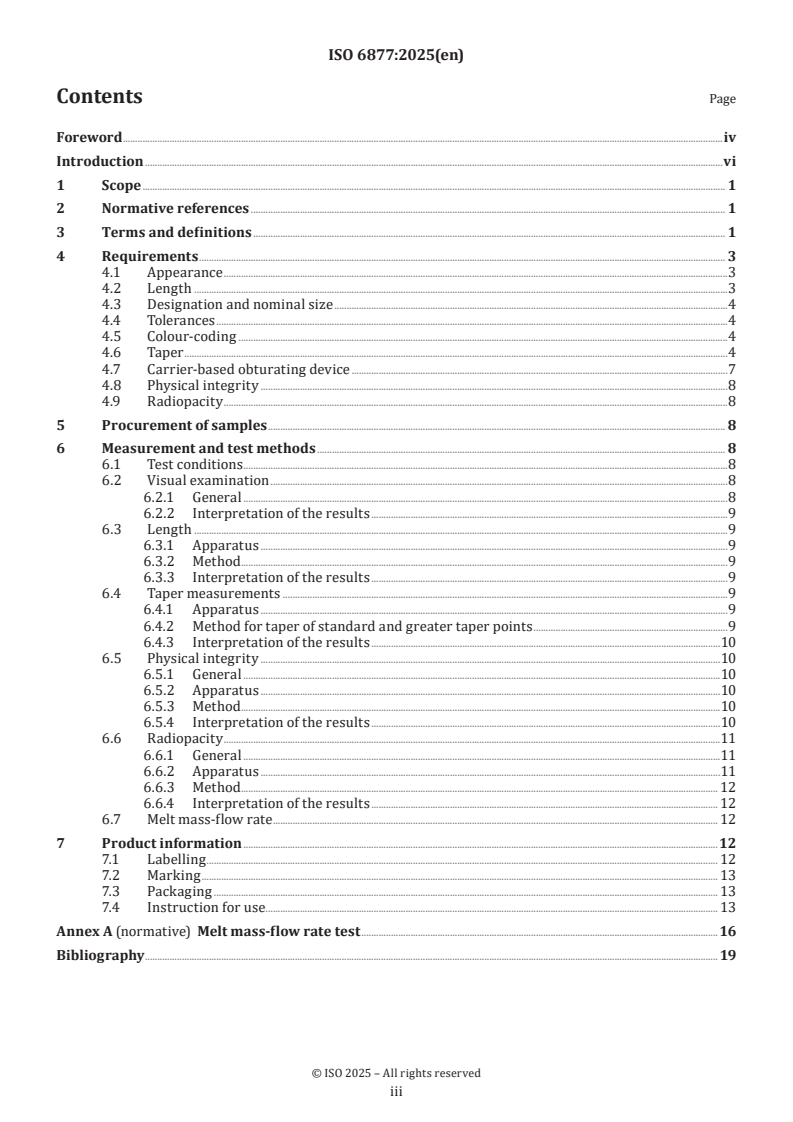
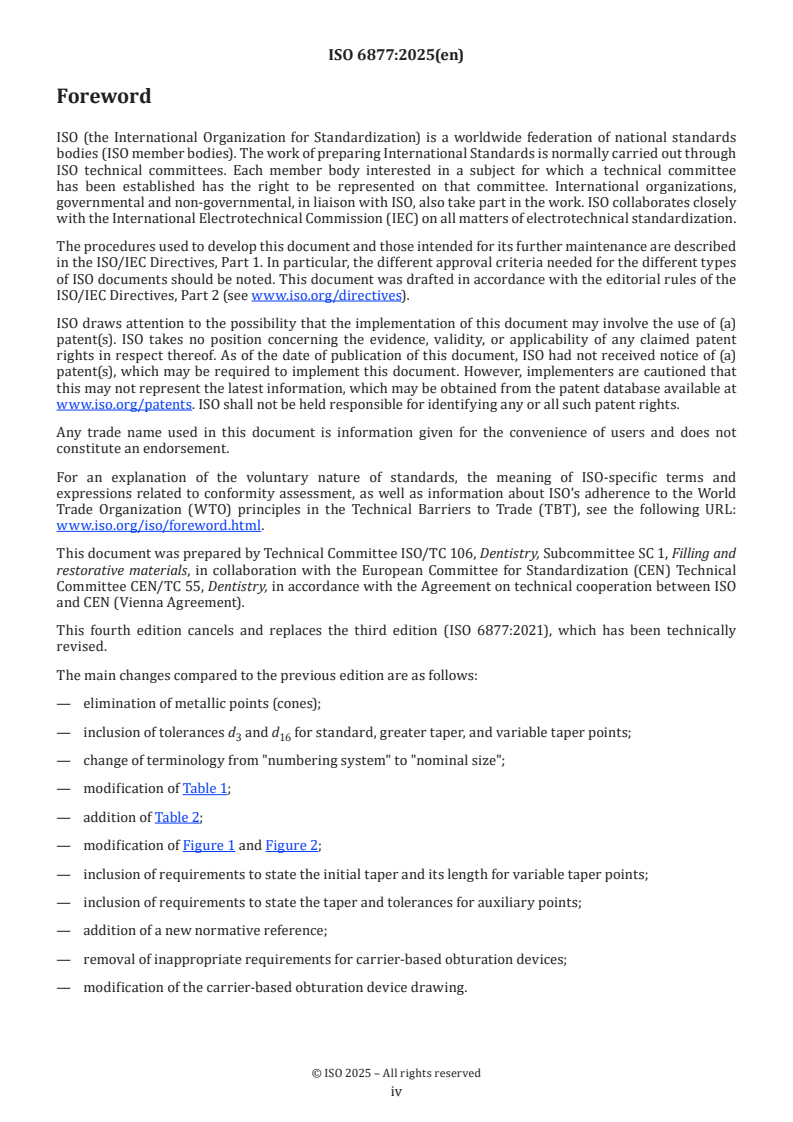
ISO 6877:2025 - Dentistry — Endodontic obturating materials Released:1. 08. 2025
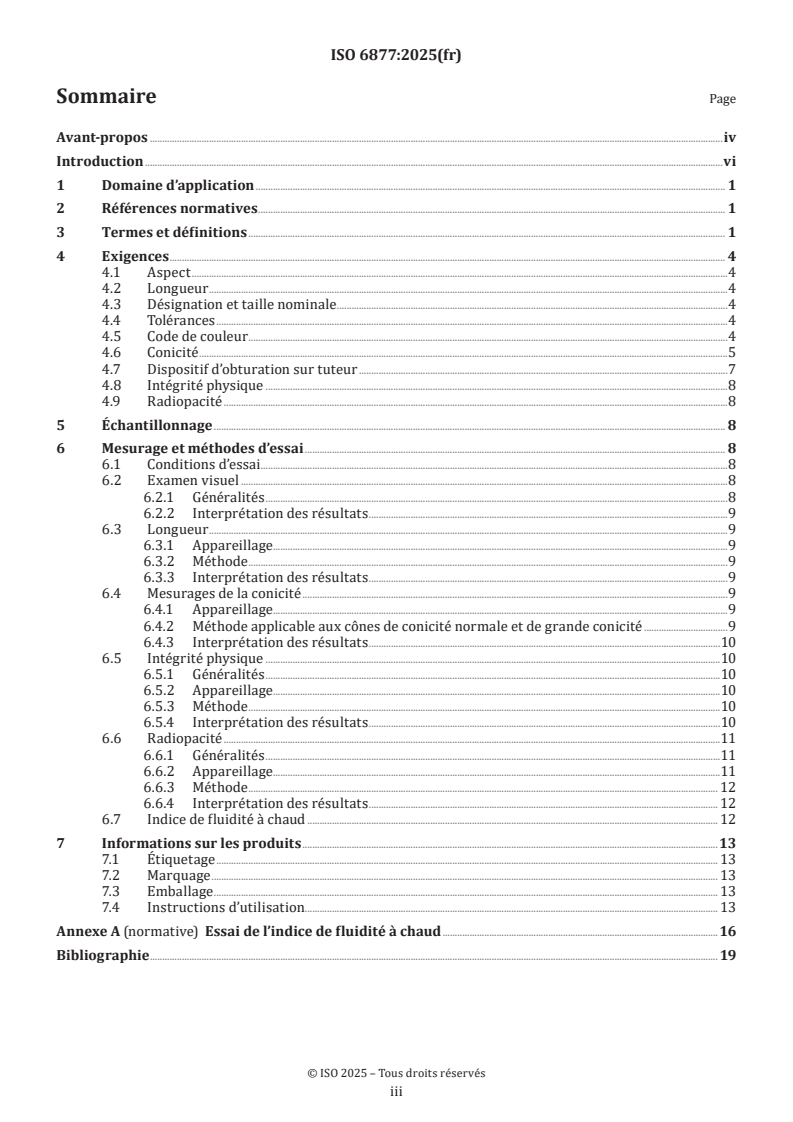
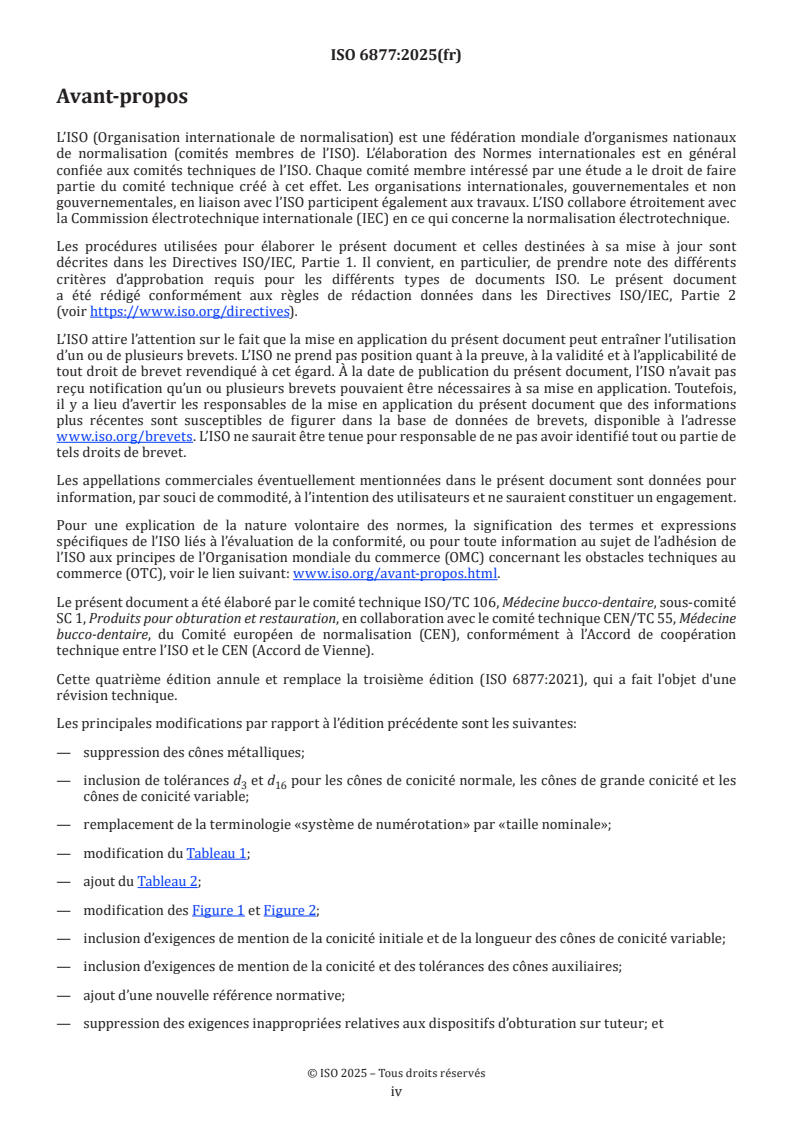
ISO 6877:2025 - Médecine bucco-dentaire — Matériaux d’obturation endodontique Released:1. 08. 2025
Overview
ISO 6877:2025 - "Dentistry - Endodontic obturating materials" defines dimensional, radiographic and information requirements for materials used to obturate (fill and seal) root canal systems. The fourth edition focuses on polymeric points, polymeric‑coated thermoplastic carriers, non‑point thermoplastic materials, and combinations thereof. It standardizes size designation, colour‑coding, test methods (including a melt mass‑flow rate for injectable materials) and product information (marking, labelling, packaging, instructions for use).
Key topics and requirements
- Scope and exclusions
- Applies to preformed points, carrier‑based devices and injection materials used with endodontic sealing materials.
- Does not address sterility - any sterile claims are the manufacturer’s responsibility; sterilization validation follows national regulations and relevant pharmacopeia.
- Excludes instruments or apparatus used to heat obturating materials or materials intended to support coronal restorations.
- Dimensions and tolerances
- Requirements for length, nominal size (numerical designation), taper (including variable and greater tapers) and specified tolerances.
- New/updated tolerance specifications and requirements to state initial taper and its length for variable taper points.
- Designation and colour‑coding
- Numerical system for nominal size (diameter at the tip) and standardized colour‑coding to identify sizes consistently.
- Physical integrity and radiopacity
- Tests and acceptance criteria for structural integrity of points/carriers.
- Radiopacity requirements for polymeric materials and coated carriers to ensure radiographic detection (test methods referenced).
- Test methods
- Measurement procedures for length, taper, physical integrity and radiopacity (references ISO 13116).
- Melt mass‑flow rate test method for injectable materials (normative Annex A).
- Product information
- Clause 7: marking, labelling, packaging and instructions for use; alignment with ISO 20417 and ISO 15223‑1.
Applications and users
Who benefits:
- Dental device manufacturers - product design, dimensional controls, labelling and regulatory submissions.
- Quality and regulatory teams - conformity assessment, technical files and sterilization claims.
- Testing and calibration laboratories - implementing measurement and radiopacity methods.
- Endodontists and dental clinics - clearer, consistent sizing and radiographic visibility for clinical decision making.
- Procurement and distributors - specification, acceptance and traceability of obturating materials.
Practical uses:
- Standardizing preformed point sizes and colour codes across product lines.
- Ensuring radiographic detectability of polymeric obturating products.
- Defining test methods for production quality control and batch release.
Related standards
- ISO 13116 - Test method for radiopacity of materials
- ISO 20417 - Medical device information supplied by the manufacturer
- ISO 15223‑1 - Symbols for medical device information
- ISO 3630‑1, ISO 1942 - Dentistry vocabulary and instrument requirements
- ISO/IEC 17025 - Laboratory competence
Keywords: ISO 6877:2025, endodontic obturating materials, polymeric points, radiopacity, melt mass‑flow rate, nominal size, taper, colour‑coding, dental standards.
Relations
- Effective Date
- 12-Feb-2026
- Effective Date
- 06-Jun-2022
- Effective Date
- 06-Jun-2022
Buy Documents
ISO 6877:2025 - Dentistry — Endodontic obturating materials Released:1. 08. 2025
ISO 6877:2025 - Médecine bucco-dentaire — Matériaux d’obturation endodontique Released:1. 08. 2025
Get Certified
Connect with accredited certification bodies for this standard

BSI Group
BSI (British Standards Institution) is the business standards company that helps organizations make excellence a habit.

TÜV Rheinland
TÜV Rheinland is a leading international provider of technical services.

TÜV SÜD
TÜV SÜD is a trusted partner of choice for safety, security and sustainability solutions.
Sponsored listings
Frequently Asked Questions
ISO 6877:2025 is a standard published by the International Organization for Standardization (ISO). Its full title is "Dentistry — Endodontic obturating materials". This standard covers: This document specifies the requirements for the dimensions of various endodontic obturating materials and the radiopacity for polymeric points, polymeric-coated thermoplastic obturating carriers, non-point-shaped thermoplastic obturating material, or combinations of the above used for obturation of a root canal system. It also specifies numerical and colour-coding systems for designating the sizes of preformed endodontic obturating points, a method for determining the melt mass-flow rate for injection material, and the requirements for marking, labelling, packaging and the instructions for use. Dental endodontic obturating points are marketed as sterilized or non-sterilized. Sterility is not included in this document. Any claim that the product is sterile is the manufacturer's responsibility (see Table 3). This document does not apply to instruments or apparatus used with obturating materials that become plastic with heat or materials supporting a coronal restoration. Clause 7 08D0C9EA79F9BACE118C8200AA004BA90B02000000080000000E000000530065006300740069006F006E005F007300650063005F0037000000 specifies marking, labelling and packaging, including the instructions for use. This document does not specify requirements or test methods for sterility. Reference to applicable national regulations, internationally accepted pharmacopoeia and standards for validating sterilization processes can apply.
This document specifies the requirements for the dimensions of various endodontic obturating materials and the radiopacity for polymeric points, polymeric-coated thermoplastic obturating carriers, non-point-shaped thermoplastic obturating material, or combinations of the above used for obturation of a root canal system. It also specifies numerical and colour-coding systems for designating the sizes of preformed endodontic obturating points, a method for determining the melt mass-flow rate for injection material, and the requirements for marking, labelling, packaging and the instructions for use. Dental endodontic obturating points are marketed as sterilized or non-sterilized. Sterility is not included in this document. Any claim that the product is sterile is the manufacturer's responsibility (see Table 3). This document does not apply to instruments or apparatus used with obturating materials that become plastic with heat or materials supporting a coronal restoration. Clause 7 08D0C9EA79F9BACE118C8200AA004BA90B02000000080000000E000000530065006300740069006F006E005F007300650063005F0037000000 specifies marking, labelling and packaging, including the instructions for use. This document does not specify requirements or test methods for sterility. Reference to applicable national regulations, internationally accepted pharmacopoeia and standards for validating sterilization processes can apply.
ISO 6877:2025 is classified under the following ICS (International Classification for Standards) categories: 11.060.10 - Dental materials. The ICS classification helps identify the subject area and facilitates finding related standards.
ISO 6877:2025 has the following relationships with other standards: It is inter standard links to EN ISO 6877:2025, ISO 13919-2:2021, ISO 6877:2021. Understanding these relationships helps ensure you are using the most current and applicable version of the standard.
ISO 6877:2025 is available in PDF format for immediate download after purchase. The document can be added to your cart and obtained through the secure checkout process. Digital delivery ensures instant access to the complete standard document.
Standards Content (Sample)
International
Standard
ISO 6877
Fourth edition
Dentistry — Endodontic obturating
2025-08
materials
Médecine bucco-dentaire — Matériaux d’obturation
endodontique
Reference number
© ISO 2025
All rights reserved. Unless otherwise specified, or required in the context of its implementation, no part of this publication may
be reproduced or utilized otherwise in any form or by any means, electronic or mechanical, including photocopying, or posting on
the internet or an intranet, without prior written permission. Permission can be requested from either ISO at the address below
or ISO’s member body in the country of the requester.
ISO copyright office
CP 401 • Ch. de Blandonnet 8
CH-1214 Vernier, Geneva
Phone: +41 22 749 01 11
Email: copyright@iso.org
Website: www.iso.org
Published in Switzerland
ii
Contents Page
Foreword .iv
Introduction .vi
1 Scope . 1
2 Normative references . 1
3 Terms and definitions . 1
4 Requirements . 3
4.1 Appearance .3
4.2 Length .3
4.3 Designation and nominal size .4
4.4 Tolerances .4
4.5 Colour-coding .4
4.6 Taper .4
4.7 Carrier-based obturating device .7
4.8 Physical integrity .8
4.9 Radiopacity .8
5 Procurement of samples . 8
6 Measurement and test methods . 8
6.1 Test conditions .8
6.2 Visual examination .8
6.2.1 General .8
6.2.2 Interpretation of the results .9
6.3 Length .9
6.3.1 Apparatus .9
6.3.2 Method . .9
6.3.3 Interpretation of the results .9
6.4 Taper measurements .9
6.4.1 Apparatus .9
6.4.2 Method for taper of standard and greater taper points .9
6.4.3 Interpretation of the results .10
6.5 Physical integrity .10
6.5.1 General .10
6.5.2 Apparatus .10
6.5.3 Method . .10
6.5.4 Interpretation of the results .10
6.6 Radiopacity .11
6.6.1 General .11
6.6.2 Apparatus .11
6.6.3 Method . . 12
6.6.4 Interpretation of the results . 12
6.7 Melt mass-flow rate . 12
7 Product information .12
7.1 Labelling . 12
7.2 Marking . 13
7.3 Packaging . 13
7.4 Instruction for use . . 13
Annex A (normative) Melt mass-flow rate test .16
Bibliography . 19
iii
Foreword
ISO (the International Organization for Standardization) is a worldwide federation of national standards
bodies (ISO member bodies). The work of preparing International Standards is normally carried out through
ISO technical committees. Each member body interested in a subject for which a technical committee
has been established has the right to be represented on that committee. International organizations,
governmental and non-governmental, in liaison with ISO, also take part in the work. ISO collaborates closely
with the International Electrotechnical Commission (IEC) on all matters of electrotechnical standardization.
The procedures used to develop this document and those intended for its further maintenance are described
in the ISO/IEC Directives, Part 1. In particular, the different approval criteria needed for the different types
of ISO documents should be noted. This document was drafted in accordance with the editorial rules of the
ISO/IEC Directives, Part 2 (see www.iso.org/directives).
ISO draws attention to the possibility that the implementation of this document may involve the use of (a)
patent(s). ISO takes no position concerning the evidence, validity, or applicability of any claimed patent
rights in respect thereof. As of the date of publication of this document, ISO had not received notice of (a)
patent(s), which may be required to implement this document. However, implementers are cautioned that
this may not represent the latest information, which may be obtained from the patent database available at
www.iso.org/patents. ISO shall not be held responsible for identifying any or all such patent rights.
Any trade name used in this document is information given for the convenience of users and does not
constitute an endorsement.
For an explanation of the voluntary nature of standards, the meaning of ISO-specific terms and
expressions related to conformity assessment, as well as information about ISO's adherence to the World
Trade Organization (WTO) principles in the Technical Barriers to Trade (TBT), see the following URL:
www.iso.org/iso/foreword.html.
This document was prepared by Technical Committee ISO/TC 106, Dentistry, Subcommittee SC 1, Filling and
restorative materials, in collaboration with the European Committee for Standardization (CEN) Technical
Committee CEN/TC 55, Dentistry, in accordance with the Agreement on technical cooperation between ISO
and CEN (Vienna Agreement).
This fourth edition cancels and replaces the third edition (ISO 6877:2021), which has been technically
revised.
The main changes compared to the previous edition are as follows:
— elimination of metallic points (cones);
— inclusion of tolerances d and d for standard, greater taper, and variable taper points;
3 16
— change of terminology from "numbering system" to "nominal size";
— modification of Table 1;
— addition of Table 2;
— modification of Figure 1 and Figure 2;
— inclusion of requirements to state the initial taper and its length for variable taper points;
— inclusion of requirements to state the taper and tolerances for auxiliary points;
— addition of a new normative reference;
— removal of inappropriate requirements for carrier-based obturation devices;
— modification of the carrier-based obturation device drawing.
iv
Any feedback or questions on this document should be directed to the user’s national standards body. A
complete listing of these bodies can be found at www.iso.org/members.html.
v
Introduction
The following information should be considered when using this document: specific qualitative and
quantitative test methods for demonstrating freedom from unacceptable biological risks are not included in
this document, but it is recommended that, for the assessment of such biological risks, reference be made to
ISO 7405 and ISO 10993-1. No performance limits are provided in this document for melt mass-flow rate, but
they can be added in the future.
vi
International Standard ISO 6877:2025(en)
Dentistry — Endodontic obturating materials
1 Scope
This document specifies the requirements for the dimensions of various endodontic obturating materials
and the radiopacity for polymeric points, polymeric-coated thermoplastic obturating carriers, non-point-
shaped thermoplastic obturating material, or combinations of the above used for obturation of a root
canal system. It also specifies numerical and colour-coding systems for designating the sizes of preformed
endodontic obturating points, a method for determining the melt mass-flow rate for injection material, and
the requirements for marking, labelling, packaging and the instructions for use.
Dental endodontic obturating points are marketed as sterilized or non-sterilized. Sterility is not included in
this document. Any claim that the product is sterile is the manufacturer's responsibility (see Table 3). This
document does not apply to instruments or apparatus used with obturating materials that become plastic
with heat or materials supporting a coronal restoration.
Clause 7 specifies marking, labelling and packaging, including the instructions for use. This document
does not specify requirements or test methods for sterility. Reference to applicable national regulations,
internationally accepted pharmacopoeia and standards for validating sterilization processes can apply.
2 Normative references
The following documents are referred to in the text in such a way that some or all of their content constitutes
the requirements of this document. For dated references, only the edition cited applies. The latest edition of
the referenced document (including any amendments) applies for undated references.
ISO 1942, Dentistry — Vocabulary
ISO 3630-1, Dentistry — Endodontic instruments — Part 1: General requirements
ISO 3665, Photography — Intra-oral dental radiographic film and film packets — Manufacturer specifications
ISO 8601-1, Date and time — Representations for information interchange — Part 1: Basic rules
ISO 13116:2014, Dentistry — Test method for determining radio-opacity of materials
ISO 15223-1, Medical devices — Symbols to be used with information to be supplied by the manufacturer — Part
1: General requirements
ISO/IEC 17025, General requirements for the competence of testing and calibration laboratories
ISO 20417, Medical devices — Information to be supplied by the manufacturer
3 Terms and definitions
For the purposes of this document, the terms and definitions given in ISO 1942, ISO 3630-1 and the
following apply.
ISO and IEC maintain terminological databases for use in standardization at the following addresses:
— ISO Online browsing platform: available at https:// www .iso .org/ obp
— IEC Electropedia: available at http:// www .electropedia .org
3.1
endodontic sealing material
material intended to permanently seal the root canal system usually used in combination with endodontic
obturating materials (3.2) during orthograde obturation, i.e. filling a root canal from the coronal part of a
tooth, or materials used for other endodontic sealing procedures including apexification, perforation filling,
resorption or retrograde root-end filling
Note 1 to entry: Endodontic sealing material is within the scope of ISO 6876.
3.2
endodontic obturating material
radiopaque dental material used in the form of a point (3.3), carrier-based obturating device, or injection
material used in combination with an endodontic sealing material (3.1) to fill voids and seal root canals
during orthograde obturation
3.3
point
preformed polymeric cone for use in the obturation of a root canal system, used with endodontic sealing
material (3.1)
Note 1 to entry: For the purposes of this document, the term “endodontic obturating point (cone)” is abbreviated as
“point”.
Note 2 to entry: For the purposes of this document, the term "tip" refers to the smaller end of the point (cone) inserted
towards the apex.
3.4
nominal size
D
general designation of a point (3.3), based on the size of the calculated diameter at the end of the point with
the extended taper of the point in hundredths of a millimetre
Note 1 to entry: The nominal size is described by “###” representing the size of D in hundredths of a millimetre.
Note 2 to entry: See Figure 1 for standard and greater taper points, where the determination of the nominal size is
shown. For variable taper points, the extended diameter of the initial taper is used to determine D.
Note 3 to entry: For a carrier-based obturating device, D is designated by the manufacturer. D corresponds to the final
instrument size of the root canal preparation that the manufacturer deems suitable for the nominal size, D, of the device.
3.5
taper
percentage increase in diameter from the tip to the proximal end of the point (3.3), indicated by two numbers
EXAMPLE An 02 taper represents a nominal 2 % increase in diameter from the tip to the proximal end of the point.
Note 1 to entry: The manufacturer designates the taper for a carrier-based obturating device.
3.6
standard point
point (3.3) that has a uniform 02 taper (3.5) over the first 16 mm from the tip to the proximal end of the point
3.7
greater taper point
point (3.3) that has a uniform taper (3.5) greater than 02 over the first 16 mm from the tip to the proximal
end of the point
3.8
variable taper point
point (3.3) that has multiple tapers that decrease over the first 16 mm from the tip to the proximal end of
the point
Note 1 to entry: The first taper, nearest the tip, is considered the initial taper.
3.9
auxiliary point
point (3.3), excepting standard point (3.6), greater taper point (3.7), and variable taper point (3.8)
Note 1 to entry: Auxiliary points are not subject to nominal size (3.4) requirements.
3.10
carrier-based obturating device
thermoplastic polymeric material coated on a core or carrier material, used to obturate a root canal
Note 1 to entry: The core material can remain in the canal or can be removed after carrying the thermoplastic material
into the root canal.
Note 2 to entry: Nominal size (3.4) and taper (3.5) of a carrier-based obturating device corresponds to the final
instrument taper of the root canal preparation that the manufacturer deems suitable for the nominal size of the device.
Note 3 to entry: Carrier-based obturating devices require a heating system, which is different from an injection
system (3.12).
3.11
injection material
endodontic obturating material (3.1) supplied in non-point form, such as pellets, which become plastic after
being warmed, for injection in a root canal system
3.12
injection system
device designed to dispense warmed thermoplastic injection material (3.11) for obturation of a root canal system
3.13
melt mass-flow rate
MFR
measure of flow through a capillary of a thermoplastic injection material (3.11) at a particular temperature,
measured in grams per unit of time under a given force
Note 1 to entry: Thermoplastic materials may be placed into a root canal system using an injection system (3.12).
3.14
unit pack
smallest pack of points (3.3) distributed, containing one or more sizes of point or carrier-based obturating
device (3.10)
3.15
radiopacity
property of materials to obstruct the passage of X-rays through the material, appearing grey or white on an
exposed film or sensor image
4 Requirements
4.1 Appearance
A point shall be smooth, uniform, and free from extraneous matter throughout its length. Test in accordance
with 6.2.
4.2 Length
The overall length, l , shall be not less than 28 mm, unless otherwise stated by the manufacturer. If some
tot
other length is stated, the point shall not be less than the stated length. Test in accordance with 6.3.
4.3 Designation and nominal size
The designations for the standard point, the greater taper point, the initial taper of a variable taper point,
and the carrier-based obturating device shall be in the form of a five-digit numerical set consisting of two
parts: ### XX, where ### corresponds to the nominal size and XX corresponds to the two significant
figures of the taper percent. The nominal size designation shall be accompanied by its specified colour or its
abbreviation.
The nominal size of the tip, D, except for auxiliary points, shall be in accordance with the numbering system
shown in Tables 1 and 2.
EXAMPLE A point of nominal size 040 and 2 % taper is designated as 040 02 and has black colour coding.
4.4 Tolerances
The tolerances of the diameters of a standard point and a greater taper point for d and d (see Figure 1)
3 16
shall be:
— ±0,05 mm for polymeric points or carrier-based obturating devices of sizes 008 to 025;
— ±0,07 mm for polymeric points of carrier-based obturating devices of sizes 030 to 140.
The dimensions of standard points and greater taper points shall conform to Table 1 and Figure 1.
For a variable taper point of a given nominal size, the manufacturer shall state the initial taper and its
length, that is, the first taper of the point nearest the tip. Reference locations (distance from the tip) within
the initial taper shall be designated as l and l (l < l ), and the corresponding diameters shall be defined as
x y x y
d and d .
x y
The tolerance of the diameters shall be ±0,05 mm for sizes 008 to 025 and ±0,07 mm for sizes 030 to 140,
and they shall be verified to be within tolerance. The initial taper length shall be stated as ±0,1 mm.
The tolerance of the diameters of an auxiliary point for d and d shall be ±0,05 mm. The diameters d and
3 16 3
d of auxiliary points at l and l shall be verified to be within tolerance.
16 3 16
Test in accordance with 6.4 and ISO 3630-1.
4.5 Colour-coding
The unit pack shall have a colour corresponding to the nominal size, D, in Table 1 for a standard point, greater
taper point, variable taper point or carrier-based obturating device.
Colour-coding is optional on the individual points or carrier-based obturators; if used, the colours shall
conform to Table 1.
If a manufacturer chooses to colour-code an auxiliary point, the colour shall be other than those in Table 1.
NOTE A colour code system is not defined for taper.
4.6 Taper
a) The taper of a standard point, a greater taper point and an auxiliary point shall be uniform for a
minimum of 16 mm from the tip (see Figure 1), increasing at the taper designated by the manufacturer
along the length.
b) Table 1 lists the dimensions for d and d for standard taper points of nominal sizes from 008 to 140.
3 16
c) Table 2 lists the dimensions for d and d for greater taper points of nominal sizes from 008 to 140.
3 16
d) The manufacturer shall designate the taper of the variable taper points.
e) The manufacturer shall state the taper and the length of the taper closest to the tip by providing the
dimensions of l and l .
x y
f) The
...
Norme
internationale
ISO 6877
Quatrième édition
Médecine bucco-dentaire —
2025-08
Matériaux d’obturation
endodontique
Dentistry — Endodontic obturating materials
Numéro de référence
DOCUMENT PROTÉGÉ PAR COPYRIGHT
© ISO 2025
Tous droits réservés. Sauf prescription différente ou nécessité dans le contexte de sa mise en œuvre, aucune partie de cette
publication ne peut être reproduite ni utilisée sous quelque forme que ce soit et par aucun procédé, électronique ou mécanique,
y compris la photocopie, ou la diffusion sur l’internet ou sur un intranet, sans autorisation écrite préalable. Une autorisation peut
être demandée à l’ISO à l’adresse ci-après ou au comité membre de l’ISO dans le pays du demandeur.
ISO copyright office
Case postale 401 • Ch. de Blandonnet 8
CH-1214 Vernier, Genève
Tél.: +41 22 749 01 11
E-mail: copyright@iso.org
Web: www.iso.org
Publié en Suisse
ii
Sommaire Page
Avant-propos .iv
Introduction .vi
1 Domaine d’application . 1
2 Références normatives . 1
3 Termes et définitions . 1
4 Exigences . 4
4.1 Aspect .4
4.2 Longueur .4
4.3 Désignation et taille nominale .4
4.4 Tolérances .4
4.5 Code de couleur .4
4.6 Conicité .5
4.7 Dispositif d’obturation sur tuteur .7
4.8 Intégrité physique .8
4.9 Radiopacité .8
5 Échantillonnage . 8
6 Mesurage et méthodes d’essai . 8
6.1 Conditions d’essai . . .8
6.2 Examen visuel .8
6.2.1 Généralités .8
6.2.2 Interprétation des résultats .9
6.3 Longueur .9
6.3.1 Appareillage.9
6.3.2 Méthode .9
6.3.3 Interprétation des résultats .9
6.4 Mesurages de la conicité .9
6.4.1 Appareillage.9
6.4.2 Méthode applicable aux cônes de conicité normale et de grande conicité .9
6.4.3 Interprétation des résultats .10
6.5 Intégrité physique .10
6.5.1 Généralités .10
6.5.2 Appareillage.10
6.5.3 Méthode .10
6.5.4 Interprétation des résultats .10
6.6 Radiopacité .11
6.6.1 Généralités .11
6.6.2 Appareillage.11
6.6.3 Méthode . 12
6.6.4 Interprétation des résultats . 12
6.7 Indice de fluidité à chaud . 12
7 Informations sur les produits .13
7.1 Étiquetage . 13
7.2 Marquage . 13
7.3 Emballage . 13
7.4 Instructions d’utilisation . . 13
Annexe A (normative) Essai de l’indice de fluidité à chaud .16
Bibliographie . 19
iii
Avant-propos
L’ISO (Organisation internationale de normalisation) est une fédération mondiale d’organismes nationaux
de normalisation (comités membres de l’ISO). L’élaboration des Normes internationales est en général
confiée aux comités techniques de l’ISO. Chaque comité membre intéressé par une étude a le droit de faire
partie du comité technique créé à cet effet. Les organisations internationales, gouvernementales et non
gouvernementales, en liaison avec l’ISO participent également aux travaux. L’ISO collabore étroitement avec
la Commission électrotechnique internationale (IEC) en ce qui concerne la normalisation électrotechnique.
Les procédures utilisées pour élaborer le présent document et celles destinées à sa mise à jour sont
décrites dans les Directives ISO/IEC, Partie 1. Il convient, en particulier, de prendre note des différents
critères d’approbation requis pour les différents types de documents ISO. Le présent document
a été rédigé conformément aux règles de rédaction données dans les Directives ISO/IEC, Partie 2
(voir https://www.iso.org/directives).
L’ISO attire l’attention sur le fait que la mise en application du présent document peut entraîner l’utilisation
d’un ou de plusieurs brevets. L’ISO ne prend pas position quant à la preuve, à la validité et à l’applicabilité de
tout droit de brevet revendiqué à cet égard. À la date de publication du présent document, l’ISO n’avait pas
reçu notification qu’un ou plusieurs brevets pouvaient être nécessaires à sa mise en application. Toutefois,
il y a lieu d’avertir les responsables de la mise en application du présent document que des informations
plus récentes sont susceptibles de figurer dans la base de données de brevets, disponible à l’adresse
www.iso.org/brevets. L’ISO ne saurait être tenue pour responsable de ne pas avoir identifié tout ou partie de
tels droits de brevet.
Les appellations commerciales éventuellement mentionnées dans le présent document sont données pour
information, par souci de commodité, à l’intention des utilisateurs et ne sauraient constituer un engagement.
Pour une explication de la nature volontaire des normes, la signification des termes et expressions
spécifiques de l’ISO liés à l’évaluation de la conformité, ou pour toute information au sujet de l’adhésion de
l’ISO aux principes de l’Organisation mondiale du commerce (OMC) concernant les obstacles techniques au
commerce (OTC), voir le lien suivant: www.iso.org/avant-propos.html.
Le présent document a été élaboré par le comité technique ISO/TC 106, Médecine bucco-dentaire, sous-comité
SC 1, Produits pour obturation et restauration, en collaboration avec le comité technique CEN/TC 55, Médecine
bucco-dentaire, du Comité européen de normalisation (CEN), conformément à l’Accord de coopération
technique entre l’ISO et le CEN (Accord de Vienne).
Cette quatrième édition annule et remplace la troisième édition (ISO 6877:2021), qui a fait l'objet d'une
révision technique.
Les principales modifications par rapport à l’édition précédente sont les suivantes:
— suppression des cônes métalliques;
— inclusion de tolérances d et d pour les cônes de conicité normale, les cônes de grande conicité et les
3 16
cônes de conicité variable;
— remplacement de la terminologie «système de numérotation» par «taille nominale»;
— modification du Tableau 1;
— ajout du Tableau 2;
— modification des Figure 1 et Figure 2;
— inclusion d’exigences de mention de la conicité initiale et de la longueur des cônes de conicité variable;
— inclusion d’exigences de mention de la conicité et des tolérances des cônes auxiliaires;
— ajout d’une nouvelle référence normative;
— suppression des exigences inappropriées relatives aux dispositifs d’obturation sur tuteur; et
iv
— modification de la représentation schématique du dispositif d’obturation sur tuteur.
Il convient que l’utilisateur adresse tout retour d’information ou toute question concernant le présent
document à l’organisme national de normalisation de son pays. Une liste exhaustive desdits organismes se
trouve à l’adresse www.iso.org/members.html.
v
Introduction
Il convient de tenir compte des informations suivantes lors de l’utilisation du présent document: les méthodes
d’essai qualitatives et quantitatives spécifiques permettant de démontrer l’absence de risques biologiques
inacceptables ne sont pas incluses dans le présent document. Il est toutefois recommandé, pour l’évaluation
de ces risques biologiques, de se reporter à l’ISO 7405 et à l’ISO 10993-1. Les limites de performance ne sont
pas fournies dans le présent document concernant l’indice de fluidité à chaud en masse, mais elles peuvent
être ajoutées plus tard.
vi
Norme internationale ISO 6877:2025(fr)
Médecine bucco-dentaire — Matériaux d’obturation
endodontique
1 Domaine d’application
Le présent document spécifie les exigences pour les dimensions de divers matériaux d’obturation
endodontique et pour la radiopacité des cônes polymères, des matériaux d’obturation thermoplastiques
revêtus de polymère, des matériaux d’obturation thermoplastiques qui ne sont pas en forme de cônes ou les
combinaisons de ceux-ci, qui sont utilisés dans le cadre de l’obturation d’un système de canaux radiculaires.
Il spécifie également des systèmes numériques et un système de code de couleur pour la désignation des
tailles de cônes d’obturation endodontique préformés, une méthode de détermination de l’indice de fluidité
à chaud en masse pour le matériau d'injection ainsi que les exigences relatives au marquage, à l’étiquetage, à
l’emballage et aux instructions d’utilisation.
Les cônes d'obturation endodontique sont commercialisés stérilisés ou non stérilisés. La stérilité n’est pas
abordée dans le présent document et toute revendication indiquant que le produit est stérile n’engage que le
fabricant (voir Tableau 3). Le présent document ne s’applique pas aux instruments ou à l’appareillage utilisés
avec des matériaux d’obturation qui se plastifient sous l’effet de la chaleur ou des matériaux utilisés pour
l’ancrage d’une restauration coronaire.
L’Article 7 spécifie le marquage, l’étiquetage et l’emballage, y compris les instructions d’utilisation. Le
présent document ne spécifie aucune exigence ou méthode d’essai relative à la stérilité. Toute référence aux
réglementations nationales en vigueur, à la pharmacopée reconnue au niveau mondial et aux normes sur la
validation des procédés de stérilisation peut s’appliquer.
2 Références normatives
Les documents suivants sont cités dans le texte de sorte qu’ils constituent, pour tout ou partie de leur
contenu, des exigences du présent document. Pour les références datées, seule l’édition citée s’applique. Pour
les références non datées, la dernière édition du document de référence s’applique (y compris les éventuels
amendements).
ISO 1942, Médecine bucco-dentaire — Vocabulaire
ISO 3630-1, Médecine bucco-dentaire — Instruments d'endodontie — Partie 1: Exigences générales
ISO 3665, Photographie — Film et paquets de films pour la radiographie dentaire intrabuccale — Spécifications
ISO 8601-1, Date et heure — Représentations pour l'échange d'information — Partie 1: Règles de base
ISO 13116:2014, Médecine bucco-dentaire — Méthodes de détermination de la radio opacité des matériaux
ISO 15223-1, Dispositifs médicaux — Symboles à utiliser avec les informations à fournir par le fabricant —
Partie 1: Exigences générales
ISO/IEC 17025, Exigences générales concernant la compétence des laboratoires d'étalonnages et d'essais
ISO 20417, Dispositifs médicaux — Informations à fournir par le fabricant
3 Termes et définitions
Pour les besoins du présent document, les termes et les définitions de l’ISO 1942, ISO 3630-1 ainsi que les
suivants, s’appliquent.
L’ISO et l’IEC tiennent à jour des bases de données terminologiques destinées à être utilisées en normalisation,
consultables aux adresses suivantes:
— ISO Online browsing platform: disponible à l’adresse https:// www .iso .org/ obp
— IEC Electropedia: disponible à l’adresse https:// www .electropedia .org/
3.1
matériau de scellement endodontique
matériau destiné à sceller définitivement le système de canaux radiculaires, généralement en association
avec des cônes d’obturation endodontique pendant l’«obturation orthograde», et utilisé pour d’autres
interventions de scellement endodontique, notamment l’apexification, l’obturation de perforations,
l’obturation de résorptions ou l’obturation radiculaire rétrograde
Note 1 à l'article: Le matériau de scellement endodontique fait partie du domaine d’application de l’ISO 6876.
3.2
matériau d’obturation endodontique
matériau dentaire radio-opaque utilisé sous forme de cône (3.3), dispositif d’obturation sur tuteur, ou
matériau d’injection utilisé en association avec un matériau de scellement endodontique (3.1) pour remplir les
vides et sceller les canaux radiculaires pendant une obturation orthograde
3.3
cône
cône polymère préformé pouvant être utilisé dans le cadre de l’obturation d’un système de canaux
radiculaires, utilisé avec un matériau de scellement endodontique (3.1)
Note 1 à l'article: Pour les besoins du présent document, le terme «cône d'obturation endodontique» est abrégé en «cône».
Note 2 à l'article: Pour les besoins du présent document, le terme «pointe» désigne la petite extrémité du cône insérée
vers le sommet.
3.4
taille nominale
D
désignation générale d’un cône (3.3), d’après la taille du diamètre calculé à l’extrémité du cône avec la
conicité étendue du cône en centièmes de millimètre
Note 1 à l'article: La taille nominale décrite par le symbole «###» représentant la taille de D en centièmes de millimètre.
Note 2 à l'article: Pour les cônes de conicité normale et de grande conicité, voir la Figure 1 qui indique la détermination
de la taille nominale. Pour les cônes de conicité variable, le diamètre étendu de la conicité initiale est utilisé pour
déterminer D.
Note 3 à l'article: Pour un dispositif d’obturation sur tuteur, D est désignée par le fabricant. D correspond à la taille
finale de l'instrument de la préparation du canal radiculaire que le fabricant juge adaptée à la taille nominale, D, du
dispositif.
3.5
conicité
pourcentage d’augmentation du diamètre depuis la pointe jusqu’à l’extrémité proximale du cône (3.3),
indiqué par deux chiffres
EXEMPLE Une conicité 02 représente une augmentation nominale de 2 % du diamètre depuis la pointe jusqu’à
l’extrémité proximale du cône.
Note 1 à l'article: Le fabricant désigne la conicité d’un dispositif d’obturation sur tuteur.
3.6
cône de conicité normale
cône (3.3) ayant une conicité (3.5) 02 uniforme sur les 16 premiers millimètres depuis la pointe jusqu’à
l’extrémité proximale du cône
3.7
cône de grande conicité
cône (3.3) dont la conicité (3.5) uniforme est supérieure à 02 sur les 16 premiers millimètres depuis la pointe
jusqu’à l’extrémité proximale du cône
3.8
cône de conicité variable
cône (3.3) ayant plusieurs conicités qui diminuent sur les 16 premiers millimètres depuis la pointe jusqu’à
l’extrémité proximale du cône
Note 1 à l'article: La première conicité (la plus proche de la pointe) est considérée comme la conicité initiale.
3.9
cône auxiliaire
cône (3.3), à l’exception du cône de conicité normale (3.6), du cône de grande conicité (3.7) et du cône de conicité
variable (3.8)
Note 1 à l'article: Les cônes auxiliaires ne sont pas soumis aux exigences de taille nominale (3.4).
3.10
dispositif d’obturation sur tuteur
matériau polymère thermoplastique revêtu sur un matériau principal ou tuteur utilisé pour obturer un
canal radiculaire
Note 1 à l'article: Le matériau principal peut rester dans le canal ou peut être éliminé après injection du matériau
thermoplastique dans le canal radiculaire.
Note 2 à l'article: La taille nominale (3.4) et la conicité (3.5) d’un dispositif d’obturation sur tuteur correspondent à la
conicité finale de l’instrument de la préparation du canal radiculaire que le fabricant juge adaptée à la taille nominale
du dispositif.
Note 3 à l'article: Les dispositifs d’obturation sur tuteur nécessitent un système de chauffage différent d’un système
d’injection (3.12).
3.11
matériau d’injection
matériau d’obturation endodontique (3.1) fourni sous forme non conique, telle que des granulés, qui se
plastifient après avoir été réchauffés, destiné à être injecté dans un système de canaux radiculaires
3.12
système d’injection
dispositif conçu pour fournir un matériau d’injection (3.11) thermoplastique réchauffé pour obturer un
système de canaux radiculaires
3.13
indice de fluidité à chaud
MFR
mesure de l’écoulement à travers un capillaire d’un matériau d’injection (3.11) thermoplastique, à une
température particulière, mesurée en grammes par unité de temps sous une force donnée
Note 1 à l'article: Les matériaux thermoplastiques peuvent être placés dans un système de canaux radiculaires à l’aide
d’un système d’injection (3.12)
3.14
emballage unitaire
plus petit emballage de cônes (3.3) commercialisé, contenant une ou plusieurs tailles de cône ou de dispositif
d’obturation sur tuteur (3.10)
3.15
radiopacité
propriété de matériaux à obstruer le passage de l’énergie rayonnante, à travers le matériau, apparaissant de
couleur grise ou blanche sur le film exposé ou l’image du capteur
4 Exigences
4.1 Aspect
Sur toute sa longueur, le cône doit avoir un aspect lisse et uniforme et être exempt de matière étrangère.
Effectuer l’essai conformément à 6.2.
4.2 Longueur
Sauf indication contraire du fabricant, la longueur totale, l , ne doit pas être inférieure à 28 mm. Si une
tot
autre longueur est indiquée, le cône ne doit pas avoir une longueur inférieure à celle indiquée. Effectuer
l’essai conformément à 6.3.
4.3 Désignation et taille nominale
Les désignations de cône de conicité normale, cône de grande conicité, cône de conicité initiale, cône de
conicité variable et dispositif d’obturation sur tuteur doivent avoir la forme d’un nombre à cinq chiffres,
constitué de deux parties: ### XX, où ### correspond à la taille nominale et XX correspond aux deux
chiffres significatifs du pourcentage de conicité. La désignation de la taille nominale doit être accompagnée
de sa couleur spécifiée ou de son abréviation.
La taille nominale de la pointe, D, excepté pour les cônes auxiliaires, doit être en conformité avec le système
de numérotation indiqué dans les Tableaux 1 et 2.
EXEMPLE Un cône de taille nominale 040 et d’une conicité de 2 % est désigné par 040 02 et a un code de couleur noir.
4.4 Tolérances
Les tolérances sur les diamètres d’un cône de conicité normale et d’un cône de grande conicité pour d et d
3 16
(voir Figure 1) doivent être:
— ±0,05 mm pour les cônes polymères ou les dispositifs d’obturation sur tuteur de taille comprise entre
008 et 025;
— ±0,07 mm pour les cônes polymères ou les dispositifs d’obturation sur tuteur de taille comprise entre
030 et 140.
Les dimensions des cônes de conicité normale et des cônes de grande conicité doivent être conformes au
Tableau 1 et à la Figure 1.
Pour un cône de conicité variable d’une taille nominale donnée, le fabricant doit indiquer la conicité initiale
et sa longueur, c’est-à-dire la première conicité du cône le plus proche de la pointe. Des emplacements de
référence (distance depuis la pointe) dans la conicité initiale doivent être désignés par l et l (l < l ), et les
x y x y
diamètres correspondants doivent être désignés par d et d .
x y
La tolérance sur les diamètres doit être de ±0,05 mm pour les tailles 008 à 025, et de ±0,07 mm pour les tailles
030 à 140 et doit être dans les limites de tolérance. La longueur de la conicité initiale doit être de ±0,1 mm.
La tolérance sur les diamètres d’un cône auxiliaire pour d et d doit être de ±0,05 mm. Les diamètres d et
3 16 3
d des cônes auxiliaires à l et l doivent être dans les limites de tolérance.
16 3 16
Effectuer l’essai conformément à 6.4 et à l’ISO 3630-1.
4.5 Code de couleur
L'emballage unitaire doit avoir une couleur correspondant à la taille nominale, D, indiquée dans le Tableau 1
pour un cône de conicité normale, un cône de grande conicité, un cône de conicité variable ou un dispositif
d’obturation sur tuteur.
Le code de couleur est facultatif sur les cônes individuels ou sur les dispositifs d’obturation sur tuteur; s’il
est utilisé, les couleurs doivent être conformes au Tableau 1.
Si un fabricant choisit d’assigner un code de couleur à un cône auxiliaire, la couleur doit être différente de
celles indiquées dans le Tableau 1.
NOTE Aucun système de code de couleur n’est défini pour la conicité.
4.6 Conicité
a) La conicité d’un cône de conicité normale, d’un cône de grande conicité et d'un cône auxiliaire doit être
uniforme sur au moins 16 mm depuis la pointe (voir Figure 1), en augmentant au niveau de la conicité
désignée par le fabricant sur la longueur.
b) Le Tableau 1 indique les dimensions de d et d pour les tailles nominales de cônes de conicité normale
3 16
allant de 008 à 140.
c) Le Tableau 2 indique les dimensions de d et d pour les tailles nominales de cônes de grande conicité
3 16
allant de 008 à 140.
d) Le fabricant doit désigner la conicité des cônes de conicité variable.
e) IL doit indiquer la conicité et la longueur de la conicité la plus proche de la pointe en fournissant les
dimensions de l et l .
x y
f) La conicité doit être uniforme sur une distance minimale indiquée de l depuis la pointe.
y
g) Le fabricant doit indiquer la conicité d’un cône auxiliaire.
h) Effectuer l’essai conformément à 6.4.
Légende
D taille nominale
d diamètre à 3 mm
d diamètre à 16 mm
l longueur totale du cône
tot
NOTE 1 La taille nominale D et les diamètres d et d sont exprimés en centièmes de millimètres.
3 16
NOTE 2 Le Tableau 1 récapitule les valeurs de D, d et d pour chaque taille de cône de conicité normale.
3 16
NOTE 3 Le choix de la forme de la pointe est laissé à la discrétion du fabricant.
Figure 1 — Représentation schématique d’un cône de conicité normale ou de grande conicité
Tableau 1 — Désignation des tailles nomina
...