


ISO 16378:2013
(Main)Space systems — Measurements of thermo-optical properties of thermal control materials
Space systems — Measurements of thermo-optical properties of thermal control materials
ISO 16378:2013 specifies the multiple measurement methods, instruments, equipment, and samples used to calculate the thermo-optical properties of thermal control materials. It compares their features, indicates their limitations and biases, and guides the applications. These measurements will be performed at ground test facilities with the purpose of obtaining material properties. The measured properties will be used for material selection, thermal design of spacecraft, process control, quality control, etc. Also, on-orbit temperature data in the beginning of life can be assessed using the data obtained by ground measurement. Requirements for calibration and reference materials to ensure data quality are also defined. The following test methods are detailed in the annexes of ISO 16378:2013 including the configuration of samples and calculations: Solar absorptance using a spectrophotometer: (αs); Solar absorptance using the comparative test method: (αp); Hemispherical infrared emittance using the thermal test method: (εh-t); Normal infrared emittance using an IR spectrometer: (εn-s); Normal infrared emittance using ellipsoid collector optics (εn-e); Normal infrared emittance using two rotating cavities: (εn-c).
Systèmes spatiaux — Mesures des propriétés thermo-optiques des matériaux de thermorégulation
General Information
- Status
- Withdrawn
- Publication Date
- 12-Dec-2013
- Technical Committee
- ISO/TC 20/SC 14 - Space systems and operations
- Drafting Committee
- ISO/TC 20/SC 14 - Space systems and operations
- Current Stage
- 9599 - Withdrawal of International Standard
- Start Date
- 21-Sep-2022
- Completion Date
- 12-Feb-2026
Relations
- Effective Date
- 09-Feb-2026
- Effective Date
- 23-Apr-2020



Get Certified
Connect with accredited certification bodies for this standard

DEKRA North America
DEKRA certification services in North America.

Eagle Registrations Inc.
American certification body for aerospace and defense.

Element Materials Technology
Materials testing and product certification.
Sponsored listings
Frequently Asked Questions
ISO 16378:2013 is a standard published by the International Organization for Standardization (ISO). Its full title is "Space systems — Measurements of thermo-optical properties of thermal control materials". This standard covers: ISO 16378:2013 specifies the multiple measurement methods, instruments, equipment, and samples used to calculate the thermo-optical properties of thermal control materials. It compares their features, indicates their limitations and biases, and guides the applications. These measurements will be performed at ground test facilities with the purpose of obtaining material properties. The measured properties will be used for material selection, thermal design of spacecraft, process control, quality control, etc. Also, on-orbit temperature data in the beginning of life can be assessed using the data obtained by ground measurement. Requirements for calibration and reference materials to ensure data quality are also defined. The following test methods are detailed in the annexes of ISO 16378:2013 including the configuration of samples and calculations: Solar absorptance using a spectrophotometer: (αs); Solar absorptance using the comparative test method: (αp); Hemispherical infrared emittance using the thermal test method: (εh-t); Normal infrared emittance using an IR spectrometer: (εn-s); Normal infrared emittance using ellipsoid collector optics (εn-e); Normal infrared emittance using two rotating cavities: (εn-c).
ISO 16378:2013 specifies the multiple measurement methods, instruments, equipment, and samples used to calculate the thermo-optical properties of thermal control materials. It compares their features, indicates their limitations and biases, and guides the applications. These measurements will be performed at ground test facilities with the purpose of obtaining material properties. The measured properties will be used for material selection, thermal design of spacecraft, process control, quality control, etc. Also, on-orbit temperature data in the beginning of life can be assessed using the data obtained by ground measurement. Requirements for calibration and reference materials to ensure data quality are also defined. The following test methods are detailed in the annexes of ISO 16378:2013 including the configuration of samples and calculations: Solar absorptance using a spectrophotometer: (αs); Solar absorptance using the comparative test method: (αp); Hemispherical infrared emittance using the thermal test method: (εh-t); Normal infrared emittance using an IR spectrometer: (εn-s); Normal infrared emittance using ellipsoid collector optics (εn-e); Normal infrared emittance using two rotating cavities: (εn-c).
ISO 16378:2013 is classified under the following ICS (International Classification for Standards) categories: 49.140 - Space systems and operations. The ICS classification helps identify the subject area and facilitates finding related standards.
ISO 16378:2013 has the following relationships with other standards: It is inter standard links to CWA 17890:2022, ISO 16378:2022. Understanding these relationships helps ensure you are using the most current and applicable version of the standard.
ISO 16378:2013 is available in PDF format for immediate download after purchase. The document can be added to your cart and obtained through the secure checkout process. Digital delivery ensures instant access to the complete standard document.
Standards Content (Sample)
INTERNATIONAL ISO
STANDARD 16378
First edition
2013-12-15
Space systems — Measurements of
thermo-optical properties of thermal
control materials
Systèmes spatiaux — Mesures des propriétés thermo-optiques des
matériaux de thermorégulation
Reference number
©
ISO 2013
© ISO 2013
All rights reserved. Unless otherwise specified, no part of this publication may be reproduced or utilized otherwise in any form
or by any means, electronic or mechanical, including photocopying, or posting on the internet or an intranet, without prior
written permission. Permission can be requested from either ISO at the address below or ISO’s member body in the country of
the requester.
ISO copyright office
Case postale 56 • CH-1211 Geneva 20
Tel. + 41 22 749 01 11
Fax + 41 22 749 09 47
E-mail copyright@iso.org
Web www.iso.org
Published in Switzerland
ii © ISO 2013 – All rights reserved
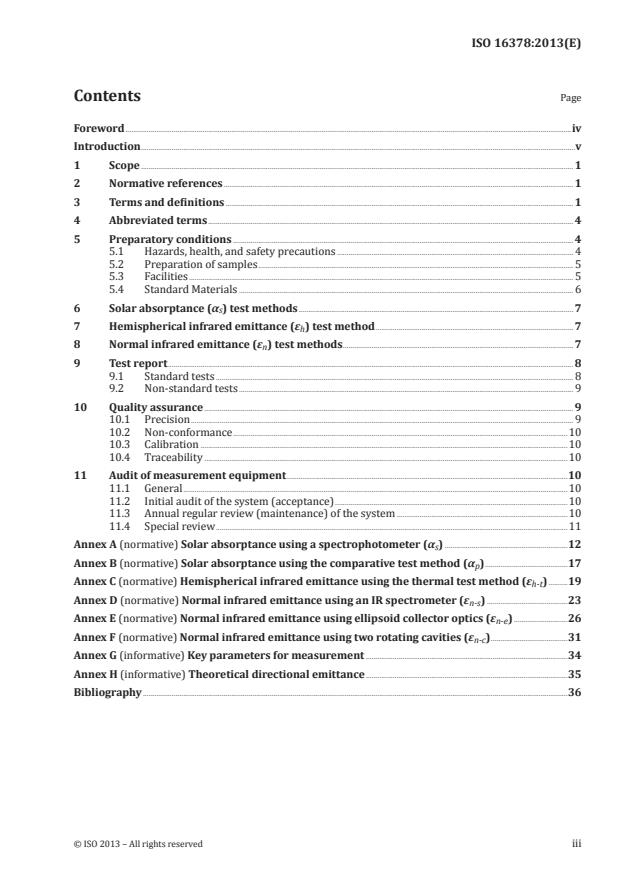
Contents Page
Foreword .iv
Introduction .v
1 Scope . 1
2 Normative references . 1
3 Terms and definitions . 1
4 Abbreviated terms . 4
5 Preparatory conditions . 4
5.1 Hazards, health, and safety precautions . 4
5.2 Preparation of samples . 5
5.3 Facilities . 5
5.4 Standard Materials . 6
6 Solar absorptance (α ) test methods .7
s
7 Hemispherical infrared emittance (ε ) test method . 7
h
8 Normal infrared emittance (ε ) test methods . 7
n
9 Test report . 8
9.1 Standard tests . 8
9.2 Non-standard tests . 9
10 Quality assurance . 9
10.1 Precision . 9
10.2 Non-conformance .10
10.3 Calibration .10
10.4 Traceability .10
11 Audit of measurement equipment .10
11.1 General .10
11.2 Initial audit of the system (acceptance) .10
11.3 Annual regular review (maintenance) of the system .10
11.4 Special review .11
Annex A (normative) Solar absorptance using a spectrophotometer (α ) .12
s
Annex B (normative) Solar absorptance using the comparative test method (α ) .17
p
Annex C (normative) Hemispherical infrared emittance using the thermal test method (ε ) .19
h-t
Annex D (normative) Normal infrared emittance using an IR spectrometer (ε ) .23
n-s
Annex E (normative) Normal infrared emittance using ellipsoid collector optics (ε ) .26
n-e
Annex F (normative) Normal infrared emittance using two rotating cavities (ε ) .31
n-c
Annex G (informative) Key parameters for measurement .34
Annex H (informative) Theoretical directional emittance .35
Bibliography .36
Foreword
ISO (the International Organization for Standardization) is a worldwide federation of national standards
bodies (ISO member bodies). The work of preparing International Standards is normally carried out
through ISO technical committees. Each member body interested in a subject for which a technical
committee has been established has the right to be represented on that committee. International
organizations, governmental and non-governmental, in liaison with ISO, also take part in the work.
ISO collaborates closely with the International Electrotechnical Commission (IEC) on all matters of
electrotechnical standardization.
The procedures used to develop this document and those intended for its further maintenance are
described in the ISO/IEC Directives, Part 1. In particular the different approval criteria needed for the
different types of ISO documents should be noted. This document was drafted in accordance with the
editorial rules of the ISO/IEC Directives, Part 2 (see www.iso.org/directives).
Attention is drawn to the possibility that some of the elements of this document may be the subject of
patent rights. ISO shall not be held responsible for identifying any or all such patent rights. Details of
any patent rights identified during the development of the document will be in the Introduction and/or
on the ISO list of patent declarations received (see www.iso.org/patents).
Any trade name used in this document is information given for the convenience of users and does not
constitute an endorsement.
For an explanation on the meaning of ISO specific terms and expressions related to conformity
assessment, as well as information about ISO’s adherence to the WTO principles in the Technical Barriers
to Trade (TBT) see the following URL: Foreword - Supplementary information
The committee responsible for this document is ISO/TC 20, Aircraft and space vehicles, Subcommittee
SC 14, Space systems and operations.
iv © ISO 2013 – All rights reserved
Introduction
Throughout this International Standard, the minimum essential criteria are identified by the use of
the imperative or the keyword “shall”. Recommended criteria are identified by the use of the keyword
“should” and, while not mandatory, are considered to be of primary importance in providing serviceable,
economical, and practical designs. Deviations from the recommended criteria can be made only after
careful consideration, extensive testing, and thorough service evaluation have shown an alternative
method to be satisfactory.
Solar absorptance and infrared emittance are the key parameters of materials for both active and
passive thermal design of space systems.
This International Standard describes the methodology, instruments, equipment, and samples used
to calculate the key parameters of thermal-control materials, i.e. solar absorptance [α or α ] and the
s p
infrared emittance [ε or ε ].
h n
Attention is drawn to the possibility that some of the elements of this document can be the subject of
patent rights other than those identified. ISO shall not be held responsible for identifying any or all such
patent rights.
INTERNATIONAL STANDARD ISO 16378:2013(E)
Space systems — Measurements of thermo-optical
properties of thermal control materials
1 Scope
This International Standard specifies the multiple measurement methods, instruments, equipment, and
samples used to calculate the thermo-optical properties of thermal control materials. This International
Standard compares their features, indicates their limitations and biases, and guides the applications.
These measurements will be performed at ground test facilities with the purpose of obtaining material
properties. The measured properties will be used for material selection, thermal design of spacecraft,
process control, quality control, etc. Also, on-orbit temperature data in the beginning of life can be
assessed using the data obtained by ground measurement. Requirements for calibration and reference
materials to ensure data quality are also defined.
The following test methods are detailed in the Annexes of this International Standard including the
configuration of samples and calculations.
a) Solar absorptance using a spectrophotometer: (α ) — Annex A
s
b) Solar absorptance using the comparative test method: (α ) — Annex B
p
c) Hemispherical infrared emittance using the thermal test method: (ε ) — Annex C
h-t
d) Normal infrared emittance using an IR spectrometer: (ε ) — Annex D
n-s
e) Normal infrared emittance using ellipsoid collector optics (ε ) — Annex E
n-e
f) Normal infrared emittance using two rotating cavities: (ε ) — Annex F
n-c
2 Normative references
The following documents, in whole or in part, are normatively referenced in this document and are
indispensable for its application. For dated references, only the edition cited applies. For undated
references, the latest edition of the referenced document (including any amendments) applies.
ISO 9288:1989, Thermal insulation — Heat transfer by radiation — Physical quantities and definitions
ISO 21348:2007, Space environment (natural and artificial) — Process for determining solar irradiances
ASTM E490-00a:2006, Standard Solar Constant and Zero Air Mass Solar Spectral Irradiance Tables
3 Terms and definitions
For the purposes of this document, the following terms and definitions apply.
3.1
absorptance (α)
α = Φa/Φm
where Φa is the absorbed radiant flux or the absorbed luminous flux and Φm is the radiant flux or
luminous flux of the incident radiation
[SOURCE: ISO 80000-7]
3.2
emissivity, emittance (ε)
ε = M/Mb
where M is the radiant exitance of a thermal radiator and Mb is the radiant exitance of a blackbody at
the same temperature
[SOURCE: ISO 80000-7]
Note 1 to entry: The following adjectives should be added to define the conditions.
— Total: If they are related to the entire spectrum of thermal radiation (this designation can be considered as
implicit) [ISO 9288:1989]
— Spectral or monochromatic: If they are related to a spectral interval centered on the wavelength λ
[ISO 9288:1989]
— Hemispherical: If they are related to all directions along which a surface element can emit or receive
radiation [ISO 9288:1989]
— Directional: If they are related to the directions of propagation defined by a solid angle around the defined
direction [ISO 9288:1989]
— Normal: If they are related to the normal direction of propagation or incidence to the surface
EXAMPLE Total hemispherical emittance/emissivity.
Total hemispherical exitance M of the considered surface divided by the total hemispherical exitance M0
of the blackbody at the same temperature.
[SOURCE: ISO 9288:1989]
Note 2 to entry: When there is a certain need to distinguish a property of a material from a property of a real
object, the word “emissivity” could be used. Emissivity is a property of a material measured as the emittance of
an ideal material that is completely opaque and has an optically smooth surface.
Emissivity depends on the temperature at which it is determined and wavelength range.
Emittance is a property of a particular object. It is determined by material emissivity, surface roughness, oxidation,
the sample’s thermal and mechanical history, surface finish, and measured wavelength range. Although emissivity
is a major component in determining emittance, the emissivity determined under laboratory conditions seldom
agrees with actual emittance of a certain sample.
∞∞
ελ= LT(, )(ελ)/dLλλ(,Td) λ
bb
∫∫
where
-5 (c2/λT) -1
L (λ,T) Spectral Planck distribution of blackbody radiation, c λ (e -1) ;
b 1
–16 2
C 3,741 77 × 10 W·m ;
–2
C 1,438 8 × 10 m·K;
T absolute temperature, K;
λ wavelength, m;
∞ -1 4
σπ T ;
LT(,λλ)d
b
∫
–8 -2 -4
σ Stefan-Boltzmann constant, 5,670 400 (40) × 10 [W·m ·K ].
2 © ISO 2013 – All rights reserved
3.3
diffuse
indicates that flux propagates in many directions, as opposed to direct beam, which refers to collimated flux.
When referring to reflectance, it is the directional-hemispherical reflectance less the specular reflectance
3.4
infrared emittance
emittance in the infrared range at least from 5 μm to 25 μm
3.5
integrating sphere
an optical device used to either collect flux reflected or transmitted from a sample into a hemisphere
or to provide isotropic irradiation of a sample from a complete hemisphere. It consists of a cavity that
is approximately spherical in shape with apertures for admitting and detecting flux and usually having
additional apertures over which sample and reference specimens are placed
3.6
irradiance
-2
at a point on a surface, E = dΦ/dA [W·m ], where dΦ is the radiant flux incident on an element of the
surface with area dA
[SOURCE: ISO 80000-7]
3.7
near-normal-hemispherical
indicates irradiance to be directional near-normal to the specimen surface and the flux leaving the
surface or medium is collected over an entire hemisphere for detection
3.8
radiant flux
Φ = dQ/dt [W]
where dQ is the radiant energy emitted, transferred, or received during a time interval of the duration dt
[SOURCE: ISO 80000-7]
3.9
reflectance (ρ)
ρ = Φr/Φm
where Φr is the reflected radiant flux or the reflected luminous flux and Φm is the radiant flux or
luminous flux of the incident radiation
[SOURCE: ISO 80000-7]
3.10
solar
indicating that the radiant flux involved has the sun as its source or has the relative
spectral distribution of solar flux
3.11
solar
indicating a weighted average of the spectral property, with a standard solar spectral
irradiance distribution as the weighting function
3.12
solar absorptance (α )
s
ratio of the solar radiant flux absorbed by a material (or body) to the radiant flux of the incident radiation
Note 1 to entry: Differentiation is made between two methods:
a) Method of spectral measurements using a spectrophotometer covering the range from 250 nm to 2 500 nm
for the determination of α .
s
b) Portable equipment using a xenon flash for relative measurements (α ).
p
3.13
solar irradiance
radiation of the sun integrated over the full disk and expressed in SI units of power through a unit
-2
of area, W·m
[SOURCE: ISO 21348 (Notes in the original standard is omitted)]
3.14
spectral
indicating that the property was evaluated at a specific wavelength, λ, within a small
wavelength interval, Δλ about λ, symbol wavelength in parentheses as L(350 nm), or as a function of
wavelength, symbol L(λ)
Note 1 to entry: The parameters of frequency, ν, wave-number, κ, or photon energy can be substituted for
wavelength, λ, in this definition.
3.15
spectral
the concentration of the quantity per unit wavelength (or frequency), indicated by the
subscript lambda, as Lλ = dL/dλ
Note 1 to entry: The parameters of frequency, ν, wave-number, κ, or photon energy can be substituted for
wavelength, λ, in this definition.
Note 2 to entry: At a specific wavelength, the wavelength at which the spectral concentration was evaluated can
be indicated by the wavelength in parentheses following the symbol, Lλ (350 nm).
3.16
specular
indicates that the flux leaves a surface or medium at an angle that is numerically equal to the angle of
incidence, lies in the same plane as the incident ray and the perpendicular, but is on the opposite side of
the perpendicular to the surface
Note 1 to entry: Reversing the order of terms in an adjective reverses the geometry of the incident and collected
flux, respectively.
3.17
transmittance (τ)
τ=Φt/Φm
where Φt is the transmitted radiant flux or luminous flux and Φm is the radiant flux or luminous flux of
the incident radiation
[SOURCE: ISO 80000-7]
4 Abbreviated terms
For the purposes of this document, the following abbreviations are used.
RT Room Temperature
5 Preparatory conditions
5.1 Hazards, health, and safety precautions
Attention shall be given to health and safety precautions. Hazards to personnel, equipment, and materials
shall be controlled and minimized.
4 © ISO 2013 – All rights reserved
5.2 Preparation of samples
5.2.1 Sample property
This International Standard is applicable to materials having both specular and diffuse optical properties.
5.2.2 Configuration
The material samples shall be prepared according to the relevant process specification or manufacturer’s
data and shall be representative of batch variance.
The samples shall represent the work piece as exactly as possible. Expected changes in thermo-optical
properties from the measured sample to the flight equipment shall be considered in thermal design.
For instance, the application procedure for paint can result in different thermo-optical properties
depending on the painter and the type of spray gun used; therefore, the samples should be coated or
made at the same time as the work piece.
The surface roughness strongly affects on the measurement results. Bare (uncoated) samples shall be
finished to the same surface condition as the work piece.
5.2.3 Cleaning
The cleaning method and other treatment of the sample shall always be the same as for the flight
hardware. Further cleaning or treatment of the sample is not allowed.
In particular, solar absorptance properties are very sensitive to contamination and if the sample or the
flight hardware is contaminated (even by hand grease), the test results can be significantly in error.
5.2.4 Handling and storage
Samples shall only be handled with clean nylon or lint-free gloves and shall be stored in a cleanliness-
controlled area, with a room temperature of 15 °C to 30 °C and a relative humidity of 20 % to 65 %.
a) Coated surfaces shall be shielded from contact by using soft and inert material such as polyethylene
or polypropylene bags or sheets.
b) Mechanical damage shall be avoided in the standard way by packing the wrapped samples in clean
and dust and lint-free material.
c) Limited-life materials shall be labelled with their relative shelf lives and dates of manufacture.
5.2.5 Identification
a) Samples submitted for testing shall be accompanied by a completed “Material identification card”.
b) Hazardous samples shall be accompanied by a completed “Safety data sheet”.
c) The surface of the samples which is to be measured shall be clearly indicated unless the samples
have completely even properties on both surfaces.
5.3 Facilities
5.3.1 Cleanliness
a) The work area shall be clean and free of dust.
b) Air used for ventilation should be filtered to prevent contamination of the sample.
5.3.2 Environmental conditions
The ambient conditions for the process and work areas shall be from 15 °C to 30 °C with a relative
humidity of 20 % to 65 % unless otherwise stated.
5.3.3 Equipment
The equipment is specific for each test and defined in the Annexes.
5.4 Standard Materials
5.4.1 General
Both reference and working (comparison) standards are required. Highly durable materials are preferred.
Standard materials shall be handled and stored in accordance with the associated specification. Avoid
touching the optical surfaces even with gloves.
5.4.2 Reference standard material
Reference standards are the primary standard material for the calibration of instruments and working
standards. Reference standards shall be traceable to a national or an international authority having
jurisdiction.
5.4.3 Working standard material
Working standards are used in the daily operation of the instrument to provide comparison curves
for data reduction. A working standard shall be calibrated annually by measuring its thermo-optical
properties relative to the properties of the appropriate reference standard. If degradation is noticeable,
the working standard shall be cleaned, renewed, or replaced.
5.4.4 Solar absorptance
For transmitting samples, incident radiation shall be used as the standard relative to which the
transmitted light is evaluated. For some applications, calibrated transmittance standards are available.
For diffuse high-reflectance samples, a working standard that has high reflectance and is highly diffusing
over the range of the solar spectrum is required.
NOTE 1 White diffuser is commonly used as a diffuse high-reflectance standard material. Various white diffusers
1)
are provided by a national or an international authority such as NIST. Spectralon® is a commercially available
material that provides high-diffuse reflectance for 250 nm to 2 500 nm. BaSO and magnesium oxide have been
widely utilized but are no longer recommended for use as a standard since they are not stable for longer periods.
For specularly reflecting samples, a working standard that is highly specular is required. Identified
suitable working standards are vacuum-deposited thin opaque films of metals. All front surface
metalized working standards shall be calibrated frequently with an absolute reflectometer or relative
to a national or an international standard reference material before being acceptable in this test method.
NOTE 2 Aluminium-coated glass mirror is widely used because of its high reflectance and ease of deposition.
Although bare aluminium surface is highly vulnerable, protective coating could maintain the optical property.
For absorber materials, a working standard that has low reflectance over the range of the solar spectrum
is required in order to obtain an accurate zero line correction.
1) This information is given for the convenience of users of this document and does not constitute an endorsement
by ISO TC 20/SC 14 of the product named. Equivalent products may be used if they can be shown to lead to the same
results.
6 © ISO 2013 – All rights reserved
5.4.5 Infrared Emittance
A set of high- and low-emittance materials are often provided by the instrument manufacturer as
standard materials. Typical high- and low-emittance standards can consist of black paint (or preferably
a blackbody cavity) and polished high-purity aluminium, respectively.
6 Solar absorptance (α ) test methods
s
Two test methods are described in this clause.
Though α have slightly bigger standard deviations than α , both two methods provide well-repeatable
p s
data to use in thermal design. Solar absorptance obtained by these two methods shall be clearly
distinguished by the terms α and α .
s p
a) Solar absorptance using a spectrophotometer (α )
s
This method covers the measurement of spectral absorptance (α ), reflectance, and transmittance of
s
materials using spectrophotometers equipped with integrating spheres.
b) Solar absorptance using the comparative test method (α )
p
The comparative method (α ) compares the reflection of a Xenon flash by a known reference material
p
to the reflection of an unknown sample. This method has limitations due to the difference between a
Xenon flash spectrum and the solar spectrum.
7 Hemispherical infrared emittance (ε ) test method
h
A test method is described in this clause.
Hemispherical infrared emittance obtained by the thermal test method shall be clearly defined by
the term ε .
h-t
a) Hemispherical infrared emittance using the thermal test method (ε )
h-t
Only the thermal test method enables direct measurement. Although the thermal method requires more
time and effort, it is the fundamentally correct method to obtain total hemispherical infrared emittance.
ε of wider temperature samples are obtained solely by the thermal method.
h
NOTE The method that measures total hemispherical reflectance as absorptance of materials using infrared
spectrophotometers equipped with integrating spheres is still under study. ASTM E1392–96 could be referred to
for the measurement method development.
8 Normal infrared emittance (ε ) test methods
n
Three test methods are described in this clause.
a) Normal infrared emittance using an IR spectrometer (ε )
n-s
The IR spectrometer method measures the normal reflectance as residue from unity minus emittance
of materials using infrared spectrophotometers equipped with integrating spheres. Normal infrared
emittance obtained using an IR spectrometer shall be identified by the term ε .
n-s
b) Normal infrared emittance using ellipsoid collector optics (ε )
n-e
The test method using ellipsoid collector enables direct measurement without knowing the exact
sample temperature. The source beam is provided to the sample with a near-normal incident angle. The
ellipsoid collector focuses over 99 % of the hemispherical reflected energy onto the detector. Normal
infrared emittance obtained using an ellipsoid collector shall be identified by the term ε .
n-e
c) Normal infrared emittance using two rotating cavities (ε )
n-c
This method measures reflected energy of the sample using two rotating cavities that are maintained
at different temperatures. Sample temperature is not necessarily measured. Suitable calibration
with known reflectance standards is required to obtain reflectance values on samples. Total normal
emittance is calculated by subtracting the calibrated reflectance from unity.
Measured data with two rotating cavities is limited in accuracy by the degree to which the emittance
properties of calibrating standards are known and by the angular emittance characteristics of the
surfaces being measured. At the round-robin test performed in 2007, the two rotating cavities provided
relatively low emittance compared to the direct measurements. The maximum difference of ε measured
n
by the two method was greater than 0,1. Normal infrared emittance obtained using two rotating cavities
shall be identified by the term ε . Although many historical data have been obtained by this method, it
n-c
is recommended to use the other two methods instead.
9 Test report
9.1 Standard tests
9.1.1 Complete identification of the material tested
The test report shall contain as a minimum the following:
a) trade names and batch numbers of the materials under test;
b) name of the manufacturer or supplier through whom the purchase was made;
c) summary of the preparation and conditioning schedule (e.g. mixing proportions, coating thickness,
cure time and temperature, post-cure, cleaning procedure);
d) sample size and thickness, coating thickness of layers if available, surface contour if any, description
of optical properties such as diffuse or specularly reflecting, clear or translucent transmitting, etc.;
e) properties of the substrate when the material is applied on (e.g. trade name, material, thickness, etc.).
9.1.2 Complete identification of the measurement condition
The test report shall contain as a minimum the following:
a) utilized measurement method;
b) date and time the measurements were taken;
c) identification of the instrument used (Manufacturer’s name and model number including
modifications and accessories is sufficient for a commercial instrument. Other instruments shall be
described in detail including wavelength range and estimations of their accuracy. Key accessories
information such as integrating sphere coating material and diameter, filter’s path band, etc., shall
be included.);
d) identification of the working standard materials used for calibration;
e) thermo-optical properties assumed for the working standard materials;
f) ambient temperature and related humidity;
g) sample temperature (RT or controlled certain temperature);
h) locations on the surface area at which measurements were performed (not applicable for small
individual test samples);
i) estimate precision (repeatability) and estimated accuracy reported as uncertainty due to bias. The
accuracy and precision shall be reported in the same units as the optical property itself;
8 © ISO 2013 – All rights reserved
j) any noticeable incident observed during the measurement which shall be recorded;
k) the quality records (e.g. log sheets) shall be retained for at least 10 years or in accordance with
project contract requirements.
9.1.3 Measurement results
9.1.3.1 Solar optical properties
The test report shall contain as a minimum the following:
a) solar transmittance, absorptance, or reflectance, or all three, determined to the nearest 0,01 unit or 1 %;
b) solar spectral irradiance source document or source data and weighting method used for
computation of the solar optical property.
9.1.3.2 Infrared optical properties
The test report shall contain as a minimum the following:
a) infrared emittance, absorptance, or transmittance, or all three, determined to the nearest 0,01 unit
or 1 %;
b) indicated meter reading (reflectance) for three successive measurements with their standard
deviation (not applicable for ε );
h-t
c) infrared emittance determined to the nearest 0,01 unit or 1 % obtained by subtracting an average
of the three reflectance values from one (not applicable for ε );
h-t
d) for samples with rough surface and/or inhomogeneous property, appropriate number of tests shall
be performed on multiple samples considering the sample condition (an average of the measured
values shall be reported with its standard deviation).
9.2 Non-standard tests
Measurement performed with any deviation from standard test conditions is considered as a non-
standard test. The test report shall clearly indicate all the deviation. Measured data shall be distinguished
from standard test data. It is recommended to note the assumed bias on the measurement results caused
by the deviations.
10 Quality assurance
10.1 Precision
The measurement precision for the key parameters shall be as follows:
a) Solar absorptance measurement repeatability on the same point of a sample ±0,01 (non-dimension)
in repeated measurement data or 5 % of the mean measured value;
NOTE 1 0,1 % for spectrophotometer without integrating sphere; 0,5 % for spectrophotometer with
integrating sphere.
b) Infrared emittance measurement repeatability on the same point of a sample ±0,01 (non-dimension)
in repeated measurement data or 5 % of the mean measured value;
NOTE 2 Random uncertainty of reflectance measurements performed by Labsphere, Inc. is 0,005 for the
spectral range (300 nm to 2 200 nm) and is equal to 0,02 over the spectral range (250 nm to 2 500nm). (See
calibration certificate for Spectralon® reference.)
−2
c) Sample thickness: 10 mm (bulk material);
−3
d) Sample thickness: 10 mm (thin films, paints, and coatings);
e) Temperature: ±5K.
10.2 Non-conformance
Any non-conformance that is observed in respect of the measurement procedure shall be resolved in
accordance with the quality assurance requirements.
10.3 Calibration
a) Each reference standard and piece of measuring equipment shall be calibrated according to the
equipment specific procedure.
b) Any suspected or actual equipment failure shall be recorded as a project non-conformance report so that
previous results can be examined to ascertain whether or not reinspection and retesting is required.
c) The customer shall be notified of the non-conformance details.
10.4 Traceability
Traceability shall be maintained throughout the process from incoming inspection to final measurements
and calculations, including details of the test equipment and personnel employed in performing the task.
11 Audit of measurement equipment
11.1 General
The thermo-optical property data from test houses for the projects of the customer, obtained in the
manner laid down in this International Standard, are only accepted for the projects of the customer if
the test house is certified to perform the relevant procedure in this International Standard.
11.2 Initial audit of the system (acceptance)
a) Once a system has been built or purchased, it shall be audited by the customer’s product assurance
department before it can be accepted for running qualification or quality control tests on materials
for use in customer projects.
b) This initial audit shall, at least, consist of (but not necessarily be restricted to) an inspection of the
apparatus and associated equipment, the performance of a test on a defined set of materials, the
reporting of the non-conformance, and the audit findings.
11.3 Annual regular review (maintenance) of the system
a) Inspection of apparatus and associated equipment
b) Mutual comparability evaluation (testing)
c) Non-conformance:
If the inspection of the system or the “round-robin test” shows a non-conformance with the applicable
audit specification of the customer or the acceptable limits of the test results, actions shall be undertaken
10 © ISO 2013 – All rights reserved
by the test house in order to determine the reasons for the non-conformance and a further test shall be
performed in accordance with 10.2 before a certificate of conformance is renewed.
d) Reporting of findings:
1) A detailed written report of the result of the regular review shall be delivered to all participants
within six weeks after the end of the regular review or evaluation testing;
2) The certificate of conformance shall be renewed annually after a successful review.
11.4 Special review
a) All modifications of the apparatus or associated equipment shall be reported and, if deemed necessary,
be audited by the customer before utilization of the modified system for the customer’s project.
b) Major modifications shall result in the retesting of apparatus as described in 10.2.
Annex A
(normative)
Solar absorptance using a spectrophotometer (α )
s
A.1 General
Solar absorptance is calculated using the absorption spectrum of the material over the region from
250 nm to 2 500 nm and this spectrum is then multiplied with the solar spectrum.
a) The absorption spectrum shall be measured using an integrating sphere.
b) Absolute measurements are available using a sphere with central sample mounting.
c) Opaque samples shall be mounted on the wall of the integrating sphere.
d) Two measurements are required for transparent samples. Transmittance shall be measured
mounting the sample on the wall of the integrating sphere. Reflectance shall be measured with
central sample mounting.
e) For transmitting samples, incident radiation shall be used as the standard relative to which the
transmitted light is evaluated. For some applications, calibrated transmittance standards are available.
NOTE A sphere with a sample holder on the sidewall can also be used. In this case, the reflectivity is compared
to a known standard (e.g. calibrated Al-mirror or calibrated Spectralon® standard).
Measurements of spectral near-normal-hemispherical transmittance (or reflectance) are made over the
spectral range from approximately 250 nm to 2 500 nm with an integrating sphere spectrophotometer.
The solar transmittance, reflectance, or absorptance is obtained by calculating a weighted average
with a standard solar spectral irradiance as the weighting function by either the weighted or selected
ordinate method.
A.2 Configuration of samples
The size of test specimens required depends on the dimensions of the integrating sphere. For wall-
mounted spheres, the specimen shall be large enough to fully cover the aperture of the sphere. If large
enough sample is not available, the test requester shall coordinate with test facility.
EXAMPLE When the aperture of the sphere was 15 mm × 15 mm, the sample must be larger than the 15 mm
square regardless of its shape. Depending on the method and equipment used, these dimensions can vary. For
patterned samples, either the specimen shall be large enough to make a number of measurements over different
areas or several specimens representing the different areas of the material shall be used.
Flexible samples shall be mounted on a rigid surface. The sample shall be flat. For spherical curved
samples, its radius of curvature shall be larger than 300 mm.
Special care shall be taken on alignments of optical systems. The sample shall be closely fit on the sample
port in the right angle. Deviations in the incident angle of the probe beam and optical systems inside
could produce error in results.
This test method is applicable to materials having both specular and diffuse optical properties.
Opaque specimens shall have at least one surface that is essentially plane over an area large enough to
cover the aperture of the sphere.
12 © ISO 2013 – All rights reserved
Transparent and slightly translucent specimens shall have two surfaces that are essentially plane
and parallel. In order to reduce light scattered out the edges of translucent specimen, the minimum
distance between the edge of the beam and the edge of the aperture shall be 10 times the thickness of
the specimen.
The transmittance of highly scattering translucent samples is not easily measured with an integrating
sphere instrument because a significant portion of the incident flux will be scattered outside the
aperture from the side of the sample. The test report shall describe when the measured samples had
such characters.
A.3 Test equipment and setting up
The test equipment consists of a spectrometer, covering at least the range over 250 nm to 2 500 nm. An
apparatus which covers wider wavelength range is encouraged for better replication. Figure A.1 and A.2
show the test equipment configurations.
a) The wavelength resolution of the spectrometer shall be compatible with the resolution used for the
solar spectrum.
b) The signal-to-noise ratio shall be better than the following:
1) ±1 % full scale in the region between 250 nm and 2 000 nm;
2) 5 % full scale in the region between 2 000 nm and 2 500 nm.
c) If the sample is mounted on the side wall, the associated sphere shall have a maximum port to
total surface ratio of 5 %. A smaller ratio of the port area to the total internal surface area can be
achieved using large spheres. Small spheres can give rise to large errors.
NOTE 1 If the test equipment is used in a central sample mode, i.e. an “Edwards”-type integrating sphere, the
measurement is called “absolute”.
NOTE 2 If the sample is mounted on the sidewall, the measurement is done towards a calibrated standard that
can be specular (e.g. Al-mirror) or diffuse (e.g. Spectralon®). In the case of relative measurements, change in the
optical property of the standard materials affects the measured value.
Key
1 integrating sphere
2 test specimen
3 entrance port
4 sample port
5 detector
6 incident radiation
7 specular reflection
8 diffuse reflection
9 incident angle
Figure A.1 — Integrating sphere (wall mount type)
14 © ISO 2013 – All rights reserved
Key
1 integrating sphere
2 test specimen
3 entrance port
4 sample rotation
5 detector
6 incident radiation
7 reference radiation
Figure A.2 — Integrating sphere (central mount type)
d) The responsible test officer shall make the choice of a standard based on the visual aspect of the sample.
e) For materials having, in the visible region, a large specular component, a standard mirror shall be used.
f) When the diffuse component is predominant in the visible region, a diffuse sample such as
Spectralon® shall be used.
g) The standard used for the measurement shall be indicated in the report.
ISO 9505 requests that the wavelength resolution shall be
— less than 5 nm (wavelength is shorter than 380 nm),
— less than 10 nm (wavelength is 380 nm to 780 nm),
— less than 50 nm (wavelength is longer than 780 nm).
ISO 9505 requests that the photometric accuracy shall be
— less than 1 % of full scale (wavelength is shorter than 780 nm),
— less than 2 % of full scale (wavelength is longer than 780 nm).
ISO 9505 requests that the photometric reproducibility shall be
— less than 0,5 % of full scale (wavelength is shorter than 780 nm),
— less than 1 % of full scale (wave
...
МЕЖДУНАРОДНЫЙ ISO
СТАНДАРТ 16378
Первое издание
2013-12-15
Космические системы.
Измерения термооптических свойств
терморегулирующих материалов
Space systems — Measurements of thermo-optical properties of
thermal control materials
Ответственность за подготовку русской версии несёт GOST R
(Российская Федерация) в соответствии со статьёй 18.1 Устава ISO
Ссылочный номер
©
ISO 2013
ДОКУМЕНТ ЗАЩИЩЕН АВТОРСКИМ ПРАВОМ
© ISO 2013
Все права сохраняются. Если не указано иное, никакую часть настоящей публикации нельзя копировать или использовать в
какой-либо форме или каким-либо электронным или механическим способом, включая фотокопии и микрофильмы, без
предварительного письменного согласия ISO, которое должно быть получено после запроса о разрешении, направленного по
адресу, приведенному ниже, или в комитет-член ISO в стране запрашивающей стороны.
ISO copyright office
Case postale 56 • CH-1211 Geneva 20
Tel. + 41 22 749 01 11
Fax + 41 22 749 09 47
E-mail copyright@iso.org
Web www.iso.org
Опубликовано в Швейцарии
ii © ISO 2013 – Все права сохраняются
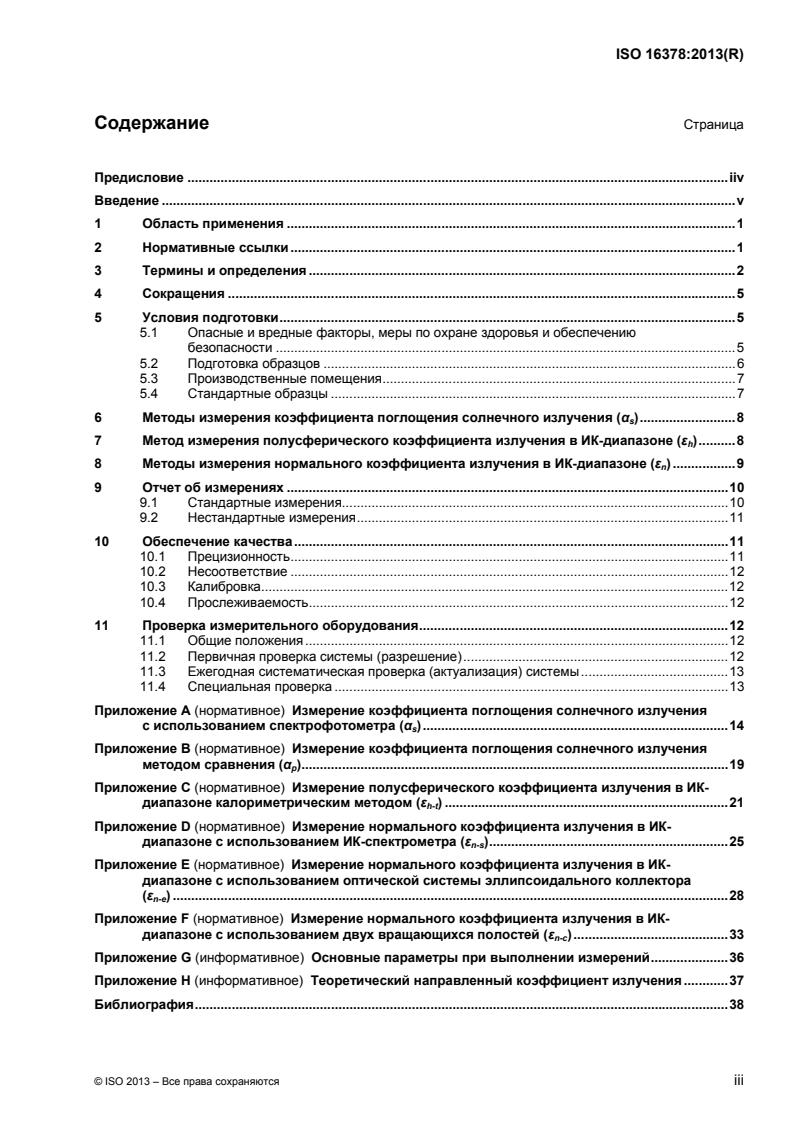
Содержание Страница
Предисловие .iiv
Введение .v
1 Область применения .1
2 Нормативные ссылки .1
3 Термины и определения .2
4 Сокращения .5
5 Условия подготовки.5
5.1 Опасные и вредные факторы, меры по охране здоровья и обеспечению
безопасности .5
5.2 Подготовка образцов .6
5.3 Производственные помещения.7
5.4 Стандартные образцы .7
6 Методы измерения коэффициента поглощения солнечного излучения (α ).8
s
7 Метод измерения полусферического коэффициента излучения в ИК-диапазоне (ε ).8
h
8 Методы измерения нормального коэффициента излучения в ИК-диапазоне (ε ) .9
n
9 Отчет об измерениях .10
9.1 Стандартные измерения.10
9.2 Нестандартные измерения.11
10 Обеспечение качества.11
10.1 Прецизионность.11
10.2 Несоответствие .12
10.3 Калибровка.12
10.4 Прослеживаемость.12
11 Проверка измерительного оборудования.12
11.1 Общие положения.12
11.2 Первичная проверка системы (разрешение).12
11.3 Ежегодная систематическая проверка (актуализация) системы.13
11.4 Специальная проверка .13
Приложение A (нормативное) Измерение коэффициента поглощения солнечного излучения
с использованием спектрофотометра (α ).14
s
Приложение B (нормативное) Измерение коэффициента поглощения солнечного излучения
методом сравнения (α ).19
p
Приложение C (нормативное) Измерение полусферического коэффициента излучения в ИК-
диапазоне калориметрическим методом (ε ) .21
h-t
Приложение D (нормативное) Измерение нормального коэффициента излучения в ИК-
диапазоне с использованием ИК-спектрометра (ε ).25
n-s
Приложение E (нормативное) Измерение нормального коэффициента излучения в ИК-
диапазоне с использованием оптической системы эллипсоидального коллектора
(ε ) .28
n-e
Приложение F (нормативное) Измерение нормального коэффициента излучения в ИК-
диапазоне с использованием двух вращающихся полостей (ε ).33
n-c
Приложение G (информативное) Основные параметры при выполнении измерений.36
Приложение H (информативное) Теоретический направленный коэффициент излучения .37
Библиография.38
Предисловие
Международная организация по стандартизации (ISO) представляет собой всемирную федерацию,
состоящую из национальных органов по стандартизации (комитеты-члены ISO). Работа по разработке
международных стандартов обычно ведется техническими комитетами ISO. Каждый комитет-член,
заинтересованный в теме, для решения которой образован данный технический комитет, имеет право
быть представленным в этом комитете. Международные организации, правительственные и
неправительственные, поддерживающие связь с ISO, также принимают участие в работе. ISO тесно
сотрудничает с Международной электротехнической комиссией (IEC) по всем вопросам
стандартизации в области электротехники.
Процедуры, использованные для разработки данного документа, и процедуры его дальнейшей
актуализации описаны в Директивах ISO/IEC Directives, Часть 1. В частности, следует отметить
различные критерии утверждения, необходимые для различных типов документов ISO. Настоящий
документ был разработан в соответствии с редакционными правилами Директив ISO/IEC Directives,
Часть 2. www.iso.org/directives
Следует обратить внимание на тот факт, что отдельные элементы данного документа могут являться
объектами патентного права. ISO не несет ответственности за идентификацию любых или всех
подобных патентных прав. Сведения о всех патентных правах, идентифицированных при разработке
данного документа, содержатся в разделе Введение и/или в перечне ISO полученных патентных
деклараций. www.iso.org/patents
Любой торговый знак, использованный в данном документе, является информацией, приводимой для
удобства пользователей, и не является свидетельством в пользу того или иного товара.
Для пояснения значений конкретных терминов и выражений ISO, относящихся к оценке соответствия, а
также информация о соблюдении Международной организацией ISO принципов ВТО по техническим
барьерам в торговле (TБT), см. следующий унифицированный локатор ресурса (URL): Foreword -
Supplementary information
Комитетом, несущим ответственность за данный документ, является Технический комитет ISO/TC 20
Авиационные и космические аппараты, Подкомитет SC 14, Космические системы и их эксплуатация.
iv © ISO 2013 – Все права сохраняются
Введение
В данном международном стандарте для обозначения минимально необходимых критериев является
использование повелительного наклонения или ключевого слова “shall”. Отличительным признаком
рекомендованных критериев служит ключевое слово “should”, и хотя они и не являются
обязательными, но считаются имеющими первостепенное значение при выполнении надежных,
экономичных и практичных проектов. Отступать от рекомендованных критериев можно только после
того, как тщательное рассмотрение, всесторонняя проверка и исчерпывающая эксплуатационная
оценка покажут удовлетворительность альтернативного метода.
Коэффициент поглощения солнечного излучения и коэффициент излучения в ИК-диапазоне являются
основными характеристиками при проведении тепловых расчетов активной и пассивной систем
космической техники.
В данном международном стандарте описывается методология, приборы, оборудование и образцы,
используемые для определения основных характеристик терморегулирующих материалов:
коэффициента поглощения солнечного излучения [α или α ] и коэффициента излучения в ИК-
s p
диапазоне [ε или ε ].
h n
Следует обратить внимание на возможность того, что некоторые из элементов данного документа
могут оказаться объектами патентных прав, помимо уже установленных. ISO не несет ответственности
за выявление частично или полностью указанных патентных прав.
МЕЖДУНАРОДНЫЙ СТАНДАРТ ISO 16378:2013(R)
Космические системы. Измерения термооптических
свойств терморегулирующих материалов
1 Область применения
В настоящем международном стандарте устанавливаются различные методы измерений, приборы,
оборудование и образцы, используемые для определения термооптических свойств
терморегулирующих материалов. В стандарте сравниваются их особенности, указываются пределы их
возможностей и систематические погрешности, дается руководство по их применению. Данные
измерения будут выполняться на наземном испытательном оборудовании с целью определения
свойств материалов. Измеренные свойства будут использованы для отбора материалов, выполнения
тепловых расчетов космических аппаратов, контроля технологического процесса, контроля качества и
т.п. Помимо этого, на основании данных, полученных при наземных измерениях, можно оценить
температуру КА на орбите в начале эксплуатации. Кроме того, с целью гарантирования качества
данных установлены также требования к калибровке и эталонным материалам.
В приложениях к данному международному стандарту подробно изложены следующие методы
измерений, в том числе требования к форме и размерам образцов и выполнение вычислений.
a) Измерение коэффициента поглощения солнечного излучения с использованием
спектрофотометра: (α ). Приложение A
s
b) Измерение коэффициента поглощения солнечного излучения методом сравнения: (α ).
p
Приложение B
c) Измерение полусферического коэффициента излучения в ИК-диапазоне калориметрическим
методом: (ε ). Приложение C
h-t
d) Измерение нормального коэффициента излучения в ИК-диапазоне с использованием ИК-
спектрометра: (ε ). Приложение D
n-s
e) Измерение нормального коэффициента излучения в ИК-диапазоне с использованием оптической
системы эллипсоидального коллектора (ε ). Приложение E
n-e
f) Измерение нормального коэффициента излучения в ИК-диапазоне с использованием двух
вращающихся полостей: (ε ). Приложение F
n-c
2 Нормативные ссылки
Ссылка на следующий документ обязательна при использовании данного документа. Для
датированных ссылок применяется только указанное по тексту издание. Для недатированных ссылок
необходимо использовать самое последнее издание нормативного ссылочного документа (включая
любые изменения).
ISO 9288:1989, Теплоизоляция. Теплопередача посредством излучения. Физические величины и
определения
ISO 21348:2007, Космическое пространство (естественное и искусственное). Определение
энергетической освещённости солнечного излучения
ASTM E490-00a:2006, Таблицы стандартной солнечной постоянной и спектрального распределения
солнечного излучения при нулевой воздушной массе
3 Термины и определения
В настоящем стандарте используются следующие термины и определения.
3.1
коэффициент поглощения (α)
absorptance (α)
α = Φa/Φm
где Φa – поглощенный поток излучения или поглощенный световой поток, а Φm – падающий поток
излучения или световой поток падающего излучения
[ИСТОЧНИК: ISO 80000-7]
3.2
излучательная способность, коэффициент излучения (ε)
emissivity, emittance (ε)
ε = M/Mb
где M – энергетическая светимость теплового излучателя, а Mb – энергетическая светимость
абсолютно черного тела при той же температуре
[ИСТОЧНИК: ISO 80000-7]
ПРИМЕЧАНИЕ 1 к статье: Для указания условий необходимо добавлять следующие прилагательные.
— Полный: Если они относятся ко всему спектру теплового излучения (данное определение можно считать
неявно подразумеваемым) [ISO 9288:1989]
— Спектральный или монохроматический: Если они относятся к спектральному диапазону с центром на длине
волны λ [ISO 9288:1989]
— Полусферический: Если они относятся ко всем направлениям, по которым элемент поверхности может
излучать или по которым излучение может попадать на элемент поверхности [ISO 9288:1989]
— Направленный: Если они относятся к направлениям распространения, задаваемым телесным углом вокруг
определенного направления [ISO 9288:1989]
— Нормальный: Если они относятся к распространению или падению по нормали к поверхности
ПРИМЕР Полный полусферический коэффициент излучения/полная полусферическая излучательная
способность.
Полная полусферическая светимость M рассматриваемой поверхности, деленная на полную
полусферическую светимость M0 абсолютно черного тела при той же температуре.
[ИСТОЧНИК : ISO 9288:1989]
ПРИМЕЧАНИЕ 2 к статье: Когда возникает необходимость провести различие между свойством материала и
свойством реального объекта, можно использовать термин “излучательная способность”. Излучательная
способность – это характеристика материала, определяемая как коэффициент излучения идеального материала,
который полностью непрозрачен и имеет оптически гладкую поверхность.
Излучательная способность зависит от температуры, при которой она измерялась, и от диапазона
длин волн.
Коэффициент излучения – это свойство конкретного объекта. Он определяется излучательной
способностью материала, шероховатостью поверхности, окисленностью, предысторией образца в
2 © ISO 2013 – Все права сохраняются
отношении тепловых и механических воздействий, качеством обработки поверхности и измеренным
диапазоном длин волн. Несмотря на то, что излучательная способность является основной
составляющей коэффициента излучения, однако при измерении в лабораторных условиях она редко
совпадает с реальным коэффициентом излучения конкретного образца.
∞∞
ε = LT(,λε) (λ)dλ/ L(λ,T)dλ
bb
∫∫
где
-
L (λ,T) Спектральное распределение излучения абсолютно черного тела Планка, cλ
b 1
5 (c2/λT) -1
(e -1) ;
–16 2
C 3,74177 × 10 Вт·м ;
–2
C 1,4388 × 10 м·K;
T абсолютная температура, K;
λ длина волны, м;
-1 4
∞
σπ T ;
LT(,λ )dλ
b
∫
–8 -2 -4
σ постоянная Стефана-Больцмана, 5,670400 (40) × 10 [Вт·м ·K ].
3.3
диффузный
diffuse
указывает, что поток распространяется в различных направлениях, в отличие от прямого пучка,
который соответствует коллимированному потоку. Что касается коэффициента отражения, то
направленно-полусферический коэффициент отражения меньше коэффициента зеркального
отражения
3.4
коэффициент излучения в ИК-диапазоне
infrared emittance
коэффициент излучения в ИК-диапазоне минимум от 5 мкм до 25 мкм
3.5
интегрирующая сфера
integrating sphere
оптическое устройство, использующееся либо для того, чтобы собрать поток, отраженный от образца
или переданный образцом в полусферу, либо для того, чтобы обеспечить изотропное облучение
образца из всей полусферы. Интегрирующая сфера представляет собой замкнутую полость
практически сферической формы с отверстиями для ввода и регистрации потока и обычно имеет
дополнительные отверстия, в которых размещаются измеряемый и эталонный образцы
3.6
облученность
irradiance
-2
в точке на поверхности, E = dΦ/dA [Вт·м ], где dΦ – поток излучения, падающий на элемент
поверхности площадью dA
[ИСТОЧНИК ^ISO 80000-7]
3.7
близкий к нормали – полусферический
near-normal-hemispherical
указывает, что направление падающего излучения близко к нормали к поверхности образца, а поток,
выходящий с поверхности или из среды, собирается для регистрации со всей полусферы
3.8
поток излучения
radiant flux
Φ = dQ/dt [Вт]
где dQ – лучистая энергия, излученная, переданная или полученная за промежуток времени
длительностью dt
[ИСТОЧНИК: ISO 80000-7]
3.9
коэффициент отражения (ρ)
reflectance (ρ)
ρ = Φr/Φm
где Φr – отраженный поток излучения или отраженный световой поток, а Φm – поток излучения или
световой поток падающего излучения
[ИСТОЧНИК: ISO 80000-7]
3.10
солнечный
solar
<радиометрический> показывающий, что источником потока излучения является Солнце, или что поток
излучения имеет спектральное распределение, близкое к солнечному
3.11
солнечный
solar
<оптический> показывающий средневзвешенную величину спектральной характеристики со
стандартным спектральным распределением солнечного излучения в качестве весовой функции
3.12
коэффициент поглощения солнечного излучения (α )
s
solar absorptance (α )
s
отношение потока солнечного излучения, поглощенного материалом (или телом), к потоку падающего
излучения
ПРИМЕЧАНИЕ 1 к статье: Различают два метода:
a) Метод спектральных измерений с использованием спектрофотометра, перекрывающего диапазон от 250 нм
до 2 500 нм, для определения α .
s
b) Использование портативного оборудования, в котором применяется ксеноновая лампа, для выполнения
относительных измерений (α ).
p
3.13
солнечная облученность
solar irradiance
солнечное излучение, проинтегрированное по полному диску и выраженное в единицах системы СИ
-2
мощности, падающей на единичную площадку, Вт·м
[ИСТОЧНИК: ISO 21348 (Примечания в исходном стандарте опущены)]
4 © ISO 2013 – Все права сохраняются
3.14
спектральный
spectral
<оптический> указывающее, что свойство оценивалось на определенной длине волны λ, в малом
интервале длин волн Δλ, включающих λ, при этом значение длины волны указывается в скобках как
L(350 нм) или приводится как функция длины волны L(λ)
ПРИМЕЧАНИЕ 1 к статье: В данном определении параметры частоты ν, волнового числа κ или энергии фотонов
могут быть заменены длиной волны λ.
3.15
спектральный
spectral
<радиометрический> концентрация количества в единичном интервале длин волн (или частоты),
указанном нижним индексом лямбда как Lλ = dL/dλ
ПРИМЕЧАНИЕ 1 к статье: В данном определении параметры частоты ν, волнового числа κ или энергии фотонов
могут быть заменены длиной волны λ.
ПРИМЕЧАНИЕ 2 к статье: Для конкретного интервала длин волн, длина волны, для которой оценивалась
спектральное распределение, может быть указана в скобках после обозначения Lλ (350 нм).
3.16
зеркальный
specular
указывает, что поток отражается от поверхности или выходит из среды под углом, численно равным
углу падения, лежит в той же плоскости, что и падающий луч с нормалью, но находится на
противоположной стороне от нормали к поверхности
ПРИМЕЧАНИЕ 1 к статье: Изменение порядка следования терминов в определении на обратное меняет
соответственно геометрию падающего и отраженного потока.
3.17
коэффициент пропускания (τ)
transmittance (τ)
τ=Φt/Φm
где Φt – прошедший поток излучения или световой поток, а Φm – поток излучения или световой поток
падающего излучения
[ИСТОЧНИК: ISO 80000-7]
4 Сокращения
В настоящем стандарте используются следующие сокращения.
ИК инфрокрасная
5 Условия подготовки
5.1 Опасные и вредные факторы, меры по охране здоровья и обеспечению
безопасности
Следует уделять внимание мерам по охране здоровья и обеспечению безопасности. Необходимо
контролировать и минимизировать факторы, представляющие опасность для персонала,
оборудования и материалов.
5.2 Подготовка образцов
5.2.1 Свойства образцов
Настоящий международный стандарт применим к материалам, обладающим как зеркальными, так и
диффузными оптическими свойствами.
5.2.2 Конфигурация
Образцы материала должны изготавливаться согласно действующей технологической документации
или в соответствии с данными изготовителя и должны отражать отклонения показателей в партии.
Образцы должны как можно более точно воспроизводить рабочую деталь. В тепловых расчетах
следует учитывать предполагаемые изменения термооптических свойств при переходе от образцов к
материалам бортового оборудования.
К примеру, операция по нанесению лакокрасочного материала может дать различные
термооптические свойства в зависимости от того, кто проводит окраску и какой тип краскораспылителя
используется; поэтому образцы должны изготавливаться одновременно с рабочей деталью или на них
должно одновременно с деталью наноситься покрытие.
Шероховатость поверхности существенно влияет на результаты измерений. Чистота поверхности
образцов без покрытия после завершающей технологической операции должна быть такой же, как и у
рабочей детали.
5.2.3 Очистка
Способ очистки и иная обработка образцов всегда должны быть точно такими же, как и для
материалов бортового оборудования. Дополнительная очистка или обработка образца не допускается.
В частности, коэффициент поглощения солнечного излучения исключительно чувствителен к
загрязнению, и если образец или материал бортового оборудования загрязнен (пусть даже пото-
жировыми выделениями рук), результаты измерений могут оказаться в немалой степени ошибочными.
5.2.4 Обращение с образцами и их хранение
Образцы следует брать только в чистых нейлоновых или не оставляющих ворса перчатках, а хранить
их необходимо в помещении с контролем чистоты, при комнатной температуре от 15 °C до 30 °C и
относительной влажности от 20 % до 65 %.
a) Поверхности с нанесенным покрытием следует предохранять от касаний, используя для этого
мягкий и инертный материал, например, полиэтиленовые или полипропиленовые пакеты или
листы.
b) Следует предупреждать нанесение механических повреждений стандартным образом, упаковывая
завернутые образцы в чистый, не оставляющий пыльных следов и ворса материал.
c) Материалы с ограниченным сроком годности должны быть снабжены этикетками или
промаркированы с указанием их сроков хранения на складе и датами изготовления.
5.2.5 Идентификация
a) К образцам, передаваемым для измерений, должен прилагаться заполненный “Лист
идентификации материала”.
b) К опасным образцам должен прилагаться заполненный “Паспорт безопасности материала”.
6 © ISO 2013 – Все права сохраняются
c) Следует явным образом указывать поверхность образцов, на которой предстоит проводить
измерения, за исключением случаев, когда на обеих поверхностях образцов свойства полностью
идентичны.
5.3 Производственные помещения
5.3.1 Чистота
a) Рабочее место должно быть чистым и свободным от пыли.
b) Используемый для вентиляции воздух следует фильтровать, чтобы предупредить загрязнение
образцов.
5.3.2 Условия окружающей среды
Температура в технологических помещениях и на рабочих местах должна быть от 15 °C до 30 °C, а
относительная влажность – от 20 % до 65 %, если не оговорено иное.
5.3.3 Оборудование
Оборудование является индивидуальным для каждого измерения и приводится в Приложениях.
5.4 Стандартные образцы
5.4.1 Общие положения
Необходимы как контрольные, так и рабочие эталоны (образцы сравнения). Предпочтительнее
пользоваться износостойкими и долговечными материалами. Со стандартными образцами следует
обращаться и хранить их согласно соответствующим инструкциям и правилам. Старайтесь не касаться
оптических поверхностей даже перчатками.
5.4.2 Контрольный эталон
Контрольные эталоны – это первичный эталонный образец для калибровки приборов и рабочих
эталонов. Контрольные эталоны должны быть поверены национальным или международным органом,
уполномоченным на проведение подобного рода действий.
5.4.3 Рабочий эталон
Рабочие эталоны применяются при повседневной работе с приборами для получения кривых
сравнения с целью преобразования данных. Рабочий эталон должен поверяться ежегодно путем
измерения его термооптических свойств относительно свойств соответствующего контрольного
эталона. При наличии заметной деградации рабочий эталон следует очистить, обновить или заменить.
5.4.4 Коэффициент поглощения солнечного излучения
Для пропускающих свет образцов материалов в качестве эталона следует использовать падающее
излучение, относительно которого оценивается прошедший свет. Для некоторых областей применения
существуют калиброванные эталоны коэффициентов пропускания.
Для диффузных образцов с высоким коэффициентом отражения требуется рабочий эталон, который
имеет высокий коэффициент отражения и является сильно диффузным в области солнечного спектра.
ПРИМЕЧАНИЕ 1 В качестве диффузного эталона с высоким коэффициентом отражения обычно используется
белый светорассеивающий материал. Различные белые светорассеивающие материалы предоставляются
национальными и международными органами, к примеру, Национальным институтом стандартов и технологий
(NIST). В продаже имеется материал Spectralon® , который обладает высоким коэффициентом диффузного
отражения в диапазоне от 250 нм до 2 500 нм. Ранее широко использовались BaSO и окись магния, но теперь их
не рекомендуют к применению в качестве эталонов, поскольку они не стабильны в течение длительного времени.
Для зеркально отражающих образцов необходим рабочий эталон, который является в высокой степени
зеркальным. Применяемые рабочие эталоны представляют собой осажденные в вакууме тонкие
непрозрачные пленки металлов. Все рабочие эталоны с металлизацией на лицевой стороне должны
регулярно калиброваться с помощью абсолютного рефлектометра или относительно национальных
или международных контрольных эталонов, прежде чем их разрешат использовать в этом методе
измерений.
ПРИМЕЧАНИЕ 2 Стеклянное зеркало с алюминиевым покрытием широко применяется благодаря своему
высокому коэффициенту отражения и простоте нанесения. Хотя алюминиевая поверхность без покрытия легко
повреждается, защитное покрытие способно сохранить оптические свойства.
Для поглощающих материалов необходим рабочий эталон, который имеет низкий коэффициент
отражения в области солнечного спектра, чтобы обеспечить точную коррекцию нулевой линии.
5.4.5 Коэффициент излучения в ИК-диапазоне
В качестве эталонных образцов изготовители приборов часто поставляют набор материалов с
высокими и низкими коэффициентами излучения. Стандартными эталонами с высоким и низким
коэффициентами излучения могут служить, соответственно, черная краска (или, что более
предпочтительно, полость абсолютно черного тела) и полированный высокочистый алюминий.
6 Методы измерения коэффициента поглощения солнечного излучения (α )
s
В данном разделе описываются два метода измерения.
Хотя α имеет немного большее среднеквадратичное отклонение, чем α , оба метода дают хорошо
p s
воспроизводимые результаты для использования в тепловых расчетах. Необходимо четко различать
коэффициенты поглощения солнечного излучения, полученные этими двумя методами: α и α .
s p
a) Измерение коэффициента поглощения солнечного излучения с использованием
спектрофотометра (α )
s
В данном методе выполняются измерения спектрального коэффициента поглощения (α ),
s
коэффициента отражения и коэффициента пропускания материалов с помощью спектрофотометров,
оснащенных интегрирующими сферами.
b) Измерение коэффициента поглощения солнечного излучения методом сравнения (α )
p
В методе сравнения (α ) сравнивается излучение ксеноновой лампы, отраженное известным
p
эталонным материалом и отраженное неизвестным образцом. Данный метод имеет ограничения из-за
отличия спектра ксеноновой лампы от солнечного спектра.
7 Метод измерения полусферического коэффициента излучения в ИК-
диапазоне (ε )
h
В данном разделе описывается метод измерения.
Данная информация приведена для удобства пользователей настоящего документа и не является поддержкой
ISO TC 20/SC 14 продукта данной торговой марки. Допускается использование аналогичных продуктов, если
можно будет показать, что они дадут такие же результаты.
8 © ISO 2013 – Все права сохраняются
Полусферический коэффициент излучения в ИК-диапазоне, полученный калориметрическим методом,
следует явно обозначать ε .
h-t
a) Измерение полусферического коэффициента излучения в ИК-диапазоне калориметрическим
методом (ε )
h-t
Только калориметрический метод позволяет проводить непосредственное измерение. Хотя для
калориметрического метода требуется больше времени и усилий, он является, по сути, точным
методом для получения полного полусферического коэффициента излучения в ИК-диапазоне. ε
h
образцов в более широком температурном интервале получают с помощью исключительно
калориметрического метода.
ПРИМЕЧАНИЕ Метод, который позволяет измерять с помощью ИК-спектрофотометров, оснащенных
интегрирующими сферами, полный полусферический коэффициент отражения как коэффициент поглощения
материалов, пока проходит проверку. В отношении разработки метода измерения можно указать ASTM E1392–96.
8 Методы измерения нормального коэффициента излучения в ИК-диапазоне
(ε )
n
В данном разделе описываются три метода измерения.
a) Измерение нормального коэффициента излучения в ИК-диапазоне с использованием ИК-
спектрометра (ε )
n-s
В методе с использованием ИК-спектрометра нормальный коэффициент отражения определяется как
единица минус коэффициент излучения материалов, определенных с помощью ИК-
спектрофотометров, оснащенных интегрирующими сферами. Нормальный коэффициент излучения в
ИК-диапазоне, полученный с помощью ИК-спектрометра, следует обозначать ε .
n-s
b) Измерение нормального коэффициента излучения в ИК-диапазоне с использованием оптической
системы эллипсоидального коллектора (ε )
n-e
Данный метод измерений с использованием эллипсоидального коллектора позволяет проводить
непосредственные измерения, не зная точную температуру образца. Исходный пучок направляется на
образец под углом, близким к нормали. Эллипсоидальный коллектор собирает на датчике более 99 %
отраженной в полусферу энергии. Нормальный коэффициент излучения в ИК-диапазоне, полученный с
помощью эллипсоидального коллектора, следует обозначать ε .
n-e
c) Измерение нормального коэффициента излучения в ИК-диапазоне с использованием двух
вращающихся полостей (ε )
n-c
В этом методе измеряется отраженная образцом энергия путем использования двух вращающихся
полостей, которые поддерживаются при разных температурах. Температуру образца измерять не
нужно. Для получения значений коэффициентов отражения на образцах необходимо провести
соответствующую калибровку по эталонам с известными коэффициентами отражения. Полный
нормальный коэффициент излучения получается путем вычитания калиброванного коэффициента
отражения из единицы.
Точность измеряемого значения с использованием двух вращающихся полостей ограничена тем,
насколько нам известны излучательные способности калибровочных эталонов и угловое
распределение излучательной способности измеряемых поверхностей. В межлабораторных
испытаниях, проведенных в 2007 г., методом с двумя вращающимися полостями был получен
сравнительно низкий коэффициент излучения по сравнению с прямыми измерениями. Максимальное
различие ε , измеренного обоими методами, составило больше 0,1. Нормальный коэффициент
n
излучения в ИК-диапазоне, полученный методом с двумя вращающимися полостями, следует
обозначать ε . Хотя исторически многие результаты были получены с помощью этого метода,
n-c
рекомендуется вместо него пользоваться двумя другими методами.
9 Отчет об измерениях
9.1 Стандартные измерения
9.1.1 Полная идентификация испытываемого материала
В отчете об измерениях должно быть приведено, как минимум, следующее:
a) торговые марки и номера партий испытываемых материалов;
b) наименование изготовителя материала или поставщика, через которого была произведена
закупка;
c) сводная информация по программе подготовки и доведения до требуемых параметров (напр.,
состав смеси, толщина покрытия, время и температура отверждения, доотверждение, процедура
очистки);
d) размеры и толщина образца, толщина слоев покрытия, если есть данные, профиль поверхности,
если известен, описание оптических свойств, как то: диффузно или зеркально отражающий,
прозрачный или полупрозрачный, и т.п.;
e) если материал наносится на подложку, то ее свойства (напр., торговая марка, материал, толщина,
и т.п.).
9.1.2 Полная идентификация условий измерения
В отчете об измерениях должно быть приведено, как минимум, следующее:
a) применяемый метод измерения;
b) дата и время проведения измерения;
c) идентификация используемых приборов (для серийно изготавливаемого измерительного прибора
достаточно будет указать наименование изготовителя и номер модели, включая модификации и
дополнительное оборудование. Другие приборы должны быть описаны подробно, в том числе
указан диапазон длин волн и оценка их точности. Должна быть указана информация по наиболее
важному вспомогательному оборудованию, в частности, материал покрытия и диаметр
интегрирующей сферы, полоса пропускания фильтра и т.п.);
d) идентификация рабочих эталонов, применяемых для калибровки;
e) термооптические свойства материалов, предполагаемых для использования в качестве рабочих
эталонов;
f) температура и относительная влажность окружающей среды;
g) температура образцов (комнатная или регулируемая определенная температура);
h) местоположение на участке поверхности, на котором проводились измерения (не относится к
небольшим отдельным образцам для измерений);
i) оценку прецизионности (повторяемость) и оценочную точность, представленные как
неопределенность вследствие систематической погрешности. Точность и прецизионность должны
быть приведены в тех же единицах, что и сама оптическая характеристика;
j) любой значимые события, наблюдавшиеся во время проведения регистрируемых измерений;
10 © ISO 2013 – Все права сохраняются
k) документация по качеству (напр., регистрационные журналы) должна храниться не менее 10 лет,
либо столько, сколько требуется контрактом на выполнение проекта.
9.1.3 Результаты измерений
9.1.4 Оптические свойства в области солнечного спектра
В отчете об измерениях должно быть приведено, как минимум, следующее:
a) коэффициент пропускания, коэффициент поглощения или коэффициент отражения солнечного
излучения, либо все три коэффициента, определенные с точностью 0,01 или 1 %;
b) исходный документ о солнечной спектральной облученности или исходные данные и метод
взвешивания, используемые для вычисления оптической характеристики в области солнечного
спектра.
9.1.5 Оптические свойства в ИК-области спектра
В отчете об измерениях должно быть приведено, как минимум, следующее:
a) коэффициент излучения, коэффициент поглощения или коэффициент пропускания в ИК-
диапазоне, либо все три коэффициента, определенные с точностью 0,01 или 1 %;
b) зафиксированные показания прибора (коэффициент отражения) для трех последовательных
измерений и их среднеквадратичное отклонение (не применяется для ε );
h-t
c) коэффициент излучения в ИК-диапазоне, определенный с точностью 0,01 или 1 %, полученный
вычитанием из единицы усредненной величины трех значений коэффициента отражения (не
применяется для ε );
h-t
d) для образцов с шероховатой поверхностью и/или неоднородными свойствами необходимое
количество измерений должно выполняться на нескольких образцах, принимая во внимание
характер образца (следует указать усредненную величину измеренных значений и ее
среднеквадратичное отклонение).
9.2 Нестандартные измерения
Измерение, выполненное с любыми отклонениями от стандартных условий, считается нестандартным
измерением. В отчете должны быть четко указаны все отклонения. Измеренные данные необходимо
отличать от результатов стандартных измерений. Рекомендуется указать предположительную
систематическую погрешность результатов измерений, обусловленную отклонениями.
10 Обеспечение качества
10.1 Прецизионность
Прецизионность измерений основных характеристик должна быть следующей:
a) Повторяемость измерения коэффициента поглощения солнечного излучения в одной и той же
точке образца ±0,01 (безразмерная) при повторяющихся результатах измерений или 5 % от
среднего измеренного значения;
ПРИМЕЧАНИЕ 1 0,1 % для спектрофотометра без интегрирующей сферы; 0,5 % для спектрофотометра с
интегрирующей сферой.
b) Повторяемость измерения коэффициента излучения в ИК-диапазоне в одной и той же точке
образца ±0,01 (безразмерная) при повторяющихся результатах измерений или 5 % от среднего
измеренного значения;
ПРИМЕЧАНИЕ 2 Случайная погрешность при измерениях коэффициента отражения, выполненных Labsphere,
Inc., составляет 0,005 для спектрального диапазона (300 нм – 2 200 нм) и равна 0,02 в спектральном диапазоне
(250 нм – 2 500 нм). (См. сертификат калибровки для эталонного образца Spectralon®.)
−2
c) толщина образца: 10 мм (объемный материал);
−3
d) толщина образца: 10 мм (тонкие пленки, краски и покрытия);
e) температура: ±5 K.
10.2 Несоответствие
Любое отмеченное несоответствие, касающееся процедуры измерения, должно быть устранено в
соответствии с требованиями по обеспечению качества.
10.3 Калибровка
a) Каждый контрольный эталон и каждая единица измерительного оборудования должны быть
прокалиброваны в соответствии с процедурой, установленной для конкретного оборудования.
b) Любые потенциальные или фактически выявленные неисправности оборудования должны быть
отражены в акте о выявленных несоответствиях, чтобы можно было проверить предыдущие
результаты и выяснить, потребуется ли проведение повторных измерений и измерений.
c) Заказчика необходимо уведомить о конкретных деталях несоответствия.
10.4 Прослеживаемость
Прослеживаемость должна обеспечиваться на всех этапах от входного контроля до завершающих
измерений и вычислений, включая данные об испытательном оборудовании и о персонале,
задействованном для решения задачи.
11 Проверка измерительного оборудования
11.1 Общие положения
Данные по термооптическим свойствам, полученные испытательными центрами для проектов
заказчика в форме, установленной данным международным стандартом, признаются только для
проектов данного заказчика, если указанный испытательный центр аккредитован для выполнения
соответствующей процедуры по данному международному стандарту.
11.2 Первичная проверка системы (разрешение)
a) После монтажа или покупки системы отдел обеспечения качества заказчика должен проверить ее,
прежде чем можно будет дать разрешение на проведение с ее помощью квалификационных
испытаний или испытаний по контролю качества материалов для использования в проектах
заказчика.
b) Первичная проверка должна включать в себя, как минимум (но не обязательно ограничиваться
этим), техническую проверку аппаратуры и относящегося к ней оборудования, проведения
измерения на определенной группе материалов, выпуск отчета о несоответствии и выпуск
заключения экспертизы.
12 © ISO 2013 – Все права сохраняются
11.3 Ежегодная систематическая проверка (актуализация) системы
a) Техническая проверка аппаратуры и относящегося к ней оборудования
b) Оценка взаимной сопоставимости (проведение измерений)
c) Несоответствие:
Если техническая проверка системы или “межлабораторные измерения” показывают несоответствие с
существующим положением заказчика о проверке или с допустимыми пределами результатов
измерений, испытательный центр должен предпринять действия по выявлению причины
несоответствия и, в соответствии с 10.2, прежде чем будет продлен сертификат соответствия,
провести еще одно измерение.
d) Подготовка отчета о результатах проверки:
1) Подробный письменный отчет о результатах систематической проверки должен быть
предоставлен всем участникам не позднее чем через шесть недель после завершения
указанной систематической проверки или проведения оценочного испытания;
2) Сертификат соответствия должен продлеваться ежегодно после успешного завершения
проверки.
11.4 Специальная проверка
a) Любые модификации аппаратуры и относящегося к ней оборудования должны быть отражены в
отчете и, если будет сочтено необходимым, проверены заказчиком до использования измененной
системы при выполнении проекта заказчика.
b) При существенных модификациях необходимо заново провести испытание аппаратуры, как
описано в 10.2.
Приложение A
(нормативное)
Измерение коэффициента поглощения солнечного излучения с
использованием спектрофотометра (α )
s
A.1 Общие положения
Для вычисления коэффициента поглощения солнечного излучения используется спектр поглощения
материала в диапазоне длин волн от 250 нм до 2 500 нм, который затем перемножается со спектром
солнечного излучения.
a) Спектр поглощения следует измерять с помощью интегрирующей сферы.
b) Абсолютные измерения выполняются с использованием сферы, в центре которой помещается
образец.
c) Непрозрачные образцы следует размещать на стенке интегрирующей сферы.
d) Для прозрачных образцов потребуется выполнить два измерения. Коэффициент пропускания
следует измерять, размещая образец на стенке интегрирующей сферы. Коэффициент отражения
следует измерять при центральном расположении образца.
e) Для пропускающих свет образцов падающее излучение должно использоваться в качестве
опорного, относительно которого оценивается прошедший свет. Для некоторых областей
применения существуют калиброванные эталоны коэффициентов пропускания.
ПРИМЕЧАНИЕ Можно также использовать сферу с держателем образца на боковой стенке. В этом случае
отражательная способность сравнивается с известным эталоном (напр., калиброванным алюминиевым зеркалом
или калиброванным эталонным образцом Spectralon®).
Измерения спектрального близкого к нормали - полусферического коэффициента пропускания (или
отражения) выполняются в спектральном диапазоне примерно от 250 нм до 2 500 нм с
использованием спектрофотометра с интегрирующей сферой.
Коэффициент пропускания, коэффициент отражения или коэффициент поглощения солнечного
излучения получается путем вычисления средневзвешенного значения со стандартной солнечной
спектральной облученностью в качестве весовой функции методом либо взвешенных, либо избранных
ординат.
A.2 Форма и размеры образцов
Требуемый размер измеряемых образцов зависит от размеров интегрирующей сферы. Для сфер, в
которых образец крепится на стенке, он должен быть достаточно большим, чтобы полностью закрыть
окно сферы. Е
...
Questions, Comments and Discussion
Ask us and Technical Secretary will try to provide an answer. You can facilitate discussion about the standard in here.
Loading comments...