

ISO 32679:2024
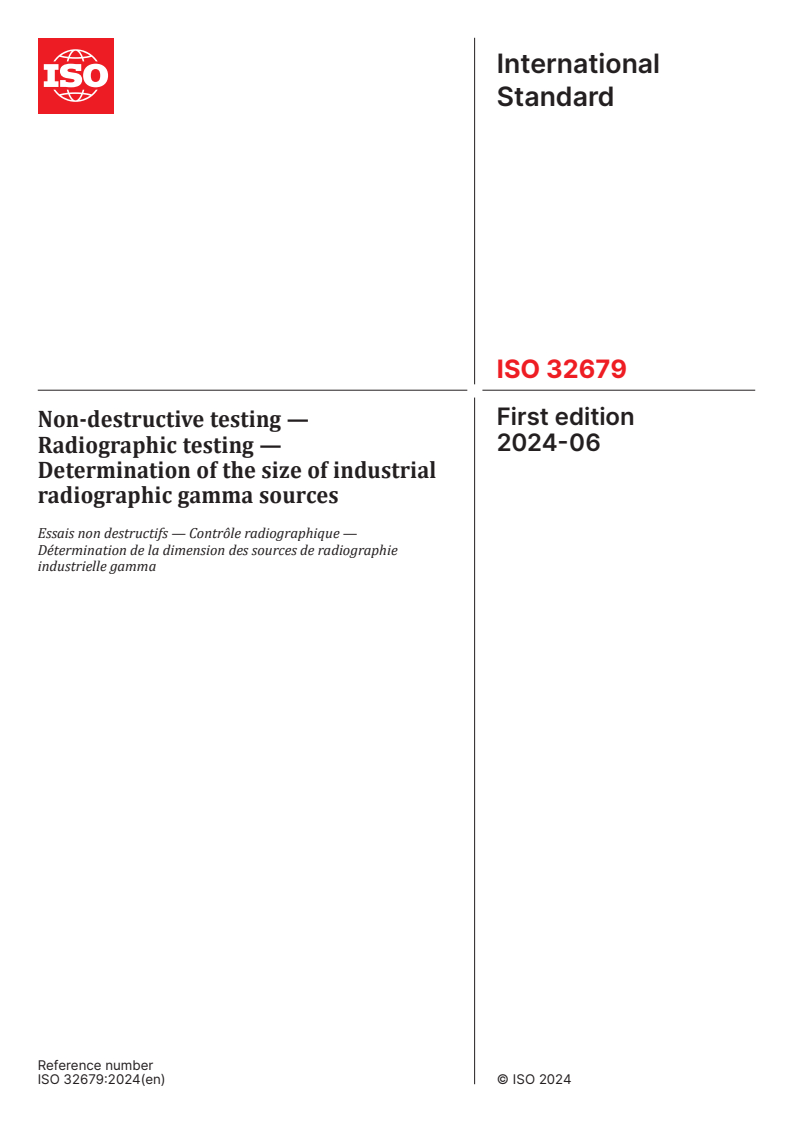
(Main)Non-destructive testing — Radiographic testing — Determination of the size of industrial radiographic gamma sources
General Information
- Abstract
This document specifies a test procedure for determination of the size of industrial radiographic gamma sources of 0,5 mm or greater, made from the radionuclides Iridium 192, Ytterbium 169, Selenium 75 or Cobalt 60, by a radiography method with X-rays. The source size of a gamma radiation source is an important factor which affects the image quality of gamma ray images. The source size is determined with an accuracy of ±10 % but typically not better than ±0,1 mm. The source size is provided by the manufacturer as the mechanical dimension of the source insert. A measurement can be required if the manufacturing process is validated or monitored after implementation of the source into the holder. This document can be used for other radionuclides after validation. The standard test method ASTM E1114 provides further information on the measurement of the Ir-192 source size, the characterization of the source shape, and its correct assembly and packaging.
- Status
- Published
- Publication Date
- 16-Jun-2024
- Technical Committee
- ISO/TC 135/SC 5 - Radiographic testing
- Drafting Committee
- ISO/TC 135/SC 5 - Radiographic testing
- Current Stage
- 6060 - International Standard published
- Start Date
- 17-Jun-2024
- Due Date
- 13-Jan-2025
- Completion Date
- 17-Jun-2024
Buy Documents
ISO 32679:2024 - Non-destructive testing — Radiographic testing — Determination of the size of industrial radiographic gamma sources Released:17. 06. 2024
ISO 32679:2024 - Essais non destructifs — Contrôle radiographique — Détermination de la dimension des sources de radiographie industrielle gamma Released:17. 06. 2024
Overview
ISO 32679:2024 - Non-destructive testing - Radiographic testing - Determination of the size of industrial radiographic gamma sources describes a radiographic X‑ray method to measure the size of industrial gamma sources (≥ 0.5 mm) made from Ir‑192, Yb‑169, Se‑75 or Co‑60. The standard defines test alignment, film and digital measurement procedures, digital detector requirements and reporting. Typical measurement accuracy is ±10% (commonly not better than ±0.1 mm). The measured projected size is corrected by a geometrical magnification factor to obtain the true source dimension.
Key topics and technical requirements
- Scope of measurement: Source sizes ≥ 0.5 mm; method can be validated for other radionuclides.
- Test alignment and magnification: X‑ray source, gamma source and detector geometry are specified; the projected size is corrected using the magnification factor ((a+b)/a).
- Measurement methods:
- Film radiography with optical magnification and graticule for direct measurement.
- Digital radiography (CR or DDA) using image‑processing profiles to determine source projection.
- Digital detector requirements:
- Pixel pitch ≤ 50 μm and at least 40× smaller than the nominal source size.
- Basic spatial detector resolution (SRb) < 1/20 of the nominal source size.
- Signal‑to‑noise ratio (SNR) in free beam area > 100; SNR measurement per ASTM E2597 (DDA) or ISO 16371‑1 (CR).
- Image quality controls: Contrast-to-noise criteria, use of reference objects (steel/tungsten cylinder or guide‑tube diameter) to calibrate pixel size and magnification.
- Reporting: Required items include identification of source/holder and activity, geometry (a, b, magnification), X‑ray parameters, detector details, measured size d, date and tester identification.
Applications and users
- Practical for NDT laboratories, industrial radiography service providers, gamma source manufacturers, and regulatory/quality assurance organizations that need to:
- Validate manufacturing and assembly of encapsulated gamma sources.
- Monitor source shape and dimension after insertion into holders.
- Calculate image unsharpness and set appropriate source‑to‑object distances for radiographic inspection.
- Helps improve image quality control, traceability and conformity of gamma radiography operations.
Related standards
- ISO 19232‑5 - image unsharpness determination (duplex wire IQI)
- ISO 16371‑1 - computed radiography (CR) system classification
- ASTM E1114 - Ir‑192 source size measurement and source characterization
- ASTM E2002 - image unsharpness and spatial resolution practice
- ASTM E2597/E2597M - DDA manufacturing & SNR characterization
Keywords: ISO 32679:2024, radiographic testing, gamma source size, non‑destructive testing, industrial radiography, Ir‑192, Co‑60, digital detectors, computed radiography, image unsharpness.
Relations
- Effective Date
- 12-Feb-2026
- Effective Date
- 15-Jul-2023
Buy Documents
ISO 32679:2024 - Non-destructive testing — Radiographic testing — Determination of the size of industrial radiographic gamma sources Released:17. 06. 2024
ISO 32679:2024 - Essais non destructifs — Contrôle radiographique — Détermination de la dimension des sources de radiographie industrielle gamma Released:17. 06. 2024
Get Certified
Connect with accredited certification bodies for this standard

IMP NDT d.o.o.
Non-destructive testing services. Radiography, ultrasonic, magnetic particle, penetrant, visual inspection.
Inštitut za kovinske materiale in tehnologije
Institute of Metals and Technology. Materials testing, metallurgical analysis, NDT.
Q Techna d.o.o.
NDT and quality assurance specialist. 30+ years experience. NDT personnel certification per ISO 9712, nuclear and thermal power plant inspections, QA/
Sponsored listings
Frequently Asked Questions
ISO 32679:2024 is a standard published by the International Organization for Standardization (ISO). Its full title is "Non-destructive testing — Radiographic testing — Determination of the size of industrial radiographic gamma sources". This standard covers: This document specifies a test procedure for determination of the size of industrial radiographic gamma sources of 0,5 mm or greater, made from the radionuclides Iridium 192, Ytterbium 169, Selenium 75 or Cobalt 60, by a radiography method with X-rays. The source size of a gamma radiation source is an important factor which affects the image quality of gamma ray images. The source size is determined with an accuracy of ±10 % but typically not better than ±0,1 mm. The source size is provided by the manufacturer as the mechanical dimension of the source insert. A measurement can be required if the manufacturing process is validated or monitored after implementation of the source into the holder. This document can be used for other radionuclides after validation. The standard test method ASTM E1114 provides further information on the measurement of the Ir-192 source size, the characterization of the source shape, and its correct assembly and packaging.
This document specifies a test procedure for determination of the size of industrial radiographic gamma sources of 0,5 mm or greater, made from the radionuclides Iridium 192, Ytterbium 169, Selenium 75 or Cobalt 60, by a radiography method with X-rays. The source size of a gamma radiation source is an important factor which affects the image quality of gamma ray images. The source size is determined with an accuracy of ±10 % but typically not better than ±0,1 mm. The source size is provided by the manufacturer as the mechanical dimension of the source insert. A measurement can be required if the manufacturing process is validated or monitored after implementation of the source into the holder. This document can be used for other radionuclides after validation. The standard test method ASTM E1114 provides further information on the measurement of the Ir-192 source size, the characterization of the source shape, and its correct assembly and packaging.
ISO 32679:2024 is classified under the following ICS (International Classification for Standards) categories: 19.100 - Non-destructive testing. The ICS classification helps identify the subject area and facilitates finding related standards.
ISO 32679:2024 has the following relationships with other standards: It is inter standard links to EN 12679:2018, ISO 22303:2008. Understanding these relationships helps ensure you are using the most current and applicable version of the standard.
ISO 32679:2024 is available in PDF format for immediate download after purchase. The document can be added to your cart and obtained through the secure checkout process. Digital delivery ensures instant access to the complete standard document.
Standards Content (Sample)
International
Standard
ISO 32679
First edition
Non-destructive testing —
2024-06
Radiographic testing —
Determination of the size of industrial
radiographic gamma sources
Essais non destructifs — Contrôle radiographique —
Détermination de la dimension des sources de radiographie
industrielle gamma
Reference number
© ISO 2024
All rights reserved. Unless otherwise specified, or required in the context of its implementation, no part of this publication may
be reproduced or utilized otherwise in any form or by any means, electronic or mechanical, including photocopying, or posting on
the internet or an intranet, without prior written permission. Permission can be requested from either ISO at the address below
or ISO’s member body in the country of the requester.
ISO copyright office
CP 401 • Ch. de Blandonnet 8
CH-1214 Vernier, Geneva
Phone: +41 22 749 01 11
Email: copyright@iso.org
Website: www.iso.org
Published in Switzerland
ii
Contents Page
Foreword .iv
1 Scope . 1
2 Normative references . 1
3 Terms and definitions . 1
4 Test procedure . 2
4.1 Test alignment .2
4.2 Test practice .3
5 Requirements to digital equipment . 3
5.1 Digital Detectors .3
5.2 Test parameters for digital radiography .4
6 Measurement and determination of size d of the radiographic gamma source. 4
6.1 Measurement with film .4
6.2 Measurement with digital detectors .4
6.3 Determination of source size .6
7 Test report . 6
Bibliography . 7
iii
Foreword
ISO (the International Organization for Standardization) is a worldwide federation of national standards
bodies (ISO member bodies). The work of preparing International Standards is normally carried out through
ISO technical committees. Each member body interested in a subject for which a technical committee
has been established has the right to be represented on that committee. International organizations,
governmental and non-governmental, in liaison with ISO, also take part in the work. ISO collaborates closely
with the International Electrotechnical Commission (IEC) on all matters of electrotechnical standardization.
The procedures used to develop this document and those intended for its further maintenance are described
in the ISO/IEC Directives, Part 1. In particular, the different approval criteria needed for the different types
of ISO document should be noted. This document was drafted in accordance with the editorial rules of the
ISO/IEC Directives, Part 2 (see www.iso.org/directives).
ISO draws attention to the possibility that the implementation of this document may involve the use of (a)
patent(s). ISO takes no position concerning the evidence, validity or applicability of any claimed patent
rights in respect thereof. As of the date of publication of this document, ISO had not received notice of (a)
patent(s) which may be required to implement this document. However, implementers are cautioned that
this may not represent the latest information, which may be obtained from the patent database available at
www.iso.org/patents. ISO shall not be held responsible for identifying any or all such patent rights.
Any trade name used in this document is information given for the convenience of users and does not
constitute an endorsement.
For an explanation of the voluntary nature of standards, the meaning of ISO specific terms and expressions
related to conformity assessment, as well as information about ISO's adherence to the World Trade
Organization (WTO) principles in the Technical Barriers to Trade (TBT), see www.iso.org/iso/foreword.html.
This document was prepared by Technical Committee CEN/TC 138, Non-destructive testing (as EN
12679:2018) and was adopted (without modification other than that (those) given below) by Technical
Committee ISO/TC 135, Non-destructive testing, Subcommittee SC 5, Radiographic testing.
The main changes are as follows:
— revised definitions 3.1, 3.3 and 3.4;
— deleted definition 3.5;
— added Formula (1) defining the geometrical magnification factor;
— updated figures;
— editorial corrections.
Any feedback or questions on this document should be directed to the user’s national standards body. A
complete listing of these bodies can be found at www.iso.org/members.html.
iv
International Standard ISO 32679:2024(en)
Non-destructive testing — Radiographic testing — Determination
of the size of industrial radiographic gamma sources
1 Scope
This document specifies a test procedure for determination of the size of industrial radiographic gamma
sources of 0,5 mm or greater, made from the radionuclides Iridium 192, Ytterbium 169, Selenium 75 or Cobalt
60, by a radiography method with X-rays. The source size of a gamma radiation source is an important factor
which affects the image quality of gamma ray images.
The source size is determined with an accuracy of ±10 % but typically not better than ±0,1 mm.
The source size is provided by the manufacturer as the mechanical dimension of the source insert. A
measurement can be required if the manufacturing process is validated or monitored after implementation
of the source into the holder.
This document can be used for other radionuclides after validation.
The standard test method ASTM E1114 provides further information on the measurement of the Ir-192
source size, the characterization of the source shape, and its correct assembly and packaging.
2 Normative references
The following documents are referred to in the text in such a way that some or all of their content constitutes
requirements of this document. For dated references, only the edition cited applies. For undated references,
the latest edition of the referenced document (including any amendments) applies.
ISO 19232-5, Non-destructive testing — Image quality of radiographs — Part 5: Determination of the image
unsharpness value using duplex wire-type image quality indicators
ISO 16371-1, Non-destructive testing — Industrial computed radiography with storage phosphor imaging plates
— Part 1: Classification of systems
ASTM E 2002 - 22, Standard Practice for Determining Total Image Unsharpness and Basic Spatial Resolution in
Radiography and Radioscopy
ASTM E 2597/2597M - 22, Standard Practice for Manufacturing Characterization of Digital Detector Arrays
3 Terms and definitions
For the purposes of this document, the following terms and definitions apply.
ISO and IEC maintain terminology databases for use in standardization at the following addresses:
— ISO Online browsing platform: available at https:// www .iso .org/ obp
— IEC Electropedia: available at https:// www .electropedia .org/
3.1
source size
d
maximum dimension of the gamma radiation source
3.2
...
Norme
internationale
ISO 32679
Première édition
Essais non destructifs — Contrôle
2024-06
radiographique — Détermination
de la dimension des sources de
radiographie industrielle gamma
Non-destructive testing — Radiographic testing —
Determination of the size of industrial radiographic gamma
sources
Numéro de référence
DOCUMENT PROTÉGÉ PAR COPYRIGHT
© ISO 2024
Tous droits réservés. Sauf prescription différente ou nécessité dans le contexte de sa mise en œuvre, aucune partie de cette
publication ne peut être reproduite ni utilisée sous quelque forme que ce soit et par aucun procédé, électronique ou mécanique,
y compris la photocopie, ou la diffusion sur l’internet ou sur un intranet, sans autorisation écrite préalable. Une autorisation peut
être demandée à l’ISO à l’adresse ci-après ou au comité membre de l’ISO dans le pays du demandeur.
ISO copyright office
Case postale 401 • Ch. de Blandonnet 8
CH-1214 Vernier, Genève
Tél.: +41 22 749 01 11
E-mail: copyright@iso.org
Web: www.iso.org
Publié en Suisse
ii
Sommaire Page
Avant-propos .iv
1 Domaine d’application . 1
2 Références normatives . 1
3 Termes et définitions . 1
4 Mode opératoire d'essai . 2
4.1 Montage d'essai .2
4.2 Réalisation de l'essai .3
5 Exigences relatives à l'équipement numérique . 3
5.1 Détecteurs numériques .3
5.2 Paramètres d'essai pour la radiographie numérique .4
6 Mesurage et détermination de la dimension d de la source de radiographie gamma . 4
6.1 Mesurage avec un film .4
6.2 Mesurage utilisant des détecteurs numériques .4
6.3 Détermination de la dimension de la source .6
7 Rapport d’essai . 6
Bibliographie . 7
iii
Avant-propos
L’ISO (Organisation internationale de normalisation) est une fédération mondiale d’organismes nationaux
de normalisation (comités membres de l’ISO). L’élaboration des Normes internationales est en général
confiée aux comités techniques de l’ISO. Chaque comité membre intéressé par une étude a le droit de faire
partie du comité technique créé à cet effet. Les organisations internationales, gouvernementales et non
gouvernementales, en liaison avec l’ISO participent également aux travaux. L’ISO collabore étroitement avec
la Commission électrotechnique internationale (IEC) en ce qui concerne la normalisation électrotechnique.
Les procédures utilisées pour élaborer le présent document et celles destinées à sa mise à jour sont
décrites dans les Directives ISO/IEC, Partie 1. Il convient, en particulier, de prendre note des différents
critères d'approbation requis pour les différents types de documents ISO. Le présent document
a été rédigé conformément aux règles de rédaction données dans les Directives ISO/IEC, Partie 2
(voir https://www.iso.org/directives).
L’ISO attire l’attention sur le fait que la mise en application du présent document peut entraîner l’utilisation
d’un ou de plusieurs brevets. L’ISO ne prend pas position quant à la preuve, à la validité et à l’applicabilité de
tout droit de propriété revendiqué à cet égard. À la date de publication du présent document, l’ISO n'avait pas
reçu notification qu’un ou plusieurs brevets pouvaient être nécessaires à sa mise en application. Toutefois,
il y a lieu d’avertir les responsables de la mise en application du présent document que des informations
plus récentes sont susceptibles de figurer dans la base de données de brevets, disponible à l'adresse
www.iso.org/brevets. L’ISO ne saurait être tenue pour responsable de ne pas avoir identifié tout ou partie de
tels droits de brevets.
Les appellations commerciales éventuellement mentionnées dans le présent document sont données pour
information, par souci de commodité, à l’intention des utilisateurs et ne sauraient constituer un engagement.
Pour une explication de la nature volontaire des normes, la signification des termes et expressions
spécifiques de l’ISO liés à l’évaluation de la conformité, ou pour toute information au sujet de l’adhésion de
l’ISO aux principes de l’Organisation mondiale du commerce (OMC) concernant les obstacles techniques au
commerce (OTC), voir le lien suivant: www.iso.org/avant-propos.
Le présent document a été élaboré par le comité technique CEN/TC 138, Essais non destructifs (en tant
qu’EN 12679‑2:2018) et a été adopté (sans modifications autres que celles indiquées ci‑dessous) par le
comité technique ISO/TC 135, Essais non destructifs, sous-comité SC 5, Contrôle par radiographie.
Les principales modifications sont les suivantes:
— révision des définitions 3.1, 3.3 et 3.4;
— suppression de la définition 3.5;
— ajout de la Formule (1) qui définit le facteur de grandissement géométrique;
— mise à jour des figures;
— corrections rédactionnelles.
Il convient que l’utilisateur adresse tout retour d’information ou toute question concernant le présent
document à l’organisme national de normalisation de son pays. Une liste exhaustive desdits organismes se
trouve à l’www.iso.org/members.html.
iv
Norme internationale ISO 32679:2024(fr)
Essais non destructifs — Contrôle radiographique —
Détermination de la dimension des sources de radiographie
industrielle gamma
1 Domaine d’application
Le présent document spécifie un mode opératoire d’essai pour la détermination, par une méthode de
radiographie aux rayons X, de la dimension des sources de radiographie industrielle gamma de 0,5 mm
ou plus, fabriquées à partir des radionucléides iridium 192, ytterbium 169, sélénium 75 ou cobalt 60. La
dimension d'une source de rayonnement gamma est un facteur important qui affecte la qualité des images
obtenues par rayonnement gamma.
La dimension d'une source est déterminée avec une exactitude de ± 10 %, mais généralement de ± 0,1 mm au
maximum.
La dimension de la source est fournie par le fabricant comme la dimension mécanique de la garniture de la
source. Un mesurage peut être requis si le processus de fabrication est validé ou contrôlé après la mise en
place de la source dans le porte-source.
Le présent document peut être utilisé pour d'autres radionucléides après validation.
La méthode d'essai normalisée de l'ASTM E1114 fournit des informations supplémentaires sur le mesurage
de la dimension de la source d'Ir-192, la caractérisation de la forme de la source ainsi que des instructions
pour la monter et l'emballer correctement
2 Références normatives
Les documents suivants sont cités dans le texte de sorte qu’ils constituent, pour tout ou partie de leur
contenu, des exigences du présent document. Pour les références datées, seule l’édition citée s’applique. Pour
les références non datées, la dernière édition de la publication à laquelle il est fait référence s'applique (y
compris tous les amendements).
ISO 19232-5, Essais non destructifs — Qualité d'image des radiogrammes — Partie 5: Détermination de l'indice
de flou de l'image et de la résolution spatiale de base à l'aide d'indicateurs de qualité d'image duplex à fils
ISO 16371-1, Essais non destructifs — Radiographie industrielle numérisée avec des plaques-images au
phosphore — Partie 1: Classification des systèmes
ASTM E 2002 - 22, Standard Practice for Determining Total Image Unsharpness and Basic Spatial Resolution in
Radiography and Radioscopy
ASTM E 2597/2597M - 22, Standard Practice for Manufacturing Characterization of Digital Detector Arrays
3 Termes et définitions
Pour les besoins du présent document, les termes et définitions suivants s'appliquent.
L'ISO et l'IEC tiennent à jour des bases de données terminologiques destinées à être utilisées en normalisation,
consultables aux adresses suivantes:
— ISO Online browsing platform: disponible à l'adresse https:// www .iso .org/ obp
— IEC Electropedia: disponible à l'adresse https:// www .electropedia .org/
3.1
dimension de la source
d
dimension maximale de la source de rayonnement gamma
3.2
rapport signal/bruit
SNR
rapport de la valeur moyenne des valeurs de gris linéarisées et de l'écart-type des valeurs de gris linéarisées
(bruit) dans une zone d'intérêt donnée d'une image numérique
3.3
rapport signal/bruit normalisé
SNR
N
rapport signal/bruit (3.2) tel que mesuré directement dans l'image numérique et normalisé par la résolution
détecteur
spatiale de base d’un détecteur, SR
b
c
SNRS=⋅NR
N
d
...