

ISO 8493:1998
(Main)Metallic materials — Tube — Drift-expanding test
General Information
- Abstract
- Status
- Published
- Publication Date
- 21-Oct-1998
- Technical Committee
- ISO/TC 164/SC 2 - Ductility testing
- Drafting Committee
- ISO/TC 164/SC 2 - Ductility testing
- Current Stage
- 9060 - Close of review
- Completion Date
- 04-Jun-2031
Buy Documents
ISO 8493:1998 - Metallic materials — Tube — Drift-expanding test Released:10/22/1998
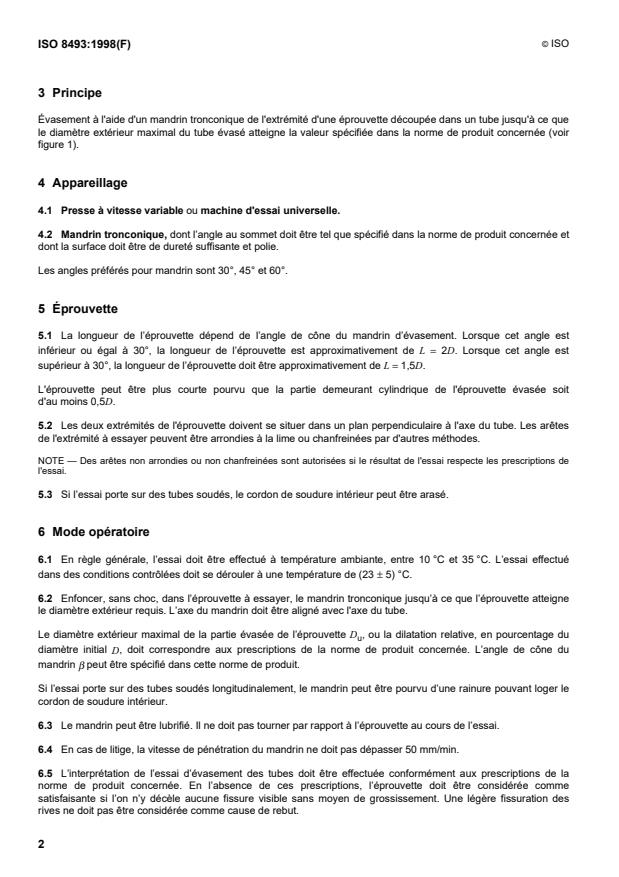
ISO 8493:1998 - Matériaux métalliques — Tubes — Essai d'évasement Released:10/22/1998
Overview
ISO 8493:1998 specifies a standardized drift-expanding test for metallic tubes (circular section) to determine their aptitude for plastic deformation by internal expansion. Prepared by ISO/TC 164 (mechanical testing of metals), this second edition replaces ISO 8493:1986 and defines the test principle, apparatus, specimen geometry, operating procedure and minimum reporting requirements for tubes used in product standards.
Key topics and technical requirements
- Scope limits: applicable to tubes with external diameter ≤ 150 mm (≤ 100 mm for light metals) and wall thickness ≤ 10 mm, unless a product standard defines a narrower range.
- Test principle: expand the tube end by pushing a conical mandrel into a specimen until the specified maximum expanded external diameter or percentage expansion is reached.
- Apparatus:
- Variable-speed press or universal testing machine.
- Hardened, polished conical mandrel; preferred cone angles: 30°, 45°, 60°. Mandrel surface hardness and finish must be adequate.
- Specimen geometry:
- Length L ≈ 2D when mandrel cone angle ≤ 30°; L ≈ 1.5D when angle > 30° (D = initial outer diameter).
- Remaining cylindrical length after expansion must be at least 0.5D.
- Ends must be perpendicular to tube axis; edges may be rounded or chamfered.
- Test conditions and procedure:
- Performed generally at ambient temperature 10 °C–35 °C; controlled tests at (23 ± 5) °C.
- Mandrel inserted without shock; axis alignment required; mandrel may be lubricated and must not rotate relative to specimen.
- For dispute resolution, penetration speed ≤ 50 mm/min.
- For welded tubes, internal weld bead may be machined flush; mandrel groove permitted to accommodate weld seam.
- Acceptance criteria & reporting:
- Interpretation as per the relevant product standard. If none, specimen is satisfactory if no visible crack without magnification; minor edge cracking is not cause for rejection.
- Test report should include reference to ISO 8493, specimen ID and dimensions, maximum expanded diameter or percent expansion, mandrel cone angle and test result.
Applications and users
ISO 8493 is used for quality control, product acceptance and material qualification where tube ductility and formability under internal expansion are critical. Typical users:
- Tube manufacturers and suppliers
- Quality assurance and metallurgical laboratories
- Product standards committees and purchasers specifying acceptance testing
- Fabricators assessing suitability for forming/joining operations
Related standards
- Product-specific tube standards (referenced for acceptance limits and mandrel angles)
- ISO/TC 164 publications on mechanical testing of metals
Keywords: ISO 8493:1998, drift-expanding test, tube testing, metallic materials, mandrel, tube ductility test, tube expansion.
Relations
- Consolidated By
ISO 1874-1:2010 - Plastics — Polyamide (PA) moulding and extrusion materials — Part 1: Designation system and basis for specification - Effective Date
- 06-Jun-2022
- Effective Date
- 15-Apr-2008
Buy Documents
ISO 8493:1998 - Metallic materials — Tube — Drift-expanding test Released:10/22/1998
ISO 8493:1998 - Matériaux métalliques — Tubes — Essai d'évasement Released:10/22/1998
Get Certified
Connect with accredited certification bodies for this standard

Element Materials Technology
Materials testing and product certification.

Inštitut za kovinske materiale in tehnologije
Institute of Metals and Technology. Materials testing, metallurgical analysis, NDT.
Sponsored listings
Frequently Asked Questions
ISO 8493:1998 is a standard published by the International Organization for Standardization (ISO). Its full title is "Metallic materials — Tube — Drift-expanding test". This standard covers: Metallic materials — Tube — Drift-expanding test
Metallic materials — Tube — Drift-expanding test
ISO 8493:1998 is classified under the following ICS (International Classification for Standards) categories: 77.040.10 - Mechanical testing of metals. The ICS classification helps identify the subject area and facilitates finding related standards.
ISO 8493:1998 has the following relationships with other standards: It is inter standard links to ISO 1874-1:2010, ISO 8493:1986. Understanding these relationships helps ensure you are using the most current and applicable version of the standard.
ISO 8493:1998 is available in PDF format for immediate download after purchase. The document can be added to your cart and obtained through the secure checkout process. Digital delivery ensures instant access to the complete standard document.
Standards Content (Sample)
INTERNATIONAL ISO
STANDARD 8493
Second edition
1998-11-01
Metallic materials — Tube —
Drift-expanding test
Matériaux métalliques — Tubes — Essai d’évasement
A
Reference number
Foreword
ISO (the International Organization for Standardization) is a worldwide federation of national standards bodies (ISO
member bodies). The work of preparing International Standards is normally carried out through ISO technical
committees. Each member body interested in a subject for which a technical committee has been established has
the right to be represented on that committee. International organizations, governmental and non-governmental, in
liaison with ISO, also take part in the work. ISO collaborates closely with the International Electrotechnical
Commission (IEC) on all matters of electrotechnical standardization.
Draft International Standards adopted by the technical committees are circulated to the member bodies for voting.
Publication as an International Standard requires approval by at least 75 % of the member bodies casting a vote.
International Standard ISO 8493 was prepared by Technical Committee ISO/TC 164, Mechanical testing of metals,
Subcommittee SC 2, Ductility testing.
This second edition cancels and replaces the first edition (ISO 8493:1986), of which it constitutes a technical
revision.
© ISO 1998
All rights reserved. Unless otherwise specified, no part of this publication may be reproduced or utilized in any form or by any means, electronic
or mechanical, including photocopying and microfilm, without permission in writing from the publisher.
International Organization for Standardization
Case postale 56 • CH-1211 Genève 20 • Switzerland
Internet iso@iso.ch
Printed in Switzerland
ii
INTERNATIONAL STANDARD © ISO ISO 8493:1998(E)
Metallic materials — Tube — Drift-expanding test
1 Scope
This International Standard specifies a method for determining the ability of metallic tubes of circular cross-section
to undergo plastic deformation in drift expansion.
This International Standard is intended for tubes having an outside diameter no greater than 150 mm (100 mm for
light metals) and a thickness no greater than 10 mm although the range of the outside diameter or the thickness for
which this International Standard is applicable may be more exactly specified in the relevant product standard.
2 Symbols, designations and units
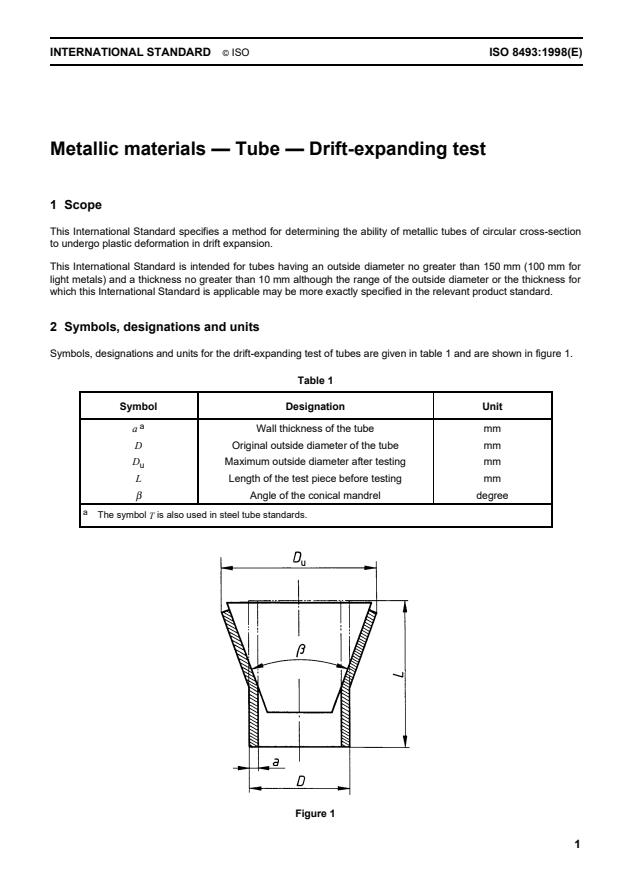
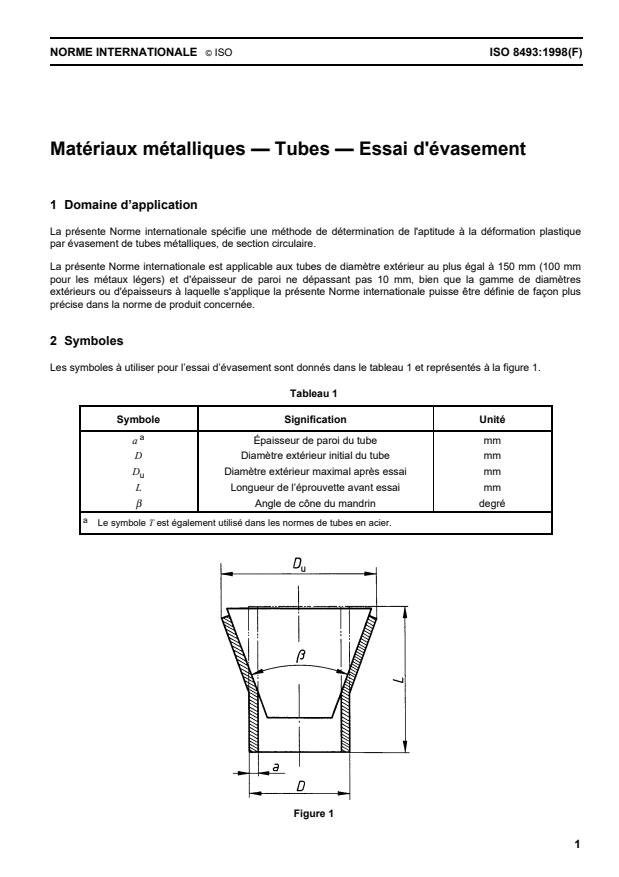
Symbols, designations and units for the drift-expanding test of tubes are given in table 1 and are shown in figure 1.
Table 1
Symbol Designation Unit
a
a Wall thickness of the tube mm
D Original outside diameter of the tube mm
D Maximum outside diameter after testing mm
u
L Length of the test piece before testing mm
b Angle of the conical mandrel degree
a
The symbol T is also used in steel tube standards.
Figure 1
© ISO
3 Principle
Expansion of the end of the test piece cut from the tube, by means of a conical mandrel, until the maximum outside
diameter of the expanded tube reaches the value specified in the relevant product standard (see figure 1).
4 Testing equipment
4.1 Variable-speed press or universal testing machine.
4.2
...
NORME ISO
INTERNATIONALE 8493
Deuxième édition
1998-11-01
Matériaux métalliques — Tubes — Essai
d’évasement
Metallic materials — Tube — Drift-expanding test
A
Numéro de référence
Avant-propos
L'ISO (Organisation internationale de normalisation) est une fédération mondiale d'organismes nationaux de
normalisation (comités membres de l'ISO). L'élaboration des Normes internationales est en général confiée aux
comités techniques de l'ISO. Chaque comité membre intéressé par une étude a le droit de faire partie du comité
technique créé à cet effet. Les organisations internationales, gouvernementales et non gouvernementales, en
liaison avec l'ISO, participent également aux travaux. L'ISO collabore étroitement avec la Commission
électrotechnique internationale (CEI) en ce qui concerne la normalisation électrotechnique.
Les projets de Normes internationales adoptés par les comités techniques sont soumis aux comités membres pour
vote. Leur publication comme Normes internationales requiert l'approbation de 75 % au moins des comités
membres votants.
La Norme internationale ISO 8493 a été élaborée par le comité technique ISO/TC 164, Essais mécaniques des
métaux, sous-comité SC 2, Essais de ductilité.
Cette deuxième édition annule et remplace la première édition (ISO 8493:1986), dont elle constitue une révision
technique.
© ISO 1998
Droits de reproduction réservés. Sauf prescription différente, aucune partie de cette publication ne peut être reproduite ni utilisée sous quelque
forme que ce soit et par aucun procédé, électronique ou mécanique, y compris la photocopie et les microfilms, sans l'accord écrit de l'éditeur.
Organisation internationale de normalisation
Case postale 56 • CH-1211 Genève 20 • Suisse
Internet iso@iso.ch
Imprimé en Suisse
ii
NORME INTERNATIONALE © ISO ISO 8493:1998(F)
Matériaux métalliques — Tubes — Essai d'évasement
1 Domaine d’application
La présente Norme internationale spécifie une méthode de détermination de l'aptitude à la déformation plastique
par évasement de tubes métalliques, de section circulaire.
La présente Norme internationale est applicable aux tubes de diamètre extérieur au plus égal à 150 mm (100 mm
pour les métaux légers) et d'épaisseur de paroi ne dépassant pas 10 mm, bien que la gamme de diamètres
extérieurs ou d'épaisseurs à laquelle s'applique la présente Norme internationale puisse être définie de façon plus
précise dans la norme de produit concernée.
2 Symboles
Les symboles à utiliser pour l’essai d’évasement sont donnés dans le tableau 1 et représentés à la figure 1.
Tableau 1
Symbole Signification Unité
a
a Épaisseur de paroi du tube mm
D Diamètre extérieur initial du tube mm
D Diamètre extérieur maximal après essai mm
u
L Longueur de l’éprouvette avant essai mm
b Angle de cône du mandrin degré
a
Le symbole est également utilisé dans les normes de tubes en acier.
T
Figure 1
© ISO
3 Principe
Évasement à l'aide d'un mandrin tronconique de l'extrémité d'une éprouvette découpée dans un tube jusqu'à ce que
le diamètre extérieur maximal du tube évasé atteigne la valeur spécifiée dans la norme de produit concernée (voir
figure 1).
4 Appareillage
4.1 Presse à vitesse variable ou machine d'e
...