

ISO 7012-3:2025
(Main)Paints and varnishes — Determination of preservatives in water-dilutable coating materials — Part 3: Determination of in-can isothiazolinones with LC-UV and LC-MS
General Information
- Abstract
This document specifies the apparatus and the analytical methods for determining the content of in-can isothiazolinone preservatives in water-dilutable coating materials or related products. This document is also applicable to polymer dispersions.
- Status
- Published
- Publication Date
- 31-Mar-2025
- Technical Committee
- ISO/TC 35/SC 16 - Chemical analysis
- Drafting Committee
- ISO/TC 35/SC 16 - Chemical analysis
- Current Stage
- 6060 - International Standard published
- Start Date
- 01-Apr-2025
- Due Date
- 11-Jan-2025
- Completion Date
- 31-Mar-2025
Buy Documents
ISO 7012-3:2025 - Paints and varnishes — Determination of preservatives in water-dilutable coating materials — Part 3: Determination of in-can isothiazolinones with LC-UV and LC-MS Released:1. 04. 2025
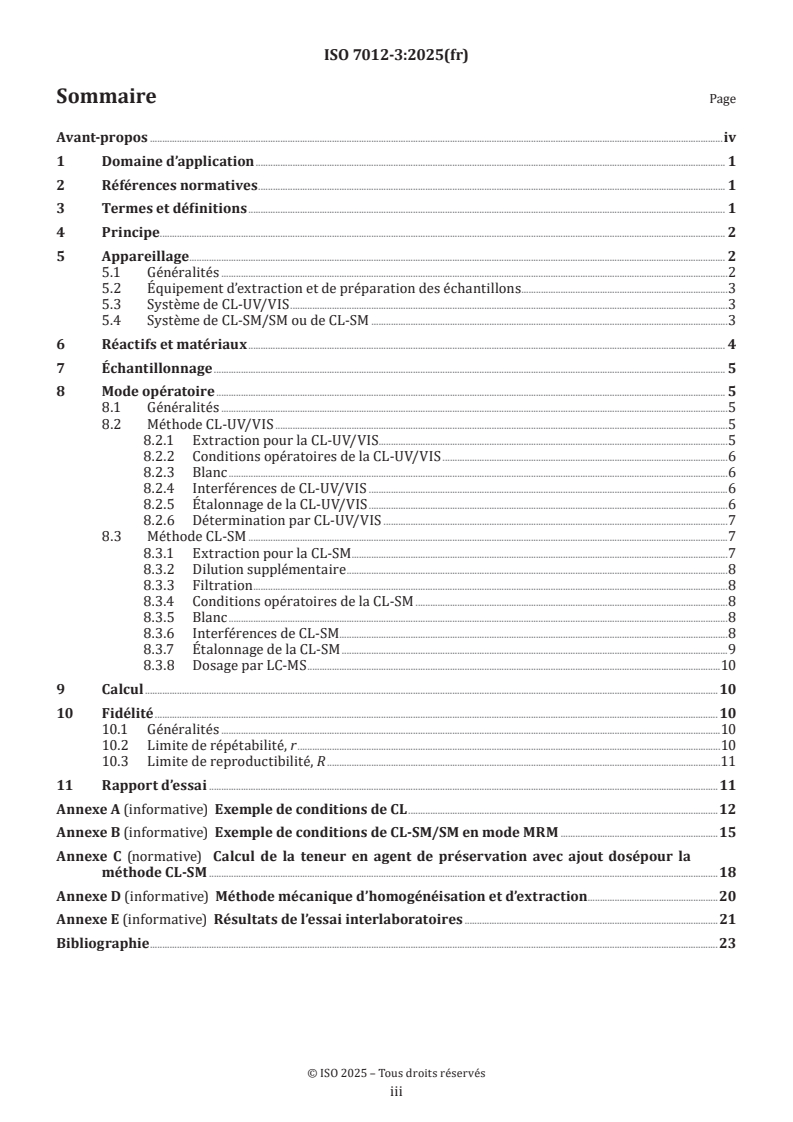
ISO 7012-3:2025 - Peintures et vernis — Dosage des agents de préservation dans les produits de peinture diluables a l’eau — Partie 3: Dosage des isothiazolinones en pot par CL-UV et CL-SM Released:1. 04. 2025
Overview
ISO 7012-3:2025 specifies analytical methods for the determination of in-can isothiazolinone preservatives in water-dilutable coating materials (paints and varnishes) and related products, including polymer dispersions. The standard defines required apparatus, sample preparation and extraction, and chromatographic determination using liquid chromatography with UV/VIS detection (LC-UV/DAD) and liquid chromatography coupled to mass spectrometry (LC‑MS or LC‑MS/MS). Applicable ionization techniques include electrospray (ESI) and atmospheric pressure chemical ionization (APCI).
Key topics and technical requirements
- Scope and applicability: Targeted at in‑can preservative analysis in water‑based coatings and polymer dispersions; the standard is part of the ISO 7012 series.
- Principle: Homogenize and extract samples with an appropriate solvent, purify by centrifugation, then identify and quantify isothiazolinones by LC‑UV or LC‑MS(/MS).
- Sample preparation & apparatus:
- High‑speed centrifuge (e.g., 5 000–30 000 r/min noted as suitable)
- Ultrasonic water bath (35–45 kHz)
- Analytical balances, volumetric flasks (10–100 ml), 0.22 µm filtration membranes
- Chromatography & detection:
- Reverse phase C18 analytical columns (HPLC/UPLC/UHPLC compatible)
- LC‑UV/DAD method and LC‑MS or LC‑MS/MS (single or tandem quadrupole)
- LC‑MS requires LC‑MS grade solvents
- Quality control & method performance:
- Requirements for blanks, calibration procedures, interferences assessment and calculation
- Precision statements including repeatability and reproducibility limits (method validation and interlaboratory testing are addressed)
- Documentation: Test report contents and annexes give example LC conditions, MRM setups, extraction mechanics and interlaboratory results.
Practical applications and users
ISO 7012-3:2025 is intended for:
- Quality control laboratories in paint, varnish and coating manufacturing verifying preservative content
- Regulatory and compliance testing where control of in‑can biocides (isothiazolinones such as MIT/MBC etc.) is required
- R&D teams developing water‑dilutable coatings and polymer dispersions to optimize preservative performance and stability
- Third‑party testing labs performing routine or contract analyses using HPLC/UPLC with UV and MS detection
Practical benefits include standardized extraction and chromatographic procedures, harmonized reporting, and traceable calibration for consistent preservative measurement across laboratories.
Related standards
- ISO 1513 (sample preparation)
- ISO 3696 (laboratory water quality)
- ISO 15528 (sampling)
- ISO 4618 and ISO 11890-2 (terminology and related paint definitions)
- Other parts of the ISO 7012 series (see ISO website for full listing)
Keywords: paints and varnishes, in‑can isothiazolinones, preservatives, LC‑UV, LC‑MS, LC‑MS/MS, HPLC, UPLC, polymer dispersions, analytical methods.
Relations
- Effective Date
- 12-Feb-2026
- Effective Date
- 06-Jun-2022
Buy Documents
ISO 7012-3:2025 - Paints and varnishes — Determination of preservatives in water-dilutable coating materials — Part 3: Determination of in-can isothiazolinones with LC-UV and LC-MS Released:1. 04. 2025
ISO 7012-3:2025 - Peintures et vernis — Dosage des agents de préservation dans les produits de peinture diluables a l’eau — Partie 3: Dosage des isothiazolinones en pot par CL-UV et CL-SM Released:1. 04. 2025
Frequently Asked Questions
ISO 7012-3:2025 is a standard published by the International Organization for Standardization (ISO). Its full title is "Paints and varnishes — Determination of preservatives in water-dilutable coating materials — Part 3: Determination of in-can isothiazolinones with LC-UV and LC-MS". This standard covers: This document specifies the apparatus and the analytical methods for determining the content of in-can isothiazolinone preservatives in water-dilutable coating materials or related products. This document is also applicable to polymer dispersions.
This document specifies the apparatus and the analytical methods for determining the content of in-can isothiazolinone preservatives in water-dilutable coating materials or related products. This document is also applicable to polymer dispersions.
ISO 7012-3:2025 is classified under the following ICS (International Classification for Standards) categories: 87.040 - Paints and varnishes. The ICS classification helps identify the subject area and facilitates finding related standards.
ISO 7012-3:2025 has the following relationships with other standards: It is inter standard links to EN ISO 7012-3:2025, ISO 6182-1:2021. Understanding these relationships helps ensure you are using the most current and applicable version of the standard.
ISO 7012-3:2025 is available in PDF format for immediate download after purchase. The document can be added to your cart and obtained through the secure checkout process. Digital delivery ensures instant access to the complete standard document.
Standards Content (Sample)
International
Standard
ISO 7012-3
First edition
Paints and varnishes —
2025-03
Determination of preservatives in
water-dilutable coating materials —
Part 3:
Determination of in-can
isothiazolinones with LC-UV and LC-
MS
Peintures et vernis — Dosage des agents de préservation dans les
produits de peinture diluables à l’eau —
Partie 3: Dosage des isothiazolinones en pot par CL-UV et CL-SM
Reference number
© ISO 2025
All rights reserved. Unless otherwise specified, or required in the context of its implementation, no part of this publication may
be reproduced or utilized otherwise in any form or by any means, electronic or mechanical, including photocopying, or posting on
the internet or an intranet, without prior written permission. Permission can be requested from either ISO at the address below
or ISO’s member body in the country of the requester.
ISO copyright office
CP 401 • Ch. de Blandonnet 8
CH-1214 Vernier, Geneva
Phone: +41 22 749 01 11
Email: copyright@iso.org
Website: www.iso.org
Published in Switzerland
ii
Contents Page
Foreword .iv
1 Scope . 1
2 Normative references . 1
3 Terms and definitions . 1
4 Principle . 2
5 Apparatus . 2
5.1 General .2
5.2 Equipment for extraction and sample preparation .2
5.3 LC-UV/VIS system . .3
5.4 LC-MS/MS or LC-MS system .3
6 Reagents and materials . 3
7 Sampling . 5
8 Procedure . 5
8.1 General .5
8.2 LC-UV/VIS method .5
8.2.1 Extraction of LC-UV/VIS .5
8.2.2 Operation conditions of LC-UV/VIS .6
8.2.3 Blank .6
8.2.4 Interferences of LC-UV/VIS .6
8.2.5 Calibration of LC-UV/VIS . .6
8.2.6 Determination by LC-UV/VIS .7
8.3 LC-MS method .7
8.3.1 Extraction of LC-MS .7
8.3.2 Further dilution . .7
8.3.3 Filtration .8
8.3.4 Operation conditions of LC-MS .8
8.3.5 Blank .8
8.3.6 Interferences of LC-MS .8
8.3.7 Calibration of LC-MS .8
8.3.8 Determination by LC-MS .9
9 Calculation . 9
10 Precision . 10
10.1 General .10
10.2 Repeatability limit,r .10
10.3 Reproducibility limit,R .10
11 Test report . 10
Annex A (informative) Example of LC conditions .12
Annex B (informative) Example of multiple reaction monitoring LC-MS/MS conditions .15
Annex C (normative) Calculation of preservative content with standard addition for LC-MS
method .18
Annex D (informative) Mechanical method for homogenization and extraction.20
Annex E (informative) Results of the interlaboratory test .21
Bibliography .23
iii
Foreword
ISO (the International Organization for Standardization) is a worldwide federation of national standards
bodies (ISO member bodies). The work of preparing International Standards is normally carried out through
ISO technical committees. Each member body interested in a subject for which a technical committee
has been established has the right to be represented on that committee. International organizations,
governmental and non-governmental, in liaison with ISO, also take part in the work. ISO collaborates closely
with the International Electrotechnical Commission (IEC) on all matters of electrotechnical standardization.
The procedures used to develop this document and those intended for its further maintenance are described
in the ISO/IEC Directives, Part 1. In particular, the different approval criteria needed for the different types
of ISO document should be noted. This document was drafted in accordance with the editorial rules of the
ISO/IEC Directives, Part 2 (see www.iso.org/directives).
ISO draws attention to the possibility that the implementation of this document may involve the use of (a)
patent(s). ISO takes no position concerning the evidence, validity or applicability of any claimed patent
rights in respect thereof. As of the date of publication of this document, ISO had not received notice of (a)
patent(s) which may be required to implement this document. However, implementers are cautioned that
this may not represent the latest information, which may be obtained from the patent database available at
www.iso.org/patents. ISO shall not be held responsible for identifying any or all such patent rights.
Any trade name used in this document is information given for the convenience of users and does not
constitute an endorsement.
For an explanation of the voluntary nature of standards, the meaning of ISO specific terms and expressions
related to conformity assessment, as well as information about ISO's adherence to the World Trade
Organization (WTO) principles in the Technical Barriers to Trade (TBT), see www.iso.org/iso/foreword.html.
This document was prepared by Technical Committee ISO/TC 35, Paints and varnishes, Subcommittee SC 16,
Chemical analysis, in collaboration with the European Committee for Standardization (CEN) Technical
Committee CEN/TC 139, Paints and varnishes, in accordance with the Agreement on technical cooperation
between ISO and CEN (Vienna Agreement).
A list of all parts in the ISO 7012 series can be found on the ISO website.
Any feedback or questions on this document should be directed to the user’s national standards body. A
complete listing of these bodies can be found at www.iso.org/members.html.
iv
International Standard ISO 7012-3:2025(en)
Paints and varnishes — Determination of preservatives in
water-dilutable coating materials —
Part 3:
Determination of in-can isothiazolinones with LC-UV and LC-MS
1 Scope
This document specifies the apparatus and the analytical methods for determining the content of in-can
isothiazolinone preservatives in water-dilutable coating materials or related products.
This document is also applicable to polymer dispersions.
2 Normative references
The following documents are referred to in the text in such a way that some or all of their content constitutes
requirements of this document. For dated references, only the edition cited applies. For undated references,
the latest edition of the referenced document (including any amendments) applies.
ISO 1513, Paints and varnishes — Examination and preparation of test samples
ISO 3696, Water for analytical laboratory use — Specification and test methods
ISO 15528, Paints, varnishes and raw materials for paints and varnishes — Sampling
3 Terms and definitions
For the purposes of this document, the following terms and definitions apply.
ISO and IEC maintain terminology databases for use in standardization at the following addresses:
— ISO Online browsing platform: available at https:// www .iso .org/ obp
— IEC Electropedia: available at https:// www .electropedia .org/
3.1
ready for use
state of a product when it is mixed in accordance with the manufacturer’s instructions in the correct
proportions and thinned if required using the correct thinners so that it is ready for application by the
approved method
[SOURCE: ISO 11890-2:2020, 3.7]
3.2
water-dilutable coating material
water-reducible coating material
water-based coating material
water-borne coating material
water-thinnable coating material
DEPRECATED: water paint
coating material whose viscosity is reduced by the addition of water
[SOURCE: ISO 4618:2023, 3.272]
3.3
detection limit of instrument
three times the standard deviation of the result obtained in the blank test using a specific instrument
[SOURCE: ISO 8124-5:2015, 3.5]
3.4
in-can preservative
biocide used to prevent growth of microorganisms during storage of a stock solution of a coating material or
water-based coating material (3.2)
[SOURCE: ISO 4618:2023, 3.141]
4 Principle
The sample is extracted with suitable dilution solvent using an appropriate homogenization method, such as
ultrasonic water bath. The extract is purified by centrifugation, after which the isothiazolinones are identified
and quantified by liquid chromatography (LC) in combination with ultraviolet/visible (UV/VIS) detection
or different mass spectrometry detectors. This includes liquid chromatography-tandem quadrupole mass
spectrometry (LC-MS/MS) and liquid chromatography-single quadrupole mass spectrometry (LC-MS).
For the purposes of this document, LC also designates high-performance liquid chromatography (HPLC) or
ultra-performance liquid chromatography (e.g. UPLC or UHPLC).
Atmospheric pressure chemical ionization (APCI) and electrospray ionization (ESI) have been found suitable.
Other ionization techniques and mass analysers with sufficient performance can also be used.
NOTE The difference between the results is expected to be smaller than the reproducibility limits of the methods
for a standard water-borne coating sample. In the interlaboratory test according to Annex E, the determination by
the LC-UV/VIS method and the LC-MS or LC-MS/MS method turned out to deliver comparable results within the
reproducibility limits of the methods, validating the above statement.
This document is generally applicable for n-octyl-4-isothiazolin-3-one (OIT) and 4,5-dichloro-n-octyl-
4-isothiazolin-3-one (DCOIT). However, the document was not validated for OIT and DCOIT in the
interlaboratory test. There are national standards covering these compounds.
5 Apparatus
5.1 General
The usual laboratory apparatus and, in particular, the following apparatus stated in 5.2 to 5.4 shall be used.
5.2 Equipment for extraction and sample preparation
5.2.1 High speed centrifuge, with an acceleration at a suitable speed.
NOTE A rotation speed of (5 000 - 30 000) revolutions per minute (r/min) has been found suitable.
5.2.2 Ultrasonic water bath, with a frequency from 35 kHz to 45 kHz.
5.2.3 Analytical balance, capable of weighing to an accuracy of 0,1 mg.
5.2.4 One-mark volumetric flask, of 10 ml, 25 ml, 50 ml and 100 ml nominal capacity.
5.2.5 Pipettes, suitable single-volume pipettes, graduated pipettes and Pasteur pipettes.
5.2.6 Centrifuge tubes, with a suitable snap/screw cap.
5.2.7 Glass autosampler vials, with a suitable snap/screw pre-slit cap, 2 ml.
5.2.8 Syringe, minimum volume 2 ml.
5.2.9 Filtration membrane, about 0,22 μm pore size.
5.3 LC-UV/VIS system
5.3.1 LC system, equipped with a sample injection system, a solvent pumping system capable of mixing
solvents, a sample compartment capable of maintaining required temperature and a temperature-controlled
column compartment, a degassing system and data processing software. An LC system that can perform
at the flows, pressures, controlled temperatures, sample volumes and other requirements of the document
shall be used.
5.3.2 Analytical column; reverse phase C18 particle columns were used to develop this test method. Any
column that achieves adequate resolution may be used. The retention times and order of elution may change
depending on the column used and shall be monitored.
5.3.3 UV/VIS detector, or optionally a diode array detector (DAD).
5.4 LC-MS/MS or LC-MS system
5.4.1 LC system, equipped with a sample injection system, a solvent pumping system capable of mixing
solvents, a sample compartment capable of maintaining required temperature and a temperature-controlled
column compartment, a degassing system and data processing software. An LC system that can perform at
the flows, pressures, controlled temperatures, sample volumes, and other requirements of the document
shall be used.
5.4.2 Analytical column, as specified in 5.3.2.
5.4.3 MS/MS or MS-system, equipped with APCI or ESI. Other ionization techniques and mass analysers
with sufficient performance can also be used.
6 Reagents and materials
During the analysis, unless otherwise stated, use only reagents of recognized analytical grade and only
distilled water or water of grade 1 in accordance with ISO 3696. Solvents shall be of a suitable quality for LC-
UV/VIS and LC-MS, i.e. LC-MS grade for LC-MS analysis.
®1)
6.1 Reference substances: methylisothiazolinone (MIT, CAS RN 2682-20-4), 5-chloro-2-methyl-4-
isothiazolin-3-one (CMIT, CAS RN 26172-55-4), 1,2-benzisothiazolin-3-one (BIT, CAS RN 2634-33-5).
6.2 Methanol (CAS RN 67-56-1).
6.3 Acetonitrile (CAS RN 75-05-8).
6.4 Formic acid (CAS RN 64-18-6).
6.5 Acetic acid (CAS RN 64-19-7), ≥ 99 % mass fraction, optional for better recovery rates.
NOTE The acetic acid is found useful to improve the recovery rate by loosening up the structure of the emulsion paint.
6.6 Ammonium acetate (CAS RN 631-61-8).
6.7 Precipitating agent (optional for better precipitation when using LC-UV/VIS), e.g. aluminium
sulfate ≥ 98 %, Carrez reagent.
A precipitating agent (e.g. aluminium sulfate, Carrez reagent) can be used to clean up the sample solution
after the extraction. In this case, tests shall be carried out to ensure that the use of the precipitating agent
does not reduce the recovery rate as compared to the analysis without precipitation agent.
6.8 Dilution solvent, suitable for diluting the sample. It shall have a purity of at least 99 % by mass or
shall be of known purity, and it shall not contain any substances which interfere with the determination,
e.g. causing overlapping peaks in the chromatogram. Methanol and mixture of water and methanol (1:1 by
volume) have been found suitable.
Alternatively, other suitable solvents may also be used. However, it should be ensured that the sample does
not agglomerate, which can lead to the inclusion of preservatives and thus to analytical errors.
6.9 Internal standard (ISTD) for LC-MS method, which should be added at the extraction step and to
standard working solutions.
Isotope labelled internal standards should be used as much as possible.
6.10 Calibration standard solutions
6.10.1 General
The calibration standard solutions should be prepared in the same dilution solvent as the final sample
solution. All standard solutions used in this method shall be prepared as described in 6.10.
Commercially available standard stock solutions with known content may also be used. If necessary, the
content of these solutions shall be determined using certified/traceable standards (see 6.1).
NOTE If commercially available standard stock solution is used, standard working solutions are prepared in one-
mark volumetric flask (5.2.4) by diluting the stock solution with dilution solvent (6.8).
6.10.2 Standard stock solutions
Weigh each of the target reference substances (6.1) into a 100 ml one-mark volumetric flask (5.2.4) at
concentrations that are sufficiently high to allow the preparation of standard working solutions. Fill up
to the mark with the dilution solvent (6.8) and let them dissolve completely. Transfer the standard stock
solutions to amber-glass flask and seal with glass cap or PTFE-coated cap. Seal the bottle neck again with
1) CAS Registry Number® is a trademark of the American Chemical Society (ACS). This information is given for the
convenience of users of this document and does not constitute an endorsement by ISO of the product named. Equivalent
products may be used if they can be shown to lead to the same results.
flexible laboratory sealing film. The preparation of standard stock solutions shall be repeated after a time
period that shall be specified by the laboratory, after which a degradation can occur.
NOTE Normally, a stock solution can be kept in the refrigerator at 2 °C to 6 °C in the dark for up to 1 month, when
stability has been proven, or according to the expiry date of the producer.
Given the broad applicability of this method and the partly divergent pH-stability of preservatives, analyte
mixtures of different composition can be necessary.
6.10.3 Standard working solutions
Prepare standard working solutions of a minimum of five concentration levels from the standard stock
solution (6.10.2) by diluting with dilution solvent (6.8). It is possible that they are stable for only a few days.
The preparation of standard working solutions shall be repeated after a time period that shall be specified
by the laboratory, after which a degradation can occur.
If internal standard is used, a fixed volume of internal standard solution shall be added to the standard
working solutions before dilution.
7 Sampling
Take a representative sample of the product to be tested (or of each product in the case of a multi-coat
system) as specified in ISO 15528.
Examine and prepare each sample for testing, as specified in ISO 1513, preparing the final sample for testing
in the “ready for use” state.
8 Procedure
8.1 General
Carry out all tests by taking duplicate coating samples as described in Clause 7.
8.2 LC-UV/VIS method
8.2.1 Extraction of LC-UV/VIS
Weigh, to the nearest 0,1 mg, 2 g ± 0,2 g of the test sample into a 25 ml one-mark volumetric flask (5.2.4).
Add about 10 ml dilution solvent (6.8) to the one-mark volumetric flasks, shake it in the ultrasonic water
bath (5.2.2) until it is homogenized (typically 3 min of manual shaking is sufficient), fill up to the mark with
dilution solvent (6.8) and shake again until it is homogenized (typically 30 s of manual shaking is sufficient).
Another sample mass may also be used, as long as the mass of the sample and the volume of the one-mark
volumetric flask change proportionally. For example, if 4 g ± 0,4 g of the test sample is used, the volume of
the one-mark volumetric flask shall be 50 ml and the dilution solvent for the first homogenization should be
about 20 ml. However, the mass shall not be smaller than 0,5 g.
NOTE 1 Dead volume is not taken into account in the extraction procedure and further calculations.
Put the one-mark volumetric flask (5.2.4) into the ultrasonic water bath (5.2.2) and extract at (25 ± 5) °C
for 10 min.
Other suitable homogenization and extraction method proved to be equally suitable may also be used. An
example of mechanical method for homogenization and extraction is given in Annex D.
Then a suitable aliquot of the sample solution is transferred into a centrifuge tube (5.2.6) and centrifuged
at a suitable speed (typically 25 000 r/min) for at least 10 min to obtain a transparent solution. Using a
filtration membrane (5.2.9), withdraw and transfer a suitable aliquot of the solution into a glass autosampler
vial (5.2.7) for LC analysis.
NOTE 2 Direct injection into LC of suspended matter solution or cloudy solution can contaminate the equipment.
The use of a precipitating agent (6.7) is found to be helpful for cleaning up the sample solution after extraction.
NOTE 3 Centrifugation at –5 °C to –1 °C is found helpful to clean the sample and make the filtration easier.
If necessary, prepare a further diluted solution using an appropriate volume of dilution solvent (6.8).
8.2.2 Operation conditions of LC-UV/VIS
Optimize the operating conditions of the LC-UV/VIS in accordance with the manufacturer’s instructions.
The appropriate LC-UV/VIS gradient programme for the mobile phase is determined experimentally during
method development and validation. An example of typical operating conditions is given in Annex A.
8.2.3 Blank
Treat the blank, i.e. dilution solvent (6.8), in exactly the same manner as the samples. Procedural blanks
should preferably be analysed with each batch of samples (a maximum of 20 samples).
8.2.4 Interferences of LC-UV/VIS
Substances with similar retention times and detection wavelengths can interfere during the LC-UV/VIS
determination.
These interferences can lead to incompletely resolved signals or additional signals in the chromatographic
pattern. Depending on their levels in the sample, such substances can affect the accuracy and precision of
the results.
8.2.5 Calibration of LC-UV/VIS
The calibration standard solutions are prepared as described in 6.10. Take care to inject the same volume for
calibration as for sample
...
Norme
internationale
ISO 7012-3
Première édition
Peintures et vernis — Dosage
2025-03
des agents de préservation
dans les produits de peinture
diluables à l’eau —
Partie 3:
Dosage des isothiazolinones en pot
par CL-UV et CL-SM
Paints and varnishes — Determination of preservatives in water-
dilutable coating materials —
Part 3: Determination of in-can isothiazolinones with LC-UV
and LC-MS
Numéro de référence
DOCUMENT PROTÉGÉ PAR COPYRIGHT
© ISO 2025
Tous droits réservés. Sauf prescription différente ou nécessité dans le contexte de sa mise en œuvre, aucune partie de cette
publication ne peut être reproduite ni utilisée sous quelque forme que ce soit et par aucun procédé, électronique ou mécanique,
y compris la photocopie, ou la diffusion sur l’internet ou sur un intranet, sans autorisation écrite préalable. Une autorisation peut
être demandée à l’ISO à l’adresse ci-après ou au comité membre de l’ISO dans le pays du demandeur.
ISO copyright office
Case postale 401 • Ch. de Blandonnet 8
CH-1214 Vernier, Genève
Tél.: +41 22 749 01 11
E-mail: copyright@iso.org
Web: www.iso.org
Publié en Suisse
ii
Sommaire Page
Avant-propos .iv
1 Domaine d’application . 1
2 Références normatives . 1
3 Termes et définitions . 1
4 Principe. 2
5 Appareillage . 2
5.1 Généralités .2
5.2 Équipement d’extraction et de préparation des échantillons.3
5.3 Système de CL-UV/VIS .3
5.4 Système de CL-SM/SM ou de CL-SM .3
6 Réactifs et matériaux . 4
7 Échantillonnage . 5
8 Mode opératoire . 5
8.1 Généralités .5
8.2 Méthode CL-UV/VIS .5
8.2.1 Extraction pour la CL-UV/VIS.5
8.2.2 Conditions opératoires de la CL-UV/VIS .6
8.2.3 Blanc .6
8.2.4 Interférences de CL-UV/VIS .6
8.2.5 Étalonnage de la CL-UV/VIS .6
8.2.6 Détermination par CL-UV/VIS .7
8.3 Méthode CL-SM .7
8.3.1 Extraction pour la CL-SM . .7
8.3.2 Dilution supplémentaire .8
8.3.3 Filtration .8
8.3.4 Conditions opératoires de la CL-SM .8
8.3.5 Blanc .8
8.3.6 Interférences de CL-SM . . .8
8.3.7 Étalonnage de la CL-SM .9
8.3.8 Dosage par LC-MS .10
9 Calcul .10
10 Fidélité . 10
10.1 Généralités .10
10.2 Limite de répétabilité, r .10
10.3 Limite de reproductibilité, R .11
11 Rapport d’essai .11
Annexe A (informative) Exemple de conditions de CL .12
Annexe B (informative) Exemple de conditions de CL-SM/SM en mode MRM .15
Annexe C (normative) Calcul de la teneur en agent de préservation avec ajout dosépour la
méthode CL-SM .18
Annexe D (informative) Méthode mécanique d’homogénéisation et d’extraction .20
Annexe E (informative) Résultats de l’essai interlaboratoires .21
Bibliographie .23
iii
Avant-propos
L'ISO (Organisation internationale de normalisation) est une fédération mondiale d'organismes nationaux
de normalisation (comités membres de l'ISO). L'élaboration des Normes internationales est en général
confiée aux comités techniques de l'ISO. Chaque comité membre intéressé par une étude a le droit de faire
partie du comité technique créé à cet effet. Les organisations internationales, gouvernementales et non
gouvernementales, en liaison avec l'ISO participent également aux travaux. L'ISO collabore étroitement avec
la Commission électrotechnique internationale (IEC) en ce qui concerne la normalisation électrotechnique.
Les procédures utilisées pour élaborer le présent document et celles destinées à sa mise à jour sont
décrites dans les Directives ISO/IEC, Partie 1. Il convient, en particulier, de prendre note des différents
critères d'approbation requis pour les différents types de documents ISO. Le présent document a
été rédigé conformément aux règles de rédaction données dans les Directives ISO/IEC, Partie 2 (voir
www.iso.org/directives).
L’ISO attire l’attention sur le fait que la mise en application du présent document peut entraîner l’utilisation
d’un ou de plusieurs brevets. L’ISO ne prend pas position quant à la preuve, à la validité et à l’applicabilité
de tout droit de brevet revendiqué à cet égard. À la date de publication du présent document, l’ISO n'avait
pasreçu notification qu’un ou plusieurs brevets pouvaient être nécessaires à sa mise en application.
Toutefois, il y a lieu d’avertir les responsables de la mise en application du présent document que des
informations plus récentes sont susceptibles de figurer dans la base de données de brevets, disponible à
l'adresse www.iso.org/brevets. L’ISO ne saurait être tenue pour responsable de ne pas avoir identifié tout ou
partie de tels droits de propriété.
Les appellations commerciales éventuellement mentionnées dans le présent document sont données pour
information, par souci de commodité, à l’intention des utilisateurs et ne sauraient constituer un engagement.
Pour une explication de la nature volontaire des normes, la signification des termes et expressions
spécifiques de l'ISO liés à l'évaluation de la conformité, ou pour toute information au sujet de l'adhésion de
l'ISO aux principes de l’Organisation mondiale du commerce (OMC) concernant les obstacles techniques au
commerce (OTC), voir www.iso.org/avant-propos.
Le présent document a été élaboré par le comité ISO/TC 35, Peintures et vernis, sous-comité SC 16, Analyse
chimique, en collaboration avec le comité technique CEN/TC 139, Peintures et vernis, du Comité européen de
normalisation (CEN), conformément à l’Accord de coopération technique entre l’ISO et le CEN (Accord de
Vienne).
Une liste de toutes les parties de la série ISO 7012 se trouve sur le site web de l’ISO.
Il convient que l’utilisateur adresse tout retour d’information ou toute question concernant le présent
document à l’organisme national de normalisation de son pays. Une liste exhaustive desdits organismes se
trouve à l’adresse www.iso.org/fr/members.html.
iv
Norme internationale ISO 7012-3:2025(fr)
Peintures et vernis — Dosage des agents de préservation dans
les produits de peinture diluables à l’eau —
Partie 3:
Dosage des isothiazolinones en pot par CL-UV et CL-SM
1 Domaine d’application
Le présent document spécifie l’appareillage et les méthodes d’analyse pour déterminer la teneur des agents
de préservation isothiazolinones en pot dans des produits de peinture diluables à l’eau ou dans des produits
apparentés.
Le présent document est également applicable aux dispersions polymères.
2 Références normatives
Les documents suivants sont cités dans le texte de sorte qu’ils constituent, pour tout ou partie de leur
contenu, des exigences du présent document. Pour les références datées, seule l’édition citée s’applique. Pour
les références non datées, la dernière édition du document de référence s'applique (y compris les éventuels
amendements).
ISO 1513, Peintures et vernis — Examen et préparation des échantillons pour essai
ISO 3696, Eau pour laboratoire à usage analytique — Spécification et méthodes d'essai
ISO 15528, Peintures, vernis et matières premières pour peintures et vernis — Échantillonnage
3 Termes et définitions
Pour les besoins du présent document, les termes et définitions suivants s’appliquent.
L’ISO et l’IEC tiennent à jour des bases de données terminologiques destinées à être utilisées en normalisation,
consultables aux adresses suivantes:
— ISO Online browsing platform: disponible à l’adresse https:// www .iso .org/ obp
— IEC Electropedia: disponible à l’adresse https:// www .electropedia .org/
3.1
prêt à l’emploi
état d’un produit, une fois mélangé conformément aux instructions du fabricant, dans les bonnes proportions
et dilué, si nécessaire, à l’aide de diluants appropriés, de sorte que la peinture puisse être appliquée selon
la méthode approuvée
[SOURCE: ISO 11890-2:2020, 3.7]
3.2
produit de peinture diluable à l’eau
produit de peinture modifiable à l’eau
produit de peinture en phase aqueuse
produit de peinture aqueux
produit de peinture hydrodiluable
DÉCONSEILLÉ: peinture à l’eau
produit de peinture dont la viscosité peut être réduite par addition d’eau
[SOURCE: ISO 4618:2023, 3.272]
3.3
limite de détection de l’instrument
trois fois l’écart-type du résultat obtenu pour l’essai à blanc en utilisant un instrument spécifique
[SOURCE: ISO 8124-5: 2015, 3.5]
3.4
agent de préservation en pot
biocide utilisé pour prévenir la prolifération de microorganismes pendant le stockage d’une solution-mère
d’un produit de peinture ou d’un produit de peinture en phase aqueuse (3.2)
[SOURCE: ISO 4618:2023, 3.141]
4 Principe
L’échantillon est extrait avec un solvant de dilution approprié en utilisant une méthode d’homogénéisation
appropriée, telle qu’un bain-marie à ultrasons. L’extrait est purifié par centrifugation, après quoi les
isothiazolinones sont identifiées et quantifiées par chromatographie en phase liquide (CL) couplée à une
détection dans le domaine ultraviolet/visible (UV/VIS) ou à différents types de détecteur de spectrométrie
de masse. Cela inclut la chromatographie en phase liquide couplée à la spectrométrie de masse en tandem
quadripôle (CL-SM/SM) et la chromatographie en phase liquide couplée à la spectrométrie de masse simple
quadripôle (CL-SM).
Pour les besoins du présent document, le terme CL couvre également la chromatographie en phase liquide
haute performance (CLHP) ou la chromatographie en phase liquide ultra-performance (par exemple, UPLC
ou UHPLC).
L’ionisation chimique à pression atmosphérique (APCI) et l’ionisation par électronébulisation (ESI) se sont
révélées appropriées. D’autres techniques d’ionisation et analyseurs de masse présentant des performances
suffisantes peuvent également être utilisés.
NOTE La différence entre les résultats devrait être inférieure aux limites de reproductibilité des méthodes pour
un échantillon de peinture en phase aqueuse standard. Dans le cadre de l’essai interlaboratoires conformément à
l’Annexe E, la détermination par la méthode CL-UV/VIS et la méthode CL-SM ou CL-SM/SM s’est révélée fournir des
résultats comparables dans les limites de reproductibilité des méthodes, ce qui valide l’énoncé ci-dessus.
Le présent document est en général applicable à la n-octyl-4-isothiazolin-3-one (OIT) et à la 4,5-dichloro-n-
octyl-4-isothiazolin-3-one (DCOIT). Toutefois, le document n’a pas été validé pour l’OIT et la DCOIT lors de
l’essai interlaboratoires. Il existe des normes nationales couvrant ces composés.
5 Appareillage
5.1 Généralités
L’appareillage de laboratoire habituel et, en particulier, l’appareillage suivant indiqué de 5.2 à 5.4 doit être
utilisé.
5.2 Équipement d’extraction et de préparation des échantillons
5.2.1 Centrifugeuse à grande vitesse, avec une accélération à une vitesse appropriée.
NOTE Une vitesse de rotation de (5 000 à 30 000) tours par minute (r/min) s’est révélée appropriée.
5.2.2 Bain-marie à ultrasons, ayant une fréquence de 35 kHz à 45 kHz.
5.2.3 Balance analytique, permettant de peser à 0,1 mg près.
5.2.4 Fiole jaugée à un trait, de capacité nominale de 10 ml, 25 ml, 50 ml et 100 ml.
5.2.5 Pipettes, pipettes à volume fixe appropriées, pipettes graduées et pipettes Pasteur.
5.2.6 Tubes pour centrifugeuse, avec bouchons à pression/à vis appropriés.
5.2.7 Flacons en verre pour passeur d’échantillons, avec bouchons pré-fendus à pression/à vis
appropriés, de 2 ml.
5.2.8 Seringue, d’un volume minimal de 2 ml.
5.2.9 Membrane de filtration, d’environ 0,22 μm de porosité.
5.3 Système de CL-UV/VIS
5.3.1 Système de CL, équipé d’un système d’injection d’échantillon, d’un système de pompage de solvant
en mesure de mélanger des solvants, d’un compartiment d’échantillon pouvant maintenir la température
requise et d’un compartiment de colonne à réglage de température, d’un système de dégazage et d’un
logiciel de traitement des données. Un système de CL pouvant fonctionner aux débits, pressions, réglages de
température, volumes d’échantillon et autres exigences du document doit être utilisé.
5.3.2 Colonne analytique; des colonnes à phase inverse C18 ont été utilisées pour mettre au point
la présente méthode d’essai. Toute colonne qui atteint une résolution adéquate peut être utilisée. Les temps
de rétention et l’ordre d’élution peuvent varier en fonction de la colonne utilisée et doivent être vérifiés.
5.3.3 Détecteur UV/VIS, ou éventuellement un détecteur à barrette de diodes (DAD).
5.4 Système de CL-SM/SM ou de CL-SM
5.4.1 Système de CL, équipé d’un système d’injection d’échantillon, d’un système de pompage de solvant
en mesure de mélanger des solvants, d’un compartiment d’échantillon pouvant maintenir la température
requise et d’un compartiment de colonne à réglage de température, d’un système de dégazage et d’un
logiciel de traitement des données. Un système de CL pouvant fonctionner aux débits, pressions, réglages de
température, volumes d’échantillon et autres exigences du document doit être utilisé.
5.4.2 Colonne analytique, comme spécifié en 5.3.2.
5.4.3 Système de SM/SM ou de SM, avec ionisation APCI ou ESI. D’autres techniques d’ionisation
et analyseurs de masse présentant des performances suffisantes peuvent également être utilisés.
6 Réactifs et matériaux
Sauf indication contraire, n’utiliser, au cours de l’analyse, que des réactifs de qualité analytique reconnue
et de l’eau distillée ou de l’eau de qualité 1, conformément à l’ISO 3696. Les solvants doivent être de qualité
appropriée pour la CL-UV/VIS et la CL-SM, c’est-à-dire de qualité CL-SM pour l’analyse CL-SM.
®1)
6.1 Substances de référence: méthylisothiazolinone (MIT, N° CAS 2682-20-4), 5-chloro-2-méthyl-4-
isothiazolin-3-one (CMIT, N° CAS 26172-55-4), 1,2-benzisothiazolin-3-one (BIT, N° CAS 2634-33-5).
6.2 Méthanol (N° CAS 67-56-1).
6.3 Acétonitrile (N° CAS 75-05-8).
6.4 Acide formique (N° CAS 64-18-6).
6.5 Acide acétique (N° CAS 64-19-7), ≥ 99 % en fraction massique, facultatif pour de meilleurs taux de
récupération.
NOTE L’acide acétique se révèle utile pour améliorer le taux de récupération en dispersant davantage l’émulsion
de peinture.
6.6 Acétate d’ammonium (N° CAS 631-61-8).
6.7 Agent de floculation (facultatif pour une meilleure précipitation en cas d’utilisation de CL-UV/VIS),
par exemple sulfate d’aluminium ≥ 98 %, réactif de Carrez.
Un agent de floculation (par exemple, sulfate d’aluminium, réactif de Carrez) peut être utilisé pour purifier
la solution d’échantillon après l’extraction. Dans ce cas, des essais doivent être réalisés pour s’assurer que
l’utilisation de l’agent de floculation ne réduit pas le taux de récupération par rapport à l’analyse sans agent
de floculation.
6.8 Solvant de dilution, permettant de diluer l’échantillon. Il doit avoir une pureté d’au moins 99 %
(en masse) ou être d’une pureté connue, et ne doit pas contenir de substances susceptibles d’influer
sur la détermination, en provoquant par exemple des pics de recouvrement dans le chromatogramme.
Le méthanol et un mélange d’eau et de méthanol (1:1 en volume) se sont révélés appropriés.
Il est également admis d’utiliser d’autres solvants appropriés. Toutefois, il convient de s’assurer que
l’échantillon ne forme pas d’agglomérat pouvant encapsuler les agents de préservation et conduire de ce fait
à des erreurs d’analyse.
6.9 Étalon interne (EI) pour la méthode CL-SM, qu’il convient d’ajouter à l’étape d’extraction et aux
solutions étalons de travail.
Il convient d’utiliser autant que possible des étalons internes marqués par un isotope.
6.10 Solutions étalons d’étalonnage
6.10.1 Généralités
Il convient de préparer les solutions étalons d’étalonnage dans le même solvant de dilution que la solution
d’échantillon finale. Toutes les solutions étalons utilisées dans le cadre de la présente méthode doivent être
préparées comme en 6.10.
1) Le CAS Registry Number® (N° CAS®) est une appellation commerciale de l’American Chemical Society (ACS). Cette
information est donnée à l’intention des utilisateurs du présent document et ne signifie nullement que l’ISO approuve
l’emploi du produit ainsi désigné. Des produits équivalents peuvent être utilisés s’il est démontré qu’ils aboutissent aux
mêmes résultats.
Des solutions-mères étalons disponibles sur le marché dont la teneur est connue peuvent également être
utilisées. Si nécessaire, le contenu de ces solutions doit être déterminé à l’aide d’étalons certifiés/traçables
(voir 6.1).
NOTE Si une solution-mère étalon disponible sur le marché est utilisée, les solutions étalons de travail sont
préparées dans une fiole jaugée à un trait (5.2.4) en diluant la solution-mère avec le solvant de dilution (6.8).
6.10.2 Solutions-mères étalons
Peser chacune des substances de référence cibles (6.1) dans une fiole jaugée à un trait de 100 ml (5.2.4) à
des concentrations suffisamment élevées pour permettre la préparation des solutions étalons de travail.
Compléter jusqu’au trait de jauge avec du solvant de dilution (6.8) et agiter jusqu’à dissolution complète.
Transférer les solutions-mères étalons dans une fiole en verre ambré et fermer à l’aide d’un bouchon en verre
ou d’un bouchon revêtu de PTFE. Recouvrir le col du flacon avec un film souple d’étanchéité de laboratoire.
La préparation des solutions-mères étalons doit être renouvelée après un certain laps de temps au bout
duquel une dégradation peut se produire et qui doit être déterminé par le laboratoire.
NOTE Normalement, une solution-mère peut être conservée au réfrigérateur entre 2 °C et 6 °C à l’obscurité
pendant 1 mois au maximum, sous réserve d’avoir démontré sa stabilité, ou conformément à la date de péremption
indiquée par le fabricant.
Étant donné l’application large de la présente méthode et les différences de stabilité en partie liées au pH
des agents de préservation, des mélanges d’analytes de différentes compositions peuvent être nécessaires.
6.10.3 Solutions étalons de travail
Préparer des solutions étalons de travail d’au moins cinq niveaux de concentration à partir de la solution-
mère étalon (6.10.2) en la diluant avec un solvant de dilution (6.8). Il est possible qu’elles ne soient stables
que quelques jours. La préparation des solutions étalons de travail doit être renouvelée après un certain laps
de temps au bout duquel une dégradation peut se produire et qui doit être déterminé par le laboratoire.
Si un étalon interne est utilisé, un volume fixe de solution d’étalon interne doit être ajouté aux solutions
étalons de travail avant dilution.
7 Échantillonnage
Prélever un échantillon représentatif du produit à soumettre à essai (ou de chaque produit dans le cas d’un
système multicouche) comme spécifié dans l’ISO 15528.
Examiner et préparer chaque échantillon pour essai, comme spécifié dans l’ISO 1513, en préparant
l’échantillon final pour essai à l’état «prêt à l’emploi».
8 Mode opératoire
8.1 Généralités
Effectuer tous les essais en prélevant des échantillons de peinture en double comme décrit à l’Article 7.
8.2 Méthode CL-UV/VIS
8.2.1 Extraction pour la CL-UV/VIS
Peser, à 0,1 mg près, 2 g ± 0,2 g de l’échantillon pour essai dans une fiole jaugée à un trait de 25 ml (5.2.4).
Introduire environ 10 ml de solvant de dilution (6.8) dans la fiole, agiter dans le bain-marie à ultrasons (5.2.2)
jusqu’à homogénéisation (3 min d’agitation manuelle suffisent généralement), compléter jusqu’au trait de
jauge avec du solvant de dilution (6.8) et agiter à nouveau jusqu’à homogénéisation (30 s d’agitation manuelle
suffisent généralement).
Il est admis d’utiliser une autre masse d’échantillon, à condition de conserver la même proportion entre
la masse de l’échantillon et le volume de la fiole jaugée à un trait. Par exemple, si 4 g ± 0,4 g d’échantillon
pour essai sont utilisés, le volume de la fiole jaugée à un trait doit être de 50 ml et il convient que le solvant
de dilution pour la première homogénéisation soit d’environ 20 ml. La masse ne doit néanmoins pas être
inférieure à 0,5 g.
NOTE 1 Le volume mort n’est pas pris en compte dans le mode opératoire d’extraction et les calculs ultérieurs.
Placer la fiole jaugée à un trait (5.2.4) dans le bain-marie à ultrasons (5.2.2) et procéder à l’extraction
à (25 ± 5) °C pendant 10 min.
Il est également permis d’utiliser d’autres méthodes appropriées d’homogénéisation et d’extraction dont
le caractère tout aussi approprié a été démontré. L’Annexe D fournit un exemple de méthode mécanique
d’homogénéisation et d’extraction.
Transférer ensuite une aliquote appropriée de la solution d’échantillon dans un tube pour centrifugeuse (5.2.6)
et centrifuger à une vitesse appropriée (généralement, 25 000 r/min) pendant au moins 10 min afin d’obtenir
une solution limpide. À l’aide d’une membrane de filtration (5.2.9), prélever et transférer une aliquote
appropriée de la solution dans un flacon en verre pour passeur d’échantillons (5.2.7) pour analyse CL.
NOTE 2 L’injection directe dans la CL d’une solution contenant des matières en suspension ou d’une solution trouble
peut contaminer l’équipement. L’utilisation d’un agent de floculation (6.7) s’est révélée utile pour purifier la solution
d’échantillon après l’extraction.
NOTE 3 Une centrifugation à une température comprise entre –5 °C et –1 °C s’est révélée utile pour purifier
l’échantillon et faciliter la filtration.
Si nécessaire, préparer une solution plus diluée en utilisant un volume approprié de solvant de dilution (6.8).
8.2.2 Conditions opératoires de la CL-UV/VIS
Optimiser les conditions opératoires de la CL-UV/VIS conformément aux instructions du fabricant.
Le programme approprié de gradient de la phase mobile de CL-UV/VIS est déterminé de manière
expérimentale pendant la mise au point et la validation de la méthode. Un exemple de conditions opératoires
types est donné à l’Annexe A.
8.2.3 Blanc
Traiter le blanc, c’est-à-dire le solvant de dilution (6.8), exactement de la même manière que les échantillons.
Il convient d’analyser de préférence les blancs de mode opératoire pour chaque lot d’échantillons
(20 échantillons au maximum).
8.2.4 Interférences de CL-UV/VIS
Les substances ayant des temps de rétention et des longueurs d’onde de détection similaires peuvent
interférer pendant la détermination par CL-UV/VIS.
Ces interférences peuvent entraîner des signaux résolus de manière incomplète ou des signaux
supplémentaires dans le chromatogramme. En fonction de leurs niveaux dans l’échantillon, ces substances
peuvent affecter l’exactitude et la fidélité des résultats.
8.2.5 Étalonnage de la CL-UV/VIS
Préparer les solutions étalons d’étalonnage comme décrit en 6.10. Veiller à injecter le même volume pour
l’étalonnage et le mesurage des échantillons.
L’étalonnage initial permet d’établir le domaine de travail linéaire de la courbe d’étalonnage. Il s’effectue
lors de la première utilisation d’une méthode et à la suite de la maintenance et/ou de la réparation de
l’équipement.
La conformité de l’étalonnage
...