

ISO/IEC 27566-1:2025
(Main)Information security, cybersecurity and privacy protection — Age assurance systems — Part 1: Framework
General Information
- Abstract
This document establishes a framework for age assurance systems and describes their core characteristics, including privacy and security, for enabling age-related eligibility decisions.
- Status
- Published
- Publication Date
- 11-Dec-2025
- Drafting Committee
- ISO/IEC JTC 1/SC 27/WG 5 - Identity management and privacy technologies
- Current Stage
- 6060 - International Standard published
- Start Date
- 12-Dec-2025
- Due Date
- 27-Oct-2026
- Completion Date
- 12-Dec-2025

Overview
ISO/IEC 27566-1:2025 provides a framework for age assurance systems used to support age‑related eligibility decisions. The standard defines core characteristics of age assurance, covering privacy, information security and cybersecurity requirements, methods for assessing age (verification, estimation, inference), stakeholder roles, and practical guidance on deployment and testing. It is intended to help organizations design, evaluate and operate systems that reliably determine or infer a user’s age while protecting personal data and resisting attacks.
Key technical topics and requirements
- Terms and definitions: Common vocabulary for age assurance, actors, data elements and processes to ensure consistent implementation.
- Age assurance methods: Distinguishes age verification (credential-based), age estimation (modelling/biometrics), and age inference (behavioural or contextual signals), including successive validation approaches.
- Functional characteristics: Requirements for data acquisition, binding results to the correct individual, primary/secondary credentials, configuration management, and delivery of age results.
- Performance characteristics: Guidance on assessing effectiveness and efficiency using metrics such as classification accuracy, primary metrics, outcome error parity, resource utilization and testability.
- Privacy characteristics: Emphasis on privacy by design and default, data minimization, purpose limitation, non‑disclosure of age‑related data, access control, data disposal, avoidance of enlarging digital footprints, user awareness and audit logging.
- Security characteristics: Security by design, protections against replay/forwarding/reuse of results, resistance to attack vectors (including biometric presentation attacks, spoofing, counterfeiting), contra indicators and fail‑safe behaviours.
- Acceptability and inclusivity: Requirements for user engagement, assistance, inclusivity, complaint handling and other user‑facing considerations.
- Practice statements: Recommended practices for age assurance providers, relying parties and intermediaries.
Practical applications and who uses this standard
- Organizations implementing age verification on online platforms (e‑commerce, gaming, streaming, social media).
- Identity providers, age assurance providers and intermediaries designing credentialing workflows.
- Platform operators and relying parties that must make age‑related eligibility decisions while complying with privacy and security obligations.
- Regulators, policymakers and consumer protection agencies evaluating technical measures and harmonizing policy.
- Security and privacy auditors testing performance, robustness and compliance of age assurance systems.
Related standards
ISO/IEC 27566-1:2025 complements other ISO/IEC standards in information security, identity management and privacy by providing age‑specific framework guidance. Organizations should align implementations with applicable national and sectoral regulations and relevant ISO/IEC privacy and cybersecurity standards for a holistic approach.
Get Certified
Connect with accredited certification bodies for this standard

BSI Group
BSI (British Standards Institution) is the business standards company that helps organizations make excellence a habit.

Bureau Veritas
Bureau Veritas is a world leader in laboratory testing, inspection and certification services.

DNV
DNV is an independent assurance and risk management provider.
Sponsored listings
Frequently Asked Questions
ISO/IEC 27566-1:2025 is a standard published by the International Organization for Standardization (ISO). Its full title is "Information security, cybersecurity and privacy protection — Age assurance systems — Part 1: Framework". This standard covers: This document establishes a framework for age assurance systems and describes their core characteristics, including privacy and security, for enabling age-related eligibility decisions.
This document establishes a framework for age assurance systems and describes their core characteristics, including privacy and security, for enabling age-related eligibility decisions.
ISO/IEC 27566-1:2025 is classified under the following ICS (International Classification for Standards) categories: 35.030 - IT Security. The ICS classification helps identify the subject area and facilitates finding related standards.
ISO/IEC 27566-1:2025 is available in PDF format for immediate download after purchase. The document can be added to your cart and obtained through the secure checkout process. Digital delivery ensures instant access to the complete standard document.
Standards Content (Sample)
International
Standard
ISO/IEC 27566-1
First edition
Information security, cybersecurity
2025-12
and privacy protection — Age
assurance systems —
Part 1:
Framework
Sécurité de l'information, cybersécurité et protection de la vie
privée — Systèmes de contrôle de l’âge —
Partie 1: Cadre de travail
Reference number
© ISO/IEC 2025
All rights reserved. Unless otherwise specified, or required in the context of its implementation, no part of this publication may
be reproduced or utilized otherwise in any form or by any means, electronic or mechanical, including photocopying, or posting on
the internet or an intranet, without prior written permission. Permission can be requested from either ISO at the address below
or ISO’s member body in the country of the requester.
ISO copyright office
CP 401 • Ch. de Blandonnet 8
CH-1214 Vernier, Geneva
Phone: +41 22 749 01 11
Email: copyright@iso.org
Website: www.iso.org
Published in Switzerland
© ISO/IEC 2025 – All rights reserved
ii
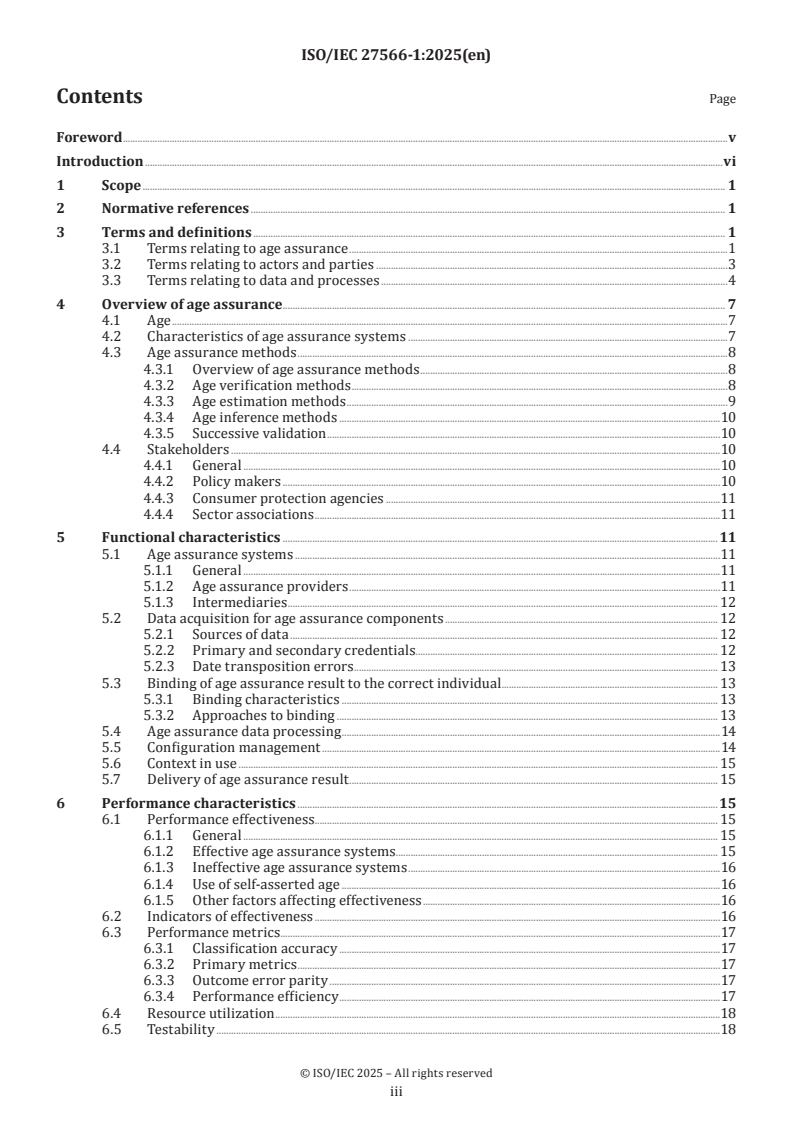
Contents Page
Foreword .v
Introduction .vi
1 Scope . 1
2 Normative references . 1
3 Terms and definitions . 1
3.1 Terms relating to age assurance .1
3.2 Terms relating to actors and parties .3
3.3 Terms relating to data and processes .4
4 Overview of age assurance . 7
4.1 Age .7
4.2 Characteristics of age assurance systems .7
4.3 Age assurance methods .8
4.3.1 Overview of age assurance methods .8
4.3.2 Age verification methods .8
4.3.3 Age estimation methods .9
4.3.4 Age inference methods .10
4.3.5 Successive validation .10
4.4 Stakeholders .10
4.4.1 General .10
4.4.2 Policy makers .10
4.4.3 Consumer protection agencies .11
4.4.4 Sector associations .11
5 Functional characteristics .11
5.1 Age assurance systems .11
5.1.1 General .11
5.1.2 Age assurance providers .11
5.1.3 Intermediaries . 12
5.2 Data acquisition for age assurance components . 12
5.2.1 Sources of data . 12
5.2.2 Primary and secondary credentials. 12
5.2.3 Date transposition errors . 13
5.3 Binding of age assurance result to the correct individual . 13
5.3.1 Binding characteristics . 13
5.3.2 Approaches to binding . 13
5.4 Age assurance data processing .14
5.5 Configuration management .14
5.6 Context in use . 15
5.7 Delivery of age assurance result . 15
6 Performance characteristics .15
6.1 Performance effectiveness. 15
6.1.1 General . 15
6.1.2 Effective age assurance systems . 15
6.1.3 Ineffective age assurance systems .16
6.1.4 Use of self-asserted age .16
6.1.5 Other factors affecting effectiveness .16
6.2 Indicators of effectiveness .16
6.3 Performance metrics.17
6.3.1 Classification accuracy .17
6.3.2 Primary metrics .17
6.3.3 Outcome error parity .17
6.3.4 Performance efficiency .17
6.4 Resource utilization .18
6.5 Testability .18
© ISO/IEC 2025 – All rights reserved
iii
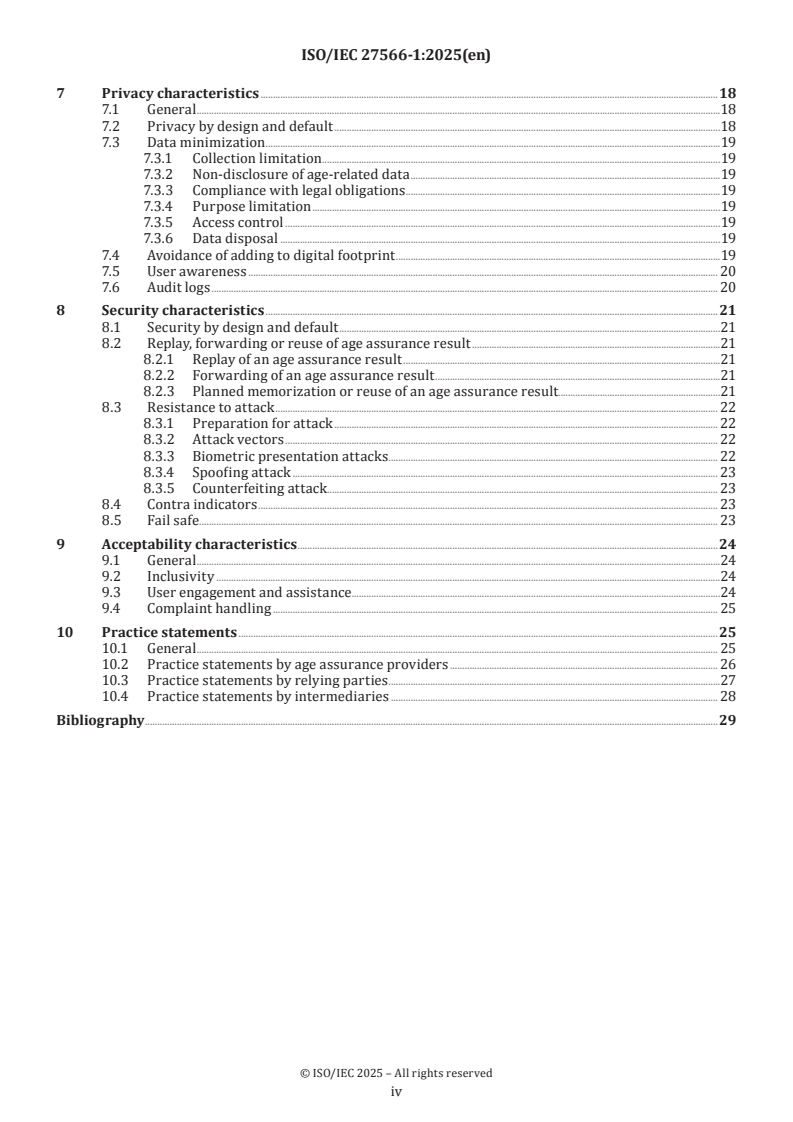
7 Privacy characteristics .18
7.1 General .18
7.2 Privacy by design and default .18
7.3 Data minimization .19
7.3.1 Collection limitation . .19
7.3.2 Non-disclosure of age-related data .19
7.3.3 Compliance with legal obligations .19
7.3.4 Purpose limitation .19
7.3.5 Access control .19
7.3.6 Data disposal .19
7.4 Avoidance of adding to digital footprint .19
7.5 User awareness . 20
7.6 Audit logs . 20
8 Security characteristics .21
8.1 Security by design and default .21
8.2 Replay, forwarding or reuse of age assurance result .21
8.2.1 Replay of an age assurance result .21
8.2.2 Forwarding of an age assurance result .21
8.2.3 Planned memorization or reuse of an age assurance result.21
8.3 Resistance to attack . 22
8.3.1 Preparation for attack . 22
8.3.2 Attack vectors . 22
8.3.3 Biometric presentation attacks . . 22
8.3.4 Spoofing attack . 23
8.3.5 Counterfeiting attack. 23
8.4 Contra indicators . 23
8.5 Fail safe . . 23
9 Acceptability characteristics .24
9.1 General .24
9.2 Inclusivity .24
9.3 User engagement and assistance.24
9.4 Complaint handling . 25
10 Practice statements .25
10.1 General . 25
10.2 Practice statements by age assurance providers . 26
10.3 Practice statements by relying parties .27
10.4 Practice statements by intermediaries . 28
Bibliography .29
© ISO/IEC 2025 – All rights reserved
iv
Foreword
ISO (the International Organization for Standardization) and IEC (the International Electrotechnical
Commission) form the specialized system for worldwide standardization. National bodies that are
members of ISO or IEC participate in the development of International Standards through technical
committees established by the respective organization to deal with particular fields of technical activity.
ISO and IEC technical committees collaborate in fields of mutual interest. Other international organizations,
governmental and non-governmental, in liaison with ISO and IEC, also take part in the work.
The procedures used to develop this document and those intended for its further maintenance are described
in the ISO/IEC Directives, Part 1. In particular, the different approval criteria needed for the different types
of document should be noted. This document was drafted in accordance with the editorial rules of the ISO/
IEC Directives, Part 2 (see www.iso.org/directives or www.iec.ch/members_experts/refdocs).
ISO and IEC draw attention to the possibility that the implementation of this document may involve the
use of (a) patent(s). ISO and IEC take no position concerning the evidence, validity or applicability of any
claimed patent rights in respect thereof. As of the date of publication of this document, ISO and IEC had not
received notice of (a) patent(s) which may be required to implement this document. However, implementers
are cautioned that this may not represent the latest information, which may be obtained from the patent
database available at www.iso.org/patents and https://patents.iec.ch. ISO and IEC shall not be held
responsible for identifying any or all such patent rights.
Any trade name used in this document is information given for the convenience of users and does not
constitute an endorsement.
For an explanation of the voluntary nature of standards, the meaning of ISO specific terms and expressions
related to conformity assessment, as well as information about ISO's adherence to the World Trade
Organization (WTO) principles in the Technical Barriers to Trade (TBT) see www.iso.org/iso/foreword.html.
In the IEC, see www.iec.ch/understanding-standards.
This document was prepared by Joint Technical Committee ISO/IEC JTC 1, Information technology,
Subcommittee SC 27, Information security, cybersecurity and privacy protection, in collaboration with ITU-T
(as ITU-T X.1901).
A list of all parts in the ISO/IEC 27566 series can be found on the ISO and IEC websites.
Any feedback or questions on this document should be directed to the user’s national standards
body. A complete listing of these bodies can be found at www.iso.org/members.html and
www.iec.ch/national-committees.
© ISO/IEC 2025 – All rights reserved
v
Introduction
This document sets out a framework and core characteristics for age assurance systems deployed for the
purpose of enabling age-related eligibility decisions. These decisions can be made by anyone for any reason
in any location through any type of relationship between an individual and the provider of any goods,
content, services (such as the supply of alcohol, tobacco, weapons or online content), venues or spaces that
have policy requirements for acquiring assurance about the age or age range of persons.
Age-related eligibility decisions are required when a person must either be a certain age, older or younger
than a given age or be within an age range, where ages are counted in years and where these criteria are
dependent upon the type of goods, content, services, venues or spaces provided.
This document aims to address issues associated with inadequately defined age assurance processes and
associated lack of trust in terms of functionality, performance, privacy, security and acceptability. This
document describes characteristics of an age assurance system to help policy makers, implementers and
individuals understand and address the issues associated with deployment of age assurance systems.
Although an individual’s age is an attribute of their identity, it is not necessarily the case that establishing
the full identity of an individual in a global context is needed to gain age assurance. As such, the process of
age assurance can in some instances be connected to identity verification but can also be performed in ways
other than via identity verification.
The aim of this document is to enable policy makers (such as governments, regulators or providers of age
restricted goods, content, services, venues or spaces) to specify applicable types of age assurance systems
and associated indicators of effectiveness in their policy requirements.
As an example, a policy maker may determine that, to authorize the sale of alcohol or tobacco or some
other age restricted product, a relying party acting as a decision maker should use a particular type of age
assurance system supporting specified characteristics to verify that an individual is an adult.
This document does not:
— determine which type of age assurance system nor which type of age assurance method is appropriate
for each type of age-related eligibility decision – that is a matter for policy makers;
— establish or recommend age thresholds for different goods, content, services, venues or spaces – these
are matters for policy makers;
— deal with financial or commercial models for age assurance systems – these are matters for economic
operators in the age assurance process;
— address the requirements for data protection for age assurance systems – these are matters for data
controllers;
— consider age-related eligibility decisions based on parental controls or parental consent;
— consider age-related eligibility decisions based on testimonies from a trusted third party or established
through a consent mechanism (such as a parent or legal guardian), since the documents that are required
to be presented vary widely among different countries or even between different regions within a
country.
© ISO/IEC 2025 – All rights reserved
vi
International Standard ISO/IEC 27566-1:2025(en)
Information security, cybersecurity and privacy protection —
Age assurance systems —
Part 1:
Framework
1 Scope
This document establishes a framework for age assurance systems and describes their core characteristics,
including privacy and security, for enabling age-related eligibility decisions.
2 Normative references
There are no normative references in this document.
3 Terms and definitions
For the purposes of this document, the following terms and definitions apply.
ISO and IEC maintain terminology databases for use in standardization at the following addresses:
— ISO Online browsing platform: available at https:// www .iso .org/ obp
— IEC Electropedia: available at https:// www .electropedia .org/
3.1 Terms relating to age assurance
3.1.1
age assurance
set of processes and methods used to verify, estimate or infer the age (3.1.3) or age range of an individual
(3.2.9), enabling organizations to make age-related eligibility decisions (3.1.9) with varying degrees of
certainty (3.3.4)
3.1.2
age assurance result
information produced by an age assurance system (3.3.3) indicating that an individual (3.2.9) is a certain age
(3.1.3), over or under a certain age or within an age range
3.1.3
age
number of complete years, months, days that have passed since the date of birth of an individual (3.2.9)
3.1.4
identity
set of attributes related to an entity
[SOURCE: ISO/IEC 24760-1:2025, 3.1.2, modified — notes to entry have been removed.]
© ISO/IEC 2025 – All rights reserved
3.1.5
identity document
physical or digital document issued by an authoritative party (3.2.6) containing identifying attributes
Note 1 to entry: This document can either have a physical form (plastic card, paper, etc.) or be immaterial (a collection
of data cryptographically signed by an authoritative party).
Note 2 to entry: An identity document can be a primary credential (3.3.16) or a form of record of a secondary credential
(3.3.17).
3.1.6
evidence
information supporting the occurrence of an event or action
Note 1 to entry: Evidence does not necessarily prove the truth or existence of something but can contribute to the
establishment of such proof.
[SOURCE: ISO/IEC 13888-1:2020, 3.11]
3.1.7
age-related eligibility
qualification for access to goods, content, services, venues or spaces based on an age limit or an age band
3.1.8
age-related eligibility requirement
policy requirement for access to goods, content, services, venues or spaces based on an age limit or an age
band
3.1.9
age-related eligibility decision
action by a relying party (3.2.2) to determine access to goods, content, services, venues or spaces based on
an age limit or an age band
3.1.10
age verification method
age assurance method (3.3.2) based on calculating the difference between a verified year or date of birth of
an individual (3.2.9) and a subsequent date
Note 1 to entry: In some cultures, an alternate calculation (such as use of birth year rather than birth date) can be
applicable.
3.1.11
age estimation method
age assurance method (3.3.2) based on analysis of biological or behavioural features of humans that vary
with age
Note 1 to entry: Such methods can use artificial intelligence (AI).
3.1.12
age inference method
age assurance method (3.3.2) based on verified information which indirectly implies that an individual (3.2.9)
is over or under a certain age or within an age range
3.1.13
successive validation
type of age assurance process where multiple independent age assurance methods are used sequentially to
establish an age assurance result (3.1.2)
3.1.14
practice statement
documentation of the practices, procedures and controls employed by an organization to fulfil a service
© ISO/IEC 2025 – All rights reserved
3.1.15
indicator of effectiveness
quantitative, qualitative, or descriptive measurement of the degree to which a given characteristic is
achieved
3.1.16
inclusivity
capability of a product to be utilized by people of various backgrounds
Note 1 to entry: Backgrounds include (and are not limited to) people of various ages, abilities, cultures, ethnicities,
languages, genders, economic situations, education, geographical locations and life situations.
[SOURCE: ISO/IEC 25010:2023, 3.4.6]
3.2 Terms relating to actors and parties
3.2.1
age assurance provider
entity responsible for providing age assurance results (3.1.2) to a relying party (3.2.2)
Note 1 to entry: The entity can be an organization providing an age assurance result to a relying party or an
organization providing an application placed under the control of an individual and capable of deriving an age
assurance result from a digital credential.
EXAMPLE A digital identity wallet is an example of an application placed under the control of an individual who
is capable of deriving an age assurance result from a digital credential granted to the individual by a digital credential
issuer.
3.2.2
relying party
entity that relies on an age assurance result (3.1.2) to make an age-related eligibility decision (3.1.9)
3.2.3
intermediary
entity that facilitates the interaction between individuals (3.2.9), age assurance providers (3.2.1), relying
parties (3.2.2) and other parties to fulfil functions in an age assurance system (3.3.3)
EXAMPLE Digital credential issuers, credit agencies, mobile network operators or orchestration service
providers.
3.2.4
policy maker
entity responsible for establishing age-related eligibility requirements (3.1.8) for access to goods, content,
services, venues or spaces
Note 1 to entry: A policy maker can be:
a) external to the relying party, e.g. a governmental organization, a regulatory organization or authorizing
organization, or
b) internal to the relying party.
Note 2 to entry: A policy for age-related eligibility can be applied consistently across a jurisdiction or organization
or individually to a location, premises or supplier of age-related goods, content, services, venues or spaces through
individually applied policy decisions, restrictions or permissions.
3.2.5
decision maker
organization or person responsible for making an age-related eligibility decision (3.1.9)
Note 1 to entry: An age-related eligibility decision maker can be an individual member of staff, a system or process or
could be automated or require human intervention.
© ISO/IEC 2025 – All rights reserved
3.2.6
authoritative party
entity that has the recognized right to create or record, and has responsibility to directly manage, an
identifying attribute
Note 1 to entry: Jurisdiction(s), industry communities or both, sometimes nominate a party as authoritative. It is
possible that such a party is subject to legal controls.
[SOURCE: ISO/IEC TS 29003:2018, 3.3]
3.2.7
authoritative source
repository which is recognized as being an accurate and up-to-date source of information
[SOURCE: ISO/IEC 29115:2013, 3.5]
3.2.8
identity information provider
entity that makes available identity information
Note 1 to entry: Typical operations performed by an identity information provider are to create and maintain identity
information for entities known in a particular domain. An identity information provider and an identity information
authority can be the same entity.
[SOURCE: ISO/IEC 24760-1:2025, 3.3.4]
3.2.9
individual
human being, i.e. a natural person, who acts as a distinct indivisible entity or is considered as such
[SOURCE: ISO 29995:2021, 3.2.6]
3.2.10
consumer protection agency
governmental, state or non-governmental organization that aids consumers to protect their interests
3.2.11
sector association
not-for-profit organization in a specific sector made up of a collection of either companies or individuals, or
both, with common interests
3.3 Terms relating to data and processes
3.3.1
age assurance component
part of an age assurance system (3.3.3)
3.3.2
age assurance method
process used to establish an age assurance result (3.1.2) to varying degrees of certainty (3.3.4)
3.3.3
age assurance system
system that utilizes one or more age assurance methods (3.3.2) to provide the relying party (3.2.2) with the
necessary information to make an age-related eligibility decision (3.1.9)
3.3.4
degree of certainty
extent to which it is possible to be confident that a given fact is true
© ISO/IEC 2025 – All rights reserved
3.3.5
true positive
TP
correct measured value in positive results, that is, the case where both the measured and the correct results
are positive
[SOURCE: ISO/TR 27877:2021, 3.1.4]
3.3.6
true negative
TN
correct measured value in negative results, that is, the case where both the measured and the correct results
are negative
[SOURCE: ISO/TR 27877:2021, 3.1.5]
3.3.7
false positive
FP
incorrect measured value in positive results, that is, the case where the measured value is positive but the
correct one is negative
[SOURCE: ISO/TR 27877:2021, 3.1.6]
3.3.8
false negative
FN
incorrect measured value in negative results, that is, the case where the measured value is negative but the
correct one is positive
[SOURCE: ISO/TR 27877:2021, 3.1.7]
3.3.9
classification accuracy
percentage of the number of correct age assurance results (3.1.2) to the total number of age assurance results
Note 1 to entry: In this document, the classification is the likelihood that the age assurance system will produce a
correct age assurance result.
3.3.10
attack vector
path or means by which one or more persons attempt to circumvent the age assurance system (3.3.3) in
order to obtain a malicious outcome
3.3.11
contra indicator
information that calls into question or otherwise indicates that either an age assurance result (3.1.2) could
be incorrect or that the binding (3.3.18) of the age assurance result to the right individual (3.2.9) could be
incorrect, or both are incorrect
Note 1 to entry: Contra indicators can be at an individual level, such as inconsistent information from multiple sources;
or at a system level, such as a presentation attack or seeking to exploit a system vulnerability.
3.3.12
presentation attack
presentation to the biometric data capture subsystem with the goal of interfering with the operation of the
biometric system
Note 1 to entry: An attack presentation can be a single attempt, a multi-attempt transaction, or another type of
interaction with a subsystem.
[SOURCE: ISO/IEC 30107-3:2023, 3.1.1]
© ISO/IEC 2025 – All rights reserved
3.3.13
age analysis
correlation of behavioural and biological characteristics of humans that vary with age
Note 1 to entry: Age analysis is a process that does not involve the unique identification of any individual.
3.3.14
liveness
quality or state of being alive, made evident by anatomical characteristics, involuntary reactions,
physiological functions, voluntary reactions, subject behaviours or any combination of these
EXAMPLE 1 Absorption of illumination by the skin and blood are anatomical characteristics.
EXAMPLE 2 The reaction of the iris to light and heart activity (pulse) are involuntary reactions (also called
physiological functions).
EXAMPLE 3 Squeezing together one's fingers in hand geometry and a biometric presentation in response to a
directive cue are both voluntary reactions (also called subject behaviours).
[SOURCE: ISO/IEC 30107-1:2023, 3.2]
3.3.15
liveness detection
measurement and analysis of anatomical characteristics or involuntary or voluntary reactions, in order to
determine whether a biometric sample is being captured from a living subject present at the point of capture
Note 1 to entry: Liveness detection methods are a subset of presentation attack detection methods.
[SOURCE: ISO/IEC 30107-1:2023, 3.3]
3.3.16
primary credential
document or record from an authoritative party (3.2.6) that contains a set of attributes associated with the
individual (3.2.9)
Note 1 to entry: A primary credential can either be physical (plastic card, piece of paper, etc.) or in electronic form (a
collection of data signed by an authoritative party).
3.3.17
secondary credential
document or record relating to an individual derived from one or more primary credentials (3.3.16)
3.3.18
binding
property that relates an age assurance result (3.1.2) to the correct individual (3.2.9)
3.3.19
configuration management
activity of managing the configuration of an information system throughout its lifecycle
[SOURCE: ISO/IEC TR 10032:2003, 2.15]
3.3.20
digital footprint
information about an individual (3.2.9) that is captured because of their online activity or because of their
interaction with some devices
3.3.21
fail safe
property of an age assurance system (3.3.3) that fails towards a safe age assurance result (3.1.2)
© ISO/IEC 2025 – All rights reserved
3.3.22
audit log
chronological sequence of audit records, each of which contains data about a specific event
[SOURCE: ISO 27789:2021, 3.9]
4 Overview of age assurance
4.1 Age
In this document, age is typically expressed as the number of complete years that have passed since the
subject’s date of birth. However, in certain cases, it can be necessary to specify age in days, months and years.
This definition is intended to accommodate different legal and cultural practices of age representation,
which can influence age-related eligibility decisions in various jurisdictions.
It can be necessary for a relying party to obtain age assurance before providing access to goods, content,
services, venues or spaces. A relying party may request five types of age assurance results:
a) the actual age,
b) over a certain age,
c) under a certain age,
d) within an age range,
e) a culture specific indicator (such as one indicating a year of birth rather than a specific age).
EXAMPLE Where x denotes the age, “x > 16”, “x < 60” and “18 < x < 30”.
4.2 Characteristics of age assurance systems
This document establishes the characteristics of age assurance systems as described in Clauses 5 to 9.
Figure 1 illustrates the structure of the framework.
Figure 1 — Structure of the framework of age assurance systems
© ISO/IEC 2025 – All rights reserved
The characteristics described in this document form the basis for the approach by each entity involved in
the age assurance process, be that of an age assurance provider, an intermediary or a relying party. Each
entity should establish their process and provide a practice statement as described in Clause 10.
4.3 Age assurance methods
4.3.1 Overview of age assurance methods
This clause describes the three different age assurance methods, which when taken together with binding
of evidence to the individual (see 5.3), can be used to generate an age assurance result leading to an age-
related eligibility decision.
The age assurance methods recognized by this document include:
a) age verification methods;
b) age estimation methods;
c) age inference methods.
Figure 2 illustrates the three age assurance methods.
Calculating the difference Analysis of biological or Verified information which
between a verified year or date behavioural features of humans indirectly implies that an
of birth of an individual and a that vary with age individual is over or under
subsequent date a certain age or within
an age range
Figure 2 — Three age assurance methods
4.3.2 Age verification methods
Age verification methods typically use identity information from an identity document that includes the
individual's date of birth. This process involves computing the difference between the date of birth in the
document and a subsequent date to determine the individual's age on that date.
NOTE In some cultures, an alternate calculation (such as use of birth year rather than birth date) can be applicable.
© ISO/IEC 2025 – All rights reserved
Age assurance systems that use an age verification method shall ensure that the identity document:
a) is genuine;
b) is associated with the right individual;
c) is not expired;
d) has not been revoked nor suspended at the time it is used.
An age verification method can, for example, involve the use of an identity document bearing the date of
birth of the individual or authoritative sources of data about the individual, where the age is computed using
the time difference between the current date and the date of birth of the individual without necessarily
revealing the date of birth of the individual to the provider of the goods, content, services or to the
organization hosting venues or spaces. The age assurance provider should ensure that the credentials
have not been issued inappropriately, to the wrong individual, with incorrect data on it or been subject to
falsification (e.g. if using a fake driving licence, a doctored passport or a falsified record in a database).
If such verification had been done directly by the provider of goods, content, services, venues or spaces,
it would necessarily acquire more information than strictly needed. The use of an age assurance provider
allows that concern to be addressed, however it can also be mitigated by strict purpose limitation and data
minimization within age assurance systems.
EXAMPLE 1 When an individual is seeking to access goods, content or services through the Internet and is using
a smart phone, they can be prompted to provide a selective disclosure of attributes present in a digital credential
stored in a digital wallet from the smart phone, where one of those attributes is indicating that they are over 18. The
wallet can then compute a cryptographic proof demonstrating that they are over 18. That cryptographic proof can be
communicated to the relying party.
EXAMPLE 2 When an individual is seeking to access a physical venue, they can use an application on a smart phone
to establish a digital credential from verified evidence of their date-of-birth that they are over 18. They can then
selectively share that information with a relying party through a one-time code (such as a 2D barcode) that contains
cryptographic protection. That one-time code can be read by a device at the physical location (such as a kiosk or entry
scanner) to enable access for the individual.
4.3.3 Age estimation methods
Age estimation methods involve the use of age analytics where age assurance results are estimated using
inherent features or behaviours related to an individual that vary with age.
Such techniques can use age analysis to correlate the biological and behavioural characteristics of an
individual (e.g. face, voice, hand geometry) or information derived from their behaviour (e.g. using social
media data, email usage).
The analysis of behavioural data can involve the use of artificial intelligence systems but can also simply
invol
...