

ISO/IEC 26554:2018
(Main)Information technology — Software and systems engineering — Tools and methods for product line testing
General Information
- Abstract
This document, within the methods and tools of testing for software and systems product lines: — provides the terms and definitions specific to testing for software and systems product lines; — defines processes performed during product line testing (those processes are described in terms of purpose, inputs, tasks and outcomes); — defines method capabilities to support the defined tasks of each process; and — defines tool capabilities to automate/semi-automate tasks or defined method capabilities. This document concerns processes and capabilities of testing methods and tools for a family of products, not for a single system.
- Status
- Published
- Publication Date
- 14-Nov-2018
- Technical Committee
- ISO/IEC JTC 1/SC 7 - Software and systems engineering
- Drafting Committee
- ISO/IEC JTC 1/SC 7/WG 4 - Tools and environment
- Current Stage
- 9093 - International Standard confirmed
- Start Date
- 10-May-2024
- Completion Date
- 29-Aug-2026
Overview - ISO/IEC 26554:2018 (Product Line Testing)
ISO/IEC 26554:2018 - "Information technology - Software and systems engineering - Tools and methods for product line testing" establishes a structured reference for testing within software and systems product lines (families of related products), not for single systems. The standard provides standardized terms and definitions, a reference model and detailed processes described by purpose, inputs, tasks and outcomes. It also specifies method capabilities and tool capabilities to support and (semi-)automate testing tasks across product families.
Keywords: ISO/IEC 26554:2018, product line testing, software product lines, testing methods, testing tools, variability management, test assets.
Key technical topics and requirements
- Reference model for product line testing: overarching structure covering test management, domain testing, application testing, asset and variability management.
- Product line test management: strategy, planning, process selection/tailoring, monitoring, control and reporting for product-family testing programs.
- Domain testing: initiation, design (unit/integration/system levels), environment setup, execution and reporting for reusable domain assets.
- Application testing: design and execution of application-specific tests across unit, integration and system testing for particular product instances.
- Asset management in testing: identify, structure, configure and annotate domain and application test artefacts as managed assets.
- Variability management in testing: categorize variability mechanisms, represent variability in test artefacts, and trace variability between test assets and variability models.
- Method and tool capabilities: definitions of capabilities required to perform tasks and the degree to which tools should automate or semi-automate those capabilities.
- Supporting material: annexes include exemplar product line test strategy, execution guidance and mapping to other standards (e.g., ISO/IEC/IEEE 29119-2 and 15288).
Practical applications
- Create or refine a product line test strategy and organizational test plan.
- Select or specify testing tools that automate product-family test tasks (e.g., variant selection, test artifact generation, traceability).
- Establish asset and variability governance for test artefacts reused across multiple products.
- Define repeatable domain-level test processes that scale across variants and product releases.
- Improve test monitoring, risk analysis and reporting across a portfolio of products.
Who should use this standard
- Test managers and QA leads responsible for software/product family testing
- Product line engineers and systems engineers
- Tool vendors and integrators building automation for product line testing
- Process improvement and compliance teams aligning testing with international best practice
Related standards
- ISO/IEC/IEEE 29119 (software testing)
- ISO/IEC/IEEE 15288 (system lifecycle processes)
- ISO/IEC 26554 contains mappings to these standards (see annex C).
Get Certified
Connect with accredited certification bodies for this standard

BSI Group
BSI (British Standards Institution) is the business standards company that helps organizations make excellence a habit.

BSCIC Certifications Pvt. Ltd.
Established 2006, accredited by NABCB, JAS-ANZ, EIAC, IAS. CDSCO Notified Body.

Intertek India Pvt. Ltd.
Delivers Assurance, Testing, Inspection & Certification since 1993 with 26 labs and 32 offices.
Sponsored listings
Frequently Asked Questions
ISO/IEC 26554:2018 is a standard published by the International Organization for Standardization (ISO). Its full title is "Information technology — Software and systems engineering — Tools and methods for product line testing". This standard covers: This document, within the methods and tools of testing for software and systems product lines: — provides the terms and definitions specific to testing for software and systems product lines; — defines processes performed during product line testing (those processes are described in terms of purpose, inputs, tasks and outcomes); — defines method capabilities to support the defined tasks of each process; and — defines tool capabilities to automate/semi-automate tasks or defined method capabilities. This document concerns processes and capabilities of testing methods and tools for a family of products, not for a single system.
This document, within the methods and tools of testing for software and systems product lines: — provides the terms and definitions specific to testing for software and systems product lines; — defines processes performed during product line testing (those processes are described in terms of purpose, inputs, tasks and outcomes); — defines method capabilities to support the defined tasks of each process; and — defines tool capabilities to automate/semi-automate tasks or defined method capabilities. This document concerns processes and capabilities of testing methods and tools for a family of products, not for a single system.
ISO/IEC 26554:2018 is classified under the following ICS (International Classification for Standards) categories: 35.080 - Software. The ICS classification helps identify the subject area and facilitates finding related standards.
ISO/IEC 26554:2018 is available in PDF format for immediate download after purchase. The document can be added to your cart and obtained through the secure checkout process. Digital delivery ensures instant access to the complete standard document.
Standards Content (Sample)
INTERNATIONAL ISO/IEC
STANDARD 26554
First edition
2018-11
Information technology — Software
and systems engineering — Tools and
methods for product line testing
Technologies de l'information — Ingénierie des systèmes et du logiciel
— Outils et méthodes pour tester une gamme de produits
Reference number
©
ISO/IEC 2018
© ISO/IEC 2018
All rights reserved. Unless otherwise specified, or required in the context of its implementation, no part of this publication may
be reproduced or utilized otherwise in any form or by any means, electronic or mechanical, including photocopying, or posting
on the internet or an intranet, without prior written permission. Permission can be requested from either ISO at the address
below or ISO’s member body in the country of the requester.
ISO copyright office
CP 401 • Ch. de Blandonnet 8
CH-1214 Vernier, Geneva
Phone: +41 22 749 01 11
Fax: +41 22 749 09 47
Email: copyright@iso.org
Website: www.iso.org
Published in Switzerland
ii © ISO/IEC 2018 – All rights reserved
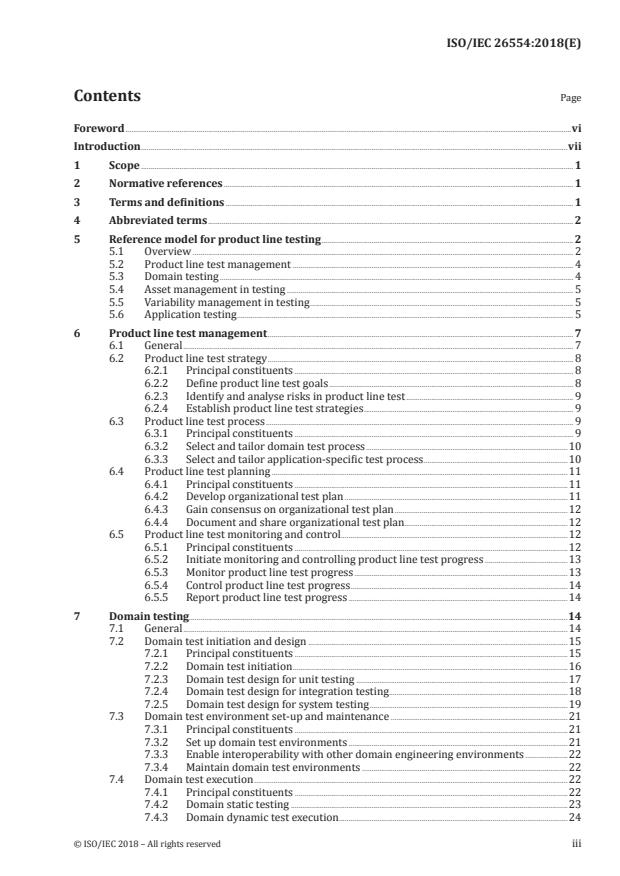
Contents Page
Foreword .vi
Introduction .vii
1 Scope . 1
2 Normative references . 1
3 Terms and definitions . 1
4 Abbreviated terms . 2
5 Reference model for product line testing . 2
5.1 Overview . 2
5.2 Product line test management . 4
5.3 Domain testing . 4
5.4 Asset management in testing . 5
5.5 Variability management in testing . 5
5.6 Application testing . 5
6 Product line test management . 7
6.1 General . 7
6.2 Product line test strategy . 8
6.2.1 Principal constituents . 8
6.2.2 Define product line test goals . 8
6.2.3 Identify and analyse risks in product line test . 9
6.2.4 Establish product line test strategies . 9
6.3 Product line test process . 9
6.3.1 Principal constituents . 9
6.3.2 Select and tailor domain test process .10
6.3.3 Select and tailor application-specific test process .10
6.4 Product line test planning .11
6.4.1 Principal constituents .11
6.4.2 Develop organizational test plan .11
6.4.3 Gain consensus on organizational test plan .12
6.4.4 Document and share organizational test plan.12
6.5 Product line test monitoring and control.12
6.5.1 Principal constituents .12
6.5.2 Initiate monitoring and controlling product line test progress .13
6.5.3 Monitor product line test progress .13
6.5.4 Control product line test progress .14
6.5.5 Report product line test progress .14
7 Domain testing.14
7.1 General .14
7.2 Domain test initiation and design .15
7.2.1 Principal constituents .15
7.2.2 Domain test initiation .16
7.2.3 Domain test design for unit testing .17
7.2.4 Domain test design for integration testing . .18
7.2.5 Domain test design for system testing .19
7.3 Domain test environment set-up and maintenance .21
7.3.1 Principal constituents .21
7.3.2 Set up domain test environments .21
7.3.3 Enable interoperability with other domain engineering environments .22
7.3.4 Maintain domain test environments .22
7.4 Domain test execution .22
7.4.1 Principal constituents .22
7.4.2 Domain static testing .23
7.4.3 Domain dynamic test execution .24
© ISO/IEC 2018 – All rights reserved iii
7.5 Domain test reporting .25
7.5.1 Principal constituents .25
7.5.2 Analyse domain test results .26
7.5.3 Create/update domain test reports .26
8 Asset management in testing .26
8.1 General .26
8.2 Domain test artefacts as domain assets .26
8.2.1 Principal constituents .26
8.2.2 Identify domain test artefacts managed as domain assets .27
8.2.3 Structure configuration and annotation for domain test assets .27
8.3 Application test artefacts as application assets .28
8.3.1 Principal constituents .28
8.3.2 Identify application test artefacts managed as application assets .28
8.3.3 Structure configuration and annotation for application test assets .29
9 Variability management in testing .29
9.1 General .29
9.2 Variability mechanism category in testing.30
9.2.1 Principal constituents .30
9.2.2 Identify variability mechanisms in testing by category .31
9.2.3 Guide the use of variability mechanism category by PL test strategy .31
9.2.4 Guide the use of variability mechanism category by test levels .32
9.2.5 Trace the usage status of variability mechanism category in testing.32
9.2.6 Update variability mechanism category in testing .33
9.3 Variability in test artefacts .33
9.3.1 Principal constituents .33
9.3.2 Define variability type in test artefacts .34
9.3.3 Define variability representation in test artefacts .34
9.4 Traceability of variability in test .35
9.4.1 Principal constituents .35
9.4.2 Define explicit links between variability in test assets and variability model .35
9.4.3 Define explicit links between application test assets and application
variability model .36
10 Application testing .36
10.1 General .36
10.2 Application test initiation and design .37
10.2.1 Principal constituents .37
10.2.2 Application test initiation .37
10.2.3 Application-specific test design for unit testing .38
10.2.4 Application test design for integration testing .40
10.2.5 Application test design for system testing .41
10.3 Application test environment set-up and maintenance .42
10.3.1 Principal constituents .42
10.3.2 Set up application test environments .43
10.3.3 Enable interoperability with other application engineering environments .43
10.3.4 Maintain application test environments .44
10.4 Application test execution .44
10.4.1 Principal constituents .44
10.4.2 Application static testing .45
10.4.3 Application dynamic test execution .46
10.5 Application test reporting .47
10.5.1 Principal constituents .47
10.5.2 Analyse application test results .48
10.5.3 Create/update application test reports .48
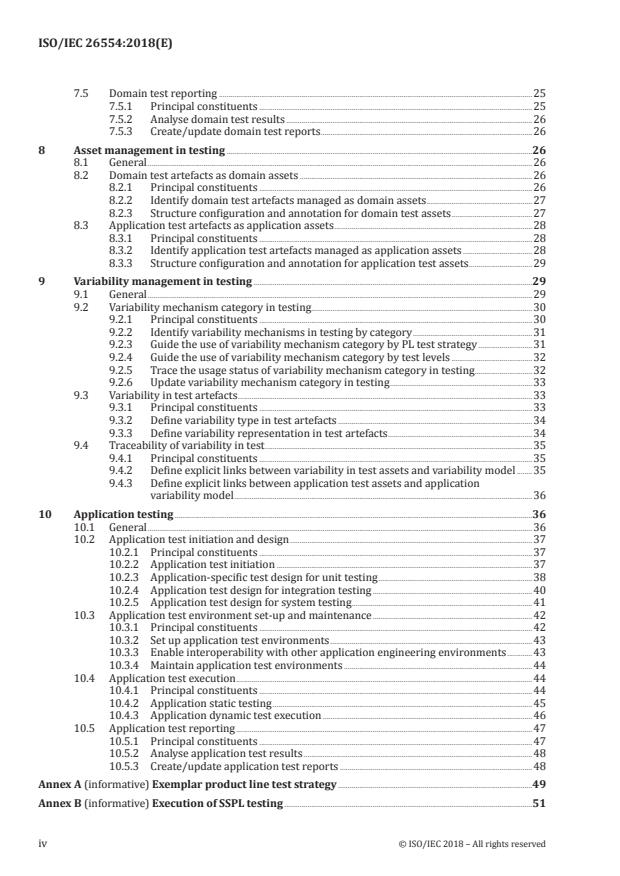
Annex A (informative) Exemplar product line test strategy .49
Annex B (informative) Execution of SSPL testing .51
iv © ISO/IEC 2018 – All rights reserved
Annex C (informative) Mapping of ISO/IEC/IEEE 29119-2 and ISO/IEC/IEEE 15288 .52
Bibliography .54
© ISO/IEC 2018 – All rights reserved v
Foreword
ISO (the International Organization for Standardization) and IEC (the International Electrotechnical
Commission) form the specialized system for worldwide standardization. National bodies that are
members of ISO or IEC participate in the development of International Standards through technical
committees established by the respective organization to deal with particular fields of technical
activity. ISO and IEC technical committees collaborate in fields of mutual interest. Other international
organizations, governmental and non-governmental, in liaison with ISO and IEC, also take part in the
work. In the field of information technology, ISO and IEC have established a joint technical committee,
ISO/IEC JTC 1.
The procedures used to develop this document and those intended for its further maintenance are
described in the ISO/IEC Directives, Part 1. In particular, the different approval criteria needed for
the different types of document should be noted. This document was drafted in accordance with the
editorial rules of the ISO/IEC Directives, Part 2 (see www .iso .org/directives).
Attention is drawn to the possibility that some of the elements of this document may be the subject
of patent rights. ISO and IEC shall not be held responsible for identifying any or all such patent
rights. Details of any patent rights identified during the development of the document will be in the
Introduction and/or on the ISO list of patent declarations received (see www .iso .org/patents).
Any trade name used in this document is information given for the convenience of users and does not
constitute an endorsement.
For an explanation of the voluntary nature of standards, the meaning of ISO specific terms and
expressions related to conformity assessment, as well as information about ISO's adherence to the
World Trade Organization (WTO) principles in the Technical Barriers to Trade (TBT) see www .iso
.org/iso/foreword .html.
This document was prepared by Technical Committee ISO/IEC JTC 1, Information technology,
Subcommittee SC 7, Software and systems engineering.
Any feedback or questions on this document should be directed to the user’s national standards body. A
complete listing of these bodies can be found at www .iso .org/members .html.
vi © ISO/IEC 2018 – All rights reserved
Introduction
The main purpose of this document is to deal with the capabilities of methods and tools of software
and systems product line (SSPL) testing. This document defines how methods and tools can support the
software and systems product line-specific testing processes.
Product line engineering sets up a common product line platform including identified key variability
and develops individual systems on top of the platform. Variability realizes flexibility among member
products, and it is closely related to the purpose of the product line reuse. In addition to the verification
and validation of commonalities, domain testing generates reusable test artefacts, so as to minimize
test efforts in application testing. However, variability continues throughout the product line life cycle,
and its resolution phase is diverse. Thus, the complexity of product line testing becomes high. Testing in
product line engineering differs from testing in the single system development in the following aspects:
— there are two testing life cycles, domain testing and application testing;
— test cases generated during domain testing can be incomplete due to unresolved variability;
— integration and system testing should be executed in the absence of non-functioning components
because even complete test cases can interact with components or subsystems that include
unresolved variability;
— application testing should be performed by reusing domain test assets and avoid retesting what has
been tested during domain testing;
— test cases including variability are executable at different stages because the binding times of
variabilities differ; and
— regression testing is performed in both domain testing and application testing. In application
testing, when variability bindings are conducted, regression testing is performed as necessary.
This document addresses the product line-specific testing processes with the guidance of a set of tools’
and methods’ capabilities for supporting testing in software and systems product lines.
This document is intended to benefit the groups of people that acquire, supply, develop, operate and
maintain tools and methods of testing for software and systems product lines. This document can be
used in one or more of the following modes:
— by an organization intended to implement product lines – to understand, adopt and enact the
processes, tools and methods of testing for product line. This also helps the organization evaluate
and select relevant tools and methods based on business and user-related criteria;
— by a tool vendor who facilitate or leverage product line engineering practices – to provide a set of
tool capabilities that should be embodied in a tool for supporting testing of a product line.
The ISO/IEC 26550 family of standards addresses both engineering and management processes and
capabilities of methods and tools in terms of the key characteristics of product line development. This
document provides processes and capabilities of methods and tools for product line testing. Other
standards in the ISO/IEC 26550 family are as follows:
ISO/IEC 26550, ISO/IEC 26551, ISO/IEC 26555, ISO/IEC 26557, ISO/IEC 26558 and ISO/IEC 26559
are published. ISO/IEC 26552, ISO/IEC 26553, ISO/IEC 26556, ISO/IEC 26560, ISO/IEC 26561, ISO/
IEC 26562 and ISO/IEC 26563 are planned International Standards. The following list provides an
overview of the series:
— processes and capabilities of methods and tools for domain requirements engineering and
application requirements engineering are provided in ISO/IEC 26551;
— processes and capabilities of methods and tools for domain design and application design are
provided in ISO/IEC 26552;
© ISO/IEC 2018 – All rights reserved vii
— processes and capabilities of methods and tools for domain realization and application realization
are provided in ISO/IEC 26553;
— processes and capabilities of methods and tools for technical management are provided in ISO/
IEC 26555;
— processes and capabilities of methods and tools for organizational management are provided in
ISO/IEC 26556;
— processes and capabilities of methods and tools for variability mechanisms are provided in ISO/
IEC 26557;
— processes and capabilities of methods and tools for variability modelling are provided in ISO/
IEC 26558;
— processes and capabilities of methods and tools for variability traceability are provided in ISO/
IEC 26559;
— processes and capabilities of methods and tools for product management are provided in ISO/
IEC 26560;
— processes and capabilities of methods and tools for technical probe are provided in ISO/IEC 26561;
— processes and capabilities of methods and tools for transition management are provided in ISO/
IEC 26562;
— processes and capabilities of methods and tools for configuration management of asset are provided
in ISO/IEC 26563;
— others (ISO/IEC 26564 to ISO/IEC 26599) are to be developed.
viii © ISO/IEC 2018 – All rights reserved
INTERNATIONAL STANDARD ISO/IEC 26554:2018(E)
Information technology — Software and systems
engineering — Tools and methods for product line testing
1 Scope
This document, within the methods and tools of testing for software and systems product lines:
— provides the terms and definitions specific to testing for software and systems product lines;
— defines processes performed during product line testing (those processes are described in terms of
purpose, inputs, tasks and outcomes);
— defines method capabilities to support the defined tasks of each process; and
— defines tool capabilities to automate/semi-automate tasks or defined method capabilities.
This document concerns processes and capabilities of testing methods and tools for a family of products,
not for a single system.
2 Normative references
The following documents are referred to in the text in such a way that some or all of their content
constitutes requirements of this document. For dated references, only the edition cited applies. For
undated references, the latest edition of the referenced document (including any amendments) applies.
ISO/IEC 26555, Software and systems engineering — Tools and methods for product line technical
management
3 Terms and definitions
For the purposes of this document, the following terms and definitions apply.
ISO and IEC maintain terminological databases for use in standardization at the following addresses:
— ISO Online browsing platform: available at http: //www .iso .org/obp
— IEC Electropedia: available at http: //www .electropedia .org/
3.1
absent variants
variants that are not determined or developed at the specific time
3.2
application testing
sub-process of application engineering where domain test artefacts are reused to uncover evidence of
defects in the application
3.3
application test asset
application-specific test asset that has reuse potential
3.4
aspect
special consideration within product line engineering process groups and tasks to which one can
associate specialized methods and tools
© ISO/IEC 2018 – All rights reserved 1
3.5
domain testing
domain engineering phase whose role is to test domain artefacts
Note 1 to entry: Testing of artefacts related to a product line (domain) rather than to an individual product.
3.6
domain test asset
domain test artefacts that will be reused in application testing (3.2)
Note 1 to entry: Domain test assets can be reused in domain testing (3.5), e.g., test plans, artefacts of regression
testing. In this document, however, the platform role of domain asset, which can be reused for member products,
is the central theme.
3.7
domain test requirements
specific elements of a domain artefact that should be covered by domain testing (3.5)
Note 1 to entry: Domain test requirements cover functional and non-functional commonality and variability, and
they include both their normal and error conditions.
3.8
product line test strategy
scope of domain testing (3.5) and application testing (3.2)
Note 1 to entry: Many variants may not be implemented in domain engineering. To cope with the impacts of un-
implemented variants to domain integration testing and system testing, the appropriate test strategy should be
established.
3.9
texture
architectural texture
collection of common development rules and constraints for realizing the applications of a product line
3.10
variability binding
selection of a certain variant for a variation point
3.11
variability in test cases
variability included in domain test cases that will be bound during application testing in order to derive
concrete test cases
4 Abbreviated terms
CRS commonality and reuse strategy
SAS sample application strategy
SSPL software and systems product line
UML unified modelling language
5 Reference model for product line testing
5.1 Overview
The key characteristics of product line testing are that there are two test processes: domain testing
and application testing, with variability included in domain artefacts. The major difference between
2 © ISO/IEC 2018 – All rights reserved
SSPL testing and single product testing comes from variability in domain artefacts. Handling variability
is challenging and the decisions on how to deal with it are the starting point of SSPL testing. From
this view, there are two types of test assets, domain test assets (test cases, procedures and scenarios
that are produced during domain engineering) and application test assets (test cases, procedures and
scenarios that are produced during application engineering for a member product).
Domain test assets should have forms that can be efficiently reused in application testing; and they
should address variations. In addition, testing for a member product of a product line should devise
a method to reuse domain test cases and minimize regression testing for the parts that are already
tested in domain testing or tested by another member product. It is unusual for all variants to be
implemented during domain engineering. So, domain testing should consider tests for non-executable
domain artefacts due to the undeveloped variants, i.e. absent variants. Coping with absent variants is
challenging because they can complicate integration testing and system testing, making system testing
in domain engineering impossible in some cases. However, because the quality of domain artefacts
affects the quality of all member products in a product line, test execution of parts linked to absent
variants should be carefully handled during domain testing.
Variability is bound during application engineering. The binding times of variability can be widely
separate, so integration testing and system testing for a member product are much more complicated.
If testing is executed whenever binding occurs, a significant amount of effort will be required for
developing test stubs and drivers. Therefore, the trade-off between defect correction costs and test
development effort should be considered. Application testing deals with testing for application-specific
parts and with re-testing or regression testing for the domain parts already tested.
Product line testing requires specific organizational level managerial supports and technical
management supports, product line test management and variability management in testing. Product
line test management provides managerial supports for domain testing, application testing and asset
management in testing from the product line organization level. Variability management in testing,
on the other hand, manages variability in domain and application test artefacts, including variability
models from the testing perspective.
The reference model specifies the structure of supporting processes and sub processes for product line
testing. As shown in Figure 1, product line testing can be structured in five processes. Each process is
divided into sub processes to address product line realization issues; and each sub process is described
in terms of the following attributes:
— the title of the sub process;
— the purpose of the sub process;
— the outcomes of the sub process;
— the inputs to produce the outcomes;
— the tasks to achieve the outcomes; and
— the capabilities of methods and tools required for performing the tasks effectively and efficiently.
NOTE 1 Test methods in this document include technique, pattern and template as well as procedure.
NOTE 2 The ISO/IEC/IEEE 29119 series defines “test methods” as “procedure used to derive and/or select
test cases”.
NOTE 3 When the process, sub process, outcomes and tasks are listed or described in a sentence they are
italicized in order to increase their visibility.
© ISO/IEC 2018 – All rights reserved 3
Figure 1 — Product line testing reference model
To reduce efforts and costs invested in product line testing and to manage the complexity of testing
due to the variability in a product line, testing activities should be initiated as early as at the domain
requirements analysis phase, in parallel with domain and application engineering. Defects in domain
assets have influence on the whole product line members and dynamic testing is performed restrictedly
because of variability, so static testing should be performed thoroughly. Product line testing thus
covers both static and dynamic testing. Static testing for product lines includes reviews, inspections
and prototyping for domain and application artefacts to fulfil verification and validation. In addition,
testers responsible for domain and application testing should cooperate with domain requirements
engineers, architects and developers in order to detect defects in the corresponding development phase
as early as possible. To that end, these test organization should develop reasonable domain test plans
and have systematic test case generation methods including tool supports at hand for each domain test
levels or test types.
5.2 Product line test management
The product line test management shall be responsible for the following.
— Product line test strategy determines how domain and application testing will be carried out at
the product line organization. The product line test strategy documents guidelines for governing
product line testing operated in the organization.
— Product line test process is to define the process specific to a product line testing by selecting and
tailoring a generic domain and application test process to solve domain and application-specific test
problems.
— Product line test planning is to develop the product line test plan. It describes activities, schedules and
resources for product line testing, and product line plans are revisited and refined as domain and
application test plans for conducting the specific test types or test levels of domain and application
testing.
— Product line test monitoring and control monitor and control the status of product line testing to
ensure it is performed in line with the product line test plan. It serves to monitor, measure and
control domain and application test progress. Domain and application test status are integrated
into product line-wide management.
5.3 Domain testing
In domain testing, normally there is no single, executable application to be tested, since only the
platform consisting of a set of loosely coupled components exists, and thus product line policies and
processes reflecting this aspect are necessary. Domain testing covers the generation of domain test
4 © ISO/IEC 2018 – All rights reserved
artefacts and executions, and making them domain assets for reuse. Domain testing is responsible
for validation and verification of domain requirements specification, domain architecture, detailed
domain design artefacts and realization artefacts. However, system testing in domain engineering may
be partially executed or may not be performed because there may be no complete application during
domain engineering. Therefore, domain testing should have a proper strategy for these cases.
The domain testing shall serve to do the following and define the capabilities of tools and methods for
supporting those services.
— Domain test initiation and design set up the readiness for performing domain testing, derive domain
test cases and define domain test procedures.
— Domain test environment set-up and maintenance set up and maintain domain test environments
including support tools as well as integrated environments for each lifecycle phase related to each
domain test type (i.e. static test and dynamic test).
— Domain test execution performs dynamic and static testing for the domain on the established
domain test environments. Domain test cases may include variability that cannot be executed
simultaneously.
— Domain test reporting analyses the identified failures and locations where the failures have occurred
and reports domain test incidents with how they will be managed.
5.4 Asset management in testing
The asset management in testing establishes and maintains domain test assets that have reuse potential
for the right use in application engineering and application test assets for later reuse by the relevant
member product or the other member products within a product line. The asset management in testing
shall serve to do the following and to define the capabilities of tools and methods for supporting them.
— Domain test artefacts as domain assets manages domain test artefacts that will be reused by the
product line members such as test cases for commonalities, those for variabilities and those
including interactions between common and variable modules.
— Application test artefacts as application assets manages application test artefacts that will be referred
in regression testing due to the application evolution or as inputs in other applications.
5.5 Variability management in testing
Variability is newly defined during domain testing for handling test requirements variation among
member products. Domain test assets include variability because of the variability included in test targets
(i.e. domain assets). Therefore methods and tools for product line testing should have the capability for
variability representation and its binding at the right time. The variability management in testing shall
serve to do the following and to define the capabilities of tools and methods for supporting them.
— Variability mechanism category in testing maintains a set of variability implementation mechanisms
that can be used for expressing or realizing variability in domain test artefacts.
— Variability in test artefacts serves to define variability types and ways to express variability included
in test artefacts such as test plans, test cases and test scenarios.
— Traceability of variability in test establishes and maintains trace links between variability in test
artefacts and variability models in test defined separately. The trace links are required to support
the reuse of test artefacts in application testing.
5.6 Application testing
Domain test assets should be correctly reused in application testing. The application testing validates
the final member product against the application requirements by drawing upon test assets from
domain test assets and by performing additional application-specific tests. This process shall guide to
© ISO/IEC 2018 – All rights reserved 5
minimize test efforts by avoiding redundant test execution and reusing domain assets. Furthermore,
this process covers all test types and levels from static testing for application through acceptance
testing. The application testing shall serve to do the following and to define the capabilities of tools and
methods for supporting them.
— Application test initiation and design set up the readiness for performing application testing, derive
application-specific test cases and define application-specific test procedures. Application test
cases and test procedures are derived from domain test assets, so this process only deals with
application-specific test cases and procedures.
— Application test environment set-up and maintenance set up and maintain application test
environments based on the established domain test environment.
— Application test execution performs application dynamic and static testing on the established
application test environments.
— Application test reporting analyses the identified failures and location where the failure has occurred.
Application test reports include application-specific and domain test incidents as well as how they
will be managed.
The identification and analysis of the key differentiators between single-system engineering and
management and product line engineering and management can help organizations to understand the
product line and to formulate a strategy for successful implementation of product line engineering and
management. The key aspects are defined in ISO/IEC 26550 and Table 1 shows the category of the key
aspects.
Table 1 — Key aspects for identifying product line-specific testing tasks
Category Aspects
application engineering, domain assets, domain engineering, product management,
Reuse management
platform, reusability
Variability management binding, variability
collaboration, configuration, enabling technology support, reference architecture, tex-
Complexity management
ture, traceability
Quality management measurement and tracking, cross functional verification and validation
The following are the descriptions for each aspect concerning product line testing. The product line
tests-relevant processes and tasks shall be identified on the basis of these aspects. The concerns
specific to product line testing will enable an organization to understand the product line test-relevant
processes, sub processes, tasks, methods and tools’ capabilities.
— Application engineering. Application testing is a stage of application engineering where the
domain test artefacts are reused. Application-specific testing is developed from scratch.
— Binding. Most application test artefacts are generated by variability binding according to
application variability model, so testing processes, methods and tools for product lines should
contain capabilities to support binding.
— Collaboration. For
...