

ISO 13779-2:2018
(Main)Implants for surgery — Hydroxyapatite — Part 2: Thermally sprayed coatings of hydroxyapatite
General Information
- Abstract
This document specifies requirements for single layer thermally sprayed hydroxyapatite coatings applied to metallic surgical implants. These requirements are intended to describe properties of the materials and to communicate these between organizations. These requirements are not written with the objective of replacing a company's internal operational and assessment requirements although they could be used as such. NOTE 1 For thin coatings with a thickness of less than 50 µm, some of the test methods described in this document might be difficult to apply without modification. NOTE 2 The requirements of the hydroxyapatite layer of dual-layer coatings (consisting of a lower layer of metallic coating and an upper layer of hydroxyapatite coating) can follow this document; however, testing methods referred to in this document cannot be applied to dual layer coatings. If this document is taken in reference for the requirements of the hydroxyapatite layer of dual layer coatings, a rationale on how the single-layer tested coupons are representative of the dual-layer coated implant might be considered necessary. This document does not cover coatings made from glasses, glass ceramics, alpha- and beta-tricalcium phosphate, biphasic calcium phosphate or other forms of calcium phosphate. NOTE 3 While the requirements in this document are intended to be used as specifications of a thermally sprayed coating of hydroxyapatite, it might be necessary to establish routine control procedures specifying control tests and their time intervals to make sure the characteristics of the coating stay within specified limits. NOTE 4 This document was developed with a focus on plasma sprayed coating of hydroxyapatite. It might also be used to characterize other thermally sprayed coatings of hydroxyapatite. However, thermally sprayed coatings that do not have a history of clinical use might present different risks and might need additional characterizations beyond those identified in this document.
- Status
- Published
- Publication Date
- 04-Dec-2018
- Technical Committee
- ISO/TC 150/SC 1 - Materials
- Drafting Committee
- ISO/TC 150/SC 1/WG 3 - Ceramics
- Current Stage
- 9093 - International Standard confirmed
- Start Date
- 11-Mar-2024
- Completion Date
- 29-Aug-2026
Buy Documents


ISO 13779-2:2018 - Implants for surgery -- Hydroxyapatite


ISO 13779-2:2018 - Implants for surgery — Hydroxyapatite — Part 2: Thermally sprayed coatings of hydroxyapatite/5/2018

ISO 13779-2:2018 - Implants chirurgicaux -- Hydroxyapatite

ISO 13779-2:2018 - Implants chirurgicaux — Hydroxyapatite — Partie 2: Revêtements à base d'hydroxyapatite, obtenus par projection thermique/5/2018
Overview
ISO 13779-2:2018 - "Implants for surgery - Hydroxyapatite - Part 2: Thermally sprayed coatings of hydroxyapatite" specifies material and characterization requirements for single-layer thermally sprayed hydroxyapatite (HA) coatings applied to metallic surgical implants. The standard is primarily aimed at plasma-sprayed HA but can be used to characterize other thermal spray processes. It is not intended to replace internal operational controls and does not cover glass/glass-ceramic or other calcium‑phosphate coatings (e.g., α/β‑TCP, biphasic calcium phosphate).
Keywords: ISO 13779-2:2018, hydroxyapatite coatings, thermally sprayed, plasma sprayed, surgical implants, coating characterization, biocompatibility.
Key topics and technical requirements
- Scope: Requirements apply to single-layer thermally sprayed HA coatings; special considerations for thin coatings (<50 µm) and dual‑layer systems are noted.
- Material sourcing: Powders must conform to ISO 13779-6 and production test specimens should reflect actual implant manufacturing.
- Chemical composition:
- Calcium to phosphorus (Ca:P) atomic ratio: 1.61 – 1.76 (measured per ISO 13779-3).
- Trace elements / heavy metals: Maximum limits include As 3 mg/kg, Cd 5 mg/kg, Hg 5 mg/kg, Pb 30 mg/kg, and total heavy metals 50 mg/kg.
- Phase purity:
- Sum of α‑TCP, β‑TCP and tetracalcium phosphate ≤ 30%.
- CaO content ≤ 5%.
- Crystallinity: Crystallinity ratio ≥ 45% (ISO 13779-3 method).
- Morphology:
- Thickness and tolerances assessed by ASTM F1854; roughness (Ra or Rt) per ISO 4288.
- SEM or optical microscopy for porosity and cross‑sectional evaluation.
- No universal thickness/roughness acceptance levels are set - these must be defined per implant design.
- Adhesion / coating strength:
- Tensile (ISO 13779-4) or shear (ASTM F1044) testing as appropriate.
- Mean adhesion strength ≥ 15 MPa and no single result < 10 MPa.
- Testing & reporting: Test methods, sampling, and test reports are specified; additional routine control tests may be necessary.
Applications
- Use ISO 13779-2:2018 to define product specifications, validate coating processes, and support regulatory submissions for orthopedic and dental implants with thermally sprayed HA coatings.
- Helps ensure biocompatibility, controlled dissolution/solubility behavior, and mechanical adhesion for osseointegration-promoting surfaces.
- Useful during supplier qualification, process change control, and failure/root‑cause analyses.
Who should use this standard
- Implant manufacturers and design engineers
- Medical device quality and regulatory teams
- Coating service providers and contract coaters
- Materials scientists and R&D groups developing HA coatings
- Notified bodies and testing laboratories verifying implant coating conformity
Related standards
- ISO 13779-3 (chemical analysis, crystallinity, phase purity)
- ISO 13779-4 (coating adhesion strength)
- ISO 13779-6 (HA powders)
- ISO 4288 (surface roughness)
- ASTM F1044, ASTM F1854 (shear testing, thickness/porosity evaluation)
ISO 13779-2:2018 is a practical reference for specifying and assessing thermally sprayed hydroxyapatite coatings on implants, balancing compositional, structural and mechanical requirements to support safe clinical performance.
Relations
- Revises
ISO 13779-2:2008 - Implants for surgery — Hydroxyapatite — Part 2: Coatings of hydroxyapatite - Effective Date
- 27-Jul-2013
Buy Documents
ISO 13779-2:2018 - Implants for surgery -- Hydroxyapatite
ISO 13779-2:2018 - Implants for surgery — Hydroxyapatite — Part 2: Thermally sprayed coatings of hydroxyapatite/5/2018
ISO 13779-2:2018 - Implants chirurgicaux -- Hydroxyapatite
ISO 13779-2:2018 - Implants chirurgicaux — Hydroxyapatite — Partie 2: Revêtements à base d'hydroxyapatite, obtenus par projection thermique/5/2018
Get Certified
Connect with accredited certification bodies for this standard

BSI Group
BSI (British Standards Institution) is the business standards company that helps organizations make excellence a habit.

TÜV Rheinland
TÜV Rheinland is a leading international provider of technical services.

TÜV SÜD
TÜV SÜD is a trusted partner of choice for safety, security and sustainability solutions.
Sponsored listings
Frequently Asked Questions
ISO 13779-2:2018 is a standard published by the International Organization for Standardization (ISO). Its full title is "Implants for surgery — Hydroxyapatite — Part 2: Thermally sprayed coatings of hydroxyapatite". This standard covers: This document specifies requirements for single layer thermally sprayed hydroxyapatite coatings applied to metallic surgical implants. These requirements are intended to describe properties of the materials and to communicate these between organizations. These requirements are not written with the objective of replacing a company's internal operational and assessment requirements although they could be used as such. NOTE 1 For thin coatings with a thickness of less than 50 µm, some of the test methods described in this document might be difficult to apply without modification. NOTE 2 The requirements of the hydroxyapatite layer of dual-layer coatings (consisting of a lower layer of metallic coating and an upper layer of hydroxyapatite coating) can follow this document; however, testing methods referred to in this document cannot be applied to dual layer coatings. If this document is taken in reference for the requirements of the hydroxyapatite layer of dual layer coatings, a rationale on how the single-layer tested coupons are representative of the dual-layer coated implant might be considered necessary. This document does not cover coatings made from glasses, glass ceramics, alpha- and beta-tricalcium phosphate, biphasic calcium phosphate or other forms of calcium phosphate. NOTE 3 While the requirements in this document are intended to be used as specifications of a thermally sprayed coating of hydroxyapatite, it might be necessary to establish routine control procedures specifying control tests and their time intervals to make sure the characteristics of the coating stay within specified limits. NOTE 4 This document was developed with a focus on plasma sprayed coating of hydroxyapatite. It might also be used to characterize other thermally sprayed coatings of hydroxyapatite. However, thermally sprayed coatings that do not have a history of clinical use might present different risks and might need additional characterizations beyond those identified in this document.
This document specifies requirements for single layer thermally sprayed hydroxyapatite coatings applied to metallic surgical implants. These requirements are intended to describe properties of the materials and to communicate these between organizations. These requirements are not written with the objective of replacing a company's internal operational and assessment requirements although they could be used as such. NOTE 1 For thin coatings with a thickness of less than 50 µm, some of the test methods described in this document might be difficult to apply without modification. NOTE 2 The requirements of the hydroxyapatite layer of dual-layer coatings (consisting of a lower layer of metallic coating and an upper layer of hydroxyapatite coating) can follow this document; however, testing methods referred to in this document cannot be applied to dual layer coatings. If this document is taken in reference for the requirements of the hydroxyapatite layer of dual layer coatings, a rationale on how the single-layer tested coupons are representative of the dual-layer coated implant might be considered necessary. This document does not cover coatings made from glasses, glass ceramics, alpha- and beta-tricalcium phosphate, biphasic calcium phosphate or other forms of calcium phosphate. NOTE 3 While the requirements in this document are intended to be used as specifications of a thermally sprayed coating of hydroxyapatite, it might be necessary to establish routine control procedures specifying control tests and their time intervals to make sure the characteristics of the coating stay within specified limits. NOTE 4 This document was developed with a focus on plasma sprayed coating of hydroxyapatite. It might also be used to characterize other thermally sprayed coatings of hydroxyapatite. However, thermally sprayed coatings that do not have a history of clinical use might present different risks and might need additional characterizations beyond those identified in this document.
ISO 13779-2:2018 is classified under the following ICS (International Classification for Standards) categories: 11.040.40 - Implants for surgery, prosthetics and orthotics. The ICS classification helps identify the subject area and facilitates finding related standards.
ISO 13779-2:2018 has the following relationships with other standards: It is inter standard links to ISO 13779-2:2008. Understanding these relationships helps ensure you are using the most current and applicable version of the standard.
ISO 13779-2:2018 is available in PDF format for immediate download after purchase. The document can be added to your cart and obtained through the secure checkout process. Digital delivery ensures instant access to the complete standard document.
Standards Content (Sample)
INTERNATIONAL ISO
STANDARD 13779-2
Third edition
2018-12
Implants for surgery —
Hydroxyapatite —
Part 2:
Thermally sprayed coatings of
hydroxyapatite
Implants chirurgicaux — Hydroxyapatite —
Partie 2: Revêtements à base d'hydroxyapatite, obtenus par projection
thermique
Reference number
©
ISO 2018
© ISO 2018
All rights reserved. Unless otherwise specified, or required in the context of its implementation, no part of this publication may
be reproduced or utilized otherwise in any form or by any means, electronic or mechanical, including photocopying, or posting
on the internet or an intranet, without prior written permission. Permission can be requested from either ISO at the address
below or ISO’s member body in the country of the requester.
ISO copyright office
CP 401 • Ch. de Blandonnet 8
CH-1214 Vernier, Geneva
Phone: +41 22 749 01 11
Fax: +41 22 749 09 47
Email: copyright@iso.org
Website: www.iso.org
Published in Switzerland
ii © ISO 2018 – All rights reserved
Contents Page
Foreword .iv
Introduction .v
1 Scope . 1
2 Normative references . 1
3 Terms and definitions . 2
4 Coating preparation . 2
5 Requirements . 2
5.1 General . 2
5.2 Calcium to phosphorus ratio (Ca:P) . 2
5.3 Trace elements . 2
5.4 Foreign crystalline phases. 3
5.5 Crystallinity ratio . 3
5.6 Morphology . 4
5.7 Coating strength . 4
5.8 Accuracy of test methods . 4
6 Test report . 5
Annex A (informative) Other possible characterization tests . 6
Annex B (informative) Comparison of foreign crystalline phases content limits .7
Bibliography .10
Foreword
ISO (the International Organization for Standardization) is a worldwide federation of national standards
bodies (ISO member bodies). The work of preparing International Standards is normally carried out
through ISO technical committees. Each member body interested in a subject for which a technical
committee has been established has the right to be represented on that committee. International
organizations, governmental and non-governmental, in liaison with ISO, also take part in the work.
ISO collaborates closely with the International Electrotechnical Commission (IEC) on all matters of
electrotechnical standardization.
The procedures used to develop this document and those intended for its further maintenance are
described in the ISO/IEC Directives, Part 1. In particular the different approval criteria needed for the
different types of ISO documents should be noted. This document was drafted in accordance with the
editorial rules of the ISO/IEC Directives, Part 2 (see www .iso .org/directives).
Attention is drawn to the possibility that some of the elements of this document may be the subject of
patent rights. ISO shall not be held responsible for identifying any or all such patent rights. Details of
any patent rights identified during the development of the document will be in the Introduction and/or
on the ISO list of patent declarations received (see www .iso .org/patents).
Any trade name used in this document is information given for the convenience of users and does not
constitute an endorsement.
For an explanation on the voluntary nature of standards, the meaning of ISO specific terms and
expressions related to conformity assessment, as well as information about ISO's adherence to the
World Trade Organization (WTO) principles in the Technical Barriers to Trade (TBT) see the following
URL: www .iso .org/iso/foreword .html.
This document was prepared by Technical Committee ISO/TC 150, Implants for surgery, Subcommittee
SC 1, Materials.
This third edition cancels and replaces the second edition (ISO 13779-2:2008), which has been
technically revised.
A list of all parts in the ISO 13779 series can be found on the ISO website.
Any feedback or questions on this document should be directed to the user’s national standards body. A
complete listing of these bodies can be found at www .iso .org/members .html.
iv © ISO 2018 – All rights reserved
Introduction
No known surgical implant material has ever been shown to be completely free of adverse reactions
in the human body. However, long-term clinical experience of the use of the material referred to in
ISO 13779 has shown that an acceptable level of biological response can be expected, if the material is
used in appropriate applications.
The biological response to hydroxyapatite coatings has been demonstrated by a history of clinical use
and by laboratory studies (see References [1], [2], [3], [4], [5], [6]).
INTERNATIONAL STANDARD ISO 13779-2:2018(E)
Implants for surgery — Hydroxyapatite —
Part 2:
Thermally sprayed coatings of hydroxyapatite
1 Scope
This document specifies requirements for single layer thermally sprayed hydroxyapatite coatings
applied to metallic surgical implants.
These requirements are intended to describe properties of the materials and to communicate these
between organizations. These requirements are not written with the objective of replacing a company’s
internal operational and assessment requirements although they could be used as such.
NOTE 1 For thin coatings with a thickness of less than 50 µm, some of the test methods described in this
document might be difficult to apply without modification.
NOTE 2 The requirements of the hydroxyapatite layer of dual-layer coatings (consisting of a lower layer
of metallic coating and an upper layer of hydroxyapatite coating) can follow this document; however, testing
methods referred to in this document cannot be applied to dual layer coatings. If this document is taken in
reference for the requirements of the hydroxyapatite layer of dual layer coatings, a rationale on how the single-
layer tested coupons are representative of the dual-layer coated implant might be considered necessary.
This document does not cover coatings made from glasses, glass ceramics, alpha- and beta-tricalcium
phosphate, biphasic calcium phosphate or other forms of calcium phosphate.
NOTE 3 While the requirements in this document are intended to be used as specifications of a thermally
sprayed coating of hydroxyapatite, it might be necessary to establish routine control procedures specifying
control tests and their time intervals to make sure the characteristics of the coating stay within specified limits.
NOTE 4 This document was developed with a focus on plasma sprayed coating of hydroxyapatite. It might
also be used to characterize other thermally sprayed coatings of hydroxyapatite. However, thermally sprayed
coatings that do not have a history of clinical use might present different risks and might need additional
characterizations beyond those identified in this document.
2 Normative references
The following documents are referred to in the text in such a way that some or all of their content
constitutes requirements of this document. For dated references, only the edition cited applies. For
undated references, the latest edition of the referenced document (including any amendments) applies.
ISO 4288, Geometrical Product Specifications (GPS) — Surface texture: Profile method — Rules and
procedures for the assessment of surface texture
ISO 10993-1, Biological evaluation of medical devices — Part 1: Evaluation and testing within a risk
management process
ISO 13779-3, Implants for surgery — Hydroxyapatite — Part 3: Chemical analysis and characterization of
crystallinity ratio and phase purity
ISO 13779-4, Implants for surgery — Hydroxyapatite — Part 4: Determination of coating adhesion strength
ISO 13779-6, Implants for surgery — Hydroxyapatite — Part 6: Powders
ASTM F1044, Standard Test Method for Shear Testing of Calcium Phosphate Coatings and Metallic Coatings
ASTM F1854, Standard Test Method for Stereological Evaluation of Porous Coatings on Medical Implants
3 Terms and definitions
For the purposes of this document, the terms and definitions given in ISO 13779-3 and the following apply.
ISO and IEC maintain terminological databases for use in standardization at the following addresses:
— ISO Online browsing platform: available at https: //www .iso .org/obp
— IEC Electropedia: available at http: //www .electropedia .org/
3.1
thermally sprayed hydroxyapatite coating
coating formed by thermal spraying of hydroxyapatite powders
Note 1 to entry: For the purpose of this document, the terms “coating” and “hydroxyapatite coating” both mean
“thermally sprayed hydroxyapatite coating”
4 Coating preparation
The powder used for thermal spraying of the hydroxyapatite coating shall be in accordance with
ISO 13779-6.
Unless documented and justified by the manufacturer, all test specimens shall be prepared using the
same production methods of regular implant components, including initial hydroxyapatite powder,
substrate material, production installations, substrate surface preparation process, coating process
parameters, cleaning and sterilization.
5 Requirements
5.1 General
The minimum requirements for the hydroxyapatite coating are established in 5.2 to 5.8.
Other characterization tests, such as those described in A.2, A.3 and A.4, might also be requested (e.g. in
order to satisfy applicable national or regional regulation).
NOTE 1 In addition to the tests described in 5.2 to 5.8, some regulatory bodies can request the tests given in
Annex A to characterize the hydroxyapatite coating.
5.2 Calcium to phosphorus ratio (Ca:P)
Coating shall be scraped from the substrate before testing.
The calcium to phosphorus ratio, Ca:P, of the hydroxyapatite ceramic coating shall be determined in
accordance with ISO 13779-3.
The calcium to phosphorus ratio, Ca:P, shall have a value in the range of 1,61 to 1,76 for the atomic ratio.
NOTE Calcium to phosphorous ratio is usually not influenced by the thickness of the coating.
5.3 Trace elements
Coating shall be scraped from the substrate before testing. The amount of sample required for chemical
analysis is dependent on the chemical analysis technique used. The amount of sample used shall be
sufficient to achieve adequate quantification limits. The technique used to remove the coating shall
2 © ISO 2018 – All rights reserved
minimize the chance of contamination of the coating: care shall be taken to use appropriate tools and
avoid contamination with particles coming from the substrate.
The trace element concentrations shall be determined as specified in ISO 13779-3. Heavy metals shall
be as specified in ISO
...
INTERNATIONAL ISO
STANDARD 13779-2
Third edition
2018-12
Implants for surgery —
Hydroxyapatite —
Part 2:
Thermally sprayed coatings of
hydroxyapatite
Implants chirurgicaux — Hydroxyapatite —
Partie 2: Revêtements à base d'hydroxyapatite, obtenus par projection
thermique
Reference number
©
ISO 2018
© ISO 2018
All rights reserved. Unless otherwise specified, or required in the context of its implementation, no part of this publication may
be reproduced or utilized otherwise in any form or by any means, electronic or mechanical, including photocopying, or posting
on the internet or an intranet, without prior written permission. Permission can be requested from either ISO at the address
below or ISO’s member body in the country of the requester.
ISO copyright office
CP 401 • Ch. de Blandonnet 8
CH-1214 Vernier, Geneva
Phone: +41 22 749 01 11
Fax: +41 22 749 09 47
Email: copyright@iso.org
Website: www.iso.org
Published in Switzerland
ii © ISO 2018 – All rights reserved
Contents Page
Foreword .iv
Introduction .v
1 Scope . 1
2 Normative references . 1
3 Terms and definitions . 2
4 Coating preparation . 2
5 Requirements . 2
5.1 General . 2
5.2 Calcium to phosphorus ratio (Ca:P) . 2
5.3 Trace elements . 2
5.4 Foreign crystalline phases. 3
5.5 Crystallinity ratio . 3
5.6 Morphology . 4
5.7 Coating strength . 4
5.8 Accuracy of test methods . 4
6 Test report . 5
Annex A (informative) Other possible characterization tests . 6
Annex B (informative) Comparison of foreign crystalline phases content limits .7
Bibliography .10
Foreword
ISO (the International Organization for Standardization) is a worldwide federation of national standards
bodies (ISO member bodies). The work of preparing International Standards is normally carried out
through ISO technical committees. Each member body interested in a subject for which a technical
committee has been established has the right to be represented on that committee. International
organizations, governmental and non-governmental, in liaison with ISO, also take part in the work.
ISO collaborates closely with the International Electrotechnical Commission (IEC) on all matters of
electrotechnical standardization.
The procedures used to develop this document and those intended for its further maintenance are
described in the ISO/IEC Directives, Part 1. In particular the different approval criteria needed for the
different types of ISO documents should be noted. This document was drafted in accordance with the
editorial rules of the ISO/IEC Directives, Part 2 (see www .iso .org/directives).
Attention is drawn to the possibility that some of the elements of this document may be the subject of
patent rights. ISO shall not be held responsible for identifying any or all such patent rights. Details of
any patent rights identified during the development of the document will be in the Introduction and/or
on the ISO list of patent declarations received (see www .iso .org/patents).
Any trade name used in this document is information given for the convenience of users and does not
constitute an endorsement.
For an explanation on the voluntary nature of standards, the meaning of ISO specific terms and
expressions related to conformity assessment, as well as information about ISO's adherence to the
World Trade Organization (WTO) principles in the Technical Barriers to Trade (TBT) see the following
URL: www .iso .org/iso/foreword .html.
This document was prepared by Technical Committee ISO/TC 150, Implants for surgery, Subcommittee
SC 1, Materials.
This third edition cancels and replaces the second edition (ISO 13779-2:2008), which has been
technically revised.
A list of all parts in the ISO 13779 series can be found on the ISO website.
Any feedback or questions on this document should be directed to the user’s national standards body. A
complete listing of these bodies can be found at www .iso .org/members .html.
iv © ISO 2018 – All rights reserved
Introduction
No known surgical implant material has ever been shown to be completely free of adverse reactions
in the human body. However, long-term clinical experience of the use of the material referred to in
ISO 13779 has shown that an acceptable level of biological response can be expected, if the material is
used in appropriate applications.
The biological response to hydroxyapatite coatings has been demonstrated by a history of clinical use
and by laboratory studies (see References [1], [2], [3], [4], [5], [6]).
INTERNATIONAL STANDARD ISO 13779-2:2018(E)
Implants for surgery — Hydroxyapatite —
Part 2:
Thermally sprayed coatings of hydroxyapatite
1 Scope
This document specifies requirements for single layer thermally sprayed hydroxyapatite coatings
applied to metallic surgical implants.
These requirements are intended to describe properties of the materials and to communicate these
between organizations. These requirements are not written with the objective of replacing a company’s
internal operational and assessment requirements although they could be used as such.
NOTE 1 For thin coatings with a thickness of less than 50 µm, some of the test methods described in this
document might be difficult to apply without modification.
NOTE 2 The requirements of the hydroxyapatite layer of dual-layer coatings (consisting of a lower layer
of metallic coating and an upper layer of hydroxyapatite coating) can follow this document; however, testing
methods referred to in this document cannot be applied to dual layer coatings. If this document is taken in
reference for the requirements of the hydroxyapatite layer of dual layer coatings, a rationale on how the single-
layer tested coupons are representative of the dual-layer coated implant might be considered necessary.
This document does not cover coatings made from glasses, glass ceramics, alpha- and beta-tricalcium
phosphate, biphasic calcium phosphate or other forms of calcium phosphate.
NOTE 3 While the requirements in this document are intended to be used as specifications of a thermally
sprayed coating of hydroxyapatite, it might be necessary to establish routine control procedures specifying
control tests and their time intervals to make sure the characteristics of the coating stay within specified limits.
NOTE 4 This document was developed with a focus on plasma sprayed coating of hydroxyapatite. It might
also be used to characterize other thermally sprayed coatings of hydroxyapatite. However, thermally sprayed
coatings that do not have a history of clinical use might present different risks and might need additional
characterizations beyond those identified in this document.
2 Normative references
The following documents are referred to in the text in such a way that some or all of their content
constitutes requirements of this document. For dated references, only the edition cited applies. For
undated references, the latest edition of the referenced document (including any amendments) applies.
ISO 4288, Geometrical Product Specifications (GPS) — Surface texture: Profile method — Rules and
procedures for the assessment of surface texture
ISO 10993-1, Biological evaluation of medical devices — Part 1: Evaluation and testing within a risk
management process
ISO 13779-3, Implants for surgery — Hydroxyapatite — Part 3: Chemical analysis and characterization of
crystallinity ratio and phase purity
ISO 13779-4, Implants for surgery — Hydroxyapatite — Part 4: Determination of coating adhesion strength
ISO 13779-6, Implants for surgery — Hydroxyapatite — Part 6: Powders
ASTM F1044, Standard Test Method for Shear Testing of Calcium Phosphate Coatings and Metallic Coatings
ASTM F1854, Standard Test Method for Stereological Evaluation of Porous Coatings on Medical Implants
3 Terms and definitions
For the purposes of this document, the terms and definitions given in ISO 13779-3 and the following apply.
ISO and IEC maintain terminological databases for use in standardization at the following addresses:
— ISO Online browsing platform: available at https: //www .iso .org/obp
— IEC Electropedia: available at http: //www .electropedia .org/
3.1
thermally sprayed hydroxyapatite coating
coating formed by thermal spraying of hydroxyapatite powders
Note 1 to entry: For the purpose of this document, the terms “coating” and “hydroxyapatite coating” both mean
“thermally sprayed hydroxyapatite coating”
4 Coating preparation
The powder used for thermal spraying of the hydroxyapatite coating shall be in accordance with
ISO 13779-6.
Unless documented and justified by the manufacturer, all test specimens shall be prepared using the
same production methods of regular implant components, including initial hydroxyapatite powder,
substrate material, production installations, substrate surface preparation process, coating process
parameters, cleaning and sterilization.
5 Requirements
5.1 General
The minimum requirements for the hydroxyapatite coating are established in 5.2 to 5.8.
Other characterization tests, such as those described in A.2, A.3 and A.4, might also be requested (e.g. in
order to satisfy applicable national or regional regulation).
NOTE 1 In addition to the tests described in 5.2 to 5.8, some regulatory bodies can request the tests given in
Annex A to characterize the hydroxyapatite coating.
5.2 Calcium to phosphorus ratio (Ca:P)
Coating shall be scraped from the substrate before testing.
The calcium to phosphorus ratio, Ca:P, of the hydroxyapatite ceramic coating shall be determined in
accordance with ISO 13779-3.
The calcium to phosphorus ratio, Ca:P, shall have a value in the range of 1,61 to 1,76 for the atomic ratio.
NOTE Calcium to phosphorous ratio is usually not influenced by the thickness of the coating.
5.3 Trace elements
Coating shall be scraped from the substrate before testing. The amount of sample required for chemical
analysis is dependent on the chemical analysis technique used. The amount of sample used shall be
sufficient to achieve adequate quantification limits. The technique used to remove the coating shall
2 © ISO 2018 – All rights reserved
minimize the chance of contamination of the coating: care shall be taken to use appropriate tools and
avoid contamination with particles coming from the substrate.
The trace element concentrations shall be determined as specified in ISO 13779-3. Heavy metals shall
be as specified in ISO
...
NORME ISO
INTERNATIONALE 13779-2
Troisième édition
2018-12
Implants chirurgicaux —
Hydroxyapatite —
Partie 2:
Revêtements à base d'hydroxyapatite,
obtenus par projection thermique
Implants for surgery — Hydroxyapatite —
Part 2: Thermally sprayed coatings of hydroxyapatite
Numéro de référence
©
ISO 2018
DOCUMENT PROTÉGÉ PAR COPYRIGHT
© ISO 2018
Tous droits réservés. Sauf prescription différente ou nécessité dans le contexte de sa mise en œuvre, aucune partie de cette
publication ne peut être reproduite ni utilisée sous quelque forme que ce soit et par aucun procédé, électronique ou mécanique,
y compris la photocopie, ou la diffusion sur l’internet ou sur un intranet, sans autorisation écrite préalable. Une autorisation peut
être demandée à l’ISO à l’adresse ci-après ou au comité membre de l’ISO dans le pays du demandeur.
ISO copyright office
Case postale 401 • Ch. de Blandonnet 8
CH-1214 Vernier, Genève
Tél.: +41 22 749 01 11
Fax: +41 22 749 09 47
E-mail: copyright@iso.org
Web: www.iso.org
Publié en Suisse
ii © ISO 2018 – Tous droits réservés
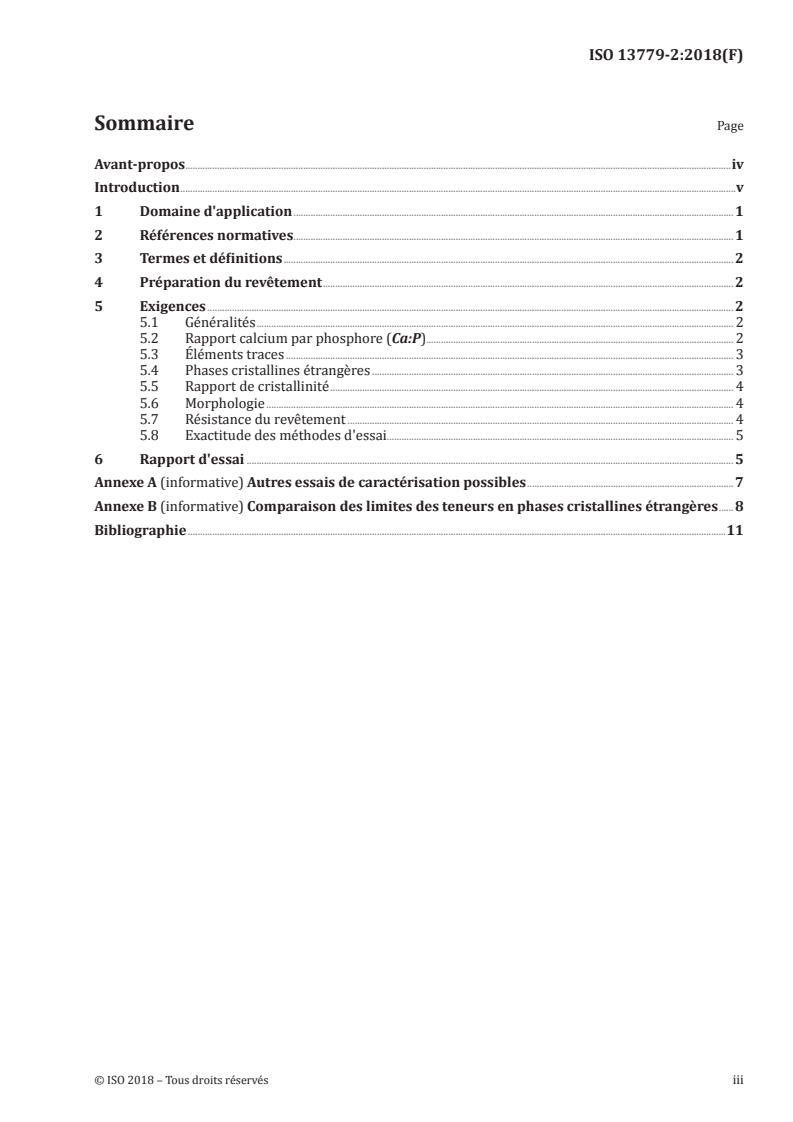
Sommaire Page
Avant-propos .iv
Introduction .v
1 Domaine d'application . 1
2 Références normatives . 1
3 Termes et définitions . 2
4 Préparation du revêtement . 2
5 Exigences . 2
5.1 Généralités . 2
5.2 Rapport calcium par phosphore (Ca:P). 2
5.3 Éléments traces . 3
5.4 Phases cristallines étrangères . 3
5.5 Rapport de cristallinité . 4
5.6 Morphologie . 4
5.7 Résistance du revêtement . 4
5.8 Exactitude des méthodes d'essai . 5
6 Rapport d'essai . 5
Annexe A (informative) Autres essais de caractérisation possibles . 7
Annexe B (informative) Comparaison des limites des teneurs en phases cristallines étrangères .8
Bibliographie .11
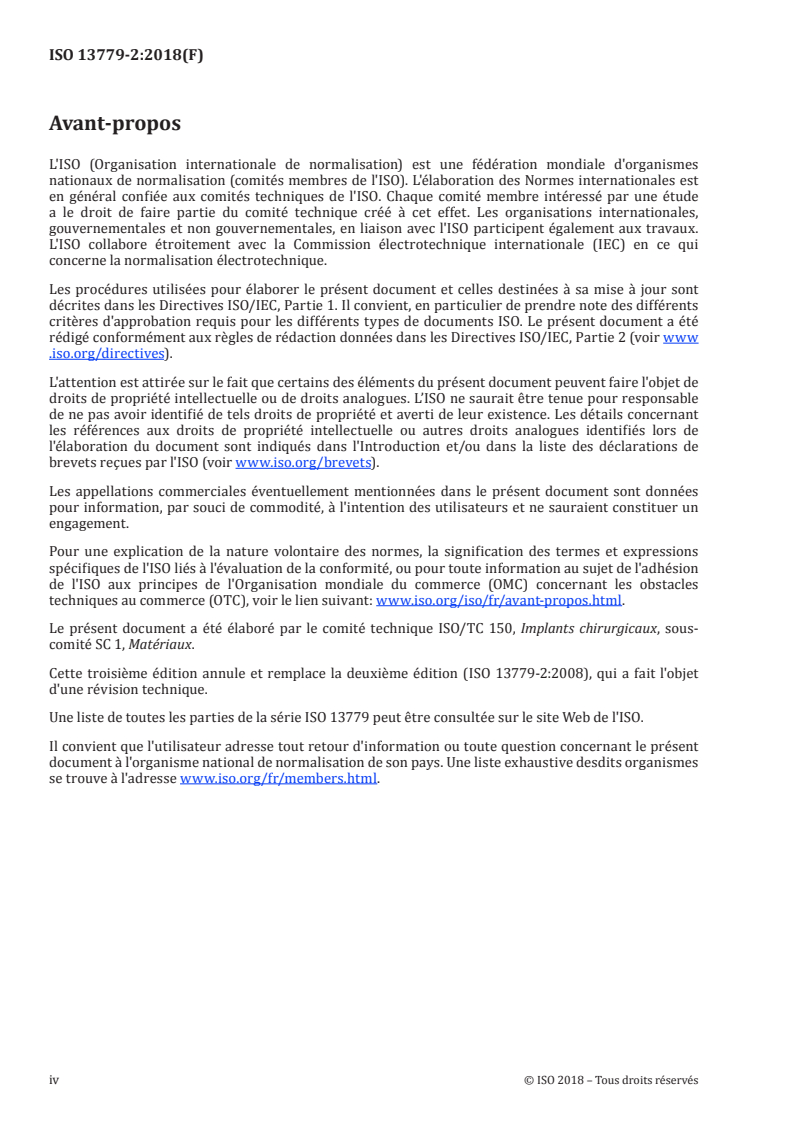
Avant-propos
L'ISO (Organisation internationale de normalisation) est une fédération mondiale d'organismes
nationaux de normalisation (comités membres de l'ISO). L'élaboration des Normes internationales est
en général confiée aux comités techniques de l'ISO. Chaque comité membre intéressé par une étude
a le droit de faire partie du comité technique créé à cet effet. Les organisations internationales,
gouvernementales et non gouvernementales, en liaison avec l'ISO participent également aux travaux.
L'ISO collabore étroitement avec la Commission électrotechnique internationale (IEC) en ce qui
concerne la normalisation électrotechnique.
Les procédures utilisées pour élaborer le présent document et celles destinées à sa mise à jour sont
décrites dans les Directives ISO/IEC, Partie 1. Il convient, en particulier de prendre note des différents
critères d'approbation requis pour les différents types de documents ISO. Le présent document a été
rédigé conformément aux règles de rédaction données dans les Directives ISO/IEC, Partie 2 (voir www
.iso .org/directives).
L'attention est attirée sur le fait que certains des éléments du présent document peuvent faire l'objet de
droits de propriété intellectuelle ou de droits analogues. L’ISO ne saurait être tenue pour responsable
de ne pas avoir identifié de tels droits de propriété et averti de leur existence. Les détails concernant
les références aux droits de propriété intellectuelle ou autres droits analogues identifiés lors de
l'élaboration du document sont indiqués dans l'Introduction et/ou dans la liste des déclarations de
brevets reçues par l'ISO (voir www .iso .org/brevets).
Les appellations commerciales éventuellement mentionnées dans le présent document sont données
pour information, par souci de commodité, à l'intention des utilisateurs et ne sauraient constituer un
engagement.
Pour une explication de la nature volontaire des normes, la signification des termes et expressions
spécifiques de l'ISO liés à l'évaluation de la conformité, ou pour toute information au sujet de l'adhésion
de l'ISO aux principes de l'Organisation mondiale du commerce (OMC) concernant les obstacles
techniques au commerce (OTC), voir le lien suivant: www .iso .org/iso/fr/avant -propos .html.
Le présent document a été élaboré par le comité technique ISO/TC 150, Implants chirurgicaux, sous-
comité SC 1, Matériaux.
Cette troisième édition annule et remplace la deuxième édition (ISO 13779-2:2008), qui a fait l'objet
d'une révision technique.
Une liste de toutes les parties de la série ISO 13779 peut être consultée sur le site Web de l'ISO.
Il convient que l'utilisateur adresse tout retour d'information ou toute question concernant le présent
document à l'organisme national de normalisation de son pays. Une liste exhaustive desdits organismes
se trouve à l'adresse www .iso .org/fr/members .html.
iv © ISO 2018 – Tous droits réservés
Introduction
Il n'existe pas, actuellement, de matériau pour implants chirurgicaux complètement exempt de réactions
indésirables sur le corps humain. Cependant, une longue expérience clinique de l'utilisation du matériau
désigné dans l'ISO 13779 a démontré que, si le matériau est utilisé pour des applications appropriées, la
réponse biologique peut être d'un niveau acceptable.
La réponse biologique vis-à-vis des revêtements de céramique à base d'hydroxyapatite a été mise
en évidence par l'étude à long terme de l'utilisation clinique et par des études en laboratoire (voir
Références [1], [2], [3], [4], [5], [6]).
NORME INTERNATIONALE ISO 13779-2:2018(F)
Implants chirurgicaux — Hydroxyapatite —
Partie 2:
Revêtements à base d'hydroxyapatite, obtenus par
projection thermique
1 Domaine d'application
Le présent document spécifie les exigences relatives aux revêtements monocouches à base
d'hydroxyapatite obtenus par projection thermique, appliqués sur les implants chirurgicaux
métalliques.
Ces exigences visent à décrire les propriétés du matériau et à les communiquer entre différents
organismes. Ces exigences ne sont pas rédigées en vue de remplacer les exigences de fonctionnement et
d'évaluation internes d'une entreprise, bien qu'elles puissent être utilisées comme telles.
NOTE 1 Pour les revêtements minces ayant une épaisseur inférieure à 50 µm, certaines méthodes d'essai
décrites dans le présent document peuvent être difficiles à appliquer sans modification.
NOTE 2 Les exigences applicables à la couche d'hydroxyapatite de revêtements bicouches (constitués d'une
couche inférieure de revêtement métallique et d'une couche supérieure de revêtement à base d'hydroxyapatite)
peuvent être conformes au présent document; cependant, les méthodes d'essai désignées dans le présent
document ne peuvent pas s'appliquer aux revêtements bicouches. Si le présent document est utilisé comme
référence pour les exigences applicables à la couche d'hydroxyapatite de revêtements bicouches, il peut être
considéré nécessaire de fournir une justification expliquant comment les éprouvettes monocouches soumises à
essai sont représentatives de l'implant bicouche revêtu.
Le présent document ne concerne pas les revêtements fabriqués à partir de verre de phosphate de
calcium, de vitrocéramique de phosphate de calcium, de phosphate tricalcique alpha ou bêta, de
phosphate de calcium biphasique ou d'autres formes de phosphate de calcium.
NOTE 3 Bien que les exigences du présent document soient destinées à être utilisées comme spécifications
pour un revêtement à base d'hydroxyapatite obtenu par projection thermique, il peut s'avérer nécessaire
d'établir des modes opératoires de contrôles de routine spécifiant des essais de contrôle et leur fréquence afin de
s'assurer que le revêtement se maintienne dans les limites spécifiées.
NOTE 4 Le présent document a été développé en se concentrant sur le revêtement à base d'hydroxyapatite
obtenu par projection au plasma. Il peut également être utilisé pour caractériser d'autres revêtements à base
d'hydroxyapatite obtenus par projection thermique. Toutefois, les revêtements obtenus par projection thermique
qui n'ont pas fait l'objet d'un usage clinique à long terme peuvent présenter des risques différents et nécessiter
des caractérisations supplémentaires au-delà de celles identifiées dans le présent document.
2 Références normatives
Les documents suivants sont cités dans le texte de sorte qu’ils constituent, pour tout ou partie de leur
contenu, des exigences du présent document. Pour les références datées, seule l’édition citée s’applique.
Pour les références non datées, la dernière édition du document de référence s'applique (y compris les
éventuels amendements).
ISO 4288, Spécification géométrique des produits (GPS) — État de surface: Méthode du profil — Règles et
procédures pour l'évaluation de l'état de surface
ISO 10993-1, Évaluation biologique des dispositifs médicaux — Partie 1: Évaluation et essais au sein d'un
processus de gestion du risque
ISO 13779-3, Implants chirurgicaux — Hydroxyapatite — Partie 3: Analyse chimique et caractérisation du
rapport de cristallinité et de la pureté de phase
ISO 13779-4, Implants chirurgicaux — Hydroxyapatite — Partie 4: Détermination de la résistance à
l’adhésion du revêtement
ISO 13779-6, Implants chirurgicaux — Hydroxyapatite — Partie 6: Poudres
ASTM F1044, Standard Test Method for Shear Testing of Calcium Phosphate Coatings and Metallic Coatings
ASTM F1854, Standard Test Method for Stereological Evaluation of Porous Coatings on Medical Implants
3 Termes et définitions
Pour les besoins du présent document, les termes et définitions donnés dans l'ISO 13779-3 ainsi que les
suivants s'appliquent.
L'ISO et l'IEC tiennent à jour des bases de données terminologiques destinées à être utilisées en
normalisation, consultables aux adresses suivantes:
— ISO Online browsing platform: disponible à l’adresse https: //www .iso .org/obp
— IEC Electropedia: disponible à l’adresse http: //www .electropedia .org/
3.1
revêtement à base d'hydroxyapatite obtenu par projection thermique
revêtement formé par projection thermique de poudres à base d'hydroxyapatite
Note 1 à l'article: Pour les besoins du présent document, les termes «revêtement» et «revêtement à base
d'hydroxyapatite» désignent tous deux un «revêtement à base d'hydroxyapatite obtenu par projection
thermique».
4 Préparation du revêtement
La poudre utilisée pour la projection thermique du revêtement à base d'hydroxyapatite doit être
conforme à l'ISO 13779-6.
À moins que le contraire ne soit documenté et justifié par le fabricant, toutes les éprouvettes doivent être
préparées en utilisant les mêmes méthodes de production que pour les composants d'implants finaux,
notamment la poudre d'hydroxyapatite initiale, le matériau substrat, les installations de production, le
procédé de préparation de surface du substrat, les paramètres du procédé de revêtement, le nettoyage
et la stérilisation.
5 Exigences
5.1 Généralités
Les exigences minimales applicables au revêtement à base d'hydroxyapatite sont établies de 5.2 à 5.8.
D'autres essais de caractérisation, tels que ceux décrits en A.2, A.3 et A.4, peuvent également être requis
(par exemple en vue de satisfaire aux exigences de la réglementation nationale ou régionale en vigueur).
NOTE 1 En plus des essais décrits de 5.2 à 5.8, certains organismes réglementaires peuvent exiger les essais
de caractérisation du revêtement à base d'hydroxyapatite indiqués dans l'Annexe A.
5.2 Rapport calcium par phosphore (Ca:P)
Le revêtement doit être gratté du substrat avant l'essai.
2 © ISO 2018 – Tous droits réservés
Le rapport calcium par phosphore, Ca:P, du revêtement céramique à base d'hydroxyapatite doit être
déterminé conformément à l'ISO 13779-3.
Le rapport atomique calcium par phosphore, Ca:P, doit être compris entre 1,61 et 1,76.
NOTE Généralement, le rapport calcium par phosphore n'est pas influencé par l'épaisseur du revêtement.
5.3 Éléments traces
Le revêtement doit être gratté du substrat avant l'essai. La quantité d'échantillon requise pour l'analyse
chimique dépend de la technique d'analyse chimique utilisée. La quantité d'échantillon utilisée doit être
suffisante pour obtenir des limites de quantification adéquates. La technique utilisée pour prélever le
revêtement doit réduire au maximum le risque de contamination du revêtement: veiller à utiliser des
outils appropriés et à éviter toute contamination avec des particules provenant du substrat.
Les concentrations en éléments traces doivent être déterminées tel qu'il est spécifié dans l'ISO 13779-3.
Les métaux lourds doivent être tels que spécifiés dans l'ISO 13779-3.
Les limites maximales admissibles de la concentration en éléments traces spécifiques et en métaux
lourds des revêtements à base d'hydroxyapatite sont données dans le Tableau 1.
Tout élément trace susceptible d'être présent avec une fraction massique supérieure à 1 000 mg/kg doit
être identifié. Ces éléments doivent être quantifiés et, s'ils sont présents avec une fraction massique
supérieure à 1 000 mg/kg, leur influe
...
NORME ISO
INTERNATIONALE 13779-2
Troisième édition
2018-12
Implants chirurgicaux —
Hydroxyapatite —
Partie 2:
Revêtements à base d'hydroxyapatite,
obtenus par projection thermique
Implants for surgery — Hydroxyapatite —
Part 2: Thermally sprayed coatings of hydroxyapatite
Numéro de référence
©
ISO 2018
DOCUMENT PROTÉGÉ PAR COPYRIGHT
© ISO 2018
Tous droits réservés. Sauf prescription différente ou nécessité dans le contexte de sa mise en œuvre, aucune partie de cette
publication ne peut être reproduite ni utilisée sous quelque forme que ce soit et par aucun procédé, électronique ou mécanique,
y compris la photocopie, ou la diffusion sur l’internet ou sur un intranet, sans autorisation écrite préalable. Une autorisation peut
être demandée à l’ISO à l’adresse ci-après ou au comité membre de l’ISO dans le pays du demandeur.
ISO copyright office
Case postale 401 • Ch. de Blandonnet 8
CH-1214 Vernier, Genève
Tél.: +41 22 749 01 11
Fax: +41 22 749 09 47
E-mail: copyright@iso.org
Web: www.iso.org
Publié en Suisse
ii © ISO 2018 – Tous droits réservés
Sommaire Page
Avant-propos .iv
Introduction .v
1 Domaine d'application . 1
2 Références normatives . 1
3 Termes et définitions . 2
4 Préparation du revêtement . 2
5 Exigences . 2
5.1 Généralités . 2
5.2 Rapport calcium par phosphore (Ca:P). 2
5.3 Éléments traces . 3
5.4 Phases cristallines étrangères . 3
5.5 Rapport de cristallinité . 4
5.6 Morphologie . 4
5.7 Résistance du revêtement . 4
5.8 Exactitude des méthodes d'essai . 5
6 Rapport d'essai . 5
Annexe A (informative) Autres essais de caractérisation possibles . 7
Annexe B (informative) Comparaison des limites des teneurs en phases cristallines étrangères .8
Bibliographie .11
Avant-propos
L'ISO (Organisation internationale de normalisation) est une fédération mondiale d'organismes
nationaux de normalisation (comités membres de l'ISO). L'élaboration des Normes internationales est
en général confiée aux comités techniques de l'ISO. Chaque comité membre intéressé par une étude
a le droit de faire partie du comité technique créé à cet effet. Les organisations internationales,
gouvernementales et non gouvernementales, en liaison avec l'ISO participent également aux travaux.
L'ISO collabore étroitement avec la Commission électrotechnique internationale (IEC) en ce qui
concerne la normalisation électrotechnique.
Les procédures utilisées pour élaborer le présent document et celles destinées à sa mise à jour sont
décrites dans les Directives ISO/IEC, Partie 1. Il convient, en particulier de prendre note des différents
critères d'approbation requis pour les différents types de documents ISO. Le présent document a été
rédigé conformément aux règles de rédaction données dans les Directives ISO/IEC, Partie 2 (voir www
.iso .org/directives).
L'attention est attirée sur le fait que certains des éléments du présent document peuvent faire l'objet de
droits de propriété intellectuelle ou de droits analogues. L’ISO ne saurait être tenue pour responsable
de ne pas avoir identifié de tels droits de propriété et averti de leur existence. Les détails concernant
les références aux droits de propriété intellectuelle ou autres droits analogues identifiés lors de
l'élaboration du document sont indiqués dans l'Introduction et/ou dans la liste des déclarations de
brevets reçues par l'ISO (voir www .iso .org/brevets).
Les appellations commerciales éventuellement mentionnées dans le présent document sont données
pour information, par souci de commodité, à l'intention des utilisateurs et ne sauraient constituer un
engagement.
Pour une explication de la nature volontaire des normes, la signification des termes et expressions
spécifiques de l'ISO liés à l'évaluation de la conformité, ou pour toute information au sujet de l'adhésion
de l'ISO aux principes de l'Organisation mondiale du commerce (OMC) concernant les obstacles
techniques au commerce (OTC), voir le lien suivant: www .iso .org/iso/fr/avant -propos .html.
Le présent document a été élaboré par le comité technique ISO/TC 150, Implants chirurgicaux, sous-
comité SC 1, Matériaux.
Cette troisième édition annule et remplace la deuxième édition (ISO 13779-2:2008), qui a fait l'objet
d'une révision technique.
Une liste de toutes les parties de la série ISO 13779 peut être consultée sur le site Web de l'ISO.
Il convient que l'utilisateur adresse tout retour d'information ou toute question concernant le présent
document à l'organisme national de normalisation de son pays. Une liste exhaustive desdits organismes
se trouve à l'adresse www .iso .org/fr/members .html.
iv © ISO 2018 – Tous droits réservés
Introduction
Il n'existe pas, actuellement, de matériau pour implants chirurgicaux complètement exempt de réactions
indésirables sur le corps humain. Cependant, une longue expérience clinique de l'utilisation du matériau
désigné dans l'ISO 13779 a démontré que, si le matériau est utilisé pour des applications appropriées, la
réponse biologique peut être d'un niveau acceptable.
La réponse biologique vis-à-vis des revêtements de céramique à base d'hydroxyapatite a été mise
en évidence par l'étude à long terme de l'utilisation clinique et par des études en laboratoire (voir
Références [1], [2], [3], [4], [5], [6]).
NORME INTERNATIONALE ISO 13779-2:2018(F)
Implants chirurgicaux — Hydroxyapatite —
Partie 2:
Revêtements à base d'hydroxyapatite, obtenus par
projection thermique
1 Domaine d'application
Le présent document spécifie les exigences relatives aux revêtements monocouches à base
d'hydroxyapatite obtenus par projection thermique, appliqués sur les implants chirurgicaux
métalliques.
Ces exigences visent à décrire les propriétés du matériau et à les communiquer entre différents
organismes. Ces exigences ne sont pas rédigées en vue de remplacer les exigences de fonctionnement et
d'évaluation internes d'une entreprise, bien qu'elles puissent être utilisées comme telles.
NOTE 1 Pour les revêtements minces ayant une épaisseur inférieure à 50 µm, certaines méthodes d'essai
décrites dans le présent document peuvent être difficiles à appliquer sans modification.
NOTE 2 Les exigences applicables à la couche d'hydroxyapatite de revêtements bicouches (constitués d'une
couche inférieure de revêtement métallique et d'une couche supérieure de revêtement à base d'hydroxyapatite)
peuvent être conformes au présent document; cependant, les méthodes d'essai désignées dans le présent
document ne peuvent pas s'appliquer aux revêtements bicouches. Si le présent document est utilisé comme
référence pour les exigences applicables à la couche d'hydroxyapatite de revêtements bicouches, il peut être
considéré nécessaire de fournir une justification expliquant comment les éprouvettes monocouches soumises à
essai sont représentatives de l'implant bicouche revêtu.
Le présent document ne concerne pas les revêtements fabriqués à partir de verre de phosphate de
calcium, de vitrocéramique de phosphate de calcium, de phosphate tricalcique alpha ou bêta, de
phosphate de calcium biphasique ou d'autres formes de phosphate de calcium.
NOTE 3 Bien que les exigences du présent document soient destinées à être utilisées comme spécifications
pour un revêtement à base d'hydroxyapatite obtenu par projection thermique, il peut s'avérer nécessaire
d'établir des modes opératoires de contrôles de routine spécifiant des essais de contrôle et leur fréquence afin de
s'assurer que le revêtement se maintienne dans les limites spécifiées.
NOTE 4 Le présent document a été développé en se concentrant sur le revêtement à base d'hydroxyapatite
obtenu par projection au plasma. Il peut également être utilisé pour caractériser d'autres revêtements à base
d'hydroxyapatite obtenus par projection thermique. Toutefois, les revêtements obtenus par projection thermique
qui n'ont pas fait l'objet d'un usage clinique à long terme peuvent présenter des risques différents et nécessiter
des caractérisations supplémentaires au-delà de celles identifiées dans le présent document.
2 Références normatives
Les documents suivants sont cités dans le texte de sorte qu’ils constituent, pour tout ou partie de leur
contenu, des exigences du présent document. Pour les références datées, seule l’édition citée s’applique.
Pour les références non datées, la dernière édition du document de référence s'applique (y compris les
éventuels amendements).
ISO 4288, Spécification géométrique des produits (GPS) — État de surface: Méthode du profil — Règles et
procédures pour l'évaluation de l'état de surface
ISO 10993-1, Évaluation biologique des dispositifs médicaux — Partie 1: Évaluation et essais au sein d'un
processus de gestion du risque
ISO 13779-3, Implants chirurgicaux — Hydroxyapatite — Partie 3: Analyse chimique et caractérisation du
rapport de cristallinité et de la pureté de phase
ISO 13779-4, Implants chirurgicaux — Hydroxyapatite — Partie 4: Détermination de la résistance à
l’adhésion du revêtement
ISO 13779-6, Implants chirurgicaux — Hydroxyapatite — Partie 6: Poudres
ASTM F1044, Standard Test Method for Shear Testing of Calcium Phosphate Coatings and Metallic Coatings
ASTM F1854, Standard Test Method for Stereological Evaluation of Porous Coatings on Medical Implants
3 Termes et définitions
Pour les besoins du présent document, les termes et définitions donnés dans l'ISO 13779-3 ainsi que les
suivants s'appliquent.
L'ISO et l'IEC tiennent à jour des bases de données terminologiques destinées à être utilisées en
normalisation, consultables aux adresses suivantes:
— ISO Online browsing platform: disponible à l’adresse https: //www .iso .org/obp
— IEC Electropedia: disponible à l’adresse http: //www .electropedia .org/
3.1
revêtement à base d'hydroxyapatite obtenu par projection thermique
revêtement formé par projection thermique de poudres à base d'hydroxyapatite
Note 1 à l'article: Pour les besoins du présent document, les termes «revêtement» et «revêtement à base
d'hydroxyapatite» désignent tous deux un «revêtement à base d'hydroxyapatite obtenu par projection
thermique».
4 Préparation du revêtement
La poudre utilisée pour la projection thermique du revêtement à base d'hydroxyapatite doit être
conforme à l'ISO 13779-6.
À moins que le contraire ne soit documenté et justifié par le fabricant, toutes les éprouvettes doivent être
préparées en utilisant les mêmes méthodes de production que pour les composants d'implants finaux,
notamment la poudre d'hydroxyapatite initiale, le matériau substrat, les installations de production, le
procédé de préparation de surface du substrat, les paramètres du procédé de revêtement, le nettoyage
et la stérilisation.
5 Exigences
5.1 Généralités
Les exigences minimales applicables au revêtement à base d'hydroxyapatite sont établies de 5.2 à 5.8.
D'autres essais de caractérisation, tels que ceux décrits en A.2, A.3 et A.4, peuvent également être requis
(par exemple en vue de satisfaire aux exigences de la réglementation nationale ou régionale en vigueur).
NOTE 1 En plus des essais décrits de 5.2 à 5.8, certains organismes réglementaires peuvent exiger les essais
de caractérisation du revêtement à base d'hydroxyapatite indiqués dans l'Annexe A.
5.2 Rapport calcium par phosphore (Ca:P)
Le revêtement doit être gratté du substrat avant l'essai.
2 © ISO 2018 – Tous droits réservés
Le rapport calcium par phosphore, Ca:P, du revêtement céramique à base d'hydroxyapatite doit être
déterminé conformément à l'ISO 13779-3.
Le rapport atomique calcium par phosphore, Ca:P, doit être compris entre 1,61 et 1,76.
NOTE Généralement, le rapport calcium par phosphore n'est pas influencé par l'épaisseur du revêtement.
5.3 Éléments traces
Le revêtement doit être gratté du substrat avant l'essai. La quantité d'échantillon requise pour l'analyse
chimique dépend de la technique d'analyse chimique utilisée. La quantité d'échantillon utilisée doit être
suffisante pour obtenir des limites de quantification adéquates. La technique utilisée pour prélever le
revêtement doit réduire au maximum le risque de contamination du revêtement: veiller à utiliser des
outils appropriés et à éviter toute contamination avec des particules provenant du substrat.
Les concentrations en éléments traces doivent être déterminées tel qu'il est spécifié dans l'ISO 13779-3.
Les métaux lourds doivent être tels que spécifiés dans l'ISO 13779-3.
Les limites maximales admissibles de la concentration en éléments traces spécifiques et en métaux
lourds des revêtements à base d'hydroxyapatite sont données dans le Tableau 1.
Tout élément trace susceptible d'être présent avec une fraction massique supérieure à 1 000 mg/kg doit
être identifié. Ces éléments doivent être quantifiés et, s'ils sont présents avec une fraction massique
supérieure à 1 000 mg/kg, leur influe
...