

ISO 636:2024
(Main)Welding consumables — Rods, wires and deposits for tungsten inert gas welding of non-alloy and fine-grain steels — Classification
General Information
- Abstract
This document specifies requirements for classification of rods, wires and deposits in the as-welded condition and in the post-weld heat-treated condition for tungsten inert gas welding of non-alloy and fine-grain steels with a minimum yield strength of up to 500 MPa or a minimum tensile strength of up to 570 MPa. This document is a combined specification providing classification utilizing a system based upon the yield strength and the average impact energy of 47 J of all-weld metal or utilizing a system based upon the tensile strength and the average impact energy of 27 J of all-weld metal. a) Components which carry the suffix “system A” are applicable only to rods, wires and deposits classified to the system based upon the yield strength and the average impact energy of 47 J of all-weld metal in accordance with this document. b) Components which carry the suffix “system B” are applicable only to rods, wires and deposits classified to the system based upon the tensile strength and the average impact energy of 27 J of all-weld metal in accordance with this document. c) Components which have neither the suffix “system A” nor the suffix “system B” are applicable to all rods, wires and deposits classified in accordance with this document.
- Status
- Published
- Publication Date
- 23-Sep-2024
- Technical Committee
- ISO/TC 44/SC 3 - Welding consumables
- Drafting Committee
- ISO/TC 44/SC 3 - Welding consumables
- Current Stage
- 6060 - International Standard published
- Start Date
- 24-Sep-2024
- Due Date
- 24-Mar-2026
- Completion Date
- 24-Sep-2024
Buy Documents
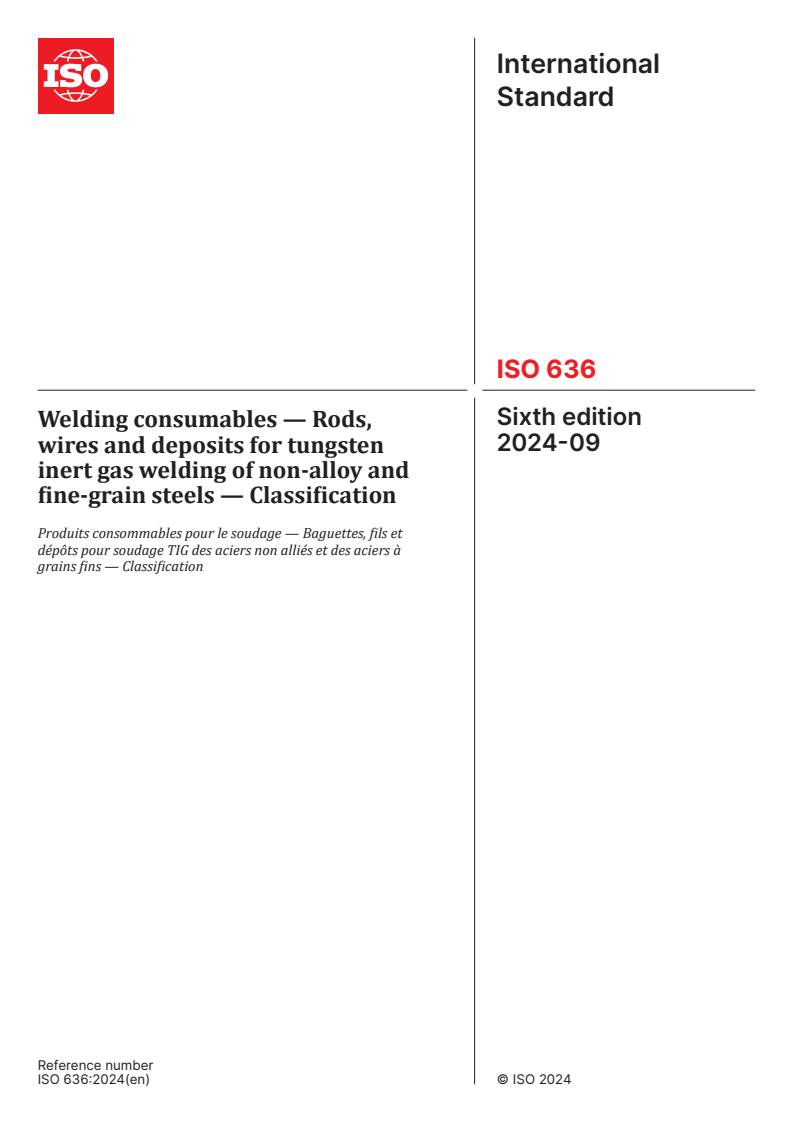
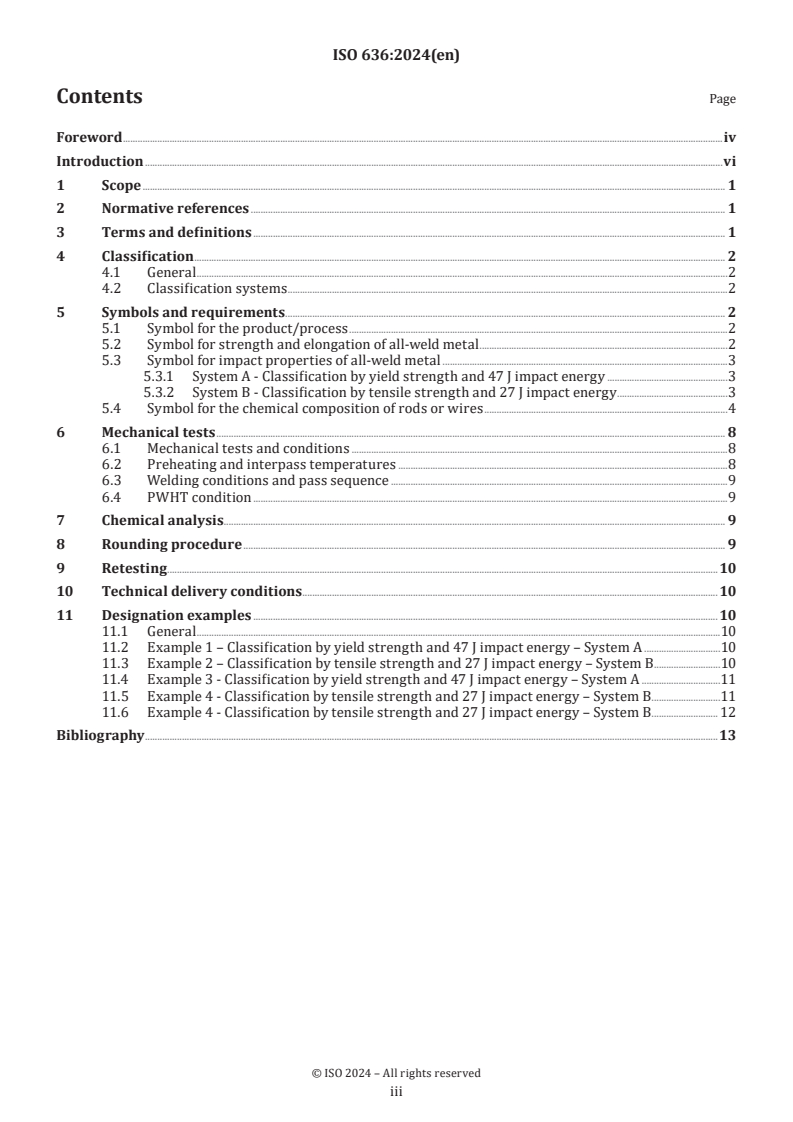
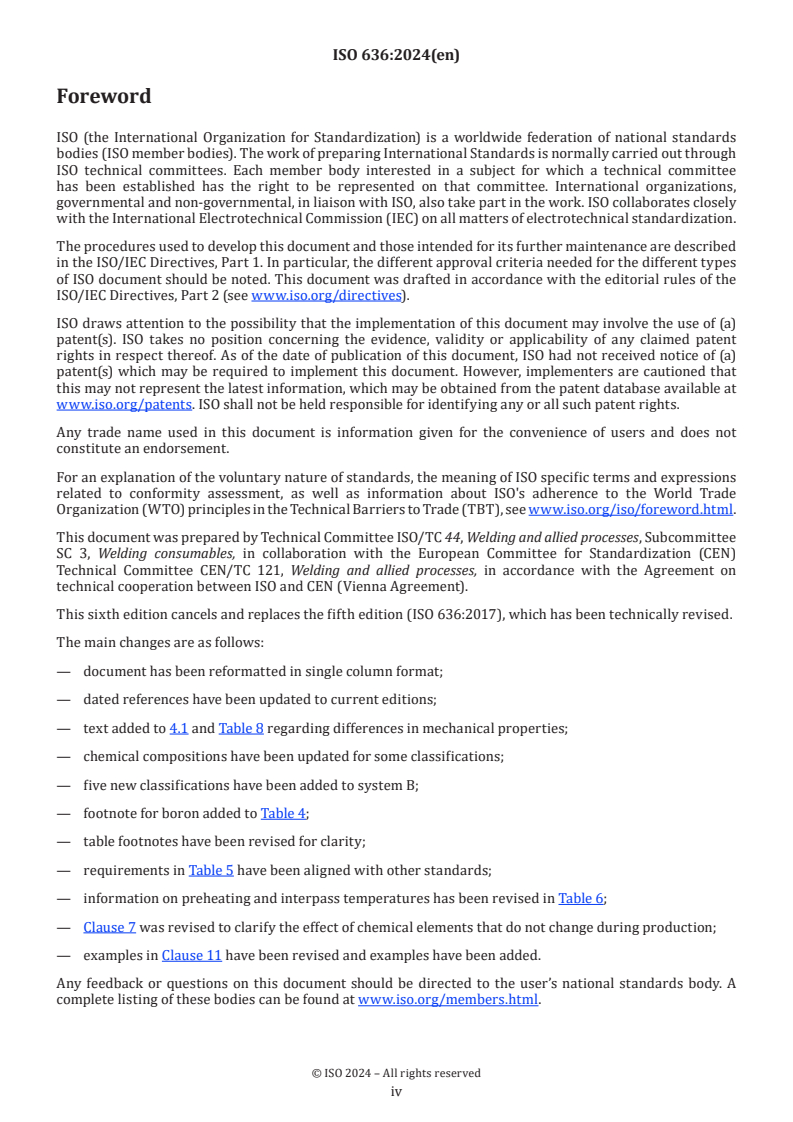
ISO 636:2024 - Welding consumables — Rods, wires and deposits for tungsten inert gas welding of non-alloy and fine-grain steels — Classification Released:24. 09. 2024
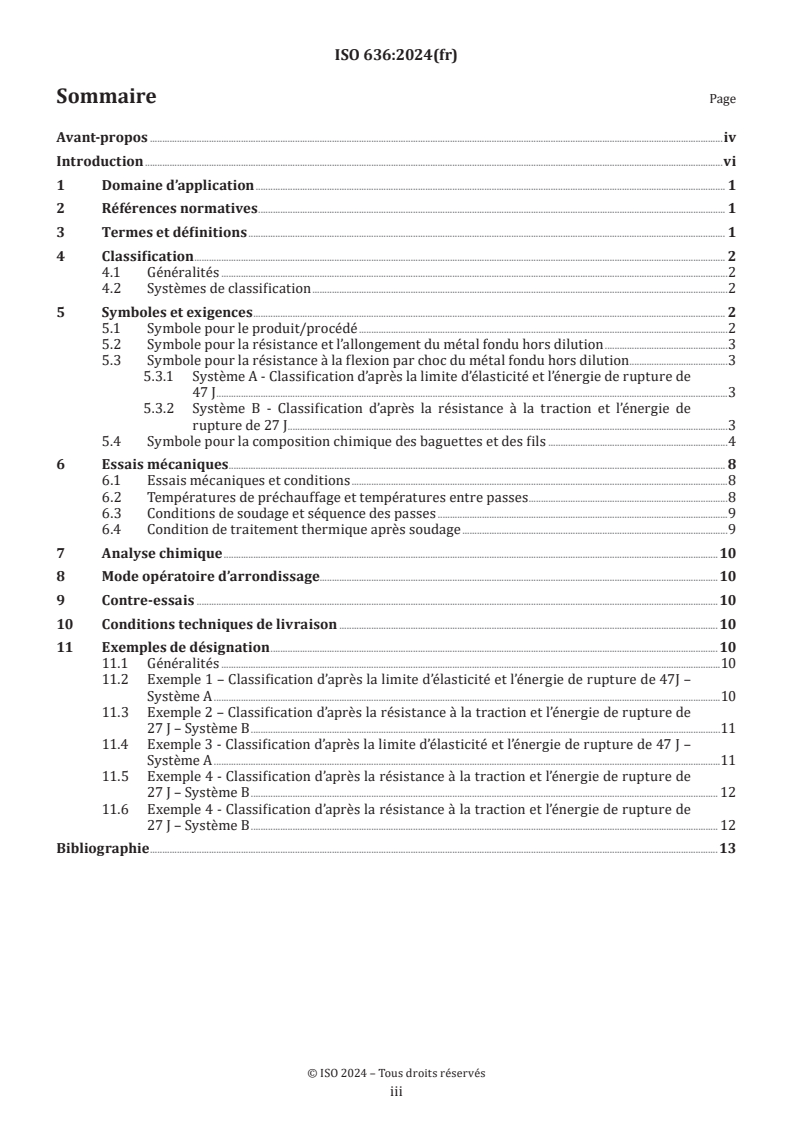
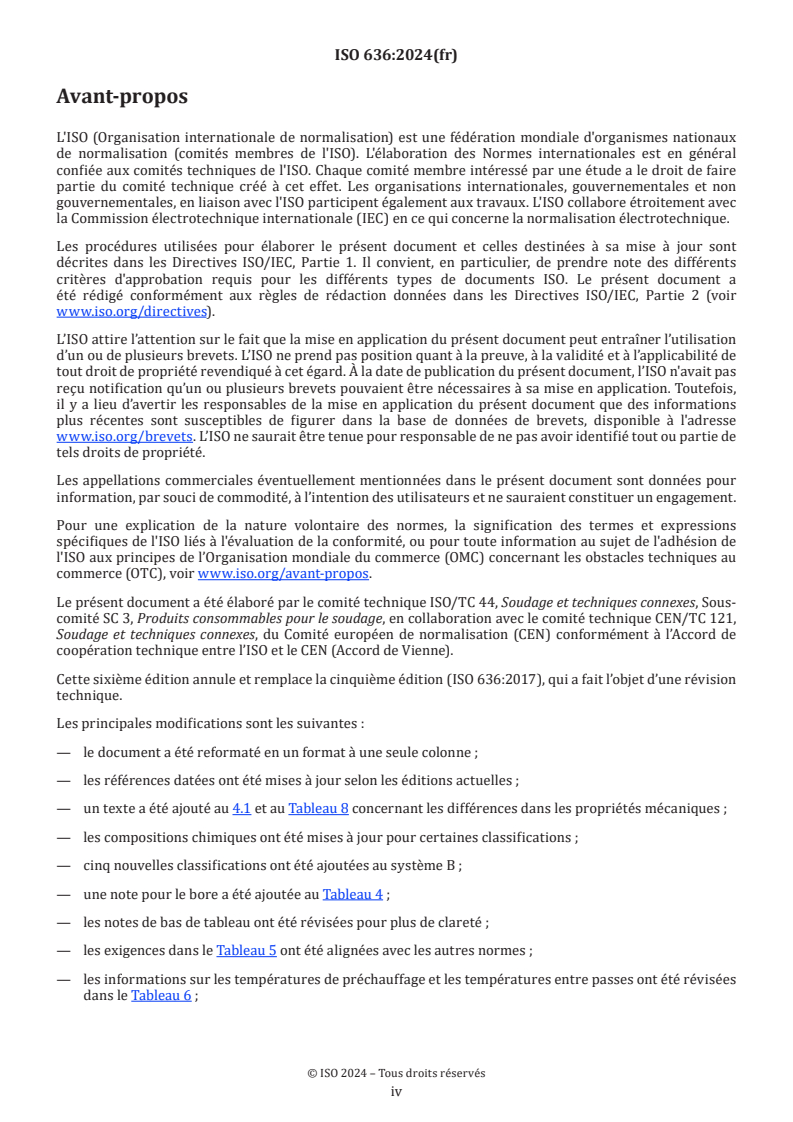
ISO 636:2024 - Produits consommables pour le soudage — Baguettes, fils et dépôts pour soudage TIG des aciers non alliés et des aciers a grains fins — Classification Released:24. 09. 2024
Overview
ISO 636:2024 - "Welding consumables - Rods, wires and deposits for tungsten inert gas (TIG) welding of non-alloy and fine‑grain steels - Classification" - is the sixth edition of the ISO classification for TIG welding filler materials. It specifies how to classify rods, wires and weld deposits for TIG welding of non‑alloy and fine‑grain steels with a minimum yield strength up to 500 MPa or a minimum tensile strength up to 570 MPa. The standard provides a combined classification system based on mechanical properties of the all‑weld metal and the chemical composition of the consumable.
Key topics and technical requirements
- Two classification systems
- System A - classification by yield strength and average Charpy impact energy 47 J (all‑weld metal).
- System B - classification by tensile strength and average Charpy impact energy 27 J (all‑weld metal).
- Designation rules
- Symbols begin with the letter “W” for tungsten inert gas welding.
- Suffix “system A” or “system B” indicate which approach applies; absence of a suffix means the designation is applicable to both systems.
- Impact test protocols
- System A: three Charpy specimens, average ≥ 47 J; one value may be lower but not below 32 J.
- System B: five specimens, discard highest and lowest, average of remaining three ≥ 27 J; one of the three may be below 27 J but not below 20 J.
- Mechanical testing and conditions
- All‑weld metal test-piece preparation, preheating/interpass and post‑weld heat treatment (PWHT) conditions are specified (see Clause 6).
- Chemical composition
- Rods and wires are classified by chemical composition (Table 4); deposits follow the chemical composition of the consumable plus the mechanical properties of the all‑weld metal (Tables 2–4).
- Conformity and delivery
- Includes rounding procedures, retesting rules, and technical delivery conditions (Clause 10).
- Updates in 2024 edition
- Reformatting, updated references, revised mechanical/chemical requirements, new system B classifications and clarifications on preheat/interpass and boron footnote.
Applications and users
ISO 636:2024 is practical for:
- Welding engineers and metallurgists selecting TIG welding consumables for non‑alloy and fine‑grain steels.
- Manufacturers of welding rods and wires seeking compliant product classification.
- Fabricators, inspectors and procurement teams specifying filler materials to match strength and impact requirements of parent material.
- Quality management and certification bodies verifying mechanical test results and documentation.
Practical benefits include clearer consumable selection, consistent all‑weld metal performance expectations, and harmonized procurement language for TIG welding projects.
Related standards
- ISO 15792‑1 (all‑weld metal test piece preparation)
- ISO 14175 (welding gases)
- ISO 544, ISO 14344 (technical delivery / procurement of filler materials)
- EN 1668 (informative for system A references)
Keywords: ISO 636:2024, welding consumables, TIG welding, tungsten inert gas, rods, wires, all‑weld metal, classification, yield strength, tensile strength, impact energy, non‑alloy steels.
Relations
- Effective Date
- 12-Feb-2026
- Effective Date
- 22-Apr-2023
- Effective Date
- 25-Mar-2023
Buy Documents
ISO 636:2024 - Welding consumables — Rods, wires and deposits for tungsten inert gas welding of non-alloy and fine-grain steels — Classification Released:24. 09. 2024
ISO 636:2024 - Produits consommables pour le soudage — Baguettes, fils et dépôts pour soudage TIG des aciers non alliés et des aciers a grains fins — Classification Released:24. 09. 2024
Get Certified
Connect with accredited certification bodies for this standard

DVS-ZERT GmbH
German welding certification society.
CARES (UK Certification Authority for Reinforcing Steels)
UK certification for reinforcing steels and construction.
EWF/IIW (European/International Welding Federation)
International welding personnel certification.
Sponsored listings
Frequently Asked Questions
ISO 636:2024 is a standard published by the International Organization for Standardization (ISO). Its full title is "Welding consumables — Rods, wires and deposits for tungsten inert gas welding of non-alloy and fine-grain steels — Classification". This standard covers: This document specifies requirements for classification of rods, wires and deposits in the as-welded condition and in the post-weld heat-treated condition for tungsten inert gas welding of non-alloy and fine-grain steels with a minimum yield strength of up to 500 MPa or a minimum tensile strength of up to 570 MPa. This document is a combined specification providing classification utilizing a system based upon the yield strength and the average impact energy of 47 J of all-weld metal or utilizing a system based upon the tensile strength and the average impact energy of 27 J of all-weld metal. a) Components which carry the suffix “system A” are applicable only to rods, wires and deposits classified to the system based upon the yield strength and the average impact energy of 47 J of all-weld metal in accordance with this document. b) Components which carry the suffix “system B” are applicable only to rods, wires and deposits classified to the system based upon the tensile strength and the average impact energy of 27 J of all-weld metal in accordance with this document. c) Components which have neither the suffix “system A” nor the suffix “system B” are applicable to all rods, wires and deposits classified in accordance with this document.
This document specifies requirements for classification of rods, wires and deposits in the as-welded condition and in the post-weld heat-treated condition for tungsten inert gas welding of non-alloy and fine-grain steels with a minimum yield strength of up to 500 MPa or a minimum tensile strength of up to 570 MPa. This document is a combined specification providing classification utilizing a system based upon the yield strength and the average impact energy of 47 J of all-weld metal or utilizing a system based upon the tensile strength and the average impact energy of 27 J of all-weld metal. a) Components which carry the suffix “system A” are applicable only to rods, wires and deposits classified to the system based upon the yield strength and the average impact energy of 47 J of all-weld metal in accordance with this document. b) Components which carry the suffix “system B” are applicable only to rods, wires and deposits classified to the system based upon the tensile strength and the average impact energy of 27 J of all-weld metal in accordance with this document. c) Components which have neither the suffix “system A” nor the suffix “system B” are applicable to all rods, wires and deposits classified in accordance with this document.
ISO 636:2024 is classified under the following ICS (International Classification for Standards) categories: 25.160.20 - Welding consumables. The ICS classification helps identify the subject area and facilitates finding related standards.
ISO 636:2024 has the following relationships with other standards: It is inter standard links to EN ISO 636:2024, ISO 5984:2022, ISO 636:2017. Understanding these relationships helps ensure you are using the most current and applicable version of the standard.
ISO 636:2024 is available in PDF format for immediate download after purchase. The document can be added to your cart and obtained through the secure checkout process. Digital delivery ensures instant access to the complete standard document.
Standards Content (Sample)
International
Standard
ISO 636
Sixth edition
Welding consumables — Rods,
2024-09
wires and deposits for tungsten
inert gas welding of non-alloy and
fine-grain steels — Classification
Produits consommables pour le soudage — Baguettes, fils et
dépôts pour soudage TIG des aciers non alliés et des aciers à
grains fins — Classification
Reference number
© ISO 2024
All rights reserved. Unless otherwise specified, or required in the context of its implementation, no part of this publication may
be reproduced or utilized otherwise in any form or by any means, electronic or mechanical, including photocopying, or posting on
the internet or an intranet, without prior written permission. Permission can be requested from either ISO at the address below
or ISO’s member body in the country of the requester.
ISO copyright office
CP 401 • Ch. de Blandonnet 8
CH-1214 Vernier, Geneva
Phone: +41 22 749 01 11
Email: copyright@iso.org
Website: www.iso.org
Published in Switzerland
ii
Contents Page
Foreword .iv
Introduction .vi
1 Scope . 1
2 Normative references . 1
3 Terms and definitions . 1
4 Classification . 2
4.1 General .2
4.2 Classification systems .2
5 Symbols and requirements . 2
5.1 Symbol for the product/process .2
5.2 Symbol for strength and elongation of all-weld metal .2
5.3 Symbol for impact properties of all-weld metal .3
5.3.1 System A - Classification by yield strength and 47 J impact energy .3
5.3.2 System B - Classification by tensile strength and 27 J impact energy .3
5.4 Symbol for the chemical composition of rods or wires .4
6 Mechanical tests . 8
6.1 Mechanical tests and conditions .8
6.2 Preheating and interpass temperatures .8
6.3 Welding conditions and pass sequence .9
6.4 PWHT condition .9
7 Chemical analysis . . 9
8 Rounding procedure . 9
9 Retesting .10
10 Technical delivery conditions . 10
11 Designation examples . 10
11.1 General .10
11.2 Example 1 – Classification by yield strength and 47 J impact energy – System A .10
11.3 Example 2 – Classification by tensile strength and 27 J impact energy – System B .10
11.4 Example 3 - Classification by yield strength and 47 J impact energy – System A .11
11.5 Example 4 - Classification by tensile strength and 27 J impact energy – System B .11
11.6 Example 4 - Classification by tensile strength and 27 J impact energy – System B . 12
Bibliography .13
iii
Foreword
ISO (the International Organization for Standardization) is a worldwide federation of national standards
bodies (ISO member bodies). The work of preparing International Standards is normally carried out through
ISO technical committees. Each member body interested in a subject for which a technical committee
has been established has the right to be represented on that committee. International organizations,
governmental and non-governmental, in liaison with ISO, also take part in the work. ISO collaborates closely
with the International Electrotechnical Commission (IEC) on all matters of electrotechnical standardization.
The procedures used to develop this document and those intended for its further maintenance are described
in the ISO/IEC Directives, Part 1. In particular, the different approval criteria needed for the different types
of ISO document should be noted. This document was drafted in accordance with the editorial rules of the
ISO/IEC Directives, Part 2 (see www.iso.org/directives).
ISO draws attention to the possibility that the implementation of this document may involve the use of (a)
patent(s). ISO takes no position concerning the evidence, validity or applicability of any claimed patent
rights in respect thereof. As of the date of publication of this document, ISO had not received notice of (a)
patent(s) which may be required to implement this document. However, implementers are cautioned that
this may not represent the latest information, which may be obtained from the patent database available at
www.iso.org/patents. ISO shall not be held responsible for identifying any or all such patent rights.
Any trade name used in this document is information given for the convenience of users and does not
constitute an endorsement.
For an explanation of the voluntary nature of standards, the meaning of ISO specific terms and expressions
related to conformity assessment, as well as information about ISO's adherence to the World Trade
Organization (WTO) principles in the Technical Barriers to Trade (TBT), see www.iso.org/iso/foreword.html.
This document was prepared by Technical Committee ISO/TC 44, Welding and allied processes, Subcommittee
SC 3, Welding consumables, in collaboration with the European Committee for Standardization (CEN)
Technical Committee CEN/TC 121, Welding and allied processes, in accordance with the Agreement on
technical cooperation between ISO and CEN (Vienna Agreement).
This sixth edition cancels and replaces the fifth edition (ISO 636:2017), which has been technically revised.
The main changes are as follows:
— document has been reformatted in single column format;
— dated references have been updated to current editions;
— text added to 4.1 and Table 8 regarding differences in mechanical properties;
— chemical compositions have been updated for some classifications;
— five new classifications have been added to system B;
— footnote for boron added to Table 4;
— table footnotes have been revised for clarity;
— requirements in Table 5 have been aligned with other standards;
— information on preheating and interpass temperatures has been revised in Table 6;
— Clause 7 was revised to clarify the effect of chemical elements that do not change during production;
— examples in Clause 11 have been revised and examples have been added.
Any feedback or questions on this document should be directed to the user’s national standards body. A
complete listing of these bodies can be found at www.iso.org/members.html.
iv
Official interpretations of ISO/TC 44 documents, where they exist, are available from this page:
https://committee.iso.org/sites/tc44/home/interpretation.html.
v
Introduction
This document provides a classification for the designation of rods and wires in terms of their chemical
composition and, where required, in terms of the yield strength, tensile strength, and elongation of the all-
weld metal. The ratio of yield to tensile strength of weld metal is generally higher than that of the parent
metal. Matching weld metal yield strength to parent metal yield strength will not necessarily ensure that
the weld metal tensile strength matches that of the parent material.
Where the application requires matching tensile strengths, selection of consumables is made by reference to
columns 3 and 7 of Table 2.
Of note is that the mechanical properties of all-weld metal test specimens used to classify the rods and wires
vary from those obtained in production joints because of differences in welding procedure such as diameter,
width of weave, welding position, and material composition.
[1]
The classification according to system A is mainly based on EN 1668:1997 . The classification according to
system B is mainly based upon standards used around the Pacific Rim.
vi
International Standard ISO 636:2024(en)
Welding consumables — Rods, wires and deposits for
tungsten inert gas welding of non-alloy and fine-grain steels
— Classification
1 Scope
This document specifies requirements for classification of rods, wires and deposits in the as-welded
condition and in the post-weld heat-treated condition for tungsten inert gas welding of non-alloy and fine-
grain steels with a minimum yield strength of up to 500 MPa or a minimum tensile strength of up to 570 MPa.
This document is a combined specification providing classification utilizing a system based upon the yield
strength and the average impact energy of 47 J of all-weld metal or utilizing a system based upon the tensile
strength and the average impact energy of 27 J of all-weld metal.
a) Components which carry the suffix “system A” are applicable only to rods, wires and deposits classified
to the system based upon the yield strength and the average impact energy of 47 J of all-weld metal in
accordance with this document.
b) Components which carry the suffix “system B” are applicable only to rods, wires and deposits classified
to the system based upon the tensile strength and the average impact energy of 27 J of all-weld metal in
accordance with this document.
c) Components which have neither the suffix “system A” nor the suffix “system B” are applicable to all rods,
wires and deposits classified in accordance with this document.
2 Normative references
The following documents are referred to in the text in such a way that some or all of their content constitutes
requirements of this document. For dated references, only the edition cited applies. For undated references,
the latest edition of the referenced document (including any amendments) applies.
ISO 544, Welding consumables — Technical delivery conditions for filler materials and fluxes — Type of product,
dimensions, tolerances and markings
ISO 13916, Welding — Guidance on the measurement of preheating temperature, interpass temperature and
preheat maintenance temperature
ISO 14175:2008, Welding consumables — Gases and gas mixtures for fusion welding and allied processes
ISO 14344, Welding consumables — Procurement of filler materials and fluxes
ISO 15792-1:2020, Welding consumables — Test methods — Part 1: Preparation of all-weld metal test pieces
and specimens in steel, nickel and nickel alloys
ISO 80000-1:2022, Quantities and units — Part 1: General
3 Terms and definitions
No terms and definitions are listed in this document.
ISO and IEC maintain terminology databases for use in standardization at the following addresses:
— ISO Online browsing platform: available at https:// www .iso .org/ obp
— IEC Electropedia: available at https:// www .electropedia .org/
4 Classification
4.1 General
Classification designations are based upon two approaches to indicate the tensile properties and the
impact properties of the all-weld metal obtained with rods or wires. The two designation approaches
include additional designators for some other classification requirements, but not all. In most cases, a given
commercial product can be classified to the classification requirements in both systems. Then, either or
both classification designations can be used for the product.
Rods or wires shall be classified according to their chemical composition in accordance with Table 4.
Deposits shall be classified in accordance with the chemical composition of the wire or rod used in
accordance with Table 4 and the mechanical properties of the all-weld metal deposit in accordance with
system A or B in Table 2 and Table 3.
4.2 Classification systems
Each classification system, A and B, is split into four parts as given in Table 1.
Table 1 — Parts of the classification systems, A and B
Classification system
Part of classifi-
System A System B
cation designa-
Classification by yield strength and 47 J Classification by tensile strength and 27 J
tion
impact energy impact energy
1 Symbol indicating the product/process to be identified.
Symbol indicating the strength and elongation
Symbol indicating the strength and elongation of
2 of the all-weld metal in either the as-welded or
the all-weld metal (see Table 2)
post-weld heat-treated condition (see Table 2).
Symbol indicating the impact properties of all-
weld metal in the same condition as specified for
the tensile strength (see Table 3).
Symbol indicating the impact properties of all-
3 The letter “U” after this designator indicates
weld metal (see Table 3).
that the deposit meets an average 4 optional
requirement of 47 J at the designated Charpy
test temperature.
Symbol indicating the chemical composition of the rods or wires used (See system A or system B in
Table 4).
5 Symbols and requirements
5.1 Symbol for the product/process
The symbol of weld deposit by the tungsten inert gas welding process shall be the letter “W” placed at the
beginning of the designation.
The symbol of rods or wires for the tungsten inert gas welding shall be the letter “W” placed at the beginning
of the rod or wire designation.
5.2 Symbol for strength and elongation of all-weld metal
See Table 2.
Table 2 — Symbol for strength and elongation of all-weld metal
System A System B
Classification by yield strength and 47 J Classification by tensile strength and 27 J
impact energy impact energy
Minimum Minimum
Tensile Minimum Tensile Minimum
yield yield
b b
strength elongation c strength elongation
Symbol Symbol
a a
strength strength
MPa MPa % MPa MPa %
35 355 440 to 570 22 43X 330 430 to 600 20
38 380 470 to 600 20 49X 390 490 to 670 18
42 420 500 to 640 20 55X 460 550 to 740 17
46 460 530 to 680 20
57X 490 570 to 770 17
50 500 560 to 720 18
a
For yield strength, the lower yield (R ) is used when yielding occurs. Otherwise, the 0,2 % proof strength (R ) is used.
eL p0,2
b
Gauge length is equal to five times the test specimen diameter.
c
X is “A” or “P”. Where “A” indicates testing in the as-welded condition and “P” indicates testing in the post weld heat-treated
condition.
5.3 Symbol for impact properties of all-weld metal
5.3.1 System A - Classification by yield strength and 47 J impact energy
The symbols in Table 3 indicate the temperature at which impact energy of 47 J is achieved under the
conditions given in Clause 6.
Three test specimens shall be tested. Only one individual value can be lower than 47 J, but not lower than
32 J. The average of the three values shall be at least 47 J.
5.3.2 System B - Classification by tensile strength and 27 J impact energy
The symbol in Table 3 indicates the temperature at which impact energy of 27 J is achieved in the as-welded
condition or in the post-weld heat-treated condition under the conditions given in Clause 6.
Five test specimens shall be tested. The lowest and highest values obtained shall be disregarded. Two of the
three remaining values shall be equal or greater than the specified 27 J level. One of the three can be lower,
but shall not be less than 20 J. The average of the three remaining values shall be at least 27 J.
The addition of the optional symbol U immediately after the symbol for condition of heat treatment indicates
that the supplemental requirement of 47 J impact energy at the normal 27 J impact test temperature has also
been satisfied. For the 47 J impact requirement, the number of specimens tested and values obtained shall
meet the requirement of 5.3.1.
Table 3 — Symbol for impact properties of all-weld metal
Temperature for minimum average impact
a b
energy of 47 J or 27 J
Symbol
°C
Z No requirements
a b
A or Y +20
0 0
2 −20
3 −30
a
System A - Classification by yield strength and 47 J impact energy.
b
System B - Classification by tensile strength and 27 J impact energy.
TTaabblle 3 e 3 ((ccoonnttiinnueuedd))
Temperature for minimum avera
...
Norme
internationale
ISO 636
Sixième édition
Produits consommables pour le
2024-09
soudage — Baguettes, fils et dépôts
pour soudage TIG des aciers non
alliés et des aciers à grains fins —
Classification
Welding consumables — Rods, wires and deposits for tungsten
inert gas welding of non-alloy and fine-grain steels —
Classification
Numéro de référence
DOCUMENT PROTÉGÉ PAR COPYRIGHT
© ISO 2024
Tous droits réservés. Sauf prescription différente ou nécessité dans le contexte de sa mise en œuvre, aucune partie de cette
publication ne peut être reproduite ni utilisée sous quelque forme que ce soit et par aucun procédé, électronique ou mécanique,
y compris la photocopie, ou la diffusion sur l’internet ou sur un intranet, sans autorisation écrite préalable. Une autorisation peut
être demandée à l’ISO à l’adresse ci-après ou au comité membre de l’ISO dans le pays du demandeur.
ISO copyright office
Case postale 401 • Ch. de Blandonnet 8
CH-1214 Vernier, Genève
Tél.: +41 22 749 01 11
E-mail: copyright@iso.org
Web: www.iso.org
Publié en Suisse
ii
Sommaire Page
Avant-propos .iv
Introduction .vi
1 Domaine d’application . 1
2 Références normatives . 1
3 Termes et définitions . 1
4 Classification . 2
4.1 Généralités .2
4.2 Systèmes de classification .2
5 Symboles et exigences . 2
5.1 Symbole pour le produit/procédé .2
5.2 Symbole pour la résistance et l’allongement du métal fondu hors dilution .3
5.3 Symbole pour la résistance à la flexion par choc du métal fondu hors dilution .3
5.3.1 Système A - Classification d’après la limite d’élasticité et l’énergie de rupture de
47 J .3
5.3.2 Système B - Classification d’après la résistance à la traction et l’énergie de
rupture de 27 J . .3
5.4 Symbole pour la composition chimique des baguettes et des fils .4
6 Essais mécaniques . . 8
6.1 Essais mécaniques et conditions .8
6.2 Températures de préchauffage et températures entre passes .8
6.3 Conditions de soudage et séquence des passes .9
6.4 Condition de traitement thermique après soudage .9
7 Analyse chimique . 10
8 Mode opératoire d’arrondissage.10
9 Contre-essais . 10
10 Conditions techniques de livraison . 10
11 Exemples de désignation . 10
11.1 Généralités .10
11.2 Exemple 1 – Classification d’après la limite d’élasticité et l’énergie de rupture de 47J –
Système A .10
11.3 Exemple 2 – Classification d’après la résistance à la traction et l’énergie de rupture de
27 J – Système B .11
11.4 Exemple 3 - Classification d’après la limite d’élasticité et l’énergie de rupture de 47 J –
Système A .11
11.5 Exemple 4 - Classification d’après la résistance à la traction et l’énergie de rupture de
27 J – Système B . 12
11.6 Exemple 4 - Classification d’après la résistance à la traction et l’énergie de rupture de
27 J – Système B . 12
Bibliographie .13
iii
Avant-propos
L'ISO (Organisation internationale de normalisation) est une fédération mondiale d'organismes nationaux
de normalisation (comités membres de l'ISO). L'élaboration des Normes internationales est en général
confiée aux comités techniques de l'ISO. Chaque comité membre intéressé par une étude a le droit de faire
partie du comité technique créé à cet effet. Les organisations internationales, gouvernementales et non
gouvernementales, en liaison avec l'ISO participent également aux travaux. L'ISO collabore étroitement avec
la Commission électrotechnique internationale (IEC) en ce qui concerne la normalisation électrotechnique.
Les procédures utilisées pour élaborer le présent document et celles destinées à sa mise à jour sont
décrites dans les Directives ISO/IEC, Partie 1. Il convient, en particulier, de prendre note des différents
critères d'approbation requis pour les différents types de documents ISO. Le présent document a
été rédigé conformément aux règles de rédaction données dans les Directives ISO/IEC, Partie 2 (voir
www.iso.org/directives).
L’ISO attire l’attention sur le fait que la mise en application du présent document peut entraîner l’utilisation
d’un ou de plusieurs brevets. L’ISO ne prend pas position quant à la preuve, à la validité et à l’applicabilité de
tout droit de propriété revendiqué à cet égard. À la date de publication du présent document, l’ISO n'avait pas
reçu notification qu’un ou plusieurs brevets pouvaient être nécessaires à sa mise en application. Toutefois,
il y a lieu d’avertir les responsables de la mise en application du présent document que des informations
plus récentes sont susceptibles de figurer dans la base de données de brevets, disponible à l'adresse
www.iso.org/brevets. L’ISO ne saurait être tenue pour responsable de ne pas avoir identifié tout ou partie de
tels droits de propriété.
Les appellations commerciales éventuellement mentionnées dans le présent document sont données pour
information, par souci de commodité, à l’intention des utilisateurs et ne sauraient constituer un engagement.
Pour une explication de la nature volontaire des normes, la signification des termes et expressions
spécifiques de l'ISO liés à l'évaluation de la conformité, ou pour toute information au sujet de l'adhésion de
l'ISO aux principes de l’Organisation mondiale du commerce (OMC) concernant les obstacles techniques au
commerce (OTC), voir www.iso.org/avant-propos.
Le présent document a été élaboré par le comité technique ISO/TC 44, Soudage et techniques connexes, Sous-
comité SC 3, Produits consommables pour le soudage, en collaboration avec le comité technique CEN/TC 121,
Soudage et techniques connexes, du Comité européen de normalisation (CEN) conformément à l’Accord de
coopération technique entre l’ISO et le CEN (Accord de Vienne).
Cette sixième édition annule et remplace la cinquième édition (ISO 636:2017), qui a fait l’objet d’une révision
technique.
Les principales modifications sont les suivantes :
— le document a été reformaté en un format à une seule colonne ;
— les références datées ont été mises à jour selon les éditions actuelles ;
— un texte a été ajouté au 4.1 et au Tableau 8 concernant les différences dans les propriétés mécaniques ;
— les compositions chimiques ont été mises à jour pour certaines classifications ;
— cinq nouvelles classifications ont été ajoutées au système B ;
— une note pour le bore a été ajoutée au Tableau 4 ;
— les notes de bas de tableau ont été révisées pour plus de clareté ;
— les exigences dans le Tableau 5 ont été alignées avec les autres normes ;
— les informations sur les températures de préchauffage et les températures entre passes ont été révisées
dans le Tableau 6 ;
iv
— l’Article 7 a été révisé pour clarifier l’effet d’éléments chimiques qui ne changent pas pendant la
production ;
— les exemples à l’Article 11 ont été révisés et des exemples ont été ajoutés.
Il convient que l’utilisateur adresse tout retour d’information ou toute question concernant le présent
document à l’organisme national de normalisation de son pays. Une liste exhaustive desdits organismes se
trouve à l’adresse www.iso.org/fr/members.html.
Les interprétations officielles des documents élaborés par l’ISO/TC 44, lorsqu’elles existent, sont disponibles
depuis la page : https://committee.iso.org/sites/tc44/home/interpretation.html.
v
Introduction
Le présent document fournit une classification pour la désignation des baguettes et des fils en fonction de
leur composition chimique et, si exigée, en fonction de la limite d’élasticité, de la résistance à la traction
et de l’allongement du métal fondu hors dilution. Le rapport entre la limite d’élasticité et la résistance à la
traction du métal fondu est généralement plus élevé que celui du métal de base. Une correspondance des
limites d’élasticité du métal fondu et du métal de base ne garantira pas nécessairement que la résistance à la
traction du métal fondu correspondra à celle du matériau de base.
Lorsque l’application exige la correspondance des résistances à la traction, le choix des produits
consommables est fait en référence aux colonnes 3 et 7 du Tableau 2.
Noter que les caractéristiques mécaniques des éprouvettes en métal fondu hors dilution utilisées pour
classifier les baguettes et les fils varient de celles obtenues sur des assemblages réalisés en production à
cause de différences dans le mode opératoire de soudage telles que le diamètre, la largeur du balayage, la
position de soudage et la composition du matériau.
[1]
La classification conformément au système A se base principalement sur l’EN 1668:1997 . La classification
conformément au système B se base principalement sur les normes utilisées dans la Zone Pacifique.
vi
Norme internationale ISO 636:2024(fr)
Produits consommables pour le soudage — Baguettes, fils et
dépôts pour soudage TIG des aciers non alliés et des aciers à
grains fins — Classification
1 Domaine d’application
Le présent document spécifie les exigences relatives à la classification des baguettes, des fils et des dépôts
à l’état brut de soudage et à l’état de traitement thermique après soudage, par soudage TIG des aciers non
alliés et des aciers à grains fins ayant une limite d’élasticité minimale pouvant atteindre 500 MPa ou une
résistance à la traction minimale pouvant atteindre 570 MPa.
Le présent document propose une spécification mixte permettant une classification utilisant un système
fondé soit sur la limite d’élasticité et l’énergie de rupture moyenne de 47 J pour le métal fondu hors dilution,
soit sur la résistance à la traction et l’énergie de rupture moyenne de 27 J pour le métal fondu hors dilution.
a) Les composants qui portent le suffixe « système A » ne sont applicables qu’aux baguettes, fils et dépôts
classifiés d’après le système basé sur la limite d’élasticité et l’énergie de rupture moyenne de 47 J pour le
métal fondu hors dilution conformément au présent document.
b) Les composants qui portent le suffixe « système B » ne sont applicables qu’aux baguettes, fils et dépôts
classifiés d’après le système basé sur la résistance à la traction et l’énergie de rupture moyenne de 27 J
pour le métal fondu hors dilution conformément au présent document.
c) Les composants qui ne comportant ni le suffixe «système A » ni le suffixe « système B » sont applicables
à toutes les baguettes, fils et dépôts classifiés conformément au présent document.
2 Références normatives
Les documents suivants sont cités dans le texte de sorte qu’ils constituent, pour tout ou partie de leur
contenu, des exigences du présent document. Pour les références datées, seule l’édition citée s’applique. Pour
les références non datées, la dernière édition du document de référence s’applique (y compris les éventuels
amendements).
ISO 544, Produits consommables pour le soudage — Conditions techniques de livraison des produits d’apport et
des flux — Type de produits, dimensions, tolérances et marquage
ISO 13916, Soudage — Mesurage de la température de préchauffage, de la température entre passes et de la
température de maintien du préchauffage
ISO 14175:2008, Produits consommables pour le soudage — Gaz et mélanges gazeux pour le soudage par fusion
et les techniques connexes
ISO 14344, Produits consommables pour le soudage — Approvisionnement en matériaux d’apport et flux
ISO 15792-1:2020, Produits consommables pour le soudage — Méthodes d'essai — Partie 1: Préparation des
pièces d'essai et des éprouvettes de métal fondu hors dilution pour le soudage de l'acier, du nickel et des alliages
de nickel
ISO 80000-1:2022, Grandeurs et unités — Partie 1: Généralités
3 Termes et définitions
Aucun terme n’est défini dans le présent document.
L’ISO et l’IEC tiennent à jour des bases de données terminologiques destinées à être utilisées en normalisation,
consultables aux adresses suivantes :
— ISO Online browsing platform: disponible à l’adresse https:// www .iso .org/ obp
— IEC Electropedia : disponible à l’adresse https:// www .electropedia .org/
4 Classification
4.1 Généralités
Les désignations de classification sont fondées sur deux approches pour indiquer la résistance à la traction
et la résistance à la flexion par choc du métal fondu hors dilution des baguettes ou des fils. Les deux
approches de désignation comportent des indicateurs supplémentaires pour certaines autres exigences de
classification, mais pas toutes. Dans la plupart des cas, un produit commercial donné peut être classifié dans
les exigences de classification des deux systèmes. Il est alors possible d’utiliser pour le produit l’une ou les
deux désignations de classification.
Les baguettes ou les fils doivent être classifiés suivant leur composition chimique conformément au
Tableau 4.
Les dépôts doivent être classifiés suivant la composition chimique du fil ou de la baguette utilisée
conformément au Tableau 4, et des caractéristiques mécaniques du dépôt de métal fondu hors dilution
conformément au système A ou B dans le Tableau 2 et le Tableau 3.
4.2 Systèmes de classification
Chaque système de classification, A et B, est divisé en quatre parties, comme indiqué dans le Tableau 1.
Tableau 1 — Parties des systèmes de classification A et B
Système de classification
Partie de la
Système A Système B
désignation de
Classification d’après la limite d’élasticité et Classification d’après la résistance à la trac-
classification
l’énergie de rupture de 47 J tion et l’énergie de rupture de 27 J
1 Symbole indiquant le produit/procédé à identifier.
Symbole indiquant la résistance et l’allongement
Symbole indiquant la résistance et l’allon-
du métal fondu hors dilution soit à l’état brut de
2 gement du métal fondu hors dilution (voir
soudage, soit à l’état de traitement thermique
Tableau 2)
après soudage (voir Tableau 2).
Symbole indiquant la résistance à la flexion Symbole indiquant la résistance à la flexion par
par choc du métal fondu hors dilution (voir choc du métal fondu hors dilution pour le même
Tableau 3). état que celui spécifié pour la résistance à la trac-
tion (voir Tableau 3).
La lettre « U » placée après cet indicateur indique
que le dépôt satisfait à une moyenne de 4 exi-
gences optionnelles de 47 J à la température
d’essai Charpy désignée.
Symbole indiquant la composition chimique des baguettes ou des fils utilisés (Voir système A ou
système B dans le Tableau 4).
5 Symboles et exigences
5.1 Symbole pour le produit/procédé
Le symbole du métal déposé par procédé de soudage TIG doit être la lettre « W » placée au début de la
désignation.
Le symbole pour les baguettes et les fils pour le soudage TIG doit être la lettre « W » placée au début de la
désignation de baguette ou de fil.
5.2 Symbole pour la résistance et l’allongement du métal fondu hors dilution
Voir Tableau 2.
Tableau 2 — Symbole pour la résistance et l’allongement du métal fondu hors dilution
Système A Système B
Classification d’après la limite d’élasticité et l’énergie Classification d’après la résistance à la traction et
de rupture de 47 J l’énergie de rupture de 27 J
Limite Limite
Résistance Allongement Résistance à Allongement
d’élasticité d’élasticité
b b
à la traction minimal c la traction minimal
Symbole Symbole
a a
minimale minimale
MPa MPa % MPa MPa %
35 355 440 à 570 22 43X 330 430 à 600 20
38 380 470 à 600 20 49X 390 490 à 670 18
42 420 500 à 640 20 55X 460 550 à 740 17
46 460 530 à 680 20
57X 490 570 à 770 17
50 500 560 à 720 18
a
Lorsqu’un écoulement se produit, la limite d’élasticité utilisée est la limite inférieure d’écoulement (R ) . D a n s l e c a s
eL
contraire, la limite conventionnelle d’élasticité (R ) à 0,2 % est utilisée.
p0,2
b
La longueur entre repères est égale à cinq fois le diamètre de l’éprouvette.
c
X est « A » ou « P ». Lorsque « A » indique que l’essai a été effectué à l’état brut de soudage, et la lettre « P » indique que l’essai a
été effectué à l’état de traitement thermique après soudage.
5.3 Symbole pour la résistance à la flexion par choc du métal fondu hors dilution
5.3.1 Système A - Classification d’après la limite d’élasticité et l’énergie de rupture de 47 J
Les symboles du Tableau 3 indiquent la température à laquelle une énergie de rupture de 47 J est obtenue
dans les conditions données à l’Article 6.
Trois éprouvettes doivent être soumises aux essais. Une seule valeur individuelle peut être inférieure à 47 J,
sans être inférieure à 32 J. La moyenne des trois valeurs doit être d’au moins 47 J.
5.3.2 Système B - Classification d’après la résistance à la traction et l’énergie de rupture de 27 J
Le symbole du Tableau 3 indique la température à laquelle une énergie de rupture de 27 J est obtenue à l’état
brut de soudage ou à l’état de traitement thermique après soudage, dans les conditions données à l’Article 6.
Cinq éprouvettes doivent être soumises aux essais. Les valeurs maximales et minimales obtenues doivent
être ignorées. Deux des trois valeurs restantes doivent être supérieures ou égales au niveau spécifié de 27 J.
L’une des trois peut être inférieure, mais ne doit pas être inférieure à 20 J. La moyenne des trois valeurs
restantes doit être au moins égale à 27 J.
L’ajout du symbole facultatif U immédiatement après le symbole pour l'état de traitement thermique, indique
que l’exigence supplémentaire de l’énergie de rupture de 47 J à la température normale de l’essai de rupture
à 27 J a également été satisfaite. Pour l’exigence de l’énergie de rupture de 47 J, le nombre d’éprouvettes
so
...