


ISO/FDIS 14064-5
(Main)Greenhouse gases - Part 5: Guidance on activities and techniques used remotely in conducting verification and validation of greenhouse gas statements
Greenhouse gases - Part 5: Guidance on activities and techniques used remotely in conducting verification and validation of greenhouse gas statements
This document provides guidance for conducting verification and validation of greenhouse gas statements (claims) using of remote methods. It is applicable to all organizations and products that need to plan and conduct internal or external verification/validation (i.e. 1st, 2nd , 3rd party) of greenhouse gas statements. This document additionally provides competence for verifier/validator in the use of remote method. This document is intended to strengthen reliability in verifying or validating greenhouse gas statements using remote methods among clients, intended users, responsible parties, regulators, accreditation bodies, verification and validation bodies, scheme owners, industry, employees, manufacturer, consumers and other interested parties. The use of remote methods in carrying out verification and validation of greenhouse gas statements is not intended to replace general onsite verification or validation as the default method. This document is applicable whether a verification or validation process uses remote methods only or combination methods of remote and onsite. This document is applied to any greenhouse gas programme (see definition 3.19., a draft attached). This document provides guidance in addition to the requirements in of ISO 14065, ISO 14066 and ISO 14064-3.
Gaz à effet de serre — Partie 5: Recommandations concernant les activités et les techniques utilisées pour la vérification et la validation à distance des déclarations des gaz à effet de serre
General Information
- Status
- Not Published
- Technical Committee
- ISO/TC 207/SC 7 - Greenhouse gas management and related activities
- Current Stage
- 5020 - FDIS ballot initiated: 2 months. Proof sent to secretariat
- Start Date
- 26-Nov-2025
- Completion Date
- 26-Nov-2025
Overview
ISO/FDIS 14064-5:2025 - Greenhouse gases - Part 5 provides guidance on using remote activities and techniques when conducting verification and validation of greenhouse gas (GHG) statements. The document clarifies when remote methods (or a mix of remote and on-site methods) are appropriate, how to plan and document their use, and how to manage the specific risks introduced by remote evidence gathering. It is intended to strengthen confidence in GHG verification/validation outcomes for clients, regulators, accreditation bodies, verification and validation bodies (VVBs), scheme owners, industry and other interested parties.
Key Topics
- Scope and applicability
- Guidance for first-, second- and third‑party verification/validation engagements that may use remote methods exclusively or in combination with on-site work.
- Pre-engagement considerations
- Assessing whether remote techniques are feasible and documenting expected remote activities prior to the engagement.
- Evidence‑gathering planning
- Developing an evidence‑gathering plan that evaluates risks and determines which activities can be performed remotely (e.g., document review, interviews, analytical testing, cross‑checks).
- Risk assessment and mitigation
- Addressing inherent, control and detection risks unique to remote methods - including sensory limitations, uncertainty, omission, and the threat of fabricated evidence (deepfakes) and cyber risks.
- ICT and technical infrastructure
- Requirements for software, hardware, connectivity, security (data acquisition, transmission, storage, deletion), reliability and test results.
- Competence
- Ensuring verifier/validator teams have specific technical skills for remote techniques in addition to ISO 14066 team competence requirements.
- Local and ethical considerations
- Privacy, accessibility, biosecurity and cultural requirements when using drones, satellites, cameras or other remote tools.
Applications and Practical Use
- Use cases:
- Remote review of emissions data and documentation, virtual interviews with personnel, drone or satellite surveys (e.g., LiDAR, Sentinel satellites), and remote analytical testing where on-site access is limited.
- Practical benefits:
- Cost and time savings, broader geographic coverage, safer assessments where travel is restricted.
- Limitations:
- Remote methods are not a mandated replacement for on-site verification by default; the decision depends on risk, objectives, and regulatory acceptance.
- Who should use it:
- GHG verifiers/validators, VVBs, scheme owners, accreditation bodies, regulators, facility managers, consultants and organizations planning internal or external GHG assurance using remote techniques.
Related Standards
- ISO 14064-3:2019 (verification and validation of GHG statements)
- ISO 14065:2020 (requirements for bodies validating and verifying environmental information)
- ISO 14066:2023 (competence requirements for validation/verification teams)
- ISO/IEC 17029:2019 and ISO/IEC 30071-1:2019 referenced for pre-engagement and ICT terminology
Keywords: ISO/FDIS 14064-5, greenhouse gas verification, remote verification, GHG validation, remote methods, verification and validation bodies, ICT security, drone surveys, satellite monitoring.
ISO/FDIS 14064-5 - Greenhouse gases — Part 5: Guidance on activities and techniques used remotely in conducting verification and validation of greenhouse gas statements Released:12. 11. 2025
REDLINE ISO/FDIS 14064-5 - Greenhouse gases — Part 5: Guidance on activities and techniques used remotely in conducting verification and validation of greenhouse gas statements Released:12. 11. 2025
Frequently Asked Questions
ISO/FDIS 14064-5 is a draft published by the International Organization for Standardization (ISO). Its full title is "Greenhouse gases - Part 5: Guidance on activities and techniques used remotely in conducting verification and validation of greenhouse gas statements". This standard covers: This document provides guidance for conducting verification and validation of greenhouse gas statements (claims) using of remote methods. It is applicable to all organizations and products that need to plan and conduct internal or external verification/validation (i.e. 1st, 2nd , 3rd party) of greenhouse gas statements. This document additionally provides competence for verifier/validator in the use of remote method. This document is intended to strengthen reliability in verifying or validating greenhouse gas statements using remote methods among clients, intended users, responsible parties, regulators, accreditation bodies, verification and validation bodies, scheme owners, industry, employees, manufacturer, consumers and other interested parties. The use of remote methods in carrying out verification and validation of greenhouse gas statements is not intended to replace general onsite verification or validation as the default method. This document is applicable whether a verification or validation process uses remote methods only or combination methods of remote and onsite. This document is applied to any greenhouse gas programme (see definition 3.19., a draft attached). This document provides guidance in addition to the requirements in of ISO 14065, ISO 14066 and ISO 14064-3.
This document provides guidance for conducting verification and validation of greenhouse gas statements (claims) using of remote methods. It is applicable to all organizations and products that need to plan and conduct internal or external verification/validation (i.e. 1st, 2nd , 3rd party) of greenhouse gas statements. This document additionally provides competence for verifier/validator in the use of remote method. This document is intended to strengthen reliability in verifying or validating greenhouse gas statements using remote methods among clients, intended users, responsible parties, regulators, accreditation bodies, verification and validation bodies, scheme owners, industry, employees, manufacturer, consumers and other interested parties. The use of remote methods in carrying out verification and validation of greenhouse gas statements is not intended to replace general onsite verification or validation as the default method. This document is applicable whether a verification or validation process uses remote methods only or combination methods of remote and onsite. This document is applied to any greenhouse gas programme (see definition 3.19., a draft attached). This document provides guidance in addition to the requirements in of ISO 14065, ISO 14066 and ISO 14064-3.
ISO/FDIS 14064-5 is classified under the following ICS (International Classification for Standards) categories: 13.020.40 - Pollution, pollution control and conservation. The ICS classification helps identify the subject area and facilitates finding related standards.
ISO/FDIS 14064-5 is available in PDF format for immediate download after purchase. The document can be added to your cart and obtained through the secure checkout process. Digital delivery ensures instant access to the complete standard document.
Standards Content (Sample)
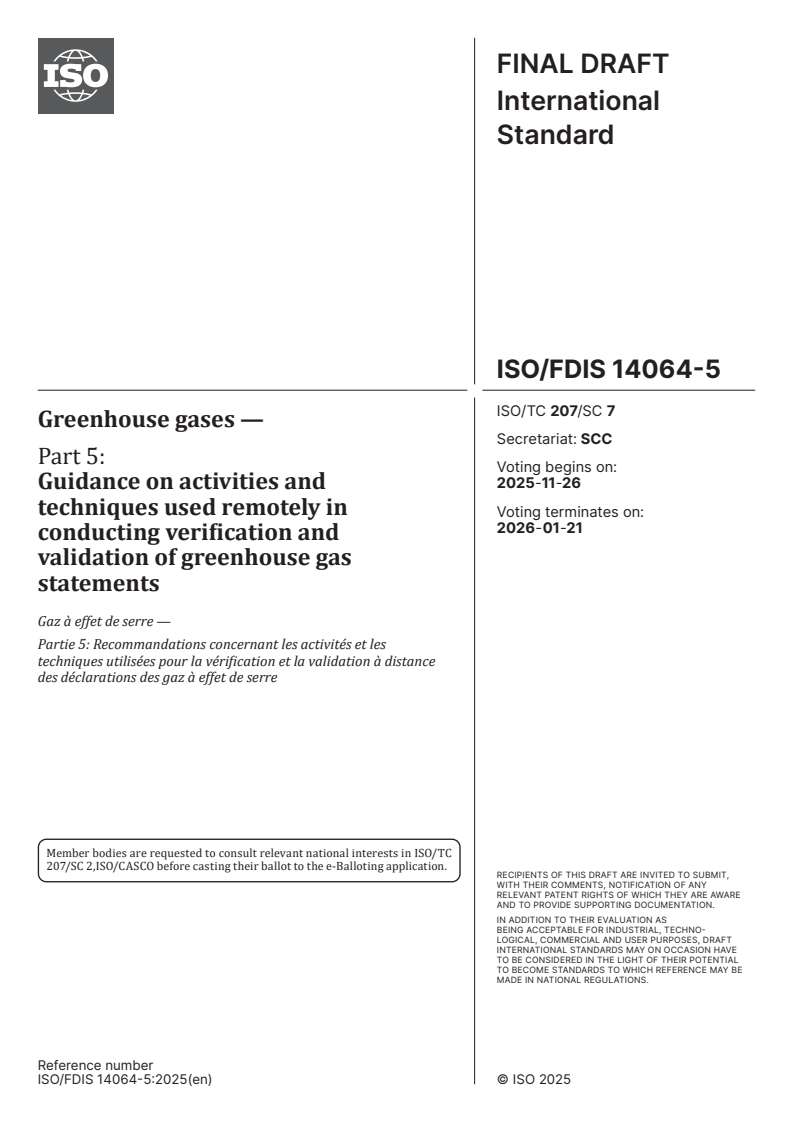
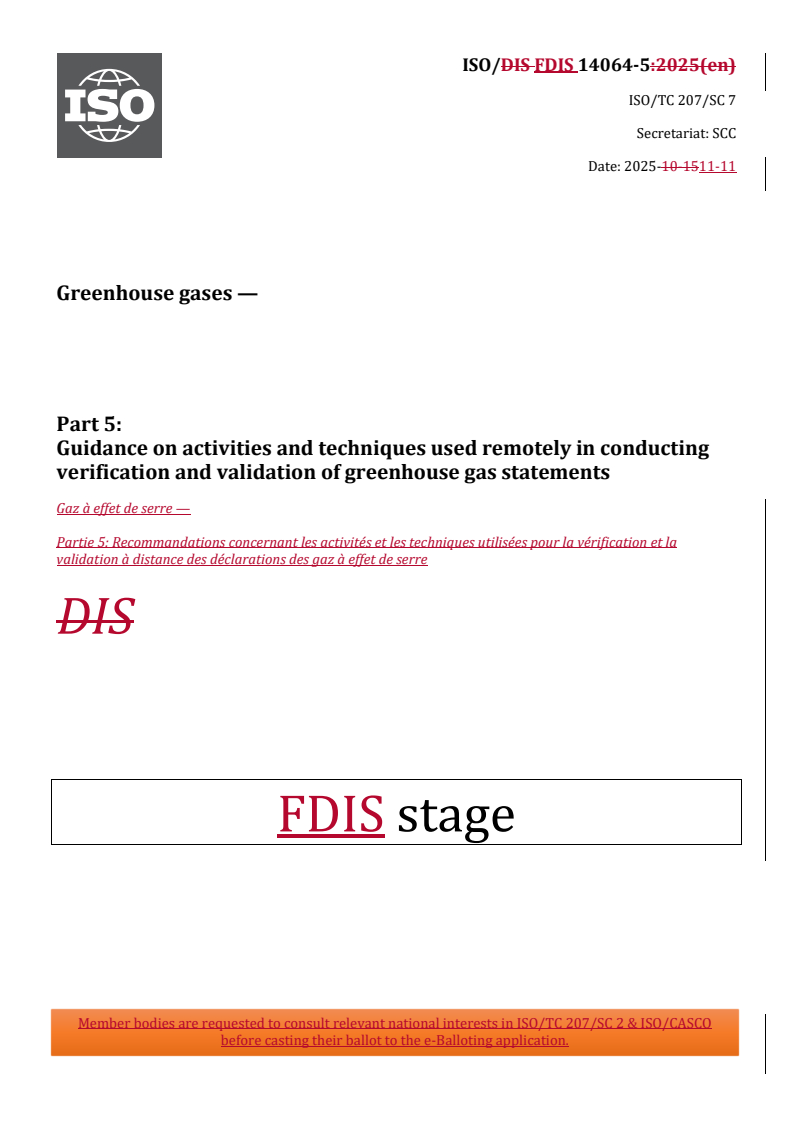
FINAL DRAFT
International
Standard
ISO/TC 207/SC 7
Greenhouse gases —
Secretariat: SCC
Part 5:
Voting begins on:
2025-11-26
Guidance on activities and
techniques used remotely in
Voting terminates on:
2026-01-21
conducting verification and
validation of greenhouse gas
statements
Gaz à effet de serre —
Partie 5: Recommandations concernant les activités et les
techniques utilisées pour la vérification et la validation à distance
des déclarations des gaz à effet de serre
Member bodies are requested to consult relevant national interests in ISO/TC
207/SC 2,ISO/CASCO before casting their ballot to the e-Balloting application.
RECIPIENTS OF THIS DRAFT ARE INVITED TO SUBMIT,
WITH THEIR COMMENTS, NOTIFICATION OF ANY
RELEVANT PATENT RIGHTS OF WHICH THEY ARE AWARE
AND TO PROVIDE SUPPOR TING DOCUMENTATION.
IN ADDITION TO THEIR EVALUATION AS
BEING ACCEPTABLE FOR INDUSTRIAL, TECHNO-
LOGICAL, COMMERCIAL AND USER PURPOSES, DRAFT
INTERNATIONAL STANDARDS MAY ON OCCASION HAVE
TO BE CONSIDERED IN THE LIGHT OF THEIR POTENTIAL
TO BECOME STAN DARDS TO WHICH REFERENCE MAY BE
MADE IN NATIONAL REGULATIONS.
Reference number
FINAL DRAFT
International
Standard
ISO/TC 207/SC 7
Greenhouse gases —
Secretariat: SCC
Part 5:
Voting begins on:
Guidance on activities and
techniques used remotely in
Voting terminates on:
conducting verification and
validation of greenhouse gas
statements
Gaz à effet de serre —
Partie 5: Recommandations concernant les activités et les
techniques utilisées pour la vérification et la validation à distance
des déclarations des gaz à effet de serre
Member bodies are requested to consult relevant national interests in ISO/TC
207/SC 2,ISO/CASCO before casting their ballot to the e-Balloting application.
RECIPIENTS OF THIS DRAFT ARE INVITED TO SUBMIT,
WITH THEIR COMMENTS, NOTIFICATION OF ANY
RELEVANT PATENT RIGHTS OF WHICH THEY ARE AWARE
AND TO PROVIDE SUPPOR TING DOCUMENTATION.
© ISO 2025
IN ADDITION TO THEIR EVALUATION AS
All rights reserved. Unless otherwise specified, or required in the context of its implementation, no part of this publication may
BEING ACCEPTABLE FOR INDUSTRIAL, TECHNO-
LOGICAL, COMMERCIAL AND USER PURPOSES, DRAFT
be reproduced or utilized otherwise in any form or by any means, electronic or mechanical, including photocopying, or posting on
INTERNATIONAL STANDARDS MAY ON OCCASION HAVE
the internet or an intranet, without prior written permission. Permission can be requested from either ISO at the address below
TO BE CONSIDERED IN THE LIGHT OF THEIR POTENTIAL
or ISO’s member body in the country of the requester.
TO BECOME STAN DARDS TO WHICH REFERENCE MAY BE
MADE IN NATIONAL REGULATIONS.
ISO copyright office
CP 401 • Ch. de Blandonnet 8
CH-1214 Vernier, Geneva
Phone: +41 22 749 01 11
Email: copyright@iso.org
Website: www.iso.org
Published in Switzerland Reference number
ii
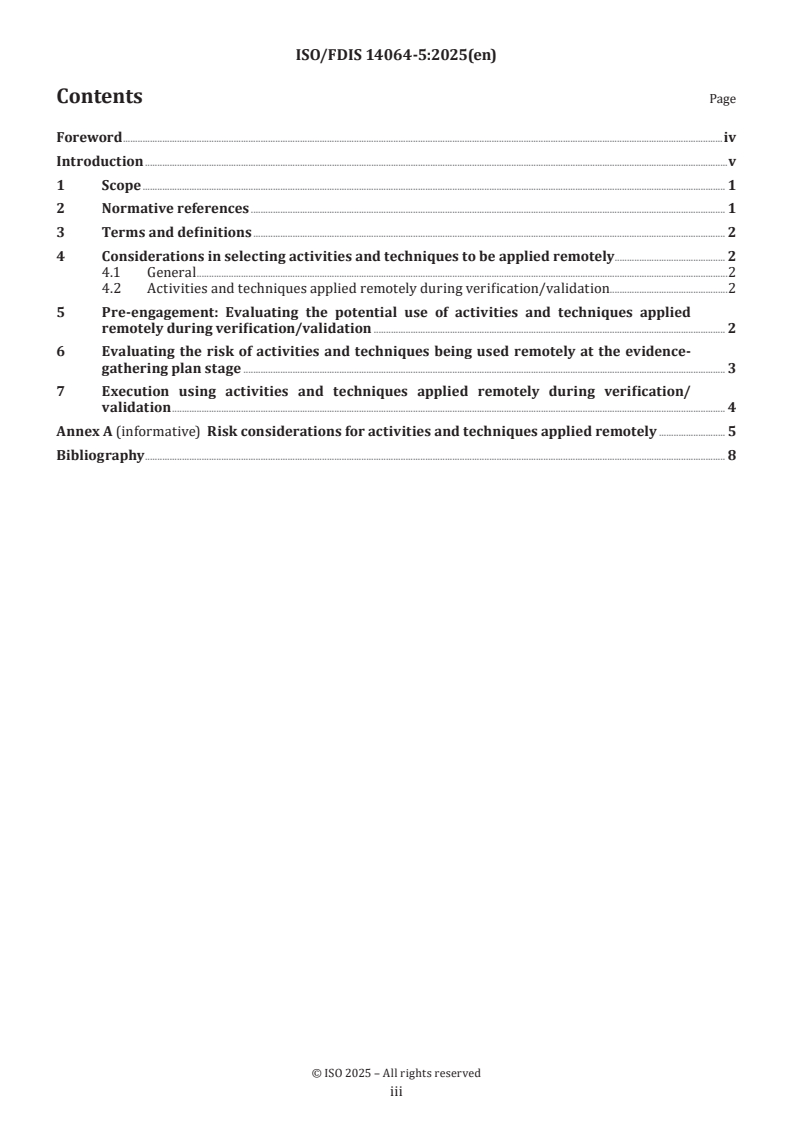
Contents Page
Foreword .iv
Introduction .v
1 Scope . 1
2 Normative references . 1
3 Terms and definitions . 2
4 Considerations in selecting activities and techniques to be applied remotely . 2
4.1 General .2
4.2 Activities and techniques applied remotely during verification/validation.2
5 Pre-engagement: Evaluating the potential use of activities and techniques applied
remotely during verification/validation . 2
6 Evaluating the risk of activities and techniques being used remotely at the evidence-
gathering plan stage . 3
7 Execution using activities and techniques applied remotely during verification/
validation . 4
Annex A (informative) Risk considerations for activities and techniques applied remotely . 5
Bibliography . 8
iii
Foreword
ISO (the International Organization for Standardization) is a worldwide federation of national standards
bodies (ISO member bodies). The work of preparing International Standards is normally carried out through
ISO technical committees. Each member body interested in a subject for which a technical committee
has been established has the right to be represented on that committee. International organizations,
governmental and non-governmental, in liaison with ISO, also take part in the work. ISO collaborates closely
with the International Electrotechnical Commission (IEC) on all matters of electrotechnical standardization.
The procedures used to develop this document and those intended for its further maintenance are described
in the ISO/IEC Directives, Part 1. In particular, the different approval criteria needed for the different types
of ISO document should be noted. This document was drafted in accordance with the editorial rules of the
ISO/IEC Directives, Part 2 (see www.iso.org/directives).
ISO draws attention to the possibility that the implementation of this document may involve the use of (a)
patent(s). ISO takes no position concerning the evidence, validity or applicability of any claimed patent
rights in respect thereof. As of the date of publication of this document, ISO had not received notice of (a)
patent(s) which may be required to implement this document. However, implementers are cautioned that
this may not represent the latest information, which may be obtained from the patent database available at
www.iso.org/patents. ISO shall not be held responsible for identifying any or all such patent rights.
Any trade name used in this document is information given for the convenience of users and does not
constitute an endorsement.
For an explanation of the voluntary nature of standards, the meaning of ISO specific terms and expressions
related to conformity assessment, as well as information about ISO’s adherence to the World Trade
Organization (WTO) principles in the Technical Barriers to Trade (TBT), see www.iso.org/iso/foreword.html.
This document was prepared by Technical Committee ISO/TC 207, Environmental management,
Subcommittee SC 7, Greenhouse gas and climate change management and related activities, in collaboration
with Subcommittee SC 2, Environmental auditing and related practices, and ISO/CASCO, Committee on
conformity assessment.
A list of all parts in the ISO 14064 series can be found on the ISO website.
Any feedback or questions on this document should be directed to the user’s national standards body. A
complete listing of these bodies can be found at www.iso.org/members.html.
iv
Introduction
This document provides guidance on risk considerations in cases where greenhouse gas (GHG) verification/
validation activities and techniques are carried out remotely, noting that most activities and techniques can
be used either in person or remotely.
Relying on evidence gathered remotely can pose unique verification and validation risks (inherent, control
and detection). For example, when the verifier/validator is limited in the use of their senses (restricted sight,
touch, sound, smell), to assess whether evidence is sufficient and appropriate, detection and control risks
can increase. Understanding risks allows them to be managed during verification and validation activities.
The use of information and communication technology (ICT) has become commonplace. Verification and
validation bodies (VVBs) routinely employ ICT to communicate with clients and responsible parties and to
share information. The sharing of documents in the form of electronic files is more likely to occur than the
exchange of paper documents. In short, the work of verifiers and validators is increasingly based on the
review and secure storage of digitized information.
Activities and techniques used remotely, such as mobile LiDAR (light detection and ranging) systems, drone
surveys, the Sentinel family of satellites and other international satellites are becoming commonly used for
gathering GHG-evidence used in verification and validation engagements. In addition, interviews with key
personnel are being conducted remotely via virtual meetings or closed-circuit camera views. In some cases,
activities and techniques are deployed remotely instead of in-person visits to facility operations.
Many verification/validation bodies are engaged in the planning and execution of verification and validation
engagements where some activities and techniques can be applied remotely. This document provides
guidance on carrying out verification/validation activities remotely in accordance with ISO 14064-3 and
ISO 14065 and promotes a consistent approach for achieving verification/validation objectives. An effective
verification/validation engagement using activities and techniques remotely should be adequately planned
by a verifier/validator who is competent in using activities and techniques remotely. Such competence is in
addition to those requirements for verification and validation teams specified in ISO 14066.
This document provides principles, practices and guidance where GHG verification and validation activities
and techniques are employed remotely.
Using this document will help verifiers/validators to identify, minimize and mitigate the unique verification/
validation risks associated with the application of activities and techniques used remotely.
v
FINAL DRAFT International Standard ISO/FDIS 14064-5:2025(en)
Greenhouse gases —
Part 5:
Guidance on activities and techniques used remotely in
conducting verification and validation of greenhouse gas
statements
1 Scope
This document gives guidance on planning, evaluating the risks, and conducting activities and techniques
remotely for internal or external verification/validation (i.e. first, second and third party) of greenhouse gas
(GHG) statements.
It is applicable to cases where a verifier determines that the circumstances defined in ISO 14064-3:2019,
6.1.4.2, do not require an in-person site or facility visit or a validator determines that an evidence-gathering
plan can include activities and techniques performed remotely as defined in ISO 14064-3:2019, 7.1.6.
Activities and techniques applied remotely can be used by a verifier for activities such as inquiry of persons
and documents, analytical testing, recalculation, estimate testing, cross-checking and reconciliation when a
verifier’s risk assessment does not require the use of on-site activities and techniques.
Activities and techniques applied remotely can be used by a validator when their use does not compromise
the validator’s ability to assess whether the characteristics of GHG activities (see ISO 14064-3:2019, Clause 7)
will meet the needs of intended users.
This document is applicable to verifications/validations that use:
— a combination of activities and techniques applied remotely and on-site;
— exclusively activities and techniques applied remotely.
NOTE Legislation can differ from jurisdiction to jurisdiction. It is the user’s responsibility to determine how
applicable legal requirements relate to this document.
2 Normative references
The following documents are referred to in the text in such a way that some or all of their content constitutes
requirements of this document. For dated references, only the edition cited applies. For undated references,
the latest edition of the referenced document (including any amendments) applies.
ISO 14065:2020, General principles and requirements for bodies validating and verifying environmental
information
ISO 14066:2023, Environmental information — Competence requirements for teams validating and verifying
environmental information
ISO 14064-3:2019, Greenhouse gases — Part 3: Specification with guidance for the verification and validation of
greenhouse gas statements
3 Terms and definitions
For the purposes of this document, the terms a
...
ISO/DIS FDIS 14064-5:2025(en)
ISO/TC 207/SC 7
Secretariat: SCC
Date: 2025-10-1511-11
Greenhouse gases —
Part 5:
Guidance on activities and techniques used remotely in conducting
verification and validation of greenhouse gas statements
Gaz à effet de serre —
Partie 5: Recommandations concernant les activités et les techniques utilisées pour la vérification et la
validation à distance des déclarations des gaz à effet de serre
DIS
FDIS stage
MeMemmbeberr bodbodiieess aarree rreeququeesstteedd tto o cconsonsuulltt rreelleevvaantnt nanattiiononaall iintnteerreessttss iin n IISSOO//TTCC 220077//SSCC 22 && IISSOO//CCAASSCCOO
bebeffororee ccaassttiinngg tthheeiirr b baallllotot t to o tthhee ee--BBaallllootintingg aapplpplicicaatiotionn.
All rights reserved. Unless otherwise specified, or required in the context of its implementation, no part of this publication
may be reproduced or utilized otherwise in any form or by any means, electronic or mechanical, including photocopying,
or posting on the internet or an intranet, without prior written permission. Permission can be requested from either ISO
at the address below or ISO’s member body in the country of the requester.
ISO copyright office
CP 401 • Ch. de Blandonnet 8
CH-1214 Vernier, Geneva
Phone: + 41 22 749 01 11
E-mail: copyright@iso.org
Website: www.iso.org
Published in Switzerland
ii
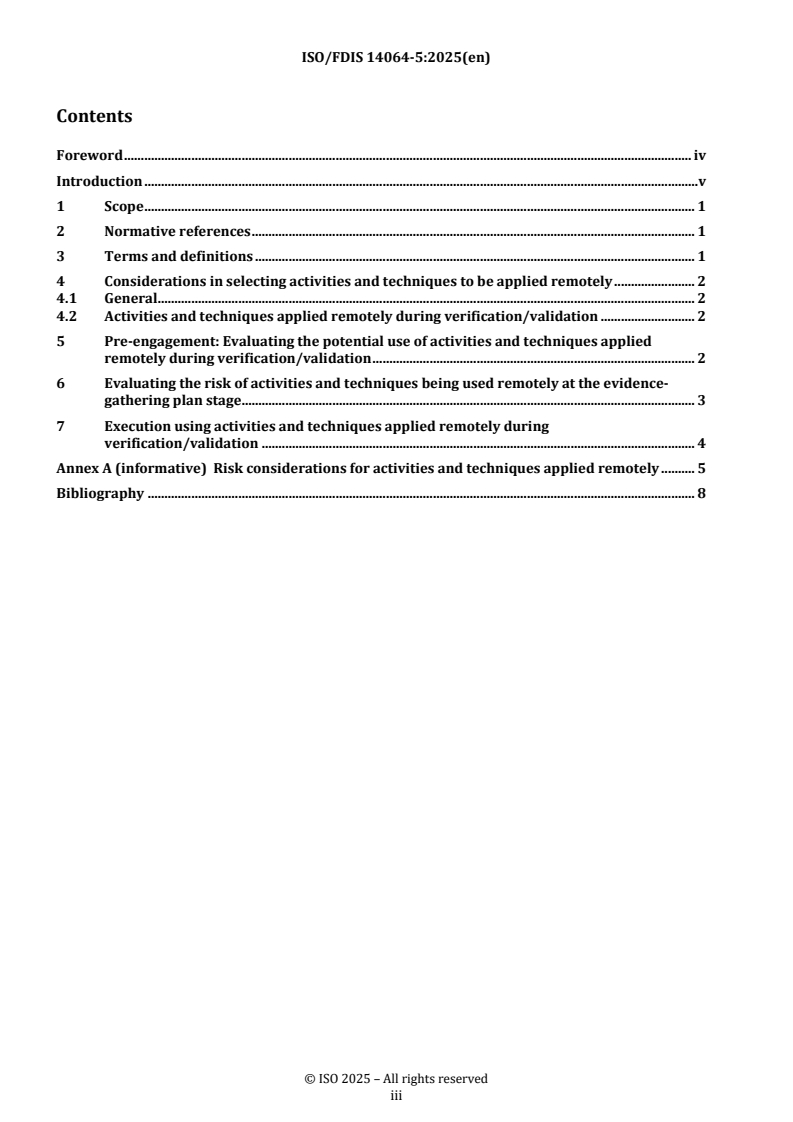
Contents
Foreword . iv
Introduction . v
1 Scope . 1
2 Normative references . 1
3 Terms and definitions . 1
4 Considerations in selecting activities and techniques to be applied remotely . 2
4.1 General . 2
4.2 Activities and techniques applied remotely during verification/validation . 2
5 Pre-engagement: Evaluating the potential use of activities and techniques applied
remotely during verification/validation . 2
6 Evaluating the risk of activities and techniques being used remotely at the evidence-
gathering plan stage . 3
7 Execution using activities and techniques applied remotely during
verification/validation . 4
Annex A (informative) Risk considerations for activities and techniques applied remotely . 5
Bibliography . 8
iii
Foreword
ISO (the International Organization for Standardization) is a worldwide federation of national standards
bodies (ISO member bodies). The work of preparing International Standards is normally carried out through
ISO technical committees. Each member body interested in a subject for which a technical committee has been
established has the right to be represented on that committee. International organizations, governmental and
non-governmental, in liaison with ISO, also take part in the work. ISO collaborates closely with the
International Electrotechnical Commission (IEC) on all matters of electrotechnical standardization.
The procedures used to develop this document and those intended for its further maintenance are described
in the ISO/IEC Directives, Part 1. In particular, the different approval criteria needed for the different types of
ISO document should be noted. This document was drafted in accordance with the editorial rules of the
ISO/IEC Directives, Part 2 (see www.iso.org/directives).
ISO draws attention to the possibility that the implementation of this document may involve the use of (a)
patent(s). ISO takes no position concerning the evidence, validity or applicability of any claimed patent rights
in respect thereof. As of the date of publication of this document, ISO had not received notice of (a) patent(s)
which may be required to implement this document. However, implementers are cautioned that this may not
represent the latest information, which may be obtained from the patent database available at
www.iso.org/patents. ISO shall not be held responsible for identifying any or all such patent rights.
Any trade name used in this document is information given for the convenience of users and does not
constitute an endorsement.
For an explanation of the voluntary nature of standards, the meaning of ISO specific terms and expressions
related to conformity assessment, as well as information about ISO’s adherence to the World Trade
Organization (WTO) principles in the Technical Barriers to Trade (TBT), see www.iso.org/iso/foreword.html.
This document was prepared by Technical Committee ISO/TC 207, Environmental management,
Subcommittee SC 7, Greenhouse gas and climate change management and related activities, in collaboration
with Subcommittee SC 2, Environmental auditing and related environmental investigationspractices, and
ISO/CASCO, Committee on conformity assessment.
A list of all parts in the ISO 1400014064 series can be found on the ISO website.
Any feedback or questions on this document should be directed to the user’s national standards body. A
complete listing of these bodies can be found at www.iso.org/members.html.
iv
Introduction
This document provides guidance on risk considerations in cases where greenhouse gas (GHG)
verification/validation activities and techniques are carried out remotely, noting that most activities and
techniques can be used either in person or remotely.
Relying on evidence gathered remotely can pose unique verification and validation risks (inherent, control
and detection). For example, when the verifier/validator is limited in the use of their senses (restricted sight,
touch, sound, smell), to assess whether evidence is sufficient and appropriate, detection and control risks can
increase. Understanding risks allows them to be managed during verification and validation activities.
The use of information and communication technology (ICT) has become commonplace. Verification and
validation bodies (VVBs) routinely employ ICT to communicate with clients and responsible parties and to
share information. The sharing of documents in the form of electronic files is more likely to occur than the
exchange of paper documents. In short, the work of verifiers and validators is increasingly based on the review
and secure storage of digitized information.
Activities and techniques used remotely, such as mobile LiDAR (light detection and ranging) systems, drone
surveys, the Sentinel family of satellites and other international satellites are becoming commonly used for
gathering GHG-evidence used in verification and validation engagements. In addition, interviews with key
personnel are being conducted remotely via virtual meetings or closed-circuit camera views. In some cases,
activities and techniques are deployed remotely instead of in-person visits to facility operations.
Many verification/validation bodies are engaged in the planning and execution of verification and validation
engagements where some activities and techniques can be applied remotely. This document provides
guidance on carrying out verification/validation activities remotely in accordance with ISO 14064-3 and
ISO 14065 and promotes a consistent approach for achieving verification/validation objectives. An effective
verification/validation engagement using activities and techniques remotely should be adequately planned by
a verifier/validator who is competent in using activities and techniques remotely. Such competence is in
addition to those requirements for verification and validation teams specified in ISO 14066.
This document provides principles, practices and guidance where GHG verification and validation activities
and techniques are employed remotely.
Using this document will help verifiers/validators to identify, minimize and mitigate the unique
verification/validation risks associated with the application of activities and techniques used remotely.
v
Greenhouse gases —
Part 5:
Guidance on activities and techniques used remotely in conducting
verification and validation of greenhouse gas statements
1 Scope
This document gives guidance on planning, evaluating the risks, and conducting activities and techniques
remotely for internal or external verification/validation (i.e.,. first, second and third party) of greenhouse gas
(GHG) statements.
It is applicable to cases where a verifier determines that the circumstances defined in ISO 14064-3:2019,
6.1.4.2, do not require an in-person site or facility visit or a validator determines that an evidence-gathering
plan can include activities and techniques performed remotely as defined in ISO 14064-3:2019, 7.1.6.
Activities and techniques applied remotely can be used by a verifier for activities such as inquiry of persons
and documents, analytical testing, recalculation, estimate testing, cross-checking and reconciliation when a
verifier’s risk assessment does not require the use of on-site activities and techniques.
Activities and techniques applied remotely can be used by a validator when their use does not compromise
the validator’s ability to assess whether the characteristics of GHG activities (see ISO 14064-3:2019, Clause 7)
will meet the needs of intended users.
This document is applicable to verifications/validations that use:
— a combination of activities and techniques applied remotely and on-site;
— exclusively activities and techniques applied remotely.
NOTE Legislation can differ from jurisdiction to jurisdiction. It is the user’s responsibility to determine how
applicable legal requirements relate to this document.
2 Normative references
The following documents are referred to in the text in such a way that some or all of their content constitutes
requirements of this document. For dated references, only the edition cited applies. For undated references,
the latest edition of the referenced document (including any amendments) applies.
ISO 14065:2020, General principles and requirements for bodies validating and verifying environmental
information
ISO 14066:2023, Environmental information — Competence requirements for teams validating and verifying
environmental information
ISO 14064-3:2019, Greenhouse gases — Part 3: Specification with guidance for the verification and validation
of greenhouse gas statements
3 Terms and definitions
For the purposes of this document, the terms and definitions given in ISO 14064-3:2019, ISO 14065:2020,
ISO 14066:2023, ISO 14064-3:2019 and the following apply:.
ISO and IEC maintain terminology databases for use in standardization at the following addresses:
— ISO Online browsing platform: available at https://www.iso.org/obp
— IEC Electropedia: available at https://www.electropedia.org/
3.1
information and communication technology
ICT
technology for gathering, storing, retrieving, processing, analysing and transmitting information
[SOURCE: ISO/IEC 30071-1:2019, 3.4]
4 Considerations in selecting activities and techniques to be applied remotely
4.1 General
Where the activities and techniques used remotely for verification/validation require specific technical
expertise, the verification/validation team should ensure that such specific technical knowledge or skill is
available to them.
Verification/validation teams retain the authority to perform the activities in person in cases where activities
and techniques planned to be applied remotely pose an unacceptably high risk of compromising the integrity
of the verification/validation process.
4.2 Activities and tech
...
Questions, Comments and Discussion
Ask us and Technical Secretary will try to provide an answer. You can facilitate discussion about the standard in here.
Loading comments...