

ISO 17584:2022
(Main)Refrigerant properties
General Information
- Abstract
This document specifies the thermophysical properties of several commonly used refrigerants and refrigerant blends. This document is applicable to refrigerants R12, R22, R32, R123, R125, R134a, R143a, R152a, R290, R600a, R717 (ammonia), R744 (carbon dioxide), R1233zd(E), R1336mzz(Z), R1234yf and R1234ze(E) and to the refrigerant blends R404A, R407C, R410A, and R507A. The following properties are included: density, pressure, internal energy, enthalpy, entropy, heat capacity at constant pressure, heat capacity at constant volume, speed of sound, and the Joule-Thomson coefficient, in both single-phase states and along the liquid-vapour saturation boundary. The numerical designation of these refrigerants is that defined in ISO 817. NOTE 1 R12, R22, R123 are controlled substances under the Montreal Protocol, Annex A (R12) or Annex C Group I (R22, R123). NOTE 2 R32, R125, R134a, R143a, R152a, R404A, R407C, R410A, and R507A are controlled substances under the Montreal Protocol, Annex F or blend thereof.
- Status
- Published
- Publication Date
- 11-Aug-2022
- Technical Committee
- ISO/TC 86/SC 8 - Refrigerants and refrigeration lubricants
- Drafting Committee
- ISO/TC 86/SC 8/WG 7 - Refrigerant properties
- Current Stage
- 6060 - International Standard published
- Start Date
- 12-Aug-2022
- Due Date
- 18-Feb-2022
- Completion Date
- 12-Aug-2022

Overview
ISO 17584:2022 - Refrigerant properties - defines standard thermophysical data and calculation methods for commonly used refrigerants and refrigerant blends. The document specifies equations of state and numerical parameters to determine key refrigerant properties (density, pressure, internal energy, enthalpy, entropy, Cp, Cv, speed of sound, Joule–Thomson coefficient) in single-phase conditions and along the liquid–vapour saturation boundary. Covered fluids include R12, R22, R32, R123, R125, R134a, R143a, R152a, R290, R600a, R717 (ammonia), R744 (CO2), R1233zd(E), R1336mzz(Z), R1234yf, R1234ze(E) and blends R404A, R407C, R410A, R507A. Numerical refrigerant designations follow ISO 817.
Key topics and technical requirements
- Equations of state: Prescribed pure-fluid and mixture formulations, with coefficients and exponents for each refrigerant.
- Thermophysical properties: Standardized methods to calculate density, enthalpy, entropy, internal energy, Cp, Cv, speed of sound, and Joule–Thomson coefficient.
- Saturation boundary: Property values and behavior along liquid–vapour equilibrium are specified.
- Mixture handling: Interaction parameters and excess function terms for refrigerant blends (e.g., R404A, R407C, R410A, R507A).
- Implementation requirements: Annex A sets out normative requirements for implementing equations of state; Annexes B and C provide informative calculation procedures for pure fluids and mixtures, and Annex D lists verification literature.
- Verification and testing: The standard includes guidance to test software implementations against defined verification values and ranges of validity for each refrigerant.
- Regulatory notes: Identifies refrigerants controlled under the Montreal Protocol (e.g., R12, R22, R123, and certain blends).
Applications and users
ISO 17584:2022 is intended for professionals and organizations that require accurate, standardized refrigerant data:
- HVACR system designers and OEMs for performance modelling and heat‑pump/refrigeration design
- Simulation and CAE software developers (thermodynamic libraries)
- Test labs performing calorimetry, performance verification, and component testing
- Researchers working on refrigerant selection, lifecycle impact, and low-GWP alternatives
- Regulatory and standards bodies needing traceable refrigerant property references
Practical uses include refrigerant selection and comparison, cycle simulation (COP, capacity), transcritical CO2 system modelling, and safety/pressure vessel calculations.
Related standards
- ISO 817 - Refrigerants - Designation system
- Montreal Protocol provisions (control listings noted in the standard)
- Other thermodynamic reference standards and national guidelines used for refrigerant testing and validation
Keywords: ISO 17584:2022, refrigerant properties, thermophysical properties, equations of state, refrigerant blends, HVACR, R744, R1234yf.
Relations
- Effective Date
- 15-Dec-2017
Get Certified
Connect with accredited certification bodies for this standard

ECOCERT
Organic and sustainability certification.

Eurofins Food Testing Global
Global leader in food, environment, and pharmaceutical product testing.

Intertek Bangladesh
Intertek certification and testing services in Bangladesh.
Sponsored listings
Frequently Asked Questions
ISO 17584:2022 is a standard published by the International Organization for Standardization (ISO). Its full title is "Refrigerant properties". This standard covers: This document specifies the thermophysical properties of several commonly used refrigerants and refrigerant blends. This document is applicable to refrigerants R12, R22, R32, R123, R125, R134a, R143a, R152a, R290, R600a, R717 (ammonia), R744 (carbon dioxide), R1233zd(E), R1336mzz(Z), R1234yf and R1234ze(E) and to the refrigerant blends R404A, R407C, R410A, and R507A. The following properties are included: density, pressure, internal energy, enthalpy, entropy, heat capacity at constant pressure, heat capacity at constant volume, speed of sound, and the Joule-Thomson coefficient, in both single-phase states and along the liquid-vapour saturation boundary. The numerical designation of these refrigerants is that defined in ISO 817. NOTE 1 R12, R22, R123 are controlled substances under the Montreal Protocol, Annex A (R12) or Annex C Group I (R22, R123). NOTE 2 R32, R125, R134a, R143a, R152a, R404A, R407C, R410A, and R507A are controlled substances under the Montreal Protocol, Annex F or blend thereof.
This document specifies the thermophysical properties of several commonly used refrigerants and refrigerant blends. This document is applicable to refrigerants R12, R22, R32, R123, R125, R134a, R143a, R152a, R290, R600a, R717 (ammonia), R744 (carbon dioxide), R1233zd(E), R1336mzz(Z), R1234yf and R1234ze(E) and to the refrigerant blends R404A, R407C, R410A, and R507A. The following properties are included: density, pressure, internal energy, enthalpy, entropy, heat capacity at constant pressure, heat capacity at constant volume, speed of sound, and the Joule-Thomson coefficient, in both single-phase states and along the liquid-vapour saturation boundary. The numerical designation of these refrigerants is that defined in ISO 817. NOTE 1 R12, R22, R123 are controlled substances under the Montreal Protocol, Annex A (R12) or Annex C Group I (R22, R123). NOTE 2 R32, R125, R134a, R143a, R152a, R404A, R407C, R410A, and R507A are controlled substances under the Montreal Protocol, Annex F or blend thereof.
ISO 17584:2022 is classified under the following ICS (International Classification for Standards) categories: 71.100.45 - Refrigerants and antifreezes. The ICS classification helps identify the subject area and facilitates finding related standards.
ISO 17584:2022 has the following relationships with other standards: It is inter standard links to ISO 17584:2005. Understanding these relationships helps ensure you are using the most current and applicable version of the standard.
ISO 17584:2022 is available in PDF format for immediate download after purchase. The document can be added to your cart and obtained through the secure checkout process. Digital delivery ensures instant access to the complete standard document.
Standards Content (Sample)
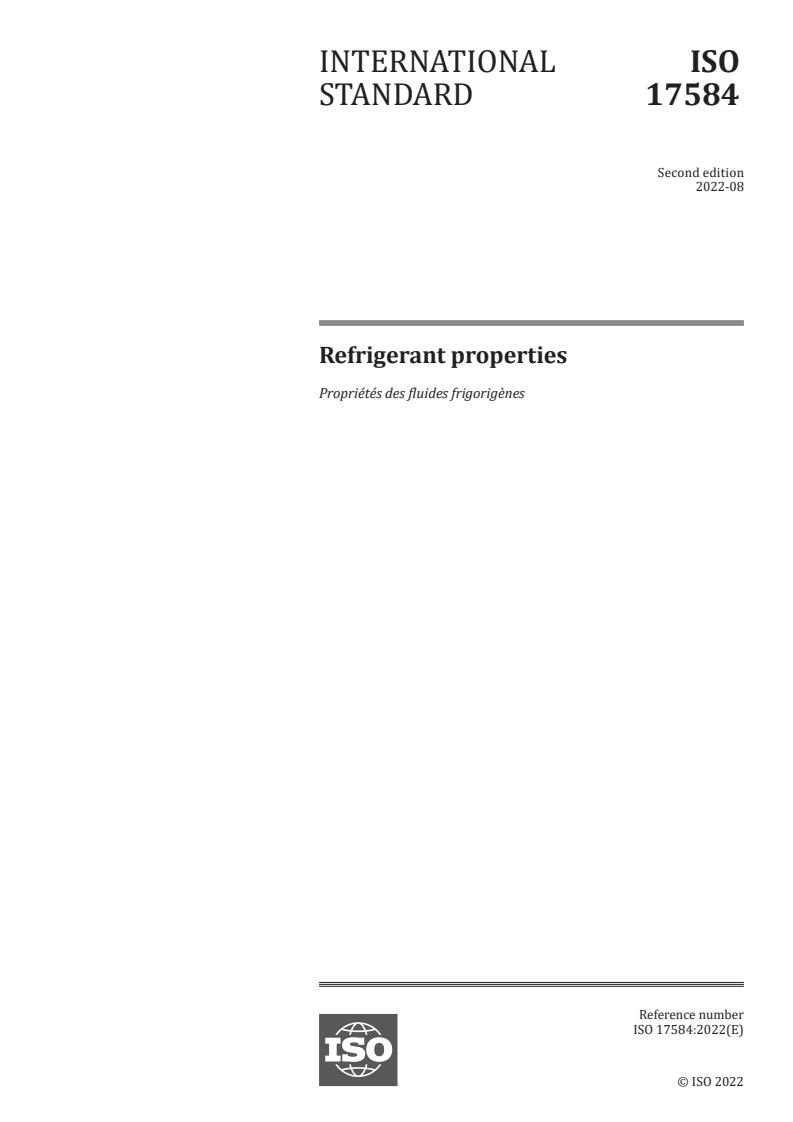
INTERNATIONAL ISO
STANDARD 17584
Second edition
2022-08
Refrigerant properties
Propriétés des fluides frigorigènes
Reference number
© ISO 2022
All rights reserved. Unless otherwise specified, or required in the context of its implementation, no part of this publication may
be reproduced or utilized otherwise in any form or by any means, electronic or mechanical, including photocopying, or posting on
the internet or an intranet, without prior written permission. Permission can be requested from either ISO at the address below
or ISO’s member body in the country of the requester.
ISO copyright office
CP 401 • Ch. de Blandonnet 8
CH-1214 Vernier, Geneva
Phone: +41 22 749 01 11
Email: copyright@iso.org
Website: www.iso.org
Published in Switzerland
ii
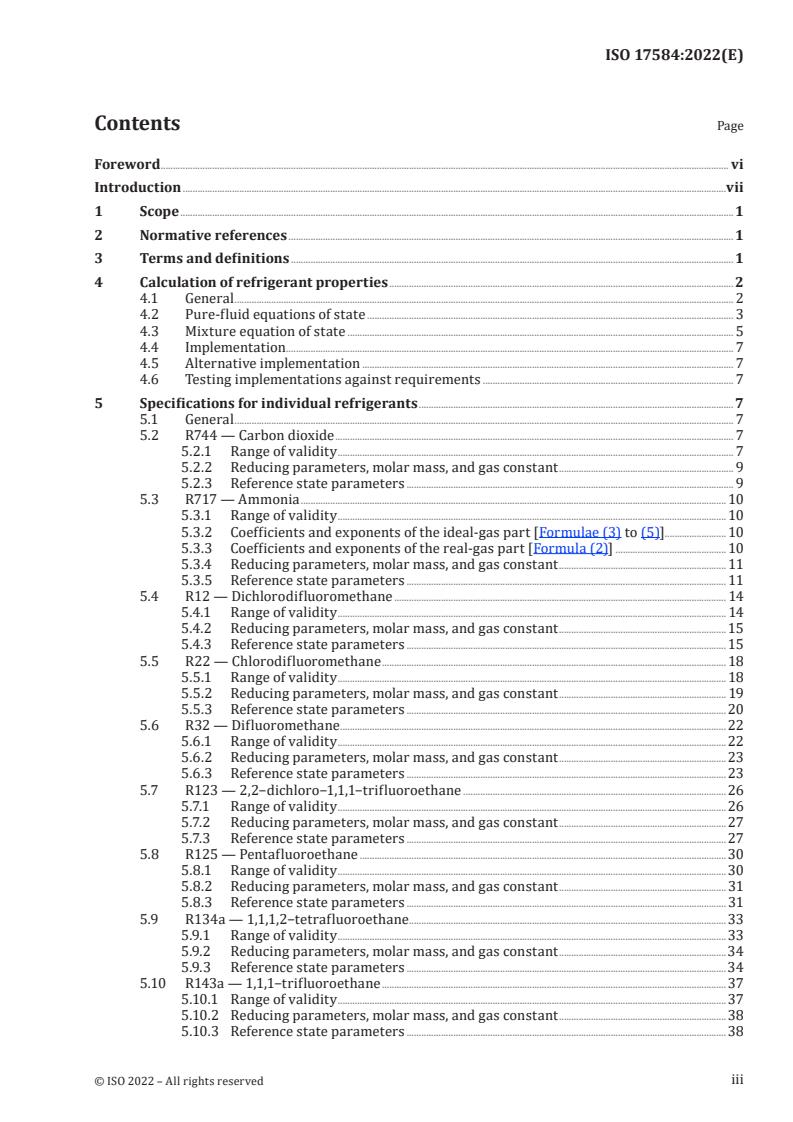
Contents Page
Foreword . vi
Introduction .vii
1 Scope . 1
2 Normative references . 1
3 Terms and definitions . 1
4 Calculation of refrigerant properties . 2
4.1 General . 2
4.2 Pure-fluid equations of state . 3
4.3 Mixture equation of state . 5
4.4 Implementation . . 7
4.5 Alternative implementation . 7
4.6 Testing implementations against requirements . 7
5 Specifications for individual refrigerants . 7
5.1 General . 7
5.2 R744 — Carbon dioxide . 7
5.2.1 Range of validity . 7
5.2.2 Reducing parameters, molar mass, and gas constant . 9
5.2.3 Reference state parameters . 9
5.3 R717 — Ammonia . 10
5.3.1 Range of validity . 10
5.3.2 Coefficients and exponents of the ideal-gas part [Formulae (3) to (5)]. 10
5.3.3 Coefficients and exponents of the real-gas part [Formula (2)] . 10
5.3.4 Reducing parameters, molar mass, and gas constant . 11
5.3.5 Reference state parameters . 11
5.4 R12 — Dichlorodifluoromethane . 14
5.4.1 Range of validity . 14
5.4.2 Reducing parameters, molar mass, and gas constant .15
5.4.3 Reference state parameters . 15
5.5 R22 — Chlorodifluoromethane . 18
5.5.1 Range of validity . 18
5.5.2 Reducing parameters, molar mass, and gas constant . 19
5.5.3 Reference state parameters . 20
5.6 R32 — Difluoromethane . 22
5.6.1 Range of validity .22
5.6.2 Reducing parameters, molar mass, and gas constant .23
5.6.3 Reference state parameters . 23
5.7 R123 — 2,2−dichloro−1,1,1−trifluoroethane . 26
5.7.1 Range of validity .26
5.7.2 Reducing parameters, molar mass, and gas constant . 27
5.7.3 Reference state parameters . 27
5.8 R125 — Pentafluoroethane .30
5.8.1 Range of validity .30
5.8.2 Reducing parameters, molar mass, and gas constant . 31
5.8.3 Reference state parameters . 31
5.9 R134a — 1,1,1,2−tetrafluoroethane . 33
5.9.1 Range of validity .33
5.9.2 Reducing parameters, molar mass, and gas constant .34
5.9.3 Reference state parameters .34
5.10 R143a — 1,1,1−trifluoroethane . 37
5.10.1 Range of validity . 37
5.10.2 Reducing parameters, molar mass, and gas constant .38
5.10.3 Reference state parameters .38
iii
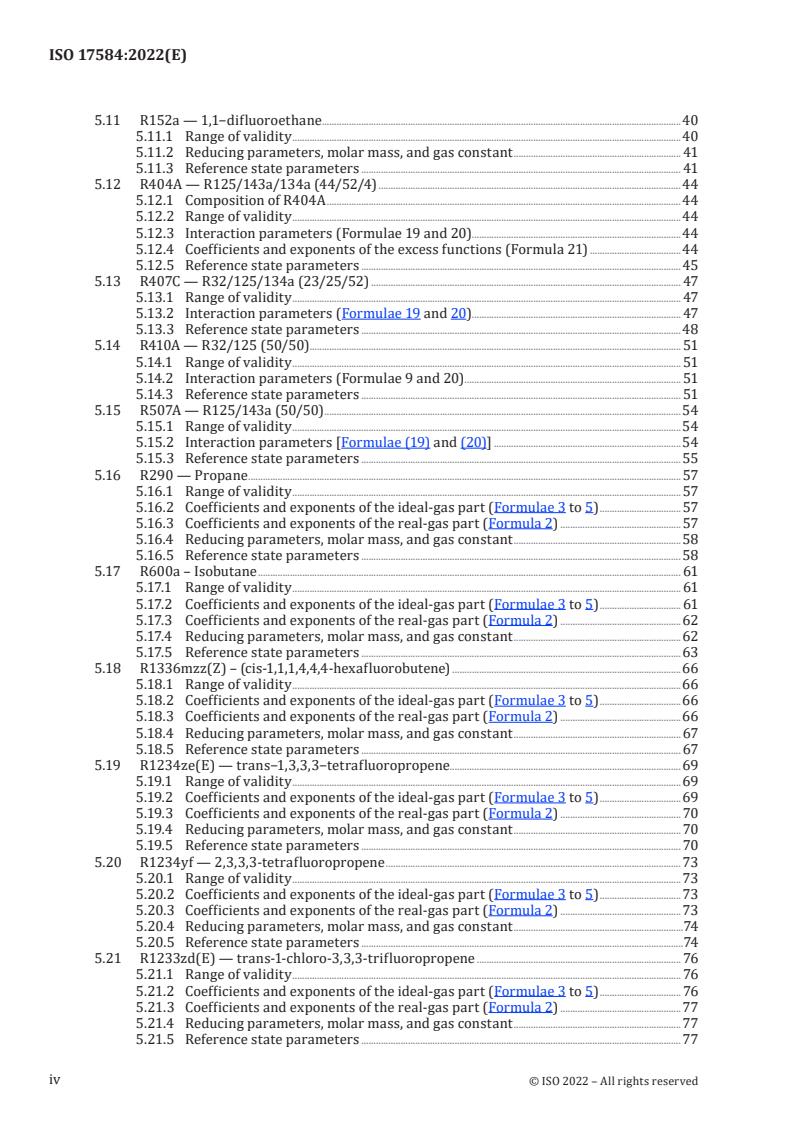
5.11 R152a — 1,1−difluoroethane . .40
5.11.1 Range of validity .40
5.11.2 Reducing parameters, molar mass, and gas constant . 41
5.11.3 Reference state parameters . 41
5.12 R404A — R125/143a/134a (44/52/4) .44
5.12.1 Composition of R404A .44
5.12.2 Range of validity .44
5.12.3 Interaction parameters (Formulae 19 and 20) . .44
5.12.4 Coefficients and exponents of the excess functions (Formula 21) .44
5.12.5 Reference state parameters . 45
5.13 R407C — R32/125/134a (23/25/52) . 47
5.13.1 Range of validity . 47
5.13.2 Interaction parameters (Formulae 19 and 20) . . 47
5.13.3 Reference state parameters .48
5.14 R410A — R32/125 (50/50) . . 51
5.14.1 Range of validity . 51
5.14.2 Interaction parameters (Formulae 9 and 20) . . 51
5.14.3 Reference state parameters . 51
5.15 R507A — R125/143a (50/50) .54
5.15.1 Range of validity .54
5.15.2 Interaction parameters [Formulae (19) and (20)] .54
5.15.3 Reference state parameters . 55
5.16 R290 — Propane . 57
5.16.1 Range of validity . 57
5.16.2 Coefficients and exponents of the ideal-gas part (Formulae 3 to 5) . 57
5.16.3 Coefficients and exponents of the real-gas part (Formula 2) . 57
5.16.4 Reducing parameters, molar mass, and gas constant .58
5.16.5 Reference state parameters .58
5.17 R600a – Isobutane . 61
5.17.1 Range of validity . 61
5.17.2 Coefficients and exponents of the ideal-gas part (Formulae 3 to 5) . 61
5.17.3 Coefficients and exponents of the real-gas part (Formula 2) . 62
5.17.4 Reducing parameters, molar mass, and gas constant . 62
5.17.5 Reference state parameters .63
5.18 R1336mzz(Z) – (cis-1,1,1,4,4,4-hexafluorobutene) .66
5.18.1 Range of validity .66
5.18.2 Coefficients and exponents of the ideal-gas part (Formulae 3 to 5) .66
5.18.3 Coefficients and exponents of the real-gas part (Formula 2) .66
5.18.4 Reducing parameters, molar mass, and gas constant . 67
5.18.5 Reference state parameters . 67
5.19 R1234ze(E) — trans−1,3,3,3−tetrafluoropropene. 69
5.19.1 Range of validity .69
5.19.2 Coefficients and exponents of the ideal-gas part (Formulae 3 to 5) .69
5.19.3 Coefficients and exponents of the real-gas part (Formula 2) . 70
5.19.4 Reducing parameters, molar mass, and gas constant . 70
5.19.5 Reference state parameters . 70
5.20 R1234yf — 2,3,3,3-tetrafluoropropene .73
5.20.1 Range of validity .73
5.20.2 Coefficients and exponents of the ideal-gas part (Formulae 3 to 5) .73
5.20.3 Coefficients and exponents of the real-gas part (Formula 2) .73
5.20.4 Reducing parameters, molar mass, and gas constant .74
5.20.5 Reference state parameters .74
5.21 R1233zd(E) — trans-1-chloro-3,3,3-trifluoropropene . 76
5.21.1 Range of validity . 76
5.21.2 Coefficients and exponents of the ideal-gas part (Formulae 3 to 5) . 76
5.21.3 Coefficients and exponents of the real-gas part (Formula 2) .77
5.21.4 Reducing parameters, molar mass, and gas constant .77
5.21.5 Reference state parameters .77
iv
Annex A (normative) Requirements for implementation of equations of state .81
Annex B (informative) Calculation of pure-fluid thermodynamic properties from
an equation of state .83
Annex C (informative) Calculation of mixture thermodynamic properties from an equation
of state .86
Annex D (informative) Literature citations for equations of state and verification values .88
Annex E (informative) Variation of mixture properties due to composition tolerance .96
Bibliography .98
v
Foreword
ISO (the International Organization for Standardization) is a worldwide federation of national standards
bodies (ISO member bodies). The work of preparing International Standards is normally carried out
through ISO technical committees. Each member body interested in a subject for which a technical
committee has been established has the right to be represented on that committee. International
organizations, governmental and non-governmental, in liaison with ISO, also take part in the work.
ISO collaborates closely with the International Electrotechnical Commission (IEC) on all matters of
electrotechnical standardization.
The procedures used to develop this document and those intended for its further maintenance are
described in the ISO/IEC Directives, Part 1. In particular, the different approval criteria needed for the
different types of ISO documents should be noted. This document was drafted in accordance with the
editorial rules of the ISO/IEC Directives, Part 2 (see www.iso.org/directives).
Attention is drawn to the possibility that some of the elements of this document may be the subject of
patent rights. ISO shall not be held responsible for identifying any or all such patent rights. Details of
any patent rights identified during the development of the document will be in the Introduction and/or
on the ISO list of patent declarations received (see www.iso.org/patents).
Any trade name used in this document is information given for the convenience of users and does not
constitute an endorsement.
For an explanation of the voluntary nature of standards, the meaning of ISO specific terms and
expressions related to conformity assessment, as well as information about ISO's adherence to the
World Trade Organization (WTO) principles in the Technical Barriers to Trade (TBT), see www.iso.org/
iso/foreword.html.
This document was prepared by Technical Committee ISO/TC 86, Refrigeration and air-conditioning,
Subcommittee SC 8, Refrigerants and refrigeration lubricants.
This second edition cancels and replaces the first edition (ISO 17584:2005), which has been technically
revised.
The main changes are as follows:
— Addition of new refrigerants (R290, R600a, R1233zd(E), R1336mzz(Z), R1234yf, R1234ze(E));
— Update of Ammonia.
Any feedback or questions on this document should be directed to the user’s national standards body. A
complete listing of these bodies can be found at www.iso.org/members.html.
vi
Introduction
This document is consistent with and is intended to complement ISO 817. The purpose of this document
is to address the differing performance ratings due to the differences between multiple property
formulations, which is a problem especially in international trade. The fluids and properties included in
this document represent those for which sufficient high-quality data were available.
This document allows for “alternative implementations” for the properties. These can take the form
of simpler equations of state that may be applicable over limited ranges of conditions or simple
correlations of single properties (e.g., expressions for vapour pressure or the enthalpy of the saturated
vapour).
Tolerances in this document do not necessarily represent the uncertainty of the original experimental
data or of the equation of state in fitting the data.
The tolerances are relative (i.e. plus or minus a percentage) for some properties and absolute for others
(e.g. plus or minus a constant enthalpy value). Properties such as enthalpy and entropy, which can be
negative, demand an absolute tolerance; any allowable percentage variation would be too strict at
values near zero. The allowable tolerances for enthalpy and entropy are scaled by the enthalpy and
entropy of vapourisation for each fluid. By scaling the tolerance to the vapourisation values, a greater
tolerance is allowed for fluids, such as ammonia, with high heats of vapourisation.
The tolerances apply to individual thermodynamic states. In cycle and equipment analyses, it is the
differences in enthalpy and/or entropy between two different states that are important. However, it
is not possible to specify, in a simple way, allowable tolerances based on pairs of states because of the
large number of possible pairs of interest.
The values of C and C approach infinity at the critical point, but the actual values returned by the
v p
equation of state are large numbers that vary from computer to computer due to round-off errors in
the calculations. According to critical-region theory, the speed of sound is zero at the critical point; all
traditional equations of state (including the ones in this document), however, do not reproduce this
behaviour. Rather than list values that are inconsistent with either the theory or the specified equations
of state, these points are not included as part of this document.
The values of the gas constant, R, vary from fluid to fluid. Similarly, the number of significant values
−6
given for the molecular mass, M, vary. The various values of R differ by less than 5 ⤬ 10 (equal to parts
per million, a deprecated unit) from the currently accepted value of 8,314 462 618 J/(mol·K) and result
in similarly small differences in the properties. The compositions of the refrigerant blends (R400- and
R500-series) are defined on a mass basis, but the equations of state are given on a molar basis. The
mass compositions have been converted to the equivalent molar basis and listed in Clause 5; a large
number of significant values are given for consistency with the tables of “verification values” given in
Annex D.
vii
INTERNATIONAL STANDARD ISO 17584:2022(E)
Refrigerant properties
1 Scope
This document specifies the thermophysical properties of several commonly used refrigerants and
refrigerant blends.
This document is applicable to refrigerants R12, R22, R32, R123, R125, R134a, R143a, R152a, R290,
R600a, R717 (ammonia), R744 (carbon dioxide), R1233zd(E), R1336mzz(Z), R1234yf and R1234ze(E)
and to the refrigerant blends R404A, R407C, R410A, and R507A. The following properties are included:
density, pressure, internal energy, enthalpy, entropy, heat capacity at constant pressure, heat capacity
at constant volume, speed of sound, and the Joule-Thomson coefficient, in both single-phase states and
along the liquid-vapour saturation boundary. The numerical designation of these refrigerants is that
defined in ISO 817.
NOTE 1 R12, R22, R123 are controlled substances under the Montreal Protocol, Annex A (R12) or Annex C
Group I (R22, R123).
NOTE 2 R32, R125, R134a, R143a, R152a, R404A, R407C, R410A, and R507A are controlled substances under
the Montreal Protocol, Annex F or blend thereof.
2 Normative references
There are no normative references in this document.
3 Terms and definitions
For the purposes of this document, the following terms and definitions apply.
ISO and IEC maintain terminology databases for use in standardization at the following addresses:
— ISO Online browsing platform: available at https:// www .iso .org/ obp
— IEC Electropedia: available at https:// www .electropedia .org/
3.1
algorithm
procedure for the computation of refrigerant properties
Note 1 to entry: An algorithm is most often a computer program. An algorithm may also consist of one or more
single-property correlations as allowed under 4.4.
3.2
blend
mixture of two or more chemical compounds
3.3
critical point
state at which the properties of the saturated liquid and those of the saturated vapour become equal
Note 1 to entry: Separate liquid and vapour phases do not exist above the critical point temperature for a pure
fluid. This is more completely referred to as the “gas-liquid critical point” as other “critical points” can be defined.
3.4
equation of state
mathematical equation that is a complete and thermodynamically consistent representation of the
thermodynamic properties of a fluid
Note 1 to entry: An equation of state most commonly expresses pressure or Helmholtz energy as a function of
temperature, density, and (for a blend) composition. Other thermodynamic properties are obtained through
integration and/or differentiation of the equation of state.
3.5
fluid
refrigerant
substance, present in liquid and/or gaseous states, used for heat transfer in a refrigerating system
Note 1 to entry: The fluid absorbs heat at a low temperature and low pressure, then releases the heat at a higher
temperature and a higher pressure, usually through a change of state.
3.6
liquid-vapour saturation
state at which liquid and vapour phases of a fluid are in thermodynamic equilibrium with each other at
a common temperature and pressure
Note 1 to entry: Such states exist from the triple point to the critical point.
3.7
transport properties
viscosity, thermal conductivity, and diffusion coefficient
3.8
thermodynamic properties
density, pressure, fugacity, internal energy, enthalpy, entropy, Gibbs and Helmholtz energies, heat
capacities, speed of sound, and the Joule-Thomson coefficient, in both single-phase states and along the
liquid-vapour saturation boundary
3.9
thermophysical properties
thermodynamic, transport, and other miscellaneous properties
3.10
triple point
state at which solid, liquid, and vapour phases of a substance are in thermodynamic equilibrium
4 Calculation of refrigerant properties
4.1 General
This document specifies properties for the refrigerants listed in Clause 1. These properties are derived
from experimental measurements.
The properties enumerated in this document are calculated from specified equations of state, although
alternative algorithms are allowed. The properties themselves constitute this document. The equations
of state serve as a convenient means to represent and reproduce the properties. The properties
enumerated in the tables in this document thus represent only a subset of the properties specified
by this document; the full range of conditions is given for each fluid in Clause 5. An equation of state
is a mathematical equation that is a complete and thermodynamically consistent representation of
the thermodynamic properties of a fluid. These equations have been selected based on the following
criteria:
a) accuracy in reproducing the available experimental data;
b) applicability over wide ranges of temperature, pressure, and density;
c) proper behavior on extrapolation beyond the available experimental data; and
d) preference has been given to fully documented and published formulations.
4.2 Pure-fluid equations of state
An equation of state for a pure fluid may express the reduced molar Helmholtz energy, A, as a function
of temperature, T, and density. The equation of state is composed of separate terms arising from ideal-
gas behaviour (subscript “id”) and a “residual” or “real-fluid” (subscript “r”) contribution as given in
Formula (1):
A
φφ== +φ (1)
id r
RT
where R is the gas constant.
Formulae of this form may be written on either a molar basis or a mass basis. For a consistent
representation in this document, the equations of state originally published on a mass basis have been
converted to a molar basis. The “residual” or “real-fluid” contribution is given by Formula (2):
td l m
kk kk
φτ=−N δαexpe()δε− xp −−βτ()γ (2)
r ∑ k kk kk
k
where
τ is the dimensionless temperature variable T*/T;
T* is the reducing parameter that is often equal to the critical temperature;
δ is the dimensionless density variable ρ/ρ*;
ρ* is the reducing parameter that is often equal to the critical density;
N are numerical coefficients fitted to experimental data;
k
α , β , ε and γ are parameters optimized for a particular fluid or group of fluids by a selec-
k k k k
tion algorithm starting with a large bank of terms or by use of a non-linear
fitting process;
t , d , l and m are exponents optimized for a particular fluid or group of fluids by a selection
k k k k
algorithm starting with a large bank of terms or by use of a non-linear fitting
process.
The ideal-gas contribution can be represented in one of several ways. One representation is in terms of
the heat capacity of the ideal-gas state, as given in Formula (3):
T T C
h s
RTρ 11
p,idd
refref
φ =− −+1 ln +−CTd dT (3)
id p,id
∫ ∫
T T
RRT pRT R T
ref ref
ref
where
h is the arbitrary reference enthalpy for the ideal gas at the reference state specified by T ;
ref ref
s is the arbitrary reference entropy for the ideal gas at the reference state specified by T
ref ref
and p .
ref
In this document, the h and s are chosen to yield a reference state for enthalpy of 200 kJ/kg and for
ref ref
entropy of 1 kJ/(kg·K), both for the saturated liquid at 0 °C. Such values of h and s are informative
ref ref
only; different values, corresponding to different reference state conventions, are acceptable.
The heat capacity of the ideal gas state, C may be represented as a function of temperature by the
p,id
general form consisting of separate summations of polynomial (empirical) and exponential (theoretical)
terms, as given in Formula (4):
C
uuexp
()
p,id
t
kk
k
=+cc Ta+ (4)
0 ∑∑k k
R
[]exp()u −1
k k
k
where
b
k
u = ; (5)
k
T
c , a , b and t are numerical coefficients and exponents fitted to data or derived from theo-
k k k k
retical calculations.
A second representation of the ideal-gas contribution is given directly in terms of the Helmholtz free
energy, as shown in Formula (6):
t
k
φτ=+dd ++lnδτddln ++ττa ln 1−−exp λ (6)
[]()
id 12 3 ∑∑k kk
k k
where
d and d are adjusted to yield the desired reference state values for the enthalpy and
1 2
entropy;
d , d , a , λ and t are either empirical or theoretical parameters.
3 k k k k
Formula (6) is functionally equivalent to Formulae (3) to (5), and an ideal-gas contribution in the form
of Formula (6) may be converted to the heat capacity form as given by Formula (7):
t
k 2
*
C
uuexp()
p,id T
kk
=+dd11−−tt() + a (7)
3 ∑ kk k ∑ k
R T
exp()u −11
[]
k k
k
where
*
λ T
k
u = (8)
k
T
The equations of state for certain fluids may also include special terms to represent the behaviour very
close to the critical point. These are of the form of Formula (9):
b
k
φδ= N ΔΨ (9)
crit k
∑
k
where
a
k
2 2
Δ=+θδB −1 (10)
()
k
12()β
k
θτ=−()11+−A ()δ (11)
k
Ψ =−exp CD()δτ−11−−() (12)
kk
where N , A , B , C , D , α and β are adjustable parameters fitted to data.
k k k k k k k
Formula (9) is added to the normal terms in Formula (1). Among the fluids in this document, only the
equation of state for R744 (carbon dioxide) includes these critical region terms.
Alternately, an equation of state may express pressure as an explicit function of temperature and molar
density. One form is that of a modified Benedict-Webb-Rubin (MBWR) equation of state, as given in
Formula (13):
9 15
k 22 21k− 7
pa=+ρρexp − ρρa (13)
()
k crit k
∑∑
k=1 k=10
where the a are functions of temperature resulting in a total of 32 adjustable parameters that are
k
fitted to the experimental data. For a complete description of the thermodynamic properties, the MBWR
formula is combined with an expression for the ideal-gas heat capacity, such as Formula (4) or (5).
In this document, pressure-explicit equations of state [such as Formula (13)] are transformed into
the Helmholtz-energy form to maintain a consistent representation. The pressure is related to the
Helmholtz energy using the thermodynamic identity shown in Formula (14):
∂A
p=− (14)
∂V
T
Thus, the Helmholtz energy can be evaluated from the pressure by an integration over volume, V, , using
Formula (15):
∞
AT,ρ
() p
r
==φρ−− dV (15)
r
∫
V
RT RT
Formula (15) is then combined with an ideal-gas contribution given by Formulae (3) to (5) to yield
a complete description of the thermodynamic properties. Among the fluids in this document, the
equations of state for R123 and R152a have been transformed in this manner.
An equation of state or the ideal-gas heat capacity may also be expressed in other forms, but the forms
represented by Formulae (1) through (15) encompass all those specified in this document.
Methods for computing pure-fluid thermodynamic properties from an equation of state are given in
Annex B.
4.3 Mixture equation of state
Thermodynamic properties of mixtures are calculated by applying mixing rules to the Helmholtz
energy of the mixture components together with a separate mixture function. The reduced Helmholtz
energy of the mixture is a sum of ideal-gas and residual contributions as given by Formula (16):
A
φφ== +φ (16)
mixmix,idmix,r
RT
The ideal gas part is given by Formula (17):
n
φφ=+xx lnxf++ fT/ (17)
mix,id ∑ ii,id ii 34
i=1
where
x is the mole fraction of component i in the n-component mixture;
i
x ln x are terms arising from the entropy of mixing of ideal gases.
i i
The parameters f and f are used to shift the thermodynamic surface such that the reference state for
3 4
enthalpy is 200 kJ/kg and entropy is 1 kJ/(kg·K) at the saturated liquid at 0 °C, similar to that done for
the pure fluids. Setting the parameters f and f to zero corresponds to a reference state based solely on
3 4
the constituents of the mixture.
The residual part is given by Formula (18):
n n−1 n
φφ=+xx x φ (18)
mix,r,∑∑ii r,∑ ij ij excess
i==11i=1 ji+
The first summation in this formula represents the ideal solution; it consists of the real fluid terms for
each of the pure fluids multiplied by their respective compositions. The double summation accounts for
the “excess” Helmholtz energy or “departure” from ideal solution. The φ and φ functions in
i ,r ij,excess
Formula (18) are not evaluated at the temperature, T , and density, ρ , of the mixture, but, rather, at
mix mix
a reduced temperature, τ, and density, δ. The mixing rules for the reducing parameters are given by
Formulae (19) and (20):
*
T
τ = (19)
T
mix
where
n n−1 n
**
Tx=+Tx x ζ
∑∑ii ∑ ij ij
i==11i=1 ji+
and
ρ
mix
δ = (20)
*
ρ
where
n n−1 n
1 x
i
=+ xx ξ
ij ij
∑∑∑
**
ρρ
i==11i i=1 ji+
where
ζ and ξ are “interaction parameters”;
ij ij
T * and ρ * are the reducing parameters of the pure fluids.
i i
The φ function is of the general form of Formula (21):
ij,excess
dt l
kk k
φδ=−FN τδexp (21)
()
ij,excess ij∑ k
k
The φ function will, in general, vary from mixture to mixture (see Annex E), and the coefficients
ij,excess
and exponents are tabulated in Clause 5 for the refrigerant blends included in this document. In all
cases, the pure-component contributions are those defined in Clause 5 of this document.
Methods for computing thermodynamic properties from a mixture equation of state are given in
Annex C.
4.4 Implementation
An algorithm shall directly implement one or more of the equations of state specified in Clause 5
together with the methods of calculating the thermodynamic properties given in Annex B and is also
demonstrate to reproduce, for the fluids implemented, the “verification values” given in Annex D.
4.5 Alternative implementation
An algorithm shall, by any method, reproduce the values of thermodynamic properties specified in this
document for the fluids implemented. Such an algorithm is considered to be applicable to the full range
of temperature, pressure, and density and to the full set of properties or to any subrange of conditions
and/or subset of properties. Any algorithm shall state the fluids for which it is applicable and the
applicable property(ies) and range(s). The allowable variations (tolerances) between the property
values specified in this document and those of an alternative implementation vary from property to
property and are defined in Annex A.
4.6 Testing implementations against requirements
Any computer program or other implementation of this document shall satisfy the requirements
specified in Annex A before it can claim compliance with this document. These requirements shall be
carried out by the developer of the particular implementation.
5 Specifications for individual refrigerants
5.1 General
The following subclauses specify the equations of state used to calculate the properties of each of
the refrigerants covered by this document and also tabulate the properties along the liquid-vapour
saturation boundary. In the tabulations of coefficients and exponents, any terms not listed are zero.
5.2 R744 — Carbon dioxide
5.2.1 Range of validity
The coefficients are valid within the following ranges:
T = 216,592 K, T = 1 100 K; p = 800 MPa; ρ = 37,24 mol/l (1 639 kg/m )
min max max max
Coefficients and exponents of the ideal-gas part are listed in Table 1. Coefficients and exponents of the
real-gas part are listed in Table 2. Coefficients and exponents of the critical region terms are listed in
Table 3.
Table 1 — Coefficients and exponents of the ideal-gas part [Formulae (3) to (5)]
k a b c
k k k
0 — — 3,5
1 1,994 270 42 958,499 56 —
2 0,621 052 475 1 858,801 15 —
3 0,411 952 928 2 061,101 14 —
4 1,040 289 22 3 443,899 08 —
5 0,083 276 775 3 8 238,200 35 —
Table 2 — Coefficients and exponents of the real-gas part [Formula (2)]
k N t d l α m β γ ε
k k k k k k k k k
1 0,388 568 232 032 0 1 0 0 — — — —
2 0,293 854 759 427 ⤬ 10 0,75 1 0 0 — — — —
3 −0,558 671 885 349 ⤬ 10 1 1 0 0 — — — —
4 −0,767 531 995 925 2 1 0 0 — — — —
5 0,317 290 055 804 0,75 2 0 0 — — — —
6 0,548 033 158 978 2 2 0 0 — — — —
7 0,122 794 112 203 0,75 3 0 0 — — — —
8 0,216 589 615 432 ⤬ 10 1,5 1 1 1 — — — —
9 0,158 417 351 097 ⤬ 10 1,5 2 1 1 — — — —
10 −0,231 327 054 055 2,5 4 1 1 — — — —
−1
11 0,581 169 164 314 ⤬ 10 0 5 1 1 — — — —
12 −0,553 691 372 054 1,5 5 1 1 — — — —
13 0,489 466 159 094 2 5 1 1 — — — —
−1
14 −0,242 757 398 435 ⤬ 10 0 6 1 1 — — — —
−1
15 0,624 947 905 017 ⤬ 10 1 6 1 1 — — — —
16 −0,121 758 602 252 2 6 1 1 — — — —
17 −0,370 556 852 701 3 1 2 1 — — — —
−1
18 −0,167 758 797 004 ⤬ 10 6 1 2 1 — — — —
19 −0,119 607 366 380 3 4 2 1 — — — —
−1
20 −0,456 193 625 088 ⤬ 10 6 4 2 1 — — — —
−1
21 0,356 127 892 703 ⤬ 10 8 4 2 1 — — — —
−2
22 −0,744 277 271 321 ⤬ 10 6 7 2 1 — — — —
−2
23 −0,173 957 049 024 ⤬ 10 0 8 2 1 — — — —
−1
24 −0,218 101 212 895 ⤬ 10 7 2 3 1 — — — —
−1
25 0,243 321 665 592 ⤬ 10 12 3 3 1 — — — —
−1
26 −0,374 401 334 235 ⤬ 10 16 3 3 1 — — — —
27 0,143 387 157 569 22 5 4 1 — — — —
28 −0,134 919 690 833 24 5 4 1 — — — —
−1
29 −0,231 512 250 535 ⤬ 10 16 6 4 1 — — — —
−1
30 0,123 631 254 929 ⤬ 10 24 7 4 1 — — — —
−2
31 0,210 583 219 729 ⤬ 10 8 8 4 1 — — — —
−3
32 −0,339 585 190 264 ⤬ 10 2 10 4 1 — — — —
−2
33 0,559 936 517 716 ⤬ 10 28 4 5 1 — — — —
−3
34 −0,303 351 180 556 ⤬ 10 14 8 6 1 — — — —
35 −0,213 654 886 883 ⤬ 10 1 2 2 25 2 325 1,16 1
36 0,266 415 691 493 ⤬ 10 0 2 2 25 2 300 1,19 1
37 −0,240 272 122 046 ⤬ 10 1 2 2 25 2 300 1,19 1
38 −0,283 416 034 240 ⤬ 10 3 3 2 15 2 275 1,25 1
39 0,212 472 844 002 ⤬ 10 3 3 2 20 2 275 1,22 1
Table 3 — Coefficients and exponents of the critical region terms [Formulae (9) to (12)]
k N a b β A B C D
k k k k k k k k
40 −0,666 422 765 408 3,5 0,875 0,3 0,7 0,3 10 275
Table 3 (continued)
k N a b β A B C D
k k k k k k k k
41 0,726 086 323 499 3,5 0,925 0,3 0,7 0,3 10 275
−1
42 0,550 686 686 128 ⤬ 10 3 0,875 0,3 0,7 1 12,5 275
5.2.2 Reducing parameters, molar mass, and gas constant
T* = 304,128 2 K, ρ* = 10,624 906 3 mol/l, M = 44,009 8 g/mol, R = 8,314 51 J/(mol·K)
5.2.3 Reference state parameters
T = 273,15 K, p = 1,0 kPa, h = 21 389,328 J/mol, s = 155,741 4 J/(mol·K),
ref ref ref
...