

ISO/TR 22957:2018
(Main)Document management — Analysis, selection and implementation of enterprise content management (ECM) systems
General Information
- Abstract
This document gives guidelines for a set of procedures and activities to be considered and/or performed by organizations when planning, designing and implementing various enterprise content management (ECM) technologies. The aspects or project phases range from initial business analysis through to vendor/integrator selection and technology implementation. The implementation of processes to manage electronically stored information (ESI) requires significant participation from the affected business units, if the content is stored and managed when created/received and controlled through the information life cycle following organizational policies and/or records retention and control policies are applied. As these efforts require multiple people with different disciplines, including technical teams, records managers and organizational management, this document has been prepared taking those perspectives into account. This document is applicable to both in-house and outsourced systems, including cloud solutions. It can also be useful when dealing with specialized business systems. The term "enterprise content management (ECM)" (or "document management") used throughout this document is intended as an all-encompassing term referring to capture technologies [scanning, indexing, optical character recognition (OCR), forms, digital creation, etc.], management technologies (document services, workflow and other work management tools), and storage [primarily non-alterable or write once read many (WORM) technologies]. This document provides information to users related to the technical reports, guidelines and standards that have been developed for technologies commonly available in ECM systems. This document is not intended to be an all-inclusive paper on electronic document or content management and does not attempt to influence any single technology or provide legal guidance or legal opinions. While there are storage technologies other than optical/magnetic currently available (i.e. microfilm, microfiche and hybrid storage systems) that are not included in this document, those technologies can be reviewed if determined to be appropriate by the end-user organization.
- Status
- Published
- Publication Date
- 06-Dec-2018
- Technical Committee
- ISO/TC 171/SC 2 - Document file formats, EDMS systems and authenticity of information
- Drafting Committee
- ISO/TC 171/SC 2/WG 11 - EDMS Guidelines
- Current Stage
- 9092 - International Standard to be revised
- Start Date
- 17-Sep-2025
- Completion Date
- 29-Aug-2026
Buy Documents
ISO/TR 22957:2018 - Document management — Analysis, selection and implementation of enterprise content management (ECM) systems Released:12/7/2018
ISO/TR 22957:2018 - Document management — Analysis, selection and implementation of enterprise content management (ECM) systems/7/2018
Overview
ISO/TR 22957:2018 - Document management - Analysis, selection and implementation of enterprise content management (ECM) systems - is a vendor‑neutral ISO technical report that provides guidelines for planning, designing and implementing ECM/document management solutions. Applicable to both in‑house and outsourced/cloud implementations, this second edition updates terminology (ECM replacing EDMS) and aligns guidance with current technologies without offering legal advice.
Key topics and technical coverage
ISO/TR 22957:2018 organizes practical guidance across both functional and technical perspectives. Major technical topics include:
- Functional and technical views of ECM systems (architecture, services and components)
- Core ECM technologies and modules:
- Document/library services
- Document imaging and capture (scanning, indexing)
- Intelligent document recognition and OCR/ICR
- Forms processing and digital creation
- Workflow and work management tools
- Records management modules and lifecycle controls
- Enterprise report management and WORM/non‑alterable storage considerations
- Infrastructure elements: database services, storage device drivers, ECM application services
- Standards, guidelines and selection criteria: technology standards, industry guidelines, trusted system and legal considerations, Annex A recommended references
- Hosted/cloud considerations: trusted third‑party repository requirements and service expectations
- Project and change management: assessment, baselining, process metrics, classification/indexing models, legacy conversion strategies, procurement, evaluation, testing, rollout and acceptance criteria
Practical applications - who should use it
ISO/TR 22957:2018 is designed for cross‑disciplinary stakeholders involved in ECM projects:
- Records and information managers planning retention, capture and lifecycle policies
- IT architects and systems integrators evaluating ECM architectures, storage and integration patterns
- Project managers and procurement teams creating RFIs/RFPs and vendor evaluation criteria
- Compliance and legal teams seeking vendor‑neutral context for trusted repository requirements (note: the report is not legal guidance)
- Business unit leaders and change managers coordinating user participation, forms redesign and rollout planning
Practical uses include vendor/integrator selection, technology evaluation, cloud/trusted repository assessments, backfile conversion planning, and establishing records capture/retention workflows.
Related guidance
The report consolidates references to applicable standards and technical reports (see Annex A) and complements organization‑specific policies on records retention, data protection and IT governance. Use ISO/TR 22957:2018 as a roadmap for structured, standards‑aligned ECM selection and implementation efforts.
Relations
- Effective Date
- 18-Jun-2016
Buy Documents
ISO/TR 22957:2018 - Document management — Analysis, selection and implementation of enterprise content management (ECM) systems Released:12/7/2018
ISO/TR 22957:2018 - Document management — Analysis, selection and implementation of enterprise content management (ECM) systems/7/2018
Frequently Asked Questions
ISO/TR 22957:2018 is a technical report published by the International Organization for Standardization (ISO). Its full title is "Document management — Analysis, selection and implementation of enterprise content management (ECM) systems". This standard covers: This document gives guidelines for a set of procedures and activities to be considered and/or performed by organizations when planning, designing and implementing various enterprise content management (ECM) technologies. The aspects or project phases range from initial business analysis through to vendor/integrator selection and technology implementation. The implementation of processes to manage electronically stored information (ESI) requires significant participation from the affected business units, if the content is stored and managed when created/received and controlled through the information life cycle following organizational policies and/or records retention and control policies are applied. As these efforts require multiple people with different disciplines, including technical teams, records managers and organizational management, this document has been prepared taking those perspectives into account. This document is applicable to both in-house and outsourced systems, including cloud solutions. It can also be useful when dealing with specialized business systems. The term "enterprise content management (ECM)" (or "document management") used throughout this document is intended as an all-encompassing term referring to capture technologies [scanning, indexing, optical character recognition (OCR), forms, digital creation, etc.], management technologies (document services, workflow and other work management tools), and storage [primarily non-alterable or write once read many (WORM) technologies]. This document provides information to users related to the technical reports, guidelines and standards that have been developed for technologies commonly available in ECM systems. This document is not intended to be an all-inclusive paper on electronic document or content management and does not attempt to influence any single technology or provide legal guidance or legal opinions. While there are storage technologies other than optical/magnetic currently available (i.e. microfilm, microfiche and hybrid storage systems) that are not included in this document, those technologies can be reviewed if determined to be appropriate by the end-user organization.
This document gives guidelines for a set of procedures and activities to be considered and/or performed by organizations when planning, designing and implementing various enterprise content management (ECM) technologies. The aspects or project phases range from initial business analysis through to vendor/integrator selection and technology implementation. The implementation of processes to manage electronically stored information (ESI) requires significant participation from the affected business units, if the content is stored and managed when created/received and controlled through the information life cycle following organizational policies and/or records retention and control policies are applied. As these efforts require multiple people with different disciplines, including technical teams, records managers and organizational management, this document has been prepared taking those perspectives into account. This document is applicable to both in-house and outsourced systems, including cloud solutions. It can also be useful when dealing with specialized business systems. The term "enterprise content management (ECM)" (or "document management") used throughout this document is intended as an all-encompassing term referring to capture technologies [scanning, indexing, optical character recognition (OCR), forms, digital creation, etc.], management technologies (document services, workflow and other work management tools), and storage [primarily non-alterable or write once read many (WORM) technologies]. This document provides information to users related to the technical reports, guidelines and standards that have been developed for technologies commonly available in ECM systems. This document is not intended to be an all-inclusive paper on electronic document or content management and does not attempt to influence any single technology or provide legal guidance or legal opinions. While there are storage technologies other than optical/magnetic currently available (i.e. microfilm, microfiche and hybrid storage systems) that are not included in this document, those technologies can be reviewed if determined to be appropriate by the end-user organization.
ISO/TR 22957:2018 is classified under the following ICS (International Classification for Standards) categories: 37.080 - Document imaging applications. The ICS classification helps identify the subject area and facilitates finding related standards.
ISO/TR 22957:2018 has the following relationships with other standards: It is inter standard links to ISO/TR 22957:2009. Understanding these relationships helps ensure you are using the most current and applicable version of the standard.
ISO/TR 22957:2018 is available in PDF format for immediate download after purchase. The document can be added to your cart and obtained through the secure checkout process. Digital delivery ensures instant access to the complete standard document.
Standards Content (Sample)
TECHNICAL ISO/TR
REPORT 22957
Second edition
2018-12
Document management — Analysis,
selection and implementation of
of enterprise content management
(ECM) systems
Reference number
©
ISO 2018
© ISO 2018
All rights reserved. Unless otherwise specified, or required in the context of its implementation, no part of this publication may
be reproduced or utilized otherwise in any form or by any means, electronic or mechanical, including photocopying, or posting
on the internet or an intranet, without prior written permission. Permission can be requested from either ISO at the address
below or ISO’s member body in the country of the requester.
ISO copyright office
CP 401 • Ch. de Blandonnet 8
CH-1214 Vernier, Geneva
Phone: +41 22 749 01 11
Fax: +41 22 749 09 47
Email: copyright@iso.org
Website: www.iso.org
Published in Switzerland
ii © ISO 2018 – All rights reserved
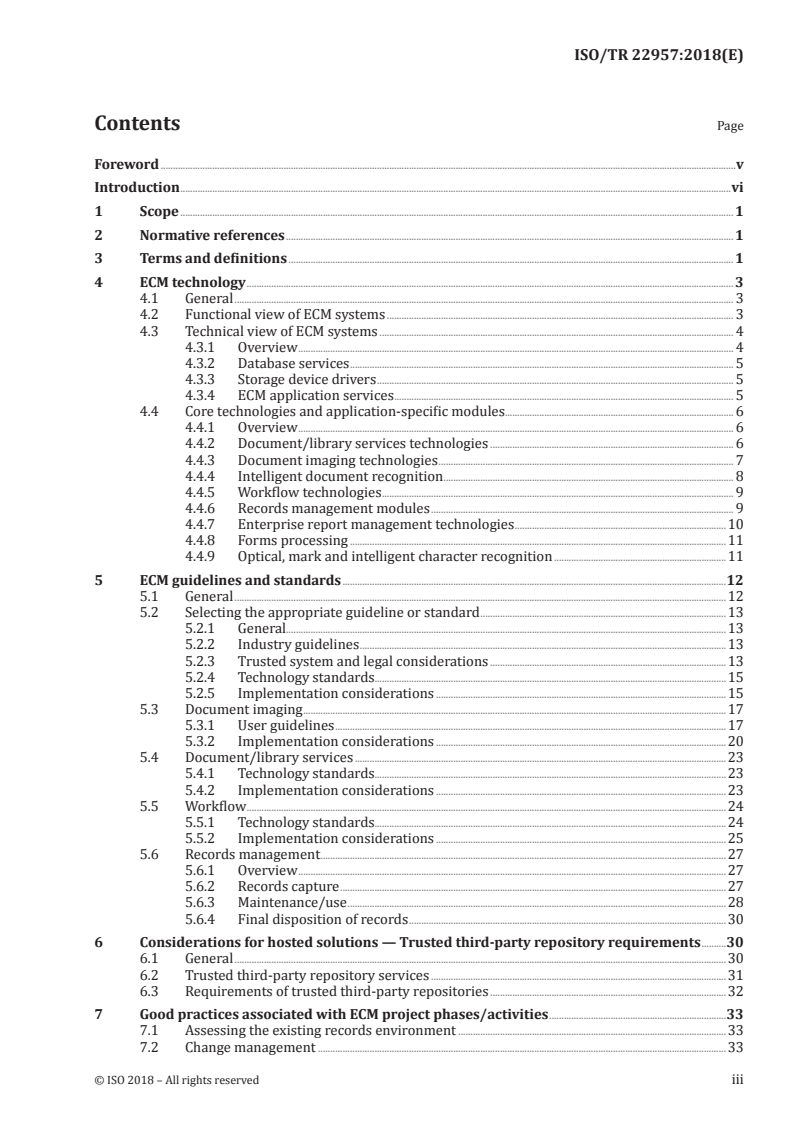
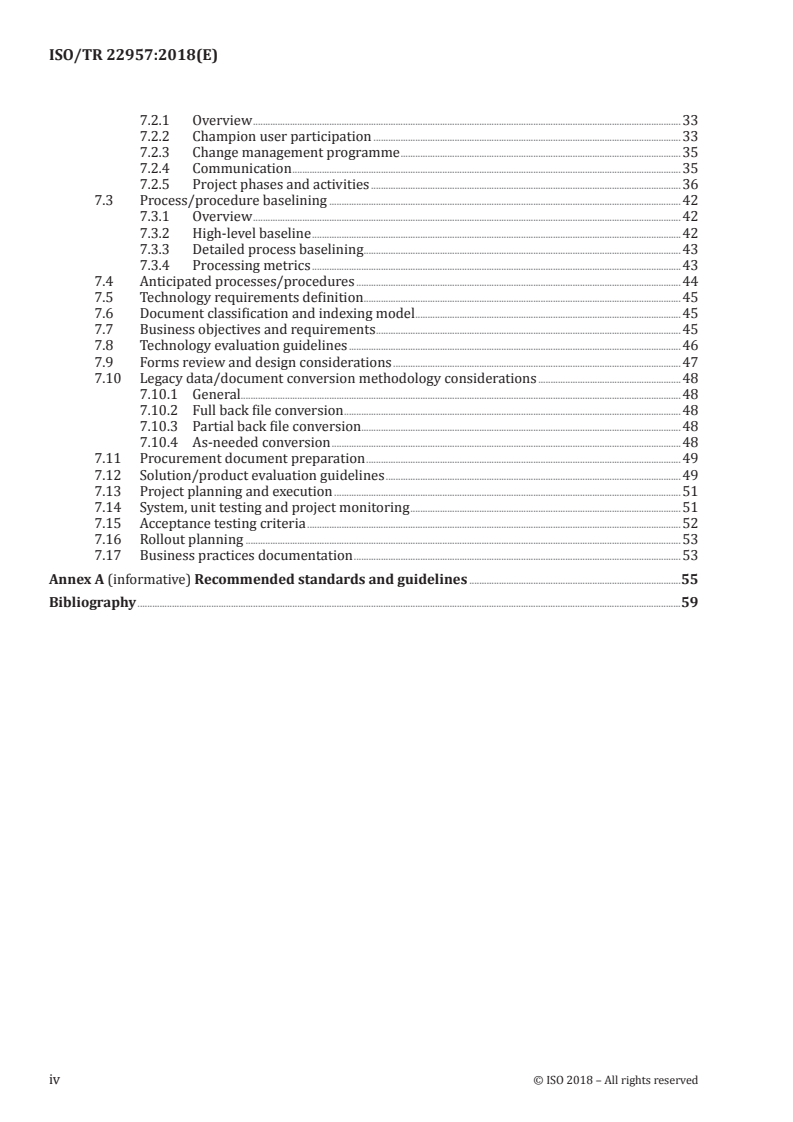
Contents Page
Foreword .v
Introduction .vi
1 Scope . 1
2 Normative references . 1
3 Terms and definitions . 1
4 ECM technology . 3
4.1 General . 3
4.2 Functional view of ECM systems . 3
4.3 Technical view of ECM systems . 4
4.3.1 Overview . 4
4.3.2 Database services . 5
4.3.3 Storage device drivers . 5
4.3.4 ECM application services . 5
4.4 Core technologies and application-specific modules. 6
4.4.1 Overview . 6
4.4.2 Document/library services technologies . 6
4.4.3 Document imaging technologies . 7
4.4.4 Intelligent document recognition . 8
4.4.5 Workflow technologies . 9
4.4.6 Records management modules . 9
4.4.7 Enterprise report management technologies .10
4.4.8 Forms processing .11
4.4.9 Optical, mark and intelligent character recognition .11
5 ECM guidelines and standards .12
5.1 General .12
5.2 Selecting the appropriate guideline or standard .13
5.2.1 General.13
5.2.2 Industry guidelines .13
5.2.3 Trusted system and legal considerations .13
5.2.4 Technology standards.15
5.2.5 Implementation considerations .15
5.3 Document imaging .17
5.3.1 User guidelines .17
5.3.2 Implementation considerations .20
5.4 Document/library services .23
5.4.1 Technology standards.23
5.4.2 Implementation considerations .23
5.5 Workflow .24
5.5.1 Technology standards.24
5.5.2 Implementation considerations .25
5.6 Records management .27
5.6.1 Overview .27
5.6.2 Records capture .27
5.6.3 Maintenance/use .28
5.6.4 Final disposition of records .30
6 Considerations for hosted solutions — Trusted third-party repository requirements .30
6.1 General .30
6.2 Trusted third-party repository services .31
6.3 Requirements of trusted third-party repositories .32
7 Good practices associated with ECM project phases/activities .33
7.1 Assessing the existing records environment .33
7.2 Change management .33
7.2.1 Overview .33
7.2.2 Champion user participation .33
7.2.3 Change management programme .35
7.2.4 Communication .35
7.2.5 Project phases and activities .36
7.3 Process/procedure baselining .42
7.3.1 Overview .42
7.3.2 High-level baseline .42
7.3.3 Detailed process baselining .43
7.3.4 Processing metrics .43
7.4 Anticipated processes/procedures .44
7.5 Technology requirements definition .45
7.6 Document classification and indexing model .45
7.7 Business objectives and requirements .45
7.8 Technology evaluation guidelines .46
7.9 Forms review and design considerations .47
7.10 Legacy data/document conversion methodology considerations .48
7.10.1 General.48
7.10.2 Full back file conversion .48
7.10.3 Partial back file conversion.48
7.10.4 As-needed conversion .48
7.11 Procurement document preparation .49
7.12 Solution/product evaluation guidelines .49
7.13 Project planning and execution .51
7.14 System, unit testing and project monitoring .51
7.15 Acceptance testing criteria .52
7.16 Rollout planning .53
7.17 Business practices documentation .53
Annex A (informative) Recommended standards and guidelines .55
Bibliography .59
iv © ISO 2018 – All rights reserved
Foreword
ISO (the International Organization for Standardization) is a worldwide federation of national standards
bodies (ISO member bodies). The work of preparing International Standards is normally carried out
through ISO technical committees. Each member body interested in a subject for which a technical
committee has been established has the right to be represented on that committee. International
organizations, governmental and non-governmental, in liaison with ISO, also take part in the work.
ISO collaborates closely with the International Electrotechnical Commission (IEC) on all matters of
electrotechnical standardization.
The procedures used to develop this document and those intended for its further maintenance are
described in the ISO/IEC Directives, Part 1. In particular, the different approval criteria needed for the
different types of ISO documents should be noted. This document was drafted in accordance with the
editorial rules of the ISO/IEC Directives, Part 2 (see www .iso .org/directives).
Attention is drawn to the possibility that some of the elements of this document may be the subject of
patent rights. ISO shall not be held responsible for identifying any or all such patent rights. Details of
any patent rights identified during the development of the document will be in the Introduction and/or
on the ISO list of patent declarations received (see www .iso .org/patents).
Any trade name used in this document is information given for the convenience of users and does not
constitute an endorsement.
For an explanation of the voluntary nature of standards, the meaning of ISO specific terms and
expressions related to conformity assessment, as well as information about ISO’s adherence to the
World Trade Organization (WTO) principles in the Technical Barriers to Trade (TBT) see www .iso
.org/iso/foreword .html.
This document was prepared by Technical Committee ISO/TC 171, Document management applications,
Subcommittee SC 2, Document file formats, EDMS systems and authenticity of information.
This second edition cancels and replaces the first edition (ISO/TR 22957:2009), which has been
technically revised. The main changes compared with the previous edition are as follows:
— updates have been made to bring the document in line with current generation technologies;
— the references have been revised and updated throughout;
— terms and definitions have been added and the acronyms section has been removed;
— “electronic document management system (EDMS)” has been changed to “enterprise content
management (ECM)” throughout;
— the wording has been improved throughout and the contents have been reorganized to provide
clarifications.
Any feedback or questions on this document should be directed to the user’s national standards body. A
complete listing of these bodies can be found at www .iso .org/members .html.
Introduction
This document provides detailed information associated with the analysis, selection and implementation
procedures associated with enterprise content management (ECM) systems. The development of
this document is a result of organizational requests to receive vendor-neutral industry information
associated with technology standards, technical reports and industry best practices for ECM projects.
Terms and acronyms associated with various aspects of ECM technologies commonly change over
time, as technology developers and vendors update product lines and solutions to address customer
requirements. In most cases, the new terms and acronyms reflect updates and changes to how these
technologies are used, typically by incorporating additional levels of functionality and very rarely
resulting in an entirely new core technology. This is important to note as the core ECM technologies
are constantly maturing, and solution providers are identifying not only new approaches to addressing
organizational issues and requirements, but also expanding the use of these technologies into areas
previously unconsidered. As such, organizations are constantly challenged to keep pace with how
an updated technology is currently being referenced, especially when the same core technology is
referenced differently between vendors and, at times, various groups of suppliers.
For the purposes of this document, the terms “document management” and “content management”
can be considered to be synonymous. As the ECM industry (previously referred to as the “document
management” or “electronic content management” industry) has matured over the years the ability
to store electronic information has greatly expanded from hard copy document scanning into digital
images in the early 1980s to the management of any digital or electronic document that today is referred
to as “electronically stored information (ESI)”.
Clause 4 provides detailed information describing each of these technologies, and how they operate and
inter-operate.
Clause 5 provides detailed information associated with currently available industry standards and
technical reports.
Clause 7 provides detailed information related to industry best practices associated with all the
customary project phases for ECM technology analysis, selection and implementation. These project
activities are considered to be industry best practices. It has been demonstrated over the past 10 years
that organizations following all the recommended steps and activities have a much greater level of
project success while greatly decreasing, and in most cases eliminating, unnecessary technologies,
user licences, etc. This is very important, especially with most organizations carefully examining all
expenditures related to all aspects of technology procurements.
This document provides detailed guidance to organizations considering the use of any of those
technologies that comprise ECM [document imaging, document/library services, routing/business
process management (BPM)/workflow, records management applications (RMAs), forms management,
enterprise report management (ERM), etc.]. It should be noted and acknowledged that a complete
records management programme set up against ISO 15489-1 is critical to any organization and is
integral to any complete and thorough management plan associated with electronic information
regardless of whether it is referred to as a “document”, “record”, “audio”, “video”, etc., internally by the
organization.
vi © ISO 2018 – All rights reserved
TECHNICAL REPORT ISO/TR 22957:2018(E)
Document management — Analysis, selection and
implementation of of enterprise content management
(ECM) systems
1 Scope
This document gives guidelines for a set of procedures and activities to be considered and/or performed
by organizations when planning, designing and implementing various enterprise content management
(ECM) technologies. The aspects or project phases range from initial business analysis through to
vendor/integrator selection and technology implementation. The implementation of processes to
manage electronically stored information (ESI) requires significant participation from the affected
business units, if the content is stored and managed when created/received and controlled through the
information life cycle following organizational policies and/or records retention and control policies
are applied. As these efforts require multiple people with different disciplines, including technical
teams, records managers and organizational management, this document has been prepared taking
those perspectives into account.
This document is applicable to both in-house and outsourced systems, including cloud solutions.
It can also be useful when dealing with specialized business systems. The term “enterprise content
management (ECM)” (or “document management”) used throughout this document is intended as an all-
encompassing term referring to capture technologies [scanning, indexing, optical character recognition
(OCR), forms, digital creation, etc.], management technologies (document services, workflow and other
work management tools), and storage [primarily non-alterable or write once read many (WORM)
technologies]. This document provides information to users related to the technical reports, guidelines
and standards that have been developed for technologies commonly available in ECM systems.
This document is not intended to be an all-inclusive paper on electronic document or content
management and does not attempt to influence any single technology or provide legal guidance or
legal opinions. While there are storage technologies other than optical/magnetic currently available
(i.e. microfilm, microfiche and hybrid storage systems) that are not included in this document, those
technologies can be reviewed if determined to be appropriate by the end-user organization.
2 Normative references
The following documents are referred to in the text in such a way that some or all of their content
constitutes requirements of this document. For dated references, only the edition cited applies. For
undated references, the latest edition of the referenced document (including any amendments) applies.
ISO 12651-1, Electronic document management — Vocabulary — Part 1: Electronic document imaging
ISO 12651-2, Electronic document management — Vocabulary — Part 2: Workflow management
ISO 15489-1, Information and documentation — Records management — Part 1: Concepts and principles
ISO/TR 15801, Document management — Electronically stored information — Recommendations for
trustworthiness and reliability
3 Terms and definitions
For the purposes of this document, the terms and definitions given in ISO 12651-1, ISO 12651-2,
ISO 15489-1 and ISO/TR 15801 and the following apply.
ISO and IEC maintain terminological databases for use in standardization at the following addresses:
— ISO Online browsing platform: available at https: //www .iso .org/obp
— IEC Electropedia: available at http: //www .electropedia .org/
3.1
library services
administrative components of the ECM system that handle access to information
3.2
expungement
process of removing a document from a system and leaving no evidence of the document ever having
appeared on the system
3.3
semi-structured document
document that contains both some level of structure and organization along with completely
unformatted text or text without any structure
EXAMPLE Letters, emails, forms with free-form text components, forms.
3.4
structured document
document that follows a strict structure or format
EXAMPLE Table, database record.
3.5
unstructured document
document that has no pre-defined structure or format and contains free-form text, which may or may
not be similar to other documents of the same type, and varies greatly in structure, content, terminology
and format
3.6
intelligent document recognition
IDR
technology that incorporates various methods of capturing and extracting information (or data) used
to identify a specific type of document and data extraction with minimal (or no) user intervention
required
Note 1 to entry: The most basic or traditional method of IDR has been in use since the late 1990s and incorporates
the processing of barcodes, patch codes and other manual indexing methodologies. The current generations of
this technology can also incorporate more advanced technology, techniques and algorithms to self-teach, i.e.
to update the processing rules to classify or to extract data without user intervention, while others require
linguistic algorithms, referred to natural language processing (NLP), to process unstructured content. IDR is
a common marketing term used to describe the process of capturing content (scanned documents and digital
born) and extracting content from the document within the limits of the technology being used.
3.7
natural language processing
NLP
technology used to determine and identify key words and phrases within processing audio data (e.g.
call centres) and free-form text (e.g. the body of an email)
Note 1 to entry: This technology is able to reduce words to their base constructs and perform other actions, such
as stemming, along with locating similar words or phrases without user intervention. This technology also varies
greatly from standard IDR technology due to the ability to automatically update rules as determined by the users
without the need for technical intervention. This technology is best suited for unstructured documents.
2 © ISO 2018 – All rights reserved
4 ECM technology
4.1 General
Many organizations still function in a hybrid environment of both electronic and hard copy environments.
This environment is a direct result of the need of the organization to maintain information on all
aspects of their business activities, as a business asset, to enable business efficiency and accountability.
These requirements for organizational record keeping are often driven by government regulations and
legislation to demonstrate accountability and implement quality control procedures. Organizations
are also dealing with the exponential growth of digitally created content, ever increasing volume,
diverging variety of formats, the acceleration of the velocity that content is arriving or being created
and the growing doubt about the veracity of this content. These pressures lead to the disorganization of
information as organizations try to keep up with the scale of change.
It is therefore a very important consideration for an organization evaluating or considering ECM
technologies to first design, plan and implement the necessary foundational components, supporting
the informational and organizational needs, and then expand and/or add additional functionality as
required by the business units. This approach to phasing enables organizations to fully adopt new
technologies while minimizing typically encountered issues adversely impacting day-to-day operations.
Organizations should also recognize that there is a wide range of stakeholders to be consulted, including
senior managers, end users from business units, records managers and archivists, legal counsel and
information technology (IT) staff.
4.2 Functional view of ECM systems
To help frame the concepts within this document, common terms used to reference these technologies
should be discussed.
“ECM systems” has become an all-encompassing term referring to the integration of various underlying
technologies, including:
— document imaging (used to convert hard copy documents into digital format);
— document/library services (used to manage digitally born documents);
NOTE Most ECM systems allow users to use this technology to also manage scanned documents, if
desired.
— BPM/workflow (used to automate work processes, including the creation, routing, tracking and
management of information being processed);
— ERM (used to store electronic formatted reports);
— forms processing (used to incorporate interactive forms and manage related forms data);
— OCR/intelligent character recognition (ICR) technologies;
— enterprise or faceted search;
— records management modules;
NOTE In some instances, this will be a module and in others an ECM will act as an integrated “front end”
for an application that can be separate, such as RMAs, case management applications, legal discovery tools
or web content management (WCM).
— metadata management;
— various applications (also considered add-ons), such as legacy system integration tools.
These systems provide users with greater access to ESI from common user interfaces, typically utilizing
industry standard internet browser technology. One of the primary reasons users prefer web-based
client tools is the distributed functionality and ability to maintain standard desktop configurations for
other office and business-related applications.
Figure 1 is a functional view of how ECM technologies, including records management, workflow, forms
processing, etc., typically integrate within an organization. This view shows multiple applications
integrated with and operating in conjunction with the ECM solution resulting in an overall trustworthy
and reliable ECM environment. As Figure 1 shows, while there are many solutions available, it is important
to remember that the policy layer is equally as important as the presentation and content layers.
Figure 1 — ECM functional view
4.3 Technical view of ECM systems
4.3.1 Overview
From a technical perspective, the structure of ECM technologies can be viewed as a set of building
blocks, as shown in Figure 2.
Figure 2 — ECM technology building blocks
4 © ISO 2018 – All rights reserved
The lowest level is the operating system. Database services and storage device drivers are installed
onto the server as the second layer. The third layer includes the base ECM application components
and services provided by the service provider. This layer typically includes the solution configuration
tools, application programming interfaces (APIs), and application components integrating the core
applications components with the database services along with providing the components that
integrate the storage environment with the overall solution. The fourth layer incorporates the various
core technologies of ECM technologies. Each of these core technologies (except for the operating system
layer) are further described in the following sections.
4.3.2 Database services
There has been a significant shift from developing custom technology solutions at the database level to
configuring/implementing commercially available software over the past 10 years. As the ECM industry
and associated technologies matured, end-user organizations could shift from a “development” model
to a “configuration” model for the base technological components. In fact, the selection of the database
to be used is typically at the discretion of the organization but has become standardized using open
database connectivity (ODBC) tools, which has resulted in the database components to be almost
considered a “commodity item” rather than a specialized tool.
This is an important consideration for any organization evaluating ECM technologies from the
perspective that almost all of today’s ECM solutions have moved away from needing to have specialized
database administrators to discouraging organizations from changing and/or modifying the ECM
database table structures and configuration, which in many cases now results in the solution provider
withdrawing solution support. While years ago it was important for the organization to hire dedicated
ECM database administrators, this is no longer the case.
Since the very early 2000s, the ECM industry has effectively standardized the most commonly used
database platforms enabling the solution providers to offer standardized support, thereby significantly
reducing the organizational cost associated with hiring database specialists solely or primarily
dedicated to managing the ECM solutions.
4.3.3 Storage device drivers
The storage device drivers or services are at the same level as the database services. The storage device
drivers are used to connect the selected storage technology to the system and make the storage space
available for the selected ECM solution.
4.3.4 ECM application services
The next layer in the “building block” is the ECM server application. Early in the development and
maturity cycle of ECM technologies, end-user organizations were required to provide database
administration and resources. During the late 1980s and early 1990s, ECM technologies had not
matured to a level approaching commercial off-the-shelf (COTS) availability. While ECM technologies
were maturing, end-user organizations were required to maintain the database along with the
application.
Current versions of enterprise ECM solutions have shifted the database administrative functions back
to the vendor/integrator with the end-user organization responsible for daily application maintenance
and periodic server maintenance. Most enterprise ECM solution providers provide their products with
technical support, including system installation, initial configuration, application updates/patches,
etc. This major shift from requiring significant technical resources at the end-user level to vendor-
supported solutions has resulted in an extensive amount of vertical market penetration. This has been
achieved using standard technology components configured to address specific environments and
business needs.
The application services are provided by the selected solution provider and include all the necessary
components supporting the platform of modules being implemented. These services include the various
application interfaces to other applications, along with providing the integration points between the
operating system security and management features and the management of the data being stored in
the ECM solution. The application services also provide all the core and underlying functionality for all
the solution components.
4.4 Core technologies and application-specific modules
4.4.1 Overview
There are various core technologies and application-specific modules that provide specific functionality,
including some or all the following core technologies: document imaging, document/library services,
workflow, forms processing, records management modules, etc. All enterprise ECM solutions have at
least one of these core technologies and, in most cases, include multiple components. Furthermore,
many solutions have integrated both the document imaging and document/library services components
into a single application, while other solutions simply integrate these components as required by the
organization.
A very important aspect of ECM technologies is associated with trustworthiness and reliability. Any
ECM solution should ensure that any information stored and managed will be retrieved exactly as
stored without any unauthorized access, modification or deletion. Not implementing a solution that
can protect the managed information is rarely of much use to an organization and becomes simply
another data silo. Trustworthy ECM solutions incorporate not only software and hardware, but require
organizational procedures and acceptance.
There are two very distinct approaches seen in the industry related to integrating and implementing
various ECM technologies. There are applications that are what is referred to as “image enabled”,
meaning that the legacy application has a process to save scanned documents and records along with
digitally born content (e.g. office documents, emails, facsimiles). Typically, the electronic (or digital)
information is then stored on a network device or directly within the application/database (only for
much older applications, typically). It is important to note that this is not considered to be an ECM
solution.
On the other hand, there are ECM solutions that go beyond basic “image enabling” and provide full
and extensive levels of control over electronically stored documents or records. These solutions always
incorporate the following functionality, with varying degrees of sophistication and capabilities that
allow for:
— capture of enterprise content (via document imaging or importing, if already in electronic format);
— process automation (workflows, forms processing, process automation, application integration);
— content management, storage and retention controls (trustworthiness, retention schedules, security
controls, access controls).
The following sections provide detailed information on each aspect of these technologies and how they
function and/or inter-operate within an ECM environment.
4.4.2 Document/library services technologies
Document/library services technologies enable organizations to manage digitally born documents and
have become the core component of almost every ECM solution available in today’s marketplace. A key
component of document/library services is the ability to generate, log and track all aspects related to
users accessing content, creating content and all associated actions taken within the system. Having
this history generation and logging capability of all user actions when searching, accessing and/or
creating content is the cornerstone of any trusted ECM solution.
These technologies control the authoring, check-in/out and/or version control of documents being
developed, managed or stored. This enables collaborative development when desired, along with
a mechanism to store/manage digitally born document libraries. The basic capabilities of these
technologies include allowing authorized users to:
— load or import digitally born documents directly into the system;
6 © ISO 2018 – All rights reserved
— enter relevant metadata associated with the document, according to a metadata’s schema previously
defined in the organization;
— create virtual folders linking various documents, according to a classification schema previously
defined;
— check information in/out of the repository;
— make changes and check the modified information back into the repository;
— manage whether original documents are updated or replaced during the update operations;
— establish security levels for groupings of documents.
The management aspect of document/library services technologies includes the ability to restrict
access to certain documents or groups of documents to only authorized users. Along with security
controls, these technologies enable users to be granted different levels of access. For example, the
author of a document might only grant “read” access to all users outside of a specific organization while
granting “check-in/out” control to others who are working on updating the document. As the other
users prepare to update the document, they would “check” the document out of the library, update the
information and then “check” the document back in.
Document/library services technologies ensure that any other user attempting to check the document
out would, first, not be allowed to check it out, and, second, would be notified that someone already
has a copy being updated. Upon completion of the update cycle, the system automatically updates the
version number of the document and makes it available to all authorized users.
Along with the abovementioned authoring controls, document/library services are commonly
configured to integrate with records management technologies, establishing retention controls and
enforcing the records retention policies in an automated and regulated fashion, rather than allowing
users to select relevant record series during indexing. The linkage between the retention schedule and
the enterprise content is referred to as the “retention bridge”, where information from the retention
schedule is associated as appropriate with the classification schema.
NOTE The linkage between the retention schedule and the enterprise content is usually established by
assigning retention rules to the elements of the classification schema (file plan).
Additional information on the integration of records management technologies is discussed below.
4.4.3 Document imaging technologies
Before discussing document imaging in general, it is important to note that terms used throughout
the industry are constantly changing as the ability to automate information classification and data
extraction continue to mature. Since the mid-1990s, the industry began exploring ways to streamline
the imaging process and the term “intelligent document recognition (IDR)” became a common
marketing term within the content/document management industry. Initially, the critical need was to
incorporate software with the ability to deskew, despeckle, rotate and ignore certain type of pages
based on colour and then these technologies matured/expanded to include barcode, patch code and
other more advanced recognition capabilities. Throughout this timeframe, various solutions used
varying terms to describe their solution and those marketing terms continue in various forms today,
but the underlying process to reduce user intervention remained the same goal.
From a basic technology perspective, document imaging technologies enable users to scan hard copy
documents into a digital or electronic format. The components of document imaging consist of a
hardware device used to
...
TECHNICAL ISO/TR
REPORT 22957
Second edition
2018-12
Document management — Analysis,
selection and implementation of
of enterprise content management
(ECM) systems
Reference number
©
ISO 2018
© ISO 2018
All rights reserved. Unless otherwise specified, or required in the context of its implementation, no part of this publication may
be reproduced or utilized otherwise in any form or by any means, electronic or mechanical, including photocopying, or posting
on the internet or an intranet, without prior written permission. Permission can be requested from either ISO at the address
below or ISO’s member body in the country of the requester.
ISO copyright office
CP 401 • Ch. de Blandonnet 8
CH-1214 Vernier, Geneva
Phone: +41 22 749 01 11
Fax: +41 22 749 09 47
Email: copyright@iso.org
Website: www.iso.org
Published in Switzerland
ii © ISO 2018 – All rights reserved
Contents Page
Foreword .v
Introduction .vi
1 Scope . 1
2 Normative references . 1
3 Terms and definitions . 1
4 ECM technology . 3
4.1 General . 3
4.2 Functional view of ECM systems . 3
4.3 Technical view of ECM systems . 4
4.3.1 Overview . 4
4.3.2 Database services . 5
4.3.3 Storage device drivers . 5
4.3.4 ECM application services . 5
4.4 Core technologies and application-specific modules. 6
4.4.1 Overview . 6
4.4.2 Document/library services technologies . 6
4.4.3 Document imaging technologies . 7
4.4.4 Intelligent document recognition . 8
4.4.5 Workflow technologies . 9
4.4.6 Records management modules . 9
4.4.7 Enterprise report management technologies .10
4.4.8 Forms processing .11
4.4.9 Optical, mark and intelligent character recognition .11
5 ECM guidelines and standards .12
5.1 General .12
5.2 Selecting the appropriate guideline or standard .13
5.2.1 General.13
5.2.2 Industry guidelines .13
5.2.3 Trusted system and legal considerations .13
5.2.4 Technology standards.15
5.2.5 Implementation considerations .15
5.3 Document imaging .17
5.3.1 User guidelines .17
5.3.2 Implementation considerations .20
5.4 Document/library services .23
5.4.1 Technology standards.23
5.4.2 Implementation considerations .23
5.5 Workflow .24
5.5.1 Technology standards.24
5.5.2 Implementation considerations .25
5.6 Records management .27
5.6.1 Overview .27
5.6.2 Records capture .27
5.6.3 Maintenance/use .28
5.6.4 Final disposition of records .30
6 Considerations for hosted solutions — Trusted third-party repository requirements .30
6.1 General .30
6.2 Trusted third-party repository services .31
6.3 Requirements of trusted third-party repositories .32
7 Good practices associated with ECM project phases/activities .33
7.1 Assessing the existing records environment .33
7.2 Change management .33
7.2.1 Overview .33
7.2.2 Champion user participation .33
7.2.3 Change management programme .35
7.2.4 Communication .35
7.2.5 Project phases and activities .36
7.3 Process/procedure baselining .42
7.3.1 Overview .42
7.3.2 High-level baseline .42
7.3.3 Detailed process baselining .43
7.3.4 Processing metrics .43
7.4 Anticipated processes/procedures .44
7.5 Technology requirements definition .45
7.6 Document classification and indexing model .45
7.7 Business objectives and requirements .45
7.8 Technology evaluation guidelines .46
7.9 Forms review and design considerations .47
7.10 Legacy data/document conversion methodology considerations .48
7.10.1 General.48
7.10.2 Full back file conversion .48
7.10.3 Partial back file conversion.48
7.10.4 As-needed conversion .48
7.11 Procurement document preparation .49
7.12 Solution/product evaluation guidelines .49
7.13 Project planning and execution .51
7.14 System, unit testing and project monitoring .51
7.15 Acceptance testing criteria .52
7.16 Rollout planning .53
7.17 Business practices documentation .53
Annex A (informative) Recommended standards and guidelines .55
Bibliography .59
iv © ISO 2018 – All rights reserved
Foreword
ISO (the International Organization for Standardization) is a worldwide federation of national standards
bodies (ISO member bodies). The work of preparing International Standards is normally carried out
through ISO technical committees. Each member body interested in a subject for which a technical
committee has been established has the right to be represented on that committee. International
organizations, governmental and non-governmental, in liaison with ISO, also take part in the work.
ISO collaborates closely with the International Electrotechnical Commission (IEC) on all matters of
electrotechnical standardization.
The procedures used to develop this document and those intended for its further maintenance are
described in the ISO/IEC Directives, Part 1. In particular, the different approval criteria needed for the
different types of ISO documents should be noted. This document was drafted in accordance with the
editorial rules of the ISO/IEC Directives, Part 2 (see www .iso .org/directives).
Attention is drawn to the possibility that some of the elements of this document may be the subject of
patent rights. ISO shall not be held responsible for identifying any or all such patent rights. Details of
any patent rights identified during the development of the document will be in the Introduction and/or
on the ISO list of patent declarations received (see www .iso .org/patents).
Any trade name used in this document is information given for the convenience of users and does not
constitute an endorsement.
For an explanation of the voluntary nature of standards, the meaning of ISO specific terms and
expressions related to conformity assessment, as well as information about ISO’s adherence to the
World Trade Organization (WTO) principles in the Technical Barriers to Trade (TBT) see www .iso
.org/iso/foreword .html.
This document was prepared by Technical Committee ISO/TC 171, Document management applications,
Subcommittee SC 2, Document file formats, EDMS systems and authenticity of information.
This second edition cancels and replaces the first edition (ISO/TR 22957:2009), which has been
technically revised. The main changes compared with the previous edition are as follows:
— updates have been made to bring the document in line with current generation technologies;
— the references have been revised and updated throughout;
— terms and definitions have been added and the acronyms section has been removed;
— “electronic document management system (EDMS)” has been changed to “enterprise content
management (ECM)” throughout;
— the wording has been improved throughout and the contents have been reorganized to provide
clarifications.
Any feedback or questions on this document should be directed to the user’s national standards body. A
complete listing of these bodies can be found at www .iso .org/members .html.
Introduction
This document provides detailed information associated with the analysis, selection and implementation
procedures associated with enterprise content management (ECM) systems. The development of
this document is a result of organizational requests to receive vendor-neutral industry information
associated with technology standards, technical reports and industry best practices for ECM projects.
Terms and acronyms associated with various aspects of ECM technologies commonly change over
time, as technology developers and vendors update product lines and solutions to address customer
requirements. In most cases, the new terms and acronyms reflect updates and changes to how these
technologies are used, typically by incorporating additional levels of functionality and very rarely
resulting in an entirely new core technology. This is important to note as the core ECM technologies
are constantly maturing, and solution providers are identifying not only new approaches to addressing
organizational issues and requirements, but also expanding the use of these technologies into areas
previously unconsidered. As such, organizations are constantly challenged to keep pace with how
an updated technology is currently being referenced, especially when the same core technology is
referenced differently between vendors and, at times, various groups of suppliers.
For the purposes of this document, the terms “document management” and “content management”
can be considered to be synonymous. As the ECM industry (previously referred to as the “document
management” or “electronic content management” industry) has matured over the years the ability
to store electronic information has greatly expanded from hard copy document scanning into digital
images in the early 1980s to the management of any digital or electronic document that today is referred
to as “electronically stored information (ESI)”.
Clause 4 provides detailed information describing each of these technologies, and how they operate and
inter-operate.
Clause 5 provides detailed information associated with currently available industry standards and
technical reports.
Clause 7 provides detailed information related to industry best practices associated with all the
customary project phases for ECM technology analysis, selection and implementation. These project
activities are considered to be industry best practices. It has been demonstrated over the past 10 years
that organizations following all the recommended steps and activities have a much greater level of
project success while greatly decreasing, and in most cases eliminating, unnecessary technologies,
user licences, etc. This is very important, especially with most organizations carefully examining all
expenditures related to all aspects of technology procurements.
This document provides detailed guidance to organizations considering the use of any of those
technologies that comprise ECM [document imaging, document/library services, routing/business
process management (BPM)/workflow, records management applications (RMAs), forms management,
enterprise report management (ERM), etc.]. It should be noted and acknowledged that a complete
records management programme set up against ISO 15489-1 is critical to any organization and is
integral to any complete and thorough management plan associated with electronic information
regardless of whether it is referred to as a “document”, “record”, “audio”, “video”, etc., internally by the
organization.
vi © ISO 2018 – All rights reserved
TECHNICAL REPORT ISO/TR 22957:2018(E)
Document management — Analysis, selection and
implementation of of enterprise content management
(ECM) systems
1 Scope
This document gives guidelines for a set of procedures and activities to be considered and/or performed
by organizations when planning, designing and implementing various enterprise content management
(ECM) technologies. The aspects or project phases range from initial business analysis through to
vendor/integrator selection and technology implementation. The implementation of processes to
manage electronically stored information (ESI) requires significant participation from the affected
business units, if the content is stored and managed when created/received and controlled through the
information life cycle following organizational policies and/or records retention and control policies
are applied. As these efforts require multiple people with different disciplines, including technical
teams, records managers and organizational management, this document has been prepared taking
those perspectives into account.
This document is applicable to both in-house and outsourced systems, including cloud solutions.
It can also be useful when dealing with specialized business systems. The term “enterprise content
management (ECM)” (or “document management”) used throughout this document is intended as an all-
encompassing term referring to capture technologies [scanning, indexing, optical character recognition
(OCR), forms, digital creation, etc.], management technologies (document services, workflow and other
work management tools), and storage [primarily non-alterable or write once read many (WORM)
technologies]. This document provides information to users related to the technical reports, guidelines
and standards that have been developed for technologies commonly available in ECM systems.
This document is not intended to be an all-inclusive paper on electronic document or content
management and does not attempt to influence any single technology or provide legal guidance or
legal opinions. While there are storage technologies other than optical/magnetic currently available
(i.e. microfilm, microfiche and hybrid storage systems) that are not included in this document, those
technologies can be reviewed if determined to be appropriate by the end-user organization.
2 Normative references
The following documents are referred to in the text in such a way that some or all of their content
constitutes requirements of this document. For dated references, only the edition cited applies. For
undated references, the latest edition of the referenced document (including any amendments) applies.
ISO 12651-1, Electronic document management — Vocabulary — Part 1: Electronic document imaging
ISO 12651-2, Electronic document management — Vocabulary — Part 2: Workflow management
ISO 15489-1, Information and documentation — Records management — Part 1: Concepts and principles
ISO/TR 15801, Document management — Electronically stored information — Recommendations for
trustworthiness and reliability
3 Terms and definitions
For the purposes of this document, the terms and definitions given in ISO 12651-1, ISO 12651-2,
ISO 15489-1 and ISO/TR 15801 and the following apply.
ISO and IEC maintain terminological databases for use in standardization at the following addresses:
— ISO Online browsing platform: available at https: //www .iso .org/obp
— IEC Electropedia: available at http: //www .electropedia .org/
3.1
library services
administrative components of the ECM system that handle access to information
3.2
expungement
process of removing a document from a system and leaving no evidence of the document ever having
appeared on the system
3.3
semi-structured document
document that contains both some level of structure and organization along with completely
unformatted text or text without any structure
EXAMPLE Letters, emails, forms with free-form text components, forms.
3.4
structured document
document that follows a strict structure or format
EXAMPLE Table, database record.
3.5
unstructured document
document that has no pre-defined structure or format and contains free-form text, which may or may
not be similar to other documents of the same type, and varies greatly in structure, content, terminology
and format
3.6
intelligent document recognition
IDR
technology that incorporates various methods of capturing and extracting information (or data) used
to identify a specific type of document and data extraction with minimal (or no) user intervention
required
Note 1 to entry: The most basic or traditional method of IDR has been in use since the late 1990s and incorporates
the processing of barcodes, patch codes and other manual indexing methodologies. The current generations of
this technology can also incorporate more advanced technology, techniques and algorithms to self-teach, i.e.
to update the processing rules to classify or to extract data without user intervention, while others require
linguistic algorithms, referred to natural language processing (NLP), to process unstructured content. IDR is
a common marketing term used to describe the process of capturing content (scanned documents and digital
born) and extracting content from the document within the limits of the technology being used.
3.7
natural language processing
NLP
technology used to determine and identify key words and phrases within processing audio data (e.g.
call centres) and free-form text (e.g. the body of an email)
Note 1 to entry: This technology is able to reduce words to their base constructs and perform other actions, such
as stemming, along with locating similar words or phrases without user intervention. This technology also varies
greatly from standard IDR technology due to the ability to automatically update rules as determined by the users
without the need for technical intervention. This technology is best suited for unstructured documents.
2 © ISO 2018 – All rights reserved
4 ECM technology
4.1 General
Many organizations still function in a hybrid environment of both electronic and hard copy environments.
This environment is a direct result of the need of the organization to maintain information on all
aspects of their business activities, as a business asset, to enable business efficiency and accountability.
These requirements for organizational record keeping are often driven by government regulations and
legislation to demonstrate accountability and implement quality control procedures. Organizations
are also dealing with the exponential growth of digitally created content, ever increasing volume,
diverging variety of formats, the acceleration of the velocity that content is arriving or being created
and the growing doubt about the veracity of this content. These pressures lead to the disorganization of
information as organizations try to keep up with the scale of change.
It is therefore a very important consideration for an organization evaluating or considering ECM
technologies to first design, plan and implement the necessary foundational components, supporting
the informational and organizational needs, and then expand and/or add additional functionality as
required by the business units. This approach to phasing enables organizations to fully adopt new
technologies while minimizing typically encountered issues adversely impacting day-to-day operations.
Organizations should also recognize that there is a wide range of stakeholders to be consulted, including
senior managers, end users from business units, records managers and archivists, legal counsel and
information technology (IT) staff.
4.2 Functional view of ECM systems
To help frame the concepts within this document, common terms used to reference these technologies
should be discussed.
“ECM systems” has become an all-encompassing term referring to the integration of various underlying
technologies, including:
— document imaging (used to convert hard copy documents into digital format);
— document/library services (used to manage digitally born documents);
NOTE Most ECM systems allow users to use this technology to also manage scanned documents, if
desired.
— BPM/workflow (used to automate work processes, including the creation, routing, tracking and
management of information being processed);
— ERM (used to store electronic formatted reports);
— forms processing (used to incorporate interactive forms and manage related forms data);
— OCR/intelligent character recognition (ICR) technologies;
— enterprise or faceted search;
— records management modules;
NOTE In some instances, this will be a module and in others an ECM will act as an integrated “front end”
for an application that can be separate, such as RMAs, case management applications, legal discovery tools
or web content management (WCM).
— metadata management;
— various applications (also considered add-ons), such as legacy system integration tools.
These systems provide users with greater access to ESI from common user interfaces, typically utilizing
industry standard internet browser technology. One of the primary reasons users prefer web-based
client tools is the distributed functionality and ability to maintain standard desktop configurations for
other office and business-related applications.
Figure 1 is a functional view of how ECM technologies, including records management, workflow, forms
processing, etc., typically integrate within an organization. This view shows multiple applications
integrated with and operating in conjunction with the ECM solution resulting in an overall trustworthy
and reliable ECM environment. As Figure 1 shows, while there are many solutions available, it is important
to remember that the policy layer is equally as important as the presentation and content layers.
Figure 1 — ECM functional view
4.3 Technical view of ECM systems
4.3.1 Overview
From a technical perspective, the structure of ECM technologies can be viewed as a set of building
blocks, as shown in Figure 2.
Figure 2 — ECM technology building blocks
4 © ISO 2018 – All rights reserved
The lowest level is the operating system. Database services and storage device drivers are installed
onto the server as the second layer. The third layer includes the base ECM application components
and services provided by the service provider. This layer typically includes the solution configuration
tools, application programming interfaces (APIs), and application components integrating the core
applications components with the database services along with providing the components that
integrate the storage environment with the overall solution. The fourth layer incorporates the various
core technologies of ECM technologies. Each of these core technologies (except for the operating system
layer) are further described in the following sections.
4.3.2 Database services
There has been a significant shift from developing custom technology solutions at the database level to
configuring/implementing commercially available software over the past 10 years. As the ECM industry
and associated technologies matured, end-user organizations could shift from a “development” model
to a “configuration” model for the base technological components. In fact, the selection of the database
to be used is typically at the discretion of the organization but has become standardized using open
database connectivity (ODBC) tools, which has resulted in the database components to be almost
considered a “commodity item” rather than a specialized tool.
This is an important consideration for any organization evaluating ECM technologies from the
perspective that almost all of today’s ECM solutions have moved away from needing to have specialized
database administrators to discouraging organizations from changing and/or modifying the ECM
database table structures and configuration, which in many cases now results in the solution provider
withdrawing solution support. While years ago it was important for the organization to hire dedicated
ECM database administrators, this is no longer the case.
Since the very early 2000s, the ECM industry has effectively standardized the most commonly used
database platforms enabling the solution providers to offer standardized support, thereby significantly
reducing the organizational cost associated with hiring database specialists solely or primarily
dedicated to managing the ECM solutions.
4.3.3 Storage device drivers
The storage device drivers or services are at the same level as the database services. The storage device
drivers are used to connect the selected storage technology to the system and make the storage space
available for the selected ECM solution.
4.3.4 ECM application services
The next layer in the “building block” is the ECM server application. Early in the development and
maturity cycle of ECM technologies, end-user organizations were required to provide database
administration and resources. During the late 1980s and early 1990s, ECM technologies had not
matured to a level approaching commercial off-the-shelf (COTS) availability. While ECM technologies
were maturing, end-user organizations were required to maintain the database along with the
application.
Current versions of enterprise ECM solutions have shifted the database administrative functions back
to the vendor/integrator with the end-user organization responsible for daily application maintenance
and periodic server maintenance. Most enterprise ECM solution providers provide their products with
technical support, including system installation, initial configuration, application updates/patches,
etc. This major shift from requiring significant technical resources at the end-user level to vendor-
supported solutions has resulted in an extensive amount of vertical market penetration. This has been
achieved using standard technology components configured to address specific environments and
business needs.
The application services are provided by the selected solution provider and include all the necessary
components supporting the platform of modules being implemented. These services include the various
application interfaces to other applications, along with providing the integration points between the
operating system security and management features and the management of the data being stored in
the ECM solution. The application services also provide all the core and underlying functionality for all
the solution components.
4.4 Core technologies and application-specific modules
4.4.1 Overview
There are various core technologies and application-specific modules that provide specific functionality,
including some or all the following core technologies: document imaging, document/library services,
workflow, forms processing, records management modules, etc. All enterprise ECM solutions have at
least one of these core technologies and, in most cases, include multiple components. Furthermore,
many solutions have integrated both the document imaging and document/library services components
into a single application, while other solutions simply integrate these components as required by the
organization.
A very important aspect of ECM technologies is associated with trustworthiness and reliability. Any
ECM solution should ensure that any information stored and managed will be retrieved exactly as
stored without any unauthorized access, modification or deletion. Not implementing a solution that
can protect the managed information is rarely of much use to an organization and becomes simply
another data silo. Trustworthy ECM solutions incorporate not only software and hardware, but require
organizational procedures and acceptance.
There are two very distinct approaches seen in the industry related to integrating and implementing
various ECM technologies. There are applications that are what is referred to as “image enabled”,
meaning that the legacy application has a process to save scanned documents and records along with
digitally born content (e.g. office documents, emails, facsimiles). Typically, the electronic (or digital)
information is then stored on a network device or directly within the application/database (only for
much older applications, typically). It is important to note that this is not considered to be an ECM
solution.
On the other hand, there are ECM solutions that go beyond basic “image enabling” and provide full
and extensive levels of control over electronically stored documents or records. These solutions always
incorporate the following functionality, with varying degrees of sophistication and capabilities that
allow for:
— capture of enterprise content (via document imaging or importing, if already in electronic format);
— process automation (workflows, forms processing, process automation, application integration);
— content management, storage and retention controls (trustworthiness, retention schedules, security
controls, access controls).
The following sections provide detailed information on each aspect of these technologies and how they
function and/or inter-operate within an ECM environment.
4.4.2 Document/library services technologies
Document/library services technologies enable organizations to manage digitally born documents and
have become the core component of almost every ECM solution available in today’s marketplace. A key
component of document/library services is the ability to generate, log and track all aspects related to
users accessing content, creating content and all associated actions taken within the system. Having
this history generation and logging capability of all user actions when searching, accessing and/or
creating content is the cornerstone of any trusted ECM solution.
These technologies control the authoring, check-in/out and/or version control of documents being
developed, managed or stored. This enables collaborative development when desired, along with
a mechanism to store/manage digitally born document libraries. The basic capabilities of these
technologies include allowing authorized users to:
— load or import digitally born documents directly into the system;
6 © ISO 2018 – All rights reserved
— enter relevant metadata associated with the document, according to a metadata’s schema previously
defined in the organization;
— create virtual folders linking various documents, according to a classification schema previously
defined;
— check information in/out of the repository;
— make changes and check the modified information back into the repository;
— manage whether original documents are updated or replaced during the update operations;
— establish security levels for groupings of documents.
The management aspect of document/library services technologies includes the ability to restrict
access to certain documents or groups of documents to only authorized users. Along with security
controls, these technologies enable users to be granted different levels of access. For example, the
author of a document might only grant “read” access to all users outside of a specific organization while
granting “check-in/out” control to others who are working on updating the document. As the other
users prepare to update the document, they would “check” the document out of the library, update the
information and then “check” the document back in.
Document/library services technologies ensure that any other user attempting to check the document
out would, first, not be allowed to check it out, and, second, would be notified that someone already
has a copy being updated. Upon completion of the update cycle, the system automatically updates the
version number of the document and makes it available to all authorized users.
Along with the abovementioned authoring controls, document/library services are commonly
configured to integrate with records management technologies, establishing retention controls and
enforcing the records retention policies in an automated and regulated fashion, rather than allowing
users to select relevant record series during indexing. The linkage between the retention schedule and
the enterprise content is referred to as the “retention bridge”, where information from the retention
schedule is associated as appropriate with the classification schema.
NOTE The linkage between the retention schedule and the enterprise content is usually established by
assigning retention rules to the elements of the classification schema (file plan).
Additional information on the integration of records management technologies is discussed below.
4.4.3 Document imaging technologies
Before discussing document imaging in general, it is important to note that terms used throughout
the industry are constantly changing as the ability to automate information classification and data
extraction continue to mature. Since the mid-1990s, the industry began exploring ways to streamline
the imaging process and the term “intelligent document recognition (IDR)” became a common
marketing term within the content/document management industry. Initially, the critical need was to
incorporate software with the ability to deskew, despeckle, rotate and ignore certain type of pages
based on colour and then these technologies matured/expanded to include barcode, patch code and
other more advanced recognition capabilities. Throughout this timeframe, various solutions used
varying terms to describe their solution and those marketing terms continue in various forms today,
but the underlying process to reduce user intervention remained the same goal.
From a basic technology perspective, document imaging technologies enable users to scan hard copy
documents into a digital or electronic format. The components of document imaging consist of a
hardware device used to
...