

ISO/TR 25741-1:2025
(Main)Lifts and escalators subject to seismic conditions — Compilation report — Part 1: Rule by rule comparison
General Information
- Abstract
This document compares the requirements of selected topics as covered by the following seismic standards (excluding local deviations): a) EN 81-77:2018 (EU); b) ASME 17.1 16 CH 8.4 (USA) / CSA B44-16 CH 8.4 (CAN); c) NZS 4332-1997, NZS1170.5-2004 (NZ); d) AS 1735.1:2016, AS 1735.5 :2001 (AUS); e) BSLJ / GFS:2016 (Japan).
- Status
- Published
- Publication Date
- 27-Oct-2025
- Technical Committee
- ISO/TC 178 - Lifts, escalators and moving walks
- Drafting Committee
- ISO/TC 178 - Lifts, escalators and moving walks
- Current Stage
- 6060 - International Standard published
- Start Date
- 28-Oct-2025
- Completion Date
- 28-Oct-2025


Overview - ISO/TR 25741-1:2025 (Rule by rule comparison)
ISO/TR 25741-1:2025 is a Technical Report that provides a systematic, rule‑by‑rule comparison of how selected seismic topics are treated across major national and regional standards for lifts and escalators subject to seismic conditions. This first part of the compilation report compares requirements from EN 81‑77:2018 (EU), ASME A17.1‑2016 / CSA B44‑16 (USA/Canada), New Zealand standards (NZS 4332‑1997, NZS 1170.5‑2004), Australian standards (AS 1735.1:2016, AS 1735.5:2001), and Japanese BSLJ / GFS:2016. The document is intended as a reference to aid standards writers, national committees, designers and users - it does not replace any of the individual seismic standards.
Key topics and technical content
- Rule‑by‑rule comparison: Side‑by‑side mapping of clauses and requirements for elevators, escalators and moving walks, showing where codes align or diverge.
- Scope and assumptions: Clarifies which equipment and seismic effects are included (selected topics only, excluding local deviations) and notes that design acceleration (ad) and placement of seismic detection systems should be agreed between customer and supplier/installer and provided by the building designer or owner.
- Seismic design principles: Discussion of risk analysis approaches referenced (e.g., EN ISO 12100 methods) and how different standards treat objectives such as preventing loss of life, avoiding entrapment, reducing damage and environmental hazards (oil leakage).
- Structural interface: Notes that the overall structural design of the lift installation and building support is often outside the scope of lift standards and must be handled with building‑design codes (examples shown for NZS).
- Comparative tables and figures: Tabulated comparisons for elevators/lifts and escalators/moving walks, highlighting clause‑level differences and commonalities to support harmonization.
Practical applications - who uses this report
- Standards developers and national committees - to review and harmonize seismic requirements.
- Lift and escalator manufacturers, designers and installers - to understand international differences and inform design choices for multi‑market products.
- Building designers and owners - to coordinate seismic design accelerations and interfaces with building structure.
- Regulators, inspectors and safety assessors - to interpret cross‑jurisdictional requirements during approvals and inspections.
Related standards (covered in the report)
- EN 81‑77:2018 (EU) and EN 115‑1:2017 Annex M
- ASME A17.1‑2016 / CSA B44‑16 (USA / Canada)
- NZS 4332‑1997, NZS 1170.5‑2004 (New Zealand)
- AS 1735.1:2016, AS 1735.5:2001 (Australia)
- BSLJ / GFS:2016 (Japan)
Use keywords: ISO/TR 25741-1:2025, lifts and escalators seismic, seismic standards comparison, EN 81-77, ASME A17.1, NZS 4332, AS 1735, BSLJ/GFS, design acceleration, seismic detection.
Relations
- Effective Date
- 06-Jun-2022
Get Certified
Connect with accredited certification bodies for this standard

DIBt (Deutsches Institut für Bautechnik)
German Institute for Building Technology.
DIN CERTCO
DIN Group product certification.

Aboma Certification B.V.
Specialized in construction, metal, and transport sectors.
Sponsored listings
Frequently Asked Questions
ISO/TR 25741-1:2025 is a technical report published by the International Organization for Standardization (ISO). Its full title is "Lifts and escalators subject to seismic conditions — Compilation report — Part 1: Rule by rule comparison". This standard covers: This document compares the requirements of selected topics as covered by the following seismic standards (excluding local deviations): a) EN 81-77:2018 (EU); b) ASME 17.1 16 CH 8.4 (USA) / CSA B44-16 CH 8.4 (CAN); c) NZS 4332-1997, NZS1170.5-2004 (NZ); d) AS 1735.1:2016, AS 1735.5 :2001 (AUS); e) BSLJ / GFS:2016 (Japan).
This document compares the requirements of selected topics as covered by the following seismic standards (excluding local deviations): a) EN 81-77:2018 (EU); b) ASME 17.1 16 CH 8.4 (USA) / CSA B44-16 CH 8.4 (CAN); c) NZS 4332-1997, NZS1170.5-2004 (NZ); d) AS 1735.1:2016, AS 1735.5 :2001 (AUS); e) BSLJ / GFS:2016 (Japan).
ISO/TR 25741-1:2025 is classified under the following ICS (International Classification for Standards) categories: 91.120.25 - Seismic and vibration protection; 91.140.90 - Lifts. Escalators. The ICS classification helps identify the subject area and facilitates finding related standards.
ISO/TR 25741-1:2025 has the following relationships with other standards: It is inter standard links to ISO/TR 25741:2008. Understanding these relationships helps ensure you are using the most current and applicable version of the standard.
ISO/TR 25741-1:2025 is available in PDF format for immediate download after purchase. The document can be added to your cart and obtained through the secure checkout process. Digital delivery ensures instant access to the complete standard document.
Standards Content (Sample)
Technical
Report
ISO/TR 25741-1
First edition
Lifts and escalators subject to
2025-10
seismic conditions — Compilation
report —
Part 1:
Rule by rule comparison
Ascenseurs et escaliers mécaniques soumis aux conditions
sismiques — Rapport de compilation —
Partie 1: Comparaison règle par règle
Reference number
© ISO 2025
All rights reserved. Unless otherwise specified, or required in the context of its implementation, no part of this publication may
be reproduced or utilized otherwise in any form or by any means, electronic or mechanical, including photocopying, or posting on
the internet or an intranet, without prior written permission. Permission can be requested from either ISO at the address below
or ISO’s member body in the country of the requester.
ISO copyright office
CP 401 • Ch. de Blandonnet 8
CH-1214 Vernier, Geneva
Phone: +41 22 749 01 11
Email: copyright@iso.org
Website: www.iso.org
Published in Switzerland
ii
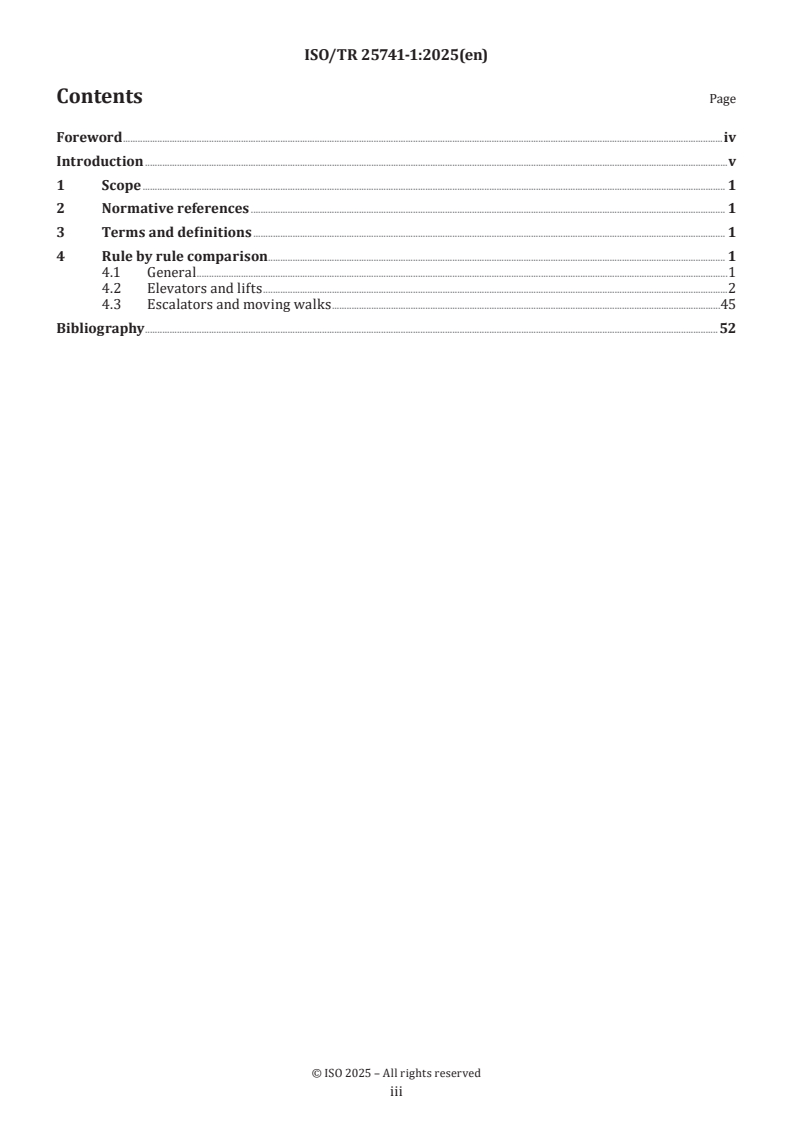
Contents Page
Foreword .iv
Introduction .v
1 Scope . 1
2 Normative references . 1
3 Terms and definitions . 1
4 Rule by rule comparison . 1
4.1 General .1
4.2 Elevators and lifts .2
4.3 Escalators and moving walks .45
Bibliography .52
iii
Foreword
ISO (the International Organization for Standardization) is a worldwide federation of national standards
bodies (ISO member bodies). The work of preparing International Standards is normally carried out through
ISO technical committees. Each member body interested in a subject for which a technical committee
has been established has the right to be represented on that committee. International organizations,
governmental and non-governmental, in liaison with ISO, also take part in the work. ISO collaborates closely
with the International Electrotechnical Commission (IEC) on all matters of electrotechnical standardization.
The procedures used to develop this document and those intended for its further maintenance are described
in the ISO/IEC Directives, Part 1. In particular, the different approval criteria needed for the different types
of ISO documents should be noted. This document was drafted in accordance with the editorial rules of the
ISO/IEC Directives, Part 2 (see www.iso.org/directives).
ISO draws attention to the possibility that the implementation of this document may involve the use of (a)
patent(s). ISO takes no position concerning the evidence, validity or applicability of any claimed patent
rights in respect thereof. As of the date of publication of this document, ISO had not received notice of (a)
patent(s) which may be required to implement this document. However, implementers are cautioned that
this may not represent the latest information, which may be obtained from the patent database available at
www.iso.org/patents. ISO shall not be held responsible for identifying any or all such patent rights.
Any trade name used in this document is information given for the convenience of users and does not
constitute an endorsement.
For an explanation of the voluntary nature of standards, the meaning of ISO specific terms and expressions
related to conformity assessment, as well as information about ISO's adherence to the World Trade
Organization (WTO) principles in the Technical Barriers to Trade (TBT), see www.iso.org/iso/foreword.html.
This document was prepared by Technical Committee ISO/TC 178, Lifts, escalators and moving walks.
This first edition of ISO/TR 25741-1 cancels and replaces ISO/TR 25741:2008, which has been technically
revised.
A list of all parts in the ISO 25741 series can be found on the ISO website.
Any feedback or questions on this document should be directed to the user’s national standards body. A
complete listing of these bodies can be found at www.iso.org/members.html.
iv
Introduction
The work on a comparison of world-wide standards which includes the American, Australian, European
and Japanese escalator, lifts and moving walk safety code was started in 2016, with the aim to prepare a
cross reference between the relevant sections of these standards and to analyse the differences on selected
subjects. The goal at that time was to prepare a document which would provide reference information to
assist national committees when reviewing and revising individual standards, which can initiate a gradual
convergence of the technical requirements.
This document is intended to aid standards writers in developing their seismic requirements, and to help
standards users understand the basis for the requirements as they are applied throughout the world.
This document is not intended to replace existing seismic standards which have possibly been updated.
Conclusions are arrived at in some cases, but only where there is unanimity amongst the various experts. In
other cases, the reasons for the divergent views are expressed.
This document is intended to be read in conjunction with the various seismic standards. The information
contained in this document does not necessarily represent the opinions of these standards writing
organizations (see the Bibliography for references). This document was prepared with EN 81-77:2018 and EN
115-1: 2017 Annex M. All other codes are not in their normal sequence and logical order. They are structured
differently to EN 81-77:2018 and EN 115-1: 2017 Annex M.
v
Technical Report ISO/TR 25741-1:2025(en)
Lifts and escalators subject to seismic conditions —
Compilation report —
Part 1:
Rule by rule comparison
1 Scope
This document compares the requirements of selected topics as covered by the following seismic standards
(excluding local deviations):
a) EN 81-77:2018 (EU);
b) ASME 17.1 16 CH 8.4 (USA) / CSA B44-16 CH 8.4 (CAN);
c) NZS 4332-1997, NZS1170.5-2004 (NZ);
d) AS 1735.1:2016, AS 1735.5 :2001 (AUS);
e) BSLJ / GFS:2016 (Japan).
2 Normative references
There are no normative references in this document.
3 Terms and definitions
No terms and definitions are listed in this document.
ISO and IEC maintain terminology databases for use in standardization at the following addresses:
— ISO Online browsing platform: available at https:// www .iso .org/ obp
— IEC Electropedia: available at https:// www .electropedia .org/
4 Rule by rule comparison
4.1 General
This comparison is made between EN 81-77:2018, EN 115-1:2017, Annex M, and the rules in ASME A17.1-
2016/CSA B44-16, AS 1735.1:2016, AS 1735.5 (EN 115:1995), NZS 4332-1997, NZS1170.5-2004 and Japanese
Building Codes.
There are other standards, see listed in the Scope (Clause 1), in the countries concerned that have
requirements which are not shown in the escalator/moving walk standards compared, but address some of
the same requirements as EN 81-77/EN 115-1:2017, Annex M.
EN 81-77 / EN 115-1:2017, Annex M clause numbers in brackets serve only as a reference point. They do not
exist in the published version of EN 81-77/EN 115-1:2017, Annex M.
Figure 1 — Overview of different areas
It should be noted that in addition to the above listed standards and other regulations, escalators and
moving walks may be required to conform to the requirements of other standards as appropriate. Where
ISO/TC 178 was aware of these standards, they are mentioned in the bibliography.
4.2 Elevators and lifts
Table 1 — Comparison of requirements for elevators and lifts
EN 81-77:2018 ASME 17.1 16 CH 8.4 (USA) / NZS 4332-1997, AS 1735.1:2016, BSLJ / GFS:2016
(EU) CSA B44-16 CH 8.4 (CAN) NZS1170.5-2004, (NZ) AS 1735.5 :2001, (AUS) (Japan)
0 Introduction SECTION 8.4 1.5.1 Structural design No such comparable introduction No such comparable introduction
0.1 General ELEVATOR SEISMIC REQUIREMENTS The structural design of the lift
installation including its various com-
The machinery concerned and the (a) – (d)
ponents and the building housing the
extent to which hazards, hazardous
installation are outside of the scope
situations and events are covered, are
of this Standard. Designs need to be
indicated in the scope of this standard.
undertaken by a suitably qualified
This document is a Type C Standard as
designer, using verification methods
stated in EN ISO 12100.
B1/VM1 and EN 81-77 as considered
When provisions of this C standard
appropriate, with proposals approved
are different from those which are
by the building consent authority as
stated in type A or B standards, the
part of the building consent process.
provisions of this Type C standard
Note: Although this Standard provides
take precedence over the provisions
some design criteria and informa-
of the other standards, for machines
tion on the lift installation, it does
that have been designed and built ac-
not fully account for all loadings that
cording to the provisions of this Type
must be taken into consideration, e.g.
C standard.
earthquake. The overall structural
design of the lift installation and of its
components is therefore outside of this
scope of this Standard
0.2 General remarks No such comparable introduction No such comparable introduction No such comparable introduction No such comparable introduction
0.2.1 The object of this standard is to
define additional safety rules related
to passenger and goods/passenger-
lifts with a view to safeguarding
persons and objects against the risks
described below associated with the
use, maintenance, inspection and
emergency operation of lifts subject to
seismic conditions.
0.2.2 The aim of this European Stand-
ard is to:
— avoid loss of life and reduce the
extent of injuries;
— avoid people trapped in the lift;
— avoid damage;
— avoid environmental problems
related to oil leakage;
— reduce the number of lifts out of
service.
0.3 Principles No such comparable principles No such comparable principles No such comparable principles No such comparable principles
Risk analysis, terminology and tech-
nical solutions have been considered
taking into account the methods
of EN ISO 12100 and EN ISO 14798
standards.
Table 1 (continued)
EN 81-77:2018 ASME 17.1 16 CH 8.4 (USA) / NZS 4332-1997, AS 1735.1:2016, BSLJ / GFS:2016
(EU) CSA B44-16 CH 8.4 (CAN) NZS1170.5-2004, (NZ) AS 1735.5 :2001, (AUS) (Japan)
0.4 Assumptions No such comparable assumptions No such comparable assumptions No such comparable assumptions No such comparable assumptions
It is assumed that negotiations have
been made for each contract between
the customer and the supplier/install-
er about the design acceleration (ad) to
be considered and the most effective
position of the seismic detection
system, if any, and of the primary wave
detection system, if any. The building
designer or the lift owner should pro-
vide the design acceleration (ad) which
will be documented in the information
for the owner provided by the installer.
This European Standard covers only
the effects of earthquakes on lifts and
not the nature of them.
1 Scope See Part 8 Part 1 General Requirements A.1.2 The object of earthquake 1.2 Scope
resistance
This European Standard specifies the General Requirements 1 Scope (1) These guidelines refer to elevators
special provisions and safety rules a) The vertical transportation should and escalators installed in buildings.
SCOPE The Scope of this Standard is the
for passenger and goods passenger continue to provide safe operation
design, construction, operation and (2) For those seismic design and con-
Part 8 contains general requirements
lifts where these lifts are permanent- without any trouble, even after the
testing of passenger carrying lifts struction is carried out on the basis
for new and existing equipment.
ly installed in buildings that are in occurrence of an earthquake, by as-
including goods lifts with car controls. of a special investigation or research,
See SECTION 8.4
compliance with EN 1998-1 (Eurocode suming that a middle scale earthquake
except for items that only specification
It is not intended for single unit
8). This standard defines additional ELEVATOR SEISMIC REQUIRE- would frequently hit the building
regulations are defined in the notice,
dwellings.
MENTS(a) – (d)
requirements to EN 81-20 and EN during its useful life.
it is possible not to be subject to the
This standard applies to new building
81-50. It applies to new passenger lifts
b) The elevator should ensure the guidelines.
work being either the installation of a
and goods passenger lifts. However, it
safety of passengers even if it gets
2. Objective of earthquake resist-
new work associated with an existing
may be used as a basis to improve the
damaged by assuming that a large
ance performance
installation.
safety of existing passenger and goods
scale earthquake might often hit the
(1) The elevator shall operate smooth-
New wok includes the complete or sub-
passenger lifts. This standard does
building during its useful life.
ly after the earthquake against rare
stantial replacement of a major part of
not introduce any additional special
AS 1170-4
earthquake motions. For extremely
the lift such occurs with:
provisions and safety rules for lifts
rare earthquake motions, it is assumed
which are in lift category 0 as defined
that even if the equipment is damaged,
in Table A.1. This European Standard
the car is suspended and supported.
does not address other risks due to
seismic events (for example fire, flood,
explosion).
(a) An increase in the carrying load (2) Escalators shall not fall off
requiring a new hoisting machine from supporting materials such as
and new ropes; building beams even if the equipment
is damaged against extremely rare
(b) An extension of travel by addi-
earthquake motions
tion of a new floor or floors;
(c) A conversion of hydraulic or
belt driven lift to electric drive.
It does not include routine main-
tenance, or repair or replacement
of any component or assembly
with a comparable component or
assembly
Table 1 (continued)
EN 81-77:2018 ASME 17.1 16 CH 8.4 (USA) / NZS 4332-1997, AS 1735.1:2016, BSLJ / GFS:2016
(EU) CSA B44-16 CH 8.4 (CAN) NZS1170.5-2004, (NZ) AS 1735.5 :2001, (AUS) (Japan)
Note
(1) A conversion or assembly replace-
ment that results in a speed increase
will count as new work if the resulting
installation ca no longer complies
with the peed-related requirements of
this standard such as top and bottom
clearances etc. A refit of a lift car that
significantly increases the car weight
may also count as a new work. An
increase in car weight requires the
balancing to be checked and a review
of the lift drive capacity, guide rail
capacity etc…
(2) The structural design of the
building necessary to support the
installation of the lift shall comply
with Clause B1 of the NZBC and is not
covered by the standard.
2. General
2.1 Earthquake loadings
NZS 4203 General structural design
and design loadings for buildings
shall be used for determining loadings
due to seismic accelerations on lift
machinery, lift guides, lift car and
landing doors and standby equipment.
Alternatively these shall be calculated
by using the seismic coefficient details
from the lift particular sheets (see 5.2
and 31.2). The appropriate risk factor
shall be determined from table 2,1 and
seismic zone from Appendix B.
NZS 1170-5 supplement 2004 chapter
Seismic categories
C : Zone A=0.6;Zone B=0.5;
Pmax
Zone C = 0.4
Seismic design coefficient C =R x C
d pmax
See Appendix B for seismic zones and
table 2.1 for risk factor (R)
Table 1 (continued)
EN 81-77:2018 ASME 17.1 16 CH 8.4 (USA) / NZS 4332-1997, AS 1735.1:2016, BSLJ / GFS:2016
(EU) CSA B44-16 CH 8.4 (CAN) NZS1170.5-2004, (NZ) AS 1735.5 :2001, (AUS) (Japan)
2 Normative references See Section 9.1 Reference Documents See Section Related documents See section 3 Normative References No such comparable reference
The following documents are referred
to in the text in such a way that some
or all of their content constitutes
requirements of this document. For
dated references, only the edition
cited applies. For undated references,
the latest edition of the referenced
document (including any amendments)
applies.
EN 81-20:2014, Safety rules for the
construction and installation of lifts -
Lifts for the transport of persons and
goods - Part 20: Passenger and goods
passenger lifts
EN 81-50:2014, Safety rules for the
construction and installation of lifts -
Examinations and tests - Part 50: Design
rules, calculations, examinations and
tests of lift components
EN 81-72:2015, Safety rules for the
construction and installation of lifts -
Particular applications for passenger
and goods passenger lifts - Part 72:
Firefighters lifts
EN 81-73:2016, Safety rules for the
construction and installation of lifts -
Particular applications for passenger
and goods passenger lifts - Part 73:
Behaviour of lifts in the event of fire
EN ISO 12100:2010, Safety of machin-
ery - General principles for design
- Risk assessment and risk reduction
(ISO 12100:2010)
ISO 7465:2007, Passenger lifts and
service lifts - Guide rails for lift cars
and counterweights - T-type
Table 1 (continued)
EN 81-77:2018 ASME 17.1 16 CH 8.4 (USA) / NZS 4332-1997, AS 1735.1:2016, BSLJ / GFS:2016
(EU) CSA B44-16 CH 8.4 (CAN) NZS1170.5-2004, (NZ) AS 1735.5 :2001, (AUS) (Japan)
3 Terms and definitions See Section 1.3 DEFINITIONS See Section 3 Definitions See section 6 Definitions No such comparable definitions
For the purposes of this document,
the terms and definitions given in EN
81-20:2014 and EN 81-50:2014 and the
following apply.
3.1 snag point
point of interference between flexible
elements and fixed
Note 1 to entry: Examples of flexible
elements are ropes, chains, travelling
cable.
Note 2 to entry: Examples of fixed
elements are guide rail brackets, guide
rail clip bolts, fishplates, vanes, and
similar devices.
3.2 design acceleration
ad
horizontal acceleration to be used
for calculation of forces – moments
acting on lift systems and arising from
seismic events
Note 1 to entry: See Annex B. 3.3
seismic lift categories
categories in which lifts have been
divided, taking into account the design
acceleration (ad)
Note 1 to entry: Table A.1 shows the
seismic lift categories.
3.4 primary wave
compressional wave that is longitudi-
nal in nature
Note 1 to entry: Earthquake advance
warning is possible by detecting
the non-destructive primary waves
that travel more quickly through the
Earth's crust than do the destructive
secondary waves. The amount of
advance warning depends on the delay
between the arrival of the primary
wave and other destructive waves,
generally in the order of seconds for
distant, large quakes.
Table 1 (continued)
EN 81-77:2018 ASME 17.1 16 CH 8.4 (USA) / NZS 4332-1997, AS 1735.1:2016, BSLJ / GFS:2016
(EU) CSA B44-16 CH 8.4 (CAN) NZS1170.5-2004, (NZ) AS 1735.5 :2001, (AUS) (Japan)
3.5 secondary wave
shear wave that is transverse in na-
ture, its motion being perpendicular to
the direction of wave propagation
Note 1 to entry: Secondary waves
move through solids, unlike surface
waves. They are destructive and arrive
later than primary waves.
3.6 seismic trigger level
seismic acceleration which activates a
seismic detection system
3.7 seismic mode
special mode in which the lift operates
after detection of seismic trigger level
3.8 seismic stand-by mode
special mode in which the lift operates
after detection of primary wave
without the activation of the seismic
detection system
3.9 normal operation
operation mode in which the lift op-
erates when not in seismic mode or in
seismic stand-by mode
3.10 retaining device
mechanical device securely fixed to
a structural member of the lift car,
counterweight or balancing weight
frame, designed to retain the lift car
and counterweight (balancing weight)
within its guide rails during seismic
activity
3.11 expansion joint
assembly designed to safely absorb
the heat-induced expansion and con-
traction of various construction mate-
rials, to absorb vibration, or to allow
movement due to ground settlement or
earthquakes
Table 1 (continued)
EN 81-77:2018 ASME 17.1 16 CH 8.4 (USA) / NZS 4332-1997, AS 1735.1:2016, BSLJ / GFS:2016
(EU) CSA B44-16 CH 8.4 (CAN) NZS1170.5-2004, (NZ) AS 1735.5 :2001, (AUS) (Japan)
4 List of significant hazards No such comparable list of hazards No such comparable list of hazards No such comparable list of hazards No such comparable list of hazards
This clause contains all the significant
hazards, hazardous situations and
events, as far as they are dealt with
in this standard, identified by risk
assessment as significant for this type
of machinery and which require action
to eliminate or reduce the risk (see
Table 1).
5 Safety requirements and/or pro- No such comparable requirement See Clause 25.8 Operation of lifts No such comparable requirement No such comparable requirement
tective measures under earthquake conditions the
clause shall be modified by adding
5.1 General
the words. The requirements of
Passenger and goods passenger lifts
clause 25.8 may be replaced with an
shall comply with the safety require-
earthquake detection system comply-
ments and/or protective measures of
ing with clauses.
the following clauses when the lifts are
5.10.3 and 5.10.4 of EN 81-77".
subject to seismic conditions. In addi-
tion, passenger and goods passenger
lifts shall be designed according to the
principles of EN ISO 12100 for hazards
relevant but not significant that are
not dealt with by this document.
If not differently specified the follow-
ing requirements apply to lift category
1, 2 and 3.
Table 1 (continued)
EN 81-77:2018 ASME 17.1 16 CH 8.4 (USA) / NZS 4332-1997, AS 1735.1:2016, BSLJ / GFS:2016
(EU) CSA B44-16 CH 8.4 (CAN) NZS1170.5-2004, (NZ) AS 1735.5 :2001, (AUS) (Japan)
5.2 Lift well See section 8.4.1.1.2 See 12 Liftwell enclosures No particular requirements for seismic Construction of Hoistways of Ele-
vators)
In order to prevent that suspension See section 8.4.2.2 18.2 Rope Retainer guards
ropes, overspeed governor ropes, Article 129-7.
See section 8.4.3 Guarding of Equip- Rope retainer guards shall be provided
travelling cables, compensation ropes
ment on deflector sheaves, machine sheaves, 1. Hoistways of elevators shall be
and chains, swaying in the well, get
compensator rope sheaves, governor constructed as specified below:
See section 8.4.3.1 Retainers for Sus-
entangled with fixed equipment, snag
tension sheaves and hoist rope sheaves
pension Members (5) No projecting part shall be
points created by brackets, sills, de-
on cars and counterweights to inhibit
installed in hoistways expect those
See section 8.4.3.2 Guarding of Snag
vices and other equipment mounted in
displacement of ropes in the event
specified by one of the following:
Points.
the well shall be protected according
ropes become slack.
(a) Rail brackets or horizontal framing
to Table 2.
Tope guards shall be continuous or
members which comply with the fol-
Table 2 — Protection of snag points
there shall be one guard for 30° wrap
lowing criteria.
or less, and 2 guards for a wrap in ex-
[1] Wire netting, iron sheeting or
cess of 30°. The guard or guards shall
other object similar thereto shall be
be located so that the included angle
installed in such a way that it does not
between the outer faces of the guard
obstruct the ascent and descent of the
or guards encloses two –thirds of the
cage, opening and closing of the doors
angle of contact between the rope and
of entrances/exits of the cage or any
sheave, etc.
other function of the elevator even if
18.5 Sheave guards Multiple roping
it comes into contact with the main
Multiple sheaves mounted on a car or cable or any other cable during an
counter weight shall be provided with earthquake.
guard to:
[2] In addition to the case in [1], meas-
ures specified by the Minister of Land,
Infrastructure, Transport and Tourism
shall be taken.
(a) Prevent the ropes leaving (b) omission
their correct grooves in the
sheaves in accordance with
18.2
18.6 Guarding of Nip Points (c) In addition to the measures
referred to in (a) or (b), an engaging
Where the car hoist rope lead is
device, etc. which must be installed
diverted by an overhead sheave and
inside the hoistway as part of the
the nip-point is under the liftwell
construction of the elevator, and
ceiling and is less than 2 450 mm from
necessary measures shall be taken so
the crosshead when the cars is level
that it will not obstruct the functions
with the top landing, then the rope nip
of the main cable, electrical wires
point shall be adequately guarded.
or any other parts, even during an
For single and double wrap sheaves
earthquake.
in secondary floors, the nip points
B.5 Protection measures
of ropes and the spokes of open-
web sheaves which are less than Table B.6 — Protection measures
2 450 mmfrom the floor shall be
Section 8 of GFS
adequately guarded
Protection means for suspension
The nip points of compensation
ropes, overspeed governor ropes, trav-
sheaves and ropes shall be adequately
elling cables, etc., swaying in the well,
guarded.
to prevent getting entangled with snag
24.9.4Check but no distances point in the hoistway.
(1)In case of Seismic Class A
Table 1 (continued)
EN 81-77:2018 ASME 17.1 16 CH 8.4 (USA) / NZS 4332-1997, AS 1735.1:2016, BSLJ / GFS:2016
(EU) CSA B44-16 CH 8.4 (CAN) NZS1170.5-2004, (NZ) AS 1735.5 :2001, (AUS) (Japan)
Case1: H≦10 m
Vertical protection for,
A) traveling cables
B) main ropes
C) compensating chain(s)
D) compensating rope(s)
E) governor rope for counterweight
Case2: 10 m
horizontal protection and metal mesh
in addition to protection of Case1 for:
A) traveling cables
B) governor rope
C) main ropes
D) compensating chain(s)
E) compensating rope(s)
F) steel tape
Case3: 60 m
Additional protections (ex. Protectors)
in addition to protection of Case2 for :
A) traveling cables
B) governor rope
C) main ropes
D) compensating chain(s)
E) compensating rope(s)
F) steel tape
Case4:120 m
Further additional protections (ex. Tie
bars) in addition to protection of Case
3 for :
A) traveling cables
B) governor rope
C) main ropes
D) compensating chain(s)
E) compensating rope(s)
F) steel tape
See table 8-1 in detail
(2) In case of Seismic Class S
Case 1: 10 m < H ≦60 m
Protection means for Case 3 of Seismic
Class A
Case 2: 60 m≦H
Protection means for Case 4 of Seismic
Class A
See table 8-2 in detail
Table 1 (continued)
EN 81-77:2018 ASME 17.1 16 CH 8.4 (USA) / NZS 4332-1997, AS 1735.1:2016, BSLJ / GFS:2016
(EU) CSA B44-16 CH 8.4 (CAN) NZS1170.5-2004, (NZ) AS 1735.5 :2001, (AUS) (Japan)
A.1.3 Earthquake resistant design
and construction
a) Taking the seismic force for design
into consideration, the design and
construction of the elevator must be
conducted so that the stress and de-
flection of the equipment and the ma-
terial will be less than the allowable
unit stress of the material or remain
within the required scope.
b) Against the seismic force for design,
the equipment of the elevator must be
designed and installed so that shift,
overturn or detachment of the equip-
ment, will not be caused.
c) The main ropes of the sheaves must
not be detached by the shaking caused
by the earthquake.
d) Protection measures should be
taken so that the mobile cables will not
be damaged by the projections in the
hoistway when the earthquake occurs.
e) The escalator must be designed and
installed so that it will not be detached
or will not fall from the supporting
material or beam of the building
A.2.6 The hoistway equipment
Protection measures must be conduct-
ed, taking into account that equipment
and fitting materials will not exces-
sively deform and that the ropes and
the cables will not be damaged by
projections in the hoistway.
A.2.6.1 The installation of the
equipment in the hoistway. In order
to securely install equipment in the
hoistway, enough strength against
the seismic force must be provided
to prevent excessive deformation of
equipment, based on the horizontal
seismic intensity for design regulated
in 2.2.
A.2.6.2 Protection measures against
projections in the hoistway. Protection
measures against the projections in
the hoistway must be taken according
to Table A.8 and Figure A.7.
Table A.8 — Protection measures
against projections
Table 1 (continued)
EN 81-77:2018 ASME 17.1 16 CH 8.4 (USA) / NZS 4332-1997, AS 1735.1:2016, BSLJ / GFS:2016
(EU) CSA B44-16 CH 8.4 (CAN) NZS1170.5-2004, (NZ) AS 1735.5 :2001, (AUS) (Japan)
5.3 Machinery and pulley spaces See section 8.4.11. Hydraulic Elevator 6 Machinery and Shave Beams, Sup- No equivalent requirement. No equivalent requirement.
ports and Foundations
Where buildings are designed with See section 8.4.11 11 Machine Rooms
expansion joints subdividing the and Machinery Spaces.
structure into dynamically independ-
See section 8.4.16 Machine Rooms and
ent units, all the lift machinery includ-
Machinery Spaces
ing the landing entrances and the well
of the lift shall be located on the same
side of an expansion joint (see EN 81-
20:2014, 0.4.2).
5.4 Car See section 8.4.5.2 Design Section 2.1 earthquake loadings for No equivalent requirement. 6.2.1 (2) Evaluation criteria of guide
seismic no equivalent requirement, rail
5.4.1 Mass of the car for lift design See section 8.4.5.2.1
otherwise section 21.1
calculations Evaluation criteria of guide rail is as
Note: EN 81-77 :2018 is used for deter- follows.
For lift design calculations, the forces
mining design car load mass for seismic
generated by the design acceleration Stress σ ≦ Short term allowable
events 2
(ad) shall be calculated taking into stress ( N/mm )
account: 1.5.1 Structural design
Deformation of guide rail δ + defor-
— for passenger lifts the mass of the The structural design of the lift mation of rail bracket δ ≦ Effective
b
car plus 40 % of the rated load evenly installation including its various com- overlap dimension
distributed; ponents and the building housing the (A − C ) − ( margin dimension : 10 mm )
installation are outside of the scope
— for goods passenger lifts the mass Where
of this Standard. Designs need to be
of the car plus 80 % of the rated load
A: Overlap dimension of guiding parts.
undertaken by a suitably qualified
evenly distributed.
C: Gap between rail and retainer.
designer, using verification methods
B1/VM1 and EN 81-77 as considered A − C:Effective overlap dimension.
appropriate, with proposals approved
by the building consent authority as
part of the building consent process.
Note: Although this Standard provides
some design criteria and informa-
tion on the lift installation, it does
not fully account for all loadings that
must be taken into consideration, e.g.
earthquake. The overall structural
design of the lift installation and of its
components is therefore outside of this
scope of this Standard for seismic no
equivalent requirement, otherwise see
section 20.16
Table 1 (continued)
EN 81-77:2018 ASME 17.1 16 CH 8.4 (USA) / NZS 4332-1997, AS 1735.1:2016, BSLJ / GFS:2016
(EU) CSA B44-16 CH 8.4 (CAN) NZS1170.5-2004, (NZ) AS 1735.5 :2001, (AUS) (Japan)
5.4.2 Car retaining devices See section 8.4.5 Guiding Members and For seismic no equivalent require- A.2.4.2 The calculation of displace-
Position Restraints ment, otherwise see section 9, 18.2, 20, ment (shifted position).
For lifts in lift categories 2 and 3 the
20.6 (ii)
car frame shall be provided with upper See section 8.4.5.2 Design Safety against the displacement of
and lower retaining devices able to 20.16 equipment in the machine room must
See section 8.4.5.2.1
hold the car frame on its guide rails. be studied by comparing the horizon-
See section 8.4.5.2.2
tal seismic force given to the equip-
The retaining devices shall be placed
ment with the vibration rubber, fitting
in such a way to distribute loads in a
bolt, anchor bolt of the equipment or
similar way as the guide shoes. The
the allowable shear load of the stopper.
retaining devices shall either be inte-
In case of fixing the traction machine
grated or mounted close to the fixing
with vibration proof supports, the
of the guide shoes. When the car is
machine beam should be welded with
centre located between the guide rails
steel angles. The calculation is accord-
the clearances d1, d2 and d3 (Figure 1
ing to the following formulae.
a)) between the retaining device and
the guide rail shall not exceed 5 mm If the specific equipment is installed
and the dimensions chosen shall not by specific engineering methods, the
cause accidental tripping of the safety calculation must be correctly made
gear during an earthquake. based on that.
The condition not to cause displace-
ment is as follows.
The depth of the retaining device (z1) Fs > FH (2-69)
shall be limited to avoid collision with
FH = KH × W (2-70)
guide rail attachments or other fixed
where
devices, but long enough to guaran-
FH is the horizontal seismic force for
tee a minimum overlapping length
design in kilograms force;
between retaining
W is the equipment weight in kilo-
devices and the guide rail blade during
grams force;
an earthquake. The required depth of
the retaining devices is also correlated KH is the horizontal seismic intensity;
with the type of guide rail through the
Fs is the allowable shear load of vibra-
allowable deflection of the guide rail
tion rubber, fitting bolt, anchor bolt or
(see 5.8.2).
stopper in kilograms force
During an earthquake, the minimum
overlapping length (z3) between re-
taining devices and the guide rail blade
shall be at least 5 mm (Figure 1 b)).
The car structure and retaining devic-
es shall be sufficient to withstand the
loads and forces imposed on them in-
cluding forces generated by the design
acceleration (ad), without permanent
deformation.
5.4.3 Car door locking devices No such comparable requirement See sections 12.2 and 14.4 No such comparable requirement No such comparable requirement
To prevent the opening of car doors,
for lifts in lift category 2 and 3 the car
doors shall be provided with a car door
locking device which shall be designed
and operate as described in EN 81-
20:2014, 5.3.9.2.
Table 1 (continued)
EN 81-77:2018 ASME 17.1 16 CH 8.4 (USA) / NZS 4332-1997, AS 1735.1:2016, BSLJ / GFS:2016
(EU) CSA B44-16 CH 8.4 (CAN) NZS1170.5-2004, (NZ) AS 1735.5 :2001, (AUS) (Japan)
5.5 Counterweight or balancing See section 8.4.1 Horizontal Car and 1.5.1 Structural design No such requirements specified GFS 7.2(1) Prevention measure for
weight Counterweight Clearances avoiding detach of weight block of
The structural design of the lift
counterweight
The counterweight or balancing See section 8.4.7 Counterweights installation including its various com-
weight shall be provided with upper ponents and the building housing the Counterweight shall have a structure
See section 8.4.7.1 Design
and lower retaining devices able to installation are outside of the scope so that its weight block should not be
See section 8.4.7.2 Guiding Members
hold the frame in between its guide of this Standard. Designs need to be detached from counterweight frame
and Position Restraints
rails. undertaken by a suitably qualified during earthquake.
designer, using verification methods
The retaining devices shall be placed If counterweight frame is not detach
B1/VM1 and EN 81-77 as considered
in such a way to distribute loads in a preventive structure, its deforma-
appropriate, with proposals approved
similar way as the guideshoes. The tion shall be evaluated with factor
by the building consent authority as
retaining devices shall either be inte- KSH=2.0.
part of the building consent process.
grated or mounted close to the fixing
6.2.1 (2) Evaluation criteria of guide
Note: Although this Standard provides
of the guide shoes. The clearances d1,
rail
some design criteria and informa-
d2 and d3 (Figure 1 a)) between the
Evaluation criteria of guide rail is as
tion on the lift installation, it does
retaining devices and the guide rails
follows.
not fully account for all loadings that
shall not exceed 5 mm. When a safety
Deformation of guide rail δ + defor-
must be taken into consideration, e.g.
gear is present, the dimensions chosen
mation of rail bracket δb ≦ Effective
earthquake. The overall structural
for the clearances d1, d2 and d3 shall
design of the lift installation and of its overlap dimension (A − C ) − (margin
not cause accidental tripping of the
dimension : 10 mm)
components is therefore outside of this
safety gear.
scope of this Standard
Where
During an earthquake, the minimum
See section 9 b) i), 13.3.3, 13.3.4, 18.2,
A:Overlap dimension of guiding parts.
overlapping length between retaining
20, 20.6 (ii)
C:Gap between rail and retainer
devices and the guide railblade side
shall be not less than 5 mm (Figure 1
b)).
The counterweight or balancing For seismic no equivalent require- A − C:Effective overlap dimension
weight structure and retaining devices ment, otherwise see section 20.8
Calculation of the stress intensity
shall be sufficient to withstand the
and the deflection.
loads and forces imposed on them in-
As for the normal elevator, the stress
cluding forces generated by the design
intensity and the deflection are
acceleration (ad), without permanent
calculated by use of the following
deformation.
formula to the load Px or Py being
The strength of the retaining devices
given to the guide rail through the car
and the counterweight frame or
and the counterweight by the seismic
balancing weight frame shall be calcu-
intensity.
lated taking into account the vertical
Regarding the special elevators such
mass distribution of the assembly of
as a fork type (industrial truck) ele-
the counterweight frame or balancing
vator, the calculation should be made
weight including filler weights.
based on its structure.
If the counterweight or the balancing
Stress Intensity =
weight incorporates filler weights,
γ1*7/40*β* P* L/ Z (6-2-1)
necessary measures shall be taken to
Deflection=
prevent their movement outside the
γ2*11/960*β* P* L/ E I (6-2-2)
frame considering the design acceler-
ation value.
Table 1 (continued)
EN 81-77:2018 ASME 17.1 16 CH 8.4 (USA) / NZS 4332-1997, AS 1735.1:2016, BSLJ / GFS:2016
(EU) CSA B44-16 CH 8.4 (CAN) NZS1170.5-2004, (NZ) AS 1735.5 :2001, (AUS) (Japan)
where
P is load Px or Py loaded on the guide
rail in kilograms force;
L is the distance of the rail bracket in
centimetres;
Z is section modulus Zx or Zy of the
guide rail in cubic centimetres (Refer
to Table 6-2-1);
E is Young’s modulus of elasticity of
the guide rail in kilograms force per
square centimetre;
I is the geometrical moment of inertia
Ix or Iy of the guide rail in centimetres
to the fourth (see Table 6-2-1);
β is the load reduction rate by tie
bracket or middle stopper (see
Table 6-3-1). However, β applies to β1
or β2 of Table 6-3-1.
γ1 is Stress coefficient of Joint board
see Table 6-2-2)
γ2 is Deflection coefficient of Joint
board (see Table 6-2-3)
In case of not installing the tie bracket
or the middle stopper, β = 1.
Table 6-3-1 — Reduction rate, β
Table 6-2-1 Rail cross-sectional
performance, stress, and allowable
deflection
Table 1 (continued)
EN 81-77:2018 ASME 17.1 16 CH 8.4 (USA) / NZS 4332-1997, AS 1735.1:2016, BSLJ / GFS:2016
(EU) CSA B44-16 CH 8.4 (CAN) NZS1170.5-2004, (NZ) AS 1735.5 :2001, (AUS) (Japan)
5.6 Suspension and compensation See section 8.4.3 Guarding of Equip- For seismic no equivalent require- No particular design requirement 7-1(1) The reinforcement of earth-
ment ment, otherwise see section 24.9.3 & quake resistant stopper.
5.6.1 Protection for traction
38.6 & 39.3&39.5 & 47 & 66.7.
sheaves, pulleys and sprockets See section 8.4.3.1 Retainers for Sus- If these conditions cannot be satisfied,
pension Members 18.2 Rope Retainer Guards increase the strength of the vibration
The devices for preventing the ropes
rubber or fitting bolt, otherwise install
from leaving the grooves of traction See section 8.4.6 Compensating Rope Rope Retainer Guards shall….
a stopper.
sheaves and pulleys shall include one Sheave Assembly
1.5
...