

ISO 4323:2018
(Main)Soaps — Determination of chloride content — Potentiometric method
General Information
- Abstract
This document specifies a potentiometric method for the determination of the chloride content of soaps, containing or not containing other surface active agents, and also of compounded products.
- Status
- Withdrawn
- Publication Date
- 06-Dec-2018
- Technical Committee
- ISO/TC 91 - Surface active agents
- Drafting Committee
- ISO/TC 91/WG 1 - Analytical methods
- Current Stage
- 9599 - Withdrawal of International Standard
- Start Date
- 01-Oct-2025
- Completion Date
- 29-Aug-2026
Buy Documents


ISO 4323:2018 - Soaps -- Determination of chloride content -- Potentiometric method
ISO 4323:2018 - Soaps — Determination of chloride content — Potentiometric method/7/2018
Overview
ISO 4323:2018 specifies a potentiometric titration method for determining the chloride content of soaps (including compounded products and soaps that contain other surface‑active agents). The standard describes sample preparation, reagents, apparatus, calibration and titration procedures using silver nitrate (AgNO3) and a silver ion selective electrode (or combined electrode), and how to report results as mass percentage expressed as sodium chloride (NaCl).
Key topics and requirements
- Scope: Applicable to soaps and compounded products; chloride reported as % NaCl.
- Principle: Potentiometric titration of chloride ions with standard AgNO3 in an acidic medium using a silver ion selective electrode plus a reference electrode (or combined electrode).
- Reagents: Analytical grade reagents; nitric acid (~6 mol/L); AgNO3 solutions (~0.1 mol/L and ~0.01 mol/L); standard NaCl reference solutions (0.1 and 0.01 mol/L); isopropanol. Potassium chloride may be used as an alternative primary standard (adjust weight accordingly).
- Apparatus: Potentiometer (or autotitrator), silver ISE with double junction reference (recommended), electromagnetic stirrer, Class A burette (ISO 385), and basic glassware.
- Sampling & sample prep: Follow ISO 8212 for sampling during manufacture; solid soap bars should be grated (cheese grater) and stored airtight to avoid moisture loss.
- Calibration: Standardize AgNO3 by titrating known volumes of NaCl standard solutions; determine end‑point potentiometrically by the maximum incremental change in potential; calculate AgNO3 normality.
- Determination: Dissolve test portion in a 1:1 mixture of water and isopropanol, acidify with nitric acid, titrate with the appropriate AgNO3 solution (choice based on expected chloride content), and run a blank. Control temperatures (ideally 25 °C) to ±1 °C between solutions and electrodes.
- Results & reporting: Clause 9 gives the calculation to convert titration volumes and AgNO3 normality into chloride content (expressed as % NaCl). Test report must include sample ID, method reference, conditions, results and any deviations.
Applications and users
- Quality control laboratories in soap and detergent manufacturing
- R&D teams developing soap formulations
- Incoming raw‑material inspection and supplier quality assurance
- Regulatory testing and conformity assessment for product specifications
- Contract testing laboratories offering analytical services for personal care products
Related standards
- ISO 385 - Laboratory glassware - Burettes (used for titration apparatus requirements)
- ISO 8212 - Soaps and detergents - Sampling techniques during manufacture (sampling procedure referenced)
- Prepared by ISO/TC 91 (Surface active agents)
Keywords: ISO 4323:2018, chloride content, soaps, potentiometric method, silver nitrate titration, silver ion selective electrode, soap testing, quality control.
Relations
- Effective Date
- 25-May-2024
- Effective Date
- 04-Nov-2015
Buy Documents
ISO 4323:2018 - Soaps -- Determination of chloride content -- Potentiometric method
ISO 4323:2018 - Soaps — Determination of chloride content — Potentiometric method/7/2018
Get Certified
Connect with accredited certification bodies for this standard

ECOCERT
Organic and sustainability certification.

Eurofins Food Testing Global
Global leader in food, environment, and pharmaceutical product testing.

Intertek Bangladesh
Intertek certification and testing services in Bangladesh.
Sponsored listings
Frequently Asked Questions
ISO 4323:2018 is a standard published by the International Organization for Standardization (ISO). Its full title is "Soaps — Determination of chloride content — Potentiometric method". This standard covers: This document specifies a potentiometric method for the determination of the chloride content of soaps, containing or not containing other surface active agents, and also of compounded products.
This document specifies a potentiometric method for the determination of the chloride content of soaps, containing or not containing other surface active agents, and also of compounded products.
ISO 4323:2018 is classified under the following ICS (International Classification for Standards) categories: 71.100.40 - Surface active agents. The ICS classification helps identify the subject area and facilitates finding related standards.
ISO 4323:2018 has the following relationships with other standards: It is inter standard links to ISO 4323:2025, ISO 4323:1977. Understanding these relationships helps ensure you are using the most current and applicable version of the standard.
ISO 4323:2018 is available in PDF format for immediate download after purchase. The document can be added to your cart and obtained through the secure checkout process. Digital delivery ensures instant access to the complete standard document.
Standards Content (Sample)
INTERNATIONAL ISO
STANDARD 4323
Second edition
2018-12
Soaps — Determination of chloride
content — Potentiometric method
Savons — Dosage des chlorures — Méthode potentiométrique
Reference number
©
ISO 2018
© ISO 2018
All rights reserved. Unless otherwise specified, or required in the context of its implementation, no part of this publication may
be reproduced or utilized otherwise in any form or by any means, electronic or mechanical, including photocopying, or posting
on the internet or an intranet, without prior written permission. Permission can be requested from either ISO at the address
below or ISO’s member body in the country of the requester.
ISO copyright office
CP 401 • Ch. de Blandonnet 8
CH-1214 Vernier, Geneva
Phone: +41 22 749 01 11
Fax: +41 22 749 09 47
Email: copyright@iso.org
Website: www.iso.org
Published in Switzerland
ii © ISO 2018 – All rights reserved
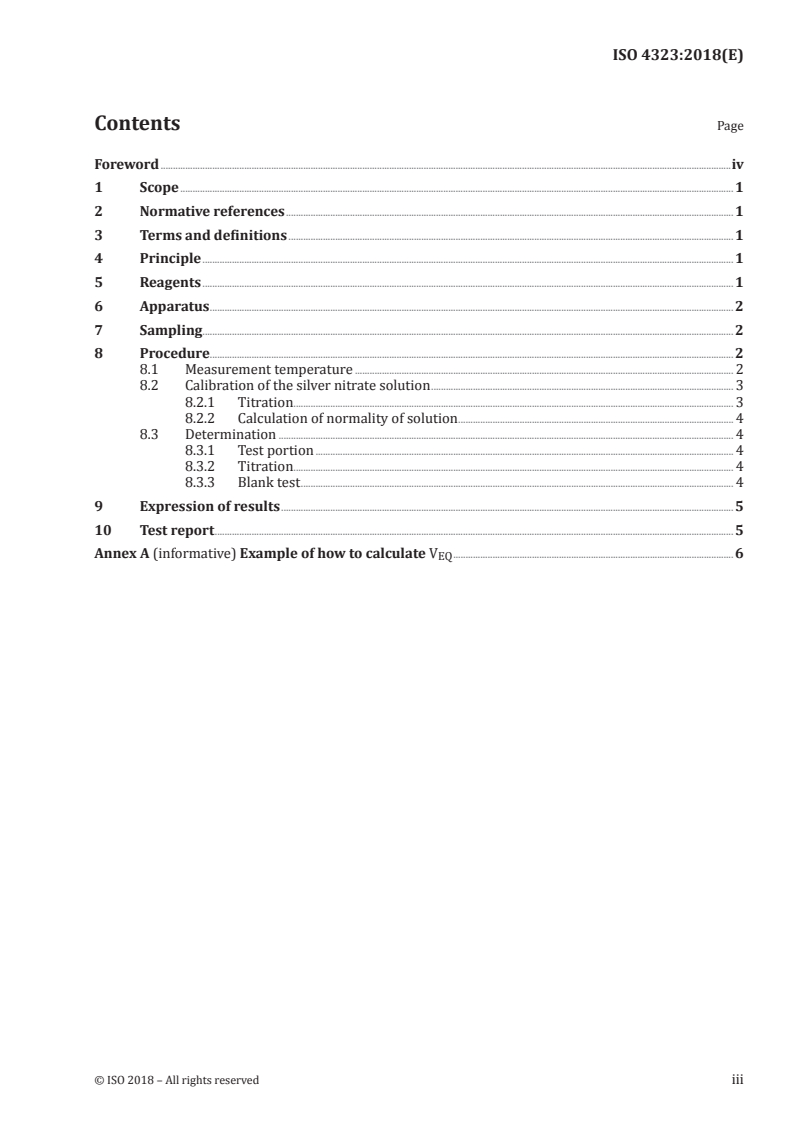
Contents Page
Foreword .iv
1 Scope . 1
2 Normative references . 1
3 Terms and definitions . 1
4 Principle . 1
5 Reagents . 1
6 Apparatus . 2
7 Sampling . 2
8 Procedure. 2
8.1 Measurement temperature . 2
8.2 Calibration of the silver nitrate solution . 3
8.2.1 Titration. 3
8.2.2 Calculation of normality of solution . 4
8.3 Determination . 4
8.3.1 Test portion . 4
8.3.2 Titration. 4
8.3.3 Blank test . 4
9 Expression of results . 5
10 Test report . 5
Annex A (informative) Example of how to calculate V . 6
EQ
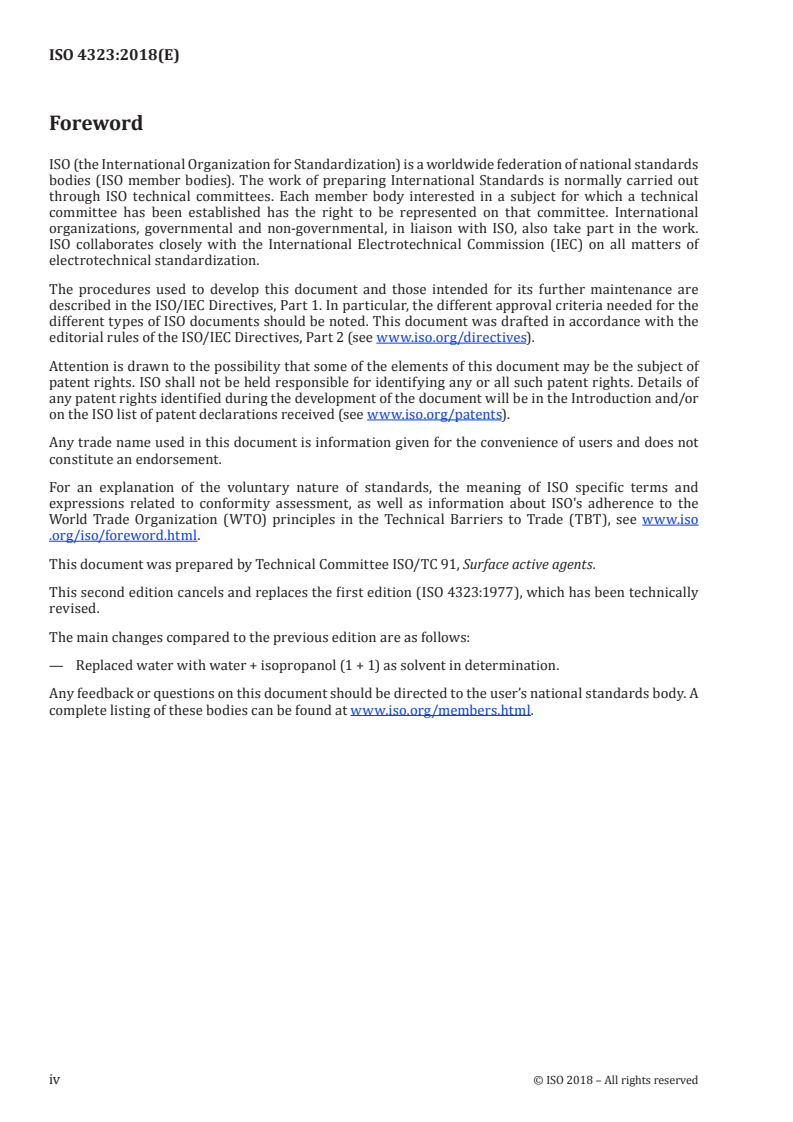
Foreword
ISO (the International Organization for Standardization) is a worldwide federation of national standards
bodies (ISO member bodies). The work of preparing International Standards is normally carried out
through ISO technical committees. Each member body interested in a subject for which a technical
committee has been established has the right to be represented on that committee. International
organizations, governmental and non-governmental, in liaison with ISO, also take part in the work.
ISO collaborates closely with the International Electrotechnical Commission (IEC) on all matters of
electrotechnical standardization.
The procedures used to develop this document and those intended for its further maintenance are
described in the ISO/IEC Directives, Part 1. In particular, the different approval criteria needed for the
different types of ISO documents should be noted. This document was drafted in accordance with the
editorial rules of the ISO/IEC Directives, Part 2 (see www .iso .org/directives).
Attention is drawn to the possibility that some of the elements of this document may be the subject of
patent rights. ISO shall not be held responsible for identifying any or all such patent rights. Details of
any patent rights identified during the development of the document will be in the Introduction and/or
on the ISO list of patent declarations received (see www .iso .org/patents).
Any trade name used in this document is information given for the convenience of users and does not
constitute an endorsement.
For an explanation of the voluntary nature of standards, the meaning of ISO specific terms and
expressions related to conformity assessment, as well as information about ISO's adherence to the
World Trade Organization (WTO) principles in the Technical Barriers to Trade (TBT), see www .iso
.org/iso/foreword .html.
This document was prepared by Technical Committee ISO/TC 91, Surface active agents.
This second edition cancels and replaces the first edition (ISO 4323:1977), which has been technically
revised.
The main changes compared to the previous edition are as follows:
— Replaced water with water + isopropanol (1 + 1) as solvent in determination.
Any feedback or questions on this document should be directed to the user’s national standards body. A
complete listing of these bodies can be found at www .iso .org/members .html.
iv © ISO 2018 – All rights reserved
INTERNATIONAL STANDARD ISO 4323:2018(E)
Soaps — Determination of chloride content —
Potentiometric method
1 Scope
This document specifies a potentiometric method for the determination of the chloride content of soaps,
containing or not containing other surface active agents, and also of compounded products.
2 Normative references
The following documents are referred to in the text in such a way that some or all of their content
constitutes requirements of this document. For dated references, only the edition cited applies. For
undated references, the latest edition of the referenced document (including any amendments) applies.
ISO 385, Laboratory glassware — Burettes
ISO 8212, Soaps and detergents — Techniques of sampling during manufacture
3 Terms and definitions
For the purposes of this document, the following terms and definitions apply.
ISO and IEC maintain terminological databases for use in standardization at the following addresses:
— ISO Online browsing platform: available at https: //www .iso .org/obp
— IEC Electropedia: available at http: //www .electropedia .org/
3.1
chloride content of soap products
mass fraction of chloride, expressed as sodium chloride and in percent, determined in accordance with
the procedure described in this document
4 Principle
−
Potentiometric titration of the chloride (Cl ) ions with standard silver nitrate solution in an acidic
medium, by using either a silver ion selective electrode plus a reference electrode or a combi
...
INTERNATIONAL ISO
STANDARD 4323
Second edition
2018-12
Soaps — Determination of chloride
content — Potentiometric method
Savons — Dosage des chlorures — Méthode potentiométrique
Reference number
©
ISO 2018
© ISO 2018
All rights reserved. Unless otherwise specified, or required in the context of its implementation, no part of this publication may
be reproduced or utilized otherwise in any form or by any means, electronic or mechanical, including photocopying, or posting
on the internet or an intranet, without prior written permission. Permission can be requested from either ISO at the address
below or ISO’s member body in the country of the requester.
ISO copyright office
CP 401 • Ch. de Blandonnet 8
CH-1214 Vernier, Geneva
Phone: +41 22 749 01 11
Fax: +41 22 749 09 47
Email: copyright@iso.org
Website: www.iso.org
Published in Switzerland
ii © ISO 2018 – All rights reserved
Contents Page
Foreword .iv
1 Scope . 1
2 Normative references . 1
3 Terms and definitions . 1
4 Principle . 1
5 Reagents . 1
6 Apparatus . 2
7 Sampling . 2
8 Procedure. 2
8.1 Measurement temperature . 2
8.2 Calibration of the silver nitrate solution . 3
8.2.1 Titration. 3
8.2.2 Calculation of normality of solution . 4
8.3 Determination . 4
8.3.1 Test portion . 4
8.3.2 Titration. 4
8.3.3 Blank test . 4
9 Expression of results . 5
10 Test report . 5
Annex A (informative) Example of how to calculate V . 6
EQ
Foreword
ISO (the International Organization for Standardization) is a worldwide federation of national standards
bodies (ISO member bodies). The work of preparing International Standards is normally carried out
through ISO technical committees. Each member body interested in a subject for which a technical
committee has been established has the right to be represented on that committee. International
organizations, governmental and non-governmental, in liaison with ISO, also take part in the work.
ISO collaborates closely with the International Electrotechnical Commission (IEC) on all matters of
electrotechnical standardization.
The procedures used to develop this document and those intended for its further maintenance are
described in the ISO/IEC Directives, Part 1. In particular, the different approval criteria needed for the
different types of ISO documents should be noted. This document was drafted in accordance with the
editorial rules of the ISO/IEC Directives, Part 2 (see www .iso .org/directives).
Attention is drawn to the possibility that some of the elements of this document may be the subject of
patent rights. ISO shall not be held responsible for identifying any or all such patent rights. Details of
any patent rights identified during the development of the document will be in the Introduction and/or
on the ISO list of patent declarations received (see www .iso .org/patents).
Any trade name used in this document is information given for the convenience of users and does not
constitute an endorsement.
For an explanation of the voluntary nature of standards, the meaning of ISO specific terms and
expressions related to conformity assessment, as well as information about ISO's adherence to the
World Trade Organization (WTO) principles in the Technical Barriers to Trade (TBT), see www .iso
.org/iso/foreword .html.
This document was prepared by Technical Committee ISO/TC 91, Surface active agents.
This second edition cancels and replaces the first edition (ISO 4323:1977), which has been technically
revised.
The main changes compared to the previous edition are as follows:
— Replaced water with water + isopropanol (1 + 1) as solvent in determination.
Any feedback or questions on this document should be directed to the user’s national standards body. A
complete listing of these bodies can be found at www .iso .org/members .html.
iv © ISO 2018 – All rights reserved
INTERNATIONAL STANDARD ISO 4323:2018(E)
Soaps — Determination of chloride content —
Potentiometric method
1 Scope
This document specifies a potentiometric method for the determination of the chloride content of soaps,
containing or not containing other surface active agents, and also of compounded products.
2 Normative references
The following documents are referred to in the text in such a way that some or all of their content
constitutes requirements of this document. For dated references, only the edition cited applies. For
undated references, the latest edition of the referenced document (including any amendments) applies.
ISO 385, Laboratory glassware — Burettes
ISO 8212, Soaps and detergents — Techniques of sampling during manufacture
3 Terms and definitions
For the purposes of this document, the following terms and definitions apply.
ISO and IEC maintain terminological databases for use in standardization at the following addresses:
— ISO Online browsing platform: available at https: //www .iso .org/obp
— IEC Electropedia: available at http: //www .electropedia .org/
3.1
chloride content of soap products
mass fraction of chloride, expressed as sodium chloride and in percent, determined in accordance with
the procedure described in this document
4 Principle
−
Potentiometric titration of the chloride (Cl ) ions with standard silver nitrate solution in an acidic
medium, by using either a silver ion selective electrode plus a reference electrode or a combi
...