


ISO 4042:2018
(Main)Fasteners — Electroplated coating systems
Fasteners — Electroplated coating systems
This document specifies requirements for electroplated coatings and coating systems on steel fasteners. The requirements related to dimensional properties also apply to fasteners made of copper or copper alloys. It also specifies requirements and gives recommendations to minimize the risk of hydrogen embrittlement; see 4.4 and Annex B. It mainly applies to zinc and zinc alloy coating systems (zinc, zinc-nickel, zinc-iron) and cadmium, primarily intended for corrosion protection and other functional properties: — with or without conversion coating; — with or without sealant; — with or without top coat; — with or without lubricant (integral lubricant and/or subsequently added lubricant). Specifications for other electroplated coatings and coating systems (tin, tin-zinc, copper-tin, copper-silver, copper, silver, copper-zinc, nickel, nickel-chromium, copper-nickel, copper-nickel-chromium) are included in this document only for dimensional requirements related to fasteners with ISO metric threads. This document applies to bolts, screws, studs and nuts with ISO metric thread, to fasteners with non-ISO metric thread, and to non-threaded fasteners such as washers, pins, clips and rivets. Information for design and assembly of coated fasteners is given in Annex A. This document does not specify requirements for properties such as weldability or paintability. NOTE Other International Standards specify differing electroplating processes. For electroplating of fasteners, the requirements of this document apply, unless otherwise agreed.
Fixations — Systèmes de revêtements électrolytiques
Le présent document spécifie les exigences applicables aux revêtements et aux systèmes de revêtement électrolytiques destinés aux fixations en acier. Les exigences portant sur les caractéristiques dimensionnelles s'appliquent également aux fixations en cuivre ou en alliages de cuivre. Il spécifie également les exigences et donne des recommandations visant à réduire le risque de fragilisation par l'hydrogène; voir 4.4 et Annexe B. Il s'applique principalement aux systèmes de revêtement de zinc et d'alliage de zinc (zinc, zinc-nickel, zinc-fer) et de cadmium, essentiellement destinés à la protection contre la corrosion et à l'obtention d'autres caractéristiques fonctionnelles: — avec ou sans couche de conversion; — avec ou sans finitions «sealer»; — avec ou sans finition «top coat»; — avec ou sans lubrifiant (lubrifiant intégré et/ou lubrifiant additionnel). Les spécifications concernant d'autres revêtements et systèmes de revêtement électrolytiques (étain, étain-zinc, cuivre-étain, cuivre-argent, cuivre, argent, cuivre-zinc, nickel, nickel-chrome, cuivre-nickel, cuivre-nickel-chrome) sont incluses dans le présent document uniquement pour les exigences dimensionnelles relatives aux fixations à filetage métrique ISO. Le présent document s'applique aux vis, goujons, tiges filetées et écrous à filetage métrique ISO, aux fixations à filetage non métrique ISO et aux fixations non filetées telles que les rondelles, les goupilles, les clips et les rivets. Des informations sur la conception et l'assemblage des fixations revêtues sont données à l'Annexe A. Le présent document ne spécifie pas d'exigence pour les caractéristiques telles que la soudabilité ou l'aptitude à la peinture. NOTE Des procédés de revêtement électrolytique différents sont spécifiés dans d'autres Normes internationales. Pour le revêtement électrolytique des fixations, les exigences du présent document s'appliquent, sauf accord contraire.
General Information
- Status
- Withdrawn
- Publication Date
- 12-Aug-2018
- Technical Committee
- ISO/TC 2/SC 14 - Surface coatings
- Drafting Committee
- ISO/TC 2/SC 14 - Surface coatings
- Current Stage
- 9599 - Withdrawal of International Standard
- Start Date
- 03-Jun-2022
- Completion Date
- 12-Feb-2026
Relations
- Effective Date
- 12-Feb-2026
- Effective Date
- 06-Jun-2022
- Effective Date
- 23-Apr-2020
- Effective Date
- 04-Nov-2015


Frequently Asked Questions
ISO 4042:2018 is a standard published by the International Organization for Standardization (ISO). Its full title is "Fasteners — Electroplated coating systems". This standard covers: This document specifies requirements for electroplated coatings and coating systems on steel fasteners. The requirements related to dimensional properties also apply to fasteners made of copper or copper alloys. It also specifies requirements and gives recommendations to minimize the risk of hydrogen embrittlement; see 4.4 and Annex B. It mainly applies to zinc and zinc alloy coating systems (zinc, zinc-nickel, zinc-iron) and cadmium, primarily intended for corrosion protection and other functional properties: — with or without conversion coating; — with or without sealant; — with or without top coat; — with or without lubricant (integral lubricant and/or subsequently added lubricant). Specifications for other electroplated coatings and coating systems (tin, tin-zinc, copper-tin, copper-silver, copper, silver, copper-zinc, nickel, nickel-chromium, copper-nickel, copper-nickel-chromium) are included in this document only for dimensional requirements related to fasteners with ISO metric threads. This document applies to bolts, screws, studs and nuts with ISO metric thread, to fasteners with non-ISO metric thread, and to non-threaded fasteners such as washers, pins, clips and rivets. Information for design and assembly of coated fasteners is given in Annex A. This document does not specify requirements for properties such as weldability or paintability. NOTE Other International Standards specify differing electroplating processes. For electroplating of fasteners, the requirements of this document apply, unless otherwise agreed.
This document specifies requirements for electroplated coatings and coating systems on steel fasteners. The requirements related to dimensional properties also apply to fasteners made of copper or copper alloys. It also specifies requirements and gives recommendations to minimize the risk of hydrogen embrittlement; see 4.4 and Annex B. It mainly applies to zinc and zinc alloy coating systems (zinc, zinc-nickel, zinc-iron) and cadmium, primarily intended for corrosion protection and other functional properties: — with or without conversion coating; — with or without sealant; — with or without top coat; — with or without lubricant (integral lubricant and/or subsequently added lubricant). Specifications for other electroplated coatings and coating systems (tin, tin-zinc, copper-tin, copper-silver, copper, silver, copper-zinc, nickel, nickel-chromium, copper-nickel, copper-nickel-chromium) are included in this document only for dimensional requirements related to fasteners with ISO metric threads. This document applies to bolts, screws, studs and nuts with ISO metric thread, to fasteners with non-ISO metric thread, and to non-threaded fasteners such as washers, pins, clips and rivets. Information for design and assembly of coated fasteners is given in Annex A. This document does not specify requirements for properties such as weldability or paintability. NOTE Other International Standards specify differing electroplating processes. For electroplating of fasteners, the requirements of this document apply, unless otherwise agreed.
ISO 4042:2018 is classified under the following ICS (International Classification for Standards) categories: 21.060.01 - Fasteners in general. The ICS classification helps identify the subject area and facilitates finding related standards.
ISO 4042:2018 has the following relationships with other standards: It is inter standard links to EN ISO 4042:2018, ISO/IEC 11694-6:2014, ISO 4042:2022, ISO 4042:1999. Understanding these relationships helps ensure you are using the most current and applicable version of the standard.
ISO 4042:2018 is available in PDF format for immediate download after purchase. The document can be added to your cart and obtained through the secure checkout process. Digital delivery ensures instant access to the complete standard document.
Standards Content (Sample)
INTERNATIONAL ISO
STANDARD 4042
Third edition
2018-08
Fasteners — Electroplated coating
systems
Fixations — Systèmes de revêtements électrolytiques
Reference number
©
ISO 2018
© ISO 2018
All rights reserved. Unless otherwise specified, or required in the context of its implementation, no part of this publication may
be reproduced or utilized otherwise in any form or by any means, electronic or mechanical, including photocopying, or posting
on the internet or an intranet, without prior written permission. Permission can be requested from either ISO at the address
below or ISO’s member body in the country of the requester.
ISO copyright office
CP 401 • Ch. de Blandonnet 8
CH-1214 Vernier, Geneva
Phone: +41 22 749 01 11
Fax: +41 22 749 09 47
Email: copyright@iso.org
Website: www.iso.org
Published in Switzerland
ii © ISO 2018 – All rights reserved
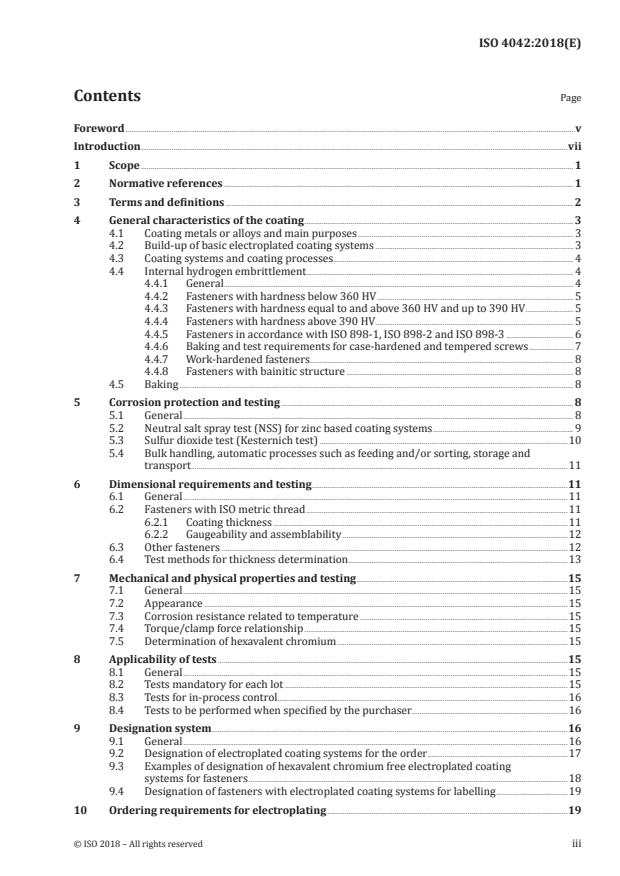
Contents Page
Foreword .v
Introduction .vii
1 Scope . 1
2 Normative references . 1
3 Terms and definitions . 2
4 General characteristics of the coating . 3
4.1 Coating metals or alloys and main purposes . 3
4.2 Build-up of basic electroplated coating systems . 3
4.3 Coating systems and coating processes. 4
4.4 Internal hydrogen embrittlement. 4
4.4.1 General. 4
4.4.2 Fasteners with hardness below 360 HV . 5
4.4.3 Fasteners with hardness equal to and above 360 HV and up to 390 HV . 5
4.4.4 Fasteners with hardness above 390 HV . 5
4.4.5 Fasteners in accordance with ISO 898-1, ISO 898-2 and ISO 898-3 . 6
4.4.6 Baking and test requirements for case-hardened and tempered screws . 7
4.4.7 Work-hardened fasteners . 8
4.4.8 Fasteners with bainitic structure . 8
4.5 Baking . 8
5 Corrosion protection and testing . 8
5.1 General . 8
5.2 Neutral salt spray test (NSS) for zinc based coating systems . 9
5.3 Sulfur dioxide test (Kesternich test) .10
5.4 Bulk handling, automatic processes such as feeding and/or sorting, storage and
transport . .11
6 Dimensional requirements and testing .11
6.1 General .11
6.2 Fasteners with ISO metric thread .11
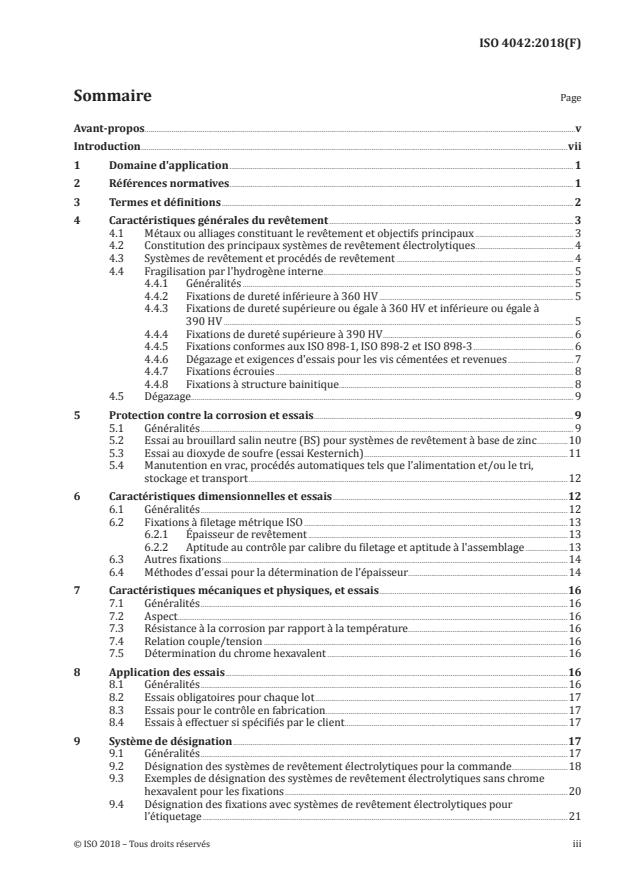
6.2.1 Coating thickness .11
6.2.2 Gaugeability and assemblability .12
6.3 Other fasteners .12
6.4 Test methods for thickness determination .13
7 Mechanical and physical properties and testing .15
7.1 General .15
7.2 Appearance .15
7.3 Corrosion resistance related to temperature .15
7.4 Torque/clamp force relationship .15
7.5 Determination of hexavalent chromium .15
8 Applicability of tests .15
8.1 General .15
8.2 Tests mandatory for each lot .15
8.3 Tests for in-process control.16
8.4 Tests to be performed when specified by the purchaser .16
9 Designation system .16
9.1 General .16
9.2 Designation of electroplated coating systems for the order .17
9.3 Examples of designation of hexavalent chromium free electroplated coating
systems for fasteners .18
9.4 Designation of fasteners with electroplated coating systems for labelling .19
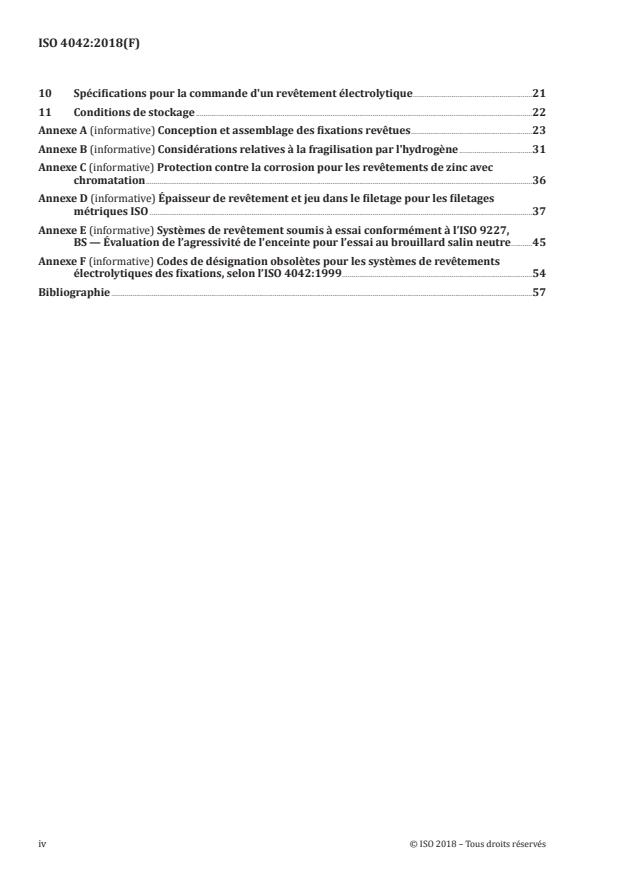
10 Ordering requirements for electroplating .19
11 Storage conditions .20
Annex A (informative) Design aspects and assembly of coated fasteners .21
Annex B (informative) Hydrogen embrittlement consideration .29
Annex C (informative) Corrosion protection related to zinc coatings with chromate
conversion coatings .33
Annex D (informative) Coating thickness and thread clearance for ISO metric screw threads .34
Annex E (informative) Coating systems tested in accordance with ISO 9227, NSS —
Evaluation of cabinet corrosivity for the neutral salt spray test .42
Annex F (informative) Obsolete designation codes for electroplated coating systems on
fasteners according to ISO 4042:1999 .51
Bibliography .54
iv © ISO 2018 – All rights reserved
Foreword
ISO (the International Organization for Standardization) is a worldwide federation of national standards
bodies (ISO member bodies). The work of preparing International Standards is normally carried out
through ISO technical committees. Each member body interested in a subject for which a technical
committee has been established has the right to be represented on that committee. International
organizations, governmental and non-governmental, in liaison with ISO, also take part in the work.
ISO collaborates closely with the International Electrotechnical Commission (IEC) on all matters of
electrotechnical standardization.
The procedures used to develop this document and those intended for its further maintenance are
described in the ISO/IEC Directives, Part 1. In particular the different approval criteria needed for the
different types of ISO documents should be noted. This document was drafted in accordance with the
editorial rules of the ISO/IEC Directives, Part 2 (see www .iso .org/directives).
Attention is drawn to the possibility that some of the elements of this document may be the subject of
patent rights. ISO shall not be held responsible for identifying any or all such patent rights. Details of
any patent rights identified during the development of the document will be in the Introduction and/or
on the ISO list of patent declarations received (see www .iso .org/patents).
Any trade name used in this document is information given for the convenience of users and does not
constitute an endorsement.
For an explanation on the voluntary nature of standards, the meaning of ISO specific terms and
expressions related to conformity assessment, as well as information about ISO's adherence to the
World Trade Organization (WTO) principles in the Technical Barriers to Trade (TBT) see the following
URL: www .iso .org/iso/foreword .html.
This document was prepared by Technical Committee ISO/TC 2, Fasteners, Subcommittee SC 14, Surface
coatings.
This third edition cancels and replaces the second edition (ISO 4042:1999), which has been technically
revised. The main changes compared to the previous edition are as follows:
— application to all fasteners, including self-tapping and thread forming screws, washers, rivets,
clips, etc.;
— focus on coatings designed for corrosion protection of fasteners;
— application to electroplated coating systems with or without additional layers (conversion coating,
sealant, top coat, lubricant);
— specification of minimum corrosion resistance (white corrosion and red rust);
— inclusion of up-to-date knowledge about hydrogen embrittlement and prevention measures;
— definitions specified in ISO 1891-2;
— concerning corrosion tests, inclusion of sulfur dioxide test (Kesternich) and calibration of neutral
salt spray test;
— inclusion of gaugeability and assemblability requirements;
— for thickness determination, addition of adequate test methods and deletion of the batch average
thickness;
— new designation system for all coating systems;
— specification for mechanical and physical properties and related test methods;
— information about design aspects and assembly of coated fasteners;
— information for coating thickness and thread clearance for ISO metric screw threads;
— information about evaluation of cabinet corrosivity for the neutral salt spray test.
vi © ISO 2018 – All rights reserved
Introduction
This document was completely revised to take into account new developments related to hexavalent
chromium free passivations, application of sealants and top coats, requirements for functional
properties as well as results of research work to minimize the risk of hydrogen embrittlement.
INTERNATIONAL STANDARD ISO 4042:2018(E)
Fasteners — Electroplated coating systems
1 Scope
This document specifies requirements for electroplated coatings and coating systems on steel
fasteners. The requirements related to dimensional properties also apply to fasteners made of copper
or copper alloys.
It also specifies requirements and gives recommendations to minimize the risk of hydrogen
embrittlement; see 4.4 and Annex B.
It mainly applies to zinc and zinc alloy coating systems (zinc, zinc-nickel, zinc-iron) and cadmium,
primarily intended for corrosion protection and other functional properties:
— with or without conversion coating;
— with or without sealant;
— with or without top coat;
— with or without lubricant (integral lubricant and/or subsequently added lubricant).
Specifications for other electroplated coatings and coating systems (tin, tin-zinc, copper-tin, copper-
silver, copper, silver, copper-zinc, nickel, nickel-chromium, copper-nickel, copper-nickel-chromium)
are included in this document only for dimensional requirements related to fasteners with ISO metric
threads.
This document applies to bolts, screws, studs and nuts with ISO metric thread, to fasteners with non-
ISO metric thread, and to non-threaded fasteners such as washers, pins, clips and rivets.
Information for design and assembly of coated fasteners is given in Annex A.
This document does not specify requirements for properties such as weldability or paintability.
NOTE Other International Standards specify differing electroplating processes. For electroplating of
fasteners, the requirements of this document apply, unless otherwise agreed.
2 Normative references
The following documents are referred to in the text in such a way that some or all of their content
constitutes requirements of this document. For dated references, only the edition cited applies. For
undated references, the latest edition of the referenced document (including any amendments) applies.
ISO 1456, Metallic and other inorganic coatings — Electrodeposited coatings of nickel, nickel plus
chromium, copper plus nickel and of copper plus nickel plus chromium
ISO 1463, Metallic and oxide coatings — Measurement of coating thickness — Microscopical method
ISO 1502, ISO general-purpose metric screw threads — Gauges and gauging
ISO 1891-2, Fasteners — Terminology — Part 2: Vocabulary and definitions for coatings
ISO 2081, Metallic and other inorganic coatings — Electroplated coatings of zinc with supplementary
treatments on iron or steel
ISO 2082, Metallic and other inorganic coatings — Electroplated coatings of cadmium with supplementary
treatments on iron or steel
ISO 2093, Electroplated coatings of tin — Specification and test methods
ISO 2177, Metallic coatings — Measurement of coating thickness — Coulometric method by anodic
dissolution
ISO 2178, Non-magnetic coatings on magnetic substrates — Measurement of coating thickness —
Magnetic method
ISO 3231, Paints and varnishes — Determination of resistance to humid atmospheres containing sulfur dioxide
ISO 3497, Metallic coatings — Measurement of coating thickness — X-ray spectrometric methods
ISO 3613:2010, Metallic and other inorganic coatings — Chromate conversion coatings on zinc, cadmium,
aluminium-zinc alloys and zinc-aluminium alloys — Test methods
ISO 4521, Metallic and other inorganic coatings — Electrodeposited silver and silver alloy coatings for
engineering purposes — Specification and test methods
ISO 6988, Metallic and other non organic coatings — Sulfur dioxide test with general condensation of
moisture
ISO 8991, Designation system for fasteners
ISO 9227, Corrosion tests in artificial atmospheres — Salt spray tests
ISO 15330, Fasteners — Preloading test for the detection of hydrogen embrittlement — Parallel bearing
surface method
ISO 15726, Metallic and other inorganic coatings — Electrodeposited zinc alloys with nickel, cobalt or iron
ISO 16047, Fasteners — Torque/clamp force testing
ISO 16228, Fasteners — Types of inspection documents
ISO 19598, Metallic coatings — Electroplated coatings of zinc and zinc alloys on iron or steel with
supplementary Cr(VI)-free treatment
ISO 21968, Non-magnetic metallic coatings on metallic and non-metallic basis materials — Measurement
of coating thickness — Phase-sensitive eddy-current method
ASME B18.6.3, Machine Screws, Tapping Screws, and Metallic Drive Screws (Inch Series)
3 Terms and definitions
For the purposes of this document, the terms and definitions given in ISO 1891-2 and the following apply.
ISO and IEC maintain terminological databases for use in standardization at the following addresses:
— ISO Online browsing platform: available at https: //www .iso .org/obp
— IEC Electropedia: available at http: //www .electropedia .org/
3.1
reference panel
reference material that is to be exposed to check the corrosivity level of the test cabinet used for
fastener testing
2 © ISO 2018 – All rights reserved
4 General characteristics of the coating
4.1 Coating metals or alloys and main purposes
Electroplated coating systems for steel fasteners are primarily applied for corrosion protection and
functional properties, such as torque/clamp force relationship.
In addition, other functional properties or decorative properties can be specified; see Annex A.
Table 1 shows commonly used electroplated coatings in relation with their main purposes and
references to related ISO standards, which give additional general information not covered by this
document, e.g. for designation. Some of the International Standards listed in Table 1 specify differing
electroplating processes. For the purpose of fasteners, the requirements of this document apply.
Table 1 — Electroplated coatings in accordance with their main purposes and related
ISO standards
Main purpose of
Coating metal(s) Nature the coating for ISO standard
fasteners
Symbol Element
Zn Zinc Metal P/D/F ISO 2081, ISO 19598
ZnNi Zinc-nickel Alloy P/D/F ISO 15726, ISO 19598
ZnFe Zinc-iron Alloy P/D/F ISO 15726, ISO 19598
a
Cd Cadmium Metal P/F ISO 2082
Ni Nickel Metal D/F ISO 1456
Ni+Cr Nickel-chromium Multi-layer D ISO 1456
Cu+Ni Copper-nickel Multi-layer D ISO 1456
Cu+Ni+Cr Copper-nickel-chromium Multi-layer D ISO 1456
CuZn Brass Alloy D —
CuSn Copper-tin (bronze) Alloy F —
Cu Copper Metal F/D —
Ag Silver Metal F/D ISO 4521
CuAg Copper-silver Alloy F —
Sn Tin Metal F ISO 2093
SnZn Tin-zinc Metal F/P —
P corrosion protection
F functional properties
D decorative properties (colour, aspect)
a
Cadmium is restricted or prohibited for many applications (remaining cadmium users are predominantly military and
aerospace industries).
4.2 Build-up of basic electroplated coating systems
Figure 1 shows basic electroplated coating systems.
Key
1 only metal layer(s)
2 metal layer(s) + conversion coating
3 metal layer(s) + conversion coating + additional lubricant
4 metal layer(s) + conversion coating + sealant/top coat
5 metal layer(s) + conversion coating + sealant/top coat + additional lubricant
Figure 1 — Basic electroplated coating systems (schematic)
A conversion coating increases corrosion protection on zinc, zinc alloys and cadmium coatings. It may
be a passivation (chromium VI free) or a chromatation (chromium VI containing). The conversion
coating can also provide better adhesion for additional layer(s) and/or additional colour/paint.
An additional sealant/top coat (with or without integral lubricant) may be chosen to increase corrosion
resistance and to achieve other specific properties (e.g. torque/clamp force properties, resistance to
chemicals, mechanical resistance, aspect, colour, thermal stability, increased electrical resistance, UV
radiation resistance). The selection of the nature of a sealant or top coat should be based on desired
additional properties.
An additional lubricant may be applied to adjust or amend the torque/clamp force relationship.
4.3 Coating systems and coating processes
The type and geometry of the fasteners should be considered when selecting a coating system and the
related coating process (see Annex A) as well as hydrogen embrittlement considerations (see Annex B).
The electroplating process shall be under control, in accordance with a recognized standard and/or a
specification by agreement with the customer.
4.4 Internal hydrogen embrittlement
4.4.1 General
If the three following conditions are concurrently present for fasteners:
— with high tensile strength or hardness or which have been case-hardened and tempered or cold
worked to high hardness,
— which are under tensile stress, and
— which have absorbed hydrogen,
there is a risk of Internal Hydrogen Embrittlement (IHE).
The susceptibility to IHE increases with increasing hardness of the fastener material. Appropriate
measures for prevention of IHE for quenched and tempered fasteners depending on hardness are
4 © ISO 2018 – All rights reserved
specified in Table 2. For fasteners in accordance with ISO 898-1, ISO 898-2 and ISO 898-3, Tables 3, 4
and 5 apply.
Table 2 — Measures related to IHE for quenched and tempered fasteners with regard to
hardness
360 HV 390 HV
A B C
No supplemental process veri- Supplemental process verifica-
Supplemental process verification and/or
fication or product testing with tion and/or product tests with
product testing with regard to IHE
regard to IHE regard to IHE
OR
AND AND
No baking necessary Baking Baking
(at the choice of the fastener manufacturer) (baking temperature and dura-
tion shall be specified)
See 4.4.2 See 4.4.3 and B.6 See 4.4.4 and B.6
4.4.2 Fasteners with hardness below 360 HV
When electroplating fasteners with specified maximum hardness below 360 HV (A in Tables 2, 3, 4
and 5), no supplemental process verification with regard to IHE and no baking are necessary.
4.4.3 Fasteners with hardness equal to and above 360 HV and up to 390 HV
When electroplating fasteners with specified maximum hardness equal to and above 360 HV and up to
and including 390 HV (B in Tables 2, 3, 4 and 5), baking is not required provided supplemental process
verification and/or product testing with regard to IHE have been performed. However, the purchaser is
free to require baking generally.
For fasteners in this specified hardness range, electroplating does not pose a risk of IHE. In case of a
failure in a product test, it cannot be assumed that baking the parts would have prevented such failure:
the metallurgical and physical conditions of the fastener material should be investigated for non-
conformances. For more information, see B.4.
4.4.4 Fasteners with hardness above 390 HV
When electroplating fasteners with specified maximum hardness above 390 HV (C in Tables 2, 3 and 5),
baking is required; see B.4 for minimum recommended baking temperature and duration.
The following exemptions apply:
— for fasteners which are not specified to be under tensile stress by design or standard (e.g. set screws
in accordance with ISO 898-5), baking is not required (see B.2),
— induction hardened ends (e.g. for thread forming screws) shall not be considered for determining
measures related to IHE in relation to Table 2, because they are normally not subjected to tensile
stress provided that the end protrudes through the mating thread.
For alkaline zinc-nickel electroplatings (and nickel content from 12 % to 16 %), it is possible to avoid
baking because of low risk of IHE (see B.3). The decision not to carry out baking shall be based on
testing (see B.6) and be agreed between the supplier and the purchaser.
NOTE For acid zinc-nickel electroplatings, studies have shown similar benefits as for alkaline zinc-nickel
electroplating, however more data is necessary with regard to baking avoidance.
4.4.5 Fasteners in accordance with ISO 898-1, ISO 898-2 and ISO 898-3
For fasteners in accordance with ISO 898-1, ISO 898-2 and ISO 898-3, Tables 3, 4 and 5 apply.
Table 3 — Measures related to IHE for fasteners in accordance with ISO 898-1
Property class
Bolts, screws, studs in ac-
≤ 9.8 10.9 12.9 and 12.9
cordance with ISO 898-1
A B C
No supplemental process Supplemental process ver- Supplemental process ver-
verification or product ification and/or product ification and/or product
testing with regard to IHE testing with regard to IHE testing with regard to IHE
Measures related to IHE
AND OR AND
a
No baking necessary Baking Baking
Baking temperature and
At the choice of the fasten-
— duration shall be specified
er manufacturer
(see also B.4)
See 4.4.2 See 4.4.3 and B.6 See 4.4.4 and B.6
a
For alkaline zinc-nickel electroplatings (and nickel content from 12 % to 16 %), the decision not to carry out baking
shall be based on testing (see B.6) and be agreed between the supplier and the purchaser.
Table 4 — Measures related to IHE for nuts in accordance with ISO 898-2
Property class
≤ 12
Nuts in accordance with
Nuts with specified maximum Nuts with specified maximum
ISO 898-2
a
hardness < 360 HV hardness ≥ 360 HV
A B
No supplemental process verification Supplemental process verification
with regard to IHE
AND
Measures related to IHE
OR
No baking necessary
Baking
At the choice of the fastener
—
manufacturer
See 4.4.2 See 4.4.3
a
Only:
— for regular nuts (style 1) with fine pitch thread, property class 10, and
— for high nuts (style 2) with fine pitch thread, property class 12, and diameters above 16 mm.
6 © ISO 2018 – All rights reserved
Table 5 — Measures related to IHE for flat washers in accordance with ISO 898-3
Property class
Flat washers in accord-
≤ 200HV 300HV 380HV
ance with ISO 898-3
A B C
No supplemental process Supplemental process veri- Supplemental process veri-
verification fication with regard to IHE fication with regard to IHE
Measures related to IHE
AND OR AND
a
No baking necessary Baking Baking
Baking temperature and
At the choice of the
— duration shall be specified
fastener manufacturer
(see also B.4)
See 4.4.2 See 4.4.3 See 4.4.4
a
For alkaline zinc-nickel electroplatings (and nickel content from 12 % to 16 %), the decision not to carry out baking
shall be based on testing (see B.6) and be agreed between the supplier and the purchaser.
4.4.6 Baking and test requirements for case-hardened and tempered screws
Case-hardened and tempered fasteners include self-tapping screws (see ISO 2702), thread-forming
screws for metallic materials, self-drilling screws (see ISO 10666) and screws for soft materials (e.g.
plastic, wood). The surface of these screws is usually intentionally hardened to fulfil their specific
functions.
The susceptibility to IHE of case-hardened and tempered screws depends not only on core hardness;
see B.3.
Requirements for case-hardened and tempered fasteners (except for self-tapping screws and screws for
soft materials) are specified in Table 6.
Requirements for self-tapping screws and screws for soft materials are specified in Table 7.
Testing with regard to IHE for case-hardened and tempered screws with core hardness above 370 HV
(C in Table 6) and for self-tapping screws above 390 HV (C in Table 7) shall be performed in accordance
with ISO 15330 or ASME B18.6.3.
Table 6 — Measures related to IHE for case-hardened and tempered screws
(except self-tapping screws and screws for soft materials)
Core hardness
≤ 370 HV > 370 HV
B C
Supplemental process verification with
regard to IHE
Supplemental process verification with
AND
regard to IHE
Measures related to IHE Baking
AND
AND
Product testing and/or baking
Product testing for each manufactur-
a
ing lot
At the choice of the fastener Baking temperature and duration shall
manufacturer be specified (see also B.4)
a
For alkaline zinc-nickel electroplatings (and nickel content from 12 % to 16 %), product testing shall be considered as
part of in-process control (not mandatory for each manufacturing lot).
Table 7 — Measures related to IHE for self-tapping screws and screws for soft materials
Core hardness
≤ 390 HV > 390 HV
B C
Supplemental process verification with
regard to IHE
Supplemental process verification with
AND
regard to IHE
Measures related to IHE Baking
AND
AND
Product testing and/or baking
Product testing for each manufactur-
a
ing lot
At the choice of the fastener Baking temperature and duration shall
manufacturer be specified (see also B.4)
a
For alkaline zinc-nickel electroplatings (and nickel content from 12 % to 16 %), product testing shall be considered as
part of in-process control (not mandatory for each manufacturing lot).
4.4.7 Work-hardened fasteners
For fasteners work-hardened to high hardness resulting in residual stresses and not intended to be
quenched and tempered, see B.5.
Table 3 for fasteners with ISO metric thread shall apply regardless of thread rolling before or after
heat treatment: a local increase of surface hardness by work-hardening has no negative impact on
susceptibility to IHE.
4.4.8 Fasteners with bainitic structure
Fasteners with bainitic structure are not addressed in 4.4. A written agreement between the supplier
and the purchaser with regard to IHE is necessary.
4.5 Baking
When baking is performed, baking conditions including temperature and duration shall be based on
fastener material properties, electroplating process, and coating material. See B.4 for more detailed
guideline/advice.
Baking is usually performed before application of a conversion coating and/or before application of an
additional sealant/top coat. In case of passivations (with or without sealant) and depending on baking
temperature, baking in the passivated and/or sealed condition may be suitable provided corrosion
resistance is not impaired.
NOTE With proper care, many steel fasteners are electroplated without baking by correlating process
conditions and coating material to the susceptibility of the fastener material to hydrogen embrittlement, and by
applying adequate process control procedures. Methods according to DIN 50969-2 or ASTM F1940 are recognized
investigation methods for process control to minimize the risk of IHE. These or other similar test methods can be
used as the basis for specifying baking requirements in a controlled process.
However, prevention of the risk of IHE does not only depend on baking (see 4.4 and Annex B).
5 Corrosion protection and testing
5.1 General
The corrosion protection of an electroplated coating system depends to a considerable extent on the
thickness of the metal layer(s). Conversion coatings and/or sealants/top coats on zinc, zinc-iron, zinc-
8 © ISO 2018 – All rights reserved
nickel and cadmium coatings provide protection against coating metal corrosion (formation of white
corrosion), thus providing additional protection against basis metal corrosion.
Coatings of zinc, zinc alloys and cadmium are less electropositive than the steel basis metal, which is the
condition to provide cathodic protection. In contrast, metals more electropositive than the steel basis
metal (e.g. nickel, copper, silver) cannot provide cathodic protection, which can intensify corrosion of
the fastener if the coating is damaged or pitted.
The frequency and duration of wetting and service temperatures, contact with corrosive chemicals
and contact with other metals and materials (galvanic corrosion/contact corrosion) can influence the
protective performance of coatings.
Corrosion resistance is considered to be a product characteristic that can be altered as a consequence
of the following factors:
— physical damage to the coating from handling and transportation, and
— oxidation of the coating or reaction with the environment during transportation and storage.
Before selecting a coating system, all functions and conditions of the assembly should be considered
and not just the fastener; see Annex A. An appropriate choice for a given application should be made
between the purchaser and the fastener supplier and/or the coater and/or the chemical supplier.
Corrosion resistance in accelerated corrosion tests (e.g. neutral salt spray test, sulfur dioxide test)
cannot be directly related to corrosion protection behaviour in service environments. However,
accelerated tests are commonly used to evaluate the corrosion resistance of the coating system.
5.2 Neutral salt spray test (NSS) for zinc based coating systems
The neutral salt spray test (NSS) in accordance with ISO 9227 is used to evaluate the corrosion
resistance of the coating system.
When evaluation of the cabinet corrosivity is requested, it should be performed in accordance with
Annex E.
The NSS test in accordance with ISO 9227 shall be used to monitor the consistency of the process by
quantifying corrosion resistance on sample fasteners taken periodically from the electroplating
process (i.e. in-process control). For these reasons, the NSS test shall be carried out on sample fasteners
in the “as-coated” condition.
The “as-coated” condition is defined as the condition after completion of all steps of coating (including
application of any sealant, top coat or lubrication) without the occurrence of deterioration from the
factors listed in 5.4, i.e. before any sorting, packaging, assembling, transportation or storage.
NOTE 1 Customers or end-users often wish to separately use the NSS test as a reference to evaluate corrosion
resistance as a “performance characteristic” and/or for supplier monitoring. In such cases, corrosion resistance
is evaluated on sample fasteners in the “as-received” condition, i.e. after the occurrence of deterioration from
sorting, packaging, assembling, transportation and/or storage; in these cases, it is not appropriate to use the
minimum neutral salt spray test duration in Table 8. Rather, the values in Table 8 serve as a starting basis to
evaluate corrosion resistance in the as-received condition, taking into account factors that cause deterioration of
the corrosion resistance. See 5.4.
The neutral salt spray test duration specified in Table 8 for coating systems with Cr(VI)-free passivation
shall apply for fasteners alone, tested no sooner than 24 h after coating and in the “as-coated” condition.
For neutral salt spray test duration of zinc coating systems with chromate conversion coatings, see
Annex C.
Contact points of the fastener with a holding fixture, if any, shall not be considered in the evaluation of
the corrosion test.
Fasteners with a captive washer have areas between the mating fastener and the washer with less
coating thickness due to intrinsic electrochemical deposition behaviour; this is similar for fasteners
with blind holes. Both result in reduced corrosion resistance in these areas during the corrosion test
and should not be cause for rejection. In service, these areas are not normally exposed to environmental
corrosion.
NOTE 2 For fasteners intended to be subjected to a high level of plastic deformation after coating (crimping,
riveting, etc.), corrosion resistance is reduced in the deformed area.
Table 8 — Corrosion resistance for commonly used zinc and zinc alloy coating systems
Minimum neutral salt spray test duration for
a
barrel coating
hours
Zinc based coating system Code No basis metal corrosion
(red rust)
No coating
(see Table 11)
metal corrosion
Coating thickness
(white corrosion)
5 µm 8 µm 12 µm
b
Zn, transparent passivated Zn//An/T0 8 48 72 96
b
Zn, iridescent passivated Zn//Cn/T0 72 120 192 240
b
Zn, iridescent passivated, sealed Zn//Cn/T2 120 168 240 288
c
Zn, black passivated, sealed Zn//Fn/T2 24 72 144 192
b
ZnFe, iridescent passivated ZnFe//Cn/T0 96 144 216 264
b
ZnFe, iridescent passivated, sealed ZnFe//Cn/T2 120 216 288 360
c
ZnFe, black passivated, sealed ZnFe//Fn/T2 96 192 240 312
d
ZnNi, silver grey, passivated ZnNi//Cn/T0 120 480 720 720
d
ZnNi, silver grey passivated, sealed ZnNi//Cn/T2 168 600 720 720
c d
ZnNi, black passivated ZnNi//Fn/T0 48 360 600 720
c d
ZnNi, black passivated, sealed ZnNi//Fn/T2 120 480 720 720
Minimum neutral salt spray test duration shall not be regarded as a direct guide for the corrosion resistance of coated
fasteners in all environments where they might be used. See ISO 9227.
a
With a rack plating process, the effect of possible damage to coating is reduced and therefore increased corrosion
resistance can be achieved.
b
Black spots shall not be cause for rejection because they do not impair corrosion resistance, see A.1.4.4.
c
White haze is not considered as white corrosion, see A.1.4.2.
d
Typically higher corrosion resistance is achieved, however for the purpose of this document, corrosion tests are
stopped after 720 h.
See also 7.3 for corrosion resistance related to temperature.
5.3 Sulfur dioxide test (Kesternich test)
This test is intended for outdoor building fasteners with zinc based coating systems.
When required, the sulfur dioxide test with general condensation of moisture in accordance with
ISO 6988 or ISO 3231 shall be used to evaluate the corrosion resistance of the coating systems; however,
as opposed to ISO 6988 or ISO 3231 for outdoor building fasteners, this test shall be carried out with
two litres of SO .
This test is used to monitor the consistency of the process by quantifying corrosion resistance on
sample fasteners taken periodically from the electroplating process (i.e. in-process control). For these
reasons, the sulfur dioxide test shall be carried out on sample fasteners in the “as-coated” condition.
The “as-coated” condition is defined as the condition after completion of all steps of coating (including
application of any sealant, top coat or lubrication) without the occurrence of deterioration from the
factors listed in 5.4, i.e. before any sorting, packaging, assembling, transportation or storage.
10 © ISO 2018 – All rights reserved
The sulfur dioxide test shall apply for fasteners alone and shall be carried out no sooner than 24 h after
coating in the “as-coated” condition.
The minimum number of cycles shall be agreed between the supplier and the purchaser at the time of
the order (i.e. 2, 3, 5, 8, 10, 12, 15 cycles, etc.)
Contact points of fasteners with a holding fixture, if any, shall not be considered in the evaluation of the
corrosion test.
Fasteners with a captive washer have areas between the mating fastener and the washer with less
coating thickness, due to intrinsic electrochemical deposition behaviour; this is similar for fasteners
with blind holes. Both result in reduced corrosion resistance in these areas during the corrosion test
and should not be cause for rejection. In service, these areas are not normally exposed to environmental
corrosion.
5.4 Bulk handling, automatic processes such as feeding and/or sorting, storage and
transport
Bulk handling, automatic processes such as feeding and/or sorting, storage and transport can cause a
significant reduction of corrosion protection (especially of protection against coating metal corrosion)
depending on the coating system and the type and geometry of the fasteners. This can especially occur
for Cr(VI)-free coating systems where less self-healing effect takes place and/or where sealants/top
coats are sensitive to impact damage and/or abrasion.
If corrosion protection is to be checked after any of these or similar processes/steps, an agreement
should be reached between the supplier and the purchaser, e.g.:
— reducing the minimum duration to neutral salt spray test;
— adjusting coating parameters;
— increasing the thickness of the coating system; and/or
— changing the electroplated coating system.
6 Dimensional requirements and testing
6.1 General
Before coating, all fastener dimensions shall be within the specified tolerances specified in product
standards or technical specifications.
Coating thicknesses which can be applied on ISO metric threads in accordance with ISO 965-1, ISO 965-2
and ISO 965-3 depend on the fundamental deviation available, which itself depends on the thread and
the following tolerance positions:
— g, f, e for external threads;
— G or H for internal threads.
For more information, see Annex D.
6.2 Fasteners with ISO metric thread
6.2.1 Coating thickness
Coating thickness has a significant influence on gaugeability and assemblability, therefore thread
tolerance and clearance in the thread shall be taken into account. The coating shall not cause the zero
-------------------
...
NORME ISO
INTERNATIONALE 4042
Troisième édition
2018-08
Fixations — Systèmes de revêtements
électrolytiques
Fasteners — Electroplated coating systems
Numéro de référence
©
ISO 2018
DOCUMENT PROTÉGÉ PAR COPYRIGHT
© ISO 2018
Tous droits réservés. Sauf prescription différente ou nécessité dans le contexte de sa mise en œuvre, aucune partie de cette
publication ne peut être reproduite ni utilisée sous quelque forme que ce soit et par aucun procédé, électronique ou mécanique,
y compris la photocopie, ou la diffusion sur l’internet ou sur un intranet, sans autorisation écrite préalable. Une autorisation peut
être demandée à l’ISO à l’adresse ci-après ou au comité membre de l’ISO dans le pays du demandeur.
ISO copyright office
Case postale 401 • Ch. de Blandonnet 8
CH-1214 Vernier, Genève
Tél.: +41 22 749 01 11
Fax: +41 22 749 09 47
E-mail: copyright@iso.org
Web: www.iso.org
Publié en Suisse
ii © ISO 2018 – Tous droits réservés
Sommaire Page
Avant-propos .v
Introduction .vii
1 Domaine d'application . 1
2 Références normatives . 1
3 Termes et définitions . 2
4 Caractéristiques générales du revêtement . 3
4.1 Métaux ou alliages constituant le revêtement et objectifs principaux . 3
4.2 Constitution des principaux systèmes de revêtement électrolytiques . 4
4.3 Systèmes de revêtement et procédés de revêtement . 4
4.4 Fragilisation par l'hydrogène interne . 5
4.4.1 Généralités . 5
4.4.2 Fixations de dureté inférieure à 360 HV . 5
4.4.3 Fixations de dureté supérieure ou égale à 360 HV et inférieure ou égale à
390 HV . 5
4.4.4 Fixations de dureté supérieure à 390 HV . 6
4.4.5 Fixations conformes aux ISO 898-1, ISO 898-2 et ISO 898-3 . 6
4.4.6 Dégazage et exigences d'essais pour les vis cémentées et revenues . 7
4.4.7 Fixations écrouies . 8
4.4.8 Fixations à structure bainitique . . 8
4.5 Dégazage . 9
5 Protection contre la corrosion et essais . 9
5.1 Généralités . 9
5.2 Essai au brouillard salin neutre (BS) pour systèmes de revêtement à base de zinc .10
5.3 Essai au dioxyde de soufre (essai Kesternich) .11
5.4 Manutention en vrac, procédés automatiques tels que l’alimentation et/ou le tri,
stockage et transport .12
6 Caractéristiques dimensionnelles et essais .12
6.1 Généralités .12
6.2 Fixations à filetage métrique ISO .13
6.2.1 Épaisseur de revêtement .13
6.2.2 Aptitude au contrôle par calibre du filetage et aptitude à l'assemblage .13
6.3 Autres fixations .14
6.4 Méthodes d’essai pour la détermination de l’épaisseur.14
7 Caractéristiques mécaniques et physiques, et essais .16
7.1 Généralités .16
7.2 Aspect . .16
7.3 Résistance à la corrosion par rapport à la température .16
7.4 Relation couple/tension .16
7.5 Détermination du chrome hexavalent .16
8 Application des essais .16
8.1 Généralités .16
8.2 Essais obligatoires pour chaque lot .17
8.3 Essais pour le contrôle en fabrication.17
8.4 Essais à effectuer si spécifiés par le client .17
9 Système de désignation .17
9.1 Généralités .17
9.2 Désignation des systèmes de revêtement électrolytiques pour la commande .18
9.3 Exemples de désignation des systèmes de revêtement électrolytiques sans chrome
hexavalent pour les fixations .20
9.4 Désignation des fixations avec systèmes de revêtement électrolytiques pour
l’étiquetage .21
10 Spécifications pour la commande d'un revêtement électrolytique .21
11 Conditions de stockage .22
Annexe A (informative) Conception et assemblage des fixations revêtues .23
Annexe B (informative) Considérations relatives à la fragilisation par l'hydrogène .31
Annexe C (informative) Protection contre la corrosion pour les revêtements de zinc avec
chromatation .36
Annexe D (informative) Épaisseur de revêtement et jeu dans le filetage pour les filetages
métriques ISO .37
Annexe E (informative) Systèmes de revêtement soumis à essai conformément à l’ISO 9227,
BS — Évaluation de l’agressivité de l'enceinte pour l’essai au brouillard salin neutre .45
Annexe F (informative) Codes de désignation obsolètes pour les systèmes de revêtements
électrolytiques des fixations, selon l’ISO 4042:1999 .54
Bibliographie .57
iv © ISO 2018 – Tous droits réservés
Avant-propos
L'ISO (Organisation internationale de normalisation) est une fédération mondiale d'organismes
nationaux de normalisation (comités membres de l'ISO). L'élaboration des Normes internationales est
en général confiée aux comités techniques de l'ISO. Chaque comité membre intéressé par une étude
a le droit de faire partie du comité technique créé à cet effet. Les organisations internationales,
gouvernementales et non gouvernementales, en liaison avec l'ISO participent également aux travaux.
L'ISO collabore étroitement avec la Commission électrotechnique internationale (IEC) en ce qui
concerne la normalisation électrotechnique.
Les procédures utilisées pour élaborer le présent document et celles destinées à sa mise à jour sont
décrites dans les Directives ISO/IEC, Partie 1. Il convient, en particulier de prendre note des différents
critères d'approbation requis pour les différents types de documents ISO. Le présent document a été
rédigé conformément aux règles de rédaction données dans les Directives ISO/IEC, Partie 2 (voir www
.iso .org/directives).
L'attention est attirée sur le fait que certains des éléments du présent document peuvent faire l'objet de
droits de propriété intellectuelle ou de droits analogues. L'ISO ne saurait être tenue pour responsable
de ne pas avoir identifié de tels droits de propriété et averti de leur existence. Les détails concernant
les références aux droits de propriété intellectuelle ou autres droits analogues identifiés lors de
l'élaboration du document sont indiqués dans l'Introduction et/ou dans la liste des déclarations de
brevets reçues par l'ISO (voir www .iso .org/brevets).
Les appellations commerciales éventuellement mentionnées dans le présent document sont données
pour information, par souci de commodité, à l’intention des utilisateurs et ne sauraient constituer un
engagement.
Pour une explication de la nature volontaire des normes, la signification des termes et expressions
spécifiques de l'ISO liés à l'évaluation de la conformité, ou pour toute information au sujet de l'adhésion
de l'ISO aux principes de l’Organisation mondiale du commerce (OMC) concernant les obstacles
techniques au commerce (OTC), voir le lien suivant: www .iso .org/avant -propos.
Le présent document a été préparé par le comité technique l'ISO/TC 2/SC 14, Revêtements de surface.
Cette troisième édition annule et remplace la seconde édition (ISO 4042:1999) qui a fait l’objet d’une
révision technique. Les principales modifications par rapport à l’édition précédente sont les suivantes:
— application à toutes les fixations, y compris les vis à tôle et les vis formant leur propre filetage, les
rondelles, les rivets, les clips, etc.;
— accent mis sur les revêtements conçus pour protéger les fixations contre la corrosion,
— application aux revêtements électrolytiques avec ou sans couches supplémentaires (couche de
conversion, finition «sealer», finition «top coat», lubrifiant);
— spécification de la résistance minimale à la corrosion (oxydation blanche et rouille rouge);
— inclusion des dernières connaissances actuelles sur la fragilisation par l'hydrogène et mesures de
prévention;
— définitions spécifiées dans la norme distincte ISO 1891-2;
— en ce qui concerne les essais de corrosion, inclusion de l’essai au dioxyde de soufre (Kesternich) et
du calibrage de l'essai au brouillard salin neutre (BS);
— inclusion d’exigences portant sur l'aptitude au contrôle par calibre du filetage et l’aptitude à
l'assemblage;
— pour la détermination de l'épaisseur, ajout de méthodes d'essai adéquates et suppression de
l'épaisseur moyenne du lot;
— nouveau système de désignation pour tous les systèmes de revêtement;
— spécification des caractéristiques mécaniques et physiques et méthodes d'essai associées;
— informations sur les aspects de conception et d’assemblage des fixations revêtues;
— informations sur l’épaisseur de revêtement et le jeu dans le filetage pour les filetages métriques ISO;
— informations sur l’évaluation de l’agressivité de l'enceinte pour l’essai au brouillard salin neutre.
vi © ISO 2018 – Tous droits réservés
Introduction
Le présent document a été complètement révisé pour prendre en compte les nouveaux développements
sur les passivations sans chrome hexavalent, l’application de finitions «sealer» et «top coat», les
exigences concernant les caractéristiques fonctionnelles ainsi que les résultats des travaux de recherche
visant à réduire le risque de fragilisation par l'hydrogène.
NORME INTERNATIONALE ISO 4042:2018(F)
Fixations — Systèmes de revêtements électrolytiques
1 Domaine d'application
Le présent document spécifie les exigences applicables aux revêtements et aux systèmes de revêtement
électrolytiques destinés aux fixations en acier. Les exigences portant sur les caractéristiques
dimensionnelles s’appliquent également aux fixations en cuivre ou en alliages de cuivre.
Il spécifie également les exigences et donne des recommandations visant à réduire le risque de
fragilisation par l’hydrogène; voir 4.4 et Annexe B.
Il s’applique principalement aux systèmes de revêtement de zinc et d’alliage de zinc (zinc, zinc-nickel,
zinc-fer) et de cadmium, essentiellement destinés à la protection contre la corrosion et à l’obtention
d'autres caractéristiques fonctionnelles:
— avec ou sans couche de conversion;
— avec ou sans finitions «sealer»;
— avec ou sans finition «top coat»;
— avec ou sans lubrifiant (lubrifiant intégré et/ou lubrifiant additionnel).
Les spécifications concernant d’autres revêtements et systèmes de revêtement électrolytiques (étain,
étain-zinc, cuivre-étain, cuivre-argent, cuivre, argent, cuivre-zinc, nickel, nickel-chrome, cuivre-
nickel, cuivre-nickel-chrome) sont incluses dans le présent document uniquement pour les exigences
dimensionnelles relatives aux fixations à filetage métrique ISO.
Le présent document s’applique aux vis, goujons, tiges filetées et écrous à filetage métrique ISO, aux
fixations à filetage non métrique ISO et aux fixations non filetées telles que les rondelles, les goupilles,
les clips et les rivets.
Des informations sur la conception et l’assemblage des fixations revêtues sont données à l’Annexe A.
Le présent document ne spécifie pas d'exigence pour les caractéristiques telles que la soudabilité ou
l'aptitude à la peinture.
NOTE Des procédés de revêtement électrolytique différents sont spécifiés dans d’autres Normes
internationales. Pour le revêtement électrolytique des fixations, les exigences du présent document s’appliquent,
sauf accord contraire.
2 Références normatives
Les documents suivants sont référencés dans le texte de telle manière que tout ou partie de leur contenu
soit considéré comme une exigence du présent document. Pour les références datées, seule l’édition
citée s’applique. Pour les références non datées, la dernière édition du document de référence s’applique
(y compris les éventuels amendements)
ISO 1456, Revêtements métalliques et autres revêtements inorganiques — Dépôts électrolytiques de nickel,
de nickel plus chrome, de cuivre plus nickel et de cuivre plus nickel plus chrome
ISO 1463, Revêtements métalliques et couches d'oxyde — Mesurage de l'épaisseur de revêtement — Méthode
par coupe micrographique
ISO 1502, Filetages métriques ISO pour usages généraux — Calibres à limites et vérification
ISO 1891-2, Fixations — Terminologie — Partie 2: Vocabulaire et définitions pour les revêtements
ISO 2081, Revêtements métalliques et autres revêtements inorganiques — Dépôts électrolytiques de zinc
avec traitements supplémentaires sur fer ou acier
ISO 2082, Revêtements métalliques et autres revêtements inorganiques — Dépôts électrolytiques de
cadmium avec traitements supplémentaires sur fer ou acier
ISO 2093, Dépôts électrolytiques d'étain — Spécifications et méthodes d'essai
ISO 2177, Revêtements métalliques — Mesurage de l'épaisseur — Méthode coulométrique par dissolution
anodique
ISO 2178, Revêtement métalliques non magnétiques sur métal de base magnétique — Mesurage de
l'épaisseur du revêtement — Méthode magnétique
ISO 3231, Peintures et vernis — Détermination de la résistance aux atmosphères humides contenant du
dioxyde de soufre
ISO 3497, Revêtements métalliques — Mesurage de l'épaisseur du revêtement — Méthodes par
spectrométrie de rayons X
ISO 3613:2010, Revêtements métalliques et autres revêtements inorganiques — Couches de conversion au
chromate sur zinc, cadmium et alliages d'aluminium-zinc et de zinc-aluminium — Méthodes d'essai
ISO 4521, Revêtements métalliques et autres revêtements inorganiques — Dépôts électrolytiques d'argent
et d'alliages d'argent pour applications industrielles — Spécifications et méthodes d'essai
ISO 6988, Revêtements métalliques et autres revêtements non organiques — Essai au dioxyde de soufre
avec condensation générale de l'humidité
ISO 8991, Système de désignation des éléments de fixation
ISO 9227, Essais de corrosion en atmosphères artificielles — Essais aux brouillards salins
ISO 15330, Éléments de fixation — Essai de précharge pour la détection de la fragilisation par l'hydrogène —
Méthode des plaques parallèles
ISO 15726, Revêtements métalliques et autres revêtements inorganiques — Dépôts électrolytiques
d'alliages de zinc au nickel, cobalt ou fer
ISO 16047, Éléments de fixation — Essais couple/tension
ISO 16228, Fixations — Types de documents de contrôle
ISO 19598, Revêtements métalliques — Revêtements électrolytiques de zinc et d'alliages de zinc sur du fer
ou de l'acier avec traitement supplémentaire sans Cr(VI)
ISO 21968, Revêtements métalliques non magnétiques sur des matériaux de base métalliques et non
métalliques — Mesurage de l'épaisseur de revêtement — Méthode par courants de Foucault sensible aux
variations de phase
ASME B18.6.3, Machine Screws, Tapping Screws, and Metallic Drive Screws (Inch Series)
3 Termes et définitions
Pour les besoins du présent document, les termes et définitions donnés dans l'ISO 1891-2, ainsi que les
suivants s'appliquent.
L’ISO et l’IEC maintiennent des bases de données terminologiques pour utilisation dans le domaine de la
normalisation aux adresses suivantes:
— Plateforme ISO de consultation en ligne (OBP): disponible à l'adresse http: //www .iso .org/obp
2 © ISO 2018 – Tous droits réservés
— IEC Electropedia: disponible à l'adresse http: //www .electropedia .org/
3.1
plaque de référence
matériau de référence à exposer pour vérifier le degré d’agressivité de l'enceinte d’essai utilisée pour
les essais de fixations
4 Caractéristiques générales du revêtement
4.1 Métaux ou alliages constituant le revêtement et objectifs principaux
Les systèmes de revêtement électrolytiques pour les fixations en acier sont essentiellement destinés à
la protection contre la corrosion et à l’obtention de caractéristiques fonctionnelles, telles que la relation
couple/tension.
En outre, d’autres caractéristiques fonctionnelles ou propriétés décoratives peuvent être spécifiées;
voir Annexe A.
Le Tableau 1 présente les revêtements électrolytiques couramment utilisés par rapport à leurs objectifs
principaux ainsi que les références aux normes ISO associées, qui fournissent des informations
générales supplémentaires non couvertes par le présent document, par exemple, pour la désignation.
Des procédés de revêtement électrolytique différents sont spécifiés dans certaines des Normes
internationales du Tableau 1. Pour le revêtement électrolytique des fixations, les exigences du présent
document s’appliquent.
Tableau 1 — Revêtements électrolytiques en fonction de leurs objectifs principaux et
normes ISO associées
Métal/Métaux de revêtement Objectif principal
Nature du revêtement Norme ISO
Symbole Élément
pour fixations
Zn Zinc Métal P/D/F ISO 2081, ISO 19598
ZnNi Zinc-nickel Alliage P/D/F ISO 15726, ISO 19598
ZnFe Zinc-fer Alliage P/D/F ISO 15726, ISO 19598
a
Cd Cadmium Métal P/F ISO 2082
Ni Nickel Métal D ISO 1456
Ni+Cr Nickel-chrome Multicouche D ISO 1456
Cu+Ni Cuivre-nickel Multicouche D ISO 1456
Cu+Ni+Cr Cuivre-nickel-chrome Multicouche D ISO 1456
CuZn Laiton Alliage D —
CuSn Cuivre-étain (bronze) Alliage F —
Cu Cuivre Métal F/D —
Ag Argent Métal F/D ISO 4521
CuAg Cuivre-argent Alliage F —
Sn Étain Métal F ISO 2093
SnZn Étain-zinc Métal F/P —
P protection contre la corrosion
F caractéristiques fonctionnelles
D propriétés décoratives (couleur, aspect)
a
L'usage du cadmium est restreint ou interdit pour de nombreuses applications (les derniers utilisateurs du
cadmium sont principalement les industries militaires et aérospatiales).
4.2 Constitution des principaux systèmes de revêtement électrolytiques
La Figure 1 illustre les principaux systèmes de revêtement électrolytiques.
Légende
1 uniquement couche(s) métallique(s)
2 couche(s) métallique(s) + couche de conversion
3 couche(s) métallique(s) + couche de conversion + lubrifiant additionnel
4 couche(s) métallique(s) + couche de conversion + finition «sealer/top coat»
5 couche(s) métallique(s) + couche de conversion + finition «sealer/top coat» + lubrifiant additionnel
Figure 1 — Représentation schématique des principaux systèmes de revêtement électrolytiques
Une couche de conversion augmente la protection contre la corrosion sur les revêtements de zinc,
d’alliages de zinc et de cadmium. Il peut s'agir d'une passivation (sans chrome VI) ou d'une chromatation
(contenant du chrome VI). La couche de conversion peut également permettre une meilleure adhérence
de la/des couche(s) supplémentaire(s), et/ou des couleurs/peintures additionnelles.
Une finition «sealer/top coat» additionnelle (avec ou sans lubrifiant intégré) peut être choisie pour
augmenter la résistance à la corrosion et obtenir d’autres caractéristiques spécifiques (par exemple,
relation couple/tension, résistance chimique, résistance mécanique, aspect, couleur, stabilité
thermique, résistance électrique accrue, résistance aux rayons UV). Il convient de choisir la nature de la
finition «sealer» ou «top coat» en fonction des caractéristiques additionnelles souhaitées.
Un lubrifiant additionnel peut être appliqué pour ajuster ou modifier la relation couple/tension.
4.3 Systèmes de revêtement et procédés de revêtement
Il convient que le type et la géométrie des fixations soient pris en considération lors du choix du système
de revêtement et du procédé d'application adapté (voir Annexe A) ainsi que les considérations sur la
fragilisation par l'hydrogène (voir Annexe B).
Le procédé de revêtement électrolytique doit être maitrisé, conformément à une norme reconnue et/ou
à une spécification par accord avec le client.
4 © ISO 2018 – Tous droits réservés
4.4 Fragilisation par l'hydrogène interne
4.4.1 Généralités
Si les trois conditions suivantes sont réunies:
— fixations de résistance à la traction ou de dureté élevées, ou cémentées et revenues, ou écrouies
jusqu’à une dureté élevée,
— qui sont soumises à des contraintes de traction, et
— qui ont absorbé de l'hydrogène,
il y a un risque de fragilisation par l’hydrogène interne (Internal Hydrogen Embrittlement, IHE).
La susceptibilité à l'IHE augmente avec l'augmentation de la dureté du matériau de la fixation. Des
mesures appropriées de prévention de l’IHE pour les fixations trempées et revenues sont spécifiées, en
fonction de la dureté, au Tableau 2. Pour les fixations conformes aux ISO 898-1, ISO 898-2 et ISO 898-3,
les Tableaux 3, 4 et 5 s’appliquent.
Tableau 2 — Mesures par rapport à l’IHE pour les fixations trempées et revenues, en fonction de
la dureté
360 HV 390 HV
A B C
Aucune vérification du procédé Vérification du procédé et/ou es-
Vérification du procédé et/ou essais de pro-
ou essai de produit supplémen- sais de produit supplémentaire(s)
duit supplémentaire(s) par rapport à l’IHE
taire par rapport à l’IHE par rapport à l’IHE
OU
ET ET
Dégazage
Dégazage
Aucun dégazage nécessaire
(La température et la durée de
(au choix du fabricant de fixations)
dégazage doivent être spécifiées)
Voir 4.4.2 Voir 4.4.3 et B.6 Voir 4.4.4 et B.6
4.4.2 Fixations de dureté inférieure à 360 HV
Lors de l’application d’un revêtement électrolytique sur des fixations de dureté maximale spécifiée
inférieure à 360 HV (A dans les Tableaux 2, 3, 4 et 5), aucune vérification supplémentaire du procédé
n’est nécessaire par rapport à l’IHE et aucun dégazage n’est nécessaire.
4.4.3 Fixations de dureté supérieure ou égale à 360 HV et inférieure ou égale à 390 HV
Lors de l’application d’un revêtement électrolytique sur des fixations de dureté maximale spécifiée
supérieure ou égale à 360 HV et inférieure ou égale à 390 HV (B dans les Tableaux 2, 3, 4 et 5) et à
condition qu’une vérification supplémentaire du procédé et/ou des essais supplémentaires des produits
aient été effectués par rapport à l’IHE, le dégazage n'est pas exigé. Cependant, le client est libre de
demander un dégazage de façon générale.
Pour les fixations dans cette gamme de dureté spécifiée, le revêtement électrolytique n’implique pas
de risque d’IHE. En cas de rupture lors de l’essai des pièces, on ne peut pas présumer que leur dégazage
aurait empêché cette rupture: il convient de réaliser des investigations sur la conformité ou non des
conditions métallurgiques et physiques du matériau de la fixation. Pour plus d’informations, voir B.4.
4.4.4 Fixations de dureté supérieure à 390 HV
Lors de l’application d’un revêtement électrolytique sur des fixations de dureté maximale spécifiée
supérieure à 390 HV (C dans les Tableaux 2, 3 et 5), le dégazage est exigé; voir B.4 pour la température
et la durée de dégazage minimales recommandées.
Les exemptions suivantes s'appliquent:
— pour les fixations qui ne sont pas soumises à des contraintes de traction du fait de leur conception
ou de la norme qui s’applique (par exemple, vis sans tête conformes à l’ISO 898-5), le dégazage n’est
pas exigé (voir B.2),
— les extrémités durcies par induction (par exemple pour les vis formant leur propre filetage) ne
doivent pas être prises en compte pour déterminer les mesures de prévention relatives à l’IHE du
Tableau 2, car elles ne sont normalement pas soumises à des contraintes de traction, à condition que
l'extrémité dépasse du taraudage formé.
Pour les revêtements électrolytiques de zinc-nickel alcalin (et de teneur en nickel de 12 % à 16 %), il est
possible de ne pas effectuer le dégazage en raison du faible risque d’IHE (voir B.3). La décision de ne pas
procéder au dégazage doit être basée sur des essais (voir B.6) et doit faire l'objet d'un accord entre le
client et le fournisseur.
NOTE Pour les revêtements électrolytiques de zinc-nickel acide, des études ont montré des avantages
similaires à ceux des revêtements électrolytiques de zinc-nickel alcalin, cependant des données supplémentaires
sont nécessaires pour s’affranchir du dégazage.
4.4.5 Fixations conformes aux ISO 898-1, ISO 898-2 et ISO 898-3
Pour les fixations conformes aux ISO 898-1, ISO 898-2 et ISO 898-3, les Tableaux 3, 4 et 5 s'appliquent.
Tableau 3 — Mesures par rapport à l’IHE pour les fixations conformes à l’ISO 898-1
Classe de qualité
Vis, goujons, tiges filetées
≤ 9.8 10.9 12.9 et 12.9
conformes à l’ISO 898-1
A B C
Aucune vérification sup- Vérification supplémen- Vérification supplémen-
plémentaire du procédé taire du procédé et/ou taire du procédé et/ou
ou essai des produits par essais des produits par essais des produits par
rapport à l’IHE rapport à l’IHE rapport à l’IHE
ET OU ET
Mesures par rapport à
l’IHE
a
Aucun dégazage nécessaire Dégazage Dégazage
La température et la
Au choix du fabricant de durée de dégazage doivent
—
fixations être spécifiées (voir égale-
ment B.4)
Voir 4.4.2 Voir 4.4.3 et B.6 Voir 4.4.4 et B.6
a
Pour les revêtements électrolytiques de zinc-nickel alcalin (et de teneur en nickel de 12 % à 16 %), la décision de ne pas
procéder au dégazage doit être basée sur des essais (voir B.6) et doit faire l'objet d'un accord entre le client et le fournisseur.
6 © ISO 2018 – Tous droits réservés
Tableau 4 — Mesures par rapport à l’IHE pour les écrous conformes à l’ISO 898-2
Classe de qualité
≤ 12
Écrous conformes à l’ISO 898-2
Écrous d’une dureté maximale Écrous d’une dureté maximale
a
spécifiée < 360 HV spécifiée ≥ 360 HV
A B
Aucune vérification supplémentaire Vérification supplémentaire du
du procédé procédé par rapport à l’IHE
ET OU
Mesures par rapport à l’IHE
Aucun dégazage nécessaire Dégazage
— Au choix du fabricant de fixations
Voir 4.4.2 Voir 4.4.3
a
Uniquement:
— pour les écrous normaux (style 1) à pas fin, de classe de qualité 10, et
— pour les écrous hauts (style 2) à pas fin, de classe de qualité 12 et de diamètres supérieurs à 16 mm.
Tableau 5 — Mesures par rapport à l’IHE pour les rondelles planes conformes à l’ISO 898-3
Classe de qualité
Rondelles planes
≤ 200HV 300HV 380HV
conformes à l’ISO 898-3
A B C
Vérification supplémen- Vérification supplémen-
Aucune vérification sup-
taire du procédé par taire du procédé par
plémentaire du procédé
rapport à l’IHE rapport à l’IHE
ET
OU ET
Mesures par rapport à
Aucun dégazage nécessaire
a
Dégazage Dégazage
l’IHE
La température et la
Au choix du fabricant de durée de dégazage doivent
—
fixations être spécifiées (voir égale-
ment B.4)
Voir 4.4.2 Voir 4.4.3 Voir 4.4.4
a
Pour les revêtements électrolytiques de zinc-nickel alcalin (contenant de 12 % à 16 % de nickel), la décision de ne pas
procéder au dégazage doit être basée sur les essais (voir B.6) et doit faire l'objet d'un accord entre le client et le fournisseur.
4.4.6 Dégazage et exigences d'essais pour les vis cémentées et revenues
Les fixations cémentées et revenues comprennent les vis auto-taraudeuses (voir l’ISO 2702), les vis
auto-formeuses pour matériaux métalliques, les vis auto-perceuses (voir l’ISO 10666) et les vis pour
matériaux tendres (par exemple plastique, bois). En général, la dureté de la surface de ces vis est
volontairement augmentée pour remplir leurs fonctions spécifiques.
La susceptibilité à l'IHE des vis cémentées et revenues ne dépend pas seulement de la dureté à cœur;
voir B.3.
Les exigences pour les vis cémentées et revenues (à l’exception des vis à tôle et des vis pour matériaux
tendres) sont spécifiées dans le Tableau 6.
Les exigences pour les vis à tôle et les vis pour matériaux tendres sont spécifiées dans le Tableau 7.
Les essais par rapport à l’IHE pour les vis cémentées et revenues de dureté à cœur supérieure à 370 HV
(C dans le Tableau 6) et pour les vis à tôle de dureté supérieure à 390 HV (C dans le Tableau 7) doivent
être réalisés, conformément à l’ISO 15330 ou l’ASME B18.6.3.
Tableau 6 — Mesures par rapport à l’IHE pour les vis cémentées et revenues
(à l’exception des vis à tôle et des vis pour matériaux tendres)
Dureté à cœur
≤ 370 HV > 370 HV
B C
Vérification supplémentaire du procédé
par rapport à l’IHE
Vérification supplémentaire du procédé
ET
par rapport à l’IHE
Dégazage
Mesures par rapport à ET
l’IHE ET
Essais produits et/ou dégazage
a
Essais produits pour chaque lot de
fabrication
La température et la durée de dégazage
Au choix du fabricant de fixations doivent être spécifiées (voir égale-
ment B.4)
a
Pour les revêtements électrolytiques de zinc-nickel alcalin (contenant de 12 % à 16 % de nickel), l’essai produits doit
être considéré comme partie intégrante du contrôle en cours de fabrication (non obligatoire pour chaque lot de fabrication).
Tableau 7 — Mesures par rapport à l’IHE pour les vis à tôle et les vis pour les matériaux tendres
Dureté à cœur
≤ 390 HV > 390 HV
B C
Vérification supplémentaire du procédé
par rapport à l’IHE
Vérification supplémentaire du procédé
ET
par rapport à l’IHE
Dégazage
ET
Mesures par rapport à
ET
Essais produits et/ou dégazage
l’IHE
a
Essais produits pour chaque lot de
fabrication
La température et la durée de dégazage
Au choix du fabricant de fixations doivent être spécifiées (voir égale-
ment B.4)
a
Pour les revêtements électrolytiques de zinc-nickel alcalin (contenant de 12 % à 16 % de nickel), l’essai produits doit
être considéré comme partie intégrante du contrôle en cours de fabrication (non obligatoire pour chaque lot de fabrication).
4.4.7 Fixations écrouies
Pour les fixations écrouies en vue d’obtenir une dureté élevée qui de ce fait induit des contraintes
résiduelles, et non destinées à être trempées et revenues, voir B.5.
Le Tableau 3 pour les fixations à filetage métrique ISO doit s'appliquer indépendamment du fait que le
roulage des filets ait été effectué avant ou après le traitement thermique: une augmentation locale de la
dureté de surface par écrouissage n'a pas d'incidence négative sur la susceptibilité à l'IHE.
4.4.8 Fixations à structure bainitique
Les fixations à structure bainitique ne sont pas traitées au 4.4. Un accord écrit est nécessaire entre le
client et le fournisseur par rapport à l’IHE.
8 © ISO 2018 – Tous droits réservés
4.5 Dégazage
Lorsqu’un dégazage est effectué, les conditions de dégazage, y compris la température et la durée,
doivent être établies sur la base des caractéristiques du matériau de la fixation, du procédé de
revêtement électrolytique et du matériau de revêtement. Voir B.4 pour des préconisations et conseils
plus détaillés.
Le dégazage est généralement effectué avant l'application d’une couche de conversion et/ou avant
l’application d'une finition «sealer/top coat» additionnelle. Dans le cas de passivations (avec ou sans
finition «sealer») et en fonction de la température de dégazage, l’opération de dégazage peut être
effectuée après passivation et/ou finition «sealer» à condition que la résistance à la corrosion ne soit
pas dégradée.
NOTE Avec des précautions appropriées, de nombreuses fixations en acier font l’objet d’un revêtement
électrolytique sans dégazage, en corrélant les conditions du procédé et du matériau de revêtement
à la susceptibilité du matériau de la fixation à la fragilisation par l'hydrogène, et en appliquant des
procédures adéquates de contrôle des procédés. Les méthodes selon la DIN 50969-2 ou ASTM F1940
sont des méthodes d'investigation reconnues pour le contrôle des procédés afin de minimiser les
risques de fragilisation par l’hydrogène interne. Ces méthodes ou d'autres méthodes d'essai similaires
peuvent être utilisées comme base pour spécifier les exigences de dégazage d’un procédé contrôlé.
Cependant, la prévention du risque de fragilisation par l'hydrogène interne ne dépend pas uniquement
du dégazage (voir 4.4 et Annexe B).
5 Protection contre la corrosion et essais
5.1 Généralités
La protection contre la corrosion d'un système de revêtement électrolytique dépend principalement de
l’épaisseur de la ou des couche(s) métallique(s). Les couches de conversion et/ou les finitions «sealer/
top coat» sur des revêtements de zinc, zinc-fer, zinc-nickel et cadmium apportent une protection contre
la corrosion de la partie métallique du revêtement (formation d’oxydation blanche), assurant ainsi une
protection supplémentaire contre la corrosion du métal de base.
Les revêtements de zinc, d’alliages de zinc et de cadmium sont moins électropositifs que l'acier du
métal de base, ce qui est la condition pour assurer une protection cathodique. Au contraire, les métaux
plus électropositifs que l'acier du métal de base (par exemple, nickel, cuivre, argent) ne peuvent pas
assurer de protection cathodique, ce qui peut intensifier la corrosion de la fixation si le revêtement est
endommagé ou présente des piqûres.
La fréquence et la durée d’exposition à l'humidité et aux températures en service, le contact avec des
produits chimiques corrosifs et le contact avec d'autres métaux et matériaux (corrosion galvanique/
corrosion de contact) peuvent modifier les performances de protection des revêtements.
La résistance à la corrosion est considérée comme une caractéristique du produit, qui peut être altérée
en raison des facteurs suivants:
— dégradation physique du revêtement dû à la manutention et au transport, et
— oxydation du revêtement ou réaction avec l'environnement pendant le transport et le stockage.
Avant de sélectionner un système de revêtement, il est recommandé de prendre en compte toutes
les fonctions et toutes les conditions de l’assemblage et non pas seulement la fixation; voir Annexe A.
Il convient, pour une application donnée, qu’un choix approprié soit effectué entre le client et le
fournisseur des fixations et/ou l’applicateur et/ou le formulateur.
Il ne peut pas y avoir de corrélation directe entre les résultats d'essai en corrosion accélérée (par
exemple, essai au brouillard salin neutre, essai au dioxyde de soufre) et la protection contre la corrosion
dans des environnements d'utilisation. Cependant, des essais accélérés sont couramment utilisés pour
évaluer la résistance à la corrosion des systèmes de revêtement.
5.2 Essai au brouillard salin neutre (BS) pour systèmes de revêtement à base de zinc
L’essai au brouillard salin neutre (BS) conforme à l’ISO 9227 est utilisé pour évaluer la résistance à la
corrosion d’un système de revêtement.
Lorsque l’évaluation de la corrosivité de l’enceinte d’essai est demandée, elle doit être effectuée
conformément à l’Annexe E.
L’essai BS conforme à l’ISO 9227 doit être utilisé pour surveiller la constance de la réponse du procédé,
en quantifiant la résistance à la corrosion sur des échantillons de fixations issus du procédé de
revêtement électrolytique et prélevés périodiquement (c’est-à-dire un contrôle en fabrication). Pour ces
raisons, l’essai BS doit être réalisé sur des échantillons de fixations à l’état «tel que revêtu».
L’état «tel que revêtu» est défini comme étant l’état obtenu à l’issue de toutes les étapes de revêtement
(y compris le cas échéant après l’application de finition «sealer», finition «top coat» ou lubrification),
en l’absence de détériorations dues aux facteurs listés en 5.4, c’est-à-dire avant toute opération de tri,
emballage, assemblage, transport ou stockage.
NOTE 1 Les clients ou les utilisateurs finaux souhaitent souvent utiliser séparément l’essai BS comme
référence pour évaluer la résistance à la corrosion en tant que «caractéristique de performance» et/ou pour
la surveillance des fournisseurs. Dans de tels cas, la résistance à la corrosion est évaluée sur des échantillons
de fixations «en état de livraison», c'est-à-dire après des détériorations possibles dues au tri, à l'emballage, à
l'assemblage, au transport et/ou au stockage; dans ces cas, il n’est pas approprié d'utiliser la durée minimale
d’essai au brouillard salin neutre du Tableau 8. Par contre, les valeurs du Tableau 8 servent de base de départ
pour évaluer la résistance à la corrosion «en état de livraison», en prenant en compte les facteurs qui ont causé
des détériorations de la résistance à la corrosion. Voir 5.4.
La durée d’essai au brouillard salin neutre spécifiée au Tableau 8 pour les systèmes de revêtement avec
passivation sans Cr(VI) doit s'appliquer aux fixations seules, soumises à essai au moins 24 h après le
revêtement et à l’état «tel que revêtu». Pour la durée de l’essai au brouillard salin neutre des systèmes
de revêtement de zinc avec chromatation, voir l’Annexe C.
Les points de contact de la fixation avec un support, le cas échéant, ne doivent pas être pris en compte
pour l’évaluation de l’essai de corrosion.
Les zones entre une fixation à rondelle imperdable et sa rondelle présentent une épaisseur de
revêtement moindre, du fait du comportement électrochimique intrinsèque du dépôt; il en va de même
pour les fixations avec des trous borgnes. Dans les deux cas, il en résulte une résistance moindre à la
corrosion dans ces zones lors de l’essai de corrosion, mais il convient que cela n’entraîne pas de rejet. En
service, ces zones ne sont normalement pas exposées à la corrosion environnementale.
NOTE 2 Pour les fixations destinées à être soumises à une forte déformation plastique après revêtement
(sertissage, rivetage, etc.), la résistance à la corrosion est réduite dans la zone d
...
Questions, Comments and Discussion
Ask us and Technical Secretary will try to provide an answer. You can facilitate discussion about the standard in here.
Loading comments...