


ISO/FDIS 19131
(Main)Geographic information — Data product specifications
Geographic information — Data product specifications
Information géographique — Spécifications de contenu informationnel
General Information
- Status
- Withdrawn
- Technical Committee
- ISO/TC 211 - Geographic information/Geomatics
- Drafting Committee
- ISO/TC 211/WG 9 - Information management
- Current Stage
- 5098 - Project deleted
- Start Date
- 04-Jan-2022
- Completion Date
- 12-Feb-2026
Relations
- Effective Date
- 06-Jun-2022
- Effective Date
- 28-May-2016
- Effective Date
- 28-May-2016
Get Certified
Connect with accredited certification bodies for this standard

BSI Group
BSI (British Standards Institution) is the business standards company that helps organizations make excellence a habit.

NYCE
Mexican standards and certification body.
Sponsored listings
Frequently Asked Questions
ISO/FDIS 19131 is a draft published by the International Organization for Standardization (ISO). Its full title is "Geographic information — Data product specifications". This standard covers: Geographic information — Data product specifications
Geographic information — Data product specifications
ISO/FDIS 19131 is classified under the following ICS (International Classification for Standards) categories: 35.240.70 - IT applications in science. The ICS classification helps identify the subject area and facilitates finding related standards.
ISO/FDIS 19131 has the following relationships with other standards: It is inter standard links to ISO 19131:2022, ISO 19131:2007, ISO 19131:2007/Amd 1:2011. Understanding these relationships helps ensure you are using the most current and applicable version of the standard.
ISO/FDIS 19131 is available in PDF format for immediate download after purchase. The document can be added to your cart and obtained through the secure checkout process. Digital delivery ensures instant access to the complete standard document.
Standards Content (Sample)
FINAL
INTERNATIONAL ISO/FDIS
DRAFT
STANDARD 19131
ISO/TC 211
Geographic information — Data
Secretariat: SIS
product specifications
Voting begins on:
20200518
Information géographique — Spécifications de contenu
informationnel
Voting terminates on:
20200713
RECIPIENTS OF THIS DRAFT ARE INVITED TO
SUBMIT, WITH THEIR COMMENTS, NOTIFICATION
OF ANY RELEVANT PATENT RIGHTS OF WHICH
THEY ARE AWARE AND TO PROVIDE SUPPOR TING
DOCUMENTATION.
IN ADDITION TO THEIR EVALUATION AS
Reference number
BEING ACCEPTABLE FOR INDUSTRIAL, TECHNO
LOGICAL, COMMERCIAL AND USER PURPOSES,
DRAFT INTERNATIONAL STANDARDS MAY ON
OCCASION HAVE TO BE CONSIDERED IN THE
LIGHT OF THEIR POTENTIAL TO BECOME STAN
DARDS TO WHICH REFERENCE MAY BE MADE IN
©
NATIONAL REGULATIONS. ISO 2020
© ISO 2020
All rights reserved. Unless otherwise specified, or required in the context of its implementation, no part of this publication may
be reproduced or utilized otherwise in any form or by any means, electronic or mechanical, including photocopying, or posting
on the internet or an intranet, without prior written permission. Permission can be requested from either ISO at the address
below or ISO’s member body in the country of the requester.
ISO copyright office
CP 401 • Ch. de Blandonnet 8
CH1214 Vernier, Geneva
Phone: +41 22 749 01 11
Fax: +41 22 749 09 47
Email: copyright@iso.org
Website: www.iso.org
Published in Switzerland
ii © ISO 2020 – All rights reserved
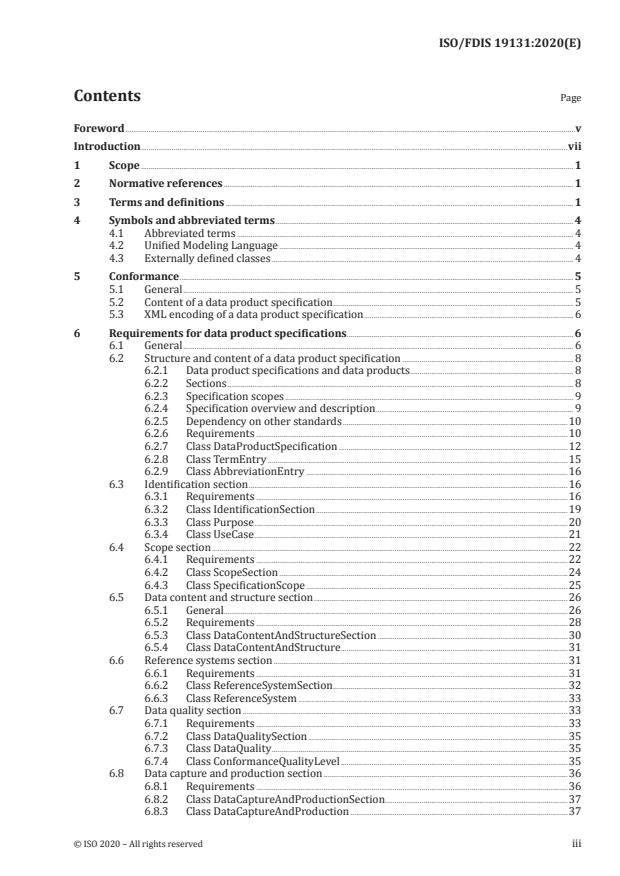
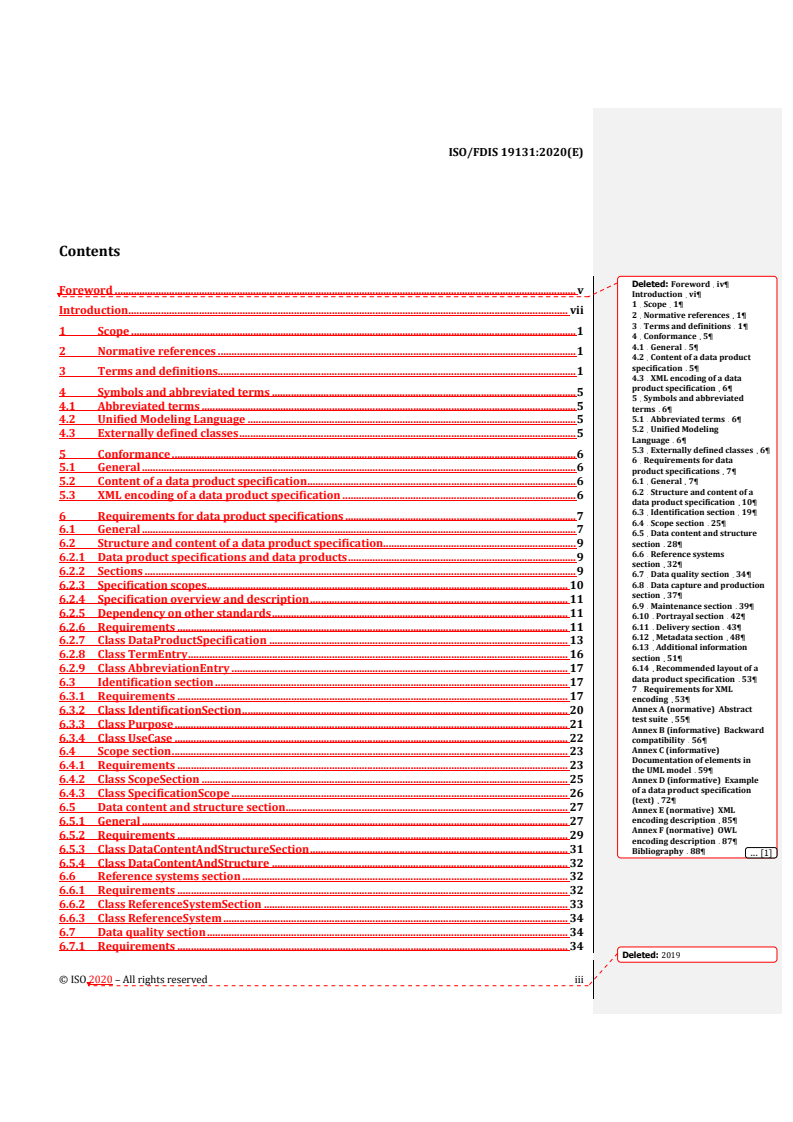
Contents Page
Foreword .v
Introduction .vii
1 Scope . 1
2 Normative references . 1
3 Terms and definitions . 1
4 Symbols and abbreviated terms . 4
4.1 Abbreviated terms . 4
4.2 Unified Modeling Language . 4
4.3 Externally defined classes . 4
5 Conformance . 5
5.1 General . 5
5.2 Content of a data product specification . 5
5.3 XML encoding of a data product specification . 6
6 Requirements for data product specifications. 6
6.1 General . 6
6.2 Structure and content of a data product specification . 8
6.2.1 Data product specifications and data products . 8
6.2.2 Sections . 8
6.2.3 Specification scopes . 9
6.2.4 Specification overview and description . 9
6.2.5 Dependency on other standards .10
6.2.6 Requirements .10
6.2.7 Class DataProductSpecification .12
6.2.8 Class TermEntry .15
6.2.9 Class AbbreviationEntry .16
6.3 Identification section .16
6.3.1 Requirements .16
6.3.2 Class IdentificationSection .19
6.3.3 Class Purpose .20
6.3.4 Class UseCase .21
6.4 Scope section .22
6.4.1 Requirements .22
6.4.2 Class ScopeSection .24
6.4.3 Class SpecificationScope .25
6.5 Data content and structure section .26
6.5.1 General.26
6.5.2 Requirements .28
6.5.3 Class DataContentAndStructureSection .30
6.5.4 Class DataContentAndStructure .31
6.6 Reference systems section .31
6.6.1 Requirements .31
6.6.2 Class ReferenceSystemSection .32
6.6.3 Class ReferenceSystem .33
6.7 Data quality section .33
6.7.1 Requirements .33
6.7.2 Class DataQualitySection .35
6.7.3 Class DataQuality .35
6.7.4 Class ConformanceQualityLevel .35
6.8 Data capture and production section .36
6.8.1 Requirements .36
6.8.2 Class DataCaptureAndProductionSection .37
6.8.3 Class DataCaptureAndProduction .37
6.8.4 Class DataAcquisitionAndProcessing .38
6.9 Maintenance section .39
6.9.1 Requirements .39
6.9.2 Class MaintenanceSection.40
6.9.3 Class Maintenance .40
6.9.4 Class MaintenanceAndUpdateFrequency .41
6.10 Portrayal section .41
6.10.1 Requirements .41
6.10.2 Class PortrayalSection .42
6.10.3 Class Portrayal .43
6.11 Delivery section .43
6.11.1 Requirements .43
6.11.2 Class DeliverySection .45
6.11.3 Class Delivery .45
6.11.4 Class DeliveryFormat .46
6.11.5 Class DeliveryMedium . .47
6.11.6 Class DeliveryService .47
6.11.7 Class ServiceProperty .48
6.12 Metadata section .48
6.12.1 Requirements .48
6.12.2 Class MetadataSection .50
6.12.3 Class Metadata .50
6.12.4 Class MetadataElement .50
6.13 Additional information section .51
6.13.1 Requirements .51
6.13.2 Class AdditionalInformationSection .52
6.13.3 Class AdditionalInformation .52
6.14 Recommended layout of a data product specification .53
7 Requirements for XML encoding .53
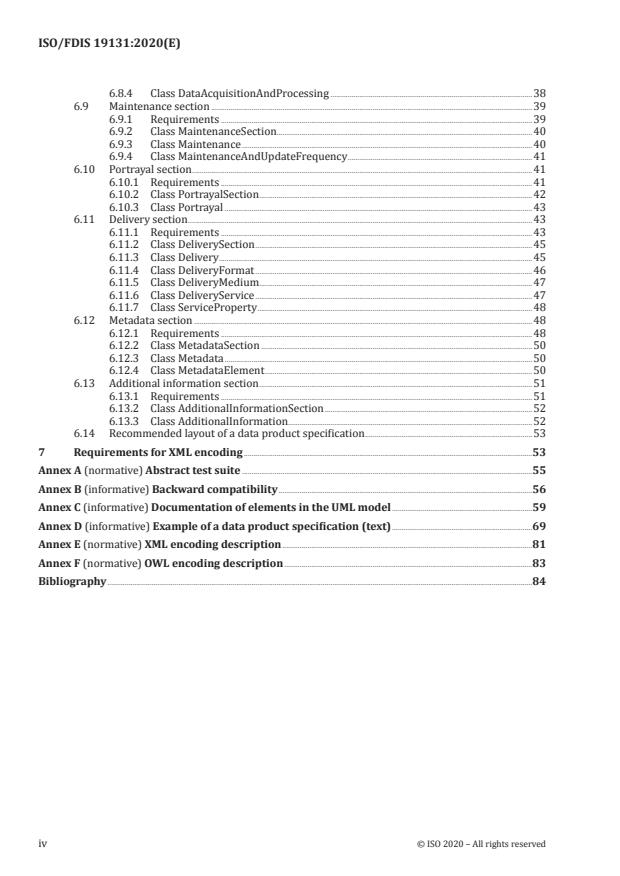
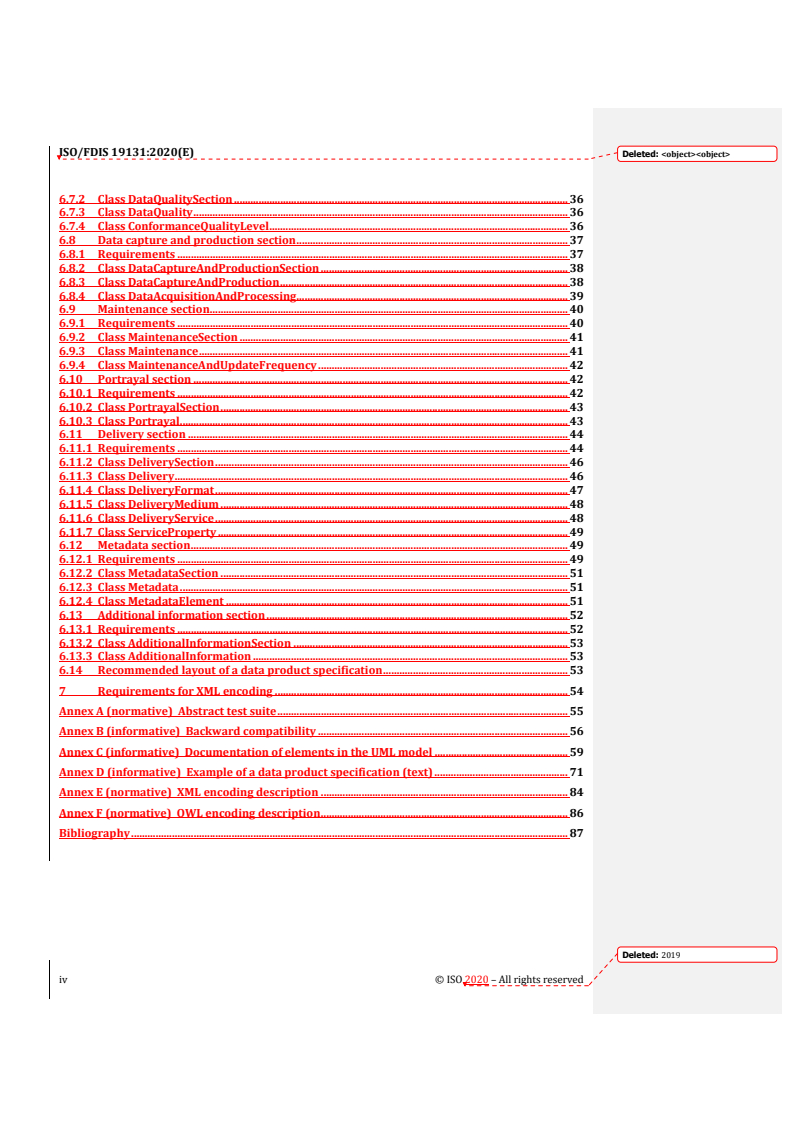
Annex A (normative) Abstract test suite .55
Annex B (informative) Backward compatibility .56
Annex C (informative) Documentation of elements in the UML model .59
Annex D (informative) Example of a data product specification (text) .69
Annex E (normative) XML encoding description .81
Annex F (normative) OWL encoding description .83
Bibliography .84
iv © ISO 2020 – All rights reserved
Foreword
ISO (the International Organization for Standardization) is a worldwide federation of national standards
bodies (ISO member bodies). The work of preparing International Standards is normally carried out
through ISO technical committees. Each member body interested in a subject for which a technical
committee has been established has the right to be represented on that committee. International
organizations, governmental and nongovernmental, in liaison with ISO, also take part in the work.
ISO collaborates closely with the International Electrotechnical Commission (IEC) on all matters of
electrotechnical standardization.
The procedures used to develop this document and those intended for its further maintenance are
described in the ISO/IEC Directives, Part 1. In particular, the different approval criteria needed for the
different types of ISO documents should be noted. This document was drafted in accordance with the
editorial rules of the ISO/IEC Directives, Part 2 (see www .iso .org/ directives).
Attention is drawn to the possibility that some of the elements of this document may be the subject of
patent rights. ISO shall not be held responsible for identifying any or all such patent rights. Details of
any patent rights identified during the development of the document will be in the Introduction and/or
on the ISO list of patent declarations received (see www .iso .org/ patents).
Any trade name used in this document is information given for the convenience of users and does not
constitute an endorsement.
For an explanation of the voluntary nature of standards, the meaning of ISO specific terms and
expressions related to conformity assessment, as well as information about ISO's adherence to the
World Trade Organization (WTO) principles in the Technical Barriers to Trade (TBT), see www .iso .org/
iso/ foreword .html.
This document was prepared by Technical Committee ISO/TC 211, Geographic information/Geomatics.
This second edition cancels and replaces the first edition (ISO 19131:2007), which has been technically
revised. It also incorporates ISO 19131:2007/Amd 1:2011.
The main changes compared to the previous edition are as follows:
— XML encoding has been added;
— Mandatory sections working as place holders have been introduced;
— The UML model has been restructured, introducing new/renamed attributes and elements, and
ISO 19115-1 datatypes have been used where possible.
— New attributes and elements have been introduced to separate information in the Overview.
— In the Identification section:
— the description and identification of the data product has been clearly separated from the
description and identification of the specification;
— the data type for attribute purpose has been changed to allow explanation of the purpose of the
data product using use cases;
— the attribute extent has been changed to allow specification of temporal and vertical extent, in
addition to the geographical extent; and
— a new attribute restriction has been introduced, used to describe handling restrictions of the
data product.
— In the Scope section:
— relations between scopes have been removed (the concept of super and sub scopes); and
— a requirement has been introduced that at least one of the attributes level, levelName, or extent
shall be used for each scope.
— The Data content and structure section has been restructured using elements from ISO 191151.
— In the Reference System section, the data type of the attribute temporalReferenceSystem has been
changed.
— In the Quality section:
— the requirement to list data quality elements that have no defined quality requirements has
been removed; and
— a new attribute requirementId has been introduced, to be able to reference a specific data quality
requirement in other contexts.
— In the Data Capture and Production section, new elements and attributes have been introduced, to
contain information previously located in the attribute. dataCaptureStatement
— In the Maintenance section, information about maintenance has been made mandatory, and the data
type of the attribute maintenanceAndUpdateFrequency has been changed, with a new mandatory
attribute introduced.
— In the Delivery section, a new attribute deliveryService has been introduced.
— The Metadata section has been restructured and new attributes introduced to specify the metadata
standard and encoding to be used, as well as a possibility to describe how specific metadata elements
should be used.
— A recommended layout is introduced.
— A detailed overview regarding changes and backwards compatibility can be found in Annex B.
Any feedback or questions on this document should be directed to the user’s national standards body. A
complete listing of these bodies can be found at www .iso .org/ members .html.
vi © ISO 2020 – All rights reserved
Introduction
A data product specification is a specification of a dataset or dataset series together with additional
information that will enable it to be created, supplied to and used by another party. In this context of
creating, supplying and using data products, the specification thereof is of essence in a controlled and
standardized process leading to interoperability. The data product specification is the final product
in a process that describes the conceptual formalization of semantics and data structure related to
specific requirements or use cases. It is a precise and full description of the data product in terms of the
requirements that it will or may fulfil. A data product specification is primarily a technical document
that may contain non-technical elements such as narrative descriptions of some aspects, like the
overview or data capture statements. However, for various reasons compromises may need to be made
in the implementation.
The purpose of this document is to provide requirements on the content of data product specifications,
in conformance with other existing standards for geographic information. This conformance is at
different levels. Firstly, there is the aspect of a dataset and its metadata conforming to a data product
specification, and secondly that the data product specification conforms to ISO 19131. Some of the
items used to specify the data product in a data product specification can also be used as metadata
for a data product that conforms to the data product specification. Figure 1 shows how a data product
specification relates to datasets and their metadata.
Figure 1 — Relations between ISO 19131, the data product specification and the datasets
A data product specification may be created and used on different occasions, by different parties and
for different reasons. It may, for example, be used for the original process of collecting data as well as
for products derived from already existing data. It may be created by producers to specify their product
or by users to state their requirements.
This document describes the content, structure and encoding of a data product specification.
This document contains URIs for normative statements, conformance classes, conformance tests and
requirements classes. Also, other standards are referenced with URIs. All URIs within the namespace
https:// standards .isotc211 .org/ iso19131/ / 2 are resolvable. URIs outside this namespace may not be
resolvable.
viii © ISO 2020 – All rights reserved
FINAL DRAFT INTERNATIONAL STANDARD ISO/FDIS 19131:2020(E)
Geographic information — Data product specifications
1 Scope
This document describes requirements for the specification of geographic data products, based upon
the concepts of other International Standards in the ISO 19100 family of standards. It also provides
guidance in the creation of data product specifications, so that they are easily understood and fit for
their intended purpose.
This document also specifies XML encoding of data product specifications.
This document provides OWL representation of the underlying UML model. See Annex F.
This document is intended for use by data producers, data providers, service providers and potential
users of data products.
2 Normative references
The following documents are referred to in the text in such a way that some or all of their content
constitutes requirements of this document. For dated references, only the edition cited applies. For
undated references, the latest edition of the referenced document (including any amendments) applies.
ISO 6392, Codes for the representation of names of languages — Part 2: Alpha-3 code
ISO 19103, Geographic information — Conceptual schema language
ISO 19108, Geographic information — Temporal schema
ISO 191151, Geographic information — Metadata — Part 1: Fundamentals
ISO 19157, Geographic information — Data quality
3 Terms and definitions
For the purposes of this document, the following terms and definitions apply.
ISO and IEC maintain terminological databases for use in standardization at the following addresses:
— ISO Online browsing platform: available at https:// www .iso .org/ obp
— IEC Electropedia: available at http:// www .electropedia .org/
3.1
application
manipulation and processing of data in support of user requirements
[SOURCE: ISO 191011:2014, 4.1.1]
3.2
application schema
conceptual schema (3.4) for data required by one or more applications (3.1)
[SOURCE: ISO 191011:2014, 4.1.2]
3.3
conceptual model
model that defines concepts of a universe of discourse (3.23)
[SOURCE: ISO 191011:2014, 4.1.5]
3.4
conceptual schema
formal description of a conceptual model (3.3)
[SOURCE: ISO 191011:2014, 4.1.6]
3.5
conformance quality level
threshold value or set of threshold values for data quality (3.20) results used to determine how well a
dataset (3.10) meets the criteria set forth in its data product specification (3.9) or user requirements
Note 1 to entry: In the context of 19131, dataset refer to data product.
[SOURCE: ISO 19157:2013, 4.4]
3.6
coverage
feature (3.13) that acts as a function to return values from its range for any direct position within its
spatial, temporal or spatiotemporal domain
EXAMPLE Raster image, polygon overlay, digital elevation matrix.
[SOURCE: ISO 19123:2005, 4.1.7, modified - NOTE has been deleted.]
3.7
data capture
action or process of collecting data
Note 1 to entry: The capture can be human interaction (such as field observation) or by computers
3.8
data product
dataset (3.10) or dataset series (3.11) that may be supplied
Note 1 to entry: A data product may contain additional information such as portrayal (3.19), data quality (3.20),
metadata (3.17) and distribution format.
3.9
data product specification
specification (3.21) of a data product (3.8) together with additional information that will enable it to be
created, supplied to and used by another party
Note 1 to entry: A data product specification provides a description of the universe of discourse (3.23) and a
specification for mapping the universe of discourse to a data product. It may be used for production, sales, end-
use or other purposes.
3.10
dataset
identifiable collection of data
Note 1 to entry: A dataset may be a smaller grouping of data which, though limited by some constraint such as
spatial extent or feature (3.13) type, is located physically within a larger dataset. Theoretically, a dataset may be
as small as a single feature or feature attribute (3.15) contained within a larger dataset. A hardcopy map or chart
may be considered a dataset.
[SOURCE: ISO 191151:2014, 4.3]
2 © ISO 2020 – All rights reserved
3.11
dataset series
collection of datasets (3.10) sharing common characteristics
[SOURCE: ISO 191151:2014, 4.4]
3.12
domain
well-defined set
Note 1 to entry: Well-defined means that the definition is both necessary and sufficient, as everything that satisfies
the definition is in the set and everything that does not satisfy the definition is necessarily outside the set.
[SOURCE: ISO 19109:2015, 4.8]
3.13
feature
abstraction of realworld phenomena
Note 1 to entry: A feature may occur as a type or an instance. Feature type or feature instance shall be used when
only one is meant.
[SOURCE: ISO 191011:2014, 4.1.11]
3.14
feature association
relationship that links instances of one feature (3.13) type with instances of the same or a different
feature type
Note 1 to entry: A feature (3.13) association may occur as a type or an instance. Feature association type or
feature association instance is used when only one is meant.
Note 2 to entry: Feature associations include aggregation of features.
[SOURCE: ISO 19110:2016, 3.3]
3.15
feature attribute
characteristic of a feature (3.13)
Note 1 to entry: A feature (3.13) attribute has a name, a data type and a value domain (3.12) associated to it. A
feature attribute for a feature instance has an attribute value taken from the value domain.
Note 2 to entry: A feature (3.13) attribute may occur as a type or an instance. Feature attribute type or feature
attribute instance is used when only one is meant.
[SOURCE: ISO 19101-1:2014, 4.1.12, modified — EXAMPLES 1 and 2 were deleted, Notes 2 and 3 to entry
were deleted and a new Note 2 to entry has been added.]
3.16
geographic data
data with implicit or explicit reference to a location relative to the Earth
Note 1 to entry: Geographic information is also used as a term for information concerning phenomena implicitly
or explicitly associated with a location relative to the Earth.
[SOURCE: ISO 19109:2015, 4.13]
3.17
metadata
information about a resource
[SOURCE: ISO 191151:2014, 4.10]
3.18
model
abstraction of some aspects of reality
3.19
portrayal
representation of information for human interpretation
3.20
quality
degree to which a set of inherent characteristics of an object fulfils requirements
[SOURCE: ISO 9000:2015, 3.6.2, modified – Notes 1 and 2 to entry have been deleted.]
3.21
specification
document stating requirements
[SOURCE: ISO 9000:2015, 3.8.7, modified – Notes 1 and 2 to entry have been deleted.]
3.22
specification scope
definition of a part of a data product (3.8) with certain characteristics
Note 1 to entry: A specification scope may for example be based on spatial or temporal extent, certain feature
(3.13) types or properties or product hierarchy.
3.23
universe of discourse
view of the real or hypothetical world that includes everything of interest
[SOURCE: ISO 191011:2014, 4.1.38]
4 Symbols and abbreviated terms
4.1 Abbreviated terms
This document adopts the following conventions for presentation purposes:
UML Unified Modeling Language
XML Extensible Markup Language
URI Uniform Resource Identifier
OWL Web Ontology Language
4.2 Unified Modeling Language
In this document, conceptual schemas are presented in the Unified Modeling Language (UML).
ISO 19103 presents the specific profile of UML used in this document.
4.3 Externally defined classes
Several model elements used in this document are defined in packages specified in other International
Standards; these are listed in Table 1.
4 © ISO 2020 – All rights reserved
Table 1 — Externally defined classes
Class name Package International standard
CI_Citation Citation ISO 191151
CI_Date Citation ISO 191151
CI_Responsibility Citation ISO 191151
DQ_ConformanceResult Data Quality ISO 19157
DQ_DescriptiveResult Data Quality ISO 19157
DQ_Element Data Quality ISO 19157
DQ_QuantitativeResult Data Quality ISO 19157
EX_Extent Extent ISO 191151
LanguageCode Languagecharacterset localization ISO 191151
LI_ProcessStep Lineage ISO 191151
LI_Source Lineage ISO 191151
MD_ApplicationSchemaInformation Metadata ISO 191151
MD_CharacterSetCode Metadata ISO 191151
MD_ClassificationCode Metadata ISO 191151
MD_Constraints Metadata ISO 191151
MD_ContentInformation Metadata ISO 191151
MD_CoverageDescription Metadata ISO 191151
MD_FeatureCatalogue Metadata ISO 191151
MD_FeatureCatalogueDescription Metadata ISO 191151
MD_Keywords Metadata ISO 191151
MD_MaintenanceFrequencyCode Metadata ISO 191151
MD_ReferenceSystem Metadata ISO 191151
MD_Resolution Metadata ISO 191151
MD_ScopeCode Metadata ISO 191151
MD_SpatialRepresentationTypeCode Metadata ISO 191151
MD_TopicCategoryCode Metadata ISO 191151
MediaType ISO 19103
TM_PeriodDuration Temporal ISO 19108
5 Conformance
5.1 General
In this document two conformance classes are defined, see 5.2 and 5.3. The related tests are provided
in the abstract test suite in Annex A.
Requirements and recommendations are explicitly marked and assigned a requirement identifier or a
recommendation identifier.
5.2 Content of a data product specification
Table 2 describes the conformance class for the content of a data product specification.
Table 2 — Content conformance class
Conformance class https:// standards .isotc211 .org/ 19131/ / 2/ conf/ content
Standardization target type Instance of a data product specification, regardless of data encoding
Table 2 (continued)
Conformance class https:// standards .isotc211 .org/ 19131/ / 2/ conf/ content
Dependency https://st andards. isotc211. org/1 9103/ /1/ (Conceptual schema language):
— Conformance class UML2
— Conformance class CoreExtendedTypes
Classes referred to in this document, as specified in:
https:// standards .isotc211 .org/ 19108/ / 1/ (Temporal schema)
https:// standards .isotc211 .org/ 19115/ 1/ 1/ (Metadata – Part 1:
Fundamentals)
https:// standards .isotc211 .org/ 19157/ / 1/ (Data quality)
Requirements class https:// standards .isotc211 .org/ 19131/ / 2/ req/ content
(see Clause 6)
Tests All tests in A.1
Requirement URIs in Clause 6 are based on https:// standards .isotc211 .org/ 19131/ / 2/ req/ content/
and distinguished by the requirement identifier.
Recommendation URIs in Clause 6 are based on https:// standards .isotc211 .org/ 19131/ / 2/ rec/
optionalContent/ and distinguished by the recommendation identifier.
5.3 XML encoding of a data product specification
Table 3 describes the conformance class for the XML representation of a data product specification.
Table 3 — XML encoding conformance class
Conformance class https:// standards .isotc211 .org/ 19131/ / 2/ conf/ xml
Standardization target type XML document representing a data product specification
Dependency https:// standards .isotc211 .org/ 19131/ / 2/ conf/ content
Requirements class https:// standards .isotc211 .org/ 19131/ / 2/ req/ xml
(see Clause 7)
Tests All tests in A.2
Requirement URIs in Clause 7 are based on https:// standards .isotc211 .org/ 19131/ / 2/ req/ xml/ and
distinguished by the requirement identifier.
6 Requirements for data product specifications
6.1 General
Subclauses 6.2 to 6.13 describe elements of a data product specification based on the conceptual UML
model for ISO 19131 (second edition) being part of the ISO/TC 211 harmonized model. Furthermore,
additional descriptions, requirements and recommendations are included. A compact documentation of
the elements in the UML model is provided in Annex C.
Annex D contains an example of a data product specification's content according to the content in 6.2
to 6.13.
Subclause 6.14 provides a recommendation on how to order the elements described in 6.2 to 6.13 when
human readability is prioritized.
The rules that apply for the content of a data product specification comprise a requirements class
summarized in Table 4.
6 © ISO 2020 – All rights reserved
Table 4 — Requirements class for the content of a data product specification
Requirements class https:// standards .isotc211 .org/ 19131/ / 2/ req/ content
Standardization Instance of a data product specification, regardless of data encoding
target type
Dependency https:// standards .isotc211 .org/ 19103/ / 1/ (Conceptual schema language)
Dependency https:// standards .isotc211 .org/ 19108/ / 1/ (Temporal schema)
Dependency https:// standards .isotc211 .org/ 19115/ 1/ 1/ (Metadata – Part 1: Fundamentals)
Dependency https:// standards .isotc211 .org/ 19157/ / 1/ (Data quality)
Requirement https:// standards .isotc211 .org/ 19131/ / 2/ req/ content/ specification model
Requirement https:// standards .isotc211 .org/ 19131/ / 2/ req/ content/ specification language
Requirement https:// standards .isotc211 .org/ 19131/ / 2/ req/ content/ identification model
Requirement https:// standards .isotc211 .org/ 19131/ / 2/ req/ content/ extent
Requirement https:// standards .isotc211 .org/ 19131/ / 2/ req/ content/ scope model
Requirement https:// standards .isotc211 .org/ 19131/ / 2/ req/ content/ scope cover
Requirement https:// standards .isotc211 .org/ 19131/ / 2/ req/ content/ specification scope
Requirement https:// standards .isotc211 .org/ 19131/ / 2/ req/ content/ scope -identification
Requirement https:// standards .isotc211 .org/ 19131/ / 2/ req/ content/ content model
Requirement https:// standards .isotc211 .org/ 19131/ / 2/ req/ content/ content scope
Requirement https:// standards .isotc211 .org/ 19131/ / 2/ req/ content/ reference model
Requirement https:// standards .isotc211 .org/ 19131/ / 2/ req/ content/ reference scope
Requirement https:// standards .isotc211 .org/ 19131/ / 2/ req/ content/ quality level
Requirement https:// standards .isotc211 .org/ 19131/ / 2/ req/ content/ quality model
Requirement https:// standards .isotc211 .org/ 19131/ / 2/ req/ content/ quality scope
Requirement https:// standards .isotc211 .org/ 19131/ / 2/ req/ content/ capture model
Requirement https:// standards .isotc211 .org/ 19131/ / 2/ req/ content/ capture scope
Requirement https:// standards .isotc211 .org/ 19131/ / 2/ req/ content/ maintenance model
Requirement https:// standards .isotc211 .org/ 19131/ / 2/ req/ content/ maintenance scope
Requirement https:// standards .isotc211 .org/ 19131/ / 2/ req/ content/ maintenance
-updateFrequency
Requirement https:// standards .isotc211 .org/ 19131/ / 2/ req/ content/ portrayal model
Requirement https:// standards .isotc211 .org/ 19131/ / 2/ req/ content/ portrayal scope
Requirement https:// standards .isotc211 .org/ 19131/ / 2/ req/ content/ delivery model
Requirement https:// standards .isotc211 .org/ 19131/ / 2/ req/ content/ delivery scope
Requirement https:// standards .isotc211 .org/ 19131/ / 2/ req/ content/ delivery -specification
Requirement https:// standards .isotc211 .org/ 19131/ / 2/ req/ content/ metadata model
Requirement https:// standards .isotc211 .org/ 19131/ / 2/ req/ content/ metadata scope
Requirement https:// standards .isotc211 .org/ 19131/ / 2/ req/ content/ additional model
Requirement https:// standards .isotc211 .org/ 19131/ / 2/ req/ content/ additional content
In addition to the requirements class in Table 4, a recommendations class is defined in Table 5.
These recommendations, when implemented, can contribute to improved content of a data product
specification. However, recommendations are optional and do not have an impact on the results of
conformance testing, thus the recommendations class in Table 5 is not related to any of the conformance
classes defined in Clause 4.
Table 5 — Recommendations class for the content of a data product specification
Recommendations class https:// standards .isotc211 .org/ 19131/ / 2/ rec/ optionalContent
Standardization Instance of a data product specification, regardless of data encoding
target type
Dependency https:// standards .isotc211 .org/ 19131/ / 2/ req/ content
Recommendation https:// standards .isotc211 .org/ 19131/ / 2/ rec/ optionalContent/ useCase
Recommendation https:// standards .isotc211 .org/ 19131/ / 2/ rec/ optionalContent/ content
features
Recommendation https:// standards .isotc211 .org/ 19131/ / 2/ rec/ optionalContent/ content
coverage
Recommendation https:// standards .isotc211 .org/ 19131/ / 2/ rec/ optionalContent/ content
application
Recommendation https:// standards .isotc211 .org/ 19131/ / 2/ rec/ optionalContent/ content
complete
Recommendation https:// standards .isotc211 .org/ 19131/ / 2/ rec/ optionalContent/ metadata
minimum
Recommendation https:// standards .isotc211 .org/ 19131/ / 2/ rec/ optionalContent/ dps -layout
6.2 Structure and content of a data product specification
6.2.1 Data product specifications and data products
A data product specification defines the requirements for a data product. It forms the basis for
producing, acquiring and exploiting a data product. It may also help potential users to evaluate the data
product to determine its fitness for use.
6.2.2 Sections
A data product specification is divided into sections. Each section covers and specifies a specific aspect
of the data product. All sections are always included in the data product specification, even when
there is no content. This provides a stable and recognizable structure across different data product
specifications.
Each section may be further divided based on specification scopes (see 6.4), to specify different
requirements for different parts of the data product.
This document specifies the following sections:
— identification section, as specified in 6.3;
— Title, abstract
— Use case descriptions
— scope section, as specified in 6.4;
— Different ranges within the data product
— data content and structure section, as specified in 6.5;
— Feature concept dictionary (ISO 19126)
— Feature catalogue (ISO 19110)
8 © ISO 2020 – All rights reserved
— Application schema (ISO 19109)
— reference systems section, as specified in 6.6;
— Coordinate reference systems (ISO 19111)
— System using geographic identifiers (ISO 19112)
— Temporal reference systems (ISO 19108)
— data quality section, as specified in 6.7;
— Data quality measure and threshold values for acceptance (ISO 19157)
— data capture and production section, as specified in 6.8;
— Processing catalogue
— maintenance section, as specified in 6.9;
— Maintenance statement
— portrayal section, as specified in 6.10;
— Portrayal catalogue (ISO 19117)
— Map legend
— delivery section, as specified in 6.11;
— Data media
— Download services
— View services
— metadata section, as
...
© ISO 2020 – All rights reserved
Deleted:
Deleted: 2019
ISO/TC 211
Date: 2020‐02‐12
ISO/TC 211/WG 9
Secretariat: SIS
Geographic information — Data product specifications
Deleted: --
Information géographique — Spécifications de contenu informationnel
Deleted: i
© ISO 2019, Published in Switzerland
All rights reserved. Unless otherwise specified, no part of this publication may be reproduced or
utilized otherwise in any form or by any means, electronic or mechanical, including photocopying,
or posting on the internet or an intranet, without prior written permission. Permission can be
requested from either ISO at the address below or ISO’s member body in the country of the
requester.
ISO copyright office
Ch. de Blandonnet 8 • CP 401
CH‐1214 Vernier, Geneva, Switzerland
Tel. + 41 22 749 01 11 Deleted:
Fax + 41 22 749 09 47 Deleted:
copyright@iso.org
www.iso.org
Deleted: 2019
ii © ISO 2020 – All rights reserved
Contents
Deleted: Foreword iv
Foreword . v
Introduction vi
1 Scope 1
Introduction. vii
2 Normative references 1
3 Terms and definitions 1
1 Scope . 1
4 Conformance 5
4.1 General 5
2 Normative references . 1
4.2 Content of a data product
specification 5
3 Terms and definitions . 1
4.3 XML encoding of a data
product specification 6
4 Symbols and abbreviated terms . 5
5 Symbols and abbreviated
4.1 Abbreviated terms . 5
6
terms
5.1 Abbreviated terms 6
4.2 Unified Modeling Language . 5
5.2 Unified Modeling
4.3 Externally defined classes . 5
Language 6
5.3 Externally defined classes 6
5 Conformance . 6
6 Requirements for data
5.1 General . 6
product specifications 7
6.1 General 7
5.2 Content of a data product specification . 6
6.2 Structure and content of a
5.3 XML encoding of a data product specification . 6
data product specification 10
6.3 Identification section 19
6 Requirements for data product specifications . 7
6.4 Scope section 25
6.1 General . 7
6.5 Data content and structure
6.2 Structure and content of a data product specification. 9 section 28
6.6 Reference systems
6.2.1 Data product specifications and data products . 9
section 32
6.2.2 Sections . 9
6.7 Data quality section 34
6.2.3 Specification scopes . 10 6.8 Data capture and production
section 37
6.2.4 Specification overview and description . 11
6.9 Maintenance section 39
6.2.5 Dependency on other standards . 11
6.10 Portrayal section 42
6.11 Delivery section 43
6.2.6 Requirements . 11
6.12 Metadata section 48
6.2.7 Class DataProductSpecification . 13
6.13 Additional information
6.2.8 Class TermEntry . 16
section 51
6.14 Recommended layout of a
6.2.9 Class AbbreviationEntry . 17
data product specification 53
6.3 Identification section . 17
7 Requirements for XML
6.3.1 Requirements . 17
encoding 53
Annex A (normative) Abstract
6.3.2 Class IdentificationSection . 20
test suite 55
6.3.3 Class Purpose . 21
Annex B (informative) Backward
6.3.4 Class UseCase . 22
compatibility 56
Annex C (informative)
6.4 Scope section . 23
Documentation of elements in
6.4.1 Requirements . 23
the UML model 59
6.4.2 Class ScopeSection . 25 Annex D (informative) Example
of a data product specification
6.4.3 Class SpecificationScope . 26
(text) 72
6.5 Data content and structure section. 27
Annex E (normative) XML
encoding description 85
6.5.1 General . 27
Annex F (normative) OWL
6.5.2 Requirements . 29
encoding description 87
6.5.3 Class DataContentAndStructureSection . 31
Bibliography 88
... [1]
6.5.4 Class DataContentAndStructure . 32
6.6 Reference systems section . 32
6.6.1 Requirements . 32
6.6.2 Class ReferenceSystemSection . 33
6.6.3 Class ReferenceSystem . 34
6.7 Data quality section . 34
6.7.1 Requirements . 34
Deleted: 2019
© ISO 2020 – All rights reserved iii
6.7.2 Class DataQualitySection . 36
6.7.3 Class DataQuality . 36
6.7.4 Class ConformanceQualityLevel . 36
6.8 Data capture and production section . 37
6.8.1 Requirements . 37
6.8.2 Class DataCaptureAndProductionSection . 38
6.8.3 Class DataCaptureAndProduction . 38
6.8.4 Class DataAcquisitionAndProcessing . 39
6.9 Maintenance section. 40
6.9.1 Requirements . 40
6.9.2 Class MaintenanceSection . 41
6.9.3 Class Maintenance . 41
6.9.4 Class MaintenanceAndUpdateFrequency . 42
6.10 Portrayal section . 42
6.10.1 Requirements . 42
6.10.2 Class PortrayalSection . 43
6.10.3 Class Portrayal . 43
6.11 Delivery section . 44
6.11.1 Requirements . 44
6.11.2 Class DeliverySection . 46
6.11.3 Class Delivery . 46
6.11.4 Class DeliveryFormat . 47
6.11.5 Class DeliveryMedium . 48
6.11.6 Class DeliveryService . 48
6.11.7 Class ServiceProperty . 49
6.12 Metadata section . 49
6.12.1 Requirements . 49
6.12.2 Class MetadataSection . 51
6.12.3 Class Metadata . 51
6.12.4 Class MetadataElement . 51
6.13 Additional information section . 52
6.13.1 Requirements . 52
6.13.2 Class AdditionalInformationSection . 53
6.13.3 Class AdditionalInformation . 53
6.14 Recommended layout of a data product specification . 53
7 Requirements for XML encoding . 54
Annex A (normative) Abstract test suite . 55
Annex B (informative) Backward compatibility . 56
Annex C (informative) Documentation of elements in the UML model . 59
Annex D (informative) Example of a data product specification (text) . 71
Annex E (normative) XML encoding description . 84
Annex F (normative) OWL encoding description . 86
Bibliography . 87
Deleted: 2019
iv © ISO 2020 – All rights reserved
Foreword
ISO (the International Organization for Standardization) is a worldwide federation of national
standards bodies (ISO member bodies). The work of preparing International Standards is normally
carried out through ISO technical committees. Each member body interested in a subject for which a
technical committee has been established has the right to be represented on that committee.
International organizations, governmental and non‐governmental, in liaison with ISO, also take part in
the work. ISO collaborates closely with the International Electrotechnical Commission (IEC) on all
matters of electrotechnical standardization.
The procedures used to develop this document and those intended for its further maintenance are
described in the ISO/IEC Directives, Part 1. In particular, the different approval criteria needed for the
different types of ISO documents should be noted. This document was drafted in accordance with the
editorial rules of the ISO/IEC Directives, Part 2 (see www.iso.org/directives).
Attention is drawn to the possibility that some of the elements of this document may be the subject of
patent rights. ISO shall not be held responsible for identifying any or all such patent rights. Details of
any patent rights identified during the development of the document will be in the Introduction and/or
on the ISO list of patent declarations received (see www.iso.org/patents).
Any trade name used in this document is information given for the convenience of users and does not
constitute an endorsement.
For an explanation of the voluntary nature of standards, the meaning of ISO specific terms and
expressions related to conformity assessment, as well as information about ISO's adherence to the
World Trade Organization (WTO) principles in the Technical Barriers to Trade (TBT), Deleted: )
see www.iso.org/iso/foreword.html.
This document was prepared by Technical Committee ISO/TC 211, Geographic information/Geomatics. Deleted: The committee responsible
for this
This second edition cancels and replaces the first edition (ISO 19131:2007), which has been technically Deleted: is
revised. It also incorporates ISO 19131:2007/Amd 1:2011.
The main changes compared to the previous edition are as follows:
Deleted: The main changes compared
— XML encoding has been added;
to the previous edition are as follows:
— Mandatory sections working as place holders have been introduced; Deleted: are
— The UML model has been restructured, introducing new/renamed attributes and elements, and Deleted: is
ISO 19115‐1 datatypes have been used where possible.
Deleted:
Deleted: :2014
— New attributes and elements have been introduced to separate information in the Overview.
Deleted: are
Deleted: ;
— In the Identification section:
Deleted: are
— the description and identification of the data product has been clearly separated from the
Deleted: ;
description and identification of the specification;
Deleted: ,
Deleted: is
— the data type for attribute purpose has been changed to allow explanation of the purpose of the
data product using use cases; Deleted: is
Deleted: extent
— the attribute extent has been changed to allow specification of temporal and vertical extent, in
Deleted: is
addition to the geographical extent; and
Deleted: 2019
© ISO 2020 – All rights reserved v
— a new attribute restriction has been introduced, used to describe handling restrictions of the Deleted: is
data product.
Deleted: ;
— In the Scope section: Deleted: ,
— relations between scopes have been removed (the concept of super and sub scopes); and Deleted: are
— a requirement has been introduced that at least one of the attributes level, levelName, or extent Deleted: is
shall be used for each scope.
Deleted: ;
— The Data content and structure section has been restructured using elements from ISO 19115‐1. Deleted: is
Deleted:
— In the Reference System section, the data type of the attribute temporalReferenceSystem has been
Deleted: :2014;
changed.
Deleted: is
Deleted: ;
— In the Quality section:
Deleted: ,
— the requirement to list data quality elements that have no defined quality requirements has
Deleted: is
been removed; and
— a new attribute requirementId has been introduced, to be able to reference a specific data Deleted: is
quality requirement in other contexts.
Deleted: ;
— In the Data Capture and Production section, new elements and attributes have been introduced, to Deleted: are
contain information previously located in the attribute. dataCaptureStatement
Deleted: attribute;
— In the Maintenance section, information about maintenance has been made mandatory, and the Deleted: is
data type of the attribute maintenanceAndUpdateFrequency has been changed, with a new
Deleted: is
mandatory attribute introduced.
Deleted: ;
— In the Delivery section, a new attribute deliveryService has been introduced. Deleted: is
Deleted: ;
— The Metadata section has been restructured and new attributes introduced to specify the metadata
Deleted: is
standard and encoding to be used, as well as a possibility to describe how specific metadata
elements should be used. Deleted: ;
— A recommended layout is introduced. Deleted: ;
— A detailed overview regarding changes and backwards compatibility can be found in Annex B.
Any feedback or questions on this document should be directed to the user’s national standards body. A
complete listing of these bodies can be found at www.iso.org/members.html.
Deleted: 2019
vi © ISO 2020 – All rights reserved
Introduction
A data product specification is a specification of a dataset or dataset series together with additional
information that will enable it to be created, supplied to and used by another party. In this context of
creating, supplying and using data products, the specification thereof is of essence in a controlled and
standardized process leading to interoperability. The data product specification is the final product in a
process that describes the conceptual formalization of semantics and data structure related to specific
requirements or use cases. It is a precise and full description of the data product in terms of the
requirements that it will or may fulfil. A data product specification is primarily a technical document
that may contain non‐technical elements such as narrative descriptions of some aspects, like the
overview or data capture statements. However, for various reasons compromises may need to be made
in the implementation. Deleted:
The purpose of this document is to provide requirements on the content of data product specifications,
in conformance with other existing standards for geographic information. This conformance is at
Deleted: First
different levels. Firstly, there is the aspect of a dataset and its metadata conforming to a data product
specification, and secondly that the data product specification conforms to ISO 19131. Some of the
Deleted: second
items used to specify the data product in a data product specification can also be used as metadata for a
data product that conforms to the data product specification. Figure 1 shows how a data product Deleted:
specification relates to datasets and their metadata.
specifies
requ
is described by
describes a
includes
description
Deleted:
Formatted: Font: 0 pt
Formatted: Font:
Deleted: 2019
© ISO 2020 – All rights reserved vii
Deleted:
Figure 1 — Relations between ISO 19131, the data product specification and the datasets
Deleted:
A data product specification may be created and used on different occasions, by different parties and for
different reasons. It may, for example, be used for the original process of collecting data as well as for
products derived from already existing data. It may be created by producers to specify their product or
by users to state their requirements.
This document describes the content, structure and encoding of a data product specification.
This document contains URIs for normative statements, conformance classes, conformance tests and
requirements classes. Also, other standards are referenced with URIs. All URIs within the
namespace https://standards.isotc211.org/iso19131/‐/2 are resolvable. URIs outside this namespace
may not be resolvable.
Deleted: 2019
viii © ISO 2020 – All rights reserved
FINAL DRAFT INTERNATIONAL STANDARD ISO/FDIS 19131:2020(E)
Geographic information — Data product specifications
1 Scope
This document describes requirements for the specification of geographic data products, based upon
the concepts of other International Standards in the ISO 19100 family of standards. It also provides
guidance in the creation of data product specifications, so that they are easily understood and fit for Deleted: help
their intended purpose.
This document also specifies XML encoding of data product specifications.
This document provides OWL representation of the underlying UML model. See Annex F.
This document is intended for use by data producers, data providers, service providers and potential
users of data products.
2 Normative references
The following documents are referred to in the text in such a way that some or all of their content
constitutes requirements of this document. For dated references, only the edition cited applies. For
undated references, the latest edition of the referenced document (including any amendments) applies.
ISO 639‐2, Codes for the representation of names of languages — Part 2: Alpha-3 code Deleted: (all parts),
ISO 19103, Geographic information — Conceptual schema language Deleted: :2015
ISO 19108, Geographic information — Temporal schema Deleted: :2002
ISO 19115‐1, Geographic information — Metadata — Part 1: Fundamentals Deleted: :2014
Deleted:
ISO 19157, Geographic information — Data quality
Deleted: ISO/TS 19139‐1:2019,
Geographic information — XML schema
implementations — Part 1: Encoding
Rules
3 Terms and definitions
Deleted: :2013
For the purposes of this document, the following terms and definitions apply.
ISO and IEC maintain terminological databases for use in standardization at the following addresses:
— ISO Online browsing platform: available at https://www.iso.org/obp Field Code Changed
— IEC Electropedia: available at http://www.electropedia.org/
3.1 Deleted: In the ISO Online browsing
platform, only terms and definitions
application
from the ISO/TC 211 committee applies.
manipulation and processing of data in support of user requirements
[SOURCE: ISO 19101‐1:2014, 4.1.1]
3.2
application schema
Deleted: 2019
© ISO 2020 – All rights reserved 1
conceptual schema (3.4) for data required by one or more applications (3.1)
[SOURCE: ISO 19101‐1:2014, 4.1.2]
3.3
conceptual model
Deleted: 24
model that defines concepts of a universe of discourse (3.23)
[SOURCE: ISO 19101‐1:2014, 4.1.5]
3.4
conceptual schema
formal description of a conceptual model (3.3)
[SOURCE: ISO 19101‐1:2014, 4.1.6]
3.5
conformance quality level
threshold value or set of threshold values for data quality (3.20) results used to determine how well a
dataset (3.10) meets the criteria set forth in its data product specification (3.9) or user requirements
Note 1 to entry: In the context of 19131, dataset refer to data product.
Moved (insertion) [1]
[SOURCE: ISO 19157:2013, 4.4]
3.6 Moved up [1]: Note 1 to entry: In the
context of 19131, dataset refer to data
coverage
product.
feature (3.13) that acts as a function to return values from its range for any direct position within its
Deleted: 
spatial, temporal or spatiotemporal domain
EXAMPLE Raster image, polygon overlay, digital elevation matrix.
[SOURCE: ISO 19123:2005, 4.1.7, modified ‐ NOTE has been deleted.]
3.7
data capture
action or process of collecting data
Note 1 to entry: The capture can be human interaction (such as field observation) or by computers
3.8 Deleted: [SOURCE: Oxford Advanced
Learner’s Dictionary]
data product
dataset (3.10) or dataset series (3.11) that may be supplied Deleted: 11
Deleted: 12
Note 1 to entry: A data product may contain additional information such as portrayal (3.19), data quality (3.20),
Deleted:
metadata (3.17) and distribution format.
Deleted: ,
3.9 Deleted: ,
data product specification
specification (3.21) of a data product (3.8) together with additional information that will enable it to be Deleted: 22
created, supplied to and used by another party
Note 1 to entry: A data product specification provides a description of the universe of discourse (3.23) and a
Deleted: 24
specification for mapping the universe of discourse to a data product. It may be used for production, sales, end‐use
or other purposes.
3.10
Deleted: 2019
2 © ISO 2020 – All rights reserved
dataset Deleted: data production
action or process of processing data
identifiable collection of data
prior to supplying it
3.11
Note 1 to entry: A dataset may be a smaller grouping of data which, though limited by some constraint such as
spatial extent or feature (3.13) type, is located physically within a larger dataset. Theoretically, a dataset may be as
small as a single feature or feature attribute (3.15) contained within a larger dataset. A hardcopy map or chart
may be considered a dataset.
[SOURCE: ISO 19115‐1:2014, 4.3]
3.11 Deleted: 12
dataset series
collection of datasets (3.10) sharing common characteristics Deleted: 11
[SOURCE: ISO 19115‐1:2014, 4.4]
3.12 Deleted: 13
domain
well‐defined set
Note 1 to entry: Well‐defined means that the definition is both necessary and sufficient, as everything that satisfies
Deleted: “
the definition is in the set and everything that does not satisfy the definition is necessarily outside the set.
Deleted: ”
[SOURCE: ISO 19109:2015, 4.8]
3.13 Deleted: 14
feature
abstraction of real‐world phenomena
Note 1 to entry: A feature may occur as a type or an instance. Feature type or feature instance shall be used when
only one is meant.
[SOURCE: ISO 19101‐1:2014, 4.1.11]
3.14 Deleted: 15
feature association
relationship that links instances of one feature (3.13) type with instances of the same or a different Deleted: 14
feature type
Note 1 to entry: A feature (3.13) association may occur as a type or an instance. Feature association type or
feature association instance is used when only one is meant.
Note 2 to entry: Feature associations include aggregation of features.
[SOURCE: ISO 19110:2016, 3.3]
3.15 Deleted: 16
feature attribute
characteristic of a feature (3.13) Deleted: 14
Note 1 to entry: A feature (3.13) attribute has a name, a data type and a value domain (3.12) associated to it. A
Deleted: Note 1 to entry: A feature
feature attribute for a feature instance has an attribute value taken from the value domain.
Note 2 to entry: A feature (3.13) attribute may occur as a type or an instance. Feature attribute type or feature
attribute instance is used when only one is meant.
Deleted: 2019
© ISO 2020 – All rights reserved 3
[SOURCE: ISO 19101‐1:2014, 4.1.12, modified — EXAMPLES 1 and 2 were deleted, Notes 2 and 3 to Deleted: Note 2 to entry: A feature
attribute type has a name, a data type
entry were deleted and a new Note 2 to entry has been added.]
and a domain (3.13) associated with it. A
feature attribute for a feature instance
3.16 has an attribute value taken from the
domain.
geographic data
Deleted: 17
data with implicit or explicit reference to a location relative to the Earth
Note 1 to entry: Geographic information is also used as a term for information concerning phenomena implicitly
or explicitly associated with a location relative to the Earth.
[SOURCE: ISO 19109:2015, 4.13]
3.17 Deleted: 18
metadata
information about a resource
[SOURCE: ISO 19115‐1:2014, 4.10]
3.18 Deleted: 19
model
abstraction of some aspects of reality
Deleted: 20
3.19
portrayal
representation of information for human interpretation
Deleted: [SOURCE: ISO 19117:2012,
3.20
4.20, modified – Note 1 to entry has
quality
been deleted.]
degree to which a set of inherent characteristics of an object fulfils requirements
3.21
[SOURCE: ISO 9000:2015, 3.6.2, modified – Notes 1 and 2 to entry have been deleted.]
Deleted: 22
3.21
specification
document stating requirements
Deleted: has
[SOURCE: ISO 9000:2015, 3.8.7, modified – Notes 1 and 2 to entry have been deleted.]
Deleted: 23
3.22
specification scope
definition of a part of a data product (3.8) with certain characteristics
Note 1 to entry: A specification scope may for example be based on spatial or temporal extent, certain feature
(3.13) types or properties or product hierarchy.
Deleted: 14
3.23 Deleted: 24
universe of discourse
view of the real or hypothetical world that includes everything of interest
[SOURCE: ISO 19101‐1:2014, 4.1.38]
Deleted: 2019
4 © ISO 2020 – All rights reserved
Moved (insertion) [2]
4 Symbols and abbreviated terms
4.1 Abbreviated terms
This document adopts the following conventions for presentation purposes:
UML Unified Modeling Language
Moved (insertion) [3]
XML Extensible Markup Language
URI Uniform Resource Identifier
OWL Web Ontology Language
4.2 Unified Modeling Language
In this document, conceptual schemas are presented in the Unified Modeling Language (UML).
ISO 19103 presents the specific profile of UML used in this document. Moved (insertion) [4]
4.3 Externally defined classes
Several model elements used in this document are defined in packages specified in other International
Standards; these are listed in Table 1.
Moved (insertion) [5]
Table 1 — Externally defined classes
Class name Package International standard
CI_Citation Citation ISO 19115‐1
CI_Date Citation ISO 19115‐1
CI_Responsibility Citation ISO 19115‐1
DQ_ConformanceResult Data Quality ISO 19157
DQ_DescriptiveResult Data Quality ISO 19157
DQ_Element Data Quality ISO 19157
DQ_QuantitativeResult Data Quality ISO 19157
EX_Extent Extent ISO 19115‐1
LanguageCode Language‐characterset localization ISO 19115‐1
LI_ProcessStep Lineage ISO 19115‐1
LI_Source Lineage ISO 19115‐1
MD_ApplicationSchemaInformation Metadata ISO 19115‐1
MD_CharacterSetCode Metadata ISO 19115‐1
MD_ClassificationCode Metadata ISO 19115‐1
MD_Constraints Metadata ISO 19115‐1
MD_ContentInformation Metadata ISO 19115‐1
MD_CoverageDescription Metadata ISO 19115‐1
MD_FeatureCatalogue Metadata ISO 19115‐1
MD_FeatureCatalogueDescription Metadata ISO 19115‐1
MD_Keywords Metadata ISO 19115‐1
MD_MaintenanceFrequencyCode Metadata ISO 19115‐1
MD_ReferenceSystem Metadata ISO 19115‐1
Deleted: 2019
© ISO 2020 – All rights reserved 5
Class name Package International standard
MD_Resolution Metadata ISO 19115‐1
MD_ScopeCode Metadata ISO 19115‐1
MD_SpatialRepresentationTypeCode Metadata ISO 19115‐1
MD_TopicCategoryCode Metadata ISO 19115‐1
MediaType ISO 19103
TM_PeriodDuration Temporal ISO 19108
5 Conformance
5.1 General
In this document two conformance classes are defined, see 5.2 and 5.3. The related tests are provided in Deleted: 4
the abstract test suite in Annex A.
Deleted: 4
Requirements and recommendations are explicitly marked and assigned a requirement identifier or a
recommendation identifier.
5.2 Content of a data product specification
Deleted: 1
Table 2 describes the conformance class for the content of a data product specification.
Deleted: 1
Table 2 — Content conformance class
Deleted: https://standards.isotc211.
Conformance class https://standards.isotc211.org/19131/-/2/conf/content
org/19131/-/2/conf/content
Standardization target type Instance of a data product specification, regardless of data encoding
Deleted: https://standards.isotc211.or
Dependency https://standards.isotc211.org/19103/‐/1/ (Conceptual schema
g/19103/‐/1/
language):
— Conformance class UML2
Deleted: 
— Conformance class CoreExtendedTypes
Moved down [6]: Classes referred to
in this document, as specified in:
Deleted: https://standards.isotc211.or
Classes referred to in this document, as specified in:
g/19108/‐/1/ (Temporal schema)
https://standards.isotc211.org/19115/‐
https://standards.isotc211.org/19108/‐/1/ (Temporal schema)
1/1/ (Metadata – Part 1: Fundamentals)
https://standards.isotc211.org/19157
https://standards.isotc211.org/19115/‐1/1/ (Metadata – Part 1:
/‐/1/ (Data quality)
Fundamentals)
Moved (insertion) [6]
https://standards.isotc211.org/19157/‐/1/ (Data quality)
Deleted: https://standards.isotc211.or
Requirements class https://standards.isotc211.org/19131/‐/2/req/content
g/19131/‐/2/req/content
(see Clause 6)
(see Clause 6)
Tests All tests in A.1
Deleted: 
Requirement URIs in Clause 6 are based on https://standards.isotc211.org/19131/‐/2/req/content/
and distinguished by the requirement identifier.
Deleted: https://standards.isotc211.or
g/19131/‐/2/req/content/
Recommendation URIs in Clause 6 are based on https://standards.isotc211.org/19131/‐
Deleted: https://standards.isotc211.or
/2/rec/optionalContent/ and distinguished by the recommendation identifier.
g/19131/‐/2/rec/optionalContent/
5.3 XML encoding of a data product specification
Deleted: 2
Table 3 describes the conformance class for the XML representation of a data product specification.
Deleted: 2019
6 © ISO 2020 – All rights reserved
Deleted: 2
Table 3 — XML encoding conformance class
Deleted: https://standards.isotc211.
Conformance class https://standards.isotc211.org/19131/-/2/conf/xml
org/19131/-/2/conf/xml
Standardization target type XML document representing a data product specification
Deleted: https://standards.isotc211.or
Dependency https://standards.isotc211.org/19131/‐/2/conf/content
g/19131/‐/2/conf/content
Requirements class https://standards.isotc211.org/19131/‐/2/req/xml
Deleted: https://standards.isotc211.or
(see Clause 7)
g/19131/‐/2/req/xml
(see Clause 7)
Tests All tests in A.2
Requirement URIs in Clause 7 are based on https://standards.isotc211.org/19131/‐/2/req/xml/ and Deleted: https://standards.isotc211.or
g/19131/‐/2/req/xml/
distinguished by the requirement identifier.
Moved up [2]: Symbols and
abbreviated terms
Abbreviated terms
6.1
Deleted: This document adopts the
following convention for presentation
purposes:
UML
... [2]
Moved up [3]: XML
6.2
Deleted: ISO
Moved up [4]: 19103 presents the
6.3
specific profile of UML used in this
document.
Externally defined classes
Several model elements used in this
document are defined in packages
specified in other International
Standards; these are listed in Table
Deleted: 3.
7 Requirements for data product specifications
Table 3
Moved up [5]: — Externally defined
classes
7.1 General
Class name
Deleted: CI_Citation
Subclauses 6.2 to 6.13 describe elements of a data product specification based on the conceptual UML . [3]
model for ISO 19131 (second edition) being part of the ISO/TC 211 harmonized model. Furthermore, Deleted:
additional descriptions, requirements and recommendations are included. A compact documentation of
the elements in the UML model is provided in Annex C.
Annex D contains an example of a data product specification's content according to the content in 6.2 to
6.13.
Subclause 6.14 provides a recommendation on how to order the elements described in 6.2 to 6.13 when
human readability is prioritized.
The rules that apply for the content of a data product specification comprise a requirements class
summarized in Table 4. Deleted:
Deleted:
Table 4 — Requirements class for the content of a data product specification
Deleted: https://standards.isotc211.
Requirements class https://standards.isotc211.org/19131/-/2/req/content
org/19131/-/2/req/content
Standardization Instance of a data product specification, regardless of data encoding
target type
Deleted: 2019
© ISO 2020 – All rights reserved 7
Deleted: https://standards.isotc211.or
Dependency https://standards.isotc211.org/19103/‐/1/ (Conceptual schema language)
g/19103/‐/1/
Dependency https://standards.isotc211.org/19108/‐/1/ (Temporal schema)
Deleted: https://standards.isotc211.or
g/19108/‐/1/
Dependency https://standards.isotc211.org/19115/‐1/1/ (Metadata – Part 1:
Deleted: https://standards.isotc211.or
Fundamentals)
g/19115/‐1/1/
Dependency https://standards.isotc211.org/19157/‐/1/ (Data quality)
Deleted: https://standards.isotc211.or
g/19157/‐/1/ (Data quality)
Requirement https://standards.isotc211.org/19131/‐/2/req/content/specification‐model
Deleted: https://standards.isotc211.or
Requirement https://standards.isotc211.org/19131/‐/2/req/content/specification‐language
g/19131/‐
/2/req/content/specification‐model
Requirement https://standards.isotc211.org/19131/‐/2/req/content/identification‐model
Deleted: https://standards.isotc211.or
Requirement https://standards.isotc211.org/19131/‐/2/req/content/extent g/19131/‐
/2/req/content/specification‐language
Requirement https://standards.isotc211.org/19131/‐/2/req/content/scope‐model
Deleted: https://standards.isotc211.or
g/19131/‐
Requirement https://standards.isotc211.org/19131/‐/2/req/content/scope‐cover
/2/req/content/identification‐model
Requirement https://standards.isotc211.org/19131/‐/2/req/content/specification‐scope
Deleted: https://standards.isotc211.or
g/19131/‐/2/req/content/extent
Requirement https://standards.isotc211.org/19131/‐/2/req/content/scope‐identification
Deleted: https://standards.isotc211.or
Requirement https://standards.isotc211.org/19131/‐/2/req/content/content‐model
g/19131/‐/2/req/content/scope‐model
Requirement https://standards.isotc211.org/19131/‐/2/req/content/content‐scope Deleted: https://standards.isotc211.or
g/19131/‐/2/req/content/scope‐cover
Requirement https://standards.isotc211.org/19131/‐/2/req/content/reference‐model
Deleted: https://standards.isotc211.or
... [4]
Requirement https://standards.isotc211.org/19131/‐/2/req/content/reference‐scope
Deleted: https://standards.isotc211.or
... [5]
Requirement https://standards.isotc211.org/19131/‐/2/req/content/quality‐level Deleted: https://standards.isotc211.or
... [6]
Deleted: https://standards.isotc211.or
... [7]
Requirement https://standards.isotc211.org/19131/‐/2/req/content/quality‐model
Deleted: https://standards.isotc211.or
... [8]
Requirement https://standards.isotc211.org/19131/‐/2/req/content/quality‐scope
Deleted: https://standards.isotc211.or
... [9]
Requirement https://standards.isotc211.org/19131/‐/2/req/content/capture‐model
Deleted: https://standards.isotc211.or
... [10]
Requirement https://standards.isotc211.org/19131/‐/2/req/content/capture‐scope
Deleted: https://standards.isotc211.or
... [11]
Requirement https://standards.isotc211.org/19131/‐/2/req/content/maintenance‐model Deleted: https://standards.isotc211.or
... [12]
Deleted: https://standards.isotc211.or
... [13]
Requirement https://standards.isotc211.org/19131/‐/2/req/content/maintenance‐scope
Deleted: https://standards.isotc211.or
... [14]
Requirement https://standards.isotc211.org/19131/‐/2/req/content/maintenance‐
Deleted: https:
...
Questions, Comments and Discussion
Ask us and Technical Secretary will try to provide an answer. You can facilitate discussion about the standard in here.
Loading comments...