

ISO 20430:2020
(Main)Plastics and rubber machines — Injection moulding machines — Safety requirements
General Information
- Abstract
This document specifies the essential safety requirements for the design and construction of injection moulding machines for the processing of plastics and/or rubber and provides information for their safe use. This document is applicable only to injection moulding machines with hydraulic and/or electrical drives for platen movement. This document deals with all significant hazards, hazardous situations and events relevant to injection moulding machines, when they are used as intended and under conditions of misuse which are reasonably foreseeable by the manufacturer (see Annex A) during the life cycle of the machinery (see ISO 12100:2010, 5.4). The following are not covered: — machines on which the clamping unit can only be operated by the physical force of the operator; — machines for which the hydraulic jack can only be manually operated; — injection blow moulding machines; — machines for reaction injection moulding; — compression moulding machines and transfer moulding machines; — direct-on sole moulding machines, unit sole and footwear component moulding machines, full shoe and boot moulding machines; — design of an exhaust system; — design and construction of the mould. NOTE Moulds and exhaust systems are not part of the machinery. This document is not applicable to injection moulding machines which are manufactured before the date of its publication.
- Status
- Published
- Publication Date
- 21-Apr-2020
- Technical Committee
- ISO/TC 270 - Plastics and rubber machines
- Drafting Committee
- ISO/TC 270/WG 1 - Safety of injection moulding machines
- Current Stage
- 9093 - International Standard confirmed
- Start Date
- 17-Nov-2025
- Completion Date
- 29-Aug-2026
Buy Documents

ISO 20430:2020 - Plastics and rubber machines -- Injection moulding machines -- Safety requirements
ISO 20430:2020 - Plastics and rubber machines — Injection moulding machines — Safety requirements/22/2020
ISO 20430:2020 - Machines pour les matieres plastiques et le caoutchouc -- Machines de moulage par injection -- Prescription de sécurité
ISO 20430:2020 - Machines pour les matières plastiques et le caoutchouc — Machines de moulage par injection — Prescription de sécurité/22/2020
Overview
ISO 20430:2020 - Plastics and rubber machines - Injection moulding machines - Safety requirements - specifies the essential safety requirements for the design, construction and safe use of injection moulding machines for plastics and/or rubber. It applies to machines with hydraulic and/or electrical drives for platen movement and addresses significant hazards during the machine life cycle, including reasonably foreseeable misuse (see ISO 12100:2010). The standard excludes certain machine types (for example, manual-only clamping or hydraulic jack operation, injection blow moulding, reaction injection, compression/transfer moulding, and mould or exhaust system design).
Key topics and technical requirements
ISO 20430:2020 organizes safety measures by area and function. Major technical topics include:
- General safety principles and risk reduction measures aligned with ISO 12100.
- Start, stop, restart functions and emergency stop (E‑stop) design and performance.
- Guards and presence-sensing devices, including ESPE (e.g., light curtains), pressure-sensitive mats/floors/edges, and power-operated guards.
- Two‑hand control devices, acknowledging systems and requirements for use in the mould area.
- Mould area safety: closing movements, thermal hazards, whole‑body access, and additional protections for downstroking/upstroking platens.
- Clamping, injection unit, nozzle and ejection areas: mechanical and thermal hazards and requirements for cores/ejectors outside the mould.
- Hydraulic, pneumatic, electrical and hose‑related hazards, plus electromagnetic interference and fluid release protections.
- Noise, fumes, gases, slip/trip hazards, maintenance/adjustment safety and information for use (instruction handbook, marking, warning signs).
- Verification and testing procedures and normative annexes covering protective types, two‑hand devices, proportional valve use, and a noise test code.
Practical applications and who uses this standard
ISO 20430:2020 is used to:
- Guide machine builders and designers in developing compliant injection moulding machines.
- Support safety engineers, risk assessors and compliance officers in evaluating machine safety and preparing instruction handbooks.
- Inform plant managers, maintenance teams and operators about safe operation, guarding, emergency procedures and maintenance practices.
- Assist notified bodies and certification organizations performing conformity assessments and verification tests.
- Help procurement teams specify safety requirements when purchasing injection moulding equipment.
Keywords: ISO 20430:2020, injection moulding machines, safety requirements, plastics and rubber machines, machine safety, guards, ESPE, two‑hand control, risk reduction.
Related standards
- ISO 12100:2010 - General principles for risk assessment and risk reduction (referenced for life-cycle and misuse considerations).
- Other IEC/ISO standards referenced indirectly in the text for electrical, noise and guarding requirements (see normative references in ISO 20430:2020).
Relations
- Effective Date
- 12-Feb-2026
- Effective Date
- 06-Jun-2022
Buy Documents
ISO 20430:2020 - Plastics and rubber machines -- Injection moulding machines -- Safety requirements
ISO 20430:2020 - Plastics and rubber machines — Injection moulding machines — Safety requirements/22/2020
ISO 20430:2020 - Machines pour les matieres plastiques et le caoutchouc -- Machines de moulage par injection -- Prescription de sécurité
ISO 20430:2020 - Machines pour les matières plastiques et le caoutchouc — Machines de moulage par injection — Prescription de sécurité/22/2020
Get Certified
Connect with accredited certification bodies for this standard

DIN CERTCO
DIN Group product certification.

Smithers Quality Assessments
US management systems and product certification.
Sponsored listings
Frequently Asked Questions
ISO 20430:2020 is a standard published by the International Organization for Standardization (ISO). Its full title is "Plastics and rubber machines — Injection moulding machines — Safety requirements". This standard covers: This document specifies the essential safety requirements for the design and construction of injection moulding machines for the processing of plastics and/or rubber and provides information for their safe use. This document is applicable only to injection moulding machines with hydraulic and/or electrical drives for platen movement. This document deals with all significant hazards, hazardous situations and events relevant to injection moulding machines, when they are used as intended and under conditions of misuse which are reasonably foreseeable by the manufacturer (see Annex A) during the life cycle of the machinery (see ISO 12100:2010, 5.4). The following are not covered: — machines on which the clamping unit can only be operated by the physical force of the operator; — machines for which the hydraulic jack can only be manually operated; — injection blow moulding machines; — machines for reaction injection moulding; — compression moulding machines and transfer moulding machines; — direct-on sole moulding machines, unit sole and footwear component moulding machines, full shoe and boot moulding machines; — design of an exhaust system; — design and construction of the mould. NOTE Moulds and exhaust systems are not part of the machinery. This document is not applicable to injection moulding machines which are manufactured before the date of its publication.
This document specifies the essential safety requirements for the design and construction of injection moulding machines for the processing of plastics and/or rubber and provides information for their safe use. This document is applicable only to injection moulding machines with hydraulic and/or electrical drives for platen movement. This document deals with all significant hazards, hazardous situations and events relevant to injection moulding machines, when they are used as intended and under conditions of misuse which are reasonably foreseeable by the manufacturer (see Annex A) during the life cycle of the machinery (see ISO 12100:2010, 5.4). The following are not covered: — machines on which the clamping unit can only be operated by the physical force of the operator; — machines for which the hydraulic jack can only be manually operated; — injection blow moulding machines; — machines for reaction injection moulding; — compression moulding machines and transfer moulding machines; — direct-on sole moulding machines, unit sole and footwear component moulding machines, full shoe and boot moulding machines; — design of an exhaust system; — design and construction of the mould. NOTE Moulds and exhaust systems are not part of the machinery. This document is not applicable to injection moulding machines which are manufactured before the date of its publication.
ISO 20430:2020 is classified under the following ICS (International Classification for Standards) categories: 83.200 - Equipment for the rubber and plastics industries. The ICS classification helps identify the subject area and facilitates finding related standards.
ISO 20430:2020 has the following relationships with other standards: It is inter standard links to EN ISO 20430:2020, ISO/TS 13399-80:2014. Understanding these relationships helps ensure you are using the most current and applicable version of the standard.
ISO 20430:2020 is available in PDF format for immediate download after purchase. The document can be added to your cart and obtained through the secure checkout process. Digital delivery ensures instant access to the complete standard document.
Standards Content (Sample)
INTERNATIONAL ISO
STANDARD 20430
First edition
2020-04
Plastics and rubber machines —
Injection moulding machines — Safety
requirements
Machines pour les matières plastiques et le caoutchouc — Machines
de moulage par injection — Prescription de sécurité
Reference number
©
ISO 2020
© ISO 2020
All rights reserved. Unless otherwise specified, or required in the context of its implementation, no part of this publication may
be reproduced or utilized otherwise in any form or by any means, electronic or mechanical, including photocopying, or posting
on the internet or an intranet, without prior written permission. Permission can be requested from either ISO at the address
below or ISO’s member body in the country of the requester.
ISO copyright office
CP 401 • Ch. de Blandonnet 8
CH-1214 Vernier, Geneva
Phone: +41 22 749 01 11
Fax: +41 22 749 09 47
Email: copyright@iso.org
Website: www.iso.org
Published in Switzerland
ii © ISO 2020 – All rights reserved
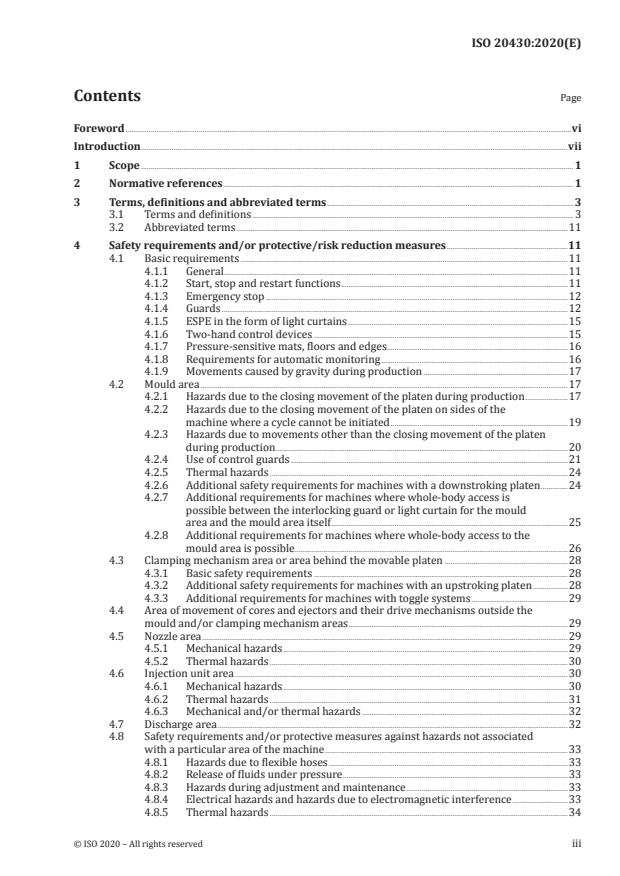
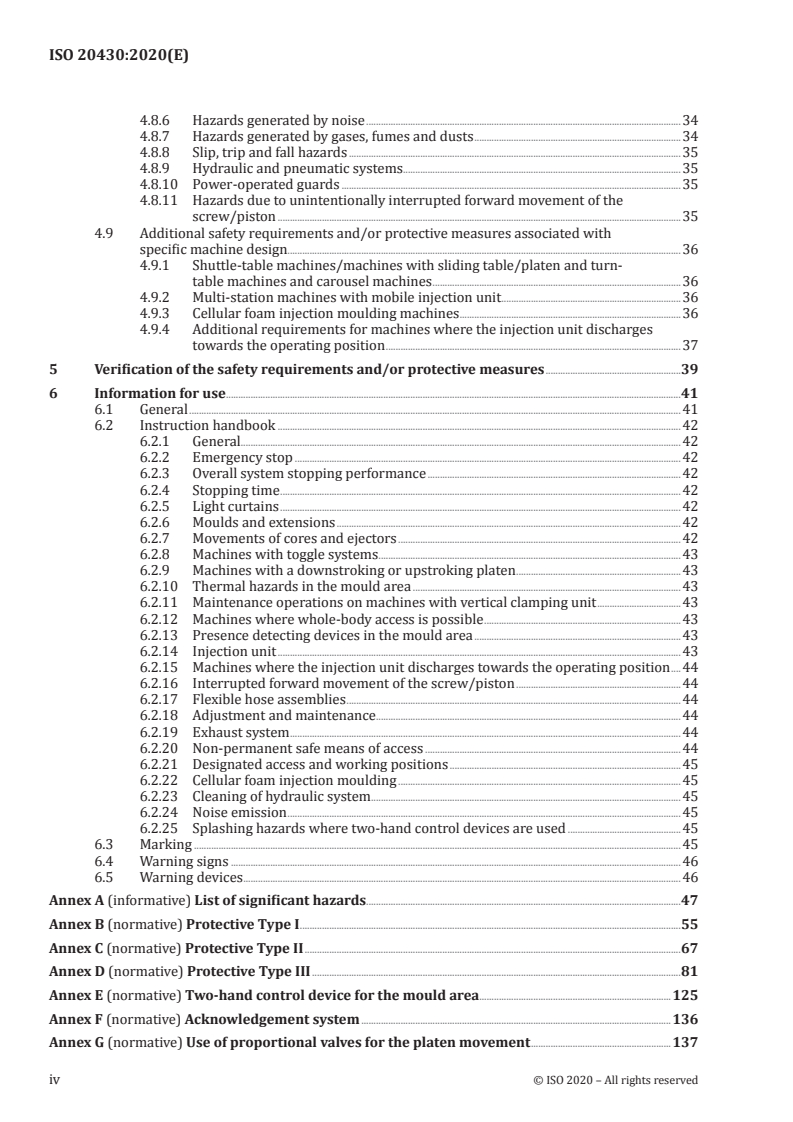
Contents Page
Foreword .vi
Introduction .vii
1 Scope . 1
2 Normative references . 1
3 Terms, definitions and abbreviated terms . 3
3.1 Terms and definitions . 3
3.2 Abbreviated terms .11
4 Safety requirements and/or protective/risk reduction measures .11
4.1 Basic requirements .11
4.1.1 General.11
4.1.2 Start, stop and restart functions .11
4.1.3 Emergency stop .12
4.1.4 Guards .12
4.1.5 ESPE in the form of light curtains .15
4.1.6 Two-hand control devices .15
4.1.7 Pressure-sensitive mats, floors and edges .16
4.1.8 Requirements for automatic monitoring .16
4.1.9 Movements caused by gravity during production .17
4.2 Mould area .17
4.2.1 Hazards due to the closing movement of the platen during production .17
4.2.2 Hazards due to the closing movement of the platen on sides of the
machine where a cycle cannot be initiated .19
4.2.3 Hazards due to movements other than the closing movement of the platen
during production .20
4.2.4 Use of control guards .21
4.2.5 Thermal hazards .24
4.2.6 Additional safety requirements for machines with a downstroking platen .24
4.2.7 Additional requirements for machines where whole-body access is
possible between the interlocking guard or light curtain for the mould
area and the mould area itself .25
4.2.8 Additional requirements for machines where whole-body access to the
mould area is possible . . .26
4.3 Clamping mechanism area or area behind the movable platen .28
4.3.1 Basic safety requirements .28
4.3.2 Additional safety requirements for machines with an upstroking platen .28
4.3.3 Additional requirements for machines with toggle systems .29
4.4 Area of movement of cores and ejectors and their drive mechanisms outside the
mould and/or clamping mechanism areas .29
4.5 Nozzle area .29
4.5.1 Mechanical hazards .29
4.5.2 Thermal hazards .30
4.6 Injection unit area .30
4.6.1 Mechanical hazards .30
4.6.2 Thermal hazards .31
4.6.3 Mechanical and/or thermal hazards .32
4.7 Discharge area .32
4.8 Safety requirements and/or protective measures against hazards not associated
with a particular area of the machine .33
4.8.1 Hazards due to flexible hoses .33
4.8.2 Release of fluids under pressure .33
4.8.3 Hazards during adjustment and maintenance .33
4.8.4 Electrical hazards and hazards due to electromagnetic interference .33
4.8.5 Thermal hazards .34
4.8.6 Hazards generated by noise .34
4.8.7 Hazards generated by gases, fumes and dusts .34
4.8.8 Slip, trip and fall hazards .35
4.8.9 Hydraulic and pneumatic systems.35
4.8.10 Power-operated guards .35
4.8.11 Hazards due to unintentionally interrupted forward movement of the
screw/piston .35
4.9 Additional safety requirements and/or protective measures associated with
specific machine design.36
4.9.1 Shuttle-table machines/machines with sliding table/platen and turn-
table machines and carousel machines .36
4.9.2 Multi-station machines with mobile injection unit .36
4.9.3 Cellular foam injection moulding machines .36
4.9.4 Additional requirements for machines where the injection unit discharges
towards the operating position .37
5 Verification of the safety requirements and/or protective measures .39
6 Information for use .41
6.1 General .41
6.2 Instruction handbook .42
6.2.1 General.42
6.2.2 Emergency stop .42
6.2.3 Overall system stopping performance .42
6.2.4 Stopping time .42
6.2.5 Light curtains .42
6.2.6 Moulds and extensions .42
6.2.7 Movements of cores and ejectors .42
6.2.8 Machines with toggle systems .43
6.2.9 Machines with a downstroking or upstroking platen .43
6.2.10 Thermal hazards in the mould area .43
6.2.11 Maintenance operations on machines with vertical clamping unit .43
6.2.12 Machines where whole-body access is possible .43
6.2.13 Presence detecting devices in the mould area .43
6.2.14 Injection unit .43
6.2.15 Machines where the injection unit discharges towards the operating position .44
6.2.16 Interrupted forward movement of the screw/piston .44
6.2.17 Flexible hose assemblies .44
6.2.18 Adjustment and maintenance .44
6.2.19 Exhaust system .44
6.2.20 Non-permanent safe means of access .44
6.2.21 Designated access and working positions .45
6.2.22 Cellular foam injection moulding .45
6.2.23 Cleaning of hydraulic system .45
6.2.24 Noise emission .45
6.2.25 Splashing hazards where two-hand control devices are used .45
6.3 Marking .45
6.4 Warning signs .46
6.5 Warning devices .46
Annex A (informative) List of significant hazards.47
Annex B (normative) Protective Type I .55
Annex C (normative) Protective Type II .67
Annex D (normative) Protective Type III .81
Annex E (normative) Two-hand control device for the mould area.125
Annex F (normative) Acknowledgement system .136
Annex G (normative) Use of proportional valves for the platen movement .137
iv © ISO 2020 – All rights reserved
Annex H (informative) Warning signs, prohibition signs and mandatory action signs .138
Annex I (normative) Noise test code .142
Bibliography .148
Foreword
ISO (the International Organization for Standardization) is a worldwide federation of national standards
bodies (ISO member bodies). The work of preparing International Standards is normally carried out
through ISO technical committees. Each member body interested in a subject for which a technical
committee has been established has the right to be represented on that committee. International
organizations, governmental and non-governmental, in liaison with ISO, also take part in the work.
ISO collaborates closely with the International Electrotechnical Commission (IEC) on all matters of
electrotechnical standardization.
The procedures used to develop this document and those intended for its further maintenance are
described in the ISO/IEC Directives, Part 1. In particular, the different approval criteria needed for the
different types of ISO documents should be noted. This document was drafted in accordance with the
editorial rules of the ISO/IEC Directives, Part 2 (see www .iso .org/ directives).
Attention is drawn to the possibility that some of the elements of this document may be the subject of
patent rights. ISO shall not be held responsible for identifying any or all such patent rights. Details of
any patent rights identified during the development of the document will be in the Introduction and/or
on the ISO list of patent declarations received (see www .iso .org/ patents).
Any trade name used in this document is information given for the convenience of users and does not
constitute an endorsement.
For an explanation of the voluntary nature of standards, the meaning of ISO specific terms and
expressions related to conformity assessment, as well as information about ISO's adherence to the
World Trade Organization (WTO) principles in the Technical Barriers to Trade (TBT) see www .iso .org/
iso/ foreword .html.
This document was prepared by Technical Committee ISO/TC 270, Plastics and rubber machines, in
collaboration with the European Committee for Standardization (CEN) Technical Committee CEN/TC
145, Plastics and rubber machines, in accordance with the Agreement on technical cooperation between
ISO and CEN (Vienna Agreement).
Any feedback or questions on this document should be directed to the user’s national standards body. A
complete listing of these bodies can be found at www .iso .org/ members .html.
vi © ISO 2020 – All rights reserved
Introduction
This document is a type-C standard as stated in ISO 12100:2010.
This document is of relevance, in particular, for the following stakeholder groups representing the
market players with regard to machinery safety:
— machine manufacturers (small, medium and large enterprises);
— health and safety bodies (regulators, accident prevention organizations, market surveillance, etc.).
Others can be affected by the level of machinery safety achieved with the means of the document by the
above-mentioned stakeholder groups:
— machine distributors, resellers, rebuilders and integrators;
— machine users/employers (small, medium and large enterprises);
— machine operators/employees (e.g. trade unions, organizations for people with special needs);
— service providers, e.g. for maintenance (small, medium and large enterprises).
The above-mentioned stakeholder groups have been given the possibility to participate in the drafting
process of this document.
The machinery concerned and the extent to which hazards, hazardous situations or hazardous events
are covered are indicated in the Scope of this document.
When requirements of this type-C standard are different from those which are stated in type-A or
type-B standards, the requirements of this type-C standard take precedence over the requirements of
the other standards for machines that have been designed and built according to the requirements of
this type-C standard.
INTERNATIONAL STANDARD ISO 20430:2020(E)
Plastics and rubber machines — Injection moulding
machines — Safety requirements
1 Scope
This document specifies the essential safety requirements for the design and construction of injection
moulding machines for the processing of plastics and/or rubber and provides information for their
safe use.
This document is applicable only to injection moulding machines with hydraulic and/or electrical drives
for platen movement.
This document deals with all significant hazards, hazardous situations and events relevant to injection
moulding machines, when they are used as intended and under conditions of misuse which are
reasonably foreseeable by the manufacturer (see Annex A) during the life cycle of the machinery (see
ISO 12100:2010, 5.4).
The following are not covered:
— machines on which the clamping unit can only be operated by the physical force of the operator;
— machines for which the hydraulic jack can only be manually operated;
— injection blow moulding machines;
— machines for reaction injection moulding;
— compression moulding machines and transfer moulding machines;
— direct-on sole moulding machines, unit sole and footwear component moulding machines, full shoe
and boot moulding machines;
— design of an exhaust system;
— design and construction of the mould.
NOTE Moulds and exhaust systems are not part of the machinery.
This document is not applicable to injection moulding machines which are manufactured before the
date of its publication.
2 Normative references
The following documents are referred to in the text in such a way that some or all of their content
constitutes requirements of this document. For dated references, only the edition cited applies. For
undated references, the latest edition of the referenced document (including any amendments) applies.
ISO 1402:2009, Rubber and plastics hoses and hose assemblies — Hydrostatic testing
ISO 3744:2010, Acoustics — Determination of sound power levels and sound energy levels of noise sources
using sound pressure — Engineering methods for an essentially free field over a reflecting plane
ISO 3746:2010, Acoustics — Determination of sound power levels and sound energy levels of noise sources
using sound pressure — Survey method using an enveloping measurement surface over a reflecting plane
ISO 3747:2010, Acoustics — Determination of sound power levels and sound energy levels of noise sources
using sound pressure — Engineering/survey methods for use in situ in a reverberant environment
ISO 4413:2010, Hydraulic fluid power — General rules and safety requirements for systems and their
components
ISO 4414:2010, Pneumatic fluid power — General rules and safety requirements for systems and their
components
ISO 4871:1996, Acoustics — Declaration and verification of noise emission values of machinery and
equipment
ISO 7751:2016, Rubber and plastics hoses and hose assemblies — Ratios of proof and burst pressure to
maximum working pressure
ISO 11201:2010, Acoustics — Noise emitted by machinery and equipment — Determination of emission
sound pressure levels at a work station and at other specified positions in an essentially free field over a
reflecting plane with negligible environmental corrections
ISO 11202:2010, Acoustics — Noise emitted by machinery and equipment — Determination of emission
sound pressure levels at a work station and at other specified positions applying approximate environmental
corrections
ISO 11204:2010, Acoustics — Noise emitted by machinery and equipment — Determination of emission
sound pressure levels at a work station and at other specified positions applying accurate environmental
corrections
ISO 12100:2010, Safety of machinery — General principles for design — Risk assessment and risk reduction
ISO 13732-1:2006, Ergonomics of the thermal environment — Methods for the assessment of human
responses to contact with surfaces — Part 1: Hot surfaces
ISO 13849-1:2015, Safety of machinery — Safety-related parts of control systems — Part 1: General
principles for design
ISO 13849-2:2012, Safety of machinery — Safety-related parts of control systems — Part 2: Validation
ISO 13850:2015, Safety of machinery — Emergency stop function — Principles for design
ISO 13851:2002, Safety of machinery — Two-hand control devices — Functional aspects and design
principles
ISO 13855:2010, Safety of machinery — Positioning of safeguards with respect to the approach speeds of
parts of the human body
ISO 13856-1:2013, Safety of machinery — Pressure-sensitive protective devices — Part 1: General principles
for design and testing of pressure-sensitive mats and pressure-sensitive floors
ISO 13856-2:2013, Safety of machinery — Pressure-sensitive protective devices — Part 2: General
principles for design and testing of pressure-sensitive edges and pressure-sensitive bars
ISO 13857:2008, Safety of machinery — Safety distances to prevent hazard zones being reached by upper
and lower limbs
ISO 14118:2017, Safety of machinery — Prevention of unexpected start-up
ISO 14119:2013, Safety of machinery — Interlocking devices associated with guards — Principles for
design and selection
ISO 14120:2015, Safety of machinery — Guards — General requirements for the design and construction of
fixed and movable guards
ISO 14122-1:2016, Safety of machinery — Permanent means of access to machinery — Part 1: Choice of
fixed means and general requirements of access
2 © ISO 2020 – All rights reserved
ISO 14122-2:2016, Safety of machinery — Permanent means of access to machinery — Part 2: Working
platforms and walkways
ISO 14122-3:2016, Safety of machinery — Permanent means of access to machinery — Part 3: Stairs,
stepladders and guard-rails
ISO 14122-4:2016, Safety of machinery — Permanent means of access to machinery — Part 4: Fixed ladders
IEC 60204-1:2016, Safety of machinery — Electrical equipment of machines — Part 1: General requirements
IEC 60947-5-3:2013, Low-voltage switchgear and controlgear — Part 5-3: Control circuit devices
and switching elements — Requirements for proximity devices with defined behaviour under fault
conditions (PDDB)
IEC 61496-1:2012, Safety of machinery — Electro-sensitive protective equipment — Part 1: General
requirements and tests
IEC 61496-2:2013, Safety of machinery — Electro-sensitive protective equipment — Part 2: Particular
requirements for equipment using active opto-electronic protective devices (AOPDs)
IEC 61496-3:2008, Safety of machinery — Electro-sensitive protective equipment — Part 3: Particular
requirements for active opto-electronic protective devices responsive to diffuse Reflection (AOPDDR)
IEC 61800-5-1:2007, Adjustable speed electrical power drive systems — Part 5-1: Safety requirements —
Electrical, thermal and energy
IEC 61800-5-2:2016, Adjustable speed electrical power drive systems — Part 5-2: Safety Requirements —
Functional
3 Terms, definitions and abbreviated terms
3.1 Terms and definitions
For the purposes of this document, the following terms and definitions given in ISO 12100:2010 and the
following apply.
ISO and IEC maintain terminological databases for use in standardization at the following addresses:
— ISO Online browsing platform: available at https:// www .iso .org/ obp
— IEC Electropedia: available at http:// www .electropedia .org/
3.1.1
injection moulding machine
machine for the cyclic production of moulded parts from plastics and/or rubber
Note 1 to entry: The material is injected through a nozzle into a mould (3.1.2) containing one or more cavities in
which the article is formed.
Note 2 to entry: An injection moulding machine essentially consists of one or more clamping units (3.1.6), one or
more injection units (3.1.8), drive and control systems.
Note 3 to entry: Examples of horizontal and vertical injection moulding machine are shown in Annex A.
3.1.2
mould
exchangeable part consisting of two or more halves clamped on the platens of the machine in which the
material is injected
3.1.3
ejector
driven component (e.g. pin with linear movement) inside a mould (3.1.2) used for the ejection of the
moulded part(s) out of the opened mould
3.1.4
core
driven component inside a mould (3.1.2) for carrying out mould functions, e.g. enabling undercuts in
the moulded part
3.1.5
mould area
area between the platens where the mould (3.1.2) is fixed
3.1.6
clamping unit
part of the machine that holds, opens and closes the mould (3.1.2)
3.1.7
clamping mechanism area
area which comprises mechanisms for the movement of the movable platen and/or the application of
the clamping force
3.1.8
injection unit
unit for processing (plasticizing and/or homogenizing) and delivering material through a nozzle
3.1.9
carousel machine
machine consisting of two or more clamping units (3.1.6) mounted on a carousel in either a vertical or
horizontal configuration to index on one or more fixed injection units (3.1.8)
Note 1 to entry: See Figure 1.
4 © ISO 2020 – All rights reserved
Figure 1 — Example of a carousel machine, shown without guards
3.1.10
shuttle-table machine
machine with a sliding table/platen
machine designed to contain one or more parts of moulds (3.1.2) attached to a sliding table/platen
Note 1 to entry: The table/platen indexes the parts of the mould by a sliding movement between the loading/
unloading station and the injection position.
Note 2 to entry: See Figure 2.
Figure 2 — Examples of shuttle-table machines (two stations left; single station right), shown
without guards for the movements of the table
3.1.11
turn-table machine
machine designed to contain one or more parts of moulds (3.1.2) attached to a rotating table
Note 1 to entry: The table indexes the parts of the mould by a rotary movement between the loading/unloading
station and the injection position.
Note 2 to entry: See Figure 3.
6 © ISO 2020 – All rights reserved
Figure 3 — Example of a turn-table machine, shown without guards for the movements of
the table
3.1.12
multi-station machine with mobile injection unit
machine consisting of a mobile injection unit (3.1.8) which indexes between two or more stationary
clamping units (3.1.6)
Note 1 to entry: See Figures 4 and 5.
Figure 4 — Example of multi-station machine with mobile injection unit, shown without guards
for the clamping units
Figure 5 — Example of multi-station machine with mobile injection unit, shown with guards for
the clamping units
8 © ISO 2020 – All rights reserved
3.1.13
ancillary equipment
equipment which interacts with the injection moulding machine (3.1.1)
Note 1 to entry: Examples are pick and place device, robot, mould changing equipment, mould clamping system
or conveyor.
3.1.14
cellular foam injection moulding
injection moulding which involves either an entrained gas mixed into the melt or a granulate containing
a foaming agent to achieve a cellular-structured product
3.1.15
electrical axis
axis where the primary movement of the axis is initiated by electrical energy
3.1.16
hydraulic axis
axis where the primary movement of the axis is initiated by hydraulic energy
3.1.17
standstill
condition under which there is no movement of a machine part
Note 1 to entry: See Figure 6 for the relation of standstill, safe standstill (3.1.18), stopping (3.1.19), safe stopping
(3.1.20) and overall system stopping performance (3.1.21).
3.1.18
safe standstill
standstill (3.1.17) during which unexpected start-up is prevented
Note 1 to entry: See Figure 6 for the relation of standstill , safe standstill, stopping (3.1.19), safe stopping (3.1.20)
and overall system stopping performance (3.1.21).
3.1.19
stopping
deceleration of a movement of a machine part until standstill (3.1.17) is achieved
Note 1 to entry: See Figure 6 for the relation of standstill , safe standstill (3.1.18), stopping, safe stopping (3.1.20)
and overall system stopping performance (3.1.21).
3.1.20
safe stopping
controlled stopping (3.1.19) and following standstill (3.1.17) during which a hazardous situation is
prevented
Note 1 to entry: See Figure 6 for the relation of standstill , safe standstill (3.1.18), stopping , safe stopping and
overall system stopping performance (3.1.21).
3.1.21
overall system stopping performance
time interval between the actuation of the sensing function and until standstill (3.1.17) is achieved
Note 1 to entry: See Figure 6 for the relation of standstill , safe standstill (3.1.18), stopping (3.1.19), safe stopping
(3.1.20) and overall system stopping performance.
Key
P power supply to the actuator
C command (actuation of emergency stop device, interruption of light curtain, opening of interlocking guard …)
v velocity of the hazardous movement
t time
t reaction time of sensor/actuator and control system
t maximum stopping time required to terminate the hazardous machine function
T overall system stopping performance
S standstill
A safe stopping
B safe standstill
Figure 6 — Diagram for standstill, safe standstill, stopping, safe stopping and overall system
stopping performance
3.1.22
safety-related input
input to a motor control unit activating the safety function related to the drive of the electrically
driven axis
3.1.23
operating position
position in front of the mould area (3.1.5) where the operator typically stands
3.1.24
automatic mode
selectable mode of operation that runs one or more cycles continuously
3.1.25
semi-automatic mode
selectable mode of operation that runs a single cycle and then stops
3.1.26
manual mode
selectable mode of operation that allows manual activation of individual movements
10 © ISO 2020 – All rights reserved
3.2 Abbreviated terms
AOPD active opto-electronic protective device (see IEC 61496-2:2013)
AOPDDR active opto-electronic protective device responsive to diffuse reflection
(see IEC 61496-3:2008)
ESPE electro-sensitive protective equipment (see IEC 61496-1:2012)
PL performance level (see ISO 13849-1:2015)
PL required performance level (see ISO 13849-1:2015)
r
PLC programmable logic controller (see ISO 13849-1:2015)
SS1 safe stop 1 (see IEC 61800-5-2:2016)
STO safe torque off (see IEC 61800-5-2:2016)
4 Safety requirements and/or protective/risk reduction measures
4.1 Basic requirements
4.1.1 General
Machinery shall comply with the safety requirements and/or protective/risk reduction measures of this
clause. In addition, the machine shall be designed in accordance with the principles of ISO 12100:2010
for relevant but not significant hazards, which are not dealt with by this document.
Protective systems and safety-related parts of the control systems shall be in accordance with:
— Protective Type I, II and III as specified in Annexes B, C and D. These annexes describe minimum
requirements and the calculation of the PL of the whole system achieved is not required; or
— the PL in accordance with ISO 13849-1:2015, as specified in the relevant subclauses.
r
NOTE The safety level achieved when applying the PL as specified in the relevant subclauses is at least
r
equivalent to the safety level achieved when applying the annexes.
4.1.2 Start, stop and restart functions
4.1.2.1 Start function
The start of an operation shall be possible only when all safeguards are in place and functioning (see
IEC 60204-1:2016, 9.2.3.2). The machine shall only be started by actuation of the start device provided
for that purpose or closing a control guard in accordance with 4.2.4.
4.1.2.2 Stop function
4.1.2.2.1 Normal stop
The machine shall be equipped with a control device activating a stop function in accordance with stop
category 0 or 1 as described in IEC 60204-1:2016, 9.2.2, that brings the machine to a complete stop.
4.1.2.2.2 Operational stop
For operational reasons, e.g. to permit an easier and more rapid restart of the machinery, it could be
necessary to provide a stop control that does not cut off the energy supply to the actuators.
In this case, in addition to the above normal stop function, a stop category 2 may be used for the
movements in the areas which are enclosed by safeguards which are in place and functioning. When
a safeguard is activated, stop category 0 or 1 shall become effective as specified in the relevant
subclauses.
4.1.2.3 Interruption or failure of the power supply
An interruption or a failure of the power supply shall not result in a loss of safety function and restoration
of the energy supply shall not result in the automatic restarting of the machine (see ISO 12100:2010,
6.2.11.4 and 6.2.11.5).
4.1.3 Emergency stop
The emergency stop shall function as a category 0 or 1 stop as described in IEC 60204-1:2016, 9.2.2
ensuring the fastest stopping.
Emergency stop devices shall be in accordance with ISO 13850:2015 and IEC 60204-1:2016, 10.7. An
emergency stop device shall, at a minimum, be located at each operator station.
Actuation of an emergency stop device shall stop any dangerous movement and shall discharge the
hydraulic accumulators.
In addition, the actuation of emergency stop devices shall stop the supply of the following unless their
continued supply is necessary to prevent further hazards such as overheating/overpressure when
processing materials which can lead to degradation (e.g. PVC):
— power to the cooling/heating elements;
— gas/water.
See 6.2.2.
4.1.4 Guards
4.1.4.1 Common requirements
Guards shall be designed in accordance with ISO 14120:2015.
Safety distances for distance guards, enclosing guards, and interlocking guards shall be in accordance
with the following unless otherwise specified in this document:
— ISO 13857:2008, Table 1 for reaching over protective structures;
— ISO 13857:2008, Table 3 for reaching around with limitation of movement;
— ISO 13857:2008, Table 4 for reaching through regular openings;
— ISO 13857:2008, Table 6 for reaching around with additional protective structures;
— ISO 13857:2008, Table 7 for reaching through openings of regular shape by lower limbs.
As an alternative to ISO 13857:2008, Table 1, protective structures may be designed as shown in
Figure 7, provided that:
— dimension x is ≥1 600 mm; and
— dimensions a, b and c are in accordance with ISO 13857:2008, Table 1. In this case, c = c′ + r
(see Figure 7).
12 © ISO 2020 – All rights reserved
Key
a height of hazard zone
b overall height of protective structure
c horizontal safety distance to hazard zone in ISO 13857:2008, Table 1
c′ depth of protective structure
r distance from the nearest edge of the protective structure to the hazardous point
x distance from floor to angle of the protective structure
Figure 7 — Alternative shapes for protective structures
Closing of an interlocking guard shall not automatically initiate further movement and a new start
command shall be required, unless a control guard in accordance with 4.2.4 is used.
Interlocking devices associated with guards shall fulfil the requirements of ISO 14119:2013, especially
regarding the selection, arrangement and mounting. Reasonably foreseeable manipulation shall
be prevented. Type 3 interlocking devices according to ISO 14119:2013 shall only be used if in the
specific application they cannot be defeated. When a Type 3 or Type 4 interlocking device according
to ISO 14119:2013 is used, it shall have two independent electrical contacts, and both shall be
independently connected to the control and monitoring system.
NOTE The connection between the control and monitoring systems to the shut-off device(s) depends on the
safety level required.
4.1.4.2 Interlocking guards without guard locking
Movable interlocking guards without guard locking shall be positioned so that when the guard is
opened, the overall system stopping performance, T, is shorter than the access time, t.
The access time, t, is calculated with Formula (1):
d
t=+t (1)
v
where
d is the minimum distance from the nearest edge of the opening of the guard to the
hazardous point;
v is 1,6 m/s, approach speed as defined in ISO 13855:2010;
t is the time required to open the guard to the extent that the opening size permits
access of the relevant parts of the body (see ISO 13855:2010, Clause 9).
For manually operated guards, t shall be:
— 100 ms; or
— calculated with regard to the forces in ISO 14119:2013, Table I.1; or
— determined in accordance with ISO 13855:2010, Clause 9.
For power-operated guards, t shall be determined in accordance with ISO 13855:2010, Clause 9.
When calculating or measuring the overall system stopping performance, T, the worst case shall be
taken into account for each of the following factors during the whole lifetime of the machine and also in
the case of power failure:
— speed;
— mass;
— temperature;
— switching time of valves/contactors; and
— ageing of components.
See 6.2.3.
If a dual channel architecture (use of Protective Type III or ISO 13849-1:2015, Category 3 or 4 for the
safety-related parts of
...
INTERNATIONAL ISO
STANDARD 20430
First edition
2020-04
Plastics and rubber machines —
Injection moulding machines — Safety
requirements
Machines pour les matières plastiques et le caoutchouc — Machines
de moulage par injection — Prescription de sécurité
Reference number
©
ISO 2020
© ISO 2020
All rights reserved. Unless otherwise specified, or required in the context of its implementation, no part of this publication may
be reproduced or utilized otherwise in any form or by any means, electronic or mechanical, including photocopying, or posting
on the internet or an intranet, without prior written permission. Permission can be requested from either ISO at the address
below or ISO’s member body in the country of the requester.
ISO copyright office
CP 401 • Ch. de Blandonnet 8
CH-1214 Vernier, Geneva
Phone: +41 22 749 01 11
Fax: +41 22 749 09 47
Email: copyright@iso.org
Website: www.iso.org
Published in Switzerland
ii © ISO 2020 – All rights reserved
Contents Page
Foreword .vi
Introduction .vii
1 Scope . 1
2 Normative references . 1
3 Terms, definitions and abbreviated terms . 3
3.1 Terms and definitions . 3
3.2 Abbreviated terms .11
4 Safety requirements and/or protective/risk reduction measures .11
4.1 Basic requirements .11
4.1.1 General.11
4.1.2 Start, stop and restart functions .11
4.1.3 Emergency stop .12
4.1.4 Guards .12
4.1.5 ESPE in the form of light curtains .15
4.1.6 Two-hand control devices .15
4.1.7 Pressure-sensitive mats, floors and edges .16
4.1.8 Requirements for automatic monitoring .16
4.1.9 Movements caused by gravity during production .17
4.2 Mould area .17
4.2.1 Hazards due to the closing movement of the platen during production .17
4.2.2 Hazards due to the closing movement of the platen on sides of the
machine where a cycle cannot be initiated .19
4.2.3 Hazards due to movements other than the closing movement of the platen
during production .20
4.2.4 Use of control guards .21
4.2.5 Thermal hazards .24
4.2.6 Additional safety requirements for machines with a downstroking platen .24
4.2.7 Additional requirements for machines where whole-body access is
possible between the interlocking guard or light curtain for the mould
area and the mould area itself .25
4.2.8 Additional requirements for machines where whole-body access to the
mould area is possible . . .26
4.3 Clamping mechanism area or area behind the movable platen .28
4.3.1 Basic safety requirements .28
4.3.2 Additional safety requirements for machines with an upstroking platen .28
4.3.3 Additional requirements for machines with toggle systems .29
4.4 Area of movement of cores and ejectors and their drive mechanisms outside the
mould and/or clamping mechanism areas .29
4.5 Nozzle area .29
4.5.1 Mechanical hazards .29
4.5.2 Thermal hazards .30
4.6 Injection unit area .30
4.6.1 Mechanical hazards .30
4.6.2 Thermal hazards .31
4.6.3 Mechanical and/or thermal hazards .32
4.7 Discharge area .32
4.8 Safety requirements and/or protective measures against hazards not associated
with a particular area of the machine .33
4.8.1 Hazards due to flexible hoses .33
4.8.2 Release of fluids under pressure .33
4.8.3 Hazards during adjustment and maintenance .33
4.8.4 Electrical hazards and hazards due to electromagnetic interference .33
4.8.5 Thermal hazards .34
4.8.6 Hazards generated by noise .34
4.8.7 Hazards generated by gases, fumes and dusts .34
4.8.8 Slip, trip and fall hazards .35
4.8.9 Hydraulic and pneumatic systems.35
4.8.10 Power-operated guards .35
4.8.11 Hazards due to unintentionally interrupted forward movement of the
screw/piston .35
4.9 Additional safety requirements and/or protective measures associated with
specific machine design.36
4.9.1 Shuttle-table machines/machines with sliding table/platen and turn-
table machines and carousel machines .36
4.9.2 Multi-station machines with mobile injection unit .36
4.9.3 Cellular foam injection moulding machines .36
4.9.4 Additional requirements for machines where the injection unit discharges
towards the operating position .37
5 Verification of the safety requirements and/or protective measures .39
6 Information for use .41
6.1 General .41
6.2 Instruction handbook .42
6.2.1 General.42
6.2.2 Emergency stop .42
6.2.3 Overall system stopping performance .42
6.2.4 Stopping time .42
6.2.5 Light curtains .42
6.2.6 Moulds and extensions .42
6.2.7 Movements of cores and ejectors .42
6.2.8 Machines with toggle systems .43
6.2.9 Machines with a downstroking or upstroking platen .43
6.2.10 Thermal hazards in the mould area .43
6.2.11 Maintenance operations on machines with vertical clamping unit .43
6.2.12 Machines where whole-body access is possible .43
6.2.13 Presence detecting devices in the mould area .43
6.2.14 Injection unit .43
6.2.15 Machines where the injection unit discharges towards the operating position .44
6.2.16 Interrupted forward movement of the screw/piston .44
6.2.17 Flexible hose assemblies .44
6.2.18 Adjustment and maintenance .44
6.2.19 Exhaust system .44
6.2.20 Non-permanent safe means of access .44
6.2.21 Designated access and working positions .45
6.2.22 Cellular foam injection moulding .45
6.2.23 Cleaning of hydraulic system .45
6.2.24 Noise emission .45
6.2.25 Splashing hazards where two-hand control devices are used .45
6.3 Marking .45
6.4 Warning signs .46
6.5 Warning devices .46
Annex A (informative) List of significant hazards.47
Annex B (normative) Protective Type I .55
Annex C (normative) Protective Type II .67
Annex D (normative) Protective Type III .81
Annex E (normative) Two-hand control device for the mould area.125
Annex F (normative) Acknowledgement system .136
Annex G (normative) Use of proportional valves for the platen movement .137
iv © ISO 2020 – All rights reserved
Annex H (informative) Warning signs, prohibition signs and mandatory action signs .138
Annex I (normative) Noise test code .142
Bibliography .148
Foreword
ISO (the International Organization for Standardization) is a worldwide federation of national standards
bodies (ISO member bodies). The work of preparing International Standards is normally carried out
through ISO technical committees. Each member body interested in a subject for which a technical
committee has been established has the right to be represented on that committee. International
organizations, governmental and non-governmental, in liaison with ISO, also take part in the work.
ISO collaborates closely with the International Electrotechnical Commission (IEC) on all matters of
electrotechnical standardization.
The procedures used to develop this document and those intended for its further maintenance are
described in the ISO/IEC Directives, Part 1. In particular, the different approval criteria needed for the
different types of ISO documents should be noted. This document was drafted in accordance with the
editorial rules of the ISO/IEC Directives, Part 2 (see www .iso .org/ directives).
Attention is drawn to the possibility that some of the elements of this document may be the subject of
patent rights. ISO shall not be held responsible for identifying any or all such patent rights. Details of
any patent rights identified during the development of the document will be in the Introduction and/or
on the ISO list of patent declarations received (see www .iso .org/ patents).
Any trade name used in this document is information given for the convenience of users and does not
constitute an endorsement.
For an explanation of the voluntary nature of standards, the meaning of ISO specific terms and
expressions related to conformity assessment, as well as information about ISO's adherence to the
World Trade Organization (WTO) principles in the Technical Barriers to Trade (TBT) see www .iso .org/
iso/ foreword .html.
This document was prepared by Technical Committee ISO/TC 270, Plastics and rubber machines, in
collaboration with the European Committee for Standardization (CEN) Technical Committee CEN/TC
145, Plastics and rubber machines, in accordance with the Agreement on technical cooperation between
ISO and CEN (Vienna Agreement).
Any feedback or questions on this document should be directed to the user’s national standards body. A
complete listing of these bodies can be found at www .iso .org/ members .html.
vi © ISO 2020 – All rights reserved
Introduction
This document is a type-C standard as stated in ISO 12100:2010.
This document is of relevance, in particular, for the following stakeholder groups representing the
market players with regard to machinery safety:
— machine manufacturers (small, medium and large enterprises);
— health and safety bodies (regulators, accident prevention organizations, market surveillance, etc.).
Others can be affected by the level of machinery safety achieved with the means of the document by the
above-mentioned stakeholder groups:
— machine distributors, resellers, rebuilders and integrators;
— machine users/employers (small, medium and large enterprises);
— machine operators/employees (e.g. trade unions, organizations for people with special needs);
— service providers, e.g. for maintenance (small, medium and large enterprises).
The above-mentioned stakeholder groups have been given the possibility to participate in the drafting
process of this document.
The machinery concerned and the extent to which hazards, hazardous situations or hazardous events
are covered are indicated in the Scope of this document.
When requirements of this type-C standard are different from those which are stated in type-A or
type-B standards, the requirements of this type-C standard take precedence over the requirements of
the other standards for machines that have been designed and built according to the requirements of
this type-C standard.
INTERNATIONAL STANDARD ISO 20430:2020(E)
Plastics and rubber machines — Injection moulding
machines — Safety requirements
1 Scope
This document specifies the essential safety requirements for the design and construction of injection
moulding machines for the processing of plastics and/or rubber and provides information for their
safe use.
This document is applicable only to injection moulding machines with hydraulic and/or electrical drives
for platen movement.
This document deals with all significant hazards, hazardous situations and events relevant to injection
moulding machines, when they are used as intended and under conditions of misuse which are
reasonably foreseeable by the manufacturer (see Annex A) during the life cycle of the machinery (see
ISO 12100:2010, 5.4).
The following are not covered:
— machines on which the clamping unit can only be operated by the physical force of the operator;
— machines for which the hydraulic jack can only be manually operated;
— injection blow moulding machines;
— machines for reaction injection moulding;
— compression moulding machines and transfer moulding machines;
— direct-on sole moulding machines, unit sole and footwear component moulding machines, full shoe
and boot moulding machines;
— design of an exhaust system;
— design and construction of the mould.
NOTE Moulds and exhaust systems are not part of the machinery.
This document is not applicable to injection moulding machines which are manufactured before the
date of its publication.
2 Normative references
The following documents are referred to in the text in such a way that some or all of their content
constitutes requirements of this document. For dated references, only the edition cited applies. For
undated references, the latest edition of the referenced document (including any amendments) applies.
ISO 1402:2009, Rubber and plastics hoses and hose assemblies — Hydrostatic testing
ISO 3744:2010, Acoustics — Determination of sound power levels and sound energy levels of noise sources
using sound pressure — Engineering methods for an essentially free field over a reflecting plane
ISO 3746:2010, Acoustics — Determination of sound power levels and sound energy levels of noise sources
using sound pressure — Survey method using an enveloping measurement surface over a reflecting plane
ISO 3747:2010, Acoustics — Determination of sound power levels and sound energy levels of noise sources
using sound pressure — Engineering/survey methods for use in situ in a reverberant environment
ISO 4413:2010, Hydraulic fluid power — General rules and safety requirements for systems and their
components
ISO 4414:2010, Pneumatic fluid power — General rules and safety requirements for systems and their
components
ISO 4871:1996, Acoustics — Declaration and verification of noise emission values of machinery and
equipment
ISO 7751:2016, Rubber and plastics hoses and hose assemblies — Ratios of proof and burst pressure to
maximum working pressure
ISO 11201:2010, Acoustics — Noise emitted by machinery and equipment — Determination of emission
sound pressure levels at a work station and at other specified positions in an essentially free field over a
reflecting plane with negligible environmental corrections
ISO 11202:2010, Acoustics — Noise emitted by machinery and equipment — Determination of emission
sound pressure levels at a work station and at other specified positions applying approximate environmental
corrections
ISO 11204:2010, Acoustics — Noise emitted by machinery and equipment — Determination of emission
sound pressure levels at a work station and at other specified positions applying accurate environmental
corrections
ISO 12100:2010, Safety of machinery — General principles for design — Risk assessment and risk reduction
ISO 13732-1:2006, Ergonomics of the thermal environment — Methods for the assessment of human
responses to contact with surfaces — Part 1: Hot surfaces
ISO 13849-1:2015, Safety of machinery — Safety-related parts of control systems — Part 1: General
principles for design
ISO 13849-2:2012, Safety of machinery — Safety-related parts of control systems — Part 2: Validation
ISO 13850:2015, Safety of machinery — Emergency stop function — Principles for design
ISO 13851:2002, Safety of machinery — Two-hand control devices — Functional aspects and design
principles
ISO 13855:2010, Safety of machinery — Positioning of safeguards with respect to the approach speeds of
parts of the human body
ISO 13856-1:2013, Safety of machinery — Pressure-sensitive protective devices — Part 1: General principles
for design and testing of pressure-sensitive mats and pressure-sensitive floors
ISO 13856-2:2013, Safety of machinery — Pressure-sensitive protective devices — Part 2: General
principles for design and testing of pressure-sensitive edges and pressure-sensitive bars
ISO 13857:2008, Safety of machinery — Safety distances to prevent hazard zones being reached by upper
and lower limbs
ISO 14118:2017, Safety of machinery — Prevention of unexpected start-up
ISO 14119:2013, Safety of machinery — Interlocking devices associated with guards — Principles for
design and selection
ISO 14120:2015, Safety of machinery — Guards — General requirements for the design and construction of
fixed and movable guards
ISO 14122-1:2016, Safety of machinery — Permanent means of access to machinery — Part 1: Choice of
fixed means and general requirements of access
2 © ISO 2020 – All rights reserved
ISO 14122-2:2016, Safety of machinery — Permanent means of access to machinery — Part 2: Working
platforms and walkways
ISO 14122-3:2016, Safety of machinery — Permanent means of access to machinery — Part 3: Stairs,
stepladders and guard-rails
ISO 14122-4:2016, Safety of machinery — Permanent means of access to machinery — Part 4: Fixed ladders
IEC 60204-1:2016, Safety of machinery — Electrical equipment of machines — Part 1: General requirements
IEC 60947-5-3:2013, Low-voltage switchgear and controlgear — Part 5-3: Control circuit devices
and switching elements — Requirements for proximity devices with defined behaviour under fault
conditions (PDDB)
IEC 61496-1:2012, Safety of machinery — Electro-sensitive protective equipment — Part 1: General
requirements and tests
IEC 61496-2:2013, Safety of machinery — Electro-sensitive protective equipment — Part 2: Particular
requirements for equipment using active opto-electronic protective devices (AOPDs)
IEC 61496-3:2008, Safety of machinery — Electro-sensitive protective equipment — Part 3: Particular
requirements for active opto-electronic protective devices responsive to diffuse Reflection (AOPDDR)
IEC 61800-5-1:2007, Adjustable speed electrical power drive systems — Part 5-1: Safety requirements —
Electrical, thermal and energy
IEC 61800-5-2:2016, Adjustable speed electrical power drive systems — Part 5-2: Safety Requirements —
Functional
3 Terms, definitions and abbreviated terms
3.1 Terms and definitions
For the purposes of this document, the following terms and definitions given in ISO 12100:2010 and the
following apply.
ISO and IEC maintain terminological databases for use in standardization at the following addresses:
— ISO Online browsing platform: available at https:// www .iso .org/ obp
— IEC Electropedia: available at http:// www .electropedia .org/
3.1.1
injection moulding machine
machine for the cyclic production of moulded parts from plastics and/or rubber
Note 1 to entry: The material is injected through a nozzle into a mould (3.1.2) containing one or more cavities in
which the article is formed.
Note 2 to entry: An injection moulding machine essentially consists of one or more clamping units (3.1.6), one or
more injection units (3.1.8), drive and control systems.
Note 3 to entry: Examples of horizontal and vertical injection moulding machine are shown in Annex A.
3.1.2
mould
exchangeable part consisting of two or more halves clamped on the platens of the machine in which the
material is injected
3.1.3
ejector
driven component (e.g. pin with linear movement) inside a mould (3.1.2) used for the ejection of the
moulded part(s) out of the opened mould
3.1.4
core
driven component inside a mould (3.1.2) for carrying out mould functions, e.g. enabling undercuts in
the moulded part
3.1.5
mould area
area between the platens where the mould (3.1.2) is fixed
3.1.6
clamping unit
part of the machine that holds, opens and closes the mould (3.1.2)
3.1.7
clamping mechanism area
area which comprises mechanisms for the movement of the movable platen and/or the application of
the clamping force
3.1.8
injection unit
unit for processing (plasticizing and/or homogenizing) and delivering material through a nozzle
3.1.9
carousel machine
machine consisting of two or more clamping units (3.1.6) mounted on a carousel in either a vertical or
horizontal configuration to index on one or more fixed injection units (3.1.8)
Note 1 to entry: See Figure 1.
4 © ISO 2020 – All rights reserved
Figure 1 — Example of a carousel machine, shown without guards
3.1.10
shuttle-table machine
machine with a sliding table/platen
machine designed to contain one or more parts of moulds (3.1.2) attached to a sliding table/platen
Note 1 to entry: The table/platen indexes the parts of the mould by a sliding movement between the loading/
unloading station and the injection position.
Note 2 to entry: See Figure 2.
Figure 2 — Examples of shuttle-table machines (two stations left; single station right), shown
without guards for the movements of the table
3.1.11
turn-table machine
machine designed to contain one or more parts of moulds (3.1.2) attached to a rotating table
Note 1 to entry: The table indexes the parts of the mould by a rotary movement between the loading/unloading
station and the injection position.
Note 2 to entry: See Figure 3.
6 © ISO 2020 – All rights reserved
Figure 3 — Example of a turn-table machine, shown without guards for the movements of
the table
3.1.12
multi-station machine with mobile injection unit
machine consisting of a mobile injection unit (3.1.8) which indexes between two or more stationary
clamping units (3.1.6)
Note 1 to entry: See Figures 4 and 5.
Figure 4 — Example of multi-station machine with mobile injection unit, shown without guards
for the clamping units
Figure 5 — Example of multi-station machine with mobile injection unit, shown with guards for
the clamping units
8 © ISO 2020 – All rights reserved
3.1.13
ancillary equipment
equipment which interacts with the injection moulding machine (3.1.1)
Note 1 to entry: Examples are pick and place device, robot, mould changing equipment, mould clamping system
or conveyor.
3.1.14
cellular foam injection moulding
injection moulding which involves either an entrained gas mixed into the melt or a granulate containing
a foaming agent to achieve a cellular-structured product
3.1.15
electrical axis
axis where the primary movement of the axis is initiated by electrical energy
3.1.16
hydraulic axis
axis where the primary movement of the axis is initiated by hydraulic energy
3.1.17
standstill
condition under which there is no movement of a machine part
Note 1 to entry: See Figure 6 for the relation of standstill, safe standstill (3.1.18), stopping (3.1.19), safe stopping
(3.1.20) and overall system stopping performance (3.1.21).
3.1.18
safe standstill
standstill (3.1.17) during which unexpected start-up is prevented
Note 1 to entry: See Figure 6 for the relation of standstill , safe standstill, stopping (3.1.19), safe stopping (3.1.20)
and overall system stopping performance (3.1.21).
3.1.19
stopping
deceleration of a movement of a machine part until standstill (3.1.17) is achieved
Note 1 to entry: See Figure 6 for the relation of standstill , safe standstill (3.1.18), stopping, safe stopping (3.1.20)
and overall system stopping performance (3.1.21).
3.1.20
safe stopping
controlled stopping (3.1.19) and following standstill (3.1.17) during which a hazardous situation is
prevented
Note 1 to entry: See Figure 6 for the relation of standstill , safe standstill (3.1.18), stopping , safe stopping and
overall system stopping performance (3.1.21).
3.1.21
overall system stopping performance
time interval between the actuation of the sensing function and until standstill (3.1.17) is achieved
Note 1 to entry: See Figure 6 for the relation of standstill , safe standstill (3.1.18), stopping (3.1.19), safe stopping
(3.1.20) and overall system stopping performance.
Key
P power supply to the actuator
C command (actuation of emergency stop device, interruption of light curtain, opening of interlocking guard …)
v velocity of the hazardous movement
t time
t reaction time of sensor/actuator and control system
t maximum stopping time required to terminate the hazardous machine function
T overall system stopping performance
S standstill
A safe stopping
B safe standstill
Figure 6 — Diagram for standstill, safe standstill, stopping, safe stopping and overall system
stopping performance
3.1.22
safety-related input
input to a motor control unit activating the safety function related to the drive of the electrically
driven axis
3.1.23
operating position
position in front of the mould area (3.1.5) where the operator typically stands
3.1.24
automatic mode
selectable mode of operation that runs one or more cycles continuously
3.1.25
semi-automatic mode
selectable mode of operation that runs a single cycle and then stops
3.1.26
manual mode
selectable mode of operation that allows manual activation of individual movements
10 © ISO 2020 – All rights reserved
3.2 Abbreviated terms
AOPD active opto-electronic protective device (see IEC 61496-2:2013)
AOPDDR active opto-electronic protective device responsive to diffuse reflection
(see IEC 61496-3:2008)
ESPE electro-sensitive protective equipment (see IEC 61496-1:2012)
PL performance level (see ISO 13849-1:2015)
PL required performance level (see ISO 13849-1:2015)
r
PLC programmable logic controller (see ISO 13849-1:2015)
SS1 safe stop 1 (see IEC 61800-5-2:2016)
STO safe torque off (see IEC 61800-5-2:2016)
4 Safety requirements and/or protective/risk reduction measures
4.1 Basic requirements
4.1.1 General
Machinery shall comply with the safety requirements and/or protective/risk reduction measures of this
clause. In addition, the machine shall be designed in accordance with the principles of ISO 12100:2010
for relevant but not significant hazards, which are not dealt with by this document.
Protective systems and safety-related parts of the control systems shall be in accordance with:
— Protective Type I, II and III as specified in Annexes B, C and D. These annexes describe minimum
requirements and the calculation of the PL of the whole system achieved is not required; or
— the PL in accordance with ISO 13849-1:2015, as specified in the relevant subclauses.
r
NOTE The safety level achieved when applying the PL as specified in the relevant subclauses is at least
r
equivalent to the safety level achieved when applying the annexes.
4.1.2 Start, stop and restart functions
4.1.2.1 Start function
The start of an operation shall be possible only when all safeguards are in place and functioning (see
IEC 60204-1:2016, 9.2.3.2). The machine shall only be started by actuation of the start device provided
for that purpose or closing a control guard in accordance with 4.2.4.
4.1.2.2 Stop function
4.1.2.2.1 Normal stop
The machine shall be equipped with a control device activating a stop function in accordance with stop
category 0 or 1 as described in IEC 60204-1:2016, 9.2.2, that brings the machine to a complete stop.
4.1.2.2.2 Operational stop
For operational reasons, e.g. to permit an easier and more rapid restart of the machinery, it could be
necessary to provide a stop control that does not cut off the energy supply to the actuators.
In this case, in addition to the above normal stop function, a stop category 2 may be used for the
movements in the areas which are enclosed by safeguards which are in place and functioning. When
a safeguard is activated, stop category 0 or 1 shall become effective as specified in the relevant
subclauses.
4.1.2.3 Interruption or failure of the power supply
An interruption or a failure of the power supply shall not result in a loss of safety function and restoration
of the energy supply shall not result in the automatic restarting of the machine (see ISO 12100:2010,
6.2.11.4 and 6.2.11.5).
4.1.3 Emergency stop
The emergency stop shall function as a category 0 or 1 stop as described in IEC 60204-1:2016, 9.2.2
ensuring the fastest stopping.
Emergency stop devices shall be in accordance with ISO 13850:2015 and IEC 60204-1:2016, 10.7. An
emergency stop device shall, at a minimum, be located at each operator station.
Actuation of an emergency stop device shall stop any dangerous movement and shall discharge the
hydraulic accumulators.
In addition, the actuation of emergency stop devices shall stop the supply of the following unless their
continued supply is necessary to prevent further hazards such as overheating/overpressure when
processing materials which can lead to degradation (e.g. PVC):
— power to the cooling/heating elements;
— gas/water.
See 6.2.2.
4.1.4 Guards
4.1.4.1 Common requirements
Guards shall be designed in accordance with ISO 14120:2015.
Safety distances for distance guards, enclosing guards, and interlocking guards shall be in accordance
with the following unless otherwise specified in this document:
— ISO 13857:2008, Table 1 for reaching over protective structures;
— ISO 13857:2008, Table 3 for reaching around with limitation of movement;
— ISO 13857:2008, Table 4 for reaching through regular openings;
— ISO 13857:2008, Table 6 for reaching around with additional protective structures;
— ISO 13857:2008, Table 7 for reaching through openings of regular shape by lower limbs.
As an alternative to ISO 13857:2008, Table 1, protective structures may be designed as shown in
Figure 7, provided that:
— dimension x is ≥1 600 mm; and
— dimensions a, b and c are in accordance with ISO 13857:2008, Table 1. In this case, c = c′ + r
(see Figure 7).
12 © ISO 2020 – All rights reserved
Key
a height of hazard zone
b overall height of protective structure
c horizontal safety distance to hazard zone in ISO 13857:2008, Table 1
c′ depth of protective structure
r distance from the nearest edge of the protective structure to the hazardous point
x distance from floor to angle of the protective structure
Figure 7 — Alternative shapes for protective structures
Closing of an interlocking guard shall not automatically initiate further movement and a new start
command shall be required, unless a control guard in accordance with 4.2.4 is used.
Interlocking devices associated with guards shall fulfil the requirements of ISO 14119:2013, especially
regarding the selection, arrangement and mounting. Reasonably foreseeable manipulation shall
be prevented. Type 3 interlocking devices according to ISO 14119:2013 shall only be used if in the
specific application they cannot be defeated. When a Type 3 or Type 4 interlocking device according
to ISO 14119:2013 is used, it shall have two independent electrical contacts, and both shall be
independently connected to the control and monitoring system.
NOTE The connection between the control and monitoring systems to the shut-off device(s) depends on the
safety level required.
4.1.4.2 Interlocking guards without guard locking
Movable interlocking guards without guard locking shall be positioned so that when the guard is
opened, the overall system stopping performance, T, is shorter than the access time, t.
The access time, t, is calculated with Formula (1):
d
t=+t (1)
v
where
d is the minimum distance from the nearest edge of the opening of the guard to the
hazardous point;
v is 1,6 m/s, approach speed as defined in ISO 13855:2010;
t is the time required to open the guard to the extent that the opening size permits
access of the relevant parts of the body (see ISO 13855:2010, Clause 9).
For manually operated guards, t shall be:
— 100 ms; or
— calculated with regard to the forces in ISO 14119:2013, Table I.1; or
— determined in accordance with ISO 13855:2010, Clause 9.
For power-operated guards, t shall be determined in accordance with ISO 13855:2010, Clause 9.
When calculating or measuring the overall system stopping performance, T, the worst case shall be
taken into account for each of the following factors during the whole lifetime of the machine and also in
the case of power failure:
— speed;
— mass;
— temperature;
— switching time of valves/contactors; and
— ageing of components.
See 6.2.3.
If a dual channel architecture (use of Protective Type III or ISO 13849-1:2015, Category 3 or 4 for the
safety-related parts of
...
NORME ISO
INTERNATIONALE 20430
Première édition
2020-04
Machines pour les matières plastiques
et le caoutchouc — Machines de
moulage par injection — Prescription
de sécurité
Plastics and rubber machines — Injection moulding machines —
Safety requirements
Numéro de référence
©
ISO 2020
DOCUMENT PROTÉGÉ PAR COPYRIGHT
© ISO 2020
Tous droits réservés. Sauf prescription différente ou nécessité dans le contexte de sa mise en œuvre, aucune partie de cette
publication ne peut être reproduite ni utilisée sous quelque forme que ce soit et par aucun procédé, électronique ou mécanique,
y compris la photocopie, ou la diffusion sur l’internet ou sur un intranet, sans autorisation écrite préalable. Une autorisation peut
être demandée à l’ISO à l’adresse ci-après ou au comité membre de l’ISO dans le pays du demandeur.
ISO copyright office
Case postale 401 • Ch. de Blandonnet 8
CH-1214 Vernier, Genève
Tél.: +41 22 749 01 11
Fax: +41 22 749 09 47
E-mail: copyright@iso.org
Web: www.iso.org
Publié en Suisse
ii © ISO 2020 – Tous droits réservés
Sommaire Page
Avant-propos .vi
Introduction .vii
1 Domaine d'application . 1
2 Références normatives . 1
3 Termes, définitions et termes abrégés . 3
3.1 Termes et définitions . 3
3.2 Termes abrégés .11
4 Exigences de sécurité et/ou mesures de prévention/réduction des risques .11
4.1 Exigences de base .11
4.1.1 Généralités .11
4.1.2 Mise en marche, arrêt et remise en marche .11
4.1.3 Arrêt d'urgence .12
4.1.4 Protecteurs . .12
4.1.5 ESPE sous forme de rideaux lumineux .15
4.1.6 Dispositifs de commande bimanuelle .16
4.1.7 Tapis, planchers et bords sensibles à la pression .16
4.1.8 Exigences relatives à l'auto-surveillance .16
4.1.9 Mouvements par gravité au cours de la production .17
4.2 Zone du moule .17
4.2.1 Phénomènes dangereux dus au mouvement de fermeture du plateau
pendant la production .17
4.2.2 Phénomènes dangereux dus au mouvement de fermeture du plateau sur
les côtés de la machine à partir desquels un cycle ne peut pas être commandé .20
4.2.3 Phénomènes dangereux dus aux mouvements autres que le mouvement
de fermeture du plateau pendant la production .20
4.2.4 Utilisation de protecteurs commandant la mise en marche .22
4.2.5 Phénomènes dangereux thermiques .25
4.2.6 Exigences de sécurité supplémentaires relatives aux machines à plateau
supérieur descendant .25
4.2.7 Exigences supplémentaires relatives aux machines permettant l'accès
du corps entier entre le protecteur avec dispositif de verrouillage ou le
rideau lumineux de la zone du moule et la zone du moule elle-même .26
4.2.8 Exigences supplémentaires relatives aux machines permettant l'accès du
corps entier dans la zone du moule .28
4.3 Zone du mécanisme de fermeture ou zone à l'arrière du plateau mobile .29
4.3.1 Exigences de sécurité de base .29
4.3.2 Exigences supplémentaires relatives aux machines à plateau inférieur
montant .30
4.3.3 Exigences supplémentaires relatives aux machines avec systèmes à
genouillère .30
4.4 Zone de mouvement des noyaux et éjecteurs et de leurs mécanismes
d'actionnement, hors des zones du moule et/ou du mécanisme de fermeture .30
4.5 Zone de la buse .31
4.5.1 Phénomènes dangereux mécaniques .31
4.5.2 Phénomènes dangereux thermiques .32
4.6 Zone de l'unité d'injection .32
4.6.1 Phénomènes dangereux mécaniques .32
4.6.2 Phénomènes dangereux thermiques .33
4.6.3 Phénomènes dangereux mécaniques et/ou thermiques .33
4.7 Zone de l'ouverture d'évacuation .34
4.8 Exigences de sécurité et/ou mesures de prévention relatives aux phénomènes
dangereux non liés à une zone particulière de la machine .35
4.8.1 Phénomènes dangereux dus aux tuyaux flexibles.35
4.8.2 Échappement de fluides sous pression .35
4.8.3 Phénomènes dangereux lors des réglages et de la maintenance .35
4.8.4 Phénomènes dangereux électriques et phénomènes dangereux dus à des
perturbations électromagnétiques .35
4.8.5 Phénomènes dangereux thermiques .36
4.8.6 Phénomènes dangereux engendrés par le bruit .36
4.8.7 Phénomènes dangereux engendrés par les gaz, fumées et poussières .37
4.8.8 Phénomènes dangereux de glissade, trébuchement et chute .37
4.8.9 Systèmes hydrauliques et pneumatiques .37
4.8.10 Protecteurs motorisés .37
4.8.11 Phénomènes dangereux engendrés par l'interruption involontaire du
mouvement d'avance de la vis/du piston .37
4.9 Exigences de sécurité et/ou mesures de prévention supplémentaires associées à
certains types de machines .38
4.9.1 Machines à table coulissante/à plateau coulissant, machines à table
pivotante et machines à carrousel .38
4.9.2 Machines multipostes à unité d'injection mobile .38
4.9.3 Machines de moulage par injection de mousse cellulaire .39
4.9.4 Exigences supplémentaires pour les machines dans lesquelles l'unité
d'injection refoule en direction de la position de l'opérateur .39
5 Vérification des exigences de sécurité et/ou mesures de prévention/réduction du
risque.42
6 Informations pour l'utilisation .44
6.1 Généralités .44
6.2 Notice d'instructions .44
6.2.1 Généralités .44
6.2.2 Arrêt d'urgence .44
6.2.3 Temps de réponse global .44
6.2.4 Temps d'arrêt .44
6.2.5 Rideaux lumineux .44
6.2.6 Moules et leurs extensions .45
6.2.7 Mouvements des noyaux et des éjecteurs .45
6.2.8 Machines avec systèmes à genouillère .45
6.2.9 Machines à plateau supérieur descendant ou plateau inférieur montant .45
6.2.10 Phénomènes dangereux thermiques dans la zone du moule .45
6.2.11 Opérations de maintenance sur les machines à unité de fermeture verticale .45
6.2.12 Machines permettant l'accès du corps entier .45
6.2.13 Dispositifs de détection de présence dans la zone du moule .45
6.2.14 Unité d'injection .45
6.2.15 Machines dans lesquelles l'unité d'injection refoule en direction de la
position de l'opérateur .46
6.2.16 Mouvement d'avance interrompu de la vis/du piston .46
6.2.17 Tuyauteries flexibles . .46
6.2.18 Réglages et maintenance .46
6.2.19 Système d'aspiration .47
6.2.20 Moyens d'accès sûrs non permanents .47
6.2.21 Emplacements d'accès et d'intervention prévus .47
6.2.22 Moulage par injection de mousse cellulaire .47
6.2.23 Nettoyage du système hydraulique .47
6.2.24 Émission sonore .47
6.2.25 Risques de projection de matière en cas d'utilisation de dispositifs de
commande bimanuelle .48
6.3 Marquage .48
6.4 Signaux de sécurité.48
6.5 Dispositifs d'avertissement .48
Annexe A (informative) Liste des phénomènes dangereux significatifs .50
iv © ISO 2020 – Tous droits réservés
Annexe B (normative) Type de protection I .58
Annexe C (normative) Type de protection II .70
Annexe D (normative) Type de protection III .85
Annexe E (normative) Dispositif de commande bimanuelle pour la zone du moule .130
Annexe F (normative) Système d'acquittement .142
Annexe G (normative) Utilisation de distributeurs proportionnels pour la commande des
mouvements du plateau . .143
Annexe H (informative) Signaux de sécurité, signaux d'interdiction et signaux d'action
obligatoire .144
Annexe I (normative) Code d'essai acoustique .148
Bibliographie .154
Avant-propos
L'ISO (Organisation internationale de normalisation) est une fédération mondiale d'organismes
nationaux de normalisation (comités membres de l'ISO). L'élaboration des Normes internationales est
en général confiée aux comités techniques de l'ISO. Chaque comité membre intéressé par une étude
a le droit de faire partie du comité technique créé à cet effet. Les organisations internationales,
gouvernementales et non gouvernementales, en liaison avec l'ISO participent également aux travaux.
L'ISO collabore étroitement avec la Commission électrotechnique internationale (IEC) en ce qui
concerne la normalisation électrotechnique.
Les procédures utilisées pour élaborer le présent document et celles destinées à sa mise à jour sont
décrites dans les Directives ISO/IEC, Partie 1. Il convient, en particulier de prendre note des différents
critères d'approbation requis pour les différents types de documents ISO. Le présent document a été
rédigé conformément aux règles de rédaction données dans les Directives ISO/IEC, Partie 2 (voir www
.iso .org/ directives).
L'attention est attirée sur le fait que certains des éléments du présent document peuvent faire l'objet de
droits de propriété intellectuelle ou de droits analogues. L'ISO ne saurait être tenue pour responsable
de ne pas avoir identifié de tels droits de propriété et averti de leur existence. Les détails concernant
les références aux droits de propriété intellectuelle ou autres droits analogues identifiés lors de
l'élaboration du document sont indiqués dans l'Introduction et/ou dans la liste des déclarations de
brevets reçues par l'ISO (voir www .iso .org/ brevets).
Les appellations commerciales éventuellement mentionnées dans le présent document sont données
pour information, par souci de commodité, à l’intention des utilisateurs et ne sauraient constituer un
engagement.
Pour une explication de la nature volontaire des normes, la signification des termes et expressions
spécifiques de l'ISO liés à l'évaluation de la conformité, ou pour toute information au sujet de l'adhésion
de l'ISO aux principes de l’Organisation mondiale du commerce (OMC) concernant les obstacles
techniques au commerce (OTC), voir www .iso .org/ avant -propos .html.
Le présent document a été élaboré par le comité technique ISO/TC 270, Machines pour les matières
plastiques et le caoutchouc en collaboration avec le comité technique CEN/TC 145, Machines pour les
matières plastiques et le caoutchouc, du Comité européen de normalisation (CEN), conformément à
l'Accord de coopération technique entre l'ISO et le CEN (Accord de Vienne).
Il convient que l’utilisateur adresse tout retour d’information ou toute question concernant le présent
document à l’organisme national de normalisation de son pays. Une liste exhaustive desdits organismes
se trouve à l’adresse www .iso .org/ members .html.
vi © ISO 2020 – Tous droits réservés
Introduction
Le présent document est une norme de type C comme indiqué dans l'ISO 12100:2010.
Le présent document concerne, en particulier, les groupes de parties prenantes suivants représentant
les acteurs du marché dans le domaine de la sécurité des machines:
— fabricants de machines (petites, moyennes et grandes entreprises);
— organismes de santé et de sécurité (autorités réglementaires, organismes de prévention des risques
professionnels, surveillance du marché, etc.);
D’autres partenaires peuvent être concernés par le niveau de sécurité des machines atteint à l’aide du
document par les groupes de parties prenantes mentionnées ci-dessus:
— distributeurs, revendeurs, reconstructeurs et intégrateurs de machines;
— utilisateurs de machines/employeurs (petites, moyennes et grandes entreprises);
— utilisateurs de machines/salariés (par exemple: syndicats de salariés, organisations représentant
des personnes ayant des besoins particuliers);
— prestataires de services, par exemple sociétés de maintenance (petites, moyennes et grandes
entreprises).
Les groupes de parties prenantes mentionnés ci-dessus ont eu la possibilité de participer à l'élaboration
du présent document.
Les machines concernées et l'étendue des phénomènes dangereux, situations dangereuses ou
événements dangereux couverts sont indiqués dans le domaine d'application du présent document.
Lorsque des exigences de la présente norme de type C sont différentes de celles énoncées dans des
normes de type A ou de type B, les exigences de la présente norme de type C ont priorité sur celles des
autres normes, pour les machines ayant été conçues et fabriquées suivant les exigences de la présente
norme de type C.
NORME INTERNATIONALE ISO 20430:2020(F)
Machines pour les matières plastiques et le caoutchouc —
Machines de moulage par injection — Prescription de
sécurité
1 Domaine d'application
Le présent document spécifie les exigences essentielles de sécurité applicables à la conception et à la
construction des machines de moulage par injection qui sont utilisées pour le moulage des matières
plastiques et/ou du caoutchouc et fournit des informations pour leur utilisation en toute sécurité.
Le présent document s'applique uniquement aux machines de moulage par injection à actionneurs
hydrauliques et/ou électriques pour les mouvements du plateau.
Le présent document traite de tous les phénomènes dangereux, situations dangereuses et événements
dangereux significatifs applicables aux machines de moulage par injection, dans le cadre d'une
utilisation normale ou d'un mauvais usage raisonnablement prévisible par le fabricant (voir Annexe A)
pendant leur cycle de vie (voir ISO 12100:2010, 5.4).
Les machines et éléments suivants sont exclus:
— machines dont l'unité de fermeture ne peut être actionnée que par la force de l'opérateur;
— machines dont le vérin hydraulique ne peut être actionné que manuellement;
— machines de moulage par injection-soufflage;
— machines de moulage par injection et réaction;
— machines de moulage par compression et machines de moulage par transfert;
— machines de moulage direct de semelles, machines de moulage de semelles et de composants
d'articles chaussants, machines de moulage de chaussures et bottes complètes;
— conception d'un système d'aspiration;
— conception et construction du moule.
NOTE Les moules et systèmes d'évacuation ne font pas partie des machines.
Le présent document ne s'applique pas aux machines de moulage par injection fabriquées avant sa date
de publication.
2 Références normatives
Les documents suivants cités dans le texte constituent, pour tout ou partie de leur contenu, des
exigences du présent document. Pour les références datées, seule l'édition citée s'applique. Pour les
références non datées, la dernière édition du document de référence s'applique (y compris les éventuels
amendements).
ISO 1402:2009, Tuyaux et flexibles en caoutchouc et en plastique — Essais hydrostatiques
ISO 3744:2010, Acoustique — Détermination des niveaux de puissance acoustique et des niveaux d’énergie
acoustique émis par les sources de bruit à partir de la pression acoustique — Méthodes d’expertise pour des
conditions approchant celles du champ libre sur plan réfléchissant
ISO 3746:2010, Acoustique — Détermination des niveaux de puissance acoustique et des niveaux d’énergie
acoustique émis par les sources de bruit à partir de la pression acoustique — Méthode de contrôle employant
une surface de mesure enveloppante au-dessus d’un plan réfléchissant
ISO 3747:2010, Acoustique — Détermination des niveaux de puissance acoustique et des niveaux d’énergie
acoustique émis par les sources de bruit à partir de la pression acoustique — Méthode d’expertise et de
contrôle pour une utilisation in situ en environnement réverbérant
ISO 4413:2010, Transmissions hydrauliques — Règles générales et exigences de sécurité relatives aux
systèmes et leurs composants
ISO 4414:2010, Transmissions pneumatiques — Règles générales et exigences de sécurité pour les systèmes
et leurs composants
ISO 4871:1996, Acoustique — Déclaration et vérification des valeurs d’émission sonore des machines et
équipements
ISO 7751:2016, Tuyaux et flexibles en caoutchouc et en plastique — Rapports des pressions d’épreuve et de
rupture à la pression maximale de service
ISO 11201:2010, Acoustique — Bruit émis par les machines et équipements — Détermination des niveaux
de pression acoustique d’émission au poste de travail et en d’autres positions spécifiées dans des conditions
approchant celles du champ libre sur plan réfléchissant avec des corrections d’environnement négligeables
ISO 11202:2010, Acoustique — Bruit émis par les machines et équipements — Détermination des niveaux
de pression acoustique d’émission au poste de travail et en d’autres positions spécifiées en appliquant des
corrections d’environnement approximatives
ISO 11204:2010, Acoustique — Bruit émis par les machines et équipements — Détermination des niveaux
de pression acoustique d’émission au poste de travail et en d’autres positions spécifiées en appliquant des
corrections d’environnement exactes
ISO 12100:2010, Sécurité des machines — Principes généraux de conception — Appréciation du risque et
réduction du risque
ISO 13732-1:2006, Ergonomie des ambiances thermiques — Méthodes d’évaluation de la réponse humaine
au contact avec des surfaces — Partie 1: Surfaces chaudes
ISO 13849-1:2015, Sécurité des machines — Parties des systèmes de commande relatives à la sécurité —
Partie 1: Principes généraux de conception
ISO 13849-2:2012, Sécurité des machines — Parties des systèmes de commande relatives à la sécurité —
Partie 2: Validation
ISO 13850:2015, Sécurité des machines — Fonction d’arrêt d’urgence — Principes de conception
ISO 13851:2002, Sécurité des machines — Dispositifs de commande bimanuelle — Aspects fonctionnels et
principes de conception
ISO 13855:2010, Sécurité des machines — Positionnement des moyens de protection par rapport à la
vitesse d’approche des parties du corps
ISO 13856-1:2013, Sécurité des machines — Dispositifs de protection sensibles à la pression — Partie 1:
Principes généraux de conception et d’essai des tapis et planchers sensibles à la pression
ISO 13856-2:2013, Sécurité des machines — Dispositifs de protection sensibles à la pression — Partie 2:
Principes généraux de conception et d’essai des bords et barres sensibles à la pression
ISO 13857:2008, Sécurité des machines — Distances de sécurité empêchant les membres supérieurs et
inférieurs d’atteindre les zones dangereuses
ISO 14118:2017, Sécurité des machines — Prévention de la mise en marche intempestive
2 © ISO 2020 – Tous droits réservés
ISO 14119:2013, Sécurité des machines — Dispositifs de verrouillage associés à des protecteurs — Principes
de conception et de choix
ISO 14120:2015, Sécurité des machines — Protecteurs — Prescriptions générales pour la conception et la
construction des protecteurs fixes et mobiles
ISO 14122-1:2016, Sécurité des machines — Moyens d’accès permanents aux machines — Partie 1: Choix
d’un moyen d’accès et des exigences générales d’accès
ISO 14122-2:2016, Sécurité des machines — Moyens d’accès permanents aux machines — Partie 2: Plates-
formes de travail et passerelles
ISO 14122-3:2016, Sécurité des machines — Moyens d’accès permanents aux machines — Partie 3:
Escaliers, échelles à marches et garde-corps
ISO 14122-4:2016, Sécurité des machines — Moyens d’accès permanents aux machines — Partie 4:
Échelles fixes
IEC 60204-1:2016, Sécurité des machines — Équipement électrique des machines — Partie 1: Exigences
générales
IEC 60947-5-3:2013, Appareillage à basse tension — Partie 5-3: Appareils et éléments de commutation
pour circuits de commande — Exigences pour dispositifs de détection de proximité à comportement défini
dans des conditions de défaut (PDDB)
IEC 61496-1:2012, Sécurité des machines — Équipements de protection électrosensibles —
Partie 1: Prescriptions générales et essais
IEC 61496-2:2013, Sécurité des machines — Équipements de protection électrosensibles —
Partie 2: Exigences particulières à un équipement utilisant des dispositifs protecteurs optoélectroniques
actifs (AOPD)
IEC 61496-3:2008, Sécurité des machines — Équipements de protection électrosensibles —
Partie 3: Exigences particulières pour les équipements utilisant des dispositifs protecteurs optoélectroniques
actifs sensibles aux réflexions diffuses (AOPDDR)
IEC 61800-5-1:2007, Entraînements électriques de puissance à vitesse variable — Partie 5-1: Exigences de
sécurité — Électrique, thermique et énergétique
IEC 61800-5-2:2016, Entraînements électriques de puissance à vitesse variable — Partie 5-2: Exigences de
sécurité — Fonctionnelle
3 Termes, définitions et termes abrégés
3.1 Termes et définitions
Pour les besoins du présent document, les termes et définitions de l'ISO 12100:2010 ainsi que les
suivants s'appliquent.
L'ISO et l’IEC tiennent à jour des bases de données terminologiques destinées à être utilisées en
normalisation, consultables aux adresses suivantes:
— ISO Online browsing platform: disponible à l'adresse https:// www .iso .org/ obp
— IEC Electropedia: disponible à l'adresse http:// www .electropedia .org/
3.1.1
machine de moulage par injection
machine utilisée pour la production cyclique de pièces moulées à partir de matières plastiques et/ou de
caoutchouc
Note 1 à l'article: Le matériau est injecté à travers une buse dans un moule (3.1.2) contenant une ou plusieurs
cavités où il prend sa forme.
Note 2 à l'article: Une machine de moulage par injection se compose essentiellement d'une ou plusieurs unités de
fermeture (3.1.6), d'une ou plusieurs unités d'injection (3.1.8), de systèmes d'actionnement et de commande.
Note 3 à l'article: Des exemples de machines de moulage par injection horizontale et verticale sont illustrés à
l'Annexe A.
3.1.2
moule
pièce interchangeable composée d'au moins deux moitiés fixées sur les plateaux de la machine et dans
laquelle le matériau est injecté
3.1.3
éjecteur
composant entraîné (par exemple: goupille à mouvement linéaire) situé à l'intérieur d'un moule (3.1.2),
utilisé pour éjecter la ou les pièces moulées hors du moule ouvert
3.1.4
noyau
composant entraîné, situé à l'intérieur d'un moule (3.1.2), réalisant les fonctions du moule, par exemple
permettant les dégagements sur la pièce moulée
3.1.5
zone du moule
zone entre les plateaux sur lesquels le moule (3.1.2) est fixé
3.1.6
unité de fermeture
partie de la machine qui maintient, ouvre et ferme le moule (3.1.2)
3.1.7
zone du mécanisme de fermeture
zone des mécanismes d'entraînement du plateau mobile et/ou d'application de la force de verrouillage
3.1.8
unité d'injection
unité de traitement (plastification et/ou homogénéisation) et d'injection du matériau à travers une buse
3.1.9
machine à carrousel
machine constituée de deux ou plusieurs unités de fermeture (3.1.6) montées horizontalement ou
verticalement sur un carrousel et avançant par indexage devant une ou plusieurs unités d'injection
(3.1.8) fixes
Note 1 à l'article: Voir la Figure 1.
4 © ISO 2020 – Tous droits réservés
Figure 1 — Exemple de machine à carrousel, montrée sans protecteurs
3.1.10
machine à table coulissante
machine à plateau coulissant
machine conçue pour recevoir un ou plusieurs demi-moules (3.1.2) solidaires d'une table coulissante/
d'un plateau coulissant
Note 1 à l'article: La table/le plateau fait passer les demi-moules par translation à la position d'injection.
Note 2 à l'article: Voir la Figure 2.
Figure 2 — Exemples de machines à table coulissante (deux postes à gauche, un seul poste à
droite), montrées sans protecteurs pour les mouvements de la table
3.1.11
machine à table pivotante
machine conçue pour recevoir un ou plusieurs demi-moules (3.1.2) solidaires d'une table pivotante
Note 1 à l'article: La table fait passer les demi-moules par rotation du poste de chargement/déchargement à la
position d'injection.
Note 2 à l'article: Voir la Figure 3.
6 © ISO 2020 – Tous droits réservés
Figure 3 — Exemple de machine à table pivotante, montrée sans protecteurs pour les
mouvements de la table
3.1.12
machine multipostes à unité d'injection mobile
machine comportant une unité d'injection (3.1.8) mobile qui se déplace par indexage entre deux ou
plusieurs unités de fermeture (3.1.6) fixes
Note 1 à l'article: Voir Figures 4 et 5.
Figure 4 — Exemple de machine multipostes à unité d'injection mobile, montrée sans
protecteurs pour les unités de fermeture
Figure 5 — Exemple de machine multipostes à unité d'injection mobile, montrée avec
protecteurs pour les unités de fermeture
8 © ISO 2020 – Tous droits réservés
3.1.13
équipement auxiliaire
équipement travaillant en interaction avec la machine de moulage par injection (3.1.1)
Note 1 à l'article: Un manipulateur, un robot, un système de changement de moule, un système de bridage du
moule ou un convoyeur en sont des exemples.
3.1.14
moulage par injection de mousse cellulaire
procédé de moulage par injection permettant d'obtenir un produit de structure cellulaire, soit par
introduction d'un gaz entraîné dans le mélange, soit à partir d'un granulat contenant un agent moussant
3.1.15
axe électrique
axe autour duquel le mouvement principal est initié par une énergie électrique
3.1.16
axe hydraulique
axe autour duquel le mouvement principal est initié par une énergie hydraulique
3.1.17
arrêt
état dans lequel une partie de machine n'est animée d'aucun mouvement
Note 1 à l'article: Voir la Figure 6 pour la relation de l'arrêt, de l'arrêt sûr (3.1.18), de la mise à l'arrêt (3.1.19), de la
mise à l'arrêt sûre (3.1.20) et du temps de réponse global (3.1.21).
3.1.18
arrêt sûr
arrêt (3.1.17) pendant lequel toute mise en marche intempestive est empêchée
Note 1 à l'article: Voir la Figure 6 pour la relation de l'arrêt, de l'arrêt sûr, de la mise à l'arrêt (3.1.19), de la mise à
l'arrêt sûre (3.1.20) et du temps de réponse global (3.1.21).
3.1.19
mise à l'arrêt
décélération du mouvement d'une partie de machine jusqu'à l'obtention de l'arrêt (3.1.17)
Note 1 à l'article: Voir la Figure 6 pour la relation de l'arrêt, de l'arrêt sûr (3.1.18), de la mise à l'arrêt, de la mise à
l'arrêt sûre (3.1.20) et du temps de réponse global (3.1.21).
3.1.20
mise à l'arrêt sûre
mise à l'arrêt (3.1.19) contrôlée qui suit l'arrêt (3.1.17), pendant laquelle toute situation dangereuse est
empêchée
Note 1 à l'article: Voir la Figure 6 pour la relation de l'arrêt , de l'arrêt sûr (3.1.18), de la mise à l'arrêt, de la mise à
l'arrêt sûre et du temps de réponse global (3.1.21).
3.1.21
temps de réponse global
intervalle de temps entre l'activation de la fonction de détection et l'obtention de l'arrêt (3.1.17)
Note 1 à l'article: Voir la Figure 6 pour la relation de l'arrêt, de l'arrêt sûr (3.1.18), de la mise à l'arrêt (3.1.19), de la
mise à l'arrêt sûre (3.1.20) et du temps de réponse global.
Légende
P alimentation en énergie pour l'organe de service
C commande (actionnement d'un dispositif d'arrêt d'urgence, occultation du rideau lumineux, ouverture du
protecteur avec dispositif de verrouillage, etc.)
v vitesse du mouvement dangereux
t temps
t temps de réaction du détecteur/de l'organe de service et du système de commande
t temps d'arrêt maximal requis pour arrêter toutes les fonctions dangereuse de la machine
T temps de réponse global
S arrêt
A mise à l'arrêt sûre
B arrêt sûr
Figure 6 — Diagramme pour l'arrêt, l'arrêt sûr, la mise à l'arrêt, la mise à l'arrêt sûre et le
temps de réponse global
3.1.22
entrée relative à la sécurité
entrée à une unité de commande du moteur, activant la fonction de sécurité relative à l'entraînement de
l'axe entraîné électriquement
3.1.23
position de l'opérateur
position située devant la zone du moule (3.1.5) où se tient habituellement l'opérateur
3.1.24
mode automatique
mode de fonctionnement sélectionnable qui exécute un ou plusieurs cycles en continu
3.1.25
mode semi-automatique
mode de fonctionnement sélectionnable qui exécute un seul cycle, puis s'arrête
10 © ISO 2020 – Tous droits réservés
3.1.26
mode manuel
mode de fonctionnement sélectionnable qui permet d'activer manuellement des mouvements individuels
3.2 Termes abrégés
AOPD dispositif de protection optoélectronique actif (voir IEC 61496-2:2013)
AOPDDR dispositif protecteur optoélectronique actif sensible aux réflexions diffuses (voir IEC 61496-
3:2008)
ESPE équipements de protection électro-sensibles (voir IEC 61496-1:2012)
PL niveau de performance (voir ISO 13849-1:2015)
PL niveau de performance requis (voir ISO 13849-1:2015)
r
PLC automate programmable industriel (voir ISO 13849-1:2015)
SS1 arrêt de sécurité 1 (voir IEC 61800-5-2:2016)
STO couple de sécurité nul (voir IEC 61800-5-2:2016)
4 Exigences de sécurité et/ou mesures de prévention/réduction des risques
4.1 Exigences de base
4.1.1 Généralités
Les machines doivent être conformes aux spécifications de sécurité et/ou mesures de prévention/
réduction des risques du présent article. De plus, les machines doivent être conçues suivant les principes
de l'ISO 12100:2010 pour les phénomènes dangereux pertinents mais non significatifs qui ne sont pas
traités dans le présent document.
Les systèmes de protection et les parties des systèmes de commande relatives à la sécurité doivent être
conformes au:
— type de protection I, II ou III tel que spécifié dans les Annexes B, C et D. Ces annexes décrivent les
exigences minimales et le calcul du PL obtenu pour l'ensemble du système n'est pas requis; ou
— PL conformément à l'ISO 13849-1:2015, tel que spécifié dans les paragraphes pertinents.
r
NOTE Le niveau de sécurité obtenu avec les PL spécifiés dans les paragraphes correspondants ci-après est
r
au moins équivalent au niveau de sécurité obtenu en appliquant les annexes.
4.1.2 Mise en marche, arrêt et remise en marche
4.1.2.1 Mise en marche
Le démarrage d'une opération ne doit être possible que lorsque tous les moyens de protection sont en
place et fonctionnent (voir l’IEC 60204-1:2016, 9.2.3.2). La machine ne doit être mise en marche que
par l'actionnement du dispositif de démarrage prévu à cet effet ou par la fermeture d'un protecteur
commandant la mise en marche conformément à 4.2.4.
4.1.2.2 Fonction d'arrêt
4.1.2.2.1 Arrêt normal
La machine doit être munie d’un organe de service activant une fonction d'arrêt de catégorie 0 ou 1 tel
que décrit dans l’IEC 60204-1:2016, 9.2.2, qui amène la machine à un arrêt complet.
4.1.2.2.2 Arrêt de fonctionnement
Pour des raisons opérationnelles, par exemple pour permettre une remise en marche plus facile et
plus rapide de la machine, il peut être nécessaire de prévoir une commande d'arrêt qui ne coupe pas
l'alimentation en énergie des actionneurs.
Dans ce cas, en plus de la fonction d'arrêt normal ci-dessus, un arrêt de catégorie 2 peut être utilisé
pour les mouvements dans les zones dont l’accès est empêché par des moyens de protection qui sont en
place et en fonctionnement. Lorsqu'une mesure de protection est activée, l’arrêt de catégorie 0 ou 1 doit
être effectif, tel que spécifié dans les paragraphes pertinents.
4.1.2.3 Interruption ou défaillance de l'alimentation en énergie
Une interruption ou une défaillance de l'alimentation en énergie ne doit pas entraîner la perte
d'une fonction de sécurité et le rétablissement de l'alimentation en énergie ne doit pas entraîner le
redémarrage automatique de la machine (voir l'ISO 12100:2010, 6.2.11.4 et 6.2.11.5).
4.1.3 Arrêt d'urgence
L'arrêt d'urgence doit fonctionner en arrêt de catégorie 0 ou 1, comme décrit dans l’IEC 60204-1:2016,
9.2.2, en assurant la mise à l'arrêt la plus rapide.
Les appareils d'arrêt d'urgence doivent être conformes à l'ISO 13850:2015 et à l’IEC 60204-1:2016, 10.7.
Un organe d'arrêt d'urgence doit au minimum être placé à chaque poste d'opérateur.
L'actionnement d'un organe d'arrêt d'urgence doit arrêter tout mouvement dangereux et décharger les
accumulateurs hydrauliques.
En outre, l'actionnement des organes d'arrêt d'urgence doit couper l'alimentation des éléments
suivants, sauf si leur alimentation en continu est nécessaire pour empêcher tout phénomène dangereux
supplémentaire tel que la surchauffe/surpression lors du traitement de matériaux pouvant conduire à
une dégradation (par exemple: PVC):
— éléments de chauffage/refroidissement;
— eau/gaz.
Voir 6.2.2.
4.1.4 Protecteurs
4.1.4.1 Exigences générales
Les protecteurs doivent être conçus conformément à l'ISO 14120:2015.
Sauf spécification contraire dans le présent document, les distances de sécurité pour les protecteurs de
maintien à distance, les protecteurs enveloppants et les protecteurs avec dispositif d'interverrouillage
doivent être conformes à c
...
NORME ISO
INTERNATIONALE 20430
Première édition
2020-04
Machines pour les matières plastiques
et le caoutchouc — Machines de
moulage par injection — Prescription
de sécurité
Plastics and rubber machines — Injection moulding machines —
Safety requirements
Numéro de référence
©
ISO 2020
DOCUMENT PROTÉGÉ PAR COPYRIGHT
© ISO 2020
Tous droits réservés. Sauf prescription différente ou nécessité dans le contexte de sa mise en œuvre, aucune partie de cette
publication ne peut être reproduite ni utilisée sous quelque forme que ce soit et par aucun procédé, électronique ou mécanique,
y compris la photocopie, ou la diffusion sur l’internet ou sur un intranet, sans autorisation écrite préalable. Une autorisation peut
être demandée à l’ISO à l’adresse ci-après ou au comité membre de l’ISO dans le pays du demandeur.
ISO copyright office
Case postale 401 • Ch. de Blandonnet 8
CH-1214 Vernier, Genève
Tél.: +41 22 749 01 11
Fax: +41 22 749 09 47
E-mail: copyright@iso.org
Web: www.iso.org
Publié en Suisse
ii © ISO 2020 – Tous droits réservés
Sommaire Page
Avant-propos .vi
Introduction .vii
1 Domaine d'application . 1
2 Références normatives . 1
3 Termes, définitions et termes abrégés . 3
3.1 Termes et définitions . 3
3.2 Termes abrégés .11
4 Exigences de sécurité et/ou mesures de prévention/réduction des risques .11
4.1 Exigences de base .11
4.1.1 Généralités .11
4.1.2 Mise en marche, arrêt et remise en marche .11
4.1.3 Arrêt d'urgence .12
4.1.4 Protecteurs . .12
4.1.5 ESPE sous forme de rideaux lumineux .15
4.1.6 Dispositifs de commande bimanuelle .16
4.1.7 Tapis, planchers et bords sensibles à la pression .16
4.1.8 Exigences relatives à l'auto-surveillance .16
4.1.9 Mouvements par gravité au cours de la production .17
4.2 Zone du moule .17
4.2.1 Phénomènes dangereux dus au mouvement de fermeture du plateau
pendant la production .17
4.2.2 Phénomènes dangereux dus au mouvement de fermeture du plateau sur
les côtés de la machine à partir desquels un cycle ne peut pas être commandé .20
4.2.3 Phénomènes dangereux dus aux mouvements autres que le mouvement
de fermeture du plateau pendant la production .20
4.2.4 Utilisation de protecteurs commandant la mise en marche .22
4.2.5 Phénomènes dangereux thermiques .25
4.2.6 Exigences de sécurité supplémentaires relatives aux machines à plateau
supérieur descendant .25
4.2.7 Exigences supplémentaires relatives aux machines permettant l'accès
du corps entier entre le protecteur avec dispositif de verrouillage ou le
rideau lumineux de la zone du moule et la zone du moule elle-même .26
4.2.8 Exigences supplémentaires relatives aux machines permettant l'accès du
corps entier dans la zone du moule .28
4.3 Zone du mécanisme de fermeture ou zone à l'arrière du plateau mobile .29
4.3.1 Exigences de sécurité de base .29
4.3.2 Exigences supplémentaires relatives aux machines à plateau inférieur
montant .30
4.3.3 Exigences supplémentaires relatives aux machines avec systèmes à
genouillère .30
4.4 Zone de mouvement des noyaux et éjecteurs et de leurs mécanismes
d'actionnement, hors des zones du moule et/ou du mécanisme de fermeture .30
4.5 Zone de la buse .31
4.5.1 Phénomènes dangereux mécaniques .31
4.5.2 Phénomènes dangereux thermiques .32
4.6 Zone de l'unité d'injection .32
4.6.1 Phénomènes dangereux mécaniques .32
4.6.2 Phénomènes dangereux thermiques .33
4.6.3 Phénomènes dangereux mécaniques et/ou thermiques .33
4.7 Zone de l'ouverture d'évacuation .34
4.8 Exigences de sécurité et/ou mesures de prévention relatives aux phénomènes
dangereux non liés à une zone particulière de la machine .35
4.8.1 Phénomènes dangereux dus aux tuyaux flexibles.35
4.8.2 Échappement de fluides sous pression .35
4.8.3 Phénomènes dangereux lors des réglages et de la maintenance .35
4.8.4 Phénomènes dangereux électriques et phénomènes dangereux dus à des
perturbations électromagnétiques .35
4.8.5 Phénomènes dangereux thermiques .36
4.8.6 Phénomènes dangereux engendrés par le bruit .36
4.8.7 Phénomènes dangereux engendrés par les gaz, fumées et poussières .37
4.8.8 Phénomènes dangereux de glissade, trébuchement et chute .37
4.8.9 Systèmes hydrauliques et pneumatiques .37
4.8.10 Protecteurs motorisés .37
4.8.11 Phénomènes dangereux engendrés par l'interruption involontaire du
mouvement d'avance de la vis/du piston .37
4.9 Exigences de sécurité et/ou mesures de prévention supplémentaires associées à
certains types de machines .38
4.9.1 Machines à table coulissante/à plateau coulissant, machines à table
pivotante et machines à carrousel .38
4.9.2 Machines multipostes à unité d'injection mobile .38
4.9.3 Machines de moulage par injection de mousse cellulaire .39
4.9.4 Exigences supplémentaires pour les machines dans lesquelles l'unité
d'injection refoule en direction de la position de l'opérateur .39
5 Vérification des exigences de sécurité et/ou mesures de prévention/réduction du
risque.42
6 Informations pour l'utilisation .44
6.1 Généralités .44
6.2 Notice d'instructions .44
6.2.1 Généralités .44
6.2.2 Arrêt d'urgence .44
6.2.3 Temps de réponse global .44
6.2.4 Temps d'arrêt .44
6.2.5 Rideaux lumineux .44
6.2.6 Moules et leurs extensions .45
6.2.7 Mouvements des noyaux et des éjecteurs .45
6.2.8 Machines avec systèmes à genouillère .45
6.2.9 Machines à plateau supérieur descendant ou plateau inférieur montant .45
6.2.10 Phénomènes dangereux thermiques dans la zone du moule .45
6.2.11 Opérations de maintenance sur les machines à unité de fermeture verticale .45
6.2.12 Machines permettant l'accès du corps entier .45
6.2.13 Dispositifs de détection de présence dans la zone du moule .45
6.2.14 Unité d'injection .45
6.2.15 Machines dans lesquelles l'unité d'injection refoule en direction de la
position de l'opérateur .46
6.2.16 Mouvement d'avance interrompu de la vis/du piston .46
6.2.17 Tuyauteries flexibles . .46
6.2.18 Réglages et maintenance .46
6.2.19 Système d'aspiration .47
6.2.20 Moyens d'accès sûrs non permanents .47
6.2.21 Emplacements d'accès et d'intervention prévus .47
6.2.22 Moulage par injection de mousse cellulaire .47
6.2.23 Nettoyage du système hydraulique .47
6.2.24 Émission sonore .47
6.2.25 Risques de projection de matière en cas d'utilisation de dispositifs de
commande bimanuelle .48
6.3 Marquage .48
6.4 Signaux de sécurité.48
6.5 Dispositifs d'avertissement .48
Annexe A (informative) Liste des phénomènes dangereux significatifs .50
iv © ISO 2020 – Tous droits réservés
Annexe B (normative) Type de protection I .58
Annexe C (normative) Type de protection II .70
Annexe D (normative) Type de protection III .85
Annexe E (normative) Dispositif de commande bimanuelle pour la zone du moule .130
Annexe F (normative) Système d'acquittement .142
Annexe G (normative) Utilisation de distributeurs proportionnels pour la commande des
mouvements du plateau . .143
Annexe H (informative) Signaux de sécurité, signaux d'interdiction et signaux d'action
obligatoire .144
Annexe I (normative) Code d'essai acoustique .148
Bibliographie .154
Avant-propos
L'ISO (Organisation internationale de normalisation) est une fédération mondiale d'organismes
nationaux de normalisation (comités membres de l'ISO). L'élaboration des Normes internationales est
en général confiée aux comités techniques de l'ISO. Chaque comité membre intéressé par une étude
a le droit de faire partie du comité technique créé à cet effet. Les organisations internationales,
gouvernementales et non gouvernementales, en liaison avec l'ISO participent également aux travaux.
L'ISO collabore étroitement avec la Commission électrotechnique internationale (IEC) en ce qui
concerne la normalisation électrotechnique.
Les procédures utilisées pour élaborer le présent document et celles destinées à sa mise à jour sont
décrites dans les Directives ISO/IEC, Partie 1. Il convient, en particulier de prendre note des différents
critères d'approbation requis pour les différents types de documents ISO. Le présent document a été
rédigé conformément aux règles de rédaction données dans les Directives ISO/IEC, Partie 2 (voir www
.iso .org/ directives).
L'attention est attirée sur le fait que certains des éléments du présent document peuvent faire l'objet de
droits de propriété intellectuelle ou de droits analogues. L'ISO ne saurait être tenue pour responsable
de ne pas avoir identifié de tels droits de propriété et averti de leur existence. Les détails concernant
les références aux droits de propriété intellectuelle ou autres droits analogues identifiés lors de
l'élaboration du document sont indiqués dans l'Introduction et/ou dans la liste des déclarations de
brevets reçues par l'ISO (voir www .iso .org/ brevets).
Les appellations commerciales éventuellement mentionnées dans le présent document sont données
pour information, par souci de commodité, à l’intention des utilisateurs et ne sauraient constituer un
engagement.
Pour une explication de la nature volontaire des normes, la signification des termes et expressions
spécifiques de l'ISO liés à l'évaluation de la conformité, ou pour toute information au sujet de l'adhésion
de l'ISO aux principes de l’Organisation mondiale du commerce (OMC) concernant les obstacles
techniques au commerce (OTC), voir www .iso .org/ avant -propos .html.
Le présent document a été élaboré par le comité technique ISO/TC 270, Machines pour les matières
plastiques et le caoutchouc en collaboration avec le comité technique CEN/TC 145, Machines pour les
matières plastiques et le caoutchouc, du Comité européen de normalisation (CEN), conformément à
l'Accord de coopération technique entre l'ISO et le CEN (Accord de Vienne).
Il convient que l’utilisateur adresse tout retour d’information ou toute question concernant le présent
document à l’organisme national de normalisation de son pays. Une liste exhaustive desdits organismes
se trouve à l’adresse www .iso .org/ members .html.
vi © ISO 2020 – Tous droits réservés
Introduction
Le présent document est une norme de type C comme indiqué dans l'ISO 12100:2010.
Le présent document concerne, en particulier, les groupes de parties prenantes suivants représentant
les acteurs du marché dans le domaine de la sécurité des machines:
— fabricants de machines (petites, moyennes et grandes entreprises);
— organismes de santé et de sécurité (autorités réglementaires, organismes de prévention des risques
professionnels, surveillance du marché, etc.);
D’autres partenaires peuvent être concernés par le niveau de sécurité des machines atteint à l’aide du
document par les groupes de parties prenantes mentionnées ci-dessus:
— distributeurs, revendeurs, reconstructeurs et intégrateurs de machines;
— utilisateurs de machines/employeurs (petites, moyennes et grandes entreprises);
— utilisateurs de machines/salariés (par exemple: syndicats de salariés, organisations représentant
des personnes ayant des besoins particuliers);
— prestataires de services, par exemple sociétés de maintenance (petites, moyennes et grandes
entreprises).
Les groupes de parties prenantes mentionnés ci-dessus ont eu la possibilité de participer à l'élaboration
du présent document.
Les machines concernées et l'étendue des phénomènes dangereux, situations dangereuses ou
événements dangereux couverts sont indiqués dans le domaine d'application du présent document.
Lorsque des exigences de la présente norme de type C sont différentes de celles énoncées dans des
normes de type A ou de type B, les exigences de la présente norme de type C ont priorité sur celles des
autres normes, pour les machines ayant été conçues et fabriquées suivant les exigences de la présente
norme de type C.
NORME INTERNATIONALE ISO 20430:2020(F)
Machines pour les matières plastiques et le caoutchouc —
Machines de moulage par injection — Prescription de
sécurité
1 Domaine d'application
Le présent document spécifie les exigences essentielles de sécurité applicables à la conception et à la
construction des machines de moulage par injection qui sont utilisées pour le moulage des matières
plastiques et/ou du caoutchouc et fournit des informations pour leur utilisation en toute sécurité.
Le présent document s'applique uniquement aux machines de moulage par injection à actionneurs
hydrauliques et/ou électriques pour les mouvements du plateau.
Le présent document traite de tous les phénomènes dangereux, situations dangereuses et événements
dangereux significatifs applicables aux machines de moulage par injection, dans le cadre d'une
utilisation normale ou d'un mauvais usage raisonnablement prévisible par le fabricant (voir Annexe A)
pendant leur cycle de vie (voir ISO 12100:2010, 5.4).
Les machines et éléments suivants sont exclus:
— machines dont l'unité de fermeture ne peut être actionnée que par la force de l'opérateur;
— machines dont le vérin hydraulique ne peut être actionné que manuellement;
— machines de moulage par injection-soufflage;
— machines de moulage par injection et réaction;
— machines de moulage par compression et machines de moulage par transfert;
— machines de moulage direct de semelles, machines de moulage de semelles et de composants
d'articles chaussants, machines de moulage de chaussures et bottes complètes;
— conception d'un système d'aspiration;
— conception et construction du moule.
NOTE Les moules et systèmes d'évacuation ne font pas partie des machines.
Le présent document ne s'applique pas aux machines de moulage par injection fabriquées avant sa date
de publication.
2 Références normatives
Les documents suivants cités dans le texte constituent, pour tout ou partie de leur contenu, des
exigences du présent document. Pour les références datées, seule l'édition citée s'applique. Pour les
références non datées, la dernière édition du document de référence s'applique (y compris les éventuels
amendements).
ISO 1402:2009, Tuyaux et flexibles en caoutchouc et en plastique — Essais hydrostatiques
ISO 3744:2010, Acoustique — Détermination des niveaux de puissance acoustique et des niveaux d’énergie
acoustique émis par les sources de bruit à partir de la pression acoustique — Méthodes d’expertise pour des
conditions approchant celles du champ libre sur plan réfléchissant
ISO 3746:2010, Acoustique — Détermination des niveaux de puissance acoustique et des niveaux d’énergie
acoustique émis par les sources de bruit à partir de la pression acoustique — Méthode de contrôle employant
une surface de mesure enveloppante au-dessus d’un plan réfléchissant
ISO 3747:2010, Acoustique — Détermination des niveaux de puissance acoustique et des niveaux d’énergie
acoustique émis par les sources de bruit à partir de la pression acoustique — Méthode d’expertise et de
contrôle pour une utilisation in situ en environnement réverbérant
ISO 4413:2010, Transmissions hydrauliques — Règles générales et exigences de sécurité relatives aux
systèmes et leurs composants
ISO 4414:2010, Transmissions pneumatiques — Règles générales et exigences de sécurité pour les systèmes
et leurs composants
ISO 4871:1996, Acoustique — Déclaration et vérification des valeurs d’émission sonore des machines et
équipements
ISO 7751:2016, Tuyaux et flexibles en caoutchouc et en plastique — Rapports des pressions d’épreuve et de
rupture à la pression maximale de service
ISO 11201:2010, Acoustique — Bruit émis par les machines et équipements — Détermination des niveaux
de pression acoustique d’émission au poste de travail et en d’autres positions spécifiées dans des conditions
approchant celles du champ libre sur plan réfléchissant avec des corrections d’environnement négligeables
ISO 11202:2010, Acoustique — Bruit émis par les machines et équipements — Détermination des niveaux
de pression acoustique d’émission au poste de travail et en d’autres positions spécifiées en appliquant des
corrections d’environnement approximatives
ISO 11204:2010, Acoustique — Bruit émis par les machines et équipements — Détermination des niveaux
de pression acoustique d’émission au poste de travail et en d’autres positions spécifiées en appliquant des
corrections d’environnement exactes
ISO 12100:2010, Sécurité des machines — Principes généraux de conception — Appréciation du risque et
réduction du risque
ISO 13732-1:2006, Ergonomie des ambiances thermiques — Méthodes d’évaluation de la réponse humaine
au contact avec des surfaces — Partie 1: Surfaces chaudes
ISO 13849-1:2015, Sécurité des machines — Parties des systèmes de commande relatives à la sécurité —
Partie 1: Principes généraux de conception
ISO 13849-2:2012, Sécurité des machines — Parties des systèmes de commande relatives à la sécurité —
Partie 2: Validation
ISO 13850:2015, Sécurité des machines — Fonction d’arrêt d’urgence — Principes de conception
ISO 13851:2002, Sécurité des machines — Dispositifs de commande bimanuelle — Aspects fonctionnels et
principes de conception
ISO 13855:2010, Sécurité des machines — Positionnement des moyens de protection par rapport à la
vitesse d’approche des parties du corps
ISO 13856-1:2013, Sécurité des machines — Dispositifs de protection sensibles à la pression — Partie 1:
Principes généraux de conception et d’essai des tapis et planchers sensibles à la pression
ISO 13856-2:2013, Sécurité des machines — Dispositifs de protection sensibles à la pression — Partie 2:
Principes généraux de conception et d’essai des bords et barres sensibles à la pression
ISO 13857:2008, Sécurité des machines — Distances de sécurité empêchant les membres supérieurs et
inférieurs d’atteindre les zones dangereuses
ISO 14118:2017, Sécurité des machines — Prévention de la mise en marche intempestive
2 © ISO 2020 – Tous droits réservés
ISO 14119:2013, Sécurité des machines — Dispositifs de verrouillage associés à des protecteurs — Principes
de conception et de choix
ISO 14120:2015, Sécurité des machines — Protecteurs — Prescriptions générales pour la conception et la
construction des protecteurs fixes et mobiles
ISO 14122-1:2016, Sécurité des machines — Moyens d’accès permanents aux machines — Partie 1: Choix
d’un moyen d’accès et des exigences générales d’accès
ISO 14122-2:2016, Sécurité des machines — Moyens d’accès permanents aux machines — Partie 2: Plates-
formes de travail et passerelles
ISO 14122-3:2016, Sécurité des machines — Moyens d’accès permanents aux machines — Partie 3:
Escaliers, échelles à marches et garde-corps
ISO 14122-4:2016, Sécurité des machines — Moyens d’accès permanents aux machines — Partie 4:
Échelles fixes
IEC 60204-1:2016, Sécurité des machines — Équipement électrique des machines — Partie 1: Exigences
générales
IEC 60947-5-3:2013, Appareillage à basse tension — Partie 5-3: Appareils et éléments de commutation
pour circuits de commande — Exigences pour dispositifs de détection de proximité à comportement défini
dans des conditions de défaut (PDDB)
IEC 61496-1:2012, Sécurité des machines — Équipements de protection électrosensibles —
Partie 1: Prescriptions générales et essais
IEC 61496-2:2013, Sécurité des machines — Équipements de protection électrosensibles —
Partie 2: Exigences particulières à un équipement utilisant des dispositifs protecteurs optoélectroniques
actifs (AOPD)
IEC 61496-3:2008, Sécurité des machines — Équipements de protection électrosensibles —
Partie 3: Exigences particulières pour les équipements utilisant des dispositifs protecteurs optoélectroniques
actifs sensibles aux réflexions diffuses (AOPDDR)
IEC 61800-5-1:2007, Entraînements électriques de puissance à vitesse variable — Partie 5-1: Exigences de
sécurité — Électrique, thermique et énergétique
IEC 61800-5-2:2016, Entraînements électriques de puissance à vitesse variable — Partie 5-2: Exigences de
sécurité — Fonctionnelle
3 Termes, définitions et termes abrégés
3.1 Termes et définitions
Pour les besoins du présent document, les termes et définitions de l'ISO 12100:2010 ainsi que les
suivants s'appliquent.
L'ISO et l’IEC tiennent à jour des bases de données terminologiques destinées à être utilisées en
normalisation, consultables aux adresses suivantes:
— ISO Online browsing platform: disponible à l'adresse https:// www .iso .org/ obp
— IEC Electropedia: disponible à l'adresse http:// www .electropedia .org/
3.1.1
machine de moulage par injection
machine utilisée pour la production cyclique de pièces moulées à partir de matières plastiques et/ou de
caoutchouc
Note 1 à l'article: Le matériau est injecté à travers une buse dans un moule (3.1.2) contenant une ou plusieurs
cavités où il prend sa forme.
Note 2 à l'article: Une machine de moulage par injection se compose essentiellement d'une ou plusieurs unités de
fermeture (3.1.6), d'une ou plusieurs unités d'injection (3.1.8), de systèmes d'actionnement et de commande.
Note 3 à l'article: Des exemples de machines de moulage par injection horizontale et verticale sont illustrés à
l'Annexe A.
3.1.2
moule
pièce interchangeable composée d'au moins deux moitiés fixées sur les plateaux de la machine et dans
laquelle le matériau est injecté
3.1.3
éjecteur
composant entraîné (par exemple: goupille à mouvement linéaire) situé à l'intérieur d'un moule (3.1.2),
utilisé pour éjecter la ou les pièces moulées hors du moule ouvert
3.1.4
noyau
composant entraîné, situé à l'intérieur d'un moule (3.1.2), réalisant les fonctions du moule, par exemple
permettant les dégagements sur la pièce moulée
3.1.5
zone du moule
zone entre les plateaux sur lesquels le moule (3.1.2) est fixé
3.1.6
unité de fermeture
partie de la machine qui maintient, ouvre et ferme le moule (3.1.2)
3.1.7
zone du mécanisme de fermeture
zone des mécanismes d'entraînement du plateau mobile et/ou d'application de la force de verrouillage
3.1.8
unité d'injection
unité de traitement (plastification et/ou homogénéisation) et d'injection du matériau à travers une buse
3.1.9
machine à carrousel
machine constituée de deux ou plusieurs unités de fermeture (3.1.6) montées horizontalement ou
verticalement sur un carrousel et avançant par indexage devant une ou plusieurs unités d'injection
(3.1.8) fixes
Note 1 à l'article: Voir la Figure 1.
4 © ISO 2020 – Tous droits réservés
Figure 1 — Exemple de machine à carrousel, montrée sans protecteurs
3.1.10
machine à table coulissante
machine à plateau coulissant
machine conçue pour recevoir un ou plusieurs demi-moules (3.1.2) solidaires d'une table coulissante/
d'un plateau coulissant
Note 1 à l'article: La table/le plateau fait passer les demi-moules par translation à la position d'injection.
Note 2 à l'article: Voir la Figure 2.
Figure 2 — Exemples de machines à table coulissante (deux postes à gauche, un seul poste à
droite), montrées sans protecteurs pour les mouvements de la table
3.1.11
machine à table pivotante
machine conçue pour recevoir un ou plusieurs demi-moules (3.1.2) solidaires d'une table pivotante
Note 1 à l'article: La table fait passer les demi-moules par rotation du poste de chargement/déchargement à la
position d'injection.
Note 2 à l'article: Voir la Figure 3.
6 © ISO 2020 – Tous droits réservés
Figure 3 — Exemple de machine à table pivotante, montrée sans protecteurs pour les
mouvements de la table
3.1.12
machine multipostes à unité d'injection mobile
machine comportant une unité d'injection (3.1.8) mobile qui se déplace par indexage entre deux ou
plusieurs unités de fermeture (3.1.6) fixes
Note 1 à l'article: Voir Figures 4 et 5.
Figure 4 — Exemple de machine multipostes à unité d'injection mobile, montrée sans
protecteurs pour les unités de fermeture
Figure 5 — Exemple de machine multipostes à unité d'injection mobile, montrée avec
protecteurs pour les unités de fermeture
8 © ISO 2020 – Tous droits réservés
3.1.13
équipement auxiliaire
équipement travaillant en interaction avec la machine de moulage par injection (3.1.1)
Note 1 à l'article: Un manipulateur, un robot, un système de changement de moule, un système de bridage du
moule ou un convoyeur en sont des exemples.
3.1.14
moulage par injection de mousse cellulaire
procédé de moulage par injection permettant d'obtenir un produit de structure cellulaire, soit par
introduction d'un gaz entraîné dans le mélange, soit à partir d'un granulat contenant un agent moussant
3.1.15
axe électrique
axe autour duquel le mouvement principal est initié par une énergie électrique
3.1.16
axe hydraulique
axe autour duquel le mouvement principal est initié par une énergie hydraulique
3.1.17
arrêt
état dans lequel une partie de machine n'est animée d'aucun mouvement
Note 1 à l'article: Voir la Figure 6 pour la relation de l'arrêt, de l'arrêt sûr (3.1.18), de la mise à l'arrêt (3.1.19), de la
mise à l'arrêt sûre (3.1.20) et du temps de réponse global (3.1.21).
3.1.18
arrêt sûr
arrêt (3.1.17) pendant lequel toute mise en marche intempestive est empêchée
Note 1 à l'article: Voir la Figure 6 pour la relation de l'arrêt, de l'arrêt sûr, de la mise à l'arrêt (3.1.19), de la mise à
l'arrêt sûre (3.1.20) et du temps de réponse global (3.1.21).
3.1.19
mise à l'arrêt
décélération du mouvement d'une partie de machine jusqu'à l'obtention de l'arrêt (3.1.17)
Note 1 à l'article: Voir la Figure 6 pour la relation de l'arrêt, de l'arrêt sûr (3.1.18), de la mise à l'arrêt, de la mise à
l'arrêt sûre (3.1.20) et du temps de réponse global (3.1.21).
3.1.20
mise à l'arrêt sûre
mise à l'arrêt (3.1.19) contrôlée qui suit l'arrêt (3.1.17), pendant laquelle toute situation dangereuse est
empêchée
Note 1 à l'article: Voir la Figure 6 pour la relation de l'arrêt , de l'arrêt sûr (3.1.18), de la mise à l'arrêt, de la mise à
l'arrêt sûre et du temps de réponse global (3.1.21).
3.1.21
temps de réponse global
intervalle de temps entre l'activation de la fonction de détection et l'obtention de l'arrêt (3.1.17)
Note 1 à l'article: Voir la Figure 6 pour la relation de l'arrêt, de l'arrêt sûr (3.1.18), de la mise à l'arrêt (3.1.19), de la
mise à l'arrêt sûre (3.1.20) et du temps de réponse global.
Légende
P alimentation en énergie pour l'organe de service
C commande (actionnement d'un dispositif d'arrêt d'urgence, occultation du rideau lumineux, ouverture du
protecteur avec dispositif de verrouillage, etc.)
v vitesse du mouvement dangereux
t temps
t temps de réaction du détecteur/de l'organe de service et du système de commande
t temps d'arrêt maximal requis pour arrêter toutes les fonctions dangereuse de la machine
T temps de réponse global
S arrêt
A mise à l'arrêt sûre
B arrêt sûr
Figure 6 — Diagramme pour l'arrêt, l'arrêt sûr, la mise à l'arrêt, la mise à l'arrêt sûre et le
temps de réponse global
3.1.22
entrée relative à la sécurité
entrée à une unité de commande du moteur, activant la fonction de sécurité relative à l'entraînement de
l'axe entraîné électriquement
3.1.23
position de l'opérateur
position située devant la zone du moule (3.1.5) où se tient habituellement l'opérateur
3.1.24
mode automatique
mode de fonctionnement sélectionnable qui exécute un ou plusieurs cycles en continu
3.1.25
mode semi-automatique
mode de fonctionnement sélectionnable qui exécute un seul cycle, puis s'arrête
10 © ISO 2020 – Tous droits réservés
3.1.26
mode manuel
mode de fonctionnement sélectionnable qui permet d'activer manuellement des mouvements individuels
3.2 Termes abrégés
AOPD dispositif de protection optoélectronique actif (voir IEC 61496-2:2013)
AOPDDR dispositif protecteur optoélectronique actif sensible aux réflexions diffuses (voir IEC 61496-
3:2008)
ESPE équipements de protection électro-sensibles (voir IEC 61496-1:2012)
PL niveau de performance (voir ISO 13849-1:2015)
PL niveau de performance requis (voir ISO 13849-1:2015)
r
PLC automate programmable industriel (voir ISO 13849-1:2015)
SS1 arrêt de sécurité 1 (voir IEC 61800-5-2:2016)
STO couple de sécurité nul (voir IEC 61800-5-2:2016)
4 Exigences de sécurité et/ou mesures de prévention/réduction des risques
4.1 Exigences de base
4.1.1 Généralités
Les machines doivent être conformes aux spécifications de sécurité et/ou mesures de prévention/
réduction des risques du présent article. De plus, les machines doivent être conçues suivant les principes
de l'ISO 12100:2010 pour les phénomènes dangereux pertinents mais non significatifs qui ne sont pas
traités dans le présent document.
Les systèmes de protection et les parties des systèmes de commande relatives à la sécurité doivent être
conformes au:
— type de protection I, II ou III tel que spécifié dans les Annexes B, C et D. Ces annexes décrivent les
exigences minimales et le calcul du PL obtenu pour l'ensemble du système n'est pas requis; ou
— PL conformément à l'ISO 13849-1:2015, tel que spécifié dans les paragraphes pertinents.
r
NOTE Le niveau de sécurité obtenu avec les PL spécifiés dans les paragraphes correspondants ci-après est
r
au moins équivalent au niveau de sécurité obtenu en appliquant les annexes.
4.1.2 Mise en marche, arrêt et remise en marche
4.1.2.1 Mise en marche
Le démarrage d'une opération ne doit être possible que lorsque tous les moyens de protection sont en
place et fonctionnent (voir l’IEC 60204-1:2016, 9.2.3.2). La machine ne doit être mise en marche que
par l'actionnement du dispositif de démarrage prévu à cet effet ou par la fermeture d'un protecteur
commandant la mise en marche conformément à 4.2.4.
4.1.2.2 Fonction d'arrêt
4.1.2.2.1 Arrêt normal
La machine doit être munie d’un organe de service activant une fonction d'arrêt de catégorie 0 ou 1 tel
que décrit dans l’IEC 60204-1:2016, 9.2.2, qui amène la machine à un arrêt complet.
4.1.2.2.2 Arrêt de fonctionnement
Pour des raisons opérationnelles, par exemple pour permettre une remise en marche plus facile et
plus rapide de la machine, il peut être nécessaire de prévoir une commande d'arrêt qui ne coupe pas
l'alimentation en énergie des actionneurs.
Dans ce cas, en plus de la fonction d'arrêt normal ci-dessus, un arrêt de catégorie 2 peut être utilisé
pour les mouvements dans les zones dont l’accès est empêché par des moyens de protection qui sont en
place et en fonctionnement. Lorsqu'une mesure de protection est activée, l’arrêt de catégorie 0 ou 1 doit
être effectif, tel que spécifié dans les paragraphes pertinents.
4.1.2.3 Interruption ou défaillance de l'alimentation en énergie
Une interruption ou une défaillance de l'alimentation en énergie ne doit pas entraîner la perte
d'une fonction de sécurité et le rétablissement de l'alimentation en énergie ne doit pas entraîner le
redémarrage automatique de la machine (voir l'ISO 12100:2010, 6.2.11.4 et 6.2.11.5).
4.1.3 Arrêt d'urgence
L'arrêt d'urgence doit fonctionner en arrêt de catégorie 0 ou 1, comme décrit dans l’IEC 60204-1:2016,
9.2.2, en assurant la mise à l'arrêt la plus rapide.
Les appareils d'arrêt d'urgence doivent être conformes à l'ISO 13850:2015 et à l’IEC 60204-1:2016, 10.7.
Un organe d'arrêt d'urgence doit au minimum être placé à chaque poste d'opérateur.
L'actionnement d'un organe d'arrêt d'urgence doit arrêter tout mouvement dangereux et décharger les
accumulateurs hydrauliques.
En outre, l'actionnement des organes d'arrêt d'urgence doit couper l'alimentation des éléments
suivants, sauf si leur alimentation en continu est nécessaire pour empêcher tout phénomène dangereux
supplémentaire tel que la surchauffe/surpression lors du traitement de matériaux pouvant conduire à
une dégradation (par exemple: PVC):
— éléments de chauffage/refroidissement;
— eau/gaz.
Voir 6.2.2.
4.1.4 Protecteurs
4.1.4.1 Exigences générales
Les protecteurs doivent être conçus conformément à l'ISO 14120:2015.
Sauf spécification contraire dans le présent document, les distances de sécurité pour les protecteurs de
maintien à distance, les protecteurs enveloppants et les protecteurs avec dispositif d'interverrouillage
doivent être conformes à c
...