

ISO/TS 22499:2024
(Main)Thermoplastic pipes for the conveyance of fluids — Inspection of polyethylene butt fusion joints using phased array ultrasonic testing
General Information
- Abstract
This document describes the phased array ultrasonic testing (PAUT) of polyethylene butt fusion (BF) joints, including pipe-to-pipe, pipe-to-fitting and fitting-to-fitting joints, used for the conveyance of fluids. This document provides a test, whereby the presence of imperfections such as voids, inclusions, lack of fusions, misalignment and particulate contamination in the BF joints can be detected. The document is only applicable to polyethylene pipes and fittings without a barrier to ultrasonic waves. This document also provides requirements for procedure qualification and guidance for personnel qualifications, which are essential for the application of this test technique. This document also covers the equipment, the preparation and performance of the test, the indication assessment and the reporting for polyethylene BF joints. Acceptance criteria are not covered in this document.
- Status
- Published
- Publication Date
- 14-Feb-2024
- Current Stage
- 6060 - International Standard published
- Start Date
- 15-Feb-2024
- Due Date
- 18-Oct-2023
- Completion Date
- 15-Feb-2024
Overview
ISO/TS 22499:2024 - Thermoplastic pipes for the conveyance of fluids - Inspection of polyethylene butt fusion joints using phased array ultrasonic testing (PAUT) - is a Technical Specification that defines how to inspect polyethylene butt fusion (BF) joints with phased array ultrasonic testing. It applies to pipe-to-pipe, pipe-to-fitting and fitting-to-fitting joints made of polyethylene that are without an ultrasonic barrier. The document describes equipment, test setup, procedure qualification, guidance for personnel qualifications, test execution, indication assessment and reporting. Acceptance criteria are not included in this TS.
Key Topics
- Scope of PAUT for BF joints: Inspection method for detecting imperfections such as voids, inclusions, lack of fusion, misalignment and particulate contamination in polyethylene butt fusion joints.
- Applicability limits: Only for polyethylene materials that allow ultrasonic wave transmission; cold fusion detection is not covered by this TS.
- Procedure qualification: Requirements to qualify inspection procedures prior to field use.
- Personnel guidance: Guidance aligned with NDT personnel qualification practices (referenced standards) for competent PAUT operators.
- Equipment and settings: Requirements for ultrasonic instruments, phased array probes, scanning mechanisms, couplants, range and sensitivity settings, and reference blocks/reflectors.
- Test execution: Preparation of scanning surfaces, temperature considerations, scan increments, geometry considerations, and data storage.
- Data interpretation: Assessment of test data quality, identification and classification of relevant indications, sizing/location determination and reporting.
- Supporting material: Informative annexes include example reference reflectors/blocks and methods to produce reference imperfections for procedure validation.
Applications
ISO/TS 22499:2024 is aimed at professionals and organizations involved in the manufacture, installation, quality assurance and maintenance of polyethylene piping systems:
- NDT inspectors and PAUT technicians
- Pipeline and utility operators (water, gas, industrial fluids)
- Manufacturers of polyethylene pipes and fittings
- Inspection service providers and QA/QC engineers
- Research and validation labs developing PAUT procedures for polyethylene BF joints
Using this specification helps improve the reliability of non-destructive inspection, supports procedure development and qualification, and ensures consistent data recording and reporting for butt fusion joint integrity assessments.
Related Standards
- ISO 5577 - Ultrasonic testing vocabulary (NDT terminology)
- ISO 9712 - Qualification and certification of NDT personnel
- ISO 13953 - Determination of tensile strength and failure mode of test pieces from a butt-fused joint
Keywords: ISO/TS 22499:2024, phased array ultrasonic testing, PAUT, butt fusion joints, polyethylene pipes, non-destructive testing, NDT, procedure qualification, personnel qualification, fusion joint inspection.
Relations
- Effective Date
- 06-Jun-2022
Get Certified
Connect with accredited certification bodies for this standard

Institut za varilstvo d.o.o. (Welding Institute)
Slovenia's leading welding institute since 1952. ISO 3834, EN 1090, pressure equipment certification, NDT personnel, welder qualification. Only IIW Au
Sponsored listings
Frequently Asked Questions
ISO/TS 22499:2024 is a technical specification published by the International Organization for Standardization (ISO). Its full title is "Thermoplastic pipes for the conveyance of fluids — Inspection of polyethylene butt fusion joints using phased array ultrasonic testing". This standard covers: This document describes the phased array ultrasonic testing (PAUT) of polyethylene butt fusion (BF) joints, including pipe-to-pipe, pipe-to-fitting and fitting-to-fitting joints, used for the conveyance of fluids. This document provides a test, whereby the presence of imperfections such as voids, inclusions, lack of fusions, misalignment and particulate contamination in the BF joints can be detected. The document is only applicable to polyethylene pipes and fittings without a barrier to ultrasonic waves. This document also provides requirements for procedure qualification and guidance for personnel qualifications, which are essential for the application of this test technique. This document also covers the equipment, the preparation and performance of the test, the indication assessment and the reporting for polyethylene BF joints. Acceptance criteria are not covered in this document.
This document describes the phased array ultrasonic testing (PAUT) of polyethylene butt fusion (BF) joints, including pipe-to-pipe, pipe-to-fitting and fitting-to-fitting joints, used for the conveyance of fluids. This document provides a test, whereby the presence of imperfections such as voids, inclusions, lack of fusions, misalignment and particulate contamination in the BF joints can be detected. The document is only applicable to polyethylene pipes and fittings without a barrier to ultrasonic waves. This document also provides requirements for procedure qualification and guidance for personnel qualifications, which are essential for the application of this test technique. This document also covers the equipment, the preparation and performance of the test, the indication assessment and the reporting for polyethylene BF joints. Acceptance criteria are not covered in this document.
ISO/TS 22499:2024 is classified under the following ICS (International Classification for Standards) categories: 23.040.20 - Plastics pipes. The ICS classification helps identify the subject area and facilitates finding related standards.
ISO/TS 22499:2024 has the following relationships with other standards: It is inter standard links to ISO/TS 22499:2019. Understanding these relationships helps ensure you are using the most current and applicable version of the standard.
ISO/TS 22499:2024 is available in PDF format for immediate download after purchase. The document can be added to your cart and obtained through the secure checkout process. Digital delivery ensures instant access to the complete standard document.
Standards Content (Sample)
Technical
Specification
ISO/TS 22499
Second edition
Thermoplastic pipes for the
2024-02
conveyance of fluids — Inspection
of polyethylene butt fusion joints
using phased array ultrasonic
testing
Tubes en matières thermoplastiques pour le transport des
fluides — Contrôle des assemblages par soudage bout à bout
en polyéthylène au moyen de la technique par ultrasons multi-
éléments
Reference number
© ISO 2024
All rights reserved. Unless otherwise specified, or required in the context of its implementation, no part of this publication may
be reproduced or utilized otherwise in any form or by any means, electronic or mechanical, including photocopying, or posting on
the internet or an intranet, without prior written permission. Permission can be requested from either ISO at the address below
or ISO’s member body in the country of the requester.
ISO copyright office
CP 401 • Ch. de Blandonnet 8
CH-1214 Vernier, Geneva
Phone: +41 22 749 01 11
Email: copyright@iso.org
Website: www.iso.org
Published in Switzerland
ii
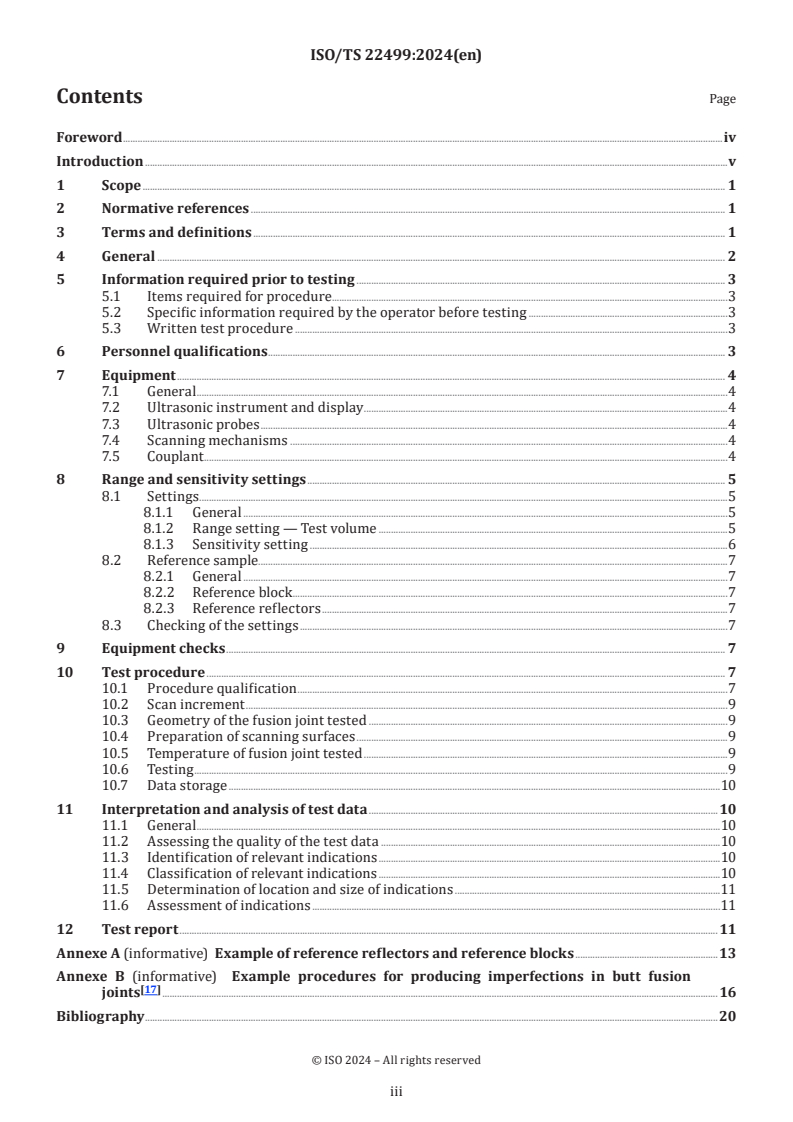
Contents Page
Foreword .iv
Introduction .v
1 Scope . 1
2 Normative references . 1
3 Terms and definitions . 1
4 General . 2
5 Information required prior to testing . 3
5.1 Items required for procedure.3
5.2 Specific information required by the operator before testing .3
5.3 Written test procedure .3
6 Personnel qualifications . . 3
7 Equipment . 4
7.1 General .4
7.2 Ultrasonic instrument and display .4
7.3 Ultrasonic probes .4
7.4 Scanning mechanisms .4
7.5 Couplant .4
8 Range and sensitivity settings . 5
8.1 Settings . . .5
8.1.1 General .5
8.1.2 Range setting — Test volume .5
8.1.3 Sensitivity setting .6
8.2 Reference sample.7
8.2.1 General .7
8.2.2 Reference block . .7
8.2.3 Reference reflectors .7
8.3 Checking of the settings .7
9 Equipment checks . 7
10 Test procedure . 7
10.1 Procedure qualification .7
10.2 Scan increment .9
10.3 Geometry of the fusion joint tested .9
10.4 Preparation of scanning surfaces .9
10.5 Temperature of fusion joint tested .9
10.6 Testing .9
10.7 Data storage .10
11 Interpretation and analysis of test data .10
11.1 General .10
11.2 Assessing the quality of the test data .10
11.3 Identification of relevant indications .10
11.4 Classification of relevant indications .10
11.5 Determination of location and size of indications .11
11.6 Assessment of indications .11
12 Test report .11
Annexe A (informative) Example of reference reflectors and reference blocks .13
Annexe B (informative) Example procedures for producing imperfections in butt fusion
[17]
joints .16
Bibliography .20
iii
Foreword
ISO (the International Organization for Standardization) is a worldwide federation of national standards
bodies (ISO member bodies). The work of preparing International Standards is normally carried out through
ISO technical committees. Each member body interested in a subject for which a technical committee
has been established has the right to be represented on that committee. International organizations,
governmental and non-governmental, in liaison with ISO, also take part in the work. ISO collaborates closely
with the International Electrotechnical Commission (IEC) on all matters of electrotechnical standardization.
The procedures used to develop this document and those intended for its further maintenance are described
in the ISO/IEC Directives, Part 1. In particular, the different approval criteria needed for the different types
of ISO document should be noted. This document was drafted in accordance with the editorial rules of the
ISO/IEC Directives, Part 2 (see www.iso.org/directives).
ISO draws attention to the possibility that the implementation of this document may involve the use of (a)
patent(s). ISO takes no position concerning the evidence, validity or applicability of any claimed patent
rights in respect thereof. As of the date of publication of this document, ISO had not received notice of (a)
patent(s) which may be required to implement this document. However, implementers are cautioned that
this may not represent the latest information, which may be obtained from the patent database available at
www.iso.org/patents. ISO shall not be held responsible for identifying any or all such patent rights.
Any trade name used in this document is information given for the convenience of users and does not
constitute an endorsement.
For an explanation of the voluntary nature of standards, the meaning of ISO specific terms and expressions
related to conformity assessment, as well as information about ISO's adherence to the World Trade
Organization (WTO) principles in the Technical Barriers to Trade (TBT), see www.iso.org/iso/foreword.html.
This document was prepared by Technical Committee ISO/TC 138, Plastics pipes, fittings and valves for the
transport of fluids, Subcommittee SC 5, General properties of pipes, fittings and valves of plastic materials and
their accessories — Test methods and basic specifications.
This second edition cancels and replaces the first edition (ISO/TS 22499:2019), which has been technically
revised.
The main changes are as follows:
— clarification of the definition of "cold fusion" and "lack of fusion";
— revision of the procedure qualification.
Any feedback or questions on this document should be directed to the user’s national standards body. A
complete listing of these bodies can be found at www.iso.org/members.html.
iv
Introduction
At the present time, laboratory experiences exist on the use of PAUT for polyethylene BF joints and/or
[1][2][3][4][5]
reference blocks of wall thickness between 8 mm to 100 mm . Field experience on BF joints in
[6]
PE80 and PE100 materials has been reported .
Interlaboratory test has shown that PAUT is a viable method for enhancing the integrity assessment of butt-
[7][16]
fusion joints .
PAUT techniques for cold fusion detection are known to be available. However further research, verification
and experience are needed to transfer the technique into an ISO Standard. This document does not provide
[16]
any information regarding the detection of cold fusions .
v
Technical Specification ISO/TS 22499:2024(en)
Thermoplastic pipes for the conveyance of fluids —
Inspection of polyethylene butt fusion joints using phased
array ultrasonic testing
1 Scope
This document describes the phased array ultrasonic testing (PAUT) of polyethylene butt fusion (BF)
joints, including pipe-to-pipe, pipe-to-fitting and fitting-to-fitting joints, used for the conveyance of fluids.
This document provides a test, whereby the presence of imperfections such as voids, inclusions, lack of
fusions, misalignment and particulate contamination in the BF joints can be detected. The document is only
applicable to polyethylene pipes and fittings without a barrier to ultrasonic waves.
This document also provides requirements for procedure qualification and guidance for personnel
qualifications, which are essential for the application of this test technique.
This document also covers the equipment, the preparation and performance of the test, the indication
assessment and the reporting for polyethylene BF joints.
Acceptance criteria are not covered in this document.
2 Normative references
The following documents are referred to in the text in such a way that some or all of their content constitutes
requirements of this document. For dated references, only the edition cited applies. For undated references,
the latest edition of the referenced document (including any amendments) applies.
ISO 5577, Non-destructive testing — Ultrasonic testing — Vocabulary
ISO 9712, Non-destructive testing — Qualification and certification of NDT personnel
ISO 13953, Polyethylene (PE) pipes and fittings — Determination of the tensile strength and failure mode of test
pieces from a butt-fused joint
3 Terms and definitions
For the purposes of this document, the terms and definitions given in ISO 5577 and the following apply.
ISO and IEC maintain terminological databases for use in standardization at the following addresses:
— ISO Online browsing platform: available at https:// www .iso .org/ obp
— IEC Electropedia: available at https:// www .electropedia .org/
3.1
cold fusion
incomplete intermolecular diffusion of polymer chains for proper molecular entanglement at the joint
interface due to reasons other than contamination
Note 1 to entry: Cold fusion results in insufficient joint integrity including significant reduction of joint ductility.
3.2
inclusion
foreign material trapped in the fusion joint
3.3
lack of fusion
absence of intermolecular diffusion of polymer chains for molecular entanglement at the interface
Note 1 to entry: A lack of fusion flaw results in complete separation at the flaw location.
3.4
melt fusion zone
MFZ
zone containing the fusion interface and having boundaries on either side of the interface which reflect the
limits of crystalline melting during the butt fusion jointing process
Note 1 to entry: The MFZ is shown in Figure 1.
3.5
misalignment
offset between the axis of the pipes/fittings to be jointed
3.6
particulate contamination
fine particles (e.g. airborne dust) or coarse particles (e.g. sand and grit) that are present at the fusion
interface
3.7
surface imperfection
imperfection on the inner diameter or outer diameter surface of the butt fusion joint
3.8
void
empty space (or air pocket) in a butt fusion joint
3.9
phased array image
one-, two-, or three-dimensional display, constructed from the phased array data
3.10
phased array set-up
probe arrangement defined by probe characteristics (e.g. frequency, probe element size, beam angle, wave
mode), probe position (3.11), and the number of probes
3.11
probe position
point between the front of the wedge (or probe) and the butt fusion center line
3.12
scan increment
distance between successive data collection points in the direction of scanning
3.13
false call
reporting an imperfection when none exists
4 General
This document covers the equipment, the preparation and performance of the test, the indication assessment
and the reporting for polyethylene butt fusion joints.
This document may be used to draft a detailed procedure for phased array ultrasonic testing of polyethylene
butt fusion joints.
Characterization of imperfections in the parent material adjacent to the butt fusion joint is also possible.
5 Information required prior to testing
5.1 Items required for procedure
Information on the following items shall be provided:
a) purpose and extent of testing;
b) manufacturing or operation stage of BF joints at which the testing is to be carried out;
c) reference sample;
d) requirements for getting access to the BF joints, the surface condition of the pipe; and the temperature
range;
e) personnel qualifications;
f) reporting requirements.
5.2 Specific information required by the operator before testing
Before any testing of a fusion joint begins, the operator shall have access to all the information as specified
in 5.1 together with the following additional information:
a) written test procedure, qualified in accordance with Clause 10;
b) all relevant joint dimensions.
5.3 Written test procedure
For all testing, a written test procedure is required. This test procedure shall include the following
information:
a) documented testing strategy or scan plan.
NOTE The testing strategy gives information on the probe placement, movement and component coverage
that provides a standardized and repeatable methodology for fusion joint testing. The scan plan gives information
on the volume tested for each butt fusion joint.
b) equipment requirements and settings (including but not limited to frequency, sampling rate, pitch
between elements and elements size);
c) evaluation of indications;
d) environmental and safety issues.
6 Personnel qualifications
Personnel performing testing in accordance with this document shall be qualified to an appropriate level in
accordance with ISO 9712 or an equivalent standard in the relevant industrial sector.
In addition to a general knowledge of ultrasonic testing, the operator shall be familiar with and have
practical experience in the use of phased array systems on polyethylene butt fusion joints.
Specific theoretical and practical training and examination of personnel shall be performed on representative
polyethylene butt fusion joints containing natural or artificial reflectors similar to those expected in the
field.
These training and examination results shall be documented.
7 Equipment
7.1 General
The complete equipment (i.e. ultrasonic instrument, probe, cables and display monitor) shall be capable of
the repetition of test results.
For selecting the system components (hardware and software), ISO 13588 and ISO/TS 16829 provide useful
information.
Equipment used for phased array testing is described in ISO 18563-1, ISO 18563-2 and ISO 18563-3 and
contains some useful information.
7.2 Ultrasonic instrument and display
The instrument shall be able to select an appropriate portion of the time base within which A-scans are
digitized. It is recommended that a sampling rate of the A-scan should be at least six times the nominal
probe frequency.
7.3 Ultrasonic probes
Only longitudinal waves are feasible for polyethylene.
Any type of phased array probe can be used if it satisfies the range and sensitivity setting requirements of
Clause 7 with the phased array instrument.
The most suitable ultrasonic probe frequency shall be selected in accordance with the pipe wall thickness.
Table 1 shows the recommended frequencies for each thickness range. However, the optimal frequency can
deviate from these values depending on the attenuation and thickness of the sample to be tested.
The gap between the test surface and the bottom of the wedge shall not be greater than 0,5 mm.
Table 1 — Selection of probe frequency
Recommended frequency Wall thickness, t
MHz mm
1,0 to 2,25 60 ≤ t ≤ 100
2,25 to 4,0 30 ≤ t < 60
4,0 to 5,0 8 ≤ t < 30
NOTE In general, higher frequencies provide better resolution and lower frequencies provide better penetration.
7.4 Scanning mechanisms
To achieve consistency of the images (collected data), guiding mechanisms and scan encoder(s) shall be used.
7.5 Couplant
In order to generate proper images, a couplant shall be used which provides a constant transmission of
ultrasound between the probe and the fusion joint tested.
The same couplant used for calibration shall be used for the testing.
Any couplant used should be cleaned off after testing.
8 Range and sensitivity settings
8.1 Settings
8.1.1 General
Setting of range and sensitivity shall be carried out prior to each testing period in accordance with this
document. Any change of the phased array set-up, e.g. probe position and steering parameters, will require
a new setting. The set-up should be optimized on the reference reflectors to give a minimum signal-to-noise
ratio of 6 dB.
8.1.2 Range setting — Test volume
The range in the depth direction shall cover the full joint thickness in the fusion zone.
The range in the axial direction shall cover the MFZ on both sides of the BF centre line. As a general guidance,
for wall thicknesses <100 mm, the test area width is 10 mm or 1/5 of the wall thickness from either side of
the fusion zone, whichever is smaller (see Figure 1).
The range in the circumferential direction shall include the full circumference.
Key
1 outside of joint
2 inside of joint
3 MFZ boundary
4 test area
5 MFZ
6 fusion interface
x width of test area
Figure 1 — Test area
8.1.3 Sensitivity setting
After selection of mode (E-scan, S-scan), the following shall be carried out:
a) sensitivity shall be set for each beam generated by the phased array probe;
1) when a probe with wedge is used, the sensitivity shall be set with the wedge in place,
2) when beam focussing is used, the sensitivity shall be set for each focused beam;
b) use of angle-corrected gain (ACG) or time-corrected gain (TCG) shall be applied
...