

ISO 23999:2025
(Main)Resilient floor coverings — Determination of dimensional stability and curling (vertical deformation) after exposure to heat
General Information
- Abstract
This document specifies methods for determining dimensional stability and curling (vertical deformation) of resilient floor coverings in all forms (e.g. of sheets, tiles, panels, planks or in rolls) after exposure to either heat or after reconditioning, or both.
- Status
- Published
- Publication Date
- 25-Nov-2025
- Technical Committee
- ISO/TC 219 - Floor coverings
- Drafting Committee
- ISO/TC 219/WG 2 - Resilient floor coverings
- Current Stage
- 6060 - International Standard published
- Start Date
- 26-Nov-2025
- Due Date
- 05-Mar-2026
- Completion Date
- 26-Nov-2025
Buy Documents


ISO 23999:2025 - Resilient floor coverings — Determination of dimensional stability and curling (vertical deformation) after exposure to heat Released:11/26/2025

ISO 23999:2025 - Revetements de sol résilients — Détermination de la stabilité dimensionnelle et de l’incurvation (déformation verticale) apres exposition a la chaleur Released:29. 01. 2026


REDLINE ISO 23999:2025 - Revetements de sol résilients — Détermination de la stabilité dimensionnelle et de l’incurvation (déformation verticale) apres exposition a la chaleur Released:29. 01. 2026
Overview
ISO 23999:2025 - "Resilient floor coverings - Determination of dimensional stability and curling (vertical deformation) after exposure to heat" specifies standardized test methods to assess how resilient flooring (sheets, tiles, panels, planks or rolls) reacts to heat. The standard defines procedures for measuring dimensional stability (linear change) and curling (vertical deformation) after heat exposure and optional reconditioning. It replaces the 2021 edition and includes clarified measurement approaches and new informative annexes for result calculation.
Key technical topics and requirements
- Scope and test principle
- Measures dimensional change and vertical deformation of resilient floor coverings after heat exposure and reconditioning.
- Tests use three specimens measured before and after treatment.
- Specimen types
- Applicable to sheets, rolls, tiles, panels and planks; preparation steps differ by form.
- Apparatus and oven requirements
- Thermostatically controlled, ventilated oven with uniform temperature ±2 °C.
- Specimens must be positioned so heating elements do not radiate directly; support plates must sit >50 mm from oven walls and >100 mm from ceiling/base.
- Support plates
- Metal plates (e.g., aluminium or stainless steel), thickness 2.0 mm ±0.5 mm, smooth and flat.
- Measurement devices and resolution
- Curling (vertical deformation): devices with minimum resolution ±0.1 mm (laser, optical, tactile gauges).
- Linear dimensional change: devices with minimum resolution ±0.02 mm (optical bench, callipers, block and dial gauge setups).
- Includes guidance on scoring marks, rigid steel plate use, and the “block and dial gauge apparatus” for tiles/planks.
- Terminology
- Defines machine direction (MD) and across machine direction (AMD); MD/AMD can be assigned arbitrarily when unknown.
- Curling conventions: concave (outer-edge uplift = positive) and convex (centre dome = negative).
- Procedure
- Initial measurement → heat exposure → reconditioning (if applicable) → final measurement.
- Annex A and B provide measurement and calculation guidance.
Practical applications and who uses it
ISO 23999:2025 is used by:
- Flooring manufacturers for product development and quality control.
- Independent testing laboratories to provide consistent test data.
- Specifiers, architects, and procurement teams assessing material suitability for heated environments (e.g., commercial fit-outs, underfloor heating situations).
- Installers and compliance officers verifying product claims and conformity to performance requirements.
Benefits include reproducible test results, improved product specification, and reduced installation failures related to thermal distortion.
Related standards and context
- Prepared by ISO/TC 219 (Floor coverings) in collaboration with CEN/TC 134.
- Includes informative Annex A (measurement of dimensional change due to heat) and Annex B (calculation and expression of results).
Keywords: ISO 23999:2025, resilient floor coverings, dimensional stability, curling, vertical deformation, heat exposure, oven requirements, block and dial gauge, optical bench, flooring test methods.
Relations
- Effective Date
- 12-Feb-2026
- Effective Date
- 23-Mar-2024
- Effective Date
- 27-Jan-2024
Buy Documents
ISO 23999:2025 - Resilient floor coverings — Determination of dimensional stability and curling (vertical deformation) after exposure to heat Released:11/26/2025
ISO 23999:2025 - Revetements de sol résilients — Détermination de la stabilité dimensionnelle et de l’incurvation (déformation verticale) apres exposition a la chaleur Released:29. 01. 2026
REDLINE ISO 23999:2025 - Revetements de sol résilients — Détermination de la stabilité dimensionnelle et de l’incurvation (déformation verticale) apres exposition a la chaleur Released:29. 01. 2026
Frequently Asked Questions
ISO 23999:2025 is a standard published by the International Organization for Standardization (ISO). Its full title is "Resilient floor coverings — Determination of dimensional stability and curling (vertical deformation) after exposure to heat". This standard covers: This document specifies methods for determining dimensional stability and curling (vertical deformation) of resilient floor coverings in all forms (e.g. of sheets, tiles, panels, planks or in rolls) after exposure to either heat or after reconditioning, or both.
This document specifies methods for determining dimensional stability and curling (vertical deformation) of resilient floor coverings in all forms (e.g. of sheets, tiles, panels, planks or in rolls) after exposure to either heat or after reconditioning, or both.
ISO 23999:2025 is classified under the following ICS (International Classification for Standards) categories: 97.150 - Floor coverings. The ICS classification helps identify the subject area and facilitates finding related standards.
ISO 23999:2025 has the following relationships with other standards: It is inter standard links to EN ISO 23999:2025, ISO 8893:2021, ISO 23999:2021. Understanding these relationships helps ensure you are using the most current and applicable version of the standard.
ISO 23999:2025 is available in PDF format for immediate download after purchase. The document can be added to your cart and obtained through the secure checkout process. Digital delivery ensures instant access to the complete standard document.
Standards Content (Sample)
International
Standard
ISO 23999
Fourth edition
Resilient floor coverings —
2025-11
Determination of dimensional
stability and curling (vertical
deformation) after exposure to heat
Revêtements de sol résilients — Détermination de la stabilité
dimensionnelle et de l’incurvation (déformation verticale) après
exposition à la chaleur
Reference number
© ISO 2025
All rights reserved. Unless otherwise specified, or required in the context of its implementation, no part of this publication may
be reproduced or utilized otherwise in any form or by any means, electronic or mechanical, including photocopying, or posting on
the internet or an intranet, without prior written permission. Permission can be requested from either ISO at the address below
or ISO’s member body in the country of the requester.
ISO copyright office
CP 401 • Ch. de Blandonnet 8
CH-1214 Vernier, Geneva
Phone: +41 22 749 01 11
Email: copyright@iso.org
Website: www.iso.org
Published in Switzerland
ii
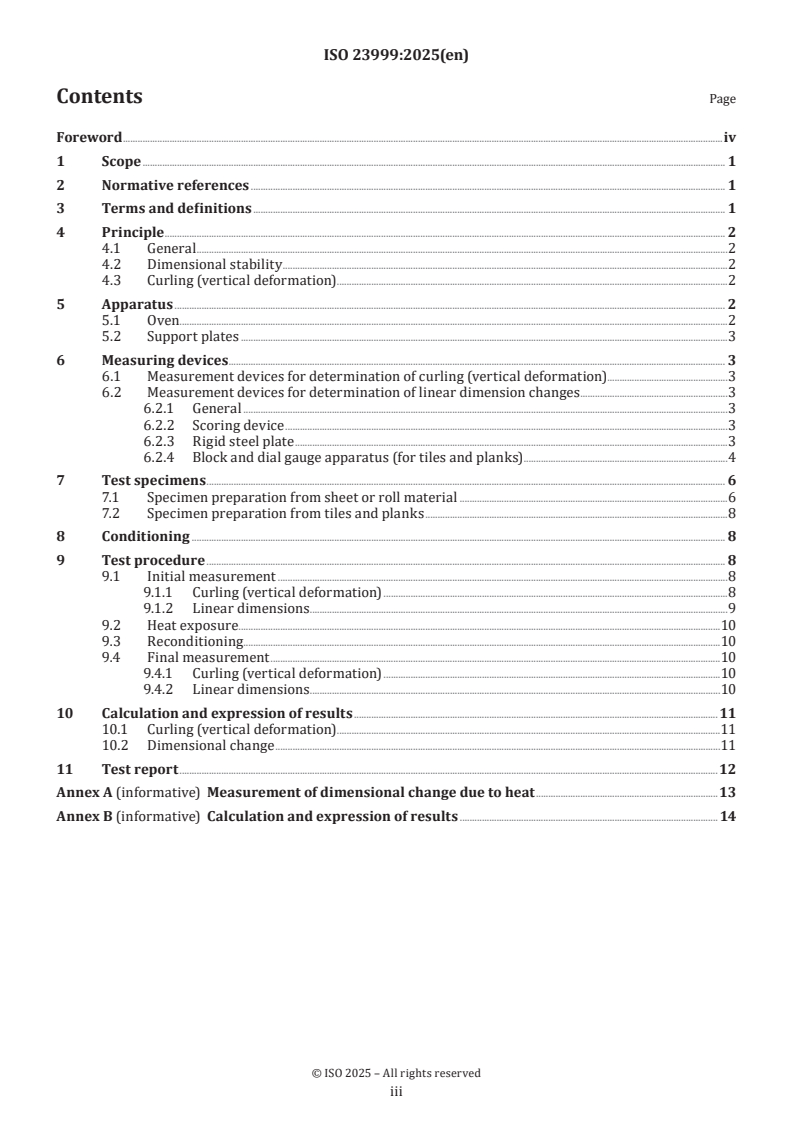
Contents Page
Foreword .iv
1 Scope . 1
2 Normative references . 1
3 Terms and definitions . 1
4 Principle . 2
4.1 General .2
4.2 Dimensional stability .2
4.3 Curling (vertical deformation) .2
5 Apparatus . 2
5.1 Oven.2
5.2 Support plates .3
6 Measuring devices . 3
6.1 Measurement devices for determination of curling (vertical deformation) .3
6.2 Measurement devices for determination of linear dimension changes .3
6.2.1 General .3
6.2.2 Scoring device .3
6.2.3 Rigid steel plate .3
6.2.4 Block and dial gauge apparatus (for tiles and planks) .4
7 Test specimens . 6
7.1 Specimen preparation from sheet or roll material .6
7.2 Specimen preparation from tiles and planks .8
8 Conditioning . 8
9 Test procedure . 8
9.1 Initial measurement .8
9.1.1 Curling (vertical deformation) .8
9.1.2 Linear dimensions . . .9
9.2 Heat exposure.10
9.3 Reconditioning.10
9.4 Final measurement .10
9.4.1 Curling (vertical deformation) .10
9.4.2 Linear dimensions . . .10
10 Calculation and expression of results .11
10.1 Curling (vertical deformation) .11
10.2 Dimensional change .11
11 Test report .12
Annex A (informative) Measurement of dimensional change due to heat .13
Annex B (informative) Calculation and expression of results . 14
iii
Foreword
ISO (the International Organization for Standardization) is a worldwide federation of national standards
bodies (ISO member bodies). The work of preparing International Standards is normally carried out through
ISO technical committees. Each member body interested in a subject for which a technical committee
has been established has the right to be represented on that committee. International organizations,
governmental and non-governmental, in liaison with ISO, also take part in the work. ISO collaborates closely
with the International Electrotechnical Commission (IEC) on all matters of electrotechnical standardization.
The procedures used to develop this document and those intended for its further maintenance are described
in the ISO/IEC Directives, Part 1. In particular, the different approval criteria needed for the different types
of ISO document should be noted. This document was drafted in accordance with the editorial rules of the
ISO/IEC Directives, Part 2 (see http://www.iso.org/directives).
ISO draws attention to the possibility that the implementation of this document may involve the use of (a)
patent(s). ISO takes no position concerning the evidence, validity or applicability of any claimed patent
rights in respect thereof. As of the date of publication of this document, ISO had not received notice of (a)
patent(s) which may be required to implement this document. However, implementers are cautioned that
this may not represent the latest information, which may be obtained from the patent database available at
http://www.iso.org/patents. ISO shall not be held responsible for identifying any or all such patent rights.
Any trade name used in this document is information given for the convenience of users and does not
constitute an endorsement.
For an explanation of the voluntary nature of standards, the meaning of ISO specific terms and expressions
related to conformity assessment, as well as information about ISO's adherence to the World Trade Organization
(WTO) principles in the Technical Barriers to Trade (TBT), see http://www.iso.org/iso/foreword.html.
This document was prepared by Technical Committee ISO/TC 219, Floor coverings, in collaboration with the
European Committee for Standardization (CEN) Technical Committee CEN/TC 134 Resilient, textile, laminate
and modular mechanical locked floor coverings, in accordance with the Agreement on technical cooperation
between ISO and CEN (Vienna Agreement).
This fourth edition cancels and replaces the third edition (ISO 23999:2021), which has been technically
revised.
The main changes are as follows:
— revision of terms and definitions;
— clarification on the deviation between devices used for either sheet or roll, or both, materials and
rectangular shaped elements (squared tiles or long panels);
— inclusion of an explanation on the use of the so called “block and dial gauge apparatus” and minor changes
to the figures and a new figure was added;
— inclusion of description of the preparation distinguishing sheet, roll materials and rectangular shaped
elements (squared tiles or long panels);
— detailed calculation and expression of results can be found in new Annex B.
Any feedback or questions on this document should be directed to the user’s national standards body. A
complete listing of these bodies can be found at http://www.iso.org/members.html.
iv
International Standard ISO 23999:2025(en)
Resilient floor coverings — Determination of dimensional
stability and curling (vertical deformation) after
exposure to heat
1 Scope
This document specifies methods for determining dimensional stability and curling (vertical deformation)
of resilient floor coverings in all forms (e.g. of sheets, tiles, panels, planks or in rolls) after exposure to either
heat or after reconditioning, or both.
2 Normative references
There are no normative references in this document.
3 Terms and definitions
For the purposes of this document, the following terms and definitions apply.
ISO and IEC maintain terminology databases for use in standardization at the following addresses:
— ISO Online browsing platform: available at https:// www .iso .org/ obp
— IEC Electropedia: available at https:// www .electropedia .org/
3.1
dimensional stability
ability of a resilient floor covering to retain its original linear dimensions after exposure to heat, determined
by measuring the linear dimensional change in machine direction or across machine direction
Note 1 to entry: Retaining original linear dimensions includes no elongation or shrinking.
3.2
curling
vertical deformation
vertically concave (+) or convex (-) deformation from the horizontal
3.3
concave deformation
type of curling (vertical deformation) appearing as uplifted top surface at the outer edge of the specimen;
given as positive value (+)
3.4
convex deformation
type of curling (vertical deformation) appearing as uplifted, domed top surface in the centre of the specimen;
given as negative value (-)
3.5
machine direction
MD
direction parallel to the length side of a floor covering manufactured in a continuous process
Note 1 to entry: For rectangular or squared cut specimens (e.g. tiles and planks) where the machine direction cannot
be determined, the direction of MD can be arbitrarily assigned for the test to enable differentiation from across
machine direction (AMD).
3.6
across machine direction
AMD
direction across to the length side of a floor covering manufactured in a continuous process
Note 1 to entry: For rectangular or squared cut specimens (e.g. tiles and planks) where the across machine direction
cannot be determined, the AMD can be arbitrarily assigned for the test to enable differentiation from machine
direction (MD).
4 Principle
4.1 General
Three test specimens are initially measured and then placed in an oven at an elevated temperature
which can cause dimensional changes and curl. After a specific period in the oven and subsequent time of
reconditioning, dimensional stability and the stability against vertical deformation (curling) are measured
again on the same test specimens.
4.2 Dimensional stability
The relative change in linear distance between the same marks or same specific locations of the top surface
layer of a test specimen, measured after exposure to a heat treatment and reconditioning. Depending on
the size of the specimen and the structure of the surface, different measuring devices can therefore be
appropriate.
As a special interest case, the change of linear dimensions can be determined on hot test specimens, meaning
before reconditioning. As this does not affect the measurement of dimensional stability and curling, it may
be determined as an intermediate result on the same test specimens (see Annex A).
4.3 Curling (vertical deformation)
Curling is measured at the highest peaks of the test specimens, possibly occurring after the specified heat
treatment in an oven at an elevated temperature and reconditioning in a normal conditioned climate.
An initial vertical deformation of the test specimen (before the exposure to heat) may be measured (see
Figure 7).
5 Apparatus
5.1 Oven
The oven shall be thermostatically controlled and ventilated, capable of being maintained at a uniform
temperature with maximum deviations of ±2 °C.
The oven shall allow for specimens to be placed inside in a way that ensures that radiation from the heating
elements does not directly reach the test specimens or support plates (see 5.2). Therefore, the distance
between the support plates and the vertical walls of the oven shall be more than 50 mm and the vertical
distance between the support plates and between the plates and the oven ceiling and base shall be more
than 100 mm.
5.2 Support plates
The support plates on which the specimens will be placed for the test shall be of metal, e.g. aluminium or
stainless steel, and 2,0 mm ± 0,5 mm in thickness. The overall length and width of the support plates shall
be of dimensions larger than the test specimen. Ensure that the support plates are kept smooth and polished
so that surface friction does not interfere with free shrinkage or growth of the test specimens. The plates
shall be flat and free of convex or concave distortion and fully support the specimen (e.g. a wire rack support
plate is not acceptable.).
6 Measuring devices
6.1 Measurement devices for determination of curling (vertical deformation)
The measuring equipment can be any appropriate apparatus or device capable of measuring small distances
vertical from the support plate (see 5.2) with a minimum resolution of the display accuracy or graduation of
±0,1 mm and without influencing the test specimens by any kind of load from the test device itself.
This may include:
— a laser measuring device;
— other optical measuring devices;
— tactile measuring devices (e.g. pillar-mounted drop gauge device, feeler gauges or a micrometer).
6.2 Measurement devices for determination of linear dimension changes
6.2.1 General
All used measuring equipment shall measure with a minimum resolution of the display accuracy or
graduation of at least ±0,02 mm.
The measuring equipment may include:
— an optical bench for non-contact dimensional measurements between two marks on the top surface (for
example scores which are carefully made in the surface); or
— callipers; or
— a block and dial set-up (see 6.2.4) as shown in Figures 2, 3 and 4 for tactile measurement at the outer edge
of the specimen top layer.
For many types of optical benches, ensure that the test specimen is properly seated against the base
horizontal index guide when a specific measurement is being taken, otherwise test specimens with concave
or convex edges can be read incorrectly.
For ready shaped floor covering elements (e.g. tiles and planks), the block and dial gauge apparatus is
appropriate. For test specimens prepared from sheet or roll material, equipment shall be used which take
measures from the top surface.
6.2.2 Scoring device
For measurements with an optical bench (see 6.2.1) a scoring device, e.g. a single edge razor blade, scalpel
or scribe point, may be used to make marks in the top surface of test specimens made from sheet or roll
material or optionally tiles and planks.
6.2.3 Rigid steel plate
Optional auxiliary device to help flatten test specimens from sheet or roll material or optionally-tiles and
planks with a concave deformation or with a convex deformation. A rigid plate of steel, squared and finished,
of dimensions 240 mm × 240 mm with holes to see the measuring marks (examples are shown in Figures 1
and 6) on the top surface of the specimens. If larger format specimens are tested, then the rigid plate should
be of commensurate size and configuration.
Dimensions in millimetres
Figure 1 — Rigid steel plate
6.2.4 Block and dial gauge apparatus (for tiles and planks)
6.2.4.1 General
Test device consisting of a support that is large enough to fit the test specimen and with a lay-on edge (block)
to be used with a measuring device (for example a dial gauge, see Figures 2, 3 and 4).
6.2.4.2 Square standard template
A standard template may be used together with the block and dial gauge apparatus (see 6.2.4.1) for
determination of deviations in size between the template and a product or a specimen. Figure 2 shows an
example of a block and dial gauge apparatus with the possible use of standard templates in four different
sizes and possible positions of the measuring devices to also determine straightness and squareness.
A square standard template has the nominal side length of a product or a test specimen and should be
rectangular. The deviations from the template sizes before and after heat exposure can show the linear
dimensional changes due to the heat influence.
NOTE 1 A standard template calibrated for straightness, squareness, and length with regard to the nominal sizes of
a product can be useful for a quick measurement (e.g. for in-house production monitoring).
NOTE 2 The calculation of the dimensional changes shown in Clause 10 do not refer to the measuring method with
the use of a template.
6.2.4.3 Shim or spacer block
An auxiliary device to bridge the gap between the stop (edge) of the block and dial gauge apparatus (see
6.2.4.1) and a specimen whose dimensions are such that the dial gauges may not be in direct contact with
the specimen as shown in Figures 3 and 4. A rigid steel plate, square and with parallel sides, which serves as
a filling for the free space when it is required for the use of the block and dial gauge device.
NOTE Specimens (flooring products) can have different widths which can make it necessary to use shim or
spacer blocks with different sizes or a combination of two or more spacer blocks. As the measurement is a relative
measurement of a change in dimension, the spacer block can be without calibration provided that the spacer block is
placed in exactly the same position and orientation between measurements.
Dimensions in millimetres
Key
1 edge 1
2 edge 2
3 edge 3
4 edge 4
A template 610 mm × 610 mm
A template 508 mm × 508 mm
A template 305 mm × 305 mm
A template 229 mm × 2
...
Norme
internationale
ISO 23999
Quatrième édition
Revêtements de sol résilients —
2025-11
Détermination de la stabilité
dimensionnelle et de l’incurvation
(déformation verticale) après
exposition à la chaleur
Resilient floor coverings — Determination of dimensional
stability and curling (vertical deformation) after exposure to heat
Numéro de référence
DOCUMENT PROTÉGÉ PAR COPYRIGHT
© ISO 2025
Tous droits réservés. Sauf prescription différente ou nécessité dans le contexte de sa mise en œuvre, aucune partie de cette
publication ne peut être reproduite ni utilisée sous quelque forme que ce soit et par aucun procédé, électronique ou mécanique,
y compris la photocopie, ou la diffusion sur l’internet ou sur un intranet, sans autorisation écrite préalable. Une autorisation peut
être demandée à l’ISO à l’adresse ci-après ou au comité membre de l’ISO dans le pays du demandeur.
ISO copyright office
Case postale 401 • Ch. de Blandonnet 8
CH-1214 Vernier, Genève
Tél.: +41 22 749 01 11
E-mail: copyright@iso.org
Web: www.iso.org
Publié en Suisse
ii
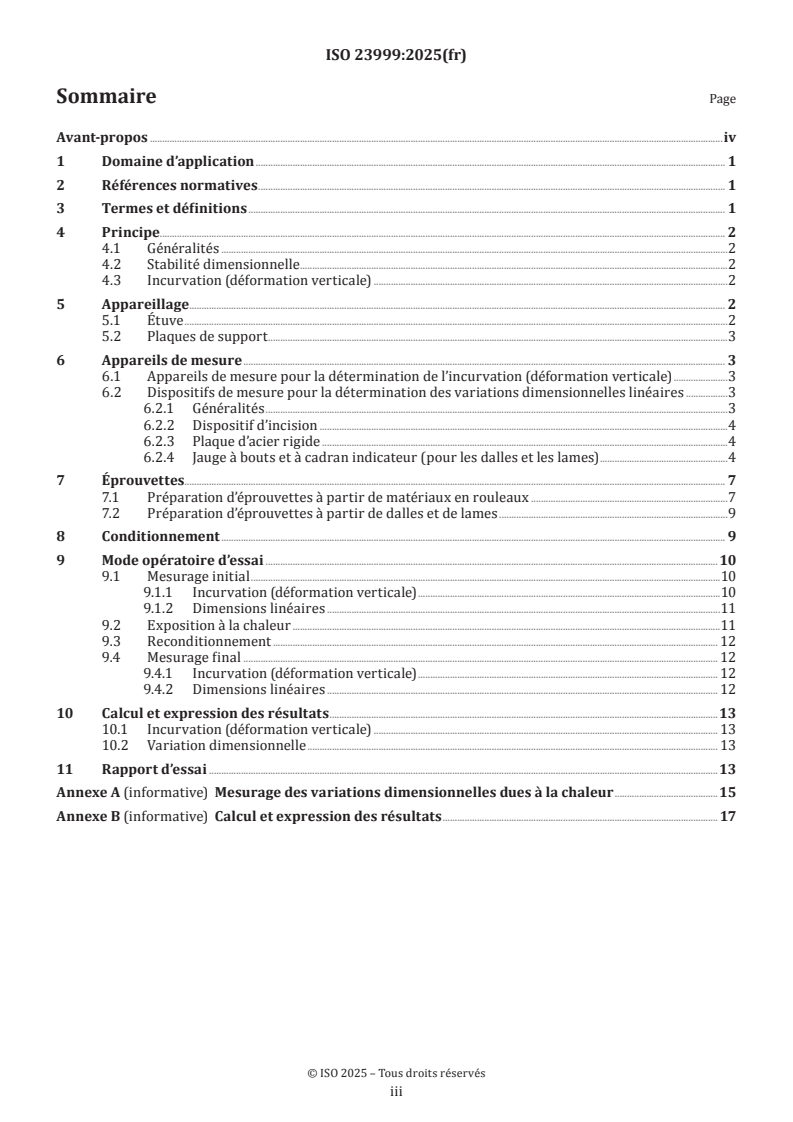
Sommaire Page
Avant-propos .iv
1 Domaine d’application . 1
2 Références normatives . 1
3 Termes et définitions . 1
4 Principe. 2
4.1 Généralités .2
4.2 Stabilité dimensionnelle .2
4.3 Incurvation (déformation verticale) .2
5 Appareillage . 2
5.1 Étuve .2
5.2 Plaques de support .3
6 Appareils de mesure . 3
6.1 Appareils de mesure pour la détermination de l’incurvation (déformation verticale) .3
6.2 Dispositifs de mesure pour la détermination des variations dimensionnelles linéaires .3
6.2.1 Généralités .3
6.2.2 Dispositif d’incision .4
6.2.3 Plaque d’acier rigide .4
6.2.4 Jauge à bouts et à cadran indicateur (pour les dalles et les lames) .4
7 Éprouvettes. 7
7.1 Préparation d’éprouvettes à partir de matériaux en rouleaux .7
7.2 Préparation d’éprouvettes à partir de dalles et de lames .9
8 Conditionnement . 9
9 Mode opératoire d’essai . 10
9.1 Mesurage initial .10
9.1.1 Incurvation (déformation verticale) .10
9.1.2 Dimensions linéaires .11
9.2 Exposition à la chaleur .11
9.3 Reconditionnement . 12
9.4 Mesurage final . 12
9.4.1 Incurvation (déformation verticale) . 12
9.4.2 Dimensions linéaires . 12
10 Calcul et expression des résultats .13
10.1 Incurvation (déformation verticale) . 13
10.2 Variation dimensionnelle . 13
11 Rapport d’essai .13
Annexe A (informative) Mesurage des variations dimensionnelles dues à la chaleur .15
Annexe B (informative) Calcul et expression des résultats . 17
iii
Avant-propos
L’ISO (Organisation internationale de normalisation) est une fédération mondiale d’organismes nationaux
de normalisation (comités membres de l’ISO). L’élaboration des Normes internationales est en général
confiée aux comités techniques de l’ISO. Chaque comité membre intéressé par une étude a le droit de faire
partie du comité technique créé à cet effet. Les organisations internationales, gouvernementales et non
gouvernementales, en liaison avec l’ISO participent également aux travaux. L’ISO collabore étroitement avec
la Commission électrotechnique internationale (IEC) en ce qui concerne la normalisation électrotechnique.
Les procédures utilisées pour élaborer le présent document et celles destinées à sa mise à jour sont
décrites dans les Directives ISO/IEC, Partie 1. Il convient, en particulier, de prendre note des différents
critères d’approbation requis pour les différents types de documents ISO. Le présent document
a été rédigé conformément aux règles de rédaction données dans les Directives ISO/IEC, Partie 2
(voir http://www.iso.org/directives).
L’ISO attire l’attention sur le fait que la mise en application du présent document peut entraîner l’utilisation
d’un ou de plusieurs brevets. L’ISO ne prend pas position quant à la preuve, à la validité et à l’applicabilité de
tout droit de propriété revendiqué à cet égard. À la date de publication du présent document, l’ISO n’avait pas
reçu notification qu’un ou plusieurs brevets pouvaient être nécessaires à sa mise en application. Toutefois,
il y a lieu d’avertir les responsables de la mise en application du présent document que des informations
plus récentes sont susceptibles de figurer dans la base de données de brevets, disponible à l’adresse
http://www.iso.org/brevets. Le ISO ne saurait être tenu pour responsable de ne pas avoir identifié tout ou
partie de tels droits de brevet.
Les appellations commerciales éventuellement mentionnées dans le présent document sont données pour
information, par souci de commodité, à l’intention des utilisateurs et ne sauraient constituer un engagement.
Pour une explication de la nature volontaire des normes, la signification des termes et expressions
spécifiques de l’ISO liés à l’évaluation de la conformité, ou pour toute information au sujet de l’adhésion de
l’ISO aux principes de l’Organisation mondiale du commerce (OMC) concernant les obstacles techniques au
commerce (OTC), voir http://www.iso.org/avant-propos.
Le présent document a été élaboré par le comité technique ISO/TC 219, Revêtements de sol, en collaboration
avec le comité technique CEN/TC 134, Revêtements de sol résilients, textiles, stratifiés et modulaires à
verrouillage, du Comité européen de normalisation (CEN), conformément à l’Accord de coopération technique
entre l’ISO et le CEN (Accord de Vienne).
Cette quatrième édition annule et remplace la troisième édition (ISO 23999:2021), qui a fait l’objet d’une
révision technique.
Les principales modifications sont les suivantes:
— révision des termes et définitions;
— clarification de l’écart entre les dispositifs utilisés pour les matériaux en rouleaux et les éléments de
forme rectangulaire (dalles équerrées ou panneaux longs);
— inclusion d’une explication sur l’utilisation de la jauge à bouts et à cadran indicateur, modifications
mineures des figures et ajout d’une nouvelle figure;
— inclusion d’une description de la préparation distinguant les matériaux en rouleaux et les éléments de
forme rectangulaire (dalles équerrées ou panneaux longs);
— les calculs détaillés et l’expression des résultats figurent dans la nouvelle Annexe B.
Il convient que l’utilisateur adresse tout retour d’information ou toute question concernant le présent
document à l’organisme national de normalisation de son pays. Une liste exhaustive desdits organismes se
trouve à l’adresse http://www.iso.org/fr/members.html.
iv
Norme internationale ISO 23999:2025(fr)
Revêtements de sol résilients — Détermination de la stabilité
dimensionnelle et de l’incurvation (déformation verticale)
après exposition à la chaleur
1 Domaine d’application
Le présent document spécifie des méthodes de détermination de la stabilité dimensionnelle et de l’incurvation
(déformation verticale) des revêtements de sol résilients de toutes formes (par exemple rouleaux, dalles,
panneaux ou lames), après exposition à la chaleur ou après reconditionnement, ou les deux.
2 Références normatives
Le présent document ne contient aucune référence normative.
3 Termes et définitions
Pour les besoins du présent document, les termes et définitions suivants s’appliquent.
L’ISO et l’IEC tiennent à jour des bases de données terminologiques destinées à être utilisées en normalisation,
consultables aux adresses suivantes:
— ISO Online browsing platform: disponible à l’adresse https:// www .iso .org/ obp
— IEC Electropedia: disponible à l’adresse https:// www .electropedia .org/
3.1
stabilité dimensionnelle
aptitude d’un revêtement de sol résilient à conserver ses dimensions linéaires d’origine après exposition à la
chaleur, déterminée en mesurant la variation dimensionnelle linéaire dans le sens machine ou dans le sens
travers
Note 1 à l'article: La conservation des dimensions linéaires d’origine ne comprend pas d’allongement ou de
rétrécissement.
3.2
incurvation
déformation verticale
déformation verticale concave (+) ou convexe (-) par rapport à l’horizontale
3.3
déformation concave
type d’incurvation (déformation verticale) se manifestant par une élévation de la surface supérieure à l’arête
extérieure de l’éprouvette; exprimé par une valeur positive (+)
3.4
déformation convexe
type d’incurvation (déformation verticale) se manifestant par une élévation en forme de dôme de la surface
supérieure au centre de l’éprouvette; exprimé par une valeur négative (-)
3.5
sens machine
MD
sens parallèle au côté longitudinal d’un revêtement de sol fabriqué selon un procédé continu
Note 1 à l'article: Pour les éprouvettes rectangulaires ou équerrées (par exemple les dalles et les lames) pour lesquelles
le sens machine ne peut pas être déterminé, celui-ci peut être attribué arbitrairement dans le cadre de l’essai afin de
permettre la différenciation par rapport au sens travers (AMD).
3.6
sens travers
AMD
sens perpendiculaire au côté longitudinal d’un revêtement de sol fabriqué selon un procédé continu
Note 1 à l'article: Pour les éprouvettes rectangulaires ou équerrées (par exemple les dalles et les lames) pour lesquelles
le sens machine ne peut pas être déterminé, celui-ci peut être attribué arbitrairement dans le cadre de l’essai afin de
permettre la différenciation par rapport au sens machine (MD).
4 Principe
4.1 Généralités
Trois éprouvettes sont mesurées, puis placées dans une étuve à température élevée, pouvant entraîner des
variations dimensionnelles et une incurvation. Après une période spécifique dans l’étuve suivie d’un temps
de reconditionnement, la stabilité dimensionnelle et la stabilité contre la déformation verticale (incurvation)
sont mesurées à nouveau sur les mêmes éprouvettes d’essai.
4.2 Stabilité dimensionnelle
La variation relative de la distance linéaire entre les mêmes marques ou les mêmes emplacements
spécifiques de la couche supérieure de surface d’une éprouvette d’essai, mesurée après exposition à un
traitement thermique et reconditionnement. En fonction de la taille de l’éprouvette et de la structure de la
surface, différents appareils de mesure peuvent donc s’avérer appropriés.
La variation des dimensions linéaires peut être déterminée sur les éprouvettes à chaud, c’est-à-dire avant
reconditionnement; c’est un cas d’intérêt particulier. Comme elle n’affecte pas le mesurage de la stabilité
dimensionnelle et de l’incurvation, elle peut être déterminée comme résultat intermédiaire sur les mêmes
éprouvettes d’essai (voir Annexe A).
4.3 Incurvation (déformation verticale)
L’incurvation est mesurée au niveau des crêtes les plus élevées des éprouvettes d’essai qui se produisent
éventuellement après le traitement thermique spécifié dans une étuve à température élevée et le
reconditionnement dans des conditions normales d’acclimatation.
Il est possible de mesurer une déformation verticale initiale de l’éprouvette (avant l’exposition à la chaleur)
(voir Figure 7).
5 Appareillage
5.1 Étuve
L’étuve doit être thermostatée et ventilée, capable d’être maintenue à une température constante subissant
au maximum des écarts de ±2 °C.
L’étuve doit permettre de placer les éprouvettes à l’intérieur de sorte que le rayonnement des éléments
chauffants n’atteigne pas directement les éprouvettes ou les plaques de support (voir 5.2). Par conséquent,
la distance entre les plaques de support et les parois verticales de l’étuve doit être supérieure à 50 mm et la
distance verticale entre les plaques de support et entre les plaques, le plafond et le plancher de l’étuve doit
être supérieure à 100 mm.
5.2 Plaques de support
Les plaques de support sur lesquelles les éprouvettes seront placées pour l’essai doivent être en métal (par
exemple en aluminium ou en acier inoxydable) et d’une épaisseur de 2,0 ± 0,5 mm. La longueur et la largeur
totales des plaques de support doivent être supérieures à celles de l’éprouvette. S’assurer que les plaques de
support sont toujours lisses et polies afin que le frottement de la surface n’interfère pas avec l’expansion ou
le rétrécissement indéterminé des éprouvettes. Les plaques doivent être plates et exemptes de déformation
convexe ou concave et doivent supporter entièrement l’éprouvette (une plaque de support de type grille
métallique n’est pas acceptable, par exemple).
6 Appareils de mesure
6.1 Appareils de mesure pour la détermination de l’incurvation (déformation verticale)
L’équipement de mesure peut être tout appareil ou dispositif approprié capable de mesurer de petites
distances verticales à partir de la plaque de support (voir 5.2) avec une résolution minimale de la précision
d’affichage ou de la graduation de ±0,1 mm et sans influencer les éprouvettes d’essai par une charge
quelconque provenant du dispositif d’essai lui-même.
Il peut s’agir:
— d’un appareil de mesure au laser;
— d’autres appareils de mesure optique;
— de dispositifs de mesure tactiles (par exemple une jauge de hauteur montée sur des piliers, un comparateur
palpeur ou un micromètre).
6.2 Dispositifs de mesure pour la détermination des variations dimensionnelles linéaires
6.2.1 Généralités
Tous les appareils de mesure utilisés doivent avoir une résolution minimale de la précision d’affichage ou de
la graduation d’au moins ±0,02 mm.
L’équipement de mesure peut comprendre:
— un banc optique pour des mesurages dimensionnels sans contact entre deux marques sur la surface
supérieure (par exemple des incisions soigneusement faites dans la surface); ou
— des pieds à coulisse; ou
— une jauge à bouts et à cadran indicateur (voir 6.2.4) comme illustrée dans les Figures 2, 3 et 4 pour le
mesurage tactile à partir de l’arête extérieure de la couche supérieure de l’éprouvette.
Pour de nombreux types de bancs optiques, veiller à ce que l’éprouvette soit convenablement plaquée contre
le guide principal de l’indice horizontal lorsqu’une mesure spécifique est réalisée. Autrement, les éprouvettes
avec des arêtes concaves ou convexes peuvent être mal lues.
Pour les éléments de revêtement de sol préformés (par exemple les dalles et les lames), il est approprié
d’utiliser la jauge à bouts et à cadran indicateur. Pour les éprouvettes préparées à partir de matériaux en
rouleaux, un équipement permettant de prendre des mesures à partir de la surface supérieure doit être
utilisé.
6.2.2 Dispositif d’incision
Un dispositif d’incision (par exemple un rasoir à lame simple, un scalpel ou un traçoir) peut être utilisé pour
faire des marques sur la surface supérieure des éprouvettes fabriquées à partir de matériaux en rouleaux
ou, éventuellement, pour des dalles et des lames en vue de les mesurer à l’aide d’un banc optique (voir 6.2.1).
6.2.3 Plaque d’acier rigide
Dispositif auxiliaire optionnel pour aider à aplanir les éprouvettes à partir de matériaux en rouleaux ou,
éventuellement, pour des dalles et des lames à déformation concave ou à déformation convexe. Une plaque
rigide en acier, équerrée et finie, de dimensions 240 mm × 240 mm avec des trous pour voir les marques de
mesure (voir les exemples en Figure 1 et 6) sur la surface supérieure des éprouvettes. Si des essais sont faits
sur des éprouvettes de plus grand format, il convient que la plaque rigide soit de taille et de configuration
proportionnelles.
6.2.4 Jauge à bouts et à cadran indicateur (pour les dalles et les lames)
6.2.4.1 Généralités
Dispositif d’essai constitué d’une plaque de support de taille suffisante pour contenir l’éprouvette et
présentant un bord sur lequel reposer (bloc), à utiliser avec un dispositif de mesure (par exemple un cadran
indicateur, voir les Figures 2, 3 et 4).
6.2.4.2 Gabarit carré standard
Un gabarit standard peut être utilisé avec la jauge à bouts et à cadran indicateur (voir 6.2.4.1) pour
déterminer les écarts de taille entre le gabarit et un produit ou une éprouvette. La Figure 2 présente un
exemple de jauge à bouts et à cadran indicateur avec la possibilité d’utiliser des gabarits standard de quatre
tailles différentes, et différentes positions possibles des dispositifs de mesure pour déterminer la rectitude
et l’équerrage. Un gabarit carré standard a la longueur nominale du côté d’un produit ou d’une éprouvette
d’essai et il convient qu’il soit rectangulaire. Les écarts par rapport aux dimensions du gabarit avant et après
l’exposition à la chaleur peuvent montrer les variations dimensionnelles linéaires dues à l’influence de la
chaleur.
NOTE 1 Un gabarit standard calibré pour la rectitude, l’équerrage et la longueur par rapport aux dimensions
nominales d’un produit peut être utile pour un mesurage rapide (par exemple pour le suivi de la production en interne).
NOTE 2 Le calcul des variations dimensionnelles indiqué à l’10 ne se réfère pas à la méthode de mesure à l’aide d’un
gabarit.
6.2.4.3 Cale ou pièce d’écartement
Dispositif auxiliaire permettant de combler l’écart entre la butée (le bord) de la jauge à bouts et à cadran
indicateur (voir 6.2.4.1) et une éprouvette dont les dimensions sont telles que les cadrans indicateurs ne
peuvent pas être en contact direct avec l’éprouvette, comme le montrent les Figures 3 et 4. Une plaque
d’acier rigide, carrée, dont les côtés sont parallèles, qui sert à remplir l’espace libre lorsque cela est exigé
pour l’utilisation de la jauge à bouts et à cadran indicateur.
NOTE Les éprouvettes (produits de revêtement de sol) peuvent avoir des largeurs différentes, ce qui peut
nécessiter l’utilisation de cales ou de pièces d’écartement de tailles différentes ou une combinaison de deux blocs
d’écartement ou plus. Comme le mesurage correspond au mesurage relatif d’une variation de dimension, la pièce
d’écartement peut être sans étalonnage à condition que la pièce d’écartement soit placée exactement dans la même
position et la même orientation entre les mesurages.
Dimensions en millimètres
Figure 1 — Plaque d’acier rigide
Dimensions en millimètres
Légende
1 arête 1
2 arête 2
3 arête 3
4 arête 4
A gabarit de 610 mm × 610 mm
A gabarit de 508 mm × 508 mm
A gabarit de 305 mm × 305 mm
A gabarit de 229 mm × 229 mm
a
Dans les 10 % de l’angle de l’arête de la dalle.
b
Dans les 10 % du centre de l’arête de la dalle.
c
Dans les 10 % de l’angle de l’arête de la dalle.
d
Dans les 10 % de l’angle de l’arête de la dalle.
NOTE La Figure 2 montre une jauge à bouts et à cadran indicateur pour mesurer la longueur, la rectitude et
l’équerrage des arêtes des dalles.
Figure 2 — Exemple d’appareil avec des gabarits standard
------------------
...
ISO/TC 219
Secrétariat: NBN
Date: 2025-12-032026-01-09
Revêtements de sol résilients — Détermination de la stabilité dimensionnelle et de l’incurvation
(déformation verticale) après exposition à la chaleur
Resilient floor coverings — Determination of dimensional stability and curling (vertical deformation) after
exposure to heat
Tous droits réservés. Sauf prescription différente ou nécessité dans le contexte de sa mise en œuvre, aucune partie de
cette publication ne peut être reproduite ni utilisée sous quelque forme que ce soit et par aucun procédé, électronique
ou mécanique, y compris la photocopie, ou la diffusion sur l’internet ou un intranet, sans autorisation écrite préalable.
Une autorisation peut être demandée à l’ISO à l’adresse ci-après ou au comité membre de l’ISO dans le pays du
demandeur.
ISO copyright office
CP 401 • Ch. de Blandonnet 8
CH-1214 Vernier, Genève
Tél.: + 41 22 749 01 11
E-mail: copyright@iso.org
Site web: www.iso.org
Publié en Suisse
ii
Sommaire Page
Avant-propos . iv
1 Domaine d’application . 1
2 Références normatives . 1
3 Termes et définitions . 1
4 Principe . 2
4.1 Généralités . 2
4.2 Stabilité dimensionnelle . 2
4.3 Incurvation (déformation verticale) . 2
5 Appareillage . 3
5.1 Étuve . 3
5.2 Plaques de support . 3
6 Appareils de mesure . 3
6.1 Appareils de mesure pour la détermination de l’incurvation (déformation verticale) . 3
6.2 Dispositifs de mesure pour la détermination des variations dimensionnelles linéaires . 3
6.2.1 Généralités . 3
6.2.2 Dispositif d’incision. 4
6.2.3 Plaque d’acier rigide . 4
6.2.4 Jauge à bouts et à cadran indicateur (pour les dalles et les lames) . 4
7 Éprouvettes . 8
7.1 Préparation d’éprouvettes à partir de matériaux en rouleaux. 8
7.2 Préparation d’éprouvettes à partir de dalles et de lames . 9
8 Conditionnement . 9
9 Mode opératoire d’essai . 10
9.1 Mesurage initial . 10
9.1.1 Incurvation (déformation verticale) . 10
9.1.2 Dimensions linéaires . 11
9.2 Exposition à la chaleur . 11
9.3 Reconditionnement. 12
9.4 Mesurage final . 12
9.4.1 Incurvation (déformation verticale) . 12
9.4.2 Dimensions linéaires . 12
10 Calcul et expression des résultats . 12
10.1 Incurvation (déformation verticale) . 12
10.2 Variation dimensionnelle . 13
11 Rapport d’essai . 13
Annexe A (informative) Mesurage des variations dimensionnelles dues à la chaleur . 15
Annexe B (informative) Calcul et expression des résultats . 17
iii
Avant-propos
L’ISO (Organisation internationale de normalisation) est une fédération mondiale d’organismes nationaux de
normalisation (comités membres de l’ISO). L’élaboration des Normes internationales est en général confiée
aux comités techniques de l’ISO. Chaque comité membre intéressé par une étude a le droit de faire partie du
comité technique créé à cet effet. Les organisations internationales, gouvernementales et non
gouvernementales, en liaison avec l’ISO participent également aux travaux. L’ISO collabore étroitement avec
la Commission électrotechnique internationale (IEC) en ce qui concerne la normalisation électrotechnique.
Les procédures utilisées pour élaborer le présent document et celles destinées à sa mise à jour sont décrites
dans les Directives ISO/IEC, Partie 1. Il convient, en particulier, de prendre note des différents critères
d’approbation requis pour les différents types de documents ISO. Le présent document a été rédigé
conformément aux règles de rédaction données dans les Directives ISO/IEC, Partie 2
(voir http://www.iso.org/directives).
L’ISO attire l’attention sur le fait que la mise en application du présent document peut entraîner l’utilisation
d’un ou de plusieurs brevets. L’ISO ne prend pas position quant à la preuve, à la validité et à l’applicabilité de
tout droit de propriété revendiqué à cet égard. À la date de publication du présent document, l’ISO n’avait pas
reçu notification qu’un ou plusieurs brevets pouvaient être nécessaires à sa mise en application. Toutefois, il
y a lieu d’avertir les responsables de la mise en application du présent document que des informations plus
récentes sont susceptibles de figurer dans la base de données de brevets, disponible à l’adresse
http://www.iso.org/brevets. Le ISO ne saurait être tenu pour responsable de ne pas avoir identifié tout ou
partie de tels droits de brevet.
Les appellations commerciales éventuellement mentionnées dans le présent document sont données pour
information, par souci de commodité, à l’intention des utilisateurs et ne sauraient constituer un engagement.
Pour une explication de la nature volontaire des normes, la signification des termes et expressions spécifiques
de l’ISO liés à l’évaluation de la conformité, ou pour toute information au sujet de l’adhésion de l’ISO aux
principes de l’Organisation mondiale du commerce (OMC) concernant les obstacles techniques au commerce
(OTC), voir http://www.iso.org/avant-propos.
Le présent document a été élaboré par le comité technique ISO/TC 219, Revêtements de sol, en collaboration
avec le comité technique CEN/TC 134, Revêtements de sol résilients, textiles et stratifiés, du Comité européen
de normalisation (CEN), conformément à l’Accord de coopération technique entre l’ISO et le CEN (Accord de
Vienne).
Cette quatrième édition annule et remplace la troisième édition (ISO 23999:2021[eXtyles2]), qui a fait l’objet d’une
révision technique.
Les principales modifications sont les suivantes:
— révision des termes et définitions;
— clarification de l’écart entre les dispositifs utilisés pour les matériaux en rouleaux et les éléments de forme
rectangulaire (dalles équerrées ou panneaux longs);
— inclusion d’une explication sur l’utilisation de la jauge à bouts et à cadran indicateur, modifications
mineures des figures et ajout d’une nouvelle figure;
— inclusion d’une description de la préparation distinguant les matériaux en rouleaux et les éléments de
forme rectangulaire (dalles équerrées ou panneaux longs);
— les calculs détaillés et l’expression des résultats figurent dans la nouvelle Annexe B.
iv
Il convient que l’utilisateur adresse tout retour d’information ou toute question concernant le présent
document à l’organisme national de normalisation de son pays. Une liste exhaustive desdits organismes se
trouve à l’adresse http://www.iso.org/fr/members.html.
v
Norme internationale ISO 23999:2025(fr)
Revêtements de sol résilients — Détermination de la stabilité
dimensionnelle et de l’incurvation (déformation verticale) après
exposition à la chaleur
1 Domaine d’application
Le présent document spécifie des méthodes de détermination de la stabilité dimensionnelle et de l’incurvation
(déformation verticale) des revêtements de sol résilients de toutes formes (par exemple rouleaux, dalles,
panneaux ou lames), après exposition à la chaleur ou après reconditionnement, ou les deux.
2 Références normatives
Le présent document ne contient aucune référence normative.
3 Termes et définitions
Pour les besoins du présent document, les termes et définitions suivants s’appliquent.
L’ISO et l’IEC tiennent à jour des bases de données terminologiques destinées à être utilisées en normalisation,
consultables aux adresses suivantes:
— ISO Online browsing platform: disponible à l’adresse https://www.iso.org/obp
— IEC Electropedia: disponible à l’adresse https://www.electropedia.org/
3.1
stabilité dimensionnelle
aptitude d’un revêtement de sol résilient à conserver ses dimensions linéaires d’origine après exposition à la
chaleur, déterminée en mesurant la variation dimensionnelle linéaire dans le sens machine ou dans le sens
travers
Note 1 à l’article: La conservation des dimensions linéaires d’origine ne comprend pas d’allongement ou de
rétrécissement.
3.2
incurvation
déformation verticale
déformation verticale concave (+) ou convexe (-) par rapport à l’horizontale
3.3
déformation concave
type d’incurvation (déformation verticale) se manifestant par une élévation de la surface supérieure à l’arête
extérieure de l’éprouvette; exprimé par une valeur positive (+)
3.4
déformation convexe
type d’incurvation (déformation verticale) se manifestant par une élévation en forme de dôme de la surface
supérieure au centre de l’éprouvette; exprimé par une valeur négative (-)
3.5
sens machine
MD
sens parallèle au côté longitudinal d’un revêtement de sol fabriqué selon un procédé continu
Note 1 à l’article: Pour les éprouvettes rectangulaires ou équerrées (par exemple les dalles et les lames) pour lesquelles
le sens machine ne peut pas être déterminé, celui-ci peut être attribué arbitrairement dans le cadre de l’essai afin de
permettre la différenciation par rapport au sens travers (AMD).
3.6
sens travers
AMD
sens perpendiculaire au côté longitudinal d’un revêtement de sol fabriqué selon un procédé continu
Note 1 à l’article: Pour les éprouvettes rectangulaires ou équerrées (par exemple les dalles et les lames) pour lesquelles
le sens machine ne peut pas être déterminé, celui-ci peut être attribué arbitrairement dans le cadre de l’essai afin de
permettre la différenciation par rapport au sens machine (MD).
4 Principe
4.1 Généralités
Trois éprouvettes sont mesurées, puis placées dans une étuve à température élevée, pouvant entraîner des
variations dimensionnelles et une incurvation. Après une période spécifique dans l’étuve suivie d’un temps de
reconditionnement, la stabilité dimensionnelle et la stabilité contre la déformation verticale (incurvation) sont
mesurées à nouveau sur les mêmes éprouvettes d’essai.
4.2 Stabilité dimensionnelle
La variation relative de la distance linéaire entre les mêmes marques ou les mêmes emplacements spécifiques
de la couche supérieure de surface d’une éprouvette d’essai, mesurée après exposition à un traitement
thermique et reconditionnement. En fonction de la taille de l’éprouvette et de la structure de la surface,
différents appareils de mesure peuvent donc s’avérer appropriés.
La variation des dimensions linéaires peut être déterminée sur les éprouvettes à chaud, c’est-à-dire avant
reconditionnement; c’est un cas d’intérêt particulier. Comme elle n’affecte pas le mesurage de la stabilité
dimensionnelle et de l’incurvation, elle peut être déterminée comme résultat intermédiaire sur les mêmes
éprouvettes d’essai (voir Annexe A).
4.3 Incurvation (déformation verticale)
L’incurvation est mesurée au niveau des crêtes les plus élevées des éprouvettes d’essai qui se produisent
éventuellement après le traitement thermique spécifié dans une étuve à température élevée et le
reconditionnement dans des conditions normales d’acclimatation.
Il est possible de mesurer une déformation verticale initiale de l’éprouvette (avant l’exposition à la chaleur)
(voir Figure 7).
5 Appareillage
5.1 Étuve
L’étuve doit être thermostatée et ventilée, capable d’être maintenue à une température constante subissant
au maximum des écarts de ±2 °C.
L’étuve doit permettre de placer les éprouvettes à l’intérieur de sorte que le rayonnement des éléments
chauffants n’atteigne pas directement les éprouvettes ou les plaques de support (voir 5.2). Par conséquent, la
distance entre les plaques de support et les parois verticales de l’étuve doit être supérieure à 50 mm et la
distance verticale entre les plaques de support et entre les plaques, le plafond et le plancher de l’étuve doit
être supérieure à 100 mm.
5.2 Plaques de support
Les plaques de support sur lesquelles les éprouvettes seront placées pour l’essai doivent être en métal (par
exemple en aluminium ou en acier inoxydable) et d’une épaisseur de 2,0 ± 0,5 mm. La longueur et la largeur
totales des plaques de support doivent être supérieures à celles de l’éprouvette. S’assurer que les plaques de
support sont toujours lisses et polies afin que le frottement de la surface n’interfère pas avec l’expansion ou le
rétrécissement indéterminé des éprouvettes. Les plaques doivent être plates et exemptes de déformation
convexe ou concave et doivent supporter entièrement l’éprouvette (une plaque de support de type grille
métallique n’est pas acceptable, par exemple).
6 Appareils de mesure
6.1 Appareils de mesure pour la détermination de l’incurvation (déformation verticale)
L’équipement de mesure peut être tout appareil ou dispositif approprié capable de mesurer de petites
distances verticales à partir de la plaque de support (voir 5.2) avec une résolution minimale de la précision
d’affichage ou de la graduation de ±0,1 mm et sans influencer les éprouvettes d’essai par une charge
quelconque provenant du dispositif d’essai lui-même.
Il peut s’agir:
— d’un appareil de mesure au laser;
— d’autres appareils de mesure optique;
— de dispositifs de mesure tactiles (par exemple une jauge de hauteur montée sur des piliers, un
comparateur palpeur ou un micromètre).
6.2 Dispositifs de mesure pour la détermination des variations dimensionnelles linéaires
6.2.1 Généralités
Tous les appareils de mesure utilisés doivent avoir une résolution minimale de la précision d’affichage ou de
la graduation d’au moins ±0,02 mm.
L’équipement de mesure peut comprendre:
— un banc optique pour des mesurages dimensionnels sans contact entre deux marques sur la surface
supérieure (par exemple des incisions soigneusement faites dans la surface); ou
— des pieds à coulisse; ou
— une jauge à bouts et à cadran indicateur (voir 6.2.4) comme illustrée dans les Figures 2, 3 et 4 pour le
mesurage tactile à partir de l’arête extérieure de la couche supérieure de l’éprouvette.
Pour de nombreux types de bancs optiques, veiller à ce que l’éprouvette soit convenablement plaquée contre
le guide principal de l’indice horizontal lorsqu’une mesure spécifique est réalisée. Autrement, les éprouvettes
avec des arêtes concaves ou convexes peuvent être mal lues.
Pour les éléments de revêtement de sol préformés (par exemple les dalles et les lames), il est approprié
d’utiliser la jauge à bouts et à cadran indicateur. Pour les éprouvettes préparées à partir de matériaux en
rouleaux, un équipement permettant de prendre des mesures à partir de la surface supérieure doit être utilisé.
6.2.2 Dispositif d’incision
Un dispositif d’incision (par exemple un rasoir à lame simple, un scalpel ou un traçoir) peut être utilisé pour
faire des marques sur la surface supérieure des éprouvettes fabriquées à partir de matériaux en rouleaux ou,
éventuellement, pour des dalles et des lames en vue de les mesurer à l’aide d’un banc optique (voir 6.2.1).
6.2.3 Plaque d’acier rigide
Dispositif auxiliaire optionnel pour aider à aplanir les éprouvettes à partir de matériaux en rouleaux ou,
éventuellement, pour des dalles et des lames à déformation concave ou à déformation convexe. Une plaque
rigide en acier, équerrée et finie, de dimensions 240 mm × 240 mm avec des trous pour voir les marques de
mesure (voir les exemples en Figure 1 et 6) sur la surface supérieure des éprouvettes. Si des essais sont faits
sur des éprouvettes de plus grand format, il convient que la plaque rigide soit de taille et de configuration
proportionnelles.
6.2.4 Jauge à bouts et à cadran indicateur (pour les dalles et les lames)
6.2.4.1 Généralités
Dispositif d’essai constitué d’une plaque de support de taille suffisante pour contenir l’éprouvette et
présentant un bord sur lequel reposer (bloc), à utiliser avec un dispositif de mesure (par exemple un cadran
indicateur, voir les Figures 2, 3 et 4).
6.2.4.2 Gabarit carré standard
Un gabarit standard peut être utilisé avec la jauge à bouts et à cadran indicateur (voir 6.2.4.1) pour déterminer
les écarts de taille entre le gabarit et un produit ou une éprouvette. La Figure 2 présente un exemple de jauge
à bouts et à cadran indicateur avec la possibilité d’utiliser des gabarits standard de quatre tailles différentes,
et différentes positions possibles des dispositifs de mesure pour déterminer la rectitude et l’équerrage. Un
gabarit carré standard a la longueur nominale du côté d’un produit ou d’une éprouvette d’essai et il convient
qu’il soit rectangulaire. Les écarts par rapport aux dimensions du gabarit avant et après l’exposition à la
chaleur peuvent montrer les variations dimensionnelles linéaires dues à l’influence de la chaleur.
NOTE 1 Un gabarit standard calibré pour la rectitude, l’équerrage et la longueur par rapport aux dimensions
nominales d’un produit peut être utile pour un mesurage rapide (par exemple pour le suivi de la production en interne).
NOTE 2 Le calcul des variations dimensionnelles indiqué à l’10 ne se réfère pas à la méthode de mesure à l’aide d’un
gabarit.
6.2.4.3 Cale ou pièce d’écartement
Dispositif auxiliaire permettant de combler l’écart entre la butée (le bord) de la jauge à bouts et à cadran
indicateur (voir 6.2.4.1) et une éprouvette dont les dimensions sont telles que les cadrans indicateurs ne
peuvent pas être en contact direct avec l’éprouvette, comme le montrent les Figures 3 et 4. Une plaque d’acier
rigide, carrée, dont les côtés sont parallèles, qui sert à remplir l’espace libre lorsque cela est exigé pour
l’utilisation de la jauge à bouts et à cadran indicateur.
NOTE Les éprouvettes (produits de revêtement de sol) peuvent avoir des largeurs différentes, ce qui peut nécessiter
l’utilisation de cales ou de pièces d’écartement de tailles différentes ou une combinaison de deux blocs d’écartement ou
plus. Comme le mesurage correspond au mesurage relatif d’une variation de dimension, la pièce d’écartement peut être
sans étalonnage à condition que la pièce d’écartement soit placée exactement dans la même position et la même
orientation entre les mesurages.
Dimensions en millimètres
23999-ed4fig1.EPS
Figure 1 — Plaque d’acier rigide
Dimensions en millimètres
23999-ed4fig2.EPS
Légende
1 arête 1
2 arête 2
3 arête 3
4 arête 4
A gabarit de 610 mm × 610 mm
A gabarit de 508 mm × 508 mm
A gabarit de 305 mm × 305 mm
A gabarit de 229 mm × 229 mm
a
Dans les 10 % de l’angle de l’arête de la dalle.
b
Dans les 10 % du centre de l’arête de la dalle.
c
Dans les 10 % de l’angle de l’arête de la dalle.
d
Dans les 10 % de l’angle de l’arête de la dalle.
NOTE La Figure 2 montre une jauge à bouts et à cadran indicateur pour mesurer la longueur, la rectitude et
l’équerrage des arêtes des dalles.
Figure 2 — Exemple d’appareil avec des gabarits standard
23999-ed4fig3.EPS
a
Cadran indicateur.
b
Cadran indicateur.
c
Éprouvette.
d
Cale.
NOTE La Figure 3 montre un exemple de montage avec cale pour mesurer la largeur.
Figure 3 — Exemple de montage avec cale
23999-ed4fig4.EPS
a
Cadran indicateur.
b
Cadran indicateur.
c
Éprouvette.
Figure 4 — Exemple de montage pour mesurer la longueur
7 Éprouvettes
7.1 Préparation d’éprouvettes à partir de matériaux en rouleaux
Avant de découper les éprouvettes, étaler le produit à plat autant que possible et marquer le sens de
production.
Découper trois éprouvettes carrées de dimension nominale de 240 mm, à distance égale, à partir du matériau
d’échantillon (voir Figure 5).
...