

ISO/PAS 24644-1:2023
(Main)Mass customization value chain management — Part 1: Framework
General Information
- Abstract
This document specifies a framework for mass customization value chain management, including the framework model, functions and information flow of mass customization. This document does not describe interoperability at a system level or interoperability throughout the life cycle in detail.
- Status
- Published
- Publication Date
- 13-Sep-2023
- Current Stage
- 9092 - International Standard to be revised
- Start Date
- 28-Jan-2025
- Completion Date
- 29-Aug-2026


Overview
ISO/PAS 24644-1:2023 - Mass customization value chain management (Part 1: Framework) defines a high‑level framework for managing value chains that deliver mass‑customized products and services. Published as the first edition in 2023, the document specifies a framework model, a functional model and the information flows that support mass customization across the product life cycle. It focuses on process and function views rather than low‑level system interoperability or detailed lifecycle system integration.
Key topics and technical requirements
- Framework model: a two‑dimensional model (system level × life cycle) that maps activities to system layers.
- System layers: Equipment layer (EML), Control layer (CTL), Workshop layer (WSL), Enterprise layer (EPL), Collaboration layer (CBL) (aligned with IEC 62264‑1).
- Life‑cycle activities: Interaction, R&D, Marketing & Sales, Sourcing & Planning, Production, Logistics, Service.
- Mass customization domains: defined domains such as Mind‑to‑Order (MTO), Order‑to‑Delivery (OTD), and Delivery‑to‑Service (DTS) to clarify responsibilities and information boundaries.
- Functional model: notation and descriptions for enterprise functions, interactions and behaviour following the function‑view concepts in ISO 19439.
- Information flow: specification of information inputs/outputs between activities (e.g., user orders, customization data, master production schedules) to enable coordinated, small‑lot customized production.
- Terminology and scope: standardized terms (mass customization, interaction, value chain, etc.) and explicit exclusions - it does not prescribe system‑level interoperability protocols or detailed lifecycle interoperability.
Practical applications
- Designing or documenting enterprise processes for mass customization platforms and e‑commerce channels.
- Defining information exchanges between product design, sales, procurement, production and after‑sales service for configurable products.
- Aligning IT/OT, ERP/PLM, CRM and logistics processes to support fast, small‑lot production and personalized fulfillment.
- Supporting supplier collaboration and master schedule formation when products are made to individual user requirements.
- Generating industry‑specific adaptations - the standard includes informative annexes with examples for consumer electronics, iron & steel, electrical industries and reverse customization.
Who should use this standard
- Enterprise architects, process and operations managers
- Supply‑chain, production planning and logistics professionals
- Product managers and R&D leads implementing configurable product lines
- IT/OT integrators, systems engineers and platform developers
- Standards practitioners and consultants designing mass‑customization ecosystems
Related standards
- ISO 19439 (enterprise modelling - function view)
- ISO 15704 (requirements for enterprise‑reference architectures)
- IEC 62264‑1 (enterprise/control system integration)
- The broader ISO 24644 series for further parts and guidance
Keywords: mass customization, value chain management, ISO/PAS 24644-1:2023, framework model, information flow, MTO, OTD, DTS, enterprise layer, collaboration layer.
Relations
- Effective Date
- 01-Feb-2025
Get Certified
Connect with accredited certification bodies for this standard

DVS-ZERT GmbH
German welding certification society.
CARES (UK Certification Authority for Reinforcing Steels)
UK certification for reinforcing steels and construction.
EWF/IIW (European/International Welding Federation)
International welding personnel certification.
Sponsored listings
Frequently Asked Questions
ISO/PAS 24644-1:2023 is a technical specification published by the International Organization for Standardization (ISO). Its full title is "Mass customization value chain management — Part 1: Framework". This standard covers: This document specifies a framework for mass customization value chain management, including the framework model, functions and information flow of mass customization. This document does not describe interoperability at a system level or interoperability throughout the life cycle in detail.
This document specifies a framework for mass customization value chain management, including the framework model, functions and information flow of mass customization. This document does not describe interoperability at a system level or interoperability throughout the life cycle in detail.
ISO/PAS 24644-1:2023 is classified under the following ICS (International Classification for Standards) categories: 25.040.40 - Industrial process measurement and control. The ICS classification helps identify the subject area and facilitates finding related standards.
ISO/PAS 24644-1:2023 has the following relationships with other standards: It is inter standard links to ISO/PRF 24644-1. Understanding these relationships helps ensure you are using the most current and applicable version of the standard.
ISO/PAS 24644-1:2023 is available in PDF format for immediate download after purchase. The document can be added to your cart and obtained through the secure checkout process. Digital delivery ensures instant access to the complete standard document.
Standards Content (Sample)
PUBLICLY ISO/PAS
AVAILABLE 24644-1
SPECIFICATION
First edition
2023-09
Mass customization value chain
management —
Part 1:
Framework
Management de la chaîne de valeur de la personnalisation de
masse —
Partie 1: Cadre
Reference number
© ISO 2023
All rights reserved. Unless otherwise specified, or required in the context of its implementation, no part of this publication may
be reproduced or utilized otherwise in any form or by any means, electronic or mechanical, including photocopying, or posting on
the internet or an intranet, without prior written permission. Permission can be requested from either ISO at the address below
or ISO’s member body in the country of the requester.
ISO copyright office
CP 401 • Ch. de Blandonnet 8
CH-1214 Vernier, Geneva
Phone: +41 22 749 01 11
Email: copyright@iso.org
Website: www.iso.org
Published in Switzerland
ii
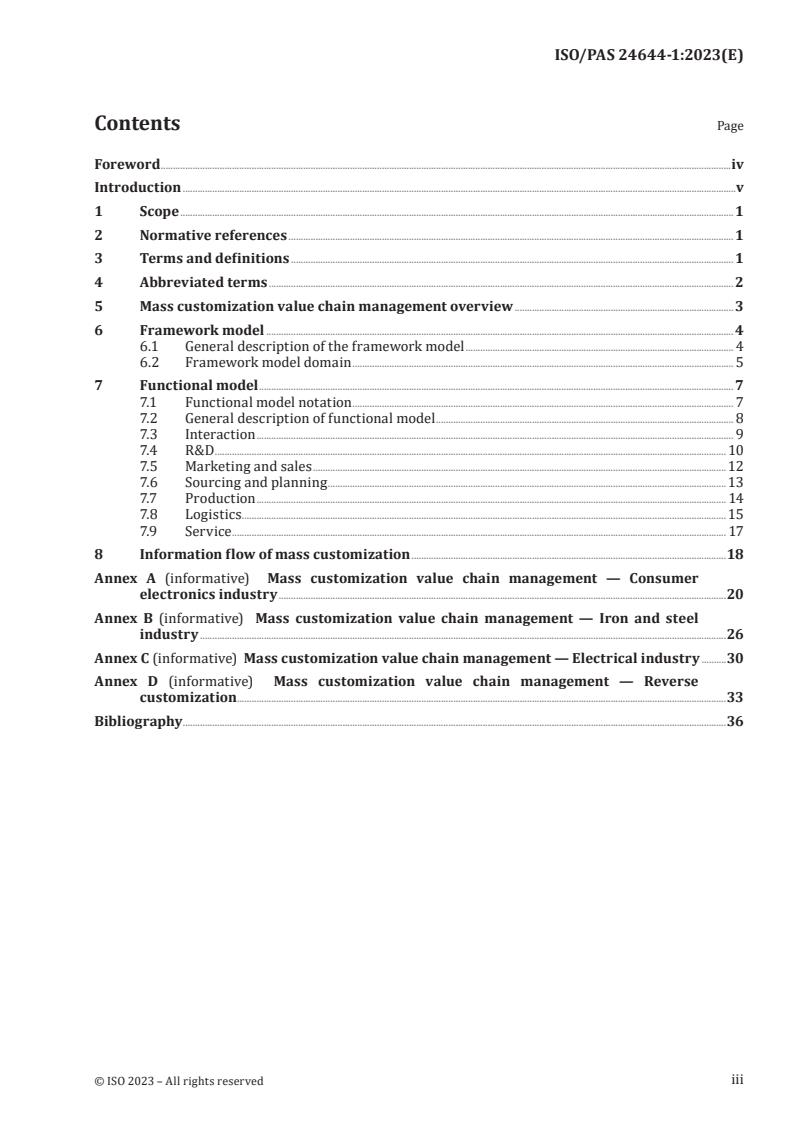
Contents Page
Foreword .iv
Introduction .v
1 Scope . 1
2 Normative references . 1
3 Terms and definitions . 1
4 Abbreviated terms . 2
5 Mass customization value chain management overview . 3
6 Framework model . 4
6.1 General description of the framework model . 4
6.2 Framework model domain . 5
7 Functional model . 7
7.1 Functional model notation . 7
7.2 General description of functional model . 8
7.3 Interaction . 9
7.4 R&D . 10
7.5 Marketing and sales .12
7.6 Sourcing and planning .13
7.7 Production . 14
7.8 Logistics . . 15
7.9 Service . 17
8 Information flow of mass customization .18
Annex A (informative) Mass customization value chain management — Consumer
electronics industry .20
Annex B (informative) Mass customization value chain management — Iron and steel
industry .26
Annex C (informative) Mass customization value chain management — Electrical industry .30
Annex D (informative) Mass customization value chain management — Reverse
customization . .33
Bibliography .36
iii
Foreword
ISO (the International Organization for Standardization) is a worldwide federation of national standards
bodies (ISO member bodies). The work of preparing International Standards is normally carried out
through ISO technical committees. Each member body interested in a subject for which a technical
committee has been established has the right to be represented on that committee. International
organizations, governmental and non-governmental, in liaison with ISO, also take part in the work.
ISO collaborates closely with the International Electrotechnical Commission (IEC) on all matters of
electrotechnical standardization.
The procedures used to develop this document and those intended for its further maintenance are
described in the ISO/IEC Directives, Part 1. In particular, the different approval criteria needed for the
different types of ISO document should be noted. This document was drafted in accordance with the
editorial rules of the ISO/IEC Directives, Part 2 (see www.iso.org/directives).
ISO draws attention to the possibility that the implementation of this document may involve the use
of (a) patent(s). ISO takes no position concerning the evidence, validity or applicability of any claimed
patent rights in respect thereof. As of the date of publication of this document, ISO had not received
notice of (a) patent(s) which may be required to implement this document. However, implementers are
cautioned that this may not represent the latest information, which may be obtained from the patent
database available at www.iso.org/patents. ISO shall not be held responsible for identifying any or all
such patent rights.
Any trade name used in this document is information given for the convenience of users and does not
constitute an endorsement.
For an explanation of the voluntary nature of standards, the meaning of ISO specific terms and
expressions related to conformity assessment, as well as information about ISO's adherence to
the World Trade Organization (WTO) principles in the Technical Barriers to Trade (TBT), see
www.iso.org/iso/foreword.html.
This document was prepared by Technical Committee ISO/TC 184, Automation systems and integration,
Subcommittee SC 5, Interoperability, integration, and architectures for enterprise systems and automation
applications.
A list of all parts in the ISO 24644 series can be found on the ISO website.
Any feedback or questions on this document should be directed to the user’s national standards body. A
complete listing of these bodies can be found at www.iso.org/members.html.
iv
Introduction
Along with the generalization and popularization of Internet technologies, Internet of Things (IoT),
flexible manufacturing technologies and modern logistics, individualized customization services have
become embedded into all industrial and service sectors. Users can, by means of Internet platforms,
determine and customize their own products upon their own demands. Mass customization is becoming
a new mode in the manufacturing industry, and value chains will be ultimately driven by the users.
Cooperation among enterprises is required by utilizing quick-response Internet platforms to provide
a wide range of products and services in small lots to satisfy the users with various individualized
demands.
From the user perspective, as the users directly interact with enterprises for customized products, they
want to participate in the creation process of their individualized product and also to obtain or receive
information about the progress of the product.
From the enterprise perspective, mass customization assists the enterprises in realizing the real-time
and accurate understanding of the user’s demands. Customized products increase the premium value
of products for enterprises. Because of accurately estimated a priori information from customized
product demand and requirements from the users, the enterprises can reduce or eliminate the
inventory-related costs by appropriately conducting large-scale procurement or production.
v
PUBLICLY AVAILABLE SPECIFICATION ISO/PAS 24644-1:2023(E)
Mass customization value chain management —
Part 1:
Framework
1 Scope
This document specifies a framework for mass customization value chain management, including the
framework model, functions and information flow of mass customization.
This document does not describe interoperability at a system level or interoperability throughout the
life cycle in detail.
2 Normative references
There are no normative references in this document.
3 Terms and definitions
For the purposes of this document, the following terms and definitions apply.
ISO and IEC maintain terminology databases for use in standardization at the following addresses:
— ISO Online browsing platform: available at https:// www .iso .org/ obp
— IEC Electropedia: available at https:// www .electropedia .org/
3.1
domain
functional area
[SOURCE: ISO 24097-1:2017, 3.1.2, modified — “in a policy assertion” has been deleted from the
definition. The EXAMPLE has been deleted.]
3.2
information flow
transfer of information from an information-source-object to an information-destination-object
[SOURCE: ISO/IEC 16500-1:1999, 3.30]
3.3
interaction
exchange of information between a user and a system via the human-system interface to achieve the
intended goal
[SOURCE: ISO 11064-5:2008, 3.20, modified — term "dialogue" was removed.]
3.4
mass customization
production mode that provides customized products and services according to the individualized
demands of users with the cost and efficiency in mass production
3.5
user experience
person's perceptions and responses resulting from the use and/or anticipated use of a product, system
or service
[SOURCE: ISO/IEC 30071-1:2019, 3.1.6, modified — Notes 1 and 2 to entry were removed.]
3.6
value-added service
service that is offered in addition to the core service in question thus creating additional value
[SOURCE: ISO/TS 17573-2:2020, 3.231]
3.7
value chain
range of activities or parties that create or receive value in the form of products or services
[SOURCE: ISO 22948:2020, 3.2.11]
4 Abbreviated terms
For the purposes of this document, the following abbreviated terms apply.
APS Advanced Planning and Scheduling
BOM Bill of Material
B2B Business to Business
CAX Computer Aided X
CBL Collaboration layer
CP Configuration Partner
CRM Customer Relationship Management
CTL Control layer
CTO Configure to Order
DTS Delivery-to-Service
EML Equipment layer
ENDO Bare unit on which customization can be configured through assembly. Transceiver is set
in working assembly form.
EPL Enterprise layer
ERP Enterprise Resource Planning
EVI Early Vendor Involvement
FIFO First-In-First-Out
IT&OT Information technology and operational technology
M&S Modelling and simulation
MRP Material Requirements Planning
MTO Mind-to-Order
OTD Order-to-Delivery
PLM Product Lifecycle Management
R&D Research and Development
TMS Transportation Management System
WMS Warehouse Management System
WSL Workshop layer
5 Mass customization value chain management overview
For mass customization value chain management, the value activities of mass customization can be
divided into domains from the perspective of life cycle and system, and the contents of each activity
and the information transmitted between activities should be clearly defined. The framework of mass
customization value chain management consists of the framework model, functions and information
flow of mass customization.
This document falls in the constructs of function view, according to the definition of enterprise activity
and function view in ISO 19439.
According to ISO 19439:2006 5.3.2, the function view shall represent the business processes of
the enterprise domain, their functionality, behaviour, inputs and outputs. The function view shall
describe the assembly of single processing steps as a collection of processes (business processes and
enterprise activities) structured as a network of activities reflecting their logical connection and
interdependencies.
According to ISO 19439:2006 3.19, enterprise activity is all, or part, of process functionality that
consists of elementary tasks performed in the enterprise that consume inputs and allocate time and
resources to produce outputs.
With the definitions and concepts of enterprise activity and function view, the framework is generated
referring to the enterprise modelling concepts defined in ISO 19439, which conforms with the
requirement of ISO 15704. Specifically, the framework corresponds with the domain identification,
concept definitions and requirements definition of the function view at the generic level as shown in the
dash area of Figure 1. The modelling concepts are reused in ISO 19440, which is built upon ISO 19439,
to identify and specify constructs necessary for users that model enterprises.
Figure 1 — Overview of the framework for enterprise modelling
NOTE Figure 1 is taken from ISO 19439:2006, Figure 5.
6 Framework model
6.1 General description of the framework model
The framework model of mass customization consists of two dimensions, namely system level and life
cycle. The vertical axis in Figure 2 presents the system level, which includes equipment layer (EML),
control layer (CTL), workshop layer (WSL), enterprise layer (EPL), and collaboration layer (CBL) as
referenced in IEC 62264-1. The horizontal axis in Figure 2 covers the whole life cycle of a product,
which includes seven activities, i.e. interaction, research and development (R&D), marketing and sales,
sourcing and planning, production, logistics, and service.
System level in Figure 2 is divided into five layers according to the organizational structure related to
enterprise production activities, in which:
— EML is applied by an enterprise to realize the actual physical process, and perceive and operate it by
means of sensor, instrument, machine and device and others;
— CTL is used for handling information, and realizing the monitoring and controlling physical process
within an enterprise;
— WSL is applicable for realizing production management within a factory or a workshop;
— EPL aims to realize enterprise-oriented business management;
— CBL is applied to realizing the interconnectivity and sharing of internal and external information in
an enterprise and the business coordination between enterprises.
Mass customization domains include mind-to-order (MTO) domain, order-to-delivery (OTD) domain,
and delivery-to-service (DTS) domain.
As shown in Figure 2, the MTO domain covers four activities from the life cycle, i.e. interaction, R&D,
marketing and sales, and sourcing and planning, and it contains WSL and CBL from the system level.
The OTD domain includes the production activity and logistic activity. The production activity covers
the EML, CTL, WSL and EPL. The logistics activity includes all five system layers.
The DTS domain covers the service activity from the life cycle and it contains the EPL and CBL from the
system level.
Key
domain
Figure 2 — Mass customization domains
6.2 Framework model domain
In the MTO domain, enterprises shall focus on user demands, output product schemes through the
interaction and R&D activities. User orders are generated through the marketing and sales activity.
Enterprises shall arrange a master production schedule according to the product scheme and the user
1)
orders and find suitable suppliers through the sourcing and planning activity to ensure commodity
1) In this document, commodity includes raw material and purchasing parts from suppliers.
supply. The contents of a user order include, e.g. user basic information, customization information,
expected delivery date and place, product model, payment information.
In the interaction activity, enterprises shall collect user demands, and interact with users and
ecosystem partners, conduct user demands analysis and screening, and output customized demands.
The interaction methods include user interfaces, networks (e.g. user interactions with enterprises by
surfing the Internet using search engines), social networking (e.g. user interaction with enterprises
through social media), web, apps, etc.
In the R&D activity, enterprises shall conduct customized demands classification, assessment, and
transformation, and output product solutions after simulation verification.
In the marketing and sales activity, enterprises shall conduct product positioning and pricing, and this
activity shall obtain user orders through precision marketing.
In the sourcing and planning activity, enterprises shall find suitable material suppliers for source
searching demands and procurement demands.
In the OTD domain, factories shall conduct the production activity to produce customized products and
deliver them to users through the logistics activity.
In the production activity, factories shall arrange a detailed production plan according to the master
production schedule and material status (including material in stock or its expected arrival time), and
this activity shall execute manufacturing according to the detailed production plan.
In the logistics activity, enterprises shall arrange a reasonable delivery route and deliver the customized
products to the designated place at the appointed time through logistics management.
In the DTS domain, enterprises shall obtain user experience information through the service activity,
conduct online or offline diagnosis to get the status information of products, and this activity shall
provide after-sales and value-added services for users.
The user experience information and new demands obtained from the DTS domain shall be fed back to
the MTO domain to promote product optimization and iteration.
Figure 3 depicts mass customization domains, elements and functions, and information flow showing
the interaction between the users and domains, pictorially summarizing the dynamics of the MTO,
OTD, and DTS domains.
Key
domain
function
information flow
element
Figure 3 — Mass customization domains and functions
7 Functional model
7.1 Functional model notation
The notations used in the mass customization functional model shown in Figure 4 and the interaction
workflow of seven activities, i.e. interaction, R&D, marketing and sales, sourcing and planning,
production, logistics and service, shown in Figure 5 are described in Table 1.
Table 1 — Notation used in functional model and workflow of seven activities
Symbol Name Definition
Any entity (e.g. person, group) who makes usage of either the
users
customized services or products, or both.
A set of actions that consumes time and resources and whose
activity performance is necessary to achieve, or contribute to, the reali-
zation of one or more outcomes.
input/output infor-
Information which transfers into/out of workflow.
mation
The representation of all information that is dealt within an
database
information system, taken together.
element A necessary or typical part of workflow.
Transfer of information from an information-source-object to
information flow
an information-destination-object.
7.2 General description of functional model
As shown in Figure 4, the mass customization functional model is a synthesis of user-centred functions
covering seven activities in the customization life cycle. In Figure 4, “Users” is shown at the centre;
the rectangle boxes in the perimeter represent the lifecycle activities; and the solid arrows represent
the information flow between “Users” and the activities and also between the adjacent activities. The
activities do not need to completely correspond to a department or departments of the enterprise.
Different enterprises may place one or more activities in different departments or with external entrust
third parties.
Mass customization enterprises need to establish a unified platform or system not only to support the
horizontal integration and interoperability of the seven activities, but also to acquire users’ immediate
and overall satisfaction from creativity to product development, production, delivery and service. In
mass customization, the relationship among activities is many-to-many, which means that multiple
entities (e.g. enterprises or departments) may take the same role carrying out the same activity
simultaneously, and they may interact with another entity or a group of entities. The reason for taking
the same role or the same activity simultaneously is to meet a high demand of customized products in
a short period of time.
To ensure the proper data is transmitted between different entities, the input and output of each activity
can be seen as the data which should be exchanged or accessed through a common interface from/to
other activities. The users of this document can build their own uniform semantic/format models of
2)
data and interface accordingly, which can be helpful to establish an interoperable mass customization
system.
2) The method of achieving interoperability in the functional model of mass customization is described in
ISO 15704.
Figure 4 — Functional model
7.3 Interaction
Interaction is an activity which specifies reciprocal actions, including recognizing information, making
inputs, making selections and receiving outputs, required by users to achieve a goal. The workflow of
the interaction activity is shown in Figure 5.
An interaction platform shall aggregate user resources (e.g. a multitude of user information collected
from the users via the interaction platform) by introducing the users being targeted for mass
customization. Then the platform carries out categorizing the users to form social communities for
demand interaction. In each social community, experts, key opinion leaders, enterprises and resource
parties shall provide high-quality and relevant topics for community discussion and also supply
professional information for reference to the community members. After demand interaction, the
platform shall conduct demand analysis and screening from the perspective of cost, outcome, scale, etc.
Customized demands shall be output of the interaction activity.
Meanwhile, the new product/service demands proposed by the users from the service activity shall be
sent to the interaction activity to be included in the demand interaction.
Through the repository and reutilization of interaction data of different social communities, the
platform shall achieve a unified analysis and utilization of these data, such as output of user profiles.
The output of the customized demand from the interaction activity shall be transmitted to the R&D
activity for demand creation.
Figure 5 — Workflow of the interaction activity
7.4 R&D
R&D includes activities that enterprises undertake to innovate and introduce new products and
services. R&D defines the product scheme based on the customized demands and the resources, and
then publishes the product scheme to the marketing and sales activity and the sourcing and planning
activity. The workflow of the R&D activity is shown in Figure 6.
R&D, in the mass customization, shall refine the users' primary demand and transform it into a
quantifiable demand. R&D shall then distribute the quantifiable demand to appropriate resource
providers, including but are not limited to, technical resources, design resources, supplier resources,
corresponding to the quantifiable demand classifications, e.g. function, appearance, and module. The
providers shall then design customized products according to the quantifiable demand distributed to
them, and the design shall be verified and optimized through the interactions with the users. Once the
final design for the customized products is approved, modular design, development and test processes
shall be carried out and then the customized product can be available on the market.
The interactivity of the demand distribution and resource matching process should be considered while
implementing the mass customization system. Enterprises shall build mechanisms for timely release of
the demand to the providers and collection of the response from the providers.
It should be noted that the modular design takes an important role in mass customization because it
balances "mass production" and "customized craft" by linking the customized demand to different
process configurations or different combinations of modules for productizing. On the one hand,
considerations should be given in the module design process to ensure that the configurability will not
affect product functionality. Considerations also should be given to whether or not the designed module
can easily be used for large-scale production while balancing customizability and cost.
Moreover, the process data generated by R&D should be comprehensively recorded in a data store (e.g.
R&D data repository and reutilization) as reusable resources/knowledge-base for possible process
reengineering, system upgrade or product iterations.
The customized demand, i.e. the input to R&D, is from the interaction activity. The customized products
produced by an approved design shall be output to the marketing and sales activity, while the sourcing
and planning activity receives the source search demand and procurement demand from the R&D
activity.
Figure 6 — Workflow of the R&D activity
7.5 Marketing and sales
Marketing and sales is an activity that informs users about a product, gaining their curiosity and
interest in it, and leading them to purchase it. The workflow of the marketing and sales activity is
shown in Figure 7.
The information on the customized products, i.e. the output from R&D, shall be transmitted to the
marketing and sales activity for product positioning and pricing. The customized products shall be
promoted to target users through precision marketing. The users who have an intention to purchase
shall select their choices from the customized products. Upon placing orders and paying for the
products, user orders shall be generated.
The products purchasing demand, i.e. the output from the service, shall be transmitted to marketing
and sales for demand matching. If there is a matching product in the product library, the user places an
order directly, and then the purchase is completed when the user pays for the products. Otherwise, the
demand information shall be transmitted to the interaction activity to drive a new round of interaction
and R&D activities.
Through reutilizing the marketing and sales data in the repository, enterprises shall achieve unified
analysis of these data, such as membership management. After the user orders are generated, the
marketing and sales activity shall output the source search demand or procurement demand for the
orders. This demand shall be transmitted to the sourcing and planning activity for supplier sourcing.
Figure 7 — Workflow of the marketing and sales activity
7.6 Sourcing and planning
The activities in R&D and marketing and sales shall trigger the master production scheduling. The
workflow of sourcing and planning activity is shown in Figure 8.
The procurement demand required for the user orders shall be released from the master production
schedule. Whether the available suppliers can meet the procurement demand shall be evaluated. If
available suppliers cannot meet the procurement demand, new supplier source search demands are
issued. New suppliers respond to the demand and then the suppliers shall be evaluated. If the available
suppliers can meet the procurement demand, the demand is released to available suppliers for the
demand interaction. Purchasing mechanisms such as bidding mechanisms shall be carried out during
the supplier selection. The suppliers shall deliver the commodity to the factory through the logistics
activity.
The master production schedule, commodity in stock and their lead time from the sourcing and
planning activity shall be transmitted to the production activity. The sourcing and planning related
data shall be stored and analysed to optimize this activity.
Figure 8 — Workflow of the sourcing and planning activity
7.7 Production
The production activity executes the actual manufacturing process and shall interact with the sourcing
and planning activity and the logistics activity. The workflow of the production activity is shown in
Figure 9.
The master production schedule from the upstream, material in stock and its lead time information
from the sourcing and planning activity shall be transmitted to the production activity. After the
demand and capacity are balanced by the scheduling system, a detailed production plan and a material
demand plan shall be automatically aligned to generate an executable master production plan. In the
process of mass customization, the master production schedule shall be changed according to the users’
demand.
The suppliers shall produce and deliver the materials according to the material demand plan. The
factory shall produce products according to the executable production plan. Intelligent manufacturing
technologies, e.g. information technology and operational technology (IT&OT) integration, technology
grouping, may be applied to increase production efficiency and flexibility. After the ordered products
are rolled off the production line, they shall be automatically moved and stored in a warehouse. As
the products enter a warehouse and are registered with a warehouse management system (WMS),
the product information, e.g. product name, identification, location, is immediately transmitted to a
logistics platform to begin the process of product delivery.
Production data repository and reutilization shall be deployed to optimize the key indicators in the
manufacturing process, such as production efficiency, manufacturing costs, and product quality.
Figure 9 — Workflow of the production activity
7.8 Logistics
Logistics in this document refers to off-site logistics, which includes planning, execution and control of
the movement and placement of materials, while on-site logistics is included as part of the production
activity. The workflow of the logistics activity is shown in Figure 10.
The commodity supply information output from the sourcing and planning activity shall be transmitted
to the logistics activity for distribution. After the factory receives the commodity, the commodity
delivery information shall be sent to the souring and planning activity.
The production activity shall output a customized product distribution order after completing the
production of the ordered products. The logistics activity shall generate a delivery schedule, including
loading and vehicles’ route plans, etc., for customized products according to the individualized demands
ordered by the users. The delivery time to each delivery location in the route plan is estimated by
using predictive algorithm engines, real-time optimization by simulation engines, etc. The logistics
activity shall obtain real-time delivery vehicle location data and real-time traffic information to
update the delivery schedule, called an intelligent vehicle scheduling, to improve the delivery efficiency
to guarantee the arrival of the customized products on schedule. The updated delivery time to each
delivery location is also sent to the users at delivery locations.
The arrival of commodities information shall be sent back to sourcing and planning activity.
Storing the logistics data in a repository for reutilization shall be performed during the process of
product distribution. The logistics activity shall produce the arrival information of each customized
product, and the arrival information shall be transmitted to the service activity.
Figure 10 — Workflow of the logistics activity
7.9 Service
Service is a series of activities such as maintenance, product upgrading and value-added actions which
shall be provided by enterprises after product delivery. The workflow of the service activity is shown
in Figure 11.
After the completion of product delivery and with users' permission, the enterprise can conduct online
diagnostics and operation data analysis of the products, provide users with remote fault diagnoses and
usage suggestions, and execute remote preventive maintenance services according to users' customized
demands.
The enterprise should provide relevant after-sales services according to users’ service demands or the
subsequent events driven by the initial services. At the same time, through the collection and analysis
of product data and user service data, the enterprise shall form product and service upgrade plans and
feed them back to the interaction activity in order to continuously upgrade customized products and
optimize customized services.
Enterprises shall recommend or provide value-added customized services to users according to user
demands or product usage scenarios or combine third-party resources to recommend or provide third-
party customized value-added services to the users.
Through the repository and reutilization of service data after product deliveries, enterprises shall
continuously update their service modes and models to improve user satisfaction.
Figure 11 — Workflow of the service activity
8 Information flow of mass customization
The centre of mass customization is the users who participate in the activities of interaction, R&D,
marketing and sales, production, logistics, and service. The information flow of mass customization
between different activities is shown in Figure 12, and it may include the following:
a) In the interaction activity, a user interacts with a mass customization product provider to initiate
the user’s concept discussion. Based on the concept, and a creative solution or solutions in terms
of the product concepts that shall be shaped and iteratively adjusted according to the feedback of
users. After the creative solution, i.e. the concept design, is confirmed by the users, the solution
shall be transmitted to the R&D activity.
b) The R&D department develops product design plans based on creative solutions. The product
design scheme shall be adjusted according to the users’ demand feedback and also to its validation
by modelling and simulation (M&S). Finally, a bill of material (BOM) of a customized product shall
be developed.
c) User orders are generated by precision marketing. After the user places an order for payment,
a user order is created. The enterprise collects user data/information from the user orders and
enters the data/information into a membership management database.
d) A master production schedule is derived from the user orders. After the master production schedule
is generated, it triggers the production activity of customized products.
e) The commodity purchase orders are generated by the master production schedule. Material
suppliers shall evaluate the purchase orders to ensure that the delivery of material can meet the
production activity requirements.
f) The detailed and executable production plans are derived from the master production schedule
and the lead time of the material. The enterprise carries out flexible production as planned.
g) After the customized product is rolled out from the production line, the products shall be moved
and stored automatically in a warehouse, and the data about the customized product, e.g. product
name and identifier, location, is sent and synchronized to the logistics activity.
h) The customized products shall be delivered to the users through the logistics activity. Enterprises
shall send and update the product delivery information to the users in real-time.
i) The enterprise shall provide after-sales and value-added services to the users based on online or
offline evaluation of the product’s diagnostics and operations data.
j) The enterprise shall continuously interact with the users via the service activity, obtain users'
requirements and suggestions based on their experiences in using the products, and facilitate
product iteration.
In Figure 12, the vertical axis presents the interoperability of user experience, industrial knowledge
and data among enterprise and external affiliates. The horizontal axis covers the whole life cycle of the
product which is represented by a series of mutually connected value creation activities from the mass
customization interaction to service.
Because the application of mass customization varies in different industries, it is described in detail
in Annexes A to D for four different industries, namely, consumer electronics, iron and steel, electrical
products, and reverse customization, respectively.
Key
component
information flow
Figure 12 — Information flow of mass customization
Annex A
(informative)
Mass customization value chain management — Consumer
electronics industry
A.1 Business challenges
Consumer electronics manufacturers face the following challenges:
a) diversification of user demands;
b) long design time and high costs;
c) difficult supply chain management;
d) differentiation of after-sales service.
A.2 Solutions
A.2.1 Process flow
Process ownership is divided into three domains: manufacturer; configuration partner (CP); and
electronics manufacturing supplier. Each domain is shown in Figure A.1 as the layers separated by the
horizontal dotted lines. The numbers in the boxes in Figure A.1 represent the sequential activities of
process flow.
Key
C quality data
D order management interface
E product data management interface
F planning data
G prints, specs, CAD
H performance data and reports
Figure A.1 — Process flow
A.2.1.1 R&D activity
This activity contains the design module, denoted by “1-Design,” in Figure A.1.
For consumer electronics, most R&D activities are associated with design verifications. The verification
test strategy consists of configuration test, assembly test, system test, and acceptance test. The test
plans include manufacturer test plan, partner test plan, and integration test plan.
A.2.1.2 Scheduling activity
Scheduling activity contains the manage BOM module (see “2-Manage BOM” and “3.1-Manage BOM”),
the setup BOM module (see 3.2-Setup BOM), the plan demand module (see “4-Plan demand”) and the
plan supply module (see “5.1-Plan supply” and “5.2-Plan supply”) as shown in Figure A.1.
The CP sets up and manages product items and BOMs in their product data management system. A
brand manufacturer is the source and the final approver for any changes in scheduling. The brand
manufacturer develops planning requirements and transmits them to its partner sites via a secure
interface. The CP receives a 52-week-rolling-demand from the brand manufacturer bi-weekly. The
brand manufacturer assumes CP’s commitment to all items on forecast within lead time. The CP then
provides the demands to electronics manufacturing supplier designated by the brand manufacturer for
bare units. The CP provides the visibility report of all supplies as defined by the brand manufacturer
via a secure interface.
A.2.1.3 Production activity
The production activities include the manage orders module (see “6.1-Manage orders”), the place
orders module (see “6.2-Place orders” and “6.3-Place orders”), the receive and put away module (see
“7.1-Receive and put away” and “7.2-Receive and put away”), the assemble and inspect module (see
“8.1-Assemble and inspect”), and the program and pack module (see “9.1-Program and pack”) shown in
Figure A.1.
The brand ma
...