

ISO 29945:2016
(Main)Refrigerated non-petroleum based liquefied gaseous fuels — Dimethylether (DME) — Method of manual sampling onshore terminals
General Information
- Abstract
ISO 29945:2016 specifies a manual sampling method for refrigerated liquefied DME at terminals in both loading and unloading ports along with precautions. ISO 29945:2016 does not include recommendations for the location of a sampling point in a line or vessel. ISO 29945:2016 is also applicable to the following cases, with necessary modifications: - sampling of DME on board liquefied gas tankers where appropriate sampling apparatus is provided; - sampling of other refrigerated, non-petroleum-based, liquefied gaseous fuels whose chemical and physical properties are similar to those of DME. The detailed chemical and physical properties of DME differ from those of LPG, which suggests that DME requires precautions different from those of LPG. However, their basic properties are similar to each other and so general reference is made in this document to precautions for LPG that have been applied in many countries. Reference can also be made to the appropriate individual items in this document for precautions concerning the quality.
- Status
- Published
- Publication Date
- 06-Nov-2016
- Current Stage
- 9093 - International Standard confirmed
- Start Date
- 16-Mar-2022
- Completion Date
- 29-Aug-2026
Buy Documents



ISO 29945:2016 - Refrigerated non-petroleum based liquefied gaseous fuels -- Dimethylether (DME) -- Method of manual sampling onshore terminals

ISO 29945:2016 - Refrigerated non-petroleum based liquefied gaseous fuels — Dimethylether (DME) — Method of manual sampling onshore terminals/7/2016
Overview
ISO 29945:2016 provides a standardized method for the manual sampling of refrigerated liquefied Dimethylether (DME) at onshore terminals. Developed by the International Organization for Standardization (ISO), this standard focuses on ensuring representative sampling at both loading and unloading ports. Special attention is given to critical precautions due to DME’s unique chemical and physical properties, which set it apart from other liquefied gaseous fuels like LPG. The standard is also applicable, with appropriate modifications, for sampling DME on board liquefied gas tankers and for other non-petroleum-based, refrigerated liquefied gases with similar properties.
Using ISO 29945:2016 helps maintain fuel quality, supports environmental protection measures, and upholds safety across industrial and commercial applications involving DME.
Key Topics
General Characteristics of DME:
- Non-corrosive, effective solvent, hydrophilic
- Small coefficient of thermal expansion
- Distinct boiling point and vapor pressure
Safety Precautions:
- Use of protective clothing, helmets, goggles, gloves, and safety footwear
- Procedures to minimize operator exposure, including standing upwind and shortening sampling time
- Static electricity grounding and applying in-house safety directives
- Sampling to be performed by skilled personnel
Sampling Apparatus and Methods:
- Sampling lines and cylinders primarily constructed of stainless steel and compatible polymers
- Types of sample cylinders: two-valve, with or without ullage/siphon tubes, or single-valve cylinders
- Floating-piston cylinders as an alternative
Sampling Procedures and Adjustments:
- Procedures for taking samples during loading and unloading operations
- Steps for cylinder filling, pressure management, and leak checking
- Methods for adjusting sample volume to maintain correct cylinder fill (typically 85% volume)
Sample Identification and Retention:
- Accurate labeling for traceability: content, date, sampler identity, cylinder/sample numbers, source, and any special observations
- Retention protocols for analysis and archiving under safe, controlled conditions
Applications
ISO 29945:2016 is primarily applicable in:
Energy Sector Terminals and Depots:
- Ensuring batch conformity during DME transfer in large-scale terminals and storage facilities
Maritime and Bulk Transportation:
- Sampling DME cargo aboard specialized tankers to assess quality after long-haul transport
Quality Assurance and Regulatory Compliance:
- Laboratory and field verification for DME purity, supporting contractual obligations and regulatory standards
Development of Alternative Fuels:
- Facilitating the safe adoption of DME as an environmentally friendly alternative to petroleum-based fuels by allowing accurate, repeatable sampling
Adoption of ISO 29945:2016 assures stakeholders of consistency in sampling practices, supporting international trade, safety, and environmental goals.
Related Standards
ISO 4257: Liquefied petroleum gases - Method of sampling
A referenced standard for LPG sampling, offering additional context for handling liquefied gases.ISO/IEC Directives, Part 1 and 2:
Framework for the development and drafting of international standards.
Professionals responsible for the handling, transport, and analysis of refrigerated liquefied DME, or similar fuels, should also consult relevant ISO standards to ensure harmonized and safe operations across the energy supply chain.
Keywords: ISO 29945:2016, Dimethylether (DME), manual sampling, refrigerated liquefied gaseous fuels, onshore terminals, DME safety, DME sampling procedure, non-petroleum-based fuels, gas terminal standards, DME quality assurance.
Relations
- Effective Date
- 05-Nov-2015
Buy Documents
ISO 29945:2016 - Refrigerated non-petroleum based liquefied gaseous fuels -- Dimethylether (DME) -- Method of manual sampling onshore terminals
ISO 29945:2016 - Refrigerated non-petroleum based liquefied gaseous fuels — Dimethylether (DME) — Method of manual sampling onshore terminals/7/2016
Get Certified
Connect with accredited certification bodies for this standard

Element Materials Technology
Materials testing and product certification.

ABS Group Brazil
ABS Group certification services in Brazil.

ABS Quality Evaluations Inc.
American Bureau of Shipping quality certification.
Sponsored listings
Frequently Asked Questions
ISO 29945:2016 is a standard published by the International Organization for Standardization (ISO). Its full title is "Refrigerated non-petroleum based liquefied gaseous fuels — Dimethylether (DME) — Method of manual sampling onshore terminals". This standard covers: ISO 29945:2016 specifies a manual sampling method for refrigerated liquefied DME at terminals in both loading and unloading ports along with precautions. ISO 29945:2016 does not include recommendations for the location of a sampling point in a line or vessel. ISO 29945:2016 is also applicable to the following cases, with necessary modifications: - sampling of DME on board liquefied gas tankers where appropriate sampling apparatus is provided; - sampling of other refrigerated, non-petroleum-based, liquefied gaseous fuels whose chemical and physical properties are similar to those of DME. The detailed chemical and physical properties of DME differ from those of LPG, which suggests that DME requires precautions different from those of LPG. However, their basic properties are similar to each other and so general reference is made in this document to precautions for LPG that have been applied in many countries. Reference can also be made to the appropriate individual items in this document for precautions concerning the quality.
ISO 29945:2016 specifies a manual sampling method for refrigerated liquefied DME at terminals in both loading and unloading ports along with precautions. ISO 29945:2016 does not include recommendations for the location of a sampling point in a line or vessel. ISO 29945:2016 is also applicable to the following cases, with necessary modifications: - sampling of DME on board liquefied gas tankers where appropriate sampling apparatus is provided; - sampling of other refrigerated, non-petroleum-based, liquefied gaseous fuels whose chemical and physical properties are similar to those of DME. The detailed chemical and physical properties of DME differ from those of LPG, which suggests that DME requires precautions different from those of LPG. However, their basic properties are similar to each other and so general reference is made in this document to precautions for LPG that have been applied in many countries. Reference can also be made to the appropriate individual items in this document for precautions concerning the quality.
ISO 29945:2016 is classified under the following ICS (International Classification for Standards) categories: 75.180.30 - Volumetric equipment and measurements. The ICS classification helps identify the subject area and facilitates finding related standards.
ISO 29945:2016 has the following relationships with other standards: It is inter standard links to ISO 29945:2009. Understanding these relationships helps ensure you are using the most current and applicable version of the standard.
ISO 29945:2016 is available in PDF format for immediate download after purchase. The document can be added to your cart and obtained through the secure checkout process. Digital delivery ensures instant access to the complete standard document.
Standards Content (Sample)
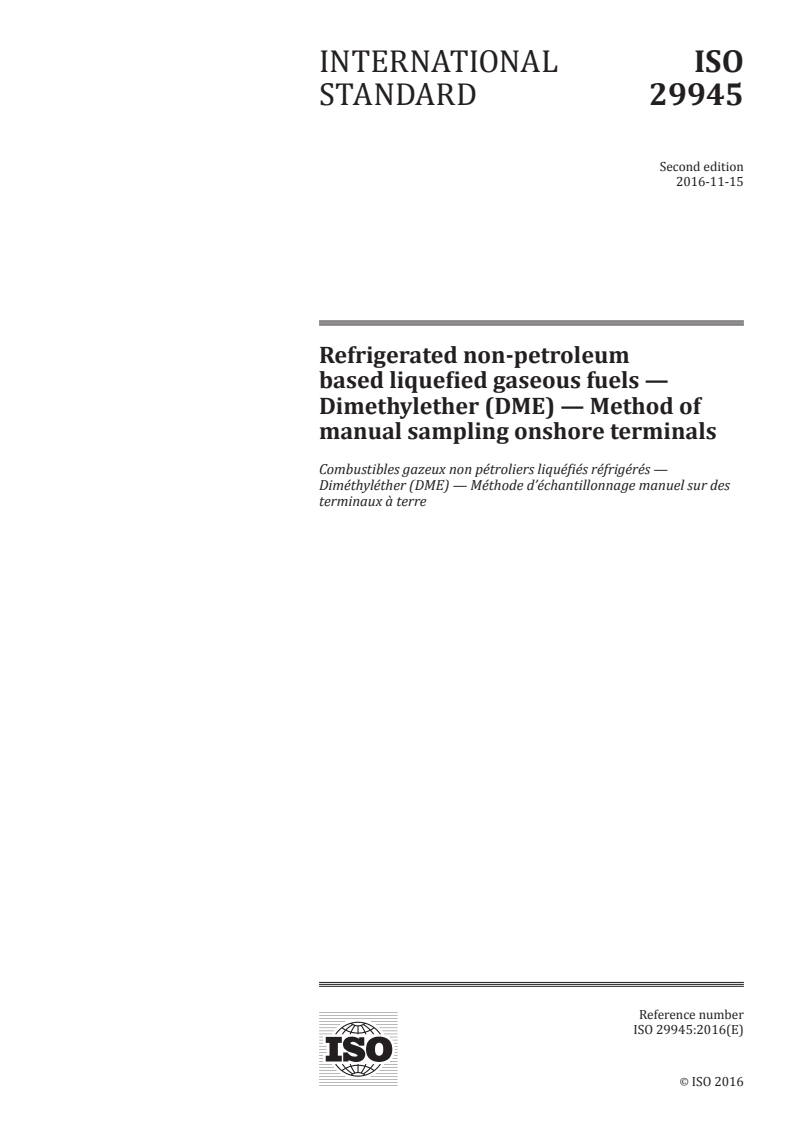
INTERNATIONAL ISO
STANDARD 29945
Second edition
2016-11-15
Refrigerated non-petroleum
based liquefied gaseous fuels —
Dimethylether (DME) — Method of
manual sampling onshore terminals
Combustibles gazeux non pétroliers liquéfiés réfrigérés —
Diméthyléther (DME) — Méthode d’échantillonnage manuel sur des
terminaux à terre
Reference number
©
ISO 2016
© ISO 2016, Published in Switzerland
All rights reserved. Unless otherwise specified, no part of this publication may be reproduced or utilized otherwise in any form
or by any means, electronic or mechanical, including photocopying, or posting on the internet or an intranet, without prior
written permission. Permission can be requested from either ISO at the address below or ISO’s member body in the country of
the requester.
ISO copyright office
Ch. de Blandonnet 8 • CP 401
CH-1214 Vernier, Geneva, Switzerland
Tel. +41 22 749 01 11
Fax +41 22 749 09 47
copyright@iso.org
www.iso.org
ii © ISO 2016 – All rights reserved
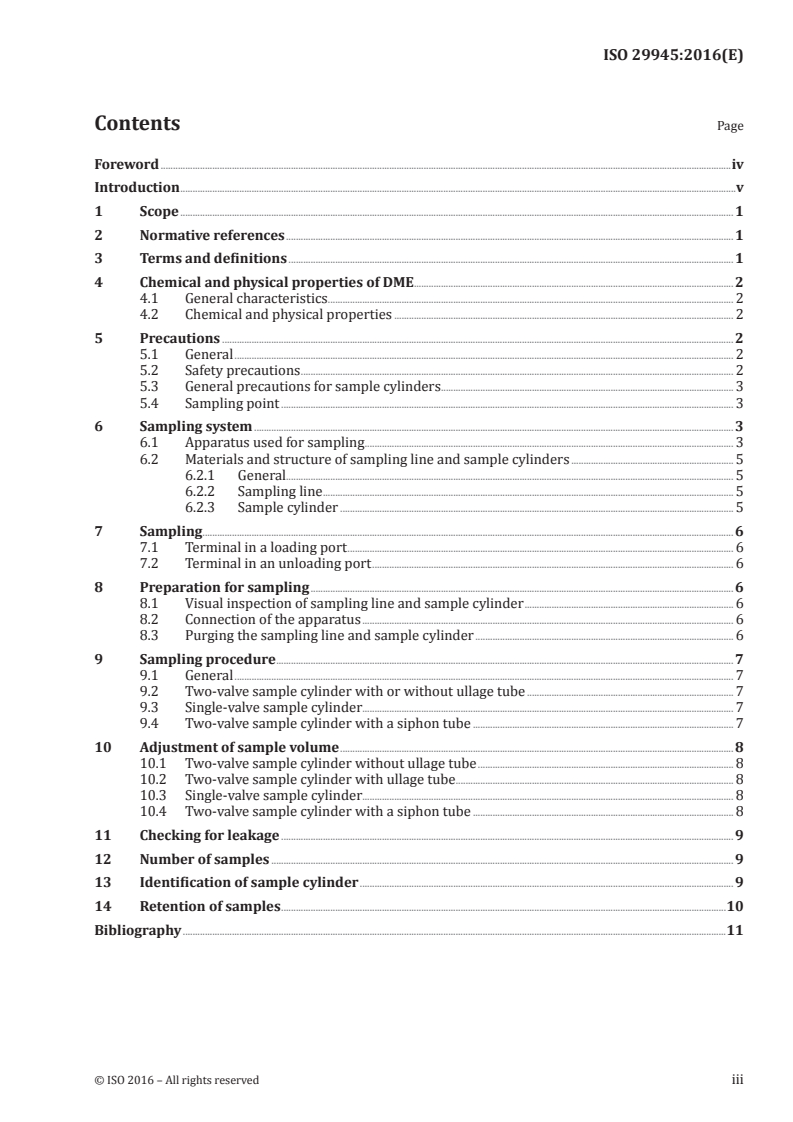
Contents Page
Foreword .iv
Introduction .v
1 Scope . 1
2 Normative references . 1
3 Terms and definitions . 1
4 Chemical and physical properties of DME . 2
4.1 General characteristics . 2
4.2 Chemical and physical properties . 2
5 Precautions . 2
5.1 General . 2
5.2 Safety precautions . 2
5.3 General precautions for sample cylinders . 3
5.4 Sampling point . 3
6 Sampling system . 3
6.1 Apparatus used for sampling . 3
6.2 Materials and structure of sampling line and sample cylinders . 5
6.2.1 General. 5
6.2.2 Sampling line . 5
6.2.3 Sample cylinder . 5
7 Sampling . 6
7.1 Terminal in a loading port . 6
7.2 Terminal in an unloading port . 6
8 Preparation for sampling . 6
8.1 Visual inspection of sampling line and sample cylinder . 6
8.2 Connection of the apparatus . 6
8.3 Purging the sampling line and sample cylinder . 6
9 Sampling procedure . 7
9.1 General . 7
9.2 Two-valve sample cylinder with or without ullage tube . 7
9.3 Single-valve sample cylinder. 7
9.4 Two-valve sample cylinder with a siphon tube . 7
10 Adjustment of sample volume . 8
10.1 Two-valve sample cylinder without ullage tube . 8
10.2 Two-valve sample cylinder with ullage tube . 8
10.3 Single-valve sample cylinder. 8
10.4 Two-valve sample cylinder with a siphon tube . 8
11 Checking for leakage . 9
12 Number of samples . 9
13 Identification of sample cylinder . 9
14 Retention of samples .10
Bibliography .11
Foreword
ISO (the International Organization for Standardization) is a worldwide federation of national standards
bodies (ISO member bodies). The work of preparing International Standards is normally carried out
through ISO technical committees. Each member body interested in a subject for which a technical
committee has been established has the right to be represented on that committee. International
organizations, governmental and non-governmental, in liaison with ISO, also take part in the work.
ISO collaborates closely with the International Electrotechnical Commission (IEC) on all matters of
electrotechnical standardization.
The procedures used to develop this document and those intended for its further maintenance are
described in the ISO/IEC Directives, Part 1. In particular the different approval criteria needed for the
different types of ISO documents should be noted. This document was drafted in accordance with the
editorial rules of the ISO/IEC Directives, Part 2 (see www.iso.org/directives).
Attention is drawn to the possibility that some of the elements of this document may be the subject of
patent rights. ISO shall not be held responsible for identifying any or all such patent rights. Details of
any patent rights identified during the development of the document will be in the Introduction and/or
on the ISO list of patent declarations received (see www.iso.org/patents).
Any trade name used in this document is information given for the convenience of users and does not
constitute an endorsement.
For an explanation on the meaning of ISO specific terms and expressions related to conformity assessment,
as well as information about ISO’s adherence to the World Trade Organization (WTO) principles in the
Technical Barriers to Trade (TBT) see the following URL: www.iso.org/iso/foreword.html.
The committee responsible for this document is ISO/TC 28, Petroleum products and related products
of synthetic or biological origin, Subcommittee SC 5, Measurement of refrigerated hydrocarbon and non-
petroleum based liquefied gaseous fuels.
This second edition cancels and replaces the first edition (ISO 29945:2009), which has been technically
revised.
iv © ISO 2016 – All rights reserved
Introduction
Measures for environmental protection are required on a global scale. In this context, various
methods of achieving these aims have been independently studied or undertaken in many countries.
One such project, the development of the use of dimethylether (DME) as a new form of energy, has
been undertaken in several countries. The use of DME generates neither sulfur oxide nor any other
particulate matter known to cause environmental pollution at the time of combustion.
Another benefit of the use of DME as a petroleum alternative is that it can be produced easily from
natural gases, coals and biomasses with only slight additional development of the existing techniques of
production, transportation, storage and consumption.
In international trade, especially bulk transportation by sea, DME is liquefied by either refrigeration
or pressurization and transported using ocean-going DME tankers and/or LPG tankers. To detect
qualitative deterioration of the DME that can take place during transportation or storage, the
establishment of an International Standard, agreed to by all concerned nations and parties, is required.
This document specifies a method of manual sampling of DME liquefied by refrigeration for analysis to
define and/or confirm adherence to contractual specifications.
INTERNATIONAL STANDARD ISO 29945:2016(E)
Refrigerated non-petroleum based liquefied gaseous
fuels — Dimethylether (DME) — Method of manual
sampling onshore terminals
1 Scope
This document specifies a manual sampling method for refrigerated liquefied DME at terminals in both
loading and unloading ports along with precautions.
This document does not include recommendations for the location of a sampling point in a line or vessel.
This document is also applicable to the following cases, with necessary modifications:
— sampling of DME on board liquefied gas tankers where appropriate sampling apparatus is provided;
— sampling of other refrigerated, non-petroleum-based, liquefied gaseous fuels whose chemical and
physical properties are similar to those of DME.
The detailed chemical and physical properties of DME differ from those of LPG, which suggests that
DME requires precautions different from those of LPG. However, their basic properties are similar to
each other and so general reference is made in this document to precautions for LPG that have been
applied in many countries. Reference can also be made to the appropriate individual items in this
document for precautions concerning the quality.
2 Normative references
There are no normative references in this document.
3 Terms and definitions
For the purposes of this document, the following terms and definitions apply.
ISO and IEC maintain terminological databases for use in standardization at the following addresses:
— IEC Electropedia: available at http://www.electropedia.org/
— ISO Online browsing platform: available at http://www.iso.org/obp
3.1
sampling line
line used to connect a sample probe (3.2) and a sample cylinder
3.2
sample probe
device inserted into gas or liquid to be sampled from the transfer line or fitted to the transfer line for
collecting a sample
[SOURCE: ISO 1988-6:2000, 6.40.104]
3.3
ullage tube
outage tube
tube fitted in a sample cylinder in order to easily adjust volume of the DME vapour
4 Chemical and physical properties of DME
4.1 General characteristics
DME has the following general characteristics, which should be considered with respect to personal
safety precautions.
a) It is non-corrosive.
b) It has a relatively small coefficient of thermal expansion.
c) It acts as an effective solvent for many materials.
d) It is hydrophilic.
4.2 Chemical and physical properties
DME has the following general chemical and physical properties:
a) boiling point (at atmospheric pressure) −25,1 °C;
b) saturated vapour pressure (at 25 °C) 0,61 MPa;
c) explosive range 3,4 % to 27,0 % volume fraction;
d) gas density (relative to air) 1,59;
e) liquid density (at 20 °C) 670 kg/m ;
f) chemical structure (CH ) O;
3 2
−1
g) molecular weight 46,07 g mol ;
h) auto ignition temperature 350 °C.
5 Precautions
5.1 General
Clause 5 introduces
...
INTERNATIONAL ISO
STANDARD 29945
Second edition
2016-11-15
Refrigerated non-petroleum
based liquefied gaseous fuels —
Dimethylether (DME) — Method of
manual sampling onshore terminals
Combustibles gazeux non pétroliers liquéfiés réfrigérés —
Diméthyléther (DME) — Méthode d’échantillonnage manuel sur des
terminaux à terre
Reference number
©
ISO 2016
© ISO 2016, Published in Switzerland
All rights reserved. Unless otherwise specified, no part of this publication may be reproduced or utilized otherwise in any form
or by any means, electronic or mechanical, including photocopying, or posting on the internet or an intranet, without prior
written permission. Permission can be requested from either ISO at the address below or ISO’s member body in the country of
the requester.
ISO copyright office
Ch. de Blandonnet 8 • CP 401
CH-1214 Vernier, Geneva, Switzerland
Tel. +41 22 749 01 11
Fax +41 22 749 09 47
copyright@iso.org
www.iso.org
ii © ISO 2016 – All rights reserved
Contents Page
Foreword .iv
Introduction .v
1 Scope . 1
2 Normative references . 1
3 Terms and definitions . 1
4 Chemical and physical properties of DME . 2
4.1 General characteristics . 2
4.2 Chemical and physical properties . 2
5 Precautions . 2
5.1 General . 2
5.2 Safety precautions . 2
5.3 General precautions for sample cylinders . 3
5.4 Sampling point . 3
6 Sampling system . 3
6.1 Apparatus used for sampling . 3
6.2 Materials and structure of sampling line and sample cylinders . 5
6.2.1 General. 5
6.2.2 Sampling line . 5
6.2.3 Sample cylinder . 5
7 Sampling . 6
7.1 Terminal in a loading port . 6
7.2 Terminal in an unloading port . 6
8 Preparation for sampling . 6
8.1 Visual inspection of sampling line and sample cylinder . 6
8.2 Connection of the apparatus . 6
8.3 Purging the sampling line and sample cylinder . 6
9 Sampling procedure . 7
9.1 General . 7
9.2 Two-valve sample cylinder with or without ullage tube . 7
9.3 Single-valve sample cylinder. 7
9.4 Two-valve sample cylinder with a siphon tube . 7
10 Adjustment of sample volume . 8
10.1 Two-valve sample cylinder without ullage tube . 8
10.2 Two-valve sample cylinder with ullage tube . 8
10.3 Single-valve sample cylinder. 8
10.4 Two-valve sample cylinder with a siphon tube . 8
11 Checking for leakage . 9
12 Number of samples . 9
13 Identification of sample cylinder . 9
14 Retention of samples .10
Bibliography .11
Foreword
ISO (the International Organization for Standardization) is a worldwide federation of national standards
bodies (ISO member bodies). The work of preparing International Standards is normally carried out
through ISO technical committees. Each member body interested in a subject for which a technical
committee has been established has the right to be represented on that committee. International
organizations, governmental and non-governmental, in liaison with ISO, also take part in the work.
ISO collaborates closely with the International Electrotechnical Commission (IEC) on all matters of
electrotechnical standardization.
The procedures used to develop this document and those intended for its further maintenance are
described in the ISO/IEC Directives, Part 1. In particular the different approval criteria needed for the
different types of ISO documents should be noted. This document was drafted in accordance with the
editorial rules of the ISO/IEC Directives, Part 2 (see www.iso.org/directives).
Attention is drawn to the possibility that some of the elements of this document may be the subject of
patent rights. ISO shall not be held responsible for identifying any or all such patent rights. Details of
any patent rights identified during the development of the document will be in the Introduction and/or
on the ISO list of patent declarations received (see www.iso.org/patents).
Any trade name used in this document is information given for the convenience of users and does not
constitute an endorsement.
For an explanation on the meaning of ISO specific terms and expressions related to conformity assessment,
as well as information about ISO’s adherence to the World Trade Organization (WTO) principles in the
Technical Barriers to Trade (TBT) see the following URL: www.iso.org/iso/foreword.html.
The committee responsible for this document is ISO/TC 28, Petroleum products and related products
of synthetic or biological origin, Subcommittee SC 5, Measurement of refrigerated hydrocarbon and non-
petroleum based liquefied gaseous fuels.
This second edition cancels and replaces the first edition (ISO 29945:2009), which has been technically
revised.
iv © ISO 2016 – All rights reserved
Introduction
Measures for environmental protection are required on a global scale. In this context, various
methods of achieving these aims have been independently studied or undertaken in many countries.
One such project, the development of the use of dimethylether (DME) as a new form of energy, has
been undertaken in several countries. The use of DME generates neither sulfur oxide nor any other
particulate matter known to cause environmental pollution at the time of combustion.
Another benefit of the use of DME as a petroleum alternative is that it can be produced easily from
natural gases, coals and biomasses with only slight additional development of the existing techniques of
production, transportation, storage and consumption.
In international trade, especially bulk transportation by sea, DME is liquefied by either refrigeration
or pressurization and transported using ocean-going DME tankers and/or LPG tankers. To detect
qualitative deterioration of the DME that can take place during transportation or storage, the
establishment of an International Standard, agreed to by all concerned nations and parties, is required.
This document specifies a method of manual sampling of DME liquefied by refrigeration for analysis to
define and/or confirm adherence to contractual specifications.
INTERNATIONAL STANDARD ISO 29945:2016(E)
Refrigerated non-petroleum based liquefied gaseous
fuels — Dimethylether (DME) — Method of manual
sampling onshore terminals
1 Scope
This document specifies a manual sampling method for refrigerated liquefied DME at terminals in both
loading and unloading ports along with precautions.
This document does not include recommendations for the location of a sampling point in a line or vessel.
This document is also applicable to the following cases, with necessary modifications:
— sampling of DME on board liquefied gas tankers where appropriate sampling apparatus is provided;
— sampling of other refrigerated, non-petroleum-based, liquefied gaseous fuels whose chemical and
physical properties are similar to those of DME.
The detailed chemical and physical properties of DME differ from those of LPG, which suggests that
DME requires precautions different from those of LPG. However, their basic properties are similar to
each other and so general reference is made in this document to precautions for LPG that have been
applied in many countries. Reference can also be made to the appropriate individual items in this
document for precautions concerning the quality.
2 Normative references
There are no normative references in this document.
3 Terms and definitions
For the purposes of this document, the following terms and definitions apply.
ISO and IEC maintain terminological databases for use in standardization at the following addresses:
— IEC Electropedia: available at http://www.electropedia.org/
— ISO Online browsing platform: available at http://www.iso.org/obp
3.1
sampling line
line used to connect a sample probe (3.2) and a sample cylinder
3.2
sample probe
device inserted into gas or liquid to be sampled from the transfer line or fitted to the transfer line for
collecting a sample
[SOURCE: ISO 1988-6:2000, 6.40.104]
3.3
ullage tube
outage tube
tube fitted in a sample cylinder in order to easily adjust volume of the DME vapour
4 Chemical and physical properties of DME
4.1 General characteristics
DME has the following general characteristics, which should be considered with respect to personal
safety precautions.
a) It is non-corrosive.
b) It has a relatively small coefficient of thermal expansion.
c) It acts as an effective solvent for many materials.
d) It is hydrophilic.
4.2 Chemical and physical properties
DME has the following general chemical and physical properties:
a) boiling point (at atmospheric pressure) −25,1 °C;
b) saturated vapour pressure (at 25 °C) 0,61 MPa;
c) explosive range 3,4 % to 27,0 % volume fraction;
d) gas density (relative to air) 1,59;
e) liquid density (at 20 °C) 670 kg/m ;
f) chemical structure (CH ) O;
3 2
−1
g) molecular weight 46,07 g mol ;
h) auto ignition temperature 350 °C.
5 Precautions
5.1 General
Clause 5 introduces
...